All energy costs rise but small nuclear most reactive.

Small modular nuclear reactors proved the most expensive technology of the eight options by a large margin, with the report basing its costs on Canada’s Darlington nuclear project, announced in May.
Small modular nuclear reactors proved the most expensive technology of the eight options by a large margin, with the report basing its costs on Canada’s Darlington nuclear project, announced in May.
By Jennifer Dudley-Nicholson, July 29 2025 , https://www.canberratimes.com.au/story/9027259/all-energy-costs-rise-but-small-nuclear-most-reactive/
Next-generation nuclear reactors are the most expensive of all energy-producing technologies, a report has found, and would significantly increase electricity prices in Australia.
Establishing a large-scale nuclear power plant for the first time would also require more than double the typical costs, and estimates for wind projects had inflated by four per cent due to unforeseen requirements.
The CSIRO, Australia’s national science agency, released its GenCost report on Tuesday, revealing rising construction and finance costs would push up prices for energy projects of all kinds in the coming years.
The findings come after a heated debate about introducing nuclear power to Australia and after members of the federal coalition questioned the nation’s reliance on renewable energy projects to achieve net zero by 2050.
The final GenCost report for 2024-2025 analysed the cost of several energy-generating technologies, including variations of coal, gas, nuclear, solar and wind projects.
Renewable technology continued to provide the cheapest energy generation, the report’s lead author and CSIRO chief energy economist Paul Graham said.
“We’re still finding that solar PV and wind with firming is the lowest-cost, new build low-emission technology,” he told AAP.
“In second place is gas with (carbon capture storage) … then large-scale nuclear, black coal with CCS, then the small modular reactors.”
Small modular nuclear reactors proved the most expensive technology of the eight options by a large margin, with the report basing its costs on Canada’s Darlington nuclear project, announced in May.
The 1200-megawatt development is estimated to cost $23.2 billion and will be the first commercial small modular reactor built in a Western country.
The new reactors produce one-third the power of typical nuclear reactors and can be built on sites not suitable for larger plants, but have only been built in China and Russia.
“This is a big deal for Canada – it’s their first nuclear build in 30 years,” Mr Graham said.
“It’s not just about meeting electricity demand … they’ve said a few things that indicate they’re trying to build a nuclear SMR industry and export the technology.”
In addition to the cost of different technologies, the report estimated “premiums” for establishing first-of-a-kind energy projects, with the first large-scale nuclear project expected to command 120 per cent more and the first offshore wind development expected to cost an extra 63 per cent.
The cost of wind projects also grew by four per cent as researchers factored in building work camps to accommodate remote employees, and capital financing costs rose by one per cent.
Developing energy projects was also expected to cost between six and 20 per cent more by 2050, the report found, due to the rising price of materials such as cement and wages, as detailed in a report by Oxford Economics Australia.
Findings from the CSIRO report would help inform the design of future energy infrastructure, Australian Energy Market Operator system design executive general manager Merryn York said.
“We’ll use the capital costs for generation and storage from GenCost in the upcoming Draft Integrated System Plan in December,” she said.
Nuclear technology is banned as an energy source in Australia, which has a target of achieving 82 per cent renewable energy in the national grid by 2030 and reaching net zero by 2050.
Small Nuclear Reactor company’s focus turns to raising $500+ million.
COMMENT. The ask for $500-million has been out there for about two years. Deadbeats, all of them involved in this sorry excuse for a project. It’s pathetic.
It comes after review by Canadian Nuclear Safety Commission that it hopes to parlay into newfound investment
Adam Huras, Jul 10, 2025,
https://tj.news/new-brunswick/smr-companys-focus-turns-to-raising-millions-to-finish-design-work
ARC Clean Technology says its focus is now raising what is likely still the hundreds of millions of dollars it needs to finish the design work of its small modular nuclear reactor.
It’s a figure that’s likely upwards of $500 million, according to two former ARC CEOs.
That’s with the aim to enable NB Power to submit a license to construct application hopefully by 2027, with a target commercial deployment at Point Lepreau in the early 2030s.
It comes after the completion of a review by the Canadian Nuclear Safety Commission that it hopes to parlay into newfound private investment.
Earlier this week, the country’s safety commission said it identified “no fundamental barriers” to licensing the ARC’s proposed sodium-cooled fast neutron reactor, after completing a second design review that had stretched on for over three years.
It’s a result that ARC is calling a “pivotal step” toward commercial deployment.
That’s while adding it gives the company new “global credibility” in a race to market.
Its focus now is raising new money.
“Our current focus is on advancing strategic partnership and investment discussions to set the stage for the next phase of design work to support a license to construct application,” ARC Clean Technology spokesperson Sandra Donnelly told Brunswick News.
Asked specifically how much money is needed, Donnelly declined to say.
“We continue to evaluate the going forward cost estimate through current discussions with strategic partners,” she said.
“We are not sharing specific numbers.”
ARC’s former CEO Bill Labbe had previously said the ARC-100 would cost $500 million to develop and needed an additional $600 million more in power purchase agreements to move the project forward.
That was after the Higgs government gave $20 million to ARC, while the feds awarded the company another $7 million.
Ottawa also provided NB Power with $5 million to help it prepare for SMRs at Point Lepreau.
The Gallant Liberal government also first spent $10 million on ARC and Moltex, the province’s other company pursuing SMR technology, as they set up offices in Saint John now roughly eight years ago.
In an interview with Brunswick News on Thursday, another former ARC president and CEO, Norm Sawyer, who left the company in 2021 and is now a board member at the National Research Council Canada, pegged the figure needed to likely be between US$500 and $700 million.
“A preliminary design is almost essentially complete,” Sawyer said of the Phase 2 review. “Obviously, the next step needs money.
“They would also have to staff up.”
Sawyer said further design work could involve upwards of 100 employees with intensive final engineering to be completed.
That doesn’t include the construction of a facility at Lepreau, Sawyer said.
Brunswick News first reported last spring that ARC had handed out layoff notices to employees, while confirming that, in parallel, its president and CEO since 2021, Labbe, was leaving the company.
Asked if staffing levels will now change, Donnelly said that’s now “being reviewed as part of preparations for the next phase of design work.”
“It’s a positive step for them, it’s just can they leverage it now to get to the next step which is really investment,” Sawyer said. “I think there’s value there for investors.
“It’s also up to how much risk investors are willing to take. I think the investor would want a PPA (power purchase agreement) first.”
A power purchase agreement is a long-term contract where a nuclear power plant sells electricity to a buyer, often a utility, government, or large energy consumer.
NB Power CEO Lori Clark told a committee of MLAs at the provincial legislature earlier this year that ARC is “looking for investors now.”
Clark herself travelled to South Korea last December to promote ARC’s “commercialization possibilities,” in part to drum up new financial support.
A trilateral collaboration agreement was announced last year between South Korea’s utility, ARC, and NB Power with the goal of establishing “teaming agreements for global small modular reactor fleet deployment.”
ARC also said that it welcomed in February “multiple delegations” from South Korea’s utility.
No financial agreement has been revealed as of yet.
Finding the money necessary to finish design work is integral to building timelines.
“Our next objective is to complete the required design work by 2027 to enable NB Power to submit a license to construct application, with a target commercial deployment in early 2030s,” Donnelly said.
“Timelines will continue to be reviewed as design work and partnership discussions progress.”
The company still faces other challenges.
Brunswick News has also reported that ARC is still in search of a new enriched uranium supplier, after it originally planned to buy from Russia. It’s a problem Sawyer has suggested might result in a redesign of the company’s small modular nuclear reactor technology.
Asked if the concern over an enriched uranium source has been resolved, Donnelly said that “the availability of HALEU (high-assay low-enriched uranium) fuel remains an overall market issue.
“We are encouraged that the HALEU supply chain has advanced significantly over the past year with strong government support in multiple countries, and we continue to evaluate multiple options to secure a fuel supply for the first ARC unit,” she added.
The enriched uranium is an integral component of the company’s ARC-100 sodium-cooled fast reactor.
But it’s not as simple as finding that enriched uranium closer to home. While Canada mines uranium, and there are currently five uranium mines and mills operating in Canada, all located in northern Saskatchewan, it does not have uranium enrichment plants.
The U.S. opened its first and only enrichment plant, operated by Centrus Energy in Ohio, amid a federal push to find a solution to the Russia problem. It remains the only facility in the U.S. licensed to enrich uranium, and has a lineup for SMR firms seeking its fuel.
That said, there appeared to be a glimmer of hope on the uranium front late last year as the Trudeau federal government’s fall economic statement promised support to strengthen nuclear fuel supply chains.
“To support demand for allied enriched nuclear fuel and bolster supply chain resiliency, the 2024 fall economic statement announces the government’s intent to backstop up to $500 million in enriched nuclear fuel purchase contracts from the United States or other allied countries, including high-assay low-enriched uranium (HALEU), subject to further consultations with industry stakeholders on program details, and provide $4 million over 10 years, starting in 2024-25, for Natural Resources Canada to administer the program,” reads the fall mini budget.
The current Carney government has yet to table a budget laying out whether that commitment will continue to go ahead.
Torness ideal for small modular nuclear reactor, says Britain Remade.

a recent analysis of the technology in the United States said that SMR are projected
to be the most expensive of all electricity technologies per KW. The report
by management consultancy firm ICF found that they would cost more than any
other source of electricity, including battery energy storage systems,
solar, wind, combustion turbines and gas.
A UK campaign for accelerated infrastructure-building has said that
Torness is “a prime site” for the next generation of small nuclear
reactors. Britain Remade, a group co-founded by a former energy and climate
advisor to Boris Johnson, says Torness as an ideal target for small modular
reactors of the type the UK Government recently backed. ………………………………….
Britain Remade, which is strongly focussed on campaigning
for “nuclear power alongside the rapid roll-out of renewables” and
infrastructure-building to drive growth, hosted a public meeting in Dunbar
in April. The campaign also conducted a poll which found that half of the
SNP’s voters believe nuclear power should be part of Scotland’s mix of
clean energy generation.
But many in Scotland still maintain a strong objection to nuclear.
Pete Roche, who campaigned against Torness in the
1970s, founding the Scottish Campaign to Resist the Atomic Menace, said:
“The last thing Scotland needs at Torness is more reactors, whether large
or small. Incidentally Rolls Royce’s so-called small reactors at 470MW are
only slightly smaller than Torness’s two 660MW reactors.”
Earlier this month, the UK Government announced its selection of Rolls-Royce SMR as the
preferred bidder “to develop small modular reactors, subject to final
government approvals and contract signature – marking a new golden age of
nuclear in the UK”. Dumitriu said: “SMRs are already being deployed in
Canada. The idea behind them is that because you build them in a factory
and 90% of the construction of them is done in a factory, you’re rolling
them off a production line and because of that you get all of the cost
reductions of economies of scale, of learning by doing and you’re able to
build them a lot cheaper than the current design.”
However a recent analysis of the technology in the United States said that SMR are projected
to be the most expensive of all electricity technologies per KW. The report
by management consultancy firm ICF found that they would cost more than any
other source of electricity, including battery energy storage systems,
solar, wind, combustion turbines and gas.
Campaigner Pete Roche said:
“There is no evidence that small modular reactors will be cheaper,
because almost none have ever been built. In fact it is beginning to look
like small reactors will be even more expensive than large reactors because
they won’t benefit from economies of scale.”
Energy Secretary Gillian Martin said: “Decommissioning Scotland’s nuclear sites will take
decades and will require the retention of a highly skilled workforce.
Meanwhile, the significant growth in renewables, storage hydrogen, carbon
capture and decommissioning are key opportunities for our future energy
workforce in Scotland – with independent scenarios from Ernst and Young
(EY), showing that with the right support, Scotland’s low carbon and
renewable energy sector could support nearly 80,000 jobs by 2050.“
Herald 28th June 2025,
https://www.heraldscotland.com/news/25261384.torness-ideal-small-modular-reactor-says-britain-remade/
The nuclear mirage: why small modular reactors won’t save nuclear power
Small Modular Reactors (SMRs) are the nuclear industry’s latest shiny dream. It is more hope than strategy. SMRs only exist in the imagination of the nuclear industry and its supporters. SMRs can only be found on glossy PowerPoint slides. That is why Mycle Schneider dubbed SMRs “power point reactors.” There are no engineering plans, no blueprints, no working prototypes.
Climate and Capital Media, by Arnie Gundersen | Jun 20, 2025
Don’t believe the hype, says a 50-year industry veteran
“The definition of insanity is doing the same thing repeatedly and expecting different results.”
Everywhere you look, the nuclear industry’s hype machine is in overdrive. Columbia University’s Center on Global Energy Policy urges a “warp speed” nuclear revival. Goldman Sachs, Microsoft, and the UK government all tout small modular reactors (SMRs) as the silver bullet for climate change and energy security. Tech billionaires are hiring nuclear veterans. Wall Street is whispering about “round-the-clock power” for AI data centers. The UK is betting billions on “mini nukes” to fill its looming energy gap.
For those old enough to remember, this should sound familiar. For those who don’t, listen up. I spent over 50 years in the nuclear industry, advancing to Senior Vice President and managing projects at 70 nuclear power plants. I hold a nuclear safety patent and co-authored three peer-reviewed papers on the spread of radiation after meltdowns.
I once believed in the dream. I helped build the dream. And now, watching this third act unfold, I can only shake my head at the déjà vu. Because the nuclear industry’s latest pitch is not a revolution, but a rerun — an expensive distraction from real climate solutions.
The nuclear industry’s latest pitch is not a revolution, but a rerun — an expensive distraction from real climate solutions.
What is an SMR, anyway?
Small Modular Reactors (SMRs) are the nuclear industry’s latest shiny dream. It is more hope than strategy. SMRs only exist in the imagination of the nuclear industry and its supporters. SMRs can only be found on glossy PowerPoint slides. That is why Mycle Schneider dubbed SMRs “power point reactors.” There are no engineering plans, no blueprints, no working prototypes.
Still, hope springs eternal, and the idea is to build advanced atomic fission reactors, typically defined as producing up to 300 megawatts of electricity per unit, less than a third the size of a conventional nuclear plant.
The “small” part refers to their reduced output and physical footprint, while “modular” means they’re designed to be built in factories, shipped to sites, and installed as needed, supposedly making them cheaper and faster to deploy than traditional reactors. In theory, you could add modules over time to scale up output, like snapping together Lego blocks.
Too small to succeed
But let’s not be fooled by the word “small.” Even a single SMR is a massive, highly radioactive industrial machine, capable of powering a mid-sized city and containing a radioactive inventory far greater than the bombs dropped on Hiroshima and Nagasaki.
The “small” label is relative only to the behemoths of the last century. In practice, a “small” reactor brings all the big problems of a conventional reactor: dangerous radioactive fuel, complex safety systems, and the risk of catastrophic failure or sabotage. The only thing that’s truly small about SMRs is their inability to benefit from the economies of scale that, in theory, were supposed to make large reactors affordable — but never actually did.
All risk, no advantage
So, the SMR is a lose-lose: all the risks and headaches of traditional nuclear, but with none of the cost or scale advantages that never materialized in the first place.
But that is not stopping nuclear power zealots from championing what will be another failed chapter in the sad legacy of commercial atomic power. Sensing blood, the battered commercial nuclear industry is back with its most audacious pitch yet: SMR lobbying of governments worldwide for taxpayer money. Why? No private investor will touch nukes with a ten-foot uranium rod.
The irony is rich: while Goldman Sachs, Microsoft, and Amazon herald SMRs as the solution to everything from AI’s energy hunger to coal’s decline, the nuclear vendors themselves won’t promise atomic power will be cheaper than renewables. Perhaps they recall the Westinghouse executives who were imprisoned for defrauding the public on atomic project costs. They know what I know: it is pure fantasy to think smaller, less powerful SMRs will magically generate cheap power. Power generation doesn’t work that way.
A legacy of failure — and my place in it
I started my career in the early 1970s, a young engineer with a master’s degree and a reactor operator’s license, working on Millstone Unit 1 in Connecticut. We were going to make electricity “too cheap to meter.” Instead, we made it too expensive to afford — and too complex to run reliably…………………………………………………………………………………………………………………….
“The NRC is truly a captured agency… NEI complained that the agency’s proposed language for a new rule to weaken security for new nuclear reactors was too stringent. So, the NRC complied and completely eviscerated the draft. Pathetic,” said Dr. Edwin Lyman, Union of Concerned Scientists
Who’s who in SMRs
But none of this has stopped nuclear vendors from pushing their SMR hopefuls:
- Holtec: It has never built a reactor. Its design has changed three times in three years, each version more complex. Larger and expensive than the last. At one point, Holtec claimed its reactor would be as safe as a chocolate factory. Willy Wonka would disagree.
Natrium: Backed by Bill Gates, it uses liquid sodium coolant and a thermal storage gimmick. The design is so complicated that the only thing it’s likely to generate is more press releases — and perhaps a few more government grants. And here’s the kicker: the only fuel available for Natrium’s first core load was to come from Russia. When Russia invaded Ukraine, the project was immediately delayed by at least two years, exposing the folly of building a new generation of reactors dependent on a single, geopolitically fraught source of fuel.- NuScale: The first to get NRC approval for an SMR design, but has no customers and just canceled its flagship project due to cost overruns. Its original 50 MW design was quickly upsized to 77 MW after the economics failed to pencil out. After revisiting the drawing board, the new version was just approved in May, but there are no unsubsidized potential buyers.
- Westinghouse: The old hand. Its AP1000 reactors in Georgia nearly bankrupted the company. Now it’s back with an even smaller AP300. Because if at first you don’t succeed, shrink the reactor and try again.
Goldman Sachs, Microsoft, and the UK: The new true believers
But never let facts get in the way of a good story. It’s almost touching to see the world’s financial and tech giants lining up behind SMRs, as long as they are subsidized by someone else……………………………………………….
Why nuclear can’t compete with renewables
The dream of the first nuclear plants was that mining uranium was a lot cheaper than mining coal. But while nuclear costs continue to rise, wind, solar, and battery storage are becoming increasingly cheaper and more reliable every year. And the sun and wind give energy for free. Renewables are now the lowest-cost source of new electricity in most markets. Nuclear, by contrast, has never achieved cost reductions through learning or mass production. Every new design is a new experiment, with new risks and new costs……………………………………………….
SMRs will never be built
Here’s the final irony: despite all the headlines and billions in taxpayer subsidies, an SMR will never be built — not in time to matter, and not at a price that makes sense. But that won’t stop the industry from burning through billions more in public money, chasing a fantasy that distracts and diverts resources from real, proven solutions. As Yogi Berra said, “It’s déjà vu all over again.” And as someone who’s lived through every act of this atomic opera, I can only add: Fool me once, shame on you. Fool me twice, shame on me. Fool me a third time? Well, that’s just nuclear insanity.
Arnie Gundersen is a former nuclear industry executive and Chief Engineer at Fairewinds Energy Education. He has testified as an expert on nuclear safety and reliability worldwide.
Small Modular Nuclear Reactors (SMRs) are nothing but a Big Boondoggle.
Guardian 13th June 2025, Dr Ian Fairlie
Independent consultant on radioactivity in the environment; vice-president, Campaign for Nuclear Disarmament
The more I read about the government’s nuclear intentions, the more it sounds like HS2 all over again, ie another financial boondoggle. Where are the detailed costings? What is our experience with cost overruns, eg at Hinkley Point C? What is the overseas experience with pressurised water reactors (the kind proposed for Sizewell C) at Olkiluoto, at Flamanville, at Taishan? Uniformly bad in all cases, actually.
No matter which way you look at this, viz the future cost overruns, the facts that we consumers will be on the hook for them, that reactors are never constructed on time, that nuclear wastes are unaudited, that we have to import all our uranium, that the UN’s Intergovernmental Panel on Climate Change stated in 2023 that renewables are 10 times better than nuclear at lowering carbon emissions, all point to a remarkably poor decision by the government, sad to say. https://www.theguardian.com/environment/2025/jun/13/spending-billions-on-unclean-risky-energy-what-a-nuclear-waste
Spending billions on unclean, risky energy? What a nuclear waste!
Laurie Hill, MBA student, Cambridge Judge Business School 13 June 25
Rolls-Royce pressurised water reactors have powered British nuclear subs since 1966, but small modular reactors (SMRs) aren’t yet proven at scale anywhere on land (Rolls-Royce named winning bidder for UK small nuclear reactors, 10 June). Only three are operating worldwide: two in Russia, one in China. Argentina is constructing the world’s fourth; is Labour simply keen to keep up with historical geopolitical rivals (Sizewell C power station to be built as part of UK’s £14bn nuclear investment, 10 June)?
The Institute for Energy Economics and Financial Analysis (IEEFA) reported actual cost overruns of 300% to 700% for all four projects. Rolls-Royce claims costs of £35 to £50 per MWh; so should we triple this? The government says the SMR project would create 3,000 new low-carbon British jobs, but at what cost? The energy secretary, Ed Miliband, can’t know the true costs yet, and three reactors doesn’t scream “economies of scale”.
Yet £2.5bn is already 10 times more than Great British Energy has invested into simple, cheap rooftop solar, which democratises energy savings. The true cost of renewables must consider intermittency and balancing costs, but why not invest more in flexibility through distributed renewables and grid-scale storage? And what of energy security? SMRs may mitigate against Putin snipping offshore wind cables, but increased reliance on imported uranium, and a heightened nuclear waste security threat, are significant risks.
Last May, the IEEFA concluded that SMRs “are still too expensive, too slow and too risky”, and that we “should embrace the reality that renewables, not SMRs, are the near-term solution to the energy transition”. Has this truly changed? The climate crisis requires scaling all feasible solutions as fast as possible, but, with limited capital, we should prioritise those that make economic sense today. https://www.theguardian.com/environment/2025/jun/13/spending-billions-on-unclean-risky-energy-what-a-nuclear-waste
Why small modular reactors do not exist – history gives the answer.
David Toke, Jan 15, 2025, https://davidtoke.substack.com/p/why-small-modular-reactors-do-not
In recent years we have seen many stories with an upbeat message about small modular reactors (SMRs) and ‘races’ to develop them. But in fact, the concept of SMR is a bogus term that tries to give the impression that something new in nuclear power is afoot. It most certainly is not. In fact what are called SMRs cannot easily be distinguished from nuclear power plants that were built in the 1940s to 1960s, long before the SMR notion was invented. The term SMR does not exist as a useful definable concept.
Even examples of new so-called SMRs are practically non-existent around the world when it comes to operating projects. But there has been a tremendous amount of hype. Indeed the hype seems to grow in inverse proportion to the lack of any projects being completed. First, a definition:
According to the International Atomic Energy Agency:
‘Small modular reactors (SMRs) are advanced nuclear reactors that have a power capacity of up to 300 MW(e) per unit, which is about one-third of the generating capacity of traditional nuclear power reactors. SMRs, which can produce a large amount of low-carbon electricity, are:
- Small – physically a fraction of the size of a conventional nuclear power reactor.
- Modular – making it possible for systems and components to be factory-assembled and transported as a unit to a location for installation.
- Reactors – harnessing nuclear fission to generate heat to produce energy.’ (Ref: see HERE
Yet the problem with this definition is that none of this represents anything new i.e. something that has not been done long ago. The term ‘advanced’ is vague and does not seem to exclude approaches that have been tried before. The notion of modular is even more misleading in practice. That is because having smaller reactors reduces the scope for factory production of components.
There are fewer economies of scale for small reactors compared to making parts for larger-scale reactors (which require more parts of a particular type). The word ‘reactor’ is not new. So what’s new? Certainly nothing, in my view, to warrant the ascription of ‘fourth generation’ nuclear designs that these so-called SMR proposals have often been given.
In practice, even projects that are called SMRs are very, very few in operation around the world. There are very few even under construction, and the ones that are seem to be taking a long time to build. That is, according to the International Atomic Energy Agency. So how can we explain this apparent contrast between, as the media stories put it ‘races’ to develop SMRs, and reality?
The problems with the concept of SMRs can be explained by reference to the historical development of nuclear power. In the 1950s and 1960s, the nuclear industry found that the (then) existing designs of small(er) reactors, what is now called SMRs, were uneconomic compared to larger reactors. As a result, the industry developed larger reactor types. The larger reactors, of course, have had very big construction problems and costs. However, this should not obscure the fact that in comparison the smaller reactors were even worse. Let us look at some of the reactor history in terms of size.
Originally, after WW2, the first electricity-generating nuclear reactors were designed for nuclear submarines. These pressurised water reactors (PWRs) range from a few MWe to over 100MWe for the largest submarines today. I would say that they are the original small nuclear reactors. Indeed here it gets a bit confusing. Why aren’t these submarine reactors called small modular reactors? Essentially, I think, because they do not fit into the current narrative which tries to give the impression that there is a new type of advanced reactor called an SMR.
Small reactors were then designed, starting in the 1950s, for land-based operations to supply mainstream electricity grids. Then design sizes increased and PWRs became the dominant technology throughout the world. Chart 1 shows how nuclear reactor sizes have increased over the decades in the case of the UK. You can see how the average design size for reactors increased from around 100 MW in the 1950s, to 400 MW in the 1960s, over 500 MW in the 1970s, and then to over 1000MW since the 1980s.
There is a very good reason that design sizes increased from the 1950s onwards. Indeed this reason seems to have been mostly overlooked in the blizzard of press releases about small modular reactors. It is all to do with the economies of scale.
There was a (at the time, well-regarded) book published in 1978 by Bupp and Derian (see later reference). This summed up the reason why the rush of ordering nuclear reactors in the USA came to an end in the 1970s. It has great relevance to the issue of small reactors today. It is all to do with the size and cost and also the safety requirements of reactors. They said:
‘In 1955 a 180 MW light water reactor design called for more than 30 tons of structural steel and about one-third of a cubic yard of concrete per MW. By 1965 a much larger plant of about 550MW required less than half as much of these materials per megawatt of capacity. These efficiencies reflect classic ‘economies of scale’. Then, in the late 1960s, the trend reversed. Larger light water plants began to require more, not less, structural materials per unit of capacity; by 1975, the steel and concrete needed per megawatt for 1,200 MW plant approximately equaled the 1960 requirement for a 200-300 MW design. This reversal was a direct consequence of stricter safety and environmental protection requirements laid down during this period. More stringent safety requirements meant thicker concrete walls.’1
So, essentially, nuclear power plants became bigger because of the drive for economies of scale. A big reason why nuclear power did not continue to become cheaper was because, by the 1970s, demands for stricter safety precautions were being translated into regulations. This meant that the progress in reduced costs had been reversed. More recent (so-called Generation 3) nuclear designs have been based on the hope that ever-bigger reactors with better safety designs would once again pave the way to cheaper nuclear reactors. It has not, of course, happened.
In other words, small modular reactors will not produce cheaper outcomes. Arguing for such a proposition flies in the face of history, not to mention basic engineering economic theory. That is, of course, if we assume that small reactors have to deliver the same safety levels as big reactors. Yet it is difficult to see the regulators scrapping the main safety requirements accumulated since the 1960s just for small nuclear reactors. Why would they? Having a much larger number of smaller reactors would increase the risk of there being a serious accident at one of them.
Progress in constructing new small reactors
This is extremely thin. Only two operating so-called SMRs were identified by the International Atomic Energy Agency in 2024, and there are very few others (three in fact) listed as under construction (see HERE page 13). So far as I can see all are very well supported by direct state or research demonstration funds. That is they are nowhere near becoming commercial propositions able to survive on the promise of privately funded bank loans and equity investment.
Of the two so-called SMR plants in operation, one is a 200 MWe reactor built in China (See HERE) – which as you can see in Chart 1 is actually rather bigger than the average reactor size in the UK designed in the 1950s. Not only that, but it took a total of 12 years to construct (see HERE). The other operational project is based on a ship in Russia. This could be described as a variation on a submarine reactor built to support a very niche market, with financing details not available.
One of the three of the three so-called SMRs under construction is being built in Argentina (and whose funding stream is threatened by Government cutbacks). This has a 32MWe reactor and is a variant of a PWR. Construction began in 2014. This is oriented mainly not to electricity production but to an extremely limited market in radioactive products.
The second is a 300 MWe ‘fast’ reactor being built in Russia. Fast reactors are certainly not new. They have been tried in various countries before (including the UK) and have not been commercially successful.
A third, much publicised, development is the 150 MWe Kairos reactor in the USA. This power plant is sited at East Tennessee Technology Park. The US Government’s Department of Energy is supporting the construction of the project. It is a ‘pebble’ bed high temperature, gas cooled reactor. Although called ‘Advanced’ pebble bed reactors were first mooted in the 1940s and have been tried and discontinued before.
Indeed, as Steve Thomas has said about the notion of ‘Advanced’ reactors (see HERE) ‘The advanced designs are not new. For example, sodium cooled fast reactors and high temperature reactors were built as prototypes in the 1950s and 1960s but successive attempts to build demonstration plants have been short-lived failures. It is hard to see why these technologies should now succeed given their poor record. Other designs have been talked about for decades but have not even been built as prototype power reactors – so again it is hard to see why the problems that prevented their deployment to date will be overcome.’
Other variants, including thorium-based plants are proposed (most recently in China). On the one hand, all of these ideas have been tried before, but are being presented as ‘new’ developments. They have failed before. These warmed-up versions of previously tried technical nuclear fission variants do not solve nuclear power’s basic cost problems. These problems involve too much steel, and concrete and the need for unique, very expensive, types of parts and techniques that are too specialist to be sourced from standard industrial supply chains.
This (Kairos) project was made famous by an announcement from Google to buy power from it. However, beyond that, I have no information about how much money Google has actually spent on the project or indeed how much it has agreed to pay for the power the reactor will produce.
Indeed the Autumn of 2024 saw a flurry of announcements of support for so-called SMRs from ‘Tech Giants’. However, the terms of the financial support were generally vague. The announcements were made just prior to the General Election and seemed to respond to the rising hype about powerful AI. In a different blog post I analyse this AI over-hype, (see HERE).
Of course, we can all agree to buy power from people for a specified price by agreeing to PPAs. No commitment to part with money is necessarily required. Whether banks and equity investors are willing to lend money to the energy project in question on the basis of such PPAs is an entirely separate matter.
SMRs in the UK
There are no projects called SMRs operating in the UK. None are under construction and none are in the process of getting anywhere near construction starts. The UK Government for its part, amongst a fanfare of publicity about support for SMRs, promises an aim of ‘deploying a First-of-a-Kind SMR by the early 2030s’ (See HERE). Of course, as Chart 1 above implies, there used to be reactors that are small enough to fit the definition of ‘SMR’. They just weren’t called SMRs at the time.
Indeed, Rolls Royce, has, for several years been promoting their so-called small modular reactor (SMR) design. This is rather larger than a lot of past British nuclear power plants, albeit none still in operation. Their proposed (so-called) SMR design has gone up to 470MWe (See HERE). It uses PWR technology.
This proposed project is rather larger, for example than the 235 MW units which comprised Hinkley A nuclear power station. This power plant began construction in 1957, started generation in 1966, and stopped generating electricity to the grid in 1999. When construction of this project began such a nuclear power plant would have been called large, not small!
I do not understand the claims made by Rolls Royce for their ‘SMR’ to be called modular. The power plant has to be constructed on-site. As I have already stated I do not understand why there is more, or even as much, scope for mass production of parts compared to a conventional reactor such as that being built at Hinkley C.
I could say much the same about Holtec, a US nuclear services company who are promoting a 300 MW reactor – again not really that small. Like Rolls Royce, it has been exciting local people in places in Yorkshire with talk of building factories. This seems unlikely to happen without, essentially the UK Government paying for all or at least much of the project.
My prize for the most ingenious piece of SMR promotion are the claims made by ‘Last Energy’, who are promoting what they describe as a 20 MW PWR reactor. A headline appeared on the Data Centre Dynamics website saying ‘Last Energy claims to have sold 24 nuclear reactors in the UK for £2.4 billion’ (see HERE). Associated with this was another story in Power Magazine saying (see HERE) that the company had secured PPAs for 34 power plants in the UK and Poland, something that was described as ‘extraordinary progress’.
I cannot see any evidence that these power plants are being constructed, ie ‘concrete poured’ at any site. However, it is claimed that the first project will be finished by 2027. There are reports that the company has been conducting site surveys in Wales (see HERE).
What I find especially puzzling about the Last Energy promotion is the lack of a mention on a specific page on the website of the Office of Nuclear Regulation (ONR). In order for a new design of a nuclear power plant to be licensed to generate in the UK, it has to be approved for what is a very lengthy (several years) and very expensive (many £millions) Generic Design Assessment (GDA). However, there is no mention of Last Energy on the ONR information page giving the current and completed GDAs (see HERE).
Why is all this so-called ‘SMR’ activity happening now?
There are two interrelated factors in operation here; material rewards and political-psychological pressures. Material factors include the designation of governmental programmes to fund demonstrations of so-called SMRs. The second is the possibility of raising share capital to fund projects labeled as ‘SMR’.
Of course this in itself does not explain why this has happened in recent years. An excerpt from an opinion piece published in the Guardian in September 2015 can give us an important clue to the political psychology involved. In an article entitled ‘We are pro-nuclear, but Hinkley C must be scrapped’, written by George Monbiot, Mark Lynas and Chris Goodall, there was a subtitle: ‘Overpriced, overcomplicated and overdue, the Hinkley project needs to be killed off and the money invested into other low-carbon technologies’. The authors’ recommendations for alternative funding went on to say: ‘We would like to see the government produce a comparative study of nuclear technologies, including the many proposed designs for small modular reactor, and make decisions according to viability and price’ (See HERE)
What this looks like to me is a face-saving device. It tries to deal with the (recently re-discovered) fact that new nuclear power stations are much too expensive. I interpret this as a piece of cognitive dissonance to deal with the very apparent limitations of environmentalists trying to promote nuclear power as a response to climate change.
This is a form of cognitive denial of the obvious; that nuclear power is extremely expensive and difficult and very longwinded to deliver. SMRs have been at least partly invented to serve the purpose of shifting mental attention from this fact, a form of denial. The denial is sugar-coated with the notion that we can escape reality by embracing so-called SMRs.
This cognitive dissonance allows people to carry on believing in and promoting nuclear power in spite of reality. A new SMR alternative reality is created. This fills the void created by dull reality.
This, in practice, diverts attention from the central cost problems of nuclear power. These are the quantities of steel and concrete needed to build nuclear power stations, the need for unique types of very expensive parts, and the need for exacting, highly specialised processes of building the reactors. Making smaller nuclear plants will not solve these problems. Indeed it makes them worse insofar as this reduces the possibilities for economies of scale.
Now I am not trying to heap the blame for the SMR fantasies on Monbiot, Lynas, and Goodall – at least not entirely! There is a large well of public wishful thinking attached to things with the word ‘nuclear’ in them and this well can be tapped by concerted, if flimsily-based efforts. The promoters of the so-called SMR technologies are the ones who have ignored history to produce what is, in essence, a warmed-up version of a long-discarded set of nuclear technological ideas and practices. Indeed I would class this stream of historical re-interpretation as an example of the use of postmodernism in the nuclear industry.
SMRs as nuclear postmodernism
Postmodernism emerged originally in architecture. It was, put simply, about reviving ancient, or at least old, building designs and using them in contemporary building design (See HERE). The old is presented therefore as the new. For buildings, that’s a pretty harmless, indeed often pleasing, pathway to adopt. However, to present old (smaller) sizes of nuclear power stations (often mixed in with long discarded design ideas) as new and call them ‘Advanced’ nuclear technologies is, in my view, doing a great disservice to us all. It skews public debate relatively against real green energy options by presenting an option (so-called SMRs) that does not exist.
Social scientists are often derided for talking about postmodernism. Yet here we see the apparent apotheosis of natural science, the nuclear sector, engaging in precisely this sort of approach. They are presenting the technologies of the 1940s to 1960s as ‘new’. We should not have to take it seriously. Many people in the nuclear industry are either living in their own alternative postmodern reality or at least are tolerating this non-existent vision.
There may be a small number of demonstration projects constructed that are called SMRs. They are, and will be, expensive and take a long to build. But they are really just warmed-up old-style versions of the 1950s-1960s-sized reactors, mixed in sometimes with tried and failed techniques. They certainly do not represent an ‘advanced’ path for a nuclear-powered future. As a concept, Small Modular Reactors have no existence outside of a postmodernist nuclear industry fantasy.
I invite people to listen to Bonzo Dog’s old hit ‘Urban Spaceman’ (see HERE). The general spirit and especially the last couple of lines of the song seem especially apposite to a discussion of so-called SMRs.
After I wrote this post came the news that the Ontario Government has given the go-ahead to the so-called SMR project at Darlington. Acclaimed as a breakthrough, it may only be a breakthrough as being the most expensive nuclear power scheme in history. Its starting price, as around $21 billion (Canadian dollars, see HERE) for 1.2 GW is almost exactly the same as the final price of the Flamanville EPR reactor in France built by EDF. This came in at €13 billion, roughly 4 times its original price tag (see HERE). Yet Flamanville has a generating capacity of 1.63 GW, that is around a third larger than the sum of the capacities of the four new Ontario reactors! So the Darlington scheme is already a third more expensive than Flamanville!

The crucial difference between the new Ontario scheme and the French power plant at Flamanville is that construction is only about to start at the Canadian scheme. So, let's repeat this. The (spuriously) acclaimed Ontario SMR scheme is already around a third more expensive than the widely panned super-expensive French Flamanville EPR even before the inevitable construction cost increases start piling up!

Given that all nuclear power plant built in the West this century have all come in a great deal more expensive than projected before construction, the cost will spiral even farther upwards. It is likely that the Ontario SMR project will win the prize of the most expensive nuclear project (per GW) this century! Even at its projected price the Ontario SMR scheme is calculated by the Ontario Clean Air Alliance to be up to 8xs more expensive than wind power (See HERE) This puts my arguments in this post in perspective, SMRs are going to be a lot more expensive than conventional nuclear power!
pages 156-157, Bupp, I, and Derian, J-C. 1978. Light Water: How the Nuclear Dream Dissolved. New York: Basic Books
Ontario’s Costly Nuclear Folly

May 12, 2025 • David Robertson, https://socialistproject.ca/2025/05/ontarios-costly-nuclear-folly/#more
The last time the nuclear industry got its way in the province, Ontario Hydro spent over two decades building 20 nuclear reactors. It was a mash-up of missed deadlines, cost overruns, and a troubling pattern of declining nuclear performance.
Even more troubling, the last generation of nuclear reactors forced Ontario Hydro to the edge of bankruptcy. And it saddled us with a mountain of nuclear debt that we are still paying off.
The Conservative government of Doug Ford is now repeating those costly mistakes in the largest expansion of the nuclear industry in Canada’s history. A nuclear blunder on steroids.
Part 1: Past Debt Due
In 1999, Ontario Hydro collapsed under the staggering weight of its nuclear debt. When the account books were opened, the reality hit home. At the time, Hydro’s assets were valued at $17.2-billion but its debt amounted to $38.1-billion. The government was faced with a stranded debt of $20.9-billion.
In response, the government of the day split Ontario Hydro into five separate organizations. Ontario Power Generation took over the generating facilities (hydro, coal, gas, nuclear) and Hydro One, later privatized, inherited the transmission grid. Neither of these organizations would survive if they had to carry the debt. The government was aware that any future hopes of privatizing the successors of Ontario Hydro would be scuttled if investors had to absorb the debt. The debt was transferred to Ontario families through special charges on electricity bills (until 2018), regular electricity bills, and the tax system. It was the world’s largest nuclear bailout, one we are still paying.
The Ontario Electrical Financial Corporation is one of the five Ontario Hydro successor entities. It was set up to manage and service the long-term debt of the former Ontario Hydro. According to its 2024 Annual Report, the total debt, twenty-five years later, is still $12.1-billion. In 2024, OEFC paid $626-million in interest charges alone, an amount that is recouped from taxpayers and ratepayers. In its financial statements the organization notes that its longest-term debt issue matures on December 2, 2050. In 2050, Ontario will still be paying the debt of the failed nuclear program of the 1970s and 80s.
Part 2: Repeating Past Mistakes
Ontario Power Generation (OPG) is owned by the government of Ontario. OPG is leading Ontario’s nuclear resurrection. It is aided and abetted by the IESO (Independent Electricity System Operator) another surviving offshoot of the collapse of Ontario Hydro. And it is directed by a series of government policy announcements and legislative initiatives. These directives put nuclear on the fast track while shouldering aside clean, cost-effective, and safe renewables.
It is an astonishing nuclear industry coup. Without putting up their own money, without bearing the financial risks, the nuclear industry has captured Ontario’s energy policy and turned crown agencies into nuclear cheerleaders.
Even a few years ago this would have seemed impossible. The nuclear industry was on the ropes. Catastrophic nuclear accidents at Three Mile Isle in the US, Chernobyl in Ukraine, and Fukushima in Japan had severely tarnished the nuclear safety image. All around the world, the cost overruns and lengthy build times of nuclear plants had chilled utility and government interest in more nuclear plants. In Europe, only one nuclear plant has been built and come on line since 2000.
In Ontario, the last nuclear reactor went into operation in 1993. Nuclear plants that had been forecast to operate for 40 years showed major signs of early ageing after about ten years. Most of the existing nuclear fleet was rapidly reaching its best before dates. Safety and operational issues plagued the industry. The four units at Pickering had been shutdown because of safety reasons. And shut down again. By 1993, Bruce A’s performance, as a result of ‘fretting’ pressure tubes, had drastically declined. In 1997, Ontario Hydro announced that it would temporarily shut down its oldest seven reactors. By that time, the escalating costs of the newest reactors at the Darlington site were already a cautionary tale. Originally billed in 1978 at $3.9-billion, the final cost in 1993 had more than tripled to $14.4-billion (1993 dollars).
The first generation of nuclear plants had clearly demonstrated the failure of the nuclear industry to deliver electricity on time and on budget. It also demonstrated that nuclear reactors couldn’t provide affordable electricity. In fact, Ontario Hydro’s last public cost comparison (1999) revealed the cost of nuclear energy to be more than six times the cost of hydro electricity. (7.72 c/kWh vs $1.09)
Part 3: The Nuclear Resurrection

It seems that all those ‘hard lessons’ learned have been willfully forgotten. The Ford government has now launched a multipoint nuclear power offensive. It has passed legislation to ensure that nuclear is Ontario’s energy priority. It has made commitments to build untested and costly small modular reactors (SMRs). It has decided to refurbish antiquated nuclear plants (Pickering) when there is no business case to do so. It has announced as the centrepiece of its energy policy the irrational goal of becoming a nuclear energy superpower. And it has opened the public purse to the appetite of the nuclear industry.
It is a power play with some revealing features.
3a. A Propaganda Push

In 2023, OPG launched a series of propaganda ads. The ads, in bus shelters and transit, print, and television, were designed to overcome public skepticism and convince us that a new generation of nuclear was safe, reliable, and clean. The company behind the pubic relations campaign made the following claim: “For years, popular culture has distorted perceptions about nuclear power with false narratives that served to stoke fear.” They go on: “The campaign is intended to recast nuclear power as a “true hero” of the province’s clean energy mix.”
Some of the ads focused on Gen Z and Tik Tok with the cartoon character “Pelly the uranium pellet.” Others were tailored to older generations who were well aware of the problems with the nuclear industry and there were ads which simply made outrageous claims. For example, the ad for Small Modular Reactors declared that “SMRs are clean and reliable.” Quite the claim since none have been built.
The ad campaign effectively echoed the industry’s talking points, talking points that have become the mantra of the Ford government. Nuclear energy is now described by Ontario’s energy minister as “clean,” “non-emitting,” “reliable,” and “fundamental to our future.”
3b. A revolving door between the government and the industry
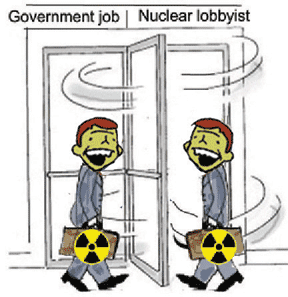
Back in June 2024, former Energy Minister Todd Smith left the government, after spending billions on the nuclear industry and promising billions more. Upon his departure, Todd Smith landed a job as a VP of CANDU Energy Inc. CANDU Energy Inc was created when SNC-Lavalin purchased the commercial reactor division of Atomic Energy of Canada Limited from the federal government in 2011. In an effort to distance itself from its scandal ridden past, SNC-Lavalin has since changed its name to AtkinsRealis. The company is heavily involved in the refurbishment of Ontario nuclear plants and the plans for new builds.
3c. The technological hype of SMRs
Small Modular Reactors (SMRs) are not small and they are not that modular. And they are not that new. The designs, of which there are about 54, have been kicking around for a long time. It’s just that no one wanted to build them, and investors were loathe to put up their own money. The fate of SMRs changed when the nuclear industry convinced governments in Canada to develop what it called the “SMR Roadmap.” The “Roadmap,” largely produced by the industry, was all hype and little substance, but it was enough to convince the Ford government to join the parade.
The World Nuclear Industry Status Review is an annual independent assessment of the global nuclear industry. In its 2022 review, it concluded:
“Small modular (nuclear) reactors or SMRs continue to hog the headlines in many countries, even though all the evidence so far shows that they will likely face major economic challenges and not be competitive on the electricity market. Despite this evidence, nuclear advocates argue that these untested reactor designs are the solution to the nuclear industry’s woes.”
In the 2024 edition of the review, the analysts note: “The gap between hype about Small Modular Reactors (SMRs) and reality continues to grow. The nuclear industry and multiple governments are doubling down on their investments into SMRs, both in monetary and political terms.”
3d. Over-the-top visioning and ideological straw men
Stephen Lecce became the Minister of Energy in June 2024. Shortly afterwards, he travelled to the US where he made a pitch to western leaders and industry movers and shakers. He told them that Ontario is building a blueprint for a nuclear energy future.
A CP wire story put it this way: “Ontario is selling itself as the nuclear North Star to guide the direction of American power.”
Speaking to a largely American audience, he said it’s time to “rid our economies of any dependence on these foreign states that … do not share our democratic embrace,” (Oops).
The minister’s early charm offensive turned more aggressive back home when he criticized those who support renewable energy as” ideologues” who want to “romanticize certain resources.” As he told the National Post, “We are seeing forces on the left, the illiberal left, who cannot come to terms with the fact that in order to decarbonize we’re going to need nuclear.”
The commitment to nuclear was further baked into Ontario’s future when the Ford government released its energy vision in October 2024. The document ironically entitled “Ontario’s Affordable Energy Future” sets the stage for a massive build out of nuclear power.
It also makes it clear that Ontario has set its sights on becoming a nuclear energy superpower in the hopes of selling expensive nuclear electricity to the US and costly nuclear technology to the world.
Reflecting the grandiose aspirations of a would-be energy superpower the Minister declared that “this was Ontario’s moment.”
3e. The legislative lock-in
In December 2024, the government passed the misnamed “Affordable Energy Act” (Bill 214) The legislation has many troubling aspects. Various sections of the act restrict public consultation, further erode the independence of regulatory tribunals, and shifts more decision making to the government. But most alarming is how the government has used the Act to give preference and priority to nuclear power. Section 25.29 (2) of the Act refers to, “the prioritization of nuclear power generation to meet future increases in the demand for electricity …”
3f. The commitment to underwrite the costs of nuclear
The government is bankrolling the nuclear expansion with public money because investors don’t want their own money at risk. The costs of nuclear power have driven private investors away. Even with massive subsidies from governments, investors are reluctant to ante up.
A spokesperson for the government-owned Ontario Power Generation made the point very clear when commenting on small modular reactors.
Kim Lauritsen is a senior OPG vice-president. She told a Global Business conference audience that the crown corporation was willing to take the “first-mover risk.”
As she put it: “Because they (small modular reactors) take too long and the industry needs to see that these things can be built successfully, to give investors the confidence and really get the ball rolling for other jurisdictions.”
Because investors are nervous and because Ontario wants to show the way for other jurisdictions, the Ford government is prepared to saddle Ontario families and future generations with the exorbitant costs of nuclear power.
Part 4: The nuclear three-prong plug: Refurbishments, SMRs and New Large Scale Reactors
Refurbishments
The Ontario government is spending billions to refurbish old nuclear plants. Fourteen reactors are scheduled to be rejuvenated – 6 at Bruce, 4 at Darlington, and 4 at Pickering. The repair schedule for existing nuclear plants stretches out for decades. While these reactors are off line, the government plans to make up the electricity shortfall with more climate wrecking, fossil-gas generating plants.
The cost of the refurbishments will be in excess of $40-billion. That forty billion and the millions more in interest charges will find its way onto our electricity bills.
As our electricity bills go up, so does political pressure and when that pressure reaches a tipping point, the government steps in with subsidies to help reduce electricity bills. It is a repeated pattern in Ontario.
A recent report from the Government’s Financial Accountability Office (FAO) projected the cost of current electricity subsidies to be $118-billion over the next 20 years. These are not all nuclear electricity subsidies. But as we spend more on nuclear and nuclear increases the cost of electricity and governments are pressured to reduce the cost of electricity, there will be even more subsidies to shift the costs from our electricity bills to our taxes.
Small Modular Reactors (SMRs)
In addition to the massive refurbishment program the Ford government has announced a series of nuclear new builds.
There will be four new small modular reactors (SMRs) built at the Darlington nuclear location. Site preparation work is already underway on the first one. OPG has convinced the Canadian Nuclear Safety Commission to forego an environmental impact assessment, relying instead on an assessment that had been done years ago on the site for a different project.
The government has selected the GE-Hitachi BWRX-300 design. This is based on a design that has been kicking around for about 20 years and has had to be redesigned about ten times. It still has never been built. The engineering designs for Darlington have again been changed, making the small modular reactor less small and even less modular.

OPG has not released a cost estimate for the reactors. But there are some indications of the probable magnitude. In the US, the only SMR project that had been approved by the US federal government was NuScale in the mid-west. The project was cancelled because of escalating costs. Originally estimated at $3-billion (US), it was terminated in 2024 when the projected costs reached $9.3-billion (US).
The Tennessee Valley Authority, a large power utility in the US, has partnered with the OPG to promote the GE-Hitachi SMR. The TVA recently provided some estimates of the costs of building the SMR in the US. It indicated that the cost of the first reactor could be about $5.4-billion (US). It hoped the costs could be reduced to about $3.7-billion (US) if more were built. These costs do not include any interest charges, cost overruns, or missed deadlines.
If we assume the lower cost and convert to Canadian dollars, the price tag for the four SMRs at Darlington would be about $20-billion before things go wrong. In 2019, the company’s indicated the costs would have to be below $1-billion (US).
New Large Scale Nuclear Reactors
In July 2023, the Ontario government announced its support to expand the capacity of the Bruce nuclear power plant near Kincardine. The Bruce nuclear generating station is owned by OPG but operated by Bruce Power, a private consortium. Bruce Power is planning a major expansion of the site’s generating capacity. At present, six of the eight reactors are being refurbished. This new development, if it goes ahead, will add an additional 4800 MW, which would require building four or five new reactors. Admittedly, it is early days, and no costs have been provided.
Port Hope
In January 2025, the Ontario government announced that it was in the preliminary stages of a massive new nuclear plant that could be built at the OPG site in Wesleyville, near Port Hope. Officials have suggested the plant could have a capacity of 8,000 to 10,000 megawatts and be in operation by the 2040s. Achieving that generating capacity would require building eight or more nuclear reactors.
Part 5: Calculating the Costs
Continue readingCritics Slam Cost of Ontario SMR Plan, Question Dependence on U.S. Uranium
May 12, 2025, Mitchell Beer, https://www.theenergymix.com/critics-slam-cost-of-ontario-smr-plan-question-dependence-on-u-s-uranium/
Critics are taking a hard line on Ontario’s announcement that it will build four 300-megawatt small modular nuclear reactors (SMRs) at the existing Darlington nuclear plant near Bowmanville, with most concerns focused on the cost of the project and the geopolitical risk in sourcing enriched uranium from a U.S. supplier.
Ontario Power Generation announced provincial approval for the first of the four units May 8, describing it as “the first new nuclear build in Ontario in more than three decades.”
“This is truly a historic moment,” said OPG President and CEO Nicolle Butcher. “This made-in-Ontario project will support provincial companies, create jobs for Ontarians, and spur growth for our economy.”
Energy and Mines Minister Stephen Lecce declared the 1,200-megawatt installation, the first of its kind in the G7, a “nation-building project being built right here in Ontario.” Durham MPP Todd McCarthy called it “the next step to strengthening Ontario and Canada’s energy security.”
The published cost of the project is $7.7 billion for the first reactor, including $1.6 billion for infrastructure and administrative buildings, and $20.9 billion to complete the series of four. Citing Conference Board of Canada figures, OPG said the four SMRs will contribute $38.5 billion to Canada’s GDP over 65 years and sustain an average of about 3,700 jobs per year, including 18,000 per year during construction.
First Mover Advantage or Boutique Pricing?
In the OPG announcement, Butcher suggested an advantage in being the first G7 jurisdiction to bring an SMR to market. “As a first mover on SMRs, Ontario will also be able to market our capabilities and nuclear expertise to the world to further grow our domestic industry,” she said.
The Globe and Mail says the Darlington New Nuclear Project “is being watched closely by utilities around the world,,”, and OPG’s BWRX-300 design “is a candidate for construction in the United States, Britain, Poland, Estonia, and elsewhere.” But “the costs published Thursday are higher than what independent observers argue are necessary to attract many more orders. For comparison, a recently completed 377-megawatt natural gas-fired power station in Saskatchewan cost $825-million.”
Ed Lyman, director of nuclear power safety at the Cambridge, MA-based Union of Concerned Scientists, called the Ontario estimate “an eye-popping figure, but not unexpected given what we know about the poor economics of small nuclear reactors.” That would make the Darlington SMR facility “a boutique unit that’s going to produce electricity for a very expensive price.”
An independent study released last week by the Ontario Clean Air Alliance found that the Darlington SMRs will cost up to eight times as much as onshore wind, almost six times as much as utility-scale solar, and 2.7 times as much offshore wind in the Great Lakes after factoring in the federal tax credit. The analysis by Hinesburg, Vermont-based Energy Futures Group “used data from Ontario’s Independent Electricity System Operator (IESO) but used realistic real-world capital costs and performance measures to develop a more accurate comparison of the cost of nuclear and renewable power options,” OCAA writes.
The report calculates the levelized cost of electricity (LCOE) from different sources in 2030 and 2040, with and without the federal government’s 30% clean energy investment tax credit (ITC). It places the unsubsidized costs per megawatt-hour in 2030 at:
• $33 to $51 for onshore wind;
• $54 for utility-scale solar;
• $105 to $113 for offshore wind;
• $214 to $319 for different SMR designs;
• $279 to $307 for conventional nuclear plants.
By 2040, the prices range from $30 for onshore wind and $41 for utility-scale solar to up to $269 for SMRs and $307 for conventional nuclear. SMR pricing falls as low as $137 per MWh with a 30% ITC.
“It remains unclear how this, and the province’s larger nuclear expansion program, will actually be paid for,” Mark Winfield, co-chair of York University’s Sustainable Energy Initiative, told The Energy Mix in an email. “Putting this on the rate base means higher rates for Ontario electricity consumers, even if the costs are as claimed.”
He added that “the potential role of the federal ITC and [Canada] Infrastructure Bank Investment raises serious questions about what should be defined as ‘clean’ energy given the risks involved in this case, in terms of economic and technological viability, safety risks, and unanswered questions regarding waste streams.”
Critics were already questioning whether field experience with four individual SMRs will be enough to drive down production costs from $6.1 billion plus surrounding infrastructure for the first unit to a range of $4.1 to $4.9 billion for the next three, after the estimated price of the project has already ballooned. Now, with New Brunswick scaling back its SMR development plans, “Ontario is taking something of a technological and economic flyer on this, on behalf of everyone else, underwritten by the electricity ratepayers and, ultimately, taxpayers of Ontario,” Winfield wrote. “This is a project that demands serious economic, technological, and environmental scrutiny, and has been subject to virtually none.”
Uranium Sourced from the United States
OPG is also running into concerns with its plan to power the BWRX-300 with enriched uranium supplied by a firm in the U.S. state of New Mexico. When Donald Trump launched his tariff war earlier this year and began muttering about making Canada a 51st state, Premier Doug Ford applied a short-lived tariff to Ontario power sales and referred publicly to cutting exports as a retaliatory measure. Now, the province is proposing to make 1,200 MW of electricity supply dependent on a vendor that could see its price driven up by tariffs, or be compelled to cut off the supply entirely.
“Developing a dependence on another country for our nuclear fuel has always been a concern, and recent events have proven those concerns are justified,” Bob Walker, national director of the Canadian Nuclear Workers’ Council, told the Globe and Mail in February. “The arrangements are probably as robust as they could be under normal circumstances, but the circumstances are no longer normal.”
In an email to the Globe at the time, OPG spokesperson Neal Kelly described the situation as “very fluid”, adding that “we are proactively evaluating potential impacts and will act as the situation arises.”
Kelly did not respond to an email Monday morning asking whether OPG has any concerns about sourcing enriched uranium from the U.S., and whether it has or needs a Plan B.
Westinghouse drops out of UK SMR competition
Nuclear Engineering International 30th April 2025, https://www.neimagazine.com/news/westinghouse-drops-out-of-uk-smr-competition/
S Westinghouse has pulled out of the UK’s small modular reactor (SMR) design competition, according to the UK The Telegraph.
Earlier in April, three of the four competition finalists in Great British Nuclear’s (GBN’s) small modular reactor (SMR) competition submitted their final tenders. The four finalists received an Invitation to Submit Final Tender (ISFT) in February – GE-Hitachi Nuclear Energy International, Holtec Britain, Rolls-Royce SMR, and Westinghouse Electric Company.
GEH (part of GE Vernova) proposed its BWRX-300 boiling water reactor; Holtec proposed its SMR-300 – a 300 MWe pressurised water reactor (PWR); the Rolls-Royce SMR is a 470 MWe PWR; and the Westinghouse AP300 is a 300 MWe/900 MWt PWR. Westinghouse, however, failed to submit its final tender.
GBN was expected to announce two winners this summer with bidders told to prepare to build three to four mini reactors each. The winners will be awarded contracts to co-fund further design development as well as the necessary regulatory, environmental and site-approvals before a final investment decision is taken in 2029. The contracts are expected to total £20bn ($26.7bn) – £10bn each if two companies are selected.
However, The Telegraph reported in February that the Government was considering awarding only one contract as Rachel Reeves, the Chancellor “is struggling to balance the books as weak economic growth makes it harder to meet her self-imposed ‘fiscal rules’ for borrowing.
According to The Telegraph, Westinghouse did not deny it had withdrawn but declined to give its reasons. “One industry source suggested the company had baulked at the commercial offer made by the Government.”
A spokesman from the UK Energy Department said: “Great British Nuclear is driving forward its SMR competition for UK deployment. It has now received final tenders, which it will evaluate ahead of taking final decisions this spring.”
There is growing concern that the economics of SMRs could prove even hard to justify at the high costs for the initial four units. None of the bidders has built their designs which are still in development. All SMRs in the GBN competition will be first-of-a-kind units (FOAK), which will push up costs.
Commenting on the issue, Neutron Bytes noted: “Most estimates are that economies of scale based on factory production of SMRs, promised by all four vendors, only kick in when order books come in “fleet mode,” e.g. by the dozen or more. It follows that even £10bn could be insufficient to cover the costs of four units any of the three 300 MWe offerings based on their status as FOAK projects.”
It added: “Splitting the difference for the GBN competition, e.g. awarding one winner £10bn, keeps the SMR initiative alive, but does nothing to promote long-term “fleet mode” production of SMRs which the UK nuclear industry points out is the only way to achieve economies of scale with factory production of SMRs.”
US nuclear giant Westinghouse pulls out of race to build Britain’s first mini-nukes
There are growing fears that the economics of SMRs could prove even harder to justify – because they have many of the same problems as large reactors – meaning security and waste disposal – but produce far less electricity and so make less money.
There are growing fears that the economics of SMRs could prove even harder to justify – because they have many of the same problems as large reactors – meaning security and waste disposal – but produce far less electricity and so make less money.
Westinghouse has not submitted its final bid for the UK’s SMR design competition
Matt Oliver, Industry Editor, https://www.telegraph.co.uk/business/2025/04/26/us-company-pulls-out-race-build-britains-first-mini-nuke/
US nuclear giant Westinghouse has pulled out of the UK’s small modular reactor (SMR) design competition.
The four companies remaining in the contest were given a deadline of mid-April to make their final bids, but The Telegraph understands that Westinghouse did not submit one following a negotiation process.
It means only three finalists – Rolls-Royce, GE-Hitachi and Holtec – remain in the running.
Great British Nuclear (GBN), the quango responsible for the SMR programme, was expected to announce two winners this summer with bidders told to prepare to build three to four mini reactors each.
Westinghouse did not deny it had withdrawn on Friday but declined to give its reasons.
One industry source suggested the company had baulked at the commercial offer made by the Government.
GBN previously advertised contracts worth £20bn in total for SMR “technology partners”, a figure that is understood to be based on the assumption two winners would be chosen.
However, The Telegraph revealed in February that the Government was considering awarding a contract to only one company as Rachel Reeves, the Chancellor, looks to make savings in her cross-departmental spending review.
The Chancellor is struggling to balance the books as weak economic growth makes it harder to meet her self-imposed “fiscal rules” for borrowing.
SMR supporters claim they could be a breakthrough in nuclear power because they would be made predominantly in factories and then assembled on site, cutting building times from around a decade to a few years. In theory this could cut costs – as would-be builders of SMRS have repeatedly promised..
Many politicians have snapped up that bait. When he opened the latest stage of the SMR competition, Mr Miliband said: “Small modular reactors will support our mission to become a clean energy superpower.”
However, the nuclear industry has a mixed record on bringing in key projects on time and on budget.
The biggest current example is the UK’s Hinkley Point C power station in Somerset which EDF originally said would cost under £20bn and be operating by now. Current costs estimates are for a final price approaching £50bn and a start-up after 2030.
There are growing fears that the economics of SMRs could prove even harder to justify – because they have many of the same problems as large reactors – meaning security and waste disposal – but produce far less electricity and so make less money.
A spokesman from the UK Energy Department said: “Great British Nuclear is driving forward its SMR competition for UK deployment. It has now received final tenders, which it will evaluate ahead of taking final decisions this spring.”
On Friday, a GBN spokesman declined to comment on Westinghouse’s position as did Westinghouse itself.
‘I guarded Britain’s nuclear sites – our security can’t cope with new mini reactors’

mini reactors do not pose miniature hazards. “On security, size doesn’t matter. When it comes to the fuel and the byproducts, they are equally dangerous.”
“You get less energy, but you’re still going to have exactly the same security concerns,” says Okuhara. “How enthusiastic is a site operator going to be paying for security when that’s eating into their bottom line?”
INTERVIEW . Matthew Okuhara, a former armed officer with the Civil Nuclear Constabulary, fears that current security plans will be inadequate to protect the UK’s next generation of nuclear power plants..
Rob Hastings, Special Projects Editor , April 22, 2025
Sometimes he would patrol rural lanes on foot, carrying his assault rifle, looking out for any terrorists hiding in the countryside. On other assignments he would man machine guns mounted on armoured ships, watching for any sign of hostile vessels coming his way. Or he would drive in weapons-laden road convoys, monitoring potential threats from vehicles.
While serving as an armed officer with the Civil Nuclear Constabulary (CNC), Matt Okuhara saw every aspect of how the UK’s nuclear power stations and their radioactive fuel are protected from terrorists.
He spent years escorting the transport of uranium fuel to and from plants, which would be planned for months in advance. “Nuclear material is at its most vulnerable when it’s in transit,” he explains. “You’ve got to move it as secretly as possible.”
Working for the specialist force, Okuhara always felt confident the country’s civil nuclear programme was in safe hands. “Any threat has been detected long before it’s been able to cause any problems,” he says.
However, he believes the situation is “definitely more dangerous now” than when he was serving. Terrorism has become more advanced and there are new fears about so-called hybrid warfare from geopolitical adversaries including Russia.
“You don’t have to be a James Bond super-villain to realise where the vulnerable parts of a site are. You can just look on Google Maps and say, ‘We’ll attack that bit,’ especially now we’ve got drones. The threat has really shot up.”
With new technology also on the horizon, he believes the nuclear industry must face up to big security questions.
The CNC currently guards just a handful of sites, all in relatively remote locations. But experts believe the Government’s planned array of cutting-edge mini nuclear power stations could lead to a “proliferation” of reactors around the country, potentially much closer to towns and cities. This may also lead to their fuel being transported more often.
Small modular reactors (SMRs) are seen as an essential source of green energy for the UK in decades to come. Proponents say they will be quicker and cheaper to build than conventional plants, because they will be largely prefabricated.
But security experts are worried about the complex implications for how SMRs will be policed and protected, as The i Paper revealed this week. Analysts say that thousands more armed officers would have to be recruited, co-ordination with local police would have to be strengthened, and a new national infrastructure force may even have to be created.
Okuhara shares these concerns. “I don’t think the CNC’s current policing model would be able to cope with any more sites,” he says. “The generating sites, they’re kept well away from the public for good reasons.
“One, they’re easier to protect. And two, if something goes wrong, the contingency engineers have got some space to work with.”
What is the Civil Nuclear Constabulary?
- The CNC is a specialist armed force with about 1,600 officers and staff. It was created in 2005 to guard civil nuclear sites and material.
- “The CNC will deter any attacker whose intent is the theft, sabotage or destruction of nuclear material, whether static or in transit, or the sabotage of high consequence facilities,” its web page explains.
- It adds: “If an attack occurs, CNC will defend that material and those facilities and deny access to them. If material is seized or high consequence facilities are compromised, the CNC will recover control of those facilities and regain custody of the material.”
New small reactors, same big risks
After fighting in the Iraq War with British infantry, Okuhara joined the CNC in 2006 and served for six years. He describes how he helped to protect Gloucestershire’s Oldbury Power Station – which is now undergoing decommissioning – in his new book, Nuclear Copper. “Based within the high metal fences and fortress-like security measures of the power station, there was a heavily armed police presence on duty at any given time,” he writes.
To deter and prevent terrorism, the team patrolled surrounding roads and villages, wearing body armour and carrying G36C assault rifles. They benefited from the rural location by building relationships with local farmers and villagers, who “could recognise an unfamiliar car or person instantly” and knew to inform officers.
Rules currently state that nuclear power stations can only be placed in “semi-urban” settings. A spokesperson for the Department for Energy Security & Net Zero insists: “All new nuclear projects, including SMRs, are prevented from being built in densely populated areas.” The Government is loosening restrictions on them being built in the countryside.
But a majority of industry figures believe that “new nuclear technologies could be safely located closer to densely populated areas,” according to an official consultation paper.
The Whitehall document says that the semi-urban restriction will be reviewed every five years “to ensure it remains relevant and effective,” and the Government is “open to revising” this rule in future……………………….
The nuclear industry argues that SMRs will be small enough to build in urban settings, but Okuhara argues this would rob officers of a key advantage. “An intervention zone around a site gives you plenty of space where you can detect things,” he explains.
And he underlines that mini reactors do not pose miniature hazards. “On security, size doesn’t matter. When it comes to the fuel and the byproducts, they are equally dangerous.”
At the moment, energy companies cover much of the CNC’s costs. But having many smaller sites is likely to make security operations proportionately more expensive.
He continues: “If you think about the largest sites in the UK, places like Sellafield or Dounreay, they’ve got hundreds of officers. There are plenty of people out on patrol. Are these SMRs going to be given sufficient resources? Or are the companies going to be saying: ‘It’s a small reactor, we don’t need as many bodies on the ground’?”
The Government offers reassurance that any SMR will “need to have the highest levels of security in place.” A spokesperson said: “All operators are answerable to a robust and independent regulator – the Office for Nuclear Regulation – which must approve their security plan covering physical, personnel and cyber security.” The CNC declined to comment.
Vetting failures
If potentially thousands more armed officers must be recruited to guard SMRs, the CNC must improve its vetting procedures. That much is clear because of one man: Wayne Couzens.
Couzens’ name became infamous after he raped and murdered Sarah Everard in Surrey in 2021, having used his Metropolitan Police ID to falsely arrest her.
Couzens had previously been an authorised firearms officer with the CNC, serving at Sellafield and Dungeness. He had passed the CNC’s vetting procedures in 2011 despite previously being accused of numerous sexual offences, including harassment, assault and indecent exposure. He transferred to the Met in 2018.
The CNC’s Chief Constable, Simon Chesterman, apologised “unreservedly” on behalf of the force in 2024, “for the part CNC played in his entry as a full-time police officer.”………………………………………………
No matter whether they’re protecting groundbreaking SMRs, or conventional nuclear sites, or convoys of radioactive fuel, “every officer in the CNC should have the top level of vetting,” he says. “They’ve got access to firearms. They can access some of the most toxic material that has ever existed.”
It’s a reminder that when it comes to nuclear security, sometimes the biggest threats can come from insiders.
‘Nuclear Copper: The Secret World of Nuclear Policing’ by Matt Okuhara is out now (£22.99, Amberley Publishing) @robhastings.bsky.social https://inews.co.uk/news/crime/i-guarded-britains-nuclear-sites-security-mini-reactors-3649782
INSIDER THREAT SECURITY CONSIDERATIONSFOR ADVANCED AND SMALL MODULAR REACTORS.
The wide range of nuclear power plant technologies currently in design
globally have an assortment of unique characteristics that create novel
security considerations compared to large conventional nuclear power
plants.
Some of these characteristics create “insider threat”
considerations for nuclear security, where insiders are defined as
individuals with legitimate access to nuclear facilities and materials who
use this access to carry out sabotage or theft of nuclear material.
These include a lack of mature security culture in developer organisations,
serial plant manufacturing in a production line environment, plant siting
in remote and isolated areas, minimised staff numbers, teleoperation of
plants by offsite staff, the increased reliance on digital instrumentation
and control systems, and the potential for greater involvement of foreign
experts and third-party suppliers, especially on short-term bases for, e.g,
refuelling and maintenance.
The paper takes a technology agnostic approach
to examine what these factors may mean for insider threat risks and
suggests that plant designers should be identifying and minimising the
opportunities of insiders to act throughout the engineering design process.
Doing so is anticipated to strengthen effective insider threat mitigation
in deployed small and advanced reactors.
Kings College 21st April 2025 – https://kclpure.kcl.ac.uk/ws/portalfiles/portal/311074601/Paper_381_Insider_Threat_for_SMR.pdf
Small nuclear reactors are no fix for California’s energy needs
I know all too well that the hype is built on quicksand …….. many of those “building support for small modular reactors” are putting forward “rhetorical visions imbued with elements of fantasy.”
SMRs are just one of several wildly overhyped false promises on which the world is poised to spend hundreds of billions of dollars by 2040
Joseph Romm, April 18, 2025 , https://www.latimes.com/opinion/story/2025-04-18/small-modular-reactors-cost-california
It might seem like everyone from venture capitalists to the news media to the U.S. secretary of Energy has been hyping small modular reactors as the key to unlocking a nuclear renaissance and solving both climate change and modern data centers’ ravenous need for power.
On Monday, the Natural Resources Committee of the California Assembly will consider a bill to repeal a longstanding moratorium on nuclear plants in the state, which was meant to be in place until there is a sustainable plan for what to do with radioactive waste. Defeated multiple times in the past, this bill would carve out an exception for small modular reactors, or SMRs, the current pipe dream of nuclear advocates.
SMRs are typically under 300 megawatts, compared with the combined 2.2 gigawatts from Diablo Canyon’s two operating reactors near San Luis Obispo. These smaller nukes have received so much attention in recent years mainly because modern reactors are so costly that the U.S. and Europe have all but stopped building any.
The sad truth is that small reactors make even less sense than big ones. And Trump’s tariffs only make the math more discouraging.
I’ve been analyzing nuclear power since 1993, when I started a five-year stint at the Department of Energy as a special assistant to the deputy secretary. I helped him oversee both the nuclear energy program and the energy efficiency and renewable energy program, which I ran in 1997.
So I know all too well that the hype is built on quicksand — specifically, a seven-decade history of failure. As a 2015 analysis put it, “Economics killed small nuclear power plants in the past — and probably will keep doing so.” A 2014 journal article concluded many of those “building support for small modular reactors” are putting forward “rhetorical visions imbued with elements of fantasy.”
But isn’t there a nuclear renaissance going on? Nope. Georgia’s Vogtle plant is the only new nuclear plant the U.S. has successfully built and started in recent decades. The total cost was $35 billion, or about $16 million per megawatt of generating capacity — far more than methane (natural gas) or solar and wind with battery storage.
As such, Vogtle is “the most expensive power plant ever built on Earth,” with an “astoundingly high” estimated electricity cost, noted Power magazine. Georgia ratepayers each paid $1,000 to support this plant before they even got any power, and now their bills are rising more than $200 annually.
The high cost of construction and the resulting high energy bills explain why nuclear’s share of global power peaked at 17% in the mid-1990s but was down to 9.1% in 2024.
For decades, economies of scale drove reactors to grow beyond 1,000 megawatts. The idea that abandoning this logic would lead to a lower cost per megawatt is magical thinking, defying technical plausibility, historical reality and common sense.
Even a September report from the federal Department of Energy — which funds SMR development — modeled a cost per megawatt more than 50% higher than for large reactors. That’s why there are only three operating SMRs: one in China, with a 300% cost overrun, and two in Russia, with a 400% overrun. In March, a Financial Times analysis labeled such small reactors “the most expensive energy source.”
Indeed, the first SMR the U.S. tried to build — by NuScale — was canceled in 2023 after its cost soared past $20 million per megawatt, higher than Vogtle. In 2024, Bill Gates told CBS the full cost of his 375-megawatt Natrium reactor would be “close to $10 billion,” making its cost nearly $30 million per megawatt — almost twice Vogtle’s.
All of this has played out against a backdrop of historically cheap natural gas and a rapid expansion of renewable energy sources for electricity generation. All that competition against nuclear power matters: A 2023 Columbia University report concluded that “if the costs of new nuclear end up being much higher” than $6.2 million per megawatt, “new nuclear appears unlikely to play much of a role, if any, in the U.S. power sector.” R.I.P.
SMRs are just one of several wildly overhyped false promises on which the world is poised to spend hundreds of billions of dollars by 2040, including hydrogen energy and direct air carbon capture.
But nuclear power is the original overhyped energy technology. When he was chairman of the Atomic Energy Commission, Lewis Strauss — the Robert Downey Jr. character in “Oppenheimer” — predicted in 1954 that our children would enjoy nuclear power “too cheap to meter.”
Yet by the time I joined the Department of Energy in 1993, nuclear power costs had grown steadily for decades. Since then, prices for new reactors have kept rising, and they are now the most expensive power source. But solar, wind and battery prices have kept dropping, becoming the cheapest. Indeed, those three technologies constitute a remarkable 93% of planned U.S. utility-scale electric-generating capacity additions in 2025. The rest is natural gas.
China is the only country building many new nuclear plants over the next five years — about 35 gigawatts. Less than 1% of this projected capacity would be from small reactors — while more than 95% will be from reactors over 1,100 megawatts. Now compare all that to the 350 gigawatts of solar and wind China built — just in 2024.
For the U.S., President Trump’s erratic tariffs make small modular reactors an even riskier bet. If the U.S. economy shrinks, so does demand for new electric power plants. And the twin threats of inflation and higher interest rates increase the risk of even worse construction cost overruns.
Also, China, Canada and other trading partners provide critical supply chain elements needed to mass-produce SMRs — and mass production is key to the sales pitch claiming this technology could become affordable. That logic would apply only if virtually all of the current SMR ventures fail and only one or two end up pursuing mass production.
So, can we please stop talking about small modular reactors as a solution to our power needs and get back to building the real solutions — wind, solar and batteries? They’re cheaper and cleaner — and actually modular.
Joseph Romm is a former acting assistant secretary of Energy and the author of “The Hype About Hydrogen: False Promises and Real Solutions in the Race to Save the Climate.”
Bill Gates enters race to build mini-nuclear reactors in Britain
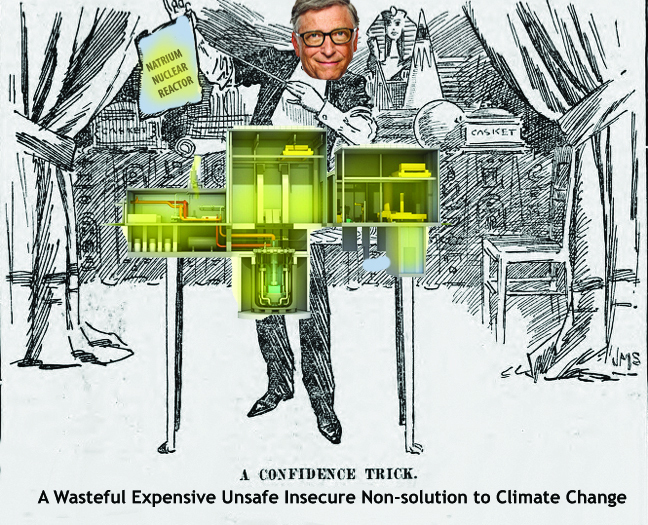
Competition from billionaire’s company TerraPower threatens blow for Rolls-Royce
A company founded by Bill Gates has submitted a bid to build
mini-nuclear reactors in Britain, dealing a potential blow to
Rolls-Royce’s hopes of dominating the domestic market.
Seattle-based TerraPower has written to the Government outlining its intention to submit
its reactor design for regulatory approval. The move kickstarts efforts by
the US company to enter an increasingly competitive market to build small
modular reactors (SMR), which are expected to play a key role in the UK’s
shift to cleaner energy.
The Microsoft billionaire’s company has
developed a reactor, called Natrium, that uses a molten sodium heat storage
system that allows it to rapidly ramp up its power output at peak times.
Natrium is the Latin word for sodium which has the chemical symbol Na.
Chris Levesque, TerraPower chief executive, said: “I am incredibly
excited to begin the process of licensing the Natrium technology in the UK.
Rolls-Royce had hoped to corner UK market with its small modular reactors.
While TerraPower is not involved in the competition for the UK’s SMR
contract, the potential entrant of a new deep-pocketed rival into the
market will pose a fresh challenge to Rolls-Royce’s plans.
Telegraph 16th April 2025, https://www.telegraph.co.uk/business/2025/04/16/bill-gates-bids-to-build-mini-nuclear-reactors-in-britain/
1 This Month
10 March A LIVE WEBINAR THE REAL EFFECTS OF NUCLEAR POWER
What the Industry Isn’t Telling Us
1:00 PM Mountain, 2 pm Central, 3 pm Eastern. Live on the Keepers of the Water Facebook page



18 March Webinar @ 1 PM EST: An Assessment of SMR Projects: The Case of Canada
register for the zoom:
https://us02web.zoom.us/webinar/register/WN_o8BIIOUvQ2ONJR1nta65DQ#/registration


of the week – STOP SMALL MODULAR REACTORS IN CANADA
To see nuclear-related stories in greater depth and intensity – go to https://nuclearinformation.wordpress.com
-
Archives
- March 2026 (99)
- February 2026 (268)
- January 2026 (308)
- December 2025 (358)
- November 2025 (359)
- October 2025 (376)
- September 2025 (258)
- August 2025 (319)
- July 2025 (230)
- June 2025 (348)
- May 2025 (261)
- April 2025 (305)
-
Categories
- 1
- 1 NUCLEAR ISSUES
- business and costs
- climate change
- culture and arts
- ENERGY
- environment
- health
- history
- indigenous issues
- Legal
- marketing of nuclear
- media
- opposition to nuclear
- PERSONAL STORIES
- politics
- politics international
- Religion and ethics
- safety
- secrets,lies and civil liberties
- spinbuster
- technology
- Uranium
- wastes
- weapons and war
- Women
- 2 WORLD
- ACTION
- AFRICA
- Atrocities
- AUSTRALIA
- Christina's notes
- Christina's themes
- culture and arts
- Events
- Fuk 2022
- Fuk 2023
- Fukushima 2017
- Fukushima 2018
- fukushima 2019
- Fukushima 2020
- Fukushima 2021
- general
- global warming
- Humour (God we need it)
- Nuclear
- RARE EARTHS
- Reference
- resources – print
- Resources -audiovicual
- Weekly Newsletter
- World
- World Nuclear
- YouTube
-
RSS
Entries RSS
Comments RSS
 nuclear-news