US-Turkey agreement to accelerate SMR deployment
Thursday, 24 September 2026, https://www.world-nuclear-news.org/articles/us-turkey-agreement-to-accelerate-smr-deployment
The US Trade and Development Agency has signed an agreement with Turkey’s state-owned nuclear development enterprise TÜNAŞ to fund technical assistance to create the regulatory, institutional, and financial roadmap needed for Turkish private sector companies to deploy small modular reactor nuclear technology.
Last November, Turkey’s energy minister set out a target to deploy 5000 MWe of small modular reactor (SMR) capacity – in addition to 12 larger reactors – by 2050. The US Trade and Development Agency’s (USTDA) assistance will identify the policy and investment steps needed to bring SMRs to market, producing recommendations to TÜNAŞ that Turkey’s Ministry of Energy and Natural Resources and the Turkish Nuclear Regulatory Authority can then use to establish a clear, workable framework for SMR deployment through updates to the country’s nuclear regulations and procedures, USTDA said.
The work will also include a review of how US reactor designs could meet Turkey’s needs, which USTDA said will give US SMR companies an early entry point into Turkey’s civil nuclear sector.
According to Turkey’s Ministry of Energy and Natural Resources, the year-long study will evaluate SMR designs from four US companies, as well as five 4th generation US reactor designs, from technical, economic, regulatory and licensing perspectives, culminating in the preparation of technical reports. The agreement has a budget of around USD2 million, with USTDA covering the technical work.
“Our goal is to advance TÜNAŞ’s efforts to create the conditions for deploying SMRs, which can increase energy security for Türkiye while providing opportunities for U.S. companies,” USTDA Deputy Director Thomas Hardy said. “This framework will incorporate international expertise in this fast-moving field while tailoring it to Türkiye’s specific needs.”
The USTDA acts as the US government’s “first mover” on critical infrastructure development in emerging markets, advancing shared priorities with partner countries while creating opportunities for deployment of US solutions. Amongst other things, it funds up-front technical work that accelerates the development of infrastructure projects, helping them attract the financing they need for implementation and procurement of US goods and services.
TÜNAŞ (Türkiye Nükleer Enerji Anonim Şirketi) is a subsidiary of Turkish state generating company Elektrik Üretim AŞ (EÜAŞ) and was established in 2022 to carry out the construction, operation, maintenance, and repair of nuclear power plants in Turkey.
The agreement was signed in New York by Hardy and TÜNAŞ General Manager Necati Yamaç in the presence of Turkey’s Energy and Natural Resources Minister Alparslan Bayraktar, who said: “In line with our 2053 Net Zero Emissions and full energy independence goals, we are determined to diversify our energy mix. In addition to our large-scale nuclear power plants, we will resolutely continue to build a strong and modern energy infrastructure by meticulously studying the most suitable alternatives for our country’s needs.”
Turkey’s first nuclear power plant, comprising four Russian-designed VVER-1200 reactors, is under construction at Akkuyu in the southern Mersin province. It is being built by Russia’s Rosatom under a so-called BOO (build-own-operate) model. TÜNAŞ has previously signed memorandums of understanding on nuclear cooperation covering project development, technology transfer, site evaluation and financing with Korea Electric Power Corporation and Canada’s Candu Energy, part of AtkinsRéalis.
With federal funding windfall, X-energy advances small nuclear reactor
For the nuclear renaissance to truly arrive, however, these new projects need to be completed on a reasonable timeline and at a reasonable cost. Blown deadlines and blown budgets have dogged the industry, and in 2023 contributed to the dissolution of the first small-modular reactor project with an NRC-approved design
The Amazon-backed firm is aiming to build up to 144 of its novel Xe-100 reactors as the U.S. government seeks to revitalize an industry beset by rising costs.
Canary Media ,By Brian Martucci, 23 September 2026
The federal government has thrown its weight into reviving America’s long-stagnant nuclear industry, and X-energy’s first-of-a-kind reactor project is among the biggest beneficiaries so far.
The U.S. Department of Energy last month said it would award $1 billion to X-energy, an Amazon-backed advanced nuclear startup working to bring four novel 80-megawatt electric reactors online at a Dow Chemical facility in Seadrift, Texas, in the early 2030s.
The federal government has thrown its weight into reviving America’s long-stagnant nuclear industry, and X-energy’s first-of-a-kind reactor project is among the biggest beneficiaries so far.
The U.S. Department of Energy last month said it would award $1 billion to X-energy, an Amazon-backed advanced nuclear startup working to bring four novel 80-megawatt electric reactors online at a Dow Chemical facility in Seadrift, Texas, in the early 2030s.
The award nearly doubles the federal government’s commitment to X-energy, following a $1.2 billion investment in early 2021. Both tranches were structured as 50-50 cost-sharing agreements under the DOE’s Advanced Reactor Demonstration Program, launched in 2020 to commercialize next-generation nuclear technologies.
X-energy’s Seadrift project now enjoys a level of federal funding that rivals any other advanced nuclear development in the nation. The Bill Gates–backed TerraPower’s commercial demonstration project in Wyoming, which broke ground earlier this year, has also been awarded up to $2 billion in cost-sharing funds through the ARDP.
The X-energy project does not yet have a license from the Nuclear Regulatory Commission, though it received a key environmental approval in May and expects the regulator to green-light reactor construction in early 2027. Only TerraPower and the Google-backed startup Kairos Power currently have NRC construction permits.
Nuclear energy has struggled in recent decades in America, but surging energy demand and a desire by some states and companies to secure carbon-free electricity have revitalized the industry. Tens of billions of dollars in public and private funding are now flowing into a crop of startups looking to build advanced reactors — as well as efforts to restart or build new large-scale reactors like the 96 America already has.
For the nuclear renaissance to truly arrive, however, these new projects need to be completed on a reasonable timeline and at a reasonable cost. Blown deadlines and blown budgets have dogged the industry, and in 2023 contributed to the dissolution of the first small-modular reactor project with an NRC-approved design.
In early 2023, before it had fully engaged with Dow or selected Seadrift for its commercial debut, X-energy estimated the cost of completing the full ARDP scope between $4.75 billion and $5.75 billion.
X-energy has not publicly updated its cost estimates since then, though the federal funding of up to $2.1 billion implies at least $4.2 billion will be spent on the project. In securities filings this year, however, it said that it faces the same broad inflationary and trade-related pressures that have pushed up costs for natural gas, renewables, and other types of energy infrastructure.
CEO J. Clay Sell told investors and stock analysts on an Aug. 13 earnings call that he expected the government to contribute more funding as needed.
“I’m confident to the extent more dollars will be required, they will be provided by our partners at the Department of Energy and Commerce,” he said. “We’ll see where the number ends up.”……………………………………https://www.canarymedia.com/articles/nuclear/federal-funding-x-energy-small-nuclear-reactor
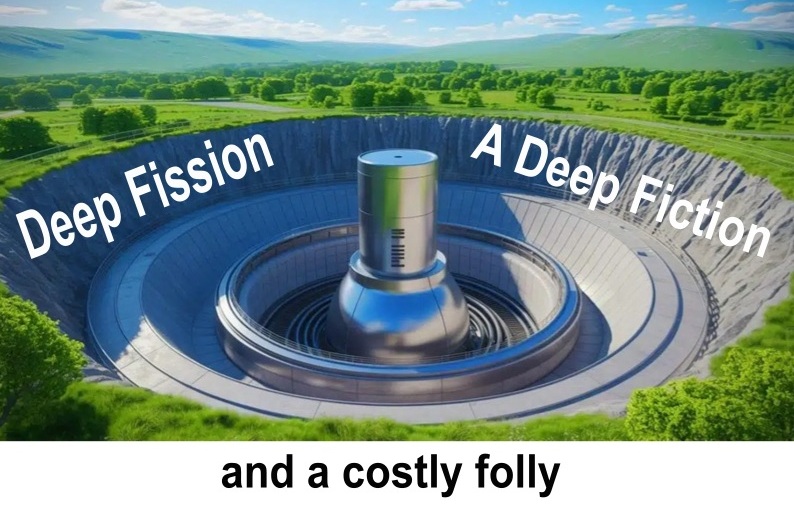
Deep Fission ($FISN): a Money Pit
ICRBERG RESEARCH, September 24, 2026
Please refer to our disclaimer at the bottom of the report.
Main findings
- Nasdaq-listed Deep Fission (FISN) is developing a small modular reactor (SMR) with a capacity of 5MWe-15MWe. The company plans to bury a miniature version of the widely used pressurized water reactor (PWR) one mile deep, inside a 40-60-inch water-filled borehole drilled into hard rock.
- Like other SMR developers, FISN pitches itself as an AI data-center power solution. But data centers have turned to natural gas to accelerate deployment. Almost all of the roughly 75GW of booked data center on-site generation is natural gas-based. FISN has no regulatory approval and remains years away from commercialization.
- Before its June 2026 IPO, FISN guided to a levelized cost of energy (LCOE) of just $50-70/MWh. Then the company dropped the reference. Using figures disclosed in its June 2026 prospectus, we calculate an LCOE of $289/MWh for the first-of-a-kind (FOAK) reactor and $148/MWh for the nth-of-a-kind (NOAK) reactor, about 200% above prior guidance. This is not competitive with behind-the-meter gas solutions.
- Even this NOAK estimate is too optimistic, as capital cost is understated. Using figures from independent third parties, we estimate NOAK capital cost to be $112mn, 34% above FISN’s estimate, raising our estimated NOAK LCOE to $170/MWh.
- FISN claims it can secure Nuclear Regulatory Commission (NRC) approval in less than a year. Yet it has already struggled with the less demanding Department of Energy (DOE) process, missing the program deadline while at least four peers have already completed it. Even if NRC approved, commercialization is far from assured: NuScale, which has a much more conventional design, has yet to sell a reactor three years after receiving its NRC license.
- FISN targets deploying its reactor in just six months versus 3-4 years for other advanced SMRs, citing fewer safety-related systems. Yet its own filing states a two-year development timeline. Peers pursue the same simplification strategy, but FISN adds a major step: drilling a one-mile borehole.
- FISN touts the industry’s largest customer pipeline. Most counterparties are undisclosed. Of those identified, one is an undeveloped industrial park with doubtful demand for a nuclear reactor. The other two (Endeavour Energy and Blue Owl) have signed only non-binding agreements.
- FISN has less than twelve months of cash runway and faces ~$350mn of unfunded capital needs, potentially implying ~43% dilution to its existing shareholders. At the same time, the competition for SMR funding is intensifying: publicly traded SMR names have risen from three before October 2025 to nine today, with three more coming to the market, including a far more established player, Westinghouse.
- FISN is largely a repackaging of the founders’ prior venture, Deep Isolation, a deep-borehole nuclear waste disposal company that has failed to commercialize its concept after a decade.
Background and bull case
Deep Fission (NASDAQ: FISN) is a California-headquartered company founded in 2023. The company is developing a nuclear reactor called Gravity. The reactor is intended to be a miniature version of the conventional pressurized water reactor (PWR), using low-enriched uranium (LEU) as fuel. The company’s key innovation is that its reactor would be buried in a 40-60-inch water-filled borehole one mile (~1.6 km) underground. The reactor is designed with a power generation capacity of 5–15MWe.
Management claims that its reactor is cheaper to build because its innovative borehole design eliminates certain components required in above-ground PWR reactors……………………..
FISN is participating in the Department of Energy’s (DOE) pilot reactor program. The company is seeking DOE authorization to build a pilot reactor at a site in Parsons, Kansas, by 1H 2027. Then, FISN plans to submit license applications to the Nuclear Regulatory Commission (NRC) to convert the pilot reactor into a commercial facility by the end of 2027, with high-volume deployment targeted to begin in 2028. Because its reactor is based on well-established PWR technology, its licensing pathway would be simpler than for novel advanced reactor designs.
The company claims that its reactor can then be commercially deployed in as little as six months, compared with three to four years for other small modular reactors (SMR). ……………………………………..
The company’s own numbers show its reactors are not cost-competitive
Even FISN’s own numbers reveal the poor economics of its reactors. Before its June 2026 IPO, the company claimed that its reactor could achieve a levelized cost of energy (LCOE) of only $50-70/MWh, including in an investor presentation prepared in connection with the February 2026 private placement. The number excluded non-engineering, procurement, and construction (EPC) costs and contingencies……………………………………………………………..
Then, when the company was listed, the reference to the LCOE was dropped. The prospectus filed in connection with FISN’s June 2026 Nasdaq debut no longer mentions an LCOE target, nor do the company’s subsequent investor presentations, news releases and filings. Yet the company itself recognizes that LCOE is a key driver of its success (p. 38):………………………………….
Another claim made in the January 2026 presentation (p. 17) but absent after the IPO was the assertion that its reactors would achieve 70%-80% cost reduction versus newly built conventional PWRs. The company probably realized that there was no basis for such a claim. It seems that material walkbacks like those mentioned above are fairly common for the company. ………………………….
If we simply apply the financial assumptions provided by the company, there is no way FISN can achieve such a low LCOE, whether for a FOAK or a NOAK reactor…………………………………………………………………………………………
Finally, let’s remember that the nuclear industry is prone to cost overruns. FISN is particularly at risk as its design is still evolving………………………..
The certification timeline is wildly optimistic………………………………………………………………………………………………………………………………………………………………
An avalanche of newly listed SMR companies compete for funding
FISN’s need for additional fundraising comes at a time when investor appetite for SMR stocks has materially weakened, as the broader SMR investment theme has cooled and SMR-related stocks have lost momentum. After years of warnings about the technology’s readiness and economics, institutional investors are noticing that natural gas is the actual solution being adopted by AI data centers, while SMRs remain a distant and highly speculative prospect. Retail investors, who largely fueled the bubble, are turning their attention to SpaceX’s space-based data center concept.
…………………………………………………………………….. Deep Fission recycles the founders’ past venture that never achieved commercialization ……………………………………………………………………………………………………………………………………………………………………………………………………………………… https://iceberg-research.com/2026/09/24/deep-fission-fisn-a-money-pit/
RIP SMRs: Is It the End of the Line for Small Modular Nuclear Reactors?

the companies promoting the 10 SMR designs in Canada had either left the country, lost their proponents, filed for bankruptcy protection, or failed to secure private sector backing for their projects.
Despite the public spending largesse, and after heroic promotional efforts by Ontario Power Generation and the federal and Ontario governments, there are no reports of private investment in the Darlington SMR—not even after Prime Minister Mark Carney’s high-profile Canada Investment Summit last week—and none have been ordered in Canada or elsewhere.
Moltex lost its proponent in 2025 when New Brunswick Minister of Energy René Legacy told CBC the province was no longer willing to take on the risk of supporting first-of-a-kind experimental SMRs. A second “advanced” SMR slated for the Point Lepreau site also lost government support.
The Energy Mix, Susan O’Donnell, September 22, 2026, https://www.theenergymix.com/rip-smrs-is-it-the-end-of-the-line-for-small-modular-nuclear-reactors/?
In early September, the organization behind Canada’s push for small modular nuclear reactors (SMRs) quietly signalled their demise.
In 2016, Canadian Nuclear Laboratories President Mark Leskinski proclaimed that “SMRs can live among the annals of great Canadian innovations.” Ten years later, the organization announced the termination of its two programs to support SMR development.
During the intervening decade [pdf], the companies promoting the 10 SMR designs in Canada had either left the country, lost their proponents, filed for bankruptcy protection, or failed to secure private sector backing for their projects.
An SMR is a nuclear reactor designed to generate 300 megawatts of electricity or less, compared to Canada’s existing CANDU reactors which generate 500 megawatts or more.
Canadian Nuclear Laboratories (CNL) manages Chalk River, the federal research campus where Canada’s top nuclear researchers conceived and designed the CANDU reactor. All the power reactors operating in Canada are a similar CANDU design, and CANDUs also operate in six other countries. But the last unit to connect to an electric grid in Canada was in 1993, and CANDU exports dried up decades ago.
CNL’s idea for a transition from large CANDU reactors to smaller reactors was an attempt to reenergize a moribund domestic nuclear industry. The concept was to lower the cost of nuclear reactors by making them smaller and building multiple modular units in factories.
The Canadian Nuclear Laboratories president made his bold claim in 2016 about a stellar future for SMRs during a pitch to the federal government for multiple millions of public dollars to transform Chalk River to focus on SMR research.
Since that public money began flowing, Chalk River’s upgrades included the Advanced Nuclear Materials Research Centre for SMR research, still under construction and projected to open in 2028. The cost for the new facility ballooned from $370 million in 2018 to an estimated $1.025 billionin 2025, about half the cost of the overall SMR transformation of the Chalk River site.
The new research centre’s focus is on “advanced” nuclear fuels for SMRs, including plutonium. One of Canadian Nuclear Laboratories’ first research collaborations for SMR fuel was with Moltex, a UK start-up company that had set up in Saint John in 2018. Moltex proposed to use plutonium to fuel an experimental “advanced” SMR it wanted to build at the Point Lepreau nuclear site on the Bay of Fundy.
Moltex lost its proponent in 2025 when New Brunswick Minister of Energy René Legacy told CBC the province was no longer willing to take on the risk of supporting first-of-a-kind experimental SMRs. A second “advanced” SMR slated for the Point Lepreau site also lost government support. At that point, the provincial and federal governments combined had spent nearly $130 million on SMR activities in New Brunswick—funds that could have gone into heat pumps and energy efficiency upgrades to combat energy poverty and cut climate pollution—without attracting private sector interest.
The New Brunswick SMR projects were two of the 10 SMR designs in Canada reviewed in a recent research report by the Fredericton-based Contesting Energy Discourses through Action Research (CEDAR) project. Of the remaining eight, most have decamped to their U.S. home base after attracting no proponent in Canada.
A CNL spokesperson told The Energy Mix the lab “is playing an important role in advancing microreactor technologies for off-grid and remote applications, with multiple, targeted, initiatives under way for federal partners.”
“CNL continues to support SMR development as part of Atomic Energy of Canada’s Federal Nuclear Science & Technology Work Plan,” Senior Communications Officer Lauren Kutchaw wrote in an email. “These research projects span the nuclear fuel cycle, reactor safety and security, materials and chemistry and energy systems analysis. They build the scientific knowledge to support decision-making, and develop the cutting-edge expertise and capabilities that can be leveraged to advance the deployment of both SMRs and Advanced Reactors in Canada and internationally.”
So far, however, only one SMR is under construction here: an American design at Ontario Power Generation’s Darlington nuclear site on Lake Ontario.
By March, 2026, the “Darlington New Build” project was still in pre-construction phase yet, had already received the lion’s share of the $4.5 billion in SMR subsidies by federal and provincial governments. In June, the federal and Ontario governments gave $715 million more via a “loan guarantee” to seven First Nations that flowed the funds through to the project. In return, the First Nations have an “equity guarantee” in a future SMR at Darlington, should one ever be built.
Despite the public spending largesse, and after heroic promotional efforts by Ontario Power Generation and the federal and Ontario governments, there are no reports of private investment in the Darlington SMR—not even after Prime Minister Mark Carney’s high-profile Canada Investment Summit last week—and none have been ordered in Canada or elsewhere.
The high price tag per unit, $6.1 billion plus $1.6 billion in associated infrastructure that could be shared with future SMRs on the site, makes Darlington considerably more expensive than alternative sources of electricity generation, and about the same price per megawatt as the most expensive large reactors ever built in the U.S. No doubt the exorbitant cost explains the investor reticence and lack of orders.
In addition to the Darlington SMR’s financing challenges and empty order book, and the abandonment of the “advanced” SMR projects in New Brunswick, the most spectacular SMR failure is a project designed and championed by Canadian Nuclear Laboratories.
In the “Roadmap” that launched Canada’s SMR strategy, CNL was mandated to develop the country’s first SMR, a “micro modular reactor” to be in operation by 2026. The reactor was meant to serve mining and remote communities. CNL put together a consortium of companies to build the SMR at Chalk River and develop “advanced” fuel to keep it running.
However, in February, 2024, the lead company in the consortium, Seattle-based Ultra Safe Nuclear, announced it was scaling back operations, complaining in a media release that “only a subset” of potential customers “have shown the resolve to incorporate advanced reactors in the near term.” Several months later, the company filed for bankruptcy protection [pdf] in the U.S., owing more than US$600,000 to Canada’s nuclear regulator and lesser amounts to many Canadian small businesses.
The same year the SMR project at Chalk River flopped, Alberta oil and gas giant Cenovus Energy abandoned a market study [pdf] of the potential of SMRs for oil sands extraction, finding that: “from a business perspective… SMRs are not economic or commercially feasible at present or in the near future. The capital costs are high, the timelines are long and uncertain, and technology and supply chains lack maturity.”
The Cenovus market research outcome was foreshadowed by academic research published in 2020 which found that the market for SMRs in mining and remote communities was “too small to be viable.”
Despite the failure of its flagship SMR venture, and the death knell for SMRs in Canada overall, Canadian Nuclear Laboratories is persisting in its quest to find a market for SMRs. After all, the organization should need at least to attempt to justify the billions in public funding it has spent so far upgrading Chalk River for SMR research.
According to its September media release announcing the demise of its two SMR support programs, Canadian Nuclear Laboratories “is playing an important role in advancing microreactor technologies for off-grid and remote applications, with multiple, targeted, initiatives under way for federal partners.”
Apparently, old SMR ideas never really die. They will only, eventually, fade away.
Susan O’Donnell is lead researcher of the CEDAR project at St. Thomas University and co-author with M.V. Ramana of a March 2026 report on SMRs in Canada that has been downloaded more than 9,000 times. The report will be published in French later this month.
This story is part of The Energy Mix’s partnership with Small Change Fund.
SGE confident of UK SMR fleet prospects
By Alex Hunt, World Nuclear News, in London, Wednesday, 23 September 2026,
https://www.world-nuclear-news.org/articles/sge-confident-of-uk-smr-fleet-prospects
The team behind plans for a fleet of 14 BWRX-300 small modular reactors in the UK says they are confident of the economic model and supply chain capability to deliver these units.
SGE (formerly Synthos Green Energy) in July submitted an application under the UK’s Advanced Nuclear Framework for reactors which could provide 4.2 GW of capacity, equivalent to 11% of current UK power demand.
Poland’s SGE – whose deployment team includes Samsung C&T, Laing O’Rourke, Aecon Group and Google Cloud – says it will privately finance the deployment of the fleet of GE Vernova Hitachi’s BWRX-300 small modular reactors (SMRs) across three sites in the UK.
The plan is for the initial site to host six of the 300 MW SMRs, with four each at two subsequent sites. The locations of the proposed sites have not yet been disclosed, pending final negotiations.
Rafał Kasprów, CEO of SGE, told World Nuclear News, “I think the UK market has amazing opportunities for SMR developers, and especially us with a fleet approach”.
From the financial point of view he says “we are bringing this investment to the UK … with the disruptive model of not asking government to cover everything on the development and construction phase. We are asking the UK government for Contract for Differences for a fleet of reactors. So it is only when electrons are delivered to the grid that we can benefit from the Contract for Difference model”.
The Contract for Difference (CfD) would work by a future price being agreed for electricity generated by the SMRs – if the price of electricity is higher, the developer will pay the extra back, and if the price of electricity is below the agreed level, the difference is provided to the developer. In the energy sector, a CfD acts as a very long-term price stabilisation mechanism. The UK used a Contract for Difference funding model for Hinkley Point C, but moved away from it for the Sizewell C project.
SGE’s project is currently going through the “deep dive” stage of the UK’s Advanced Nuclear Framework which they believe will conclude in October or November and allow them to be part of the pipeline, and start to execute the project.
As an investor in the project, SGE says that it knows what it needs to do internally to de-risk the project “so we know how to translate that same conversation to markets”.
The company has also developed plans for a fleet of SMRs in Poland and in June submitted its contract for difference application to the government there. As to which country’s projects might happen first, Kasprów says that the UK project could happen at the same time, praising the UK regulatory regime and its infrastructure.
He also rejected concerns about the capacity of supply chains and workforce to cope with the construction of Sizewell C and a number of SMR projects at the same time. He stressed the maturity of the BWRX-300 technology, its use of existing nuclear fuels and the example and experience of the first unit being constructed in Canada.
“We are using existing supply chains – there is also an advantage to the fleet approach because there are places where the supply chain exists, but maybe needs to scale up, and by coming to market with a 14-unit project as our starting point those companies can see a clear path to making that investment worthwhile,” said Robert Rudich, Chief Business Development Manager.
They also stress that the non-nuclear part of the plant is similar to conventional power plants, with the industrial giants GE Vernova and Hitachi as partners and all part of a Europe-wide supply chain.
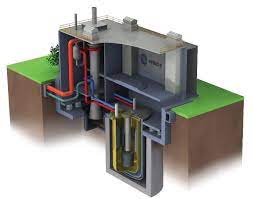
GE Vernova Hitachi Nuclear Energy’s BWRX-300 is a 300 MWe water-cooled, natural circulation SMR with passive safety systems that leverages the design and licensing basis of the company’s US Nuclear Regulatory Commission-certified ESBWR boiling water reactor design and its existing, licensed GNF2 fuel design, a unique combination that GE Vernova Hitachi Nuclear Energy says positions it to deliver an “innovative, carbon-free baseload power generation source” this decade.
The first BWRX-300 is under construction at Ontario Power Generation’s Darlington site in Canada, with completion expected by the end of the decade. The Darlington project is a reference project for OSGE.
Luba Kotzeva, founder and CEO of advisory and consultancy group Etara and part of the project team, said there had been “good engagement” with the UK side on the issue of a Contract for Difference funding model and stressed the importance of the proposal being for a fleet programme: “I think that is essential to getting the economies of scale, to getting the economics to flow, to getting the private capital.”
The example of the first SMR being built in a G7 country, at Darlington in Canada, is also seen as a key development. Kasprów said: “It’s extremely important, it is the difference between having something and nothing. It’s not about promises anymore – it’s happening.”
GE Vernova, Hitachi, SGE and Samsung C&T sign BWRX-300s MoU
An agreement to work together to identify and develop market opportunities
for the deployment of BWRX-300 small modular reactors in Europe was signed
on the sidelines of the United Nations General Assembly in New York. The
signatories of the memorandum of understanding – Poland’s SGE, the US’s GE
Vernova, Japan’s Hitachi and South Korea’s Samsung C&T – will establish “a
framework for cooperation on market development and commercial
opportunities” for the deployment of the BWRX-300 small modular reactor
(SMR).
GE Vernova Hitachi Nuclear Energy, a joint venture between GE
Vernova and Hitachi, is the designer of the BWRX-300. Samsung Construction
and Trading Corporation (Samsung C&T) has considerable experience in major
nuclear and energy infrastructure projects. SGE is already developing
projects for a fleet of BWRX-300 reactors in Europe, notably in Poland and
the UK.
World Nuclear News 23rd Sept 2026, https://www.world-nuclear-news.org/articles/ge-vernova-hitachi-sge-and-samsung-ct-sign-mou-on-bwrx-300s-in-europe
Simon Daigle lists the public concerns that must be addressed in planned development of BWRX-300 small nuclear reactors – Submission to Canadian Nuclear Safety Commission

Submission Concerning the Proposed Development of BWRX-300 – multiple reactors at the Darlington Site (Ontario)
Submitted November 19,2023 by Simon J Daigle, Simon J Daigle, B.Sc., M.Sc., M.Sc(A) Montreal, Quebec Canada
Response to the proposed development of OPGs BWRX-300 reactors at the Darlington CANDU reactors site and the items below are all real public concerns and must all be addressed independently and individually, as per the following categories:
CNSC licensing of the BWRX-300 reactors & Multiple Reactors nearby a NPP is inadequate [References: 1, 2, 4, 5]
- BWRX-300 stands for Boiling Water Reactor eXperimental 300 and developed by GE Hitachi Nuclear Energy (GEH) and will not aim to address any key challenges faced by traditional nuclear power plants. In fact, they will be costly, and generate extremely toxic nuclear wastes more than what would be expected by traditional NPP plants. [Ref. 4].
- This experimental compact design will not reduce construction costs, will not simplify operation nearby one NPP, or will ever enhanced safety measures. In fact, it will do the exact opposite as per IAEA [Ref. 1 and 5].
- It is questionable to say the least that by utilizing natural circulation and passive safety systems you will eliminate the need for external pumps and active cooling mechanisms because during a meltdown, fire or catastrophic event (lightening, flooding, extreme air temperatures over decades because of climate change), who will shut it off? A worker? I’m more reassured when a Pilot on commercial flight is present when he or she is using the auto-pilot function [Ref. 1].
- CNSC license to built an experimental reactor based on the CNSC’s decision that OPG has met the recommendations of the 2011 Environmental Assessment Report by the JRP is not objectively verifiable or can be validated based on the 2023 Update report [Ref. 2].
- No objective evidence is available to validate what specific recommendations of the JRP have been adopted, analysed and/or implemented by OPG or CNSC. [Ref. 2].
- No BWRX-300 reactors are operating anywhere in the world and is a real public concern for the citizens living nearby as well as the potential impacts of a catastrophic environmental event that could be transboundary across many municipalities.
Engineering Design Risks: Experimental, Natural water cooling & neutron leakage [4,5].
- Water cannot be used to cool a reactor as it is experimental design reactor that will use use low pressure water to remove heat from the core. A distinct feature of this reactor design is that water is circulated within the core by natural circulation and yet no data is measured or validated by any laboratory confirmed analysis or modelling study.
- Neutron leakage will be problematic for any SMR design as well as for the BRMX-300 reactor as no proof of any safe SMR reactor system can be validated or compared too to this very day.
- This is no experimental data to elude or conclude that this experimental reactor will work in terms of an internal cooling system of the core.
- BWRX-300 is by all means not small as it covers a full football field.
- No BWRX-300 reactors are operating anywhere in the world.
- The proposed design and operation of a BWRX-300 is entirely different from the CANDU design and involves a structure and a method of operating which is, in large part, below ground level.
- No data on any potential meltdown of the core of any modular nuclear including BWRX-300 including catastrophic events cascading located nearby a Nuclear Power Plant.
- Neutron leakage is a huge problem with SMRs and will be as well with the BWRX-300.
- SMR Neutronics and Design: [Ref. 4].
- “A nuclear reactor is designed to sustain criticality, a chain reaction of fission events that generates energy (∼200 MeV per fission event) and extra neutrons that can cause fission in nearby fissile nuclides.
- The neutron “economy” of a reactor depends on the efficiency of the chain reaction process; the fate of neutrons absorbed by abundant nuclides, such as 238U or 232Th; the fission of newly generated fissile nuclides, such as 239Pu and 233U; and the loss of neutrons across the fuel boundary.
- These “lost” neutrons can activate structural materials that surround the fuel assemblies. Each of these physical processes generates radioactive waste.
- Thus, the final composition of the SNF and associated wastes depend on the initial composition of the fuel, the physical design of the fuel, burnup, and the types of structural materials of the reactor.
- The probability of neutron leakage is a function of the reactor dimensions and the neutron diffusion length, the latter of which is determined by the neutron scattering properties of the fuel, coolant, moderator, and structural materials in the reactor core.
- The neutron diffusion length will be the same in reactors that use similar fuel cycles and fuel–coolant–moderator combinations; thus, the neutron leakage probability will be larger for an SMR than for a larger reactor of a similar type.”
- Public Consultation, indigenous peoples and social acceptability: [Ref. 2].
- No objective evidence has been elucidated or clearly documented with transparency.
- EIA Impact statement: page 84 of [Ref. 2].
- EIA impact statement, nor final PPE parameters, did not follow IAEA Multi-Unit Probabilistic Safety Assessment required for 1 or 4 experimental reactors nearby a Nuclear Power Plant despite the fact that EIA significance analysis had assessed all the residual adverse effects [Ref. 1, 5]. Please refer to the list of EIA and PPE selected quotes below as the reference to compare with the IAEA Multi-Unit Probabilistic Safety Assessment that is lacking [Ref. 1, 5].
EIA and PPE selected quotes:
“EIS significance analysis had assessed all the residual adverse effects to be “Not Significant”. Of the likely residual adverse effects that were forwarded for assessment of significance in the EIS:
• Seven (7) were also determined to result in minor residual adverse effects from the BWRX-300 but less than that described in the EIS,
• Four (4) were not applicable to the BWRX-300 reactor,
• Five (5) were determined to have residual adverse effects not significant after completion of additional studies to assess the likely effects to retained terrestrial features not considered in the EIS.
- The PPE Of the 198 PPE parameters, 60 PPE parameters were not applicable to the BWRX-300. Of the 138 applicable PPE parameters evaluated, eight (8) BWRX-300 parameters are currently not within their respective PPE parameters. These are largely due to characteristics inherent to the design of the GEH reactor technology. These eight parameters are related to the following topics:
- The rate of fire protection water withdrawal and the quantity of water in storage,
- Deeper foundations (38 m below grade) than the reactors previously assessed in the EIS (13.5 m),
- Airborne releases of radioactive contaminants and normal operation minimum release height above finished grade,
- The different proportions of radionuclides in solid wastes generated by the operation of the BWRX-300,
- The weight of the cask used to transport the BWRX-300 spent fuel on site, and
- The multiplication factors applied to basic wind speed to develop the plant design.
- A full environmental impact assessment is required to fulfill provincial and federal jurisdiction best practices for air, water and soil & biosphere impacts during a catastrophic event or meltdown of this experimental reactor as well as maritime and lake biosphere impacts.
Nuclear accidents, incidents, multiple explosion risks or 1 or 4 BMRX-300 reactors nearby a NPP, Soil Stability, hydrogeology, lithospheric & seismic Risks: [Ref. 1,2, 5].
- No objective risk assessment has been completed by OPG or CNSC as per the required IAEA Multi-Unit Probabilistic Safety Assessment required for 1 or 4 experimental reactors nearby a Nuclear Power Plant. [Ref. 1,5].
- The appropriateness of building 1 or 4 untested reactors next to the 4 existing CANDUs at Darlington as well as the current and potential stored nuclear waste is questionable given the fact that the probabilistic safety assessment was not completed according to the IAEA methodology [Ref. 1].
- JRP recommendations concerning the physical conditions of the Darlington site need to be applied with transparency by OPG and the CNSC. [Ref. 2].
Other public and safety concerns: these issues need to be addressed
- Climate change impacts have not been included in the EIS report.
- Unknown: reliability data to reduce the risk of potential accidents.
- Unknown: demonstrating that the BMRX-300 is a clean and reliable source of electricity, capable of generating vast amounts of energy without producing greenhouse gas emissions as it is only an experimental design.
- Concerns surrounding safety, waste disposal, and cost have hindered its widespread adoption globally. A handful of countries have adopted this design but no data on the true financial costs to governments or to that taxpayer. [Ref. 4].
Unknown: BWRX-300 did not address safety concerns, efficiency, efficacy as a cost-effective alternative compared to renewables such as hydro, solar or wind energy generation.
Unknown: sustainability and reliability compared to wind and solar energies to meet the growing demand for electricity.- BWRX-300 represents a significant step backwards in power technology. It is not compact, it does not meet nuclear wastes (as per the IAEA ALARA principle) that will last for thousands of years, and most certainly, it is not cost effective over time to store and monitor SMR or BWRX-300 nuclear wastes based on the probability of any heat instability of the nuclear core over time and the generation of highly toxic nuclear waste. You cannot turn off radioactivity like an electrical light bulb as there are no fuse switch off for ionizing radiation.
France’s EDF plans 10 small nuclear plants in Europe by 2035

the entire project would require “tens of billions” of euros in investments
By Francesca Landini, September 19, 2026
- Summary
- Companies
- First SMR to be built in France, with another expected in Italy
- EDF says 10-reactor project would require tens of billions of euros in investment
- Nuward reactor is expected to produce 400 megawatts of power and heat
MILAN, Sept 18 (Reuters) – France’s EDF plans to build 10 small modular nuclear reactors (SMRs) in the European Union by 2035 under a project aiming to help the bloc reduce its dependency on fossil fuel imports, an EDF executive said on Friday.
The state-owned French power group plans to use a technology developed by its NUWARD subsidiary for the SMRs, EDF Senior Vice President Vakisasai Ramany said at an event hosted by its Edison unit and attended by Italian companies that will be part of the supply chain.
The first SMR is due to be built in France with another expected to be located in Italy with assistance from Edison (EDNn.MI), opens new tab and potential support from energy contractor Saipem (SPMI.MI), opens new tab and construction group Webuild (WBD.MI), opens new tab among others.
Ramany added that EDF was also in discussions with governments over the possibility of building some of the small nuclear plants in Poland, Belgium and Finland.
CATCHING UP ON SMALL MODULAR REACTORS
EDF, Europe’s largest nuclear power developer, is rushing to catch up with the United States and others that already have plans in place to start manufacturing by the end of the decade.
The French group was originally planning a more ambitious reactor project. But design issues and fears of delays and cost overruns prompted a rethink and switch to a simpler, more proven technology.
“It is not the best technology that hits the market, it is the technology that addresses as best as possible a number of expectations,” Ramany said.
NUWARD SMR TO PRODUCE POWER AND HEAT
NUWARD’s small reactor is expected to produce 400 megawatts of power and have the flexibility to deliver heat too, making it suited to providing stable baseload power for industry.
Ramany said the entire project would require “tens of billions” of euros in investments and added that construction of 10 reactors would help to spread the costs and be more efficient.
“The targeted cost for electricity (from NUWARD SMRs) is about €100 ($115) per megawatt hour … We are talking about dispatchable energy, which should not be compared with the cost of renewable energy, but rather with gas generation,” said Edison CEO Nicola Monti.
Italy’s government is expected to give its final approval next week to a law on nuclear power generation, opening the way to nuclear power stations in a country that banned them almost 40 years ago following a referendum.
Is the much-hyped small nuclear reactor juggernaut REALLY picking up speed?
COMMENT. In this carefully worded story about SMRs, Haley Zaremba provides the required “enthusiasm”, but note where she points out the snags, and that main problem – COSTS.
Note that this predicted SMR boom is linked to the AI boom.
But one must wonder if the AI boom is headed for a bust?
“A key argument from SMR proponents is that the new reactors will be economically competitive,” says David Schlissel, IEEFA director of resource planning analysis. “But the on-the-ground experience with the initial SMRs that have been built or that are currently under construction shows that this simply is not true.”
IAEA Triples Nuclear Power Forecast as Small Reactors Finally Take Off
By Haley Zaremba – Sep 19, 2026, https://oilprice.com/Energy/Energy-General/IAEA-Triples-Nuclear-Power-Forecast-as-Small-Reactors-Finally-Take-Off.html
- The IAEA now projects SMRs will supply up to 28 percent of new nuclear capacity by 2060, a sharp jump from its prior high-case estimate of 24 percent.
- The NRC just fast-tracked construction on two SMRs at Michigan’s Palisades Energy Center, clearing the plant to break ground before a full work authorization is issued.
- Surging AI data center power demand is pushing the tech sector to back SMRs as a scalable, low-emissions alternative to the natural gas boom currently fueling AI growth.

After years of delays and plateaued development timelines, it might finally be time for the small nuclear revolution. In a brand new report, the International Atomic Energy Agency (IAEA) has once again increased its long-term nuclear power forecast, projecting that the world’s nuclear power generation capacity will fully triple by 2060. The Agency expects a whole lot of that increased capacity to come from a strong wave of small modular nuclear reactors connecting to power grids around the world, at long last.
For years, small modular reactors (SMRs) have been touted as a game-changer for clean energy, with the potential to offer round-the-clock, emissions-free electricity at a fraction of the up-front cost of traditional nuclear power plants. Typically, nuclear power plants are huge, bespoke operations with enormous up-front costs and long timelines for approval, construction, and connection. By contrast, SMRs would be factory-made and mass-produced to the same specifications, and then set up on-site. A bigger site would use more of them, and a smaller one would use less. Simple as that.
But these visions have been slow to materialize thanks to regulatory hurdles, funding gaps, and nuclear fuel supply chain issues, among other snags. The primary issue is that while these models are cheaper than traditional nuclear energy, that doesn’t mean that they’re cheap. While the nascent technology will likely continue to get cheaper over time, it is not yet genuinely competitive with other clean alternatives like large-scale hydropower and offshore wind projects.
“A key argument from SMR proponents is that the new reactors will be economically competitive,” says David Schlissel, IEEFA director of resource planning analysis. “But the on-the-ground experience with the initial SMRs that have been built or that are currently under construction shows that this simply is not true.”
While many of the world’s biggest economies – including The United States, the United Kingdom, China, and Russia – have all been investing heavily in the development of SMRs, Russia and China remain the only two nations in the world to have operational, grid connected models. The United States has approved a single patent for an SMR design, with an expected commercial deployment date slated for 2028.
But it would seem that the long slog toward commercial reality is finally picking up speed. The IAEA’s high growth scenario anticipates that 28 percent of all new nuclear capacity added by 2060 will come from SMRs. In the lowest nuclear power growth case, SMRs represent 23 percent of new capacity. In either case, their role is considerable, and both of these numbers represent a huge uptick in confidence compared to the Agency’s previous projections, in which SMRs represented 24 percent of new capacity in the high case and just 5 percent in the low case.
The IAEA report also includes a regional breakdown of where they expect to see this development occur by 2060. The Agency anticipates “particularly strong uptake in North America where about 60% of new nuclear capacity could come from SMRs.” Strong regional growth is also expected in South-Eastern Asia and in Latin America and the Caribbean, at 40 percent each in both high and low growth scenarios.
The wheels are already turning in the United States, where just this week the U.S. Nuclear Regulatory Commission approved a fast-tracked plan for the construction of two planned SMRs at the Palisades Energy Center in Michigan. The plant will be allowed to break ground on the project early, before a Limited Work Authorization is issued. Together, the two will produce a projected 680 megawatts of electricity.
In the United States and beyond, the SMR revolution is increasingly seen as a vital piece of the artificial intelligence energy puzzle. With a single hyperscale AI data center able to consume as much electricity as 50,000 homes, scalable, baseload, and low-emissions energy capacity additions are needed as quickly as possible. At present, the AI boom is leading to a massive natural gas boom, but the tech sector is also throwing money behind next-gen technologies like SMRs to more sustainably power its insatiable energy needs in the future. In that sense, the future can’t come fast enough.
Wall Street sounds alarm on nuclear stock with 40% downside
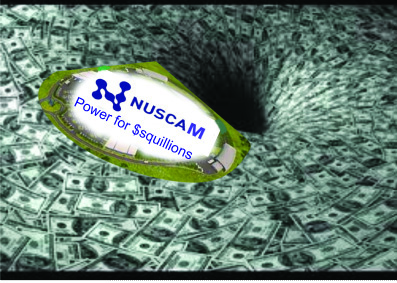
making a choice to invest and having a nuclear power plant that is up and running are completely different achievements.
NuScale has lost money since company was founded and recorded a cumulative deficit of $824.4 million as of June 30.
Cash spent in operating operations was $372.9 million during the first six months of 2026, compared with $56.1 million for the same period in 2025.
making a choice to invest and having a nuclear power plant that is up and running are completely different achievements.
NuScale has lost money since company was founded and recorded a cumulative deficit of $824.4 million as of June 30.
Cash spent in operating operations was $372.9 million during the first six months of 2026, compared with $56.1 million for the same period in 2025.
A key analyst has slashed its price target for the stock.
Sep 16, 2026,The Street, By Faizan Farooque
Nuclear energy has become one of Wall Street’s more closely watched investment themes as artificial intelligence and data centers put new pressure on the U.S. power grid.
Due to data centers, AI, and industrial growth, the U.S. Department of Energy expects electricity demand to rise significantly.
The federal government has supported that forecast with dollars.
In March of 2025, the Energy Department published a request for $900 million to assist the development of American-made Generation III+ small modular reactors.
The market opportunity is so much bigger.
The Energy Department has predicted the U.S. may need as much as 200 gigawatts of new nuclear capacity by 2050 to fulfill rising energy demand.
That suggests a potentially huge opportunity for those that can get new reactors into commercial operation.
One company aiming to get there is NuScale Power (SMR).
But Wall Street doesn’t think every nuclear stock will necessarily emerge as a winner.
UBS downgraded NuScale Power to Sell from Neutral and cut its price target to $6 from $10.
That implied roughly 40% downside from the stock’s level when the analyst call was issued.
And the questions raised by UBS go to the heart of the conundrum hanging over the growing small modular reactor industry: How soon can promising reactor technology be turned into a working commercial power plant?
UBS slashes NuScale Power stock price target
UBS’s negative argument is about execution.
Competitors are going into construction, whereas NuScale has an expected build time of more than five years and no concrete client commitments, the analyst said.
UBS said such circumstances presented “meaningful challenges.”
The bank now forecasts just one NuScale project breaks ground in 2028 and sees a cumulative cash burn of $700 million from 2026 through 2028.
That provides a stark contrast between excitement for nuclear power and the dangers of actually bringing a new reactor design to market.
Those dangers are not exclusive to NuScale.
Energy Department officials have recognized utilities’ and other prospective consumers’ worries about cost overruns in development and abandonment of projects.
DOE has also projected that order books of five to 10 deployments of at least one reactor type may be required to support advanced nuclear and reach commercial scale.
NuScale has already passed a big regulatory barrier.
NuScale’s US460 standard plant design received approval from the U.S. Nuclear Regulatory Commission in May 2025.
The design has six modules each generating 77 megawatts of power, making the overall plant capacity 462 megawatts.
The NRC said its clearance means the design may be cited in applications for building permits, operating licenses and combination licenses.
The agency finished its review in 22 months, two months ahead of schedule.
The NRC also has the underlying regulatory documentation for the approval of NuScale’s US460 design, giving investors the key record of the company’s regulatory development.
That gives NuScale a distinctive position.
We see concrete regulatory progress.
The bigger issue is the commercial timeframe.
NuScale Power has substantial liquidity but is burning cash
The $700 million cash-burn estimate from UBS is more substantial against NuScale’s most recently disclosed balance sheet.
NuScale reported $766.5 million in cash and cash equivalents as of June 30, 2026, in its quarterly filing with the Securities and Exchange Commission.
The company also held $305.7 million of short-term investments and $820.8 million of investments.
The total of these three categories is over $1.89 billion.
NuScale reported no debt and stated it anticipates that its cash, investments, and continuous access to capital markets would be adequate to satisfy its cash needs for at least the next 12 months and beyond.
But the other side of the company’s financials provides insight into why cash burn is critical to UBS’s theory.
NuScale has lost money since company was founded and recorded a cumulative deficit of $824.4 million as of June 30.
Cash spent in operating operations was $372.9 million during the first six months of 2026, compared with $56.1 million for the same period in 2025.
The increase was mostly due to a $259.9 million payment to commercialization partner ENTRA1 and reduced collections from customers and vendor prepayments for long-lead supplies, NuScale said.
NuScale too has gone to its stockholders for a big financial infusion.
The corporation sold roughly 89.7 million Class A shares via an at-the-market program in the first six months of 2026.
Those sales yielded $1 billion in gross profits, or around $984.5 million after issuance expenses, the document said.
The weighted average price of sales was $11.14 per share.
That funding gave NuScale a major cash boost but also speaks to a key portion of the investment equation.
Until commercial projects generate sufficient cash, access to capital markets remains an important source of funding.
NuScale’s annual report also gives further insight on the company’s commercialization agreements including its ties with RoPower Nuclear and ENTRA1 Energy.
NuScale’s Romania project offers a counterpoint to UBS concerns
The bearish thesis isn’t without important counterarguments.
But there are significant counterarguments to the pessimistic view. One of the biggest is Romania.
NuScale has been collaborating with RoPower Nuclear on a planned 6-module small modular reactor project at the old Doiceşti coal-power facility.
Next came a milestone of greater importance.
On Feb. 12, 2026, shareholders approved the final investment decision for the Doicești small modular reactor project.
That is substantial development for a corporation that is being challenged on its ability to transform technology into practical projects.
But making a choice to invest and having a nuclear power plant that is up and running are completely different achievements.
Nuclear plants take years to license, finance, build and complete before they generate power.
And that is the gap UBS regards as a concern.
NuScale also has a potentially far bigger possibility in the US.
TVA and NuScale have announced support for an ENTRA1 Energy initiative, with plans to install up to 6 gigawatts of NuScale small modular reactor capacity throughout TVA’s seven-state area in September 2025.
The size is substantial, but investors need to differentiate a projected deployment program from reactors currently under construction or in operation.
That divergence is especially noteworthy in light of UBS’s concern regarding solid customer agreements.
So whether NuScale can turn theoretical deployments into commercial off-take agreements and ultimately construction might be one of the most
NuScale Power faces competitors moving toward construction
The rivalry makes NuScale’s timeframe extremely relevant.
The Nuclear Regulatory Commission’s advanced-reactor docket shows other developers and utilities pushing projects through construction-related regulatory milestones.
For example, in May 2025, TVA filed the last part of its building permit application for a BWRX-300 small modular reactor at its Clinch River plant in Tennessee.
That helps explain why UBS is focused not simply on whether NuScale can eventually deploy its technology but on when that deployment can happen.
Timing is key in a market where utilities, IT corporations, and other big electrical consumers are looking for more dependable power.
The Department of Energy’s advanced-nuclear study projects the U.S. will require around 200 gigawatts of new nuclear power by 2050.
The agency also cautioned that the time it would take to ramp up deployment might make the ultimate buildout substantially harder.
A DOE scenario that begins large-scale deployment by 2030 and reaches 13 gigawatts per year by 2040 could put the U.S. on track to add 200 gigawatts of nuclear capacity by 2050.
A five-year delay might mean more than 20 gigawatts a year of deployment and could raise capital needs by as much as 50%.
Thus, the opportunity is potentially immense.
But speed counts.
Wall Street downgrade raises stakes for NuScale Power stock
The downgrading by UBS has left NuScale’s investors with two very different views of the company’s tale………………………………………………………………………………………………..
For NuScale stockholders, the more pressing issue is whether this specific nuclear business can transform regulatory clearances, alliances and planned projects into running reactors swiftly enough to justify its value.
UBS isn’t buying it. https://www.thestreet.com/investing/wall-street-sounds-alarm-on-nuclear-stock-with-40-downside
UK Nuclear Startup Signs MOU On Technology To ‘Dramatically’ Speed Up Component Production for planned Odin microreactor

By David Dalton, 16 September 2026, https://www.nucnet.org/news/uk-nuclear-startup-signs-mou-on-technology-to-dramatically-speed-up-component-production-9-3-2026
Companies will explore uses for planned Odin microreactor
UK nuclear engineering startup Cambridge Atomworks has signed a memorandum of understanding with Cambridge Vacuum Engineering (CVE) to explore how best to use technology that could dramatically accelerate the production of critical nuclear power components including reactor vessels and internals.
A statement said the aim is to leverage CVE’s expertise in electron beam welding, including the company’s Ebflow technology.
The two companies will explore the use of advanced electron beam welding to manufacture critical components for the Odin microreactor project.
The Odin microreactor was originally developed by US-based Nano Nuclear Energy. It is designed to fit within standard shipping containers to provide energy for remote communities, disaster relief and industrial sites.
In 2025 Nano Nuclear announced it was selling the Odin design and all associated intellectual property to Cambridge Atomworks, which had already been developing Odin for Nano Nuclear on an outsourced consulting basis.
Cambridge Atomworks is aiming to have an operational prototype of Odin by 2031.
Odin is a low-pressure reactor that uses solid nuclear fuel and molten salt coolant and is designed as a transportable, standalone power system. Manufactured largely offsite and deployed with minimal supporting infrastructure, potential applications for Odin include mining operations, remote and island communities, developing markets and other off-grid industrial users where reliable power can otherwise be expensive or logistically difficult to provide.
Ian Farnan, chief executive officer at Cambridge Atomworks, said “the agreement with CVE is an important step in developing the supply chain and manufacturing approach needed to make the Odin microreactor technology a reality.
He said: “Electron beam welding has the potential to transform how key reactor components are manufactured.”
Centrica And X‑Energy Progress Nuclear Plans
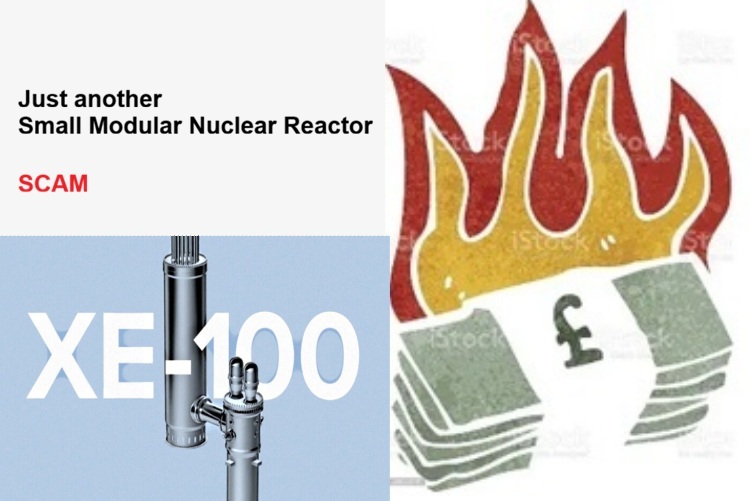
Centrica and X‑energy have confirmed that X‑energy’s Xe‑100
Generation IV small modular reactor has been accepted into the UK’s Generic
Design Assessment (GDA), marking a key step towards commercial licensing.
The move coincides with the first anniversary of the companies’ partnership
and follows a direction from government to bring the design into the formal
review process.
Under their collaboration, the companies aim to deploy up
to 6GW of new nuclear capacity across the UK, equivalent to around 10-20
Xe‑100 power stations depending on the size of each installation.
Acceptance into the GDA initiates a multi‑year process to assess the
reactor’s suitability for deployment and operation ahead of site‑specific
permits. The review, expected to take about three years, will be led by the
Office for Nuclear Regulation (ONR), the Environment Agency (EA) and
Natural Resources Wales. The UK submission builds on the Xe‑100’s
progress with US licensing and is expected to benefit from greater
collaboration between UK regulators and the US Nuclear Regulatory
Commission, including the transfer of NRC‑reviewed design documentation
and safety analyses into UK assessments.
Construction.co.uk 16th Sept 2026, https://www.construction.co.uk/construction-news/334683/centrica-and-x8209energy-progress-nuclear-plans
Canadian Nuclear Laboratories cancels SMR programs
| Ole Hendrickson, Sep 17, 2026, |
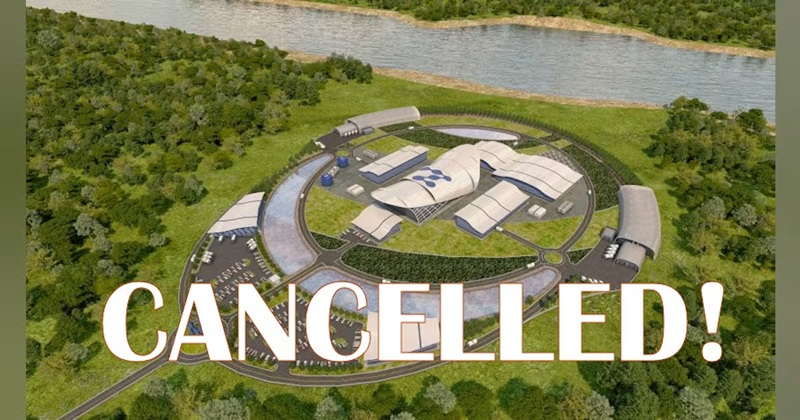
CNL’s call for SMR demonstration projects, and CNL’s “Advanced Reactor” research initiative, are now officially terminated:
Chalk River, ON – September 10, 2026 – Canadian Nuclear Laboratories (CNL), Canada’s premier nuclear science and technology organization, is announcing adjustments to its clean energy research programs. As of July 2026, CNL will close its Invitation for Clean Energy Projects program and the Canadian Nuclear Research Initiative (CNRI). Both programs were aimed at leveraging the facilities and capabilities at CNL-managed sites to advance clean energy projects.
Canadian Nuclear Research Initiative (CNRI) – it was a program to support collaborative Advanced Reactor (AR) research projects with third-party proponents in Canada.- Invitation for Clean Energy Projects program (originally titled as Invitation for SMR Demonstration Projects) – CNL had been working with its client, Atomic Energy of Canada Limited (“AECL”), to develop a process by which CNL could recommend the establishment of one or more clean energy demonstration projects on one or more sites owned by AECL (including Chalk River Laboratories and Whiteshell Laboratories).
CNL will continue “to explore the potential of micro-reactors,” using $40 million of DND funding:
On April 29, 2026, Minister Hodgson, on behalf of the Honourable David J. McGuinty, Minister of National Defence, announced that the Government of Canada, through the Department of National Defence (DND), is making an initial $40-million investment for 2026–2027 to assess the potential of a Canadian‑controlled microreactor that could provide heat and electricity to remote and northern DND and Canadian Armed Forces (CAF) facilities and operations.
Once again, pro small nuclear reactor propaganda covers itself with warnings on what could go wrong – this time it’s Centrica’s Xe-100 plan
Centrica, X-energy Advance Nuclear Plans as UK Regulators to Begin Design Review for Xe-100
X.Energy Sep 15, 2026
“…………………………………………………………………………………………..You should not rely on these forward-looking statements as predictions of future events. Actual results may differ materially due to a number of factors, including, but not limited to: delays or setbacks in the GDA process; site-specific issues related to licensing, permitting, consenting, or scaling of Xe-100 plants in the UK; changes, delays, or the inability to obtain and maintain licenses or governmental approvals from the UK Office for Nuclear Regulation or other regulatory authorities, and the risk that anticipated cooperation between jurisdictions does not occur as expected; risks relating to the Company’s partnership with Centrica, including the parties’ ability to perform under and realize the anticipated benefits of the Joint Development Agreement, to secure site development, and to meet expected timelines; changes in UK or U.S. government policy, funding, or support for advanced nuclear; supply chain and supplier constraints; and first-of-a-kind risks and the Company’s limited operating experience at intended scale, including latent design or operational issues. More information about potential risks is detailed under “Risk Factors” in X-energy’s Form 10-Q filed with the Securities and Exchange Commission (the “SEC”), and in subsequent SEC filings, available on X-energy’s Investor Relations website at https://investors.x-energy.com/ and on the SEC website at www.sec.gov. Any forward-looking statements herein are based on assumptions believed reasonable as of, and speak only as of, the date of this press release. Except as required by law, X-energy undertakes no obligation to update these statements as a result of new information or future events. https://x-energy.com/news/centrica-x-energy-advance-nuclear-plans-as-uk-regulators-to-begin-design-review-for-xe-100/
Centrica, X-energy Advance Nuclear Plans as UK Regulators to Begin Design Review for Xe-100, (but with a warning)

You should not rely on these forward-looking statements as predictions of future events. Actual results may differ materially due to a number of factors, including, but not limited to: delays or setbacks in the GDA process; site-specific issues related to licensing, permitting, consenting, or scaling of Xe-100 plants in the UK; changes, delays, or the inability to obtain and maintain licenses or governmental approvals from the UK Office for Nuclear Regulation or other regulatory authorities, and the risk that anticipated cooperation between jurisdictions does not occur as expected;
risks relating to the Company’s partnership with Centrica, including the parties’ ability to perform under and realize the anticipated benefits of the Joint Development Agreement, to secure site development, and to meet expected timelines; changes in UK or U.S. government policy, funding, or support for advanced nuclear; supply chain and supplier constraints; and first-of-a-kind risks and the Company’s limited operating experience at intended scale, including latent design or operational issues. More information about potential risks is detailed under “Risk Factors” in X-energy’s Form 10-Q filed with the Securities and Exchange Commission (the “SEC”), and in subsequent SEC filings, available on X-energy’s Investor Relations website at https://investors.x-energy.com/ and on the SEC website at www.sec.gov. Any forward-looking statements herein are based on assumptions believed reasonable as of, and speak only as of, the date of this press release. Except as required by law, X-energy undertakes no obligation to update these statements as a result of new information or future events.
- On the one-year anniversary of the Centrica X-energy partnership being signed, the UK Government has directed regulators to accept the X-energy Xe-100 Advanced Modular reactor into the Generic Design Assessment, marking a significant step toward UK commercial licensing.
- Under their partnership, the companies intend to deploy up to 6 GW of new nuclear capacity in the UK (10-20 Xe-100 power stations depending on size of each installation)
LONDON, England – September 15, 2026 – Centrica plc (“Centrica”) and X-Energy, Inc. (Nasdaq: XE) (“X-energy”), a leading developer of advanced nuclear reactors and fuel technology, today announced that X-energy’s Xe-100 Generation IV advanced Small Modular Reactor (“SMR”) has been accepted into the United Kingdom’s Generic Design Assessment (“GDA”) process.
GDA acceptance formally triggers the process of assessing the design’s acceptability for deployment and operation ahead of the technical and environmental evaluations required for site-specific licensing and permitting. The assessment is expected to take approximately three years and will be administered by the UK Office for Nuclear Regulation (“ONR”), the Environment Agency (EA), and Natural Resources Wales.
The submission builds on the Xe-100’s U.S. licensing progress and is expected to benefit from expanded collaboration between the UK regulators and the U.S. Nuclear Regulatory Commission (“NRC”), enabling transfer of NRC-reviewed design documentation and safety analyses into UK design reviews.
This press release contains forward-looking statements within the meaning of the Private Securities Litigation Reform Act of 1995, which X-energy and its subsidiary TRISO-X intend to be covered by the safe harbor provisions of Section 27A of the Securities Act of 1933, as amended, and Section 21E of the Securities Exchange Act of 1934, as amended. Words such as “assume,” “believe,” “continue,” “could,” “estimate,” “expect,” “intend,” “may,” “plan,” “potential,” “predict,” “project,” “will,” “seek,” the negative of these words, or similar terms may identify forward-looking statements, but their absence does not mean a statement is not forward-looking. These include, but are not limited to, statements regarding the intended deployment of up to 6 GW of new nuclear capacity; the expected timing, conduct and completion of the GDA; the anticipated benefits of the expanded collaboration between the UK Regulators and the U.S. Nuclear Regulatory Commission; and the anticipated development and completion of X-energy’s other ongoing reactor projects.
You should not rely on these forward-looking statements as predictions of future events. Actual results may differ materially due to a number of factors, including, but not limited to: delays or setbacks in the GDA process; site-specific issues related to licensing, permitting, consenting, or scaling of Xe-100 plants in the UK; changes, delays, or the inability to obtain and maintain licenses or governmental approvals from the UK Office for Nuclear Regulation or other regulatory authorities, and the risk that anticipated cooperation between jurisdictions does not occur as expected; risks relating to the Company’s partnership with Centrica, including the parties’ ability to perform under and realize the anticipated benefits of the Joint Development Agreement, to secure site development, and to meet expected timelines; changes in UK or U.S. government policy, funding, or support for advanced nuclear; supply chain and supplier constraints; and first-of-a-kind risks and the Company’s limited operating experience at intended scale, including latent design or operational issues. More information about potential risks is detailed under “Risk Factors” in X-energy’s Form 10-Q filed with the Securities and Exchange Commission (the “SEC”), and in subsequent SEC filings, available on X-energy’s Investor Relations website at https://investors.x-energy.com/ and on the SEC website at www.sec.gov. Any forward-looking statements herein are based on assumptions believed reasonable as of, and speak only as of, the date of this press release. Except as required by law, X-energy undertakes no obligation to update these statements as a result of new information or future events.
1 This Month
23-25 October – on Zoom – World BEYOND War’s annual global conferenc


Shut down the radiation-damaged Heysham nuclear reactors now
To see nuclear-related stories in greater depth and intensity – go to https://nuclearinformation.wordpress.com

Say No to NASA’s Reckless Nuclear Reactor on the Moon
Say No to NASA’s Reckless Nuclear Reactor on the Moon

-
Archives
- October 2026 (247)
- September 2026 (339)
- August 2026 (330)
- July 2026 (355)
- June 2026 (287)
- May 2026 (306)
- April 2026 (356)
- March 2026 (251)
- February 2026 (267)
- January 2026 (308)
- December 2025 (358)
- November 2025 (359)
-
Categories
- 1
- 1 NUCLEAR ISSUES
- business and costs
- climate change
- culture and arts
- ENERGY
- environment
- health
- history
- indigenous issues
- Legal
- marketing of nuclear
- media
- opposition to nuclear
- PERSONAL STORIES
- politics
- politics international
- Religion and ethics
- safety
- secrets,lies and civil liberties
- spinbuster
- technology
- Uranium
- wastes
- weapons and war
- Women
- 2 WORLD
- ACTION
- AFRICA
- Atrocities
- AUSTRALIA
- Christina's notes
- Christina's themes
- culture and arts
- Events
- Fuk 2022
- Fuk 2023
- Fukushima 2017
- Fukushima 2018
- fukushima 2019
- Fukushima 2020
- Fukushima 2021
- general
- global warming
- Humour (God we need it)
- Nuclear
- RARE EARTHS
- Reference
- resources – print
- Resources -audiovicual
- Weekly Newsletter
- World
- World Nuclear
- YouTube
-
RSS
Entries RSS
Comments RSS

