Renewable energy to fight climate change, – NOT Small Modular Nuclear Reactors
 Renewables – Not Small Modular Nuclear Reactors – Are the Solution to Climate Change, https://cela.ca/renewables-not-small-modular-nuclear-reactors-are-the-solution-to-climate-change/ December 4, 2019 By Theresa McClenaghan, Kerrie Blaise (CELA) and Guest Author Chris Rouse (New Clear Free Solutions) The idea of Small Modular Reactors (“SMRs”) was in the news this week with the federal government being urged to provide even more research money to develop this “new” nuclear power technology. The premise is that SMR’s are a needed, cost effective, safe and realistic solution to climate change. Renewables – Not Small Modular Nuclear Reactors – Are the Solution to Climate Change, https://cela.ca/renewables-not-small-modular-nuclear-reactors-are-the-solution-to-climate-change/ December 4, 2019 By Theresa McClenaghan, Kerrie Blaise (CELA) and Guest Author Chris Rouse (New Clear Free Solutions) The idea of Small Modular Reactors (“SMRs”) was in the news this week with the federal government being urged to provide even more research money to develop this “new” nuclear power technology. The premise is that SMR’s are a needed, cost effective, safe and realistic solution to climate change.However, SMRs are not the answer or even part of the answer to climate change given the problematic environmental, social and economic attributes of the proposed technology. Instead, in our view, investment is urgently needed in Canada’s vast and enviable renewable energy resources which are already scalable and provide safer, less costly, and more socially acceptable means of energy generation.
SMRs are not yet commercially available. Indeed, Canada’s SMR Roadmap, produced by the Canadian Nuclear Association, only sets out a path for having a commercial demonstration unit in the 2030s. To contend that SMR technology can aid in combatting climate change is potentially damaging to climate action, as it misses the 10-year window we have to reverse emissions and decarbonize. It also distracts from the urgent work needed to respond to the climate emergency. We already have many tools in our renewable energy toolbox. Canada’s electricity grid is 65% renewable, mainly from our vast hydro resources. These resources, used in combination with 30% to 35% wind and solar, makes a renewable grid achievable. Several jurisdictions have already achieved or surpassed this threshold, such as Prince Edward Island, where 43% of its power comes from wind alone. We also have access to other renewable energy resources such as biomass, geothermal, and tidal to assist in our transition to a low-carbon economy. Studies also continue to demonstrate viable pathways to a renewable grid, which are both technically and economically feasible. One report from Nova Scotia provides a pathway to reach a 90% renewable grid by 2030 and a study from New Brunswick plots a cost effective solution to achieve a 95% renewable grid. While work is needed to achieve the remaining 5% over time, the immediate need – and the focus of governmental efforts – should be on prioritizing the first 90% to 95% shift to renewables. Despite what appears as widespread interest in SMRs, very few countries have been willing to invest in their construction. Apart from technology’s risks, the problem is one of poor economics: nuclear energy is already known to be expensive and the cost-competitiveness of SMRs is contingent upon their mass fabrication. Hundreds if not thousands of SMRs would need to be deployed in order to be economically viable. Past experience also dictates this new reactor technology may never become commercially available. For instance, after two decades and hundreds of millions of taxpayer dollars, the two prototype MAPLE reactors were abandoned in 2008 because they could not be safely operated. The Gentilly 1 prototype reactor in Quebec which received similar investment, also failed and after 180 days of operation was mothballed. Despite public assurances of SMRs’ ‘passive’ and ‘inherent’ safety, SMR operators and suppliers would be protected from liability in the event of an accident under the current rules; the current nuclear liability rules are a concession by governments to the nuclear industry because of the inherent hazard that private nuclear investors do not want to underwrite. Furthermore, after 50 years of nuclear energy production, we still do not have an approved plan for Canada’s high, intermediate and low-level radioactive waste stockpiles. Because of the diverse range of fuels which can be used by SMRs, new radioactive waste streams will be created, thus increasing the complexity of the used nuclear fuel waste problem, with new types of nuclear waste hazards being introduced. The touted benefit of SMRs for use in remote and rural regions would also mean increased transport of radioactive substances on roads and railways across the country. This poses unique proliferation risks since the waste from enriched fuels can produce quantities of plutonium that could be attractive for diversion to malicious purposes. The greater the number of sites and communities with SMRs, the greater the proliferation risks because of challenges in monitoring, keeping track and measuring plutonium in spent fuel, which must be kept secure. Furthermore, Canada’s nuclear safety regulator advocated with the federal government to remove SMRs from public, more rigorous forms of decision-making under Canada’s new Impact Assessment Act (IAA). Despite requirements for wind and solar farms to undergo environmental assessments, either provincially or federally, SMRs would not trigger an environmental assessment under the current federal IAA Project List regulation. The coming into force of the Impact Assessment Act in June 2019 wholly exempts SMRs from environmental, or impact assessment review. Investment in nuclear power at the 11th hour is a distraction from real climate action when scalable, cost-effective renewable solutions could and need to be employed. Already climate-burdened future generations should not have new risks imposed on them, due to SMR’s radioactive waste and accompanying proliferation risk. We need to invest in known renewable energy solutions, and not the promise of a hypothetical and risky technology. |
|
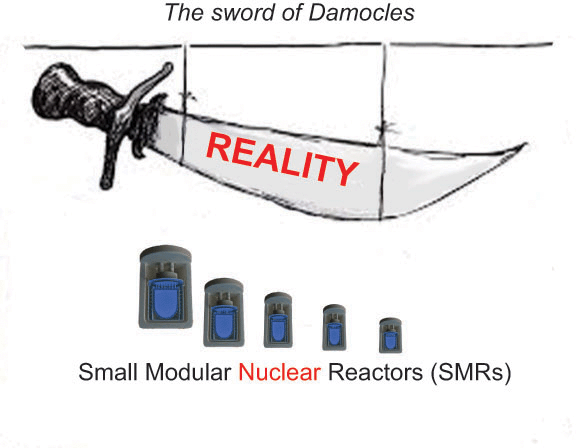
Muons: probing the depths of nuclear waste
Muons: probing the depths of nuclear waste, physicsworld, 12 Dec 2019
Having used them to look through rock, physicists are now exploiting muons to peer inside canisters of radioactive waste. The ability could prove very handy for nuclear inspectors, as Edwin Cartlidge reports
……muons – energetic subatomic particles that can pass through thick layers of dense material and which the scientists in Egypt used to look inside the limestone and granite pyramid.
Muons are generated routinely in particle colliders, where physicists use them to identify other, potentially more exotic, particles within the debris. But they are also produced naturally in the atmosphere, and an ever-growing range of researchers are using these commonly occurring muons as highly penetrating probes. Beyond archaeologists, geologists, for example, are developing muon detectors to establish when magma might be on the rise within a volcano……..
Muons offer a way to establish how much waste there is in a container without having to open or move the container in question. That capability would become vital, according to Matt Durham of Los Alamos National Laboratory in the US, should inspectors or the countries involved ever lose confidence in their monitoring. “This issue is only getting worse as more plutonium piles up around the world,” he says.
Muons offer a way to establish how much waste there is in a container without having to open or move the container in question……… https://physicsworld.com/a/muons-probing-the-depths-of-nuclear-waste/
Floating small nuclear reactors bring serious risks
nuclear experts have highlighted crucial negatives that cast doubt on the floating nuclear utopia.Jan Haverkamp, Greenpeace Netherlands senior expert nuclear energy and energy policy, sees the three main disadvantages of Akademin Lomonosov to be the big human factors risk, its problematic construction, and the pollution of the Arctic region with nuclear waste.
this project is reintroducing a major pollution risk in an area which functions as a climate regulator for the globe – “the Arctic pristine area, which is a very important natural area for the entire balance on the planet,”
Is floating nuclear power a good idea? Power Technology By Yoana Cholteeva, 9 Dec 19, Floating nuclear power promises to provide a steady source of energy at hard-to-reach locations, but at the same time the dangers inherent in nuclear power make some question whether it’s safe enough for areas where help is hard to find. Is floating nuclear power really a good idea? Yoana Cholteeva investigates.
Russian nuclear company Rosatom announced the arrival of the world’s first floating nuclear power plant, Akademik Lomonosov, in September 2019 when the technology was transported to the port of its permanent location in Russia’s Far East. The 144m-long and 30m-wide vessel has now docked at the port in Pevek, off the coast of Chukotka, where it will stay before its commissioning next year.
Akademik Lomonosov will use small modular reactor technology and is equipped with two KLT-40C reactor systems with 35MW capacity each. It has been designed to access hard-to-reach areas where it can operate for three to five years without the need for refuelling. It also has an overall life cycle of 40 years, which may be extended to 50 years Continue reading
Significant obstacles to Rolls Royce’s fantasy of “clean” nuclear-supplied jet fuel
 Rolls-Royce Touts Nuclear Reactors as Key to Clean Jet Fuel, Bloomberg,
By Christopher Jasper,December 6, 2019,
Rolls-Royce Touts Nuclear Reactors as Key to Clean Jet Fuel, Bloomberg,
By Christopher Jasper,December 6, 2019,
- Synthetics, biofuels to be mainstay of aviation, CEO says
- Small reactors to be used to generate required electricityRolls-Royce Holdings Plc is pitching nuclear reactors as the most effective way of powering the production of carbon-neutral synthetic aviation fuel without draining global electricity grids.
Drawing on technology developed for nuclear-powered submarines, the small modular reactors or SMRs could be located at individual plants to generate the large amounts of electricity needed to secure the hydrogen used in the process, according to Chief Executive Officer Warren East…….
The proposals face significant obstacles, including widespread public concern about radiation leaks and the safe disposal of nuclear waste, as well as question marks over U.K. plans to revive the sector after Hitachi Ltd. and Toshiba Corp. withdrew from major projects.Rolls aims to minimize regulatory barriers by building an initial network of 16 SMRs on the sites of former U.K. nuclear power stations still approved for atomic use.
The plants, costing 1.8 billion pounds ($2.4 billion) apiece, would feed the national grid and come online from the 2030s, with all complete by 2050. https://www.bloomberg.com/news/articles/2019-12-06/rolls-royce-pitches-nuclear-reactors-as-key-to-clean-jet-fuel
Small Modular Nuclear Reactors – many pitfalls, including security risks
‘Many issues’ with modular nuclear reactors says environmental lawyer, https://www.cbc.ca/news/canada/new-brunswick/many-issues-modular-nuclear-1.5381804
Three premiers have agreed to work together to develop the technology, Jordan Gill · CBC News Dec 03, 2019 Modular nuclear reactors may not be a cure for the nation’s carbon woes, an environmental lawyer said in reaction to an idea floated by three premiers.
Theresa McClenaghan, executive director of the Canadian Environmental Law Association, said the technology surrounding small reactors has numerous pitfalls, especially when compared with other renewable energy technology.
This comes after New Brunswick Premier Blaine Higgs, Saskatchewan Premier Scott Moe and Ontario Premier Doug Ford agreed to work together to develop the technology.
The premiers say the smaller reactors would help Canada reach its carbon reduction targets but McClenaghan, legal counsel for the environmental group, disagrees.
“I don’t think it is the answer,” said McClenaghan. “I don’t think it’s a viable solution to climate change.”
McClenaghan said the technology behind modular reactors is still in the development stage and needs years of work before it can be used on a wide scale.
“There are many issues still with the technology,” said McClenaghan. “And for climate change, the risks are so pervasive and the time scale is so short that we need to deploy the solutions we already know about like renewables and conservation.”
Waste, security concerns: lawyer
While nuclear power is considered a low-carbon method of producing electricity, McClenaghan said the waste that it creates brings its own environmental concerns.
“You’re still creating radioactive waste,” said McClenaghan.
“We don’t even have a solution to nuclear fuel waste yet in Canada and the existing plans are not taking into account these possibilities.”
McClenanghan believes there are national security risks with the plan as well. She said having more reactors, especially if they’re in rural areas, means there’s a greater chance that waste or fuel from the reactors could be stolen for nefarious purposes.
“You’d be scattering radioactive materials, potentially attractive to diversion, much further across the country,” said the environmental lawyer.
Russia’s Rosatom planning to market Small Modular Nuclear Reactors to Europe
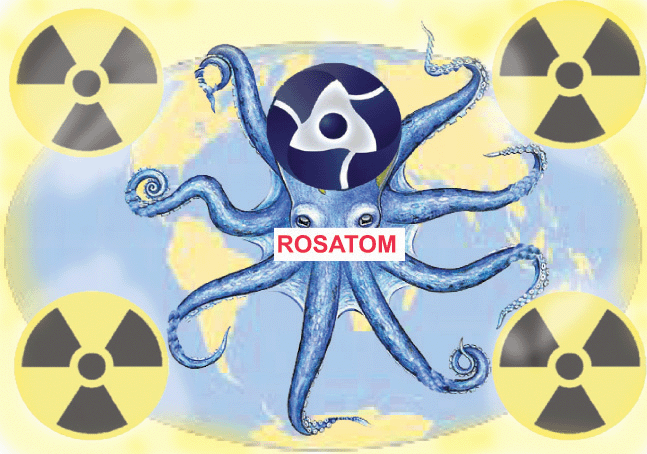
 Russian company’s plan for nuclear power expansion revealedVLADIMIR PUTIN has made nuclear energy one of Russia’s key priorities, and now the Russian nuclear power company Rosatom has revealed to Express.co.uk their plans to ramp up expansion into Europe with small modular reactors. Express UK By CHARLIE BRADLEY, Fri, Nov 29, 2019 Russian company’s plan for nuclear power expansion revealedVLADIMIR PUTIN has made nuclear energy one of Russia’s key priorities, and now the Russian nuclear power company Rosatom has revealed to Express.co.uk their plans to ramp up expansion into Europe with small modular reactors. Express UK By CHARLIE BRADLEY, Fri, Nov 29, 2019
Rosatom is completely under state control, and while its emphasis with some projects has been geared towards powering hard to reach Russian territories, it has also undertaken numerous international projects. This includes the development of nuclear power plants in China, Turkey and Iran, highlighting the growing presence of Russian energy throughout the world. And now, with some projects already under way in countries like Hungary and Finland, its Vice President of Marketing and Business Development Overseas, Anton Moskvin, has told Express.co.uk that Europe is a future target for the company.He said: “I must say Europe is very interesting for us with prospective small modular reactors market development, we know that several countries are interested. The UK has great interest in the small modular reactors.” …… However, some in the EU have expressed concern over any plans for the Russian nuclear giant, fearing that the country could use its business to wield political influence.
In 2014, President Putin agreed a deal worth £8.5billion with Hungary President Viktor Orban, a deal which has seen the two leaders meet regularly since. Hungary is both a NATO and EU member, and the latter has sought legislation to ensure countries embarking on nuclear deals with Moscow do not become dependent on the Kremlin. RFI (Radio France International) reported last month that Jan Haverkamp, vice-chairman of Nuclear Transparency Watch, has serious reservations about the projects. He said: “Our assessment is that the Kremlin tries to use nuclear power now to regain some of that lost influence. “We see Rosatom being very eager to buy up nuclear companies in Europe, where they try to get a participation in order to get a solid nuclear foothold inside the EU.” Mr Moskvin said he could not comment on political issues……… https://www.express.co.uk/news/world/1211103/putin-news-russia-europe-nuclear-power-eu-rosatom-spt |
|
Premiers of Ontario, Saskatchewan, New Brunswick to plan development of Small Modular Nuclear Reactors
 Ontario, Saskatchewan, N.B. premiers to announce nuclear reactor deal, Global News BY STAFF THE CANADIAN PRESS November 30, 2019 “….. The Ontario government said Premier Doug Ford will meet with Saskatchewan Premier Scott Moe and New Brunswick Premier Blaine Higgs for an announcement at a hotel near Pearson International Airport on Sunday afternoon.
A spokesman with Moe’s office confirmed the announcement is connected to an agreement on technology for small modular reactors, while a spokeswoman for Ford’s office said it’s an agreement to work together to determine the best technologies for the deployment of small modular reactors in Canada……
Moe has said that Saskatchewan will address climate change over the next decade by looking to carbon capture and storage technology and by increasing research efforts around small modular nuclear reactors.
However, the possibility of bringing nuclear power to Saskatchewan could still be years away https://globalnews.ca/news/6239231/premiers-nuclear-reactor-deal/
Nuclear-Powered Aircraft failed for both USA and Soviets
Both U.S. and Soviet Attempts at Developing a Nuclear-Powered Aircraft Ended in Failure Nuclear shielding and weight issues proved insurmountable to both the U.S. and the Soviet Union. By Marcia Wendorf, November 17, 2019. In the 1950s, people dreamed of using nuclear energy to power all manner of transport — from cars to airplanes to airships. In the U.S. the father of the nuclear reactor, Enrico Fermi, envisioned a nuclear-powered aircraft, while in the USSR, the chief designer of the Soviet atomic bomb, Aleksandr Kurchatov, thought nuclear-powered “heavy aircraft” could be built.
A nuclear-powered bomber seemed a no-brainer since it could theoretically stay aloft indefinitely, providing an effective deterrent to a nuclear attack. Both the U.S. and the Soviet Union researched nuclear-powered aircraft, but neither country developed an active-duty version due to problems inherent in the design. These included shielding air and ground crews from radiation, and the possible effect of a crash.
To date, no civilian nuclear-powered aircraft has ever been created.
Nuclear-powered jet engines
In May 1946, the U.S. Air Force initiated the Nuclear Energy for the Propulsion of Aircraft (NEPA) program. In 1951, NEPA was supplanted by the Aircraft Nuclear Propulsion (ANP) program, which was run by the Atomic Energy Commission………….
As an odd aside to the nuclear-powered aircraft story, the U.S. military considered solving the shielding problem by employing elderly crews to fly the nuclear-powered airplanes. Their thinking was that the crew would die of natural causes before the effects of radiation could kill them. https://interestingengineering.com/both-us-and-soviet-attempts-at-developing-a-nuclear-powered-aircraft-ended-in-failure
Will Air Independent Propulsion (AIP) submarines make nuclear submarines obsolete?

Why is the nuclear lobby frantically propagandising nuclear reactors for  Australian submarines, just as it looks as if cheaper AIP submarines look likely to take over? (Sell SMRS for submarines off quickly to a dumb nation, before they’re obsolete?)
AIP powered-submarines have proliferated across the world using three different types of engines, with nearly 60 operational today in fifteen countries. Around fifty more are on order or being constructed.
Stealth:…..AIP submarines can, if properly designed, swim underwater even more quietly.
Cost: ….a country could easily buy three or four medium-sized AIP submarines instead of one nuclear attack submarine
|
All U.S. Navy Submarines are Nuclear Powered (But That Could Change)
Here come the subs. National Interest, 11 Nov 1 9, by Sebastien Roblin Key point: AIP subs are affordable and, when piloted by a competent crew, can sink carriers.
Nuclear-powered submarines have traditionally held a decisive edge in endurance, stealth and speed over cheaper diesel submarines. However, new Air Independent Propulsion (AIP) technology has significantly narrowed the performance gap on a new generation of submarines that cost a fraction of the price of a nuclear-powered boat…….
In the 1990s, submarines powered by Air Independent Propulsion (AIP) technology entered operational use. Though the concept dated back to the 19th century and had been tested in a few prototype vessels, it was left to Sweden to deploy the first operational AIP-powered submarine, the Gotland-class, which proved to be stealthy and relatively long enduring. The 60-meter long Gotlands are powered by a Stirling-cycle engine, a heat engine consuming a combination of liquid oxygen and diesel fuel. Since then, AIP powered-submarines have proliferated across the world using three different types of engines, with nearly 60 operational today in fifteen countries. Around fifty more are on order or being constructed. China has 15 Stirling-powered Yuan-class Type 039A submarines with 20 more planned, as well as a single large Type 032 missile submarine that can fire ballistic missiles. Japan for her part has eight medium-sized Soryu class submarines that also use Stirling engines, with 15 more planned for or under construction. The Swedes, for their part, have developed four different classes of Stirling-powered submarines. Germany has also built dozens of AIP powered submarines, most notably the small Type 212 and 214, and has exported them across the globe. The German boats all use electro-catalytic fuel cells, a generally more efficient and quiet technology than the Stirling, though also more complex and expensive. Other countries intending to build fuel-cell powered submarines include Spain (the S-80), India (the Kalvari-class) and Russia (the Lada-class). Finally, France has designed several subs using closed-cycle steam turbine called MESMA. Three upgraded Agosta-90b class subs with MESMA engines serve in the Pakistani Navy. Continue reading |
New type of uranium nuclear fuel has safety risks
 Nuclear fuel alternatives after Fukushima have challenges ahead, https://www.manchester.ac.uk/discover/news/nuclear-fuel-alternatives-after-fukushima-have-challenges-ahead/ 15 Nov 19, Nuclear fuel alternatives after Fukushima have challenges ahead, https://www.manchester.ac.uk/discover/news/nuclear-fuel-alternatives-after-fukushima-have-challenges-ahead/ 15 Nov 19,
Research at The University of Manchester suggests that the preferred candidate fuel to replace uranium oxide in nuclear reactors may need further development before use. Dr Robert Harrison led the research, published in the journal Corrosion Science, with colleagues from the University and the Dalton Nuclear Institute. “Since the 2011 Fukushima accident,” explains Dr Harrison, “there has been an international effort to develop accident tolerant fuels (ATFs), which are uranium-based fuel materials that could better withstand the accident scenario than the current fuel assemblies.” One of these ATFs is a uranium silicon compound, U3Si2. This material conducts heat much better than the traditional uranium oxide fuels, allowing the reactor core to be operated at lower temperatures. In an emergency situation, this buys more time for engineers to bring the reactor under control. However, there are many unknowns about how U3Si2 will behave in the reactor core. “One of these unknowns,” says Dr Harrison, “is how it will behave when exposed to high temperature steam or air, as may happen during manufacturing or a severe accident during reactor operation.” To investigate just how accident tolerant ATFs are, Dr Harrison and his colleagues investigated how Ce3Si2 – a non-radioactive material analogous to U3Si2 – behaved under exposure to high-temperature air. Using advanced electron microscopy techniques, available at The University of Manchester Electron Microscopy Centre (EMC), the researchers were able to study the reaction products after Ce3Si2 was exposed to air at temperatures of up to 750oC. They discovered the material was prone to forming nanometre sized grains of silicon and silicon oxide, as well as cerium oxide. These nano-grains may allow for enhanced corrosion of the fuel material or the escape of radioactive gasses formed during reactor activity. This is because the formation of nano-grains creates more grain boundary areas – interfaces between grains, which provide pathways for corrosive substances or fission gases to migrate along. “Similarly,” adds Dr Harrison, “it would also allow for hazardous gaseous fission products produced during the splitting of uranium (such as xenon gas that would normally be trapped within the material) to diffuse out along these grain boundaries and be released, which would be potentially harmful to the environment.” While Dr Harrison stops short of saying that these ATFs are more unsafe under accident conditions than the current fuels they are looking to replace, he would argue they are currently not any better, and “aren’t as tolerant to accident conditions as once hoped”. Dr Harrison concludes “However, with the new insight developed in this work it will be possible to develop and engineer ATF candidates to better withstand these accident conditions, perhaps by adding other elements, such as aluminium, or manufacturing composite materials to give higher protection of the fuel material”. The full title of the paper is “Atomistic Level Study of Ce3Si2 Oxidation as an Accident Tolerant Nuclear Fuel Surrogate”, and the DOI is 10.1016/j.corsci.2019.108332
|
|
Boris Johnson and the UK plan for nuclear fusion
Boris Johnson’s nuclear energy pledge backed by UK firm with ‘answer to world’s problem’ By CALLUM HOARE. Express UK, Nov 5, 2019 A UK firm has pledged to build on Boris Johnson’s plans to take the “big step” in treading the path for nuclear energy which the Prime Minister claimed will be on sale “around the world” during the Conservative Party conference in Manchester.
The only thing that’s going to restrict us is capital.
“To an investor – no one wants to invest in fusion for safety, it’s very high risk – don’t worry about cracking fusion, it’s about cracking the finance.”
Pulsar Fusion recently opened up the UK’s biggest nuclear fusion centre in a secret location near Bletchley, Buckinghamshire.
Mr Dinan is confident his company will, during the next few months, create matter hot enough to replicate the temperature of the Sun in the UK.
A vacuum chamber will form the heart of the reactor and it is claimed it could soon reach temperatures above 100 million degrees Celsius.

Small nuclear power station consortium targeting Cumbrian sites
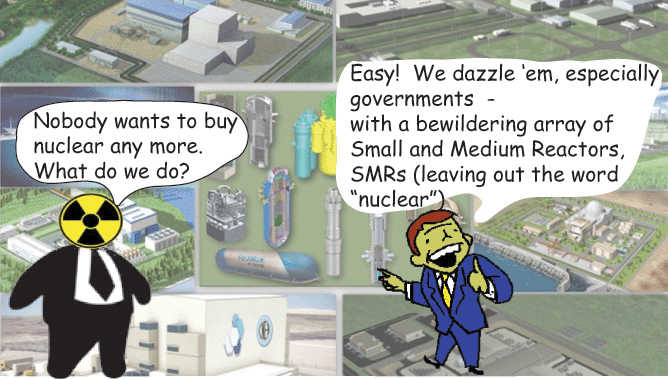 Small nuclear power station consortium targeting Cumbrian sites, The Mail 7th November, By Luke Dicicco @lukeadicicco Group business editor A consortium headed by engineering giant Rolls Royce has revealed it expects to develop its first-of-a-kind small nuclear reactors in Cumbria.
In July the Government said it will invest up to £18 million to support the design of the UK-made mini nuclear power stations. And this week UK Research and Innovation pledged to provide a further £18m, which will be matched by members of the consortium, to progress the project.
Both the Conservative Parliamentary Candidate for Copeland Trudy Harrison and Copeland Borough Council have vowed to up the ante on lobbying the Government to push for SMRs to be developed in Copeland, following the demise of plans for a large-scale nuclear power station at the Moorside site. ……
“We expect to build them on sites in Wales and particularly in Cumbria. That’s where we’re focusing, that’s where we’ll put our effort.”- Mr Woods …..
The SMRs are roughly the size of a one-and-a-half football pitches……..Construction is expected to take around four years per station, although the first unit would be longer, said Mr Woods.
The consortium says it is targeting a £1.8bn cost for each station…….
However, industry insiders still believe a large-scale plant is more suited to the vast Moorside site adjacent to Sellafield. And hopes remain high that a new development will come forward for the site once the Government unveils a new way of financially supporting new plants, with the most likely option a Regulated Asset Base Model. ……
“Unless you build a fleet, you will not do it. We want an industrial partnership between UK and China.” – Rob Davies, chief operating officer at CGN UK
CGN is already heavily involved in the UK’s nuclear new build plans.
It is a partner in the under-construction Hinkley Point C power station in Somerset, as well as planned developments for Bradwell B in Essex and Sizewell C in Somerset. https://www.nwemail.co.uk/news/18021450.small-nuclear-power-station-consortium-targeting-cumbrian-sites/
The failure of nuclear reprocessing and the “Plutonium Economy”
No one on the planet has been able to run unspent nuclear fuel through twice, and make it economically viable, let alone the countless times needed to make it ecologically viable.
It costs more to run unspent fuel through once more than to
• mine uranium,
• process for shipping
• process into yellowcake
• make into rods
• ship rods onsite to reactors
There is little to NO CHANCE of doing that again, and again.
Business history shows this wasn’t possible when;
• uranium was at its peak in price in 1980
2019, about to enter the third decade of the 21C, where commodities exchanges show nuclear fuel it is;
• LOWEST PRICE than in all of economic history,
and yet it still can’t compete with any other energy sources.
Nuclear apologists are a joke, delusional.
The nuclear sales executives of the nuclear estate have been busy rebranding, white and greenwashing their product is ever since Ronald Reagan announced The Plutonium Economy failed.
In point of fact, carbon fuel, gas spinning a turbine, has been producing cheaper energy fully levelized for three decades than any nuclear reactor.
Large scale
• solar PV and
• on-offshore wind turbines
• reached PARITY with
• carbon fuel NATURAL GAS
late last decade on an LCOE basis.
For this whole decade these;
• renewable systems
• fully lifecycle factored
• are cheaper than even carbon fuels
• NATURAL GAS
Bill Gates still hoping for tax-payer funding for his small nuclear reactor project
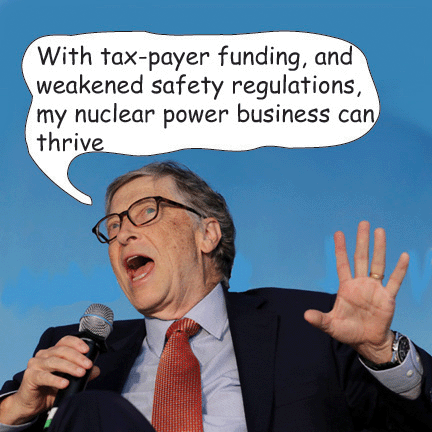
Bill Gates’ Nuclear Reactor Hits a Roadblock,
Engineering.com , October 21, 2019 Bill Gates is optimistic about the future—and the role of nuclear energy as an environmentally friendly energy source—but he faces significant obstacles along the way.
His company, TerraPower, is working on new technologies to revolutionize nuclear power. One of them is a traveling wave reactor (TWR). ………
One major problem with a TWR power plant is the price. It will cost about $3 billion to build a demonstration reactor. Even Bill Gates isn’t rich enough to fund it himself. TerraPower had signed a promising agreement with China to build a demonstration reactor, but the project has been shuttered due to China-U.S. trade tensions. The company is now lobbying Congress for a public-private partnership to fund the reactor. ……
China’s huge unfinished underground nuclear facility
In the 1960s, at the height of the Cold War and amid rising tension between the Soviet and Chinese governments, the Chinese Communist Party began relocating its military installations inland, away from major targets in the large coastal cities. The 816 Nuclear Reactor was Communist China’s first foray into building its own nuclear reactor capable of producing weapons-grade plutonium without Soviet assistance.
To further protect against a nuclear attack, Premier Zhou Enlai approved a project that called for building the reactor underground, adding an extra layer of complexity to an already difficult engineering process. For the following 18 years, more than 60,000 workers were dispatched to an isolated base in the remote Sichuan mountains, at that time only reachable by boat. The tunnels were dug using only small drills, shovels, and dynamite, and official figures state that at least 100 workers died due to the harsh and dangerous working conditions, although it is suspected that the actual number is much higher.
Due largely to the changing circumstances of the Cold War, the project was abruptly called off in 1984, with construction of the doomed project only 85 percent completed. For 26 years, the site lay mostly abandoned, used for storage and as a fertilizer factory, before opening its doors to Chinese tourists in 2010………https://www.atlasobscura.com/places/816-underground-nuclear-plant
1 This Month
29 Jan. Thursday 7-8 p.m. Webinar – World’s Largest Nuclear Station in Port Hope, ON?
To see nuclear-related stories in greater depth and intensity – go to https://nuclearinformation.wordpress.com/



31st January – Challenging the War Machine – a DECLASSIFIED UK SUMMIT


Website of the Week
Now until to February 10, 2026 Radioactive waste storage in France: the debate is finally open! How to participate?
-
Archives
- January 2026 (283)
- December 2025 (358)
- November 2025 (359)
- October 2025 (376)
- September 2025 (258)
- August 2025 (319)
- July 2025 (230)
- June 2025 (348)
- May 2025 (261)
- April 2025 (305)
- March 2025 (319)
- February 2025 (234)
-
Categories
- 1
- 1 NUCLEAR ISSUES
- business and costs
- climate change
- culture and arts
- ENERGY
- environment
- health
- history
- indigenous issues
- Legal
- marketing of nuclear
- media
- opposition to nuclear
- PERSONAL STORIES
- politics
- politics international
- Religion and ethics
- safety
- secrets,lies and civil liberties
- spinbuster
- technology
- Uranium
- wastes
- weapons and war
- Women
- 2 WORLD
- ACTION
- AFRICA
- Atrocities
- AUSTRALIA
- Christina's notes
- Christina's themes
- culture and arts
- Events
- Fuk 2022
- Fuk 2023
- Fukushima 2017
- Fukushima 2018
- fukushima 2019
- Fukushima 2020
- Fukushima 2021
- general
- global warming
- Humour (God we need it)
- Nuclear
- RARE EARTHS
- Reference
- resources – print
- Resources -audiovicual
- Weekly Newsletter
- World
- World Nuclear
- YouTube
-
RSS
Entries RSS
Comments RSS
 nuclear-news