Unjustified hype over non existent Small Nuclear Reactors
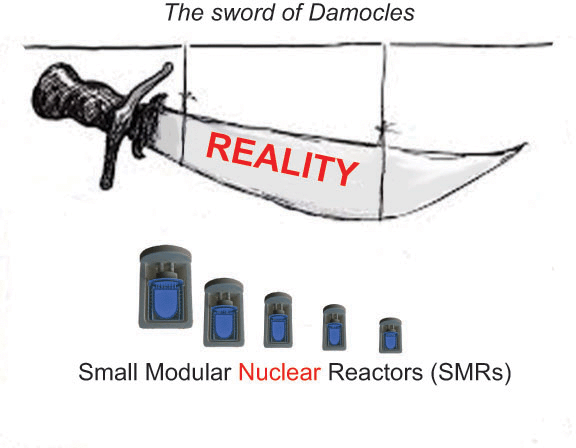 Let’s call SMRs what they are, Leaving out “nuclear” doesn’t minimize the danger, or the cost https://beyondnuclearinternational.org/2020/02/23/lets-call-smrs-what-they-are/By Gordon Edwards, Michel
  Duguay and Pierre Jasmin, February 23, 2020, On Friday the 13th, September 2019, the St John Telegraph-Journal’s front page was dominated by what many gullible readers hoped will be a good luck story for New Brunswick – making the province a booming and prosperous Nuclear Energy powerhouse for the entire world.
After many months of behind-the-scenes meetings throughout New Brunswick with utility company executives, provincial politicians, federal government representatives, township mayors and First Nations, two nuclear entrepreneurial companies laid out a dazzling dream promising thousands of jobs – nay, tens of thousands! – in New Brunswick, achieved by mass-producing and selling components for hitherto untested nuclear reactors called SMNRs (Small Modular Nuclear Reactors) which, it is hoped, will be installed around the world by the hundreds or thousands!
On December 1, the Saskatchewan and Ontario premiers hitched their hopes to the same nuclear dream machine through a dramatic tripartite Sunday press conference in Ottawa featuring the premiers of the provinces. The three amigos announced their desire to promote and deploy some version of Small Modular Nuclear Reactors in their respective provinces. All three claimed it as a strategy to fight climate change, and they want the federal government to pledge federal tax money to pay for the R&D. Perhaps it is a way of paying lip service to the climate crisis without actually achieving anything substantial; prior to the recent election, all three men were opposed to even putting a price on carbon emissions.
Motives other than climate protection may apply. Saskatchewan’s uranium is in desperate need of new markets, as some of the province’s most productive mines have been mothballed and over a thousand uranium workers have been laid off, due to the global decline in nuclear power. Meanwhile, Ontario has cancelled all investments in over 800 renewable energy projects – at a financial penalty of over 200 million dollars – while investing tens of billions of dollars to rebuild many of its geriatric nuclear reactors. This, instead of purchasing surplus water-based hydropower from Quebec at less than half the cost.
Three previous “small reactor” failures in Canada so far
These new nuclear reactors are so far perfectly safe, because they exist only on paper and are cooled only by ink. But declaring them a success before they are even built is quite a leap of faith, especially in light of the three previous Canadian failures in this field of “small reactors”. Two 10-megawatt MAPLE reactors were built at Chalk River and never operated because of insuperable safety concerns, and the 10-megawatt “Mega-Slowpoke” district heating reactor never earned a licence to operate, again because of safety concerns. The Mega-Slowpoke was offered free of charge to two universities – Sherbrooke and Saskatchewan – and several communities, all of whom refused the gift. And a good thing too, as the only Mega-Slowpoke ever built (at Pinawa, in Manitoba) is now being dismantled without ever producing a single useful megawatt of heat.
This current media hype about modular reactors is very reminiscent of the drumbeat of grandiose expectations that began around 2000, announcing the advent of a Nuclear Renaissance that envisaged thousands of new reactors — huge ones! — being built all over the planet. That initiative turned out to be a complete flop. Only a few large reactors were launched under this banner, and they were plagued with enormous cost-over-runs and extraordinarily long delays, resulting in the bankruptcy or near bankruptcy of some of the largest nuclear companies in the world – such as Areva and Westinghouse – and causing other companies to retire from the nuclear field altogether – such as Siemens.
 Speculation about that promised Nuclear Renaissance also led to a massive (and totally unrealistic) spike in uranium prices, spurring uranium exploration activities on an unprecedented scale. It ended in a near-catastrophic collapse of uranium prices when the bubble burst. Cameco was forced to close down several mines. They are still closed. The price of uranium has still not recovered from the plunge.
Large nuclear reactors have essentially priced themselves out of the market. Only Russia, China and India have managed to defy those market forces with their monopoly state involvements. Nevertheless, the nuclear contribution to world electricity production has plummeted from 17 percent in 1997 to about 10 percent in 2018. In North America and Western Europe, the prospects for new large reactor projects are virtually nil, and many of the older reactors are shutting down permanently without being replaced.
During long construction times nuclear makes the climate problem worse
Many people concerned about climate change want to know more about the moral and ethical choices regarding low-carbon technologies: “Don’t we have a responsibility to use nuclear?” The short reply is: nuclear is too slow and too expensive. The ranking of options should be based on what is cheapest and fastest — beginning with energy efficiency, then on to off-the-shelf renewables like wind and solar energy.
As a case in point, Germany installed over 30,000 megawatts of wind energy capacity in only 8 years, after deciding to close down all of its nuclear reactors by 2022. That is an impressive achievement – more than twice the total installed nuclear capacity of Canada. It would be impossible to build 30,000 megawatts of nuclear in only 8 years.
By building wind generators, Germany obtained some carbon relief in the very first year of construction, then got more benefit in the second year, even more benefit in the third, and so on, building up to a cumulative capacity of 30,000 MWe after 8 years. With nuclear, even if you could manage to build 30,000 megawatts in 8 years, you would get absolutely no benefit during that entire 8-year construction period.
In fact you would be making the problem worse by mining uranium, fabricating fuel, pouring concrete and building the reactor core and components, all adding to greenhouse gas emissions – earning no benefit until (and IF) everything is finally ready to function.
In the meantime (10 to 20 years), you will have starved the efficiency and renewable alternatives of the funds and political will needed to implement technologies that can really make an immediate and substantial difference.
In Saskatchewan, professor Jim Harding, who was director for Prairie Justice Research at University of Regina where he headed up the Uranium Inquiries Project, has offered his own reflection. Here is the conclusion of his December 2, 2019 comment:
“In short, small reactors are another distraction from Saskatchewan having the highest levels of GHGs on the planet – nearly 70 metric tonnes per capita. While the rest of Canada has been lowering emissions, those here, along with Alberta with its high-carbon tar sands, have continued to rise. Saskatchewan and Alberta’s emissions are now almost equal to all the rest of Canada. Shame on us!”
In the USA, engineers and even CEO’s of some of the leading nuclear companies are admitting that the age of nuclear energy is virtually over in North America. This negative judgment is not coming from people who are opposed to nuclear power, quite the opposite — from people lamenting the decline. See, for example, one major report from the Engineering faculty at Carnegie-Mellon University.
The SMR order book is filled with blank pages; there are no customers
That Carnegie-Mellon report includes Small Modular Nuclear Reactors in its analysis, without being any more hopeful for a nuclear revival on that account. The reason? It is mainly because a new generation of smaller reactors, such as those promised for New Brunswick, will necessarily be more expensive per unit of energy produced, if manufactured individually. The sharply increased price can be partially offset by mass production of prefabricated components; hence the need for selling hundreds or even thousands of these smaller units in order to break even and make a profit. However, the order book is filled with blank pages — there are no customers. This being the case, finding investors is not easy. So entrepreneurs are courting governments to pony up with taxpayers’ money, in the hopes that this second attempt at a Nuclear Renaissance will not be the total debacle that the first one turned out to be.
Over 150 designs and none built, tested, licensed or deployed
Chances are very slim however. There are over 150 different designs of “Small Modular Reactors”. None of them have been built, tested, licensed or deployed. At Chalk River, Ontario, a consortium of private multinational corporations, comprised of SNC-Lavalin and two corporate partners, operating under the name “Canadian Nuclear Laboratories” (CNL), is prepared to host six or seven different designs of Small Modular Nuclear Reactors — none of them being identical to the two proposed for New Brunswick – and all of these designs will be in competition with each other. The Project Description of the first Chalk River prototype Small Modular Reactor has already received over 40 responses that are posted on the CNSC web site, and virtually all of them are negative comments.
The chances that any one design will corner enough of the market to become financially viable in the long run is unlikely. So the second Nuclear Renaissance may carry the seeds of its own destruction right from the outset. Unfortunately, governments are not well equipped to do a serious independent investigation of the validity of the intoxicating claims made by the promoters, who of course conveniently overlook the persistent problem of long-lived nuclear waste and of decommissioning the radioactive structures. These wastes pose a huge ecological and human health problem for countless generations to come.
Finally, in the list of projects being investigated, one finds a scaled-down “breeder reactor” fuelled with plutonium and cooled by liquid sodium metal, a material that reacts violently or explodes on contact with air or water. The breeder reactor is an old project abandoned by Jimmy Carter and discredited by the failure of the ill-fated French SuperPhénix because of its extremely dangerous nature. In the event of a nuclear accident, the Tennessee Clinch River Breeder Reactor was judged capable of poisoning twelve American states and the SuperPhénix half of France.
One suspects that our three premiers are only willing to revisit these bygone reactor designs in order to obtain funding from the federal government while avoiding responsibility for their inaction on more sensible strategies for combatting climate changes – cheaper, faster and safer alternatives, based on investments in energy efficiency and renewable sources.
Gordon Edwards PhD, is President of the Canadian Coalition for Nuclear Responsibility. Michel Duguay, PhD, is a professor at Laval University. Pierre Jasmin, UQAM, is with Quebec Movement for Peace and Artiste pour la Paix.
Japan’s paralysis over what to do with the nuclear industry’s plutonium wastes
Review the nation’s quest for a nuclear fuel cycle https://www.japantimes.co.jp/opinion/2020/02/20/editorials/review-nations-quest-nuclear-fuel-cycle/#.XlBKh2gzbIU The uncertain fate of the spent mixed-oxide (MOX) fuel removed from two nuclear power reactors in western Japan last month — for the first time since the commercial use of plutonium-uranium fuel in light water reactors began about a decade ago — is yet another sign of the stalemate over the government’s nuclear fuel cycle policy. While the government maintains that all spent nuclear fuel will be reprocessed for reuse as fuel for nuclear reactors, there are no facilities in this country that can reprocess spent MOX fuel so it will remain indefinitely in storage pools at the nuclear plants.
Desperate nuclear industry hypes up unlikely new gimmick, HALEU nuclear fuel
 The World’s Tiniest Nuclear Plant Is Coming to Idaho, The demonstration represents a new-generation of micro-reactors. Popular Mechanics, Feb 21, 2020 “……
- experts suggest that Oklo’s timeline is unrealistic with years of nuclear approval process ahead…….
- In December, Oklo received a permit to begin building their new Aurora plant, which is the first and only permit ever issued in the U.S. to a nuclear plant using something other than a light water (“water-cooled”) reactor. The specific mix of fuel they plan to use is called HALEU for short: “High-assay, low-enriched uranium (HALEU) …..
- There are big obstacles in Oklo’s way, though. Their planned timeline, which Grist says is to open between 2022 and 2025—after just receiving a permit in December 2019—would be one of the shortest in U.S. nuclear power history. For the first-of-its-kind commercial, HALEU-fueled fast breeder reactor, this seems optimistic, to say the least.
Small nuclear reactors are no better than large ones
This very well-written and informative article still does not examine the  question “Is nuclear power, of any type REALLY a solution to climate change?” Why on earth are all these writers mindlessly buying the nuclear lobby’s spurious claim? The nuclear reactor itself emits a tiny amount of Carbon 14. The entire nuclear chain, from mining to waste storage is a huge carbon emitter. How many thousands of these so-called “small” reactors would have to be up and running in time to make any difference? This push for smrs will be useful only to the military, and only tax-payers will foot the bill.
small modular reactors suffer from many of the same problems as large reactors, most notably safety issues and the unresolved problem of what to do with long-lived radioactive waste.
even in a smaller form, nuclear power is expensive — it’s one of the costliest forms of energy, requiring substantial government subsidies to build and run, not to mention insure.
When It Comes to Nuclear Power, Could Smaller Be Better? Yale Environment 360 , BY LOIS PARSHLEY 19 Feb 20, A handful of companies and governments are working to develop small-scale nuclear reactors that proponents say are safer, cheaper, and more compatible with renewables than traditional nuclear power. But critics contend the new technology doesn’t address concerns about safety and radioactive waste.
Huge computer screens line a dark, windowless control room in Corvallis, Oregon, where engineers at the company NuScale Power hope to define the next wave of nuclear energy. Glowing icons fill the screens, representing the power output of 12 miniature nuclear reactors. Together, these small modular reactors would generate about the same amount of power as one of the conventional nuclear plants that currently dot the United States — producing enough electricity to power 540,000 homes. On the glowing screens, a palm tree indicates which of the dozen units is on “island mode,” allowing a single reactor to run disconnected from the grid in case of an emergency.
This control room is just a mock-up, and the reactors depicted on the computer screens do not, in fact, exist. Yet NuScale has invested more than $900 million in the development of small modular reactor (SMR) technology, which the company says represents the next generation of nuclear power plants. NuScale is working on a full-scale prototype and says it is on track to break ground on its first nuclear power plant — a 720-megawatt project for a utility in Idaho — within two years; the U.S. Nuclear Regulatory Commission has just completed the fourth phase of review of NuScale’s design, the first SMR certification the commission has reviewed. The company expect final approval by the end of 2020. The U.S. Department of Energy has already invested $317 million in the research and development of NuScale’s SMR project.
NuScale is not alone in developing miniature reactors. In Russia, the government has launched a floating 70-megawatt reactor in the Arctic Ocean. China announced plans in 2016 to build its own state-funded floating SMR design. Three Canadian provinces — Ontario, New Brunswick, and Saskatchewan — have signed a memorandum to look into the development and deployment of small modular reactors. And the Rolls-Royce Consortium in the United Kingdom is working on the development of a 440-megawatt SMR.
Proponents say the time is ripe for this new wave of nuclear reactors for several reasons. First, they maintain that if the global community has any hope of slashing CO2 emissions by mid-century, new nuclear technologies must be in the mix. Second, traditional nuclear power is beset with problems. Many existing plants are aging, and new nuclear power construction is plagued by substantial delays and huge cost overruns; large-scale nuclear power plants can cost more than $10 billion. Finally, advocates say that as supplies of renewable energy grow, small modular reactors can better handle the variable nature of wind and solar power as SMRs are easier to turn on and leave running.
Critics of nuclear power, however, contend that small modular reactors suffer from many of the same problems as large reactors, most notably safety issues and the unresolved problem of what to do with long-lived radioactive waste. And opponents say that even in a smaller form, nuclear power is expensive — it’s one of the costliest forms of energy, requiring substantial government subsidies to build and run, not to mention insure. NuScale’s SMR is offering an artificial 6.5 cent-per-kilowatt-hour cap as an incentive to get its first project off the ground. Yet in September, the Los Angeles Department of Water and Power announced that it had accepted a bid of electricity coming from renewables, with storage capacity that can deliver round-the-clock supply, at 2 cents a kilowatt-hour.
M.V. Ramana, the Simons Chair in Disarmament, Global and Human Security at the University of British Columbia, says that as renewable prices plummet, nuclear power just can’t compete. More than a third of U.S. nuclear plants are now unprofitable or scheduled to close. Globally, nuclear energy now only supplies 11 percent of electricity, down from a record high of 17.6 percent in 1996. After the 2011 Fukushima disaster in Japan, Germany decided to close its nuclear industry altogether, and countries like Belgium, Switzerland, and Italy have declined to replace existing reactors or move forward with plans for new ones…….
SMR opponents maintain that no matter the size, nuclear power has unresolved cost and safety concerns. To realize savings through mass manufacturing, there would need to be a standardized SMR design, critics say; currently, there are dozens. And SMRs would also have to be built in large quantities. But for a company to invest in making reactors and their components, it would need a reliable market, and many private investors are still wary of the new technology. Andrew Storer, CEO of the Nuclear Advanced Manufacturing Research Center, which forecasts markets for nuclear power manufacturers, says, as far far as supply chain companies go, “We’re advising people, ‘Don’t invest yet.’”
Recent experience supports skepticism. Westinghouse worked on an SMR design for a decade before giving up in 2014. Massachusetts-based Transatomic Power, a nuclear technology firm, walked away from a molten salt SMR in 2018, and despite an $111 million dollar infusion from the U.S. government, a SMR design from Babcock &Wilcox, an advanced energy developer, folded in 2017. While the Russians have managed to get their state-funded SMR floating, its construction costs ran over estimates by four times, and its energy will cost about four times more than current U.S. nuclear costs.
Eventually, every nuclear conversation turns to radioactive waste and safety. SMRs using a pressurized water reactor will continue to generate highly radioactive spent fuel, yet no country has a permanent solution for how to safely store this kind of waste. The U.S. has been looking for a place to put a permanent nuclear waste repository since 1982; in the meantime, 70 percent of the U.S.’s spent fuel is sitting in cooling pools, many of which are aging and vulnerable, and often in quantities much larger than what is considered safe.
Because NuScale hopes to replace coal-fired power plants in the U.S. and the UK, perhaps even building on the grounds of shuttered power plant sites in more populated areas, the Nuclear Regulatory Commission is considering eliminating some standard safety measures, including a requirement for an emergency evacuation zone and the need for backup power. NuScale says that because SMRs contain smaller quantities of radioactive materials and can be sited underground, their risks are lower and they require less security staff.
This has raised sharp criticism from nuclear experts. Even the Union of Concerned Scientists, which has generally supported nuclear power, says, “It would be irresponsible for the NRC to reduce safety and security requirements for any reactor of any size.”
|
This very well-written and informative article still does not examine the question “Is nuclear power, of any type REALLY a solution to climate change?” Why on earth are all these writers mindlessly buying the nuclear lobby’s spurious claim? The nuclear reactor itself emits a tiny amount of Carbon 14. The entire nuclear chain, from mining to waste storage is a huge carbon emitter. How many thousands of these so-called “small” reactors would have to be up and running in time to make any difference? This push for smrs will be useful only to the military, and only tax-payers will foot the bill. https://e360.yale.edu/features/when-it-comes-to-nuclear-power-could-smaller-be-better |
|
|
Rolls Royce plans small nuclear reactors near Snowdonia National Park in Wales.
|
Rolls-Royce eyes Snowdonia nuclear site for first small modular reactor, https://www.constructionnews.co.uk/sustainability/rolls-royce-eyes-snowdonia-nuclear-site-for-first-small-modular-reactor-14-02-2020/BY MILES ROWLAND Engineering firm Rolls-Royce has said that the first of its planned small nuclear reactors could be built at a site near Snowdonia National Park in Wales.
Speaking to the BBC today, Rolls-Royce chief technology officer Paul Stein said there was a “high probability” that Trawsfynydd would be the site of the first such reactor, which would be assembled from pre-manufactured components. The site was previously home to a nuclear reactor, closed in 1991, and has an existing local nuclear supply chain. Stein said: “Trawsfynydd is a great first site for the [reactor]. Right now the jury’s out – there are a number of great sites around the country – but two of the three sites [under consideration] are in Wales.” He added: “With so-called brownfield sites, where there has been a nuclear reactor, we know the local population is happy, there is a skilled local population that used to run the plant, there’s a grid connection and the seismic condition of the site [is suitable].” Rolls-Royce announced last year that it was working with a consortium of companies including Laing O’Rourke, Bam Nuttall and Atkins to develop small modular reactors (SMRs), with Laing O’Rourke telling Construction News that it could use its offsite manufacturing facility to produce components. Once operational, each SMR could generate 440MW of energy, enough to power Cardiff, Swansea and Newport combined, according to Rolls-Royce. The reactors have a target cost of £1.8bn each by the time five stations have been constructed, though the first will not be completed until at least 2029. Wylfa in Anglesey has previously been identified by Rolls-Royce as another potential site for SMRs. |
|
Few permanent jobs in small modular nuclear reactors?
In Cumbria 12th Feb 2020, Plans to develop unique small nuclear reactors in Cumbria by Rolls-Royce should not be seen as a “saviour of the county”, one of its major rivals said.
in-Cumbria exclusively revealed in November that a consortium, led by
the engineering giant, was focusing its efforts on efforts on developing
its emerging Small Modular Reactors at existing nuclear licensed sites –
with Cumbria and Wales its top targets.
But John Coughlan, chief executive of TSP Engineering, based in Workington, said he was concerned that people would think the plans would prompt people to think thousands of jobs would be created. TSP Engineering is also developing its own version of the technology, and while Mr Coughlan acknowledged that they were rivals and that was a factor in him speaking out, he was also passionate about the local community. He said:
“Make no mistake. When Rolls-Royce talk about developing their reactors in Cumbria, they are talking about a construction site. “If they get the go-ahead for Cumbria, the reactors will be shipped in from elsewhere and built on the site. So you are probably looking at a large number of short-term construction jobs – say 1,000 – then only about 60 to 100 people with a permanent position there.
Russian Space Agency confirms plans to launch nuclear-powered space tug by 2030
|
Russian Space Agency confirms plans to launch nuclear-powered space tug by 2030 Space Daily, by Staff Writers
Moscow (Sputnik) Jan 29, 2020 The secrecy-laden project, in development since 2010, is intended to facilitate the transportation of large cargoes in deep space, including for the purpose of creating permanent bases on other planets in our solar system.Roscosmos plans to deliver a nuclear-powered space tug into orbit by the year 2030, agency first deputy director Yuri Urlichich has confirmed. In a presentation at the ongoing Korolev Academic Space Conference in Moscow, Urlichich explained that the tug will be launched in 2030 for flight testing, with series production and commercial use to begin after that…….. http://www.spacedaily.com/reports/Russian_Space_Agency_confirms_plans_to_launch_nuclear_powered_space_tug_by_2030_999.html |
|
Nuclear recycling is a bad idea
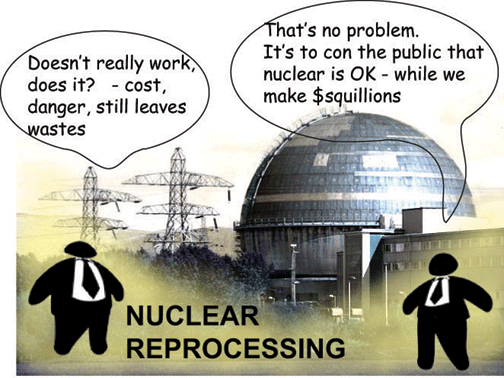

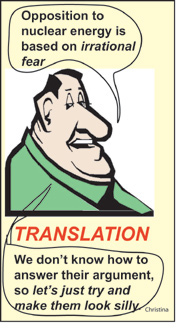 claiming that nuclear power is safe and finding a solution for its toxic waste is easy. If it’s so easy, why don’t they have a workable solution? Is it really just peoples’ unreasonable fears that obstruct the industry and the federal government from creating a final solution?
Originally we were told that there was no waste problem because the waste would be reprocessed and used again in bombs and new “breeder” reactors. That idea failed! Miserably! The only reprocessing facility for commercial nuclear waste that ever existed was West Valley in upstate New York and it shuttered after only five years because it contaminated the land and water around it with radiation. It remains a Superfund site to this day. Without the technology to safely reprocess it, nuclear fuel waste remains in fuel pools and dry storage at reactor sites all over the country.
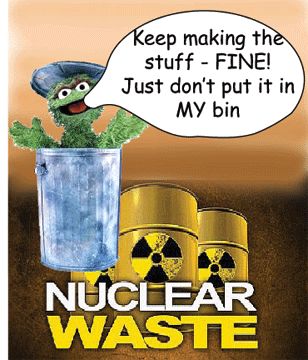 All this was codified under the 1982 Nuclear Waste Policy Act (NWPA). Once established, investigations began to determine the best dump site/s. But every state that was identified as a potential site for a repository threatened to sue. Instituting the NWPA was in crisis. The NWPA was amended and Congress targeted Yucca Mountain because
 failed to meet the necessary criteria for safe isolation of the deadly material. With the failure of the federal government and the nuclear industry to establish Yucca Mountain as the national repository for nuclear waste, nuclear corporations were forced to establish onsite storage at their operating and shuttered reactor sites. Six out of nine reactors in New England have shuttered due to significant public opposition and their inability to compete with gas and renewables. These six sites are in varying degrees of cleanup. Without a “solution” as to dealing with the nuclear waste, these sites have devolved into ad hoc nuclear waste dumps. All have created onsite storage for their high level waste. It costs a lot to store the waste onsite — at least $5 million out of pocket for each year. This waste could remain onsite for decades if not centuries. So costs could really add up for corporations without any revenue. Naivety, arrogance, and thoughtlessness add up to a lot of money!
With waste piling up at shuttered reactor sites throughout the country, the industry has a perception problem. This is not a favorable image for an  industry trying to reinvent itself as the answer to global warming. So what’s the industry’s answer? It wants to create “interim storage” dump sites in west Texas and New Mexico in working poor, Hispanic communities to make this problem disappear. These sites don’t have to meet the strict environmental standards that sunk Yucca Mountain— i.e., isolation from the environment for 1,000 years and isolation from groundwater for 10,000 years.
This “interim storage” initiative is a statement of the failure of the nuclear industry and the federal government to address the most toxic waste we have ever created. We don’t need more nukes; we don’t need half baked “solutions”. We need a commitment to put our best minds to solve this thorny problem. What is needed is a scientifically sound and environmentally just solution, not more magic or wish fulfillment. A qualified “panel” must be established and funded to create the standards required to meet the health and safety of the public and the planet, not the profit-driven, short-sighted monetary bottom line of a moribund industry.
Deb Katz is the executive director of the Citizens Awareness Network, which was founded locally in 1991 and has offices in Shelburne Falls and Rowe. Here’s a link to our website www.nukebusters.org.
Rolls Royce’s fantasy plan for so-called ‘mini’ nuclear reactors

|
Rolls-Royce plans mini nuclear reactors by 2029 https://www.bbc.com/news/business-51233444 By Roger Harrabin & Katie Prescott, BBC environment analyst and business reporter, 24 January 2020
Mini nuclear reactors could be generating power in the UK by the end of the decade. Manufacturer Rolls-Royce has told the BBC’s Today programme that it plans to install and operate factory-built power stations by 2029. Mini nuclear stations can be mass manufactured and delivered in chunks on the back of a lorry, which makes costs more predictable. But opponents say the UK should quit nuclear power altogether. They say the country should concentrate on cheaper renewable energy instead. Environmentalists are divided over nuclear power, with some maintaining it is dangerous and expensive, while others say that to achieve net zero emissions by 2050 all technologies are needed. However, the industry is confident that mini reactors can compete on price with low-cost renewables such as offshore wind. Rolls-Royce is leading a consortium to build small modular reactors (SMRs) and install them in former nuclear sites in Cumbria or in Wales. Ultimately, the company thinks it will build between 10 and 15 of the stations in the UK. They are about 1.5 acres in size – sitting in a 10-acre space. That is a 16th of the size of a major power station such as Hinkley Point. SMRs are so small that theoretically every town could have its own reactor – but using existing sites avoids the huge problem of how to secure them against terrorist attacks. It is a rare positive note from the nuclear industry, which has struggled as the cost of renewables has plummeted. In the past few years, major nuclear projects have been abandoned as Japanese companies Toshiba and Hitachi pulled out because they could not get the required funding. And the construction of Hinkley Point in Somerset could cost £3bn more than was expected, in an echo of the row over the rail mega-project HS2. “The trick is to have prefabricated parts where we use advanced digital welding methods and robotic assembly and then parts are shipped to site and bolted together,” said Paul Stein, the chief technology officer at Rolls-Royce.
He said the approach would dramatically reduce the cost of building nuclear power sites, which would lead to cheaper electricity. But Paul Dorfman from University College London said: “The potential cost benefits of assembly line module construction relative to custom-build on-site construction may prove overstated. “Production line mistakes may lead to generic defects that propagate throughout an entire fleet of reactors and are costly to fix,” he warned. “It’s far more economic to build one 1.2 GW unit than a dozen 100 MW units.” Rolls-Royce is hoping to overcome the cost barrier by selling SMRs abroad to achieve economies of scale. Its critics have warned that SMRs will not be ready in substantial numbers until the mid 2030s, by which time electricity needs to be carbon-free in the UK already to meet climate change targets. |
|

As building large nuclear stations stall in UK, sites are picked for ‘small] nuclear reactors


REVEALED: Sites for revolutionary mini nuclear power stations led by Rolls-Royce are set to be built in the North of England
- Whitehall is planning new small nuclear power plants in Cumbria and Wales
- Britain’s eight large-scale nuclear power plants are reaching their end of life
- Plans to build a new generation of large-scale nuclear power stations are stalled
- Officials hope these smaller power stations will be able to plug the potential gap
Daily Mail, By NEIL CRAVEN FOR THE MAIL ON SUNDAY 19 January 2020 | The first of a new generation of revolutionary mini nuclear power stations is to be built in the North of England and North Wales by a consortium led by Rolls-Royce, The Mail on Sunday can reveal.
A number of existing licensed nuclear sites have already been informally discussed within Whitehall.
The sites under consideration include Moorside in Cumbria and Wylfa in North Wales, where plans for future large-scale reactor projects have recently been shelved/
Britain’s eight large-scale nuclear power plants are nearing the end of their collective lifespan, with most due to close by the end of the decade.
It will be followed by up to 16 more mini reactors at other sites, with plans for all to be producing electricity.
It is understood that other locations being considered include Trawsfynydd in Snowdonia, North Wales…….
The pre-fabricated modules would then be transported to sites for construction. Officials have cautioned, though, that there could be public opposition in some areas to a nuclear facility being built nearby. ……..
Work at Wylfa by nuclear developer Horizon, owned by Japanese firm Hitachi, was suspended a year ago amid rising costs. Only months before, plans for a new nuclear power station at Moorside were scrapped after the Japanese giant Toshiba announced it was winding up the project.
A joint investment of £500 million between the Government and the Rolls-Royce consortium was proposed last summer. An initial award from the Government of £18 million was signed off in November, which the consortium will match.
One nuclear industry source said: ‘There is broad support for this programme from Government.’ https://www.dailymail.co.uk/news/article-7903495/New-Rolls-Royce-mini-nuclear-power-stations-built-North.html
No chance of re-using spent mixed-oxide (MOX) fuel, its storage highly dangerous
|
Mainichi 15th Jan 2020, There are no prospects that spent mixed-oxide (MOX) fuel, made by reprocessing spent nuclear material, can be further reprocessed and reused for nuclear power generation in accordance with the Japanese government’s energy policy.
Storing such fuel for a long period has thus raised safety
concerns. The Nuclear Regulation Authority (NRA) has expressed concerns that the storage of spent MOX fuel in the pool over such a long period is highly dangerous. In case of a power blackout, the temperature of the water in the pool could not be maintained at a certain level and it would become unable to cool the fuel just as was the case with the Fukushima nuclear crisis. https://mainichi.jp/english/articles/20200115/p2a/00m/0na/029000c |
|
Small Modular Nuclear Reactors’ costs and toxicity

Small modular nuclear reactors – a case of wishful thinking at best, NB Media Cop. by Gordon Edwards, Michel Duguay, Pierre Jasmin, 21 Dec 19
“……….4 Small Modular – Nuclear – Reactors’ costs & toxicity
That Carnegie-Mellon report includes Small Modular Nuclear Reactors in its analysis, without being any more hopeful than we are. This is mainly because a new generation of smaller reactors, such as those promised for New Brunswick, will necessarily be more expensive per unit of energy produced, if manufactured individually. The sharply increased price can be partially offset by mass production of prefabricated components; hence the need for selling hundreds or even thousands of these smaller units in order to break even and make a profit. However, the order book is filled with blank pages — there are no customers. This being the case, finding investors is not easy. So entrepreneurs are courting governments to pony up with taxpayers’ money, in the hopes that this second attempt at a Nuclear Renaissance will not be the total debacle that the first one turned out to be.
Chances are very slim however. There are over 150 different designs of “Small Modular Reactors.” None of them have been built, tested, licensed or deployed. At Chalk River, Ontario, a consortium of private multinational corporations, comprised of SNC-Lavalin and two corporate partners, operating under the name “Canadian Nuclear Laboratories” (CNL), is prepared to host six or seven different designs of Small Modular Nuclear Reactors — none of them being identical to the two proposed for New Brunswick – and all of these designs will be in competition with each other. The Project Description of the first Chalk River prototype Small Modular Reactor has already received over 40 responses that are posted on the CNSC web site, and virtually all of them are negative comments.
The chances that any one design will corner enough of the market to become financially viable in the long run is unlikely. So the second Nuclear Renaissance may carry the seeds of its own destruction right from the outset. Unfortunately, governments are not well equipped to do a serious independent investigation of the validity of the intoxicating claims made by the promoters, who of course conveniently overlook the persistent problem of long-lived nuclear waste and of decommissioning the radioactive structures. These wastes pose a huge ecological and human health problem for countless generations to come.
Finally, in the list of projects being investigated, one finds a scaled-down “breeder reactor” fuelled with plutonium and cooled by liquid sodium metal, a material that reacts violently or explodes on contact with air or water. The breeder reactor is an old project abandoned by Jimmy Carter and discredited by the failure of the ill-fated French SuperPhénix because of its extremely dangerous nature. In the event of a nuclear accident, the Tennessee Clinch River Breeder Reactor was judged capable of poisoning twelve American states and the SuperPhénix half of France.
One suspects that our three premiers are only willing to revisit these bygone reactor designs in order to obtain funding from the federal government while avoiding responsibility for their inaction on more sensible strategies for combatting climate changes – cheaper, faster and safer alternatives, based on investments in energy efficiency and renewable sources.
By Gordon Edwards PhD, President of the Canadian Coalition for Nuclear Responsibility; with assistance by Michel Duguay, PhD, professor at Laval University & Pierre Jasmin, UQAM, Quebec Movement for Peace and Artiste pour la Paix. https://nbmediacoop.org/2019/12/21/small-modular-nuclear-reactors-a-case-of-wishful-thinking-at-best/
Gordon Edwards, PhD ccnr@web.ca
Michel Duguay, PhD michel.duguay@gel.ulaval.ca
Pierre Jasmin, jasmin.pierre@uqam.ca
This article is also published in French, link here.

As conventional nuclear reactors fail economically, the pro nuclear turn to the fantasy of small nuclear reactors

Small modular nuclear reactors – a case of wishful thinking at best, NB Media Coop, by Gordon Edwards, Michel Duguay, Pierre Jasmin, 21 Dec 19
On Friday the 13th, September 2019, the Saint John Telegraph-Journal’s front page was dominated by what many readers hoped will be a good luck story for New Brunswick – making the province a booming and prosperous Nuclear Energy powerhouse for the entire world. After many months of behind-the-scenes meetings throughout New Brunswick with utility company executives, provincial politicians, federal government representatives, township mayors and First Nations, two nuclear entrepreneurial companies laid out a dazzling dream promising thousands of jobs – nay, tens of thousands! – in New Brunswick, achieved by mass-producing and selling components for hitherto untested nuclear reactors called SMNRs (Small Modular Nuclear Reactors) which, it is hoped, will be installed around the world by the hundreds or thousands!
On December 1, the Saskatchewan and Ontario premiers hitched their hopes to the same nuclear dream machine through a dramatic tripartite Sunday press conference in Ottawa featuring the premiers of the provinces. The three amigos announced their desire to promote and deploy some version of Small Modular Nuclear Reactors in their respective provinces. All three claimed it as a strategy to fight climate change, and they want the federal government to pledge federal tax money to pay for the R&D. Perhaps it is a way of paying lip service to the climate crisis without actually achieving anything substantial; prior to the recent election, all three men were opposed to even putting a price on carbon emissions.
Motives other than climate protection may apply. Saskatchewan’s uranium is in desperate need of new markets, as some of the province’s most productive mines have been mothballed and over a thousand uranium workers have been laid off, due to the global decline in nuclear power. Meanwhile, Ontario has cancelled all investments in over 800 renewable energy projects – at a financial penalty of over 200 million dollars – while investing tens of billions of dollars to rebuild many of its geriatric nuclear reactors. This, instead of purchasing surplus water-based hydropower from Quebec a lot less expensive and more secure.
In a December 2 interview on QUB radio, Gilles Provost, spokesperson for the Ralliement contre la pollution radioactive (Movement against radioactive pollution, a Quebec-based group) and former environmental journalist at Le Devoir, criticized the announcement of the three premiers as ill-considered and premature, since none of the conjectural nuclear reactor prototypes exist in reality. Quite a contrast to the three premiers’ declarations, boldly claiming that “SMRs” (they leave out the “N” to minimize public opposition) will help solve climate change, knowing full well that it will take a decade or more before any benefits can possibly be realized – IF EVER.
These new nuclear reactors are so far perfectly safe, because they exist only on paper and are cooled only by ink. Declaring them a success before they are built is quite a leap of faith, especially in light of the three previous Canadian failures in this field of “small reactors.” Two 10-megawatt MAPLE reactors were built at Chalk River and never operated because of insuperable safety concerns, and the 10-megawatt “Mega-Slowpoke” district heating reactor never earned a licence to operate, again because of safety concerns. The Mega-Slowpoke was offered free of charge to two universities – Sherbrooke and Saskatchewan –both of whom refused the gift. And a good thing too, as the only Mega-Slowpoke ever built (at Pinawa, Manitoba) is now being dismantled without ever producing a single useful megawatt of heat.
2 “Nuclear renaissance” – clambering out of the dark ages?
This current media hype about modular reactors is very reminiscent of the drumbeat of grandiose expectations that began around 2000, announcing the advent of a Nuclear Renaissance that envisaged thousands of new reactors — huge ones! — being built all over the planet. That initiative turned out to be a complete flop. Only a few large reactors were launched under this banner, and they were plagued with enormous cost-over-runs and extraordinarily long delays, resulting in the bankruptcy or near bankruptcy of some of the largest nuclear companies in the world – such as Areva and Westinghouse – and causing other companies to retire from the nuclear field altogether – such as Siemens.
Speculation about that promised Nuclear Renaissance also led to a massive (and totally unrealistic) spike in uranium prices, spurring uranium exploration activities on an unprecedented scale. It ended in a near-catastrophic collapse of uranium prices when the bubble burst. Cameco was forced to close down several mines. They are still closed. The price of uranium has still not recovered from the plunge.
Large nuclear reactors have essentially priced themselves out of the market. Only Russia, China and India have managed to defy those market forces with their monopoly state involvements. Nevertheless, the nuclear contribution to world electricity production has plummeted from 17 percent in 1997 to about 10 percent in 2018. In North America and Western Europe, the prospects for new large reactor projects are virtually nil, and many of the older reactors are shutting down permanently without being replaced. By Gordon Edwards PhD, President of the Canadian Coalition for Nuclear Responsibility; with assistance by Michel Duguay, PhD, professor at Laval University & Pierre Jasmin, UQAM, Quebec Movement for Peace and Artiste pour la Paix. https://nbmediacoop.org/2019/12/21/small-modular-nuclear-reactors-a-case-of-wishful-thinking-at-best/
Small Modular Nuclear Reactors – just a speculative technology, no use against climate change
|
Environmentalists Say Small Nuclear Reactors Aren’t A Climate Change But David Thompson of Leap4ward says the technology is too new and won’t be implemented soon enough to have an impact on climate change. Thompson says the province shouldn’t be investing in “speculative technology” and should instead be focusing renewable energy sources that have been proven to work in New Brunswick, such as wind, solar and hydro. “The renewable sources of energy that we’ve talked about to the premier, some of them can be put in place and operating in maybe three, three and a half years,” he said. Thompson says in comparison, SMRs could take 10 years or more to perfect. “We haven’t got 10 years for something that might work, and another 10 years to build it after it’s proven to work, or even longer than that to put in place enough of it so that it’ll make some kind of difference,” he said. “At the end of it we still have the problem of nuclear waste and we will have the problem of radiation.” Interest in SMR and nuclear energy has been growing in recent months as a green energy alternative, but the modular reactor technology is still in the very early stages. Thompson says climate change is a growing issue and more needs to be done sooner rather than later. “Climate change can’t wait for something that might work, and what if it doesn’t work? What if it isn’t economically feasible after 10 years?” he said. He says not only have wind, solar, and hydro been proven to work, but they’re low-cost and easy to implement. Thompson has sent a letter to Premier Blaine Higgs outlining his concerns and asking him to pull funding from SMRs. “We applaud him for the decision he made to cut all funding to the speculative Joi [Scientific] hydrogen fuel project, but we’re even more concerned about these companies who are getting government money—and attempting to get more—to build these modular reactors,” he said. “By not putting renewable energy in place now in New Brunswick, we’re not doing the right thing. We need action on climate change now.” |
|
Is anyone really interested in Small Modular Nuclear Reactors? (- only those selling them)
comment on article below
Someone should have challenged the headline. Whose interest in Small Modular Reactors is growing?
Not the major nuclear firms.
At the graveyard wherein resides the “nuclear renaissance” of the 2000s, a new occupant appears to be moving in: the small modular reactor (SMR). … Over the past year, the SMR industry has been bumping up against an uncomfortable and not-entirely-unpredictable problem: It appears that no one actually wants to buy one.”
Overton notes that in 2013, MidAmerican Energy scuttled plans to build an SMR-based plant in Iowa. This year, Babcock & Wilcox scaled back much of its SMR program and sacked 100 workers in its SMR division. Westinghouse has abandoned its SMR program. As he explains:
“The problem has really been lurking in the idea behind SMRs all along. The reason conventional nuclear plants are built so large is the economies of scale: Big plants can produce power less expensively per kilowatt-hour than smaller ones.
“The SMR concept disdains those economies of scale in favor of others: large-scale standardized manufacturing that will churn out dozens, if not hundreds, of identical plants, each of which would ultimately produce cheaper kilowatt-hours than large one-off designs.
“It’s an attractive idea. But it’s also one that depends on someone building that massive supply chain, since none of it currently exists. … That money would presumably come from customer orders – if there were any. Unfortunately, the SMR “market” doesn’t exist in a vacuum.
“SMRs must compete with cheap natural gas, renewables that continue to decline in cost, and storage options that are rapidly becoming competitive. Worse, those options are available for delivery now, not at the end of a long, uncertain process that still lacks [US Nuclear Regulatory Commission] approval.
Interest in Small Modular Nuclear Reactors Is Growing. So Are Fears They Aren’t Viable, SMRs are the future of nuclear. Will they always be the future? GTM JASON DEIGN MARCH 14, 2018 The slow-moving small modular reactor (SMR) market saw some positive activity in recent weeks, even as one expert predicted the technology would never achieve commercialization.
Earlier this month, the World Nuclear Association reported that Ukraine had signed a memorandum of understanding with SMR developer Holtec International, aiming to turn the Eastern European nation into a manufacturing hub for Holtec’s SMR-160 reactors.
The Association said Holtec is planning a Ukrainian manufacturing plant to allow for partial localization of its 160-megawatt SMRs, so Ukraine’s nuclear operator Energoatom can use the design to replace two aging Russian VVER-440 reactors at its Rivne nuclear power plant.
The news came a week after the government of Canada announced a road-mapping exercise to explore the potential of SMRs in the country.
“The road map will be an important step in positioning Canada to advance next-generation technologies and become a global leader in the emerging SMR market,” said Natural Resources Canada, a federal institution.
This was welcome news for a technology that has been slow to achieve commercialization — and which some believe might never take off.
In the December 2017 edition of the National University of Singapore’s Energy Studies Institute Bulletin, for example, Canadian academic Professor M.V. Ramana provided a detailed argument for why SMRs could never be a viable technology.
Nuclear plants in general require high levels of capital, he noted, and high construction costs mean the electricity they provide ends up being more expensive than coal, gas and, more recently, wind and solar.
SMRs may be able to overcome the first problem, said Ramana, who is a professor at the University of British Columbia’s School of Public Policy and Global Affairs.
But SMRs could end up with even higher energy costs because the smaller reactors can’t take advantage of economies of scale unless they’re manufactured “by the thousands, even under very optimistic assumptions about rates of learning.”
Experience indicates such rates of learning may be rare in the nuclear industry. In France and the U.S., according to Ramana, reactor construction costs have historically risen rather than falling.
Also, mass production would need the industry to settle on a single SMR design. As of 2016 there were 48 listed by the International Atomic Energy Agency.
Finally, said Ramana, for all the interest in SMRs, no country has yet got behind the technology enough for it to be commercialized. This likely indicates demand for the reactors is not as solid as proponents imagine.
“SMRs seem appealing to many countries at first sight,” Ramana told GTM. “But once they get into the actual nitty gritty of planning an SMR project, they realize that there are numerous problems.
“Economics are a significant challenge, as is the problem of finding sites to construct the many units that would have to replace a single nuclear reactor.” ….. https://www.greentechmedia.com/articles/read/interest-in-small-modular-nuclear-grows?utm_source=dlvr.it&utm_medium=twitter
1 This Month
29 Jan. Thursday 7-8 p.m. Webinar – World’s Largest Nuclear Station in Port Hope, ON?
To see nuclear-related stories in greater depth and intensity – go to https://nuclearinformation.wordpress.com/



31st January – Challenging the War Machine – a DECLASSIFIED UK SUMMIT

Website of the Week
Now until to February 10, 2026 Radioactive waste storage in France: the debate is finally open! How to participate?
-
Archives
- January 2026 (283)
- December 2025 (358)
- November 2025 (359)
- October 2025 (376)
- September 2025 (258)
- August 2025 (319)
- July 2025 (230)
- June 2025 (348)
- May 2025 (261)
- April 2025 (305)
- March 2025 (319)
- February 2025 (234)
-
Categories
- 1
- 1 NUCLEAR ISSUES
- business and costs
- climate change
- culture and arts
- ENERGY
- environment
- health
- history
- indigenous issues
- Legal
- marketing of nuclear
- media
- opposition to nuclear
- PERSONAL STORIES
- politics
- politics international
- Religion and ethics
- safety
- secrets,lies and civil liberties
- spinbuster
- technology
- Uranium
- wastes
- weapons and war
- Women
- 2 WORLD
- ACTION
- AFRICA
- Atrocities
- AUSTRALIA
- Christina's notes
- Christina's themes
- culture and arts
- Events
- Fuk 2022
- Fuk 2023
- Fukushima 2017
- Fukushima 2018
- fukushima 2019
- Fukushima 2020
- Fukushima 2021
- general
- global warming
- Humour (God we need it)
- Nuclear
- RARE EARTHS
- Reference
- resources – print
- Resources -audiovicual
- Weekly Newsletter
- World
- World Nuclear
- YouTube
-
RSS
Entries RSS
Comments RSS
 nuclear-news