Confusion over which American military satellites are “nuclear” and which are “nonnuclear.”
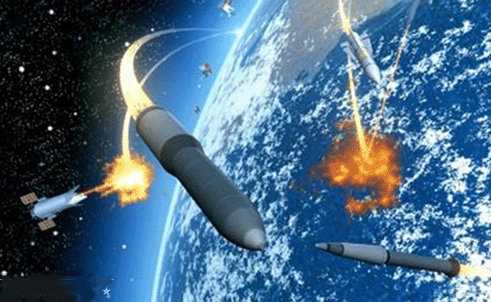 Space-Based Nuclear Command and Control and the ‘Non-Nuclear Strategic Attack’ Space-Based Nuclear Command and Control and the ‘Non-Nuclear Strategic Attack’Counterspace capabilities may meet dual-purpose command and control assets to create new risks. The Diplomat, By Ankit Panda, April 08, 2020 The Trump administration’s 2018 Nuclear Posture Review (NPR) drew much attention for the inclusion of language expanding the scope under which the United States might employ nuclear weapons. Specifically, the document observed that certain “extreme circumstances,” which “could include significant non-nuclear strategic attacks,” would rise to the level of meriting a nuclear response. In remarks delivered during an online video conference this week, Christopher Ford, U.S. assistant secretary at the State Department’s Bureau of International Security and Nonproliferation, discussed this language in the context of space security. Ford emphasized that for the purposes of parsing that bit of the 2018 NPR, American adversaries should understand that U.S. space-based dual-use (nuclear and nonnuclear) command and control assets qualified as what the 2017 National Security Strategy had dubbed a “vital U.S. interest.” Accordingly, Ford continues: “I need hardly point out — but I will nonetheless, for emphasis — that the U.S. National nuclear Command, Control, and Communications (NC3) architecture depends to some extent upon space-based systems.” He is clear therefore that nonnuclear attacks on this architecture would potentially rise to the level of a nuclear response: “Any harmful interference with or attacks upon such components of our space architecture at any time, even if undertaken only with non-nuclear tools, thus starts to move into ‘significant non-nuclear strategic attack’ territory, and would lead to a significant and potentially drastic escalation of a crisis or conflict.” Much of what Ford says here is not new or surprising, but his remarks offer one of the starker presentations of these ideas by a U.S. official in recent years — at least since the release of the 2018 NPR. The problem that arises is one of “entanglement,” where a crisis might escalate to the nuclear level inadvertently if an adversary — say China — is attempting to degrade U.S. conventional operations by taking aim at certain space-based assets. Though the United States openly acknowledges the role of space-based assets in nuclear command and control, there is no explicit tabulation of which American military satellites are “nuclear” and which are “nonnuclear.”….. https://thediplomat.com/2020/04/space-based-nuclear-command-and-control-and-the-non-nuclear-strategic-attack/ |
|
|
Critical comments on the claim that “Nuclear Energy Could Power The Trillion-Dollar Space Race”
 Haley Zaremba’s final comment “” good news for public health and the environment coming out of the space industry”” left me puzzled.
Just exactly how are nuclear-powered space travel, and nuclear reactors on the moon and on Mars “good news for public health and the environment”?
A second question – nuclear reactors in space as a “trillion dollar” industry. Does this mean that it will magically somehow bring in trillions of dollars to the U.S. economy, – or, more likely, just add trillions of dollars to the national debt?
A final question – as the global economy, and especially the American economy, goes into freefall, heading for the greatest Depression ever, is this article just a rather sad joke?

Nuclear Energy Could Power The Trillion-Dollar Space Race https://oilprice.com/Energy/Energy-General/Nuclear-Energy-Could-Power-The-Trillion-Dollar-Space-Race.html By Haley Zaremba – Apr 09, 2020, While the economy comes to a grinding halt here on Earth, some investors, inventors, and dreamers are looking to the stars for their next business venture. The final frontier has been touted as a potential breeding ground for untold numbers of industries in key economic sectors including mining, tourism, research and development, data collection and analysis, to name just a very few.
In fact, the commercial potential of the space economy is allegedly so great and so untapped (for now) that Bank of America Merrill Lynch projected back in 2017 that the size of the space industry is due to explode, expanding to more than eight times its current size by 2050. Valued at nearly $400 billion now, that means that the space sector would reach a total value of nearly $3 trillion over the next thirty years.
We are entering an exciting era in space where we expect more advances in the next few decades than throughout human history,” a Bank of America report stated. Goldman Sachs and Morgan Stanley, however, were far more conservative in their projections than Bank of America Merrill Lynch, but the financial corporations still predicted that the space sector will expand to be a more-than trillion dollar industry inside of 20 years.
Even the United States Chamber of Commerce has been bullish on the space sector, stating that “total private investment is growing at a striking pace,” citing research by Bryce Space and Technology. “From 2000-2005, the industry received more than $1.1 billion in investment from private equity, venture capital, acquisitions, prizes and grants, and public offerings. By the 2012-2017 period, the industry had received more than $10.2 billion.” The Chamber goes on to say that, “the increased investment reflects the new opportunities in the commercial space sector and new startup ventures that did not exist a decade ago.”
Last summer, Oilprice reported that the nuclear industry was also angling to get a piece of the modern-day space race. “In just a few short years from now, the United States will be shipping nuclear reactors to the moon and Mars,” the report said, citing statements from team members from the Kilopower project, a collaborative venture from NASA and the United States Department of Energy.
The Kilopower project is a near-term technology effort to develop preliminary concepts and technologies that could be used for an affordable fission nuclear power system to enable long-duration stays on planetary surfaces,” said NASA’s Space Technology Mission Directorate. “In layman’s terms, the focus of the Kilopower project is to use an experimental fission reactor to power crewed outposts on the moon and Mars, allowing researchers and scientists to stay and work for much longer durations of time than is currently possible,” the Oilprice article summed up.
Now, just this week, an article from Space.com reported that “space is about to go nuclear — at least if private companies get their way.” The article is referencing developments from the 23rd annual Commercial Space Transportation Conference (CST), which took place in Washington, D.C. back in January. There, “a panel of nuclear technology experts and leaders in the commercial space industry spoke about developments of the technology that could propel future spacecraft faster and more efficiently than current systems can.”
NASA is no stranger to nuclear power. The agency has already used nuclear energy to power its Mars rovers, its Cassini mission probe of Saturn and its rings, and the two Voyagers up there exploring the edges of our solar system as we speak. The nuclear energy that powered those projects, however, relied “on the passive decay of radioactive plutonium, converting heat from that process into electricity to power the spacecraft,” whereas, according to the panelists at the CST, the future of space industry electricity lies in “Nuclear Thermal Propulsion (NTP), a technology developed in the 1960s and ’70s that relies on the splitting, or fission, of hydrogen atoms.” This form of nuclear fission would need low-enriched uranium, a much less hazardous material.
“An NTP-powered spacecraft would pump hydrogen propellant through a miniature nuclear reactor core. Inside this reactor core, high energy neutrons would split uranium atoms in fission reactions; those freed neutrons would smack into other atoms and trigger more fission. The heat from these reactions would convert the hydrogen propellent into gas, which would produce thrust when forced through a nozzle,” explained Space.com.
At least there is some good news for public health and the environment coming out of the space industry on the week that Trump announced that he wants to mine the moon.
Nuclear fusion, too hot, too costly? And not ready before 2050

|
Nuclear fusion promises a clean, green energy future — but there’s a catch
ABC Radio National By Antony Funnell for Future Tense 9 Apr 20, It’s a nuclear race like no other, involving billions of dollars and hundreds of scientists from across the globe.
Their aim is as ambitious as it is monumental: to replicate the energy source that powers the solar system, effectively building a mini sun — a swirling mass of super-heated atomic plasma so hot that it can only be contained by a magnetic field. The process is called nuclear fusion. Scientists believe that if fusion technology can be successfully harnessed as a human energy source, it could help save the world from future environmental catastrophe. From vision to constructionJust outside the port city of Marseille in the south of France work is underway on a giant nuclear fusion test facility known as ITER — Latin for “the way”. Its construction is being funded by an international collaboration between 35 nations, and it’s expected to cost somewhere between $27 billion and $36 billion when completed…… Fusion versus fissionConventional nuclear reactors harness energy from a process called fission, which involves splitting the nucleus of a large atom. Nuclear fusion, on the other hand, works by forcing atoms together in order to release energy……. “The advantages of fusion are: no risk of meltdown — it’s very easy to stop it safely — no production of radioactive waste, and a very high energy density of the fuel,” ……. Early test reactors managed to produce a fusion reaction, but not one that was sustainable or energy efficient. In other words, it took more energy to produce the reaction, than the reaction itself produced…… The first plasma experiments are now expected to begin in 2025. For ITER to be considered a success, according to Professor Garrett, it must demonstrate that it can achieve an energy gain of a factor of 10. “ITER consumes 50 megawatts of power to produce this plasma at 150 million degrees, and the goal is to produce 500 megawatts of power from that plasma,” he says. “The second goal is to be able to maintain that condition for many minutes at a time, so maybe 10 minutes, up to an hour, and that’s what you would need for a steady-state power reactor.” Scale and manageabilityITER isn’t the only nuclear fusion initiative underway. In both North America and the United Kingdom there are numerous projects operating on a smaller scale………. Future focused or fantastic folly?Proponents of nuclear fusion believe it will end the world’s dependence on fossil fuels once and forever. But the catch is that no-one involved in the research believes a fully operational, commercially viable nuclear fusion reactor will be operating before at least 2050. That fact has seen some question the level of financial investment, including Sir Chris Llewellyn Smith, the director of Energy Research at Oxford University and a former director general of CERN. He once managed the UK’s fusion program, but two years ago, in an interview with the Simons Centre for Geometry and Physics, he expressed doubts about ITER and the viability of the industry in general. “I used to think that there was a reasonably good chance that fusion could compete with other low carbon sources of power, but while I would not say that it’s impossible, the situation has changed,” he said. “The cost of wind and solar power has decreased faster than anyone could have dreamed. Meanwhile ITER has gone way over budget. Fusion reactors will be intrinsically more expensive than we thought a decade ago.” He argues that ITER needs to go ahead, but that a final cost comparison with renewables should be conducted before any construction on a full-scale reactor is begun. |
|
Russia gambles on safety and cost, in extending life of fast breeder reactor
One of Russia’s fast neutron reactors granted a runtime extension https://bellona.org/news/nuclear-issues/2020-04-one-of-russias-fast-neutron-reactors-granted-a-runtime-extension
Russia’s nuclear regulator has agreed to extend the operational lifetime of 39-year-old experimental reactor as part of a wide-ranging modernization program at the Beloyarsk nuclear plan. April 8, 2020 by Charles Digges
The reactor, a BN-600, is a powerful sodium-cooled fast-breeder and its continued operation marks a step by Russia toward developing a closed nuclear fuel cycle, a subject of concern among some environmentalists and nonproliferation experts.
Fast breeder reactors form the backbone of Russia’s “proryv” or “breakthrough” program, which aims to develop reactors that do not produce nuclear waste. In simple terms, these breeders are theoretically designed to burn the spent nuclear fuel they produce, thus closing the nuclear fuel cycle and creating nearly limitless supplies of energy.
But the technology has been hard to perfect. Russia is alone among nuclear nations in actually running fast-breeders with any success. Yet they have still not been able to close the nuclear fuel cycle entirely.
Under the new order, the BN-600 reactor, which began operations in 1981, would continue to function until 2025, at which point the Beloyarsk plant’s operators say it will be evaluated for yet another extension that would see it run until 2040.
The Beloyarsk plant is the site of another fast-breeder reactor, the BN-800, which began commercial operations 2016 after several long delays. The plant also hosts two AMB supercritical water reactors, one of which ceased operations in 1983, the other in 1990.
At the moment, technicians at the plant have been isolated on site to prevent their exposure to the coronavirus, which has driven most of the world’s population indoors and shuttered much of the international economy.
But Rosenergoatom, Russia’s nuclear utility still maintains high hopes for the safety and modernization plan, of which the BN-600’s runtime extension is a part. So far, the modernization plan, which began in 2009 has included the installation of a reactor emergency protection system, an emergency dampening system using an air heat exchanger and a back-up reactor control panel.
In addition, a large amount of work has been carried out on the inspection and replacement of equipment, including the replacement of the reactor’s steam generators.
But many environmental groups, Bellona among them, consider reactor runtime extensions to be worrisome territory. As the world’s nuclear reactor fleet begins to age, runtime extensions throughout the world have become routine business.
Yet because commercial power-producing nuclear reactors have only been around for a little more than four decades, the industry can’t make safe bets on their behavior over longer periods of time than that.
In particular, data on how reactor cores – which are largely irreplaceable – age over time is extremely scarce. While certain characteristics of core aging can be simulated in test reactors, such simulations can’t take all variables into account.
Individual national regulatory bodies also set the criteria for whether or not reactors are granted runtime extensions – meaning that what Japan or France consider to be safe grounds for an extension might differ from what Russia or the United States deem safe.
But as the history of Chernobyl and Fukushima show, the fallout from nuclear disasters doesn’t respect international boundaries.
However, because nuclear reactors typically cost billions of dollars to build, there is less incentive to construct new ones to replace the old. But as Chernobyl and Fukushima also showed, such decisions could cost more than the short-term savings they provide.
U.S. taxpayers might cough up for a private company’s new “Small Nuclear” space travel gimmick
 Private companies find role in developing nuclear power for space travel, Space.com By JoAnna Wendel – Space.com contributor 6 Apr 20,
Nuclear-powered spacecraft could cut our travel time to Mars in half. Space is abouto go nuclear — at least if private companies get their way.
At the 2 t3rd annual Commercial Space Transportation Conference (CST) in Washington, D.C., in January, a panel of nuclear technology experts and leaders in the commercial space industry spoke about developments of the technology that could propel future spacecraft faster and more efficiently than current systems can.
Nuclear technology has powered spacecraft such as NASA’s Mars rovers, the Cassini mission and the two Voyagers that are currently exploring the outer reaches of our solar system. But those fuel sources rely on the passive decay of radioactive plutonium, converting heat from that process into electricity to power the spacecraft.
Instead, the CST panelists discussed Nuclear Thermal Propulsion (NTP), a technology developed in the 1960s and ’70s that relies on the splitting, or fission, of hydrogen atoms. Although fission is associated with more warlike images, the panel’s experts emphasized the safety of nuclear thermal propulsion, which would use low-enriched uranium.
An NTP-powered spacecraft would pump hydrogen propellant through a miniature nuclear reactor core. Inside this reactor core, high energy neutrons would split uranium atoms in fission reactions; those freed neutrons would smack into other atoms and trigger more fission. The heat from these reactions would convert the hydrogen propellent into gas, which would produce thrust when forced through a nozzle.
This chain reaction is the key to NTP’s power, panelist Venessa Clark, CEO of Atomos Space, a company that’s developing thermonuclear propulsion powered spacecraft to provide in-space transportation options to satellite operators, told Space.com. A soda-can-size fission reactor could propel humans to Mars in just three to four months, she said, about twice as fast as the currently estimated time it could take a chemically propelled ship to carry humans to the Red Planet. …..
But the government still has to play some role, both Clark and Thornburg said. Government agencies like NASA and the military branches may be the first clients for these commercial companies. Clark noted NASA’s recent pushes to partner with the private sector, such as its commercial lunar payload services program and its commercial crew program.
“Government players, NASA and also now the Air Force are looking at procuring services rather than funding the development of technology, which is really exciting for us,” Clark said…. https://www.space.com/commercial-nuclear-power-for-faster-space-travel.
COMMENT. newtons_laws 06 April 2020 14:47
British small nuclear reactors to help Turkey to get nuclear weapons?
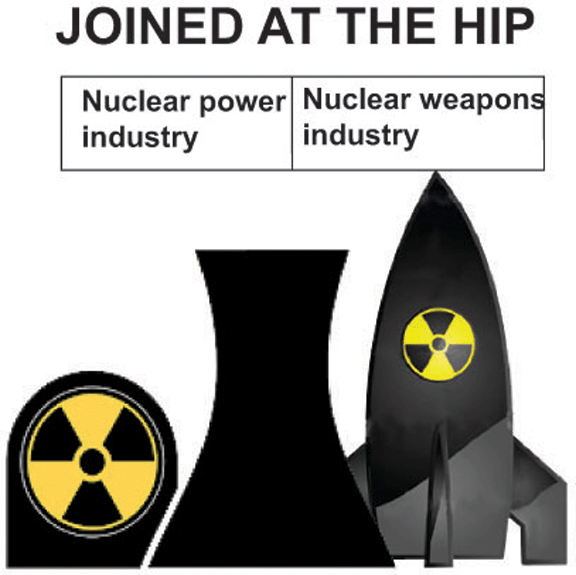 Fears over nuclear Turkey after Rolls Royce reactor deal, Morning Star,
 MARCH 25, 2020 ENGINEERING firm Rolls-Royce has struck a deal with Turkey for the production of nuclear mini-reactors, sparking fears that the British company and its international consortium partners are helping pave the way for Ankara to develop a nuclear bomb…..
the plans have raised fears that Turkey’s authoritarian President Recep Tayyip Erdogan could use the development as a step towards the country becoming a nuclear-armed power.
As previously reported in the Morning Star, Turkey’s secret nuclear programme includes plans to acquire weapons of mass destruction (WMDs), including nuclear missiles.
Writing in a pro-government newspaper in 2017, Mr Karaman said: “We need to consider producing these weapons, rather than purchasing them, without losing any time and with no regard to words of hindrance from the West.”
There are already some 70 US-owned nuclear warheads said to be based at Incirlik airbase near the southern of Adana.
In previous deals with Russia and a Japanese-French consortium, the door was left open for the development of nuclear weapons after Turkey rejected offers to include the provision of uranium and the return of the spent fuel rods used in the reactors.
The development has parallels with the Indian missile capability developed after the testing of plutonium produced in the Canadian-supplied Cirus reactor, which first raised the issue that nuclear technology supplied for peaceful purposes could be diverted to weapons production. https://morningstaronline.co.uk/article/b/fears-over-nuclear-turkey-after-rolls-royce-reactor-deal
How will the IAEA spin the mind-boggling costs of Small Modular Nuclear Reactors (SMRs)?
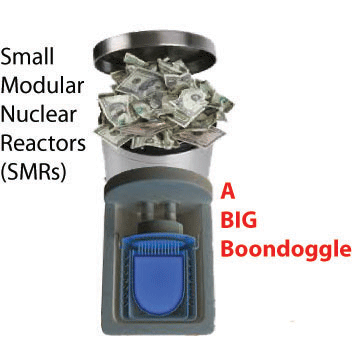 IAEA launches project to examine economics of SMRs https://www.world-nuclear-news.org/Articles/IAEA-launches-project-to-examine-economics-of-SMRs 26 March 2020, he International Atomic Energy Agency (IAEA) is launching a three-year Coordinated Research Project focused on the economics of small modular reactors (SMRs). The project will provide Member States with an economic appraisal framework for the development and deployment of such reactors.
Participants in the research project will cover: market research; analysis of the competitive landscape (SMR vs non-nuclear alternatives); value proposition and strategic positioning; project planning cost forecasting and analysis; project structuring, risk allocation and financial valuation; business planning and business case demonstration; and economic cost-benefit analysis.
The framework they establish will be applied, in particular, to assess the economics of multiples (serial production of reactors in a factory setting), factory fabrication (conditions to be met for a factory to exist), and supply chain localisation (opportunities and impacts).
The deadline for proposals to participate in the research project is 30 April.
Military use: that is clearly the reason for developing Small Nuclear Reactors
If the testing goes well, a commercially developed, Nuclear Regulatory Commission licensed reactor will be demonstrated on a “permanent domestic military installation.The department awarded contracts to BWX Technologies, Inc. of Virginia, for $13.5 million; Westinghouse Government Services of Washington, D.C. for $11.9 million; and X-energy, LLC of Maryland, for $14.3 million, to begin a two-year engineering design competition for a small nuclear microreactor designed to potentially be forward deployed with forces outside the continental United States.
The combined $39.7 million in contracts are from “Project Pele,” a project run through the Strategic Capabilities Office (SCO), located within the department’s research and engineering side. The prototype is looking at a 1-5 megawatt (MWe) power range. The Department of Energy has been supporting the project at its Idaho National Laboratory.
Pele “involves the development of a safe, mobile and advanced nuclear microreactor to support a variety of Department of Defense missions such as generating power for remote operating bases,” said Lt. Col. Robert Carver, a department spokesman. “After a two-year design-maturation period, one of the companies funded to begin design work may be selected to build and demonstrate a prototype.”…….
A second effort is being run through the office of the undersecretary of acquisition and sustainment. That effort, ordered in the 2019 National Defense Authorization Act, involves a pilot program aiming to demonstrate the efficacy of a small nuclear reactor, in the 2-10 MWe range, with initial testing at a Department of Energy site in roughly the 2023 timeframe.
If the testing goes well, a commercially developed, Nuclear Regulatory Commission licensed reactor will be demonstrated on a “permanent domestic military installation by 2027,” according to DoD spokesman Lt. Col. Mike Andrews. “If the full demonstration proves to be a cost effective energy resilience alternative, NRC-licensed [reactors] will provide an additional option for generating power provided to DoD through power purchase agreements.”…….
According to Dr. Jonathan Cobb, a spokesman for the World Nuclear Association, small nuclear reactors come in three flavors. The first, small modular reactors, sit in the 20-300 MWe range and are approaching the point they will appear on market.
The second category sits from 10-100 megawatts, and have been used in transports such as icebreakers. According to Cobb, a pair of 32 MWe reactors, based on icebreaker technology, are being used aboard the Akademik Lomonosov, a Russian “floating power plant.”
The third category, covering what the Pentagon appears most interested in, is a category known as microreactors. The challenge, Cobb said, is that this group is the furthest behind technologically, with demonstrations of commercial systems targeted for “the second half of the 2020s,” putting them in the “ballpark” of what DoD is looking for with its A&S effort……
Edwin Lyman, director of the Nuclear Safety Project at the Union of Concerned Scientists, has concerns about the availability of fuel to power a proliferation of small nuclear reactors. He noted, “there are no clear plans for manufacturing the quantity of high-assay low enriched uranium, much less the production of high-quality TRISO [TRi-structural ISOtropic particle] fuel, that would be able to meet timelines this decade.”……
Lord, for her part, would not rule out working with foreign allies on the nuclear program in some way, saying “We always talk with our partners and allies about collaboration. We have many umbrella vehicles, if you will, to do that, particularly with [National Technology and Industrial Base] countries — U.K., Canada, Australia. We have a little bit of an easy button there for working back and forth with technical information.”… https://www.defensenews.com/smr/nuclear-arsenal/2020/03/09/pentagon-to-award-mobile-nuclear-reactor-contracts-this-week/?fbclid=IwAR2MTkRUDqIkruQHY0RivblBzoSY6gubpl8gkWDUDhedVwZEGstJhHYLb6U#.XmawxEl-aJ0.facebook
A ruse to save the nuclear industry? Dangerous, expensive portable mini-reactors
|
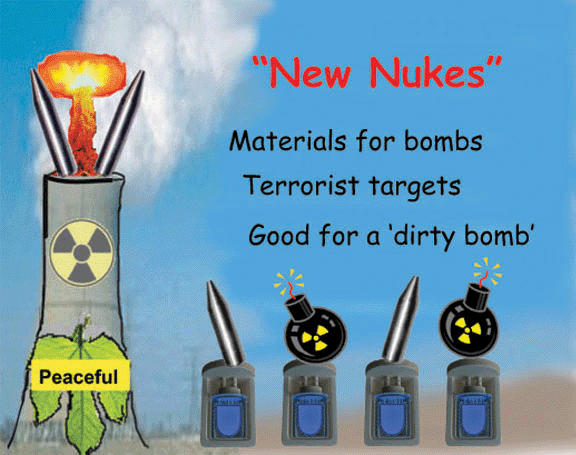
Pentagon invented the internet: This time portable Micro Nuclear reactors, https://www.globalvillagespace.com/pentagon-invented-the-internet-this-time-portable-micro-nuclear-reactors/ 12 Mar 20, There’s no shortage of hefty defense deals awarded by the US Department of Defense, but the $40 million contract for micro-reactors definitely stands out, as it hides safety risks and raises doubts over its economic efficiency.The nuclear device that the DoD strategists want must have the capability to be safely and rapidly transported by road, rail, sea or air (sic!) as well as swiftly set up and shut down. The project split between three companies — BWX Technologies, Westinghouse Government Services and X-energy — calls for a “safe, mobile and advanced nuclear micro-reactor.” The safety part sounds particularly soothing, but how would it look on the ground? What if those miniature reactors, when moved by land, become targets of high-profile terrorist attacks? And will it prove to be a real alternative (which means cheaper price, of course) to conventional energy sources? The more reactors — the greater the danger“Any nuclear reactor attracts terrorists,” Andrey Ozharovsky, nuclear scientist, program expert at the Russian Social Ecological Union, told RT. “It doesn’t matter if it’s located at a nuclear power plant [or inside a portable device]… if you remember, the terrorists planned directing one of the planes at a nuclear plant during 9/11.” The logic here is simple, he pointed out: “the more reactors are out there — the greater the danger.” If the US builds hundreds, or even dozens of such devices, it’ll be really hard for them to properly defend them all. Another vital safety issue is the reliability of the nuclear micro-reactors. Interestingly enough, the US military had already experimented with them back in the 1950s and 1960s — and it ended in a tragedy. Several portable reactors were built and setup in Greenland and Panama, but one of them blew up in 1961, killing three operators. The Army Nuclear Power Program was shut down shortly after that. “There were eight US micro-reactors and one of them exploded. That’s how safe they are,” Ozharovsky said, adding that the Pentagon’s idea of bringing them back will “likely create more risks instead of solving any problems.” Micro-reactors yet to prove their economic efficiencyBut even if the portable reactors will be shielded from the perils of the battlefield and operate without failure, what’s the Pentagon’s rationale behind bringing the radioactive fuel to their military bases? For decades, the army had been successfully running on gasoline, diesel and fuel oil; when going off-grid, it would switch to generators and high-power accumulators. “The main problem has nothing related to safety,” Anton Khlopkov, director of Energy and Security Center and member of Russian Security Council’s Scientific Council argued. Micro-reactors must prove their viability from the economic point of view since such plants always have alternatives It is yet to be proven that micro-reactors won’t be “many times more” expensive than other conventional sources of energy. Electricity produced by such devices should be at least comparable in cost to the one produced by diesel generators, he said. Some kind of a soap bubbleIf micro-reactors are such a questionable solution, why is the Pentagon pushing for their development? The answer isn’t lying on the surface, but it isn’t buried too deep. “They work against the trends,” Ozharovsky suggested. And those trends are that the world is giving up on the use of civilian nuclear energy due to being too expensive. Washington may be trying to “support the US the nuclear industry that’s dying out with the use of the military budget; sponsor their research and development — which is an expensive thing.” RT with additional input by GVS News Desk At last – someone recognises the bleeding obvious – thank you! To keep the nuclear industry alive there MUST be new nuclear reactors built. With no willing private investment available, then it must be the tax-payer who coughs up. Especially in USA, it seems that the only respectable use of tax-payer money is in that most sacred of cows – defence. |
|
Proponents of Small Nuclear Reactors need a reality check – about the STAGGERING COST
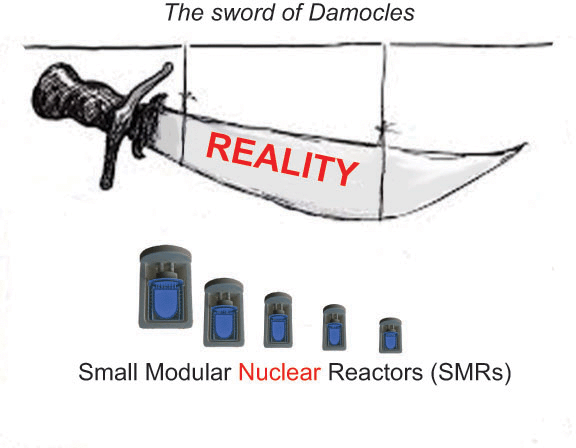 a reality check is in order. A handful of small reactors is under construction but they have been subject to huge cost overruns and delays. William Von Hoene, senior vice-president of Exelon ‒ the largest operator of nuclear power plants in the US ‒ says that no more large reactors will be built in the US and that the cost of small reactors is “prohibitive”.
Rolls-Royce sharply reduced its small-reactor investment to “a handful of salaries” in 2018 and is threatening to abandon its R&D altogether unless the British government agrees to an outrageous set of demands and subsidies.
|
Supporters of nuclear need a reality check: it’s staggeringly expensive, https://www.smh.com.au/environment/climate-change/supporters-of-nuclear-need-a-reality-check-it-s-staggeringly-expensive-20200308-p547wv.html, By Jim Green March 10, 2020 The NSW Parliament’s State Development Committee released its report into nuclear power last week. Conservative committee members recommended repeal of state laws banning uranium mining and nuclear power, while Labor members want to retain the legal bans.
What the conservatives and other supporters of nuclear power ignore is that it has priced itself out of the energy debate. Its costs are staggering and the worldwide pattern for the industry is one of stagnation and decline. In the US, the cost of the only two reactors under construction has skyrocketed to between $20.4 billion and $22.6 billion for one reactor. In 2006, Westinghouse said it could build a reactor for 10 times less than that amount. Another project in the US, a twin-reactor project in South Carolina, was abandoned in 2017 after the expenditure of at least $13.4 billion. Over in New Mexico, the world’s only deep underground nuclear waste repository was closed for three years following a chemical explosion in an underground nuclear waste barrel in 2014. In Britain, the estimated cost of the only two reactors under construction is $25.9 billion each. In the mid-2000s, the estimated cost was almost seven times lower. The British National Audit Office estimates that taxpayer subsidies for the project will amount to $58 billion. The cost of the only reactors under construction in France and Finland has nearly quadrupled and now stands at $17.7 billion to $20 billion per reactor. Both projects are 10 years behind schedule. Tomorrow, Japan will commemorate the ninth anniversary of the meltdowns, fires and explosions at the Fukushima nuclear plant. The Japanese government’s estimate of clean-up and compensation costs is over $300 billion, and rising. Insiders and lobbyists freely acknowledge that the nuclear power industry is in crisis and that worldwide decline is certain. But its Australian supporters are unfazed. Their only sideways nod to reality is to argue that even if large, conventional reactors are too expensive, the emerging “small modular reactors” would be a good fit for Australia. Continue reading |
And they say that small nuclear reactors do not have military applications
Pentagon awards contracts to design mobile nuclear reactor Defense News
The department awarded contracts to BWX Technologies, Inc. of Virginia, for $13.5 million; Westinghouse Government Services of Washington, D.C. for $11.9 million; and X-energy, LLC of Maryland, for $14.3 million, to begin a two-year engineering design competition for a small nuclear microreactor designed to potentially be forward deployed with forces outside the continental United States.
The combined $39.7 million in contracts are from “Project Pele,” a project run through the Strategic Capabilities Office (SCO), located within the department’s research and engineering side. The prototype is looking at a 1-5 megawatt (MWe) power range. The Department of Energy has been supporting the project at its Idaho National Laboratory…….
If the testing goes well, a commercially developed, Nuclear Regulatory Commission licensed reactor will be demonstrated on a “permanent domestic military installation by 2027,” according to DoD spokesman Lt. Col. Mike Andrews. “If the full demonstration proves to be a cost effective energy resilience alternative, NRC-licensed [reactors] will provide an additional option for generating power provided to DoD through power purchase agreements.”
The best way to differentiate between the programs may be to think of the A&S effort as the domestic program, built off commercial technology, as part of an effort to get off of local power grids that are seen as weak targets, either via physical or cyber espionage. Pele is focused on the prototyping a new design, with forward operations in mind — and may never actually produce a reactor, if the prototype work proves too difficult…… https://www.defensenews.com/smr/nuclear-arsenal/2020/03/09/pentagon-to-award-mobile-nuclear-reactor-contracts-this-week/
A sceptical look at NuScam’s small nuclear reactor plans
The Smaller Is Better Movement in Nuclear Power, Are miniature reactors  really safer? Mother Jones LOIS PARSHLEY, 8 Mar 20,
Huge computer screens line a dark, windowless control room in Corvallis, Oregon, where engineers at the company NuScale Power hope to define the next wave of nuclear energy. Glowing icons fill the screens, representing the power output of 12 miniature nuclear reactors. Together, these small modular reactors would generate about the same amount of power as one of the conventional nuclear plants that currently dot the United States—producing enough electricity to power 540,000 homes. On the glowing screens, a palm tree indicates which of the dozen units is on “island mode,” allowing a single reactor to run disconnected from the grid in case of an emergency.
Busting the lies of the Australian Government about “new” nuclear reactors
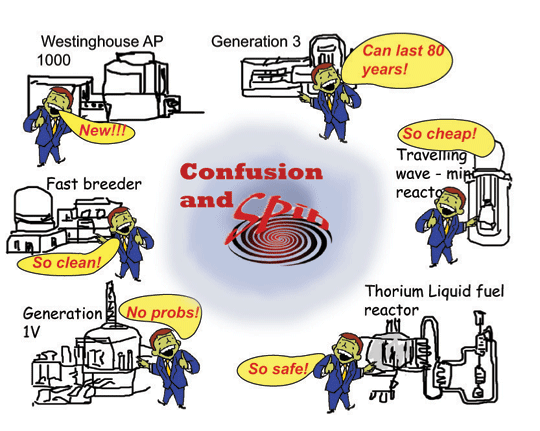
The core propositions of non-traditional reactor proponents – improved economics, proliferation resistance, safety margins, and waste management – should be reevaluated.
Before construction of non-traditional reactors begins, the economic implications of the back end of these nontraditional fuel cycles must be analyzed in detail; disposal costs may be unpalatable………. reprocessing remains a security liability of dubious economic benefit
Non-traditional” is used to encompass both small modular light water reactors (Generation III+) and Generation IV reactors (including fast reactors, thermal-spectrum molten salt reactors, and high temperature gas reactors)
|
Burning waste or playing with fire? Waste management considerations for non-traditional reactors Full Text
The Industry Push to Force Nuclear Power in Australia https://nonuclearpowerinaustralia.wordpress.com/2020/03/02/burning-waste-or-playing-with-fire-waste-management-considerations-for-non-traditional-reactors-full-text/ by nuclearhistory March 2, 2020 The following paper is copied here in order to counter the false, incorrect and erroneous propaganda published by the Australian Government and its Parliamentary Committee for lying to the Australian people about so-called new nuclear reactor designs, all of which were rejected by competent authorities in the 1950s, 1960s, and 1970s. The residues produced by these test reactors continue to cost the American taxpayer money and continue to present the American people with stored, hazardous radioactive waste which is also high chemically reactive. |
USA desperately pushing the fantasy of Small Nuclear Reactors to India
|
“………Ahead of Trump’s recent visit to India, officials of the US Department of Energy were quoted as saying that they are strongly encouraging Westinghouse Corporation to ensure further progress on the nuclear projects already in the pipeline.
Another addition to the nuclear bucket list this time are the Small Modular Reactors (SMRs), which the industry has been fervently pushing both within and outside the United States. While US-based corporations have individually attempted to introduce their SMR business in India in recent years, this is the first time these reactors have been formally introduced as part of the official US-India nuclear dialogue. Globally, nuclear lobbies have promoted SMRs as an innovation that will help address the perennial problems of cost, feasibility, environmental impacts, and scalability associated with conventional large reactors.
However, as independent experts in the field suggest, SMRs are an old and discredited idea – a make-believe renaissance after the Fukushima accident thwarted dreams of building massive-sized nuclear power parks across the globe. SMRs are neither cheap nor innovative nor green, as a number of leading experts in the field have pointed out. In particular, SMRs will be disastrous in densely populated countries like India, which already has an electricity surplus, and whose problems in the power sector owe more to its people’s lack of purchasing power, messy regulatory frameworks that do not allow it to take advantage of renewable energy sources despite their increasing efficiency and competitiveness, and the larger questions surrounding its neoliberal growth model. India has also been desperately trying to position itself as an exporter of SMRs, and the reaffirmation of US support for India’s accession to the Nuclear Suppliers’ Group (NSG) “without any delay” in the joint statement is expected to boost this ambition.
However, much like the other projections made by the Indian nuclear establishment, the pipedream of India becoming a nuclear exporter reflects its postcolonial aspirations of becoming a big player internationally, rather than being grounded in any realism. India does not have much to offer beyond the sub-300MWe capacity Pressurized Heavy Water Reactors (PHWRs) that it mastered in the 1970s by reverse engineering the Canada-imported reactors called CANDUs. Invariably these reactors had huge cost and time overruns, and India is now building their larger versions, 700MWe each, at sites such as Gorakhpur, Chutka, and Kaiga. The smaller designs are evidently unattractive for potential SMR buyers for reasons of cost, safety and reliability. However, simply pitching them in the foreign market will bring to India the tag of a major nuclear player, which is enough international recognition for the chest-thumping present regime. Despite the hype that Trump’s recent visit generated – of an upgrade of US-India relations to a ‘Comprehensive Global Strategic Partnership’ and so on – there is very little that India stands to gain. In the absence of any new meaningful and people-centric cooperation on trade, environment, education or technology, this nuclear tango will only remain a farcical buildup at the cost of the safety and livelihoods of Indian citizens.
Not long ago, Modi’s own home state of Gujarat had rejected a US-imported nuclear project labeling it unacceptably risk-prone, especially in the wake of the 2011 Fukushima accident. This leaves the Modi government with no moral right to impose the US reactors on people in other parts of the country. Kumar Sundaram is founding editor of DiaNuke.org, an international platform for nuclear-related discussions and campaigns. https://www.thecitizen.in/index.php/en/NewsDetail/index/6/18388/Namaste-Nukes-Trumps-Toxic-Sales-Pitch-for-the-Stalled-Westinghouse-Nuclear-Project-in-India
|
|
|

A Brief Study of Molten Salt Reactors
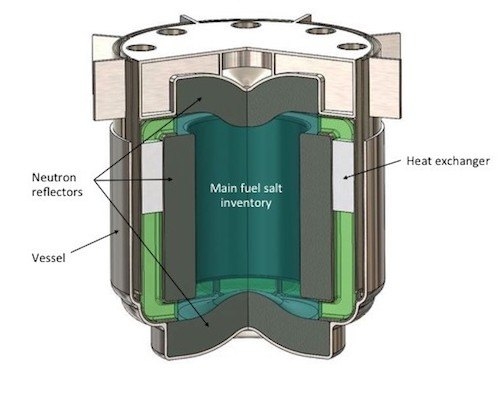 A Brief Study of Molten Salt Reactors https://nonuclearpowerinaustralia.wordpress.com/2020/03/01/a-brief-study-of-molten-salt-reactors/ 3 Mar 20,
Source:
Burning waste or playing with fire? Waste management considerations for non-traditional reactors, Lindsay Krall &Allison MacfarlanePages 326-334 | Published online: 31 Aug 2018 Bulletin of the Atomic Scientists, Volume 74, 2018. Issue 5 at https://www.tandfonline.com/doi/abs/10.1080/00963402.2018.1507791?scroll=top&needAccess=true&journalCode=rbul20
Author information:
Lindsay Krall is a post-doctoral Macarthur fellow at the George Washington University Institute for International Science and Technology Policy. Her research focuses on policies for the back end of the nuclear fuel cycle, particularly as they pertain to radionuclide transport in the environment, systems and organizations for waste storage and disposal, and the long-term behavior of spent fuels from advanced reactors. Allison Macfarlane is Professor of Public Policy and International Affairs at the George Washington University’s Elliott School of International Affairs. She directs the school’s Institute for International Science and Technology Policy Program and is the former chairman of the US Nuclear Regulatory Commission. Macfarlane was a member of the Blue Ribbon Commission on America’s Nuclear Future from 2010-2012.
“Abstract:
Nuclear energy-producing nations are almost universally experiencing delays in the commissioning of the geologic repositories needed for the long-term isolation of spent fuel and other high-level wastes from the human environment. Despite these problems, expert panels have repeatedly determined that geologic disposal is necessary, regardless of whether advanced reactors to support a “closed” nuclear fuel cycle become available. Still, advanced reactor developers are receiving substantial funding on the pretense that extraordinary waste management benefits can be reaped through adoption of these technologies. Here, the authors describe why molten salt reactors and sodium-cooled fast reactors – due to the unusual chemical compositions of their fuels – will actually exacerbate spent fuel storage and disposal issues. Before these reactors are licensed, policymakers must determine the implications of metal- and salt-based fuels vis a vis the Nuclear Waste Policy Act and the Continued Storage Rule.” end quote.Emphasis added for clarity. Mr. O’Brien and Mr. Bernardi need to consider the scientific and technical reality behind the gloss they want to disseminate.
1 This Month
29 Jan. Thursday 7-8 p.m. Webinar – World’s Largest Nuclear Station in Port Hope, ON?
To see nuclear-related stories in greater depth and intensity – go to https://nuclearinformation.wordpress.com/



31st January – Challenging the War Machine – a DECLASSIFIED UK SUMMIT

Website of the Week
Now until to February 10, 2026 Radioactive waste storage in France: the debate is finally open! How to participate?
-
Archives
- January 2026 (283)
- December 2025 (358)
- November 2025 (359)
- October 2025 (376)
- September 2025 (258)
- August 2025 (319)
- July 2025 (230)
- June 2025 (348)
- May 2025 (261)
- April 2025 (305)
- March 2025 (319)
- February 2025 (234)
-
Categories
- 1
- 1 NUCLEAR ISSUES
- business and costs
- climate change
- culture and arts
- ENERGY
- environment
- health
- history
- indigenous issues
- Legal
- marketing of nuclear
- media
- opposition to nuclear
- PERSONAL STORIES
- politics
- politics international
- Religion and ethics
- safety
- secrets,lies and civil liberties
- spinbuster
- technology
- Uranium
- wastes
- weapons and war
- Women
- 2 WORLD
- ACTION
- AFRICA
- Atrocities
- AUSTRALIA
- Christina's notes
- Christina's themes
- culture and arts
- Events
- Fuk 2022
- Fuk 2023
- Fukushima 2017
- Fukushima 2018
- fukushima 2019
- Fukushima 2020
- Fukushima 2021
- general
- global warming
- Humour (God we need it)
- Nuclear
- RARE EARTHS
- Reference
- resources – print
- Resources -audiovicual
- Weekly Newsletter
- World
- World Nuclear
- YouTube
-
RSS
Entries RSS
Comments RSS
 nuclear-news