Small modular nuclear reactors for Canada? – useless, expensive, untested, and a wasteful distraction
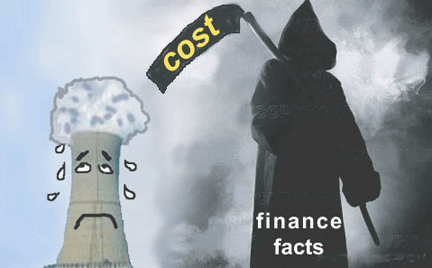 NB Media Co-op 22nd Sept 2020,Premier Blaine Higgs has endorsed so-called “small modular nuclear reactors” or SMRs. SMRs represent an untested technology but what we know on the basis of technical characteristics and historical precedent is that they will be expensive and any electricity they generate will not be economical. The nuclear industry is pushing small reactors because large reactors are simply not economical. Constructing nuclear plants is just too expensive—as Ontario’s government found out after its call in 2008 for bids to build two more reactors at the Darlington site.
https://nbmediacoop.org/2020/09/22/no-business-case-for-new-nuclear-reactors-in-new-brunswick/
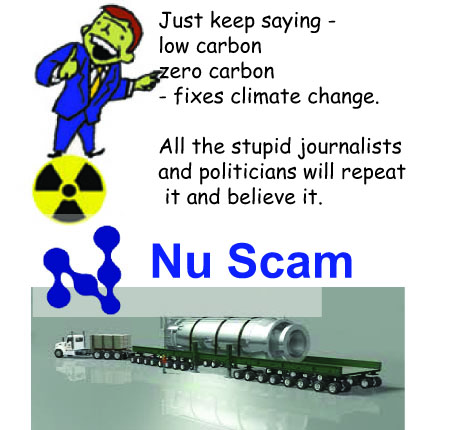 Sierra Club Canada (accessed) 23rd Sept 2020, No plan that gets us to net zero in a reasonable time frame includes new nuclear reactors. Nuclear is far too slow and expensive to deal with the climate emergency. Just like fossil fuel energy, nuclear produces wastes that pose unacceptable health hazards and economic costs.
Japanese government dangles financial carrot to persuade reluctant communities to take nuclear wastess
 But there is no prospect for the establishment of such a recycling system which would allow for disposing only of the
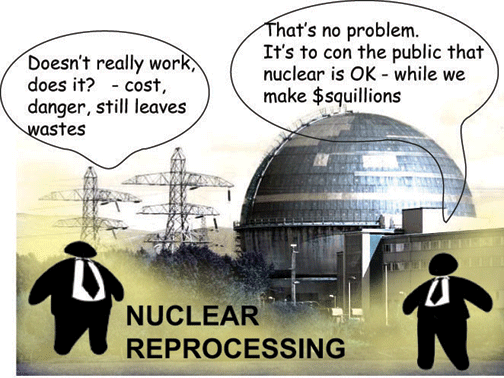 waste from reprocessing and recycling.
Eventually, Japan, like most other countries with nuclear power plants, will be forced to map out plans for “direct disposal,” or disposing of spent fuel from nuclear reactors in underground repositories.
Hokkaido Governor Suzuki has taken a dim view of the financial incentive offered to encourage local governments to apply for the first stage of the selection process, criticizing the proposed subsidies as “a wad of cash used as a powerful carrot.”
|
EDITORIAL: Much at stake in picking a final nuclear waste disposal site, http://www.asahi.com/ajw/articles/13749856 21 Sept 20, Two local communities in Hokkaido are considering pitching themselves as candidates for the site for final disposal of highly radioactive waste from nuclear power plants.Last month, the mayor of Suttsu in the northernmost main island said the municipal government is thinking to apply for the first stage of the three-stage process of selecting the site for the nation’s final repository for nuclear waste. During this period, past records about natural disasters and geological conditions for the candidate area are examined. Town authorities are holding meetings with local residents to explain its intentions. In Kamoenai, a village also in Hokkaido, the local chamber of commerce and industry submitted a petition to the local assembly to consider an application for the process. The issue was discussed at an assembly committee. However, the assembly decided to postpone making a decision after further discussion. Both communities are located close to the Tomari nuclear power plant operated by Hokkaido Electric Power Co. and struggling with common rural problems such as a dwindling population and industrial and economic stagnation. The law decrees that when the first stage of the selection process starts, the municipality that is picked will receive up to 2 billion yen ($19.1 million) in state subsidies for two years. But the Ministry of Economy, Trade and Industry and the Nuclear Waste Management Organization of Japan (NUMO), which are in charge of the selection process, have promised it will not move to the second stage if the prefectural governor or local mayor voices an objection. Hokkaido Governor Naomichi Suzuki has already expressed his opposition. A huge amount of spent nuclear fuel has been produced by nuclear plants in Japan, and it needs to be stored and disposed of somewhere in this country. This policy challenge requires a solid consensus among a broad range of people, including residents of cities who have been beneficiaries of electricity generated at nuclear plants. The two Hokkaido municipalities’ moves to consider applying for the first stage of the selection process should be taken as an opportunity for national debate on the issue. The first step should be to establish a system for local communities to discuss the issue thoroughly from a broad perspective. It is crucial to prevent bitter, acrimonious divisions in local communities between supporters and opponents. The central government and other parties involved need to provide whatever information is needed from a fair and neutral position to help create an environment for healthy, in-depth debate. There is also a crucial need to fix the problems with the current plan to build a final repository for radioactive waste. Under the plan, which is based on the assumption that a nuclear fuel recycling system will eventually be established, the repository will be used to store waste to be left after spent nuclear fuel is reprocessed to recover and recycle plutonium and uranium. But there is no prospect for the establishment of such a recycling system which would allow for disposing only of the waste from reprocessing and recycling. Eventually, Japan, like most other countries with nuclear power plants, will be forced to map out plans for “direct disposal,” or disposing of spent fuel from nuclear reactors in underground repositories. The central government has not changed its policy of maintaining nuclear power generation as a major power source. If nuclear reactors keep operating, they will continue producing spent fuel. The government will find it difficult to win local support for the planned repository unless it makes clear what kind of and how much radioactive material will be stored at the site. Many local governments are facing a fiscal crunch partly because of the impact of the COVID-19 pandemic. Hokkaido Governor Suzuki has taken a dim view of the financial incentive offered to encourage local governments to apply for the first stage of the selection process, criticizing the proposed subsidies as “a wad of cash used as a powerful carrot.” It takes tens of thousands of years for the radioactivity of spent nuclear fuel to decline to sufficiently safe levels. Trying to stem local opposition by dangling temporary subsidies could create a serious problem for the future in the communities. It is vital to ensure that the repository plan will secure a long-term policy commitment to the development of the local communities and ensure benefits for the entire areas. September 22, 2020 |
|
USA.Federal Bill to promote nuclear waste borehole system, and the dubious plan for reprocessing
|
Bill would create new federal research program for nuclear waste disposal
Deep boreholes, fuel reprocessing are on the to-do list of things to investigate, By TERI SFORZA | tsforza@scng.com | Orange County Register September 21, 2020 ”………… A federal bill that would pump a half-billion dollars into America’s long-stalled effort to find a permanent home for nuclear waste, would nudge reprocessing of spent fuel back on the table and prod officials toward big-picture solutions. The Spent Nuclear Fuel Solutions Research and Development Act, by Rep. Mike Levin, D-San Juan Capistrano, would create, among many other things, “an advanced fuel cycle research, development, demonstration, and commercial application program” at the U.S. Department of Energy. The program would be charged with investigating improvements to the fuel cycle, advanced reactor concepts “while minimizing environmental and public health and safety impacts,” and much-needed storage options, from dry casks to deep geological boreholes. Boreholes have long been considered the single best method to isolate nuclear waste for the long haul, but efforts have been plagued by opposition from communities unwilling to be home to the nation’s nuclear waste. ……..
Recycling wasteReprocessing, however, has had a fraught history in the United States. The technology to chemically separate and recover fissionable plutonium from used nuclear fuel was developed after World War II and was an integral part of the nuclear plan in America, according to a Congressional Research Service report. But reprocessing fuel produces material that can easily be used in nuclear bombs, while regular spent fuel does not. After India started showing off its nuclear muscle in the 1970s, America got spooked. President Gerald Ford suspended commercial reprocessing and recycling of plutonium in 1976, concerned that it could fall into the wrong hands. A year later, President Jimmy Carter issued an executive order that etched the policy into stone.
President Ronald Reagan reversed Carter’s order, but the work never really ramped back up. Congress soon passed the Nuclear Waste Policy Act — committing the federal government to accept and store spent commercial nuclear fuel in exchange for payments from the nuclear plant operators — so there wasn’t much more impetus for reprocessing. …….
reprocessing has strong critics. The Union of Concerned Scientists calls it dangerous, dirty, and expensive.
“While some supporters of a U.S. reprocessing program believe it would help solve the nuclear waste problem, reprocessing would not reduce the need for storage and disposal of radioactive waste. Worse, reprocessing would make it easier for terrorists to acquire nuclear weapons materials, and for nations to develop nuclear weapons programs,” the watchdog group says in its primer on the topic. The Blue Ribbon Commission on America’s Nuclear Future rejected calls for reprocessing in 2012, saying “all spent fuel reprocessing or recycle options generate waste streams that require a permanent disposal solution.” “Nuclear waste reprocessing does not benefit the environment — it only benefits the nuclear industry, and then not by much,” said Bart Ziegler, president of the Samuel Lawrence Foundation. “It’s a very financially costly process and lends to more waste effluent.”
David Victor, a UC San Diego professor and chair of a volunteer committee advising on San Onofre’s tear-down, said he sees the bill trying to create a big tent of supporters. Reprocessing wouldn’t make much sense in the U.S. unless there was a huge new demand for nuclear fuel, he said by email…… https://www.ocregister.com/2020/09/21/bill-would-create-new-federal-research-program-for-nuclear-waste-disposal/
|
|
Utah lawmakers seek details on planned nuclear plant in Idaho
Cities and districts invested in the plant have until Oct. 31 — one of several so-called off-ramps — to bow out of the project.
During the committee hearing, Sen. Ron Winterton, R-Roosevelt, shared his concerns over the cities’ financial commitments.
“I want to feel warm and fuzzy” he said, but questioned the technology and potential risks…….
Under both the Obama and the Trump administrations, the NuScale project has received strong financial support, Squires said. The federal energy agency gave NuScale a competitive award of $226 million in 2013 to develop the technology. Two years later, the federal agency gave NuScale $16.7 million for licensing preparation. …….
Critics like the Utah Taxpayers Association, however, say the investment by Utah cities is too risky and they should not be acting as seed investors.
“We are not opposed to nuclear power, we are opposed to the financial risk,” said the association’s vice president, Rusty Cannon. ……….. https://www.deseret.com/utah/2020/9/19/21438026/news-nuclear-plant-in-idaho-lawmakers-seek-details-on-planned-nuscale-uamps
NuScam’s ”small” nuclear reactor design approved – but cost, safety, public acceptance hurdles loom against them

First U.S. Small Nuclear Reactor Design Is Approved, Concerns about costs and safety remain, however, Scientific American  By Dave Levitan on September 9, 2020
- The U.S. Nuclear Regulatory Commission (NRC) has approved the design of a new kind of reactor, known as a small modular reactor (SMR). The design, from the Portland, Ore.–based company NuScale Power, is intended to speed construction, lower cost and improve safety over traditional nuclear reactors…………
- some experts have expressed concerns over the potential expense and remaining safety issues that the industry would have to address before any such reactors are actually built. ………
- The NRC’s design and related final safety evaluation report (FSER) do not mean that the firm can begin constructing reactors. But utility companies can now apply to the NRC to build and operate NuScale’s design. With almost no new nuclear construction completed in the U.S. over the past three decades, SMRs could help reinvigorate a flagging industry.
NuScale’s SMR, developed with the help of almost $300 million from the U.S. Department of Energy, has a generating capacity of 50 megawatts—substantially smaller than standard nuclear reactors, which can range to well more than 1,000 megawatts (MW). A utility could combine up to 12 SMRs at a single site, producing 600 MW of electricity—enough to power a midsize city. The NRC says it expects an application for a 60-MW version of NuScale’s SMR in 2022……….
In a July 2020 report, NRC nuclear engineer Shanlai Lu discussed a complicated issue known as boron dilution, which could possibly cause “fuel failure and prompt criticality condition”—meaning that even if a reactor is shut down, fission reactions could restart and begin a dangerous power increase. And in another report, the NRC’s Advisory Committee on Reactor Safeguards also noted that “several potentially risk-significant items” are not yet completed, though it did still recommend that the NRC issue the FSER. The agency’s response to the latter report stated that those items will be further assessed when site-specific licensing applications—the step needed to actually begin building and operating a reactor—are submitted. ……..
Lyman says that in general, the NRC’s design certification process should reduce uncertainty for utilities aiming to build nuclear plants because they can reference a completed safety review. But he thinks the NuScale approval undermines that advantage. Whether the gaps in safety will result in further delays to NuScale’s time line remains to be seen. The NRC will undertake another review when the company’s 60-MW design is submitted. https://www.scientificamerican.com/article/first-u-s-small-nuclear-reactor-design-is-approved/
Bill Gates and nuclear bigwigs-a conglomerate of propaganda for Small Nuclear Reactors

|
GE Hitachi, TerraPower Team on Nuclear-Storage Hybrid SMR, Power, Sep 3, 2020, by Sonal Patel GE Hitachi Nuclear Energy (GEH) and Bill Gates’ nuclear innovation startup TerraPower are ready to demonstrate a “cost-competitive” advanced nuclear reactor system that will integrate a 345-MWe sodium fast reactor (SFR) with a molten salt energy storage system under a unique energy system architecture. The advanced nuclear technology developed under a joint development agreement is called “Natrium.” It blends the “best of” TerraPower’s Traveling Wave Reactor (TWR) and GEH’s PRISM technology, but it boosts them with “additional innovations and improvements” to ramp up the SFR’s performance and economics and render it competitive in the U.S. and other countries, the companies told POWER on Sept. 2. Because Natrium leverages “the breadth and depth of the team’s expertise and resources”—which takes into account work on multiple reactor designs and efforts across the nuclear lifecycle—the technology has sped “beyond the research and development phase” and is ready for demonstration. “The demonstration plant is designed to be delivered in the next seven years,” TerraPower told POWER on Wednesday. “That means the Natrium technology will be available in the late 2020s,” which would make it one of the world’s first commercial advanced nuclear technologies, it said. …. https://www.powermag.com/ge-hitachi-terrapower-team-on-nuclear-storage-hybrid-smr/ |
|
Fluor could improve its finances by abandoning NuScam, as some cities pull out of ”small” nuclear reactor scheme
 Fluor could improve earnings by reducing underperforming assets, including NuScale
But two cities, Logan and Lehi, Utah have walked away from the project, and a third is now considering dropping its support because of risks and a lack of backers, according to officials.
Allen Johnson, the power department director for Bountiful, Utah, said chances are greater than 50-50 it will withdraw.
“You’ve got to have enough people to support it and some of the players I thought would be interested are not,” he said.
The defections are bad news for U.S. efforts to develop modular nuclear energy …
Combined, cities have so far committed to buying just under 200 megawatts of the plant’s planned 720 megawatts of power.
The U.S. Department of Energy has pumped more the $280 million into the project since 2013, and is expected to commit another $1.4 billion over the next nine years. The department did not respond to requests for comment…….
The consortium earlier this year pushed back the project’s commercial operation date to 2030 from 2026, Webb said, to provide more time for public input and opportunities for cities to reconsider their participation at various phases.
CITIES RETHINK COSTS
NuScale, based in Portland, Oregon, is majority owned by construction and engineering firm Fluor Corp.
The project would include 12 60-megawatt modules at the Energy Department’s Idaho National Laboratory.
The Nuclear Regulatory Commission last week approved NuScale’s design, the first such green light for a modular reactor.
Small modular reactors are meant to be cheaper and quicker to build than traditional reactors because they can be manufactured in factories. But critics say economies of scale are lost with the smaller plants.
The NuScale project’s projected cost of $6.1 billion has risen from $3.6 billion in 2017, Mark Montgomery, head of the municipal utility in Logan told officials there last month ahead of their vote to abandon the project.
Lehi withdrew from the project due to a lack of interest from other entities and increased costs, according to the Aug. 25 resolution approved by its city council.
“These cities should not be acting as venture capital investors,” said Rusty Cannon, vice president of the Utah Taxpayers Association, which has been pushing cities to leave.
Previous cost estimates did not account for financing and decommissioning, as well as higher labor, construction and materials costs over ten years, UAMPS spokesman Webb said, explaining the change.
NuScale said the project delay had been requested by UAMPS. It did not comment specifically on the city defections.
A Wednesday report written by M.V. Ramana a professor of disarmament and human security at the University of British Columbia said Fluor had cut its own investment in the project and excluded NuScale expenses from its financial forecasts because it was expecting additional funding from third party investors.
Financial analyst Jamie Cook of Credit Suisse said last year that Fluor could improve earnings by reducing underperforming assets, including NuScale. ………https://whtc.com/news/articles/2020/sep/02/some-us-cities-turn-against-first-planned-small-scale-nuclear-plant/1054578/
Small nuclear reactors – NuScam looking dodgy as parent company Fluor shares sink?
declined by -15.01% in the 3 months of the year. Over the past six months meanwhile, it has lost -19.89% and lost -47.51% year-on date. DBT News 25 August 20
Small nuclear reactor NuScam’s parent company Fluor sued over allegations of insider trading and deception
 Fluor Board Sued Over Insider Trading, Accounting Allegations, Mike Leonard, Legal Reporter, Aug. 14, 2020, COURT: Del. Ch., TRACK DOCKET: No. 2020-0655 (Bloomberg Law Subscription, JUDGE: J. Travis Laster (Bloomberg Law Subscription), COMPANY INFO: Fluor Corp. (Bloomberg Law Subscripti
The board of Fluor Corp., a leading engineering and construction conglomerate that does significant business with the federal government, has been hit with a Delaware lawsuit claiming several of its members sold stock at inflated prices while conspiring to mask the company’s deteriorating finances.
“At the same time,” Fluor’s board and top executives “engaged in a pattern” of having the company “repurchase its own shares at over-inflated prices,” the 98-page Chancery Court complaint says. “This repurchase of inflated stock cost the company over $1.6 billion.”
The heavily redacted derivative suit, made public Wednesday, comes about three months after Fluor……….(subscribers only) https://news.bloomberglaw.com/mergers-and-antitrust/fluor-board-sued-over-insider-trading-accounting-allegations
Small nuclear reactor NuScam’s parent company Fluor – shares tumble afterdisclosure of accounting probe
Fluor Shares Tumble After Disclosure of SEC Accounting Probe, Fluor shares are tumbling after the engineering company disclosed an SEC probe into its past accounting and financial reporting. ROB LENIHAN, FEB 18, 2020
Fluor (FLR) – Get Report shares were tumbling after the engineering and construction company said the Securities and Exchange Commission is looking into the company’s past accounting and financial reporting.
The Irving, Texas, company also said in a statement that the SEC has asked for documents and information related to projects for which the Company recorded charges in the second quarter of 2019……. https://www.thestreet.com/investing/stocks/fluor-shares-tumble-after-engineering-company-discloses-sec-probe
Lehi City Council backs out of NuScam ‘small’ nuclear reactor project
 Daily Herald 26 Aug 20,
The Lehi City Council voted unanimously Tuesday to withdraw the city from a multiagency nuclear power project that would provide nuclear power to cities across Utah, citing concerns over increasing costs.
The Carbon Free Power Project is an initiative by Oregon-based NuScale Power, the Utah Associated Municipal Power Systems and the United States Department of Energy to build a small modular reactor power plant at the Idaho National Laboratory………
Earlier this month, the Utah Taxpayer Association called on cities to withdraw from the project ahead of the Sept. 14 deadline after a closed-door virtual town hall meeting on July 21 where officials warned of project delays, increased costs to cities and towns involved, and “dependence on unpredictable federal subsidies.”
“The UAMPS project will lock in 27 municipalities in Utah and several in surrounding states for a share of billions of dollars in costs and unclear risk in the pursuit of a cluster of small modular reactors (SMRs) touted by Oregon-based NuScale Power, which repeatedly has delayed timelines and increased costs associated with its SMRs,” Utah Taxpayer Association Vice President Rusty Cannon said in an Aug. 4 news release. “The risky project with massive cost escalations is being conducted largely out of the public eye.”
Earlier this month, the Utah Taxpayer Association called on cities to withdraw from the project ahead of the Sept. 14 deadline after a closed-door virtual town hall meeting on July 21 where officials warned of project delays, increased costs to cities and towns involved, and “dependence on unpredictable federal subsidies.”
“The UAMPS project will lock in 27 municipalities in Utah and several in surrounding states for a share of billions of dollars in costs and unclear risk in the pursuit of a cluster of small modular reactors (SMRs) touted by Oregon-based NuScale Power, which repeatedly has delayed timelines and increased costs associated with its SMRs,” Utah Taxpayer Association Vice President Rusty Cannon said in an Aug. 4 news release. “The risky project with massive cost escalations is being conducted largely out of the public eye.”
In November 2017, the total cost of the project was estimated at $3.6 billion. By November 2019, that number had increased to $4.2 billion. By July, the estimated cost had gone up to $6.1 billion.
That would cost Lehi $466 million at the city’s current subscription levels, Eves said. UAMPS would be responsible for paying $4.8 billion, while the DOE would pay $1.3 billion and NuScale Power would pay $5 million. ………… https://www.heraldextra.com/news/local/govt-and-politics/lehi-city-council-votes-to-back-out-of-nuclear-power-project-contract/article_0af6e67c-24e5-5427-9029-e52b9f9d63ae.html
Two U.S.cities cut their losses, pullout of dodgy NuScam “small” nuclear reactor project
|
Lehi, Logan Back Out Of First-Of-Its-Kind Nuclear Power Plant Project Citing Financial Risk InKuer, By KATE GROETZINGER • 27 Aug 20, Two Utah cities have pulled out of a nuclear power plant investment — saying the financial risks are just too high. But 28 other towns and service districts in the state are still involved in the project, which is organized by a utility cooperative called Utah Associated Municipal Power Systems, or UAMPS. The Carbon Free Power Project involves a first-of-its-kind technology called “small modular nuclear reactors”, which would produce around 720 megawatts of nuclear energy. UAMPS and the U.S. Department of Energy have invested $3 million in the project since it began in 2017. But the reactors are still in development, and it’s unclear how much the project — and the power — will ultimately cost. That’s one reason the city of Logan cited in its decision to leave the project ahead of a Sept. 30 deadline to invest in its next phase, which is expected to cost $130 million. Logan was planning to use seven megawatts of power from the plant and has put around $250,000 into the project based on that amount so far. The city would have had to put in another $654,000 over the next three years to remain invested in the project. The cost could continue to grow, according to Mark Montgomery, director of light and power for Logan. He told the city council that Logan could end up having to pay millions into the project during the second phase of its licensing period, from 2023 to 2025……. Montgomery also cited concerns that it’s still up in the air whether the Department of Energy will invest in the project. The department pledged to fully fund the first reactor in 2018, but it went back on that deal. Now, it plans to invest $1.4 billion in the project — about a quarter of its total $6 billion price tag. That agreement is not yet final and the appropriation would need to be approved by Congress. The city of Lehi also voted to leave the project during a city council meeting this week. So far, Lehi has invested $455,000 in the project for a 21 megawatt subscription. Power Director Joel Eves said the project has struggled to find new investors, while its budget almost doubled to $6 billion from $3.4 billion since 2017. “A big piece of this is project subscription, and that does make us nervous,” Eves said. “It seems like we’re going at this alone as UAMPS members.” ……. https://www.kuer.org/post/lehi-logan-back-out-first-its-kind-nuclear-power-plant-project-citing-financial-risk#stream/0 |
|
City in Northern Utah pulls out of NuScam small nuclear reactors project
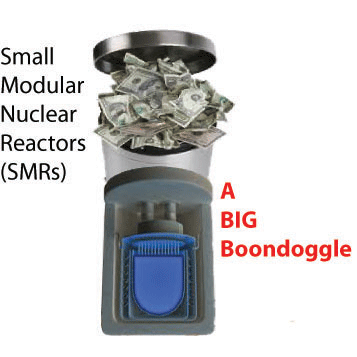
Northern Utah city opts out of planned nuclear power project over money concerns Deseret News, Amy Joi O’Donoghue @Amyjoi 16 Aug 24, 2020,
SALT LAKE CITY — Cost concerns over Logan’s participation in a next-generation nuclear power plant planned at Idaho National Laboratory led the city to withdraw from the project, and Lehi is considering a similar move in its council meeting Tuesday.
“My concerns were many and varied,” Logan Finance Director Richard Anderson said of last week’s decision
……. changes in funding by the U.S. Department of Energy for the Carbon Free Power Project caused Anderson concern, as it did for Mark Montgomery, the city’s light and power director, and prompted both of them to recommend Logan withdraw its participation.
Ultimately, the energy department committed to spend $1.4 billion on the project with an eye toward reducing carbon emissions, combating climate change and to position the country as a world leader in nuclear technology.
But critics say the proposed 720-megawatt plant is too risky and ratepayers — hence taxpayers — should not be footing the cost for technology they say is yet to be proven.
LaVarr Webb, spokesman for the municipal power association, said the investment schedule was specifically designed with these exit opportunities if cities or special districts become nervous.
The project, he added, will not proceed if costs prove too high.
The project has also come under criticism for what some say is a lack of transparency.
Earlier this month, the Utah Taxpayers Association urged cities to withdraw ahead of the deadline and complained about meetings in which groups were turned away unless they were project participants.
Rusty Cannon, vice president of Utah Taxpayers Association, said because the municipal power association is exempt from Utah’s open meeting laws, it can close its doors to others.
“We asked to observe a recent meeting and were denied access. That is the same response many others have also received,” Cannon said.
While association leaders have spent hours on video calls with the association and others, Cannon said that format does not provide the same answers.
Webb said meetings in which non-project participants were turned away, with perhaps the exception of one, are in line with why other governmental entities can close meetings under Utah law, such as contractual issues, litigation or personnel issues.
On Tuesday in Lehi, the City Council will consider a resolution outlining the city’s withdrawal from the project……. https://www.deseret.com/utah/2020/8/24/21399537/northern-utah-city-opts-out-of-planned-nuclear-power-project-over-money-concerns
Canada communities don’t want the so-called “clean” Small Modular Nuclear Reactors (SMRs)

even with SMRs under 300 megawatts, nuclear waste is a byproduct.
waste generated from SMRs would become a dangerous part of the transportation system “even if they do remove it.”
“It will be big, big transports of highly radioactive stuff, driving down the roads as an easy dirty bomb
the high cost of building infrastructure and then containing nuclear fallout and radiation are all concerns before they can go ahead.
Nuclear giants team up to develop reactors in Sask. and Ontario, Michael Bramadat-Willcock / Local Journalism Initiative Reporter, National Observer, AUGUST 23, 2020
Canada’s leading nuclear industry players announced an inter-provincial corporate partnership Thursday to support the launch of a research centre that will work on developing small modular reactors (SMRs) for use in Saskatchewan.
Saskatoon-based Cameco is the world’s biggest uranium producer and has long supplied fuel to Bruce Power, Ontario’s largest nuclear power company.SMRs are designed to produce smaller amounts of electricity, between 50 and 300 megawatts,……
The secretariat is mandated to develop and execute a strategic plan for the use of “clean-energy small modular reactors” in the province. ……
No timeframe or SMR sites were included in the announcement, but the government’s plans already have some northern residents raising alarms.
Committee for Future Generations outreach co-ordinator Candyce Paul of La Plonge at the English River First Nation told Canada’s National Observer that they haven’t been consulted on any aspects of the plan, but all signs point to the north as a site for the reactors.
Paul’s group fights nuclear waste storage in Saskatchewan and was instrumental in stopping a proposal that considered Beauval, Pinehouse and Creighton as storage locations in 2011.
“When we informed the communities that they were looking at planning to bury nuclear waste up here in 2011, once they learned what that entailed, everybody said no way. Eighty per cent of the people in the north said no way, absolutely not. It didn’t matter if they worked for Cameco or the other mines. They said if it comes here, we will not support it coming here,” she said.
Paul said she sees small modular nuclear reactors as another threat to the environment and to human safety in the region.
She noted that even with SMRs under 300 megawatts, nuclear waste is a byproduct.
“Even if they’re not burying nuclear waste here, they could be leaving it on site or hauling it through our northern regions and across our waterways,” Paul said.
She said that waste generated from SMRs would become a dangerous part of the transportation system “even if they do remove it.”
“It will be big, big transports of highly radioactive stuff, driving down the roads as an easy dirty bomb. You’d be driving down the road (behind a nuclear waste transport vehicle) and not know you’re following it,” Paul said.
Paul said the intent behind installing SMRs is anything but green and that the real goal is to prop up Saskatchewan’s ailing uranium industry and develop oilsands in the northwest.
Paul said that communities around Canada, and especially in the Far North, have long been pitched as sites for SMR development and have refused.
A 2018 brief from Pangnirtung Hamlet Council in Nunavut concluded “any Arctic-based nuclear power source should be an alternative energy choice of last resort.”
“None of our people are going to get trained for operating these. It supports people from other places. It doesn’t really support us,” Paul said.
SMRs have been pitched in the north as a way to move away from reliance on diesel fuel, which can be costly. Paul said any benefits of that remain to be seen.
She said companies would need to do environmental impact assessments for smaller reactors even though the exclusion zone around SMR sites is smaller.
“Even if the exclusion zone is only a few kilometres, a few kilometres affects a lot in an ecosystem and especially in an ecosystem that is wild,” Paul said.
“I’m not feeling confident in this at all, Canadian nuclear laboratories saying that it would only be a small radius exclusion zone. Well that’s our territory. That’s our land, our waters, our wildlife.
“It’s not their backyard, so they couldn’t care less.”
Brooke Dobni, professor of strategy at the University of Saskatchewan’s Edwards School of Business, told Canada’s National Observer that any development of small reactors would take a long time.
“It could be a good thing, but on the other hand, it might have some pitfalls. Those talks take years,” Dobni said.
He said nuclear reactors face bigger challenges because of public concerns about the environment and that the high cost of building infrastructure and then containing nuclear fallout and radiation are all concerns before they can go ahead.
“Anything nuclear is 25 years out if you’re talking about small reactors, those kinds of things to power up the city,” Dobni said.
“That technology is a long ways away and a lot of it’s going to depend on public opinion.
The court for that is the court of public opinion, whether or not people want that in their own backyard, and that’s the whole issue anywhere in the world.” https://www.humboldtjournal.ca/news/nuclear-giants-team-up-to-develop-reactors-in-sask-and-ontario-1.24191077
Huge electricity transformer will land on a Gwynedd beach, headed for nuclear power project
 Daily Post 22nd Aug 2020, A huge electricity transformer will land on a Gwynedd beach on its way to a
nuclear power station. The 128-tonne unit is being brought to North Wales
by barge and will be landed on the beach at Traeth y Graig Ddu (Black Rock
sands) at Morfa Bychan in Gwynedd. It will then be transferred onto a lorry
and taken by road to the National Grid site near the decommissioned nuclear
power station at Trawsfynydd. It had been planned to bring the barge into
Porthmadog harbour last April, but this was delayed by the coronavirus
pandemic. There had been concern the delivery would have badly disrupted
the harbour so, in a first for National Grid, the transformer is arriving
at the beach.
https://www.dailypost.co.uk/news/north-wales-news/huge-delivery-headed-nuclear-plant-18798277
1 This Month
29 Jan. Thursday 7-8 p.m. Webinar – World’s Largest Nuclear Station in Port Hope, ON?
To see nuclear-related stories in greater depth and intensity – go to https://nuclearinformation.wordpress.com/



31st January – Challenging the War Machine – a DECLASSIFIED UK SUMMIT


Website of the Week
Now until to February 10, 2026 Radioactive waste storage in France: the debate is finally open! How to participate?
-
Archives
- January 2026 (283)
- December 2025 (358)
- November 2025 (359)
- October 2025 (376)
- September 2025 (258)
- August 2025 (319)
- July 2025 (230)
- June 2025 (348)
- May 2025 (261)
- April 2025 (305)
- March 2025 (319)
- February 2025 (234)
-
Categories
- 1
- 1 NUCLEAR ISSUES
- business and costs
- climate change
- culture and arts
- ENERGY
- environment
- health
- history
- indigenous issues
- Legal
- marketing of nuclear
- media
- opposition to nuclear
- PERSONAL STORIES
- politics
- politics international
- Religion and ethics
- safety
- secrets,lies and civil liberties
- spinbuster
- technology
- Uranium
- wastes
- weapons and war
- Women
- 2 WORLD
- ACTION
- AFRICA
- Atrocities
- AUSTRALIA
- Christina's notes
- Christina's themes
- culture and arts
- Events
- Fuk 2022
- Fuk 2023
- Fukushima 2017
- Fukushima 2018
- fukushima 2019
- Fukushima 2020
- Fukushima 2021
- general
- global warming
- Humour (God we need it)
- Nuclear
- RARE EARTHS
- Reference
- resources – print
- Resources -audiovicual
- Weekly Newsletter
- World
- World Nuclear
- YouTube
-
RSS
Entries RSS
Comments RSS
 nuclear-news