Hurdles and nagging doubts remain, facing Bill Gates’pet project – multi $billion Natrium nuclear
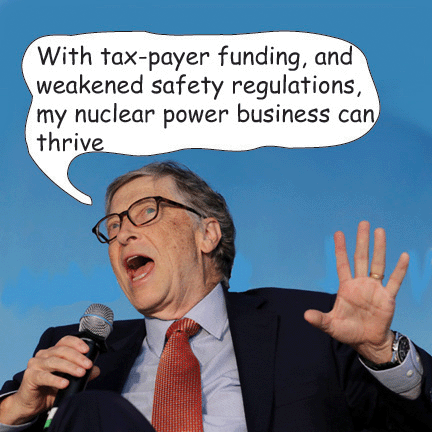
Multi-billion dollar Natrium nuclear project inches forward, County 17 , 18 Aug 21,
A progress report to members of the Joint Committee on Minerals, Business & Economic Development in Laramie Thursday offered mostly good news to proponents of building a first-of-its-kind nuclear reactor in Wyoming. Even with the backing of the Biden White House and the U.S. Department of Energy, however, the nascent plan still faces numerous administrative and legislative hurdles.
Officials with Rocky Mountain Power — who will facilitate construction of the project alongside billionaire tech entrepreneur Bill Gates’ company, TerraPower — told lawmakers they will select a project site by the end of 2021. They are eying four potential choices across Wyoming: Jim Bridger near Rock Springs, Naughton in Kemmerer, Dave Johnston near Glenrock or WyoDak near Gillette…….
Numerous legislative fixes would be required to keep Wyoming statutes up to date with changing technologies and accommodate such a facility……..
Skeptics
Some remained skeptical of the project’s broader implications.
State Rep. Chuck Gray (R-Casper) — a staunch advocate for coal — expressed concerns about a Wyoming-based utility courting federal funding to pioneer an alternative form of energy……
Others have raised environmental concerns outside of the meeting. …..
Natrium officials previously told WyoFile the waste produced by the facility would be stored on site.
Still up for debate, however, is how to tax the new style of reactor.
…. Senate Minority Leader Chris Rothfuss (D-Laramie), however, was reluctant to give nuclear a tax-free pass, urging lawmakers not to set an arbitrary tax rate that would hinder Wyoming’s future earning potential….
The committee ultimately defeated a motion to reduce the state’s production taxes on nuclear energy to zero.
Small nuclear reactors – questionable on safety, on toxic wastes, and on costs.
Nuclear Energy 101: What Exactly Are Small Modular Reactors? Bridget Reed Morawski EcoWatch Aug. 18, 2021 ”’……………………… While advanced reactor designs like small modular reactors are applauded by some for their potential to dramatically lower the costs and siting requirements for nuclear energy facilities, not everyone is throwing their support behind the technologies.
Edwin Lyman of the Union of Concerned Scientists counts himself among the SMR skeptics. As the non-profits’ nuclear power safety director, Lyman doesn’t believe that small modular reactor developers have “made the safety case that they don’t need a large structure,” even if the federal nuclear regulation agency “seems to be going along with their approach.”
………. Greg Rzentkowski, the IAEA’s nuclear installation safety division director, notes on the forum’s website that “SMRs are in general less dependent on safety systems, operational measures and human intervention than existing reactors,” adding that “the usual regulatory approach, which is based on overlapping safety provisions to compensate for potential mechanical and human failures, may not be appropriate and new ideas should be considered.”
Lyman doesn’t believe that the regulatory approach should be altered for new designs.
“I would say that any of these concepts aren’t necessarily safer and a big part of overall safety is not simply intrinsic aspects of the design, but also what is the set of safety requirements that you impose on that [design]?” said Lyman.
In Lyman’s opinion, “if the [U.S. Nuclear Regulatory Commission] grants exemptions and allows small modular reactors to take credit for these inherent safety features to reduce other aspects of operation that add layers of safety […] the overall outcome may be no better or even worse.” He explained that owners of conventional reactors are required by the NRC to draw up emergency evacuation plans that cover a 10-mile zone around the plant, for example, but that developers argue they don’t need such a plan for small reactors.
“But if they’re wrong, if there’s some unexamined accident sequence that can lead to a worse event than they contemplate, then you don’t have that extra layer of safety by being able to evacuate people,” he said.
The topic of nuclear waste disposal is among Lyman’s other concerns about small modular reactors. Although these smaller reactors may require fewer refuelings, he says that “it doesn’t matter what kind of reactor you have, there is no long-term strategy for nuclear waste disposal in this country, and most other countries in the world.” He added that more research needs to be done on storing certain small modular reactor fuel types in the long-term.
Some SMR developers also point to the added sustainability factor that comes from their recycling of nuclear waste. However, Lyman says “there’s no such thing as a reactor that consumes radioactive waste; what they’re really talking about is reprocessing spent fuel,” another term for nuclear waste.
As Lyman wrote in a March 2021 report, “any nuclear fuel cycle that utilizes reprocessing and recycling of spent fuel poses significantly greater nuclear proliferation and terrorism risks than” reactors that don’t reprocess such waste. Reprocessing “provides far greater opportunities for diversion or theft of plutonium and other nuclear-weapon usable materials.”
Lyman also questions the claims that small modular reactors are lower cost, saying that “it’s a situation where these reactors might be more affordable, but not more economical.” Procuring kilowatts of power from a small modular reactor might be cheaper in terms of how much money the overall facility costs but not in terms of how much it costs to produce a kilowatt of power compared to a much larger facility.
Think about it like your last trip to the grocery store: a single can of soda might have cost $1.50, but an entire 12-pack was priced at $10. That single soda might have a lower price than the entire pack, but you’re also getting a lot less soda per dollar spent. Similarly, Lyman believes the price per unit of electricity generated by a fleet of small modular reactors can’t actually be lower than the cost of a group of larger nuclear reactors generating the same amount of power.
Either way, small modular reactor development has attracted investment dollars from the federal government and private companies alike. Bill Gates, for example, is the main financier behind TerraPower, which plans to locate small modular reactors at the site of a former Wyoming coal plant in partnership with PacifiCorp, an investor-owned utility that operates in the intermountain west.
A competing company, the Oregon-based small modular nuclear reactor developer NuScale, has received roughly $192 million so far this year alone from private companies and investors. In 2020, the U.S. Department of Energy announced an up to $1.4 billion cost-share agreement with NuScale for a demonstration project in Idaho. At the time, Rita Baranwal, the DOE’s then-assistant secretary for nuclear energy, called the project “instrumental in the deployment of SMRs around the world.” https://www.ecowatch.com/nuclear-energy-101-2654710991.html
Canada’s Moltex small nuclear reactor project -its plutonium process brings danger of nuclear weapons proliferation.
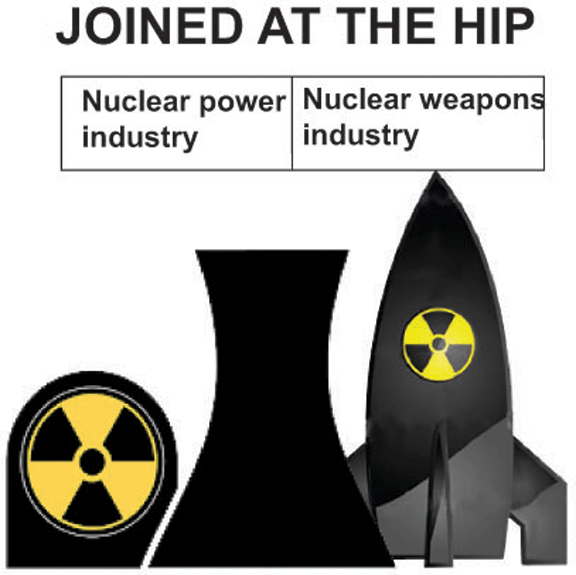
Diane Francis: Trudeau’s multi-million dollar nuclear deal called out by non-proliferation experts https://financialpost.com/diane-francis/diane-francis-trudeaus-multi-million-dollar-nuclear-deal-called-out-by-non-proliferation-experts ,
Scientists fear that the technology used to extract plutonium from spent fuel could be used to make nuclear bombs, Diane Francis Aug 12, 2021 In May, the Geneva-based International Campaign to Abolish Nuclear Weapons (ICAN) called out Prime Minister Justin Trudeau’s government over a deal he has approved and funded that critics say will undermine the goal of nuclear non-proliferation, according to an article published in the Hill Times and recently republished in the Bulletin of the Atomic Scientists.
Moltex Energy was selected by NB Power and the Government of New Brunswick to develop its new reactor technology and locate it at the Point Lepreau nuclear plant site by the early 2030s. Moltex is one of several companies that are promoting small, “next generation” nuclear reactors to replace fossil fuels in the production of electricity.
Moltex, a privately owned company that is based in the United Kingdom and has offices in Saint John, N.B., says it will “recycle nuclear waste” from New Brunswick’s closed Point Lepreau nuclear plant for use in its small-scale nuclear reactor. Federal funding and approval was announced on March 18 by Dominic LeBlanc, a New Brunswick MP who serves as minister of intergovernmental affairs.
The scientists dispute the claim that this is “recycling” and are concerned because the technology Moltex wants to use to extract plutonium, a key ingredient in nuclear weapons, from spent fuel could be used by other countries to make nuclear bombs. Decades ago, the U.S. and many of its allies, including Canada, took action to prevent this type of reprocessing from taking place.
“The idea is to use the plutonium as fuel for a new nuclear reactor, still in the design stage. If the project is successful, the entire package could be replicated and sold to other countries if the Government of Canada approves the sale,” reads the article.
On May 25, nine high-level American non-proliferation experts sent an open letter to Trudeau expressing concern that by “backing spent-fuel reprocessing and plutonium extraction, the Government of Canada will undermine the global nuclear weapons non-proliferation regime that Canada has done so much to strengthen.”
The signatories to the letter include senior White House appointees and other government advisers who worked under six U.S. presidents and who hold professorships at the Harvard Kennedy School, Princeton University and other eminent institutions.
The issue of nuclear proliferation dates back to 1974, when Canada got a black eye after India tested its first nuclear weapon using plutonium that was largely extracted using the CIRUS reactor, which was supplied by Canada for peaceful uses. Shortly after, other countries attempted to repurpose plutonium from reactors and were stopped — except for Pakistan, which, like India, succeeded in creating atomic weapons.
The Hill Times pointed out that, “To this day, South Korea is not allowed to extract plutonium from used nuclear fuel on its own territory — a long-lasting political legacy of the 1974 Indian explosion and its aftermath — due to proliferation concerns.”
The letter to Trudeau concluded: “Before Canada makes any further commitments in support of reprocessing, we urge you to convene high-level reviews of both the non-proliferation and environmental implications of Moltex’s reprocessing proposal including international experts. We believe such reviews will find reprocessing to be counterproductive on both fronts.”
The scientists’ letter has not yet been answered by the government. However, Canadians deserve to be fully briefed on all this and its implications. They deserve to know who owns Moltex, what the risks are to non-proliferation and why taxpayers are sinking millions of dollars into a project that’s morally questionable and potentially hazardous.Read and sign up for Diane Francis’ newsletter on America at dianefrancis.substack.com.
New ”Natrium” nuclear reactors – a very risky gamble.

A July 2021 Foreign Affairs article reports that in the past sixty years eight countries have spent $100 billion to produce sodium cooled fast reactors such as the one proposed for Wyoming. All have failed. The money’s spent and the lights are out.
While the Natrium design posits less risk of a meltdown, the sodium coolant is under high pressure and is explosive in the event of any breach in the containment area. And while Natrium plants produce less radioactive waste than traditional nuclear plants, there’s still the necessity to safely and permanently store this waste. How much will it cost? World Nuclear Industry Status Report’s editor Mycle Schneider says, “No one knows…because there is no functioning permanent storage facility.” Nowhere.
How much power are we talking about anyway? Writing for Canary Media, Eric Wesoff reported that in 2020, 2.4 gigawatts of new nuclear power plants were installed worldwide while there were 100 gigawatts of new solar and 60 gigawatts of new wind power generators. Meanwhile, old nuclear plants close—Indian Power in New York, Diablo Canyon in California, Exelon’s Byron and Dresden plants in Illinois. What do we do with decommissioned nuclear plants? A cooling tower in Germany has become a climbing wall.
Romtvedt: Proposal for nuclear power calls for caution https://trib.com/opinion/columns/romtvedt-proposal-for-nuclear-power-calls-for-caution/article_ecb135f0-1378-5728-9992-abd11b681ba4.html, David Romtvedt, Aug 10, 2021
In conjunction with PacifiCorp, Rocky Mountain Power’s parent company, owned by Berkshire Hathaway Energy, a subsidiary of Warren Buffett’s Berkshire Hathaway, Inc; and TerraPower, a nuclear reactor design company founded by Bill Gates, Wyoming Governor Mark Gordon has announced his support for the construction of a nuclear reactor demonstration plant in Wyoming. According to Berkshire Hathaway, the project is intended to “validate the design, construction and operational features” of TerraPower’s Natrium nuclear plant design which uses liquid sodium as a coolant rather than water.
Governor Gordon believes that Natrium offers a safe, reliable solution to Wyoming’s economic woes, saying, “I am thrilled to see Wyoming selected for this demonstration pilot project as our great state is the perfect place for this type of innovative utility facility and our experienced workforce is looking forward to the jobs this project will provide.”
So the benefits of the nuclear plant are said to be increased economic security and diminished environmental risk than with other forms of nuclear power plants. But it’s not so clear. Both in construction and operation, Natrium nuclear plants require uniquely skilled workers employing specialized materials and building techniques. Other economic issues include the temporary nature of construction work, long lead times for safety and licensing reviews (Natrium is not licensed by the Nuclear Regulatory Commission), and diminished severance tax revenues as a result of the shift from coal to nuclear.
There’s also the fuel—Natrium uses high-assay low-enriched uranium (HALEU). Power Magazine reports that there is no current supply of HALEU and that it will take at least seven years with sufficient demand to develop a fuel cycle infrastructure. Edwin Lyman of the Union of Concerned Scientist cautions that Russia is currently the only source of suitable fuel. In whatever quantity, the fuel is not likely to come from Wyoming uranium mines.
After construction there’s generation. World Nuclear Industry Status Report has recorded the changing costs of electric generation per kilowatt hour (in US cents) between 2009 and 2020. They are: solar—35.9 to 3.7, down 90%; wind—13.5 to 4.0, down 70%; gas—8.3 to 5.9, down 29%; coal—11.1 to 11.2, up 1%; and nuclear 12.3 to 16.3, up 33%. Nuclear is the most expensive way to generate electricity.
And time—the Wyoming proposal projects seven years to completion. Since no new nuclear power plant with a license application submitted since 1975 has yet begun operation, we may question the Wyoming timeline. More time equals more cost. Georgia Power’s Vogtle nuclear plants are years behind schedule with costs having risen from $14 billion to over $25 billion. But it may not matter as Georgia Power can charge cost overruns to its customers—the more the project is over budget, the more the company profits. In Florida, Duke Power, after seeing a cost increase from $5 billion to $22 billion, abandoned a Natrium nuclear project after passing $800 million dollars in excess costs to ratepayers.
A July 2021 Foreign Affairs article reports that in the past sixty years eight countries have spent $100 billion to produce sodium cooled fast reactors such as the one proposed for Wyoming. All have failed. The money’s spent and the lights are out.
While the Natrium design posits less risk of a meltdown, the sodium coolant is under high pressure and is explosive in the event of any breach in the containment area. And while Natrium plants produce less radioactive waste than traditional nuclear plants, there’s still the necessity to safely and permanently store this waste. How much will it cost? World Nuclear Industry Status Report’s editor Mycle Schneider says, “No one knows…because there is no functioning permanent storage facility.” Nowhere.
I’m guessing that Governor Gordon’s decision was driven in part by his hope to protect the lives and livelihoods of Wyoming workers. But generating radioactive waste without a procedure for safe permanent storage of that waste will protect no one—not unemployed coal miners, not me, not the governor.
How much power are we talking about anyway? Writing for Canary Media, Eric Wesoff reported that in 2020, 2.4 gigawatts of new nuclear power plants were installed worldwide while there were 100 gigawatts of new solar and 60 gigawatts of new wind power generators. Meanwhile, old nuclear plants close—Indian Power in New York, Diablo Canyon in California, Exelon’s Byron and Dresden plants in Illinois. What do we do with decommissioned nuclear plants? A cooling tower in Germany has become a climbing wall.
The questions loom. If I were a betting man, given initial costs, cost overruns, lost tax revenue, the increasing viability of renewables, the history of nuclear failure, and the health and safety hazards surrounding nuclear waste, I’d pause before I put my money on nuclear power. Not being a betting man, I wouldn’t consider it.
David Romtvedt is a writer and musician from Buffalo, Wyoming. A former activist with the Ground Zero Center for Nonviolent Action, he serves as a board member for the Powder River Basin Resource Council.
Elon Musk to take part in a project to place advertising in space?

Elon Musk slammed as SpaceX to launch satellite displaying billboard ads in space
ELON MUSK has come under fire from the scientific community after it has emerged a company wants SpaceX to launch a satellite broadcasting billboard ads from space. Express UK By SEBASTIAN KETTLEY, Aug 9, 2021
Background color
The South African billionaire, who does not shy away from controversy, has a lot going on his plate right now. SpaceX is busy assembling and testing the Mars rocket Starship, Starlink is slowly expanding its mega-constellation Internet-beaming satellites and Tesla has recently rolled out the Model S Plaid. A new report has now revealed SpaceX is partnering with a Canadian startup to launch the world’s first space-based ad satellite.
According to Samuel Reid, CEO and co-founder of Geometric Energy Corporation (GEC), the company will pay SpaceX to launch an advertisement satellite into low-Earth orbit (LEO).
This satellite, called CubeSat, will boast a large screen full of purchasable pixels on one side where advertisers will bid to have their logos and products displayed.
Mr Reid told Insider: “There might be companies which want to depict their logo… or might end up being a bit more personal artistic.

“Maybe Coca-Cola and Pepsi will fight over their logo and reclaim over each other.
SpaceX will not play a direct role in the mission but rather act as the launch provider at some point in early 2022, using one of the company’s iconic Falcon 9 rockets.
Once in orbit, the CubeSat will use a selfie stick to broadcast its stream back to Earth via Twitch or YouTube.
Luckily, this means giant billboards are not about to fill up the night skies with advertising.
But the news has sparked an outcry on social media, with scientists and spaceflight enthusiasts alike criticising the move.
Comedy writer James Felton took to Twitter to vent his disapproval
He said: “Going to be difficult to pretend we’re not living in a sci-fi dystopian apocalypse when we take a moment to look up from the raging wildfires engulfing the planet to see the words Drink Pepsi.”
Game programmer and reporter Matthew Chapman said: “No. I draw the line here.
“Congress needs to ban Space Billboards before they become a thing.
“Already SpaceX satellites are creating a minefield of pollution in low-Earth orbit.”
And science writer Amy Shira Teitel said: “Coke vs Pepsi in space? What’s a little more horrendous light pollution between mega-advertising behemoths?
“Hoping this never, ever happens…”
To advertise on the pixel billboard, customers will have to pay using cryptocurrency tokens.
These will include digital tokens like ethereum, though GEC plans to accept dogecoin in the future.
Advertisers will get to select each individual pixel they want and fill them out with a colour of their choice.
Once they fill out enough pixels, a discernable image will emerge on the screen.
Mr Reid said: “I’m trying to achieve something that can democratize access to space and allow for decentralized participation………… https://www.express.co.uk/news/science/1474414/elon-musk-slammed-spacex-launch-satellite-billboard-ads-in-space-scn
The nuclear industry is dying. Bitcoin to the rescue?

Some lawmakers have called for greater regulation of cryptocurrency, citing the enormous amount of resources required to produce it. “There are computers all over the world right now spitting out random numbers around the clock, in a competition to try to solve a useless puzzle and win the bitcoin reward,” Sen. Elizabeth Warren (D., Mass.) said in June, calling for a crackdown on “environmentally wasteful cryptocurrencies.”
Zero-carbon [?] bitcoin? The owner of a Pennsylvania nuclear plant thinks it could strike gold
Talen Energy plans to build a $400 million bitcoin mine at its Pa. nuclear plant. “I think this is a great opportunity to prolong the life of a lot of nuclear plants.”
Could bitcoin mining be the salvation of the embattled nuclear energy industry in America?
The owners of several nuclear power plants, including two in Pennsylvania, have formed ventures with cryptocurrency companies to provide the electricity needed to run computer centers that “mine” bitcoin. Since nuclear energy does not emit greenhouse gases, [ except that the whole nuclear fuel chain DOES] the project’s investors say, the zero-carbon [ a lie] bitcoin would address climate concerns that have tarnished the energy-intensive cryptocurrency industry.
Talen Energy, the owner of the Susquehanna Steam Electric Station near Berwick, Pa., announced this week that it has signed a deal with TeraWulf Inc., an Easton, Md. cryptocurrency mining firm, to build a giant bitcoin factory next to its twin reactors in northern Pennsylvania. The first phase of the venture, dubbed Nautilus Cryptomine, could cost up to $400 million.
Talen’s project could eventually use up to 300 megawatts — or 12% of Susquehanna’s 2,500 MW capacity. It’s the second bitcoin-mining venture in the last month that involves owners of Pennsylvania nuclear facilities.
Last month Energy Harbor Corp., the former power-generation subsidiary of First Energy Corp., announced it signed a five-year agreement to provide zero-carbon [nuclear is NOT zero-carbon] electricity to a new bitcoin mining center operated by Standard Power in Coshocton, Ohio. Energy Harbor owns two nuclear units in Ohio and the twin-unit Beaver Valley Power Station in Western Pennsylvania.
A nuclear fission start-up, Oklo, also announced last month it signed a 20-year deal with a bitcoin miner to supply it with power, though the company has not yet built a power plant.
In recent years, commercial nuclear operators have struggled to compete in competitive electricity markets against natural gas plants and upstart renewable sources such as wind and solar. Unfavorable market conditions have hastened the retirements of several single-unit reactors, such as Three Mile Island Unit 1 in Pennsylvania. Lawmakers in New Jersey, New York and Illinois have enacted nuclear bailouts, paid by electricity customers, to stave off early retirement for other plants.
The cryptocurrency deals would provide nuclear generators with reliable outlets for their power, and bitcoin miners with predictable sources of power at cheap prices, along with a zero-carbon [nuclear is NOT zero-carbon] cachet…….
The nuclear industry views the crypto craze not as a crutch but as a launching pad for expansion. “U.S. nuclear power plants are ready and able to supply miners with abundant, reliable carbon-free [ but nuclear is NOT carbon-free] power while also providing new business pathways for the nuclear developers and utilities, increasing their operating profits, and potentially accelerating the deployment of the next generation of reactors,” John Kotek, senior vice president of policy development and government affairs at Nuclear Energy Institute, said……
Energy and cryptocurrency experts say several trends are shifting the market in favor of U.S. nuclear power producers.
In May, Chinese regulators announced new measures to limit bitcoin mining in several regions that failed to meet Beijing’s energy-use targets. Bitcoin production levels have fallen since then, forcing bitcoin producers to relocate to places with low operating costs and cool climates to reduce the costs of cooling the bitcoin data centers. The state of Washington, which has lots of inexpensive hydroelectric power, has undergone a huge boom in bitcoin mining.
How mining is done
Bitcoin is a peer-to-peer virtual currency, operating without a central authority, and which can be exchanged for traditional currency such as the U.S. dollar. It is the most successful of hundreds of attempts to create virtual money through the use of cryptography, the science of making and breaking codes — hence, they are called cryptocurrency.
Bitcoin mining is built around blockchain technology, and it involves generating a string of code that decrypts a collection of previously executed bitcoin transactions. Successful decryption is rewarded with a new bitcoin. The supply of bitcoins is limited to 21 million — nearly 90% have already been mined. So the remaining bitcoins become increasingly scarce and more difficult to extract
Data centers operated by bitcoin miners randomly generate code strings, called “hashes,” to solve the puzzle and earn new coins. Worldwide, miners on the bitcoin network generate more than 100 quintillion hashes per second — that’s 100,000,000,000,000,000,000 guesses per second, according to Blockchain.com. The first phase of the Nautilus project in Pennsylvania would generate five quintillion hashes per second.

Such guesswork requires muscular [doncha love that word ”muscular” when they mean ”huge”] computing power, robust internet connections, and lots of electricity. Smaller bitcoin miners have teamed up in consortiums to pool their computing power. Bigger players have built huge data centers devoted exclusively to producing lines of random code.
“Mining cryptocurrency is an international, profitable, and energy-intensive business,” ScottMadden a management consulting firm, said in a paper it published last year. Bitcoin mining consumes an estimated 0.5% of the electricity produced worldwide or about as much as the country of Greece.
Some lawmakers have called for greater regulation of cryptocurrency, citing the enormous amount of resources required to produce it. “There are computers all over the world right now spitting out random numbers around the clock, in a competition to try to solve a useless puzzle and win the bitcoin reward,” Sen. Elizabeth Warren (D., Mass.) said in June, calling for a crackdown on “environmentally wasteful cryptocurrencies.”
………. Unlike other crypto projects in which the power generator is an arms-length electricity supplier, the Nautilus Cryptomine is a 50-50 venture between Talen and TeraWulf. The project would be directly connected to the Susquehanna plant — “behind the meter,” in industry parlance — and would avoid any transmission costs from the grid…….
The cryptomine would be located inside a 200,000-square-foot building — about four football fields. The mining operation would be built on a data center campus that Talen is developing next to the Susquehanna plant……..
“As you look across the United States, and you look at kind of the challenges that are facing nuclear plants, I think this is a great opportunity to prolong the life of a lot of plants,” said Dustin Wertheimer, vice president and divisional chief financial officer of Talen Energy https://www.inquirer.com/business/cryptocurrency-bitcoin-pennsylvania-nuclear-power-talen-susquehanna-20210806.html
EDF’s plans to produce pink hydrogen at proposed 3.2GW nuclear plant are ‘daft’: argues influential independent analyst Liebreich
EDF’s plans to produce pink hydrogen at proposed 3.2GW nuclear plant are ‘daft’: Liebreich
French utility wants to divert nuclear power to electrolysers at times when the supply of wind and solar is high, but ‘the economics won’t work’, argues the influential independent analyst, Recharge, 2 August 2021 EDF is planning to produce low-carbon “pink” hydrogen at a controversial planned nuclear power plant in the UK only at times when the supply of wind and solar is plentiful — an idea that influential analyst Michael Liebreich has dismissed as “daft”
The French state-backed power giant wants to build the £20bn ($27.8bn) 3.2GW Sizewell C facility on the coast of eastern England, and the UK government is said to be keen to give it the go-ahead as it aims to reach net-zero emissions by 2050.
But in the wake of the hugely expensive Hinkley Point C nuclear power plant in southwest England — which is now under construction after receiving an eye-wateringly high strike price of £92.50/MWh for 35 years (rising with inflation) — the government is wary of committing so much taxpayer money to the project.
In what could be seen as an effort to firm up government support for Sizewell C, which would come on line in 2034, EDF has unveiled plans to use the proposed facility to produce clean hydrogen by diverting electricity to H2-producing electrolysers on days when the supply from wind, solar and hydro are high.
If new nuclear is to have any chance of succeeding it will be by being paired with demand-responsive processes like electrolysis or desalination,” Liebreich wrote on Twitter. “But the idea of making H2 [from nuclear] only with excess power on sunny or windy days is daft: the economics won’t work.”………
Producing hydrogen through electrolysis only at times of excess renewable power has long been derided as uneconomic. This is because using electrolysers only occasionally will significantly increase the levelised cost of the hydrogen (LCOH……….
UK’s nuclear problems
The UK government is said to be considering funding Sizewell C through a “regulated asset base” model, through which consumers would pay a top-up on their electricity bills way before the plant starts generating power. But this would potentially mean that consumers would also have to pay for any cost overruns — a very common problem for the nuclear industry.
According to researchers at the Massachusetts Institute of Technology, the typical nuclear power plant built since 1970 had a cost overrun of 241%. This has meant it has been hard for new nuclear projects to attract investment.
The UK government is said to be considering taking over the 20% stake in Sizewell C currently owned by China General Nuclear Power Group (CGN), after declaring that it no longer wanted Chinese state-owned companies involved in the UK atomic power sector. CGN owns a 33% stake in Hinkley Point C.
Former UK Energy Secretary Ed Davey, who is now the leader of the Liberal Democrat party, says the government’s focus should be on far cheaper wind and solar, rather than expensive, risky nuclear.
“Anything that passes nuclear’s costs on to the taxpayer — costs like nuclear waste management, nuclear station decommissioning, or delays and cost overruns — will be a total betrayal of taxpayers and cost every household in Britain a small fortune,” he said……….. https://www.rechargenews.com/energy-transition/edf-s-plans-to-produce-pink-hydrogen-at-proposed-3-2gw-nuclear-plant-are-daft-liebreich/2-1-1047159
UK Taxpayer funding will pour in, to get Rols Royce’s small modular nuclear reactors happening
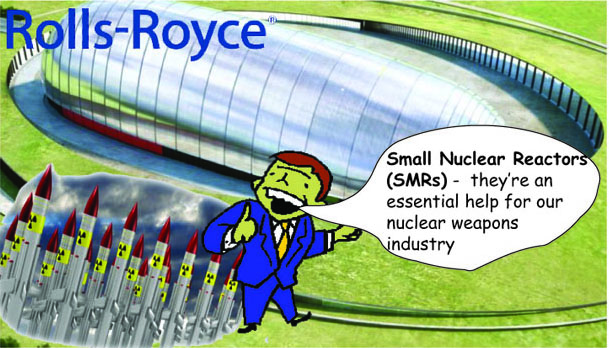
Rolls-Royce lines up funding for mini nuclear reactor revolution. Private
backing for Rolls-led consortium to build new generation of ‘mini nukes’
unlocks hundreds of millions of taxpayer support. Britain has taken a
crucial step towards creating a fleet of mini reactors that would reduce
reliance on Chinese money and nuclear technology after Rolls-Royce secured
investment to build the world’s first production line.
A consortium led by the FTSE 100 engineer has secured at least £210m needed to unlock a
matching amount of taxpayer funding, which will make it the first “small
modular reactors” (SMR) developer to submit its designs to regulators. It
is understood heavyweight financial investors specialising in energy are
now thrashing out the final details of their backing to drive work on the
so-called “mini nuke” power plants.
State support for SMRs – which
each generate about 450 megawatts, about a seventh of the output of
conventional nuclear power stations such as Hinkley Point – was revealed
in the Prime Minister’s ten-point plan for a green industrial revolution
released in the autumn. ………..
SMRs must play a
critical role in our clean energy transition and can open new export
markets worth billions of pounds. “To realise this potential, however,
the Government needs to establish a siting and policy framework by next
year to enable the deployment of a fleet of SMRs and capture the promise of
a net zero [that’s a lie] future.” Although officials are engaging with other businesses
on SMRs, one Whitehall source described the Rolls-led consortium as “by
far the most advanced”.
The UK SMR consortium also includes the National
Nuclear Laboratory and Laing O’Rourke, the construction firm. Ministers
are expected to push for the Office for Nuclear Regulation to prioritise
assessment of the consortium’s SMR design, while simultaneously driving the
planning process to get potential sites.
Telegraph 3rd Aug 2021
Small nuclear reactors, a dangerous experiment, and distraction from real climate action – David Suzuki

Renewables cost less than nuclear, come with fewer health, environmental and weapons-proliferation risks and have been successfully deployed worldwide.
Given rapid advances in energy, grid and storage technologies, along with the absolute urgency of the climate crisis, pursuing nuclear at the expense of renewables is costly, dangerous and unnecessary.
Is smaller better when it comes to nuclear? Pique, By: David Suzuki 1 Aug 21, Nuclear power hasn’t been in the news much since the 2011 Fukushima meltdown in Japan. Thanks to a push by industry and governments, you might soon hear more about how nuclear reactors are now safer and better.
Specifically, the conversation has shifted to “small modular nuclear reactors” or SMNRs, which generate less than 300 megawatts of electricity, compared to up to 1,600 MWe for large reactors.
Some of the 100 or so designs being considered include integral pressurized water reactors, molten salt reactors, high-temperature gas reactors, liquid metal cooled reactors and solid state or heat pipe reactors. To date, the industry is stuck at the prototype stage for all models and none is truly modular in the sense of being manufactured several at a time—an impediment considering the speed at which global heating is worsening.
The benefits touted by industry have convinced many countries, including Canada, to gamble huge sums on nuclear, despite the poor odds. The Small Modular Reactor Action Plan hypes it as the possible “future of Canada’s nuclear industry, with the potential to provide non-emitting energy for a wide range of applications, from grid-scale electricity generation to use in heavy industry and remote communities.” ………
given the seriousness of the climate emergency and the various options for transforming our energy systems to combat it, is nuclear—regardless of size or shape—the way to go? We must rapidly reduce emissions now, and we have readily available technologies to do so.
New nuclear doesn’t make practical or economic sense for now. Building reactors will remain expensive and time-consuming. Studies estimate electricity from small nuclear can cost from four to 10 times that of wind and solar, whose costs continue to drop. SMNRs will require substantial government subsidies.
Even when nuclear has to compete against renewables prepackaged with storage, the latter wins out.
One recent study of 123 countries over 25 years published in Nature Energy found that renewables are much better at reducing greenhouse gas emissions than nuclear—whose benefits in this area are negligible—and that combining nuclear and renewables creates a systemic tension that makes it harder to develop renewables to their potential.
Like all nuclear reactors, SMNRs produce radioactive waste and contribute to increased nuclear weapons proliferation risk—and Canada still has no effective strategy for waste. Nuclear power also requires enormous amounts of water.
Corporate interests often favour large, easily monopolized utilities, arguing that only major fossil fuel, nuclear or hydro power facilities can provide large-scale “baseload” power. But many experts argue the “baseload myth” is baseless—that a flexible system using renewables combined with investments in energy efficiency and a smart grid that helps smooth out demand peaks is far more efficient and cost-effective, especially as energy storage technologies improve.
Even for remote populations, energy systems that empower communities, households, businesses and organizations to generate and store their own energy with solar panels or wind installations and batteries, for example, and technologies like heat-exchange systems for buildings, would be better than nuclear.
Renewables cost less than nuclear, come with fewer health, environmental and weapons-proliferation risks and have been successfully deployed worldwide. Given rapid advances in energy, grid and storage technologies, along with the absolute urgency of the climate crisis, pursuing nuclear at the expense of renewables is costly, dangerous and unnecessary.
David Suzuki is a scientist, broadcaster, author and co-founder of the David Suzuki Foundation. Written with contributions from David Suzuki Foundation Senior Writer and Editor Ian Hanington. https://www.piquenewsmagazine.com/opinion/opinion-is-smaller-better-when-it-comes-to-nuclear-4175458
American public opinion ignored as NASA prioritises colonising Mars, over research to save the climate

63 percent according to a 2018 Pew Research Center survey—believe that NASA should prioritize monitoring Earth’s climate system. Only a minority—18 percent—said that NASA should prioritize sending humans to Mars.
Is using nuclear materials for space travel dangerous, genius, or a little of both? bulletin of the Atomic Scientists , Bulletin of the Atomic Scientists, By Susan D’Agostino | July 28, 2021
The 1977 Soviet satellite Kosmos 954 was supposed to monitor ocean traffic using radar—a technology that works best at short distances. For this reason, the craft traveled in Earth’s low orbit, where solar panels alone could not provide consistent power. And so, the satellite was equipped with a small, efficient, yet powerful nuclear reactor fueled by approximately 50 kg of weapons-grade uranium 235. Within weeks of its launch, Kosmos 954 veered from its path like a drunkard on a walk. The Soviets tried to eject its radioactive core into a higher orbit by way of a safety system designed for that purpose. But the safety system failed. In January 1978, Kosmos 954 burst into the Western Canada skyline, scattering radioactive dust and debris over a nearly 400-mile path. The cleanup and recovery process, which took nearly eight months and started in the subarctic winter, found that virtually all of the satellite fragments were radioactive, including one that was “sufficient to kill a person or number of persons remaining in contact with that part for a few hours.”
Now that the United States has set a goal of a human mission to Mars by 2039, the words “nuclear” and “space” are again popping up together in newspaper headlines. Nuclear propulsion systems for space exploration—should they materialize—are expected to offer significant advantages, including the possibility of sending spacecraft farther, in less time, and more efficiently than traditional chemical propulsion systems. But extreme physical conditions on the launchpad, in space, and during reentry raise questions about risk-mitigation measures, especially when nuclear materials are present.
Why not travel to Mars on a chemically propelled spacecraft? Spaceships that use chemical propellants benefit from tremendous thrust to get the job done. However, they also need to carry fuel and oxidizer to power that incredible upward or forward movement………..
Even if a spacecraft were able to refuel with a chemical propellant in space or magically carry enough chemical propellant for the journey to Mars, the long transit time would present a hazard to the crew……..
In theory, nuclear propulsion for space travel will offer two significant advantages over chemical propulsion. First, since nuclear systems are much more efficient, the amount of fuel required for the journey to Mars is practical. Second, without a need to traverse the shortest path, the flight could take off from Earth and Mars anytime—without delay. The latter would reduce the length of the roundtrip journey and the crew’s exposure to radiation.
Still, attaching what amounts to a nuclear reactor to a human-occupied spaceship is not without risks.
Is the idea of sending nuclear materials into space new? The idea of sending nuclear materials into outer space is not new. And unlike Kosmos 954, many instances have been successful. Since 1961, NASA has powered more than 25 space missions with nuclear materials. The only other practical power option—solar power—is often unavailable in dark, dusty, far-off corners of the solar system.
Likewise, the Atomic Energy Commission launched a nuclear-thermal rocket propulsion research and development program in 1955. …….funding and interest in the programs dried up in the 1970s……
What new plans does the United States have for sending nuclear materials to space? The National Academies’ report released earlier this year recommended that NASA “commit within the year to conducting an extensive and objective assessment of the merits and challenges of using different types of space nuclear propulsion systems and to making significant technology investments this decade.” The report offers a roadmap for developing two different kinds of propulsion systems—nuclear electric and nuclear thermal—for human missions to Mars.
A nuclear electric propulsion system bears some resemblance to a terrestrial power plant. That is, first a fission reactor generates power for electric thrusters. That power positively charges the ions in the gas propellant, after which electric, magnetic, or electrostatic fields accelerate the ions. The accelerated ions are then pushed out through a thruster, which propels the spacecraft.
Alternatively, in a nuclear thermal propulsion system, the reactor operates more as a heat exchanger in which a fuel such as liquid hydrogen is first heated to very high temperatures—up to 4,600 degrees Fahrenheit—that is then exhausted through a rocket nozzle to produce thrust.
“For nuclear thermal propulsion, the challenge is: temperature, temperature, temperature,” Anthony Calomino, a materials and structure research engineer at NASA’s Langley Research Center, said. “There are not many materials that can survive those kinds of temperatures.” ………..
While nuclear electric propulsion systems do not require extreme temperatures, they face a different hurdle. Nuclear electric systems have six subsystems, including a reactor, shield, power conversion, heat rejection, power management and distribution, and electric propulsion systems. The operating power of all of these subsystems will need to be scaled up by orders of magnitude—and in such a way that they continue to work together—before they are ready for space……………..
Why is the United States planning to send humans to Mars anyway? Some argue that the scientific value of a human-crewed Mars mission could be captured by robots at a much lower cost and risk. Others think that humans, whose role in terrestrial climate change is apparent, should first rehabilitate Earth before colonizing other planets. Still others worry that human microbes could contaminate the Red Planet.
Indeed, a majority of Americans—63 percent according to a 2018 Pew Research Center survey—believe that NASA should prioritize monitoring Earth’s climate system. Only a minority—18 percent—said that NASA should prioritize sending humans to Mars……………. https://thebulletin.org/2021/07/is-using-nuclear-materials-for-space-travel-dangerous-genius-or-a-little-of-both/
Jeff Bezos wants to pay NASA $billions to choose HIS company over Elon Musk’s

Jeff Bezos offers Nasa $2bn in exchange for moon mission contract, Guardian, Adam Gabbatt in New York and agencies@adamgabbatt 28 Jul 2021

Billionaire lost out to Elon Musk’s SpaceX in lunar bid
Bezos claims Nasa’s decision will delay moon mission
Jeff Bezos has offered Nasa $2bn – if the US space agency reverses course and chooses his company, Blue Origin, to make a spacecraft designed to land astronauts back on the moon.
In an open letter to the Nasa administrator, Bill Nelson – a former astronaut and Democratic senator from Florida – Bezos, who last week completed a suborbital trip to space, criticised the agency’s decision to award the moon contract to rival company SpaceX, owned by Elon Musk, in April.
Bezos urged Nasa to reconsider and said Blue Origin would waive payments in the government’s current fiscal year and the next after that up to $2bn, and pay for an orbital mission to vet its technology.
Nasa handed Musk’s SpaceX a $2.9bn contract to build a spacecraft to bring astronauts to the lunar surface as early as 2024, rejecting bids from Blue Origin and the defense contractor Dynetics. Nasa had been expected to winnow the field to two companies, but went all in on SpaceX. Blue Origin had partnered with Lockheed Martin, Northrop Grumman and Draper in its bid.
The space agency cited its own funding shortfalls, SpaceX’s proven record of orbital missions and other factors in a contract decision that a senior Nasa official, Kathy Lueders, said represented “what’s the best value to the government”.
At the time Blue Origin said the decision “not only delays but also endangers America’s return to the moon”. The company filed a complaint with the Government Accountability Office, accusing the agency of giving SpaceX an unfair advantage by allowing it to revise its pricing.
In his letter on Monday, Bezos wrote: “Blue Origin will bridge the [Human Landing System] budgetary funding shortfall by waiving all payments in the current and next two government fiscal years up to $2bn to get the program back on track right now.
“This offer is not a deferral, but is an outright and permanent waiver of those payments. This offer provides time for government appropriation actions to catch up.”
In exchange, Bezos said, Blue Origin would accept a firm, fixed-priced contract and cover any system development cost overruns…………….
A Nasa spokesperson said the agency was aware of Bezos’s letter, but declined to comment further, citing the GAO protest filed by Blue Origin. A decision in that case is expected by early August, though industry experts say Blue Origin views the possibility of a reversal as unlikely. https://www.theguardian.com/science/2021/jul/26/jeff-bezos-nasa-blue-origin-space
Moltex Energy’s nuclear pyroprocessing project with plutonium would produce weapons grade material and encourage weapons proliferation
Will Canada remain a credible nonproliferation partner? https://thebulletin.org/2021/07/will-canada-remain-a-credible-nonproliferation-partner/
By Susan O’Donnell, Gordon Edwards | July 26, 2021
Susan O’Donnell Susan O’Donnell is a researcher specializing in technology adoption and environmental issues at the University of New Brunswick.
Gordon Edwards Gordon Edwards is a mathematician, physicist, nuclear consultant, and president of the Canadian Coalition for Nuclear Responsibility,
The recent effort to persuade Canada to sign the Treaty on the Prohibition of Nuclear Weapons has stimulated a lively debate in the public sphere. At the same time, out of the spotlight, the start-up company Moltex Energy received a federal grant to develop a nuclear project in New Brunswick that experts say will undermine Canada’s credibility as a nonproliferation partner.
Moltex wants to extract plutonium from the thousands of used nuclear fuel bundles currently stored as “high-level radioactive waste” at the Point Lepreau reactor site on the Bay of Fundy. The idea is to use the plutonium as fuel for a new nuclear reactor, still in the design stage. If the project is successful, the entire package could be replicated and sold to other countries if the Government of Canada approves the sale.
The recent effort to persuade Canada to sign the Treaty on the Prohibition of Nuclear Weapons has stimulated a lively debate in the public sphere. At the same time, out of the spotlight, the start-up company Moltex Energy received a federal grant to develop a nuclear project in New Brunswick that experts say will undermine Canada’s credibility as a nonproliferation partner.
Moltex wants to extract plutonium from the thousands of used nuclear fuel bundles currently stored as “high-level radioactive waste” at the Point Lepreau reactor site on the Bay of Fundy. The idea is to use the plutonium as fuel for a new nuclear reactor, still in the design stage. If the project is successful, the entire package could be replicated and sold to other countries if the Government of Canada approves the sale.
On May 25, nine US nonproliferation experts sent an open letter to Prime Minister Justin Trudeau expressing concern that by “backing spent-fuel reprocessing and plutonium extraction, the Government of Canada will undermine the global nuclear weapons non-proliferation regime that Canada has done so much to strengthen.”
The nine signatories to the letter include senior White House appointees and other US government advisers who worked under six US presidents: John F. Kennedy, Lyndon B. Johnson, Richard Nixon, George H.W. Bush, Bill Clinton, and Barack Obama; and who hold professorships at the Harvard Kennedy School, University of Maryland, Georgetown University, University of Texas at Austin, George Washington University, and Princeton University.
Plutonium is a human-made element created as a byproduct in every nuclear reactor. It’s a “Jekyll and Hyde” kind of material: on the one hand, it is the stuff that nuclear weapons are made from. On the other hand, it can be used as a nuclear fuel. The crucial question is, can you have one without the other?
India exploded its first nuclear weapon in 1974 using plutonium extracted from a “peaceful” Canadian nuclear reactor given as a gift many years earlier. In the months afterwards, it was discovered that South Korea, Pakistan, Taiwan, and Argentina—all of them customers of Canadian nuclear technology—were well on the way to replicating India’s achievement. Swift action by the US and its allies prevented these countries from acquiring the necessary plutonium extraction facilities (called “reprocessing plants”). To this day, South Korea is not allowed to extract plutonium from used nuclear fuel on its own territory—a long-lasting political legacy of the 1974 Indian explosion and its aftermath—due to proliferation concerns.
Several years after the Indian explosion, the US Carter administration ended federal support for civil reprocessing of spent nuclear fuel in the US out of concern that it would contribute to the proliferation of nuclear weapons by making plutonium more available. At that time, Canada’s policy on reprocessing also changed to accord with the US policy—although no similar high-level announcement was made by the Canadian government.
Moltex is proposing to use a type of plutonium extraction technology called “pyroprocessing,” in which the solid used reactor fuel is converted to a liquid form, dissolved in a very hot bath of molten salt. What happens next is described by Moltex chairman and chief scientist Ian Scott in a recent article in Energy Intelligence. “We then—in a very, very simple process—extract the plutonium selectively from that molten metal. It’s literally a pot. You put the metal in, put salt in the top, mix them up, and the plutonium moves into the salt, and the salt’s our fuel. That’s it. … You tip the crucible and out pours the fuel for our reactor.”
The federal government recently supported the Moltex project with a $50.5-million grant, announced on March 18 by Intergovernmental Affairs Minister Dominic LeBlanc in Saint John.
At the event, LeBlanc and New Brunswick Premier Blaine Higgs described the Moltex project as “recycling” nuclear waste, although in fact barely one-half of one per cent of the used nuclear fuel is potentially available for use as new reactor fuel. That leaves a lot of radioactive waste left over.
From an international perspective, the government grant to Moltex can be seen as Canada sending a signal—giving a green light to plutonium extraction and the reprocessing of used nuclear fuel.
The US experts’ primary concern is that other countries could point to Canada’s support of the Moltex program to help justify its own plutonium acquisition programs. That could undo years of efforts to keep nuclear weapons out of the hands of countries that might want to join the ranks of unofficial nuclear weapons states such as Israel, India, Pakistan, and North Korea. The Moltex project is especially irksome since its proposed pyroprocessing technology is very similar to the one that South Korea has been trying to deploy for almost 10 years.
In their letter, the American experts point out that Japan is currently the only nonnuclear-armed state that reprocesses spent nuclear fuel, a fact that is provoking both domestic and international controversy.
In a follow-up exchange, signatory Frank von Hippel of Princeton University explained that the international controversy is threefold: (1) The United States sees both a nuclear weapons proliferation danger from Japan’s plutonium stockpile and also a nuclear terrorism threat from the possible theft of separated plutonium; (2) China and South Korea see Japan’s plutonium stocks as a basis for a rapid nuclear weaponization; and (3) South Korea’s nuclear-energy R&D community is demanding that the US grant them the same right to separate plutonium as Japan enjoys.
Despite the alarm raised by the nine authors in their letter to Trudeau, they have received no reply from the government. The only response has come from the Moltex CEO Rory O’Sullivan. His reply to a Globe and Mail reporter is similar to his earlier rebuttal in The Hill Times published in his letter to the editor on April 5: the plutonium extracted in the Moltex facility would be “completely unsuitable for use in weapons.”
But the International Atomic Energy Agency (IAEA) has stated that “Nuclear weapons can be fabricated using plutonium containing virtually any combination of plutonium isotopes.” All plutonium is of equal “sensitivity” for purposes of IAEA safeguards in nonnuclear weapon states.
Similarly, a 2009 report by nonproliferation experts from six US national laboratories concluded that pyroprocessing is about as susceptible to misuse for nuclear weapons as the original reprocessing technology used by the military, called PUREX.
In 2011, a US State Department official responsible for US nuclear cooperation agreements with other countries went further by stating that pyroprocessing is just as dangerous from a proliferation point of view as any other kind of plutonium extraction technology, saying: “frankly and positively that pyro-processing is reprocessing. Period. Full stop.”
And, despite years of effort, the IAEA has not yet developed an approach to effectively safeguard pyroprocessing to prevent diversion of plutonium for illicit uses.
Given that history has shown the dangers of promoting the greater availability of plutonium, why is the federal government supporting pyroprocessing?
It is clear the nuclear lobby wants it. In the industry’s report, “Feasibility of Small Modular Reactor Development and Deployment in Canada,” released in March, the reprocessing (which they call “recycling”) of spent nuclear fuel is presented as a key element of the industry’s future plans.
Important national and international issues are at stake, and conscientious Canadians should sit up and take notice. Parliamentarians of all parties owe it to their constituents to demand more accountability. To date however, there has been no democratic open debate or public consultation over the path Canada is charting with nuclear energy.
Countless Canadians have urged Canada to sign the UN Treaty on the Prohibition of Nuclear Weapons that came into force at the end of January this year. Ironically, the government has rebuffed these efforts, claiming that it does not want to “undermine” Canada’s long-standing effort to achieve a Fissile Materials Cut-off Treaty. Such a treaty would, if it ever saw the light of day (which seems increasingly unlikely), stop the production of weapons usable materials such as highly enriched uranium and (you guessed it) plutonium.
So, the Emperor not only has no clothes, but his right hand doesn’t know what his left hand is doing.
Climate change report: Jeff Bezos & the new wild west show

Bezos does not care that each and every one of his joy-ride space launches punches a larger hole in the Earth’s ozone layer exacerbating our climate crisis. This is all about him, his money, his fame, and his super-sized ego.
Climate change report: Jeff Bezos & the new wild west show, https://www.peoplesworld.org/article/climate-change-report-jeff-bezos-the-new-wild-west-show/ July 23, 2021 BY BRUCE GAGNON
Jeff Bezos (the richest man in the world) successfully took his new wild west rodeo show to the edge of space and once returning to Mother Earth had the audacity to lecture us earthlings on a few things. Yahoo News reported Bezos saying:
“We need to take all heavy industry, all polluting industry, and move it into space. And keep Earth as this beautiful gem of a planet that it is.”
In this same interview, Bezos discussed his plans to expand Blue Origin’s space tourism business over the coming decades, a venture that has the potential to pump massive amounts of carbon and other chemicals into the atmosphere. Unlike ground-based emitters like cars or coal-powered plants, rocket emissions are expelled directly into the upper atmosphere, where they linger for years.
Dr. Stuart Parkinson, Executive Director of Scientists for Global Responsibility, writes:….the fuel combination used by [Bezos is] a higher carbon fuel. Research by the University of Colorado indicates that this can damage the stratospheric ozone layer – not only leading to higher levels of damaging ultra-violet radiation reaching the Earth’s surface, but also causing a global heating effect likely to be considerably greater than that from the carbon emissions alone. And the aim of these journeys? A few minutes of ‘zero-gravity’ experience and a nice view. It is hard to see this as anything more than environmental vandalism for the super-rich. As the CEO of Amazon, for years Bezos fought against company efforts to unionize, even amid credible reports of inhumane, exploitative conditions for Amazon delivery drivers and warehouse workers. He said, “I also want to thank every Amazon employee and every Amazon customer because you guys paid for all of this.”
The truth is that virtually all space technology ‘research and development’ since the dawn of the space age was done by NASA and the military industrial complex. That means the taxpayers paid for it. And now when it is possible to make gobs of money from space tourism, colonization and mining, the capitalist dominated US government is eager to privatize space operations. They don’t care what the rest of the world thinks. America, after all, is the ‘exceptional’ nation.
It was during the Obama administration that a new law called Commercial Space Launch Competitiveness Act, sometimes referred to as the Spurring Private Aerospace Competitiveness and Entrepreneurship (SPACE) Act of 2015, was signed by the president.
The UK Independent reported in 2015:Much of the ownership of space is regulated by the “Outer Space Treaty”, a document that was signed by the US and Russia among other countries in the 1960s. As well as saying that the moon and other celestial objects are part of the “common heritage of mankind”, it says that exploration must be peaceful and bans countries from putting weapons on the moon and other celestial bodies. The US government has now thrown out that understanding so that it can get rid of “unnecessary regulations” and make it easier for private American companies to explore space resources commercially. While people won’t actually be able to claim the rock or “celestial body” itself, they will be able to keep everything that they mine out of it.
Planetary Resources, an American company that intends to make money by mining asteroids, said that the new law was the “single greatest recognition of property rights in history”, and that it “establishes the same supportive framework that created the great economies of history, and will encourage the sustained development of space”. So Bezos was wearing the cowboy hat as a message to the world that a new ‘gold rush’ has begun in space and that it will be controlled by rich fat-cat psychopaths like him. They intend to circumvent United Nations space law like the Outer Space and Moon Treaties that state the ‘heavens are the province of all humankind’
Bezos does not care that each and every one of his joy-ride space launches punches a larger hole in the Earth’s ozone layer exacerbating our climate crisis. This is all about him, his money, his fame, and his super-sized ego. If we hope to survive on planet Earth, and give life to the future generations, then the global public must demand that space stooges like Jeff Bezos, Elon Musk, Richard Branson, and the rest of their ilk, are restrained and prevented from playing god.~ Bruce Gagnon Coordinates the Global Network Against Weapons & Nuclear Power in Space. Check out our short space issues videos on our web site.
”Advanced Nuclear Reactors” -desperation to save USA’s nuclear industry – but it’s not likely to work.
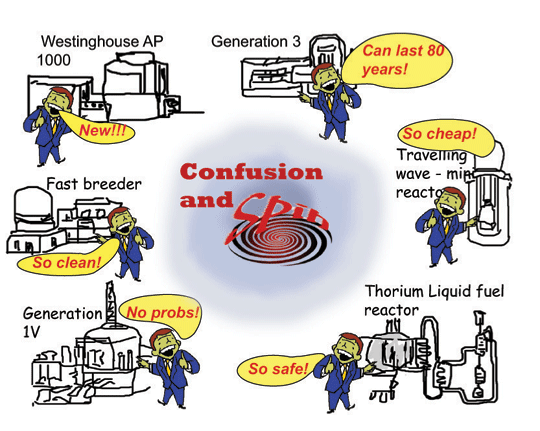
the industry has turned to two other gambits to secure a bigger market share: small, modular light-water reactors, which, because they lack the advantage of economies of scale, would produce even more expensive electricity than conventional reactors; and non-light-water “advanced” reactors, which are largely based on unproven concepts from more than 50 years ago.
Unfortunately, proponents of these non-light-water reactor designs are hyping them as a climate solution and downplaying their safety risks
Advanced’ Nuclear Reactors? Don’t Hold Your Breath. With little hard evidence, their developers maintain they’llb be cheaper, safer and more secure than existing power plants, https://www.scientificamerican.com/article/lsquo-advanced-rsquo-nuclear-reactors-don-rsquo-t-hold-your-breath/Scientific American By Elliott Negin on July 23, 2021
The U.S. nuclear power industry is at an impasse. Since 2003, 11 of the 104 light-water reactors in operation at the time have closed, mainly as a result of aging infrastructure and the inability to compete with natural gas, wind and solar, which are now the cheapest sources of electricity in the United States and most other countries worldwide.
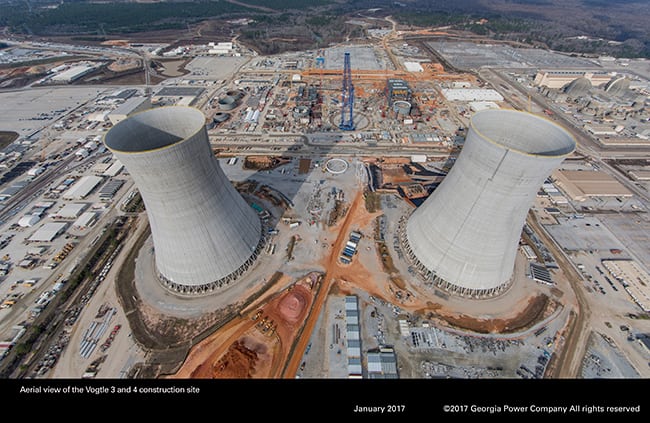
In the early 2000s, the industry promoted a “renaissance” to try to stem its incipient decline, and in 2005, Congress provided nearly $20 billion in federal loan guarantees for new nuclear reactors. The result? Only two new Westinghouse AP1000 light-water reactors, still under construction in Georgia, which will cost at least $14 billion apiece—double their estimated price tags—and take more than twice as long as estimated to be completed. Another two partially built AP1000 reactors in South Carolina were abandoned in 2017 after a $9-billion investment.
Given the struggle to build these standard-sized, 1,000-megawatt light-water reactors, the industry has turned to two other gambits to secure a bigger market share: small, modular light-water reactors, which, because they lack the advantage of economies of scale, would produce even more expensive electricity than conventional reactors; and non-light-water “advanced” reactors, which are largely based on unproven concepts from more than 50 years ago.
Unlike light-water reactors, these non-light-water designs rely on materials other than water for cooling. Some developers contend that these reactors, still in the concept stage, will solve the problems that have plagued light-water reactors and be ready for prime time by the end of this decade.

The siren song of a cheap, safe and secure nuclear reactor on the horizon has attracted the attention of Biden administration officials and some key members of Congress, who are looking for any and all ways to curb carbon emissions. But will so-called advanced reactors provide a powerful tool to combat climate change?

A Union of Concerned Scientists (UCS) analysis of non-light-water reactor concepts in development suggests that outcome may be as likely as Energy Commission Chairman Lewis Strauss’ famous 1954 prediction that electricity generated by nuclear energy would ultimately become “too cheap to meter.” Written by UCS physicist Edwin Lyman, the 140-page report found that these designs are no better—and in some respects significantly worse— than the light-water reactors in operation today.
Lyman took a close look at the claims developers have been making about the three main non-light-water designs: sodium-cooled fast reactors, high-temperature gas-cooled reactors and molten salt–fueled reactors. With little hard evidence, many developers maintain they will be cheaper, safer and more secure than currently operating reactors; will burn uranium fuel more efficiently, produce less radioactive waste, and reduce the risk of nuclear proliferation; and could be commercialized relatively soon. Those claims, however, do not hold up to scrutiny.
One of the sodium-cooled fast reactors, TerraPower’s 345-megawatt Natrium, received considerable media attention earlier this year when company founder Bill Gates touted it during interviews about his new book, How to Avoid a Climate Disaster. In mid-February, Gates told CBS’s 60 Minutes that the Natrium reactor will be safer and cheaper than a conventional light-water reactor and produce less nuclear waste.
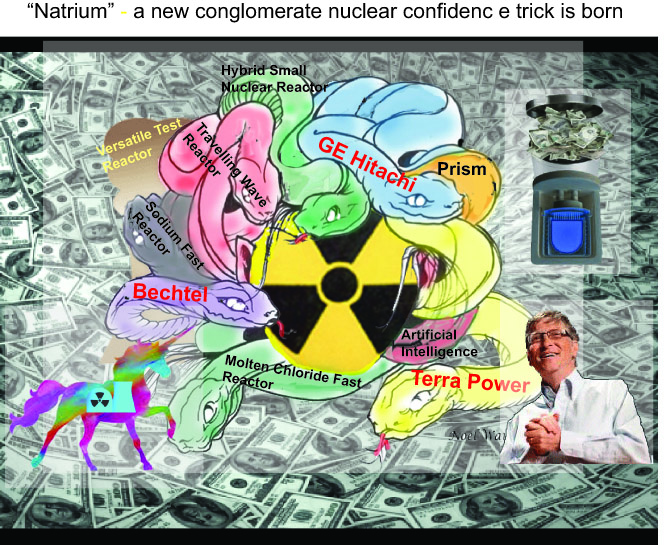
According to the UCS report, however, sodium-cooled fast reactors such as Natrium would likely be less uranium-efficient and would not reduce the amount of waste that requires long-term isolation. They also could experience safety problems that are not an issue for light-water reactors. Sodium coolant, for example, can burn when exposed to air or water, and the Natrium’s design could experience uncontrollable power increases that result in rapid core melting.
In June, TerraPower announced that it would build the first Natrium reactor in Wyoming as part of a 50-50 cost-share program with the Department of Energy. The DOE program originally required TerraPower to have the reactor, still in its early design stage, up and running by 2027. The agency recently changed the target date for commercialization to 2028.
From concept to a commercial unit in seven years?
The new Westinghouse AP1000 light-water reactor provides a cautionary tale. It took more than 30 years of research, development and construction before the first one was built in China and began generating power in 2018. According to the UCS report, if federal regulators require the necessary safety demonstrations, it could take at least 20 years—and billions of dollars in additional costs—to commercialize non-light-water reactors, their associated fuel cycle facilities, and other related infrastructure
The Nuclear Regulatory Commission (NRC) may have to adapt some regulations when licensing reactor technologies that differ significantly in design from the current fleet. Lyman says that should not mean weakening public health and safety standards, finding no justification for the claim that “advanced” reactors will be so much safer and more secure that the NRC can exempt them from fundamental safeguards. On the contrary, because there are so many open questions about these reactors, he says they may need to meet even more stringent requirements.
Finally, it recommends that the DOE and Congress consider spending more research and development dollars on improving the safety and security of light-water reactors, rather than on commercializing immature, overhyped non-light-water reactor designs.
“Unfortunately, proponents of these non-light-water reactor designs are hyping them as a climate solution and downplaying their safety risks,” says Lyman. “Given that it should take at least two decades to commercialize any new nuclear reactor technology if done properly, the non-light-water concepts we reviewed do not offer a near-term solution and could only offer a long-term one if their safety and security risks are adequately addressed.” Any federal appropriations for research, development and deployment of these reactor designs, he says, “should be guided by a realistic assessment of the likely societal benefits that would result from investing billions of taxpayer dollars, not based on wishful thinking.
Perils to austronauts’ health – high radiation and low gravity

High Radiation, Low Gravitation: The Perils of a Trip to Mars, Sunscreen and calcium supplements aren’t enough to protect Mars-bound space travelers from radiation and a lack of gravity in outer space. July 23, 2021 – 17:00Yuen Yiu, Staff Writer (Inside Science) — Back in May, SpaceX launched its Starship SN15 prototype to about the cruising altitude of a commercial airliner before landing it safely. The company claims future versions of the rocket will be able to take 100 passengers at a time to the moon, and even Mars.
But while it’s one thing to send a rocket to Mars, it’s another to send people there alive. And it’s yet another thing to make sure the people can be as healthy as they were when they left Earth.
Besides packing enough fuel and air and water and food for the seven-month-long journey to Mars (and more for a return trip if you want a return ticket), there are other luxuries we enjoy here on Earth that the spaceship will have to provide if we want to stay healthy during the long flight.
Nasty sunburns and zero gravity
Earth’s atmosphere and magnetic field protect us from harmful space radiation, but passengers bound for Mars will lose that protection. So, their spaceship would need to provide some kind of radiation shielding.
Depending on where radiation comes from, it may be made of different particles and have different energies, which would require different means of shielding and pose different levels of danger to our radiation-prone DNA. For example, radiations from energetic particles ejected from the sun behave very differently than cosmic rays from outside our galaxy.
So, how many times more radiation would a Mars-bound astronaut experience compared to what they would experience on Earth?
Enough to be of concern, according to Athanasios Petridis, a physicist from Drake University in Des Moines. According to calculations by his team, high-end estimates for radiation exposure during a round trip to Mars are in the range of several Sieverts (Sv). For reference, the U.S. Nuclear Regulatory Commission has set 0.05 Sv/year as the dose limit for workers who are exposed to radiation at their jobs.
Solar weather also plays a role in the amount of radiation you would get in space. For instance, the 11-year solar cycle affects the amount of radiation the sun emits. However, due to the complicated interplay between sun-generated radiation and cosmic rays from outer space, it may not be worth it to time the launch around these cycles.
“There are enough competing factors in radiation exposure that trying to plan around the solar cycle is like trying to time the stock market, which usually results in losing,” said Kerry Lee, a radiation analyst from NASA in Houston, Texas.
The lack of gravity can also wreak havoc on the human body given enough time. Astronauts aboard space stations have been shown to lose 1 to 1.5 % of the mineral density in their weight-bearing bones every month. They also tend to lose muscle mass, even when exercising as much as they do on Earth. ……….. https://www.insidescience.org/news/high-radiation-low-gravitation-perils-trip-mars
1 This Month
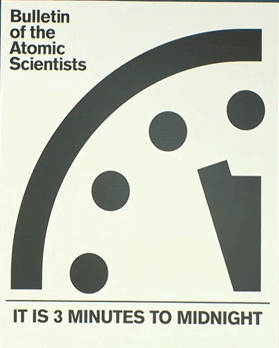
Watch the 2026 Doomsday Clock unveiling live here on January 27 at 10 a.m. EST
To see nuclear-related stories in greater depth and intensity – go to https://nuclearinformation.wordpress.com/

29 Jan. Thursday 7-8 p.m. Webinar – World’s Largest Nuclear Station in Port Hope, ON?

31st January – Challenging the War Machine – a DECLASSIFIED UK SUMMIT

Website of the Week
Now until to February 10, 2026 Radioactive waste storage in France: the debate is finally open! How to participate?
-
Archives
- January 2026 (277)
- December 2025 (358)
- November 2025 (359)
- October 2025 (376)
- September 2025 (258)
- August 2025 (319)
- July 2025 (230)
- June 2025 (348)
- May 2025 (261)
- April 2025 (305)
- March 2025 (319)
- February 2025 (234)
-
Categories
- 1
- 1 NUCLEAR ISSUES
- business and costs
- climate change
- culture and arts
- ENERGY
- environment
- health
- history
- indigenous issues
- Legal
- marketing of nuclear
- media
- opposition to nuclear
- PERSONAL STORIES
- politics
- politics international
- Religion and ethics
- safety
- secrets,lies and civil liberties
- spinbuster
- technology
- Uranium
- wastes
- weapons and war
- Women
- 2 WORLD
- ACTION
- AFRICA
- Atrocities
- AUSTRALIA
- Christina's notes
- Christina's themes
- culture and arts
- Events
- Fuk 2022
- Fuk 2023
- Fukushima 2017
- Fukushima 2018
- fukushima 2019
- Fukushima 2020
- Fukushima 2021
- general
- global warming
- Humour (God we need it)
- Nuclear
- RARE EARTHS
- Reference
- resources – print
- Resources -audiovicual
- Weekly Newsletter
- World
- World Nuclear
- YouTube
-
RSS
Entries RSS
Comments RSS
 nuclear-news