An added small nuclear reactor would just increase the burden of radioactive trash at Columbia Generating Station

“A new nuclear reactor and its inevitable waste would further perpetuate the burden of cleanup,”
Oregon group claims new nuclear reactor plan poses threat to Tri-Cities, Columbia River https://www.union-bulletin.com/news/northwest/oregon-group-claims-new-nuclear-reactor-plan-poses-threat-to-tri-cities-columbia-river/article_66e8ffd6-23d7-11ec-be7c-fbf4fdf0cc75.html Annette Cary The Tri-City Herald, 3 Oct 21,
RICHLAND — An Oregon environmental group is objecting to Energy Northwest’s plan to place a small modular power reactor on its leased land on the Hanford nuclear reservation near the Columbia River just north of Richland.
Earlier this year Energy Northwest, which operates the Columbia Generating Station nuclear power plant near Richland, announced plans with X-energy and Grant County PUD to add a small modular reactor near its current, full-size commercial nuclear power reactor.
Columbia Riverkeeper says in a new report that it is concerned about the used radioactive fuel the proposed new reactor would generate.
The United States now lacks a deep geological repository for used commercial nuclear power plant fuel, after work stopped to develop the repository at Yucca Mountain, Nev.
The used fuel for the Columbia Generating Station, the Northwest’s only commercial nuclear power reactor, is stored in 19-feet-tall concrete and steel storage cylinders on a reinforced concrete pad near the reactor until the nation has a repository.
The small nuclear reactor planned by Energy Northwest is a high temperature gas-cooled Xe-100 reactor, which could be the nation’s first operating advanced nuclear reactor. The 80-megawatt reactor could be operating in 2028.
The project, with modular reactors added, could be scaled up to a 320-megawatt reactor.
Columbia Generating Station has the capability to produce 1,207 megawatts of electricity.
Columbia Riverkeeper says the Xe-100 reactor would generate more used fuel than the conventional large reactor per the power output of each.
It also is concerned about siting the plant on Energy Northwest’s leased land at the Department of Energy’s Hanford nuclear reservation in Eastern Washington, which was developed for wartime weapons production rather than commercial power production.
The 580-square-foot DOE nuclear reservation was used to produce two-thirds of the nation’s plutonium from World War II through the Cold War.
Now about $2.5 billion is being spent annually to clean up radioactive and chemical contamination left from the project.
DOE is focused now on 56 million gallons of radioactive and chemical waste in underground tanks after chemical processes were used to separate small quantities of plutonium from irradiated uranium fuel.
Used fuel from commercial nuclear power reactors remains in a solid form rather than being chemically processed.
“Adding more nuclear infrastructure — a small modular nuclear reactor — at Hanford without any long-term plan for the radioactive waste should be a nonstarter,” said Lauren Goldberg, legal director with Columbia Riverkeeper.
The waste from a small modular reactor would burden future generations, said Miya Burke, the lead author of Columbia Riverkeeper’s new report “Q&A: Nuclear Energy Development Threatens the Columbia River.”
“A new nuclear reactor and its inevitable waste would further perpetuate the burden of cleanup,” she said.
The report quotes the Confederated Tribes of the Umatilla Indian Reservation, which have treaty rights at Hanford, as opposing new nuclear missions on the Hanford site.
The Umatillas say no expansion of nuclear energy production should be developed without permission obtained through the tribes with government-to-government consultation.
Energy Northwest responded to Columbia Riverkeepers concerns, saying that it has always supported open discussions on advanced nuclear and small modular reactors.
But it has questions of the validity of some of the claims in the new report and the data supporting them.
Among issues raised in the report was the safety and cost of the proposed new small modular reactor, which remains under development.
X-energy says its proposed reactor design is based on “safe, secure, clean and affordable technology.” The Department of Energy awarded it $80 million to develop and demonstrate its first commercial small modular reactor.
“Over the past year we have engaged many groups and stakeholders — from environmental organizations and tribes to elected officials and local communities — to understand their concerns and receive their input,” Energy Northwest said in a statement. “Energy Northwest and our partners hope to have the same opportunity with the authors of this report.”
Fake ”green” investment fund – a front for the nuclear industry – pushes small nuclear reactors

IP3 has been sounding out pension funds and institutional investors about pouring cash into a multi-billion pound fund to invest in small nuclear infrastructure. It is also advising energy providers and governments on developing nuclear power projects.
Rolls-Royce to land ‘billions of pounds’ worth of orders for mini nuclear power stations from Eastern European nations. Rolls-Royce is poised to land ‘billions of pounds’ worth of orders for mini nuclear power stations from Eastern European nations, the boss of a major investor has said.
A consortium led by the engineering giant has secured £210million of funding from private investors for its small modular reactors (SMRs) programme in the UK. That is set to unlock the same amount of funding from the Government, allowing Rolls-Royce to kick-start the project.
An announcement is expected imminently and green (?) investment fund IP3 said an endorsement by
the Government should pave the way for the technology to be exported to other countries. IP3 has been sounding out pension funds and institutional investors about pouring cash into a multi-billion pound fund to invest in small nuclear infrastructure. It is also advising energy providers and governments on developing nuclear power projects.
IP3 chief executive Mike Hewitt, a retired US Navy rear admiral, told The Mail on Sunday that
eastern European nations – including Poland, the Czech Republic, Latvia,Hungary, Estonia and Bulgaria – are developing ‘aggressive plans’ for nuclear.
Mail on Sunday 2nd Oct 2021
How close is nuclear fusion power?
Brett Burnard Stokes 3 Oct 21, “……But unlike what happens in solar fusion—which uses ordinary hydrogen—Earth-bound fusion reactors that burn neutron-rich isotopes have byproducts that are anything but harmless: Energetic neutron streams comprise 80 percent of the fusion energy output of deuterium-tritium reactions and 35 percent of deuterium-deuterium reactions.
Now, an energy source consisting of 80 percent energetic neutron streams may be the perfect neutron source, but it’s truly bizarre that it would ever be hailed as the ideal electrical energy source. In fact, these neutron streams lead directly to four regrettable problems with nuclear energy: radiation damage to structures; radioactive waste; the need for biological shielding; and the potential for the production of weapons-grade plutonium 239—thus adding to the threat of nuclear weapons proliferation, not lessening it, as fusion proponents would have it.
In addition, if fusion reactors are indeed feasible—as assumed here—they would share some of the other serious problems that plague fission reactors, including tritium release, daunting coolant demands, and high operating costs. There will also be additional drawbacks that are unique to fusion devices: the use of a fuel (tritium) that is not found in nature and must be replenished by the reactor itself; and unavoidable on-site power drains that drastically reduce the electric power available for sale.
New Natrium Fast Reactors’ Also Present a Fast Path to Nuclear Weapons

This is worse than hypocrisy. Once nations have easy access to nuclear explosive material, no inspections can prevent them from making bombs.
‘Fast Reactors’ Also Present a Fast Path to Nuclear Weapons, New “fast reactors” promise sustainable nuclear energy. They also pose serious proliferation risks because they can make lots of plutonium. https://nationalinterest.org/feature/%E2%80%98fast-reactors%E2%80%99-also-present-fast-path-nuclear-weapons-194272, by Victor Gilinsky Henry Sokolski 6 Sep 21, The Energy Department’s choice for the leading reactor design for reviving nuclear power construction in the United States is so at odds with U.S. nonproliferation policy that it opens America to charges of rank hypocrisy. The Biden administration is proposing to use nuclear fuels that we are telling others—most immediately Iran—not to produce. It will make it difficult to gain the restraints the United States seeks to limit nations’ access to bomb-grade uranium and plutonium.
We are talking here about the Department of Energy’s (DOE’s) enthusiastic support of TerraPower’s proposed Natrium “fast reactor” demonstration plant and similar fast reactor projects, which DOE has showered with grants and supports with department-funded enrichment, test reactor, and spent nuclear fuel recycling programs. TerraPower and DOE expect to build hundreds of fast reactors for domestic use and export.
Unlike conventional nuclear plants that exploit fission reactions triggered by slow neutrons, fast reactors maintain nuclear chain reactions with much more energetic fast neutrons. These reactors are billed as advanced technology, but they are an old idea. The first fast reactor designs date back to post-World War II.

Fast reactors’ main advantage is that they can make lots of plutonium, which can be extracted and used as reactor fuel instead of mining and using more uranium. This sounded good, so good to the Nixon administration that it set a goal to shift electric generation to plutonium-fueled fast reactors by the turn of the century. But the project came a cropper when it ran into safety hurdles that escalated costs. And then the increased awareness of the dangers of putting plutonium—one of the two key nuclear explosives—into the world’s commercial channels finally caused President Gerald Ford to announce the United States would not rely on plutonium fuel until the world could cope with it.
Continue reading
Australia’s nuclear submarines will be obsolete before they are ever in use
Why will they be obsolete?

Because of the rapid advances in artificial intelligence (AI), detection systems and signal processing, combined with swarming autonomous unmanned systems – by 2040 these present USA and UK models will probably be too easily detectable, and so, effectively useless.
Why does Australia want nuclear submarines?

Other reasons – helping the USA by buying these very costly submarines which are not particularly useful for monitoring our coastline, but good for long distance. Helping Scott Morrison to look important on the world stage.
One white elephant submarine deal replaced with a worse one

Australia’s submarine policy has previously eschewed nuclear propulsion. Now, as a dowry for receiving such largesse, Canberra is offering up Australia as a confirmed US asset in policing the Indo-Pacific. US Navy commanders will be smacking their lips at maintaining attack vessels in Australia as part of the arrangement……
Nuclear white elephants: Australia’s new submarine deal, Green Left, Binoy KampmarkSeptember 16, 2021Issue 1319Australia Few areas of public expenditure are more costly and mindlessly wasteful than submarines. Australia’s effort is particularly impressive.
Pick a real winner by signing a contract for a yet-to-be-designed attack class submarine, supposedly “necessary” in an “increasingly dangerous” region. Ensure the submarine design is based on a nuclear model, but remove that attribute and charge at least twice as much for a less capable weapon. Make sure the order is for 12 of these yet-to-be-designed-and-built systems. And make sure that they are only ready sometime in the 2030s (by which time they risk being obsolete).
The dubious honour for this contract, initially costing $50 billion, went to the French submarine company DCNS (now called Naval Group), which nudged out German and Japanese contenders with pre-existing designs………
The French military establishment praised it as the “contract of the century”. Le Parisien’s editorial lauded the prospect of thousands of jobs. French Defence Minister Jean-Yves Le Drian proclaimed a “50-year marriage” had begun……..
On September 15, the Canberra press gallery was awash with rumours that a divorce was being proposed.
The following day, Prime Minister Scott Morrison announced a security ménage à trois with the United States and Britain, with Australia as the subordinate partner. The glue that will hold this union together is a common suspicion: China.
Replacing the Attack Class submarine will be a nuclear-powered alternative with Anglo-American blessing, based on the US Virginia class or British Astute class.
The joint statement announcing the creation of AUKUS said the three countries were “guided” by “enduring ideals and shared commitment to the international rules-based order”. They resolved “to deepen diplomatic, security, and defence cooperation in the Indo-Pacific region, including by working with partners, to meet the challenges of the twenty-first century.”
AUKUS, they said, would be a new “enhanced trilateral security partnership” to further such goals.
The agreement is nothing less than an announcement to the region that the Anglophone bloc intends to police, oversee and, if necessary, punish…….
The first initiative is a “shared” ambition “to support Australia in acquiring nuclear-powered submarines for the Royal Australian Navy”. US and British expertise will be drawn on to “bring an Australian capability into service at the earliest achievable date” from the submarine programs of both countries…..
Australia’s submarine policy has previously eschewed nuclear propulsion. Now, as a dowry for receiving such largesse, Canberra is offering up Australia as a confirmed US asset in policing the Indo-Pacific. US Navy commanders will be smacking their lips at maintaining attack vessels in Australia as part of the arrangement……
The enduring problem of Australia being able to build these submarines will have US lawmakers pushing for their construction on home soil, a situation that could mirror the Naval Group contract headaches. Australia also lacks a shipyard able to build or maintain such vessels.
In helping create AUKUS, Canberra has exchanged one white elephant of the sea for another. It has also significantly increased the prospects for a potential nuclear conflict in the Indo-Pacific region. The warmongers will be ecstatic.
[Dr Binoy Kampmark lectures at RMIT University, Melbourne. Email bkampmark@gmail.com.] https://www.greenleft.org.au/content/nuclear-white-elephants-australias-new-submarine-deal
Russia developing more floating nuclear power plants
A Russian plan to build more floating nuclear power plants advanced this
month after two subsidiaries of Rosatom, Russia’s state nuclear
corporation, signed a cooperation agreement to power a remote mining
facility on Siberia’s northeastern tip. The new waterborne facilities
will come on the coattails of the Akademik Lomonosov, the audacious
experiment on floating nuclear power that Rosatom connected to a remote
port in Chukotka in 2019 after spending more than a decade constructing it,
amid objections from environmentalists.
Bellona 17th Sept 2021
Russia advances on plans for new floating nuclear plants
Rolls-Royce’s grandiose plan to mine the moon and Mars
Rolls-Royce’s nuclear plan to mine on the Moon: New space race for vital resources – and a launch pad to Mars, By ALEX LAWSON, FINANCIAL MAIL 20 September 2021 Rolls-Royce is developing a nuclear reactor that it hopes will be capable of powering mining operations on the Moon and even Mars, The Mail on Sunday can reveal.
Dave Gordon, head of the company’s defence division, said it is studying how a micro-nuclear reactor could be used to propel rockets while in space at huge speeds. He revealed that Rolls-Royce is investigating whether that technology could then be redeployed to provide energy for drilling, processing and storage for socalled ‘Moon mining’. ……………..
No nation can claim sovereignty of the Moon under the Outer Space Treaty, signed in 1967, but the US and Soviet Union brought back lunar soil samples in the 1960s and 1970s. Nuclear systems have been used on the Moon before. In 1969, the crew of Apollo 12 used a generator to provide the electricity to operate scientific instruments. ….
Gordon admitted that to bring the project to fruition would take ‘hundreds of millions of pounds’, but that early stage work could be achieved for far less……. https://www.thisismoney.co.uk/money/markets/article-10004081/Rolls-Royces-nuclear-plan-Moon.html
Nuclear-powered submarines have ‘long history of accidents

Nuclear-powered submarines have ‘long history of accidents’, Adelaide environmentalist warns, ABC By Daniel Keane 17 Sept 21,
The plan to build nuclear-powered submarines in South Australia has alarmed anti-war and environmental campaigners, one of whom says the vessels have a “long history” of involvement in accidents across the globe.
Key points:
- Prime Minister Scott Morrison said the nuclear submarines would be built in Adelaide
- The Greens and other environmental groups say that raises serious public safety concerns
- SA’s former nuclear royal commissioner says the risks can be managed
Prime Minister Scott Morrison unveiled a deal to construct the new fleet of at least eight submarines, declaring a new era of strategic alignment with the United States and United Kingdom, and a new trilateral security partnership called AUKUS.
All Australians benefit from the national interest decisions to protect Australians and to keep Australians safe,” Mr Morrison said.
But Friends of the Earth Australia’s anti-nuclear spokesperson Jim Green said the plan was more likely to compromise public safety than enhance it.
I’m worried about the security and proliferation aspects of this, I’m deeply concerned as an Adelaidean. A city of 1.3 million people is not the place to be building nuclear submarines,” he said.
“North-western Adelaide could be a target in the case of warfare. Of course, that’s a very low risk but if it does happen, the impacts would be catastrophic for Adelaide.
“You should build hazardous facilities away from population centres, partly because of the risk of accidents and partly because of the possibility that a nuclear submarine site could be targeted by adversaries.”
Dr Green said the question of what would become of the spent fuel remained unanswered, and there was “a long history of accidents involving nuclear submarines”.
Many — but not all — of those occurred in submarines built in the former Soviet Union, including the infamous K-19, which was subsequently dubbed “The Widowmaker” and became the subject of a Hollywood film.
After its reactor suffered a loss of coolant, members of the crew — more than 20 of whom died in the next two years — worked in highly radioactive steam to prevent a complete meltdown.
Two US naval nuclear submarines — USS Thresher and USS Scorpion — currently remain sitting at the bottom of the Atlantic Ocean, at depths of more than two kilometres, after sinking during the 1960s.
More than 200 mariners died in the disasters, and neither vessels’ reactors, nor the nuclear weapons on board the Scorpion, have ever been recovered.

Two years ago, 14 Russian naval officers were laid to rest after they were killed in a fire on a nuclear-powered submersible in circumstances that were not fully revealed by the Kremlin.
Dr Green said Australia’s “nuclear power lobby” had “been quick off the mark”, and was already using the Prime Minister’s announcement to push for further involvement with the nuclear fuel cycle, including atomic energy and waste storage.
“The South Australian Nuclear Fuel Cycle [Royal] Commission, in its 2016 report, estimated a cost of $145 billion to construct and operate a nuclear waste repository,” he said.
“No country in the world has got a repository to dispose of high-level nuclear waste, and the only repository in the world to dispose of intermediate-level nuclear waste, which is in the United States, was shut for three years from 2014 to 2017 because of a chemical explosion.”…………….https://www.abc.net.au/news/2021-09-17/nuclear-submarines-prompt-environmental-and-conflict-concern/100470362
U.S. generals planning for a space war they see as all but inevitable
U.S. generals planning for a space war they see as all but inevitable, Space News, by Sandra Erwin — September 17, 2021 A ship in the Pacific Ocean carrying a high-power laser takes aim at a U.S. spy satellite, blinding its sensors and denying the United States critical eyes in the sky.
This is one scenario that military officials and civilian leaders fear could lead to escalation and wider conflict as rival nations like China and Russia step up development and deployments of anti-satellite weapons.
If a satellite came under attack, depending on the circumstances, “the appropriate measures can be taken,” said Lt. Gen. John Shaw, deputy commander of U.S. Space Command.
The space battlefield is not science fiction and anti-satellite weapons are going to be a reality in future armed conflicts, Shaw said at the recent 36th Space Symposium in Colorado Springs.
U.S. Space Command is responsible for military operations in the space domain, which starts at the Kármán line, some 100 kilometers (62 miles) above the Earth’s surface. This puts Space Command in charge of protecting U.S. satellites from attacks and figuring out how to respond if hostile acts do occur…………
A key reason why the space race is accelerating is that technology is advancing so rapidly, Smith said. A second reason is the absence of “binding commitments on what the operating norms are going to be in space,” she said. “And without that, we’re very likely to have a space war.”
The only foundation of international space law that currently exists, the 1967 Outer Space Treaty, is outdated and doesn’t address most space security issues that could set off a war, Smith noted.
The treaty bans the stationing of weapons of mass destruction in outer space, prohibits military activities on celestial bodies and contains legally binding rules governing the peaceful exploration and use of space. But a new set of rules is needed for the current space age, Smith said. “We really haven’t addressed some of the very difficult questions. Can a nation tailgate another nation’s satellite? Is preemptive self defense going to be permissible? Are we going to ban any form of weapons in space?”…….
Nuclear power: Why molten salt reactors are problematic and Canada investing in them is a waste

Nuclear power: Why molten salt reactors are problematic and Canada investing in them is a waste https://theconversation.com/nuclear-power-why-molten-salt-reactors-are-problematic-and-canada-investing-in-them-is-a-waste-167019, MV Ramana, Simons Chair in Disarmament, Global and Human Security at the Liu Institute for Global Issues, University of British ColumbiaSeptember 15, 2021

Should an MSR be built, it will also saddle society with the challenge of dealing with the radioactive waste it will produce. This is especially difficult for MSRs because the waste is in chemical forms that are “not known to occur in nature” and it is unclear “which, if any, disposal environment could accommodate this high-level waste.” The Union of Concerned Scientists has also detailed the safety and security risks associated with MSR designs.
One of the beneficiaries of the run-up to a potential federal election has been the nuclear energy industry, specifically companies that are touting new nuclear reactor designs called small modular reactors. The largest two financial handouts have been to two companies, both developing a specific class of these reactors, called molten salt reactors (MSRs).
First, in October 2020, Canada’s minister of innovation, science and industry announced a $20-million grant to Ontario-based Terrestrial Energy and its integral molten salt reactor (IMSR) design. In March 2021, New Brunswick-based Moltex received $50.5 million from the Strategic Innovation Fund and Atlantic Canada Opportunities Agency.
As a physicist who has analyzed different nuclear reactor designs, including small modular reactors, I believe that molten salt reactors are unlikely to be successfully deployed anytime soon. MSRs face difficult technical problems, and cannot be counted on to produce electricity consistently.
How they work
Molten salt reactors use melted chemicals like lithium fluoride or magnesium chloride to remove the heat produced within the reactor. In many MSRs, the fuel is also dissolved in a molten salt.
These designs are very different from traditional reactor designs — currently, the Canada Deuterium Uranium (CANDU) design dominates Canada’s nuclear energy landscape. CANDU uses heavy water (water with deuterium, the heavier isotope of hydrogen) to transport heat, slow down or “moderate” neutrons produced during fission, and natural uranium fabricated into solid pellets as fuel. Slower neutrons are more effective in triggering fission reactions as compared to highly energetic, or fast, neutrons.
Terrestrial’s IMSR is fuelled by uranium which contains higher concentrations of uranium-235, a lighter isotope as compared to uranium found in nature (natural uranium), which is used in CANDU reactors. The enriched uranium is dissolved in a fluoride salt in the IMSR. The IMSR also uses graphite, instead of heavy water used in CANDU reactors, to moderate neutrons.
Moltex’s Stable Salt Reactor (SSR), on the other hand, uses a mixture of uranium and plutonium and other elements, dissolved in a chloride salt and placed inside a solid assembly, as fuel. It does not use any material to slow down neutrons.
Because of the different kinds of fuel used, these MSR designs need special facilities — not present in Canada currently — to fabricate their fuel. The enriched uranium for the IMSR must be produced using centrifuges, while the Moltex design proposes to use a special chemical process called pyroprocessing to produce the plutonium required to fuel it. Pyroprocessing is extremely costly and unreliable.
Both processes are intimately linked to the potential to make fissile materials used in nuclear weapons. Earlier this year, nine non-proliferation experts from the United States wrote to Prime Minister Justin Trudeau expressing serious concerns “about the technology Moltex proposes to use.”
Difficult questions
Experience with MSRs has not been very encouraging either. All current designs draw upon the only two MSRs ever built: the 1954 Aircraft Reactor Experiment that ran for just 100 hours and the Molten Salt Reactor Experiment that operated intermittently from 1965 to 1969. Over those four years, the latter reactor’s operations were interrupted 225 times; of these, only 58 were planned. The remaining were due to various unanticipated technical problems. In other words, the reactor had to be shut down at least once every four out of five weeks — that is not what one would expect of a reliable power plant.
Even the U.S. Atomic Energy Commission that had funded the U.S. MSR program for nearly two decades raised difficult questions about the technology in a devastating 1972 report. Many of the problems identified continue to be technical challenges confronting MSR designs.
Another basic problem with MSRs is that the materials used to manufacture the various reactor components will be exposed to hot salts that are chemically corrosive, while being bombarded by radioactive particles. So far, there is no material that can perform satisfactorily in such an environment. A 2018 review from the Idaho National Laboratory could only recommended that “a systematic development program be initiated” to develop new alloys that might work better. There is, of course, no guarantee that the program will be successful.
These problems and others have been identified by various research laboratories, ranging from France’s Institut de radioprotection et de sûreté nucléaire (IRSN) to the Nuclear Innovation and Research Office in the United Kingdom. Their conclusion: molten salt reactors are still far from proven.
As the IRSN put it in 2015: “numerous technological challenges remain to be overcome before the construction of an MSR can be considered,” going as far as saying that it does not envision construction of such reactors “during the first half of this century.”
Should an MSR be built, it will also saddle society with the challenge of dealing with the radioactive waste it will produce. This is especially difficult for MSRs because the waste is in chemical forms that are “not known to occur in nature” and it is unclear “which, if any, disposal environment could accommodate this high-level waste.” The Union of Concerned Scientists has also detailed the safety and security risks associated with MSR designs.
Problematic solutions
The Liberal government’s argument for investing in molten salt reactors is that nuclear power is necessary to mitigate climate change. There are good reasons to doubt this claim. But even if one were to ignore those reasons, the problems with MSRs laid out here show that they cannot be deployed for decades.
The climate crisis is far more urgent. Investing in technologies that are proven to be problematic is no way to deal with this emergency.
he Liberal government’s
USA developing space-based electromagnetic warfare

This is just the beginning.
How DOD is taking its Mission to Space https://www.thecipherbrief.com/column_article/how-dod-is-taking-its-mission-to-space?utm_source=Join+the+Community+Subscribers&utm_campaign=010f6454d2-EMAIL_CAMPAIGN_2021_09_14_12_18&utm_medium=email&utm_term=0_02cbee778d-010f6454d2-122765993&mc_cid=010f6454d2&mc_eid=b560fb1ddc. SEPTEMBER 14, 2021 | WALTER PINCUS Pulitzer Prize Winning Journalist Walter Pincus is a contributing senior national security columnist at The Cipher Brief. Pincus spent forty years at The Washington Post, writing on topics from nuclear weapons to politics. He is the author of Blown to Hell: America’s Deadly Betrayal of the Marshall Islanders (releasing November 2021)
While others this past weekend have been looking back to 9/11, U.S. Space Command is looking forward to the next domain of warfare — in the heavens — to be directed from a Space Electromagnetic Operating Base somewhere in the United States.
Space Command’s Systems Command, Enterprise Corps and Special Programs Directorate, located at Los Angeles Air Force Base, Calif., are looking for potential contractors to run an ambitious, five-year program that will, by 2027, design, develop, deliver and operate a Space Electromagnetic Warfare facility whose primary purpose would be to jam or destroy enemy satellite and land-based communications in time of war.
It all was described in a request for information published September 1, for possible contractors to provide their potential capabilities and interest in taking on the job.
The U.S. may not have done well here on earth against the Taliban in Afghanistan, but Space Command is moving to stay ahead of its big-power competitors in using the electromagnetic spectrum for use as a weapon against potential adversary satellites in space.
As the Congressional Research Service (CRS) recently described it, “The electromagnetic spectrum is the range of wavelengths or frequencies of electromagnetic radiation. It includes radio waves, microwaves, visible light, X-rays, and gamma rays.”
The majority of military communications capabilities use radio waves and microwaves. Infrared and ultraviolet spectrums can disseminate large volumes of data, including video, over long distances – for example, intelligence collection and distribution. The military can also use lasers offensively, to dazzle satellite sensors, destroy drones, and for other purposes, according to the CRS.
Electronic warfare is not new – it was extensively used in World War II and its uses have been growing ever since.
CRS described it this way: “Missiles in general, and anti-air munitions in particular, use either infrared or radar for terminal guidance (i.e., guiding a missile once it has been launched) to targets. Electronic jammers are used to deny an adversary access to the spectrum. These jammers are primarily used in the radio and microwave frequencies (and sometimes paired together), preventing communications (both terrestrially and space-based) as well as radar coverage. Militaries have also begun using lasers to disable intelligence collection sensors, destroy small unmanned aerial systems (aka ‘drones’), and communicate with satellites.”
Back in 1977, I covered a House hearing when Dr. George Ullrich, then-Deputy Director of Defense Special Weapons Agency, described resumption of atmospheric nuclear testing in 1962 following a three-year testing moratorium. One test, called Starfish Prime, was a 1.4 megaton, high-altitude detonation. It took place over Johnston Island in the South Pacific at an altitude of about 250 miles – the largest nuclear test ever conducted in outer space.
Ullrich testified that the EMP (electromagnetic pulse) effects of the Starfish explosion surprisingly knocked out the telephone service and street lights on Hawaiian Islands, which were 800 miles east of the detonation. Years later, Ullrich wrote that another surprise outcome had been that months after the 1962 detonation, an AT&T satellite transmitting television signals from space died prematurely followed by the early failure of other satellites.
Ullrich closed on a note more relevant to today. “High-altitude EMP does not distinguish between military and civilian systems. Unhardened infrastructure systems, such as commercial power grids, telecommunication networks, as we have discussed before, remain vulnerable to widespread outages and upsets due to high-altitude EMP. While DOD (Defense Department) hardens their assets it deems vital, no comparable civilian programs exist. Thus, the detonation of one or a few high-altitude nuclear weapons could result in serious problems for the entire U.S. civil and commercial infrastructure.”
There are also non-nuclear, EMP weapons that produce pulses of energy that create a powerful electromagnetic field capable of short-circuiting a wide range of electronic equipment, particularly computers, satellites, radios, radar receivers and even civilian traffic lights.
Key to the proposed Space Electromagnetic Operating Base is L3Harris’ next generation CCS (Counter Communications System) electronic warfare system known as Meadowlands, that can reversibly deny adversaries’ satellite communications. In March 2020, Space Force declared initial operational capability of Meadowlands as “the first offensive weapon system in the United States Space Force.” Currently a road-mobile system, an additional $30 million was added to the program in this fiscal year (2021) to “design forward garrison systems…Accelerate development of new mission techniques to meet advancing threat and integrate techniques into the CCS program of record.”
Defense Daily reported last month that in May, Space Force put out a bid for production of an additional 26 Meadowlands systems with production to go on through fiscal 2025.
The first task listed for the proposed, new Space Electromagnetic Operating Base is to provide a “Space EW (Electromagnetic Warfare) Common Operating Picture” that displays relevant space electromagnetic warfare information via the remote modular terminals (RMTs) of the Meadowland program. Another task will be mission planning to include providing “executable tactical instructions, planning weapon-target pairings, & enabling automated control of multiple SEW assets by a single operator.”
The proposal called for the Space EW common picture to depict the current adversary’s Space Order of Battle (SOB), the current state of space electromagnetic warfare tasking, and real-time status of operations. The information displayed will come from “real time intelligence, C2, and operational units. The information from intelligence will include SOB and Battle Damage Assessment (BDA). Command and control (C2) will provide its information to SEWOL [Space Electromagnetic Warfare Operating Location] via secure communications. Operational units will provide systems status, electromagnetic support (ES) reporting, Electromagnetic Attack (EA) strike assessment, and remote assets situational awareness (SA).”
The eventual contractor “will integrate the Meadowlands and RMT Remote Operations capability into the facility’s eventual architecture,” according to the proposal. The architecture of the proposed space warfare operating base “will be scalable and flexible to allow incorporation of future SEW [space electromagnetic warfare] systems. Future SEW systems could have substantially different interfaces from the RMT and Meadowlands systems without a baseline interface, and the development of the COI [common operating interface] will help streamline integration of future systems,” according to the proposal.
While Space Command is focused on an initial location in the continental U.S., the proposal said, “It will then expand to include multiple geographically dispersed operating locations…[which] will be able to control a scalable number of assets. In addition, they can be used interchangeably and/or collaboratively to provide high resiliency and operational flexibility.”
Three weeks ago, on August 24, Army Gen. James Dickinson, U.S. Space Command commander, declared the nation’s 11th combatant command achieved initial operational capability (IOC). “We are a very different command today at IOC then we were at stand-up in 2019 — having matured and grown into a war fighting force, prepared to address threats from competition to conflict in space, while also protecting and defending our interests in this vast and complex domain.”
to conflict in space, while also protecting and defending our interests in this vast and complex domain.”
This is just the beginning.
Small nuclear reactors, uranium mining, nuclear fuel chain, reprocessing, dismantling reactors – extract from Expert Response to pro nuclear JRC Report
.

………… If SMRs are used, this not least raises questions about proliferation, i.e. the possible spread of nuclear weapons as well as the necessary nuclear technologies or fissionable materials for their production. ………..
By way of summary, it is important to state that many questions are still unresolved with regard to any widespread use of SMRs – and this would be necessary to make a significant contribution to climate protection – and they are not addressed in the JRC Report. These issues are not just technical matters that have not yet been clarified, but primarily questions of safety, proliferation and liability, which require international coordination and regulations.
The volume of waste arising from decommissioning a power plant would therefore be significantly higher than specified in the JRC Report in Part B 2.1, depending on the time required to dismantle it
Measures to reduce the environmental impact The JRC Report is contradictory when it comes to the environmental impact of uranium mining: it certainly mentions the environmental risks of uranium mining (particularly in JRC Report, Part A 3.3.1.2, p. 67ff), but finally states that they can be contained by suitable measures (particularly JRC Report, Part A 3.3.1.5, p. 77ff). However, suitable measures are not discussed in the depth required ……..…
Expert response to the report by the Joint Research Centre entitled “Technical assessment of nuclear energy with respect to the ‛Do No Significant Harm’ criteria in Regulation (EU) 2020/852, the ‛Taxonomy Regulation’” 2021
”…………………3.2 Analysing the contribution made by small modular reactors (SMRs) to climate change mitigation in the JRC Report
The statement about many countries’ growing interest in SMRs is mentioned in the JRC Report (Part A 3.2.1, p. 38) without any further classification. In particular, there is no information about the current state of development and the lack of marketability of SMRs.
Reactors with an electric power output of up to 300 MWe are normally classified as SMRs. Most of the extremely varied SMR concepts found around the world have not yet got past the conceptual level. Many unresolved questions still need to be clarified before SMRs can be technically constructed in a country within the EU and put into operation. They range from issues about safety, transportation and dismantling to matters related to interim storage and final disposal and even new problems for the responsible licensing and supervisory authorities
The many theories frequently postulated for SMRs – their contribution to combating the risks of climate change and their lower costs and shorter construction periods – must be attributed to particular economic interests, especially those of manufacturers, and therefore viewed in a very critical light.
Today`s new new nuclear power plants have electrical output in the range of 1000-1600 MWe. SMR concepts, in contrast, envisage planned electrical outputs of 1.5 – 300 MWe. In order to provide the same electrical power capacity, the number of units would need to be increased by a factor of 3-1000. Instead of having about 400 reactors with large capacity today, it would be necessary to construct many thousands or even tens of thousands of SMRs (BASE, 2021; BMK, 2020). A current production cost calculation, which consider scale, mass and learning effects from the nuclear industry, concludes that more than 1,000 SMRs would need to be produced before SMR production was cost-effective. It cannot therefore be expected that the structural cost disadvantages of reactors with low capacity can be compensated for by learning or mass effects in the foreseeable future (BASE, 2021).
There is no classification in the JRC Report (Part A 3.2.1, p. 38) regarding the frequently asserted statement that SMRs are safer than traditional nuclear power plants with a large capacity, as they have a lower radioactive inventory and make greater use of passive safety systems. In the light of this, various SMR concepts suggest the need for reduced safety requirements, e.g. regarding the degree of redundancy or diversity. Some SMR concepts even consider refraining from normal provisions for accident management both internal and external – for example, smaller planning zones for emergency protection and even the complete disappearance of any off-site emergency zones.
The theory that an SMR automatically has an increased safety level is not proven. The safety of a specific reactor unit depends on the safety related properties of the individual reactor and its functional effectiveness and must be carefully analysed – taking into account the possible range of events or incidents. This kind of analysis will raise additional questions, particularly about the external events if SMRs are located in remote regions if SMRs are used to supply industrial plants or if they are sea-based SMRs (BASE, 2021).
Continue readingPentagon calls on corporations for nuclear-powered propulsion for its satellites
 |
|

General Atomics, Blue Origin and Lockheed Martin are the prime contractors on that effort
Pentagon taps industry for nuclear-powered propulsion for its satellitesBy Nathan Strout WASHINGTON — The Department of Defense is looking to industry for nuclear-powered propulsion technology to drive its spacecraft, freeing them from the low-energy limitations of current electric and solar-based propulsion systems.
……. DIU’s government customers are looking for lightweight, long-lasting commercial nuclear power solutions that can provide greater propulsion and electric power for small and medium-sized spacecraft. Interested companies that can show a plan for prototype development within three to five years could be awarded other transaction authority contracts to support laboratory-based prototyping of such systems, followed by a path to flight-based testing.
This isn’t the military’s first time dipping its toe into developing nuclear-powered spacecraft. Most recently, the Defense Advanced Research Projects Agency issued contracts to three companies in April to design a nuclear thermal propulsion system for space. The program, known as the Demonstration Rocket for Agile Cislunar Operations, seeks to build nuclear thermal propulsion that can enable rapid maneuver in space, particularly for cislunar operations.
General Atomics, Blue Origin and Lockheed Martin are the prime contractors on that effort………. https://www.c4isrnet.com/battlefield-tech/space/2021/09/10/pentagon-taps-industry-for-nuclear-powered-propulsion-for-its-satellites/
BRICS countries (Brazil, Russia, India, China, South Africa) reaffirmed commitment to preventing an arms race in space.
BRICS countries reaffirm commitment to preventing arms race in space, https://tass.com/science/1335943“We stand together for the long-term sustainability of outer space activities and enhancing safety of space operations through implementation and development of the relevant UN Committee on the Peaceful Uses of Outer Space guidelines,” the leaders noted in the New Delhi Declaration,
NEW DELHI, September 9. /TASS/. BRICS countries (Brazil, Russia, India, China, South Africa) reaffirmed commitment to preventing an arms race in space in the New Delhi Declaration adopted at the 13th BRICS summit on Thursday.
“We confirm the commitment to ensure prevention of an arms race in outer space and its weaponization, and the long-term sustainability of outer space activities, including through the adoption of a relevant multilateral legally binding instrument. In this regard, we note the draft Treaty on the Prevention of the Placement of Weapons in Outer Space, the Threat or Use of Force against Outer Space Objects,” the document reads.
“We stand together for the long-term sustainability of outer space activities and enhancing safety of space operations through implementation and development of the relevant UN Committee on the Peaceful Uses of Outer Space (UNCOPUOS) guidelines,” the leaders pointed out.
1 This Month
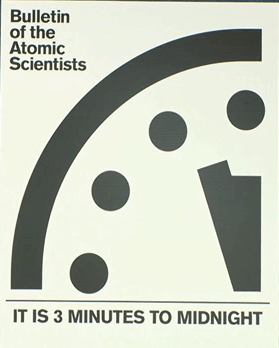
Watch the 2026 Doomsday Clock unveiling live here on January 27 at 10 a.m. EST
To see nuclear-related stories in greater depth and intensity – go to https://nuclearinformation.wordpress.com/

29 Jan. Thursday 7-8 p.m. Webinar – World’s Largest Nuclear Station in Port Hope, ON?


31st January – Challenging the War Machine – a DECLASSIFIED UK SUMMIT


Website of the Week
Now until to February 10, 2026 Radioactive waste storage in France: the debate is finally open! How to participate?
-
Archives
- January 2026 (277)
- December 2025 (358)
- November 2025 (359)
- October 2025 (376)
- September 2025 (258)
- August 2025 (319)
- July 2025 (230)
- June 2025 (348)
- May 2025 (261)
- April 2025 (305)
- March 2025 (319)
- February 2025 (234)
-
Categories
- 1
- 1 NUCLEAR ISSUES
- business and costs
- climate change
- culture and arts
- ENERGY
- environment
- health
- history
- indigenous issues
- Legal
- marketing of nuclear
- media
- opposition to nuclear
- PERSONAL STORIES
- politics
- politics international
- Religion and ethics
- safety
- secrets,lies and civil liberties
- spinbuster
- technology
- Uranium
- wastes
- weapons and war
- Women
- 2 WORLD
- ACTION
- AFRICA
- Atrocities
- AUSTRALIA
- Christina's notes
- Christina's themes
- culture and arts
- Events
- Fuk 2022
- Fuk 2023
- Fukushima 2017
- Fukushima 2018
- fukushima 2019
- Fukushima 2020
- Fukushima 2021
- general
- global warming
- Humour (God we need it)
- Nuclear
- RARE EARTHS
- Reference
- resources – print
- Resources -audiovicual
- Weekly Newsletter
- World
- World Nuclear
- YouTube
-
RSS
Entries RSS
Comments RSS
 nuclear-news