High time to rid Wales of plans for costly, risky Small Modular Nuclear Reactors
Leanne Wood: My column in The National two weeks ago argued for a transition away from manufacturing weapons of war to firing up our greeneconomy. Isn’t it also high time we rid Wales of the scourge of nuclear
power and redirect resources into clean, renewable energy? We have that opportunity now. Wales is a nuclear-free zone but for how much longer?
Plans to resurrect Wylfa B are effectively dead, even though some politicians continue to tout the idea. Attention has turned, instead, to the Trawsfynydd site where Rolls Royce is proposing a Small Modular Nuclear Reactor (SMNR), the latest experiment in nuclear fission technology. Except the old problems of safety and cost of storage and waste disposal haven’t gone away.
The first SMNR to be approved last year in the US was met by fierce criticism from notable scientists, including Professor MV Ramana of the University of Columbia who described the project as “risky and expensive”. Edwin Lyman, director of nuclear power safety at the Union of Concerned Scientists, highlighted ‘safety gaps’ in the design. Still
the Welsh Government, with the backing of Westminster, continues with costly feasibility studies.
The National (Wales) 10th Oct 2021
https://www.thenational.wales/news/19637359.wales-needs-forget-nuclear-power-forever/
Terra Praxis – another pro nuclear front group pushing for the mythical small nuclear reactors.
AJ100 practice Bryden Wood has revealed plans to repurpose the world’s
coal-fired power stations to house modular nuclear reactors as part of a
‘major initiative’ to decarbonise the energy sector. The practice’s
Repurposing Coal proposal has been drawn up with Terra Praxis, a non-profit
organisation focused on action for climate and energy.
Unveiled at COP26 this week, the strategy sets out how coal-fired boilers at existing power
plants could be replaced with Advanced Heat Sources (Generation IV Advanced
Modular Reactors) .
Architects Journal 5th Nov 2021
Utah shouldn’t gamble on unproven small nuclear reactors without public input

The budget for the UAMPS nuclear project has already increased from $3.1 billion to $6.1 billion since it was first conceived, and they are still several years away from plant construction. Last fall, Logan, Kaysville, Bountiful, Murray, Heber and Lehi all withdrew because the financial risks were too significant.
We encourage policymakers who are already involved with or are being approached to participate in the UAMPS nuclear power project to invite presentations by independent experts who can provide a balanced analysis of the pros, cons, actual costs and alternatives.
Scott Williams: Utah shouldn’t gamble on unproven nuclear energy without public input, https://www.sltrib.com/opinion/commentary/2021/11/03/scott-williams-utah/
During the October meeting of the Utah Legislature’s Public Utilities, Energy and Technology Interim Committee, the Utah Associated Municipal Power Systems (UAMPS), a consortium of small cities that operate their own power companies, gave a status update on a nuclear power project to supply electricity for Utahns who live in many of those cities. If this proposal were to succeed, it would be the first time any community in Utah would use nuclear energy to supply its electricity.
During this meeting, common themes of nuclear power being the best and/or only option to secure a reliable source of electricity to fill the gaps of wind and solar power were discussed and pushed forward.
UAMPS project would rely on new and as yet unproven technology. Its participating members would be gambling the dollars of Utah’s taxpayers and ratepayers that this first-of-a-kind project will succeed — a gamble that even risk-taking venture capitalists have shied away from. Our federal tax dollars would be funding much of the research, testing, licensing, construction, liability insurance and, perhaps most importantly, the cost of storing and safeguarding the highly toxic radioactive waste the plant would produce.
Before we accept the claims by the proponents of this project that it is the best and/or only option, the public officials who are approving these expenditures of public funds need to ask the questions about risks, benefits and alternatives that should be asked anytime public funds are being spent. In this case, it’s especially critical to do so because nuclear power projects have a history of significant cost overruns, bankruptcies and municipal bond defaults.
The VC Summer nuclear project budget in South Carolina ballooned from $11 billion to $25 billion. This project was ultimately canceled in 2017 after it was 40% complete and $9 billion had been spent. Ratepayers there will be paying for this mistake for the next 20 years.
The budget for the two new nuclear reactors currently under construction at the Vogtle plant in Georgia has increased from $14 billion to $28 billion.
The budget for the UAMPS nuclear project has already increased from $3.1 billion to $6.1 billion since it was first conceived, and they are still several years away from plant construction. Last fall, Logan, Kaysville, Bountiful, Murray, Heber and Lehi all withdrew because the financial risks were too significant.
The finance director in Logan convinced their city council to pull out, stating, “we’re the last entity that should be participating in risky endeavors. What we should participate in is the 4th or 5th iteration of this project. By that time, I guarantee that the costs will come down to whatever is the market rate for nuclear power.”
After this departure of subscribers, UAMPS decided to cut the size of the plant in half but still insisted that economies of scale would keep the rates competitive. To date, they only have a little over 20% of the purchasing commitments they need to make even this downsized project fully subscribed.
UAMPS issued no requests for proposals to see if this nuclear project was the most cost-effective way to fill the specific need for the power they are trying to address. Their minutes and supporting documents are only available by submitting a formal written public records request. And UAMPS is exempt from Utah’s Open Meetings Act, so the public cannot see the assumptions and calculations they are using to estimate the project’s costs.
We encourage policymakers who are already involved with or are being approached to participate in the UAMPS nuclear power project to invite presentations by independent experts who can provide a balanced analysis of the pros, cons, actual costs and alternatives. Scott Williams is the executive director of HEAL Utah.
Nuclear power is not a solution for anything except perhaps the nuclear industry’s desire for taxpayer dollars.

New nuclear’ wont’ solve challenges https://www.coloradopolitics.com/opinion/counterpoint-new-nuclear-wont-solve-challenges/article_ffab4b6e-38f1-11ec-a03d-733290cbcf3a.html Nuclear power is not a solution for anything except perhaps the nuclear industry’s desire for taxpayer dollars. The nuclear industry sales pitch, such as presented to a largely invitation-only meeting in Pueblo on July 15, promotes “new nuclear” or advanced nuclear, the only thing new is the packaging of the reactors. Even that is still experimental and on the drawing board, with NuScale working with the Nuclear Regulatory Commission on various elements of their design licensing. No operating commercial models have been built, and even if everything goes according to schedule, a pilot plant in Idaho is not expected to be completed until about 2030 — at a cost of 1.3 to 3.6 billion dollars, which they have received from us taxpayers via the Department of Energy. According to widely available statistics of energy costs, nuclear is still the most expensive generation source.
NuScale corporation’s small modular reactors are, in fact, the same light-water nuclear reactors as used to generate power in other settings, using uranium as fuel, requiring cooling water, and generating the same radioactive waste products. To generate power at the level of the coal-fired Comanche 3 power plant in Pueblo County would require at least 12 of the reactors NuScale is proposing. So instead of one large reactor, there would be twelve or more nuclear reactors, with a correspondingly greater probability of error or accidents.

For NuScale as with other nuclear reactors, even if their more experimental proposal for air-cooled versus water-cooled generating capacity is accepted by the NRC, the waste extracted from the reactors every 12-24 months would have to be stored for five years per batch in a pool of cooling water, with the necessity of use and refreshment of this pool for the life of the plant. A corollary of the waste fuel handling is that each of the 12 reactors must be opened and the radioactive fuel transferred and replaced every 24 months at the least, again with a multiplied probability for accidents or errors.
Because there is no long-term national repository for high level nuclear waste, this waste will be stored on-site in the community where it was generated for many years. Because that waste has a half-life of more than 20,000 years (meaning at that point half of the radioactivity will be broken down), it will remain a burden to future generation for as long as any of us can imagine.
Although proponents present nuclear power as a ready, clean solution to the climate crisis, it is neither. The classic nuclear power plants with their iconic cooling towers are aging out of the system, following a long history of operational difficulties, environmental contamination, closure and clean-up issues, as well as the storage of radioactive waste essentially in perpetuity. The “new nuclear” is not new except for means to package it and is at least 10 years or more from even being ready for commercial construction.
The proponents, including NuScale, want to put these plants into closed coal fired power plants, in communities often well within the zones of risk set by the NRC. Because that could rightfully raise community concerns, as well as increasing potential casualties in case of an accident, NuScale is asking the NRC to reduce the zones of protection around their nuclear reactors and radioactive waste sites because of the claimed lower risk for their still-experimental multi-reactor units.
Is Colorado ready for an unproven energy “solution” that will not even be ready for testing for a decade? The answer is “no.” Velma L. Campbell, MD, MPH is a physician specializing in public health, particularly occupational and environmental health. She is the vice chair of the Sangre de Cristo Group of the Sierra Club.
France’s failing EDF nuclear company hopes to save itself by marketing small nuclear reactors
France will act as the shop window for exports of the new SMR technology — billed to be less powerful but easier to produce and run than conventional reactors — with EDF expected to begin building its first “Nuward” reactor in nine years
France’s nuclear drive offers chance of redemption for EDF
New commitments boost state-controlled utility but path ahead remains uncertain , Anna Gross and Sarah White in Paris Ft.com, 31 Oct 21, As the French government signals a future where nuclear power will play an integral rolein achieving carbon neutrality for the country by 2050 [ed. that is a spurious claim] , its state-controlled energy giant EDF remains encumbered by its past. Positioned at the heart of the nuclear debate in France and Europe, EDF struggles under a debt-laden balance sheet and a reputation for being unable to make novel nuclear technologies on time and on budget. But now President Emmanuel Macron has extended an olive branch and seemingly cleared a path for it to expand internationally and attract much-needed investment.
………..Created in 1946 by General Charles de Gaulle, EDF holds emotional power in France, Europe’s last bastion of nuclear power, and is linked with the nation’s industrial past and future. For years it was unclear if Macron, under pressure to move away from nuclear power towards renewables, would give the green light to new reactors long called for by EDF. Shortly after coming to power, Macron committed to reducing nuclear’s share of France’s electricity production from 75 to 50 per cent by 2035.
However, ambitious European climate goals, which hinge on pivoting to forms of energy that emit less carbon than fossil fuels, have put the spotlight on nuclear again and handed France an opportunity to assert its dominance in the field.
For EDF, thawing state tensions and confirmation of France’s desire for a nuclear future bring increased visibility to ensure it can keep training and hiring the people it will need and attract investment. That will be no small task for a company saddled with €41bn of debt and a colossal maintenance and investment programme to fund. UBS estimates a total investment requirement of more than €100bn for it to secure a 20-year life extension for 80 per cent of its nuclear fleet.
If approved, any government subsidies to fund six new reactors — estimated in leaked documents in 2019 to cost around €47bn — and the final price of the nuclear power produced by them, will ultimately be given the green light by Brussels. The cost of this funding could also be influenced by whether or not the EU includes nuclear energy in its taxonomy on “green finance”, making it a more attractive investment prospect. That decision has been delayed indefinitely because of infighting in the EU.
“Whether we can get financing at a low rate or super high rates completely changes the final cost. That’s the real subject, behind the gross number,” said Ursat. EDF faces other hurdles too, including the failure to reach a compromise with Brussels over the restructuring of the utility that would have allowed it to raise the regulated price at which it sells nuclear energy and ringfence some of its activities. It also needs to show it can deliver on its next-generation European Pressurised Reactor (EPR) technology, which it is planning to sell to India, Poland and the Czech Republic.
EPR reactors under construction in Europe — including Flamanville in France and Hinkley Point in the UK — are billions over budget and years behind schedule. The company’s previous chief financial officer quit over concerns about strains Hinkley Point was putting on EDF’s balance sheet.
These setbacks have led some investors and analysts to question EDF’s strategy and growth in the risky and costly field of nuclear power, were it not more than 80 per cent owned by the French government.
“The new reactor at Flamanville is not up and running yet, and some will want to see that project completed before France commits to more reactors with the same design,” said Sam Arie, an analyst at UBS. “From an investor point of view, is there interest in new nuclear projects? Not really.” However, recent soaring energy prices coupled with stringent climate goals seemed to have turned the tide in EDF’s favour. ……….
France will act as the shop window for exports of the new SMR technology — billed to be less powerful but easier to produce and run than conventional reactors — with EDF expected to begin building its first “Nuward” reactor in nine years. …….. https://www.ft.com/content/a1c95212-c122-4a29-8952-14a346381b91
The push for nuclear power in space

“We know that over the years the U.S. Department of Energy has a terrible track record of worker and community contamination during these space nukes fabrication processes. One example is the 244 cases of worker contamination at Los Alamos National Laboratory in New Mexico while building the plutonium generators for the 1997 Cassini space probe,” said Gagnon.
“We’ve known for years that virtually every space mission that NASA flies is ‘dual use’—meaning that it serves two masters—civilian and military.

“The ultimate lesson here,” said Gagnon, “is that the nuclear industry views space as a new market for nuclear rockets, nuclear-powered rovers on Mars, and nuclear-powered mining colonies on the planetary bodies. Concern from Congress about impacts for life on planet Earth?
Not one word in that regard was expressed in the hearing”
The Push for Nukes in Space, CounterPunch, BY KARL GROSSMAN, 28 Oct 21,
The co-chairs of the Subcommittee on Space and Aeronautics of the U.S. House of Representatives Science, Space & Technology Committee were cheerleaders for the use of nuclear power in space at a hearing at which they presided over last week titled “Accelerating Deep Space Travel with Space Nuclear Propulsion.”
The advocacy of Representatives Don Beyer and Eddie Bernice Johnson for nukes in space was strongly criticized in a subsequent interview by Bruce Gagnon, coordinator of the Global Network Against Weapons and Nuclear Power in Space………
Witnesses testifying before the subcommittee included those from the aerospace industry including Michael French, vice president for space systems of the Aerospace Industries Association. ……….
There were no witnesses invited to the hearing who are critical of the use of nuclear power in space. Gagnon has been coordinator of the Global Network Against Weapons and Nuclear Power in Space since its formation in 1992. Based in Maine, it is the leading international organization opposing the use of nuclear power in space through protests, an annual “Space for Peace Week” and lawsuits through the years.
Said Gagnon: “The recent testimonies by aerospace industry operatives before the House Subcommittee on Space and Aeronautics were quite telling. But even more so were the opening statements by committee co-chairs, both Democrats, who hail from the heavily space-oriented states of Virginia and Texas. Both committee chairs Don Beyer (VA) and Bernice Johnson (TX) enthusiastically endorsed the proposal to continue spending hundreds of millions of dollars annually toward preparation of nuclear reactor flight tests in space.”
“The logic behind this dangerous ‘field test’ is to prepare to send nuclear-powered rockets to Mars,” said Gagnon. “Ostensibly these plans are to protect the ‘safety of our astronauts’ by reducing their exposure to in-space radiation with ‘shorter trips’ to the red planet because nuclear rockets would cut in half the travel time. This is very telling as concern over the safety of a couple of astronauts ‘trumps’ the safety of the Department of Energy workers who will be fabricating these space nuclear devices.”
“We know that over the years the U.S. Department of Energy has a terrible track record of worker and community contamination during these space nukes fabrication processes. One example is the 244 cases of worker contamination at Los Alamos National Laboratory in New Mexico while building the plutonium generators for the 1997 Cassini space probe,” said Gagnon.
“In addition, this concern over astronaut safety also ‘trumps’ the safety of all life on Earth as plans call for the testing of these nuclear rocket engines just over our heads in space,” he said.
“During the testimony of several aerospace industry executives at the hearing they admitted that current regulations that oversee ground testing of these reactors are ‘too restrictive’ because they require the capture and processing of ‘radiologic sources’ in order to ‘reduce contamination.’ Thus, with no regulation of testing in space the powerful alliance of aerospace and nuclear industry is asking Congress to give them a free pass,” Gagnon said.
“We’ve known for years that virtually every space mission that NASA flies is ‘dual use’—meaning that it serves two masters—civilian and military. During the committee hearing it was acknowledged that DARPA [the U.S. military’s Defense Advanced Research Projects Agency] has its own nuclear propulsion project for ‘national security interests’. This indicates that this proposed space nuke testing program will benefit the Pentagon’s goal to create space nuclear reactors for military operations in space.”
“The ultimate lesson here,” said Gagnon, “is that the nuclear industry views space as a new market for nuclear rockets, nuclear-powered rovers on Mars, and nuclear-powered mining colonies on the planetary bodies. Concern from Congress about impacts for life on planet Earth? Not one word in that regard was expressed in the hearing”
“If NASA wants to travel into space, then use solar power. There are ample examples of current successful solar missions into deep space,” he said.
“Let’s slow this run-away freight train down and let the public know about, and comment on, these dangerous plans to nuclearize space,” said Gagnon…………………………………………
There have been three accidents involving U.S. space nuclear missions,
the worst in 1964 involving a satellite powered by a plutonium-fueled RTG, the SNAP 9A. The satellite failed to achieve orbit, broke up in the atmosphere as it came crashing back down to Earth, its plutonium dispersing as dust extensively on Earth. Dr. John Gofman, an M.D. and Ph.D., professor at the University of California at Berkeley, formerly associate director of Lawrence Livermore National Laboratory, author of Poisoned Power and involved in early studies of plutonium, linked this accident to an increase in lung cancer on Earth.
Following the SNAP-9A accident, NASA pushed the development of solar power for satellites and now all U.S. satellites have energized by solar power—as is the International Space Station.
| Still, NASA for years insisted that nuclear power was necessary for power beyond the orbit of Mars—a claim that has been demonstrated to be false. In 2011, for example, NASA launched its Juno space probe to Jupiter—its electrical system energized by solar panels. It’s still up there studying Jupiter, despite sunlight being a hundredth of what it is on Earth.Still, the drive to utilize nuclear power in space continues being pushed hard…………………..Meanwhile, studies and articles have pointed to solar energy providing all the power needed for would-be settlements on Mars and the Moon. …………………… Karl Grossman, professor of journalism at State University of New York/College at Old Westbury, and is the author of the book, The Wrong Stuff: The Space’s Program’s Nuclear Threat to Our Planet, and the Beyond Nuclear handbook, The U.S. Space Force and the dangers of nuclear power and nuclear war in space. Grossman is an associate of the media watch group Fairness and Accuracy in Reporting (FAIR). He is a contributor to Hopeless: Barack Obama and the Politics of Illusion. https://www.counterpunch.org/2021/10/28/the-push-for-nukes-in-space/ |
Push for ”small nuclear power” in Colorado
Extract from –Pueblo County wants to replace Comanche coal plant with nuclear power. Local activists are worried.The county’s coal-fired power plant could close 30 years earlier than anticipated, Colorado newsline, OCTOBER 29, 2021 ”……………….. With that likely early closure of Comanche 3 (coal-powered station) , some county leaders want a nuclear power station to replace that energy production and — crucially for them — the tax base. Pueblo consumers do not actually receive any of the power generated by Comanche. County leadership believe that so-called small modular reactors technology is the clean energy source that will be deployable by 2030, and they argue that the technology has become much safer since catastrophes like the Chernobyl meltdown………..
Activists worry that county leadership is being lured into an experimental and unsafe energy alternative. They called the July town hall “secretive” and accused county leaders of having these conversations behind closed doors.
“We are being targeted because the nuclear industry, including NuScale, has a campaign going on to place nuclear power plants in old coal fired power plants all over the country. We are the foot in the door,” Campbell said. “Our commissioners are not doing their homework, they aren’t looking into the risk … in my opinion, they are being made to feel like bigwigs by people in the nuclear industry and have fallen in love with themselves.”
“That’s the one that is probably able to move forward quicker — nuclear,” said Commissioner Chris Wiseman.
It would be the first nuclear power plant in Colorado since Fort St. Vrain Generating Station stopped generating power in 1989…………..
Colorado isn’t completely sold on the idea yet, the nuclear option has been central to the conversation. In July, the county held a town hall with presenters from NuScale. Now, Wiseman is putting together a committee to look at possible alternative energy sources and hopes to have proposals before he retires from elected office at the end of next year. He leaves open the possibility that nuclear is not the answer, but rather some other emerging technology like green hydrogen……..
“Going through the neighborhoods and talking to people, it seems like people have just not been asked. When they are being used as sacrifice zones for these polluting industries that don’t serve them, no one comes and asks them,” said Giselle Herzfeld, a nonprofit organizer from Longmont who came down to Pueblo for the day of action.
Why nuclear instead of solar, wind?
Opponents of the nuclear idea want the county to more seriously consider replacing Comanche 3 with renewables such as solar, water or wind power.
“With all the creative thinking that exists in our community and around the state, I know we could come up with multiple ways of replacing that tax money,” said Pueblo activist Velma Campbell.
The nuclear lobby’s false story on small nuclear reactors

Too expensive, too slow: Even the baseload argument doesn’t work for nuclear. ReNeweconomy, Mark Diesendorf 29 October 2021
”………………………Small Modular Reactors
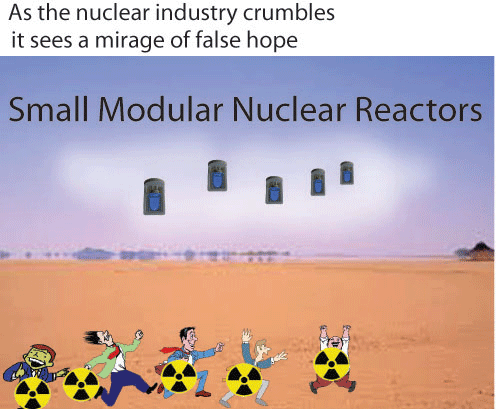
The nuclear industry is nowadays creating the false impression that new reactors exist that could solve the above major problems of existing reactors while contributing to climate mitigation.
The main hypotheticals are the so-called “small modular reactors” (SMRs), small enough to be distributed around a country and modular in the sense that they could be mass-produced by the thousand in factories and erected rapidly.
However, the actual situation is that SMRs don’t exist — they are paper reactors fuelled on hot air. They could not be installed in Australia for at least 15 years, if ever. By that time, given the political will, we could have an electricity system that’s entirely powered by renewable energy, mainly solar photovoltaics (PV) and wind, supplemented by hydro.
The reason why past and current generations of commercial nuclear power reactors are very big is to obtain economies of scale. Nuclear costs have been increasing while wind and especially solar costs continue to fall.
SMRs would have to be mass-produced in hundreds, possibly thousands, to overcome the loss of economy of scale and, even then, their electricity would at best cost much the same as from existing big nuclear power reactors.
There are no orders for multiple SMRs and that’s fortunate because the risk of proliferation would be greatly increased by distributing SMRs around the countryside. Reducing proliferation risk or increasing safety or improving waste management would all increase cost……………
SMRs that simultaneously solve proliferation, safety and waste management, while reducing costs, are a dangerous fantasy. https://reneweconomy.com.au/too-expensive-too-slow-even-the-baseload-argument-doesnt-work-for-nuclear/
Response to claims about China’s space aims
Response to claims about China’s space aims, by Michael Wong, 25 Oct 21
The claim – ”US must build space superhighway before China stakes claims-Senior Space Force Officer. From “Breaking Defense”: https://breakingdefense.com/2021/10/us-must-build-space-superhighway-before-china-stakes-claims-senior-space-force-officer/?utm_source=Sailthru&utm_medium=email&utm_campaign=EBB%2010.21.21&utm_term=Editorial%20-%20Military%20-%20Early%20Bird%20Brief
Some quotes with falsehoods:
- “China fully intends to extend its “territoriality” to the Moon, flouting international law in exactly the same way as it has with regard to the South China Sea, Brig. Gen. John Olson, chief advisor to Space Force head Gen. Jay Raymond on mobilization and space logistics, asserted today.” My comment: There is no evidence that China has any such intentions. China has not said anything like that, has not broken any international laws, nor taken any actions that are anywhere near as aggressive as US actions.
- “If you read their language, if you read their products — which I am a vigorous student of — if you look at what they do they telegraph everything that they’re going to do, they believe that the Moon is manifest destiny for them” and part of their “economic … and security equation,” Olson said.” My comment: In the San Francisco Chinese community of which I’m a part, I have many political friends including scholars, retired elected officials, and others who are from Hong Kong, China, or Taiwan, are native Chinese speakers, and follow the news from China and Asia closely. They have not reported any language, products, or anything else which implies that China believes the moon is “manifest destiny” for China. Remember American lies about WMD in Iraq, incubator babies thrown on the floor in Kuwait, or the Gulf of Tonkin “incident” in Vietnam? These are typical American lies to demonize a nation that the US decides to attack, and justify increased US defense money.
- “The officer drew a direct line between how Beijing has ignored a World Court ruling on a sovereignty dispute with the Philippines in the South China Sea to how Chinese leaders could act in space, without regard to the prohibitions of the 1967 Outer Space Treaty (OST.)” My comment: Check out this 11 minute video from a US Marine veteran living in Thailand, which breaks down this whole distorted narrative about China and the South China Sea: https://www.youtube.com/watch?v=if-fV9U_sWs
- “…US military space leaders more and more openly paint China as an aggressor in space, with goals of not just world but galactic domination.” My comment: “…galactic domination???” Come on, Washington, have you any idea how big the galaxy is? Do you really think China intends to dominate it? What is it with you guys? We hippies were the ones doing LSD in the ’60’s, why are you guys the ones hallucinating now?
Bottom line, it’s all about the money and American domination of the world. To get more and more of the US national budget, the military industrial complex needs an enemy to justify their existence. And they project their mindset onto the Chinese, who are a completely different nation and culture, and who simply don’t think like Washington (if you want to read a longer article on the mindset of the Chinese, here’s my take on it: https://peacepivot.org/america-china-life-death-the-long-game/ ).
More evidence that space radiation may be harmful to the male brain.
Deep Space Radiation Might Be Dangerous for the Male Brain
New research suggests that prolonged exposure to space is not so great for male mice. InterestingEngineering By Loukia Papadopoulos, 24 Oct 21,
Back in 2019, a study on mice was released that set out to investigate how deep space travel would impact the nervous system and found radiation exposure hurt cellular signaling in the hippocampus and prefrontal cortex of the brain leading to learning and memory difficulties. The researchers also saw the mice exhibit behaviors associated with anxiety, implying the radiation can harm the amygdala.
Now, a new study published in Science Advances is revealing that male mice exposed to radiation similar to that encountered by humans on long space missions experienced problems with spatial learning. The researchers conducted several tests to evaluate the mice’s spatial learning abilities after being exposed to galactic cosmic radiation……. https://interestingengineering.com/deep-space-radiation-might-be-dangerous-for-the-male-brain
France may have hidden agenda in promoting small nuclear reactors

“Countries that are clinging on to nuclear power are often nuclear weapon states — such as the UK, the US and France,” he explained, and pointed to a speech by Macron in December 2020.
“Without civil nuclear power, no military nuclear power; and without military nuclear power, no civil nuclear power,” the president had said
Do France’s plans for small nuclear reactors have hidden agenda? DW, 22 Oct 21,
Although France plans to invest in small modular nuclear reactors, experts doubt that this is ecologically and economically sensible. Yet it may be more about geopolitical strategy than energy.”…… A French law says the country will have to reduce its share of nuclear energy from currently roughly 70% — the highest in the world — to 50% in 2035, a goal President Emmanuel Macron has in the past called unrealistic.
But in pursuing small modular reactors (SMRs), some experts believe France may have a hidden agenda.
€1 billion planned investment
Recently, the president announced plans to invest in so-called small modular reactors (SMRs) “to lead the sector with groundbreaking innovations.” The new reactors are ostensibly to help France reduce its CO2 emissions.
The announcement came when Macron unveiled his France 2030 investment strategy of €30 billion ($35 billion) at the Elysee Palace.
“We have a decisive competitive advantage — our historical model, the existing nuclear power plants,” the president said during the ceremony.
The strategy allocates €8 billion to the development of hydrogen power and only €1 billion to SMRs, yet Macron declared the plans to develop the small plants “goal No. 1.”
The country’s SMRs will have a capacity of 50 megawatts to 500 MW each – considerably less than France’s current reactors with their capacity of up to 1,450 MW. SMRs are to be built in clusters to increase sites’ total capacity.
But nuclear champion France is not the frontrunner in the SMR race — the US is……
France’s first demonstration plant is only scheduled to be completed in 2030.
And yet, Nicolas Mazzucchi, of the Paris-based Foundation for Strategic Research, thinks the country could take the lead in the sector………
A discussion based on ‘hot air’
But Mycle Schneider thinks nuclear energy is inefficient in the fight against the climate emergency — “too expensive, too slow,” he says. He’s the editor of the annual World Nuclear Industry Status Report (WNISR), which assesses trends in the global nuclear power industry.
“Last year, more than 250 GW of renewable energy capacity has been added to the grid and only 0.4 GW of net nuclear capacity — nuclear power has become irrelevant,” he asserted.
Schneider says nuclear power plants only appear to be more reliable than renewables: “France’s nuclear reactors, on average, had to be switched off during one-third of the time in 2020, mostly due to maintenance, also as they now have been running for a long time, on average more than 35 years.”
“The discussion around SMRs is orchestrated hot air and has become hugely hyped,” he explained to DW.
He added that renewables had to be seen as a bouquet of different energies. Through demand response management, one type of energy could offset the temporary unavailability of the other. Environmentalists also often point out that construction of nuclear power plants has a significant carbon footprint.
“It takes ages to build new nuclear power plants,” Schneider added. French utility EDF and Siemens started to develop EPRs, a third-generation pressurised water reactor design, after the Chernobyl nuclear catastrophe in 1986, he explained. “And 35 years on, there’s still no EPR in Europe up and running.”
EDF is building a 1.6 GW EPR in Flamanville in northern France. But constructing the plant will exceed €11 billion, instead of the initially planned €3.3 billion, and the EPR is only scheduled to be completed next year — 10 years later than initially intended.
Nevertheless, President Macron could soon announce plans to build six additional EPRs in France.
Nuclear very capital-intensive
Such delays have Kenneth Gillingham, a professor of environmental and energy economics at Yale University in the US, wondering if investing in nuclear makes economic sense.
“The safety requirement for new nuclear plants are that strict, that constructing them becomes very costly and capital-intensive,” he told DW.
“I don’t really see why you would spend money on SMRs, especially as you don’t know if they will work in the end,” he said.
Philip Johnstone, a research fellow at the University of Sussex School of Business in southern England, thinks that SMRs turn the logic of economies of scale on its head.
Ulterior motives behind investment in SMRs
“We were told all along that building bigger nuclear plants would help us save money through the scale effect, and now it’s supposed to suddenly work the other way around?” Johnstone told DW.
He believes that France has other reasons for continuing to invest in nuclear energy.
“Countries that are clinging on to nuclear power are often nuclear weapon states — such as the UK, the US and France,” he explained, and pointed to a speech by Macron in December 2020.
“Without civil nuclear power, no military nuclear power; and without military nuclear power, no civil nuclear power,” the president had said, praising a sector that employs 220,000 people in France.
“The investment in SMRs seems first and foremost a strategic decision, even though it means wasting a lot of time and money,” Johnstone said.
Time and money that could instead be more effectively invested in climate protection.
According to the United Nations, global CO2 emissions will need to be reduced by more than 7% percent each year until 2030 — based on the year 2019 — to limit global warming to 1.5 degrees Celsius (2.7 degrees Fahrenheit). https://www.dw.com/en/do-frances-plans-for-small-nuclear-reactors-have-hidden-agenda/a-59585614
War fears soar as NASA claims it needs nuclear rockets to rival China in space
 | |||
War fears soar as NASA claims it needs nuclear rockets to rival China in space
NASA has prompted fears of a conflict after pleading with the US Government to invest in nuclear-powered spacecraft to speed ahead of rivals in the space race., Express UK, By JACOB PAUL, Oct 23, 2021
The agency’s officials were testifying at a House Science, Space, and Technology subcommittee hearing on Wednesday – and called for new weapons to help the US reach Mars before powers such as Russia and China. NASA called on US lawmakers to invest more resources into researching and developing nuclear-powered rockets. They said this would which help humans reach the planet in just three to four months……….
NASA are now scrambling for the US to boost their space defences as China appears to advancing its space technology at a rapid pace……….
while the NASA are hoping to ramp up their space defence systems as they prepare to fend off China in the space race, the move would also come at high risk.
A spokesperson for Campaign for Nuclear Disarmament told Express.co.uk: “The idea of using nuclear-power in space is not new and has long been suggested as a way of getting to Mars quickly.
“But the launch into space of a nuclear reactor also risks a catastrophic spread of radioactive material if, for example, the launch vehicle were to malfunction and explode – which would be quite possible if an over competitive rush to space were to occur.
“Nuclear power has also been suggested for other applications, such as powering space weapons and military bases on the Moon and Mars. So, there really needs to be international consideration of the possible applications of nuclear power in space and their desirability. Some of the risks may well outweigh any possible advantages.” https://www.express.co.uk/news/science/1510292/world-war-three-news-space-race-mars-nasa
Mini nuclear reactors claim to be the cheap, effective, action for reaching net zero carbon emissions: UK and others are buying this!

Mini nuclear reactors vie for key role in UK’s push to hit climate targets, Ft.com 21 Oct 21, SMRs promise huge cost savings over traditional large-scale plans, Ever since the Wylfa nuclear power plant on Anglesey stopped generating electricity in December 2015, communities on the Welsh island that are supportive of atomic power have been waiting for its revival. This week that likelihood increased when the UK government named a site near where the old reactors are being decommissioned as a possible location for a new large-scale plant or the first place in the UK to host a new technology under development, known as small modular reactors (SMRs).

One of the big selling points of SMRs is that they promise huge cost savings over traditional large-scale reactors. Rolls-Royce, the UK engineering group which is leading a consortium to produce a UK design, expects the first five SMR reactors to cost £2.2bn each, falling to £1.8bn for subsequent units. The government’s decision this week to give nuclear a central role in its net zero emissions strategy has given fresh impetus to replacing Britain’s existing reactors, which are all due to be retired by the end of 2035. Ministers committed a total of £505m in funding to the nuclear initiative, which calls for a mix of large plants, SMRs and other emerging technologies.

More than £200m of that funding is soon expected to be channelled into the consortium led by Rolls-Royce. It has been seeking private match-funding so it can submit its SMR reactor design to the extensive regulatory approval process before the end of the year. Wylfa had been earmarked for a new plant under British plans to build a new generation of large-scale reactors, financed mainly by the private sector, that dates back to 2006. But successive governments have struggled to attract private capital to these projects, where cost-overruns are commonplace because of the engineering risks in such complex structures.
So far work has only started on one: Hinkley Point C in Somerset and costs have spiralled with the latest estimate put at £23bn. The developer behind the proposed Wylfa plant, Japan’s Hitachi, pulled the plug last year after failing to reach a financing agreement with the UK government, although a US consortium is trying to resurrect it.
The UK is not alone in pushing smaller reactors. Other governments around the world looking to tap nuclear power to meet their challenging decarbonisation targets are also showing interest in the technology. Along with the promise of much lower build costs, the smaller power plants are also attractive because of their footprint. The UK, for example, has a limited number of sites suitable for large plants.
France, one of the world’s leaders in nuclear engineering, this month announced €1bn in funding for state-backed utility EDF to develop its own SMR technology by the early 2030s. The technology is similar to existing pressurised water reactors that are used in nuclear power plants today. But the key difference is that the small, modular design would allow the parts to be built in factories ready for quick assembly at the chosen location. This, SMR advocates argue, not only cuts costs and the long lead times but also avoids many of the construction risks that bedevil larger plants………..
……. Rolls-Royce is tight-lipped about its SMR fundraising but Tom Samson, who heads the consortium, said he was in talks with a “number of interested investors and developers in deploying the technology”. If the design gets regulatory approval, a process that can take up to five years, Rolls-Royce believes it could complete its first 470 megawatt SMR plant by 2031. After that it expects to build two units a year.
At 470MW the plant would have a generating capacity similar to some of Britain’s earliest reactors but would be about seven times less capable than the proposed next large-scale plant in the UK: Sizewell C on England’s east coast.
………. Among those other options are what the UK dubs “advanced modular reactors”. One of the most viable designs looks to be a high temperature gas-cooled reactor. The technology is being tested in a number of countries, including Japan. The government set a target this week of having the first advanced modular reactor demonstrator in Britain “in the early 2030s”. But analysts question whether any of these technologies would be commercialised in time to help the UK reach its 2035 target for a carbon neutral grid.
Moreover, some environmentalists argue a big challenge is the UK’s lack of experience with modularisation manufacturing techniques that are key to their economics. “We have never done it,” said Tom Burke, co-founder of E3G, a climate think-tank, arguing that modularisation would require a “very large factory” that could only be funded with a long line of orders.
Burke questioned how it would be possible to secure those orders when the first SMR is, as yet, unproven. But Rolls-Royce’s Samson remains unfazed. In contrast to future large atomic plants, which are likely to require a financing model that will be underpinned by British households through their energy bills, modularisation promises a radical shift in funding nuclear power. He conceded that government backing would be needed to help finance the initial manufacturing set-up and first orders but insisted private capital would ultimately pay for the bulk of the fleet. “This is an important transition for us. https://www.ft.com/content/7da30202-2db9-4ab3-9428-458a9d8728bd?signupConfirmation=success
Rolls Royce ”small” nuclear reactors – not really small, not useful against climate change, but useful for military purposes

Answers to the energy and climate crises are needed NOW. These answers are available based on a comprehensive programme of developing renewable energy and energy conservation technologies.
Every pound wasted on nuclear power will be a pound taken away from faster and more effectivesolutions offered by renewable energy and energy conservation.
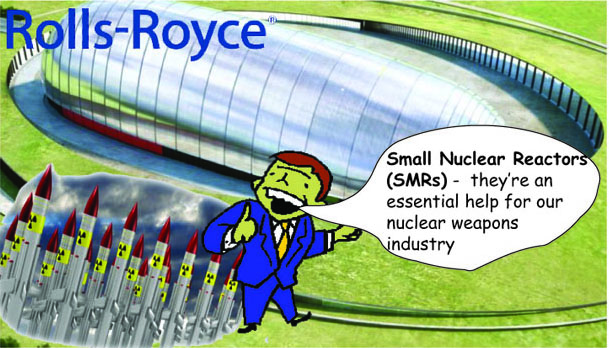
It is reported that the Tory government will restate its support on Monday, 18 October to buiding a fleet of modular nuclear reactors. The favoured reactor is the Rolls Royce SMR, namely ‘Small ModularReactor’. This term is very misleading as the Rolls Royce reactor would produce 450MW of electricity, which is more than the output of the old Magnox station at Trawsfynydd, and the same size as one of old big Magnox reactors at Wylfa.
It is known that Rolls Royce are asking for huge public subsidies to realise their nuclear ambitions. This movement towardsbuilding reactors to produce electricity is closely related to their wish to safeguard skills in the reactors they provide for submarines carrying nuclear weapons. Civil and military nuclear are two sides of the same coin. Rolls Royce claim they would like to build 18 SMRs.
How far will the government be prepared to go to fund a far from new technology and like larger nuclear reactors, is open to accidents and radioactive leaks, and produces poisonous and lethal radioactive waste.
Also mentioned is the possibility of Bechtel/Westinghouse trying to push the Westinghouse AP1000 reactor on the Johnson government to be developed at the Wylfa site. This is the very reactor on the V.C.Summer site in South Carolina that
bankrupted Toshiba Westinghouse in 2017. That happened due to huge overspending and the project was abandoned 40% of the way into construction. It was therefore no surprise that the NUGen Consortium project to build three AP1000s at Moorside near Sellafield collapsed in 2018. Nobody was prepared to invest in it. Exactly the same fate as the Hitachi/Horizon plan at Wylfa. Johnson and his ministers in the Treasury and the Business,
Energy and Industrial Stratregy Department are missing the point entirely as they cling on to past imperial grandeur by blindly
promoting nuclear power. Nuclear power is dirty, dangerous, extortionately expensive, and a threat to environmental and human health. Nuclear power will do nothing to tackle the present energy crisis, nor will it effectively counteract the effects of climate change., and we certainly cannot afford to waste the fifteen years needed to build large new nuclear stations
Answers to the energy and climate crises are needed NOW. These answers are available based on a comprehensive programme of developing renewable energy and energy conservation technologies. Every pound wasted on nuclear power will be a pound taken away from faster and more effectivesolutions offered by renewable energy and energy conservation.
People Against Wylfa B 18th Oct 2021
British government’s enthusiasm for mini nuclear reactors, led by Rolls Royce and 8 other organisations

Brexit Britain strikes historic £210m deal with Rolls-Royce to create nuclear reactors
BREXIT Britain is set to see its emissions slashed as the Government is poised to make a landmark deal with Rolls-Royce to fund a fleet of nuclear mini-reactors.
Express UK, By JACOB PAUL, Mon, Oct 18, 2021 The move is set to help Prime Minister Boris Johnson race to his target of zero-carbon electricity by 2035 in a move set to impress ahead of the COP26 climate summit in Glasgow in less than two weeks time. Mr Johnson visited Rolls-Royce’s Bristol factory on Friday, where he was shown their state-of -the-art facility by their CEO, Warren East. A consortium led by Rolls-Royce had already secured £210million in backing from private investors for the small modular reactor (SMR) project, a sum that the Government is expected to match and even surpass.
Confirmation is expected before the spending review on October 27.
The consortium called UK SMR, is set to rebrand British engineering firm Rolls-Royce SMR under a request from the Government. Tom Greatrex, chief executive of the Nuclear Industry Association (NIA), said: “Match-funding for Rolls-Royce would be a huge signal to private investors that the government wants SMRs alongside new large-scale stations to hit net zero.
It would also show investors that the Government believes in nuclear as a green technology.”
Government support will help with the consortium’s multi-billion pound plans to build 16 SMRs up and down the country……………… Rolls-Royce is also being advised by HSBC, which has helped it secure £210million from private investors, which was a condition set by the government for them to hand out at least the same amount of funding.
This move could also signal a possible U-turn from the Government on their scheduled phasing out of nuclear power in the UK.
13 nuclear reactors capable of producing 7.8GW of power currently produce around 20 percent of the nation’s electricity.
But over half of that capacity comes from reactors that are scheduled to be replaced or halted by 2025. https://www.express.co.uk/news/science/1507881/brexit-britain-rolls-royce-nuclear-power-boris-johnson-cop26-climate-change
1 This Month
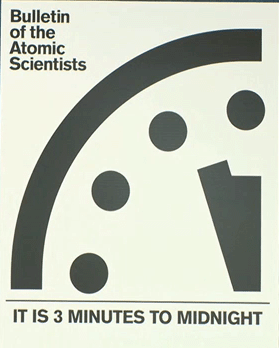
Watch the 2026 Doomsday Clock unveiling live here on January 27 at 10 a.m. EST
To see nuclear-related stories in greater depth and intensity – go to https://nuclearinformation.wordpress.com/

29 Jan. Thursday 7-8 p.m. Webinar – World’s Largest Nuclear Station in Port Hope, ON?


31st January – Challenging the War Machine – a DECLASSIFIED UK SUMMIT


Website of the Week
Now until to February 10, 2026 Radioactive waste storage in France: the debate is finally open! How to participate?
-
Archives
- January 2026 (271)
- December 2025 (358)
- November 2025 (359)
- October 2025 (376)
- September 2025 (258)
- August 2025 (319)
- July 2025 (230)
- June 2025 (348)
- May 2025 (261)
- April 2025 (305)
- March 2025 (319)
- February 2025 (234)
-
Categories
- 1
- 1 NUCLEAR ISSUES
- business and costs
- climate change
- culture and arts
- ENERGY
- environment
- health
- history
- indigenous issues
- Legal
- marketing of nuclear
- media
- opposition to nuclear
- PERSONAL STORIES
- politics
- politics international
- Religion and ethics
- safety
- secrets,lies and civil liberties
- spinbuster
- technology
- Uranium
- wastes
- weapons and war
- Women
- 2 WORLD
- ACTION
- AFRICA
- Atrocities
- AUSTRALIA
- Christina's notes
- Christina's themes
- culture and arts
- Events
- Fuk 2022
- Fuk 2023
- Fukushima 2017
- Fukushima 2018
- fukushima 2019
- Fukushima 2020
- Fukushima 2021
- general
- global warming
- Humour (God we need it)
- Nuclear
- RARE EARTHS
- Reference
- resources – print
- Resources -audiovicual
- Weekly Newsletter
- World
- World Nuclear
- YouTube
-
RSS
Entries RSS
Comments RSS
 nuclear-news