U.S. approves design for NuScale small modular nuclear reactor, but significant problems remain.

By Timothy Gardner WASHINGTON, Jan 20 (Reuters) – The U.S. nuclear power regulator has certified the design for the NuScale Power Corp’s (SMR.N) small modular reactor, the first such approval in the country for the next generation technology.
The Nuclear Regulatory Commission’s approval, published in the Federal Register late on Thursday, clears a hurdle for NuScale. The company plans to build a demonstration small modular reactor (SMR) power plant at the Idaho National Laboratory. NuScale says the six-reactor, 462 megawatt Carbon Free Power Project will be fully running in 2030.
There are significant questions about rising costs of the demonstration plant, expected to provide electricity to the Utah Associated Municipal Power Systems (UAMPS). NuScale said this month the target price for power from the plant is $89 per megawatt hour, up 53% from the previous estimate of $58 per MWh.
Backers of next generation reactors including President Joe Biden’s administration and many Republican lawmakers, say they are crucial in curbing climate change. NuScale says they will be safer than today’s far larger conventional reactors, but the reactors, like conventional nuclear plants, are expected to produce highly toxic waste, for which no permanent fix has been developed.
The U.S. Department of Energy has provided more than $600 million since 2014 to support the design, licensing and siting of NuScale’s power plant and other small modular reactors. NuScale and other companies that succeed in building next generation reactors could receive for the first time lucrative production tax credits contained in last year’s Inflation Reduction Act signed by Biden……………..
NuScale also hopes to build SMRs in Romania, Kazakhstan and Poland, despite concerns from nuclear safety experts who say Russia’s invasion of Ukraine and occupation of the Zaporizhzhia plant should make the industry think seriously about developing plants in the region. https://www.reuters.com/business/energy/us-approves-design-nuscale-small-modular-nuclear-reactor-2023-01-20/
A bit of panic in the UK small nuclear reactor lobby?

‘No regrets?”
Quite a lot of people have regrets about the introduction of nuclear power.
And that’s even when the reactor types have been tested.
The new gee-whiz nuclear reactors haven’t even been tested.
Pipeline of ‘no-regrets’ new nuclear schemes needs ‘expediting’
New Civil Engineer16 JAN, 2023 BY ROB HORGAN
A pipeline of “no-regrets” new nuclear schemes must be fast-tracked if the UK is to meet its net zero carbon emission targets, according to an independent [how independent?] review set up to assess the UK’s decarbonisation plans.
It is one of 129 recommendations made by former energy minister Chris Skidmore in his government-ordered net zero review titled Mission Zero.
The report calls for the formation of Great British Nuclear (GBN) to be “expedited in early 2023” so that a “clear roadmap” of future schemes can be developed this year to tackle “rising power demand”.
The government first announced its intention to set up GBN to develop a project pipeline in its British Energy Security Strategy published in April last year.
Skidmore concludes that speeding up the formation of GBN will address industry concerns about a “lack of clarity on the pathway” to achieving the UK government’s ambition for nuclear energy to provide a quarter of power consumed within the country. (Nuclear energy currently supplies 15% of the UK’s power needs.)
The review concludes: “Building new nuclear is a no-regrets option, despite high upfront costs and long construction times”……………….

- YOU ARE HERE:LATEST
Pipeline of ‘no-regrets’ new nuclear schemes needs ‘expediting’
16 JAN, 2023 BY ROB HORGAN
A pipeline of “no-regrets” new nuclear schemes must be fast-tracked if the UK is to meet its net zero carbon emission targets, according to an independent review set up to assess the UK’s decarbonisation plans.
It is one of 129 recommendations made by former energy minister Chris Skidmore in his government-ordered net zero review titled Mission Zero.
The report calls for the formation of Great British Nuclear (GBN) to be “expedited in early 2023” so that a “clear roadmap” of future schemes can be developed this year to tackle “rising power demand”.
The government first announced its intention to set up GBN to develop a project pipeline in its British Energy Security Strategy published in April last year.
Skidmore concludes that speeding up the formation of GBN will address industry concerns about a “lack of clarity on the pathway” to achieving the UK government’s ambition for nuclear energy to provide a quarter of power consumed within the country. (Nuclear energy currently supplies 15% of the UK’s power needs.)
The review concludes: “Building new nuclear is a no-regrets option, despite high upfront costs and long construction times.
“In view of rising power demand, nuclear energy can provide reliable baseload power which is not weather dependent and can provide other services to power networks.”
It adds: “To achieve affordability and efficiency, the Government needs to commit to funding a fleet of projects. Recognising the start times for new build nuclear, a clear roadmap for nuclear deployment up to 2035 is required.”
The government is currently committed to building Sizewell C, while construction of Hinkley Point C continues to gather pace. Ambitions to develop a fleet of small nuclear reactors has also been widely supported by government in the past few years.
Skidmore’s review concludes that as well as delivering a pipeline of projects, the government must act to remove barriers to its nuclear ambitions.
It identifies “the main barrier for new nuclear projects is the need for stable, long-term policy and funding commitments given the long timeframes involved in the building of nuclear plants”.
It also points out that “rapid expansion of nuclear power could lead to some bottlenecks in supply chains and skills pools”.
However, the report stresses that “understanding the timings of different projects” would allow “any supply chain and skills pinch points [to] be identified early, allowing for coordinated action to prevent bottlenecks”.
The review also concludes that streamlining planning and consenting decisions would “ensure nuclear projects are not unnecessarily delayed”. Likewise, Skidmore’s review calls for the lengthy protocols required for innovations like SMRs to be accelerated.
National Infrastructure Commission chair Sir John Armitt supports Skidmore’s calls for clarity and accelerated action.
He said: “Chris Skidmore’s clarity in his call for accelerated action is as compelling as it is commendable, nailing the argument that inaction now will cost us all in the long run.
“Given the economic opportunities offered by leading the pack internationally, securing policy and funding stability over the coming years is paramount.”

Nuclear energy recommendations made in Skidmore’s net zero review:
- Expedite the set-up of Great British Nuclear in early 2023, ensuring required funding and skills are in place.
- Government and GBN to set out clear roadmap in 2023, including interim targets to reach 2050 ambition, and government to ensure funding is in place. As part of the roadmap, government should assess the possibility to increase the current ambitions, supporting the development of supply chain to service a fleet of projects.
- Roadmap to set out clear pathways for different nuclear technologies (including small modular reactors) and the selection process. This should consider how to use programmatic approach to deliver further cost reductions in a competitive environment.
- Government to deliver on siting strategy by 2024
Huge cost for Japanese tax-payers to clean up the botched nuclear waste storage at Tokai reprocessing plant
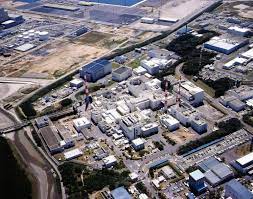
Righting shoddy nuclear waste storage site to cost Japan 36 bil. yen
https://english.kyodonews.net/news/2023/01/a53b75be634e-righting-shoddy-nuclear-waste-storage-site-to-cost-japan-36-bil-yen.html – 16 Jan 23, The Japan Atomic Energy Agency estimates that it will cost taxpayers 36.1 billion yen ($280 million) to rectify the shoddy storage of radioactive waste in a storage pool at the Tokai Reprocessing Plant, the nation’s first facility for reprocessing spent nuclear fuel, an official said Sunday.
Around 800 containers of transuranic radioactive waste, or “TRU waste,” were dropped into the pool from 1977 to 1991 using a wire in the now-disused plant in Tokai, a village in Ibaraki Prefecture northeast of Tokyo. They emit high levels of radiation.
The waste includes pieces of metal cladding tubes that contained spent nuclear fuel, generated during the reprocessing process. The containers are ultimately supposed to be buried more than 300 meters below surface.
The agency has estimated that 19.1 billion yen will be needed to build a new storage facility for the containers, and 17 billion yen for a building that will cover the storage pool and the crane equipment to grab containers.
The 794 containers each are about 80 centimeters in diameter, 90 cm tall and weigh about 1 ton, with many lying on their sides or overturned in the pool. Some have had their shape altered by the impact of being dropped.
The containers were found stored in the improper manner in the 1990s. While the agency said the storage is secure from earthquakes and tsunamis, it has nonetheless decided to improve the situation.
The extractions have been delayed by about 10 years from the original plan and are expected to begin in the mid-2030s.
The Tokai Reprocessing Plant was the nation’s first plant that reprocessed spent fuel from nuclear reactors to recover uranium and plutonium. Between 1977 and 2007, about 1,140 tons of fuel were reprocessed. The plant’s dismantlement was decided in 2014 and is expected to take about 70 years at a cost of 1 trillion yen.
Uncertainty over government funding for Rolls Royce’s small nuclear reactors

Concerns have been raised that the rollout of small modular reactors
(SMRs) in the UK could be delayed due to funding challenges. According to
The Times, a funding deal for the first fleet of mini nuclear reactors is
not expected to materialise for at least another 12 months, with a row
ongoing in government over the cost of Britain’s wider nuclear ambitions.
Going forward, SMRs, alongside large-scale nuclear plants, are seen as a
crucial tool in the country’s battle against the energy crisis and drive
towards net zero.
The government established a new body called Great British Nuclear (GBN) in conjunction with the release of its energy
security strategy with the aim of facilitating the growth of nuclear power on the grid.
However, Whitehall sources have now revealed that there
remains uncertainty over the government’s SMR investment plans. Rolls-Royce
has called for ministers to enter funding talks and start placing orders.
The firm is planning on building SMR power stations and recently announced
three shortlisted locations for its proposed factory and four potential
sites for the SMR plants themselves.
New Civil Engineer 9th Jan 2023 https://www.newcivilengineer.com/latest/fears-over-potential-delay-to-small-nuclear-reactor-rollout-09-01-2023/
A plan to build a fleet of mini nuclear reactors across the UK could be
delayed by at least another 12 months amid a row in the government over the
cost of Britain’s nuclear power ambitions. The Sunday Times cited sources
stating that there was still a large degree of uncertainty over the scale
of state investment in small modular reactors (SMRs).
Energy Live News 9th Jan 2023
Space junk cowboys are ruining our night sky

https://www.theage.com.au/national/space-junk-cowboys-are-ruining-our-night-sky-20221212-p5c5kw.html
Virginia Kilborn, Swinburne University chief scientist January 15, 2023
Without action, over the next decade the night sky as we know it will change drastically. Where once we saw constellations of stars, we will see moving constellations of satellites – hundreds and maybe thousands of them moving across the sky. The magic of a shooting star will be lost.
The constellations your parents once pointed out will be harder to find, and as Kamilaroi astrophysicist Krystal De Napoli has explained, the vital reference points that our First Nations astronomers have relied on for tens of thousands of years will no longer be visible.
Astronomers are already dismayed that their view of the universe is increasingly masked owing to optical and radio emissions from the thousands of objects overhead that make it more difficult to conduct paradigm-shifting research.
When it comes to access to space, we are undergoing a technological revolution. Once the domain of multinational companies and government agencies, the new space race is dominated by agile and comparatively young companies taking advantage of small satellite technologies, such as CubeSats – nanosatellites the size and shape of a Rubik’s Cube.
These smaller satellites allow companies to quickly test new technologies in space and take less energy to launch to their lower-altitude orbits. While they offer significant benefits to us on Earth, such as monitoring weather patterns and natural disasters, and providing internet access to remote communities, they are less reliable, have higher failure rates and shorter lifespans than previous satellites.
We’re seeing the advantages of new design and advanced manufacturing technologies reducing the cost of sending satellites into orbit. But we should also be concerned about disposable space hardware going down the same path as other technologies, such as low-cost plastics. Plastics have allowed for the development of low-cost products, but the lack of life-cycle planning means plastic waste pollution is prevalent across the planet. We need to avoid this short-term thinking when it comes to satellites.
Rather than launching satellites designed for decades of use – for example the GPS navigation system, comprised of around 30 satellites – many companies are now planning for the launch of mega-constellations of thousands of small satellites in low Earth orbit. In the US alone, the Federal Communications Commission is approving tens of thousands of satellites for launch.
Astra has applied for 13,000 satellites, SpaceX has more than 3000 satellites already launched and has sought approval for 9000 more (but they’re looking at more than 30,000 in the future). Amazon has plans for over 3000 more satellites, and Telesat plans for about 2000 satellites with just a 10-year life span.
While small low Earth orbit satellites are designed to burn up in the Earth’s atmosphere on the timescale of a decade or so, they deposit a higher concentration of aluminium than meteoroids. Over time, this will change the composition of the atmosphere. While the weight of satellite debris now entering the atmosphere is about 20 times less than that of meteoroids, satellites are mainly composed of aluminium; meteoroids are less than 1 per cent of that element. The long-term effects of this change could include changing the albedo, or reflective nature of the atmosphere.
With so many satellites in finite orbits above us, there is also a growing danger of collisions, which in turn could increase the amount of space debris orbiting Earth. NASA is already tracking more than 27,000 pieces of space junk and estimated there could be half a million pieces larger than 1 centimetre; and over 100 million pieces smaller than a centimetre.
Steps are being taken to tackle some of these issues. Here in Australia, space scientists, lawyers and policy experts from Swinburne University of Technology, EY, CSIRO’s Data61 and SmartCat CRC are working on a regulatory framework for AI-enabled systems that can operate to avoid collisions, while other projects are looking to remove existing debris and defunct technology from orbit.
Further afield, the International Astronomical Union has formed the Centre for the Protection of the Dark and Quiet Sky from Satellite Constellation Interference to work with technology companies and policymakers to ensure we preserve the night sky for research.
There is a new voluntary sustainability rating being promoted by the World Economic Forum and the US Federal Communications Commission has recently changed the regulations regarding low Earth Orbit satellite disposal, requiring a much quicker re-entry into the atmosphere to ensure these items don’t clog up our sky.
These are positive steps, but we need to go further and reconsider whether we need to launch thousands of satellites in the first place.
Finding better ways to do things now means both harnessing space to improve life on Earth and avoiding the destruction of one of our greatest assets – the night sky.
Eye-popping new cost estimates released for NuScale small modular reactor
Key Findings
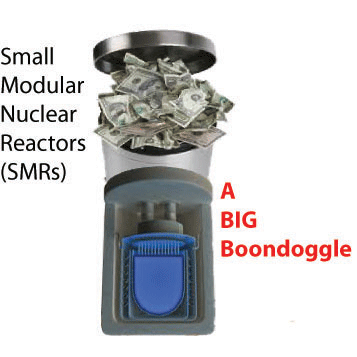
NuScale and the Utah Associated Municipal Power Systems (UAMPS) announced costs of a 462-megawatt small modular reactor (SMR) have risen dramatically
As recently as mid-2021, the target price for power was pegged at $58 per megawatt-hour (MWh); it’s risen to $89/MWh, a 53% increase.
The price would be much higher without $4 billion federal tax subsidies that include a $1.4 billion U.S. Department of Energy contribution and a $30/MWh break from the Inflation Reduction Act
The higher target price is due to a 75% increase in the estimated construction cost for the project, from $5.3 to $9.3 billion dollars
Last week, NuScale and the Utah Associated Municipal Power Systems (UAMPS) announced what many have long expected. The construction cost and target price estimates for the 462-megawatt (MW) small modular reactor (SMR) are going up, way up.
From 2016 to 2020, they said the target power price was $55/megawatt-hour (MWh). Then, the price was raised to $58/MWh when the project was downsized from 12 reactor modules to just six (924MW to 462MW). Now, after preparing a new and much more detailed cost estimate, the target price for the power from the proposed SMR has soared to $89/MWh.
Remarkably, the new $89/MWh price of power would be much higher if it were not for more than $4 billion in subsidies NuScale and UAMPS expect to get from U.S. taxpayers through a $1.4 billion contribution from the Department of Energy and the estimated $30/MWh subsidy in the Inflation Reduction Act (IRA).
It also is important to remember that the $89/MWh target price is in 2022 dollars and substantially understates what utilities and their ratepayers actually will pay if the SMR is completed. For example, assuming a modest 2% inflation rate through 2030, utilities and ratepayers would pay $102 for each MWh of power from the SMR—not the $89 NuScale and UAMPS want them to believe they will pay.
The 53% increase in the SMR’s target power price since 2021 has been driven by a dramatic 75% jump in the project’s estimated construction cost, which has risen from $5.3 billion to $9.3 billion. The new estimate makes the NuScale SMR about as expensive on a dollars-per-kilowatt basis ($20,139/kW) as the two-reactor Vogtle nuclear project currently being built in Georgia, undercutting the claim that SMRs will be cheap to build.
NuScale and UAMPS attribute the construction cost increase to inflationary pressure on the energy supply chain, particularly increases in the prices of the commodities that will be used in nuclear power plant construction.
For example, UAMPS says increases in the producer price index in the past two years have raised the cost of:
Fabricated steel plate by 54%- Carbon steel piping by 106%
- Electrical equipment by 25%
- Fabricated structural steel by 70%
- Copper wire and cable by 32%
In addition, UAMPS notes that the interest rate used for the project’s cost modeling has increased approximately 200 basis points since July 2020. The higher interest rate increases the cost of financing the project, raising its total construction cost.
Assuming the commodity price increases cited by NuScale and UAMPS are accurate, the prices of building all the SMRs that NuScale is marketing—and, indeed, of all of the SMR designs currently being marketed by any company—will be much higher than has been acknowledged, and the prices of the power produced by those SMRs will be much more expensive.
Finally, as we’ve previously said, no one should fool themselves into believing this will be the last cost increase for the NuScale/UAMPS SMR. The project still needs to go through additional design, licensing by the U.S. Nuclear Regulatory Commission, construction and pre-operational testing. The experience of other reactors has repeatedly shown that further significant cost increases and substantial schedule delays should be anticipated at any stages of project development.
The higher costs announced last week make it even more imperative that UAMPS and the utilities and communities participating in the project issue requests for proposal (RFP) to learn if there are other resources that can provide the same power, energy and reliability as the SMR but at lower cost and lower financial risk. History shows that this won’t be the last cost increase for the SMR project.
David Schlissel (dschlissel@ieefa.org) is IEEFA director of resource planning analysis
Shouldn’t a new and experimental reactor deserve a federal impact assessment?
These risks are all new to Canada. No sodium-cooled reactor has ever been built here.
BY M.V. RAMANA AND SUSAN O’DONNELL | January 12, 2023 The Hill Times https://www.hilltimes.com/story/2023/01/12/shouldnt-a-new-and-experimental-reactor-deserve-a-federal-impact-assessment/360512/
Towards the end of December 2022, Environment and Climate Change Minister Steven Guilbeault chose to ignore public concerns about small modular nuclear reactors (SMRs), rejecting a request to put a project through an additional federal impact assessment, favouring the nuclear industry and weakening oversight of an untested and risky technology.
When the revised Impact Assessment Act (IAA) became law in 2019, new nuclear reactors were exempted from assessment if they met certain conditions. Those pushing the exemption aimed to open the path to building new reactors. No surprise, then, that the conditions for exemption apply to almost all the SMR designs being considered for construction, even though Canada has no experience with them whatsoever.
The first SMR officially deemed exempt under the IAA is the ARC-100 sodium-cooled fast reactor proposed by NB Power for the Point Lepreau site on the Bay of Fundy in New Brunswick. Given the ecological sensitivity of the site and inherent problems with such reactors, the Coalition for Responsible Energy Development in New Brunswick (CRED-NB) formally requested Guilbeault to designate the project for a full impact assessment. The minister rejected the request on Dec. 22, claiming that a review by the Canadian Nuclear Safety Commission (CNSC) and the New Brunswick government would be adequate.
The federal impact assessment is the most rigorous form of public review available under law, seeking inputs from multiple stakeholders with different forms of expertise and outlooks. Ideally, the review panel would not be solely constituted by CNSC personnel and staff of the provincial government, a project funder. Indigenous nations and public interest groups had clearly stated their concerns to Guilbeault. Letters of support for CRED-NB’s request were submitted by the Wolastoq Grand Council, and Indigenous organizations representing the Peskotomuhkati Nation and the Mi’gmaq First Nations in New Brunswick, as well as more than 300 groups and individuals.
Why the public concern? Unlike the CANDU reactors operating in Ontario and New Brunswick, the ARC-100 design uses molten sodium instead of heavy water to transfer the intense heat produced by nuclear fission. Sodium reacts badly with air or water, burning or exploding upon such contact. Japan’s Monju demonstration reactor was shut down in 1995 within a few months of the reactor starting to generate power because of a sodium fire; it was reactivated in 2010 but was shut down again after another accident. The total price tag for this reactor and its cleanup is upwards of $10-billion.
Sodium also tends to leak out of pipes and vessels because of chemical interactions with the stainless steel in reactors. France’s Superphénix, the world’s largest sodium-cooled reactor, suffered numerous operational problems, including a major sodium leak. When put out of its misery in 1998, its load factor was under eight per cent, a fraction of the 80 to 90 per cent typical of commercial reactors.
Sodium-cooled reactors have also had numerous accidents, starting with the 1955 partial core meltdown of the EBR-1 in Idaho. A decade later, the Fermi-1 demonstration fast reactor near Detroit, Michigan suffered a similar but more devastating accident, leading to the book We Almost Lost Detroit and a song by Gil Scott Heron.
Sodium-cooled reactors have never been successfully commercialized despite numerous attempts over decades. Shut-down sodium-cooled reactors have proven difficult to decommission. In the U.S., the EBR-II reactor was shut down in 1994, but to date it has been unfeasible to extract the sodium metal from the highly radioactive spent fuel. The challenge is to dispose of this material without causing underground explosions due to a sodium-water reaction, as happened with the sodium-cooled Dounreay reactor in Scotland.
Radioactive particles are still being found on the Dounreay foreshore, more than four decades after the reactor waste exploded. A similar accident with the proposed ARC-100 reactor could result in widely spread radioactive contamination next to the Bay of Fundy.
These risks are all new to Canada. No sodium-cooled reactor has ever been built here. The Canadian Nuclear Safety Commission has never evaluated such reactors, one reason why the CNSC’s claim that its regulatory process provides sufficient oversight for SMR development rings hollow. What’s more, the CNSC’s active lobbying to speed up the regulatory process so SMRs could be more quickly brought to market suggests a fundamental conflict of interest by an “independent” regulator.
The ARC-100 project requires federal oversight and assessment. Its impacts on Indigenous rights as well as socio-economic factors and alternatives to the project will not be within the remit of either a CNSC review or a provincial assessment. The opportunities for an independent and official review of public concerns on these issues have now been significantly curtailed.
Susan O’Donnell is an adjunct professor at the University of New Brunswick and St. Thomas University, and a member of the Coalition for Responsible Energy Development in New Brunswick. M.V. Ramana is the Simons Chair in Disarmament, Global and Human Security and professor at the School of Public Policy and Global Affairs, University of British Columbia.
Japan and USA to develop small nuclear reactors”within each country and third countries.”
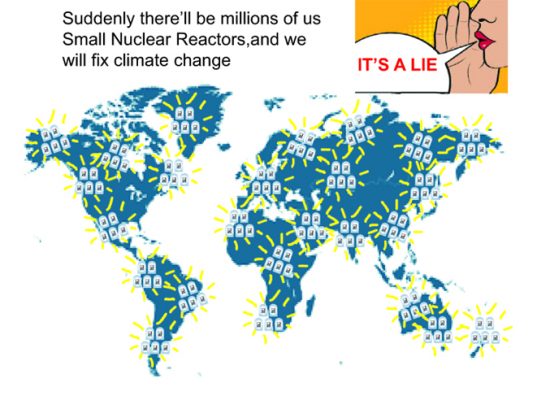
Japan and the United States agreed Monday to strengthen bilateral
cooperation on developing next-generation nuclear reactors during
ministerial talks on energy.
Japanese industry minister Yasutoshi Nishimura
and U.S. Energy Secretary Jennifer Granholm also agreed during their
meeting that Tokyo and Washington will work more closely on securing
liquefied natural gas and other energy security matters.
According to a
joint statement, Japan and the United States will step up cooperation in
developing and constructing next-generation advanced reactors, including
small modular reactors, “within each country and third countries.” The two
governments already revealed a plan in October to work together on helping
Ghana introduce small nuclear reactor technology.
Kyodo News 10th Jan 2023
The US and Japan have agreed to strengthen cooperation on developing and
constructing next-generation advanced reactors, including small modular
reactors, “within each country and third countries”. Japan’s industry
minister Yasutoshi Nishimura and US energy secretary Jennifer Granholm met
in Washington to discuss the situation surrounding global energy security,
strengthening clean energy cooperation, and the importance of clean energy
transitions, including renewable energies and nuclear energy.
Nucnet 11th Jan 2023
Georgia’s Vogtle nuclear plant startup delayed due to vibrating pipe
Vogtle is the only nuclear plant under construction in the United States. Its costs and delays could deter other utilities from building such plants
Midland Daily News, JEFF AMY, Associated Press, Jan. 11, 2023
ATLANTA (AP) — Startup of a nuclear power plant in Georgia will be delayed since its operator found a vibrating pipe in the cooling system during testing.
Georgia Power Co., the lead owner of Plant Vogtle near Waynesboro, announced the delay Wednesday. The company said that the third reactor at the plant is scheduled to begin generating electricity for the grid in April. The unit of Atlanta-based Southern Co. had previously given a startup deadline of March.
The problem was found during startup testing in a pipe that is part of the reactor’s automatic depressurization system, said Georgia Power spokesperson Jacob Hawkins. He said the pipe needs to be braced with additional support. “
Southern Nuclear Operating Co., which will operate the reactor on behalf of Georgia Power and other owners, must get approval for a license modification from the U.S. Nuclear Regulatory Commission, the company said in an investor filing. “It’s not a safety issue,” he said.
The plant includes two operating nuclear reactors and the first two nuclear reactors being built from scratch in the United States in decades. The fourth reactor is still under construction and is supposed to start generating electricity sometime in 2024.
The delay will cost Georgia Power and other co-owners at least $30 million.
A third and a fourth reactor were approved for construction at Vogtle by the Georgia Public Service Commission in 2012, and the third reactor was supposed to start generating power in 2016. The cost of the third and fourth reactors has climbed from an original cost of $14 billion to more than $30 billion…………
Georgia Power customers are already paying part of the financing cost and state regulators have approved a monthly rate increase as soon as the third reactor begins generating power. But the Georgia Public Service Commission will decide later who pays for the remainder of the costs.
Vogtle is the only nuclear plant under construction in the United States. Its costs and delays could deter other utilities from building such plants….https://www.ourmidland.com/news/article/Georgia-nuclear-plant-startup-delayed-due-to-17711807.php
Adam Tooze: Why Nuclear Fusion Is Not the Holy Grail
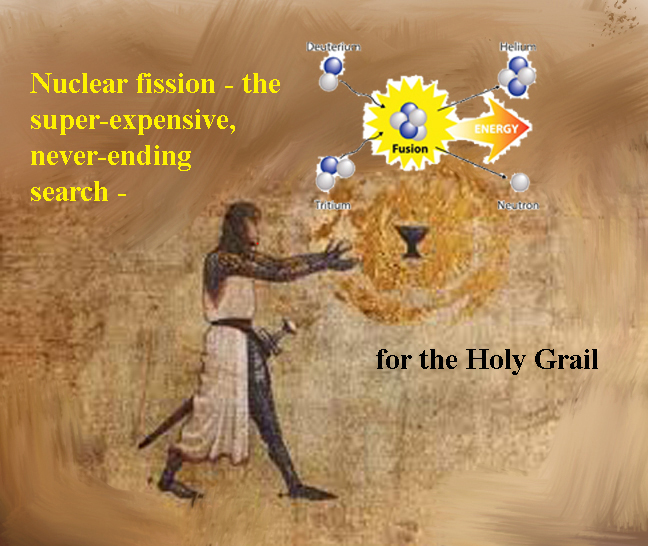
Of course, the amount of energy necessary to generate the laser beam is multiples larger—in the case of this laser beam, somewhere between 150 times larger than the amount that actually reaches the fuel materials. So this is still a powerfully net negative reaction that we have going on here; it uses more energy than it produces
It’s directly related to the military industrial complex, and so the synergies are there. It’s also very expensive; it requires a lot of capital investment, so the engineering companies like getting in on this.
A recent breakthrough is good news, but renewables are still the better bet.
FP.com By Cameron Abadi, a deputy editor at Foreign Policy. 9 Jan 23
Last month in California, a nuclear reactor produced 3.15 megajoules of energy using only 2.05 megajoules of energy input. That surplus has been treated as a major breakthrough in the future of energy because it was produced through the process of nuclear fusion. Experts have talked for decades about nuclear fusion’s potential as a carbon neutral source of energy without any of nuclear energy’s toxic waste.
What were the economics behind this breakthrough technology? Might it provide a status boost to old-fashioned engineering relative to computer engineering? And what’s the path from laboratory success to industrial use? Those are a few of the questions that came up in my recent conversation with FP economics columnist Adam Tooze on the podcast we co-host, Ones and Tooze. What follows is an excerpt, edited for length and clarity.
For the full conversation, look for Ones and Tooze wherever you get your podcasts.
………………… Adam Tooze: It’s a project that goes back originally to some really far-out thinking in the 1950s about uses that could be made of atomic bombs for the purposes of power generation. And the original idea was literally to organize a continuous stream of atomic explosions underground—you know, find some suitably stable caves, and explode several atomic bombs a day to keep a huge mass of water boiling to generate lots of steam. Anyway, that’s where it started.
But out of all of this, from the late 1960s onward, came more serious programs in fusion energy, which essentially focused on lasers. And that’s what this National Ignition Facility is—it is the ultimate fire lighter, right? Basically it’s a gigantic torch or something—the sort of effect that you generate as a Boy Scout or a Cub Scout or whatever, when you start a fire by concentrating the heat of the sun using a magnifying glass. So that’s essentially what we’re doing. And the stunning success of the current round of experiments announced by the U.S. Department of Energy to the public a few weeks ago now is that now for the first time ever, the amount of energy generated by the fusion reaction is larger than the amount of energy fired at it by the laser.
Of course, the amount of energy necessary to generate the laser beam is multiples larger—in the case of this laser beam, somewhere between 150 times larger than the amount that actually reaches the fuel materials. So this is still a powerfully net negative reaction that we have going on here; it uses more energy than it produces……….
CA: How long are we still from having fusion as a workable source of energy? What is the path generally from basic research to industrial use?
AT: I think the only honest answer to this in general is that we do not know the answer to this. You know, there was somebody talking to the New York Times and it really took me aback because this expert assumed that the answer was half a century away. …. it could easily be many decades.
……….. AT: I think, fundamentally- it’s gee whiz, final frontier, extraordinary stuff. And the physics involved are mind-blowing; the engineering is crazy and so much more exciting than just a solar panel sitting beat up in a field somewhere or on a roof or a windmill slowly turning.
It’s directly related to the military industrial complex, and so the synergies are there. It’s also very expensive; it requires a lot of capital investment, so the engineering companies like getting in on this. You know, as much as this National Ignition Facility is a public project, the $3.5 billion were mainly not spent on scientists. It was mainly spent on extremely complex raw materials and labor necessary to build the facilities, and much of that goes to the private sector. So there was a huge private sector stake in these kinds of projects.
But having said all of that, our experience both at the level of economics and at the level of politics with this particular set of technologies—those to do with nuclear power, fission, and fusion—over the last 50 years has been sobering. And on the whole, they appear at this point to be both massively unpopular technologies and, in some cases, hugely politicized technologies as well as incredibly expensive in terms of capital costs—not in terms of operating them but in terms of capital cost to build them.
…………… it’s pretty difficult to see what the case is for investing in new capacity when the costs are as explosively uneconomic.
So that is why I find it difficult to make the case for either conventional atomic power or fusion power as an immediately practical or relevant answer to the issues facing Western countries in the chase for a solution to the problem of the energy transition and decarbonization. And we are lucky, extraordinarily lucky, that renewable technologies have come on as quickly as they have. We should double down on this. We should invest even more.
CA: Can this kind of breakthrough serve to raise the status of materials engineering relative to computer engineering or even financial engineering? Is the old-fashioned kind of engineering in need of that kind of status boost in our society?
AT ………..I actually looked at the data for the National Science Foundation, and it turns out that among Ph.D.s of all types, it’s the humanities and the social sciences that we need to worry about because the share of doctorates in engineering—and this is distinct from computer science—is in fact on the rise and has been very dramatically over the last 20 years…. https://foreignpolicy.com/2023/01/08/adam-tooze-why-nuclear-fusion-is-not-the-holy-grail/
The problem with nuclear energy advocates

There is something curiously bewitching about nuclear power that makes its backers disciples rather than advocates. They become nuclear champions first rather than energy champions (which is what everyone should be), and are either unaware of or intentionally ignoring the fact that most of the time, they are putting their efforts into a solution that is looking for a problem.
ROUGH TRADE, By Ben Kritz, January 10, 2023
I WAS asked over the weekend if I planned to respond to a recent letter to the editor (“SMR issues addressed,” published on January 5), which said it was a reaction to my December 29 column about small modular reactor (SMR) technology and the problems that have been encountered in trying to make it commercially practical.
No, I responded, I had not planned to react to the letter because I could not see much in it to actually react to; while polite and thoughtful, it essentially boiled down to the same long-on-enthusiasm and short-on-specifics kind of pitch for SMR technology I see every day.
Maybe that’s exactly the point you need to address, my annoying yet helpful self-appointed consultant suggested.
I realized she’s right; there’s a bigger problem with nuclear energy and its advocates than just the technical and economic details that make it difficult to develop and use. There is something curiously bewitching about nuclear power that makes its backers disciples rather than advocates. They become nuclear champions first rather than energy champions (which is what everyone should be), and are either unaware of or intentionally ignoring the fact that most of the time, they are putting their efforts into a solution that is looking for a problem.
For the record, my December 29 column dealt with two more exotic forms of SMR technology, the traveling wave reactor (TWR) and the Natrium reactor; the basic difference between the two being that the latter uses uranium fuel that is enriched to a concentration that is four or five times what is used in a conventional reactor, and the former is designed to use unenriched or depleted uranium fuel. For a variety of reasons, both of those technologies are at least eight to 10 years from even being functional, and whether or not they can be made economical at all is still an open question.
The discussion about the less extreme and more common form of SMR technology was in the column prior to that, on December 27, and detailed obstacles with the development of commercial-ready SMRs that have been identified through actually trying to build an SMR plant, on the one hand, and a couple of reliable studies by nuclear experts (Stanford University and the Argonne National Laboratory) on the other.
The first obstacle is cost. A plant being constructed in rural Idaho by SMR developer NuScale — which is designed to eventually consist of six 77-megawatt units — has run into massive cost overruns, despite the assumption that SMRs are relatively inexpensive due to being smaller and simpler than conventional nuclear plants. NuScale is hoping to have the first of the six units online by 2029, but the per-megawatt-hour cost of the plant has hit $58, the threshold set by the consortium of six utilities in the western US which are financing the project to decide whether or not to continue.
The reason for this is that at that cost, there are already a variety of conventional and renewable energy generation sources available, so there is nothing to be gained by building the SMR complex, no matter how cutting-edge its technology may be.
The second obstacle is waste management. Again, because SMRs are smaller and less complex than conventional nuclear power plants, it is assumed that they would produce less radioactive waste, both of the more dangerous high-level variety in the form of spent fuel and the low-level variety in the form of wastewater and contaminated discarded equipment and other materials.
This, however, is not the case, according to the Stanford and Argonne studies, both published last year. Both studies found the same result, that SMRs produce about as much waste as conventional light-water reactors, but differed in their subjective interpretation. The Stanford researchers concluded that this contraindicated the use of SMRs since they do not offer any improvement in waste management, while Argonne’s lead scientist suggested that the result was more positive, as it demonstrated using SMRs wouldn’t be any worse than conventional nuclear power.
Contrary to our recent reader-correspondent’s assertions, neither of those issues — the only two I focused on concerning SMRs, because they are not hypothetical, but demonstrated by real-world experience or analysis — are “addressed” at all by what he presented, which is “a unique approach to SMRs” being developed by an unnamed enterprise only identified as being Seattle-based. The design, according to him, uses “widely available, cheap low-enriched uranium” (as I have pointed out more than once, except for reactors running on exotic fuel like the Natrium, fuel is actually the least of the cost issues for a nuclear plant); do not need to be refueled (are they then considered disposable?); and “are safe enough that their ‘plug-and-play’ generators can be placed anywhere with little infrastructure investment and without any special security.”
As for the application of this mysterious miracle technology in the Philippines, the company in question is “confident that they can satisfy all the requirements of the Philippine government regulators, the power companies and the public. They could even achieve the objective of having the current president preside over the ribbon-cutting ceremony before he leaves office.”
First of all, if the developer of this game-changing technology has created something that is ready enough that they are actively seeking a foothold in the Philippine market, one would think that they would be willing, even eager, to be clearly identified. I suspect I know who it is, and if I’m right, I’m going to be very disappointed because then this sly press release in the form of a letter to the editor (and yes, that’s exactly what it is; I get three or four press releases a day from different companies or trade publications that sound exactly like this) doesn’t even begin to answer questions that have already been raised about this specific company’s technology.
Second, even if this is just a standard-design SMR, we already know that a commercial version in its own country of origin will not be operational by the time President Marcos steps down, let alone be available to the Philippines. Local requirements might indeed be satisfied, but before that can even happen, the hoops that both US and Philippine stakeholders will have to jump through in order to secure export authorization from the US government — with the resulting agreement also needing approval from the Philippine Senate, the sort of thing it never acts quickly on — will take a couple of years at a minimum.
The Philippines could use nuclear energy, and it’s rational not to completely discount the future possibility of its doing so, provided a very long list of conditions are satisfactorily met. But it is in no position to serve as a test site for novel ideas that have been clearly demonstrated to be years from being a viable, let alone a practical, best option. Trying to mislead the public into believing that a magical solution is available for the asking — proselytizing for nuclear energy, rather than seeking actual attainable solutions for the country’s rather more immediate energy problems — is going to achieve very little, except to disappoint people and ensure this won’t be a market for whatever you’re selling.
Holtec seeks $7.4 billion government loan for expansion tied to new reactor
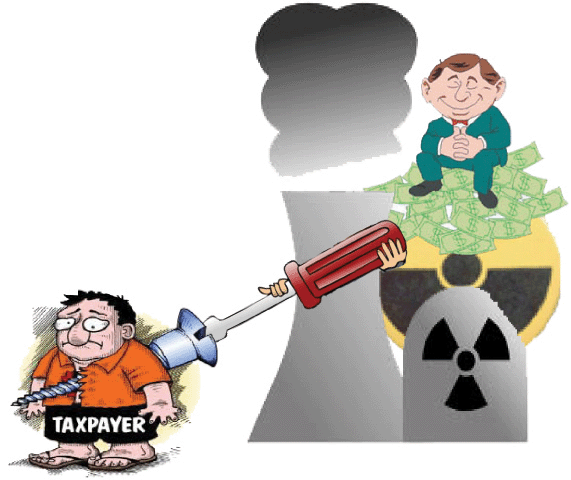
“an outrageous pickpocketing of hardworking American taxpayers to benefit a filthy rich private company.”
Jim Walsh, Cherry Hill Courier-Post, 9 Jan 23
CAMDEN – Holtec International Inc. has applied for a $7.4 billion federal loan to fund expansion expected from future sales of a company-designed nuclear reactor.
Holtec would tap the loan to boost capacity to make parts at its existing U.S. facilities, and to build and commission “at least four” SMR-160 advanced light water reactors.
It also expects to build “one or more additional manufacturing plants,” the company said.
Holtec added it’s “actively evaluating” potential sites “for the new ultra-modern manufacturing plant(s).”
The firm has three nuclear manufacturing facilities in the United States, including one at its Camden corporate campus that was designed for the eventual production of SMR-160s. It also has a fabrication plant in India.
Holtec claims its small modular reactor produces carbon-free energy more safely than a conventional nuclear power plant.
The firm has invested more than $400 million in the reactor’s development since 2010. It was approved in 2020 for $116 million in federal aid “to support the SMR-160’s commercialization readiness.”
Holtec is seeking the loan from the U.S. Department of Energy’s Loan Programs Office, which received an infusion of about $111 billion from last year’s Inflation Reduction Act.
“We anticipate that (the application process) will be ongoing for a while as DOE usually (has requests) for information or clarifying questions for an applicant,” said Holtec spokesman Patrick O’Brien………………….
Holtec also said it expects the U.S. Nuclear Regulatory Commission “early this year” will license its planned nuclear-waste storage facility in New Mexico.
The complex, in the works for seven years, could hold “the vast quantity of spent nuclear fuel presently stored at more than 70 nuclear sites in 35 states,” the company said.
But an environmental coalition plans to challenge any NRC approval in federal court, said Kevin Kamps of Beyond Nuclear, a nonprofit that’s sharply critical of Holtec’s plan.
Kamps said Holtec’s waste-storage project also faces court challenges from the states of New Mexico and Texas, as well as from businesses with mining and ranching interests near the proposed storage site.
He also described potential federal aid to Holtec as “an outrageous pickpocketing of hardworking American taxpayers to benefit a filthy rich private company.”
According to Holtec, the operation of a consolidated waste-storage site would spur nuclear power in the United States, “leading to the rise of small modular reactors.”
It also expressed the belief that modular reactors made in America would find “a large global export market.”
Holtec previously has predicted it could place 32 SMR-160s in the United Kingdom by 2050………….. https://www.courierpostonline.com/story/news/local/south-jersey/2023/01/09/holtec-federal-loan-production-advanced-nuclear-reactor-oyster-creek/69779027007/
Delay to small nuclear reactors as ministers battle over costs

Sunday January 08 2023, 12.01am GMT, The Sunday Times Harry Yorke
A funding deal for the first fleet of mini nuclear reactors is not expected to materialise for at least another 12 months, amid a row in government over the cost of Britain’s wider nuclear ambitions.
Last year, in order to triple domestic nuclear capacity to 24 gigawatts by 2050 — a quarter of the UK’s projected electricity demand — Boris Johnson set out plans for eight new large reactors alongside the development of small modular reactors (SMRs).
The government also announced the formation of Great British Nuclear (GBN), a body responsible for helping to deliver the next generation of reactors and SMRs by identifying potential sites, developers and investors.

At present only one plant, Hinkley Point C, is under construction, with the financing and final investment decisions on Sizewell C still pending. However, even though all but one of the UK’s existing plants are set to be shut down by the end of the decade, the government’s nuclear strategy now appears at risk of stalling amid internal disagreements.
In particular, Whitehall sources have revealed that there remains significant uncertainty over the scale of state investment in SMRs. Rolls-Royce, which has created designs for a 470 megawatt SMR and wants to
begin building factories, has called for ministers to enter funding talks and start placing orders. Rolls is understood to be seeking a commitment for four initial SMRs at a cost of about £2 billion each, which it
believes would unlock orders from interested foreign buyers.
But a senior government source said the Treasury would not sign off on any orders or significant funding until the technology had approval from the Office for Nuclear Regulation, which is not expected until 2024.
While the government has already invested £210 million in Rolls’s technology, the Department for Business, Energy and Industrial Strategy (BEIS) is also still assessing whether its competitors, including GE Hitachi, may offer “more viable” alternatives.
Insiders have signalled that the government may opt to launch yet another competition to gather further evidence before any firm deals are struck. More broadly, Treasury ministers harbour big concerns over the
costs associated with GBN, which officials have warned is billions over budget. While officials expect GBN to be announced early this year, after months of delays, the internal wrangling could lead to changes to both the body’s scope and funding.
Times 8th Jan 2023
SMRs – an oversold hype?
https://renewextraweekly.blogspot.com/2023/01/smrs-oversold-hype.html 8 Jan 23 Writing in the venerable US journal Bulletin of the Atomic Scientists, Markku Lehtonen takes at look at Small Modular Reactors (SMRs), warning that they may be being oversold. He says ‘Despite the boost from the Ukraine crisis, it is uncertain whether SMR advocates can muster the political will and societal acceptance needed to turn SMRs into a commercial success. The economic viability of the SMR promise will crucially depend on how much further down the road towards deglobalization, authoritarianism in its various guises, and further tweaking of the energy markets the Western societies are willing to go. Moreover, the reliance of the SMR business case on complex global supply chains as well as on massive deployment and geographical dispersion of nuclear facilities creates its own geopolitical vulnerabilities and security problems’.
A key issue for the selling of SMRs is ease of deployment . Well it may not be as easy as some hope, although the US Nuclear Regulatory Commission has recently moved to allow ‘advanced nuclear plants’ to be built in thickly populated areas. The NRC decision entitled ‘Population-Related Siting Considerations for Advanced Reactors,’ was passed subject to one vote against from Commissioner Jeffery Baran, who said ‘multiple, independent layers of protection against potential radiological exposure are necessary because we do not have perfect knowledge of new reactor technologies and their unique potential accident scenarios… Unlike light-water reactors, new advanced reactor designs do not have decades of operating experience; in many cases, the new designs have never been built or operated before.’
There may be other ways for NRC to smooth the path ahead . NIRS/WISE Nuclear Monitor 904, reports on the views of Dr Ed Lyman, from the US Union of Concerned Scientists, who says SMRs and Advanced Modular Reactors are likely to be expensive and he lists some other possible ways to ‘cut corners on safety & security to cut costs’, that the industry would like NRC to consider. Here are some of them:
• Allow nuclear power plants to have a ‘small containment-or no physical containment at all’.
• No offsite emergency planning requirements.
• Fewer or even zero operators.
• Letting the plants have ‘fewer NRC inspections and weaker enforcement.’
• ‘Reduced equipment reliability reporting.’
• ‘Fewer back-up safety systems.’
• ‘Regulatory requirements should be few in number and vague.’
• ‘Zero’ armed security personnel to try to protect an advanced nuclear plant from terrorists.
We are almost talking about a ‘wild west’ free for all! Hopefully some sense will prevail. And a more balanced view of possibilities, risks and benefits will be taken, in the US, and also in the UK, where there are plans for developing 20-30 PWR-type SMRs as part of the UK plan to triple UK nuclear capacity by 2050.
Will it really happen? There certainly are a lot of very different ideas being mooted, beyond just mini-versions of Pressurised Water-cooled Reactors, including sodium cooled fast neutron reactors, molten flouride salt reactors, and high temperature helium cooled reactors. But as I explored in my recent book, looking back how these ideas emerged and were then abandoned in the early days of nuclear experimentation, I’m not convinced that any of the new nuclear, variants large or small, has much of a future. Renewables are arguably a far better bet. And I’m not alone in thinking that SMRs are not the way ahead.
Nuclear fusion may change our world but renewable energy sources will save it: experts
Harnessing nuclear fusion could take more than 40 years, while some solutions already exist
Rossland News, Jan. 8, 2023 By Rachel Morgan, Local Journalism Initiative Reporter, The Pointer
We are living through unprecedented times……………. we are also.. living through unprecedented technological times…….
But experts are already warning that `nuclear fusion’ technology, suddenly being heralded by many as the panacea, the great answer to our planetary climate problem, should not distract from the critical role renewable energy sources are already playing in our quest to cleanse Earth.
While some forms of renewable energy have been used as far back as 2,000 years ago when the Greeks built water mills to turn grains into flour, modern renewable energy technologies first began to take shape over the 19th and 20th centuries. It wasn’t until the turn of the 21st century that technologies like wind turbines and solar panels reached the point of viability as wide scale sources of energy. According to the International Energy Agency (IEA), renewable sources of energy are now, collectively, on track to surpass coal as the number one generator of electricity by 2025.
A month ago, everything changed. Suddenly, the entire conversation around alternative energy has been shifted, forever……………..
When news broke [of a “breakthrough ” in nuclear fusion] there was a sigh of relief across the globe. Immediately, articles began circulating about salvation for the planet as fusion would, inevitably, power a clean energy grid.
But as the novelty of the remarkable breakthrough begins to wear off, researchers and scientists are already wary of the potential negative consequences.
“I was not overly optimistic,” Jean-Thomas Bernard, a visiting professor in the Department of Economics and the Institute of the Environment at the University of Ottawa, says. His expertise deals with the economics of energy use and he addressed the potential of nuclear fusion. “It is a good idea to proceed with developing, doing research on that line. But we are very far from seeing commercial plants being built.”
His concern, like many others in the growing fields dedicated to finding solutions for the most pressing environmental issues, is the danger of being distracted by a silver bullet, especially one that might arrive too late.
It could take more than 40 years before nuclear fusion can be harnessed and scaled to create the amount of electricity needed to change the game. Meanwhile, alternatives that are already doing this, could be suddenly overlooked, in favour of a technology that won’t be ready before catastrophic climate change alters Earth, forever.
Currently, there is research and testing into two different methods to create the type of nuclear fusion the California experiment produced. Both rely on heavy forms of hydrogen which are compressed until they fuse together emitting energy that can create steam to turn a turbine. The process used at the NIF lab relied on laser beams directed at the elements, which needed about 99 percent more energy to actually operate them than what was ultimately produced (the ignition event only measures the energy gain from the laser output, not the electricity required to run the laser machines).
Another process being experimented with across the globe, including in British Columbia, uses magnetic force to create the pressure and heat needed for the elements to fuse. It is unclear which process will result in the biggest gains, using the least amount of initial energy input. It’s also unclear which of the two methods might be realistically scalable, to use for global electricity production. Scientists have also said it is hard to predict how long it will take to advance current technology around each method to the point when nuclear fusion can be widely generated to create energy for everyday human use.
Experts agree it could still be decades before we see fusion contributing to our electricity grid…………
One fear is the nuclear fusion breakthrough will siphon off investments and detract attention from current renewable alternatives, just as those technologies are becoming more and more viable.
Late last year the International Energy Agency released a report with an accompanying article, headlined: “Renewable power’s growth is being turbocharged as countries seek to strengthen energy security”.
…….. Global renewable power capacity is now expected to grow by 2,400 gigawatts (GW) over the 2022-2027 period, an amount equal to the entire power capacity of China today, according to Renewables 2022, the latest edition of the IEA’s annual report on the sector.” https://www.rosslandnews.com/opinion/opinion-nuclear-fusion-may-change-our-world-but-renewable-energy-sources-will-save-it-experts/
1 This Month



26 September – International Day for the Total Elimination of Nuclear Weapons


PLEASE OPPOSE HR 8255 AND S.3639 – bills would accelerate satellite deployment, with no environmental review or safeguards – https://ncstd5li.quorum.us/campaign/169331/
To see nuclear-related stories in greater depth and intensity – go to https://nuclearinformation.wordpress.com
-
Archives
- September 2026 (233)
- August 2026 (330)
- July 2026 (355)
- June 2026 (287)
- May 2026 (306)
- April 2026 (356)
- March 2026 (251)
- February 2026 (267)
- January 2026 (308)
- December 2025 (358)
- November 2025 (359)
- October 2025 (375)
-
Categories
- 1
- 1 NUCLEAR ISSUES
- business and costs
- climate change
- culture and arts
- ENERGY
- environment
- health
- history
- indigenous issues
- Legal
- marketing of nuclear
- media
- opposition to nuclear
- PERSONAL STORIES
- politics
- politics international
- Religion and ethics
- safety
- secrets,lies and civil liberties
- spinbuster
- technology
- Uranium
- wastes
- weapons and war
- Women
- 2 WORLD
- ACTION
- AFRICA
- Atrocities
- AUSTRALIA
- Christina's notes
- Christina's themes
- culture and arts
- Events
- Fuk 2022
- Fuk 2023
- Fukushima 2017
- Fukushima 2018
- fukushima 2019
- Fukushima 2020
- Fukushima 2021
- general
- global warming
- Humour (God we need it)
- Nuclear
- RARE EARTHS
- Reference
- resources – print
- Resources -audiovicual
- Weekly Newsletter
- World
- World Nuclear
- YouTube
-
RSS
Entries RSS
Comments RSS
 nuclear-news