Canada to be the guinea pig for America’s probably unviable small nuclear reactor.

“There’s lots of enthusiasm among nuclear reactor designers, developers and national laboratories, and academic nuclear engineering departments” about SMRs, said Edwin Lyman, director of nuclear power safety at the Union of Concerned Scientists, who published a report on SMR reactor designs in early 2021. “
There’s a lot of supply but there’s not much demand, because utilities don’t want to be guinea pigs.”
cost escalation is practically inevitable.
Canada’s first new nuclear reactor in decades is an American design. Will it prompt a rethink of government support? The Globe and Mail, MATTHEW MCCLEARN, 26 Dec 21, Ontario Power Generation’s selection of GE Hitachi Nuclear Energy to help build a small modular reactor (SMR) at its Darlington station in Clarington, Ont., set in motion events that could shape Canada’s nuclear industry for decades to come.
OPG’s choice, announced in December, is the BWRX-300. It’s a light water reactor, the variety most popular in developed countries, and quite unlike Canada’s existing fleet of CANDU heavy water reactors. Though not exactly small – the BWRX’s 300-megawatt nameplate capacity is roughly equivalent to a large wind farm – it would produce only one-third as much electricity as traditional reactors. It would use different fuel, produce different wastes and possibly have different safety implications.
The Darlington SMR would be the first BWRX-300 ever constructed. By moving first, OPG hopes Ontario will become embedded in a global supply chain for these reactors.
“OPG ourselves, we don’t really get anything out of it – it’s a lot of work,” said Robin Manley, OPG’s vice-president of nuclear development. “Our goal is to have as many contracts signed with Canadian suppliers as we possibly can.” But that might not satisfy some critics, who’ve protested OPG’s selection of a U.S. design by GE Hitachi, which is based in North Carolina.
Ontario Power Generation chose GE Hitachi Nuclear Energy to build a light water reactor .
It does seem to confirm the end of Canada’s tradition of homegrown reactors. The BWRX-300 would be Canada’s first new reactor since Darlington Unit 4 in Ontario, completed in 1993. According to Mycle Schneider Consulting, the average age of the country’s 19 operational reactors is 38 years. Attempts to update the CANDU design proved largely fruitless; OPG and Bruce Power opted to refurbish reactors at Darlington and Bruce stations to operate another few decades, while sizing up SMRs as a possible next act.
Time is running short. This decade is widely regarded as crucial for building emissions-free generation capacity. SMRs will be late to that party even if this BWRX-300 is built on time. Delays and cost overruns, ever-present risks with any reactor, could kill its prospects.
The partnership with OPG represents a major coup for GE Hitachi, a U.S.-Japanese alliance that set up its SMR subsidiary in Canada less than a year ago. There are at least 50 SMR designs worldwide, but most exist only on paper; vendors compete vigorously to sell to experienced nuclear operators such as OPG because they represent an opportunity to build a bona fide reactor that might entice other clients. For the same reason, OPG’s decision is a blow to the losing candidates, Oakville, Ont.-based Terrestrial Energy Inc. and X-energy, an American vendor
“There’s lots of enthusiasm among nuclear reactor designers, developers and national laboratories, and academic nuclear engineering departments” about SMRs, said Edwin Lyman, director of nuclear power safety at the Union of Concerned Scientists, who published a report on SMR reactor designs in early 2021. “There’s a lot of supply but there’s not much demand, because utilities don’t want to be guinea pigs.”
Nuclear industry executives and government officials hope the Darlington SMR will be the first of many deployed in Ontario and beyond. SaskPower is also shopping; it has collaborated with OPG since 2017, and said the BWRX-300 is among its candidates. Canada has a small population, so observers doubt the country could support supply chains for multiple reactor designs.
But OPG’s selection of an American SMR has drawn some sharp criticism. Some observers assumed Terrestrial enjoyed a home turf advantage, particularly in light of the federal government’s decision to invest $20-million toward its Integral Molten Salt Reactor (IMSR). The Society of Professional Engineers and Associates, a union representing engineers and others working on CANDU reactors, complained that “priority should have been given to Canadian design.”
“It is a slap in the face for Terrestrial,” said M.V. Ramana, professor at the University of British Columbia’s Liu Institute for Global Issues. “It is not a good sign for Canada’s nuclear industry.”
Prof. Ramana added that OPG’s decision may prompt a rethinking of government support to SMR developers. In addition to Terrestrial’s funding, Moltex Energy received $50.5-million from the federal Strategic Innovation Fund and the Atlantic Canada Opportunities Agency to advance the Stable Salt Reactor-Wasteburner it is working on in New Brunswick. ARC Clean Energy received $20-million from New Brunswick’s government toward its ARC-100 reactor.
“If these companies are not able to persuade OPG, then maybe we should stop funding them,” he said…………………..
Unlike CANDUs, which consume unenriched uranium, light water reactors require fuel enriched to increase Uranium-235 content. Mr. Lyman said that by adopting any non-CANDU design, Canada will become dependent on enriched fuel imported from the U.S., Europe or elsewhere.
The industry would also need to learn how to dispose of unfamiliar wastes. The Nuclear Waste Management Organization (NWMO), which is in the final stages of selecting an underground storage site for Canada’s radioactive spent fuel, said spent BWRX-300 fuel would generate more heat and radioactivity than CANDU fuel, but could be stored in fewer containers, placed further apart.
“We will learn from our international partners who already have plans to permanently store this type of waste in a deep geological repository,” the NWMO said in a statement.
All this assumes OPG’s reactor gets built. To begin with, the BWRX-300 actually isn’t licensed to be built anywhere. GE Hitachi is participating in the Canadian Nuclear Safety Commission’s Vendor Design Review, through which it receives early feedback from the regulator on its reactor. ………
critics say completing the reactor by 2028 is a tall order. According to Mycle Schneider Consulting, one in eight reactors that have begun construction since 1951 were never connected to the grid. Many survivors, meanwhile, arrived years later than promised.
Mr. Manley said 2028 is “an aspirational goal” rather than a hard deadline. The project schedule will firm up over the next two years.
OPG has yet to publish a cost estimate, but according to a report published by PwC, the SMR project “is expected to spend $2-billion over seven years.” That’s already higher than the US$1-billion price tag GE Hitachi promised for a BWRX-300 in 2019. (In public presentations, GE executives declared that keeping the price below US$1-billion was crucial to its plans to exponentially grow its customer base.)……
Prof. Ramana said cost escalation is practically inevitable……….https://www.theglobeandmail.com/business/article-canadas-first-new-nuclear-reactor-in-decades-is-an-american-design/
A second great nuclear ice breaker for Russia to keep the Northern Sea Route open
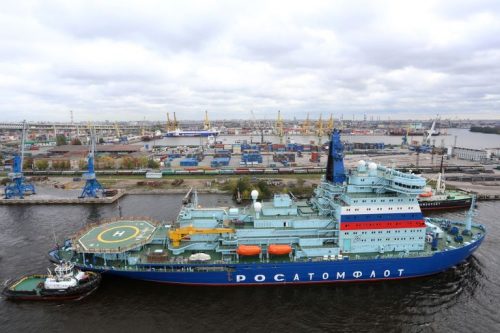
Second giant nuclear icebreaker handed over to Rosatomflot, The “Sibir”
will add to the rapidly growing fleet of powerful icebreakers tasked to
keep the Northern Sea Route open for year-round shipping. The acceptance
certificate was signed at a ceremony onboard the icebreaker at the Baltic
Shipyard in St. Petersburg on December 24, Rosatomflot informs.
Barents Observer 25th Dec 2021
ROLLS ROYCE FALLS 3% ON QATARI INVESTMENT IN SMALL NUCLEAR BUSINESS
- Rolls Royce Holding PLC (LON: RR) has fallen 3% on news of the Qatari investment into the small nuclear reactor business
- It may well not be the investment itself that is the catalyst for the price change but Omicron
- The £85 million Qatar investment isn’t really a material number for Rolls Royce, even as it’s a vote of confidence in the programme.
Rolls Royce shares have continued their recent decline even as the news comes through of a Qatari investment in the small nuclear reactor programme. This could be seen as a surprise – investment in such a programme is likely to be a good deal for Rolls Royce after all. On the other hand, £85 million, the size of the investment, isn’t a large number compared to Rolls Royce – it’s not, as they say, a material number.
The likelihood is therefore that it is wider events driving the Rolls Royce share price, Omicron continues to rage around the world, air travel becomes increasingly restricted and so on. It’s worth pointing out that the RR incomes do not depend, particularly, on actually selling engines to people. There are fees involved in that, most certainly, but there’s an element of selling razors in how the business work. Once you’ve sold someone a razor then you’ve a capitve market for razor blades. Once you’ve got an engine in an aircraft then there’s a decades-long maintenance and repair income flow. That Rolls Royce income stream though depends upon hours in the air – exactly the thing being depressed by Omicron.
Rolls Royce shares have continued their recent decline even as the news comes through of a Qatari investment in the small nuclear reactor programme. This could be seen as a surprise – investment in such a programme is likely to be a good deal for Rolls Royce after all. On the other hand, £85 million, the size of the investment, isn’t a large number compared to Rolls Royce – it’s not, as they say, a material number.
The likelihood is therefore that it is wider events driving the Rolls Royce share price, Omicron continues to rage around the world, air travel becomes increasingly restricted and so on. It’s worth pointing out that the RR incomes do not depend, particularly, on actually selling engines to people. There are fees involved in that, most certainly, but there’s an element of selling razors in how the business work. Once you’ve sold someone a razor then you’ve a capitve market for razor blades. Once you’ve got an engine in an aircraft then there’s a decades-long maintenance and repair income flow. That Rolls Royce income stream though depends upon hours in the air – exactly the thing being depressed by Omicron. https://www.asktraders.com/analysis/rolls-royce-falls-3-on-qatari-investment-in-small-nuclear-business/
NASA seems to be struggling with the fact that ionising radiation is a greater risk to women, than to men

The committee also recommended NASA provide all its astronauts with individual radiation risk assessment (based on age and sex), communicate a comprehensive picture of an astronaut’s own cancer risk, and continue to discuss changes in radiation risk during routine health briefings.
New NASA radiation exposure limit would bring equality to female, male astronauts, Healio.com, Ryan Lawrence 20 Dec 21,
“Experts in oncology help advise NASA on space radiation health standard for astronauts”A committee of experts from science, medicine and academia, among other fields, has recommended NASA proceed with a proposal for a universal, career-long radiation dose limit for all astronauts
The Committee on Assessment of Strategies for Managing Cancer Risks Associated with Radiation Exposure During Crewed Space Missions, convened at the request of NASA, concluded that the career-long dose limit should apply to both men and women, a change from previous standards, and recommended improved communication methods for advising astronauts on cancer risks.
“The old radiation standards were very restrictive for women astronauts,” Amy Berrington de González, DPhil, senior investigator and chief of the radiation epidemiology branch at the NCI and a member of the committee, told Healio | HemOnc Today. “There has been a lot of progress in understanding of radiation risk in the last few decades, so bringing that in to see whether you could make the flying time more equitable for women astronauts, I think was really important.”
Berrington de González said the universal dose was established “for the most protective case” and applied to all astronauts.
As it currently stands, men and women have different allowable doses of radiation in space travel with NASA, which were based on reported relative susceptibilities to different radiation-induced cancers. The report recommends NASA move forward with its proposed single standard dose limit for all astronauts.
“I think NASA got worried because they saw some data from the Japanese atomic bomb survivors, who we use as our primary group for determining [radiation] risk, and it looked like there was an increased risk for lung cancer among women,” committee member Gayle E. Woloschak, PhD, associate dean for graduate student and postdoctoral affairs and professor of radiation oncology and radiology at Feinberg School of Medicine at Northwestern University, told Healio | HemOnc Today. “
“Then the question was, ‘Should we have a different risk level for women than for men, considering Mars missions might limit a woman from going into space at all?’ And, you can imagine, there are ethical issues with that, too. Basically, we said there should be the same risks across the board for everybody.”
Before these proposals, the current standard set career exposure to radiation to not exceed 3% risk for exposure-induced death (REID) for cancer mortality at a 95 percent confidence level, to limit the cumulative effective dose received throughout an astronaut’s career.
NASA called for an independent review of the validity of the 3% REID, which has been the standard since 1989, because it is for low-Earth orbit missions exclusively. An update was necessary as NASA plans for longer-duration missions farther in the solar system.
“The radiation in deep space is different,” committee member Carol Scott-Conner, MD, PhD, MBA, emeritus professor of surgery in surgical oncology and endocrine surgery at Carver College of Medicine at University of Iowa, told Healio | HemOnc Today. “Once you get beyond the Earth’s magnetosphere, you get highly energetic particles from the sun. And these are things like the nuclei of iron. You can think of them as like cannon balls going through cells, as opposed to protons, electrons or gamma rays that we think of here on Earth. … If you go to Mars, and let’s say it takes you about 6 months, you’re exposed that whole time to this radiation.”
The committee also recommended NASA provide all its astronauts with individual radiation risk assessment (based on age and sex), communicate a comprehensive picture of an astronaut’s own cancer risk, and continue to discuss changes in radiation risk during routine health briefings.
.
Bill Gates’ sodium-cooled ‘Natrium’ nuclear reactor design – strikingly like the disastrous reactors at Santa Susana Field Lab.
Most striking of all is the success of official campaigns asserting that even the most serious accidents have caused little or no harm

Spent Fuel, Harpers, by Andrew Cockburn, 20 Dec 21, The risky resurgence of nuclear power ” …………………………. Gates and other backers extoll the promise of TerraPower’s Natrium reactors, which are cooled not by water, as commercial U.S. nuclear reactors are, but by liquid sodium. This material has a high boiling point, some 1,600 degrees Fahrenheit, which in theory enables the reactor to run at extreme temperatures without the extraordinary pressures that, in turn, require huge, expensive structures……………….

Prosperous and 70 percent white, West Hills, California, is one of the communities that have sprouted near the Santa Susana Field Laboratory in the decades since the 1959 meltdown. Unlike the poor, sick, and embittered residents of Shell Bluff, people living in West Hills had until recently only the barest inkling that nuclear power in the neighborhood might have had unwelcome consequences. “Almost no one knew about the Santa Susanna Field Lab, or they thought it was an urban legend,” Melissa Bumstead, who grew up in nearby Thousand Oaks, told me recently. In 2014, Bumstead’s four-year-old daughter, Grace, was diagnosed with an aggressive form of leukemia. “This has no environmental link,” her pediatric oncologist told her firmly. Childhood cancers were rare, and this was just cruel luck.
Then, while taking Grace to Children’s Hospital Los Angeles, Bumstead ran into a woman who recognized her from the local park where their young daughters played. The woman’s child had neuroblastoma, another rare cancer, as did another from nearby Simi Valley, whom they encountered while the children were getting chemo. Back at home, someone on her street noticed the childhood cancer awareness sticker on Bumstead’s car and mentioned that another neighbor had died of cancer as a teenager.
Bumstead began to draw a map detailing the cluster of cancer deaths in small children just in the previous six years, but stopped working on it in 2017. “I had such severe PTSD when I added children onto it, my therapist told me to stop.” But it is still happening, she said, mentioning the unusual number of bald children she had noticed in local elementary schools in recent years, as well as the far-above-average rate of breast cancer cases recorded in the area. A cleanup of the field lab was due to be completed in 2017, but it has yet to begin.

I called Bumstead because I had been struck by the fact thatTerraPower’s Natrium reactor resembles in its basic features the long-ago Sodium Reactor Experiment at Santa Susana. (Natrium is Latin for sodium.) “That’s exactly what we had!” Bumstead exclaimed when I mentioned that liquid sodium is integral to TerraPower’s project. “The meltdown was in the sodium reactor.” As her comment made clear, such liquid sodium technology is by no means innovative.
Nor, in an extensive history of experiments, has it ever proved popular—not least because liquid sodium explodes when it comes into contact with water, and burns when exposed to air. In addition, it is highly corrosive to metal, which is one reason the technology was rapidly abandoned by the U.S. Navy after a tryout in the Seawolf submarine in 1957.
That system “was leaking before it even left the dock on its first voyage,” recalls Foster Blair, a longtime senior engineer with the Navy’s reactor program. The Navy eventually encased the reactor in steel and dropped it into the sea 130 miles off the coast of Maryland, with the assurance that the container would not corrode while the contents were still radioactive. The main novelty of the Natrium reactor is a tank that stores molten salt, which can drive steam generators to produce extra power when demand surges. “Interesting idea,” Blair commented. “But from an engineering standpoint one that has some real potential problems, namely the corrosion of the high-temperature salt in just about any metal container over any period of time.”
TerraPower’s Jeff Navin assured me in response that Natrium “is designed to be a safe, cost-effective commercial reactor.” He added that Natrium’s use of uranium-based metal fuel would increase the reactor’s safety and performance. Blair told me that such a system had been tried and abandoned in the Fifties because the solid fuel swelled and grew after fissioning.
As the sodium saga indicates, the true history of nuclear energy is largely unknown to all but specialists, which is ironic given that it keeps repeating itself. The story of Santa Susana follows the same path as more famous disasters, most strikingly in the studious indifference of those in charge to signs of impending catastrophe.The operators at Santa Susana shrugged off evidence of problems with the cooling system for weeks prior to the meltdown, and even restarted the reactor after initial trouble. Soviet nuclear authorities covered up at least one accident at Chernobyl before the disaster and ignored warnings that the reactor was dangerously unsafe. The Fukushima plant’s designers didn’t account for the known risk of massive tsunamis, a vulnerability augmented by inadequate safety precautions that were overlooked by regulators. Automatic safety features at Santa Susana did not work. This was also the case at Fukushima, where vital backup generators were destroyed by the tidal wave.
No one knows exactly how much radiation was released by Santa Susana—it exceeded the scale of the monitors. Nor was there any precise accounting of the radioactivity released at Chernobyl. Fukushima emitted far less, yet the prime minister of Japan prepared plans to evacuate fifty million people, which would have meant, as he later recounted, the end of Japan as a functioning state. Another common thread is the attempt by overseers, both corporate and governmental, to conceal information from the public for as long as possible. Santa Susana holds the prize in this regard: its coverup was sustained for twenty years, until students at UCLA found the truth in Atomic Energy Commission documents.
Most striking of all is the success of official campaigns asserting that even the most serious accidents have caused little or no harm……………………
“The right not to know” about the effects of nuclear power is currently embraced far beyond Fukushima. In the face of escalating alarm about climate change, the siren song of “clean and affordable and reliable” power finds an audience eager to overlook a business model that is dependent on state support and often greased with corruption; failed experiments now hailed as “innovative”; a pattern of artful disinformation; and a trail of poison from accidents and leaks (not to mention the 95,000 tons of radioactive waste currently stored at reactor sites with nowhere to go) that will affect generations yet unborn. Arguments by proponents of renewables that wind, solar, and geothermal power can fill the gap on their own have found little traction with policymakers. Ignoring history, we may be condemned to repeat it. Bill Gates has bet a billion dollars on that. https://harpers.org/archive/2022/01/spent-fuel-the-risky-resurgence-of-nuclear-power/
USA has 85,000 metric tons of spent fuel from nuclear power plants, 90 million gallons of weapons wastes – robots to the rescue.
There’s over 85,000 metric tons of spent nuclear fuel from commercial
nuclear power plants, and 90 million gallons of waste from government
weapons programs in the U.S. today, according to the Government
Accountability Office.
That number is rapidly growing. Every year, we add
2,000 metric tons of spent nuclear fuel. Disposing and handling nuclear
waste is a dangerous task that requires precision and accuracy. Researchers
from the National Centre for Nuclear Robotics led by the Extreme Robotics
Lab at the University of Birmingham in the UK are finding ways to help
humans and robots work together to get the job done.
The researchers have
developed a system using a standard industrial robot that uses a parallel
jaw gripper to handle objects and an Ensenso N35 3D cameras to see the
world around it. The team’s system involves allowing humans to make more
complex decisions that AI isn’t equipped to do, while the robot
determines how to best perform the tasks. The team uses three kinds of
shared control.
The Robot Report 18th Dec 2021
Nuclear Free Local Authorities call for ”no watering down” of safety regulations regarding future nuclear fusion reactors
The Nuclear Free Local Authorities Network has called for ‘no watering
down’ of the safety regulations that will be applied to future fusion
reactors in its response to a public consultation by the Department of
Business, Energy, and Industrial Strategy.
In his letter to the BEIS, Councillor David Blackburn, Chair of the NFLA Steering Committee, outlines
the many challenges and risks that would be posed by operating nuclear
fusion, including the risk posed by the large quantities of radioactive
wastes that would result and the danger of radioactive tritium entering the
water supply.
Most frightening is the requirement to constantly and safely
contain the immense temperatures needed to spark and sustain a fusion
reaction and the long-term damage that the whole structure will suffer from
prolonged exposure to neutron radiation, a situation which if not carefully
monitored could result in the very integrity of the reactor vessel being
placed in jeopardy.
NFLA 15th Dec 2021
Small nuclear reactors for military use would be too dangerous – excellent targets for the enemy

In normal operation, they release potentially hazardous quantities of fission products that would be widely distributed by any penetration of the reactor vessel. More worryingly, the resiliency of tri-structural isotropic particles to kinetic impact is questionable: The silicon carbide coating around the fuel material is brittle and may fracture if impacted by munitions.
Further, graphite moderator material, which is used extensively in most mobile power plant cores, is vulnerable to oxidation when exposed to air or water at high temperatures, creating the possibility of a catastrophic graphite fire distributing radioactive ash. Even in the case of intact (non-leaking) fuel fragments being distributed by a strike, the radiological consequences for readiness and effectiveness are dire.
Given these vulnerabilities, sophisticated adversaries seeking to hinder U.S. forces are likely to realize the utility of the reactor as an area-denial target…….. , a reactor strike offers months of exclusion at the cost of only a few well-placed high-explosive warheads, a capability well within reach of even regional adversaries
Even an unsuccessful or minimally damaging attack on a reactor could offer an adversary significant benefits…………..placing these reactors in combat zones introduces nuclear reactors as valid military targets,
MOBILE NUCLEAR POWER REACTORS WON’T SOLVE THE ARMY’S ENERGY PROBLEMS, War on the Rocks, 14 Dec 21, JAKE HECLA ”………… As China and Russia develop microreactors for propulsion, the U.S. Army is pursuing the ultimate in self-sufficient energy solutions: the capability to field mobile nuclear power plants. In this vision of a nuclearized future, the Army will replace diesel generator banks with microreactors the size of shipping containers for electricity production by the mid-2020s.
……. the question is whether or not reactors can truly be made suitable for military use. Are they an energy panacea, or will they prove to be high-value targets capable of crippling entire bases with a single strike?
nuclear power program is confidently sprinting into uncharted territory in pursuit of a solution to its growing energy needs and has promised to put power on the grid within three years. However, the Army has not fielded a reactor since the 1960s and has made claims of safety and accident tolerance that contradict a half-century of nuclear industry experience.
The Army appears set to credulously accept industry claims of complete safety that are founded in wishful thinking and characterized by willful circumvention of basic design safety principles………..
Buyer beware: NuScale tries a new way to get funding for its small nuclear reactor plan
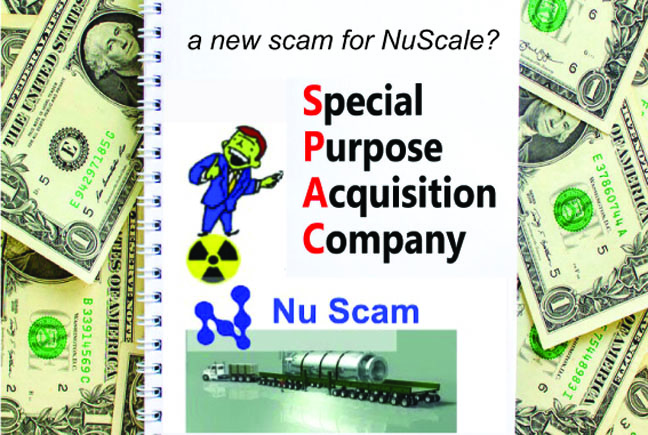
An Oregon company is going public to raise money for nuclear power ambitions, OPD, 15 Dec 21,
……………NuScale, headquartered in the Portland suburb of Tigard, will go public by merging with what’s known as a special purpose acquisition company, or SPAC. The company, Spring Valley Acquisition Corporation, is already publicly traded. Such mergers have recently gained popularity on Wall Street by allowing private companies the option to go public without the costs or risks associated with the more conventional initial public offering, or IPO.
Other Oregon businesses like the vacation rental company Vacasa and battery manufacturer ESS Tech have also gone public by merging with so-called “blank check” companies. In each of those cases, some investors pulled out when news of the mergers dropped, leaving each company with less money than they’d initially hoped……………
Dr Jim Green dissects the hype surrounding Small ”Modular” Nuclear Reactors

Nuclear power’s economic failure, Ecologist, Dr Jim Green, 13th December 2021 Small modular reactors
Small modular reactors (SMRs) are heavily promoted but construction projects are few and far between and have exhibited disastrous cost overruns and multi-year delays.
It should be noted that none of the projects discussed below meet the ‘modular’ definition of serial factory production of reactor components, which could potentially drive down costs.
Using that definition, no SMRs have ever been built and no country, company or utility is building the infrastructure for SMR construction.
In 2004, when the CAREM SMR in Argentina was in the planning stage, Argentina’s Bariloche Atomic Center estimated a cost of US$1 billion / GW for an integrated 300 MW plant (while acknowledging that to achieve such a cost would be a “very difficult task”).

Now, the cost estimate for the CAREM reactor is a mind-boggling US$23.4 billion / GW (US$750 million / 32 MW). That’s a truckload of money for a reactor with the capacity of two large wind turbines. The project is seven years behind schedule and costs will likely increase further.
Russia’s floating plant
Russia’s floating nuclear power plant (with two 35 MW reactors) is said to be the only operating SMR anywhere in the world (although it doesn’t fit the ‘modular’ definition of serial factory production).
The construction cost increased six-fold from 6 billion rubles to 37 billion rubles (US$502 million).
According to the OECD’s Nuclear Energy Agency, electricity produced by the Russian floating plant costs an estimated US$200 / MWh, with the high cost due to large staffing requirements, high fuel costs, and resources required to maintain the barge and coastal infrastructure.

The cost of electricity produced by the Russian plant exceeds costs from large reactors (US$131-204) even though SMRs are being promoted as the solution to the exorbitant costs of large nuclear plants.
Climate solution?
SMRs are being promoted as important potential contributors to climate change abatement but the primary purpose of the Russian plant is to power fossil fuel mining operations in the Arctic.
A 2016 report said that the estimated construction cost of China’s demonstration 210 MW high-temperature gas-cooled reactor (HTGR) is about US$5 billion / GW, about twice the initial cost estimates, and that cost increases have arisen from higher material and component costs, increases in labour costs, and project delays.
The World Nuclear Association states that the cost is US$6 billion / GW.
Those figures are 2-3 times higher than the US$2 billion / GW estimate in a 2009 paper by Tsinghua University researchers.
China reportedly plans to upscale the HTGR design to 655 MW but the Institute of Nuclear and New Energy Technology at Tsinghua University expects the cost of a 655 MW HTGR will be 15-20 percent higher than the cost of a conventional 600 MW pressurised water reactor.
HTGR plans dropped
NucNet reported in 2020 that China’s State Nuclear Power Technology Corp dropped plans to manufacture 20 HTGR units after levelised cost of electricity estimates rose to levels higher than a conventional pressurised water reactor such as China’s indigenous Hualong One.
Likewise, the World Nuclear Association states that plans for 18 additional HTGRs at the same site as the demonstration plant have been “dropped”.
In addition to the CAREM reactor in Argentina and the HTGR in China, the World Nuclear Association lists just two other SMR construction projects.
In July 2021, China National Nuclear Corporation (CNNC) New Energy Corporation began construction of the 125 MW pressurised water reactor ACP100.
According to CNNC, construction costs per kilowatt will be twice the cost of large reactors, and the levelised cost of electricity will be 50 percent higher than large reactors.
Fast reactor
In June 2021, construction of the 300 MW demonstration lead-cooled BREST fast reactor began in Russia.
In 2012, the estimated cost for the reactor and associated facilities was 42 billion rubles; now, the estimate is 100 billion rubles (US$1.36 billion).
Much more could be said about the proliferation of SMRs in the ‘planning’ stage, and the accompanying hype.
For example a recent review asserts that more than 30 demonstrations of different ‘advanced’ reactor designs are in progress across the globe.

In fact, few have progressed beyond the planning stage, and few will. Private-sector funding has been scant and taxpayer funding has generally been well short of that required for SMR construction projects to proceed.
Subsidies

Large taxpayer subsidies might get some projects, such as the NuScale project in the US or the Rolls-Royce mid-sized reactor project in the UK, to the construction stage.

Or they may join the growing list of abandoned SMR projects:
* The French government abandoned the planned 100-200 MW ASTRID demonstration fast reactor in 2019.
* Babcock & Wilcox abandoned its Generation mPower SMR project in the US despite receiving government funding of US$111 million.
* Transatomic Power gave up on its molten salt reactor R&D in 2018.
* MidAmerican Energy gave up on its plans for SMRs in Iowa in 2013 after failing to secure legislation that would require rate-payers to partially fund construction costs.
* TerraPower abandoned its plan for a prototype fast neutron reactor in China due to restrictions placed on nuclear trade with China by the Trump administration.
* The UK government abandoned consideration of ‘integral fast reactors’ for plutonium disposition in 2019 and the US government did the same in 2015.
Hype
So we have a history of failed small reactor projects.
And a handful of recent construction projects, most subject to major cost overruns and multi-year delays.
And the possibility of a small number of SMR construction projects over the next decade.
Clearly the hype surrounding SMRs lacks justification.
Moreover, there are disturbing, multifaceted connections between SMR projects and nuclear weapons proliferation, and between SMRs and fossil fuel mining.
Hype cycle
Dr Mark Cooper connects the current SMR hype to the hype surrounding the ‘nuclear renaissance’ in the late 2000s:
“The vendors and academic institutions that were among the most avid enthusiasts in propagating the early, extremely optimistic cost estimates of the “nuclear renaissance” are the same entities now producing extremely optimistic cost estimates for the next nuclear technology. We are now in the midst of the SMR hype cycle.
* Vendors produce low-cost estimates.
* Advocates offer theoretical explanations as to why the new nuclear technology will be cost competitive.
* Government authorities then bless the estimates by funding studies from friendly academics.” ………………. https://theecologist.org/2021/dec/13/nuclear-powers-economic-failure
Nuclear power’s economic failure – a ”renaissance in reverse”

China is said to be the industry’s shining light but nuclear growth is modest ‒ an average of 2.1 reactor construction starts per year over the past decade.
Moreover, nuclear growth in China is negligible compared to renewables ‒ 2 gigawatts (GW) of nuclear power capacity were added in 2020 compared to 135 GW of renewables.
Nuclear power’s economic failure, Ecologist, Dr Jim Green, 13th December 2021
A new report from Friends of the Earth Australia details the catastrophic cost overruns with nuclear power projects.
Despite the abundance of evidence that nuclear power is economically uncompetitive compared to renewables, the nuclear industry and some of its supporters continue to claim otherwise.
Those claims are typically based on implausible cost projections for non-existent reactor concepts. Moreover, the nuclear lobby’s claims about the cost of renewables are just as ridiculous.
Claims about ‘cheap’ nuclear power certainly don’t consider the real-world nuclear construction projects detailed in a new report by Friends of the Earth Australia.
Every power reactor construction project in Western Europe and the US over the past decade has been a disaster.
The V.C. Summer project in South Carolina (two AP1000 reactors) was abandoned after the expenditure of at least US$9 billion leading Westinghouse to file for bankruptcy in 2017.
Criminal investigations
Criminal investigations and prosecutions related to the V.C. Summer project are ongoing ‒ and bailout programs to prolong operation of ageing reactors in the US are also mired in corruption.
The only remaining reactor construction project in the US is the Vogtle project in Georgia (two AP1000 reactors). The current cost estimate of US$27-30+ billion is twice the estimate when construction began (US$14-15.5 billion).
Costs continue to increase and the Vogtle project only survives because of multi-billion-dollar taxpayer bailouts. The project is six years behind schedule…..
In 2006, Westinghouse said it could build an AP1000 reactor for as little as US$1.4 billion, 10 times lower than the current estimate for Vogtle.
The Watts Bar 2 reactor in Tennessee began operation in 2016, 43 years after construction began. When construction resumed in 2008 after a long hiatus, the cost estimate to complete the reactor was US$2.5 billion but the final completion cost was US$4.7 billion.
US nuclear renaissance in reverse
The previous reactor start-up in the US was Watts Bar 1, completed 20 years earlier (1996) after a 23-year construction period. Thus Watts Bar 1 and 2 are the only power reactor start-ups in the US over the past quarter-century.
In 2021, TVA abandoned the unfinished Bellefonte nuclear plant in Alabama, 47 years after construction began and following the expenditure of an estimated US$5.8 billion.
There have been no other power reactor construction projects in the US over the past 25 years other than those listed above.
Numerous other reactor projects were abandoned before construction began, some following the expenditure of hundreds of millions of dollars. Twelve reactors have been permanently shut down over the past decade with many more closures in the pipeline.
Western Europe
The only current reactor construction project in France is one EPR reactor under construction at Flamanville. The current cost estimate of €19.1 billion is 5.8 times greater than the original estimate.
The Flamanville reactor is 10 years behind schedule.
The only current reactor construction project in the UK comprises two EPR reactors under construction at Hinkley Point. In the late 2000s, the estimated construction cost for one EPR reactor in the UK was £2 billion.
The current cost estimate for two EPR reactors at Hinkley Point is £22-23 billion, over five times greater than the initial estimate.
In 2007, EDF boasted that Britons would be using electricity from an EPR reactor at Hinkley Point to cook their Christmas turkeys in 2017, but construction didn’t even begin until 2018.
Is China a shining light for nuclear power?
One EPR reactor (Olkiluoto-3) is under construction in Finland. The current cost estimate of about €11 billion is 3.7 times greater than the original estimate. Olkiluoto-3 is 13 years behind schedule.
Nuclear power is growing in a few countries, but only barely. China is said to be the industry’s shining light but nuclear growth is modest ‒ an average of 2.1 reactor construction starts per year over the past decade.
Moreover, nuclear growth in China is negligible compared to renewables ‒ 2 gigawatts (GW) of nuclear power capacity were added in 2020 compared to 135 GW of renewables.
There were only three power reactor construction starts in Russia in the decade from 2011 to 2020, and only four in India.
Nuclear vs renewables costs
Continue readingTaxpayer funding might not be enough to save USA’s failing new nuclear, specifically the ”Versatile Test Reactor”

Advanced Nuclear Energy Projects Stumble Despite White House Support, Forbes, 12 Dec 21, During the COP26 climate conference, U.S. Energy Secretary Jennifer Granholm said that the United States is “all-in” on nuclear energy ………The White House supports an expansion for all next-generation nuclear reactors………..
All this is in the context of the U.S. House and Senate actions, where lawmakers “zeroed-out” [reduce something to zero; eliminate or remove entirely] funding for the so-called Versatile Test Reactor (VTR) at the Idaho National Laboratories.
…. For now, Russia is the only country with a test reactor similar to VTR…… Russia’s state-owned nuclear energy industry gives it a guaranteed source of funding. In contrast, the United States’ private model requires investors to buy-in — not to mention the elected policymakers in a democratic system. ……. The Natrium facility, which Microsoft’s Bill Gates founded, is an electricity-generating reactor that is getting Energy Department support: $80 million, a small part of the overall cost. The goal is to have it up and running by 2030.
VTR will not produce power for consumers. It is a test facility that can, for example, predict the long-term wear-and-tear on reactors through modeling.
But some experts say that VTR is too costly and that advanced nuclear reactors are unproven. The Union of Concerned Scientists says that the jury is still out as to whether those units can reduce costs, limit nuclear waste, burn uranium more efficiently, and strengthen safety.
“Despite the hype surrounding them, none of the non-light-water reactors on the drawing board that we reviewed meet all of those requirements, says Dr. Edwin Lyman, a physicist and the director of nuclear power safety, in a report. “High-temperature, gas-cooled reactors may have the potential to be safer, but that remains unproven, and problems have come up during recent fuel safety tests.” ……
UK government will ”prove the potential”of advanced nuclear reactors with its Advanced Modular Reactor Research, Development and Demonstration Programme.
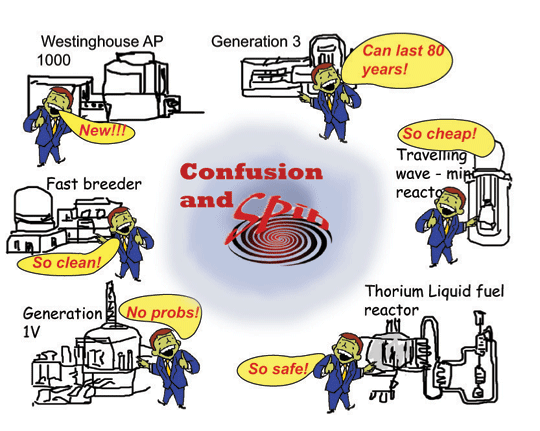
nuClear NewsNo 136 Dec 21, Advanced Reactors , Energy minister Greg Hands told the Nuclear2021 conference organised by the Nuclear Industry Association that the UK will build a high-temperature gas reactor (HTGR) as the centrepiece of its Advanced Modular Reactor Research, Development & Demonstration Programme.
The goal of the research programme is to “prove the potential” of advanced reactors and have a demonstration unit in operation “by the early 2030s, at the latest”. The key focus would be to produce high temperature heat which could be used for hydrogen production, to supply industrial processes and potentially district heating as well as electricity generation.
Several other reactor concepts could have been selected. The emerging category of ‘advanced’ reactors includes the lead-cooled fast reactor, molten salt reactor, supercritical water-cooled reactor, sodium-cooled fast reactor and very-high-temperature gas reactor in addition to hightemperature gas reactors.
Paul Howarth, CEO of the National Nuclear Laboratory (NNL), called it “a further signal of the resurgence of nuclear.” He added, “With the opportunity HTGRs bring to deliver high temperature heat, hydrogen and synthetic fuels, the potential of this technology to help decarbonise our industries and energy grid is significant.” He noted that NNL is “actively working on the fuel, graphite and high temperature materials required for HTGRs.”
The Advanced Modular Reactor Research, Development & Demonstration Programme counts on £170 million of government funding from a £385 million package intended to accelerate development of highly flexible nuclear technologies. (1)
In July the Government sought views on its preference to explore the potential of High Temperature Gas Reactors (HTGRs) for the Advanced Modular Reactor Research Development & Demonstration (AMR RD&D) Programme. It says the call found no significant, additional evidence to materially change the outcome of the Government’s underpinning analysis. As a result, the Programme will focus on High Temperature Gas Reactors with the ambition for this to lead to a HTGR demonstration by the early 2030s at the latest. In parallel, government continues to support the development of all AMRs as part of wider policy on advanced nuclear activities. This includes: opening the Generic Design Assessment (GDA) process to advanced nuclear technologies and developing a siting approach for further nuclear developments. (2) https://www.no2nuclearpower.org.uk/wp/wp-content/uploads/2021/12/nuClearNewsNo136.pdf
Inside information from China could sink the French nuclear flagship EPR.
 | |||

Image – by Eva Stegen
Maxron says –
''we are building nuclear power plants 6 new epr klima blablabla''
Inside information from China could sink the French nuclear flagship EPR https://www.ausgestrahlt.de/blog/2021/12/09/insider-infos-aus-china-k%C3%B6nnen-franz%C3%B6sisches-atomflaggschiff-epr-versenken/ 09.12.2021 | Eva Stegen In 1989, in response to Chernobyl, development of a third generation reactor began. The European pressurized water reactor EPR has not yet generated a kilowatt hour in Europe. Despite multiple disasters, no one pulled the rip cord. Now a whistleblower reveals a system error that should be the end of the EPR.
Some people either have nerves of wire, no self-esteem or the deep certainty that any nonsense they utter will be whipped into all media via the international press agencies, just as if one did not have to check a completely absurd announcement at least once. But it is so, the French emperor is naked. He just yelled out to the press that he wanted to have six more reactor construction sites for the fiasco flagship EPR (European pressurized water reactor) when a whistleblower tore the last scrap of material off his body. It was a French nuclear engineer who had an in-depth look at the EPR reactors in Taishan, China. They are the only two – out of 200 announced – that ever went online.
There it was just ………
However, one of the two is offline again after just 2.5 years of operation. With an unknown outcome. Evidence is growing that a design flaw affecting the entire EPR series has led to Taishan 1 being switched off. The whistleblower gave the radiation research institute ‘CRIIRAD’ important detailed technical information from Taishan. CRIIRAD, in turn, put a series of questions to the French nuclear regulator, ‘Autorité de Sûreté Nucléaire’, ASN.
The silence of those who knew it
A copy was sent to the news agency ‘AFP’, but miraculously the horror news did not spread as rapidly as Macron’s ludicrous announcement to sink further billions in further ‘EPR’ flop construction sites. With every additional day on which neither the operator nor the nuclear regulatory authority deny ‘ASN’, this hypothesis of the design flaw, which affects all ‘EPR’, becomes more important.
In June 2021, a CNN report from Taishan, China caused a stir. There was talk of an “imminent radiological threat” in a letter from the French consortium partner “Framatome” to the US Department of Energy, which “CNN” has received. The Chinese security authorities were accused of having raised the radiation limit values for the outside area around the nuclear power plant in order to circumvent the shutdown of the defective reactor block.
Where do the radioactive gases come from?
As early as October 2020, defects were found on the cladding tubes of some fuel elements, which led to the escape of radioactive gases in the reactor pressure vessel. Despite the radiological risks for workers and residents, the nuclear power plant continued to operate. First of all, according to Bruno Chareyron from ‘CRIIRAD’. This duct damage is quite normal, something like that happens. In fact, however, the degree of damage to the cladding tubes and the gas leaks in the reactor have steadily worsened since it was loaded with fuel in autumn 2020.
The operators have asked the authorities to increase the limit value, above which the reactor must be shut down. The authorities would have doubled the value , but as the contamination continued to rise, the new warning threshold was exceeded at the end of May 2021. This continued until the shutdown on July 30, 2021. In August, the fuel rods began unloading. Nobody knows when or whether the reactor can ever start again.
Thanks to the whistleblower’s insider knowledge, ‘CRIIRAD’ is now able to track down the causes of the defective ducts, which the investigative satirical magazine ‘le Canard enchaîné’ described as “knots in the pipelines”. The cameras that the Chinese had brought into the heart of the EPR, in the reactor pressure vessel, were supposed to check the thesis that the zirconium cladding tubes that protect the uranium fuel rods are unusually corroded.
The operators have asked the authorities to increase the limit value, above which the reactor must be shut down. The authorities would have doubled the value , but as the contamination continued to rise, the new warning threshold was exceeded at the end of May 2021. This continued until the shutdown on July 30, 2021. In August, the fuel rods began unloading. Nobody knows when or whether the reactor can ever start again.
Thanks to the whistleblower’s insider knowledge, ‘CRIIRAD’ is now able to track down the causes of the defective ducts, which the investigative satirical magazine ‘le Canard enchaîné’ described as “knots in the pipelines”. The cameras that the Chinese had brought into the heart of the EPR, in the reactor pressure vessel, were supposed to check the thesis that the zirconium cladding tubes that protect the uranium fuel rods are unusually corroded.
In addition to the risk of pipe rupture in the primary circuit, there is also the risk that the grids, which are intended to hold the fuel elements in position in the reactor pressure vessel, are damaged by the vibrations. If this structure is weakened , Chareyron explained , it is conceivable that in the event of an earthquake the clusters of fuel and control rods would swing against the inner walls of the container. A deformation induced in this way could mean that the control rods, which are actually supposed to brake the nuclear chain reaction, cannot retract.
Bad Vibrations from Olkiluoto and the scandal forge Le Creusot
As early as 2018, the Finnish electricity supplier ‘TVO’ and the Finnish safety authority ‘STUK’ reported that during tests on the Olkiluoto EPR permanent construction site, vibrations had occurred in the primary circuit on the reactor pressure vessel .
But as early as 2007/08 hydraulic model tests at the scandal-shrouded nuclear component manufacturer in Le Creusot brought the vibration problem to light. That is why ‘CRIIRAD’ asks the nuclear supervisory authority about the failed attempt to reduce the flow of water with the help of a baffle that was attached under the reactor core in order to influence the hydraulics and thus the vibrations. The vibration problem is obviously inherent in the system and affects not only the Taishan blocks but also Olkiluoto, Flamanville and Hinkley Point C. In short, all Generation 3 reactors that were once touted as “inherently safe”.
Corecatcher not catchy
In addition to carbon-brittle forging errors, messed up welds and inferior concrete, there are also vibrations of the artfully knotted pipeline design. The once-praised core catcher, which was supposed to catch a melted reactor core, apparently also gives the engineers a headache. If a large fragment of the container were to block the slide to the catcher, the corium would not flow into the catcher, according to the confidential account. But the naked Emperor Macron never tires of loudly proclaiming his atomic illusions. If the idea of the third generation of EPR reactors, which incidentally dates back to 1989, doesn’t work, you can tell the same nonsense again. Simply use the same “climate saver” texts again, just replace generation 3 and EPR with generation 4 and SMR. Apparently, the president is sure that the news agencies and the associated copy-paste editorial offices are already creating the appropriate mental cinema for EU citizens. Because he wants taxonomy money from them, for even more atomic illusions.
Nuclear Command and Control Satellites Should Be Off Limits – here’s why
|

Nuclear Command-and-Control Satellites Should Be Off Limits https://www.defenseone.com/ideas/2021/12/nuclear-command-and-control-satellites-should-be-limits/187472/ Blowing up some satellites causes problems. Blowing up these could cause nuclear war. By JAMES ACTON and THOMAS MACDONALD, DECEMBER 10, 2021
When Russia blew up an old satellite with a new missile on November 15, it created an expanding cloud of debris that will menace the outer space environment for years to come.
Hypersonic fragments from the collision with Moscow’s ground-launched, anti-satellite weapon risk destroying other satellites used for communications, meteorology, and agriculture. They even pose a danger to China’s Tiangong Space Station and the International Space Station, where personnel—including Russia’s own cosmonauts—were forced to don spacesuits and flee into their escape capsules ahead of approaching debris.
But the greatest danger that this careless stunt highlighted is to a different potential target: high-altitude satellites used for nuclear command and control. Those critical satellites face the threat of being attacked by co-orbital anti-satellite weapons, that is, other spacecraft with offensive capabilities. Destroying a nuclear command-and-control satellite, even unintentionally, could lead a conventional conflict to escalate into a nuclear war. As such, the United States, China, and Russia have a shared interest in ensuring the security of each other’s high-altitude satellites.
Satellites are integral to the United States’ nuclear command-and-control system. They would be the preferred means to transmit a presidential order to use nuclear weapons and would provide the first warning of an incoming nuclear attack. Russia uses satellites for similar purposes, even if it appears not to rely on them quite as much as the United States. While little is publicly known about China’s nuclear command-and-control system, the U.S. Department of Defense has assessed that China is in the process of developing a space-based early-warning system.
The most important nuclear command-and-control satellites—those for communications and early warning—are located in high-altitude orbits. Fortunately, most are strung out about 22,500 miles above the equator—far above the debris from Russia’s ground-launched anti-satellite weapon test. These satellites, however, are growing more vulnerable, particularly to co-orbital anti-satellite weapons.
Nuclear command-and-control satellites might be attacked deliberately, as the prelude to a nuclear war. In a conventional conflict, if China, Russia, or the United States decided to use nuclear weapons first—or believed that its opponent was about to do so—it might try to degrade the adversary’s nuclear command-and-control system preemptively. China, for example, might attack U.S. early-warning satellites to weaken the United States’ homeland missile defenses. Conversely, the United States might target Chinese communication satellites to interfere with Beijing’s ability to wield its nuclear forces.
In a conventional war, however, nuclear command-and-control satellites might be attacked and threatened for altogether different reasons—creating the risk that nuclear war might be triggered inadvertently. The United States, in particular, is deeply reliant on satellites to enable conventional operations. Moreover, most, if not all, nuclear command-and-control satellites also support nonnuclear missions—making them tempting targets even in a purely conventional conflict. For example, some U.S. satellites transmit orders to both U.S. conventional and nuclear forces. Russia might attack these satellites to try to undermine the United States’ ability to prosecute a conventional war, but with the added and unintended effect of degrading the U.S. nuclear command-and-control system.
Washington would be hard pressed to determine the intent behind such attacks. It could easily misinterpret them as preparations for a nuclear war and respond accordingly. It might threaten to use nuclear weapons unless its adversary backed off. In fact, the Trump administration’s nuclear policy explicitly threatened the use of nuclear weapons in precisely this circumstance. The Biden administration can and should remove this threat as part of its ongoing Nuclear Posture Review.
To make matters worse, it might not take actual attacks against nuclear command-and-control satellites to spark this kind of escalation. Satellites in high-altitude orbits are periodically moved to different positions to optimize their performance. Especially in a conventional conflict, a repositioning operation that led one spacecraft to approach a nuclear command-and-control satellite might appear to the latter’s owner as the beginning of an attack against its nuclearcommand-and-control system. Once again, the potential consequences could be catastrophic.
“Keep-out zones” around high-altitude satellites would be a straightforward way to mitigate these risks. Specifically, the United States, China, and Russia should agree not to maneuver their spacecraft within a certain distance—we propose 430 miles—of one another’s high-altitude satellites. (Exceptions could be made to accommodate occasional repositioning under tightly controlled conditions. Most importantly, the state conducting the maneuver should warn the others at least 24 hours in advance.)
In a conflict, if the belligerents had no intention of attacking each other’s high-altitude satellites, they would have strong reasons of self-interest to respect keep-out zones. If a state did seek to launch such attacks, keep-out zones couldn’t stop it from doing so—but they would buy time that the targeted state could use to try to evade the attack.
Negotiating keep-out zones during a conflict, when they would be most useful, would be next-to impossible. So, Washington, Beijing, and Moscow shouldn’t wait—they should start negotiating right away.
James M. Acton is co-director of the Nuclear Policy Program and holds the Jessica T. Mathews Chair at the Carnegie Endowment for International Peace. Thomas D. MacDonald is a fellow in the Nuclear Policy Program.
1 This Month
To see nuclear-related stories in greater depth and intensity – go to https://nuclearinformation.wordpress.com/

29 Jan. Thursday 7-8 p.m. Webinar – World’s Largest Nuclear Station in Port Hope, ON?


31st January – Challenging the War Machine – a DECLASSIFIED UK SUMMIT

Website of the Week
Now until to February 10, 2026 Radioactive waste storage in France: the debate is finally open! How to participate?
-
Archives
- January 2026 (271)
- December 2025 (358)
- November 2025 (359)
- October 2025 (376)
- September 2025 (258)
- August 2025 (319)
- July 2025 (230)
- June 2025 (348)
- May 2025 (261)
- April 2025 (305)
- March 2025 (319)
- February 2025 (234)
-
Categories
- 1
- 1 NUCLEAR ISSUES
- business and costs
- climate change
- culture and arts
- ENERGY
- environment
- health
- history
- indigenous issues
- Legal
- marketing of nuclear
- media
- opposition to nuclear
- PERSONAL STORIES
- politics
- politics international
- Religion and ethics
- safety
- secrets,lies and civil liberties
- spinbuster
- technology
- Uranium
- wastes
- weapons and war
- Women
- 2 WORLD
- ACTION
- AFRICA
- Atrocities
- AUSTRALIA
- Christina's notes
- Christina's themes
- culture and arts
- Events
- Fuk 2022
- Fuk 2023
- Fukushima 2017
- Fukushima 2018
- fukushima 2019
- Fukushima 2020
- Fukushima 2021
- general
- global warming
- Humour (God we need it)
- Nuclear
- RARE EARTHS
- Reference
- resources – print
- Resources -audiovicual
- Weekly Newsletter
- World
- World Nuclear
- YouTube
-
RSS
Entries RSS
Comments RSS
 nuclear-news