America’s Abandoned Nuclear Power Projects (includes Interactive Map)
THE BIG PICTURE: Abandoned Nuclear Power Projects (Interactive Map), Power, by Sonal Patel Increasing uncertainties concerning low forecasted load; construction financing constraints and reversals; state certification hurdles; and challenges to nuclear profitability posed by the growing share of coal plants beset the nuclear industry in the early 1970s. The nuclear suffered a renewed economic meltdown and fierce public pushback in the aftermath of the Three Mile Island accident in 1979. By 1983, these factors prompted the delay or cancellation of 100 nuclear units—nearly 45% of total commercial capacity previously ordered. An estimated $10 billion (in mid-1982 dollars) had been spent on the scrapped projects. Mounting public opposition from Chernobyl and new safety rules required after Fukushima also affected a number of later projects.
POWER in April 2020 published an infographic showing construction timeframes of completed nuclear reactors: THE BIG PICTURE (Infographic): U.S. Nuclear Lifetimes
A supplement to POWER‘s February 2018 THE BIG PICTURE print infographic, this interactive map offers a sampling of nuclear plant projects that have been abandoned. Double click on the map to activate the zoom function. Click on “Map Overview” to zoom out. Scroll down for an overview. Note: All dollar figures are from the corresponding year. Source: NRC
—Copy, artwork, and interactive feature by Sonal Patel, a POWER senior associate editor (@sonalcpatel, @POWERmagazine)
………………………… A Brief History of Abandoned U.S. Nuclear Projects
1974: Tyrone 2 (1.2 GW)—Wisconsin regulators denied certification of the project being built by Northern States Power (now Xcel Energy) owing to insufficient demand growth and public opposition. Abandonment cost the company $103 million. The Wisconsin Public Utility Commission ordered the company to study a substitute coal-fired plant.
1974: Vogtle 3 and 4 (each 1,113 MW)— While Georgia Power gave this project new life 2013 as AP1000s—and they remain the only two reactors under construction in the U.S.—the company canceled two reactors under construction at the Vogtle site in 1974, citing citizen opposition and regulatory changes, which contributed to rising costs and construction delays. Critics, however, pointed to management issues for the project’s failure.
1977: Surry 3 and 4 (each 882 MW)—Power demand fell dramatically from 1972, when Surry 3 and 4 were planned by Virginia Electric & Power Co. (VEPCO) northwest of Newport News, Virginia, through March 1977, when the units were canceled. VEPCO, which also cited construction delays caused by labor problems, intervention of environmentalists, and tighter NRC controls, said the company had invested $53 million in the projects and had contracts for another $93 million (1977 dollars).
1980: North Anna 4 (907 MW)—In the wake of Three Mile Island, VEPCO abandoned the project when it was only 4% complete. Abandonment of Unit 4 cost it $155 million (1980 dollars). The company had reportedly spent $485 million to build Unit 3 (abandoned two years later) and 4 at North Anna at the time. In 1982, when it scrapped Unit 3 because of a sharp increase in construction costs, VEPCO sought rate increases to cover an estimated $540 million write-off.
1980: Sterling (1.2 GW)—The New York Public Service Commission unequivocally allowed Rochester Gas & Electric Corp. full recovery of costs of the Sterling plant, which had just kicked off construction, estimated at about $129 million.
1980: Jamesport 1 and 2 (1.2 GW)—Long Island Lighting, which had also just entered construction, also recovered abandonment costs of about $120 million.
1980: Forked River 1 (1.1 GW)—Jersey Central Power & Light halted construction at this project in 1974 owing to financial cutbacks and protests, but it resumed construction only to abandon the project which was 5.6% complete owing to “financial difficulties” stemming from the Three Mile Island accidents, and also, uncertainty about whether the NRC would grant a license or put in place costly regulations.
1981: Callaway 2 (1.2 GW)—Construction had barely begun when Union Electric Co. halted the project, citing financial risks to investors posed by uncertainties afflicting the sector.
1981: Hope Creek 2 (1.1 GW)— Public Service Electric & Gas scrapped the unit when it was about 19% complete, but pressed on with Hope Creek 1. The $3.79 billion Hope Creek 1 was already plagued with soaring cost overruns, up from $600 million initially estimated for both units.
1981: Bailly 1 (645 MW)—The U.S. Supreme Court halted Northern Indiana Public Service’s $1.8 billion boiling water reactor (BWR) project owing to questions regarding pilings for the plant. Faced with longer delays for the project already seven years into construction, the company abandoned it.
1981: Shearon Harris 3 and 4 (900 MW each)—Costly safety upgrades and weakening power demand prompted Carolina Power & Light to abandon two of four planned Westinghouse 3 loop reactors under construction. The third 900-MW reactor, Shearon Harris 2, was abandoned in 1983.
1982: Washington Nuclear 4 and 5 (1.2 GW each)—Unit 4 was 25% complete and Unit 5 17% complete when Energy Northwest’s predecessor Washington Public Power Supply System halted construction at the two units after it failed to sell enough bonds to complete five reactors needed to meet projected power in the Pacific Northwest. Abandonment of the two units alone led to the company’s
defaulting on $2.2 billion in municipal bonds. Total costs for all five units planned at the site was estimated to exceed $24 billion.
1982: Phipps Bend 1 and 2 (1.2 GW each)—The Tennessee Valley Authority’s (TVA’s) board voted to stall construction of Unit 1, which was 29% complete, and Unit 2, 5% complete owing to slacker power demand as aluminum plants in the South closed down. Abandoning the project cost the TVA about $1.2 billion. The site in 2017 became home to a 1-MW solar farm.
1982: Hartsville B1 and B2 (1.2 GW each)—TVA also slowed work at Hartsville, B1 and B2, which were 17% and 7% complete, finally moving to scrap them. The decision cost $718 million.
1982: Cherokee 2 and 3 (1.3 GW)—Economic troubles also prompted Duke Power to abandon two of three reactors it was building in South Carolina. In 1983, Duke Power also scrapped the 1.3-GW Unit 1.
1984: Yellow Creek 1 and 2 (1.3 GW each)—About 30% of the two System 80 pressurized water reactors (PWRs) near Iuka, Mississippi, were complete when TVA moved to abandon them, citing lower power demand and dramatically higher construction costs. TVA estimated Yellow Creek would have cost $10 billion to build.
1984: Hartsville A1 and A2 (1.2 GW each)—On the same day it abandoned Yellow Creek, TVA also scrapped the two remaining Hartsville reactors near Nashville, Tennessee. Completing the Hartsville reactors would have cost $6.5 billion, it said.
1984: Zimmer 1 (810 MW)—When Cincinnati Gas & Electric Co. announced cancellation of the project to convert it to a coal plant, it was 97% complete and had so far cost $1.6 billion—up from a the $240 million originally estimated. The decision to scrap the project was rooted in estimates that completing the project would cost an additional $1.5 billion and two more years of construction to satisfy new requirements from the NRC. Just months before, the federal regulatory body repudiated its own probe into a pipe-weld problem at Zimmer, alleging “incompetence” after a whistleblower—29-year-old Thomas Applegate, a private investigator hired by the utility to check possible time-card padding at the plant—brought to light that the NRC’s regional office of inspection and enforcement had never inspected the defective welds in safety-related systems. While Applegate alleged a cover up by the NRC, the NRC rejected its own overall finding, deeming the investigation “unsatisfactory.” Ultimately, it halted construction on several parts of the plant after finding fault with project management and for safety violations. Fallout from the Zimmer project struck the nuclear industry widely—specifically for utilities looking to sell bonds to finance new nuclear—as no company had walked away from a costly nuclear project so close to completion.
1986: Midland 1 (818 MW) and 2 (492 MW)—After 17 years of sporadic construction, hearing and protests, and after project partner Dow Chemical pulled out of the project, Consumers Powers Co.’s board of directors voted to abandon the two reactors in Michigan—even though the project was 85% complete. At the time, the board cited changing safety rules, which it blamed for costly delays, and a refusal by some of Michigan’s major industrial consumers to agree to rate increases. Some critics also alleged project mismanagement. Consumers had spent $4 billion on the two reactors when it abandoned the project. In 1987, it began converting the plant to a natural gas–fired cogeneration facility, and in 2009, after years of high natural gas prices, the company sold its stake in the Midland Cogeneration Venture to New York–based Fortistar.
1988: Bellefonte 1 and 2 (1.2 GW each)—TVA’s board suspended the project when Unit 1 was 88% complete and Unit 2, 58% complete, after a combined $6 billion investment. TVA considered completing the project in 2010, but it ultimately sold the site in November 2016 to Nuclear Development LLC, a firm that has sought federal loan guarantees to complete the project.
1988: Seabrook 2 (1.2 GW)— Public Service Co. of New Hampshire canceled plans for the second of two reactors planned at Seabrook. Unit 2 was 25% complete and the utility had spent $800 million on the project. Unit 1 was completed in 1986.
1989: Shoreham (820 MW)—The Shoreham Long Island Lighting Co. (LILCO) fully completed this GE BWR in 1984, but considerable public opposition after Three Mile Island prompted Suffolk County officials in New York to determine that the county could not be safely evacuated in the event of a serious nuclear accident at the plant. Even though the company received federal permission for low power tests in 1985, the states declined a company-sponsored evacuation plan, effectively barring it from ever opening. In 1992, the Long Island Power Authority bough the plant from LILCO (for $1), and it was fully decommissioned in 1994. In 1965 when LILCO first announced plans for the plant, it said it could be completed by 1973 at a cost of $75 million; by the late 1970s, after LILCO decided to increase the size of Shoreham from 540 MW to 820 MW, costs soared to $2 billion; and by the 1990s, ratepayers were saddled with an enormous price tag of $6 billion for the project, which never produced commercial power.
1990: Grand Gulf 2 (1.3 GW)—Though planned in the 1970s when regional demand for power was rising sharply every year, in 1986, Middle South Utilities—Entergy’s predecessor— suspended construction of the project where work had begun in 1975 after state regulators denied the company’s request for rate increases to pay for the project. Citing a massive debt load and political imbroglio, and though the project was 66% complete and one unit at the plant had been placed in commercial operation in 1985, the company scrapped the project in 1990.
1995: Washington Nuclear 1 (1.3 GW) and Washington Nuclear 3 (1.2 GW)—Only one of five reactors planned by the Washington Public Power Supply System was completed (Columbia Generating Station, in 1984) but the remaining unfinished plants were mothballed against the possibility that construction would be resumed. In 1995, the projects were formally terminated. The company, renamed as Energy Northwest, asked the NRC to extend the construction permit for Unit 1 to 2001, but in 2005, it determined again that the construction permit was no longer needed.
2017: V.C. Summer 3 and 4 (each 1.1 GW)—SCANA Corp. and its partner Santee Cooper scrapped two AP1000 reactors that were 64% complete, claiming completion would cost $9.8 billion. The project, whose construction began in 2013, was dogged by costly delays stemming in part due to new safety rules implemented in the wake of the 2011 Fukushima disaster. In early 2017, delays at the project and two other AP1000s under construction in Georgia forced contractor Westinghouse to declare bankruptcy. The partners spent $9 billion on the project they estimated could cost up to $24 billion to complete. https://www.powermag.com/interactive-map-abandoned-nuclear-power-projects/#.Y2Sprx1KxHA.twitter
Rocket Lab: Helping the US wage endless wars from space

https://thedailyblog.co.nz/2022/10/25/rocket-lab-helping-the-us-wage-endless-wars-from-space/By John Minto, October 25, 2022
It’s clear local mana whenua were misled by Rocket Lab founder Peter Beck when iwi land at Mahia Peninsula was leased to launch satellites into space.
At the time Peter Beck was clear Rocket Lab would be used for civilian purposes only and would not take up military contracts, despite this being a particularly lucrative path to take.
Fast forward a few years and we find Beck has abandoned any principles he may have had and his company is now majority owned by the US military and is launching satellites for US military purposes.
The government has to sign off on each launch to make sure it is in line with what’s acceptable to this country but it’s clearly a rubber stamp process conducted by Stuart Nash.
Any assurances from Peter Beck or Economic and Regional Development Minister Stuart Nash, who signs off on the launches for the government, that Rocket Lab’s work is for the betterment of mankind are not credible.
Peter Beck sets up straw man arguments saying claims of Rocket Lab weaponizing space are “misinformation” and the company would “not deal in weapons”. “We’re certainly not going to launch weapons or anything that damages the environment or goes and hurts people,” he told Newshub last year.
What nonsense. These are “straw-man” arguments. No-one has claimed the rockets contain weapons but what is absolutely clear is that the US military launches rockets for military purposes and this is what is happening at Mahia.
The NZ Herald reported last year on the capabilities of “Gunsmoke-J satellites”, which have been launched from Mahia for the US military, saying:
The other is the “Gunsmoke-J” satellite being launched for the US Army’s Space and Missile Defence Command (SMDC).
Gunsmoke-J is a prototype for a possible series of nano-satellites that will collect targeting data “in direct support of Army combat operations” according to a US Army fact sheet and a US Department of Defence budget document.
Green MP and party spokesperson for security and intelligence, Teanau Tuiono, is right to speak out:
“Weaponising space is not in our national interest and goes against our international commitments to ensuring peace in space,”
“The government should put in place clear rules that stop our whenua being used to launch rockets on behalf of foreign militaries”
“We should not be a launching pad for satellites for America’s military and intelligence agencies,” Green Party security and intelligence spokesman Teanau Tuiono said.
Rocket Lab is donkey deep with US strategies for “full spectrum dominance of the planet – including space. In doing so Beck and the government have made Mahia a target for conventional or even tactical nuclear weapons if hostilities break out between the US and another world power.
It’s ironic that the government provided start-up funds for Beck to get Rocket Lab off the ground only for Aotearoa New Zealand to find the company has put us to bed with a foreign military and made us target for conventional or nuclear attack.
Mana whenua in Mahia are right to be concerned – and so should the rest of us.
The government is “consulting” at the moment on these issues in their Space Policy Review.
Make a submission for the peaceful use of space here (Deadline 31 October)
Russian delegation at UN calls on USA to join initiative to renounce weapons in space

Foreign Ministry Spokeswoman Maria Zakharova’s comment on the US initiative in the UN General Assembly First Committee
The other day, the US delegation submitted to the UN General Assembly First Committee an aide-memoire on proposed UN General Assembly resolution on destructive direct-ascent anti-satellite missile testing. We analysed the text to discover that our apprehensions concerning this US initiative were valid.
As before, we regard the moratorium on testing the above type of anti-satellite weapon (ASW) announced by the White House in April as a purely declarative move. The UN General Assembly statements and draft resolutions are clearly not enough to prevent an arms race in space (PARIS), all the more so for a country that has had experience – at least since 2008 – destroying space objects with ASW.
The United States remains bashfully silent about the most important thing: are they willing to permanently rule out the combat use of this type of weapon? The resolution says nothing about it. There are no commitments regarding the development and production of such systems, or the prospect of ever destroying the Pentagon’s existing anti-satellite capabilities.
Moreover, the possibility of deploying ASW means on the US reusable unmanned space shuttle X-37B, which is capable of staying in orbit for a long time, performing manoeuvres and carrying a payload, cannot be ruled out. By the way, our multiple requests to the United States to clarify the X-37B platform’s goals and objectives have so far remained unanswered.
Military dominance and superiority in outer space being set as clear goals in US doctrinal documents, their view of space as an arena of confrontation and their plans for achieving these goals are quite telling if one wants to understand Washington’s genuine motives. It is no coincidence that the US delegation at the Geneva Conference on Disarmament is doing its utmost to hinder the start of talks on a multilateral instrument which contains reliable international legal guarantees against deploying weapons of any kind in outer space and the renunciation of the use of force or the threat of force against space objects. The Americans are using every pretext to avoid working on the Russian-Chinese draft treaty designed to fulfill PARIS goals………………….
Washington can prove it has serious intentions if it revises its destructive stance and the US delegation that is participating in the Conference on Disarmament joins the efforts to start talks as soon as possible on a legally binding instrument with guarantees of non-deployment of weapons in space, non-use of force or threat of force against space objects.
Specifically, the approach promoted by Russia involves the following commitments:
– not to use space objects as a means of destroying any targets on Earth, in the air or outer space;
– not to create, test or deploy weapons in space to perform any tasks, including for anti-missile defence, anti-satellite activity, or use against targets on Earth or in the air, and to eliminate such systems that the states already possess;
– not to create, test, deploy or use space weapons for anti-missile defence, anti-satellite activity, or use against targets on Earth or in the air;
– not to destroy, damage, or disrupt the normal functioning and not to change the flight paths of space objects owned by other states;
– not to assist or encourage other states, groups of states, international, intergovernmental, or any non-governmental organisations, including non-governmental legal entities that were established, registered or located on the territory under their jurisdiction and/or control, to participate in the above activities.
In addition, the accession of the United States and its allies to the international initiative/political commitment not to be the first to place weapons of any kind in outer space would be a really important confidence-building measure. We are once again calling on Washington to follow the example of more than 30 UN member states and join this initiative, as well as to support the UNGA draft resolution on that matter.
We are ready to substantively and professionally discuss the US initiative in this context of multilateral efforts to arrive at a comprehensive solution to PARIS issues. https://mid.ru/en/foreign_policy/news/1835061/
American companies might make fuel for small nuclear reactors, except that there seems to be no market for them.
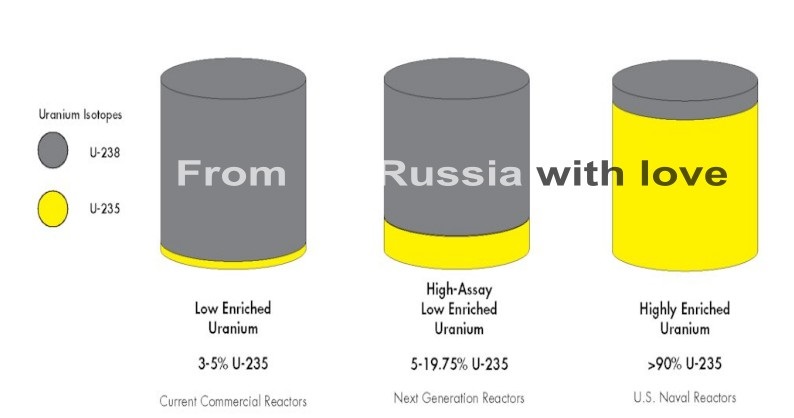
Russia’s Uranium Dominance Threatens America’s Next-Gen Nuclear Plans, By Tsvetana Paraskova – Oct 23, 2022, 10:00 AM CDT
- The United States has ambitious plans for its nuclear power industry.
- Russia’s stranglehold on the uranium market threatens to delay progress in nextgen nuclear power projects.
- U.S. companies are scrambling to develop the domestic uranium supply chain needed to fuel nuclear power ambitions.
……………………..
there is one major hurdle to the construction of most advanced reactors under development in the United States—the uranium type of fuel on which those reactors are designed to run is currently sold commercially by only one company in the world. And that company is a subsidiary of Russia’s ROSATOM, the Russian State Atomic Energy Corporation.
The federal government and U.S. companies developing advanced nuclear reactors—including Bill Gates’ TerraPower—recognize the urgent need to eliminate reliance on a Russian state corporation for nuclear fuel for America’s next-generation nuclear reactors.
The association Uranium Producers of America noted during a Senate committee hearing after the Russian invasion of Ukraine that “almost none of the fuel needed to power America’s nuclear fleet today comes from domestic producers, while U.S. nuclear utilities purchase nearly half of the of the uranium they consume from state-owned entities (SEO) in Russia, Kazakhstan, and Uzbekistan.”
“We estimate that there is more than $1 billion in annual U.S. dollar purchases of nuclear fuel flowing to ROSATOM,” said Scott Melbye, president of the association and Executive Vice President at Uranium Energy Corp.
ROSATOM is not under Western sanctions after the Russian invasion of Ukraine because of the Russian state firm’s importance in the supply chain of the global nuclear power industry. But the U.S. firms developing the next generation of more efficient, cheaper, and more environmentally friendly nuclear reactors don’t want to do business with Russia anymore.
Hence, the need for a commercially viable and stable domestic supply chain of the fuel for those advanced reactors—HALEU, or high assay low enriched uranium. ……………………………………….
the U.S. government faces the “chicken and egg” dilemma in HALEU supply, Matt Bowen, Research Scholar at the Center on Global Energy Policy at Columbia University SIPA, and Paul M. Dabbar, Distinguished Visiting Fellow at the same center, wrote in a paper in May this year/
“Existing enrichment companies, such as Urenco, Orano, GLE, and Centrus, could make HALEU, but these companies would likely be hesitant to invest too much in building HALEU infrastructure and completing NRC licensing without being confident there will in fact be a profitable market for the product,” they say.
New Zealand MP says Rocket Lab launches could betray country’s anti-nuclear stance
The commercial space company rejects criticism of satellite launches for the US military,
Guardian, Eva Corlett in Wellington, @evacorlett 17 Oct 22,
A New Zealand commercial space company, Rocket Lab, has faced new opposition to its activities on behalf of foreign militaries, with one New Zealand Green MP saying its actions could fly in the face of the country’s anti-nuclear stance.
The American-New Zealand company, founded by Peter Beck in 2006, provides rockets to deliver payloads into orbit from its launch site on the Māhia Peninsula, in New Zealand’s north. A third of Rocket Lab’s activities have been on behalf of defence and national security agencies. These include launching US and Australian spy satellites, the controversial “Gunsmoke J” satellite, and most recently Nasa’s capstone spacecraft.
The company’s contracts with the US have been flagged as concerning by the Māhia community, the Green party, and Rocket Lab Monitor – a watchdog group.
In 2019, the New Zealand government banned launch activities that were not in the country’s national interest, or were a breach of both domestic and international laws. The minister for economic and regional development, Stuart Nash, who is also the MP for the area that covers the Māhia Peninsula, has the ability to veto space launches that are not considered to be in the national interest, including payloads that contribute to nuclear weapons programmes or support or enable specific defence, security or intelligence operations contrary to government policy.
But the Green party’s security and intelligence spokesperson, Teanau Tuiono warned last week that it is “unclear when the national interest test should be invoked” and that there is no guarantee the satellites will not be used to assist nuclear programmes.
“Weaponising space is not in our national interest and goes against our international commitments to ensuring peace in space,” he said.
“Launching space satellites from Aotearoa could improve the ability of foreign actors to control a nuclear explosive device,” Tuiono said. “But right now, the government is allowing operators like Rocket Lab to put payloads into space for the US Army Space and Missile Defense Command and the US Space Force.”
Tuiono said that this poses a risk to New Zealand’s nuclear-free stance, which was enshrined in law more than 35 years ago and is considered a defining moment in the country’s history.
“We risk betraying the anti-nuclear generation and handing our kids a less safe world,” Tuiono said………………………………………………………
Watchdog group, Rocket Lab Monitor, has said it’s skeptical that this is a fail-proof system and worries the country’s space agency lacks in-house expertise to assess if satellites are contributing to nuclear weapon programmes.
“It all relies on the ‘intent’ of a payload rather than monitoring what it actually ends up being used for,” its spokesperson Sonya Smith said.
Smith pointed to Rocket Lab’s 2021 launch of the “Gunsmoke-J” satellite – an experimental satellite that, according to the US army, can “provide tactically actionable targeting data” to “warfighters”, and to which Minister Nash admitted he was “unaware of [its] specific military capabilities”.
Last month, the government announced a new aerospace strategy, that includes further financial support for the emerging sector. At the same time, it opened a review to allow the public to give feedback on the future of New Zealand’s space policy. https://www.theguardian.com/world/2022/oct/17/new-zealand-mp-says-rocket-lab-launches-could-betray-countrys-anti-nuclear-stance
Anti-nuclear campaigners have raised fears about a plan to turn Trawsfynydd into a test-bed for a new generation of mini nuclear power plants.
The Nuclear Decommissioning Authority which owns the Trawsfynydd
nuclear power plant site has signed an agreement with the Welsh
government’s development company, Cwmni Egino, to share information on
how best to redevelop the site. Cwmni Egino chief executive Alan Raymant
has said that they are focused on installing one of a new generation of
mini nuclear reactors developed by Rolls-Royce, with an aim to start on the
work by 2027.
But anti-nuclear campaigners CND Cymru, Cymdeithas y Cymod,
CADNO, and PAWB have released a statement opposing the plans and backing
renewables instead. “Wales is already a net exporter of electricity, and
the investment into true renewables like wave, wind, tidal, and sun will be
much more effective than the billions washed down the nuclear drain,”
they said. “We jointly call on the NDA to reconsider its support of
nuclear development in Wales, and Trawsfynydd and Wylfa in particular, and
further call on the UK and Welsh Government to invest in the green, clean,
and renewable future of wave, wind, and sun that we all deserve.”
Last month anti-nuclear campaigners have protested against plans for new nuclear
power stations to be built in Wales with a 70-mile march across Gwynedd and
Anglesey. Plaid Cymru Gwynedd Council leader Dyfrig Siencyn is among those
to have backed the plans for a new reactor at the nuclear power plant,
which employed 500 people when in operation between 1967 and 1993.
“There’s quite a strong anti-nuclear lobby, and they have been
demonstrating recently; we received a petition from them as a council,”
he told the Telegraph newspaper. “But I think we need nuclear energy if
we are serious about addressing the climate change emergency.”
Nation Cymru 14th Oct 2022 https://nation.cymru/news/anti-nuclear-campaigners-raise-fears-about-trawsfynydd-mini-nuke-test-bed-plans/
Small modular nuclear reactors risky venture for Saskatchewan
https://thestarphoenix.com/opinion/letters/letters-small-modular-nuclear-reactors-risky-venture-for-saskatchewan 16 Oct 22, Small modular reactors do not exist yet
Referring to nuclear as a possible part of our future energy mix in “SaskPower working to find right mix for the future,” (Oct. 5) CEO Rupen Pandya said “small modular reactors are smaller, easier to build, more affordable and safer”. This statement is both misleading and inappropriate.
Pandya’s use of the word “are” is a red flag: SMRs do not yet exist. The type of SMR SaskPower has selected to build — if it ever gets beyond the conceptual stage — would use enriched uranium fuel imported from the
USA, thus cannot be considered “safe”.
Are SMRs easier to build? We don’t know, since none have ever been built.
The exact cost of building the GE-Hitachi BWRX-300 is unknown, but would be in the billions of dollars, and is certainly less affordable than renewable energy options that are already available.
Nuclear power projects are prone to cost over-runs and delays — but this is an advantage for the companies involved in their design and construction, as it means more money will be be transferred to them from
the taxpayer.
An energy mix based on expensive, uncertain and risky SMRs would foreclose on building a truly sustainable energy future based on energy conservation and renewable sources like solar, wind, hydro, geothermal
and energy storage systems.
SaskPower should be listening — not trying to sell us on a particular option.
Cathy Holtslander, Saskatoon
SMRs are hardly emissions free
Re. Cameco engineer Brahm Neufeld’s letter on small modular reactors.
The marketing of SMRs has been entirely fraudulent. No emissions? Of course there will be emissions. All nuclear power plants must release radioactive gases, tritium and krypton intermittently and sometime inadvertently.
If carbon dioxide is included it would likely be radioactive carbon-14. Green? The carbon cost of building, mining, refining, enriching and decommissioning is many times that of solar and wind.
Dale Dewar, Wynyard
Report: small nuclear reactors an ‘uncertain and unproven’ technology that could delay Australia’s transition to renewables

Australian Conservation Foundation report finds modular reactors are expensive and introduce unnecessary challenges in managing radioactive waste
Bulletin of the Atomic Scientists, Graham Readfearn 5 Oct 22,
The next generation of small nuclear reactors being advocated by the Coalition would raise electricity prices, slow the uptake of renewables and introduce new risks from nuclear waste, according to a report from the Australian Conservation Foundation.
But the report from the conservation group has found only two small modular reactors (SMRs) are known to be operating around the world, in Russia and China, and both have seen large cost blowouts.
Promoters of nuclear energy, the report claims, were pinning their hopes on technology that was “uncertain and unproven”.
“The good news about the renewed nuclear discussion is that it highlights that business as usual with fossil fuels is not an option,” the report found.
“The bad news is the very real risk of delay, distraction and a failure to advance a just energy transition”.
Last week during question time, the energy minister, Chris Bowen, mocked the Coalition for supporting nuclear and asked which MP would be willing to have a reactor in their electorate.
Nuclear energy has been effectively banned in Australia since the late 1990s, but some Coalition senators are pushing for those restrictions to be lifted.
The opposition leader, Peter Dutton, has tasked the shadow climate minister, Ted O’Brien, to review the status of nuclear energy.
In the report Dave Sweeney, ACF’s Nuclear Free campaigner, wrote SMRs would push up electricity costs and introduce unnecessary challenges in managing nuclear waste.
“In short, Australia’s energy future is renewable, not radioactive,” he wrote.
According to the report, Russia’s floating nuclear plant, the Akademik Lomonosov, has two small SMR units on board. Construction costs had ballooned sixfold.

Work started in 2012 on a demonstration plant in China with two gas-cooled reactors that was completed nine years later, costing $8.8bn.
“The global SMR reality simply does not come close to matching the Australian SMR rhetoric,” the report says.
Three further SMR plants were under construction in Argentina, China and Russia but had been plagued by cost rises and delays, the report said.
In June, a study in the Proceedings of the National Academy of Sciences suggested future deployment of SMRs could increase the amount of nuclear waste by factors of two to 30, depending on the design.
……………………………………….. In June the International Energy Agency said SMRs were not yet commercially viable, but “lower cost, smaller size and reduced project risks” could improve social acceptance.
There was increased support and interest in Canada, France, UK and the US for the technology, the report said, adding: “But the successful long-term deployment of SMRs hinges on strong support from policymakers starting now, not just to mobilise investment but also to streamline and harmonise regulatory frameworks.” https://thebulletin.org/2022/10/report-small-nuclear-reactors-an-uncertain-and-unproven-technology-that-could-delay-australias-transition-to-renewables/
Britain’s new Energy Secretary suffering from the ‘nuclear fusion delusion’

In his speech to the 2022 Conservative Party Conference, the Britain’s
newly-appointed Energy Secretary has shown that, like those in office
before him, he too is suffering from the ‘fusion delusion’.
To the Nuclear Free Local Authorities (NFLA), the condition represents a mistaken
belief in someone in high political office that fusion can address the
nation’s future energy needs by providing access to cheap, green power in
defiance of the reality that the technology is far from being
scientifically certain, far from being economically viable, potentially
unsafe, too costly, and still comes with a legacy of nuclear waste – and
that it will in any case come decades too late to address Britain’s
immediate energy / cost-of-living crisis or the urgent need to curb carbon
emissions to arrest the worsening climate emergency.
In his first conference speech as Energy Secretary, Jacob Rees-Mogg lauded the merits of
fusion energy and announced that a new pilot plant will be established on
the site of the former West Burton A coal-fired power plant in
Nottinghamshire describing it as a ‘beacon of bountiful green
energy…proving the commercial viability of fusion energy to the world’.
NFLA 6th Oct 2022
TODAY. Small Nuclear Reactors have only one use – to lead and help the global nuclear weapons juggernaut
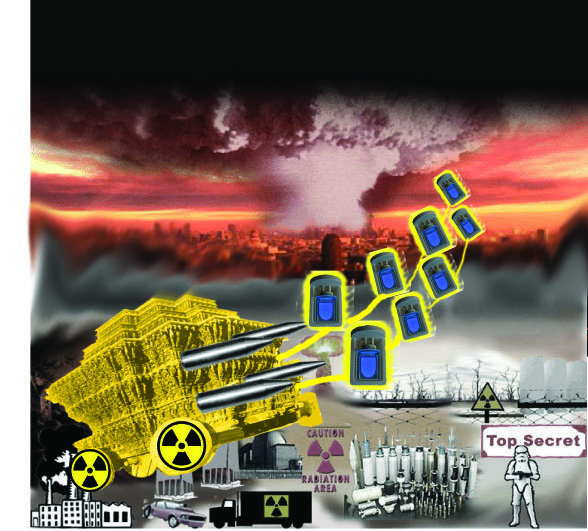
Once again, credible sources reiterate that ‘advanced nuclear’ technology – especially Small Nuclear Reactors (SMRs) are:
- non-existent as a functioning electricity source
- the most expensive of all energy sources
- not really small anyway 300MWe (and cunningly designated “medium” – up to 700MWe)
- serious producers of toxic, virtually eternal, wastes
- Thorium ones need plutonium or enriched uranium to start the reaction
- require huge security – safety and proliferation risks
- Millions of them needed to be effective against climate change, but none available till long after urgent action is needed.
- Distract and divert attention, energy and money away from real climate solutions.
So – why on Earth are all the powerful governments and media constantly trumpeting the virtues of Small Nuclear Reactors?
There is only one real reason:
Small Nuclear Reactors are essential for the nuclear weapons industry.
As the Big Nuclear power industry is failing, and cyclotrons now produce medical radioisotopes, there is really no need for the so-called “peaceful” nuclear industry (except for the massive clean-up jobs)
The Small Nuclear Reactor fantasy keeps the whole show, the whole hypocrisy, alive.
Starting with the (dubiously useful) nuclear submarines – the small nuclear reactor dream is already taking shape. But the industry needs a nice, clean-sounding ‘cover’ for its real killer purpose. Hence the foolish frenzy for “Nice Clean, Climate-helping, Waste-eating, Jobs-providing” Small Nuclear Reactors. (go to Google – you will find nothing but a procession of these lies.
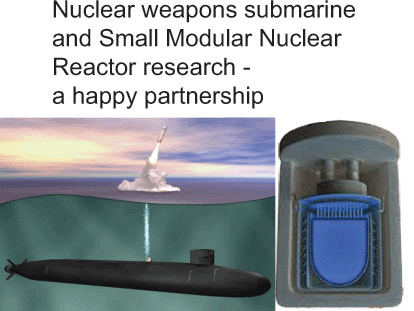
Ukraine War Exposes Risks to Deploying Small Nuclear Reactors
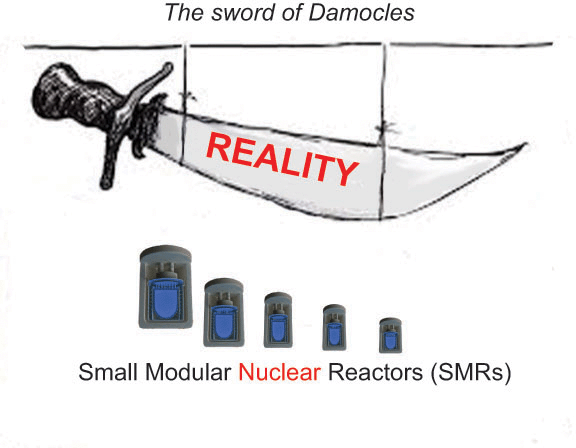
- Small modular reactors are seen as the future of atomic energy
- Russian seizure of atomic plant exposes safety vulnerabilities
By Jonathan Tirone, October 6, 2022, The Russian army’s seizure of the biggest nuclear power plant in Europe isn’t just exposing Ukrainians to the risk of an atomic accident but may also undermine plans to install new miniature reactors in far-flung places. ……… (subscribers only) more https://www.bloomberg.com/news/articles/2022-10-05/ukraine-war-shows-new-risk-to-nuclear-power-s-next-small-thing#xj4y7vzkg
NextEra Energy finds that small nuclear reactors (SMRs) really are the biggest boondoggle of all
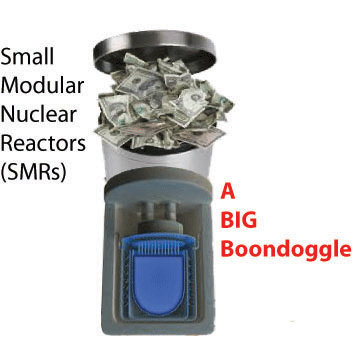
There were a couple of interesting developments in June in regards to electric power. One was that NextEra Energy issued its Investor Conference Report 2022 to its stockholders. Another was a paper from Stanford University, “Low-cost solutions to global warming, air pollution, and energy insecurity for 145 countries,” (LCS study) by Mark Z. Jacobson, et al. Looking into them is rather interesting.
The first of these makes very clear that in the opinions of the people running NextEra Energy, combustion
generating sources and nuclear power are getting too expensive. Furthermore, their opinion is that the most expensive of these, at least in the late 2020s, will be small modular nuclear reactors (SMRs).

We should make clear, just in case anyone doesn’t know, that NextEra is hardly anti-nuclear. While it is already the biggest investor in renewable energy in the US, it does own seven nuclear reactors, including the one at Seabrook. Electricity from new, near-firm solar and wind plants is a good deal less expensive than electricity from existing nuclear plants.
Let’s state this clearly: We are paying extra for electricity from nuclear plants, even after they have been paid down, and even though the sun can shine and the wind can blow almost all the time, because of really cheap battery storage. Put another way, it would be cheaper to close the nuclear plants and replace them with new renewable facilities.
Clean Technica 4th Oct 2022 https://cleantechnica.com/2022/10/04/why-should-we-pay-extra-for-nuclear-power/
Nuclear fusion – public money wasted on this unproven technology
UK ministers have been criticised for “pouring billions of pounds of
public money into unproven technology” by pressed ahead with nuclear
fusion investment. The warning comes after North Ayrshire lost out on
becoming the site of the UK’s first fusion energy plant having been
shortlisted.
Herald 4th Oct 2022
Small modular reactors: What is taking so long?
Next-generation nuclear has long been just around the corner, but debate still rages over the silver-bullet credentials of small modular reactors.
By Oliver Gordon The growing urgency of the climate crisis and, more recently, the energy crisis has reawakened global interest in nuclear energy. Even the likes of Bill Gates and Elon Musk have waded into the debate to petition for a more prominent role for nuclear power in the transition to net-zero greenhouse gas emissions. To that end, there is much expectation surrounding the development of small modular reactors (SMRs), a new generation of nuclear reactors that are being marketed as the solution to all of nuclear power’s previous shortcomings.
To that end, there is much expectation surrounding the development of small
modular reactors (SMRs), a new generation of nuclear reactors that are
being marketed as the solution to all of nuclear power’s previous
shortcomings.
In fact, SMRs are not forecast to hit the commercial market
before 2030, and although SMRs are expected to have lower up-front capital
costs per reactor, their economic competitiveness is still to be proven in
practice once they are deployed at scale.
Nuclear reactors are extremely
complex systems that must comply with stringent safety requirements, taking
into account a wide variety of accident scenarios. The licensing process is
extensive and country-dependent, implying some standardisation will be
required for SMRs to properly take off.
However – beyond the perennial
oscillation of public acceptance of nuclear energy – there are still a
variety of challenges SMR technology needs to overcome before it can reach
commercial deployment. “The hardest is economics,” says M V Ramana, the
Simons Chair in Disarmament, Global and Human Security at the School of
Public Policy and Global Affairs at the University of British Columbia,
Canada, and author of The Power of Promise: Examining Nuclear Energy in
India. “Nuclear energy is an expensive way to generate electricity.”
Energy Monitor (accessed) 21st Sept 2022
https://www.energymonitor.ai/sectors/power/small-modular-reactors-smrs-what-is-taking-so-long
1 This Month
To see nuclear-related stories in greater depth and intensity – go to https://nuclearinformation.wordpress.com/

29 Jan. Thursday 7-8 p.m. Webinar – World’s Largest Nuclear Station in Port Hope, ON?


31st January – Challenging the War Machine – a DECLASSIFIED UK SUMMIT


Website of the Week
Now until to February 10, 2026 Radioactive waste storage in France: the debate is finally open! How to participate?
-
Archives
- January 2026 (271)
- December 2025 (358)
- November 2025 (359)
- October 2025 (376)
- September 2025 (258)
- August 2025 (319)
- July 2025 (230)
- June 2025 (348)
- May 2025 (261)
- April 2025 (305)
- March 2025 (319)
- February 2025 (234)
-
Categories
- 1
- 1 NUCLEAR ISSUES
- business and costs
- climate change
- culture and arts
- ENERGY
- environment
- health
- history
- indigenous issues
- Legal
- marketing of nuclear
- media
- opposition to nuclear
- PERSONAL STORIES
- politics
- politics international
- Religion and ethics
- safety
- secrets,lies and civil liberties
- spinbuster
- technology
- Uranium
- wastes
- weapons and war
- Women
- 2 WORLD
- ACTION
- AFRICA
- Atrocities
- AUSTRALIA
- Christina's notes
- Christina's themes
- culture and arts
- Events
- Fuk 2022
- Fuk 2023
- Fukushima 2017
- Fukushima 2018
- fukushima 2019
- Fukushima 2020
- Fukushima 2021
- general
- global warming
- Humour (God we need it)
- Nuclear
- RARE EARTHS
- Reference
- resources – print
- Resources -audiovicual
- Weekly Newsletter
- World
- World Nuclear
- YouTube
-
RSS
Entries RSS
Comments RSS
 nuclear-news