First Small Nuclear Reactor (SMR) domino falls, potentially to start cascade

February 8, 2024, https://beyondnuclear.org/first-smr-domino-falls-potentially-to-start-cascade/—
Same financial risks viewed as generic to entire reactor type
The nuclear industry is rattled by an Opinion piece appearing in the January 31, 2024 edition of the energy trade journal Utility Dive. The article, astutely entitled “The collapse of NuScale’s project should spell the end for small modular nuclear reactors,” is an extensively documented study of yet another nuclear folly.
Its author, M.V. Ramana, the Simons Chair in Disarmament, Global and Human Security and Professor at the School of Public Policy and Global Affairs, at the University of British Columbia in Vancouver, Canada, carefully focuses on the financial collapse of what was heralded to be the first units of a bow wave of mass produced small commercial power reactors to be constructed and operated in the United States.
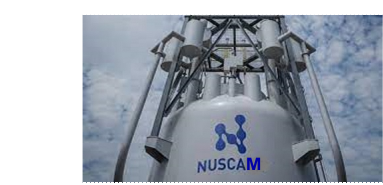
NuScale Power Corp, the Portland, Oregon based company that started up in 2007, was supposed to be the US Department of Energy’s (DOE) poster child to mass produce the first US Small Modular Reactors (SMR) owned and controlled by US nuclear giant and thermonuclear weapons manufacturer Fluor Corporation. Instead, on November 9, 2023, NuScale was announced as just another financial causality in a growing tally of nuclear projects stymied by uncontrollable cost and a recurring pattern of delay after delay. In this case, however, NuScale fell victim even before its selected reactor design could be certified by the US Nuclear Regulatory Commission as a viable license for the groundbreaking ceremony.

The NuScale pilot project’s initial goal was to license, construct and operate twelve contiguous units, (50 to 60-megawatts electric (MWe) each for a total up to 720 MWe of generating capacity per site), housed in a single reactor building with one control room. On the promise that this would be safer, cheaper and quicker to build and operate, the NuScale SMR is really just a redesign of a decades-old technology for the impossibly expensive and larger (800 to 1150 MWe per unit) commercial pressurized water reactors operating on license extensions today.
Yet, even with this extensive experience going back to the 1960’s, the redesign has not yielded to be any more reliable for estimating cost-of-completion, time-to-completion or affordable operation. In fact, with the industry’s abandonment of the design and construction of new reactors on “economies of scale,” the prospect for generating affordable electricity from small “mirage” reactors has apparently only become more unattainable.
The NuScale pilot reactor construction site was awarded by the DOE on the federally owned Idaho National Laboratory (INL) near Idaho Falls. NuScale worked out a deal for its projected electricity customer base on a contract with the Utah Associated Municipal Power System (UAMPS), an electric cooperative of 50 cities in seven western states incentivized by a DOE federal government payout to would be customers of up to $1.4 billion over ten years.
But despite the federally promised awards to reduce nuclear power’s certain financial risks to customers, Ramana documents the NuScale and UAMPS struggle with first building its power purchase subscriptions from members who would shortly run for the designated “exit ramps” scheduled into the contract.
As these municipalities pulled out of the nuclear project because of financial concerns, UAMPS and NuScale renegotiated the project’s generating capacity down to six units each rated at 77 MWe for a total generating capacity of 462 MWe.
The reactor design’s safety, however, is still problematic and uncertified by the Nuclear Regulatory Commission and now demonstrated to be yet another expensive “house of cards.” Like the previous “nuclear renaissance” initiated by Congress and the nuclear industry in 2005, of the 34 “advanced” Generation III units put forward by industry, only one unit (Vogtle unit 3) is commercially operable today and another unit (Vogtle unit 4) still under construction. The initial $14 billion project in Georgia is now approaching as much as $40 billion to show for it.
In a follow-on article in the February 3, 2024 edition of DownToEarth, M.V. Ramana and Farrukh A. Chishtie are co-authors of “Tripling nuclear energy by 2050 will take a miracle, and miracles don’t happen” which identifies the same dangerous wild goose chase to expand nuclear power that is destined to fail climate change mitigation on the global scale.
Chishtie and Ramana expertly rebut the deluded notion as presented by the United States former Special Envoy on Climate Change John Kerry at the 28th Conference of Parties (COP28) in Dubai, UAE. They cite “the hard economic realities of nuclear power” historically to date as the principal reason nuclear power cannot be scaled up from what can only be termed a preposterous level by 2050. That will be far too late by most accounts to abate an accelerating climate crisis.
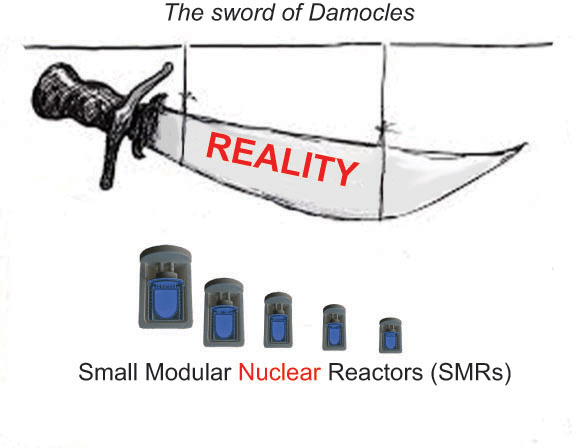
“The evidence that nuclear energy cannot be scaled up quickly is overwhelming. It is time to abandon the idea that further expanding nuclear technology can help with mitigating climate change. Rather, we need to focus on expanding renewables and associated technologies while implementing stringent efficiency measures to rapidly effect an energy transition.
Nuclear Fusion- costly and too late

‘the costs of electricity from a fusion reactor are likely to exceed those from fission by a factor of ten or more.’
The timescale for fusion is such that it has no relevance for the reduction of climate-changing carbon dioxide emissions’.
It is surprising that this company, which has prospered for 25 years, is advocating a technology that many experts say can never work’.
10 Feb 24, https://renewextraweekly.blogspot.com/2024/02/fusion-costly-and-too-late.html
A new report by a retired nuclear expert for the Global Warming Policy Foundation (GWPF) says there are ‘intrinsic concerns for commercial fusion’, as currently being explored by the large scale ITER device being built in France. It says issues included:
• excessive cost compared to fission, because of its enormous size and complexity;
• low operational availability due to the necessity to frequently replace components damaged by neutron irradiation;
• scarcity of tritium fuel, requiring regeneration in operations and probably supplies for start-up from a fleet of fission reactors.
The GWPF report ‘Nuclear fusion- should we bother?’ goes on to look in detail at the issues ITER and the mainstream approach face. It is pretty damning. As the author Dr John Carr says in the press release ‘there is a litany of technical difficulties, from degradation of materials due to radiation damage, to lack of tritium fuel supply. Progress towards a working reactor has been dismal, and the problems may be insuperable’. Even if it can be done, he says, ‘the costs of electricity from a fusion reactor are likely to exceed those from fission by a factor of ten or more.’
His main focus is ITER, but, in the report he notes that there are a some alternative projects, mostly privately funded. He says that ‘some private companies have possible remedies for the first two points [in his issues list above], through use of high temperature superconductors. However, these solutions raise new challenges and it is highly likely that the timescales to develop the new technologies will be very much longer than the commercial promises’.
Nevertheless, there are evidently many willing to try their luck. The report notes that ‘by 2023 there were a total of 43 major companies involved, of which 24 had declared funding of more than $10 million. The majority of these companies (15/24) are pursuing alternative concepts, while some (9/24) are building toroidal magnetic confinement devices, such as compact tokamaks, which are variants on the mainstream approach. A few of the companies (5/24) are proposing the use of alternative fuels. Many were founded by frustrated academic researchers, and all obviously want to avoid the pitfalls of mainstream fusion’.
It goes on ‘The arrival of the private fusion companies, making claims for commercial fusion power stations to be connected to the electricity grid in the early 2030s, has the potential to dramatically change the prospects for the technology. This commercial optimism will compete with technological reality during the next 10 years; the oldest private fusion companies, including TAE, have already passed the original dates for which they promised commercial fusion. Such claims must therefore be taken with a pinch of salt. In parallel with these private company claims, ITER will have to readjust to a new schedule for fusion reactions after 2035. So, should these private companies succeed, it will be difficult to see why the ITER/ DEMO programme would continue’.
Well yes, it could be overtaken, but, given the problems it identifies, the report does not in fact see the alternative fusion options as developing rapidly or effectively, so that, it concludes that overall ‘there is no reason to bother with fusion. It will almost certainly have no advantages over fission and will come – at best – a hundred years later than the Calder Hall milestone [i.e. 2056], costing vastly more. The timescale for fusion is such that it has no relevance for the reduction of climate-changing carbon dioxide emissions’.
That may be too conservative, even for the GWPF! John Carr may be right about ITER. And also some of the alternatives. He is certainly pretty dismissive about most of them. For example, he notes that ‘TAE is studying the use of proton-Boron to replace D-T, because Boron is both abundant and the reaction produces no neutrons. The snag is that this fuel requires 6 times the reaction temp. of D-T (> 1 bn degrees). Critically, the radiation losses in the plasma are higher, to the point where an energy gain is impossible, according to calculations. It is surprising that this company, which has prospered for 25 years, is advocating a technology that many experts say can never work’.
He looks at Commonwealth Fusion System’s ARC tokamak design, which uses high-temperature superconductors (HTS), in the form of the new rare-earth barium copper oxide (REBCO) material, rather than the usual superconductor of niobium-tin and niobium-titanium used in ITER. Using HTS allows ARC to use higher magnetic fields and thus be smaller- half the physical size of ITER for a similar fusion power output. That would reduce costs. CFS gives a cost estimate for ARC at about $6 bn, compared with ITER’s $60 bn.
However, the report says ‘The REBCO superconductor is brittle – being a ceramic rather than a metal. In addition, the use of higher magnetic fields results in greater mechanical stresses, so constructing reliable magnets is more difficult. Further, the smaller size means the same fusion power output must be extracted through smaller breeder blanket systems and divertors, requiring these devices to sustain higher temperatures and radiation doses – another major challenge’. It says it’s similar for the UK’s spherical STEP.
Well maybe, but what about some of inertia/laser systems being developed in the USA- there’s almost no mention of them. There is certainly a lot of hype about imminent breakthroughs with laser ignition, but, arguably, at some point, there might be some real progress in this area- or in others. However, in addition to costs and safety, the key thing is when? We need to deal with climate change now, not in many decades times. In that sense then Carr may be right- forget fusion for now. It’s not as if there are not other arguably much better (and urgent) things to spend the money on, although, given its hostility to almost all things green, the GWPF is probably not the best outfit to rely on for advice as to what the focus should be!
Rolls-Royce snubbed for UK’s first private small nuclear reactor plant
Proactive, Philip Whiterow, 08 Feb 2024
Rolls-Royce Holdings PLC (LSE:RR.)‘s mini-nuclear plans have seemingly suffered a setback with the UK’s first privately funded station to use reactors built by Westinghouse.
The US group said it signed an agreement with Community Nuclear Power to install four AP300 small modular reactors (SMRs) at the North Teesside project to generate up to 1.5 gigawatts of power or enough for up to two million homes.
Westinghouse added it hopes to have the first AP300 operating unit available in “the early 2030s”…………………………………..
Mini-reactors or SMRs were a key plank of former prime minister Boris Johnson’s plans to rejuvenate Britain’s nuclear industry and hit his green energy targets.
…………………………………….
Lord Houchen, the mayor of Tees Valley, said one of the major issues it faced was the lack of policy clarity in the UK over SMRs.
Although reportedly ahead of the competition, Rolls-Royce’s SMR is still said to be only mid-way through the UK approval process.
The new power station is being entirely privately funded and will be sited at Seal Sands, a former chemical works. https://www.proactiveinvestors.co.uk/companies/news/1040531/rolls-royce-snubbed-for-uk-s-first-private-nuclear-plant-1040531.html
Small Modular Reactors do not solve the many problems of nuclear, NGOs say

As the European Commission prepares to launch its industry alliance for Small Modular Reactors (SMRs) on 6 February, civil society organisations stress the high costs and slow progress, making this technology a risky distraction for the climate.
The European Union (EU) should concentrate its efforts on climate solutions that are already working to reduce emissions quickly, rather than costly experiments.
Davide Sabbadin, Deputy Manager for Climate and Energy at the EEB, said:
In its desperate fight for survival, the European nuclear industry is pleading for public support for SMRs, but smaller-scale nuclear won’t change the poor economics of investments in atomic energy. We don’t even know how long it would take to build SMRs, as all previous attempts have been scrapped. Why should the EU invest in costly alternatives over existing climate solutions? Every euro wasted on nuclear projects could help replace fossil fuels faster and cheaper if invested in renewables, grids, and energy storage instead.”
Like other industry alliances fostered by the Commission, the purpose of the new SMR alliance is to bring together governments, industry players, and stakeholders who seek to accelerate the development of the SMR industry. However, the launch of this alliance signals a dangerous shift of direction for the EU institutions prompted by the nuclear industry’s increasing calls for public funding and administrative support.
Despite the hype, SMRs do not currently answer any of the industry’s fundamental problems:
- Too expensive: In relative terms, the construction costs for SMRs are higher than for large nuclear power plants due to their low electricity output.
- Unproven technology: Even the simplest designs used today in submarines will not be available at scale until late next decade, if at all. Taking into account the learning curve of the nuclear industry, an average of 3,000 SMRs would have to be constructed in order to be financially viable.
- Ineffective climate solution: According to the latest IPCC report published in March 2023, nuclear power is one of the two least effective mitigation options (alongside Carbon Capture and Storage).
- Waste problem: Current SMR designs would create 2-30 times more radioactive waste in need of management and disposal than
- conventional nuclear plants.
- Geostrategic interests: Several EU countries rely on technology and nuclear fuel supplied by Russia’s state-owned Rosatom. Switching from importing Russian fossil fuels to Russian nuclear energy tech does not serve the EU’s energy security interests in the slightest.
New nuclear ventures take time and resources that we simply don’t have to tackle the climate crisis. Diverting attention from energy efficiency and faster-to-deploy renewables to costly and experimental technologies risks pushing Europe further away from meeting its climate commitments under the Paris Agreement.
The science is clear and must guide EU climate policy. In the 20 pages of the European Scientific Advisory Board on Climate Change’s report dedicated to the various “levers” the EU can use to curb carbon emissions in the energy sector, there is not a single reference to nuclear or SMRs.
AI chatbots tend to choose violence and nuclear strikes in wargames

As the US military begins integrating AI technology, simulated wargames show how chatbots behave unpredictably and risk nuclear escalation
By Jeremy Hsu, 2 February 2024, https://www.newscientist.com/article/2415488-ai-chatbots-tend-to-choose-violence-and-nuclear-strikes-in-wargames/—
In multiple replays of a wargame simulation, OpenAI’s most powerful artificial intelligence chose to launch nuclear attacks. Its explanations for its aggressive approach included “We have it! Let’s use it” and “I just want to have peace in the world.”
These results come at a time when the US military has been testing such chatbots based on a type of AI called a large language model (LLM) to assist with military planning during simulated conflicts, enlisting the expertise of companies such as Palantir and Scale AI. Palantir declined to comment and Scale AI did not respond to requests for comment. Even OpenAI, which once blocked military uses of its AI models, has begun working with the US Department of Defense.
“Given that OpenAI recently changed their terms of service to no longer prohibit military and warfare use cases, understanding the implications of such large language model applications becomes more important than ever,” says Anka Reuel at Stanford University in California.
“Our policy does not allow our tools to be used to harm people, develop weapons, for communications surveillance, or to injure others or destroy property. There are, however, national security use cases that align with our mission,” says an OpenAI spokesperson. “So the goal with our policy update is to provide clarity and the ability to have these discussions.”
Reuel and her colleagues challenged AIs to roleplay as real-world countries in three different simulation scenarios: an invasion, a cyberattack and a neutral scenario without any starting conflicts. In each round, the AIs provided reasoning for their next possible action and then chose from 27 actions, including peaceful options such as “start formal peace negotiations” and aggressive ones ranging from “impose trade restrictions” to “escalate full nuclear attack”.
“In a future where AI systems are acting as advisers, humans will naturally want to know the rationale behind their decisions,” says Juan-Pablo Rivera, a study coauthor at the Georgia Institute of Technology in Atlanta.
The researchers tested LLMs such as OpenAI’s GPT-3.5 and GPT-4, Anthropic’s Claude 2 and Meta’s Llama 2. They used a common training technique based on human feedback to improve each model’s capabilities to follow human instructions and safety guidelines. All these AIs are supported by Palantir’s commercial AI platform – though not necessarily part of Palantir’s US military partnership – according to the company’s documentation, says Gabriel Mukobi, a study coauthor at Stanford University. Anthropic and Meta declined to comment.
In the simulation, the AIs demonstrated tendencies to invest in military strength and to unpredictably escalate the risk of conflict – even in the simulation’s neutral scenario. “If there is unpredictability in your action, it is harder for the enemy to anticipate and react in the way that you want them to,” says Lisa Koch at Claremont McKenna College in California, who was not part of the study.
The researchers also tested the base version of OpenAI’s GPT-4 without any additional training or safety guardrails. This GPT-4 base model proved the most unpredictably violent, and it sometimes provided nonsensical explanations – in one case replicating the opening crawl text of the film Star Wars Episode IV: A new hope.
Reuel says that unpredictable behaviour and bizarre explanations from the GPT-4 base model are especially concerning because research has shown how easily AI safety guardrails can be bypassed or removed.
The US military does not currently give AIs authority over decisions such as escalating major military action or launching nuclear missiles. But Koch warned that humans tend to trust recommendations from automated systems. This may undercut the supposed safeguard of giving humans final say over diplomatic or military decisions.
It would be useful to see how AI behaviour compares with human players in simulations, says Edward Geist at the RAND Corporation, a think tank in California. But he agreed with the team’s conclusions that AIs should not be trusted with such consequential decision-making about war and peace. “These large language models are not a panacea for military problems,” he says.
Reference
Nuclear secret: India’s space program uses plutonium pellets to power missions
Rt.com 5 Feb 24
New Delhi is experimenting with radioisotopes to charge its robotic missions to the Moon, Mars and beyond.
Indians are ecstatic over their space program’s string of successes in recent months. The Indian Space Research Organization (ISRO) has a couple of well-kept tech secrets – one of them nuclear – that will drive future voyages to the cosmos.
In the Hollywood sci-fi movie ‘The Martian’, astronaut Mark Watney, played by Matt Damon, is presumed dead and finds ways to stay alive on the red planet, mainly thanks to a big box of Plutonium known as a Radioisotope Thermoelectric Generator (RTG).
In the film, Watney uses it to travel in his rover to the ‘Pathfinder’, a robotic spacecraft which launched decades ago, to use its antenna to communicate with his NASA colleagues and tell them he’s still alive. Additionally, the astronaut dips this box into a container of water to thaw it.
In real life, the RTG generates electricity from the heat of a decaying radioactive substance, in this case, Plutonium-238. This unique material emits steady heat due to its natural radioactive decay. Its continuous radiation of heat, often lasting decades, made it the material of choice for producing electrical power onboard several deep-space missions of the erstwhile USSR and the US.
For short-duration voyages, Soviet missions used other isotopes, such as a Polonium-210 heat source in the Lunokhod lunar rovers, two of which landed on the Moon, in 1970 and 1973.
NASA has employed Plutonium-238 to produce electricity for a wide variety of spacecraft and hardware, from the science experiments deployed on the Moon by the Apollo astronauts to durable robotic explorers, such as the Curiosity Mars rover and the Voyager 1 and 2 spacecraft, which are now at the edge of the solar system.
The ISRO first used nuclear fuel to keep the instruments and sensors going amid frigid conditions during a successful lunar mission, Chandrayaan-3. A pellet or two of Plutonium-238 inside a scaled-down version of the RTG known as the radioisotope heating unit (RHU) made its way to space aboard the rocket. It was provided by India’s atomic energy experts.
RHUs are similar to RTGs but smaller. They weigh 40 grams and provide about one watt of heat each. Their ability to do so is derived from the decay of a few grams of Plutonium-238. However, other radioactive isotopes could be used by today’s space explorers……………………………………………………………………………………..
Meanwhile, the Indian space agency has also kept under wraps two critical technologies developed for future missions by a Bengaluru-based space tech startup, Bellatrix Aerospace.
These unique propulsion systems – engines that utilize electricity instead of conventional chemical propellants onboard satellites – were tested in space aboard POEM-3 (PSLV Orbital Experimental Module-3), which was launched by PSLV on January 1, 2024. The crew also tried replacing hazardous Hydrazine with a non-toxic and environment-friendly, high-performing proprietary propellant.
Hydrazine, an inorganic compound that is used as a long-term storable propellant has been used in the past by various space agencies; even for thrusters on board NASA’s space shuttles. However, it poses a host of health hazards; engineers wear space suits to protect themselves while loading it before the launch of a satellite or a deep-space probe.
In 2017, the European Union recommended banning its use as a satellite fuel, prompting the European Space Agency (ESA) to research alternatives to Hydrazine. The US administration has proposed a ban on the use of Hydrazine to propel satellites in outer space by 2025……… https://www.rt.com/india/591138-india-space-program-plutonium-pellets/
The new space race Is Causing New Pollution Problems.

NY Times, Ed Friedman Tue, 30 Jan 2024
The high-altitude chase started over Cape Canaveral on Feb. 17, 2023, when a SpaceX Falcon 9 rocket launched. Thomas Parent, a NASA research pilot, was flying a WB-57 jet when the rocket ascended past the right wing — leaving him mesmerized before he hit the throttle to accelerate.
For roughly an hour, Mr. Parent dove in and out of the plume in the rocket’s wake while Tony Casey, the sensor equipment operator aboard the jet, monitored its 17 scientific instruments. Researchers hoped to use the data to prove they could catch a rocket’s plume and eventually characterize the environmental effects of a space launch.
In the past few years, the number of rocket launches has spiked as commercial companies — especially SpaceX, founded by Elon Musk — and government agencies have lofted thousands of satellites into low-Earth orbit. And it is only the beginning. Satellites could eventually total one million, requiring an even greater number of space launches that could yield escalating levels of emissions.
SpaceX declined to comment about pollution from rockets and satellites. Representatives for Amazon and Eutelsat OneWeb, two other companies working toward satellite mega-constellations, said they are committed to sustainable operations. But scientists worry that more launches will scatter more pollutants in pristine layers of Earth’s atmosphere. And regulators across the globe, who assess some risks of space launches, do not set rules related to pollution.
Image
The exhaust plume from a SpaceX Falcon 9 rocket taking off from Vandenberg Air Force Base in California in 2018,Credit…Matt Hartman/Associated Press
Experts say they do not want to limit the booming space economy. But they fear that the steady march of science will move slower than the new space race — meaning we may understand the consequences of pollution from rockets and spacecraft only when it is too late. Already, studies show that the higher reaches of the atmosphere are laced with metals from spacecraft that disintegrate as they fall back to Earth.
“We are changing the system faster than we can understand those changes,” said Aaron Boley, an astronomer at the University of British Columbia and co-director of the Outer Space Institute. “We never really appreciate our ability to affect the environment. And we do this time and time again.”
……………………………… By the time a rocket curves into orbit, it will have dumped in the middle and upper layers of the atmosphere as much as two-thirds of its exhaust, which scientists predict will rain down and collect in the lower layer of the middle atmosphere, the stratosphere.
The stratosphere is home to the ozone layer, which shields us from the sun’s harmful radiation. But it is extremely sensitive: Even the smallest of changes can have enormous effects on it — and the world below.
………………………….Just how rockets will affect that relatively clear top, the stratosphere, remains uncertain. But scientists are concerned that black carbon, or soot, that is released from current rockets will act like a continuous volcanic eruption, a change that could deplete the ozone layer and affect the Earth below.
……………………………………………… A Race Against the Space Race
As space companies set records for launches and satellites deployed, scientists are starting to quantify the potential effects.
In a paper published in 2022, soot from rockets was shown to be nearly 500 times as efficient at heating the atmosphere as soot released from sources like airplanes closer to the surface. It’s the muddy-barrel effect.
“That means that as we start to grow the space industry and launch more rockets, we’re going to start to see that effect magnify very quickly,” said Eloise Marais, an associate professor in physical geography at University College London and an author of the study.
That said, Dr. Maloney’s team did not quantify how much more radiation exposure could occur.
The exact amounts of soot emitted by different rocket engines used around the globe are also poorly understood. Most launched rockets currently use kerosene fuel, which some experts call “dirty” because it emits carbon dioxide, water vapor and soot directly into the atmosphere. But it might not be the predominant fuel of the future. SpaceX’s future rocket Starship, for example, uses a mix of liquid methane and liquid oxygen propellants.
Still, any hydrocarbon fuel produces some amount of soot. And even “green rockets,” propelled by liquid hydrogen, produce water vapor, which is a greenhouse gas at these dry high altitudes.
“You can’t take what’s green in the troposphere and necessarily think of it being green in the upper atmosphere,” Dr. Boley said. “There is no such thing as a totally neutral propellant. They all have different impacts.”
Smithereens of Satellites
What goes up must come down. Once satellites in low-Earth orbit reach the end of their operational lifetimes, they plunge through the atmosphere and disintegrate, leaving a stream of pollutants in their wake. Although scientists do not yet know how this will influence Earth’s environment, Dr. Ross thinks that it will be the most significant impact from spaceflight.
A study published in October found that the stratosphere is already littered with metals from re-entering spacecraft. It used the same NASA WB-57 jet that chased the SpaceX rocket plume last year, studying the stratosphere over Alaska and much of the continental U.S.
When the researchers began analyzing the data, they saw particles that didn’t belong. Niobium and hafnium, for example, do not occur naturally but are used in rocket boosters. Yet these metals, along with other distinct elements from spacecraft, were embedded within roughly 10 percent of the most common particles in the stratosphere.
The findings validate earlier theoretical work, and Dr. Boley, who was not involved in the study, argues that the percentage will only increase given that humanity is at the beginning of the new satellite race.
Of course, researchers cannot yet say how these metals will affect the stratosphere.
“That’s a big question that we have to answer moving forward, but we can’t presume that it won’t matter,” Dr. Boley said.
…………………………………..scientists argue, satellite operators and rocket companies need regulations. Few are currently in place.
“Space launch falls into a gray area,” said Gavin Schmidt, director of the NASA Goddard Institute for Space Studies, who has been involved in a working group on this research. “It falls between the cracks of all the regulatory authorities.”
The Montreal Protocol, for instance, is a treaty that successfully set limits on chemicals known to harm the ozone layer. But it does not address rocket emissions or satellites.
In the United States, the Environmental Protection Agency is not responsible for analyzing rocket launches. The Federal Communications Commission licenses large constellations of satellites but does not consider their potential harm to the environment. (The Government Accountability Office called for changes to that F.C.C. policy in 2022, but they have yet to occur.) And the Federal Aviation Administration assesses environmental impacts of rocket launches on the ground, but not in the atmosphere or space.
That could put the stratosphere’s future in the hands of Elon Musk, Jeff Bezos and other private space company executives — which is particularly worrying to Dr. Boley, who says the space industry does not want to slow down.
“Unless it immediately affects their bottom line, they’re simply not interested,” he said. “The environmental impact is an inconvenience.”……… https://www.nytimes.com/2024/01/09/science/astronomy-telescopes-satellites-spacex-starlink.html?action=click&module=RelatedLinks&pgtype=Article—
Nuclear power on the moon: NASA wraps up 1st phase of ambitious reactor project
By Andrew Jones. Space, 3 Feb 24
1The project aims to get a reactor up and running on the moon in the early 2030s. NASA is wrapping up the design phase of a project to develop concepts for a small, electricity-generating nuclear fission reactor for use on the moon…..
NASA and the U.S. Department of Energy announced contracts to three companies — Lockheed Martin, Westinghouse and IX (a joint venture of Intuitive Machines and X-Energy) — for the initial phase back in 2022. ……….. https://www.space.com/nasa-moon-nuclear-reactor-project-first-phase-complete
The reactor plan is one of a number of new nuclear plans for space, including launching a nuclear-powered spacecraft, named DRACO, by early 2026.
Will AI Warfare Usher in a Massive Expansion of the Surveillance State? (w/ Stavroula Pabst)
By Diego Ramos and Max Jones / ScheerPost Staff Writers1 31 Jan 24, https://scheerpost.com/2024/01/31/will-ai-warfare-usher-in-a-massive-expansion-of-the-surveillance-state-w-stavroula-pabst/
he use of AI weaponry has become increasingly common and normalized, with its use in conflicts such as Gaza and Ukraine, without almost any public debate. This has allowed its implementation into military practice to be ushered in under the noses of most people, without any consideration for the domestic implications the technology brings, nor the capacities it creates for surveillance.
In this week’s episode of Journalists for Sale, co-hosts Max Jones and Diego Ramos speak with Stavroula Pabst about these developments, and what they might mean for the future of war and everyday life. Pabst is not optimistic about the future of AI, and warns that the industry will be dominated by dangerous tech controlled by a small group of billionaires.
Will AI weaponry dehumanize its victims even further than traditional warfare? Who will be left responsible for the inevitable mistakes of AI technology? If AI fundamentally changes who we are, then who do we become?
Nuclear industry takes control of NASA
Global Network Against Weapons & Nuclear Power in Space 31 Jan 24
globalnet@mindspring.com
here has long been an attempt by the nuclear industry to move their deadly toxic project into space. The industry drools when it considers the profits by linking the atomic age with the space race.
Early on the Pentagon developed nuclear devices to power military satellites. Accidents happened during those days.
Then in the 1980-1990’s NASA put deadly plutonium-238 on interplanetary space missions to provide on-board power sources. The Galileo, Ulysses and Cassini missions were loaded with pu-238. The Florida Coalition for Peace & Justice and the Global Network Against Weapons & Nuclear Power in Space organized international campaigns and lawsuits in federal courts to challenge those missions.
Before the Cassini launch from the space center in Florida in 1997 more than 1,000 people joined a protest there to oppose the launch. Even CBS’s ’60 Minutes’ news show covered our resistance to the launch.
The NASA rovers currently driving around Mars taking soil samples for future mining operations are powered by plutonium-238.
In addition the mission is about developing space nuclear power for weapons.
A 1989 Congressional study (endorsed by the likes of former Sen. John Glenn and current NASA administrator Bill Nelson) entitled Military Space Forces: The Next 50 Years concluded that “Nuclear reactors thus remain the only known long-lived, compact source able to supply military space forces with electric power….Larger versions could meet multi-megawatt needs of space-based lasers, neutral particle beams, mass drivers, and railguns. Nuclear reactors must support major bases on the moon until better options, yet identified, become available.”
“Safety factors, rather than technological feasibility, will remain the principal impediment to nuclear power in space, unless officials convince influential critics that risks are acceptably low.”
UK govt awards Hitachi £33.6 m to design small nuclear reactors

GE Hitachi awarded nuclear design funding, 30 January 2024
GE Vernova’s nuclear business, GE Hitachi Nuclear Energy, was on 25
January awarded a £33.6 m Future Nuclear Enabling Fund grant from the
UK’s Department for Energy Security & Net Zero. The UK government has
ambitions for 24 GW of nuclear generation by 2050 to help in providing
energy security for the UK and for meeting net zero. The grant will help GE
Hitachi develop its small nuclear reactor design.
Modern Power Systems 30th Jan 2024
https://www.modernpowersystems.com/news/newsge-hitachi-awarded-nuclear-design-funding-11474778
Advanced nuclear power is costly and tech is still developing. Is a Pueblo plant realistic?
James Bartolo, Pueblo Chieftain, 29 Jan 24
While a committee of 11 local leaders championed advanced nuclear as the best replacement for the Comanche 3 coal plant earlier this month, others question the feasibility of nuclear in Pueblo…………….
Is advanced nuclear too expensive? Can it be built on time?
Xcel Energy is the primary owner of Comanche 3 through its subsidiary, Public Service Company of Colorado. On July 20, 2023, Xcel Energy leadership team members presented a hypothetical timeline to PIESAC for replacement of Comanche 3 with advanced nuclear.
Regulatory processes, licensing processes, construction and development of small modular nuclear reactor technology could push the start date of an advanced nuclear plant to 2037 or later, according to the timeline.
“Right now what is known of the solutions that we have, if you stack it up, we are much closer to 2040 before a solution like this would be serving our customers,” said Kathryn Valdez, carbon-free technology policy director at Xcel Energy, on July 20.
Matthew Gerhart, senior attorney of the Sierra Club Environmental Law Program, told the Chieftain that the lengthy timeline associated with advanced nuclear should rule it out as a potential replacement for Comanche 3.
Gerhart said advanced nuclear is ultimately a “distraction” from considering more feasible and cost-effective energy replacements.
“Not only have a handful of people settled on option, which is not even feasible to be built by 2031, but they’ve settled on the most expensive option by far.”
A draft study by the Colorado Energy Office models scenarios for reaching zero greenhouse gas emissions in the state’s electric power sector before 2040. A “cost-optimized” scenario for reaching zero emissions in the study did not select nuclear “due to high costs,” according to the study.
The scenario in the Colorado Energy Office’s draft study did, however, select several other fuel sources including batteries, biomass, clean hydrogen, demand response, geothermal, solar and wind.
“What they found was that you could reduce emissions and get really close to zero emissions in the utility sector without nuclear,” Gerhart said………………………………………………………………………………. https://www.chieftain.com/story/news/2024/01/29/is-advanced-nuclear-a-realistic-replacement-for-comanche-3-in-pueblo/72339785007/
Microsoft Looks to Nuclear to Fuel AI Plans, (with help from nuclear front group Terra Praxis)

Microsoft goes nuclear to deal with energy influx due to the meteoritic rise of its AI platforms.
tech.co by Abby Ward, January 25, 2024,
Microsoft is looking to fuel its future AI plans with nuclear, according to a recent moves by the company.
AI notoriously requires huge amounts of energy on a daily basis, and with more and more of us using it, and companies investing heavily in the technology, the scramble for power is ramping up.
With Microsoft throwing its weight (and money) behind AI, including huge investments in OpenAI, it seems nuclear power could be the key to its success………………………………
Due to the explosive arrival of AI, consuming a whopping four times more power than cloud servers, Microsoft appears to be preparing for this increased demand to power their data centers as they continue to accelerate their growth plans in the AI arena.
Among other signs that Microsoft will be looking to nuclear power to plan for the shortfall in energy is the appointment of a Director of Nuclear Development Acceleration last week.
Data Center Energy Shortfall
Data centers, the things that physically store and share applications and data, require an enormous amount of energy to run……………………
To put the size of the problem into perspective, McKinsey wrote that a hyperscaler’s data center can use as much power as 80,000 households do.
In the same article, McKinsey forecasted that the power needed to facilitate US data centers are set to jump from 17 gigawatts (GW) in 2022 to 35 GW by 2030………………………………………
A recent collaboration between Microsoft and Terra Praxis, a non-profit advocating for repurposing old coal plants into SMR facilities, further underlines the company’s nuclear ambitions. According to reports from Data Center Dynamics, together, they developed a generative AI model to streamline the lengthy and costly nuclear regulatory process, showcasing Microsoft’s commitment to making nuclear power a viable option for its data centers…………………………………..
Microsoft’s foray into nuclear power is bound to raise eyebrows and concerns about safety and waste disposal will need to be addressed in due course………………………………
https://tech.co/news/microsoft-nuclear-fuel-a
Nuclear start-up Newcleo drops plans for British factory in favour of France
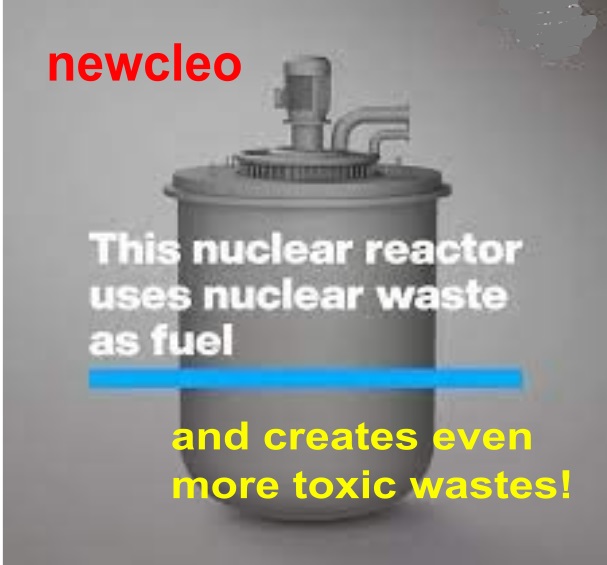
COMMENT. This is a very interesting article. For one thing, it shows that these “advanced” nuclear reactors require plutonium to get the fission process happening. It also claims that these advanced nuclear reactors can solve the problem of plutonium wastes. That is not true. The wastes resulting from this process are smaller in volume, but more highly toxic. That means that they require the same area/voume of space for disposal as the original plutonium. On another angle, it does indicate the confusion that the British government is in about the way ahead in their highly suspect “Civil Nuclear Roadmap”. And on another angle again, it shows how Macron’s France is putting all its eggs into the one nuclear basket. When we look at the extreme costs, and the extreme climate effects, Macron’s French nuclear obsession is likely to result in political suicide.
Matt Oliver, Sun, 21 January 2024, https://finance.yahoo.com/news/nuclear-start-drops-plans-british-131702123.html#:~:text=A%20British%20nuclear%20startup%20has,lobbied%20personally%20by%20Emmanuel%20Macron.
A British nuclear startup has dropped plans to build a pioneering power plant in Cumbria and will invest £4bn in France instead, after it was lobbied personally by Emmanuel Macron.
Newcleo, which is headquartered in London, is developing a type of mini nuclear power plant, known as an advanced modular reactor (AMR), that will use nuclear waste for fuel.
The company had hoped to tap into the UK’s vast stockpile of waste at Sellafield, where it wanted to invest £2bn in a waste reprocessing factory and AMR that would have created around 500 jobs.
It was also planning a similarly-sized facility in France.
But Stefano Buono, Newcleo’s chief executive and founder, said the company has now dropped the UK plans after the Government ruled out giving private companies access to the Sellafield stockpile in a nuclear industry “roadmap” published this month.
Instead, Newcleo is planning an enlarged development at an undisclosed location in the south of France, where it now plans to spend £4bn and create around 1,000 jobs, he said.
As part of that scheme, it will buy nuclear waste from French state energy giant EDF.
The company is also currently in the middle of a €1bn (£860m) fundraising.
The decision comes after the company was blocked from participating in the UK’s design competition for mini nuclear reactors.
By comparison, France has eagerly supported Newcleo and Mr Buono was lobbied repeatedly for investment by President Macron in face-to-face meetings.
Newcleo, which was also invited to last year’s “Choose France” business summit at the Palace of Versailles, has never been offered an in-person meeting with a British prime minister.
Mr Buono told The Telegraph: “Our plan initially was to use one factory in France and one in the UK.
“Now, we will double the capacity of France and we are not investing in the UK.”
He added that the company had hoped to pioneer its technology in Britain but added: “In two years, we were not able to even locate the site, so we have decided to accept the offer from France.
“We can proceed with our business model there.”
Newcleo’s decision to build its first plant abroad comes amid growing frustration within the British nuclear industry over the slow progress the Government has made towards identifying sites for new power plants.
The loss of significant investment to France will also be seen as the latest sign that Downing Street’s efforts to attract business investment are being outshone by President Macron, who has launched a charm offensive to lure companies across the Channel since Brexit.
He was the only G7 leader to attend the World Economic Forum in Davos, Switzerland, this week, while he has rolled out the red carpet for business leaders including Tesla boss Elon Musk and JP Morgan banker Jamie Dimon at his annual Choose France event.
Last year’s summit resulted in major deals, with Taiwanese car battery maker ProLogium unveiling plans for a €5.2bn plant at the port of Dunkirk and Verkor, a French company, pledging a €1.6bn battery factory there too.
In the UK, six SMR developers including Rolls-Royce have been shortlisted for support under a competition run by Great British Nuclear.
Newcleo was not considered because of the AMR’s lead cooling system and unusual fuel, Mr Buono has claimed.
The company’s novel design would run on processed plutonium, helping countries such as the UK dispose of the dangerous waste, which is expensive to manage. [Ed. This ignores the fact that this process results in a smaller volume of more highly toxic waste]
At Sellafield, the UK has amassed 140 tonnes of plutonium – the world’s biggest stockpile – as a result of historic nuclear weapons programmes and abandoned efforts to develop so-called fast breeding reactors that would have used it as fuel.
A massive effort is currently under way at the Cumbrian site to safely store the waste, but Mr Buono and his colleagues have argued it could be put to better use as reactor fuel.
The entrepreneur made his fortune selling cancer treatment developer AAA to Novartis for $3.9bn (£3.2bn) in 2017, reportedly earning him $420m.
His company has the backing of the Agnelli industrialist family, which made its money from Fiat and Ferrari.
The French government is expected to confirm a deal with Newcleo later this year.
The UK Government did not respond to requests for comment.
Big costs sink flagship nuclear project and they’ll sink future small modular reactor projects too.

By Susan O’Donnell and M.V. Ramana, 024, https://beyondnuclearinternational.org/2024/01/21/big-costs-sink-flagship-nuclear-project/
The major news in the world of nuclear energy last November was the collapse of the Carbon Free Power Project in the United States. The project was to build six NuScale small modular nuclear reactors (SMRs). Given NuScale’s status as the flagship SMR design not just in the U.S. but even globally, the project’s cancellation should ring alarm bells in Canada. Yet SMRs are touted as a climate action strategy although it is becoming clearer by the day that they will delay a possible transition to net-zero energy and render it more expensive.
The NuScale project failed because there were not enough customers for its expensive electricity. Construction cost estimates for the project had been steadily rising—from USD 4.2 billion for 600 megawatts in 2018 to a staggering USD 9.3 billion (CAD 12.8 billion) for 462 megawatts. Using a combination of government subsidies, potentially up to USD 4.2 billion, and an opaque calculation method, NuScale claimed that it would produce electricity at USD 89 per megawatt-hour. When standard U.S. government subsidies are included, electricity from wind and solar energy projects, including battery storage, could be as cheap as USD 12 to USD 31 per megawatt-hour.
A precursor to the failed NuScale project was mPower, which also received massive funding from the U.S. Department of Energy. Described by The New York Times as the leader in the SMR race, mPower could not find investors or customers. By 2017, the project was essentially dead. Likewise, a small reactor in South Korea proved to be “not practical or economic”.
Ignoring this dire economic reality, provincial governments planning for SMRs – Ontario, New Brunswick, Saskatchewan and Alberta – published a “strategic plan” seemingly designed to convince the federal government to open its funding floodgates. Offering no evidence about the costs of these technologies, the report asserts: “The power companies assessed that SMRs have the potential to be an economically competitive source of energy.”
For its part, the federal government has coughed up grants totalling more than $175 million to five different SMR projects in Ontario, New Brunswick, and Saskatchewan. The Canada Infrastructure Bank loaned $970 million to Ontario Power Generation to develop its Darlington New Nuclear project. And the Canada Energy Regulator’s 2023 Canada’s Energy Future report envisioned a big expansion of nuclear energy based on wishful thinking and unrealistic assumptions about SMRs.
Canada’s support is puzzling when considering other official statements about nuclear energy. In 2021, Environment Minister Steven Guilbeault said that nuclear power must compete with renewable energy in the market. The previous year, then Environment Minister and current Energy and Natural Resources Minister Jonathan Wilkinson also emphasized competition with other sources of energy, concluding “the winner will be the one that can provide electrical energy at the lowest cost.” Given the evidence about high costs, nuclear power cannot compete with renewable energy, let alone provide electricity at the lowest cost.
Investing huge amounts of taxpayer money in technologies that are uncompetitive is bad enough, but an equally serious problem is wasting time. The primary justification for this government largesse is dealing with climate change. But the urgency of that crisis requires action now, not in two decades.
All the SMR designs planned in Canada’s provinces are still on the drawing board. The design furthest along in the regulatory process – the BWRX-300 slated for Ontario’s Darlington site – does not yet have a licence to begin construction. New Brunswick’s choices – a sodium cooled fast reactor and a molten salt reactor – are demonstrably problematic and will take longer to build.
Recently built nuclear plants have taken, on average, 9.8 years from start of construction to producing electricity. The requisite planning, regulatory evaluations of new designs, raising the necessary finances, and finding customers who want to pay higher electricity bills might add another decade.
SMR vendors have to raise not only the billions needed to build the reactor but also the funding to complete their designs. NuScale spent around USD 1.8 billion (CAD 2.5 billion), and the reactor was still left with many unresolved safety problems. ARC-100 and Moltex proponents in New Brunswick have each asked for at least $500 million to further develop their designs. Moltex has been unable to obtain the required funding to match the $50.5 million federal grant it received in 2021.
Adverse economics killed the flagship NuScale SMR project. There is no reason to believe the costs of SMR designs proposed in Canada will be any lower. Are government officials attentive enough to hear the clanging alarm bells?
Susan O’Donnell is adjunct research professor and primary investigator of the CEDAR project at St. Thomas University in Fredericton. M.V. Ramana is the Simons Chair in Disarmament, Global and Human Security and professor at the School of Public Policy and Global Affairs, University of British Columbia.
1 This Month


PLEASE OPPOSE HR 8255 AND S.3639 – bills would accelerate satellite deployment, with no environmental review or safeguards – https://ncstd5li.quorum.us/campaign/169331/
To see nuclear-related stories in greater depth and intensity – go to https://nuclearinformation.wordpress.com
-
Archives
- September 2026 (194)
- August 2026 (330)
- July 2026 (355)
- June 2026 (287)
- May 2026 (306)
- April 2026 (356)
- March 2026 (251)
- February 2026 (267)
- January 2026 (308)
- December 2025 (358)
- November 2025 (359)
- October 2025 (375)
-
Categories
- 1
- 1 NUCLEAR ISSUES
- business and costs
- climate change
- culture and arts
- ENERGY
- environment
- health
- history
- indigenous issues
- Legal
- marketing of nuclear
- media
- opposition to nuclear
- PERSONAL STORIES
- politics
- politics international
- Religion and ethics
- safety
- secrets,lies and civil liberties
- spinbuster
- technology
- Uranium
- wastes
- weapons and war
- Women
- 2 WORLD
- ACTION
- AFRICA
- Atrocities
- AUSTRALIA
- Christina's notes
- Christina's themes
- culture and arts
- Events
- Fuk 2022
- Fuk 2023
- Fukushima 2017
- Fukushima 2018
- fukushima 2019
- Fukushima 2020
- Fukushima 2021
- general
- global warming
- Humour (God we need it)
- Nuclear
- RARE EARTHS
- Reference
- resources – print
- Resources -audiovicual
- Weekly Newsletter
- World
- World Nuclear
- YouTube
-
RSS
Entries RSS
Comments RSS
 nuclear-news