The Growing Environmental Footprint Of Generative AI

tech companies have been reporting whatever they choose, however they choose, about their AI impact

a great deal remains unrevealed about the millions of gallons of water used to cool computers running AI…… The same is true of carbon.
Undark, BY DAVID BERREBY, 02.20.2024
AI runs on power-hungry equipment that uses millions of gallons of fresh water. Policymakers are weighing the costs.
TWO MONTHS after its release in November 2022, OpenAI’s ChatGPT had 100 million active users, and suddenly tech corporations were racing to offer the public more “generative AI.” Pundits compared the new technology’s impact to the Internet, or electrification, or the Industrial Revolution — or the discovery of fire.
Time will sort hype from reality, but one consequence of the explosion of artificial intelligence is clear: this technology’s environmental footprint is large and growing.
AI use is directly responsible for carbon emissions from non-renewable electricity and for the consumption of millions of gallons of fresh water, and it indirectly boosts impacts from building and maintaining the power-hungry equipment on which AI runs. As tech companies seek to embed high-intensity AI into everything from resume-writing to kidney transplant medicine and from choosing dog food to climate modeling, they cite many ways AI could help reduce humanity’s environmental footprint. But legislators, regulators, activists, and international organizations now want to make sure the benefits aren’t outweighed by AI’s mounting hazards.
“The development of the next generation of AI tools cannot come at the expense of the health of our planet,” Massachusetts Senator Edward Markey said in a Feb. 1 statement in Washington, after he and other senators and representatives introduced a bill that would require the federal government to assess AI’s current environmental footprint and develop a standardized system for reporting future impacts. Similarly, the European Union’s “AI Act,” approved by member states last week, will require “high-risk AI systems” (which include the powerful “foundation models” that power ChatGPT and similar AIs) to report their energy consumption, resource use, and other impacts throughout their systems’ lifecycle. The EU law takes effect next year.
Meanwhile, the International Organization for Standardization, a global network that develops standards for manufacturers, regulators, and others, said it will issue criteria for “sustainable AI” later this year. Those will include standards for measuring energy efficiency, raw material use, transportation, and water consumption, as well as practices for reducing AI impacts throughout its life cycle, from the process of mining materials and making computer components to the electricity consumed by its calculations. The ISO wants to enable AI users to make informed decisions about their AI consumption.
Right now, it’s not possible to tell how your AI request for homework help or a picture of an astronaut riding a horse will affect carbon emissions or freshwater stocks. This is why 2024’s crop of “sustainable AI” proposals describe ways to get more information about AI impacts.
In the absence of standards and regulations, tech companies have been reporting whatever they choose, however they choose, about their AI impact, said Shaolei Ren, an associate professor of electrical and computer engineering at UC Riverside, who has been studying the water costs of computation for the past decade. Working from calculations of annual use of water for cooling systems by Microsoft, Ren estimates that a person who engages in a session of questions and answers with GPT-3 (roughly 10 t0 50 responses) drives the consumption of a half-liter of fresh water. “It will vary by region, and with a bigger AI, it could be more.” But a great deal remains unrevealed about the millions of gallons of water used to cool computers running AI, he said.
“Data scientists today do not have easy or reliable access to measurements of [greenhouse gas impacts from AI], which precludes development of actionable tactics,” a group of 10 prominent researchers on AI impacts wrote in a 2022 conference paper. Since they presented their article, AI applications and users have proliferated, but the public is still in the dark about those data, said Jesse Dodge, a research scientist at the Allen Institute for Artificial Intelligence in Seattle, who was one of the paper’s coauthors.
AI can run on many devices — the simple AI that autocorrects text messages will run on a smartphone. But the kind of AI people most want to use is too big for most personal devices, Dodge said. “The models that are able to write a poem for you, or draft an email, those are very large,” he said. “Size is vital for them to have those capabilities.”
Big AIs need to run immense numbers of calculations very quickly, usually on specialized Graphical Processing Units — processors originally designed for intense computation to render graphics on computer screens. Compared to other chips, GPUs are more energy-efficient for AI, and they’re most efficient when they’re run in large “cloud data centers” — specialized buildings full of computers equipped with those chips. The larger the data center, the more energy efficient it can be. Improvements in AI’s energy efficiency in recent years are partly due to the construction of more “hyperscale data centers,” which contain many more computers and can quickly scale up. Where a typical cloud data center occupies about 100,000 square feet, a hyperscale center can be 1 or even 2 million square feet.
Estimates of the number of cloud data centers worldwide range from around 9,000 to nearly 11,000. More are under construction. The International Energy Agency, or IEA, projects that data centers’ electricity consumption in 2026 will be double that of 2022 — 1,000 terawatts, roughly equivalent to Japan’s current total consumption.
However, as an illustration of one problem with the way AI impacts are measured, that IEA estimate includes all data center activity, which extends beyond AI to many aspects of modern life. Running Amazon’s store interface, serving up Apple TV’s videos, storing millions of people’s emails on Gmail, and “mining” Bitcoin are also performed by data centers. (Other IEA reports exclude crypto operations, but still lump all other data-center activity together.)
Most tech firms that run data centers don’t reveal what percentage of their energy use processes AI. The exception is Google, which says “machine learning” — the basis for humanlike AI — accounts for somewhat less than 15 percent of its data centers’ energy use…………………………………………………………………………………….
If global electricity use can feel a bit abstract, data centers’ water use is a more local and tangible issue — particularly in drought-afflicted areas. To cool delicate electronics in the clean interiors of the data centers, water has to be free of bacteria and impurities that could gunk up the works. In other words, data centers often compete “for the same water people drink, cook, and wash with,” said Ren.
In 2022, Ren said, Google’s data centers consumed about 5 billion gallons (nearly 20 billion liters) of fresh water for cooling. (“Consumptive use” does not include water that’s run through a building and then returned to its source.) According to a recent study by Ren, Google’s data centers used 20 percent more water in 2022 than they did in 2021, and Microsoft’s water use rose by 34 percent in the same period. (Google data centers host its Bard chatbot and other generative AIs; Microsoft servers host ChatGPT as well as its bigger siblings GPT-3 and GPT-4. All three are produced by OpenAI, in which Microsoft is a large investor.)
As more data centers are built or expanded, their neighbors have been troubled to find out how much water they take. For example, in The Dalles, Oregon, where Google runs three data centers and plans two more, the city government filed a lawsuit in 2022 to keep Google’s water use a secret from farmers, environmentalists, and Native American tribes who were concerned about its effects on agriculture and on the region’s animals and plants. The city withdrew its suit early last year. The records it then made public showed that Google’s three extant data centers use more than a quarter of the city’s water supply. And in Chile and Uruguay, protests have erupted over planned Google data centers that would tap into the same reservoirs that supply drinking water……………..more https://undark.org/2024/02/20/ai-environmental-footprint/?utm_source=Undark%3A+News+%26+Updates&utm_campaign=01eaa0c93b-RSS_EMAIL_CAMPAIGN&utm_medium=email&utm_term=0_5cee408d66-185e4e09de-%5BLIST_EMAIL_ID%5D
U.S. Militarizes Space While Accusing Russia of Doing So
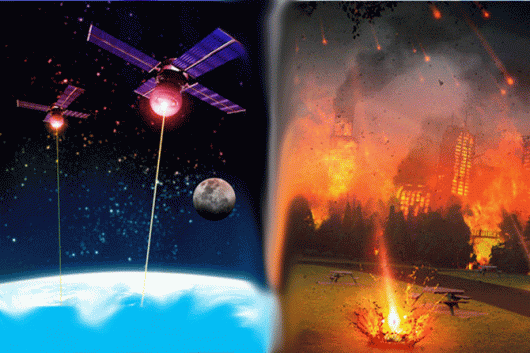
Since the creation of the U.S. Space Force in 2019, Washington has seen the militarization of space as a true strategic priority. At the time, then-American President Donald Trump had made it clear that the country’s objective was to achieve “American dominance in space.” Since then, several activities to increase American military space capabilities have been undertaken – many of them in partnership with other NATO countries and international allies.
In 2022, NATO began drafting a “space doctrine” based on “interoperability”. The following year, the alliance published a document exposing its main interests in space and pursuing American guidelines for the militarization of the orbit.
Lucas Leiroz, Strategic Culture Foundation, Tue, 20 Feb 2024, https://www.sott.net/article/489189-US-militarizes-space-while-accusing-Russia-of-doing-so
Recently, the U.S. began spreading rumors about alleged Russian space-based nuclear weapons. According to American intelligence, Moscow is developing a powerful anti-satellite weapon to be deployed in space, thus violating international norms that prohibit the militarization of Earth’s orbit.
In 2022, NATO began drafting a “space doctrine” based on “interoperability”. The following year, the alliance published a document exposing its main interests in space and pursuing American guidelines for the militarization of the orbit. According to analysts, the “interoperability” of NATO’s space activities simply means the creation of mechanisms for U.S. allies to help pay the high costs of military space development – while, on the other hand, only the Pentagon maintains real control of the activities and benefits from “space control”.
Mike Turner, head of the House Intelligence Committee, formally asked for the declassification of documents concerning the investigation on the “space-nukes”, stating that a deliberation on the case in the National Congress is necessary. According to Turner, American parliamentarians need to discuss this serious “threat” to U.S. national security, having therefore the requirement to fully release data obtained by intelligence on the subject.
Subsequently, the White House stated that there was no imminent threat to the country’s national security according to the information obtained so far. Spokespersons confirmed they are monitoring the possible existence of a Russian nuclear space program, but denied the existence of any evidence of a high-risk threat at the moment. As a result, once again American officials made contradictory statements, discrediting the image of U.S. authorities.
Moscow denied the accusations and stated that the rumors were intended to strengthen the anti-Russian establishment, pressuring parliamentarians to recognize the existence of a “threat” and thus approve the billion-dollar military aid package to Ukraine. Considering the domestic political stalemate in the U.S., with pro-war sectors failing to convince their opponents to continue aid to Kiev, it is very likely that the intention behind the spread of anti-Russian rumors is to actually increase fear among policymakers about a possible “danger”.
Obviously, as a major military power, the Russian Federation has its own anti-satellite systems and is able to employ them, if necessary, in a possible large-scale conflict scenario. However, the current tensions between Moscow and Washington, despite high, do not bring any need to use military force against American satellites, and there is therefore no “imminent threat” to the U.S. in the Russian arsenal.
In parallel, Moscow remains firmly committed to complying with international space law standards. The deployment of weapons of mass destruction in Earth’s orbit is banned by the treaties that regulate space activities. Therefore, even though it has weapons strong enough to inflict damage on enemy countries’ satellites, Russia is not willing to allocate nuclear weapons or weapons of mass destruction in outer space, as this would violate current regulations on the matter.
In fact, Russian actions regarding the outer space make it clear that Moscow intends to cooperate to prevent the militarization of Earth’s orbit. Russia, although it has the military capacity to do so, does not invest in “space-based” weapons, focusing its space activities on the peaceful and scientific sphere. This, however, is not the case with the U.S., which openly promotes the militarization of space, with constant efforts to turn Earth’s orbit into a true battlefield.
Since the creation of the U.S. Space Force in 2019, Washington has seen the militarization of space as a true strategic priority. At the time, then-American President Donald Trump had made it clear that the country’s objective was to achieve “American dominance in space.” Since then, several activities to increase American military space capabilities have been undertaken – many of them in partnership with other NATO countries and international allies.
“The U.S. Space Command planning document stated that the U.S. will ‘control and dominate space and deny other nations if necessary access to space (…) At the Space Command HQ in Colorado just above their doorway they have a sign that reads ‘Master of Space (…) Even with all its resources the U.S. can’t afford to pay for its ‘Master of Space’ plan by itself (…) [In order to maintain its dominance], the U.S. sets up a story line that it ‘must protect space’ from the dark forces in Russia, China, Iran, and North Korea (…) Interoperability’ ensures that all NATO members purchase new expensive space technologies mostly from U.S. aerospace corporations like Lockheed Martin, Raytheon, and others. In addition, ‘interoperability’ means that all space information, surveillance, and targeting is run through the U.S.-dominated system. In other words, NATO allies help pay for these costly space warfare systems but the Pentagon controls the ‘tip of the spear’,” Professor Bruce Gagnon, director of the Global Network Against Weapons and Nuclear Power in Space, once said commenting on the topic.
All these factors lead us to believe that there really was an attempt on the part of the U.S. to create a smokescreen for its own space militarization activities. By pointing out the existence of a “Russian danger”, Washington legitimizes its own “reactive” policies, thus encouraging increased investment in space weapons in NATO. In the same sense, this smokescreen helps to pressure parliamentarians to revise their stance on supporting Ukraine. With the popularity of the anti-Russian war gradually decreasing, the creation of a non-existent threat could serve as a legitimizing factor for the conflict.
In addition to all this, it is curious how contradictory U.S. narratives about Russia fluctuate. Previously, the American media accused the Russians of fighting using shovels due to the lack of weapons. Now, on the other hand, they accuse Russia of deploying nuclear weapons from space. These lies only worsen the mainstream media’s own image among Western public opinion, leading to absolute discredit.
What’s fueling the commercial fusion hype?

Despite its lack of promise for civilian use, the Energy Department and the White House have used the Livermore controlled fusion experiment results to boost the effort to harness fusion power for civilian purposes. In December 2022, Energy Secretary Jennifer Granholm announced with great fanfare that a laser pulse ignited a fusion reaction that produced more energy than was supplied by the light beams
In her energy balance, however, the energy secretary forgot to account for the energy it took to create the laser beams. This energy input, when added, drastically reverses her conclusion
By Victor Gilinsky | February 20, 2024,
https://thebulletin.org/2024/02/whats-fueling-the-commercial-fusion-hype/
Recent White House and Energy Department pronouncements on speeding up the “commercialization” of fusion energy are so over the top as to make you wonder about the scientific competence in the upper reaches of the government.
In April 2022, the White House launched what it called a “bold decadal vision” for a 10-year program to “accelerate the realization of commercial fusion energy.” The “bold” part is the proposal, in questionable analogy with high-speed computing, to do in parallel all the development steps that are typically done sequentially to bring a new technology to the market. According to the White House, this parallel processing would include: technology development, preparing a regulatory system (including rules for fusion reactor exports), securing the supply chain, identifying high-value markets, training a diverse workforce, and gaining public support, all “to support the rapid scale-up of fusion energy facilities.”
The special attraction of fusion is of course that it offers a potential source of abundant carbon-free energy that does not generate radioactive nuclear waste. But just because it would be nice if controlled fusion could work doesn’t mean it’s on the verge of doing so. The hard truth is that scientists and engineers don’t even know yet whether controlled fusion can be achieved to make useful work, at least anywhere outside the sun (and other stars, of course).
A historical perspective is useful to understand where the hype about commercial fusion is coming from.
We have known about fusion powering the sun since Hans Bethe explained it in 1939. This was also almost exactly when Otto Hahn and Fritz Strassmann discovered uranium fission (and Lise Meitner and her nephew Otto Frisch explained it). Then in 1942, Enrico Fermi and a small number of co-workers demonstrated a controlled fission chain reaction in a squash court at the University of Chicago. Fermi spent about $50 million in today’s dollars on building his 20-foot-tall atomic pile.
More than 80 years later, the corresponding control-of-fusion principle has yet to be demonstrated experimentally and the US government already made $35 billion in cumulative fusion expenditure—with probably a comparable investment abroad—without yet knowing what works.
The White House’s approach to attain success appears based on the idea that enthusiasm and coordination of all diverse stakeholders backed up with enough money can solve a so-far-unsolved scientific problem. Administration spokespersons mention projects that were successfully accelerated in this way, like the 1969 trip to the moon. Sure, this was indeed a hugely successful monumental project at the time, but no one involved doubted it was possible to do. All the necessary component technologies, like rockets and communications, were in hand on a smaller scale. In the case of fusion power reactors, no one is yet sure what they would look like, let alone if they will turn out to be possible and practicable.
The main research track today in fusion energy is “magnetic confinement”—configuring magnetic fields to keep in place a plasma of thermonuclear fuel 10 times hotter than the sun’s core within a donut-shaped magnetic “bottle.” Dozens of such machines—known as “tokamaks,” a Russian-language transliteration for toroidal chamber with axial magnetic field—have been built around the world since the 1950s, but none got close to demonstrating a net energy gain. Controlled fusion, it turns out, is an extremely difficult problem. To solve it, fusion experts have concluded the key is to have a large enough facility.
The world’s largest experimental fusion machine—ITER (initially the International Thermonuclear Experimental Reactor, also meaning “the way” in Latin)—is nearing completion in France. It is a highly complex scientific and engineering project. ITER publicity describes the building housing the reactor as “slightly taller than the Arc de Triomphe in Paris,” and that the building foundation will support some 400,000 metric tons—“more than the weight of New York’s Empire State Building.” Started in 2006, ITER is a 35-country megaproject that was supposed to be completed in 2016 at a cost of $6 billion. The reactor is currently projected to start up in 2025, but even that appears to be an optimistic date, as is the total budget estimate of about $22 billion.
The initial design objective is to produce a fusion plasma with thermal power 10 times greater than the injected thermal power. Even if successful, this net power output would not yet be the fusion equivalent of Fermi’s 1942 experimental nuclear pile, which proved the controlled fission concept. Nor would ITER’s more ambitious subsequent goal of maintaining this plasma for eight minutes. To get to proof of principle would likely take another step or an upgrading of ITER.
The Lawrence Livermore National Laboratory’s weapons laboratory pursued another approach of “internal confinement,” to create a fusion reaction at its National Ignition Facility (NIF) and claimed it could have power application. NIF uses light pulses from a concentric battery of powerful lasers to heat a small target containing a tiny bead of frozen thermonuclear fuel. This is, in effect, a miniature (secondary) thermonuclear bomb, with the lasers playing the role of the triggering fission reactions (primary). The light heats the container material sufficiently to ablate and swiftly compress the fuel to the point of detonation, which lasts some billionths of a second. The experiment was directed primarily at developing a useful diagnostic tool for weapons research. In power application, you would have to repeat the explosions at an extraordinarily fast rate, which is a tall order.
Despite its lack of promise for civilian use, the Energy Department and the White House have used the Livermore controlled fusion experiment results to boost the effort to harness fusion power for civilian purposes. In December 2022, Energy Secretary Jennifer Granholm announced with great fanfare that a laser pulse ignited a fusion reaction that produced more energy than was supplied by the light beams: “This milestone moves us one significant step closer to the possibility of zero carbon abundant energy powering our society … a huge step forward to the president’s goal of achieving commercial fusion within a decade.” (Update: In less than nine years from now.)
In her energy balance, however, the energy secretary forgot to account for the energy it took to create the laser beams. This energy input, when added, drastically reverses her conclusion, with the fusion output then amounting to only about one percent of the input. This is not disqualifying from a scientific point of view, but it obviously is in a power generating application. Still, this hasn’t stopped the Energy Department from including Livermore’s fusion ignition experiment in a promotional video on the “7 moments that changed nuclear energy history.” The clip claims “[t]he Lab was the first to produce more energy from a fusion reaction than was used to start the process,” again forgetting the energy it took to power the lasers.
Swarming Our World. What Happens When Killer Robots Start Communicating with Each Other?

“Emergent” AI Behavior and Human Destiny
What Happens When Killer Robots Start Communicating with Each Other?
Tom Dispatch, Michael Klare, FEBRUARY 20, 2024
Make no mistake, artificial Intelligence (AI) has already gone into battle in a big-time way. The Israeli military is using it in Gaza on a scale previously unknown in wartime. They’ve reportedly been employing an AI target-selection platform called (all too unnervingly) “the Gospel” to choose many of their bombing sites. According to a December report in the Guardian, the Gospel “has significantly accelerated a lethal production line of targets that officials have compared to a ‘factory.’” The Israeli Defense Forces (IDF) claim that it “produces precise attacks on infrastructure associated with Hamas while inflicting great damage to the enemy and minimal harm to noncombatants.” Significantly enough, using that system, the IDF attacked 15,000 targets in Gaza in just the first 35 days of the war. And given the staggering damage done and the devastating death toll there, the Gospel could, according to the Guardian, be thought of as an AI-driven “mass assassination factory.”
Meanwhile, of course, in the Ukraine War, both the Russians and the Ukrainians have been hustling to develop, produce, and unleash AI-driven drones with deadly capabilities. Only recently, in fact, Ukrainian President Volodymyr Zelensky created a new branch of his country’s armed services specifically focused on drone warfare and is planning to produce more than one million drones this year. According to the Independent, “Ukrainian forces are expected to create special staff positions for drone operations, special units, and build effective training. There will also be a scaling-up of production for drone operations, and inclusion of the best ideas and top specialists in the unmanned aerial vehicles domain, [Ukrainian] officials have said.”
And all of this is just the beginning when it comes to war, AI-style, which is going to include the creation of “killer robots” of every imaginable sort. But as the U.S., Russia, China, and other countries rush to introduce AI-driven battlefields, let TomDispatch regular Michael Klare, who has long been focused on what it means for the globe’s major powers to militarize AI, take you into a future in which (god save us all!) robots could be running (yes, actually running!) the show. Tom
By combining AI with advanced robotics, the U.S. military and those of other advanced powers are already hard at work creating an array of self-guided “autonomous” weapons systems — combat drones that can employ lethal force independently of any human officers meant to command them. Called “killer robots” by critics, such devices include a variety of uncrewed or “unmanned” planes, tanks, ships, and submarines capable of autonomous operation. The U.S. Air Force, for example, is developing its “collaborative combat aircraft,” an unmanned aerial vehicle (UAV) intended to join piloted aircraft on high-risk missions. The Army is similarly testing a variety of autonomous unmanned ground vehicles (UGVs), while the Navy is experimenting with both unmanned surface vessels (USVs) and unmanned undersea vessels (UUVs, or drone submarines). China, Russia, Australia, and Israel are also working on such weaponry for the battlefields of the future.
Michael Klare, Swarming Our World
POSTED ON FEBRUARY 20, 2024
Make no mistake, artificial Intelligence (AI) has already gone into battle in a big-time way. The Israeli military is using it in Gaza on a scale previously unknown in wartime. They’ve reportedly been employing an AI target-selection platform called (all too unnervingly) “the Gospel” to choose many of their bombing sites. According to a December report in the Guardian, the Gospel “has significantly accelerated a lethal production line of targets that officials have compared to a ‘factory.’” The Israeli Defense Forces (IDF) claim that it “produces precise attacks on infrastructure associated with Hamas while inflicting great damage to the enemy and minimal harm to noncombatants.” Significantly enough, using that system, the IDF attacked 15,000 targets in Gaza in just the first 35 days of the war. And given the staggering damage done and the devastating death toll there, the Gospel could, according to the Guardian, be thought of as an AI-driven “mass assassination factory.”
Meanwhile, of course, in the Ukraine War, both the Russians and the Ukrainians have been hustling to develop, produce, and unleash AI-driven drones with deadly capabilities. Only recently, in fact, Ukrainian President Volodymyr Zelensky created a new branch of his country’s armed services specifically focused on drone warfare and is planning to produce more than one million drones this year. According to the Independent, “Ukrainian forces are expected to create special staff positions for drone operations, special units, and build effective training. There will also be a scaling-up of production for drone operations, and inclusion of the best ideas and top specialists in the unmanned aerial vehicles domain, [Ukrainian] officials have said.”
And all of this is just the beginning when it comes to war, AI-style, which is going to include the creation of “killer robots” of every imaginable sort. But as the U.S., Russia, China, and other countries rush to introduce AI-driven battlefields, let TomDispatch regular Michael Klare, who has long been focused on what it means for the globe’s major powers to militarize AI, take you into a future in which (god save us all!) robots could be running (yes, actually running!) the show. Tom
“Emergent” AI Behavior and Human Destiny
What Happens When Killer Robots Start Communicating with Each Other?
Yes, it’s already time to be worried — very worried. As the wars in Ukraine and Gaza have shown, the earliest drone equivalents of “killer robots” have made it onto the battlefield and proved to be devastating weapons. But at least they remain largely under human control. Imagine, for a moment, a world of war in which those aerial drones (or their ground and sea equivalents) controlled us, rather than vice-versa. Then we would be on a destructively different planet in a fashion that might seem almost unimaginable today. Sadly, though, it’s anything but unimaginable, given the work on artificial intelligence (AI) and robot weaponry that the major powers have already begun. Now, let me take you into that arcane world and try to envision what the future of warfare might mean for the rest of us.
By combining AI with advanced robotics, the U.S. military and those of other advanced powers are already hard at work creating an array of self-guided “autonomous” weapons systems — combat drones that can employ lethal force independently of any human officers meant to command them. Called “killer robots” by critics, such devices include a variety of uncrewed or “unmanned” planes, tanks, ships, and submarines capable of autonomous operation. The U.S. Air Force, for example, is developing its “collaborative combat aircraft,” an unmanned aerial vehicle (UAV) intended to join piloted aircraft on high-risk missions. The Army is similarly testing a variety of autonomous unmanned ground vehicles (UGVs), while the Navy is experimenting with both unmanned surface vessels (USVs) and unmanned undersea vessels (UUVs, or drone submarines). China, Russia, Australia, and Israel are also working on such weaponry for the battlefields of the future.
The imminent appearance of those killing machines has generated concern and controversy globally, with some countries already seeking a total ban on them and others, including the U.S., planning to authorize their use only under human-supervised conditions. In Geneva, a group of states has even sought to prohibit the deployment and use of fully autonomous weapons, citing a 1980 U.N. treaty, the Convention on Certain Conventional Weapons, that aims to curb or outlaw non-nuclear munitions believed to be especially harmful to civilians. Meanwhile, in New York, the U.N. General Assembly held its first discussion of autonomous weapons last October and is planning a full-scale review of the topic this coming fall.
For the most part, debate over the battlefield use of such devices hinges on whether they will be empowered to take human lives without human oversight. Many religious and civil society organizations argue that such systems will be unable to distinguish between combatants and civilians on the battlefield and so should be banned in order to protect noncombatants from death or injury, as is required by international humanitarian law. American officials, on the other hand, contend that such weaponry can be designed to operate perfectly well within legal constraints.
However, neither side in this debate has addressed the most potentially unnerving aspect of using them in battle: the likelihood that, sooner or later, they’ll be able to communicate with each other without human intervention and, being “intelligent,” will be able to come up with their own unscripted tactics for defeating an enemy — or something else entirely. Such computer-driven groupthink, labeled “emergent behavior” by computer scientists, opens up a host of dangers not yet being considered by officials in Geneva, Washington, or at the U.N.
For the time being, most of the autonomous weaponry being developed by the American military will be unmanned (or, as they sometimes say, “uninhabited”) versions of existing combat platforms and will be designed to operate in conjunction with their crewed counterparts. While they might also have some capacity to communicate with each other, they’ll be part of a “networked” combat team whose mission will be dictated and overseen by human commanders. The Collaborative Combat Aircraft, for instance, is expected to serve as a “loyal wingman” for the manned F-35 stealth fighter, while conducting high-risk missions in contested airspace. The Army and Navy have largely followed a similar trajectory in their approach to the development of autonomous weaponry.
The Appeal of Robot “Swarms”
However, some American strategists have championed an alternative approach to the use of autonomous weapons on future battlefields in which they would serve not as junior colleagues in human-led teams but as coequal members of self-directed robot swarms. Such formations would consist of scores or even hundreds of AI-enabled UAVs, USVs, or UGVs — all able to communicate with one another, share data on changing battlefield conditions, and collectively alter their combat tactics as the group-mind deems necessary.
“Emerging robotic technologies will allow tomorrow’s forces to fight as a swarm, with greater mass, coordination, intelligence and speed than today’s networked forces,” predicted Paul Scharre, an early enthusiast of the concept, in a 2014 report for the Center for a New American Security (CNAS). “Networked, cooperative autonomous systems,” he wrote then, “will be capable of true swarming — cooperative behavior among distributed elements that gives rise to a coherent, intelligent whole.”
As Scharre made clear in his prophetic report, any full realization of the swarm concept would require the development of advanced algorithms that would enable autonomous combat systems to communicate with each other and “vote” on preferred modes of attack. This, he noted, would involve creating software capable of mimicking ants, bees, wolves, and other creatures that exhibit “swarm” behavior in nature. As Scharre put it, “Just like wolves in a pack present their enemy with an ever-shifting blur of threats from all directions, uninhabited vehicles that can coordinate maneuver and attack could be significantly more effective than uncoordinated systems operating en masse.”
In 2014, however, the technology needed to make such machine behavior possible was still in its infancy. To address that critical deficiency, the Department of Defense proceeded to fund research in the AI and robotics field, even as it also acquired such technology from private firms like Google and Microsoft. A key figure in that drive was Robert Work, a former colleague of Paul Scharre’s at CNAS and an early enthusiast of swarm warfare. Work served from 2014 to 2017 as deputy secretary of defense, a position that enabled him to steer ever-increasing sums of money to the development of high-tech weaponry, especially unmanned and autonomous systems.
From Mosaic to Replicator
Much of this effort was delegated to the Defense Advanced Research Projects Agency (DARPA), the Pentagon’s in-house high-tech research organization. As part of a drive to develop AI for such collaborative swarm operations, DARPA initiated its “Mosaic” program, a series of projects intended to perfect the algorithms and other technologies needed to coordinate the activities of manned and unmanned combat systems in future high-intensity combat with Russia and/or China…………………………………………………………………………………………………………..
To obtain both the hardware and software needed to implement such an ambitious program, the Department of Defense is now seeking proposals from traditional defense contractors like Boeing and Raytheon as well as AI startups like Anduril and Shield AI. While large-scale devices like the Air Force’s Collaborative Combat Aircraft and the Navy’s Orca Extra-Large UUV may be included in this drive, the emphasis is on the rapid production of smaller, less complex systems like AeroVironment’s Switchblade attack drone, now used by Ukrainian troops to take out Russian tanks and armored vehicles behind enemy lines.
At the same time, the Pentagon is already calling on tech startups to develop the necessary software to facilitate communication and coordination among such disparate robotic units and their associated manned platforms. To facilitate this, the Air Force asked Congress for $50 million in its fiscal year 2024 budget to underwrite what it ominously enough calls Project VENOM, or “Viper Experimentation and Next-generation Operations Model.” Under VENOM, the Air Force will convert existing fighter aircraft into AI-governed UAVs and use them to test advanced autonomous software in multi-drone operations. The Army and Navy are testing similar systems.
When Swarms Choose Their Own Path
In other words, it’s only a matter of time before the U.S. military (and presumably China’s, Russia’s, and perhaps those of a few other powers) will be able to deploy swarms of autonomous weapons systems equipped with algorithms that allow them to communicate with each other and jointly choose novel, unpredictable combat maneuvers while in motion. Any participating robotic member of such swarms would be given a mission objective (“seek out and destroy all enemy radars and anti-aircraft missile batteries located within these [specified] geographical coordinates”) but not be given precise instructions on how to do so. That would allow them to select their own battle tactics in consultation with one another. If the limited test data we have is anything to go by, this could mean employing highly unconventional tactics never conceived for (and impossible to replicate by) human pilots and commanders.
…………………………………… In military terms, this means that a swarm of autonomous weapons might jointly elect to adopt combat tactics none of the individual devices were programmed to perform — possibly achieving astounding results on the battlefield, but also conceivably engaging in escalatory acts unintended and unforeseen by their human commanders, including the destruction of critical civilian infrastructure or communications facilities used for nuclear as well as conventional operations………………………………………………..
What then? Might they choose to keep fighting beyond their preprogrammed limits, provoking unintended escalation — even, conceivably, of a nuclear kind? Or would they choose to stop their attacks on enemy forces and instead interfere with the operations of friendly ones, perhaps firing on and devastating them
……………………………….. Many prominent security and technology officials are, however, all too aware of the potential risks of this “emergent behavior” in future robotic weaponry and continue to issue warnings against the rapid utilization of AI in warfare.
Of particular note is the final report that the National Security Commission on Artificial Intelligence issued in February 2021. Co-chaired by Robert Work (back at CNAS after his stint at the Pentagon) and Eric Schmidt, former CEO of Google, the commission recommended the rapid utilization of AI by the U.S. military to ensure victory in any future conflict with China and/or Russia. However, it also voiced concern about the potential dangers of robot-saturated battlefields……………………………………………………………..
When the leading advocates of autonomous weaponry tell us to be concerned about the unintended dangers posed by their use in battle, the rest of us should be worried indeed. Even if we lack the mathematical skills to understand emergent behavior in AI, it should be obvious that humanity could face a significant risk to its existence, should killing machines acquire the ability to think on their own…………… more https://tomdispatch.com/emergent-ai-behavior-and-human-destiny/—
Touring South Korea to support opposition to US space warfare plans
Organizing notes, Bruce Gagnon, 19 Feb 24
https://space4peace.blogspot.com/2024/02/touring-south-korea-to-support.html
I’ve just landed in South Korea (ROK) where I will be on a speaking tour around the country for the next 10 days.
I was invited to come and talk about Washington’s push to entrap South Korea into the Pentagon’s space technology strategy aimed at North Korea, China and Russia.
Already at the US Osan AFB in South Korea the Space Force has set up operations with the ROK client state.
The US has pushed the right-wing Seoul government to massively expand their spending on military space tech. With the current US national debt now at $35 trillion, Washington can’t afford to pay for its expensive and ambitious plans to ‘control and dominate’ space. Thus the #1 job of the Pentagon and State Department is to get the allies to help pay for the space warfare infrastructure.
Currently the ROK government is building space R & D centers, satellite production facilities, new airfields likely to test hypersonic missiles and expanding ‘missile defense’ deployment sites.
One key goal the US has is to use ROK satellite production and launch facilities to hoist mini-satellites into Lower Earth Orbit (LEO) to help fill up the already crowded orbits before China and Russia can get there. Eyes and ears in LEO give a nation a decisive advantage in full scale war making.
Late last year the US hosted a big space industry conference in the capital city of Seoul in order to cement this expanding space warfare relationship. Dangling the promise of ‘lots of high-tech jobs’ the US has drawn the ROK into the trap.
The problem for the ROK (like all of Washington’s allies participating in this space warfare operation) is that they will have little to no input into how and when this Star Wars program will be used. Even though ROK will help pay for it (and host many of the bases) the Pentagon will remain in charge of the ‘tip of the spear’. Once becoming a colony of the US war machine, a nation loses their right to be full partners.
One sad thing about all of this is how Jeju Island (just off the southern tip of the Korean peninsula) is becoming further militarized via this new space tech operation.
Late last year the US hosted a big space industry conference in the capital city of Seoul in order to cement this expanding space warfare relationship. Dangling the promise of ‘lots of high-tech jobs’ the US has drawn the ROK into the trap.
The problem for the ROK (like all of Washington’s allies participating in this space warfare operation) is that they will have little to no input into how and when this Star Wars program will be used. Even though ROK will help pay for it (and host many of the bases) the Pentagon will remain in charge of the ‘tip of the spear’. Once becoming a colony of the US war machine, a nation loses their right to be full partners.
One sad thing about all of this is how Jeju Island (just off the southern tip of the Korean peninsula) is becoming further militarized via this new space tech operation.
Is there really a nuclear weapon in space?
CASSANDRA STEER, The Interpreter, 18 Feb 24
Calm down, Congressman.
Alarm was raised in the media this week about a “national security threat” to the United States from Russia, ostensibly a nuclear space-based weapon. The news came after the Republican chair of the US House of Representatives intelligence committee, Mike Turner, unusually went public with an allegation based on classified intelligence that had not yet been properly discussed across the National Security briefing channels.
The fact that a cryptic, public allegation was made about a threat in space, combined with repetitions of one unnamed source referring to a potential nuclear capability, has led to some sensationalised news articles, and a lot of misleading conclusions, that Russia has a nuclear space weapon. Lack of clarity can lead to misunderstanding, misinterpretations, and possible missteps, which are in fact the biggest threats to space security.
This news is useful in terms of raising awareness of the high stakes in space security. But as became clear when White House National Security Communications Adviser John Kirby spoke earlier today, this potential capability does “not pose an urgent threat to the United States”– i.e.: it doesn’t yet exist.
We do know all the great powers, many middle powers and even smaller nations are developing counter-space capabilities, most of which are non-kinetic, and the most effective of which have temporary, but highly impactful effects. But this is not “Star Wars”, there are no space-based nuclear weapons.
Space is critical to national, regional and international security, because of how integral space-based services are to civil life and military operations. Satellites have been key military sources of intelligence, surveillance and reconnaissance (ISR) since the 1960s, and continue to be so today. Space-based communications, internet and navigation (such as GPS) are part of our daily lives without most of us thinking about where they come from, and they are a major source of military communications, operational navigation on land, at sea and in the air, as well as guidance for precision weapons.
Because of these high dependencies, space has itself become a strategic domain. In recent decades, increasingly sophisticated counter-space capabilities have been developed globally to interfere with these systems. The most effective way to compromise an adversary’s eyes and ears is to interfere with their space systems, whether by jamming a signal, listening in on a signal, spoofing a false positioning signal, or undertaking a cyberattack on a satellite operation. These are all temporary, reversible means of targeting a satellite or the signals and data it sends to Earth. There is a reason these means are preferred over kinetic, destructive means.
Nuclear weapons (and weapons of mass destruction) are the only type of weapon prohibited in the 1967 Outer Space Treaty, in article IV. The Soviets and the United States, together with many other countries, were able to agree on this treaty at the height of the Cold War, because they realised that strategic restraint was the only way to ensure they would both continue to have access to this new critical domain. In other words, after their own nuclear and Electro-Magnetic Pulse tests in the 1960s, they realised there was no way to contain the effects of such weapons, and their own capabilities would be impacted. A lose-lose scenario.
Perhaps the strongest lessons came from the US nuclear test known as Starfish Prime, which took out US, UK and other national satellite capabilities, reaching from the east coast of the United States to Australia. US and Soviet decision-makers realised they needed to secure their own access to space by prohibiting such weapons, and other countries pushed to ensure these superpowers would not take nuclear war to space, denying access to space for others………………………………………………………………………………. more https://www.lowyinstitute.org/the-interpreter/there-really-nuclear-weapon-space
Exploding Alberta’s Myths about Small Nuclear Reactors

Small nuclear reactors are unproven and years away from being in use. But the Alberta government is presenting them as a way to keep fossil fuels flowing.
The untested technology is more about greenwashing than about cutting emissions.
Tim Rauf 15 Feb 2024, The Tyee
Alberta’s government is really excited about nuclear power.
More specifically, about novel and unproven small modular nuclear reactors. It hopes to use these to help lower the province’s carbon emissions while letting the energy industry continue operating as usual — an enticing prospect to the government given its intention to increase oil and gas production, while still having the energy sector get to net zero by 2050.
Small modular nuclear reactors produce less than one-third of the electricity of a traditional reactor.
The premise is that small reactors are easier to place and build, and cheaper.
Alberta hitched its horse to this wagon with Ontario, New Brunswick and Saskatchewan in 2022, taking part in a strategic plan for small modular reactor development and deployment. Alberta Innovates, the province’s research body, had a feasibility study conducted for it by Pacific Northwest National Laboratory. The study focused on using the reactors for greenhouse-gas-free steam emissions for oilsands projects, electricity generation in our deregulated market and providing an alternative to diesel when supplying power to remote communities.
More recently, Ontario Power Generation and Capital Power out of Edmonton entered into an agreement to assess SMRs for providing nuclear energy to Alberta’s grid. Nathan Neudorf, Alberta’s minister of affordability and utilities, was gleeful. “This partnership represents an exciting and important step forward in our efforts to decarbonize the grid while maintaining on-demand baseload power,” he said of the announcement.
All of this buzz makes it seem like SMRs are just over the horizon, an inevitability that will allow the province to evolve to have a cleaner, modern energy landscape.
But small modular reactors are nowhere near ready for deployment, and won’t be in Alberta for about a decade. That means for 10 years, they’ll provide no GHG-free steam to mitigate emissions.
“It’s still in the design phase,” Kennedy Halvorson said, speaking about the reactors. Halvorson is a conservation specialist with the Alberta Wilderness Association. The reactors are “so far off from being able to be used for us,” Halvorson added. “The earliest projections would be 2030. And we need to be reducing our emissions before 2030. So, we need to have solutions now, basically.”
With SMRs unable to stem the emissions tide for years, it’s confusing as to how they could make enough of a difference to get Alberta to net zero by 2050 (in line with United Nations emissions reduction targets to keep global warming to no more than 1.5 degrees).
Capital Power made similar projections………………………………………………………………………..
Construction itself is only one piece. Adding to that is the need to build a regulatory framework, which Alberta doesn’t have for nuclear…………………………………………………….
Ontario’s nuclear troubles
Listening to these public voices is prudent. We can look east to see what happens when the government and power utilities sidestep the process of getting explicit consent from communities that stand to be affected.
With its status as the nuclear activity hub in Canada, we can use Ontario as a litmus test of sorts and gauge Canada’s track record of care with nuclear. The report card isn’t great. There have been multiple cases of improper consultation with Indigenous Peoples on whose lands the waste, production or extraction sites are placed………………………………………………………………………..
Small reactors face a critical economic challenge
Adding to the timeline troubles are questions as to whether small reactors truly offer that much of an economic advantage, if any, compared with their larger counterparts.
In a previous article Ramana wrote, he pointed to the first reactors as an indication of the answer.
The first reactors started off small. Their size, though, coupled with the exorbitant price tag of nuclear development, meant they couldn’t compete with fossil fuels.
The only thing they could do to reduce the disadvantage was to build larger and larger reactors, Ramana said.

A large reactor that could produce five times as much electricity didn’t cost five times as much to build, he said, improving the return from the investment.
Economically the SMR can’t seem to compete with its larger sibling. Adding this to the delays abundant with nuclear, controversies around construction and communities, and the misalignment of timelines for meeting climate commitments, we need to ask why we’re seeing such a fervent enthusiasm for small modular reactors.
Greenwashing by any other name
The answer is likely a simple one: The Alberta government wants to keep the taps on. Their friends in the energy industry do too. Like carbon capture and sequestration before it, SMRs are the next way to stave off pesky talk of divestment and transition…………………………………………………………….
Deflecting and delaying isn’t the only greenwashing happening either, Halvorson argued. She noted there’s a special kind of tactic that comes with nuclear and other “clean” technology, where only carbon dioxide and greenhouse gas offsets are counted.
“When we reduce it all to just how much CO2 something emits, we’re not getting the full picture of environmental impacts,” Halvorson said. She pointed to water use in nuclear as an example.

“Most nuclear technologies require a massive input of water to work. And as we know, right now we’re in a drought in Alberta. Our water resources are so precious. We already have industries that are using way too much water as is, in a way that’s not allowing our environments and ecosystems to replenish their reserves, like their water resources,” she said.
Despite the cheerleading for nuclear Alberta, where small nuclear reactors will let us enjoy the fruits of fossil fuels (and even produce more) in a cleaner way, the bones don’t read that way. The argument that we can keep on drilling so long as we have that newest silver bullet hasn’t stood up to scrutiny before, and it doesn’t now. https://thetyee.ca/Analysis/2024/02/15/Exploding-Alberta-Myths-Small-Nuclear-Reactors/
Waste issues need consideration in SMR deployment, says UK’s Committee on Radioactive Waste Management (CoRWM).

https://world-nuclear-news.org/Articles/Waste-issues-need-consideration-in-SMR-deployment 14 Feb 24
Waste management issues need to have a significantly greater prominence in the process of developing and deploying small modular reactor and advanced modular reactor designs, according to the UK’s Committee on Radioactive Waste Management (CoRWM).
There is considerable impetus for the development of small modular reactor (SMR) and advanced modular reactor (AMR) designs and their commercial deployment, both for energy security and for environmental reasons, particularly given the historic difficulties of deploying reactors at gigawatt scale,” CoRWM notes in a new position paper.
However, it says the issue of managing the used fuel and radioactive waste from these new reactors “appears, with some exceptions … to have been largely ignored or at least downplayed up to now”. It adds that the issue “must be considered when selecting technologies for investment, further development, construction and operation”.
The paper says: “This must involve addressing the uncertainties about such management at an early stage, to avoid costly mistakes which have been made in the past, by designing reactors without sufficient consideration of how spent fuel and wastes would be managed, and also to provide financial certainty for investors regarding lifetime costs of operation and decommissioning.”
CoRWM says it is essential to know: the nature and composition of the waste and, in particular, of the used fuel; its likely heat generation and activity levels; how it could feasibly be packaged and its volume; and when it is likely to arise.
“So far there is little published material from the promoters and developers of new reactor types to demonstrate that they are devoting the necessary level of attention to the waste prospectively arising from SMR/AMRs,” it notes.
The position paper provides recommendations to the UK government, Great British Nuclear (GBN), and Nuclear Waste Services and regulators to consider as SMR and AMR deployment is progressed.
“There are many questions to be answered concerning the radioactive waste and spent fuel management aspects of the design and operation of SMRs and AMRs,” CoRWM says. “This paper begins the process of raising them, with the caveat that our knowledge of the reactor designs and their fuel requirements is relatively immature compared with large GW reactors.”
CoRWM says there are various mechanisms by which these questions could be addressed in the process of obtaining approval for the new reactors. These are principally: the process of justification, which will be mandatory for all new reactor types; Generic Design Assessment which is optional and non-statutory; nuclear site licensing; and environmental permitting.
“The last two stages of control may in some cases come too late in the process to allow for effective optimisation of designs and the selection of materials that reduce waste,” CoRWM says. “It remains to be seen how effective these mechanisms will be and whether they will occur sufficiently early in the decision-making process to ensure that radioactive waste management is fully and responsibly addressed.”
CoRWM was established in 2003 as a non-statutory advisory committee and is classed as a non-departmental public body. Its purpose is to provide independent advice to the UK government, and the devolved administrations based on scrutiny of the available evidence on the long-term management of radioactive waste, arising from civil and, where relevant, defence nuclear programmes, including storage and disposal.
The UK government has plans to expand nuclear energy capacity to 24 GW by 2050, with a fleet of SMRs a key part of that strategy. Last year, the government and the new GBN arms-length body set up to help deliver that extra capacity began the selection process for which SMR technology to use. In October, EDF, GE Hitachi Nuclear Energy, Holtec, NuScale Power, Rolls Royce SMR and Westinghouse were invited to bid for UK government contracts in the next stage of the process.
‘Everyone needs to calm down’: experts assess Russian nuclear space threat
Attacks in Earth’s orbit as likely to damage Russian interests as western ones, says leading academic
Nicola Davis , 15 Feb 24, Guardian,
Rumours that Russia is planning to deploy nuclear weapons in space have been dampened down by experts who say that while such technology is possible, there is no need to push the panic button.
The furore kicked off on Wednesday when the head of the US House of Representatives’ intelligence committee, Mike Turner, called for the Biden administration to declassify information on what he called a “serious national security threat”.
While Turner gave no further details, it was later reported by news outlets, citing unnamed sources, to involve Russia’s potential deployment of a nuclear anti-satellite weapon in space. The Kremlin dismissed the claim as a “malicious fabrication”.
Dr Bleddyn Bowen, an associate professor at the University of Leicester who specialises in outer space international relations and warfare, said the the lack of detail was no reason to panic. “It’s so vague and cryptic, it could be a number of different things. [But] no matter what they are, none of them are a big deal, to be honest. Everyone needs to calm down about this.”
Russia is bound by several legal restrictions regarding the use or presence of nuclear weapons in space. Article 4 of the Outer Space treaty (1967) bans nuclear weapons from being put into orbit, installed on celestial bodies or otherwise stationed in outer space, while the New Start treaty aims to reduce the number of deployable nuclear arms. The Partial Nuclear Test Ban treaty (1963) bans nuclear explosions in space.
Even if Russia ignores these agreements, there are other considerations. Bowen said the rumoured threat may relate to nuclear-tipped anti-satellite weapons but that such a threat was nothing new.
“These are the first and the most crude kind of anti-satellite weapons ever built: the Americans had them in 1959.” He said any state with nuclear weapons already had the technology to use them in space, broadly speaking.
Another possibility, Bowen said, was that the threat related to space-based nuclear weapons that could be used to knock out satellites. Again, the idea is not entirely new: Russia has previously explored the stationing of nuclear weapons in space, albeit to attack ground targets……………………………………………………………………………………
Space-based nuclear weapons are vulnerable to attack from other nations, while the damage from such weapons would be indiscriminate.
“When you detonate a nuclear weapon in space you generate the fireball … but what you [also] generate is the electromagnetic pulse which fries the electrical circuits of anything that’s unshielded within a few thousand kilometres’ radius,” he said. The pulse may also knock out power grids on Earth if the bomb is detonated above or near populated areas.
“After that, you have the radiation that the bomb would generate,” Bowen said. Over time it would fry the electrical circuits of satellites in the wider part of Earth’s orbit.
The loss of satellite services could affect myriad systems on Earth, from telecoms to satellite navigation services. “That can have knock-on effects to the economy, to critical infrastructure, to the financial system, which relies on these satellites.”
In other words, while nuclear bombs could take out a desired satellites, they could also damage Russia’s technology and interests.
“You’ve got to be in a very desperate situation to want to do something like that,” he said. “So I am not losing any sleep over this.”
Russia also has other technology to hand. In 2021 Russia tested a direct-ascent anti-satellite missile, successfully knocking out one of its own defunct satellites.
But James Green, a professor of public international law at the University of the West of England, said he was also dubious that that system would be deployed. “I think Russia likes to project its space power [to appear] greater than it probably is,” he said.
https://www.theguardian.com/world/2024/feb/15/experts-russian-nuclear-space-threat
What are Russia’s Top 5 Anti-Satellite Systems?
Sputnik, 15 Feb 24
Russia has effective means to thwart adversary satellites, including arms based on new physical principles. What are they?
Moscow trashed the groundless rumors of its alleged efforts to deploy a nuclear anti-satellite system in space on February 15.
A day earlier, mainstream US media claimed that Washington had informed Congress and its European allies about Russia’s work on a new, space-based nuclear weapon designed to undermine the US satellite network.
A new bugaboo about Russia’s supposed plans to destroy American satellites with nuclear arms is aimed at ramming a $60 billion funding package for Ukraine through US Congress, military analyst and editor-in-chief of the National Defense magazine Igor Korotchenko told Sputnik on Thursday. Even though the package in question was earlier passed in the US Senate as part of a $95 billion bill, the chances of the House approving the legislation is considered slim.
According to Korotchenko, Russia has cheaper and more effective means of anti-satellite warfare than those that Washington accuses it of developing.
This is a question of approaches. The fact is that the deployment of nuclear weapons in space is ineffective in terms of its use, especially given that Russia has much simpler and cheaper means to disable, in the event of hostilities, a significant part of the US satellite constellation,” the expert underscored.
Sputnik has taken a look at the systems that could do the job.
The Nudol System
On November 15, 2021, Moscow conducted a direct-ascent hit-to-kill anti-satellite (ASAT) test using the A-235 Nudol anti-satellite system. The test shot down an old Soviet reconnaissance satellite launched back in 1982.
The A-235 Nudol is an improved modification of the A-135 Amur strategic missile defense system. The missile can hit a target at a distance of up to 1,500 kilometers (versus 850 kilometers for the A-135), while its interception speed is increased to Mach 10 (versus Mach 3.5 for the A-135).
In contrast to its predecessor, the A-235 may use kinetic force, not nuclear or high-explosive fragmentation, to destroy the target.
The development of the A-235 Nudol started in 1985-1986 and was carried out in compliance with international ballistic missile agreements existing at the time. The weapon was designed to become the first Soviet mobile missile defense system capable of intercepting intercontinental-range missiles, spacecraft and satellites operating at high orbits.
Immediately after the Cold War, the development of the A-235 was suspended and restarted in 2011 by Almaz-Antey, nine years after the Bush administration unilaterally terminated the Antiballistic Missile Treaty (ABM) in 2002.
The system has been tested several times since 2014; however, in November 2021 the missile was fired at a specific moving space target and eventually destroyed it, causing a fuss in the Pentagon.
Nanosatellites: Nivelir, Burevestnik and Numismat
The development of Russia’s secretive project Nivelir (“Leveler”) has reportedly been carried out by the Central Scientific Research Institute of Chemistry and Mechanics Named after D.I. Mendeleyev since 2011.
The endeavor supposedly envisaged building small satellites designed to inspect other satellites in space. The first three satellite-inspectors were reportedly attached to three communications satellites launched between 2013 and 2015.
According to other sources, Russia has been experimenting with satellite inspectors since 2017. The satellites maneuvered in orbit, moving away from each other and then getting closer. In 2019, the Cosmos-2535 and Cosmos-2536 devices were launched. Their goal was to study the impact of “artificial and natural factors of outer space” on Russia’s space devices and to develop “technology for their protection.”…………………………………..
The Kontakt System
The USSR started to develop the 30P6 Kontakt (“Contact”) system in 1983. The 79М6 munition – a three-stage rocket – was supposed to be mounted on the MiG-31D fighter-interceptor.
Launched from an airplane at an altitude of 15 kilometers the munition was designed to fire a fragmentation warhead into space. It was assumed that the Kontakt system would be a stealth and inexpensive means of destroying enemy satellites……………………………………………………….
The Tirada Electronic Warfare System
According to the Russian Ministry of Defense, the Tirada-2S radio-electronic communication suppression system is capable of electronically jamming satellite communications with complete disabling. In this case, satellites can be deactivated directly from the Earth’s surface.
There is little information about the system’s specifications in the public domain. …………………………………………………………………………………..
The Peresvet Laser System
On March 1, 2018, Russian President Vladimir Putin first mentioned Russia’s laser weapon for air defense and anti-satellite warfare, the Peresvet, during his address to the Federal Assembly………………………………………….
The aforementioned systems are just a few of those potentially developed by the Russian military-industrial complex, indicating that Russia is capable of using its decades-long scientific and technological potential to ensure the nation’s security in the event of a large-scale conflict. https://sputnikglobe.com/20240215/what-are-russias-top-5-anti-satellite-systems-1116802215.html
SpaceX deorbiting 100 older Starlink satellites to ‘keep space safe and sustainable’

By Brett Tingley, Space,com , 14 Feb 24
There are still well over 5,000 operational Starlink satellites in low Earth orbit.
SpaceX will deorbit some of its older Starlink internet satellites in order to reduce the number of potentially dangerous spacecraft in low Earth orbit.
The company just announced that 100 Version 1 Starlink satellites will be deorbited over the next weeks and months in the name of space sustainability. SpaceX posted a statement to X (formerly Twitter) on Monday (Feb. 12) announcing the plan, noting that the move is “the right thing to do to keep space safe and sustainable.”
The statement, titled “Commitment to Space Sustainability,” points out that SpaceX‘s Starlink team found a “common issue in this small population of satellites that could increase the probability of failure in the future,” potentially rendering them unable to be maneuvered out of the way of other spacecraft. The deorbiting operation should take around six months…………………………………………………………..
All Starlink satellites are designed to fall into Earth’s atmosphere on their own in under five years from the time they are deployed due to the effects of atmospheric drag. They are also engineered to be “fully demisable by design,” SpaceX’s statement adds, meaning they burn up entirely as they deorbit, rendering the risk of debris falling to Earth to “effectively zero.”
While 100 satellites sounds like a significant amount, SpaceX currently has 5,438 Starlink craft in orbit, according to astrophysicist and satellite tracker Jonathan McDowell. The company already has regulatory approval to launch 12,000 Starlink satellites, and wants to eventually expand its fleet to 40,000 or so.
And more are going up every month; SpaceX plans to launch 144 missions this year, most of them likely devoted to placing Starlink satellites in orbit. (About 60% of the company’s launches in 2023 were dedicated Starlink missions.) The satellites offer high-speed broadband connectivity to users worldwide, including in war-torn or disaster-stricken areas. https://www.space.com/spacex-starlink-satellites-deorbit-space-sustainability
The ‘disturbing’ intel roiling the Hill is about Russian nukes in space
The U.S. has for more than a year been concerned about Russia’s potentially creating and deploying an antisatellite nuclear weapon, one of the people familiar with the intelligence said.
Politico, By ERIN BANCO, ALEXANDER WARD and LEE HUDSON, 02/14/2024
A vague warning by the chair of the House Intelligence Committee about a “serious national security threat” Wednesday is related to Russia’s attempts to develop an antisatellite nuclear weapon for use in space, according to two people familiar with the matter.
While the people did not provide further details on the intel, one of them noted the U.S. has for more than a year been concerned about Russia’s potentially creating and deploying an antisatellite nuclear weapon — a weapon the U.S. and other countries would be unable to adequately defend against.
In his statement Wednesday morning, Rep. Mike Turner (R-Ohio) said his committee had made available the information about the national security threat and called on the administration to declassify the intelligence so officials and lawmakers could discuss the matter with allies.
It is not clear what prompted Turner to issue the statement now, as the intelligence has been available to leaders of the House intelligence committee and their top aides in a secure room on Capitol Hill for more than a week, one of the people said. The Senate intelligence committee has also had access to the information.
House intelligence committee members on Tuesday voted to open the intelligence up for viewing for all members. All Senate members now have access as well.
It’s possible Turner was attempting to raise alarms about Russia’s advancements in space as a way of underscoring the need for lawmakers to approve additional aid to Ukraine. The Senate passed the supplemental bill including $60 billion in aid for Kyiv. It is currently under review by the House.
One House intelligence committee member said the intelligence was “disturbing.” Another said “it’s a serious issue but not an immediate crisis.” Both members and the others familiar with the intelligence were granted anonymity to speak about classified materials. ………………………………………………………..
U.S. officials have raised the alarm in recent years about missiles launched from Earth’s surface that can destroy satellites in orbit. In 2021, Russia conducted an anti-satellite missile test on one of its own satellites, breaking it up into more than 1,500 pieces of debris — which can pose a serious threat to other objects in orbit.
ABC previously reported on the particulars about the most recent intelligence relating specifically to the antisatellite nuclear weapon.
There are a number of other issues that the administration has viewed as concerning in regard to Russia’s activities in space, including certain developments with its satellites and its jamming of U.S. satellites. https://www.politico.com/news/2024/02/14/house-intel-national-security-threat-russia-space-power-00141473
Small Nuclear Modular Reactors (SMRs) and Consent in Saskatchewan: What You Haven’t Been Told
Uranium Mining in Northern Saskatchewan: What You Need To Know―Four-Part Webinar Series Webinar #2: February 13th, 2024,
Small Nuclear Modular Reactors (SMRs) and Consent in Saskatchewan: What You Haven’t Been Told Everyone is welcome to attend this webinar series that will help you know more about what is happening with uranium mining in Northern Saskatchewan. While many people have been busy in survival mode and exhausted from the pandemic, wars around the world, and the extreme rising cost of living, uranium mining lobbyists and governments have been taking advantage, passing industry-favourable laws that will further degrade and threaten freshwater systems already desperately overburdened by farming and mining use and wastewater byproducts.
Hosted by Tori Cress Guests: Paul Belanger, Keepers of the Water Science Advisor. Dr. Gordon Edwards, President and co-founder of the Canadian Coalition for Nuclear Responsibility, and Benjamin Ralston BA, JD, LLM, Assistant Professor at the College of Law, University of Saskatchewan Technical support: Beverly Andrews Paul Belanger works on the Keepers of the Water team as our Science Advisor and is also an environmentalist – entrepreneur, and designer. Paul founded his first environmental organization in 1987, then went on to mentor with scientists and operate an oil field supply and safety company. After more education and some research, Paul began an ecological design company called Living Design Systems – which is still active. Paul holds much knowledge and will now take us through a brief history of uranium mining in Saskatchewan.
Benjamin Ralston is an assistant professor at the College of Law at the University of Saskatchewan. Some of his research areas include Aboriginal rights, Canadian constitutional law, environmental law, human rights law, and natural resource law. Benjamin has worked at the U of S in various capacities since 2014. Including for the first year of the Nunavut law program in Iqaluit. He taught law courses in the Kanawayihetaytan Askiy (kaun-a-way-taa-tan-ah-ski) Program for Indigenous land managers and continues to teach a graduate course on environmental law and policy for the School of Environment and Sustainability. He is completing his Ph.D. at the College of Law with a dissertation investigating the intersection between environmental assessment practices and Indigenous rights in Canada. No registration is required. We will be broadcasting live from our Facebook Event Page here, https://fb.me/e/4cpZppDBU and on our YouTube channel here, https://youtube.com/live/f6TOoWU-w5A?…
Russian nuclear capabilities in space could threaten international satellites, US military comms: Sources
House Intel Chairman Mike Turner first warned of the ‘serious national security threat’ on Wednesday
By Brooke Singman , Jacqui Heinrich Fox News, February 14, 2024
The U.S. has intelligence of a national and international security threat related to Russian nuclear capabilities in space which could threaten satellites, including potentially knocking out U.S. military communications and reconnaissance, Fox News has learned.
Sources tell Fox News that the Russian capability has not yet deployed.
House Intelligence Committee Chairman Mike Turner on Wednesday morning first warned of a “serious national security threat,” and called on President Biden to declassify it………………………………………………………………………………………………………. more https://www.foxnews.com/politics/russian-nuclear-capabilities-space-could-threaten-international-satellites-us-military-comms-sources
Nuclear weapons and poison pills: Washington, Beijing warily circle AI talks

SCMP 13 Feb 24
- Bilateral dialogue on automated weapons and artificial intelligence is expected to take place this spring, with parameters yet to be established
- Both China and the US are wary of giving their adversary an advantage by limiting their own capability
The United States and China have a shared interest in sitting down to discuss automated weapons, artificial intelligence and its many potential and unforeseen abuses. Less clear is whether the two global AI superpowers and their huge militaries have common interests or goals coming into the talks, which are expected to take place this spring, according to analysts and experts involved in informal sessions between the two nations.
“The good news, which has been a really, really rare thing these days, is that the AI dialogue is seeing some hope,” said Xiaomeng Lu, director of with Eurasia Group’s geo-technology practice, who is involved with US-China “Track 2” talks among former government officials, experts and analysts. “Both sides have an interest in preventing unintended consequences.”
Washington and Beijing have agreed to sit down in the next few months and discuss AI issues, National Security Adviser Jake Sullivan said in late January after meeting with top Chinese diplomat Wang Yi in Thailand. Non-official Track 2 and semi-official Track 1.5 talks often act as a preamble to formal negotiations. The decision to establish a working group on AI was reached during the November summit between Presidents Xi Jinping and Joe Biden in northern California.
Beijing and Washington have both become increasingly uneasy about the effect that artificial intelligence could have on warfare, governance and society as the technology threatens to eclipse mankind’s ability to control or fully understand it, even as they are wary of giving their adversary an advantage by limiting their own capability.
Lu said both sides in the discussions she has participated in appear engaged and intent on defining what constitutes an autonomous weapon and what it means to have a human in the loop for weapons of mass destruction.
“I can sense the energy; we’re all trying to throw ideas at this,” she said. “The common threat to the US and China these days is what AI can unleash, let’s say nuclear weapons, like a nuclear missile. That’s a very dangerous threshold, and both sides have an interest in preventing unintended consequences.”
Less clear is how that would translate…………………………………………………………………………………………………..
So far, there’s no evidence of any army worldwide using or planning to use frontier AI models for military use, analysts said.
Separately, the world’s two largest economies – key to any meaningful global deal – are also circling around a framework for AI control in the commercial sphere, an issue former secretary of state Henry Kissinger raised last summer on a trip to Beijing four months before his death, reportedly in close consultation with former Google chief executive Eric Schmidt.
Track 2 talks in the commercial area have seen extremely limited progress, with the Chinese side arguing that the best way to ensure safety is for both sides to fully share their technology and halt export restrictions on key AI technologies.
“That’s a non-starter, a poison pill for the US,” said Lu.
This comes as Washington released a proposed rule in late January requiring cloud service providers such as Microsoft and Amazon to identify and actively investigate foreign clients developing AI applications on their platforms, seen as targeting China………………………………………………………….
Among the participants in recent AI Track 2 discussions were representatives from the Carnegie Endowment for International Peace, George Washington University, the Brookings Institution, several other US think tanks, Tsinghua University, and Chinese think tanks affiliated with the Ministry of Science and Technology and the Ministry of Industry.
Both sides have very different core interests, and also are competing for third-country support for their global AI security blueprints……………………………………………………………………
now both sides are scrambling trying to figure out what it is they are going to talk about.”
Also weighing on the talks are very different views of transparency, decision-making and centralised authority. In the past with the advance of new technologies, from mobile phones and fax machines to the internet and cryptocurrency, Beijing has moved slowly to study and control their use and ensure they do not represent a threat to the Communist Party.
The US, with its more decentralised system, has more often allowed companies and individuals to explore and exploit their uses, regulating their use after problems and abuses surface………………………………………….
hinese companies, which are reluctant to engage in international meetings without more guidance from Beijing, even as it remains unclear who has authority over international engagement on AI within the government. Beijing sent Wu Zhaohui, a vice-minister of science and technology, to the UK AI Summit, but the lead regulator is the cyberspace administration of China, which does not have much of an international presence, complicating efforts to engage on AI outside China……………………………………………………….
The Xi-Biden summit represented a bid to stem the rapid slide in bilateral relations and lower the temperature. “AI safety is not a bad place to figure out, can we establish some kind of dialogue,” said Rasser, a former intelligence analyst. “There’s so much distrust on both sides that it’s a very steep hill to climb to some sort of agreement.
“But if at minimum they’re having discussions, dialogue is better than no dialogue. All in all, it’s not a bad thing that they’re exploring the potential.” https://www.scmp.com/news/china/article/3251605/nuclear-weapons-and-poison-pills-washington-beijing-warily-circle-ai-talks
1 This Month


PLEASE OPPOSE HR 8255 AND S.3639 – bills would accelerate satellite deployment, with no environmental review or safeguards – https://ncstd5li.quorum.us/campaign/169331/
To see nuclear-related stories in greater depth and intensity – go to https://nuclearinformation.wordpress.com
-
Archives
- September 2026 (194)
- August 2026 (330)
- July 2026 (355)
- June 2026 (287)
- May 2026 (306)
- April 2026 (356)
- March 2026 (251)
- February 2026 (267)
- January 2026 (308)
- December 2025 (358)
- November 2025 (359)
- October 2025 (375)
-
Categories
- 1
- 1 NUCLEAR ISSUES
- business and costs
- climate change
- culture and arts
- ENERGY
- environment
- health
- history
- indigenous issues
- Legal
- marketing of nuclear
- media
- opposition to nuclear
- PERSONAL STORIES
- politics
- politics international
- Religion and ethics
- safety
- secrets,lies and civil liberties
- spinbuster
- technology
- Uranium
- wastes
- weapons and war
- Women
- 2 WORLD
- ACTION
- AFRICA
- Atrocities
- AUSTRALIA
- Christina's notes
- Christina's themes
- culture and arts
- Events
- Fuk 2022
- Fuk 2023
- Fukushima 2017
- Fukushima 2018
- fukushima 2019
- Fukushima 2020
- Fukushima 2021
- general
- global warming
- Humour (God we need it)
- Nuclear
- RARE EARTHS
- Reference
- resources – print
- Resources -audiovicual
- Weekly Newsletter
- World
- World Nuclear
- YouTube
-
RSS
Entries RSS
Comments RSS
 nuclear-news