Endless electricity and water use: the Artificial-Intelligence-Blockchain-Data Centre -Nuclear-NuScale nightmare to come

Blockchain biz goes nuclear: Standard Power wants to use NuScale reactors for DCs
Please, no crypto boom, thank you
The Register, Tobias Mann, Sun 8 Oct 2023 #nuclear #anti-nuclear #nucler-free #NoNukes
Colocation outfit Standard Power hopes to power two new datacenters in Ohio and Pennsylvania entirely by miniaturized nuclear reactors from NuScale.
Standard Power makes no secret it focuses on providing datacenter services to not just those into AI workloads and other kinds of high-performance computing but also those performing proof-of-work blockchain mining, the kind needed to craft digital tokens like Bitcoin. The significant energy requirements of this type of blockchain work spurred an investigation by the White House Office of Science and Technology Policy last year, and calls by lawmakers to implement reporting and/or sustainability requirements for such operations.
Generally speaking, a datacenter packed with proof-of-work miners is going to demand a chunky amount of power. Concerned it may not get adequate electricity supplies for its new facilities, which by the sounds of it will support blockchain mining as well as other workloads, Standard Power said it hopes to take the nuclear option.
“We see a lot of legacy baseload grid capacity going offline with a lack of new sustainable baseload generation options on the market especially as power demand for artificial intelligence-computing and datacenters is growing,” Standard Power CEO Maxim Serezhin said in a statement.
And the colo outfit’s Ohio and Pennsylvania datacenters may need or get a lot of power. The company expects to deploy 24 of NuScale’s small modular reactors between the two sites. These reactors are reportedly capable of generating 77 megawatts apiece — putting the total deployed capacity at 1,848 megawatts.
Despite the announcement, it may be a few years before Standard Power can realize its nuclear dreams. As we learned in January, Idaho National Labs will be among the first to demonstrate NuScale’s reactors, and the first of these modules isn’t expected to come online until 2029. We asked Standard Power when it expects its facilities will be operational; we’ll let you know if we hear anything back…………………………………..
Standard Power is hardly the first datacenter operator to get excited about nuclear power, either. Cumulus Data opened a datacenter next to a nuclear plant — the full-size kind — in January and last month we learned that Microsoft is now hiring someone to potentially deploy SMR systems to power its growing cloud enterprise. https://www.theregister.com/2023/10/08/standard_power_nuclear_datacenter/
Star Wars? Learned professor speaks of threat to peace in space

https://www.nuclearpolicy.info/news/star-wars-learned-professor-speaks-of-threat-to-peace-in-space/ 6 Oct 23 #nuclear #antinuclear #nuclear-free #NoNukes
Space-based weapons and nuclear-powered space vehicles might seem the stuff of Science Fiction but many of the leading militaries in the world now have ‘Space Commands’, an armed service dedicated ‘dominance’ in the world of space. Representatives from the UK/Ireland Nuclear Free Local Authorities heard today about the threat to peace now being posed by the increasing militarisation of space.
Professor Emeritus Dave Webb was the guest speaker at the October meeting of the NFLA Steering Committee. Dave is the former Chair of the Campaign for Nuclear Disarmament and is now the Convenor of the Global Network Against Weapons and Nuclear Power in Space. Established in 1992, the network is an international body of academics and activists opposed to the militarisation and the use of nuclear power in space.
In 1999, the United Nations General Assembly declared that October 4-10 every year would be designated as ‘World Space Week’ to ‘celebrate the contributions of space science and technology to the betterment of the human condition’; in response the Global Network designates 7-14 October as ‘Keep Space for Peace Week’.
Despite being signatories to the Outer Space Treaty of 1967 which prohibits nuclear weapons in space; limits the use of the Moon and all other celestial bodies to peaceful purposes; establishes that space shall be freely explored and used by all nations; and precludes any country from claiming sovereignty over outer space or any celestial body, many of the world’s leading powers have established new military commands to establish a presence in space.
With communications, navigation, command-and-control, surveillance, espionage, and the detection of threats being reliant on signals beamed from space, each of the world’s major powers wants to be able to ensure that its satellites remain safe from electronic interference, sabotage, or destruction, whilst over time being able to develop the capability to destroy those of their adversaries in time of war.
As militarisation continues, tensions between the powers engaged in this space race will increase and so war will become more likely. This year’s theme for ‘Keep Space for Peace Week’ reflects one such source of tension – the increasingly crowded skies above our Earth.
Professor Webb explains: “This year we are highlighting the danger posed to peace by our crowded Low Earth Orbit.
“In 1985 – 1988, there were about 5,000 – 6,000 objects in orbit, there are now about 27,000 and this figure is increasing rapidly. Elon Musk’s Space X has launched about 12,000 satellites and various other companies are now planning 71,000 more.
“The United States being especially aggressive in working to secure as many of the remaining slots as possible, seeking to freeze out its rivals generating resentment. The Global Network is currently engaged in legal action in the US to pressure the Federal Communications Commission to follow the law and conduct environmental impacts assessments before approving any further launches,
6th October 2023
Star Wars? Learned professor speaks of threat to peace in space
Space-based weapons and nuclear-powered space vehicles might seem the stuff of Science Fiction but many of the leading militaries in the world now have ‘Space Commands’, an armed service dedicated ‘dominance’ in the world of space. Representatives from the UK/Ireland Nuclear Free Local Authorities heard today about the threat to peace now being posed by the increasing militarisation of space.
Professor Emeritus Dave Webb was the guest speaker at the October meeting of the NFLA Steering Committee. Dave is the former Chair of the Campaign for Nuclear Disarmament and is now the Convenor of the Global Network Against Weapons and Nuclear Power in Space. Established in 1992, the network is an international body of academics and activists opposed to the militarisation and the use of nuclear power in space.
In 1999, the United Nations General Assembly declared that October 4-10 every year would be designated as ‘World Space Week’ to ‘celebrate the contributions of space science and technology to the betterment of the human condition’; in response the Global Network designates 7-14 October as ‘Keep Space for Peace Week’.
Despite being signatories to the Outer Space Treaty of 1967 which prohibits nuclear weapons in space; limits the use of the Moon and all other celestial bodies to peaceful purposes; establishes that space shall be freely explored and used by all nations; and precludes any country from claiming sovereignty over outer space or any celestial body, many of the world’s leading powers have established new military commands to establish a presence in space.
With communications, navigation, command-and-control, surveillance, espionage, and the detection of threats being reliant on signals beamed from space, each of the world’s major powers wants to be able to ensure that its satellites remain safe from electronic interference, sabotage, or destruction, whilst over time being able to develop the capability to destroy those of their adversaries in time of war.
As militarisation continues, tensions between the powers engaged in this space race will increase and so war will become more likely. This year’s theme for ‘Keep Space for Peace Week’ reflects one such source of tension – the increasingly crowded skies above our Earth.
Professor Webb explains: “This year we are highlighting the danger posed to peace by our crowded Low Earth Orbit.
“In 1985 – 1988, there were about 5,000 – 6,000 objects in orbit, there are now about 27,000 and this figure is increasing rapidly. Elon Musk’s Space X has launched about 12,000 satellites and various other companies are now planning 71,000 more.
“The United States being especially aggressive in working to secure as many of the remaining slots as possible, seeking to freeze out its rivals generating resentment. The Global Network is currently engaged in legal action in the US to pressure the Federal Communications Commission to follow the law and conduct environmental impacts assessments before approving any further launches,
“NASA scientists have warned that growing space debris could lead to likely-cascading collisions in orbit, however accidental. This ‘Kessler Syndrome’ could lead to military tensions as collisions would often involve space vehicles of competing nations, and retaliation and further escalation might result.”
In readiness for possible future warfighting in space, the UK Government has also established a Space Command as the fourth branch of the armed forces, with a mission to ‘protect and defend UK and allied interests in, from, and to space’.
UK government funding is also backing research at the Universities of Bangor and Southampton to develop nuclear propulsion systems for the next generation of rockets and Rolls Royce has received a grant to develop a nuclear power plant for deployment at a future crewed moon-base. In addition, seven space ports are in development in the UK, five in Scotland, one in Snowdonia, and one at Newquay.
The NFLAs have real worries about the use of the space ports for military purposes and the deployment of nuclear power in space.
NFLA Steering Committee Chair, Councillor Lawrence O’Neill explained: “With new space ports, UK Space Command will be looking to deploy more military spy satellites to further its mission, but over time a new generation of military space vehicles may be developed with the capacity to carry conventional or non-conventional weapons. Although this might seem fanciful, this pattern has been followed with drones.
“At first these unmanned aerial vehicles were used for surveillance, but they have since been developed into formidable weapons platforms bristling with missiles, with strikes guided by anonymous remote operators located thousands of miles from the battlefield; coupled with AI, they would be more formidable still as a robot never tires nor has second thoughts. Who is to say that space vehicles will not be developed in a same pattern, if left unchecked?”
The NFLAs are also concerned that a British manned moon base might be usurped for military, rather than altruistic scientific, purposes, and that any use of nuclear power there will lead to the contamination of space and the lunar surface, and pose a real of radioactive contamination if an explosion took place on Earth.
Cllr O’Neill concluded: “Any failed launch or re-entry of a nuclear-powered space vehicle could, if an explosion occurred, lead to the dispersal of radioactive contamination into our atmosphere. This fear was one of the reasons cited by the advisory body CORWM, the Committee on Radioactive Waste Management, for not recommending to government any plan to blast radioactive waste into space.
“These are the many reasons why it is so important that we Keep Space for Peace.”
AI Goes to War

But you can count on one thing: the new approach is likely to be a gold mine for weapons contractors, even if the resulting weaponry doesn’t faintly perform as advertised.
When such advanced weapons systems can be made to work, at enormous cost in time and money, they almost invariably prove of limited value, even against relatively poorly armed adversaries
Will the Pentagon’s Techno-Fantasies Pave the Way for War with China?
By William D. Hartung / TomDispatch, 4 Oct 23 #ArtificialIntelligence
On August 28th, Deputy Secretary of Defense Kathleen Hicks chose the occasion of a three-day conference organized by the National Defense Industrial Association (NDIA), the arms industry’s biggest trade group, to announce the “Replicator Initiative.” Among other things, it would involve producing “swarms of drones” that could hit thousands of targets in China on short notice. Call it the full-scale launching of techno-war.
Her speech to the assembled arms makers was yet another sign that the military-industrial complex (MIC) President Dwight D. Eisenhower warned us about more than 60 years ago is still alive, all too well, and taking a new turn. Call it the MIC for the digital age.
Hicks described the goal of the Replicator Initiative this way:
“To stay ahead [of China], we’re going to create a new state of the art… leveraging attritable, autonomous systems in all domains which are less expensive, put fewer people at risk, and can be changed, upgraded, or improved with substantially shorter lead times… We’ll counter the PLA’s [People’s Liberation Army’s] with mass of our own, but ours will be harder to plan for, harder to hit, and harder to beat.”
Think of it as artificial intelligence (AI) goes to war — and oh, that word “attritable,” a term that doesn’t exactly roll off the tongue or mean much of anything to the average taxpayer, is pure Pentagonese for the ready and rapid replaceability of systems lost in combat. Let’s explore later whether the Pentagon and the arms industry are even capable of producing the kinds of cheap, effective, easily replicable techno-war systems Hicks touted in her speech. First, though, let me focus on the goal of such an effort: confronting China.
Target: China
However one gauges China’s appetite for military conflict — as opposed to relying more heavily on its increasingly powerful political and economic tools of influence — the Pentagon is clearly proposing a military-industrial fix for the challenge posed by Beijing. As Hicks’s speech to those arms makers suggests, that new strategy is going to be grounded in a crucial premise: that any future technological arms race will rely heavily on the dream of building ever cheaper, ever more capable weapons systems based on the rapid development of near-instant communications, artificial intelligence, and the ability to deploy such systems on short notice.
The vision Hicks put forward to the NDIA is, you might already have noticed, untethered from the slightest urge to respond diplomatically or politically to the challenge of Beijing as a rising great power. It matters little that those would undoubtedly be the most effective ways to head off a future conflict with China.
Such a non-military approach would be grounded in a clearly articulated return to this country’s longstanding “One China” policy. Under it, the U.S. would forgo any hint of the formal political recognition of the island of Taiwan as a separate state, while Beijing would commit itself to limiting to peaceful means its efforts to absorb that island.
There are numerous other issues where collaboration between the two nations could move the U.S. and China from a policy of confrontation to one of cooperation, as noted in a new paper by my colleague Jake Werner of the Quincy Institute: “1) development in the Global South; 2) addressing climate change; 3) renegotiating global trade and economic rules; and 4) reforming international institutions to create a more open and inclusive world order.” Achieving such goals on this planet now might seem like a tall order, but the alternative — bellicose rhetoric and aggressive forms of competition that increase the risk of war — should be considered both dangerous and unacceptable.
On the other side of the equation, proponents of increasing Pentagon spending to address the purported dangers of the rise of China are masters of threat inflation. They find it easy and satisfying to exaggerate both Beijing’s military capabilities and its global intentions in order to justify keeping the military-industrial complex amply funded into the distant future……………………………………………………………………………………………………………………………………
The notion that advanced military technology could be the magic solution to complex security challenges runs directly against the actual record of the Pentagon and the arms industry over the past five decades. In those years, supposedly “revolutionary” new systems like the F-35 combat aircraft, the Army’s Future Combat System (FCS), and the Navy’s Littoral Combat Ship have been notoriously plagued by cost overruns, schedule delays, performance problems, and maintenance challenges that have, at best, severely limited their combat capabilities. In fact, the Navy is already planning to retire a number of those Littoral Combat Ships early, while the whole FCS program was canceled outright.
In short, the Pentagon is now betting on a complete transformation of how it and the industry do business in the age of AI — a long shot, to put it mildly.
But you can count on one thing: the new approach is likely to be a gold mine for weapons contractors, even if the resulting weaponry doesn’t faintly perform as advertised. This quest will not be without political challenges, most notably finding the many billions of dollars needed to pursue the goals of the Replicator Initiative, while staving off lobbying by producers of existing big-ticket items like aircraft carriers, bombers, and fighter jets…………………………………………………………………….
The Pentagon has long built its strategy around supposed technological marvels like the “electronic battlefield” in the Vietnam era; the “revolution in military affairs,” first touted in the early 1990s; and the precision-guided munitions praised since at least the 1991 Persian Gulf war. It matters little that such wonder weapons have never performed as advertised. For example, a detailed Government Accountability Office report on the bombing campaign in the Gulf War found that “the claim by DOD [Department of Defense] and contractors of a one-target, one-bomb capability for laser-guided munitions was not demonstrated in the air campaign where, on average, 11 tons of guided and 44 tons of unguided munitions were delivered on each successfully destroyed target.”
When such advanced weapons systems can be made to work, at enormous cost in time and money, they almost invariably prove of limited value, even against relatively poorly armed adversaries . (as in Iraq and Afghanistan in this century). China, a great power rival with a modern industrial base and a growing arsenal of sophisticated weaponry, is another matter. The quest for decisive military superiority over Beijing and the ability to win a war against a nuclear-armed power should be (but isn’t) considered a fool’s errand, more likely to spur a war than deter it, with potentially disastrous consequences for all concerned.
Perhaps most dangerous of all, a drive for the full-scale production of AI-based weaponry will only increase the likelihood that future wars could be fought all too disastrously without human intervention. As Michael Klare pointed out in a report for the Arms Control Association, relying on such systems will also magnify the chances of technical failures, as well as misguided AI-driven targeting decisions that could spur unintended slaughter and decision-making without human intervention. The potentially disastrous malfunctioning of such autonomous systems might, in turn, only increase the possibility of nuclear conflict.
It would still be possible to rein in the Pentagon’s techno-enthusiasm by slowing the development of the kinds of systems highlighted in Hicks’s speech, while creating international rules of the road regarding their future development and deployment. But the time to start pushing back against yet another misguided “techno-revolution” is now, before automated warfare increases the risk of a global catastrophe. Emphasizing new weaponry over creative diplomacy and smart political decisions is a recipe for disaster in the decades to come. There has to be a better way. https://scheerpost.com/2023/10/04/ai-goes-to-war/
UK small #nuclear competition: Rolls Royce in, Bill Gates snubbed

CITY,AM NICHOLAS EARL 3 Oct 23 #antinuclear #nuclear-free #NoNukes
Bill Gates’ nuclear reactor design company Terrapower has not been shortlisted for the next round of the government’s competition for scaled-down power plants.
Industry vehicle GB Nuclear has selected six companies to advance to the latest stage, including rumoured front-runner Rolls-Royce which has already secured over £200m in government funding.
The remaining contenders also include EDF, GE-Hitachi, Holtec Britain, Nuscale and Westinghouse Electric.
These companies will be invited to bid for government contracts later this year, with successful companies announced next spring and contracts awarded in the summer.
Gates, the world’s fifth richest man and the co-creator of Microsoft, founded Terrapower in 2006.
He is currently the company’s chairman and is still their biggest investor, leading a £588.3m funding round last year.
The company has been pitching bespoke ‘Natrium’ reactors powered by high-assay low-enriched uranium and announced its intentions earlier this year to enter the UK race for projects.
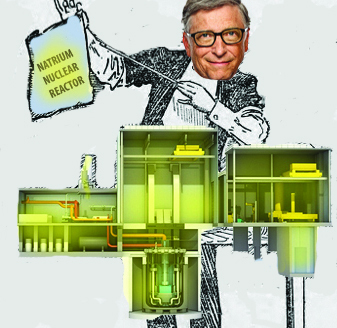
However, Whitehall officials have reportedly been concerned over insufficient supplies to import at scale to meet demand for Terrapower reactors, as most of the uranium it needs is produced in Russia – which is under sanctions following the country’s invasion of Ukraine.
City A.M. understands GB Nuclear wanted to prioritise the most ready-made technologies which could guarantee a final investment decision by the end of the decade.
Instead, Terrapower could feature in an upcoming consultation on advanced technology.
Small modular reactors are a cornerstone of the government’s plan to revive domestic nuclear energy and replace the country’s ageing fleet – with 85 per cent of the country’s current capacity set to go offline over the next 12 years.
……………………..Downing Street is targeting operational SMRs in the UK by the mid-2030s, with a £20bn cap being placed on the competitive process.
………………Downing Street is targeting operational SMRs in the UK by the mid-2030s, with a £20bn cap being placed on the competitive process. https://www.cityam.com/uk-small-nuclear-competition-rolls-royce-in-bill-gates-snubbed/
Aukus: UK defence giant BAE Systems wins Australian £3.95bn nuclear submarine contract

BBC News By Peter Hoskins, Business reporter 2 October Britain’s biggest defence firm, BAE Systems has won a £3.95bn ($4.82bn) contract to build a new generation of submarines as the security pact between the US, UK and Australia moves ahead.
In March, the three countries announced details of the so-called Aukus pact to provide Australia with nuclear-powered attack submarines by the late 2030s.
The pact aims to counter China’s ambitions in the Indo-Pacific region.
Beijing has strongly criticised the three countries over the deal.
……………………..”This multi-billion-pound investment in the Aukus submarine programme will help deliver the long-term hunter-killer submarine capabilities the UK needs to maintain our strategic advantage and secure our leading place in a contested global order,” UK Defence Secretary Grant Shapps said as the Conservative party conference got under way in Manchester.
………………….Other major UK defence contractors are also getting a boost from the Aukus deal.

In March, it was confirmed that Rolls-Royce Submarines would provide all the nuclear reactor plants that will power the SSN-Aukus vessels.
In June, Rolls-Royce said it would almost double the size of its Raynesway facility in Derby as a result of the deal. On Sunday, Babcock International, which maintains and supports the UK’s submarines, said it had signed a five-year deal with the Ministry of Defence to work on the SSN-Aukus design.
The Aukus security alliance – which was first announced in September 2021 – has repeatedly drawn criticism from China.
However, the three Western countries say the deal is aimed at shoring up stability in the Indo-Pacific more https://www.bbc.com/news/business-66979798
Elon Musk’s satellites litter the heavens as astonishing video shows how 5,000 Starlink aircraft are whizzing around the Earth and will soon outnumber the stars.
- Elon Musk’s 5,000 Starlink satellites are on track to surpass the number of visible stars in the sky, around 9,000
- A fascinating video showed the staggering number floating around in space
- Scientists fear for the future of astronomy as Musk’s space junk litters our sky

Unbalanced science. All about technology. But what about nature? What about light pollution? What about the moths, and all the other creatures that depend on the night darkness?
By MARTHA WILLIAMS FOR DAILYMAIL.COM 30 September 2023
Elon Musk‘s satellites are littering the heavens and an astonishing video has revealed how 5,000 of his Starlink aircraft are whizzing around the Earth.
Staggering footage posted by X user @flightclubio on September 18 shows thousands of little orange dots, representing the satellites, orbiting the planet and illustrating the vast scale of his investment.
But though Starlink has been hailed for providing internet in war-torn Ukraine, astronomers fear that the devices may soon obstruct our view of the cosmos – with around 9,000 stars visible from our planet.
New research showed that low-frequency radio waves – like the ones produced by Musk’s machines – are leaking into the sky which makes it difficult for scientists to make astronomical observations.
Scientists are also concerned that Musk’s ‘space junk’ could cause an extreme collision event. The ‘Kessler syndrome’ – proposed by NASA scientist Donald Kessler in 1978 – said that if there is too much space junk in the earth’s orbit then the objects could collide and make MORE space junk. This would result in Earth’s orbit becoming unstable.
SpaceX launched Starlink satellites in May 2019 and have already sent over 5,000 of the mass-produced objects into space.
The company announced reaching over 2 million subscribers in September 2023 and plan to deploy 12,000 satellites – a goal which could be raised to 42,000.
The SpaceX Starlink is a low orbit satellite that provides internet with unlimited data and quick broadband speeds.
The satellites offer fixed-location or portable internet options to users for a hefty price.
Internet provider T-mobile provide broadband for $50 monthly with no installation fee – while Starlink charges up to $2,500 for installation and can cost users up to $250 a month.
Viewers expressed their fear in the comments of the astonishing video that was uploaded to Musk’s social media website X (formerly known as Twitter).
One user said: ‘The size and scale of the Starlink project concerns astronomers, who fear that the bright, orbiting objects will interfere with observations of the universe, as well as spaceflight safety experts who now see Starlink as the number one source of collision hazard in Earth’s orbit.’
Researchers at Max Planck Institute used a telescope in the Netherlands to observe 68 devices made by Starlink, finding 47 were emitting ‘unintended electromagnetic radiation’ emanating from onboard electronics.
The team feared that the amount of emissions could be enough to be mistaken as radio waves from celestial objects.
The SpaceX CEO filed paperwork with the International Telecommunications Union for the operation of 30,000 more small devices in October 2019.
In its filings, SpaceX said the additional 30,000 satellites would operate in low Earth orbit at altitudes ranging from 1,076 feet to 1,922 feet. …………….. https://www.dailymail.co.uk/news/article-12575221/Elon-Musks-starlink-satellites-spacex-soon-outnumber-stars.html
Microsoft Sees Artificial Intelligence and Nuclear Energy as Dynamic Duo.

Bloomberg, By Drake Bennett, September 29, 2023 #nuclear #antinuclear #nuclear-free #NoNukes
“…………………………… Thinking, despite its benefits, is a lot of work, and it’s energy-intensive — human brains consume hundreds of calories a day. Artificial intelligence has much the same problem. While we can argue whether AI systems truly think and learn, they’re gobbling up enormous amounts of energy. All of those neural networks furiously training on an internet’s worth of data have a voracious appetite for electricity, as do the cooling systems needed to keep them from overheating.
The companies that have bet their future on AI know this, and they’re working on ways to solve the problem. One of the most interesting is Microsoft Corp. Its partnership with OpenAI has put it at the front of the tech world’s AI scrum. And staying there will require lots of energy, including — by Microsoft’s reckoning — nuclear power. Back in May, the company announced a power purchase agreement with Helion Energy, which has plans to start generating nuclear energy through fusion by 2028 (it already has built multiple working prototypes).
This week, Microsoft posted a job opening for a nuclear technology program manager, tasked with crafting a reactor strategy “to power the data centers that the Microsoft Cloud and AI reside on.”
There’s something a bit sobering about the idea of powering our newest potential threat to humanity with a technology associated with another one. ……………………………………………
The new Microsoft job involves overseeing small modular reactors, or SMRs,
New Brunswick Indigenous communities and Canadians need facts about Small Modular Nuclear Reactors, not sales hype.

Until the government shares facts instead of sales pitches for small modular nuclear reactors, Indigenous nations must assume that representation is not connected to people, but to industry.
BY HUGH AKAGI AND SUSAN O’DONNELL | September 28, 2023
FREDERICTON, N.B.—Governments and other nuclear proponents are failing both Indigenous and settler communities by promoting sales and publicity material about small modular nuclear reactors (SMNRs) instead of sharing facts by independent researchers not tied to the industry.
For decades, nuclear proponents, including both the federal and New Brunswick governments, have focused on the ‘dream of plentiful power’ without highlighting the risks. The nuclear fuel chain—mining uranium, chemically processing the ore, fabricating the fuel, fissioning uranium in a reactor creating toxic radioactive waste remaining hazardous for tens of thousands of years—leaves a legacy of injustices disproportionately felt by Indigenous Peoples and all our relations.
Now the same is happening with the push for SMNRs. We are promised safer reactors by nuclear startup companies in New Brunswick using modifications of reactor designs—molten salt, sodium cooled—that have never operated successfully and safely on a grid anywhere despite billions of dollars of public funds spent in other countries.
Only one example of the misguided SMNR sales pitches for Indigenous and settler communities in New Brunswick is that used CANDU reactor fuel can be “recycled” to make new fuel. The technical name for this process is “reprocessing.” Calling it “recycling” is a buzzword meant to reassure people because the truth is impossible to accept. Less than one per cent of the used fuel at Point Lepreau is plutonium and other elements that could possibly be extracted and re-used for new fuel. The more than 99 per cent left over will be a toxic mess of new kinds of nuclear waste that nobody knows how to safely contain.
The reprocessing method planned for New Brunswick is based on a technology developed by the Idaho National Laboratory, which has spent hundreds of millions of dollars so far, over two decades, attempting to reprocess a small amount of used fuel.
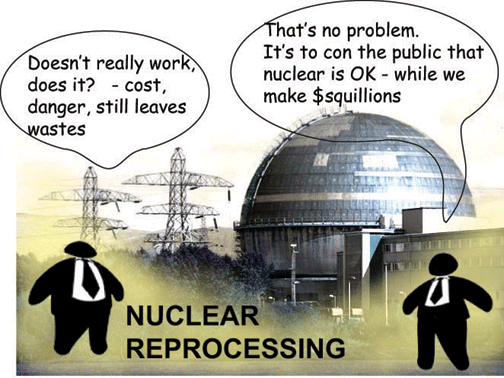
In different countries, commercial reprocessing has been an environmental and financial disaster. In just one example, a small commercial reprocessing plant in the United States operated for six years—heavily subsidized by the federal government and New York state—before shutting down for safety improvements. After the owner abandoned the project in the 1970s, the multi-billion-dollar cleanup continues today.
The research on reprocessing used fuel is clear: it’s an expensive nuclear experiment that could leave a multi-million-dollar mess affecting entire ecosystems and the health of people and other living beings. Why are governments sharing sales and promotional material about the project, and fantasies about ‘recycling’ instead of facts about reprocessing and the experiences in other countries? Why are New Brunswickers and First Nation leaders not demanding the evidence?
The lack of transparency by governments on the risks of SMNRs indicates that either they are not concerned with the risks, or they choose not to share them—the opposite of what is required under the United Nations Declaration of Rights of Indigenous Peoples.
Much of society’s standards for integrity have been lost. We accept circular references, we accept that no one is declaring a conflict of interest in conversations surrounding nuclear. When our integrity is lost, so is our quality of life. Words such as “protect” and “conservation” have no meaning anymore. Though we use the terms “transparency” and “accountability” more and more often, they have less and less meaning.
The Peskotomuhkati Nation in Canada and Wolastoq Grand Council cannot provide consent for any new nuclear developments in New Brunswick without considering the lessons they have learned in the past, the current relationships and communications they are experiencing, and the impacts of toxic wastes that remain dangerous forever. First Nations in New Brunswick cannot provide consent for toxic radioactive waste to be sent to Ontario, where Indigenous nations also do not want it on their territories.
The Wolastoq Grand Council, which issued a statement on nuclear energy and nuclear waste in 2021, opposes any destruction or harm to Wolastokuk which includes all “Flora and Fauna” in, on, and above their homeland. Nuclear is not a green source of energy, or solution to a healthier future for our children, grandchildren and the ones who are not born yet. Wolastoqewi-Elders define Nuclear in their language as ‘Askomiw Sanaqak,’ which translates as ‘forever dangerous.’
The Peskotomuhkatik ecosystem includes Point Lepreau. The Peskotomuhkati leadership in Canada has repeatedly tried to bring facts about both New Brunswick SMNR projects and their potential environmental implications to the attention of New Brunswickers and all Canadians, writing twice to Environment and Climate Change Minister Steven Guilbeault urging him to designate the SMNR projects in New Brunswick for a federal impact assessment, so that all the facts could be made public. Both attempts were denied, the most recent in August this year.
Peskotomuhkati leadership has participated, and continues to participate, in Canadian Nuclear Safety Commission and various provincial processes, and has firsthand experience that these past and current engagement and assessment tools do not provide a sufficient framework to address adverse effects and impacts to Indigenous rights.
The SMNR projects planned for Point Lepreau within Peskotomuhkatik homeland will have profound and lasting impacts on Indigenous rights as well as those of Indigenous communities in Ontario where the nuclear industry is proposing to build a deep geological repository for the used nuclear fuel and other sites for intermediate radioactive waste. The SMNR projects will also have profound and lasting impacts on the Bay of Fundy, the marine life the bay supports, and coastal communities.
Until the government begins to ask for and share facts about SMNRs instead of sales materials, Indigenous nations must assume that representation no longer means peoples’ representation, but rather representation of the industry.
Hugh Akagi is chief of the Peskotomuhkati Nation in Canada. Dr. Susan O’Donnell is the lead investigator of the CEDAR research project at St. Thomas University in Fredericton
Microsoft Is Using a Hell of a Lot of Water to Flood the World With AI
Angely Mercado, September 12, 2023 https://gizmodo.com.au/2023/09/microsoft-is-using-a-hell-of-a-lot-of-water-to-flood-the-world-with-ai/
—
As artificial intelligence is increasingly developing and data centres are erected to further this tech, it’s becoming clear that AI has a water usage problem.
Microsoft’s latest sustainability report revealed that the software giant’s water usage saw a tremendous spike between 2021 and 2022. In 2021, the company used up 4,772,890 cubic meters of water. In 2022 that went up to 6,399,415—which is around a 30 percent increase from one year to the next. That’s almost 1.7 billion gallons of water in just one year, which is enough to fill more than 2,000 Olympic-sized swimming pools.
Why did Microsoft draw so much freaking water? Data centres that run AI supercomputers are hot. Equipment heats up, and if a centre overheats, those computers can shut down. The increase in water use is directly tied to the company’s investment and development of AI. Microsoft has backed OpenAI, which has a data centre in Des Moines, Iowa. During the summer months, the centre has to use a ton of water to keep equipment cool, especially as Iowa experiences rising temperatures due to climate change.
The water is drawn from nearby watersheds including the Des Moines and Raccoon rivers to cool the supercomputer that develops AI systems, the Associated Press reported. However, local waterways also provide drinking water for nearby communities. The volume used by the data centres has become a concern for the local utility company, West Des Moines Water Works.
A document from the utility dated April 2022 outlined that officials and the utility will only “consider future data centre projects beyond Microsoft Data Center Project Ginger East and West” unless the new projects can significantly lower their water usage. “This approach to resource conservation will help preserve the water supply for current and future commercial and residential needs of West Des Moines,” the document read.
Google, another tech giant that has heavily invested in AI products, has also seen a spike in water usage. An environmental report released this July outlined that the company’s water usage increased about 20% from 2021 to 2022. “We’re working to address the impact of our water consumption through our climate-conscious data centre cooling approach and water stewardship strategy,” a spokesperson told Gizmodo in an email this July.
As the planet becomes warmer, it may become harder for large tech companies to cool facilities. Many data centres are in cooler locations like the Pacific Northwest and states like Iowa in the upper Midwest, but neither location has been spared from heat waves.
Other tech companies have experienced challenges with keeping their centres online during especially hot weather. Last September, equipment at then Twitter’s data centre in Sacramento shut down during a heat wave. Increased instances of heat waves due to the climate crisis have also plagued data centres overseas. Last July, Google and Oracle’s London-based data centres went offline as England baked through sky-high temperatures of over 40 degrees Celsius.
Microsoft May Go Nuclear to Support Its Energy-Hungry AI.
powering that AI is extraordinarily costly, even more so than its other cloud-based products. Microsoft’s latest sustainability report noted that the company’s water consumption has increased 30% year over year in order to keep its AI supercomputers cool.
Kyle Barr, September 28, 2023 https://gizmodo.com.au/2023/09/microsoft-may-go-nuclear-to-support-its-energy-hungry-ai/
Artificial intelligence has proved a costly endeavour—well, yes, in terms of money, but AI requires massive amounts of energy, and water consumption to operate at scale. That hasn’t stopped big tech companies such as Google and Microsoft from putting that energy-hungry AI into practically every single one of their user and enterprise end-products. Big daddy Microsoft has been trying to keep its (OpenAI-assisted) lead in the AI rat race, and it may need to grab the fuel rod by both hands if it wants to continue its big AI ambitions.
And when we say fuel rod, we mean it literally. Microsoft put out calls for a program manager on “Nuclear Technology” on Monday. As first reported by CNBC, The job specifically mentions that this new initiative would use “microreactors” and “Small Modular Reactors” to power the data centres used by Microsoft Cloud and AI. Whatever it is, the scope for Microsoft’s nuclear AI could be “global” as Microsoft has Azure data centres in all parts of the globe.
Microsoft declined to comment on any plans for future nuclear endeavours. The company instead linked to past blog posts on company sustainability initiatives. It’s unclear what plans Microsoft may have for nuclear-powered AI. The position references that the nuclear program manager would build a “roadmap for the technology’s integration,” which would also mean selecting partners for developing and implementing how the hell the tech giant would facilitate nuclear.
Small Modular Reactors, or SMRs, are a proposed class of reactors that would be a purportedly smaller version of a full-on nuclear plant with a smaller power capacity. The idea is they can be built in one location and then moved to a separate site. There are only a few prototype SMRs implemented in Places like Russia and China, though the U.S. Office of Nuclear Energy only approved its first SMR design in January this year.
Back in May, Microsoft signed a power purchase agreement with nuclear fusion startup Helion set to start in 2028. That’s different than an SMR, which still uses fission to generate power, and while there have been some recent successes with fusion this past year, we still could be a long way off from any kind of energy pivot.
Microsoft has spent the last year implementing generative AI into practically every one of its software products. Most recently, the Redmond, Washington company announced its AI copilot for Windows 11 to act as a kind of virtual assistant on a desktop. Court documents have shown that Microsoft has been looking for ways to implement more AI capabilities on its Azure cloud platform.
But powering that AI is extraordinarily costly, even more so than its other cloud-based products. Microsoft’s latest sustainability report noted that the company’s water consumption has increased 30% year over year in order to keep its AI supercomputers cool. Microsoft has put billions of dollars into a partnership with ChatGPT-maker OpenAI, and the Redmond company now being forced to power and cool its partner’s growing energy needs to train OpenAI’s latest models. Training GPT-3 consumed enough water to fill a full nuclear reactor’s cooling tower, according to one recent study.
Studies have shown AI is responsible for massive amounts of carbon emissions, and OpenAI’s GPT-3 model was responsible for CO2 emissions than most other large language models. The company’s GPT-4 model is purportedly 1,000 times more powerful than GPT-3.5 and was trained on nearly four times as much data. Running a larger AI model would require several times as much power as smaller models, and AI companies aren’t slowing down.
A mature design or junk? EDF plan for Sizewell C continues to rely on controversial EPR reactor

The UK/Ireland Nuclear Free Local Authorities were incredulous to hear the recent claim by Sizewell C’s Joint Managing Director that EDF’s project plan was based on ‘a mature reactor design’.
Julie Pyke’s bold assertion was included in the media statement issued last week by government ministers announcing they were seeking private sector investment in the controversial project.
EDF Energy, the wholly-French-stated-owned operator of Britain’s nuclear reactor fleet, intends to deploy its European Pressurised Reactor (or EPR) at Sizewell C, should the project ever become operational.
Cynics have assigned the EPR a less complimentary sobriquet, ‘European Problem Reactor’, for this is the same reactor design that was involved in an accident at the Taishan-1 plant in China. Here radioactive gas leaked, seemingly because of corrosion and faulty parts. It is also same reactor which, at Olkiluoto-3 in Finland, took over a year to bring online, after being delivered fourteen years late, following the discovery of repeated faults.
In response to last week’s official investment launch for Sizewell C, Andy Mayer, the Chief Executive of the Institute of Economic Affairs, was quick to rubbish its prospects saying that:
“The underlying EPR tech is junk, resulting in projects that run over-time/budget [and] when built are riddled with corrosion…investors would be mad to back Sizewell. If built, it will be late & obsolete”.
And in December of last year, the former Chief Executive of EDF (surely a man who should know), Henri Proglio, told a hearing of the French National Assembly in exasperation that:
“The EPR is too complicated, almost unbuildable. We see the result today.”
The Chair of the NFLA Steering Committee, Councillor Lawrence O’Neill, said in response to Ms Pyke’s claim:
“Whether you believe the EPR is turnkey or turkey, we suspect that this is a classic case of someone in authority adopting an attitude of hope over expectation as the history of EPRs has so far been the stuff of nightmares rather than something to write home about.
“Hinkley Point C will be delivered around a decade late at a cost of at least £33 billion, nearly double the original budget. The development at Sizewell C with its extra geographical complexities, will we suspect take even longer and cost so much more – and that is assuming that the whole project is not kiboshed by the serious legal challenge being pursued by our friends in Together Against Sizewell C and their allies”.
The timing of the government’s announcement is itself suspect as Barclays have previously been appointed by government to solicit investors and there have been many pronouncements, usually negative, by the leaders of major financial institutions on their prospects of investing in Sizewell C.
Being of similar mind to Mr Mayer, the NFLAs have been active in backing our friends in the campaign group, Stop Sizewell C, in writing to prospective investors to point out the pitfalls that might befall backing the White Elephant.
Gratifyingly, so far, the market has proven lukewarm in embracing new nuclear, with a typically prescient comment made by a spokesperson for Legal & General Capital to The Telegraph:
“Our stance hasn’t changed: we are focused on investing in and supporting other innovative, viable, and cost-effective clean energy solutions that are already delivering results.”
The NFLAs hope that this will be the uniform response of the market and that this unwanted and unneeded nuclear waste of public money will soon be abandoned.
Ottawa yet to decide whether reprocessing spent nuclear fuel should be allowed in Canada
MATTHEW MCCLEARN, (September 26, 2023)
More than two years after it provided tens of millions of dollars to a company seeking to reprocess spent nuclear fuel, the Canadian government has yet to decide whether the practice should be allowed on Canadian soil.
Reprocessing involves extracting uranium and plutonium from irradiated fuel to make new fuel. In March, 2021, the government provided Moltex Energy with $50.5-million to support development of a reprocessing facility (known as Waste To Stable Salt, or WATSS) and a reactor that would burn fuel it produced. Moltex plans to construct both at New Brunswick Power’s Point Lepreau station, on the northern shore of the Bay of Fundy.
Currently reprocessing is not conducted in Canada. With the notable exception of Japan, it’s done almost exclusively by countries that have nuclear weapons programs. It’s controversial: Critics warn reprocessing increases proliferation risks, and that Canada would set a bad precedent by pursuing it………………………………….
Documents released this summer under the Access to Information Act to Susan O’Donnell, an activist on nuclear issues and researcher at the University of New Brunswick, and provided to The Globe, show that the CANDU Owners Group (which represents utilities such as New Brunswick Power that operate Canadian-designed reactors) drafted a reprocessing policy and distributed it among government and industry officials.
The documents also reveal that Moltex warned the government last year the company would have difficulty raising money until the government clarified that reprocessing will be allowed……………………….https://www.theglobeandmail.com/business/article-moltex-canada-nuclear-waste-trudeau-letter/
Star-crossed States: No result from the UN Working Group on Reducing Space Threats
The long-standing goal of preventing an arms race in outer space could be slipping away
OPEN CANADA, BY: PAUL MEYER / 24 SEPTEMBER, 2023
It has become a challenge these days to keep up with the exponential growth in the number of satellites orbiting this planet. Current estimates of active satellites are upwards of 6000 with tens of thousands more launches planned by the end of the decade. The private sector is driving this growth with Elon Musk’s Starlink telecommunication constellation constituting almost half of the satellites operating in low earth orbit (the closest and most congested orbital slot).
The world is increasingly dependent on satellites to provide a vast spectrum of services essential for global security and well-being, and it is all the more regrettable therefore that this surge of activity in outer space is coinciding with what appears to be a nadir in the level of cooperation amongst leading space powers. Although objectively it would be in the interests of all spacefaring states, and the entire international community reliant on space-enabled services, to cooperate to ensure the continued safe and secure utilisation of outer space, the current situation is fraught with tension and mistrust. For over 40 years the UN has sought to prevent an arms race in outer space, but besides the repeated declarations that this remains a common goal there is little evidence of meaningful efforts to ensure it.
It was back in 1981 that the “Prevention of an Arms Race in Outer Space” (aka PAROS) item was added to the agenda of the UN General Assembly and the negotiating forum of the Conference on Disarmament in Geneva. While member states agreed to put this topic on the UN’s agenda, ever since they have held contending views as to how best to make progress on outer space security. The 1967 Outer Space Treaty (with 112 states parties) provided some common ground in calling for the peaceful uses of outer space and prohibiting the stationing in orbit of weapons of mass destruction, but was silent on other types of weaponry. Although the treaty required its parties to exercise “due regard” for the space operations of other states and to avoid “harmful interference” with such operations these terms have lacked a common understanding as to their import.
The Cold War era development of space weapons including anti-satellite weapons (ASATs) demonstrated that the legal regime established by the Outer Space Treaty was insufficient to ensure that the peace was kept in outer space and almost all states agreed that “further measures” would be required to strengthen it. This broad consensus that the Outer Space Treaty needed to be reinforced with complementary agreements however, quickly broke down over the specific content and form such additional measures should take.
One camp led by China and Russia, although including many other states such as Brazil, India, Mexico and Indonesia, favours legally binding agreements to supplement the Outer Space Treaty. They argue that only legal agreements will have the authority and staying power to ensure compliance with their provisions. Political measures at best might supplement a legally binding instrument, but could never substitute for one.
The other camp led by the United States, supported by many of its allies, argue that at this stage it is best to develop politically binding measures, such as so-called Transparency and Confidence Building Measures .
dherents of this approach argue that the negotiation of a legally binding agreement would take too long and would flounder over issues of definition and verification. In their view, settling on a set of practical measures would be a quicker and more effective means of agreeing “rules of the road” for state-conducted space operations.
This argument over the best diplomatic path to take to prevent armed conflict in space has gone on for decades without a resolution. As a result, in recent years the relations among leading space powers have deteriorated significantly with mutual accusations of “weaponizing” outer space and the development of “counter-space capabilities” in the arsenals of states. ……………………………………………………………… more https://opencanada.org/star-crossed-states-no-result-from-the-un-working-group-on-reducing-space-threats/
Trudeau warned of nuclear weapon risk over emerging small modular reactors
National Observer, By John Woodside | News, Energy, Politics | September 27th 2023
A dozen nuclear energy experts are calling for a formal risk assessment of emerging nuclear technologies and warning Prime Minister Justin Trudeau if a company in New Brunswick were to be successful, its product could be used by other countries to make nuclear bombs.
The open letter sent to the Prime Minister’s Office is dated Sept. 22, and spells out concerns that Saint John-based nuclear startup Moltex is embarking on a risky path. The proposed Moltex reactor is planned to be built at the site of the Point Lepreau Nuclear Generating Station in Saint John, where it would essentially recycle spent nuclear waste sourced from CANDU reactors to produce more energy. The letter, signed by experts like former U.S. Nuclear Regulatory commissioner Peter Bradford, director of nuclear power safety with the Union of Concerned Scientists Edwin Lyman, George Washington University research professor and former State Department official Sharon Squassoni, says the risk is the plutonium in the used nuclear fuel could be separated and used to make weapons.
Despite Moltex claiming its technology is “proliferation-resistant,” the expert letter says there is “every reason to be skeptical of Moltex’s reactor technology.” The letter points to failed attempts in the United States and the United Kingdom to reprocess nuclear waste as a fuel, resulting in hundreds of billions worth of cleanup costs. To date, Moltex has received at least $50.5 million worth of federal government subsidies, $10 million from New Brunswick, and $1 million from Ontario Power Generation –– and is eyeing roughly $200 million more.
……………………………………………………For the experts who wrote the letter, inadvertently creating a product that could be used to make nuclear weapons is a very real concern, and one with precedent. As the letter to Trudeau details, Canada and the United States were both exporting nuclear reactor technology to India decades ago for power generation purposes and ended up increasing the risk of nuclear war.
“Some of the plutonium India produced and separated with that assistance was used in the plutonium-fuelled prototype bomb India tested in 1974, precipitating the South Asian nuclear arms race,” the letter reads.
Canada and its allies are concerned that as new nuclear technologies are developed, the technology could similarly lead to unexpected nuclear weapon development. In May at the annual G7 meeting, Canada committed “to prioritizing efforts to reduce the production and accumulation of weapons-usable nuclear material for civil purposes around the world.”
The letter requests a nuclear weapons proliferation risk assessment of the technology………………………………………………..
As the energy transition unfolds, nuclear energy is increasingly seen as a contentious fuel. While it is non-emitting, making it a potentially valuable tool in the race to decarbonize, nuclear waste is a long-lasting environmental concern with unclear storage options given it can be hazardous for thousands of years. Moreover, preventing the worst impacts of climate change requires slashing fossil fuel use by about half globally by the end of the decade, meaning experimental technology not yet suitable for use does not have any meaningful role to play in near-term emissions reductions.
In fact, a report by the U.S. National Academies of Sciences, Engineering and Medicine concluded small modular reactor designs like Moltex’s would struggle to be deployed by 2050, and require tremendous large-scale investment to succeed. https://www.nationalobserver.com/2023/09/27/news/trudeau-warned-nuclear-weapon-risk-over-emerging-small-modular-reactors#:~:text=A%20dozen%20nuclear%20energy%20experts,countries%20to%20make%20nuclear%20bombs.
Bill Gates’ nuclear firm Terrapower fears falling behind in Small Nuclear Reactor race.
A row is brewing between a nuclear energy company founded by Bill Gates and the
UK government over fears it may be sidelined from a £1 billion competition
to build new small power plants. The billionaire is the chairman of Terrapower, which fears exclusion from the race to build the next generation of reactors over questions about its fuel source, according to people familiar with the matter.
In May, The Sunday Times revealed that
Terrapower had joined the likes of Rolls Royce, GE-Hitachi and Bechtel in
the running to manufacture Britain’s future nuclear infrastructure. But
Terrapower is concerned that the government is prioritising so-called small
modular reactors designed by its rivals, rather than Terrapower’s model,
which uses more innovative technology and is classed as an “advanced
modular reactor”, sources said.

Terrapower’s reactor, called Natrium,
uses high-assay low-enriched uranium (HALEU) as fuel. Officials are said to
be concerned that it does not have reliable supplies to import at scale, as
most of it is produced in Russia. A government spokesman said: “Great
British Nuclear is assessing the bids received as part of the latest phase
of the competition launched earlier this year and will announce an update
in due course.”
Times 24th Sept 2023
1 This Month
To see nuclear-related stories in greater depth and intensity – go to https://nuclearinformation.wordpress.com/

29 Jan. Thursday 7-8 p.m. Webinar – World’s Largest Nuclear Station in Port Hope, ON?


31st January – Challenging the War Machine – a DECLASSIFIED UK SUMMIT


Website of the Week
Now until to February 10, 2026 Radioactive waste storage in France: the debate is finally open! How to participate?
-
Archives
- January 2026 (259)
- December 2025 (358)
- November 2025 (359)
- October 2025 (376)
- September 2025 (258)
- August 2025 (319)
- July 2025 (230)
- June 2025 (348)
- May 2025 (261)
- April 2025 (305)
- March 2025 (319)
- February 2025 (234)
-
Categories
- 1
- 1 NUCLEAR ISSUES
- business and costs
- climate change
- culture and arts
- ENERGY
- environment
- health
- history
- indigenous issues
- Legal
- marketing of nuclear
- media
- opposition to nuclear
- PERSONAL STORIES
- politics
- politics international
- Religion and ethics
- safety
- secrets,lies and civil liberties
- spinbuster
- technology
- Uranium
- wastes
- weapons and war
- Women
- 2 WORLD
- ACTION
- AFRICA
- Atrocities
- AUSTRALIA
- Christina's notes
- Christina's themes
- culture and arts
- Events
- Fuk 2022
- Fuk 2023
- Fukushima 2017
- Fukushima 2018
- fukushima 2019
- Fukushima 2020
- Fukushima 2021
- general
- global warming
- Humour (God we need it)
- Nuclear
- RARE EARTHS
- Reference
- resources – print
- Resources -audiovicual
- Weekly Newsletter
- World
- World Nuclear
- YouTube
-
RSS
Entries RSS
Comments RSS
 nuclear-news