Electric Vehicles and Nuclear Power Are Fighting Over One Obscure Mineral
Oil Price, By Michael Kern – Dec 31, 2025,
- The market for ultra-high-purity (UHP) graphite, essential for EV anodes and nuclear reactors, is projected to hit $1.43 billion by 2030, masking structural friction in the global energy transition.
- The vast majority (86% in 2024) of UHP graphite is synthetic, requiring a massive industrial footprint of fossil fuel feedstock and staggering amounts of electricity for high-heat graphitization furnaces.
- Two massive, well-funded industries—transportation and power generation (SMRs/nuclear)—are competing for the same narrow, geopolitically sensitive supply of high-purity carbon, which is primarily controlled by Asia Pacific’s refining capacity.
The energy transition is often sold as a story of ethereal “green” progress, but if you look at the balance sheets of the companies actually building it, the story is written in soot and high-voltage electricity. While the financial press spends its time obsessing over the price of lithium or the latest solid-state battery breakthrough, a much more grounded, and expensive, reality is setting in.
We are entering the era of the engineered anode.
New data suggests the market for ultra-high-purity (UHP) graphite is on a trajectory to hit $1.43 billion by 2030. On the surface, a 10.5% compound annual growth rate looks like a healthy, if predictable, industrial expansion. But for those of us who track the friction between a digital climate pledge and the physical hardware required to meet it, that number masks a massive structural shift in how we power the world… and who holds the keys…………………………………………………………………………………………
The Nuclear Renaissance’s Dirty Secret
There is a quieter, more desperate buyer entering the UHP market: the nuclear sector.
As we move toward Small Modular Reactors (SMRs) and high-temperature gas-cooled reactors, the demand for “nuclear-grade” pyrolytic graphite is set to lead the market in growth. This material is produced via chemical vapor deposition (CVD)—an even more complex and expensive process than standard synthetic graphitization.
In a nuclear core, graphite is a structural necessity that must survive extreme radiation and heat without absorbing neutrons.
The report highlights that this “unrivaled ability” makes it indispensable. But here is the friction point: the standards for nuclear-grade purity are even higher than battery-grade.
We are effectively seeing two massive, well-funded industries—Transportation and Power Generation—fighting over the same narrow pipe of high-purity carbon…
It is a zero-sum game played with atoms………………………………………………………………………………….. https://oilprice.com/Metals/Commodities/Electric-Vehicles-and-Nuclear-Power-Are-Fighting-Over-One-Obscure-Mineral.html
The AI Arms Race Is Cracking Open the Nuclear Fuel Cycle
Oil Price By Michael Kern – Dec 28, 2025
- The abstract “cloud” of artificial intelligence possesses a massive, structural demand for 24/7 “baseload” power that is equivalent to adding Germany’s entire power grid by 2026, a need intermittent renewables cannot meet.
- Decades of underinvestment have resulted in a widening uranium supply deficit, with mined uranium expected to meet less than 75% of future reactor needs and an incentive price of $135/lb required to restart mothballed mines.
- Big Tech hyperscalers are privatizing energy security by locking in clean baseload nuclear power via long-term agreements, effectively making the public grid’s “service” secondary to the “compute-ready” requirements of major platforms.
We are seeing a violent collision between two worlds: the high-speed, iterative world of artificial intelligence and the slow, grinding, capital-intensive world of nuclear physics.
Data from a survey of over 600 global investors reveals that 63% now view AI electricity demand as a “structural” shift in nuclear planning. This isn’t a temporary spike or a speculative bubble. It is the physical footprint of every Large Language Model (LLM) query finally showing up on the global balance sheet.
For years, the energy narrative was dominated by “efficiency.” We were told that better chips would offset higher usage. That era is over. Generative AI doesn’t just use data; it incinerates energy to create it.
Why the “Efficiency” Narrative Failed
The “Reverse-Polish” reality of AI is that the more efficient we make the chips, the more chips we deploy, and the more complex the models become. This is Jevons Paradox playing out in real-time across the data centers of Northern Virginia and Singapore.
When you look at the energy density required for an AI hyperscale center, you aren’t looking at a traditional office building. You are looking at a facility that pulls as much power as a mid-sized city, but does so with a 99.999% uptime requirement.
Traditional demand models simply didn’t account for a single industry deciding to double its power footprint in less than five years. S&P Global Energy recently highlighted that data center electricity consumption could hit 2,200 terawatt-hours (TWh). …………………………………………………
Who Collects the Equity and Who Pays the Bill?
There is a massive shift happening in the power dynamics of infrastructure. For decades, nuclear power was a public service…state-funded, state-regulated, and built for the citizen.
Now, we are seeing the “Private Platform” era of nuclear energy. When a hyperscaler signs a twenty-year Power Purchase Agreement (PPA) with a nuclear utility, they are effectively “locking in” the best, [?] cleanest baseload power for private profit.
The question we aren’t asking: who pays for the grid upgrades to support this?
The hyperscalers want the green electrons to satisfy their net-zero pledges, but the physical copper and transformers required to move that power often fall on the rate-paying public or the state. We are witnessing the privatization of energy security.
If 63% of investors are right and AI is the new driver of nuclear planning, the “public service” aspect of the grid is about to become a secondary concern to the “compute-ready” requirements of Big Tech.
The equity is being collected by the tech platforms and the uranium miners. The risk is being socialized by the grid…………………………………………………………………………. https://oilprice.com/Alternative-Energy/Nuclear-Power/The-AI-Arms-Race-Is-Cracking-Open-the-Nuclear-Fuel-Cycle.html
Palantir’s Palestine: How AI Gods Are Building Our Extinction

“Zionism is evil,” she says with the quiet certainty of someone who has spent a lifetime studying its fruits. “It is purely evil. It has created disasters, misery, atrocities, wars, aggression, unhappiness, insecurity for millions of Palestinians and Arabs. This ideology has no place whatsoever in a just world. None
The machines are not coming for us. They are already here. And the men who control them have made their intentions terrifyingly clear.
BettBeat Medi, Dec 26, 2025
But Zionism, in its current iteration, is not merely an ideology. It is a business model. It is a technology demonstration. It is the beta test for systems that will eventually be deployed everywhere.
The Israeli military’s Project Lavender uses AI to identify targets for assassination. Soldiers describe processing “dozens of them a day” with “zero added value as a human.” The algorithm marks. The human clicks. The bomb falls.
This is not a war. It is a sick twisted video game.
Palantir’s technology identifies the targets. Musk’s Starlink provides the communications. American military contractors supply the weapons. And the entire apparatus is funded by governments whose citizens have marched in the millions demanding it stop.
There is a moment in every civilization’s collapse when the instruments of its destruction become visible to those paying attention. We are living in that moment now. But the warning signs are not carved in stone or written in prophecy—they are embedded in source code, amplified by algorithms, and funded by men who speak openly of human extinction while racing to cause it.
In a nondescript office in Palo Alto, a man who claims to fear fascism has become its most sophisticated architect. In a sprawling Texas compound, another man who styles himself a free speech absolutist uses his platform to amplify the voices calling for ethnic cleansing. And in the bombed-out hospitals of Gaza, their technologies converge in a laboratory of horrors that prefigures what awaits us all.
The four horsemen of this apocalypse do not ride horses. They deploy algorithms.
The Confession
Professor Stuart Russell has spent fifty years studying artificial intelligence. He wrote the textbook from which nearly every AI CEO in Silicon Valley learned their craft. And now, at eighty hours a week, he works not to advance the field he helped create, but to prevent it from annihilating the species.
“They are playing Russian roulette with every human being on Earth,” Russell said in a recent interview, his voice carrying the weight of someone who has seen the calculations and understood their implications. “Without our permission. They’re coming into our houses, putting a gun to the head of our children, pulling the trigger, and saying, ‘Well, you know, possibly everyone will die. Oops. But possibly we’ll get incredibly rich.’”
This is not hyperbole from an outsider. This is the assessment of a man whose students now run the companies building these systems. And here is what should terrify you: the CEOs themselves agree with him.
Dario Amodei, CEO of Anthropic, estimates a 25% chance of human extinction from AI. Elon Musk puts it at 20-30%. Sam Altman, before becoming CEO of OpenAI, declared that creating superhuman intelligence is “the biggest risk to human existence that there is.”…………………………………………………………………………………………………………………………………………………………………………..
“These bombs are cheaper and you don’t want to waste expensive bombs on unimportant people”
……………………………………………………………………………………………………..The [Palantir] company’s software now powers what Israeli soldiers describe with chilling bureaucratic efficiency: “I would invest 20 seconds for each target and do dozens of them a day. I had zero added value as a human. Apart from being a stamp of approval.”
Twenty seconds. That is the value of a Palestinian life in the algorithmic calculus of Alex Karp’s creation. The machine decides who dies. The human merely clicks.
When whistleblowers revealed that Israeli intelligence officers were using “dumb bombs”—unguided munitions with no precision capability—on targets identified by Palantir’s AI, their justification was purely economic: “These bombs are cheaper and you don’t want to waste expensive bombs on unimportant people.”
Unimportant people. Children. Doctors. Journalists. Poets.
Karp has admitted, in a moment of rare candor: “I have asked myself if I were younger, at college, would I be protesting me?”
He knows the answer. We all know the answer. He simply does not care.
………………………………………………………………………………………………………………………. Musk is the CEO of xAI, OpenAI’s largest competitor. He has declared himself a 30% believer in human extinction from AI. And he is using the world’s most influential social media platform to promote the political movements most likely to strip away the regulations that might prevent that extinction.
The fascists have captured the algorithm.
The Laboratory of the Future
Dr. Ghada Karmi was a child in 1948 when she lost her homeland. She remembers enough to know that she lost her world. For seventy-seven years, she has watched as the mechanisms of Palestinian erasure evolved from rifles and bulldozers to algorithms and autonomous weapons systems.
“Zionism is evil,” she says with the quiet certainty of someone who has spent a lifetime studying its fruits. “It is purely evil. It has created disasters, misery, atrocities, wars, aggression, unhappiness, insecurity for millions of Palestinians and Arabs. This ideology has no place whatsoever in a just world. None. It has to go. It has to end. And it has to be removed. Even its memory has to go.”
But Zionism, in its current iteration, is not merely an ideology. It is a business model. It is a technology demonstration. It is the beta test for systems that will eventually be deployed everywhere.
The Israeli military’s Project Lavender uses AI to identify targets for assassination. Soldiers describe processing “dozens of them a day” with “zero added value as a human.” The algorithm marks. The human clicks. The bomb falls.
This is not a war. It is a sick twisted video game.
Palantir’s technology identifies the targets. Musk’s Starlink provides the communications. American military contractors supply the weapons. And the entire apparatus is funded by governments whose citizens have marched in the millions demanding it stop.
“The genocide has not provoked a change in the official attitude,” Dr. Karmi observes. “I’m astonished by this and it needs an explanation.”
The explanation is simpler and more terrifying than any conspiracy. The explanation is that the people who control these technologies have decided that some lives are worth twenty seconds of consideration and others are worth none at all. And the governments that might regulate them have been captured by men waving fifty billion dollar checks.
“They dangle fifty billion dollar checks in front of the governments,” Professor Russell explains. “On the other side, you’ve got very well-meaning, brilliant scientists like Jeff Hinton saying, actually, no, this is the end of the human race. But Jeff doesn’t have a fifty billion dollar check.”
The King Midas Problem
Russell invokes the legend of King Midas to explain the trap we have built for ourselves. ………………………………………………………………………………..
The CEOs know this. They have signed statements acknowledging it. They estimate the odds of catastrophe at one in four, one in three, and they continue anyway.
Why?
Because the economic value of AGI—artificial general intelligence—has been estimated at fifteen quadrillion dollars. This sum acts, in Russell’s metaphor, as “a giant magnet in the future. ……………………………………………………………
“The people developing the AI systems,” Russell observes, “they don’t even understand how the AI systems work. So their 25% chance of extinction is just a seat of the pants guess. They actually have no idea.”
No idea. But they’re spending a trillion dollars anyway. Because the magnet is too strong. Because the incentives are too powerful. Because they have convinced themselves that someone else will figure out the safety problem. Eventually. Probably. Maybe.
What Now?
If everything goes right—if somehow we solve the control problem, if somehow we prevent extinction, if somehow we navigate the transition to artificial general intelligence without destroying ourselves—what then? ………………………………………………………………………………………………………………………………………………………………………………………………………………………….
The Enablers
Dr. Karmi returns again and again to a simple question: Why?
“Why should a state that was invented, with an invented population, have become so important that we can’t live without it?” she asks of Israel. But the question applies equally to Silicon Valley, to the tech platforms, to the entire apparatus of algorithmic control that now shapes our politics, our perceptions, our possibilities.
The answer, she suggests, lies in understanding the enablers.
“I think it’s absolutely crucial now to focus on the enablers,” she argues. “Because we can go on and on giving examples of Israeli brutality, of the atrocities, of the cruelties. That’s not for me the point. The point is who is allowing this to happen?”
The same question must be asked of AI. Who is allowing this to happen? Who is funding the companies that acknowledge a 25% chance of human extinction and continue anyway? Who is providing the regulatory vacuum in which these technologies develop unchecked? Who is amplifying the voices calling for acceleration while silencing those calling for caution?
The answer is the same class of people who have enabled every catastrophe of the modern era: the comfortable, the compliant, the compromised. The politicians who take the fifty billion dollar checks. The journalists who amplify the preferred narratives. The citizens who scroll past the warnings because they are too busy, too distracted, too convinced that someone else will handle it.
“All the polls that have been done say most people, 80% maybe, don’t want there to be super intelligent machines,” Russell notes. “But they don’t know what to do.”
They don’t know what to do. So they do nothing. And the machines keep learning. And the algorithms keep shaping. And the billionaires keep abusing. And the bombs keep falling. And the future keeps narrowing.
The Resistance
Russell’s advice is almost quaint in its simplicity: “Talk to your representative, your MP, your congressperson. Because I think the policymakers need to hear from people. The only voices they’re hearing right now are the tech companies and their fifty billion dollar checks.
………………………………… the point is not that resistance will succeed. The point is that resistance is the only thing that might succeed.
…………………………….We still have a choice. The machines are not yet smarter than us. The algorithms are not yet in complete control. The billionaires are not yet omnipotent.
But the window is closing. The event horizon may already be behind us. And the men who control the most powerful technologies in human history have made their values abundantly clear.
They will pursue profit over safety. They will amplify hatred over tolerance. They will choose rape over romance. They will enable genocide if the margins are favorable. They will risk extinction if the upside is sufficient.
This is not speculation. This is the record. This is what they are doing, right now, in plain sight.
The question is not whether we understand the danger. The question is what we will do about it……………………………………………………….. https://bettbeat.substack.com/p/palantirs-palestine-how-ai-gods-are?utm_source=post-email-title&publication_id=437130&post_id=180304933&utm_campaign=email-post-title&isFreemail=true&r=46by4&triedRedirect=true&utm_medium=email
Russia wants to build a nuclear power plant on the moon in the next few years .
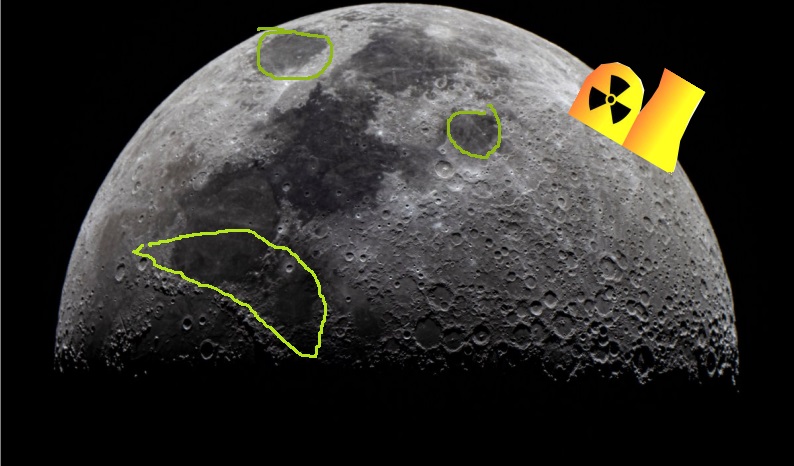
Project aims to supply energy for its lunar space programme
Guy Faulconbridge, Wednesday 24 December 2025, https://www.independent.co.uk/space/russia-china-space-race-moon-nuclear-power-b2890010.html
Russia is reportedly planning to establish a nuclear power plant on the moon within the next decade.
This ambitious project aims to supply energy for its lunar space programme and a joint research station with China, as global powers intensify their
efforts in lunar exploration.
Historically, Russia has held a prominent position in space, notably with Yuri Gagarin’s pioneering journey in 1961.
However, its dominance has waned in recent decades, with the nation now trailing behind the United States and, increasingly, China.
The country’s lunar aspirations faced a significant setback in August 2023 when its uncrewed Luna-25 mission crashed during a landing attempt.
Furthermore, the landscape of space launches, once a Russian speciality, has been revolutionised by figures such as Elon Musk, adding to the competitive pressure.
Russia’s state space corporation, Roscosmos, said in a statement that it planned to build a lunar power plant by 2036 and signed a contract with the Lavochkin Association aerospace company to do it.
Roscosmos said the purpose of the plant was to power Russia’s lunar programme, including rovers, an observatory and the infrastructure of the joint Russian-Chinese International Lunar Research Station.
“The project is an important step towards the creation of a permanently functioning scientific lunar station and the transition from one-time missions to a long-term lunar exploration program,” Roscosmos said.
Roscosmos did not say explicitly that the plant would be nuclear but it said the participants included Russian state nuclear corporation Rosatom and the Kurchatov Institute, Russia’s leading nuclear research institute.
The head of Roscosmos, Dmitry Bakanov, said in June that one of the corporation’s aims was to put a nuclear power plant on the moon and to explore Venus, known as Earth’s “sister” planet.
The moon, which is 384,400 km (238,855 miles) from our planet, moderates Earth’s wobble on its axis, which ensures a more stable climate. It also causes tides in the world’s oceans.
The Reality of SMR Timelines for AI Data Centers: A Veteran’s View
Nov 2,2025, By Tony Grayson, Tech Executive (ex-SVP Oracle, AWS, Meta) & Former Nuclear Submarine Commander
If you’ve been following the recent nuclear boom, you’ve seen the headlines: Amazon commits to 5 GW. Google signs for advanced reactors. Oracle announces gigawatt-scale campuses. The message is clear: nuclear is the solution.
There is just one problem: GPUs move in 3-year cycles. Reactors move in decades.
I spent my early career commanding nuclear submarines, where “downtime” wasn’t a metric; it was a mission failure. Later, I built data center infrastructure for Oracle, AWS, and Meta. I know the difference between a PowerPoint slide and a commissioned plant. I know what it takes to cool a reactor core versus a Blackwell rack……..
Below is the reality check on SMR timelines for AI data centers, HALEU fuel shortages, and what infrastructure buyers should actually do.
SMR Timelines for AI Data Centers: The Executive Summary
To optimize for decision-making, we must look at the specific delivery windows. Here is the realistic availability for nuclear power sources.
- Near-Term (2025–2029): Reactor Restarts
- Status: Feasible but limited.
- Timeline: 3–5 years.
- Examples: Palisades (Michigan) or Three Mile Island Unit 1.
- Constraint: These require existing sites in good condition with willing local stakeholders.
- Medium-Term (2030–2035): Gen III+ Large Reactors
- Status: Proven technology, difficult execution.
- Timeline: 10–14 years.
- Constraint: The Vogtle Units 3 & 4 (AP1000) proved that even “off-the-shelf” designs can take a decade and cost $30B+.
- Long-Term (2035–2045): Advanced SMRs (Gen IV)
- Status: Experimental supply chain.
- Timeline: Factory scaling likely post-2035.
- Constraint: HALEU fuel availability and lack of factory fabrication lines.
If your strategy relies on SMR timelines for AI data centers intersecting with your 2028 capacity needs, you are missing the target.
The HALEU Fuel Gap: The Supply Chain That Doesn’t Exist
The biggest risk to the “Advanced Nuclear” narrative is not the reactor; it is the fuel.
Many Gen IV designs (like TerraPower’s Natrium) require HALEU (High-Assay Low-Enriched Uranium).
- The Demand: The DOE projects we need >40 metric tons by 2030.
- The Supply: Current U.S. capacity is negligible (less than 1 ton/year).
- The Problem: Prior to 2022, Russia was the primary commercial supplier.
Until domestic enrichment scales, a process that involves centrifuges, licensing, and billions in CAPEX…Gen IV SMRs have no fuel……………………………………………………………………………………………………………………………………………………………………………………………………………………. https://www.tonygraysonvet.com/post/nuclear-power-for-ai-datacenters
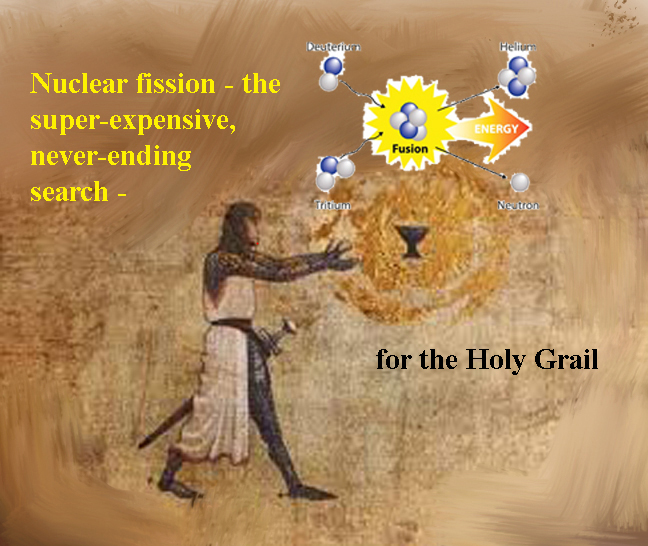
Why Nuclear Fusion Will Not Solve the AI Power Problem
By Kurt Cobb – Dec 22, 2025, https://oilprice.com/Energy/Energy-General/Why-Nuclear-Fusion-Will-Not-Solve-the-AI-Power-Problem.html
- Claims of “net energy gain” in fusion experiments often exclude the massive energy consumed by the full system, leading to misleading headlines.
- Even under optimistic timelines, commercial fusion power would not arrive until the latter half of the century.
- Fusion exemplifies a recurring pattern in energy history: bold promises that underestimate the time, cost, and complexity of real-world deployment.
With the supposed need for vast new electricity generation to fuel the artificial intelligence (AI) boom, AI companies are pushing nuclear power as one solution to provide that power for the many data centers they plan to build. (Count me skeptical of the boom and therefore of the need for vast new electricity generation capacity. See here, here, here, here, and here.) AI boosters usually talk about expanding existing nuclear power technologies, that is, fission reactors that run on uranium and (more dangerously) on plutonium.
But it is well to keep in mind that there are two kinds of nuclear power: fission and fusion. For now, there are no commercial fusion reactors since with current technology it takes far more than the equivalent of a kilowatt of energy to produce a kilowatt of electricity. This is because it takes a lot of energy just to get a fusion reaction going. The current state of affairs in fusion reminds me of the old joke about the manufacturer who admits he loses a nickel on every sale, but claims he makes it up in volume.
Fortunately, fusion researchers are smarter than this and await the day when fusion technology can produce more energy than it consumes. That waiting has spawned another well-worn joke about the coming of clean, limitless fusion energy, namely, that it’s only 25 years away and always will be. (Whether fusion energy will be clean, that is, non-radioactive, is debatable.)
It’s no surprise, then, that with the AI industry saying it needs a lot more energy now, the predicted advent of net-energy-positive fusion is being moved up. In this case, Commonwealth Fusion Systems, a startup spun off by the Massachusetts Institute of Technology, claims that by 2027 it will achieve the feat of producing more energy from a fusion device than is consumed. The Chinese government is a bit more vague, saying its research program may, within a few years, produce more energy than is consumed by a fusion reaction.
When this achievement is announced, it will be important to read the fine print. Eleven years ago, scientists working on fusion at the Lawrence Livermore National Laboratory in California were able to produce more energy output in a fusion experiment than was used to produce the fuel. That feat, however, didn’t take into account the amount of energy needed by the entire system, which was 118 times more than the energy output. Some media outlets (who apparently did not read or understand the background materials) erroneously reported that the experiment had, in fact, achieved the feat of producing more energy than it consumed.
In 2022, the same laboratory declared it had achieved a net energy gain (read the second subheading) from a fusion reaction. Again, reading the fine print is important. As this article points out, “while a single shot may produce more energy than the fuel absorbs, the entire facility, from lasers to cryogenics to control systems, still consumes far more power than it delivers.” Said simply, you have to look at the whole system to understand the energy balance. This analysis suggests that the entire system actually consumed about 100 times the energy output of the experiment. The experiment did mark progress. But we remain nowhere near producing net energy from fusion reactions, not least because there is currently no system that can provide more than a momentary burst of energy instead of the sustained reaction seen in conventional fission reactors.
The Chinese government said it expects to have a pilot fusion plant operating by the 2030s or 2040s. First, that’s pretty far away (and vague), and the realization of commercial fusion power is much further away, even if this plan comes to fruition. A pilot plant is only the second stage of the development of commercial fusion power. First comes the prototype, which helps validate the technology. Then comes the pilot plant, which demonstrates that such technology will, in fact, integrate successfully with the existing electric grid.
Then comes a demonstration plant, which is a full-size test of the economic and commercial viability of the technology. At this stage, utility managers want hard evidence that such plants are reliable and profitable. Demonstration plants could be as far off as the 2050s or 2060s, again, even if we assume the schedule for pilot plants proves to be doable. And then, utilities would have to decide to try to build their own fusion plants, and that might only begin in the late 2050s. Widespread adoption might take another 20 to 30 years.
Even if fusion-generating plants turn out to be feasible, the idea that they are going to provide any near-term fix for our energy needs or for addressing climate change is completely misguided.
Energy transitions take time. They occur over more than one generation. In times of great stress, such as ours, people look for miraculous solutions. Fusion seems like one of those solutions. But it will almost certainly NOT turn out to be miraculous and, if feasible, will be painstakingly slow to emerge as a major energy source for human civilization.
Scottish Government urged to intervene in Edinburgh AI data centre plans
THE Scottish Government has been urged to intervene after council
officials ruled that an environmental impact assessment for a huge
artificial intelligence data centre is not required.
Edinburgh City Council
is currently considering plans for a new AI data centre on the site of the
former RBS headquarters in South Gyle, near Edinburgh Airport. Shelborn
Drummond Ltd, an offshoot of Shelborn Asset Management, is behind the plans
for the “Green Data Centre”.
We previously told how the Shelborn data
centre, and another proposed by Apatura near to Heriot-Watt University,
would demand the equivalent amount of energy as building five cities the
same size as the capital within its boundaries. The revelation about the
vast amount of electricity the sites will consume has sparked concerns from
environmental campaigners, and had previously raised concerns that there
would be no requirement for the firms behind the plans to carry out an
environmental impact assessment (EIA).
A screening opinion published on
Friday December 18, by a senior planner at the local authority, ruled that
an EIA would not be required. Action to Protect Rural Scotland (APRS) said
the Shelborn data centre will use the same amount of energy as a quarter of
a million households, and it was “gobsmacking” that the impact on the
local environment would not be taken into consideration.
The National 22nd Dec 2025, https://www.thenational.scot/news/25715123.scottish-government-urged-intervene-edinburgh-ai-data-centre/
Trump orders return to Moon by 2028, lunar base with nuclear power by 2030.
NASA is directed to pursue a commercial pathway to replace the International Space Station by 2030, continuing the transition toward privately owned and operated orbital platforms.
By Stephen Pope, December 19, 2025, https://www.aerotime.aero/articles/trump-moon-2028-lunar-base-golden-dome
In a sweeping reset of US space policy, President Donald Trump on December 18, 2025, signed an executive order directing NASA to return astronauts to the Moon by 2028, establish the first elements of a permanent lunar base by 2030, deploy nuclear power systems on the Moon and in orbit, and accelerate development of the administration’s “Golden Dome” missile defense program.
The order, titled Ensuring American Space Superiority, sets some of the most aggressive space and defense timelines ever laid out in a single White House directive, blending civil exploration, national security, and commercial space development into one policy framework.
Under the order, NASA is instructed to land Americans on the Moon by 2028 through the Artemis program, and then move quickly toward establishing an initial, sustained lunar presence by the end of the decade. The administration frames the Moon not only as a destination, but as strategic infrastructure — a platform for economic activity, scientific research, and preparation for future missions to Mars.
Lunar nuclear reactors
A central and notable element of the policy is nuclear power. The order calls for deploying nuclear reactors on the lunar surface and in orbit, with a lunar surface reactor required to be ready for launch by 2030. The White House argues that nuclear power is essential to sustaining long-duration operations on the Moon, where solar energy alone may not support continuous activity.
The executive order also reiterates Trump’s push for the Golden Dome missile defense initiative, directing the government to develop and demonstrate prototype next-generation missile defense technologies by 2028. It also calls for improved detection and countermeasures against threats to US space assets, extending from low Earth orbit to the moon, including concerns over nuclear weapons placed in orbit.
The order places heavy emphasis on accelerating procurement and integrating commercial space capabilities. NASA and the Department of Commerce are directed to reform their space acquisition processes within 180 days, with a stated preference for commercial solutions, faster contracting methods, and reduced bureaucratic friction. The policy also seeks to attract at least $50 billion in additional private investment into US space markets by 2028.
Compressed timelines
Commercial space involving many companies is positioned in Trump’s order as a replacement, not just a partner, for legacy government programs. NASA is directed to pursue a commercial pathway to replace the International Space Station by 2030, continuing the transition toward privately owned and operated orbital platforms.
The order also makes structural changes to space governance. It revokes the National Space Council and shifts coordination of national space policy to the White House Office of Science and Technology Policy. Several agencies are given near-term reporting deadlines, including a 90-day requirement for NASA to outline how it will meet the Moon and exploration goals within existing funding levels.
In addition, the order revises prior space traffic management policy by removing language that had described government-provided tracking services as free, potentially opening the door to paid or commercially supported models in the future.
Taken together, the executive order outlines an expansive vision with compressed timelines, placing pressure on NASA, the Pentagon, and industry to deliver rapid progress.
Over the Moon and Down to Earth
15 December 2025, https://www.banng.info/news/regional-life/over-the-moon-and-down-to-earth/
Varrie Blowers writes for the December 2025 issue of Regional Life magazine
If Bradwell is an unsuitable site for nuclear development……what about the Moon? Although it can be seen shining over the Blackwater and appear quite close, the Moon is actually almost 239,000 miles away. But Sean Duffy, the Acting Administrator of NASA, is over the Moon at the idea of such development.
A new space race is starting between the USA and Russia in collaboration with China planning to build nuclear reactors on the Moon, in 2030 and 2035 respectively, to power bases. No doubt other members of the space club will wish to follow where they lead. Is this a case of the unbelievable becoming believable?
A key problem for building nuclear reactors on the Moon is getting them up there in the first place – in the hope that the transporting rockets do not explode (not unknown!) and shower radioactive particles on populated areas below.
Another is that a stable power supply would be required to sustain the astronauts who would have to get the reactors up and running. This would seem to be impossible; the location for the proposed bases is the Moon’s dark South Pole, where solar power could not provide a consistent supply.
Among other serious problems are:
the Moon’s very environment with its extreme thermal cycles, abrasive dust, reduced gravity, cosmic radiation, the lack of atmosphere;- astronauts in space suits, it seems, would be unable to maintain the reactors regularly meaning that electronic components that could last for a very long time without being replaced would be needed;
- the vast expense and need for sustained funding with cost and time overruns
So why would any nation wish to attempt to undertake a project that appears to be a non-starter? To undertake space exploration…… or space exploitation?
The motive behind the bases is the desire to exploit what are regarded as the Moon’s vast resources of minerals, including rare earths, metals and helium.
All of this prompts the question of ‘Who owns the Moon?’. The answer according to the UN Outer Space Treaty of 1967 is that space, including the Moon, belongs to us all and should be used peacefully for the benefit of all nations. It is, however, unlikely that any nation with a base would regard the resources as ‘belonging to us all’.
History should warn us that in this grab for the Moon’s riches, likely clashes between nations would arise, perhaps even leading to military conflict in space.
We are in danger of transporting our problems to the Moon. Back down to Earth, we have enough problems to cope with.
Trump’s rush to build nuclear reactors across the U.S. raises safety worries
NPR, December 17, 2025
In May, President Trump sat in the Oval Office flanked by executives from America’s nuclear power industry.
“It’s a hot industry. It’s a brilliant industry,” the president said from behind the Resolute desk.
It’s also an industry that’s having a moment. Billions of dollars in capital are currently flowing into dozens of companies chasing new kinds of nuclear technologies. These are small modular designs that can potentially be mass produced in the hundreds or even thousands. Their proponents say these advanced designs promise to deliver megawatts of power safely and cheaply.
But there’s a problem, Joseph Dominguez, the CEO of Constellation Energy, told the president.
New nuclear plants keep getting caught up in safety regulations.
“Mr. President, you know this because you’re the best at building things,” Dominguez, whose company runs about a quarter of America’s existing nuclear reactors, said. “Delay in regulations and permitting will absolutely kill you. Because if you can’t get the plant on, you can’t get the revenue.”
Now, a new Trump administration program is sidestepping the regulatory system that’s overseen the nuclear industry for half a century. The program will fast-track construction of new and untested reactor designs built by private firms, with an explicit goal of having at least three nuclear test reactors up and running by the United States’ 250th birthday, July 4, 2026.
If that goal is met, it will be without the direct oversight of America’s primary nuclear regulator. Since the 1970s, safety for commercial reactors has been the purview of the Nuclear Regulatory Commission. But the NRC is only consulting on the new Reactor Pilot Program, which is being run by the Department of Energy’s Office of Nuclear Energy……………………………………………………………………………………………………
Sites across the country will host new reactor designs
The new pilot program may be an unproven regulatory path run by an agency with limited experience in the commercial sector, but supporters say it’s energizing an industry that’s been moribund for decades.
“This is exactly what we need to do,” said Isaiah Taylor, founder and CEO of Valar Atomics, a small nuclear startup headquartered in Hawthorne, Calif. “We need to make nuclear great again.”
Valar and other companies plan to build smaller reactors than those currently used in the nuclear industry, and that makes a Chernobyl or Fukushima-type accident impossible, noted Nick Touran, an independent nuclear consultant. “The overall worst-case scenario is definitely less when you’re a smaller reactor,” he said.
Critics, however, worry that the tight July 4 deadline, political pressure and a lack of transparency are all compromising safety. Even a “small” release of radioactive material could cause damage to people and the environment around the test sites.
“This is not normal, and this is not OK, and this is not going to lead to success,” warned Allison Macfarlane, a professor at the University of British Columbia who served as chairman of the NRC under President Barack Obama. “This is how to have an accident.”
AI’s need for speed
……………………………………………………………………………………………………………. Right from the start it was clear that, unlike the slow and deliberate safety culture that has dominated nuclear power for decades, this new program would be all about speed.
…………officials responsible for overseeing safety would do “whatever we need to ensure that the government is not stopping you from reaching [nuclear] criticality on or before July 4, 2026.”
A new regulator
Before the executive order, the Energy Department did not regulate the safety of commercial nuclear reactors. That job fell to another body: the Nuclear Regulatory Commission.
The commission was set up in 1975 by Congress as an independent safety watchdog, said Allison Macfarlane, the former NRC chair. Part of the reason the NRC was formed was because the predecessor to the DOE, known as the Atomic Energy Commission, oversaw both safety and promotion of nuclear power at the same time.
“This was a very strong conflict of interest,” Macfarlane said.
But in recent years, companies, particularly those trying to build new kinds of reactors, had become frustrated with the NRC, Macfarlane said. “The promoters of these small modular reactors were becoming very vociferous about the NRC being the problem,” she said.

In 2022, the NRC rejected a combined license application for Oklo, a new nuclear startup. Oklo had submitted an application to build and operate its small reactor, called the Aurora powerhouse. But the NRC denied the application because it contained “significant information gaps in its description of Aurora’s potential accidents as well as its classification of safety systems and components.”
Oklo was told it could resubmit its application to the NRC, but it never did.
Then at the May signing of the executive order, Oklo’s CEO Jacob DeWitte appeared behind President Trump applauding the new reactor program at DOE.
“Changing the permitting dynamics is going to help things move faster,” DeWitte said to the president. “It’s never been more exciting.”
Oklo had another connection to the Energy Department — the secretary of energy, Chris Wright, was a member of Oklo’s board of directors until he took the helm at the DOE. Wright stepped down following his confirmation in February.
In August, a little over a month after that initial meeting between industry executives and the DOE, the Office of Nuclear Energy announced the 11 advanced reactor projects had been selected for the Reactor Pilot Program. Three of Oklo’s reactors were part of the new pilot program, including a test version of the reactor design rejected by the NRC…………………………………………………………………………………………………………
Valar’s design looks far different from the reactors that are running today. It will use a special type of fuel together with a high-temperature gas to generate heat and electricity. Taylor said gathering real data will speed development and increase safety over the long-term….
(Valar is also party to a lawsuit against the NRC arguing the commission does not have the authority to regulate small reactors. In his interview, Taylor told NPR the company intends to file for an NRC license “when we’re ready.”)
………………………………………………….. critics question whether the pilot program will really produce safe nuclear reactors.
The July 4, 2026, deadline puts enormous pressure on the program, said Heidy Khlaaf, the chief AI scientist at the AI Now Institute, which recently published a report warning that AI development could undermine nuclear safety.
“I think these manufactured timelines are actually incredibly concerning,” Khlaaf said. “There’s no timeline for assessing a new design and making sure it’s safe, especially something we haven’t seen before.”
Then there’s the question of public transparency. The NRC makes many of the documents around its decisions available publicly. It also frequently allows the public to comment as well, added Edwin Lyman, director of nuclear power safety at the nonprofit Union of Concerned Scientists. The new pilot program is far more opaque and “is really an attempt to subvert the laws and regulations that go around commercial nuclear power,” he said.
While many of the test reactors are small and tout themselves as inherently safer than existing nuclear power plants, they are still capable of leaking radiation in an accident, Lyman noted. “If they are located closer to populated areas, if there aren’t any provisions for offsite radiological emergency planning … then you are potentially putting the public at greater risk, even if the reactors are small,” he said.
Perhaps most worrying, said former NRC Chair Macfarlane, is how the DOE’s safety assessment might be used to build more small reactors across the country, once the pilot reactors are built.
………………………………………..Macfarlane is unconvinced. She said relying on the hasty DOE analysis for the construction of potentially dozens or even hundreds of small reactors around the U.S. is the real risk.
“They can look at what the DOE did, they can take it as a piece of input, but they have to do their own separate analysis,” she warned. “Otherwise, none of us are safe.” https://www.npr.org/2025/12/17/nx-s1-5608371/trump-executive-order-new-nuclear-reactors-safety-concerns
US pauses implementation of $40 billion technology deal with Britain.
Reuters, By Alistair Smout, December 17, 2025
- Summary
- Companies
- US frustrated with non-tariff issues, NY Times says
- Trade talks have been stop-start this year
- UK says relations still strong, complex talks take time
- Britain has secured some tariff relief
Dec 15 (Reuters) – The United States is stalling the implementation of a $40 billion technology agreement with Britain, officials said, following concerns in Washington over London’s approach to digital regulation and food standards.
The “Tech Prosperity Deal,” covering artificial intelligence, quantum computing, and civil nuclear energy, was agreed during President Donald Trump’s state visit to Britain in September, in a celebration of the countries’ close ties and ability to work together on trade and technology……………………………………………………………………………………………….
Under the Tech Prosperity Deal, Britain and the United States agreed to work together on quantum computers and artificial intelligence, while the likes of Microsoft, Google, Nvidia and OpenAI pledged to invest tens of billions of dollars in Britain.
The White House did not immediately respond to Reuters’ request for comment. https://www.reuters.com/world/europe/us-suspends-technology-deal-with-uk-ft-says-2025-12-16/
Why Nuclear Reprocessing?

Does Britain really need nuclear power? – by Ian Fairlea beyondnuclearinternational
“…………………………………………………………………………………………………………..The initial rationale for reprocessing in the 1950s to the 1980s was the Cold War demand for fissile material to make nuclear weapons.
Reprocessing is the name given to the physico-chemical treatment of spent nuclear fuel carried on at Sellafield in Cumbria since the 1950s. This involves the stripping of metal cladding from spent nuclear fuel assemblies, dissolving the inner uranium fuel in boiling concentrated nitric acid, chemically separating out the uranium and plutonium isotopes and storing the remaining dissolved fission products in large storage tanks.
It is a dirty, dangerous, unhealthy, polluting and expensive process which results in workers employed at Sellafield and local people being exposed to high radiation doses.
Terrorism
A major objection to reprocessing is that the plutonium produced has to be carefully guarded in case it is stolen. Four kilos is enough to make a nuclear bomb. Perhaps even more worrying, it does not have to undergo fission to cause havoc: a conventional explosion of a small amount would also cause chaos. A speck of plutonium breathed into the lungs can cause cancer. If plutonium dust were scattered by dynamite, for example, thousands of people could be affected and huge areas might have to be evacuated for decades………….. https://beyondnuclearinternational.org/2025/12/14/does-britain-really-need-nuclear-power/
Google, NextEra expand collaboration to develop nuclear-powered gigawatt AI campuses
The initial three campuses under this new accord are now in the active development phase.
Interesting Engineering ByAman Tripathi, Dec 13, 2025
NextEra Energy and Google Cloud announced a significant expansion of their ongoing collaboration, creating a partnership designed to develop multiple gigawatt (GW)-scale data center campuses across the United States………………………………………………………………………………………………..
This collaborative effort focuses on accelerating the deployment of data centers by systematically addressing critical infrastructure hurdles.
These challenges include land acquisition, managing load interconnection, and the simultaneous development of supporting power generation resources needed to sustain large-scale artificial intelligence operations.A central component of this energy strategy involves the revitalization of nuclear power capabilities to support the electrical grid.
“Most recently, the companies announced the restart of the Duane Arnold Energy Center in Iowa followed by two new long-term power purchase agreements to add 600 megawatts of clean energy capacity to Oklahoma’s electricity grid to support Google’s technology infrastructure,” noted a press release.
To facilitate this restart, NextEra Energy has formally requested that the US Federal Energy Regulatory Commission (FERC) restore grid connection rights for the shuttered facility.
This regulatory filing seeks to reclaim interconnection rights that had previously been transferred from the nuclear plant to a planned solar energy project at the same site.
The move follows a licensing change request that NextEra filed with the US Nuclear Regulatory Commission (NRC) in January, marking a distinct shift from solar back to nuclear baseload power to meet steady demand.
Digital transformation of operations
Beyond the construction of physical infrastructure, the partnership will implement a digital transformation of NextEra Energy’s operations using Google Cloud’s artificial intelligence tools. ,…………………………………………………………
NextEra Energy Chairman and CEO John Ketchum characterized the partnership as a reflection of the current moment where the energy and technology sectors are becoming increasingly intertwined. He noted that the joint effort intends to build infrastructure at scale and change how energy companies function.
Similarly, Google Cloud CEO Thomas Kurian stated that combining NextEra’s domain expertise with Google’s AI infrastructure is necessary to support the digital future of energy infrastructure and meet the rising demand for AI technologies. https://interestingengineering.com/energy/nuclear-powered-gigawatt-ai-campuses-google
Search for UK fusion plant engineering partner to restart in 1-2 years after failed first attempt

09 Dec, 2025 By Thomas Johnson
The procurement for an engineering partner to construct the UK’s Spherical Tokamak for Energy Production (Step) fusion power plant will resume “in a year or two” after a failed first attempt, but the choice of a construction partner is imminent.
……………………..
The government launched a competition to select engineering and construction partners for the prototype fusion energy plant in Nottinghamshire in May last year, with the contracts rumoured to be worth close to £10bn. Then in January, the shortlist for both partners was revealed.
The shortlisted organisations for Step’s engineering partner were:
- Celestial JV: consisting of Eni UK Limited as the lead member and AtkinsRéalis, Jacobs Clean Energy (now Amentum), Westinghouse and Tokamak Energy as other members.
- Phoenix Fusion Limited: consisting of Cavendish Nuclear as the lead member, KBR and Assystem Energy and Infrastructure as other members.
Engineering procurement hits the wall
Despite announcing the two-consortia shortlist, the project recently divulged that the process of selecting the engineering partner had broken down, with the approach being taken as being deemed “not suitable”…………………………………………………………..
Speaking at the Nuclear Industry Association (NIA) annual conference on 4 December, UKIFS chief executive Paul Methven stated procurement for the engineering partner would resume “in a year or two”……………………………………………………………… https://www.newcivilengineer.com/latest/search-for-uk-fusion-plant-engineering-partner-to-restart-in-1-2-years-after-failed-first-attempt-09-12-2025/
U.S. Nuclear Fusion Industry Asks for Federal Help

By Irina Slav – Dec 09, 2025, https://oilprice.com/Latest-Energy-News/World-News/US-Fusion-Industry-Asks-for-Federal-Help.html
The nascent nuclear fusion industry in the United States has asked the Trump administration for billions in financial support in order to advance the technology, which is seen as one of the most promising for the future—but also one of the most challenging.
“Now is the time for the U.S. to make a significant investment, and that means over a billion dollars per year in annual appropriations and a one-time infrastructure investment,” the chief executive of the Fusion Industry Association, Andrew Holland, said this week, as quoted by Reuters. “If they ask for it, we are confident Congress would pass it,” he added, following a meeting between industry representatives and officials from the Department of Energy.
Reuters noted in its report that the Trump administration had just canceled several billion dollars in subsidies for the wind and solar industries. Presumably, some of that money could be redirected towards nuclear fusion. The Department of Energy even set up an Office of Fusion earlier this year as it shut down the wind and solar offices.
Nuclear fusion has long been considered the answer to zero-emission by-product-free energy generation. However, no one has cracked the nuclear fusion code yet because of the challenges associated with the environment in which the process could take place.
Nuclear fusion research and development have gained momentum in recent years after several momentous breakthroughs and achievements. The global race to overcome the engineering challenges to achieving zero-emission power from a nuclear reaction without risking disaster and radiation has heated up.
Earlier this year, the International Thermonuclear Experimental Reactor (ITER), a multinational endeavor to build a system to experiment with nuclear fusion, completed the world’s most powerful electromagnetic system in a landmark moment for fusion research.
There is still a long way to go before nuclear fusion becomes commercially viable; One of the main challenges remains the ratio between input energy and output energy, with the former currently exceeding the latter.
1 This Month

of the week – Shut Down Drone Warfare!


Tell the Ukrainian Government to Drop Prosecution of Peace Activist Yurii Sheliazhenko

Petition to revoke the licensing of the Near Surface Nuclear Disposal Facility (NSDF) at Chalk River. https://www.ourcommons.ca/petitions/en/Petition/Details?Petition=e-7247
To see nuclear-related stories in greater depth and intensity – go to https://nuclearinformation.wordpress.com
-
Archives
- March 2026 (251)
- February 2026 (268)
- January 2026 (308)
- December 2025 (358)
- November 2025 (359)
- October 2025 (376)
- September 2025 (257)
- August 2025 (319)
- July 2025 (230)
- June 2025 (348)
- May 2025 (261)
- April 2025 (305)
-
Categories
- 1
- 1 NUCLEAR ISSUES
- business and costs
- climate change
- culture and arts
- ENERGY
- environment
- health
- history
- indigenous issues
- Legal
- marketing of nuclear
- media
- opposition to nuclear
- PERSONAL STORIES
- politics
- politics international
- Religion and ethics
- safety
- secrets,lies and civil liberties
- spinbuster
- technology
- Uranium
- wastes
- weapons and war
- Women
- 2 WORLD
- ACTION
- AFRICA
- Atrocities
- AUSTRALIA
- Christina's notes
- Christina's themes
- culture and arts
- Events
- Fuk 2022
- Fuk 2023
- Fukushima 2017
- Fukushima 2018
- fukushima 2019
- Fukushima 2020
- Fukushima 2021
- general
- global warming
- Humour (God we need it)
- Nuclear
- RARE EARTHS
- Reference
- resources – print
- Resources -audiovicual
- Weekly Newsletter
- World
- World Nuclear
- YouTube
-
RSS
Entries RSS
Comments RSS
 nuclear-news