What happened to integrity and honor in the age of Technocracy?

Charles Hugh Smith, oftwominds.com, Fri, 06 Dec 2024, https://www.sott.net/article/496524-What-happened-to-integrity-and-honor-in-the-age-of-Technocracy
The hope here is that facing the reality of moral collapse frees us of the delusion that fiddling with technocratic financial abstractions and policy tweaks can reverse moral collapse.
Ours is a technocratic culture with a short attention span, and so problems and solutions are understood to be 1) technocratic and 2) instant. The problem is something that can be distilled down to a spreadsheet, formula, algorithm or legalistic policy, and the solution is some modification of spreadsheet, formula, algorithm or legalistic policy: all our problems will go away if we just end the Fed, switch to cryptocurrency, tweak some laws, get rid of the bankers, eliminate an agency, and so on.
These solutions will offer immediate relief. The problems will start melting away the minute we modify the spreadsheet, algorithm, financial settings or legal code.
But what if the problem is the collapse of integrity and honor, a moral rot that has consumed the foundations of our social order? If this is the root problem, then technocratic-financial solutions are the equivalent of excising a wart from the big toe and declaring that as a result of this procedure, the brain cancer has been cured.
What if the problem is that everything we’re cheering as Progress is actually the opposite–it’s Anti-Progress? What if all the technocratic “advances” that are constantly being hyped as wondrous are actually harming our physical and mental health?
So a product labeled as a “veggie snack” that’s nothing more than fat-soaked, sugary potato starch is lauded because it’s immensely profitable, a virtue gained by deceiving parents into thinking a “veggie snack” is a healthy snack.
That this is a culture in moral collapse is obvious, but we dare not admit it. That integrity and honor have decayed to the point of parody is equally obvious, but that too doesn’t register in a culture attuned to novelty, profit, gadgets, legalese, techno-fantasies and technocratic “solutions” to problems that aren’t even visible to technocrats.
Integrity and honor have, along with everything else, been commoditized into something we sell as a “product” or “enhancement.” Virtue-signaling has replaced actual integrity, and as the host of my latest podcast observed, the job of corporate CEOs is not to make quality products; their job is to elevate the corporation’s stock price by whatever means are available–including hollowing out quality, reliability and durability.
Seeking a Culture of Honor and Integrity with Emerson Fersch and Amy LeNoble (59 min)
In this state of moral collapse, we look to centralized authorities to solve all our problems. But the collapse of integrity and honor does not have a legal, financial or technocratic solution. We have to reverse that collapse ourselves rather than rely on centralized diktats from on high to fix what’s broken.
Before we get to the hope, let’s first review reality. Here is loneliness–soaring. – [excellent graphics here, on original]
And we all know how positive online interactions are for our collective mental health:
Every one of these graphics depicts a social order in collapse, yet this truth is greeted with silence or delusional misdirections and self-referential parodies being passed off as “solutions.”
Let’s say we want a lifestyle stripped of denial, moral rot, techno-fantasies and technocratic delusions, a lifestyle of responsibility, accountability, integrity and honor. Oops, sorry, that lifestyle is out of stock and we don’t anticipate any reordering.
The hope here is that facing the reality of moral collapse frees us of the delusion that fiddling with technocratic financial abstractions and policy tweaks can reverse moral collapse and Anti-Progress. We are then free to see the problem is spiritual and cultural, realms that we change in our own lives, not by waiting around for central authorities–the state, Big Tech, etc.–to fix for us.
We need a new way of living, not more gadgets and financial “innovations.” A restoration of basic integrity and honor cannot be achieved by technocratic “solutions”–policies, crypto, apps, algos, AI–for the belief that these are solutions has blinded us to the decay and collapse of the foundations of the social order.
Yes, it’s understandable that we all want a solution to the collapse of integrity and honor to be done for us by some new app or a new law, but that’s like thinking the wart on the big toe is the source of the brain cancer. Real social change comes from the ground up, not the top down. I explore these themes in my new book The Mythology of Progress, Anti-Progress and a Mythology for the 21st Century.
(free sample chapter)
New podcast:Seeking a Culture of Honor and Integrity with Emerson Fersch and Amy LeNoble (59 min)
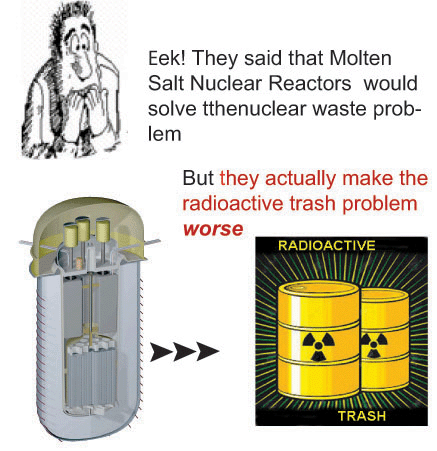
The Moltex Reactor and used CANDU Fuel
| Frank Greening, 9 Dec 24 |
From a MOLTEX Technical Report, issued May 2022:
THE FUEL
The reactor core comprises an array of fuel tubes in a graphite matrix, which fills most of the tank. Each tube sits in a separate channel, within which a molten salt primary coolant circulates.
FUEL SALT
The SSR-U is a fluoride or chloride salt reactor with separate fuel and coolant salts. The fuel is in the form of molten low-enriched uranium fluoride or chloride salt (6% enrichment).
What I find most interesting about this information on the Moltex SMR is that the fuel is enriched uranium, even though we have been led to believe that the Moltex reactor can run on used CANDU fuel, which is certainly not enriched, but depleted in U-235.
For example, consider this announcement by Moltex dated October 3, 2024:
“The SSR-W was specifically engineered to efficiently reuse and consume recycled nuclear waste,” said Moltex CEO Rory O’Sullivan. “This breakthrough research, the result of years of collaboration, clearly demonstrates that ability.” According to this research, the SSR-W can recycle used fuel indefinitely, producing a minimum of 6,000 MW of clean energy from Canada’s existing CANDU reactor fuel without the need for new fuel imports.
Unfortunately, Molex is not very forthcoming about how much fuel their reactor will use. I am going to conservatively assume that 20 tonnes of enriched uranium will be needed for the first year of reactor operation. Based on information I have found in a number of reports on the cost of enriching uranium to 6% U-235, I estimate this will cost about $1 million per tonne. By comparison, the production cost of CANDU fuel is about $250,000 per tonne.
But there are other hidden costs to the production of enriched uranium, one of the most significant being the cost of disposing of the depleted uranium generated by the U-235 enrichment process. Thus, the production of 1 kg of U-235 enriched to 6% generates 12 kg of depleted uranium tailings waste. The uranium enrichment process begins with the conversion of uranium oxide to uranium hexafluoride, UF6, which is gaseous above 64 ⁰C. UF6 is very toxic and chemically reactive so it is necessary to convert the depleted UF6 back to a solid uranium form for safe disposal – adding substantially to the cost of producing enriched fuel for the Moltex reactor.
But there’s still more bad news for the Moltex SMR! Thus, I quote from an article in the May 2023 issue of the Bulletin of the Atomic Scientists by J. Kang et al. entitled: “Canadian reactors that “recycle” plutonium would create more problems than they solve”, where we read:
Moltex’s fresh fuel will consist of potassium chloride, uranium chloride, and plutonium chloride, with some unspecified actinides and lanthanides. Using the expected distribution of plutonium and uranium, and using the ratio of the atomic masses of chlorine and plutonium, one can conclude that the reactor would need about 392 kg of plutonium as fuel every year. In a 2021 presentation, Moltex also mentioned that the average fuel assembly resides for 6.3 years in the reactor. This means that the initial loading for the reactor to start operating would require roughly 2.4 tons of plutonium.
To obtain the 2.4 tons of plutonium required in the startup fuel for a single 300 megawatt-electric (MWe) Moltex reactor, around 577 tons of CANDU spent fuel would have to be processed. In addition, a further 94 tons of CANDU spent fuel must go through Moltex’s waste-to-stable-salts chemical process to produce the necessary fuel for each year of operations.
Britain’s Energy Secretary Follows Tech Giants In Pursuit Of New Nuclear Power Stations
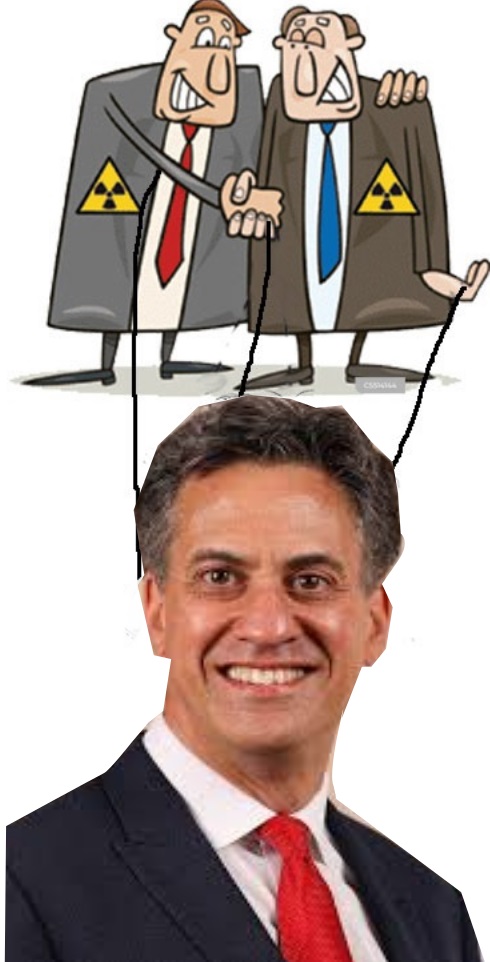
the government is “determined to drive forward” with nuclear power through both public and private investment, despite this being a period of “immense challenge for the public finances.”
Miliband was speaking in London on Thursday at the Nuclear Industry Association’s Nuclear 2024 conference, where he told the audience that their industry has an essential role to play in the U.K.’s pursuit of achieving a [ ?] clean power system by 2030.
Robert Olsen, Forbes 7th Dec 2024
British Energy Secretary Ed Miliband has been watching U.S. tech companies striking deals with operators and developers of nuclear power plants, and now he’s eager to pursue similar projects in the U.K.
“My message is clear: if you want to build a nuclear project in Britain, my door is open,” Miliband said. “My department is listening. We want all your ideas for projects that can work and provide value for money.”
Miliband was speaking in London on Thursday at the Nuclear Industry Association’s Nuclear 2024 conference, where he told the audience that their industry has an essential role to play in the U.K.’s pursuit of achieving a [ ?] clean power system by 2030.
He said the government is “determined to drive forward” with nuclear power through both public and private investment, despite this being a period of “immense challenge for the public finances.”
Great British Nuclear (GBN), the government body tasked with spearheading the development of small modular reactors (SMRs), has started contract negotiations with four companies shortlisted for the U.K.’s small modular reactor program, and final decisions will be made next year.
Britain’s Rolls-Royce is competing with U.S.-based rivals GE Hitachi, Holtec and Westinghouse Electric for contracts to develop SMRs in the U.K. The competition was launched last year, as part of the government’s plan to replenish the country’s dwindling nuclear industry………………………………..https://www.forbes.com/sites/robertolsen-1/2024/12/07/britains-energy-secretary-follows-tech-giants-in-pursuit-of-new-nuclear-power-stations/
Hinkley update: mixed reaction as first reactor drops into place
Mr Vince said: “I’m really pleased to be a patron of the Stop Hinkley campaign which is working to stop the government wasting billions of taxpayers’ money on a technology which is hugely expensive and slow to develop.”
By Simon Hacker , Punchline Gloucester 6th Dec 2024
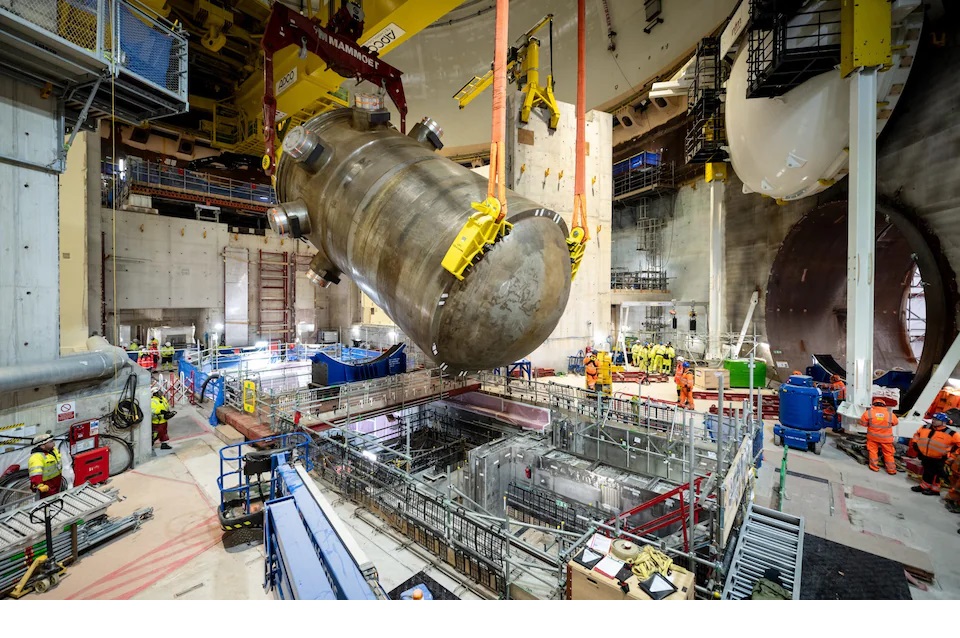
It may be delayed to the extent that existing nuclear reactors are now planning to remain operational for an extra three years, but Hinkley Point C has come a step closer to activation with an overnight operation to drop a crucial 500-tonne reactor for the process into place.
When switched on, Somerset’s Hinkley Point C, near Bridgwater, is estimated to be capable of providing 7% of the UK’s power needs – calculated to keep six million homes supplied.
The 13m-long reactor is the first of two to be put in place by French project owner EDF and each will contain the nuclear chain reaction that will generate power from a planned operational date of 2030. the 12-hour operation to manoeuvre the unit into place was the first such job in 30 years in the UK.
But the road to this landmark has been far from smooth. With the installation some five years later than was originally planned, Covid, supply chain issues and political negotiations have ensured an uphill slog on the technology’s re-introduction, while – in keeping with the original advent of nuclear power – costs have spiralled: back in 2017, the taxpayer was told that the cost of this project would be £18bn. It now stands at £46bn.
Gloucestershire businessman and energy entrepreneur Dale Vince, who owns Ecotricity and campaigns for Britain’s energy production to be brought back into the hands of British business, has argued against nuclear installations on the Severn Estuary since 1983 and became a patron of the Stop Hinkley campaign this summer.
Speaking about the decision, Mr Vince said: “I’m really pleased to be a patron of the Stop Hinkley campaign which is working to stop the government wasting billions of taxpayers’ money on a technology which is hugely expensive and slow to develop.”
Alongside Mr Vince, the Somerset campaign is urging the government to adopt a 100% renewable energy strategy which it argues is “perfectly feasible” and which, compared to the UK Government’s current strategy, would save more than £100bn on the route plan to reach net zero by 2050.
Roy Pumfrey, Stop Hinkley spokesperson, said nuclear power is “rapidly losing ground to the astonishing growth in renewables” and the campaign has wanred that there is “no scientific solutuon to safeguarding nuclear waste” and contends that while no electricity production is zero carbon, nuclear is calculated to produce between 8 and 11 times more carbon emissions than renewable sources.
EDF has also waded into controversy here in Gloucestershire this week after the Gloucestershire Wildlife Trust claimed the supplier’s mitigation scheme for fish killed in the planned nuclear site was “shambolic” and threatens to create the perfect conditions for an ecological disaster in the Severn Estuary.
Hinkley Point C is financed by the state-owned French energy giant EDF Energy and China General Nuclear Power Group, which is also state-owned. https://www.punchline-gloucester.com/articles/aanews/hinkley-update-mixed-reaction-as-first-reactor-drops-into-place
Green Group Sounds Alarm Over Meta’s Nuclear Power Plans

“In the blind sprint to win on AI, Meta and the other tech giants have lost their way,” said a leader at Environment America.
Jessica Corbett, 5 Dec 24, https://www.commondreams.org/news/meta-nuclear-power?xrs=RebelMouse_fb&ts=1733449433&fbclid=IwY2xjawHAsKZleHRuA2FlbQIxMQABHdKFUyPBOBTG7NW2ZlQDOh0gqS_OC0L73I44ICQNjlWw12xPlcO9omTXJQ_aem_Od_q57mbvDma_to2jfZafA
Environmental advocates this week responded with concern to Meta looking for nuclear power developers to help the tech giant add 1-4 gigawatts of generation capacity in the United States starting in the early 2030s.
Meta—the parent company of Instagram, Facebook, WhatsApp, and more—released a request for proposals to identify developers, citing its artificial intelligence (AI) innovation and sustainability objectives. It is “seeking developers with strong community engagement, development, …permitting, and execution expertise that have development opportunities for new nuclear energy resources—either small modular reactors (SMR) or larger nuclear reactors.”
The company isn’t alone. As TechCrunchreported: “Microsoft is hoping to restart a reactor at Three Mile Island by 2028. Google is betting that SMR technology can help it deliver on its AI and sustainability goals, signing a deal with startup Kairos Power for 500 megawatts of electricity. Amazon has thrown its weight behind SMR startup X-Energy, investing in the company and inking two development agreements for around 300 megawatts of generating capacity.”
In response to Meta’s announcement, Johanna Neumann, Environment America Research & Policy Center’s senior director of the Campaign for 100% Renewable Energy, said: “The long history of overhyped nuclear promises reveals that nuclear energy is expensive and slow to build all while still being inherently dangerous. America already has 90,000 metric tons of nuclear waste that we don’t have a storage solution for.”
Do we really want to create more radioactive waste to power the often dubious and questionable uses of AI?” Neumann asked. “In the blind sprint to win on AI, Meta and the other tech giants have lost their way. Big Tech should recommit to solutions that not only work but pose less risk to our environment and health.”
“Data centers should be as energy and water efficient as possible and powered solely with new renewable energy,” she added. “Without those guardrails, the tech industry’s insatiable thirst for energy risks derailing America’s efforts to get off polluting forms of power, including nuclear.”
In a May study, the Electric Power Research Institute found that “data centers could consume up to 9% of U.S. electricity generation by 2030—more than double the amount currently used.” The group noted that “AI queries require approximately 10 times the electricity of traditional internet searches and the generation of original music, photos, and videos requires much more.”
Meta is aiming to get the process started quickly: The intake form is due by January 3 and initial proposals are due February 7. It comes after a rare bee species thwarted Meta’s plans to build a data center powered by an existing nuclear plant.
Following the nuclear announcement, Meta and renewable energy firm Invenergy on Thursday announced a deal for 760 megawatts of solar power capacity. Operations for that four-state project are expected to begin no later than 2027.
Why NuScale Power Stock Slumped Today

By Rich Smith – Dec 2, 2024
https://www.fool.com/investing/2024/12/02/why-nuscale-power-stock-slumped-today/
Key Points
GE Vernova is much bigger, with much more cash, and already profitable.
CNBC reported on GE Vernova’s ambitions to dominate the building of small modular reactors.
NuScale Power is a pioneer in this industry, but its business is small and unprofitable.
Will GE Vernova crush NuScale’s nuclear dreams?
NuScale Power Corporation (SMR -0.08%) stock fell 3% through 11:25 a.m. ET — and it has General Electric to blame for it.
NuScale develops small modular nuclear reactors designed to be cheaper and faster to build than traditional nuclear power plants. And as it’s fond of pointing out, NuScale is “the first and only SMR to have its design certified by the U.S. Nuclear Regulatory Commission.” But leaders aren’t necessarily winners, and as CNBC reports this morning, NuScale faces serious competition from a much bigger nuclear player, GE Vernova (GEV 3.56%), the former energy arm of General Electric.
GE Vernova’s threat to NuScale
NuScale and GE Vernova both aim to develop small modular reactors, but “small” is a relative term. If a standard nuclear power plant produces 1,000 megawatts of electricity, Vernova’s BWRX-300 reactor aims to cut that output to 300 megawatts (which is still substantial, enough to power a small city of 200,000 homes), while NuScale’s Voygr reactor goes even smaller with a 77-megawatt output.
In other respects, the two companies are more direct competitors. Both Vernova and NuScale advertise their ability to deploy multiple modules of their basic SMR in a single location, to amp up total power production capacity.

Both target a global market, with GE Vernova “aiming to deploy small nuclear reactors across the developed world over the next decade,” according to CNBC.
Is NuScale Power stock a sell?
What really sets the two companies apart, though, is their financial capacity to deliver on their promises. While valued at $3 billion in market cap, NuScale boasts less than $10 million in annual revenue and is losing $80 million a year. Analysts don’t expect the company to turn profitable before 2030 at the earliest.
GE Vernova is a $92 billion behemoth earning more than $1.2 billion a year and growing its profits at 40% a year. Just the cash alone on Vernova’s balance sheet is worth twice the price of NuScale’s stock. In any direct contest, I know which stock I’d bet on to win — and unfortunately, it’s not NuScale.,
Security planning for small modular reactors ‘not where it should be’, academic says.

28 Nov, 2024 By Tom Pashby
The security planning for the forthcoming wave of small modular reactor (SMR) developments in the UK is “not where it should be” according to an academic who supports the industry.
SMRs have risen up the agenda with Great British Nuclear’s (GBN) competition for developers to get access to government support for deployment making progress, as well as other novel
nuclear energy companies like Last Energy UK saying it will deploy
micro-reactors in Wales by 2027.
Big technology companies like Google,
Amazon and Oracle have said they want SMRs to power their AI data centres,
to overcome grid power constraints.
And in the UK, the Civil nuclear:
roadmap to 2050 stated: “To deliver energy security while driving down
costs our long-term ambition is the deployment of fleets of SMRs in the
UK.” Proponents of SMRs, such as big tech companies, want them because of
the additional flexibility they offer in location. They don’t need to be
built far away from people because of their size, or near water because
SMRs can be air-cooled.
This opens up questions about appropriate security
arrangements, because traditional gigawatt-scale nuclear sites in the UK
benefit from having long sight lines and layers of physical security such
as fences, patrol paths and armed guards.
New Civil Engineer 28th Nov 2024 https://www.newcivilengineer.com/latest/security-planning-for-small-modular-reactors-not-where-it-should-be-academic-says-28-11-2024/
Small nuclear reactors are at risk from military attacks, so should be built underground

Small modular reactors (SMRs) should be built underground, including in
city centres, to protect them from military attacks, seismic activity and
other natural hazards, according to a new academic study.
Nucnet 27th Nov 2024
https://www.nucnet.org/news/underground-plants-could-be-built-in-city-centres-11-3-2024
Iran deploys advanced centrifuges in defiance of IAEA resolution
Iran has begun deploying advanced centrifuges which enrich uranium for the
country’s nuclear program in response to a resolution by the
International Atomic Energy Agency (IAEA) calling for greater transparency
into Iran’s nuclear activities.
Speaking during an open session of
parliament on Sunday, Mohammad Bagher Ghalibaf criticized the resolution,
accusing the United States and European nations of using Iran’s nuclear
program as a pretext for unjustified actions. He said, “The Islamic
Republic of Iran’s reciprocal response to this political misuse of the
Board of Governors was immediately put into action, and the deployment of a
set of new and advanced centrifuges has begun”.
Iran International 24th Nov 2024,
https://www.iranintl.com/en/202411240306
Nuclear fusion: neither imminent nor relevant to climate change

Billions of dollars have been raised on promises of limitless power from nuclear fusion. However, the technology will not deliver affordable power within our lifetimes.
By Ross McCracken, 22/11/2024,
https://www.energyvoice.com/renewables-energy-transition/563251/nuclear-fusion-neither-imminent-nor-relevant-to-climate-change/
As a child, my father, a senior experimental plasma physicist at the UK’s Culham Laboratory, would tell me that an electricity-generating fusion reactor was just 30 years away. His opinion had not changed by the time he retired, and I believe it would be the same now, if he were alive. But then, he always was an optimist.
With the exception of those on which their business is based, such as France’s EdF, electric utilities in the western world have largely given up on building new nuclear fission reactors. They are expensive; the capital outlay and commercial risks are too high, and they take too long to build.
Market forces and climate policies are now driving the construction of wind and solar farms, which generate cleaner electricity more cheaply, even when energy storage is included. As nuclear power has largely failed as a commercial market proposition, nearly all nuclear newbuild in the world today is heavily state sponsored in one form or another, rather than market driven.
But the nuclear industry is far from out. It has ‘new’ propositions, one of which is still nuclear fusion.
Dubious claims
Private companies have entered the sector, claiming that they can solve the problems encountered by decades of international research with new reactor designs and fusion processes.
Investors hope that innovation from an agile private sector will rejuvenate and overtake the slow process of publicly funded science, represented by the ITER project currently under construction at Cadarache, in France. Fusion will generate limitless clean energy and, in the process, become a key tool for addressing climate change – according to its proponents.
US company Helion, which in 2015 promised a “a useful reactor in the next three years”, now promises a fusion plant by 2028, for example. Microsoft has even agreed to purchase electricity from the facility.
However, the claims of clean, unlimited energy do not stand up to scrutiny. Or as nuclear fusion scientist SJ Zweben put it more bluntly in an article for Physics and Society in January, they are:
“At best wildly optimistic but more often mistaken, delusional, deceitful or fraudulent.”
The scientific and engineering challenges facing nuclear fusion reactors are legion, and as Zweben points out they all need to be resolved at the same time. This is extremely challenging because the solutions proposed for one problem often exacerbate others or create new ones.
The many challenges include energy confinement, impurity contamination, plasma disruptions, wall erosion, the tritium fuel cycle, availability in terms of operational uptime, excessive power consumption by the plant itself, cost and – yes, contrary to industry marketing – radioactive waste.
Spherical Tokamak for Energy Production (STEP)
The UK is basing its fusion hopes on STEP, having left the international ITER project with Brexit. A site has been chosen for the project, but it is not yet clear whether the experiment will garner the same support from the current government as it did from the previous one.
In a recent article for Physics World, fusion scientist Guy Matthews noted that the energy stored in STEP’s plasma would need to be about 5,000 times larger than that produced in the UK’s MAST-U spherical tokamak experiment. He describes the single giant leap to a power plant as “an extreme, and unprecedented, extrapolation of physics and technology”.
It may even be dangerous. There is no way yet of reliably avoiding or mitigating plasma instabilities, known as ‘disruptions’. Without a robust solution, the consequent damage “would render a power plant inoperable”.
Other experienced fusion scientists share these and other concerns.
John Evans, who worked at the Atomic Energy Research Establishment in Harwell, recently highlighted the lack of a proven solution for the fusion fuel cycle.
This involves breeding and reprocessing unprecedented quantities of radioactive tritium – a hydrogen isotope that does not occur naturally and needs to be generated from a massive ‘breeding blanket’ containing lithium. A solution must be in place before any fusion power plant can operate and each fusion plant would consume, annually, more tritium than is currently available globally.
Put simply, the technical and scientific challenges posed by any approach to fusion, whether using spherical, ‘toroidal’ tokamaks or lasers, are huge.
Will fusion be clean?
According to the International Atomic Energy Agency (IAEA), “Fusion does not create any long-lived radioactive waste”. This is true only in theory.
A fusion reactor produces helium, an inert gas, as a result of a fusion reaction between the hydrogen isotopes tritium and deuterium. Tritium is very radioactive with a half-life of 12.3 years. The tritium is both produced and consumed by the fusion reactor so, in a perfect world, there is no nuclear waste.However, 80% of the power from the fusion reaction is delivered as fast neutrons that generate the tritium from the surrounding breeding blanket, which is likely to require periodic replacement.Nuclear reactions between the neutrons, and impurities or primary elements in the blanket, make it radioactive and degrade the materials – i.e. increasing the need for replacement.Materials in a more compact fusion reactor, like STEP, would accumulate neutron damage more rapidly and would therefore need more frequent replacement.
As a result, Matthews provides a somewhat different message to the IAEA: “If conventional engineering materials are used, fusion reactors have the potential to generate far larger volumes of long-lived radioactive waste than fission reactors.”
The extent to which suitable low-activation fusion materials can be developed to mitigate this challenge at an acceptable cost is one of the many unsolved problems facing fusion power.
A neutron-free fusion reaction is possible using hydrogen and boron, but for this to work the plasma temperature needs to be around 7,000 million degrees – which makes the deuterium-tritium reaction (JET, ITER), at a mere 100 million degrees, seem like a walk in the park.
Fusion’s costs are misunderstood or ignored
Fusion advocates use the term ‘limitless’ energy to imply cheap energy. But will fusion provide either?
It could be limitless in the sense that the base fuel sources – lithium and deuterium – are abundant and only relatively small amounts are required to produce huge amounts of power. Unfortunately, the idea that a limitless or near-limitless energy source means cheap energy is plain wrong because, however energy is generated, it has a cost.
A nuclear fusion power plant will have a capital cost, an operational cost and a maximum generating capacity like any other power plant. The price of a first-of-a-kind reactor will be huge and an ‘nth of a kind’ reactor will not be cheap. ITER’s costs are currently estimated at €18-22 billion, but will likely prove much higher and it is an experiment – not a power plant.
STEP’s cost is estimated to run to several billion pounds before construction has even started and it is a far more challenging project. Moreover, the role of STEP (if successful) is only to provide a “pathway to commercialisation” according to Howard Wilson, fusion pilot plant lead at the US’ Oak Ridge National Laboratory.
Cost trajectory
For wide-scale deployment, fusion must be economically viable. The general ‘rule’ used in forecasting future costs is that they halve as production of a commodity doubles. However, this is a popularisation and over-optimistic simplification of Wright’s Law, which states that for every cumulative doubling of units produced, costs will fall by a constant percentage.
The extent of that percentage is usually governed by the complexity of the technology concerned and the degree to which it can be modularised and subject to the cost gains of mass manufacturing. Technical complexity and safety concerns, when major, mean that the cost reduction of higher production volumes can be small or non-existent.
Just as nuclear fission has struggled to follow Wright’s Law, there is no reason to believe that fusion, which is much more complex, will be any more successful.
Relevance to climate change
Nuclear fusion is still decades away from working (i.e. producing sustainable net energy gains), and then decades more from economic viability. Even then, it would be more decades still from deployment on a scale large enough to have any impact on climate change.
It is almost 2025, and to remain on track to limit global warming to 1.5°C above pre-industrial levels, the world, not just individual countries, needs to achieve net-zero carbon by 2050. It is a goal that is already slipping away. Fusion is simply too far off to be of any use.
Ross McCracken is a freelance energy analyst with more than 25 years experience, ranging from oil price assessment with S&P Global to coverage of the LNG market and the emergence of disruptive energy transition technologies.
The entanglement of fusion energy research and bombs
By Arjun Makhijani | November 12, 2024
The recent achievement of fusion ignition—meaning more
energy came out of a self-sustaining fusion reaction than was put in—at
Lawrence Livermore National Laboratory’s National Ignition Facility (NIF)
has brought to the fore long-simmering questions about whether certain
experiments violate the Comprehensive Test Ban Treaty on nuclear
explosions.
Fusion research for peaceful use and military use are highly
intertwined, despite attempts to cloak nuclear weapons with the aura of the
so-called “peaceful atom.” Ignition has been achieved, but there is
still a remarkable silence around whether pure fusion weapons—weapons
that could kill large numbers of humans with neutron radiation but have
blast effects much smaller than current thermonuclear weapons—are an
objective of the overall program.
Even if not an explicit objective, would they be built if fusion technology makes them feasible? Research and experiments into weapons-related nuclear fusion and commercial energy fusion are highly entangled, and have been notably so since the 1950s,
after the Soviets conducted their “layer cake” nuclear test with a
fusion component in 1953, and the US did its 15-megaton Bravo test in
1954—a test of a thermonuclear weapon.
To improve the terrible public
relations image that those tests cast over the world, the Eisenhower
administration came up with a carefully orchestrated propaganda campaign
for nuclear power, with the tag line “atoms for peace.” That is
happening again after the recent achievement of ignition at the National
Ignition Facility at Lawrence Livermore National Laboratory, with the
difference that the world does not even know whether pure fusion weapons
are on the agenda.
Bulletin of Atomic Scientists 11th Nov 2024,
https://thebulletin.org/premium/2024-11/the-entanglement-of-fusion-energy-research-and-bombs/
Will New Brunswick choose a “small, modular” nuclear reactor – that’s not small at all (among other problems)?

There is nothing modular about this reactor. The idea that such an elaborate structure can just be trucked in, off-loaded, and ready to go, is a fantasy cultivated by the nuclear industry as a public relations gimmick.
by Gordon Edwards, November 23, 2024, https://nbmediacoop.org/2024/11/23/will-new-brunswick-choose-a-small-modular-nuclear-reactor-thats-not-small-at-all-among-other-problems/
NB Power seems determined to build at least two experimental reactors at the Point Lepreau nuclear site, but their chosen designs are running into big problems.
One possible alternative is the reactor design Ontario Power Generation (OPG) hopes to build at the Darlington nuclear site on Lake Ontario. OPG is promoting it as a “small, modular” nuclear reactor.
Consider a building that soars 35 metres upwards and extends 38 metres below ground. That’s 10 stories up, 11 stories down. At 73 metres, that’s almost as tall as Brunswick Square in Saint John, or Assumption Place in Moncton, the tallest buildings in New Brunswick. Would you call such a structure small?
That’s the size of the new reactor design, the first so-called “Small Modular Nuclear Reactor” (SMNR) to be built in Canada, if the Canadian Nuclear Safety Commission gives OPG the go-ahead in January. It’s an American design by GE Hitachi that requires enriched uranium fuel – something Canada does not produce. If the reactor works, it will be the first time Canada will have to buy its uranium fuel from non-Canadian sources.
The new project, called the BWRX-300, is a “Boiling Water Reactor” (BWR), completely different from any reactor that has successfully operated in Canada before. Quebec tried a boiling water CANDU reactor several decades ago, but it flopped, running for only 180 days before it was shut down in 1986.
The Darlington BWR design is not yet complete. Its immediate predecessor was a BWR four times more powerful and ten times larger in volume, called the ESBWR. It was licensed for construction in the U.S. in 2011, the same year as the triple meltdown at Fukushima in Japan. The ESBWR design was withdrawn by the vendor and never built.
The BWRX-300 is a stripped-down version of ESBWR, which in turn was a simplified version of the first reactor that melted down in Japan in 2011. To shrink the size and cut the cost, the BWRX-300 eliminates several safety systems that were considered essential in its predecessors.
For example, BWRX-300 has no overpressure relief valves, no emergency core cooling system, no “core catcher” to prevent a molten core from melting through the floor of the building. Instead, it depends on a closed-loop “isolation condenser” system (ICS) to substitute for those missing features.
But is the ICS up to the job? During a 1970 nuclear accident, the ICS failed in a BWR at Humboldt Bay in California. At Fukushima, the ICS system failed after a few hours of on-and-off functioning.
Because CNSC, the Canadian nuclear regulator, has no experience with Boiling Water Reactors, it has partnered with the US Nuclear Regulatory Commission (NRC). They both met with the vendor GE-Hitachi several times.
The regulatory approach of the two countries has been very different: in February 2024, the U.S. NRC staff told GE-Hitachi that a complete design is needed before safety can be certified or any licence can be considered. But In Canada, the lack of a complete design seems no obstacle.
CNSC public hearings in November 2024 and January 2025 are aimed at giving OPG a “licence to construct” the BWRX-300 – before the design is even complete, and before the detailed questions from U.S. NRC staff have been addressed.
Building the BWRX-300 will require a work force of 1,000 or more. The entire reactor core, containing the reactor fuel and control mechanisms, will be in a subterranean cylindrical building immersed in water, not far from the shore of Lake Ontario.
There is nothing modular about this reactor. The idea that such an elaborate structure can just be trucked in, off-loaded, and ready to go, is a fantasy cultivated by the nuclear industry as a public relations gimmick.
The BWRX-300 will not be small. It will not be modular. And so far, its design is incomplete. An initial analysis of the design has identified unanswered safety questions.
If CNSC is prudent, it will not grant OPG a licence to construct the reactor next year. There are too many unanswered safety-related questions.
And if OPG is prudent, It will count on a doubling or tripling of the estimated cost. Already we have seen SMR projects in Idaho and Chalk River in Ontario run into crippling financial roadblocks.
The financial problems of the current SMNR designs in New Brunswick are the latest examples of private capital shunning nuclear investments. If New Brunswick is prudent, it will think very hard before diving into another nuclear boondoggle. The potential fallout will not be small at all.
Dr. Gordon Edwards is the president of the Canadian Coalition for Nuclear Responsibility based in Montreal.
Shares in nuclear reactor company OKLO bite the dust

Sam Altman-Backed Oklo Slumps After Kerrisdale Says It’s Shorting Stock
By Carmen Reinicke and Will Wade, November 20, 2024 , https://www.bnnbloomberg.ca/investing/2024/11/20/sam-altman-backed-oklo-slumps-after-kerrisdale-says-its-shorting-stock/
Shares of Oklo Inc., the nuclear fission reactor company backed by OpenAI Inc’s Sam Altman, tumbled Wednesday after Kerrisdale Capital said it is shorting the stock.
The report alleges that “virtually every aspect of Oklo’s investment case warrants skepticism,” sending the stock down as much as 10%. Shares pared much of the decline and were down about 6% in midday trading in New York.
Oklo shares have whip-sawed recently, rallying more than 20% this week through Tuesday’s close after falling 25% on Friday following its earnings release and the expiration of a lockup period that allows key investors like Peter Thiel’s venture capital firm to start selling shares.
Oklo declined to comment.
Since the company went public via a special purpose acquisition merger in May, its shares have soared more than 150%.
“In classic SPAC fashion, Oklo has sold the market on inflated unit economics while grossly underestimating the time and capital it will take to commercialize its product,” the Kerrisdale report said.
The company is among a wave of firms developing so-called small modular reactors that are expected to be built in factories and assembled on site. Advocates say the approach will make it faster and cheaper to build nuclear power plants, but the technology is unproven. Only a handful have been developed, and only in Russia and China.
Oklo has said it expects its first system to go into service in 2027, but the Kerrisdale report highlights numerous technical and regulatory hurdles that may delay that schedule. Oklo is pursuing a new technology that it said will make its design safer and cheaper than conventional reactors in use today. The company’s design doesn’t have approval from the US Nuclear Regulatory Commission, a process that typically takes years.
Wall Street is split on the company thus far. Of the four analysts covering Oklo, two have buy-equivalent ratings and two are neutral. The average price target implies about 5% return from where shares are trading.
Besides Altman and Thiel, the company has another potentially high-profile connection. Board member Chris Wright was nominated by President-elect Donald Trump to lead the Energy Department last week.
Why EDF’s Hinkley C nuclear power plant will probably not be running before 2035
David Toke. Nov 20, 2024, https://davidtoke.substack.com/p/why-edfs-hinkley-c-nuclear-power
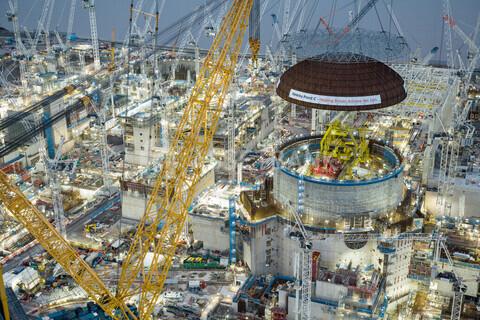
There is a broad relationship between the time it takes to build nuclear power stations and their cost. That is apparent from looking at what has happened in the past, with nuclear costs escalating as construction times have increased. A study of this relationship leads to the conclusion that the commercial operation of Hinkley Point C (HPC) will almost certainly not happen before 2035.
The model being built at Hinkley C is the European Pressurised Reactor (EPR). The only two EPRs to have been (more or less) completed in the West have involved major cost overruns. They have taken much longer to build than expected. In Finland, the plant at Olkiluoto took nearly 17 years to come into commercial operation from its construction start in 2005. The EPR at Flamanville in France has so far taken 17 years to (not quite as yet) come into commercial operation since the concrete for the reactor was first poured in 2007.
When I was writing a book about nuclear power, safety, and costs I did an (anonymised) interview with a British-based nuclear industry consultant who commented:
‘the point at which you do the first concrete pour, the organisation starts hemorrhaging money. That is when you have to build as rapidly as possible with minimum delays and commission as quickly as you can’. (anonymous interview with nuclear consultant, 01/06/2018) (page 133 see book link HERE ). It’s a simple relationship really. The longer the construction period is, then the longer you have to employ staff to do the job. Hence costs increase almost as night follows day.
You can see the relationship between costs and construction time in Figure 1 below [on original]. Please note these are so-called ‘overnight’ costs and do not include interest payments to debtors or equity holders. This, in reality, pushes up costs greatly, which is why these ‘overnight’ costs greatly understate nuclear costs. However, I use the overnight costs for comparison purposes, and also because their interpretation is much more transparent and unarguable compared to making assumptions about the cost of capital.
In a post earlier this year I explained how Flamanville 3’s construction time had been part of a trend towards increasing nuclear construction times in France. This is shown in Figure 2 below [on original]. The bar on the right represents Flamanville 3 whose construction began in 2007.
Both the power plant compared in Figure 1 (Flamanville 3 and Olkiluoto 3) cost much more than expected. However the alarming thing about the British nuclear programme is that they are still only about half as expensive as the projected costs of Hinkley C. Whereas Olkiluoto 3 and Flamanville 3 have overnight costs of around 8.7 to 8.1 billion euros per GW, Hinkley C has projected costs, according to EDF, of around double this amount (ie over 16 billion euros per GW) when EDF’s median projected costs are translated into 2024 euro prices. (See HERE for costs in 2015 £s, as reported by ‘World Nuclear News’).
This does imply that Hinkley C is going to take even longer to come online than these power plants in Finland and France did. Hinkley C’s reactor construction began at the end of 2018, and the cost estimates made then were broadly in line with the sort of costs we have seen in the cases of Fimamanville and Olkiluoto. However, projections of cost overruns for HPC have escalated since then.
Even if EDF ‘only’ took as long to build as Flamanaville and Olkiluoto, HPC will not be online until 2035. But the costs of HPC are much higher, around double, compared to either of these other EPRs. Of course, we cannot say, for definite, now how long for sure completion of HPC will take. But we can do an estimate by working backward from the cost. That is if there is a simple linear relationship between construction time and cost then we could say that if HPC is going to cost twice as much as Flamanville 3 or Olkiluoto 3 then HPC will take twice as long as these plants – that is well over 30 years. On that basis, HPC would not be finished until around 2050. You can see this calculation in Figure 3. [on original] HPC is in the third set of columns.
Maybe it will not take quite as long as 2050 to finish HPC – I cannot say – but what these simple calculations do suggest that EDF’s (most recently) projected completion dates of 2029-2031 look hopelessly optimistic. Even if HPC ‘only’ takes as long as Flamanville 3, we shall still be looking at a start no earlier than 2035. The CEO of EDF is famously quoted as saying that people would be cooking their turkeys by the xmas of 2017. We could be lucky to be cooking our turkeys using HPC power by 2037!
The prospect of HPC not being online in 2029 automatically triggers penalty clauses in the contract that was agreed between the UK Government and EDF in 2013. If EDF does not meet this deadline then it loses a year of its premium price guarantee for every year that it fails to start generating. The premium price of £92.50 per MWh in 2012 prices which equates to £129 per MWh in 2024 prices. No doubt pressure will grow on the UK Government to relax the penalty clause.
All of this does not bode well for Sizewell C. This is a carbon copy of the design of HPC, we are told. Except that it is not, It is on a different site with its own, different, challenges. There can be no confidence that the costs will be much less than HPC – as Amory Lovins puts it, nuclear power seems to have an ‘unlearning curve’ – ie it gets more expensive over time in a given country. It is unlikely that EDF will have much capacity to do much on Sizewell C until HPC is more or less completed, and as Sizewell C is likely to take at least 15 years to build (based on experience with EPRs) it seems unlikely that Sizewell C will be generating this side of 2050. I have one good reason to hope to see the day when Sizewell C is generating. It means that I shall live a very long time and be very old indeed!
Otherwise, it would not be wise to persevere with Sizewell C. Sizewell C is likely to come online when it is even more technologically uncompetitive than it is now with other green energy sources and techniques. Indeed the approach of the Government has altered dramatically since the Hinkley Point C contract was signed. Then there were penalty clauses imposed on EDF to encourage good performance. Now, with Sizewell C, EDF will be able to rely on the consumer to pay the tens of billions of pounds of cost overruns that will inevitably occur. A sort of reverse logic has been applied. It has been realized that nuclear power is too uneconomic to be built by offering a long-term contract to buy electricity. But instead of walking away from the technology, we will now take on a massive uncapped financial obligation for the next project.
Nuclear Fusion, forever the energy of tomorrow?
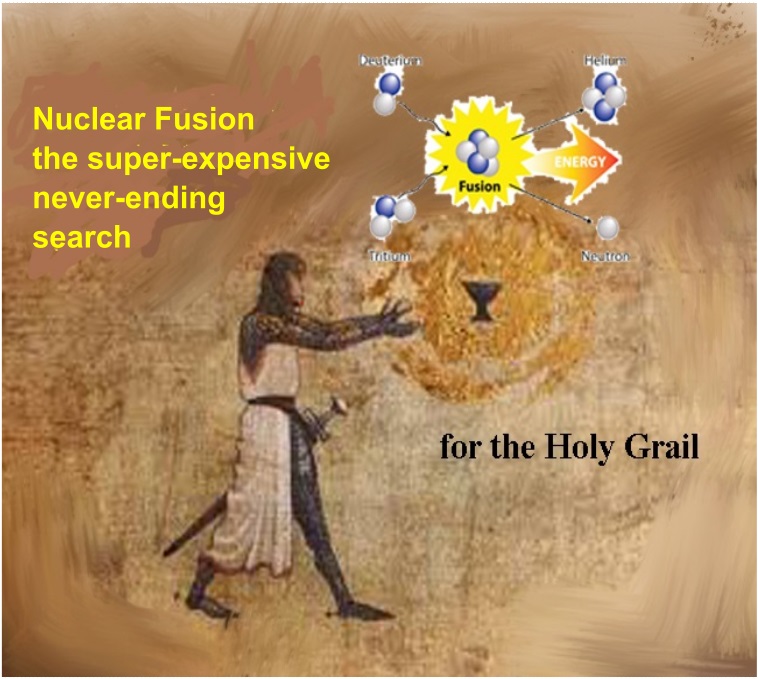
Bulletin, By Dan Drollette Jr | November 12, 2024
Nuclear fusion as a source of electricity always seems to be just around the corner. As the old joke goes, “Thirty years ago, fusion was 30 years away from becoming a viable commercial reality”—a comment borne out in the Bulletin’s own pages, if not precisely on a 30-year timescale.
In 1971, physicist Richard Post of what was then the Lawrence Radiation Laboratory published a Bulletin of the Atomic Scientists’ article featuring a chart that showed how fusion—that is, the fusing of hydrogen atoms to release energy, a process that powers all stars, including the Earth’s sun—would be widely available on a commercial scale, routinely pumping electrons to the electrical grid, by the year 1990 (although he hedged his bets by labeling it “An Optimist’s Fusion Power Timetable” [emphasis added]).
That optimism was widely shared, judging from the literature in the science and technology press of the time. But it proved to be misplaced; although militaries have thousands of nuclear warheads based on the fusion process, everything about commercial fusion as an energy has proven harder and taken longer than expected. For example, more than 60 years passed since the development of the first fusion “tokamak” reactor in the old Soviet Union to the first sustained fusion “burn,” or ignition, at the National Ignition Facility in the United States in 2022.
The difficulties involved in creating a commercial power plant are relatively simple to enumerate, as plasma physicist Bob Rosner—himself the former director of a national laboratory (and former chair of the Bulletin’s Science and Security Board)—explains in his interview, “Ferreting out the truth about fusion.” In a nutshell, the fusion process releases neutrons that are 10 times more energetic than what a commercial plant powered by the splitting of atoms, or nuclear fission, ordinarily emits. These high-powered neutrons are difficult to contain and rapidly degrade the containers proposed for controlling the extremely hot plasma required for a fusion reaction. At the same time, plasmas are just plain difficult to keep stable while producing that all-important steady (or quasi-steady) fusion “burn.”
In fact, Rosner notes, it’s likely that if a disruptive instability ever happens at ITER—the giant international research and engineering effort, based in France, that seeks to demonstrate how fusion could be produced in a magnetic fusion device—the multibillion-dollar experimental facility likely would not recover. For these reasons and more, Rosner asserts that commercial-scale, tokamak-style fusion will not be a reality in his lifetime—“and I think not in my children’s lifetime, or my grandchildren’s lifetime.” In addition, he warns about the hype and public relations fluff surrounding overly rosy projections for fusion, or what Rosner terms “a complex mixture of fact, half-truths and outright misinformation.”
It turns out that getting a reliable, steady source of tritium fuel for a fusion reactor would be an extremely difficult problem to crack, as physicist Daniel K. Jassby—formerly of the Princeton Plasma Physics Laboratory—points out. In his article, “The fuel supply quandary of fusion power reactors,” Jassby argues that the fusion reactors now envisioned would not be able to “breed” enough tritium to supply the reactor’s continued operation, and that even a few such reactors (if they ever became reality) would shortly exhaust the world’s supply of that hydrogen isotope, which is not naturally occurring.
So, why would anyone or any institution even go near fusion research? The same reasons keep popping up, in various forms, among the various experts in this issue of the magazine: There’s the desire to know and understand the basic mechanisms of our universe, and the likelihood that fundamental research and development in fusion could lead to big results in other scientific and technological arenas (“self-healing metals” being one of them). And then there’s what fusion research could do for nuclear weapons research in the immediate near-term. As Arjun Makhijani, president of the Institute for Energy and Environmental Research, writes:
“Fusion research for peaceful use and military use are highly intertwined, despite attempts to cloak nuclear weapons with the aura of the so-called ‘peaceful atom.’ ”
Given these considerations, it’s understandable that governments continue to back fusion research, despite the small likelihood that a commercial fusion power plant will come on-line soon. After all, funding basic research and providing for national defense are core goals for any state.
It is harder to understand why prominent players in the private marketplace—including the founders of Microsoft, OpenAI, Paypal, and Amazon—would invest vast sums on an infant field like commercial fusion. More than $1.8 billion was raised to fund just one startup, Commonwealth Fusion Systems, whose website indicates that it seeks to commercialize fusion energy in some form in just 10 years—decades ahead of government-funded efforts. To help explain their thinking, Silicon Valley venture capitalist and University of California Berkeley professor Mark Coopersmith delves into the world of high-finance. In his interview, “Fusion is not a typical bet,” Coopersmith explains the psychology behind putting down large sums despite long odds—assuming one has the money burning a hole in one’s pocket. The prospect of a “super return” of 1,000 or even 10,000 percent makes “deep-tech” research and development attractive, he says, even if the potential payoff could be decades away………………………………………………………. https://thebulletin.org/premium/2024-11/introduction-fusion-the-next-big-thing-again/?utm_source=Newsletter&utm_medium=Email&utm_campaign=ThursdayNewsletter11142024&utm_content=NuclearRisk_FusionNextBigThingAgain_11122024
1 This Month

To see nuclear-related stories in greater depth and intensity – go to https://nuclearinformation.wordpress.com
-
Archives
- September 2026 (194)
- August 2026 (330)
- July 2026 (355)
- June 2026 (287)
- May 2026 (306)
- April 2026 (356)
- March 2026 (251)
- February 2026 (267)
- January 2026 (308)
- December 2025 (358)
- November 2025 (359)
- October 2025 (375)
-
Categories
- 1
- 1 NUCLEAR ISSUES
- business and costs
- climate change
- culture and arts
- ENERGY
- environment
- health
- history
- indigenous issues
- Legal
- marketing of nuclear
- media
- opposition to nuclear
- PERSONAL STORIES
- politics
- politics international
- Religion and ethics
- safety
- secrets,lies and civil liberties
- spinbuster
- technology
- Uranium
- wastes
- weapons and war
- Women
- 2 WORLD
- ACTION
- AFRICA
- Atrocities
- AUSTRALIA
- Christina's notes
- Christina's themes
- culture and arts
- Events
- Fuk 2022
- Fuk 2023
- Fukushima 2017
- Fukushima 2018
- fukushima 2019
- Fukushima 2020
- Fukushima 2021
- general
- global warming
- Humour (God we need it)
- Nuclear
- RARE EARTHS
- Reference
- resources – print
- Resources -audiovicual
- Weekly Newsletter
- World
- World Nuclear
- YouTube
-
RSS
Entries RSS
Comments RSS
 nuclear-news