Micro-reactor developer optimistic about connecting South Wales project by 2027
08 Nov, 2024 By Tom Pashby
The CEO of a micro nuclear reactor developer aiming to build in Wales this
decade has told NCE he is confident that grid connection reforms will help
keep his company’s ambitious plans on schedule.
Last Energy is a developer of micro-reactors, which fall within the overall category of
small modular reactors (SMRs). The firm is hoping to build and commission
four 20MW reactors in South Wales by 2027.
Details of its Prosiect Egni Glan Llynfi project in Bridgend County were released last month and raised eyebrows. Last Energy calls it, in English, the Llynfi Clean Energy Project
and is proposed on the site of the former coal-fired Llynfi Power Station
which was in operation from 1951 to 1977.
The SMR designs in Great British
Nuclear’s competition are subject to a generic design assessment (GDA) by
regulators of the UK nuclear sector. This allows the regulators to assess
the safety, security, safeguards and environmental aspects of new reactor
designs before site-specific proposals are brought forward.
Jenner said Last Energy is not going through the generic design assessment approach. He
said the ONR “stated that that’s not absolutely essential”. “It’s
one route you can take. We are going straight to the site licensing
route,” he said. “We are linking our project and our design straight to
our project in this case, is Llynfi in South Wales, so you go through the
same rigor, but it’s linked to a site.
” Even with all the benefits for
rapid deployment, the 2027 commission date seems ambitious. Jenner said
Last Energy had not commenced any works at the site yet. “When we expect
to is something that we are still working through the timeline on in our
discussions with the ONR (Office for Nuclear Regulation),” he said.
New Civil Engineer 8th Nov 2024,
https://www.newcivilengineer.com/latest/interview-micro-reactor-developer-optimistic-about-connecting-south-wales-project-by-2027-08-11-2024/
Japanese nuclear reactor that restarted 13 years after Fukushima disaster is shut down again
A Japanese nuclear reactor that restarted last week for the first time in more than 13 years after it survived a massive earthquake and tsunami that badly damaged the nearby Fukushima nuclear plant has been shut down again due to an equipment problem
Mari Yamaguchi, 4 Nov 24, https://www.independent.co.uk/news/ap-japanese-tokyo-fukushima-b2640761.html
A Japanese nuclear reactor that restarted last week for the first time in more than 13 years after it had survived a massive 2011 earthquake and tsunami that badly damaged the nearby Fukushima nuclear plant was shut down again Monday due to an equipment problem, its operator said.
The No. 2 reactor at the Onagawa nuclear power plant on Japan’s northern coast was put back online on Oct. 29 and had been expected to start generating power in early November.
But it had to be shut down again five days after its restart due to a glitch that occurred Sunday in a device related to neutron data inside the reactor, plant operator Tohoku Electric Power Co. said.
The reactor was operating normally and there was no release of radiation into the environment, Tohoku Electric said. The utility said it decided to shut it down to re-examine equipment to address residents’ safety concerns. No new date for a restart was given.
The reactor is one of three at the Onagawa plant, which is 100 kilometers (62 miles) north of the Fukushima Daiichi plant where three reactors melted following a magnitude 9.0 earthquake and tsunami in March 2011, releasing large amounts of radiation.
ExoAnalytic observes 500 pieces of debris from Intelsat 33e breakup

It is too early to say whether parts of Intelsat 33e could hit another object in orbit after the satellite broke up Oct. 19, which could create more potentially hazardous debris.
Jason Rainbow, October 28, 202
TAMPA, Fla. — U.S.-based space-tracking company ExoAnalytic Solutions has identified about 500 pieces of debris from Intelsat 33e’s recent breakup in geostationary orbit (GEO).
“The size of the debris we are tracking ranges from small fragments roughly the size of a softball to larger pieces up to the size of a car door,” ExoAnalytic chief technology officer Bill Therien told SpaceNews in an Oct. 28 email.
“The majority of the tracked objects are on the smaller end of that spectrum, which contributes to the difficulty of consistently observing all the debris pieces.”
ExoAnalytic has observed 108 of these pieces in the last 24 hours, Therien said, adding that the company does not expect to observe every piece of debris each night because size, velocity, and position relative to ground sensors can influence whether the debris is visible during a particular observation window.
In addition, it is possible some of them are no longer present, such as solid fuel fragments that are evaporating.
“The debris field from an incident like this can be complex, and new pieces can be more reliably tracked over time,” Therien said………
It is too early to say whether parts of Intelsat 33e could hit another object in orbit after the satellite broke up Oct. 19, which could create more potentially hazardous debris……………………………………………………………………. https://spacenews.com/exoanalytic-observes-500-pieces-of-debris-from-intelsat-33e-breakup/?utm_source=ActiveCampaign&utm_medium=email&utm_content=%F0%9F%A4%9DLockheed%20Martin%20buys%20Terran%20Orbital%20-%20SpaceNews%20This%20Week&utm_campaign=SNTW%20Nov%201%202024
NextEra No Longer Bullish on Nuclear SMRs
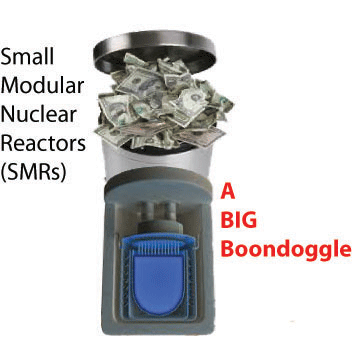
By Alex Kimani – Oil Price , Oct 31, 2024,
NextEra Energy is exploring the reopening of the Duane Arnold nuclear plant amid rising data center interest but remains cautious on the viability of small modular reactors.
SMRs, though promising in terms of smaller size, lower fuel needs, and modular design, face significant challenges.
High production costs for HALEU, estimated to reach up to $25,725/kg, pose a substantial financial hurdle.
……………………..CEO John Ketchum said he was “not bullish” on small modular reactors (SMRs), adding that the company’s in-house SMR research unit has so far not drawn favorable conclusions about the technology.
“A lot of [SMR equipment manufacturers] are very strained financially,” he said. “There are only a handful that really have capitalization that could actually carry them through the next several years.”
Ketchum might have a valid point. …………………………………………….
The U.S. Department of Energy has so far spent $1.2B on SMR R&D and is projected to spend nearly $6B over the next decade. Last year, the U.S. Nuclear Regulatory Commission (NRC) certified NuScale Power Corp.(NYSE:SMR) VOYGR 77 MW SMR in Poland, the first ever SMR to be approved in the country.
But there’s a big problem here because the fuel required to power these novel nuclear plants might be really expensive.
Three years ago, U.S. Nuclear Regulatory Commission (NRC) approved Centrus Energy Corp.’s (NYSE:LEU) request to make High Assay Low-Enriched Uranium (HALEU) at its enrichment facility in Piketon, Ohio, becoming the first company in the western world outside Russia to do so. A year later, the U.S. Department of Energy (DoE) announced a ~$150 million cost-shared award to American Centrifuge Operating, LLC, a subsidiary of Centrus Energy. HALEU is a nuclear fuel material enriched to a higher degree (between 5% and 20%) in the fissile isotope U-235. According to the World Nuclear Association, applications for HALEU are currently limited to research reactors and medical isotope production; however, HALEU will be needed for more than half of the SMRs currently in development. HALEU is only currently available from TENEX, a Rosatom subsidiary.
………..A 2023 survey by the Nuclear Energy Institute on U.S. advanced reactor developers estimated that the total market for HALEU could reach $1.6 billion by 2030 and $5.3 billion by 2035.
Last year, the Nuclear Innovation Alliance (NIA) published a report wherein they discussed production costs for HALEU. Here’s an excerpt from the report:
‘‘Calculated HALEU production cost for uranium enriched to 19.75% is $23,725/kgU for HALEU in an oxide form and $25,725 for HALEU in a metallic form under baseline economic assumptions but could be higher.’’
The report claims that a SWU (Separative Work Unit) is going to cost a lot more in a HALEU enrichment cascade compared to a standard LEU (Low-Enriched Uranium) enrichment cascade.
……………….NIA reckons it might cost ~$2000/kgU to make HALEUF6 into HALEUO2, and as much as $4000/kgU to make HALEUF6 into HALEU-metal. At the end of the day, you’d end up with HALEU with 28 times the fissile content of natural uranium at over 100 times the price.
https://oilprice.com/Alternative-Energy/Nuclear-Power/NextEra-No-Longer-Bullish-on-Nuclear-SMRs.html
BAE Systems fire: blaze at shipyard ‘could delay Aukus’
Building schedule of new fleet could be set back, experts warn, as two taken to
hospital after blaze breaks out at facility in Cumbria. Investigators are
still trying to determine the cause of a massive fire at a nuclear
submarine shipyard in Cumbria that analysts warned could delay the delivery
schedule of new boats for Australia as part of the Aukus pact.
Times 30th Oct 2024
The Rise and Fall of NuScale: a nuclear cautionary tale

Kelly Campbell, October 29, 2024 ,
https://oregoncapitalchronicle.com/2024/10/29/the-rise-and-fall-of-nuscale-a-nuclear-cautionary-tale/
A decade ago, NuScale, the Oregon-based small modular nuclear company born at Oregon State University, was on a roll. Promising a new era of nuclear reactors that were cheaper, easier to build and safer, their Star Wars-inspired artist renditions of a yet to be built reactor gleamed like a magic bullet.

As of last year, NuScale was the furthest along of any reactor design in obtaining Nuclear Regulatory Commission licensing and was planning to build the first small modular nuclear reactor in the United States. Its plan was to build it in Idaho to serve energy to a consortium of small public utility districts in Utah and elsewhere, known as UAMPS.
This home-grown Oregon company was lauded in local and national media. According to project backers, a high-tech solution to climate change was on the horizon, and an Oregon company was leading the way. It seemed almost too good to be true.
And it was.
image

Turns out, NuScale was a house of cards. The UAMPS project’s price tag more than doubled and the timeline was pushed back repeatedly until it was seven years behind schedule. Finally, UAMPS saw the writing on the wall and wisely backed out in November, 2023.
After losing their customer, NuScale’s stock plunged, it laid off nearly a third of its workforce, and it was sued by its investors and investigated for investor fraud. Then its CEO sold off most of his stock shares.
NuScale’s project is the latest in a long line of failed nuclear fantasies.

Why should you care? A different nuclear company, X-Energy, now in partnership with Amazon, wants to build and operate small modular nuclear reactors near the Columbia River, 250 miles upriver from Portland.
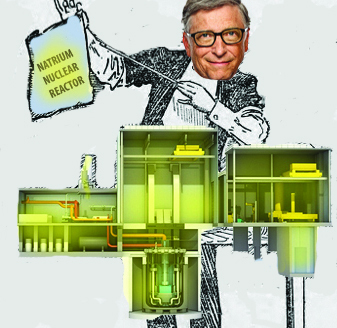
Bill Gates’s darling, the Natrium reactor in Wyoming is also plowing ahead. Both proposals are raking in the Inflation Reduction Act and other taxpayer funded subsidies. The danger: Money and time wasted on these false solutions to the climate crisis divert public resources from renewables, energy efficiency and other faster, more cost-efficient and safer ways to address the climate crisis.
A recent study from the Institute for Energy Economics and Financial Analysis concluded that small modular nuclear reactors are still too expensive, too slow to build and too risky to respond to the climate crisis.
While the nuclear industry tries to pass itself off as “clean,” it is an extremely dirty technology, beginning with uranium mining and milling which decimates Indigenous lands. Small modular nuclear reactors produce two to thirty times the radioactive waste of older nuclear designs, waste for which we have no safe, long-term disposal site. Any community that hosts a nuclear reactor will likely be saddled with its radioactive waste – forever. This harm falls disproportionately on Indigenous and low-income communities.

For those of us downriver, X-Energy’s plans to build at the Hanford Nuclear Site on the Columbia flies in the face of reason, as it would add more nuclear waste to the country’s largest nuclear cleanup site.
In Oregon, we have a state moratorium on building nuclear reactors until there is a vote of the people and a national waste repository. Every few years, the nuclear industry attempts to overturn this law at the Oregon Legislature, but so far it has been unsuccessful. This August, Umatilla County Commissioners announced they’ll attempt another legislative effort to overturn the moratorium. Keeping this moratorium is wise, given the dangerous distraction posed by the false solution of small modular nuclear reactors. Let’s learn from the NuScale debacle and keep our focus on a just transition to a clean energy future–one in which nuclear power clearly has no place.
Will AI’s huge energy demands spur a nuclear renaissance?
Contracts with Google and Amazon could help, but bringing new types of reactor online will take larger investments — and time.
Davide Castelvecchi, Nature , 25vOct 24
Last week, technology giants Google and Amazon both unveiled deals supporting ‘advanced’ nuclear energy, as part of their efforts to become carbon-neutral.
Google announced that it will buy electricity made with reactors developed by Kairos Power, based in Alameda, California. Meanwhile, Amazon is investing approximately US$500 million in the X-Energy Reactor Company, based in Rockville, Maryland, and has agreed to buy power produced by X-energy-designed reactors due to be built in Washington State.
Both moves are part of a larger [??] green trend that has arisen as tech companies deal with the escalating energy requirements of the data centres and number-crunching farms that support artificial intelligence (AI). Last month, Microsoft said it would buy power from a utility company that is planning to restart a decommissioned 835-megawatt reactor in Pennsylvania.
The partnerships agreed by Google and Amazon involve start-up companies that are pioneering the design of ‘small modular reactors’, which are intended to be assembled from prefabricated pieces………….they still have a way to go before they become a reality.
Nature talked to nuclear-energy researchers to explore the significance and possible implications of these big-tech investments.
Could these deals spur innovation in the nuclear industry?
Building nuclear power stations — a process often plagued by complex permit procedures, construction delays and cost overruns — is financially risky, and betting on unproven technologies is riskier still…………..
the details of the deals are murky, and the level of support provided by Amazon and Google is likely to be “a drop in the bucket” compared with the billions these start-ups will ultimately need, says physicist Edwin Lyman, director of nuclear power safety at the Union of Concerned Scientists in Washington DC. “The PR machine is just going into overdrive,” says Lyman, but “private capital just doesn’t seem ready yet to take that risk”.
Allison Macfarlane, director of the School of Public Policy and Global Affairs at the University of British Columbia in Vancouver, Canada, and former chair of the US Nuclear Regulatory Commission (NRC), says that the speed of progress in computer science raises another question. “If we’re talking 15 years from now, will AI need that much power?”
Are there safety advantages to the small modular designs?
“The smallest reactors, in theory, could have a high degree of passive safety,” says Lyman. When shut down, the core of a small reactor would contain less residual heat and radioactivity than does a core of the type that melted down in the Fukushima Daiichi disaster that followed the cataclysmic 2011 tsunami in Japan.
The companies also say that the proposed pebble-bed reactors are inherently safer because they are not pressurized, and because they are designed to circulate cooling fluids without the help of pumps (it was the loss of power to water pumps that caused three of the Fukushima plant’s reactors to fail).
But Lyman thinks it is risky to rely on potentially unpredictable passive cooling without the backup of an active cooling option. And as reactors become get smaller, they become less efficient. Another start-up company, NuScale Power, based in Portland, Oregon, originally designed its small modular reactor — which was certified by the NRC — to produce 50 MW of electricity, but later switched to a larger, 77-MW design. The need to make the economics work “makes passive safety less credible”, Lyman says.
Do small modular reactors carry extra risks?
In some cases, small modular reactors “could actually push nuclear power in a more dangerous direction”, says Lyman. “Advanced isn’t always better.”
In particular, Lyman points out that the pebble-bed designs drawn up by X-energy and Kairos would rely on high-assay low-enriched uranium (HALEU), which comprises 10–20% uranium-235 — compared with the 5% enrichment level required by most existing reactors (and by NuScale’s reactor). HALEU is still classified as low-enrichment fuel (as opposed to the highly enriched uranium used to make nuclear bombs), but that distinction is misleading, Lyman says. In June, he and his collaborators — including physicist Richard Garwin, who led the design of the first hydrogen bomb — warned in a Science article that a bomb could be built with a few hundred kilograms of HALEU, with no need for further enrichment1.
Smaller reactors are also likely to produce more nuclear waste and to use fuel less efficiently, according to work reported in 2022 by Macfarlane and her collaborators2. In a full-size reactor, most of the neutrons produced by the splitting of uranium travel through a large volume of fuel, meaning that they have a high probability of hitting another nucleus, rather than colliding with the walls of the reactor vessel or escaping into the surrounding building. “When you shrink the reactor, there’s less material in there, so you will have more neutron leakage,” Macfarlane says. These rogue neutrons can be absorbed by other atomic nuclei — which would then themselves become radioactive.
Will small reactors be cheaper to build?
The capacity to build components in an assembly line could drastically cut reactors’ construction costs. But there are also intrinsic economies of scale in building larger reactors, says Buongiorno. “Don’t believe people blindly” when they say smaller reactors will produce cheaper energy, he says: nuclear energy has a lot going for it, but “it ain’t cheap” — and that is unlikely to change significantly.
Will all of these efforts help to combat climate change?
…………….. whether building new reactors is the best way to rapidly cut emissions is debated. Macfarlane points out that solar panels and wind turbines can be deployed at a much faster rate.
https://www.nature.com/articles/d41586-024-03490-3
Space Tech Is How Israel Targets Doctors’ & Journalists’ Homes For Bombing

The U.S. and Israel have been blocking a space weapons ban treaty (PAROS) at the United Nations for more than 25 years………. Space technology is playing a major role in the Gaza genocide.
The current wars in both Ukraine and Gaza are experimental laboratories for arms developers and showcases for their products
Resistance to building a rocket launch site in Maine
Lisa Savage, Oct 26, 2024, https://went2thebridge.substack.com/p/space-tech-is-how-israel-targets?utm_source=post-email-title&publication_id=1580975&post_id=150711847&utm_campaign=email-post-title&isFreemail=true&r=c9zhh&triedRedirect=true&utm_medium=email
I hustled down to the Maine Space Conference yesterday morning in time to meet with a tv reporter but alas her story seems to have fallen by the wayside (if I find it later I’ll edit to include it.) I told her satellite technology is what enables Israel to target residential buildings where they know doctors and journalists live.
Similarly, an interview of Bruce Gagnon of the Global Network Against Weapons & Nuclear Power in Space by a reporter from Space News is nowhere to be found this morning. Or as Jonathan Cook put it, “Israel kills the journalists, Western media kills the truth.”
If you search for Maine Space Conference you’ll find plenty of adulatory articles about how exciting the space industry is and how each step toward turning our beautiful state into a militarized rocket launch site is to be applauded.
Folks in Kodiak, Alaska who had this experience continue to suffer the consequences. Though their launch site was built with assurances that all uses would be civilian in nature, that turned out to be a huge lie as even the Israeli military uses the launch site in Kodiak.
A recent report from a local resident highlights the pollution risks of hosting launch sites:
the Alaska DEC is keeping on top of a rocket fuel spill accident at the Pacific Spaceport Complex Alaska that happened the end of July. ABL Space was suppose to launch a rocket back in January and for 6 months all ABL did was ‘testing’ on the launch pad, no launch and closing off the state road to the public off and on during that time.
The end of July the rocket was setting on the pad for engine testing once again when the engine caught on fire, tipping the rocket over and spilled 1,800 gallons of fuel on the pad and surrounding soil. The soil is now in the process of being dug up, stored and covered until it can be shipped off island to a land fill in Washington state.
There was a Astra Space rocket accident last year and it took 6 months to dig up all the contaminated soil and ship it off island, which took until December. Rocket fuel also seeped into the ground water.
Yesterday in Maine we heard from Gagnon during the protest:
The Maine Space Conference is promoting the militarization of space. Efforts are being made to test hypersonic missiles at the former Loring Air Force Base. bluShit Aerospace is receiving funding from the U.S. Air Force and Space Force to launch ‘dual use’ (military/civilian) mini-satellites into dangerously congested Lower Earth Orbit.
Promises of lots of jobs, little to no environmental impacts, and peaceful exploration of space are the standard claims made at a myriad of potential sites the U.S. military is exploring around the world.
The U.S. and Israel have been blocking a space weapons ban treaty (PAROS) at the United Nations for more than 25 years.
Our nation cannot afford to pay for a new expensive arms race in outer space.
And we heard from Mary Beth Sullivan specifically about current wars that already depend on space-based technology:
Space technology is playing a major role in the Gaza genocide.
The current wars in both Ukraine and Gaza are experimental laboratories for arms developers and showcases for their products
Space is now an essential technical area being used in war fighting
Space is now an essential technical area being used in war fighting
BY FAR: the US is biggest spender on space programs, and the US launches more objects into space than any other nation
SpaceX developed the Starlight Satellite constellations to bring the internet and broadband to the world to connect us all to the internet, right? A commercial product to benefit the masses, right?
Did you know that SpaceX’s Starlink satellites are used by Israel in its genocide against Gaza, and its bombing campaign against Lebanon? It’s a primary enabler of the use of drones.
Militaries have developed a dependency on space systems to coordinate, command, and control activity at all levels over wide areas.
Israel also has it’s own space launch capability, and its own military satellites which are part of what’s called the Eros NG constellation. One of the most powerful intelligence collection systems in the world. They have satellites in constant orbit downloading info.
GPS Jamming by Israel being used in Gaza and Lebanon.
Also, the US and the UK use spy plane flights for Israel to aid in surveillance, facilitate propaganda, and much more
Australia has a spy base in Pine Gap which is downloading info from Gaza. Pine Gap sends the info to the US’s National Security Agency, who then sends to Israel. This clearly implicates Australia – and the US — in Israel’s genocide.
Same can be said for a spy base called Menwith Hill in the UK.
Reports show that Artificial Intelligence is enabling decision-making systems in Israel against the people of Palestine. Programs called Gospel, Lavender, and Where’s Daddy are trained to recognize features of people who might be affiliated with Hamas. The program tracks individuals and groups.

Techniques using AI and message interception are joined together.
Many nations in the region are developing their own space technology.
There have been no physical attack on a satellite as yet in this war but, if such an attack happens, new replacement satellites will need to be launched quickly. To that end, the US is operationalizing a “rapid response.”
For more information on resistance to the construction of a launch site in Maine visit NoToxicRockets4ME.org.
Mission Innovation should not send tax-payer money to Bill Gates’ nuclear dream

We cannot trust billionaire philanthropists to lead the way on climate action, Online Opinion, By Noel Wauchope , 16 December 2015 “…….At the opening of the Paris Climate Summit (COP21), with the blessing of the White House, Bill Gates announced the Breakthrough Energy Coalition (BEA), with an ambitious goal to deal with climate change. 24 billionaire philanthropists have joined in the BEA. They include Richard Branson, Mark Zuckerberg, and Jeff Bezos.
Simultaneously 19 governments, including the United States, China and India, announce “Mission Innovation”, a project that will involve tax-payer money to explore and invent new ways to develop low carbon energy.
Not surprisingly, the two organisations will work in tandem. The billionaire philanthropists plan a public-private partnership between governments, research institutions, and investors that will focus on new energy methods especially for developing countries……
For a start, this twin project is directed at researching new forms of low carbon energy. A lot of money therefore is to go into trying out new plans, that exist at best, only in blueprint form. Yet already there are in operation large scale and small scale renewable energy projects that could be deployed. In particular, small scale solar energy is very well suited to being deployed in rural India, Africa, and other developing nations, as well as in Australia and other developed nations. It is happening now. Projects such as Barefoot Power have operated for years now, bringing affordable solar power to millions of rural poor in Africa, Asia Pacific, India and the Americas.
The energy need now for poor countries is deployment of existing technologies, not years of research and testing of so far non-existent ones………
- The one and only University that has joined BEA is the University of California, which runs the Lawrence Berkeley National Laboratory, well known for its nuclear research.
- Bill Gates is co-founder and current Chairman of the innovative nuclear energy company TerraPower Gates has a long term history of enthusiasm for small nuclear power reactors. Since the Fukushima nuclear disaster, USA’s Nuclear Regulatory Commission has tightened the rules for new reactors. Fortunately for Mr Gates, China is less fussy about this, so Gates has been able to do a deal with the China National Nuclear Corporation (CNNC). TerraPower and CNNC will build the first small 600 MW unit in China, and later deploy these nuclear reactors globally.
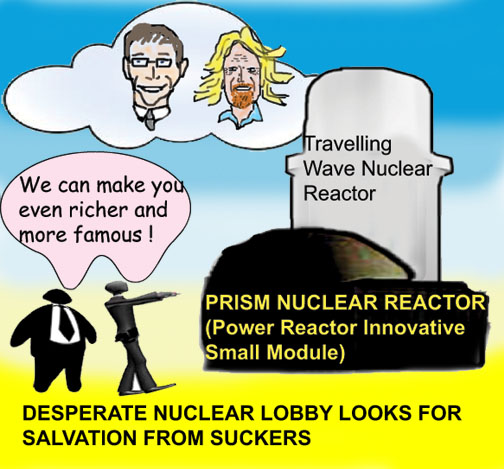
I don’t doubt that Bill Gates is sincere in his goal of reducing greenhouse gases. It’s just that I have reservations about Small Nuclear Reactors having any impact on global warming.
If Small Nuclear Reactors did in fact reduce greenhouse gases, the world would need thousands of them to be up and running quickly, but they’re still at the planning stage. They’re supposed to be much safer than conventional nuclear reactors, but still produce radioactive wastes, and are targets for terrorism. Each and every one of them would need 24 hour guarding. It gets expensive………
The term selected “Breakthrough Energy Initiative” gives the game away. For many years now, America’s Breakthrough Institute has lobbied and publicised “new nuclear” as the solution for climate change. The Breakthrough Institute has many well-meaning and enthusiastic environmentalists as members. Its philosophy, expressed in “The Ecomodernist Manifesto” is full of beautiful motherhood statements about climate and environment, and only a few paragraphs about new nuclear technology.
This Manifesto, by the way, appears as a Submission to the South Australian Nuclear Fuel Cycle Royal Commission.
The effect of the Breakthrough Institute, over the years, has been to slow down action on reducing the use of fossil fuels. It has also aimed to discredit renewable energy……..http://www.onlineopinion.com.au/view.asp?article=17899
Mini-Nukes, Big Bucks: The Interests Behind the SMR Push
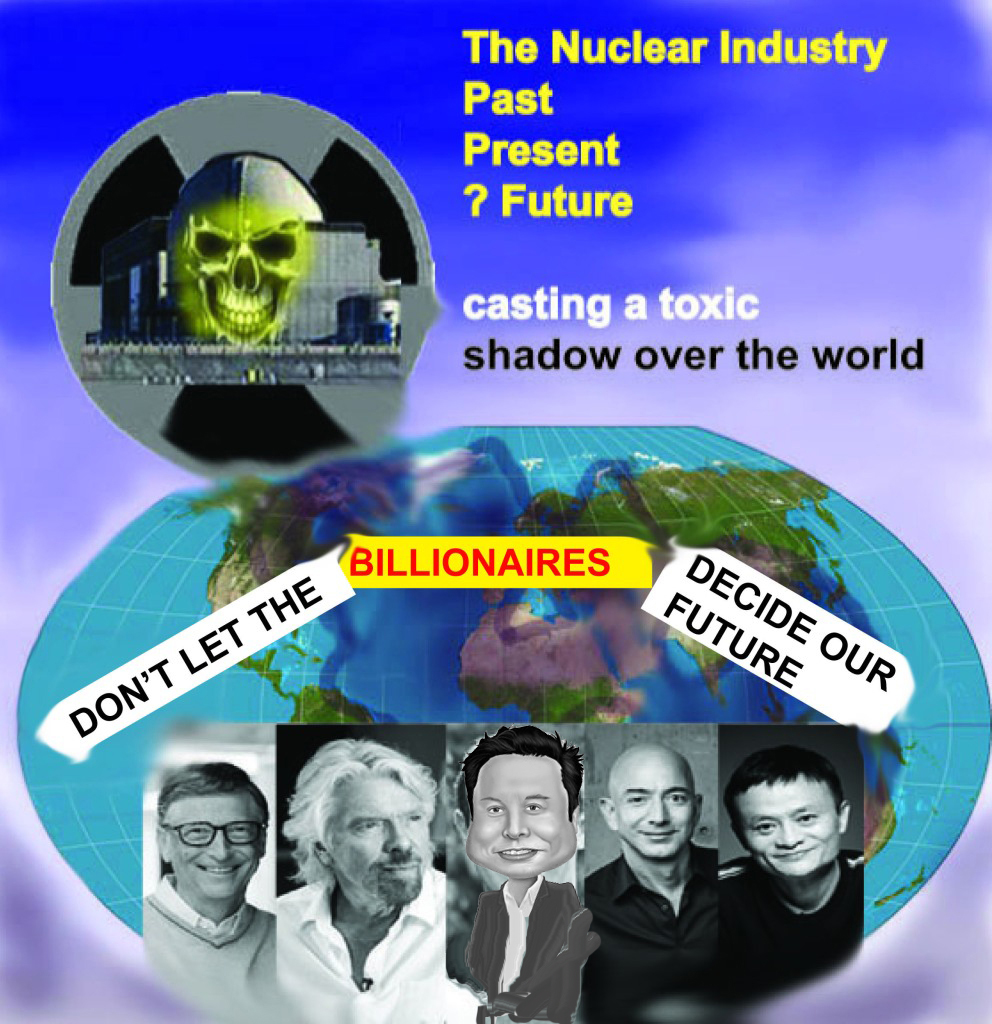
The “billionaires’ nuclear club”
The 2015 Paris climate talks featured what cleantechnica.com called a “splashy press conference” by Bill Gates to announce the launch of the Breakthrough Energy Coalition (BEC) – a group of (originally) 28 high net-worth investors, aiming “to provide early-stage capital for technologies that offer promise in bringing affordable clean energy to billions.”

Though BEC no longer makes its membership public, the original coalition included such familiar names as Jeff Bezos (Amazon), Marc Benioff (Salesforce), Michael Bloomberg, Richard Branson, Jack Ma (Alibaba), David Rubenstein (Carlyle Group), Tom Steyer, George Soros, and Mark Zuckerberg. Many of those names (and others) can now be found on the “Board and Investors” page of Breakthrough Energy’s website.
Why Canada is now poised to pour billions of tax dollars into developing Small Modular Reactors as a “clean energy” climate solution
by Joyce Nelson, January 14, 2021, story. Mini-Nukes, Big Bucks: The Interests Behind the SMR Push | Watershed Sentinel
Back in 2018, the Watershed Sentinel ran an article warning that “unless Canadians speak out,” a huge amount of taxpayer dollars would be spent on small modular nuclear reactors (SMRs), which author D. S. Geary called “risky, retro, uncompetitive, expensive, and completely unnecessary.” Now here we are in 2021 with the Trudeau government and four provinces (Saskatchewan, Ontario, New Brunswick, and Alberta) poised to pour billions of dollars into SMRs as a supposed “clean energy” solution to climate change.
It’s remarkable that only five years ago, the National Energy Board predicted: “No new nuclear units are anticipated to be built in any province” by 2040.
So what happened?
The answer involves looking at some of the key influencers at work behind the scenes, lobbying for government funding for SMRs.
The Carney factor
When the first three provinces jumped on the SMR bandwagon in 2019 at an estimated price tag of $27 billion, the Green Party called the plan “absurd” – especially noting that SMRs don’t even exist yet as viable technologies but only as designs on paper.
According to the BBC (March 9, 2020), some of the biggest names in the nuclear industry gave up on SMRs for various reasons: Babcock & Wilcox in 2017, Transatomic Power in 2018, and Westinghouse (after a decade of work on its project) in 2014.
But in 2018, the private equity arm of Canada’s Brookfield Asset Management Inc. announced that it was buying Westinghouse’s global nuclear business (Westinghouse Electric Co.) for $4.6 billion.
“If Wall Street and the banks will not finance this, why should it be the role of the government to engage in venture capitalism of this kind?”
Two years later, in August 2020, Brookfield announced that Mark Carney, former Bank of England and Bank of Canada governor, would be joining the company as its vice-chair and head of ESG (environmental, social, and governance) and impact fund investing, while remaining as UN Special Envoy for Climate Action and Finance.
“We are not going to solve climate change without the private sector,” Carney told the press, calling the climate crisis “one of the greatest commercial opportunities of our time.” He considers Canada “an energy superpower,” with nuclear a key asset.
Carney is an informal advisor to PM Trudeau and to British PM Boris Johnson. In November, Johnson announced £525 million (CAD$909.6 million) for “large and small-scale nuclear plants.”
SNC-Lavalin
Scandal-ridden SNC-Lavalin is playing a major role in the push for SMRs. In her mid-December 2020 newsletter, Elizabeth May, the Parliamentary Leader of the Green Party, focused on SNC-Lavalin, reminding readers that in 2015, then-PM Stephen Harper sold the commercial reactor division of Atomic Energy of Canada Ltd. (AECL) “to SNC-Lavalin for the sweetheart deal price of $15 million.”
May explained, “SNC-Lavalin formed a consortium called the Canadian National Energy Alliance (CNEA) to run some of the broken-apart bits of AECL. CNEA has been the big booster of what sounds like some sort of warm and cuddly version of nuclear energy – Small Modular Reactors. Do not be fooled. Not only do we not need new nuclear, not only does it have the same risks as previous nuclear reactors and creates long-lived nuclear wastes, it is more tied to the U.S. military-industrial complex than ever before. That’s because SNC-Lavalin’s partners in the CNEA are US companies Fluor and Jacobs,” who both have contracts with US Department of Energy nuclear-weapons facilities.”
But, states May, “Natural Resources Minister Seamus O’Regan has been sucked into the latest nuclear propaganda – that ‘there is no pathway to Net Zero [carbon emissions] without nuclear’.”
Terrestrial Energy
Then there’s Terrestrial Energy, which in mid-October 2020 received a $20 million grant for SMR development from NRCan’s O’Regan and Navdeep Bains (Minister of Innovation, Science and Industry). The announcement prompted more than 30 Canadian NGOs to call SMRs “dirty, dangerous, and distracting” from real, available solutions to climate change.
The Connecticut-based company has a subsidiary in Oakville, Ontario. Its advisory board includes Stephen Harper; Michael Binder, the former president and CEO of the Canadian Nuclear Safety Commission; and (as of October) Dr. Ian Duncan, the former UK Minister of Climate Change in the Dept. of Business Energy and Industrial Strategy (BEIS).

Perhaps more important, Terrestrial Energy’s advisory board includes Dr. Ernest Moniz, the former US Secretary of the Dept. of Energy (2013-2017) who provided more than $12 billion in loan guarantees to the nuclear industry. Moniz has been a key advisor to the Biden-Harris transition team, which has come out in favour of SMRs, calling them “game-changing technologies” at “half the construction cost of today’s reactors.”
In 2015, while the COP 21 Paris Climate Agreement was being finalized, Moniz told reporters that SMRs could lead to “better financing terms” than traditional nuclear plants because they would change the scale of capital at risk. For years, banks and financial institutions have been reluctant to invest in money-losing nuclear projects, so now the goal is to get governments to invest, especially in SMRs.
That has been the agenda of a powerful lobby group that has been working closely with NRCan for several years.
The “billionaires’ nuclear club”
The 2015 Paris climate talks featured what cleantechnica.com called a “splashy press conference” by Bill Gates to announce the launch of the Breakthrough Energy Coalition (BEC) – a group of (originally) 28 high net-worth investors, aiming “to provide early-stage capital for technologies that offer promise in bringing affordable clean energy to billions.”
Though BEC no longer makes its membership public, the original coalition included such familiar names as Jeff Bezos (Amazon), Marc Benioff (Salesforce), Michael Bloomberg, Richard Branson, Jack Ma (Alibaba), David Rubenstein (Carlyle Group), Tom Steyer, George Soros, and Mark Zuckerberg. Many of those names (and others) can now be found on the “Board and Investors” page of Breakthrough Energy’s website.
“As long as Bill Gates is wasting his own money or that of other billionaires, it is not so much of an issue. The problem is that he is lobbying hard for government investment.”
Writing in Counterpunch (Dec. 4, 2015) shortly after BEC’s launch, Linda Pentz Gunter noted that many of those 28 BEC billionaires (collectively worth some $350 billion at the time) are pro-nuclear and Gates himself “is already squandering part of his wealth on Terra Power LLC, a nuclear design and engineering company seeking an elusive, expensive and futile so-called Generation IV traveling wave reactor” for SMRs. (In 2016, Terra Power, based in Bellevue, Washington, received a $40 million grant from Ernest Moniz’s Department of Energy.)
According to cleantechnica.com, the Breakthrough Energy Coalition “does have a particular focus on nuclear energy.” Think of BEC as the billionaires’ nuclear club.
By 2017, BEC was launching Breakthrough Energy Ventures (BEV), a $1 billion fund to provide start-up capital to clean-tech companies in several countries.
Going after the public purse
Bill Gates was apparently very busy during the 2015 Paris climate talks. He also went on stage during the talks to announce a collaboration among 24 countries and the EU on something called Mission Innovation – an attempt to “accelerate global clean energy innovation” and “increase government support” for the technologies. Mission Innovation’s key private sector partners include the Breakthrough Energy Coalition, the World Economic Forum, the International Energy Agency, and the World Bank.
An employee at Natural Resources Canada, Amanda Wilson, was appointed as one of the 12 international members of the Mission Innovation Steering Committee.
In December 2017, Bill Gates announced that the Breakthrough Energy Coalition was partnering with Mission Innovation members Canada, UK, France, Mexico, and the European Commission in a “public-private collaboration” to “double public investment in clean energy innovation.”
Canada’s Minister of Natural Resources at the time, Jim Carr, said the partnership with BEC “will greatly benefit the environment and the economy. Working side by side with innovators like Bill Gates can only serve to enhance our purpose and inspire others.”
Dr. M.V. Ramana, an expert on nuclear energy and a professor at the School of Public Policy and Global Affairs at UBC, told me by email: “As long as Bill Gates is wasting his own money or that of other billionaires, it is not so much of an issue. The problem is that he is lobbying hard for government investment.”
Dr. Ramana explained that because SMRs only exist on paper, “the scale of investment needed to move these paper designs to a level of detail that would satisfy any reasonable nuclear safety regulator that the design is safe” would be in the billions of dollars. “I don’t see Gates and others being willing to invest anything of that scale. Instead, they invest a relatively small amount of money (compared to what they are worth financially) and then ask for government handouts for the vast majority of the investment that is needed.”
Kevin Kamps, Radioactive Waste Specialist at Beyond Nuclear, told me by email that the companies involved in SMRs “don’t care” if the technology is actually workable, “so long as they get paid more subsidies from the unsuspecting public. It’s not a question of it working, necessarily,” he noted.
Gordon Edwards, President of the Canadian Coalition for Nuclear Responsibility, says governments “are being suckers. Because if Wall Street and the banks will not finance this, why should it be the role of the government to engage in venture capitalism of this kind?”
“Roadmap” to a NICE future
By 2018, NRCan was pouring money into a 10-month, pan-Canadian “conversation” about SMRs that brought together some 180 individuals from First Nations and northern communities, provincial and territorial governments, industry, utilities, and “stakeholders.” The resulting November 2018 report, A Call to Action: A Canadian Roadmap for Small Modular Reactors, enthusiastically noted that “Canada’s nuclear industry is poised to be a leader in an emerging global market estimated at $150 billion a year by 2040.”
At the same time, Bill Gates announced the launch of Breakthrough Energy Europe, a collaboration with the European Commission (one of BEC’s five Mission Innovation partners) in the amount of 100 million euros for clean-tech innovation.
Gates’ PR tactic is effective: provide a bit of capital to create an SMR “bandwagon,” with governments fearing their economies would be left behind unless they massively fund such innovations.
NRCan’s SMR Roadmap was just in time for Canada’s hosting of the Clean Energy Ministerial/Mission Innovation summit in Vancouver in May 2019 to “accelerate progress toward a clean energy future.” Canada invested $30 million in Breakthrough Energy Solutions Canada to fund start-up companies.
A particular focus of the CEM/MI summit was a CEM initiative called “Nuclear Innovation: Clean Energy (NICE) Future,” with all participants receiving a book highlighting SMRs. As Tanya Glafanheim and M.V. Ramana warned in thetyee.ca (May 27, 2019) in advance of the summit, “Note to Ministers from 25 countries: Prepare to be dangerously greenwashed.”
Greenwash vs public backlash
While releasing the federal SMR Action Plan on December 18, O’Regan called it “the next great opportunity for Canada.”
Bizarrely, the Action Plan states that by developing SMRs, our governments would be “supporting reconciliation with Indigenous peoples” – but a Special Chiefs Assembly of the Assembly of First Nations passed a unanimous 2018 resolution demanding that “the Government of Canada cease funding and support” of SMRs. And in June 2019, the Anishinabek Chiefs-in-Assembly (representing 40 First Nations across Ontario) unanimously opposed “any effort to situate SMRs within our territory.”
Some 70 NGOs across Canada are opposed to SMRs, which are being pushed as a replacement for diesel in remote communities, for use in off-grid mining, tar-sands development, and heavy industry, and as exportable expertise in a global market.
Whether SMRs work or not, Mission Innovation members will be throwing tax-dollars at them like there is no tomorrow.
On December 7, the Hill Times published an open letter to the Treasury Board of Canada from more than 100 women leaders across Canada, stating: “We urge you to say ‘no’ to the nuclear industry that is asking for billions of dollars in taxpayer funds to subsidize a dangerous, highly-polluting and expensive technology that we don’t need. Instead, put more money into renewables, energy efficiency and energy conservation.”
No new money for SMRs was announced in the Action Plan, but in her Fall Economic Statement, Finance Minister Chrystia Freeland touted SMRs and noted that “targeted action by the government to mobilize private capital will better position Canadian firms to bring their technologies to market.” That suggests the Canada Infrastructure Bank will use its $35 billion for such projects.
It will take a Herculean effort from the public to defeat this NICE Future, but along with the Assembly of First Nations, three political parties – the NDP, the Bloc Quebecois, and the Green Party – have now come out against SMRs.
Award-winning author Joyce Nelson’s latest book, Bypassing Dystopia, is published by Watershed Sentinel Books. She can be reached via www.joycenelson.ca.
Three Mile Island nuclear plant gears up for Big Tech reboot

Reuters, By Laila Kearney, October 23, 2024
Summary
Companies
Activists say they will challenge licensing for the plant
Restart work is expected to begin in Q1 2025
Constellation has ordered major equipment
Microsoft would consider similar contracts to restart nuclear power plants
Work includes refurbishing cooling towers and millions of feet of scaffolding
THREE MILE ISLAND, Pennsylvania, Oct 22 (Reuters) – Giant cooling towers at Constellation Energy’s (CEG.O), opens new tab Three Mile Island nuclear plant in Pennsylvania have sat dormant for so long that grass has sprung up in the towers’ hollowed-out bases and wildlife roam inside.
Armed guard stations at an entrance to the shut concrete facility, surrounded by barbed wire, sit empty. The plant, which would run so loud when operating that workers were required to wear hearing protection, is nearly silent.
“It’s still eerie walking in here and it’s, just, quiet,” Constellation regulatory assurance manager Craig Smith said during a tour of the plant last week. Smith, who worked at Three Mile Island when Constellation shut the site’s remaining reactor in 2019, is now preparing for a restart.
Constellation announced last month that it would revive the half-century-old Three Mile Island with the purpose of fueling Microsoft’s (MSFT.O), opens new tab data centers. Microsoft is expected to pay at least $100 a megawatt-hour, nearly double the typical cost of renewable energy in the region, as part of the 20-year power contract.
The agreement shows the dramatic lengths Big Tech is willing to go to procure electricity for its artificial intelligence expansion and the undertaking by the U.S. power industry to meet that demand.
The effort to restore Unit 1 at Three Mile Island is expected to take four years, at least $1.6 billion, and thousands of workers to complete the unprecedented task of restarting a retired nuclear plant.
Constellation has already ordered costly equipment for the site and identified fuel for the unit’s reactor core, with work expected to start early next year, according to Reuters’ interviews with company executives, contractors and a tour of the site.
Successfully resurrecting Three Mile Island, which is widely known for a 1979 partial meltdown that cast a pall over the U.S. nuclear sector for decades, would put the plant at the front edge of an industry revival…………………………………………………..
A restart of the plant, however, is not certain. Three Mile Island, which will be renamed the Crane Clean Energy Complex, still requires licensing modifications and permitting. Local activists have also vowed to fight the project over safety and environmental concerns.
If the plan suffers the same lengthy delays and cost overruns that have plagued nearly every nuclear build in the country’s history, it could stymie other deals and set back Big Tech’s quest to rapidly expand, power experts say.
………………………………………………………………..The company has commissioned the fuel design for the reactor’s core, said Constellation Chief Generation Officer Bryan Hanson. The core holds the enriched uranium, the fuel source for the plant, stacked in pellets and sealed in tubes.
Constellation, which is the biggest U.S. operator of nuclear plants, will tap into fuel from its existing enriched uranium reserves as one of the final steps before starting up.
………………………………………………Not everyone is enthused about the prospect of a nuclear comeback. The power plants produce waste that can remain radioactive for thousands of years.
About a tennis court-size amount of spent nuclear fuel from Unit 1 is stored on Three Mile Island, which sits on a strip of land in the Susquehanna River. The decommissioning of Unit 2 is still underway about 45 years after the partial meltdown.
Local activist Eric Epstein, who remembers the March 1979 incident, said he will fight Constellation’s request to resume operating and water use licenses.
“It’s going to be a protracted battle,” Epstein said.
The first chance for the challenges comes on Oct. 25, when the Nuclear Regulatory Commission has scheduled its initial public hearing on Constellation’s plan to restart Unit 1.
Reporting by Laila Kearney Editing by Marguerita Choy
https://www.reuters.com/business/energy/three-mile-island-nuclear-plant-gears-up-big-tech-reboot-2024-10-22/
Is it worse to have no climate solutions – or to have them but refuse to use them?

Rebecca Solnit, 16 Oct 2024 ,
https://www.theguardian.com/commentisfree/2024/oct/16/climate-crisis-technology-ai
Tech barons are forever predicting some amazing new technology to fix the climate crisis. Yet fixes already exist.
When it comes to some of the tech oligarchs, I suspect the sheer modesty of the solutions is not the kind of gee-whiz rocket science they love.’

There are so many ways to fiddle while Rome burns, or as this season’s weather would have it, gets torn apart by hurricanes and tornadoes and also goes underwater – and, in other places, burns. One particularly pernicious way comes from the men in love with big tech, who are forever insisting that we need some amazing new technology to solve our problems, be it geoengineering, carbon sequestration or fusion – but wait, it gets worse.
At an artificial intelligence conference in Washington DC, the former Google CEO Eric Schmidt recently claimed that “[w]e’re not going to hit the climate goals anyway because we’re not organized to do it” and that we should just plunge ahead with AI, which is so huge an energy hog it’s prompted a number of tech companies to abandon their climate goals. Schmidt then threw out the farfetched notion that we should go all in on AI because maybe AI will somehow, maybe, eventually know how to “solve” climate, saying: “I’d rather bet on AI solving the problem than constraining it.”
Eventually is not good enough. A distinguished group of scientists said in a paper published on 8 October: “We are on the brink of an irreversible climate disaster. This is a global emergency beyond any doubt. Much of the very fabric of life on Earth is imperiled. We are stepping into a critical and unpredictable new phase of the climate crisis.”
We need to pull back from that brink, but Schmidt is arguing for plunging over it, because guys like him are excited about AI. This is like arguing we should jettison the lifeboats and hang out on the sinking ship because what if there was eventually a totally awesome, new kind of lifeboat we can’t even imagine right now?
We have the lifeboats now – we have the solutions, and we have had them for a while, and they keep getting better, as in better-designed, more efficient, more affordable and adaptable. We just need to implement them, but they’re just not the solutions a lot of the rich and powerful like. Proposing we go for some false or nonexistent solution has become an excuse constantly deployed as an excuse for not supporting the solutions we have.
Delay is the new denial” became a slogan in the climate movement a few years ago, and maybe “decoy is the new denial” should be added to it, by which I mean proposing we ignore workable present-day solutions in favor of unworkable and nonexistent ones while continuing to burn fossil fuel.
One might think that Schmidt, whose net worth is estimated at around $23bn, would devote some time and resources to organizing us to reach our climate goals rather than excuse himself from acting with his dismissive defeatism. But overall billionaires and the very rich are part of the problem, with their outsized power and the dismal ways most of them use it. And their climate impact is obscene – the richest 1% of humanity is responsible for more carbon emissions than the poorest 66%.
Scientists and engineers have been telling us for a very long time what we need to do and how to do it, and most of us already know that what we need to do is make a swift transition away from burning fossil fuels. Protecting forests and other natural systems and redesigning how we live, travel and produce and consume also matter, but phasing out the extraction and burning of fossil fuels is the big one. Schmidt lives in California, where we’ve been getting more than 100% of our electricity needs met many days this year by sun, wind and water, and storing the surplus in immense battery systems. Obviously not everything in California runs on electricity, but this is a nice demonstration model of how rapidly a renewable system can scale up.
When it comes to some of the tech oligarchs, I suspect the sheer modesty of the solutions – that we should consume less, which means we can produce less, and make this energy transition to a renewable-powered world – is not the kind of gee-whiz rocket science they love. (Though solar and wind technologies are pretty amazing, particularly if you know how rapidly their design has improved, their cost has plummeted and their implementation has spread.) It is in many ways a social solution in which lots of us adjust how we live and how we power our devices, not a grand centralized invention that is super profitable for a few.
I do not know if it would be worse to live in a world in which we genuinely did not have the solutions, or to live in one where we have them but are not implementing them on the speed and scale we know we need to. But I know we have the solutions.
- Rebecca Solnit is a Guardian US columnist. She is the author of Orwell’s Roses and co-editor with Thelma Young Lutunatabua of the climate anthology Not Too Late: Changing the Climate Story from Despair to Possibility
Amazon bets on nuclear power to fuel AI ambitions

The technology is still in its infancy and lacks regulatory approval, however, raising doubts about implementation timelines.
Daily Mail By Afp, 17 October 2024
Amazon announced significant investments in nuclear energy on Wednesday, joining other tech giants in aiming to meet the high electric power demands of artificial intelligence using atomic energy.
As companies including Microsoft, Amazon, and Google rapidly expand their global data center capabilities, they are actively seeking new electricity sources.
Amazon has signed three agreements to support the development of Small Modular Reactors (SMRs), which are more compact and potentially easier to deploy than traditional reactors.
The technology is still in its infancy and lacks regulatory approval, however, raising doubts about implementation timelines……………………
According to an Amazon spokeswoman, the contracts signed are worth over half a billion dollars.
Amazon’s new partnerships include collaborating with Energy Northwest to develop four advanced SMRs in Washington state, potentially generating up to 960 megawatts of power by the early 2030s.
The company is also taking part in a $500 million funding round in X-energy, a leading SMR developer, to support more than five gigawatts of new nuclear-energy projects.
Additionally, Amazon is teaming up with Dominion Energy to explore an SMR project near Virginia’s North Anna nuclear power station, aiming to add at least 300 MW of power to meet projected demand increases…………………
Google recently signed a deal with Kairos Power for SMR-generated electricity, while Microsoft plans to use power from the restarted Three Mile Island facility.
Amazon has also announced plans to locate a major data center next to a 40-year-old nuclear facility in Pennsylvania.
According to Goldman Sachs, data center power demand is estimated to grow 160 percent by 2030, with AI representing about 19 percent of data center power demand by 2028.
https://www.dailymail.co.uk/wires/afp/article-13967077/Amazon-bets-nuclear-power-fuel-AI-ambitions.html
To make nuclear fusion a reliable energy source one day, scientists will first need to design heat- and radiation-resilient materials
Fusion energy has the potential to be an effective clean energy source, as its reactions
generate incredibly large amounts of energy. Fusion reactors aim to
reproduce on Earth what happens in the core of the Sun, where very light
elements merge and release energy in the process. Engineers can harness
this energy to heat water and generate electricity through a steam turbine,
but the path to fusion isn’t completely straightforward.
Controlled nuclear fusion has several advantages over other power sources for
generating electricity. For one, the fusion reaction itself doesn’t
produce any carbon dioxide. There is no risk of meltdown, and the reaction
doesn’t generate any long-lived radioactive waste. I’m a nuclear
engineer who studies materials that scientists could use in fusion
reactors.
Fusion takes place at incredibly high temperatures. So to one day
make fusion a feasible energy source, reactors will need to be built with
materials that can survive the heat and irradiation generated by fusion
reactions.
The Conversation 18th Oct 2024 https://theconversation.com/to-make-nuclear-fusion-a-reliable-energy-source-one-day-scientists-will-first-need-to-design-heat-and-radiation-resilient-materials-238489
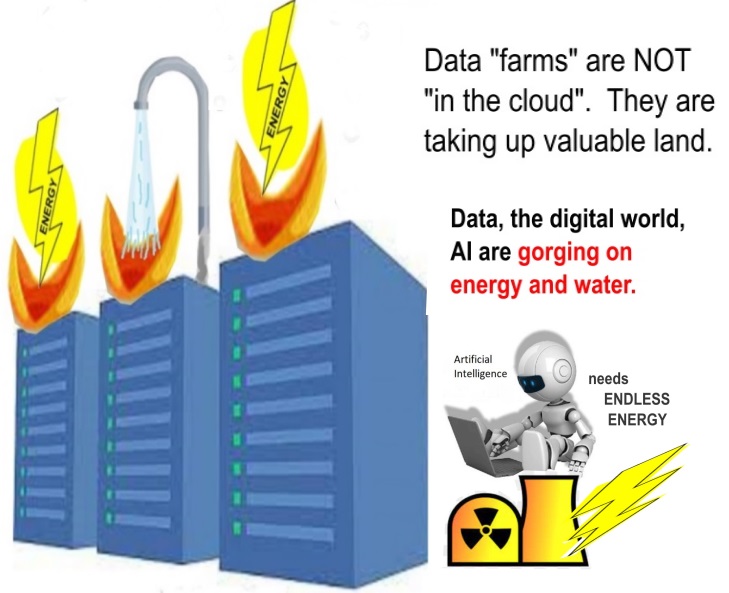
Small nuclear reactors won’t be ready in time for the needs of energy-guzzling needs of Artificial Intelligence.
As of last month, when [data centres] were classed as critical national
infrastructure, data centres are on a par with utilities, meaning the
government would step in were there a risk to connectivity. Nonetheless, as
Rohan Kelkar, the executive vice-president of power products at Schneider
Electric, puts it, the “lack of grid capacity puts UK’s AI and data
centre ambitions and energy transition goals at risk”.
So much so that we have seen the boroughs of Hillingdon, Ealing and Hounslow all rejecting
data centre projects in order to retain supply for housing. This is far
from a UK-specific issue. In Ireland, the pressure on the national grid
from computing needs is so acute they have had to pause some data centre
approvals over concerns that excessive demand from data centres could lead
to blackouts.
On the other side of the Atlantic, Big Tech companies are
also grappling with the energy conundrum: how to find low-carbon, reliable
sources of power for their power-hungry warehouses without jeopardising
customer needs or their net zero goals. Along with renewable energy and
improving battery storage, right now they all seem to be turning in one
direction: towards nuclear power. Microsoft signed a deal last month to
help resurrect a unit of the Three Mile Island plant in Pennsylvania.
Amazon bought a nuclear-powered data centre earlier in the year. On Monday,
Google became the latest to announce a nuclear energy deal to meet the
needs of its data centres, looking at mini reactors developed by a
Californian company.
A cocktail of technological innovation means this
could happen in the UK, too. Rolls-Royce, the engineer, is at the forefront
of developing mini reactors and is already having conversations with
operators in the UK about their use. While mini nukes would not have been
commercially viable in the past, now that demand for data centres has
jumped exponentially, their potential use has become more feasible. Another
key component in the future marriage of computing and nuclear power is that
data centres are becoming less location driven because of improvements in
latency, the time it takes for data to travel from one point to another.
The immediate problem with the introduction of small nuclear reactors?
Rolls-Royce estimates that they remain a decade or more away, with none
currently operating and generating electricity in the UK. In the meantime,
connection to the “constrained” grid, remains all-important headache
for those looking to build data centres.
Times 16th Oct 2024
1 This Month

To see nuclear-related stories in greater depth and intensity – go to https://nuclearinformation.wordpress.com
-
Archives
- September 2026 (194)
- August 2026 (330)
- July 2026 (355)
- June 2026 (287)
- May 2026 (306)
- April 2026 (356)
- March 2026 (251)
- February 2026 (267)
- January 2026 (308)
- December 2025 (358)
- November 2025 (359)
- October 2025 (375)
-
Categories
- 1
- 1 NUCLEAR ISSUES
- business and costs
- climate change
- culture and arts
- ENERGY
- environment
- health
- history
- indigenous issues
- Legal
- marketing of nuclear
- media
- opposition to nuclear
- PERSONAL STORIES
- politics
- politics international
- Religion and ethics
- safety
- secrets,lies and civil liberties
- spinbuster
- technology
- Uranium
- wastes
- weapons and war
- Women
- 2 WORLD
- ACTION
- AFRICA
- Atrocities
- AUSTRALIA
- Christina's notes
- Christina's themes
- culture and arts
- Events
- Fuk 2022
- Fuk 2023
- Fukushima 2017
- Fukushima 2018
- fukushima 2019
- Fukushima 2020
- Fukushima 2021
- general
- global warming
- Humour (God we need it)
- Nuclear
- RARE EARTHS
- Reference
- resources – print
- Resources -audiovicual
- Weekly Newsletter
- World
- World Nuclear
- YouTube
-
RSS
Entries RSS
Comments RSS
 nuclear-news