Can AI Solve the Nuclear Fusion Energy Puzzle?
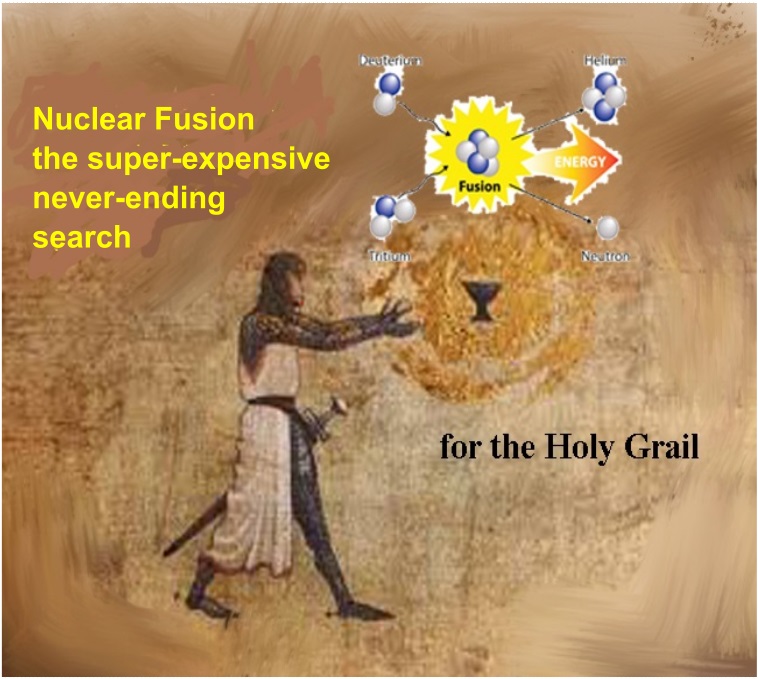
By Haley Zaremba – Oil Price, Oct 05, 2025
- Nuclear fusion holds the potential for clean, greenhouse gas-free baseload power, but challenges in controlling plasma have hindered its commercial viability.
- Recent breakthroughs, particularly with AI tools like Diag2Diag, are significantly advancing fusion development by improving plasma monitoring and control, specifically addressing issues like Edge Localized Mode (ELM).
- Despite these advancements, commercial nuclear fusion remains decades away, leading some experts to question whether it’s a realistic “silver bullet” solution for growing energy demands, especially from AI.
……………………………………………………………………………………………………………………… https://oilprice.com/Energy/Energy-General/Can-AI-Solve-the-Nuclear-Fusion-Energy-Puzzle.html
Are We Waking Up Fast Enough to the Dangers of AI Militarism?

As we continue to be force-fed AI, the voting public needs to find a way to push back against this onslaught against both personal autonomy and the democratic process.
Tom Valovic, Common Dreams, 1 Oct 25
AI is everywhere these days. There’s no escape. And as geopolitical events appear to spiral out of control in the Ukraine and Gaza, it seems clear that AI, while theoretically a force for positive change, has become has become a worrisome accelerant to the volatility and destabilization that may lead us to once again thinking the unthinkable—in this case World War III.
The reckless and irresponsible pace of AI development badly needs a measure of moderation and wisdom that seems sorely lacking in both the technology and political spheres. Those who we have relied on to provide this in the past—leading academics, forward-thinking political figures, and various luminaries and thought leaders in popular culture—often seem to be missing in action in terms of loudly sounding the necessary alarms. Lately, however, and offering at least a shred of hope, we’re seeing more coverage in the mainstream press of the dangers of AI’s destructive potential.
To get a feel for perspectives on AI in a military context, it’s useful to start with an article that appeared in Wired magazine a few years ago, “The AI-Powered, Totally Autonomous Future of War Is Here.” This treatment practically gushed with excitement about the prospect of autonomous warfare using AI. It went on to discuss how Big Tech, the military, and the political establishment were increasingly aligning to promote the use of weaponized AI in a mad new AI-nuclear arms race. The article also provided a clear glimpse of the foolish transparency of the all-too-common Big Tech mantra that “it’s really dangerous but let’s do it anyway.”
More recently, we see supposed thought leaders like former Google CEO Eric Schmidt sounding the alarm about AI in warfare after, of course, being heavily instrumental in promoting it……………………
The acceleration of frenzied AI development has now been green-lit by the Trump administration with US Vice President JD Vance’s deep ties to Big Tech becoming more and more apparent. This position is easily parsed—full speed ahead. One of Trump’s first official acts was to announce the Stargate Project, a $500 billion investment in AI infrastructure. Both President Donald Trump and Vance have made their position crystal clear about not attempting in any way to slow down progress by developing AI guardrails and regulation even to the point of attempting to preclude states from enacting their own regulation as part of the so called “Big Beautiful Bill.”
Widening The Public Debate
……………………………………………………………………………………… The role of the military in developing most of the advanced technologies that have worked their way into modern society still remains beneath the threshold of public awareness. But in the current environment characterized by the unholy alliance between corporate and government power, there no longer seems to be an ethical counterweight to unleashing a Pandora’s box of seemingly out-of-control AI technologies for less than noble purposes.
That the AI conundrum has appeared in the midst of a burgeoning world polycrisis seems to point toward a larger-than-life existential crisis for humanity that’s been ominously predicted and portrayed in science fiction movies, literature, and popular culture for decades. Arguably, these were not just films for speculative entertainment but in current circumstances can be viewed as warnings from our collective unconscious that have largely gone unheeded. As we continue to be force-fed AI, the voting public needs to find a way to push back against this onslaught against both personal autonomy and the democratic process.
No one had the opportunity to vote on whether we want to live in a quasi-dystopian technocratic world where human control and agency is constantly being eroded. And now, of course, AI itself is upon us in full force, increasingly weaponized not only against nation-states but also against ordinary citizens. As Albert Einstein warned, “It has become appallingly obvious that our technology has exceeded our humanity.” In a troubling ironic twist, we know that Einstein played a strong role in developing the technology for nuclear weapons. And yet somehow, like J. Robert Oppenheimer, he eventually seemed to understand the deeper implications of what he helped to unleash.
Can we say the same about today’s AI CEOs and other self-appointed experts as they gleefully unleash this powerful force while at the same time casually proclaiming that they don’t really know if AI and AGI might actually spell the end of humanity and Planet Earth itself? https://www.commondreams.org/opinion/ai-militarism-dangers
‘Life and death’: Penny Wong’s nuclear AI warning to UN Security Council

Nuclear weapons could be fired by artificial intelligence, Australia’s Foreign Affairs Minister has warned the United Nations.`
Blair Jackson, 26 Sept 25, https://www.news.com.au/technology/innovation/military/life-and-death-penny-wongs-nuclear-ai-warning-to-un-security-council/news-story/8ca47bc22b428922edb720dcfffe5458
Nuclear weapons could be fired by artificial intelligence, Australia’s Foreign Affairs Minister has warned the United Nations.
Speaking to the UN in New York on Thursday US time, Penny Wong issued a stark speech about technological advancements and armed conflict.
“AI’s potential use in nuclear weapons and unmanned systems challenges the future of humanity,” she said.
“Nuclear warfare has so far been constrained by human judgment, by leaders who bear responsibility and by human conscience. AI has no such concern, nor can it be held accountable.
“These weapons threaten to change war itself and they risk escalation without warning.”
Senator Wong has been with Prime Minister Anthony Albanese and Communications Minister Anika Wells at the UN this week, promoting Australia’s world-first under-16 social media ban.
Australia’s representatives have also been pushing to become one of 10 smaller nations to gain a 10-year non-permanent seat on the UN’s Security Council.
Senator Wong delivered the doomsday warning to the Security Council.
“Decisions of life and death must never be delegated to machines, and together we must set the rules and establish the norms,” she said.
“We must establish standards for the use of AI to demand it is safe, secure, responsible and ethical.
“To ensure AI transforms the tools of conflict and diplomacy for the better, the Security Council must lead by example – to strengthen international peace and security and ensure it is not undermined.”
Ukrainian President Volodymyr Zelenskyy delivered a similar warning to the UN’s General Assembly a day prior.
“It’s only a matter of time, not much, before drones are fighting drones, attacking critical infrastructure and targeting people all by themselves, fully autonomous and no human involved, except the few who control AI systems,” he said.
“We are now living through the most destructive arms race in human history because this time it includes artificial intelligence.”
Underground data fortresses: the nuclear bunkers, mines and mountains being transformed to protect our ‘new gold’ from attack
The Conversation , 26 Sept 25 A.R.E. Taylor, Senior Lecturer in Communications, University of Exeter
It’s a sunny June day in southeast England. I’m driving along a quiet, rural road that stretches through the Kent countryside. The sun flashes through breaks in the hedgerow, offering glimpses of verdant crop fields and old farmhouses.
Thick hawthorn and brambles make it difficult to see the 10ft high razor-wire fence that encloses a large grassy mound. You’d never suspect that 100ft beneath the ground, a hi-tech cloud computing facility is whirring away, guarding the most valuable commodity of our age: digital data.
This subterranean data centre is located in a former nuclear bunker that was constructed in the early 1950s as a command-and-control centre for the Royal Air Force’s radar network. You can still see the decaying concrete plinths that the radar dish once sat upon. Personnel stationed in the bunker would have closely watched their screens for signs of nuclear missile-carrying aircraft.
After the end of the cold war, the bunker was purchased by a London-based internet security firm for use as an ultra-secure data centre. Today, the site is operated by the Cyberfort Group, a cybersecurity services provider.
I’m an anthropologist visiting the Cyberfort bunker as part of my ethnographic research exploring practices of “extreme” data storage. My work focuses on anxieties of data loss and the effort we take – or often forget to take – to back-up our data.
As an object of anthropological enquiry, the bunkered data centre continues the ancient human practice of storing precious relics in underground sites, like the tumuli and burial mounds of our ancestors, where tools, silver, gold and other treasures were interred.
The Cyberfort facility is one of many bunkers around the world that have now been repurposed as cloud storage spaces. Former bomb shelters in China, derelict Soviet command-and-control centres in Kyiv and abandoned Department of Defense bunkers across the United States have all been repackaged over the last two decades as “future-proof” data storage sites.
I’ve managed to secure permission to visit some of these high-security sites as part of my fieldwork, including Pionen, a former defence shelter in Stockholm, Sweden, which has attracted considerable media interest over the last two decades because it looks like the hi-tech lair of a James Bond villain.
Many abandoned mines and mountain caverns have also been re-engineered as digital data repositories, such as the Mount10 AG complex, which brands itself as the “Swiss Fort Knox” and has buried its operations within the Swiss Alps. Cold war-era information management company Iron Mountain operates an underground data centre 10 minutes from downtown Kansas City and another in a former limestone mine in Boyers, Pennsylvania.
The National Library of Norway stores its digital databanks in mountain vaults just south of the Arctic Circle, while a Svalbard coal mine was transformed into a data storage site by the data preservation company Piql. Known as the Arctic World Archive (AWA), this subterranean data preservation facility is modelled on the nearby Global Seed Vault.
……………………..Bunkers are architectural reflections of cultural anxieties. If nuclear bunkers once mirrored existential fears about atomic warfare, then today’s data bunkers speak to the emergence of a new existential threat endemic to digital society: the terrifying prospect of data loss.
Data, the new gold?
………………………………………………………………… For governments, corporations and businesses, a severe data loss event – whether through theft, erasure or network failure – can have a significant impact on operations or even result in their collapse. The online services of high-profile companies like Jaguar and Marks & Spencer have recently been impacted by large-scale cyber-attacks that have left them struggling to operate, with systems shutdown and supply chains disrupted. But these companies have been comparatively lucky: a number of organisations had to permanently close down after major data loss events, such as the TravelEx ransomware attack in 2020, and the MediSecure and National Public Data breaches, both in 2024.
With the economic and societal impact of data loss growing, some businesses are turning to bunkers with the hope of avoiding a data loss doomsday scenario.
The concrete cloud
One of the first things visitors to the Cyberfort bunker encounter in the waiting area is a 3ft cylinder of concrete inside a glass display cabinet, showcasing the thickness of the data centre’s walls. The brute materiality of the bunkered data centre stands in stark contrast to the fluffy metaphor of the “cloud”, which is often used to discuss online data storage.
Data centres, sometimes known as “server farms”, are the buildings where cloud data is stored. When we transfer our data into the cloud, we are transferring it on to servers in a data centre (hence the meme “there is no cloud, just someone else’s computer”). Data centres typically take the form of windowless, warehouse-scale buildings containing hundreds of servers (pizza box-shaped computers) stored in cabinets that are arranged in aisles………………………………………………………….
We often think of the internet as an immaterial or ethereal realm that exists in an electronic non-place. Metaphors like the now retro-sounding cyberspace and, more recently, the cloud perpetuate this way of thinking.
But the cloud is a material infrastructure composed of thousands of miles of cables and rows upon rows of computing equipment. It always “touches the ground” somewhere, making it vulnerable to a range of non-cyber threats ………………………………………………………………………………….
Like any computer, servers generate a huge amount of heat when they are running, and must be stored in constantly air-conditioned rooms to ensure they do not overheat………………………………………………………………………
An average data centre consumes an estimated 200-terawatt hours of electricity each year. That’s around 1% of total global electricity demand, which is more than the national energy consumption of some countries. Many of these facilities are powered by non-renewable energy sources, and the data centre industry is expected to emit 2.5 billion tons of carbon dioxide by 2030.
In addition, to meet expectations for “uninterruptible” service levels, data centres rely on an array of fossil fuel-based back-up infrastructure – primarily diesel generators. …………………………
………….Amid hype and speculation about the rise of AI, which is leading to a boom in the construction of energy-hungry data centres, the carbon footprint of the industry is under increasing scrutiny…………………………..
For technology behemoths like Apple and Google, cloud storage is a key strategic avenue for long-term revenue growth. While the phones, laptops and other digital devices they make have limited lifespans, their cloud services offer potentially lifelong data storage. Apple and Google encourage us to perpetually hoard our data rather than delete it, because this locks us into their cloud subscription services, which become increasingly expensive the more storage we need.
Apple’s marketing for its cloud storage service, iCloud, encourages users to “take all the photos you want without worrying about space on your devices”. Google has made “archive” rather than “delete” the default option on Gmail. While this reduces the likelihood of us accidentally deleting an email, it also means we are steadily consuming more of our Gmail capacity, leading some to purchase more Google Drive storage space.
Cloud hoarders
It is also increasingly difficult to operate off-cloud. Internal storage space on our digital devices is dwindling as the cloud becomes the default storage option on the majority of digital products being developed. Users must pay a premium if they want more than the basic local storage on their laptop or smartphone. Ports to enable expandable, local storage – such as CD drives or SD card slots – are also being removed by tech manufacturers.
As our personal digital archives expand, our cloud storage needs will continue to grow over our lifetimes, as will the payments for more and more cloud storage space. And while we often imagine we will one day take the time to prune our accumulations of digital photos, files, and emails, that task is often indefinitely postponed. In the meantime, it is quicker and easier to simply purchase more cloud storage.
Many consumers simply use whichever cloud storage service is already pre-installed on their devices – often these are neither the cheapest nor most secure option. But once we commit to one provider, it is very difficult to move our data to another if we want a cheaper monthly storage rate, or simply want to switch – this requires investing in enough hard drives on which to download the data from one cloud provider and upload it to another. Not everyone is tech-savvy enough to do that…………………………………………. https://theconversation.com/underground-data-fortresses-the-nuclear-bunkers-mines-and-mountains-being-transformed-to-protect-our-new-gold-from-attack-262578
Small Nuclear Reactors Will Not Save The Day
By Leon Stille – Sep 23, 2025, https://oilprice.com/Energy/Energy-General/Small-Nuclear-Reactors-Will-Not-Save-The-Day.html
- SMR’s are being hailed as the perfect solution for large industrial power consumers.
- SMRs are currently being marketed like they’re the iPhone of nuclear energy: smarter, smaller, cheaper, scalable.
- Despite the hype, there are currently no SMR’s operating on a commercial scale.
You can feel the buzz: nuclear is back. Or so we’re told.
From Brussels to Washington, a new wave of enthusiasm for so-called Small Modular Reactors (SMRs) is sweeping through policy circles, think tanks, and energy startups. These compact, supposedly plug-and-play nuclear units are being hailed as the perfect solution to power data centers, feed artificial intelligence’s growing hunger, and backstop our energy transition with clean, stable electricity.
There’s just one problem. Actually, there are many. None of them small.
The hype cycle is in full spin
SMRs are currently being marketed like they’re the iPhone of nuclear energy: smarter, smaller, cheaper, scalable. A miracle solution for everything from remote grids to decarbonizing heavy industry and AI’s server farms. Countries like the U.S., Canada, and the UK have announced ambitious deployment plans. Major developers, including NuScale, Rolls-Royce SMR, GE Hitachi, and TerraPower, have painted glossy timelines with glowing promises.
Except the fine print tells a different story.
There are currently no operational commercial SMRs anywhere in the world. Not one. NuScale, the U.S. frontrunner, recently cancelled its flagship Utah project after costs ballooned to over $9,000 per kilowatt and no investors could be found. Even their CEO admitted no deployment would happen before 2030. Meanwhile, Rolls-Royce’s much-hyped SMR factory hasn’t produced a single bolt of steel yet.
So, we’re betting on a technology that doesn’t yet exist at commercial scale, won’t arrive in meaningful numbers before the 2030s, and would require thousands of units to significantly contribute to global energy demand. That’s not a strategy. That’s science fiction.
Big nuclear hasn’t exactly inspired confidence either
Even the large-scale projects that SMRs claim to “improve upon” are struggling. Take the UK’s Hinkley Point C, once heralded as the future of nuclear energy in Europe. It’s now twice as expensive as originally planned (over £46 billion), at least five years late, and facing ongoing construction delays. The French-backed EPR reactor design it’s based on has already been plagued with similar issues in Flamanville (France) and Olkiluoto (Finland), where completion took over a decade longer than promised and costs ballooned dramatically.
Let’s be honest: if any other energy technology was this unreliable on delivery, we’d laugh it out of the room.
Price floors for nuclear, and price ceilings for reason
In France and Finland, authorities have now agreed to guaranteed minimum prices for new nuclear power, effectively writing blank checks to ensure profitability for operators. In Finland, the recent deal sets the floor above €90/MWh for 20 years. Meanwhile, solar and wind regularly clear wholesale power auctions across Europe at €30–50/MWh, with even lower marginal costs.
Why, exactly, are we locking in decades of higher prices for a supposedly “market-based” energy future? It’s hard to see how this helps consumers, industries, or climate targets. Especially when these same nuclear plants will also require major grid upgrades, just like renewables, because any large-scale generator needs robust transmission capacity. So no efficiency win there either.
The SMR promise: too small, too late
Back to SMRs. Let’s suppose the best-case scenario plays out. A couple of designs clear regulatory approval by 2027–2028, construction starts in the early 2030s, and the first commercial units are online before 2035. Even then, the world would need to build and connect thousands of these small reactors within 10–15 years to displace a meaningful share of fossil generation. That’s a logistics nightmare, and we haven’t even discussed public acceptance, licensing bottlenecks, uranium supply, or waste management.
For perspective: in the time it takes to build a single SMR, solar, wind, and battery storage could be deployed 10 to 20 times over, for less money, with shorter lead times, and with no radioactive legacy.
And unlike nuclear, these technologies are modular today. They’re scalable now. They’ve proven themselves everywhere from the Australian outback to German rooftops and Californian substations.
The elephant in the reactor room: waste and risk
Nuclear fans love to stress how “safe” modern designs are. And yes, statistically speaking, nuclear energy is relatively safe per kilowatt-hour. But it’s also the only energy source with a non-zero risk of catastrophic failure and waste that stays toxic for thousands of years.
Why, exactly, would we take that risk when we have multiple clean energy options with zero risk of explosion and waste streams that are either recyclable or inert?
You don’t need to be a nuclear physicist to ask this: how is betting on high-cost, slow-deploying, risk-bearing, politically toxic infrastructure a better idea than wind, solar, and storage?
A footnote in the transition, not the headline
Let’s be clear: nuclear power will likely continue to play a role in some countries’ energy mixes. France and Sweden have legacy fleets. New projects may go ahead in China or South Korea, where costs are contained and planning is centralized. But for the majority of the world, especially countries trying to decarbonize fast, new nuclear is not the answer.
SMRs, despite their branding, will not save the day. They will be at best a niche, possibly a small contributor in specific applications like remote mines, military bases, or industrial clusters where no other solution works. That’s fine. But let’s stop pretending they’re some kind of energy silver bullet.
Final thoughts
We are in the decisive decade for climate action. Every euro, dollar, and yuan we invest must yield maximum emissions reduction per unit of time and cost. By that standard, SMRs fall flat. Nuclear power, small or large, is simply too expensive, too slow, too risky, and too narrow in its use case to lead the energy transition.
So let’s cool the reactor hype. Let’s focus instead on the technologies that are already winning: wind, solar, batteries, heat pumps, grid flexibility, green hydrogen. These are not dreams. They’re deploying by the gigawatt, today. SMRs are fascinating, yes. But when it comes to decarbonization, we need workhorses, not unicorns.
UK to build 12 advanced “small ” modular nuclear plants in £10bn plan


COMMENT. A lovely glowing picture of this proposed wonderful source of electricity. But they’re very coy about telling us about the real cost of it all, the dangerous new radioactive fuel type, and the size of these so-called “small” nuclear reactors. And of course – not a mention of their radioactive wastes
COMMENT. A lovely glowing picture of this proposed wonderful source of electricity. But they’re very coy about telling us about the real cost of it all, the dangerous new radioactive fuel type, and the size of these so-called “small” nuclear reactors. And of course – not a mention of their radioactive wastes
Bernard Gray, 21 Sept 25, https://observer.co.uk/news/business/article/uk-to-build-12-nuclear-plants-in-10bn-plan
At a projected cost of £10bn – a rough estimate that could well balloon – two companies, Centrica, the parent of British Gas, and X-energy, a US startup, are proposing to develop and build a completely novel type of nuclear power plant.
The technical challenges for the two businesses are huge; the financial challenges perhaps even more so. Centrica is a large company with a big balance sheet, but it has limited nuclear experience. X-energy is a startup with some nuclear expertise, but which has raised only about $1bn in private capital and $1.2bn from the US energy department since the company was founded in 2009.
Far more money than that will be needed to complete the design, while the build of the fuel plant and demonstrator reactors will also cost an order of magnitude more.
Finishing the detailed design of both reactor and fuel plant, and getting them licensed to be built, is a work in progress but it will not be quick. X-energy has tried to boost its financial resources by partnering with potential users: the first is chemical producer Dow, for which X-energy is proposing to build a station to power a plant on the Texas Gulf coast.
Amazon has also invested in the company, and there is talk of power stations running Amazon datacentres in the Pacific north-west. The online retailer led investors in raising $700m to fund the next stage of X-energy’s development.
It is in this context that the Hartlepool proposal sits. The UK station would be the largest X-energy has attempted and Centrica has agreed to invest an undisclosed sum into the scheme.
The two companies are also seeking other equity investors. But even so, this will not be enough to fund even the completion of design development, let alone the build.
No UK government money is being proposed at this point, but Chris O’Shea, chief executive of Centrica, floated the idea last week that the project could be funded by a similar mechanism to the newly agreed Sizewell C reactor.
Under this plan, the £10bn that he says would be required to fund building would be added incrementally to all UK consumers’ electricity bills, to provide cashflow during construction. If that is what happens, then far from being an inward investment, UK consumers will have provided assistance to develop a US reactor design that it can sell elsewhere. The hurdles that have to be cleared to get to that point are, however, huge.
The design being proposed is unlike anything before seen on an electricity grid. Instead of the usual large fuel rods sitting in a highly pressurised water bath, this will use tennis-ball-sized pebbles of nuclear fuel to create the reaction, cooled by a flow of helium.
The idea for this kind of power station has been around for more than half a century, but it has never before been used in a commercial operation. It has some advantages over normal water-cooled reactors. The helium coolant does not pick up radioactivity so, unlike water, the design does not spread radioactivity beyond the fuel pebbles.
The pebbles are composed of agglomerations of much smaller ball bearings, each of which is like a Russian doll: shells within shells. The composition of these allows the fuel to act as its own barrier, stopping it melting and avoiding the need for a thick steel pressure cooker to make sure that any accident does not cause a huge environmental disaster, such as those at Chornobyl or Fukushima.
However, there are technical difficulties that have stopped this design being used before. The fuel is extremely complex and expensive to make. Some of the materials required are very scarce, including the nuclear component itself, which would mostly be available from Russia. It is far from clear that this kind of reactor can be commercially competitive against more traditional designs.
Trump’s nuclear ‘renaissance’ rests on risky plan for radioactive waste

The administration goes all-in on recycling spent fuel despite a history of spectacular mishaps, including an unintentional atom bomb.
By Evan Halper, 23 Sept 25, https://www.washingtonpost.com/business/2025/09/22/trump-nuclear-waste-recycling-risk/
The Trump administration’s plan to fast-track construction of new commercial nuclearreactors to address a power cruncharound the country leans heavily on a small group of start-ups trumpeting a bold claim: that they can make almost all of these operations’ radioactive waste disappear.
That effort is already underway, with a company called Oklo announcing this month that it will spend $1.7 billionto build an “Advanced Fuel Center” made upof shiny, futuristic buildings on a Tennessee plot where uranium was enriched for the Manhattan Project more than 80 years ago. The first phase of the development, to be completed in the next five to seven years, will use nascent recycling machinery to spin radioactive reactor waste into fresh, usable fuel for plants.

Industry and administration officials also plan to recycle into reactor fuel plutonium retrieved from dismantled nuclear weapons, one of the most dangerous materials on the planet. The projects follow a decades-long pursuit of nuclear energy recycling in the U.S. with a history of spectacular failures, including inadvertently helping a renegade nation build an atomic bomb.
Even as some prominent nuclear scientists warn that Oklo and other start-ups are glossing over major shortcomings in their technology, the companies argue the effort is key to securing enough energy to beat China in artificial intelligence innovation.
Oklo presents nuclear recycling as a tidy process: Waste gets reformulated into fuel, the nuisance of spent-fuel stockpiles goes away, and a small amount of unusable radioactive material is safely buried, perhaps in compact canisters tubed thousands of feet into the Earth’s crust.
“We’re moving forward to actually bring this to scale and realizing the benefits of it,” said Oklo CEO Jacob DeWitte.
Nonproliferation groups and prominent nuclear scholarsoppose those plans. They say neither the companies nor the administration has shared the science backing the claim that recycling nuclear fuel at commercial scale using current industry techniques is safe or practical.
The Nuclear Regulatory Commission has redacted Oklo’s entire project plan at the company’s request. The findings from testing at federal government labs by Oklo’s main rival, a firm called Curio, are kept confidential, citing security concerns.
But the details that are public so far, experts say, don’t seem to break new ground.
“These are the same technologies that were developed and rejected decades ago,” said Ross Matzkin-Bridger, a senior adviser at the Energy Department during the Biden administration who now heads the Nuclear Materials Security Program at the nonprofit Nuclear Threat Initiative. “They have been rebranded with new names and slight tweaks, but they still have the same problems. The only thing new is misleading narratives that they have solved the safety, security and waste-management issues that make these technologies unworkable.”
If recycling spent fuel is possible, it would solve a real problem.Some 90,000 metric tons of radioactive spent fuel sits mostly in casks outside operating and retired plants. Were it all in one place, storing it could require a facility sprawling dozens of acres.
Spent nuclear fuel storage sites
More than 90,000 metric tons of radioactive spent fuel from commercial reactors sits in storage containers scattered across the country on the properties of the nation’s operating and retired nuclear plants.
“All of that spent uranium fuel from our reactors today is just a growing liability for our country,” Energy Secretary Chris Wright said at a congressional hearing in May. Calling it “a growing burden,” he said, “A lot of this waste and burden right now could actually be fuel and could be of value to next-generation reactors.”
Days later, President Donald Trump signed an executive order calling for the quadrupling of nuclear power in the U.S. and directing his Cabinet to “utilize all available legal authorities” to enable large-scale recycling of nuclear waste. Meeting that goal requires deployment of hundreds of new reactors in communities across the country.
DeWitte,Oklo’s CEO, was in the Oval Office for the signing. Before becoming energy secretary, Wright sat on Oklo’s board. He resigned in February and forfeited his unvested shares in the firm. He pledged in his government ethics disclosures to “not participate personally and substantially” in any government matters involving Oklo.

Both Oklo’s and Curio’s methods involve putting either spent fuel rodsor material recovered from theminto molten salt and using an electric current to separate out usable fuel. The technique, called “pyroprocessing,” was first developed in the Argonne National Laboratory in the 1960s, but worries about the immense cost and the risks that the process would create weapons-grade materials kept it from being deployed commercially.
Curio also converts uranium directly from spent fuel rods into a gas it says can be enriched into fuel.
DeWitte argues that the recycling process can now be completed more safely and affordably,in part because it could be used in a new generation of nuclear reactors that would not require as high a level of fuel purity as the existing fleet does. Oklo and Curioalso say new safeguards make the technology impractical for weapons production, a central claim that critics say is not backed by the research they’ve seen.
“We didn’t try to go about doing this the way that others have looked at this and which hasn’t really worked out well in the past,” said DeWitte. Earlier commercial efforts separated out usable fuel from spent rods using acid instead of molten salt, a process the start-ups say is more costly and environmentally harmful.
The advanced reactors Oklo hopes to fuel don’t yet exist in the United States. Only Russia and China have such commercial “generation IV” reactors, at deeply subsidized demonstration plants. Test reactors have been built in the U.S. and in Britain, but cost overruns and engineering setbacks have long scuttled plans to bring them to market and forced developers to push back target dates for their projects. Oklo is now attempting to build the first such commercially viable reactor at the Idaho National Laboratory by late 2027.
More than 90 percent of the energy innuclear fuel rods currently goes to waste because conventional reactors cannot extract it before it becomes mechanically useless, according to the Energy Department. Promoters of recycling argue that is like building a Porsche and junking it after one lap around the track. Skeptics have their own car metaphor: They argue that the latest iteration of the technology is just a new paint job on the same old, un-roadworthy jalopy.
Former energy secretary Ernest Moniz, an MIT physicist, warns that the administration’spush to recycle plutonium from dismantled warheads is particularly worrisome, threatening to create material that can be used in weapons in the U.S. and abroad, drive up the cost of nuclear power, and raise the risk of a dangerous radioactive incident. “None of these concerns have been addressed convincingly by new technology, and reviving ideas that have not worked in the past is particularly ill-timed now,” he said in a statement.
Those concerns are echoed in a letter that 17 prominent nuclear scholars, nongovernmental organization leaders and former nuclear regulators sent to congressional committee chairs in July, warning that the U.S. could “unintentionally foster the spread of sensitive nuclear weapons-related technology.”
The United States largely abandoned efforts to recycle waste for civilian reactors during the Carter administration, after technology shared with India was used by that country to create its first nuclear weapon, according to Frank von Hippel, co-founder of the Program on Science and Global Security at Princeton University. The recycling machinery the U.S. helped India build through the “Atoms for Peace” program enabled scientists there to separate plutonium from spent reactor fuel, he said, a key step to making a bomb.
The companies now promoting recycling have launched a public relations blitz to convince lawmakers and the public that those risks are obsolete, despite experts like von Hippel arguing otherwise.
At Curio’s headquarters in Washington, an office decorated with mid-century nuclear posters and other artifacts from the atomic era’s heyday, CEO Edward McGinnis explained his company’s solution.
“We want to make sure that we have a security barrier,” McGinnis, who was a top nuclear and nonproliferation adviser in previous administrations, said as he walked a reporter through a model of the technology. “It is self-protecting. If you attempted to get to that plutonium to use it for bad purposes, you’d probably die trying.”
The industry has won over the Trump administration.
“A couple years ago, we would have never thought about using plutonium in reactors,” Bradley Williams, the lead for energy policy at the Idaho National Laboratory, where the administration is pursuing recycling research in partnership with companies, said at a recent industry event promoting recycling. “Now it might be a necessity.”
He said the challenge of producing enough fuel to power all the new reactors needed to meet America’s surging demand for energymay require it, as the nation seeks to win a global race to develop artificial intelligence and revive its manufacturing sector. “If the U.S. is going to quadruple nuclear production by 2050, fuel availability is quickly becoming the key issue,” Williams said.
“Fuel availability and energy security are the new national security interest and our focus in light of [competition with] Russia and China,” he said. “Nonproliferation is something we continue to worry about. But I’d argue that most of the world is more worried about keeping the lights on right now, and they’ll use whatever fuel they can get, and we might need to use every fuel we can get.”
That enthusiasm has spread to the states. Curio, which is also prospecting for a site to build a football-field-size spent-fuel recycling plant where nuclear waste would be shipped from around the nation, says officials in several states are courting the firm.
It’s a marked turnabout from the first Trump administration, which pulled the plug in 2018 on a planned plutonium recycling facility in South Carolina after nearly $6 billion in tax dollars was spent on building it. The project’s cost had more than tripled by then, and its estimated completion date, according to the Government Accountability Office, had been extended to as late as 2048 — “a potential delay of nearly 32 years.”
Britain invested decades in a project intended to recycle uranium and plutonium for the type of next-generation nuclear reactors Curio and Oklo are now targeting.
But the new reactors did not work out as planned, beset by engineering challenges and cost overruns. And the recycling systems were constantly breaking down. By the early 2000s, it was significantly more expensive to try to recycle spent fuel in the U.K. than to dispose of it at storage facilities. As a result of the failed recycling efforts, the nation was left with one of the world’s largest stockpiles of plutonium, and no place to put it.
Japan has had similar problems. A facility it planned to open in the 1990s is still not producing fuel, after its cost exploded to $27 billion. France, which uses an acid process to recycle spent fuel on a large scale, has had more success. But, according to nuclear energy economists, it requiresbillions of dollars of subsidies and highly secure facilities to keep plutonium from getting into the wrong hands.
The administration projects confidence those issues are being solved, arguing that perfecting the technology is a national imperative at a time when the U.S. is growing ever more desperate for solutions to its power crunch and its nuclear waste problem.
Recycling can’t turn all of the waste into fuel. The small amount left at the end of the process is highly radioactive and challenging to dispose of. That has companies exploring technologies to put such waste in canisters that can be sent into boreholes drilled as deep as 15,000 feet underground — a solution on paper, but one that may be no more appealing to the public than forgoing recycling altogether and building a national repository for all nuclear plant waste.
“The idea that it will be more politically acceptable to build reprocessing plants that are handling intensively radioactive materials, and that also require their own waste repository, doesn’t make any sense to me,” said Matthew Bunn, a nuclear and energy policy scholar at Harvard.
States courting the projects are largely ignoring such warnings. Rep. Chuck Fleischmann, a Republican from Tennessee who co-chairs the House Nuclear Cleanup Caucus, said Oklo is just one of several recycling outfits looking to locate in his district, and he welcomes the interest. He’s convinced that the technology is no longer risky.
Utah is also positioning to go all-in, after the state’s Office of Energy Development declared in a report that “the risks of recycling are primarily political in nature, all technical risks can and already are being navigated safely around the world.” -[???]
Curio’s McGinnis got little pushback from lawmakers there when he made his pitch at a legislative hearing last fall. Following his presentation, Utah state Sen. David P. Hinkins, a Republican from Orangeville, pronounced: “You’re welcome here.”
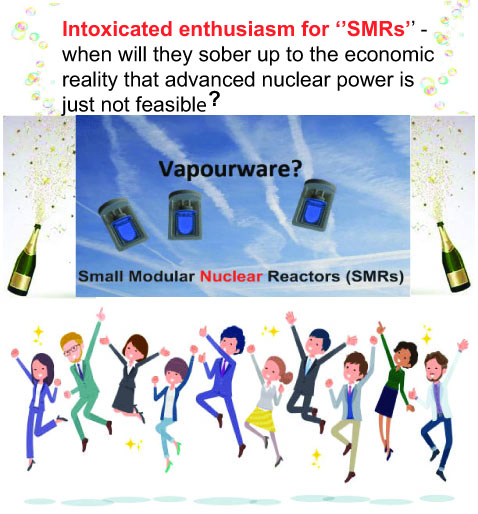
More hype about Small Modular Reactors (SMRs), but they may curb nuclear development .
Energy Revolutions by David Toke, 15 Sept 25
The amount of hype about SMR development seems to grow at inverse
proportion to the likelihood of real SMR deployment. We are now witnessing
a blast of PR about SMRs timed for the visit of Donald Trump to the UK. In
practice the imaginary SMR surge, which appears mostly in press releases
rather than real projects, may well signal a lack of development of nuclear
reactors in the West.
In an earlier post I discussed how so-called SMRs do
not exist as a concept. That is as a concept distinct from earlier attempts
to develop mainstream nuclear power using reactors that are smaller than
today’s mainstream projects. The nuclear industry gradually increased the
size of reactors to reduce costs per MW through capturing economies of
scale. Logic dictates that SMRs will be more, not less, costly than the
conventional contemporary nuclear projects.
However, SMRs could be more of
a burden for the nuclear industry than a boon. That is because instead of
building large conventional projects, small ones are being done ..
For example, in the USA the last completed nuclear reactor project, Vogtle
3&4, is around 2200 MW. Projected SMRs are in the 100-400MW range. The
policy drive for SMRs has recently been doubted by the former Chairman of
the US Nuclear Regulatory Commission, Alison Macfarlane. Her (co-authored
analysis) implies that nuclear waste problems from SMRs will be worse than
with conventional reactors. The paper also says that ‘many studies show
that the economics of SMRs will be much costlier than that of large LWRs,
thereby will not be competitive or profitable.’ https://davidtoke.substack.com/p/two-stories-1-how-smrs-may-curb-nuclear
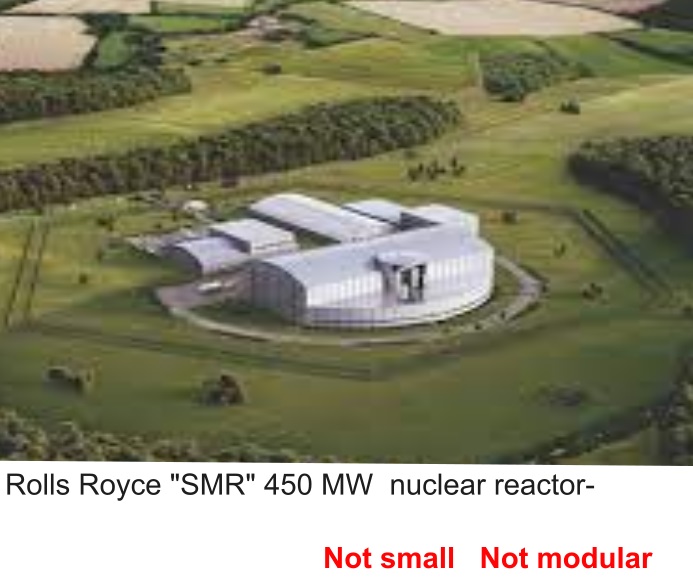
Rolls Royce “Small” nuclear reactors are not at all small!
Dr Paul Dorfman Letter: Further to your report “Deal with US to
fast-track mini nuclear reactors” (Sep 15; letter, Sep 16), small modular
reactors (SMRs) are defined by the International Atomic Energy Agency as
reactors that generate up to 300MW power.
At 470MW, the Rolls-Royce design is not an SMR: it is larger than the UK Magnox reactor, more than half the size of the 900MW reactors that make up the bulk of the French nuclear fleet, and about a third the size of the very large EPR reactor design at Hinkley Point C.
This matters because the Rolls-Royce design will need big
sites, standard nuclear safety measures, exclusion zones, core catchers,
aircraft crash protection and security. All this is important because in
calling its design an SMR, or small, Rolls-Royce appears to me to have been
economical with the truth — and all that implies for its other claims,
especially about time and cost.

As for the nuclear waste problem, the former chair of the US government Nuclear Regulatory Commission reports
that SMRs would produce more reactive waste per kWh — the key parameter — than large reactors.
Times 17th Sept 2025. https://www.thetimes.com/comment/letters-to-editor/article/times-letters-ethics-of-danny-krugers-defection-to-reform-uk-3rbg90m3b
Small Modular nuclear reactors sound great, but won’t be ready any time soon.

The UK government has announced a raft of tiny nuclear power projects, while Russia, China and a host of tech giants are also betting big on small nuclear reactor designs. Does the idea make sense and can they really be built any time soon?
By Matthew Sparkes, New Scientist 15th Sept 2025,
Bruno Merk at the University of Liverpool in the
UK says Rosatom, Russia’s state nuclear energy organisation, recently
finished building a batch of small reactors for a highly specific use in
nuclear-powered icebreaker ships. Crucially, they then continued building
more, showing either that there is demand from somewhere, or that Rosatom
is taking a risk and building them as a commercial demonstration in the
hope of selling more despite a raft of energy sanctions imposed after its
invasion of Ukraine.
China, too, has built a Linglong One small nuclear
reactor, but it is not clear whether it will yet be a commercially viable
product.
And giant technology firms like Amazon, Google and Microsoft are
investing in these sorts of nuclear technologies, too. David Dye at
Imperial College London says tiny reactors make sense for remote military
installations or Arctic sites, but is sceptical about using tiny nuclear
reactors to power these tech giants’ needs. He says it is far easier to
build data centres near a ready supply of energy instead. Michael Bluck at
Imperial College London says there is no engineering or scientific reason
we can’t build tiny nuclear reactors, and build them fast. He points out
the first experimental reactors were small, and many devices of a similar
size operate in universities and military submarines around the world
still. “Size is not the issue. It’s the modularity, it’s the building
it on a production line, it’s the standardisation of components. It’s
really practical. It’s standard engineering,” says Bluck.
But there are certainly plenty of drawbacks to miniaturising nuclear reactors. Merk says for nuclear power, scale brings useful efficiencies in both cost and
energy. Small and large reactors both require the same thickness of
concrete shielding to safely contain their reactions and, because the
volume of a reactor grows faster than its surface area when you make it
larger, bigger reactors are cheaper per megawatt of capacitySmaller reactors also make less energy from the same amount of fuel because of inefficiencies in the chain reaction of neutron fission – smaller amounts
of fuel lose more neutrons at the surface, rather than harnessing them to
continue the reaction. Bluck says there are two different approaches
involved in the new government announcements: X-Energy has designed a
gas-cooled reactor called the Xe-100 which uses a somewhat unusual design
and a type of fuel that could take 10 years to achieve regulatory approval,
while Last Energy’s PWR-20 reactor is a relatively familiar pressurised
water reactor, the same type as Sizewell B nuclear power station in
England, using the same fuel. The former could be the way forward, but the
latter may be able to come to market sooner. But even with standard fuel
and familiar technology, Bluck says Last Energy is likely five years from
having even a prototype reactor built in the UK. “Everyone would like it
tomorrow,” he says. “But I think they’re aware that energy isn’t
like that.” https://www.newscientist.com/article/2496252-modular-nuclear-reactors-sound-great-but-wont-be-ready-any-time-soon/
Communities Push Back against SpaceX in Tamaulipas
Conibio, which partners with federal conservation programs, expects to see the loss of more endangered turtles because of launches from Starbase. “It’s like launching bombs on their habitat,”
A Mexican conservation group says Elon Musk’s rocket launches from South Texas are killing turtles, damaging homes, and littering Tamaulipas beaches with debris.
Pablo De La Rosa, The Border Chronicle, Sep 10, 2025
Three miles south of Starbase, Texas, where SpaceX launches rockets into orbit, the beaches of Tamaulipas begin at the mouth of the Rio Grande. Further south along the water’s edge, generations of families from northern Mexico have spent Sundays on the shores of Playa Bagdad’s recreational area, renting small wooden palapas for shade. Local fishermen live off the seafood they catch nearby in the Gulf of Mexico. They sell their fried fish, spicy shrimp kabobs, and raw oysters to visitors who sunbathe and swim on the beach.
Many Tamaulipecos have grown up with fond memories of Playa Bagdad, and Jesús Elías Ibarra Rodríguez is one of them. Rodríguez is a Matamoros-based veterinarian and the founder and president of Conibio Global A.C., a nonprofit conservation organization based in the state of Tamaulipas.
For several years, residents of Brownsville and other border towns have protested losing access to public beaches and the harm to the environment and communities caused by many SpaceX rocket explosions. In August, several Texas border organizations demanded that the Federal Aviation Administration halt more rocket launches until a complete environmental impact statement is conducted.
A protest movement is also building in neighboring Mexico, Rodríguez said, as the number of launches and tests has increased. “We’ve been here years before SpaceX, working to conserve these precious ecosystems,” he said. “But everything is changing now. The beach is changing. Even people’s homes, old houses going back generations, are getting damaged from the launch vibrations.”
In 2019, SpaceX launched its first rocket prototype from Starbase, called Starhopper. Rodríguez said that during early tests, most noise and debris were contained north of the U.S.-Mexico border. But in recent years, SpaceX “began building rockets of great size, considered the largest rockets ever constructed on the planet.” It was around this time that communities in Tamaulipas began to feel the greater effects from the vibrations of engine tests and rocket launches.
A 2024 study from Brigham Young University found that the rocket launches at Starbase produced sound levels similar to “a rock concert or chainsaw” up to six miles away. The data also showed the blasts were powerful enough to cause structural damage to nearby homes and buildings.
Concerns increased in Mexico as residents in Tamaulipas began to find industrial debris on the beach, some labeled with the names of manufacturers of materials used in the space industry. “They started letting debris fall into Mexican territory,” said Rodríguez. “That was what really worried us, alarmed us, and upset us.” Rodríguez says that his organization has documented debris from SpaceX rocket launches along a 40-kilometer stretch of Tamaulipas beach.
Mexico’s president, Claudia Sheinbaum, said in June that the federal government was looking into a possible lawsuit against SpaceX based on damage sustained in the region from rocket launches. That same month, El País reported that Elon Musk had reached out to the Mexican government in the days after Sheinbaum’s comment for help in recovering any debris found in Tamaulipas that might still belong to the company.
Rodríguez says that Sheinbaum has assigned a local task force that is now present during launches along with Conibio staff and will soon make available a special team of divers to prepare reports on any major debris that is still under Mexican waters.
Rodríguez says that Conibio, which partners with federal conservation programs, expects to see the loss of more endangered turtles because of launches from Starbase. “It’s like launching bombs on their habitat,” said Rodríguez. “You have the sound and vibration of the explosions, and you have tons of millions of little pieces of plastic that are bait for them. And we worry about sea life in general consuming all that.”
Conibio reports that some 900 endangered turtles have died this year because they were trapped in their underground nests by compacted sand from Starbase launch and test vibrations, including from an accidental explosion of a rocket in June that occurred on the ground while it was still attached to its launch arm………………………………………………………………………………………………………………………………………..
While some community members in South Texas have rallied behind the Starbase project in hopes of jobs and economic benefits, that tradeoff does not exist for people in Tamaulipas.
“People here are very unhappy with this,” said Rodríguez. “There are hundreds, even thousands of Mexicans who want to join in, come together, and show that Mexico is united and that we will demand change, that those rockets explode somewhere else.” https://www.theborderchronicle.com/p/communities-push-back-against-spacex?publication_id=373432&post_id=173185930&isFreemail=true&r=3alev&triedRedirect=true&utm_source=substack&utm_medium=email
Small reactors: cash flow alert for Newcleo, Europe’s largest nuclear start-up.
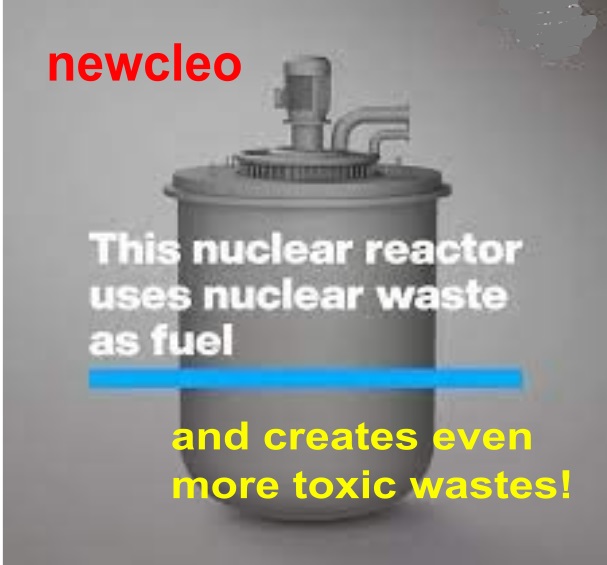
The company, which employs a thousand people, is burning through
too much cash. Its continued existence could be threatened without a new
round of financing.
But both private and public stakeholders remain
cautious. While waiting for fresh money, Newcleo is scaling back. Without a
new capital increase in the next twelve months, the company’s continued
existence is threatened, the Italian press reported in early August. The
articles, notably published in the business daily Il Sole 24 Ore , are
based on the findings of an audit of Newcleo’s 2024 accounts conducted by
KPMG, which La Tribune has seen.
The startup has notably abandoned its
ambitions in the United Kingdom, leading to the elimination of 150
positions. It also intends to reduce its engineering contracts with
external service providers.
La Tribune 29th Aug 2025, https://www.latribune.fr/climat/energie-environnement/petits-reacteurs-alerte-sur-la-tresorerie-de-newcleo-plus-grosse-start-up-europeenne-du-nucleaire-1031500.html
Golden Dome is already a turning point for American space policy.
As the space community awaits the upcoming deadline for a Golden Dome architecture, perhaps the biggest story on Golden Dome is how the program is resonating through the industry.
Last month, a new report by the Aerospace Corporation’s Center for Space Policy and Strategy identified Golden Dome (and its prominence within the Trump administration’s fiscal year 2026 defense budget request) as a significant turning point for American space policy, Pentagon spending priorities and the role of the Space Force.
The report said that “the introduction of Golden Dome is arguably the most important development affecting the defense space budget since the inception of the Space Force.”
As SpaceNews’ Sandra Erwin wrote:
For the relatively young Space Force, established in 2019, Golden Dome represents a significant expansion of resources and responsibilities. Sam Wilson, budget analyst at the Center for Space Policy & Strategy and author of the report, views the initiative as creating “a major opportunity for the Space Force as it brings extra resources for some of Space Force’s priorities such as missile warning satellites that the service already was planning to develop.”
“This is an opportunity to get those funded at higher levels,” Wilson told SpaceNews.
The article describes how Golden Dome’s prominence – and the level of attention paid to it – is elevating space issues within broader defense planning. It’s also a program that could benefit new and old space firms alike while calling broader public attention to the military’s role in and influence over space.
Investors feel the same. A note from Capital Alpha Partners this week highlighted that “Golden Dome gave something new for U.S. contractors to talk about and position for,” but so far details are scarce. At last month’s industry summit in Huntsville, Alabama, defense firms got little more than high-level overviews.
“Even if it’s classified, clarity on the architecture may provide something more meaningful for companies to discuss in the October-November earnings season,” the Capital Alpha note read….(Read more at link –
https://spacenews.bluelena.io/index.php?action=social&chash=980ecd059122ce2e50136bda65c25e07.830&s=d7cea81a8b3dc478fa14dbee41fab337)
Why NuScale Power Stock Slid 31% Last Month

By Brett Schafer – Sep 3, 2025 ,
https://www.fool.com/investing/2025/09/03/why-nuscale-power-stock-slid-31-last-month/
Key Points
- NuScale Power’s stock has pulled back after a huge gain coming from a recent executive order signing.
- The company has a small modular nuclear reactor approved, but has not won a customer contract.
- The stock trades at an expensive price, even though it generates barely any sales and has no customer wins.
The nuclear energy stock doesn’t generate much in revenue and is losing a lot of money.
Shares of NuScale Power (SMR 8.15%) fell 31% in August, according to data from S&P Global Market Intelligence. The nuclear energy upstart and designer of small modular reactors (SMRs) is experiencing wild gyrations with its stock price. The stock is up 432% in the last year and trades at a market cap of $11.5 billion, even though it generates minimal revenue and is burning a lot of cash.
It’s been a roller-coaster ride for nuclear start-ups
Nuclear energy stocks soared at the beginning of this summer, with the current presidential administration’s push to accelerate the development of nuclear energy to keep up with data center demand around artificial intelligence (AI). President Trump signed an executive order for advanced nuclear reactor technologies, of which NuScale Power is one.
In fact, NuScale Power is the only SMR company to have its design approved by the Nuclear Regulatory Commission (NRC), which could give it a head start in winning customer contracts. However, it has failed so far to win any customer contracts outside prospective contracting from a Romanian power company that’s exploring whether to use SMRs for its upcoming energy needs.
With close to zero revenue and a history of burning cash, NuScale Power is a stock that trades with a ton of volatility. As the air comes out of the post-executive order excitement, it is no surprise to see NuScale Power stock hit a bit of a rough patch. The company has no fundamental basis to anchor its $11.5 billion market cap, which makes it a risky stock to invest in.
NuScale Power’s uncertain future
NuScale Power has a few energy projects in the works that it could potentially win deals on, including a recent proposal from the Tennessee Valley Authority. Bringing these to fruition could help it actually develop an SMR to be deployed in the real world instead of talking about it, which has been all the company has done since its inception.
Even if these projects get approved, NuScale Power won’t generate much in revenue to warrant its $11.5 billion market cap, with revenue not showing up for years due to the long project life for nuclear energy developments. It is foolish to buy a stock valued at over $10 billion that’s generating zero revenue. Therefore, investors should avoid putting NuScale Power in their portfolios, given its uncertain future.
A new arms race in space must be stopped in its tracks .

A new treaty banning all weapons in space is the only way to prevent a future calamity.
August 31, Bruce K. Gagnon, https://www.pressherald.com/2025/08/31/a-new-arms-race-in-space-must-be-stopped-in-its-tracks-opinion/
Bruce K. Gagnon is the coordinator of the Global Network Against Weapons & Nuclear Power in Space.
I read with great interest the recent Associated Press article titled “Hijacked satellites and orbiting space weapons: In the 21st century, space is the new battlefield.” It was full of half-truths and manipulations that we’ve come to expect from the Pentagon and the military industrial complex.
While in the Air Force during the Vietnam War, I read the infamous Pentagon Papers that revealed how our government lied to the public, the Congress and the media to create the support for the war. We witnessed a similar story repeated in 2003 with “shock and awe” in Iraq and supposed weapons of mass destruction.
I’ve been coordinating the Global Network since its founding in 1992 while then living in Florida. In 1997, we obtained a copy of the Space Command’s internal document “Vision for 2020” that declared the U.S. would “control space, dominate space and deny other nations access to space.” Since that time the Pentagon and the aerospace industry have done everything possible to create a new arms race in space that they long ago stated would be “the largest industrial project in human history.”
For more than 30 years, China and Russia have gone to the United Nations proposing a new space treaty called PAROS (Prevention of an Arms Race in Space). At the general assembly, in a vote on the nonbinding resolution, it overwhelmingly passes despite the U.S. and Israel voting “No.” The treaty proposal is then sent to Geneva’s Conference on Disarmament for negotiation. There the U.S. and Israel block the treaty.
The official position of the U.S. (through Democrat and Republican administrations) has been “There are no weapons in space, we don’t need a new treaty.” The Global Network’s position has always been “Close the door to the barn before the horse gets out.” But the U.S. has always intended to be the dominant power in space. That is how wars are created.
China and Russia have steadily responded, telling the U.S. that they will not allow Washington to be the “Master of Space” — a slogan over the doorway at the Space Command HQ in Colorado.
NASA has long predicted that war in space will create the Kessler Syndrome — a cascading field of space debris as satellites are destroyed. The outcome would be that much of the Earth would go dark as so many things in our high-tech civilization are linked to space satellites.
A new arms race in space must be stopped in its tracks | Opinion
A new treaty banning all weapons in space is the only way to prevent a future calamity.
Posted August 31
Bruce K. Gagnon
3 min readFont size +Gift Article
Bruce K. Gagnon is the coordinator of the Global Network Against Weapons & Nuclear Power in Space. He lives in Brunswick.
I read with great interest the recent Associated Press article titled “Hijacked satellites and orbiting space weapons: In the 21st century, space is the new battlefield.” It was full of half-truths and manipulations that we’ve come to expect from the Pentagon and the military industrial complex.
While in the Air Force during the Vietnam War, I read the infamous Pentagon Papers that revealed how our government lied to the public, the Congress and the media to create the support for the war. We witnessed a similar story repeated in 2003 with “shock and awe” in Iraq
and supposed weapons of mass destruction.
I’ve been coordinating the Global Network since its founding in 1992 while then living in Florida. In 1997, we obtained a copy of the Space Command’s internal document “Vision for 2020” that declared the U.S. would “control space, dominate space and deny other nations access to space.” Since that time the Pentagon and the aerospace industry have done everything possible to create a new arms race in space that they long ago stated would be “the largest industrial project in human history.”
For more than 30 years, China and Russia have gone to the United Nations proposing a new space treaty called PAROS (Prevention of an Arms Race in Space). At the general assembly, in a vote on the nonbinding resolution, it overwhelmingly passes despite the U.S. and Israel voting “No.” The treaty proposal is then sent to Geneva’s Conference on Disarmament for negotiation. There the U.S. and Israel block the treaty.
The official position of the U.S. (through Democrat and Republican administrations) has been “There are no weapons in space, we don’t need a new treaty.” The Global Network’s position has always been “Close the door to the barn before the horse gets out.” But the U.S. has always intended to be the dominant power in space. That is how wars are created.
Advertisement
China and Russia have steadily responded, telling the U.S. that they will not allow Washington to be the “Master of Space” — a slogan over the doorway at the Space Command HQ in Colorado.
NASA has long predicted that war in space will create the Kessler Syndrome — a cascading field of space debris as satellites are destroyed. The outcome would be that much of the Earth would go dark as so many things in our high-tech civilization are linked to space satellites.
The Pentagon has a plan, though. Its strategy is to fund a slew of launch providers around the world to, in a short time during a war in space, put into orbit new military mini-satellites to replace those that were destroyed. One such potential launch provider is bluShift Aerospace in Brunswick.
The CEO of bluShift, in answering a question from me, admitted that his corporation was being funded by NASA and the U.S. Space Force to launch mini-satellites in a time of crisis in order to keep China and Russia from filling up the already overly congested Lower Earth Orbit (LEO).
The only way to peace and security in space is via a new treaty to ban all weapons in space. We delay such a move at our own peril.
1 This Month

To see nuclear-related stories in greater depth and intensity – go to https://nuclearinformation.wordpress.com
-
Archives
- September 2026 (194)
- August 2026 (330)
- July 2026 (355)
- June 2026 (287)
- May 2026 (306)
- April 2026 (356)
- March 2026 (251)
- February 2026 (267)
- January 2026 (308)
- December 2025 (358)
- November 2025 (359)
- October 2025 (375)
-
Categories
- 1
- 1 NUCLEAR ISSUES
- business and costs
- climate change
- culture and arts
- ENERGY
- environment
- health
- history
- indigenous issues
- Legal
- marketing of nuclear
- media
- opposition to nuclear
- PERSONAL STORIES
- politics
- politics international
- Religion and ethics
- safety
- secrets,lies and civil liberties
- spinbuster
- technology
- Uranium
- wastes
- weapons and war
- Women
- 2 WORLD
- ACTION
- AFRICA
- Atrocities
- AUSTRALIA
- Christina's notes
- Christina's themes
- culture and arts
- Events
- Fuk 2022
- Fuk 2023
- Fukushima 2017
- Fukushima 2018
- fukushima 2019
- Fukushima 2020
- Fukushima 2021
- general
- global warming
- Humour (God we need it)
- Nuclear
- RARE EARTHS
- Reference
- resources – print
- Resources -audiovicual
- Weekly Newsletter
- World
- World Nuclear
- YouTube
-
RSS
Entries RSS
Comments RSS
 nuclear-news