Small Modular Nuclear Reactors do not measure up to the hype of their proponents
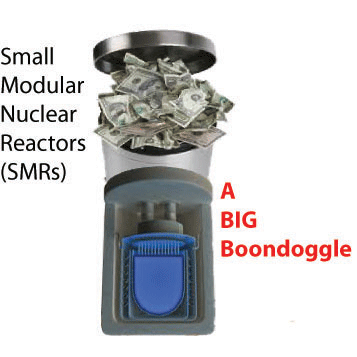 One size doesn’t fit all: Social priorities and technical conflicts for small modular reactors Science Direct, M.V. Ramana, Zia Mian 2014.04.15
Abstract
Small modular reactors (SMRs) have been proposed as a possible way to address the social problems confronting nuclear power, including poor economics, the possibility of catastrophic accidents, radioactive waste production, and linkage to nuclear weapon proliferation. Several SMR designs, with diverse technical characteristics, are being developed around the world and are promoted as addressing one or more of these problems. This paper examines the basic features of different kinds of SMRs and shows why the technical characteristics of SMRs do not allow them to solve simultaneously all four of the problems identified with nuclear power today. It shows that the leading SMR designs under development involve choices and trade-offs between desired features. Focusing on a single challenge, for example cost reduction, might make other challenges more acute. The paper then briefly discusses other cultural and political factors that contribute to the widespread enthusiasm for these reactors, despite technical and historical reasons to doubt that the promises offered by SMR technology advocates will be actually realized.
1. Introduction
Thorium lobby’s misinformation is hampering rare earths industry
 It’s anybody’s guess how long Thorium, with its “peacenik” aura, will take to get traction in corridors well-trodden by the US nuclear energy lobby, who have singularly shown zero interest in the blandishments of Thorium.
Thorium lobby thunder intent on hijacking rare earths’ coattails Investor Intel August 12, 2014 by Christopher Ecclestone Anyone in the Rare Earths space knows that Thorium frequently appears as an unwanted guest at the party. Explorers have worked on various ways to get around the issue. However there is a small group out there who we would call the “deniers”. They absolutely love Thorium. They are like Swedes liberated from the sauna in the dead of winter and would roll around in the stuff naked, if they could, to prove their commitment. While greater love hath no man to a chemical element than the Thorium crowd to their object of desire, the more measured amongst us realize that the mineral has been stuck for decades like a racehorse suffering a starting-gate malfunction.
What are we talking of here Continue reading
A nuclear boondoggle exposed – Small Modular Reactors (SMRs)
Report: New Nuclear Power Technology Would Siphon Resources Away From Renewable Energy, PROGRESS ILLINOIS Ellyn Fortino Friday August 8th, 2014, “…….one nuclear financing expert argues in a new report that SMRs, which have yet to be built in the United States, would be no cheaper than their larger counterparts. Mark Cooper, a senior fellow for economic analysis at theInstitute for Energy and the Environment at the Vermont Law School, also warns that SMR development would suck up funding that could otherwise be used for what he says are more attractive energy options like wind and solar.
“Large reactors have never been economically competitive and there is no reason to believe that smaller reactors will fare any better,” Cooper said. “Giving nuclear power a central role in climate change policy would not only drain away resources from the more promising alternatives, it would undermine the effort to create the physical and institutional infrastructure needed to support the emerging electricity systems based on renewables, distributed generation and intensive system and demand management.”………
Although SMRs would be smaller in size, “creating an assembly line for SMR technology would require a massive financial commitment,” Cooper writes in his report, “The Economic Failure of Nuclear Power and the Development of a Low-Carbon Electricity Future: Why Small Modular Reactors Are Part of the Problem, Not the Solution.”

He projects it would cost between $72 billion and $90 billion by 2020 to fund the development of just two SMR designs and assembly lines.
The estimated price tag to invest in SMRs is roughly equivalent to 75 percent of the total projected investment in U.S. electricity generation over the same time period, the report noted. It is also “substantially more” than what is expected to be spent on renewables, Cooper said.
“This massive commitment reinforces the traditional concern that nuclear power will crowd out the alternatives,” he added.
SMRs themselves would also cost more, not less, than larger reactors, according to the report.
“The higher costs result from: lost economies of scale in containment structures, dedicated systems for control, management and emergency response, and the cost of licensing and security; operating costs between one-fifth and one-quarter higher; and decommissioning costs between two and three times as high,” Cooper noted.
SMRs are up against greater challenges than previous technologies because they are “a radical new technology that its advocates would like to have treated in a very different way with respect to safety and licensing,” Cooper explained.
“They would like to deploy lots of reactors close to population centers. That’s the way they can make their economics work,” he continued. “And they need to relax safety … They’ve asked for a number of changes in safety to try to drive down the cost, and even then they cannot compete on costs.”……
the industry’s hype around SMRs is now fizzling, Cooper explained. The “unproven” SMR technology has already experienced setbacks in the marketplace, he said, pointing to recent announcements from Babcock & Wilcox and Westinghouse Electric Co., another small-reactor industry leader developing a 225-megawatt SMR.
Babcock & Wilcox said last month that it is slowing the development of and funding for its mPower technology because the company cannot find major investors for the effort. Westinghouse — after being passed up twice by the DOE for SMR cost-sharing agreements — announced in February that it is shifting its attention away from small-reactor technology because it does not have a customer base for SMRs.
“They are cutting back for simple reasons: They can’t find customers. They can’t find investors,” Cooper said. “In a market economy like ours, that is a death knell, and so they have slashed their commitment to small modular reactors……….”http://progressillinois.com/quick-hits/content/2014/05/18/report-new-nuclear-power-technology-would-siphon-resources-away-renewa
The collapse of the Small Modular Nuclear Reactor hype – ominous for the nuclear industry
Report: New Nuclear Power Technology Would Siphon Resources Away From Renewable Energy, PROGRESS ILLINOIS Ellyn Fortino Friday August 8th, 2014 “………With the industry currently unable to garner enough customer and investor interest around SMRs, it is trying to save nuclear power by making a “desperate attempt to undermine the alternatives, which are succeeding,” Cooper added.
The nuclear energy industry “says, ‘Look, just get rid of their subsides. Gerry-rig the market so that we can stay in business. Avoid policies that will let (alternatives) stay in business … and then we’ll have a level playing field.’ But of course it doesn’t look anything like a level playing field,” he said.
Over the past 60 years, the nuclear energy industry has collected 10 times more subsidies than what renewables have received, Cooper said. Government funding for SMR research and development currently represents the smallest subsidy out of many received by the nuclear power industry, he added.
He said the U.S. nuclear energy industry is grappling with a “fundamental conflict.” After failing to bring online 90 percent of new reactors as part of a “nuclear renaissance” suggested by nuclear power advocates in the early 2000s, the hope was that SMR technology would rescue the industry. And since that has yet to happen, the industry is “now struggling to save the aging reactors… simply because they cannot compete against the alternatives available.”

“The death of the small modular reactor hype really is emblematic of the fundamental conflict that’s going on in the industry,” he said. “The near term will decide, not just the fate of nuclear power, but the fundamental approach that we take to addressing the challenge of climate change.”
Looking ahead, Cooper said he questions nuclear power’s place in the emerging “integrated, two-way electricity system based on decentralized alternatives.” In such a system, an “inflexible source of supply like nuclear does not have value,” he said, adding that nuclear power “becomes a burden on the flexible system rather than a benefit.”
Nuclear power, Cooper said, is not a smart “economic proposition” or “portfolio asset” for a low-carbon electricity future.
“And looking carefully at the urgency of dealing with climate change, it’s also the most costly, most risky approach to climate change,” he stressed. http://progressillinois.com/quick-hits/content/2014/05/18/report-new-nuclear-power-technology-would-siphon-resources-away-renewa
Dr Helen Caldicott exposes the fallacies of the push for Small Modular Nuclear Reactors
Small Modular Reactors Huffington Post, Dr Helen Caldicott 08/07/2014 Now that the “nuclear renaissance” is dead following the Fukushima catastrophe, when one sixth of the world’s nuclear reactors closed, the nuclear corporations — Toshiba, Nu-Scale, Babcock and Wilcox, GE Hitachi, General Atomics, and the Tennessee Valley Authority — will not accept defeat.
Their new strategy is to develop small modular reactors (SMRs), allegedly free of the dangers inherent in large reactors: safety issues, high cost, proliferation risks and radioactive waste.
But these claims are fallacious, for the reasons outlined below.
Basically, there are three types of SMRs, which generate less than 300 megawatts of electricity compared with current 1,000-megawatt reactors.
1. Light-water reactors
These will be smaller versions of present-day pressurized water reactors, using water as the moderator and coolant, but with the same attendant problems as Fukushima and Three Mile Island. Built underground, they will be difficult to access in the event of an accident or malfunction.
Because they’re mass-produced (turnkey production), large numbers must be sold yearly to make a profit. This is an unlikely prospect, because major markets — China and India — will not buy U.S. reactors when they can make their own.
If safety problems arise, they all must be shut down, which will interfere substantially with electricity supply.
SMRs will be expensive because the cost per unit capacity increases with a decrease in reactor size. Billions of dollars of government subsidies will be required because Wall Street is allergic to nuclear power. To alleviate costs, it is suggested that safety rules be relaxed, including reducing security requirements, and reducing the 10-mile emergency planning zone to 1,000 feet.
2. Non-light-water designs
These include high-temperature gas-cooled reactors (HTGRs) or pebble-bed reactors. Five billion tiny fuel kernels consisting of high-enriched uranium or plutonium will be encased in tennis-ball-sized graphite spheres that must be made without cracks or imperfections — or they could lead to an accident. A total of 450,000 such spheres will slowly and continuously be released from a fuel silo, passing through the reactor core, and then recirculated 10 times. These reactors will be cooled by helium gas operating at high very temperatures (900 degrees C).
A reactor complex consisting of four HTGR modules will be located underground, to be run by just two operators in a central control room. Claims are that HTGRs will be so safe that a containment building will be unnecessary and operators can even leave the site (“walk-away-safe” reactors).
However, should temperatures unexpectedly exceed 1,600 degrees C, the carbon coating will release dangerous radioactive isotopes into the helium gas, and at 2,000 degrees C the carbon would ignite, creating a fierce, Chernobyl-type graphite fire.
If a crack develops in the piping or building, radioactive helium would escape, and air would rush in, also igniting the graphite.
Although HTGRs produce small amounts of low-level waste, they create larger volumes of high-level waste than conventional reactors.
Despite these obvious safety problems, and despite the fact that South Africa has abandoned plans for HTGRs, the U.S. Department of Energy has unwisely chosen the HTGR as the “next-generation nuclear plant.”
3. Liquid-metal fast reactors (PRISM)
It is claimed by proponents that fast reactors will be safe, economically competitive, proliferation-resistant, and sustainable.
They are fueled by plutonium or highly enriched uranium and cooled by either liquid sodium or a lead-bismuth molten coolant. Liquid sodium burns or explodes when exposed to air or water, and lead-bismuth is extremely corrosive, producing very volatile radioactive elements when irradiated.
Should a crack occur in the reactor complex, liquid sodium would escape, burning or exploding. Without coolant, the plutonium fuel could reach critical mass, triggering a massive nuclear explosion, scattering plutonium to the four winds. One millionth of a gram of plutonium induces cancer, and it lasts for 500,000 years. Extraordinarily, they claim that fast reactors will be so safe that they will require no emergency sirens, and that emergency planning zones can be decreased from 10 miles to 1,300 feet.
There are two types of fast reactors: a simple, plutonium-fueled reactor and a “breeder,” in which the plutonium-reactor core is surrounded by a blanket of uranium 238, which captures neutrons and converts to plutonium.
The plutonium fuel, obtained from spent reactor fuel, will be fissioned and converted to shorter-lived isotopes, cesium and strontium, which last 600 years instead of 500,000. The industry claims that this process, called “transmutation,” is an excellent way to get rid of plutonium waste. But this is fallacious, because only 10 percent fissions, leaving 90 percent of the plutonium for bomb making, etc.
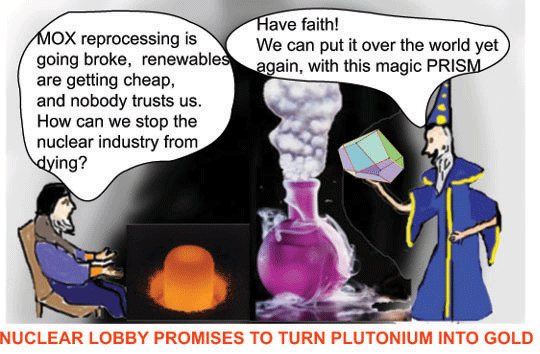
Then there’s construction. Three small plutonium fast reactors will be grouped together to form a module, and three of these modules will be buried underground. All nine reactors will then be connected to a fully automated central control room operated by only three operators. Potentially, then, one operator could face a catastrophic situation triggered by loss of off-site power to one unit at full power, another shut down for refueling and one in startup mode. There are to be no emergency core cooling systems.
Fast reactors require a massive infrastructure, including a reprocessing plant to dissolve radioactive waste fuel rods in nitric acid, chemically removing the plutonium, and a fuel fabrication facility to create new fuel rods. A total of 15 to 25 tons of plutonium are required to operate a fuel cycle at a fast reactor, and just five pounds is fuel for a nuclear weapon.
Thus fast reactors and breeders will provide extraordinary long-term medical dangers and the perfect situation for nuclear-weapons proliferation. Despite this, the industry plans to market them to many countries.
The Future for Small Modular Nuclear Reactors s does not look promising
 NuClear News August 14 “………The Future for SMRs does not look promising
Small Modular Nuclear Reactors in reality are far from safe
 nuClear News August 14, “…..Safety of SMRsdepend on convincing the US Nuclear Regulatory Commission to relax existing safety
PRISM – Power Reactor Innovative Small Modular, dangerous and produces toxic wastes
Small Modular Nuclear Reactors the energy option that does not stack up economically
Economics of SMRs nuClear News, August 14 “……….Union of Concerned Scientist says just because these reactors are cheaper doesn’t mean to say they are cost effective.Safety problems in the idea for floating nuclear power reactors
 Floating Nuclear Power Plants Might Be the Future of Energy, VICE News, By Kayla RubleAugust 1, 2014 “…………Critics are concerned about some of the design aspects of this type of NPPs. Edwin Lyman, a senior global security scientist at Union of Concerned Scientists, told VICE News that a lot of what needs to be done to make these plants deployable is the opposite of what the industry needs to do to make their land-based facilities safer. He explained that having to build lighter reactors for use in the ocean and accessibility issues are concerns with the floating plants.
Liquid Fluoride Thorium Reactor (LFTR) simply too dangerous -that’s why it was stopped
 Perhaps these technical problems can be overcome, but why would anyone bother to try, knowing in advance that the MSR plant will be uneconomic due to huge construction costs and operating costs, plus will explode and rain radioactive molten salt when (not if) the steam generator tubes leak. There are serious reasons the US has not pursued development of the thorium MSR process.
Reports are, though, that China has started a development program for thorium MSR, using technical information and assistance from ORNL. One hopes that stout umbrellas can be issued to the Chinese population that will withstand the raining down of molten, radioactive fluoride salt when one of the reactors explodes.
The Truth About Nuclear Power – Part 28 Subtitle: Thorium MSR No Better Than Uranium Process, Sowell’s law blog July 20, 2014
Fukushima’s ice wall – a hazardous and dubious operation
 Doubts over ice wall to keep Fukushima safe from damaged nuclear reactors Frozen barrier, costing £185m, being built around Fukushima Daiichi’s four damaged reactors to contain irradiated water The Guardian, Monday 14 July 2014 “…..f all goes to plan, by next March Fukushima Daiichi’s four damaged reactors will be surrounded by an underground frozen wall that will be a barrier between highly toxic water used to cool melted fuel inside reactor basements and clean groundwater flowing in from surrounding hills.
Up to 400 tonnes of groundwater that flows into the basements each day must be pumped out, stored and treated – and on-site storage is edging closer to capacity. Decommissioning the plant will be impossible until its operator, Tokyo Electric Power [Tepco] addresses the water crisis.
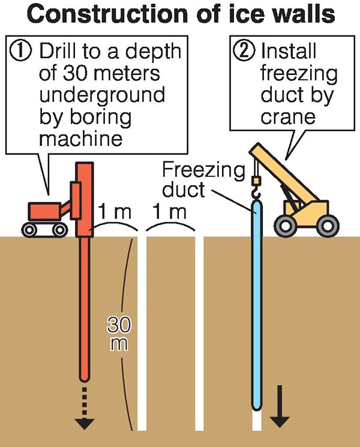
Last month workers from Tepco and the construction firm Kajima Corp began inserting 1,550 pipes 33 metres vertically into the ground to form a rectangular cordon around the reactors. Coolant set at -30C will be fed into the pipes, eventually freezing the surrounding earth to create an impermeable barrier.
“We started work a month ago and have installed more than 100 pipes, so it is all going according to plan to meet our deadline,” Tadafumi Asamura, a Kajima manager who is supervising the ice wall construction, said as workers braved rain, humidity and radiation to bore holes in the ground outside reactor No 4, scene of one of three hydrogen explosions at the plant in the early days of the crisis.
But sealing off the four reactors – three of which melted down in the March 2011 disaster – is costly and not without risks. The 32bn-yen (£185m) wall will be built with technology that has never been used on such a large scale.
“I’m not convinced the freeze wall is the best option,” Dale Klein, former head of the US Nuclear Regulatory Commission and a senior adviser to Tepco, recently told Kyodo News. “What I’m concerned about is unintended consequences. Where does that water go and what are the consequences of that? I think they need more testing and more analysis.”
The 1,500-metre wall will stay in use until 2020, using enough electricity every year to power 13,000 households, according to officials.
Over the next eight months, 360 workers from Tepco and Kajima will work in rotating shifts of up to four hours a day, with each shift beginning in the early evening to combat heat exhaustion. Each worker is wrapped in hazardous materials suits and full-face masks, along with tungsten-lined rubber torso bibs for added protection against radiation.Tepco’s record of mishaps in the three years since Fukushima Daiichi suffered a triple meltdown suggests the wall project will not be trouble free. The firm has had problems freezing irradiated water – using the same method being used to build the underground wall – that has accumulated in underground trenches, raising concerns that the ice technology is flawed…….http://www.theguardian.com/environment/2014/jul/13/doubts-giant-ice-wall-fukushima-nuclear-reactors
Freezing ducts very slowly built for Fukushima’s ice wall 90 built. 1460 more to go
TEPCO: 90 out of 1,550 freezing ducts built so far http://the-japan-news.com/news/article/0001411769 The Yomiuri Shimbun 10 July 14 Tokyo Electric Power Co. unveiled on Tuesday the construction site of the ice wall at the crippled Fukushima No. 1 nuclear power plant for the first time since work began last month.
As a measure to halt the increase of contaminated water, the ice walls are aimed at freezing the ground around the Nos. 1 to 4 reactor buildings of the plant to block groundwater from flowing into reactor buildings and becoming contaminated.
Contaminated water at the nuclear plant currently amounts to about 500,000 tons. The government and TEPCO have been working on the construction in the hope of completing it early next fiscal year.
On Tuesday evening, about 30 workers drilled small holes about 30 meters deep around the No. 4 reactor building. Ducts to freeze underground soil are to be installed in the holes.
A total of 1,550 freezing ducts must be installed to surround the Nos. 1 to 4 reactor building area, measuring about 1.5 kilometers. However, TEPCO said only about 90 freezing ducts have been installed so far.
Due to heat exhaustion concerns during summer, workers at the construction site wear vests containing blue ice.
Meanwhile, the task of freezing tunnels filled with contaminated water using the same method involving the construction of an ice wall has been facing difficulties. The Nuclear Regulation Authority has therefore been calling on TEPCO to fundamentally revise construction plans.
Akira Ono, the chief of Fukushima No. 1 nuclear power plant, said: “We’ve already confirmed the effectiveness of ice walls through an on-site experiment. We will push ahead with the construction work forward as fast as we can.”
Economics, Time, and Terrorism make a thorium nuclear industry unlikely to happen
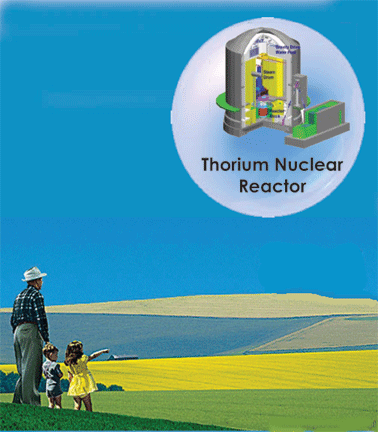 Writing in Oil Price, Andrew Topf 18 June 2014 discusses the very real impediments to starting a thorium nuclear reactor industry
“One large hole that can be punched in the argument for thorium involves the economics of thorium reactors. Experts say compared to uranium, the thorium fuel cycle is more costly and would require extensive taxpayer subsidies.
Another issue is time. With a viable thorium reactor at least a decade away if not more, the cost of renewable alternatives like solar and wind may come down to a point where thorium reactors won’t be economical. Critics also point out that the nuclear industry has invested too much in uranium reactors – along with government buy-in and a set of regulations around them – to be supplanted by thorium.
As for the “green nuclear” argument, thorium’s detractors say that isn’t necessarily the case. While thorium reactors produce less waste, they also produce other radioactive by-products that will need safe disposal, including U-232, which has a half-life of 160,000 years.
“It will create a whole new volume of radioactive waste from previously radio-inert thorium, on top of the waste from uranium reactors. Looked at in these terms, it’s a way of multiplying the volume of radioactive waste humanity can create several times over,” said Oliver Tickell, author of Kyoto2, speaking to The Guardian.”
Unanswered questions about OSMRs (Offshore Small Modular Reactors)
Andrew Topf writes in Oil Price 06 July 2014“there are some unanswered questions. One is what would happen to the surrounding marine life should an uncontained nuclear meltdown occur at sea. Who can forget the Google Earth map depicting a yellow-green plume of radiation stretching half-way across the Pacific? While the authenticity of the map was later questioned, scientists have discovered trace amounts of radiation on the North American West Coast, a full three years after the event.
Another is the threat of terrorism. The MIT researchers claim that offshore nukes would be harder to attack, but on the other hand, they would also be tough to defend. Todd Woody, writing for The Atlantic, observed that defending these “nuclear islands” from terrorist assault, by ships and submarines, “would require some James Bond-like machinations,” including early detection systems, barriers to vital access points, and the use of automatic weaponry”
1 This Month
26 September – International Day for the Total Elimination of Nuclear Weapons





PLEASE OPPOSE HR 8255 AND S.3639 – bills would accelerate satellite deployment, with no environmental review or safeguards – https://ncstd5li.quorum.us/campaign/169331/
To see nuclear-related stories in greater depth and intensity – go to https://nuclearinformation.wordpress.com
-
Archives
- September 2026 (291)
- August 2026 (330)
- July 2026 (355)
- June 2026 (287)
- May 2026 (306)
- April 2026 (356)
- March 2026 (251)
- February 2026 (267)
- January 2026 (308)
- December 2025 (358)
- November 2025 (359)
- October 2025 (375)
-
Categories
- 1
- 1 NUCLEAR ISSUES
- business and costs
- climate change
- culture and arts
- ENERGY
- environment
- health
- history
- indigenous issues
- Legal
- marketing of nuclear
- media
- opposition to nuclear
- PERSONAL STORIES
- politics
- politics international
- Religion and ethics
- safety
- secrets,lies and civil liberties
- spinbuster
- technology
- Uranium
- wastes
- weapons and war
- Women
- 2 WORLD
- ACTION
- AFRICA
- Atrocities
- AUSTRALIA
- Christina's notes
- Christina's themes
- culture and arts
- Events
- Fuk 2022
- Fuk 2023
- Fukushima 2017
- Fukushima 2018
- fukushima 2019
- Fukushima 2020
- Fukushima 2021
- general
- global warming
- Humour (God we need it)
- Nuclear
- RARE EARTHS
- Reference
- resources – print
- Resources -audiovicual
- Weekly Newsletter
- World
- World Nuclear
- YouTube
-
RSS
Entries RSS
Comments RSS

