The nuke heads want to use small nuclear reactor for Mars travel (I suppose it’s on tax-payers’ money)
 I-Team: Nuclear reactor test in Nevada could make a Mars trip reality, Las Vegas Now, By George Knapp , Matt Adams | madams@8newsnow.com 11/04 2016 “….Next year, a team of top scientists will hunker down inside a classified facility in the Nevada desert so they can experiment with a piece of advanced technology.
The test will focus on a small nuclear reactor and if it works as planned, it could be a huge step toward putting humans on Mars……
Los Alamos nuclear reactor scientist Patrick McClure is bubbling with enthusiasm about the end uses for the small nuclear reactor his team will test in the Nevada Desert in 2017. The reactor is named Kilopower. The experiment is dubbed KRUSTY, and yes, it’s an acronym named for the character in “The Simpsons” television show, but the goals are all too serious…….
“It could have happened. You could have nuclear powered rockets taking people to Mars, by now. That would be the reality of this,” said Darwin Morgan, Department of Energy.
“Definitely, in the 2030s, we will have the technology and the capability to go to Mars,” Houts said.
“This is exciting stuff,” McClure said. “We like it.” http://www.lasvegasnow.com/news/i-team-nuclear-reactor-test-in-nevada-could-make-a-mars-trip-reality
Financial disaster of America’s failed Mixed Oxide Fuel Fabrication Facility (MOX)
 Nuke Fuel Facility Costs Ten Times Estimate, is 41 Years Behind Schedule http://www.pogo.org/straus/issues/nuclear-security/2016/nuke-fuel-facility-costs-ten-times-estimate-41-years-behind-schedule.html?referrer=https://t.co/yn7hBkHF1d By: Lydia Dennett | October 13, 2016 Imagine you have a contractor working on your house. They quoted you a price and told you the project would be done in no time. Sure, you realize costs will probably go up some and the schedule will slip due to an unexpected problem or two. But months turn into years, years turn into a decade, and now, 14 years later, you find that they’ve already spent five times their original estimate and they aren’t even halfway done!
That’s the situation the Department of Energy is facing with the contractor building a nuclear fuel facility in South Carolina. The Mixed Oxide Fuel Fabrication Facility, known as MOX, is a multi-billion dollar boondoggle that is behind schedule, is over budget, and will never be able to complete its mission. Now the Army Corps of Engineers has released an independent cost estimate for the project that reveals things are even worse than we thought.
MOX was originally conceived as part of an agreement between the United States and Russia in which each country pledged to dispose of weapons grade plutonium. But that was back in 2000. As cost overruns and the technical failure has become clear, the Department of Energy asked Congress to cancel the program this year. The South Carolina delegation, defending jobs in their districts, pushed back and claimed doing so would violate the agreement. Last week Russian President Vladimir Putin announced he would be withdrawing from the agreement.
Without Russia being party to the agreement, the last remaining pretense for this boondoggle is shattered.
Congress will soon be reviewing the budget for fiscal year 2018 and should ensure that funding for this project is ended once and for all.
The new independent cost estimate shows that finishing the construction of the MOX facility has gone from $1.6 billion to a staggering $17 billion—more than 10 times the original projection. And while the facility was supposed to be fully constructed in 2007, the Army Corps of Engineers stated that MOX won’t be finished and ready for operations until 2048—putting it 41 years behind schedule.
But even if Congress decides to accept spending $17 billion in taxpayer dollars and waiting 41 extra years for the facility, the project will never work.
MOX technology dates back to the 1960s and has caused experts to raise concerns about the technical viability of the U.S. facility should it ever be completed and become operational. In 2014, Energy Department experts concluded that U.S. implementation of MOX technology still remains a “significant risk.” Moreover, even if the facility were to work perfectly and produce the mixed oxide fuel as intended, there aren’t any commercial nuclear reactor companies interested in purchasing it. In 2008, the project lost its only potential customer and hasn’t been able to find a single replacement.
What is even more unbelievable is that $17 billion isn’t even the bottom line for this monstrosity. Other independent estimates have found that over the facility’s lifetime, which includes the costs of operating the plant for 20 years on top of construction costs, MOX will cost taxpayers $110 billion.
The fact that these cost estimates come from independent sources is important. For the last several years the contractor in charge of the MOX project, CB&I AREVA MOX Services, has been spreading misleading facts and figures about the project’s true costs.
These contractor statements have been proven wrong time and time again by the Department of Energy, independent sources, and reality. The new Army Corps analysis exposes just how the contractors’ optimistic estimates border on delusional. For example, the contractors stated earlier this year that finishing the job will cost $3 billion; the Army Corps found the contractors’ estimate should have come closer to $10 billion. The contractors’ calculation, they found, had serious problems which led to the inaccuracies. “The MOX Services estimate-at-completion is not credible because it was developed using unrealistic production and productivity rates, artificially low escalation, inappropriate allocation of management reserves and contingency that is not time phased across the project duration, and lack of escalation applied to these reserves,” the Army Corps’ report stated. Based on their calculations the MOX project is only 28 percent complete, not 48 percent as the contractor has asserted.
What CB&I AREVA MOX Services also seem to conveniently forget in its calculations is that the project is running on at least a 25 percent rework rate, meaning approximately a quarter of the work already done will have to be re-done—the project takes one step back for every four steps forward. This includes everything from walls that were installed incorrectly to piping that was ordered but didn’t meet specifications.
These kinds of mistakes led to CB&I AREVA MOX Services receiving only half of its possible contract award fee in 2015. “Overall performance is below the level needed for successful project completion, as culminated in cost overruns and schedule delays,” thegovernment documents stated. They cited the contractor’s poor management of the project and failure to adequately perform random drug testing. Still, CB&I AREVA MOX Services received $4.33 million of the possible $8.86 million in bonuses for that year.
It may seem remarkable that CB&I AREVA MOX Services has managed to retain the contract after so many missteps, but it could be the result of a very successful lobbying effort. The two companies that make up CB&I AREVA MOX Services, Chicago Bridge & Iron Works (CB&I) and AREVA, spent a total of $2.4 million lobbying the government in 2015 on various issues including the MOX project. In the first two quarters of 2016 alone the groups have spent $1.4 million. That amount doubles when including other organizations, like the International Brotherhood of Electrical Workers, that listed MOX as a lobbying objective.
The contractor has effectively lined up several Senators and Representatives who have made sure that taxpayer dollars continue to flow to the MOX project, and thus to CB&I AREVA MOX Services. Senators Lindsey Graham (R-SC) and Tim Scott (R-SC), and Representatives Joe Wilson (R-SC), James Clyburn (D-SC), and Rick Allen (R-GA) have done their best to support MOX. During the budget process this year, Wilson wrote a letter to the House Committee on Appropriations Subcommittee on Energy and Water Development urging them to continue funding the MOX program. Clyburn and Allen also signed the letter. It comes as no surprise that Representatives Wilson and Clyburn as well as Senator Scott are among the AREVA Group’s top recipients for campaign donations. Also on the list are Representatives Mike Simpson (R-ID) and Marcy Kaptur (D-OH), the Chairman and Ranking Member of the Energy and Water Appropriations Subcommittee which determines annual funding for MOX. At this point the MOX project is nothing more than pork barrel politics.
“We are confident [the MOX project] is not feasible in this environment. We are going down a road spending money on something that will never happen. Unfortunately, that seems to us to be a very large waste of taxpayer money,’’ DOE Associate Deputy Secretary John MacWilliams told The State reporter Sammy Fretwell on a tour of the construction site.
MOX is unaffordable, 41 years behind schedule, and will never work. And now that Russia has withdrawn from the agreement, the United States would be the only ones trying to uphold it. Congress’s decision to continue funding this disaster was based on grossly inaccurate information about both the cost and performance of this project. But they have time to revisit this decision with unbiased facts and analysis before the next budget decisions need to be made. There are cheaper and faster ways to dispose of the plutonium, methods that the Energy Department is already exploring. There is no reason Congress should continue forcing taxpayers to fund such an obvious boondoggle.
By: Lydia Dennett, Investigator
Lydia Dennett is an investigator for the Project On Government Oversight. Lydia works on safety and security of nuclear weapons and power facilities, foreign lobbying and influence, and works with Department of Veterans Affairs whistleblowers.
The very real threat of Cyber-attacks Against Nuclear Plants
 Cyber-attacks Against Nuclear Plants: A Disconcerting Threat INFOSEC Institute, Pierluigi Paganini OCTOBER 14, 2016 A cyber-attack against critical infrastructure could cause the paralysis of critical operations with serious consequences for a country and its population.
In a worst case scenario, a cyber-attack could affect processes that in case of fault could cause serious damages and consequent losses of human lives.
Let’s think for example to a refinery or a nuclear plant, in both cases; a cyber-attack represents a threat to the infrastructure, its processes, and people that work within.
Nuclear plants are critical components of any countries; critical functions depend on their operations, and an incident could have dramatic effects on the population.
Is a cyber-attack against a nuclear plant a possible event?
Unfortunately, the response is affirmative. Nuclear plants are composed of an impressive number of components such as SCADA/ICS, sensors and legacy systems that could be hit by a hacker.
The most popular case of a cyber-attack against a nuclear plant is Stuxnet, which was launched more than five years ago. Stuxnet is the malware developed by experts from the US and Israel with the intent of destroying the Iranian nuclear program. Nation state hackers hit the plant of Natanz in Iran in 2010 interfering with the nuclear program of the Government of Teheran.
The Stuxnet targeted a grid of 984 converters, the same industrial equipment that international inspectors found out of order when visited the Natanz enrichment facility in late 2009.
The cyber-attack against the Cascade Protection System infects Siemens S7-417 controllers with a matching configuration. The S7-417 is a top-of-the-line industrial controller for big automation tasks. In Natanz, it is used to control the valves and pressure sensors of up to six cascades (or 984 centrifuges) that share common feed, product, and tails stations” states “A Technical Analysis of What Stuxnet’s Creators Tried to Achieve” written by the expert Ralph Langner.
Stuxnet was designed with a number of features that allowed to evade detection; its source code was digitally signed, and the malware uses a man-in-the-middle attack to fool the operators into thinking everything is normal.
Stuxnet is the demonstration that it is possible to use a malicious code to destroy operations at a nuclear plant.
In the last years, security experts and authorities confirmed at least three cases of cyber-attacks against Nuclear plants.
Who are the threat actors that could hit a nuclear plant?
There are many actors, such as cyber criminals, hacktivists, nation-state actors, cyber terrorists and script kiddies, that are threatening critical infrastructure worldwide
Let’s see which are the principal incidents that affected nuclear plants in the last years.
The incidents
According to the Director of the International Atomic Energy Agency (IAEA), Yukiya Amano, a nuclear power plant in Germany suffered a “disruptive” cyber-attack two to three years ago……..
This isn’t the first time that we receive the news of cyber-attacks on nuclear plants. There are three publicly known attacks against nuclear plants:
- Monju NPP (Japan 2014)
- Korea Hydro and Nuclear Power plant (S.Korea 2014)
- Gundremmingen NPP (Germany 2016).
It is likely that Amano was referring the cyber-attack against the Gundremmingen nuclear plant that occurred earlier this year. Security experts, in that case, discovered the presence of the Conficker and Ramnit malware in the target systems……
2014 – Malware based attack hit Japanese Monju Nuclear Power Plant
On January, 2nd 2014 one of the eight computers in the control room at Monju Nuclear Power Plant in Tsuruga, Japan, was compromised by a cyber-attack. The local IT staff discovered that the system in the reactor control room had been accessed over 30 times in a few days. The experts observed the intrusion started after an employee updated a free video playback application running on one of the computers in the plant…….
Cyber-attacks against the organizations operating in the Energy industry were already observed in the past, in 2012 the Japan Atomic Energy Agency was targeted by a cyber-attack that compromised a computer at the JAEA headquarters at Tokaimura by infecting it with malware.
2014 – Nuclear plant in South Korea hacked
In December 2014, the South Koran government revealed that a nuclear plant in the country was hacked. …..
2016 – A malware infected systems at the Gundremmingen nuclear plant in Germany
In April 2016, the German BR24 News Agency reported the news of a computer virus that was discovered at the Gundremmingen nuclear power plant in Germany……..The experts involved in the investigation discovered the presence of the Conficker and W32.Ramnit malware in unit B of the Gundremmingen. Conficker is worm with the ability of rapidly spreading through networks, while W32.Ramnit is a data stealer.
The RWE also added that malware had been found on 18 removable data drives, mainly USB sticks, in office computers maintained separately from the plant’s operating systems………
Conclusions
Cyber-attacks against nuclear power plants and industrial control systems are probably at the top of a long list of potential  disasters that can be caused by hackers.
Stuxnet, which targeted nuclear power plants in Iran, is still the most widely publicized threat against such systems.
Security experts are aware of the possibility that hackers could cause serious problems to these critical infrastructures worldwide, for this reason, several governments already launched internal assessments of their infrastructure.
This summer, the European Parliament has passed the new network and information security (NIS) directive that establishes minimum requirements for cyber-security on critical infrastructure operators. http://resources.infosecinstitute.com/cyber-attacks-against-nuclear-plants-a-disconcerting-threat/
China’s plan for small floating nuclear reactors carries potentially devastating risks
Could China build the world’s smallest nuclear power plant and send it to the South China Sea?
Nuclear plant under development could fit into a shipping container and make a small island economically viable, CNBC, Stephen Chen, 11 Oct 16 SCMP A top mainland research institute is developing the world’s smallest nuclear power plant, which could fit inside a shipping container and might be installed on an island in the disputed South China Sea within five years.
Although the small, lead-cooled reactor could be placed inside a shipping container measuring about 6.1 metres long and 2.6 metres high, it would be able to generate 10 megawatts of heat, which, if converted into electricity, would be enough to power some 50,000 households……The research is partially funded by the People’s Liberation Army.

Researchers at the Chinese Academy of Sciences’ Institute of Nuclear Energy Safety Technology, a national research institute in Hefei, Anhui province, say they hope to be able to ship the first unit within five years.
“Part of our funding came from the military, but we hope – and it’s our ultimate goal – that the technology will eventually benefit civilian users,” Professor Huang Qunying,a nuclear scientist involved in the research, said.
The Chinese researchers admit their technology is similar to a compact lead-cooled thermal reactor that was used by the navy of the former Soviet Union in its nuclear submarines in the 1970s.
However, China would probably be the first nation to use such military technology on land.
While these “baby” reactors would able to generate large quantities of electricity and desalinate huge supplies of seawater for use as fresh water, they have also attracted serious environmental concerns.
If any one of them were to suffer a catastrophic problem, the radioactive waste would affect not only the countries nearby, but also spread around the world via the region’s strong sea currents…….
The lead-cooled reactor is part of China’s efforts to develop new-generation reactors for its rapidly expanding nuclear energy sector. Other technological approaches, such as molten salt reactors and high-temperature gas-cooled reactors, are also under rapid development thanks to generous government funding.
China also has been considering building small floating nuclear power plants using conventional technology to generate electricity for the South China Sea islands.
A marine environment researcher at the Ocean University of China, in Qingdao, Shandong province, has warned that the inevitable discharge of hot, radioactive water from a nuclear plant into the ocean might alter the ecological system of an entire region around an island.
“Many fish and marine creatures will not be able to deal with the dramatic change of environment caused by massive desalination and the rise of sea temperatures caused by a nuclear reactor,” said the researcher, who declined to be named.
“If a nuclear disaster happened in the South China Sea, it would not have an immediate effect on people living on the mainland owing to it being a great distance away,” the researcher said.
“But the radioactive waste would enter the bodies of fish and other marine creatures and likely end up on our dining tables. Sea currents could also carry the waste to distant shores,” she said.
Before putting any nuclear power plant on a remote South China Sea island, the Chinese government should consider not only its political, military or economic benefits, but also carry out comprehensive scientific evaluations on its potential environmental impact, the researcher said. http://www.cnbc.com/2016/10/11/could-china-build-the-worlds-smallest-nuclear-power-plant-and-send-it-to-the-south-china-sea.html
Russia’s ceremony to mark start of construction of floating nuclear power station
A ceremony was held on 4 October in Pevek, Russia, to mark the start of construction of the coastal infrastructure for the first-of-a-kind floating nuclear power plant. The floating power and heat plant is set to be commissioned there in 2019.

During the ceremony, the first sheet pile driving into the foundation of the on-shore infrastructure was carried out. A memorial plaque and a time capsule were then installed to mark the start of construction of the infrastructure…….
Zavyalov said, “We expect that the works on elaborating the technical conditions for the floating plant’s power delivery we carry out jointly with the Department of Energy, Chukotenergo, and RAO EES Vostok will be completed by October-November 2016.” He added, “In December, we plan to be ready to submit operational documents and to order the electric technical equipment to be installed on our site.”……
The Akademik Lomonosov is undergoing trials at the Baltic Shipyard. These trials are expected to be completed by late October 2017 and it should be ready to be transported to Pevek later that year. Rosenergoatom plans to start installation of the plant in September 2019, followed by trials and operational launch. http://world-nuclear-news.org/WR-Work-starts-on-on-shore-infrastructure-for-Russian-floating-plant-0710165.html
Fast nuclear reactors might be hyped up, but their future looks gloomy
Nuclear: The slow death of fast reactors Jim Green, 5 Oct 2016, RenewEconomy,http://reneweconomy.com.au/2016/nuclear-the-slow-death-of-fast-reactors-21046
Generation IV ‘fast breeder’ reactors have long been promoted by nuclear enthusiasts, writes Jim Green, but Japan’s decision to abandon the Monju fast reactor is another nail in the coffin for this failed technology.
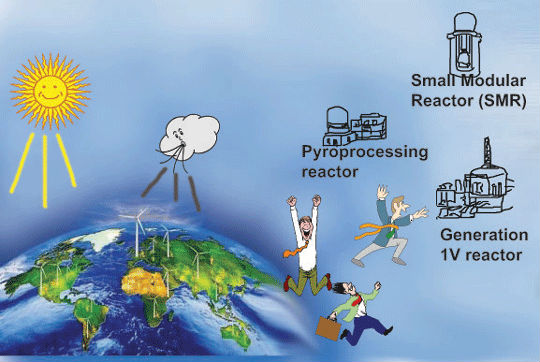
Fast neutron reactors are “poised to become mainstream” according to the World Nuclear Association. The Association lists eight “current” fast reactors although three of them are not operating. That leaves just five fast reactors ‒ three of them experimental.
Fast reactors aren’t becoming mainstream. One after another country has abandoned the technology. Nuclear physicist Thomas Cochransummarises the history: “Fast reactor development programs failed in the: 1) United States; 2) France; 3) United Kingdom; 4) Germany; 5) Japan; 6) Italy; 7) Soviet Union/Russia 8) U.S. Navy and 9) the Soviet Navy. The program in India is showing no signs of success and the program in China is only at a very early stage of development.”
The latest setback was the decision of the Japanese government at an extraordinary Cabinet meeting on September 21 to abandon plans to restart the Monju fast breeder reactor.
Monju reached criticality in 1994 but was shut down in December 1995 after a sodium coolant leak and fire. The reactor didn’t restart until May 2010, and it was shut down again three months later after a fuel handling machine was accidentally dropped in the reactor during a refuelling outage. In November 2012, it was revealed that Japan Atomic Energy Agency had failed to conduct regular inspections of almost 10,000 out of a total 39,000 pieces of equipment at Monju, including safety-critical equipment.
In November 2015, the Nuclear Regulation Authority declared that the Japan Atomic Energy Agency was “not qualified as an entity to safely operate” Monju. Education minister Hirokazu Matsuno said on 21 September 2016 that attempts to find an alternative operator have been unsuccessful.
The government has already spent 1.2 trillion yen (US$12bn) on Monju. The government calculated that it would cost another 600 billion yen (US$6bn) to restart Monju and keep it operating for another 10 years.
Decommissioning also has a hefty price-tag ‒ far more than for conventional light-water reactors. According to a 2012estimate by the Japan Atomic Energy Agency, decommissioning Monju will cost an estimated 300 billion yen (US$3bn).
India’s failed fast reactor program India’s fast reactor program has been a failure. The budget for the Fast Breeder Test Reactor (FBTR) was approved in 1971 but the reactor was delayed repeatedly, attaining first criticality in 1985. It took until 1997 for the FBTR to start supplying a small amount of electricity to the grid. The FBTR’s operations have been marred by several accidents.
Preliminary design work for a larger Prototype Fast Breeder Reactor (PFBR) began in 1985, expenditures on the reactor began in 1987/88 and construction began in 2004 ‒ but the reactor still hasn’t started up. Construction has taken more than twice the expected period. In July 2016, the Indian government announced yet another delay, and there is scepticism that the scheduled start-up in March 2017 will be realised. The PFBR’s cost estimate has gone up by 62%.
India’s Department of Atomic Energy (DAE) has for decades projected the construction of hundreds of fast reactors ‒ for example a 2004 DAE document projected 262.5 gigawatts (GW) of fast reactor capacity by 2050. But India has a track record of making absurd projections for both fast reactors and light-water reactors ‒ and failing to meet those targets by orders of magnitude.
Academic M.V. Ramana writes: “Breeder reactors have always underpinned the DAE’s claims about generating large quantities of electricity. Today, more than six decades after the grand plans for growth were first announced, that promise is yet to be fulfilled. The latest announcement about the delay in the PFBR is yet another reminder that breeder reactors in India, like elsewhere, are best regarded as a failed technology and that it is time to give up on them.”
Russia’s snail-paced program Russia’s fast reactor program is the only one that could be described as anything other than an abject failure. But it hasn’t been a roaring success either.
Three fast reactors are in operation in Russia ‒ BOR-60 (start-up in 1969), BN-600 (1980) and BN-800 (2014). There have been 27sodium leaks in the BN-600 reactor, five of them in systems with radioactive sodium, and 14 leaks were accompanied by burning of sodium.
The Russian government published a decree in August 2016 outlining plans to build 11 new reactors over the next 14 years. Of the 11 proposed new reactors, three are fast reactors: BREST-300 near Tomsk in Siberia, and two BN-1200 fast reactors near Ekaterinburg and Chelyabinsk, near the Ural mountains. However, like India, the Russian government has a track record of projecting rapid and substantial nuclear power expansion ‒ and failing miserably to meet the targets.
As Vladimir Slivyak recently noted in Nuclear Monitor: “While Russian plans looks big on paper, it’s unlikely that this program will be implemented. It’s very likely that the current economic crisis, the deepest in history since the USSR collapsed, will axe the most of new reactors.”
While the August 2016 decree signals new interest in reviving the BN-1200 reactor project, it was indefinitely suspended in 2014, with Rosatom citing the need to improve fuel for the reactor and amid speculation about the cost-effectiveness of the project.
In 2014, Rosenergoatom spokesperson Andrey Timonov said the BN-800 reactor, which started up in 2014, “must answer questions about the economic viability of potential fast reactors because at the moment ‘fast’ technology essentially loses this indicator [when compared with] commercial VVER units.”
China’s program going nowhere fast Australian nuclear lobbyist Geoff Russell cites the World Nuclear Association(WNA) in support of his claim that China expect fast reactors “to be dominating the market by about 2030 and they’ll be mass produced.”
Does the WNA paper support the claim? Not at all. China has a 20 MWe experimental fast reactor, which operated for a total of less than one month in the 63 months from criticality in July 2010 to October 2015. For every hour the reactor operated in 2015, it was offline for five hours, and there were three recorded reactor trips.
China also has plans to build a 600 MWe ‘Demonstration Fast Reactor’ and then a 1,000 MWe commercial-scale fast reactor. Whether those reactors will be built remains uncertain ‒ the projects have not been approved ‒ and it would be another giant leap from a single commercial-scale fast reactor to a fleet of them.
According to the WNA, a decision to proceed with or cancel the 1,000 MWe fast reactor will not be made until 2020, and if it proceeds, construction could begin in 2028 and operation could begin in about 2034.
So China might have one commercial-scale fast reactor by 2034 ‒ but probably won’t. Russell’s claim that fast reactors will be “dominating the market by about 2030” is unbridled jiggery-pokery.
According to the WNA, China envisages 40 GW of fast reactor capacity by 2050. A far more likely scenario is that China will have 0 GW of fast reactor capacity by 2050. And even if the 40 GW target was reached, it would still only represent aroundone-sixth of total nuclear capacity in China in 2050 ‒ fast reactors still wouldn’t be “dominating the market” even if capacity grows by orders of magnitude from 0.02 GW (the experimental reactor that is usually offline) to 40 GW.
Travelling-waves and the non-existent ‘integral fast reactor’
Perhaps the travelling-wave fast reactor popularised by Bill Gates will come to the rescue? Or perhaps not. According to theWNA, China General Nuclear Power and Xiamen University are reported to be cooperating on R&D, but the Ministry of Science and Technology, China National Nuclear Corporation, and the State Nuclear Power Technology Company are all skeptical of the travelling-wave reactor concept.
Perhaps the ‘integral fast reactor’ (IFR) championed by James Hansen will come to the rescue? Or perhaps not. The UK and US governments have been considering building IFRs (specifically GE Hitachi’s ‘PRISM’ design) for plutonium disposition ‒ but it is almost certain that both countries will choose different methods to manage plutonium stockpiles.
In South Australia, nuclear lobbyists united behind a push for IFRs/PRISMs, and they would have expected to persuade a stridently pro-nuclear Royal Commission to endorse their ideas. But the Royal Commission completely rejected the proposal, noting in its May 2016report that advanced fast reactors are unlikely to be feasible or viable in the foreseeable future; that the development of such a first-of-a-kind project would have high commercial and technical risk; that there is no licensed, commercially proven design and development to that point would require substantial capital investment; and that electricity generated from such reactors has not been demonstrated to be cost competitive with current light water reactor designs.
A future for fast reactors?
Just 400 reactor-years of worldwide experience have been gained with fast reactors. There is 42 times more experience with conventional reactors (16,850 reactor-years). And most of the experience with fast reactors suggests they are more trouble than they are worth.
Apart from the countries mentioned above, there is very little interest in pursuing fast reactor technology. Germany, the UK and the UScancelled their prototype breeder reactor programs in the 1980s and 1990s.
France is considering building a fast reactor (ASTRID) despite the country’s unhappy experience with the Phénix and Superphénix reactors. But a decision on whether to construct ASTRID will not be made until 2019/20.
The performance of the Superphénix reactor was as dismal as Monju. Superphénix was meant to be the world’s first commercial fast reactor but in the 13 years of its miserable existence it rarely operated ‒ its ‘Energy Unavailability Factor’ was 90.8% according to the IAEA. Note that the fast reactor lobbyists complain about the intermittency of wind and solar!
A 2010 article in the Bulletin of the Atomic Scientists summarised the worldwide failure of fast reactor technology: “After six decades and the expenditure of the equivalent of about $100 billion, the promise of breeder reactors remains largely unfulfilled. … The breeder reactor dream is not dead, but it has receded far into the future. In the 1970s, breeder advocates were predicting that the world would have thousands of breeder reactors operating this decade. Today, they are predicting commercialization by approximately 2050.”
Allison MacFarlane, former chair of the US Nuclear Regulatory Commission, recently made this sarcastic assessment of fast reactor technology: “These turn out to be very expensive technologies to build. Many countries have tried over and over. What is truly impressive is that these many governments continue to fund a demonstrably failed technology.”
While fast reactors face a bleak future, the rhetoric will persist. Australian academic Barry Brook wrote a puff-piece about fast reactors for the Murdoch press in 2009. On the same day he said on his website that “although it’s not made abundantly clear in the article”, he expects conventional reactors to play the major role for the next two to three decades but chose to emphasise fast reactors “to try to hook the fresh fish”.
So that’s the nuclear lobbyists’ game plan − making overblown claims about fast reactors and other Generation IV reactor concepts, pretending that they are near-term prospects, and being less than “abundantly clear” about the truth.
Dr Jim Green is the national anti-nuclear campaigner with Friends of the Earth Australia and editor of the Nuclear Monitor newsletter published by the World Information Service on Energy.
Britain’s competition to promote Small Modular Nuclear Reactors- Roll Royce keenly participating
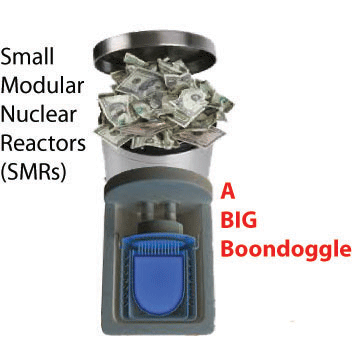 Rolls-Royce ramps up efforts to build mini-nuclear power plants, CITY.A.M. Jessica Morris , 2 Oct 16 Rolls-Royce has ramped up its efforts to build a fleet of small nuclear power stations as the next stage of a government competition draws closer. City A.M. understands that 30 employees from its Trident submarine work are now checking work on Rolls’ blueprint for the Small Modular Reactors (SMRS).
The Sunday Times first reported the news.……
The government launched a competition to identify the best value SMR design for the UK last year.
Ministers believe SMRs could increase and UK’s energy security and eventually become a leading export. However, the technology faces hurdles such as safety and security, financing as well as design approval.
There are 33 companies currently competing and a winner could be announced in the coming months.
The department for Business, Energy and Industrial Strategy has said it will publish a roadmap “for one or more possible pathways for SMRs” in the Autumn. http://www.cityam.com/250521/rolls-royce-ramps-up-efforts-build-mini-nuclear-power
Media is hyping Small Modular Nuclear Reactors , but doubts about them remain
 All over the media, on matters nuclear, I see these glowing reports on the great future just about to take off – for Small Modular (Nuclear) Reactors (SMRs) . Note that they leave out the word “Nuclear” – knowing that it’s not very popular with us all – the great unwashed.
The arguments are many – from the need for huge amounts of energy (though that’s dubious), to the false claim that SMNRs solve the radioactive trash problem, to the claim that they’ll fix climate change.
But my favourite nuclear lobby argument is the one where they either say directly, or more often imply – that big nuclear reactors are bad, so therefor Small ones must be good.

Anyway, the mainstream media knows where the money is, in reporting. Even The Guardian wrote up a lovely PR for Small Nukes – but I noticed that they sneaked in a few concerns about them:
“…….The first small modular nuclear reactors (SMRs) could be operating in the UK by 2030 with the right government support, according to a new report from theEnergy Technologies Institute (ETI).
The analysis, released today by the government and industry-backed energy research body, examined the steps needed to support the first SMR in the UK and concluded a credible schedule for implementation can be set out – as long as a policy framework is developed to reduce risks for SMR developers and increase investor confidence.
Setting out a timeline of key steps that will be required to deliver SMR deployment, the ETI said the UK should clarify and raise awareness of regulatory standards and expectations in the next five years and set out a clear statement of intent in relation to SMR development in the UK by 2024, with the aim to achieve at least one final investment decision by 2025………
While advocates of SMRs maintain they can safely bring down the cost of nuclear power and help to support an increasingly decentralised grid, critics argue there is still little evidence the technology will bring down costs where larger reactors have consistently failed to do so and fear they will come with inherent safety risks, which other low carbon sources of power could avoid….. quoted in The Guardian, 29 Sept
Failure of Japan’s 20 year, costly, nuclear reprocessing project
 Costly Japanese prototype nuclear reactor shuts down http://eandt.theiet.org/content/articles/2016/09/costly-japanese-prototype-nuclear-reactor-shuts-down/ By Jack Loughran, September 21, 2016
The Monju nuclear reactor in Japan, which has operated for less than a year in more than two decades at a cost of 1tn yen (£7.6bn), is set to be scrapped. The prototype fast-breeder reactor was designed to burn plutonium from spent fuel at conventional reactors to create more fuel than it consumes.
The process is appealing to a country whose limited resources force it to rely on imports for virtually all its oil and gas needs.
But Tokyo believes it would be difficult to gain public support to spend several hundred billion yen to upgrade the Monju facility, which has been plagued by accidents, missteps and falsification of documents.
There is also a strong anti-nuclear sentiment in Japan in reaction to the 2011 Fukushima atomic disaster, and calls to decommission Monju have been growing in the ruling Liberal Democratic Party, with scant results from using around 20 billion yen of public money a year for maintenance alone.
Science Minister Hirokazu Matsuno, Trade Minister Hiroshige Seko and others had decided to shift policy away from developing Monju, a fast-breeder nuclear reactor in the west of the country, the government said.
They had also agreed to keep the nuclear fuel cycle intact and would set up a committee to decide a policy for future fast-breeder development by the end of the year.
A formal decision to decommission Monju is likely to be made by the end of the year, government officials said.
The decision would have no impact on Japan’s nuclear recycling policy as Tokyo would continue to co-develop a fast-breeder demonstration reactor that has been proposed in France, while research will continue at another experimental fast-breeder reactor, Joyo, which was a predecessor of Monju.
“The move will not have an impact on nuclear fuel balance or nuclear fuel cycle technology development or Japan’s international cooperation,” said Tomoko Murakami, nuclear energy manager at the country’s Institute of Energy Economics.
Before the Fukushima disaster, Japan had planned to build a commercial fast-breeder before 2050, but according to the International Energy Agency that project may be delayed, given the difficulties at Monju.
The fallout from the Fukushima disaster is continuing. Specialised robots have been developed to retrieve some of the radioactive material from the ill-fated plant but they have been repeatedly unable to complete their task because the high levels of radiation destroys their circuitry.
Nuclear reprocessing a failure as a method of dealing with radioactive wastes
Where will SA put lethal nuclear waste?, BD Live, BY NEIL OVERY SEPTEMBER 20 2016, “……THE UK’s Thorp reprocessing plant, built at great cost in the 1990s, is due to close in 2018, leaving a decommissioning nightmare estimated to take at least 100 years to complete, at huge cost. In Japan, the Rokkasho reprocessing plant, which was due to open in 2008 at a cost of R100bn, has yet to open and has so far cost nearly R400bn over a 26-year period.
France, the only country that reprocesses nuclear fuel on a significant scale, has only been able to do so because of a huge subsidy from the state-owned energy company, EDF.
Despite initial hopes, a large quantity of highly radioactive waste that still needs disposing remains after processing. There are also serious security considerations, because reprocessing high-level waste results in the creation of separated plutonium, which could be stolen and worked into a simple, dirty bomb. The very existence of separated plutonium eases nuclear proliferation.
Nuclear proponents often champion so-called “fast reactors” as a different form of reprocessing that could solve the waste problem. These reactors are designed to burn more plutonium than they breed.
But after 50 years of research and vast expense, not one has operated commercially due to the high costs associated with running them and the fact that they still produce significant quantities of high-level waste that needs disposal. Due to these chronic limitations, most have closed down.
The Kalkar fast reactor in Germany, which cost R100bn to build, never operated and was sold at a huge loss in 1995 and converted into an amusement park.
The US National Academy of Sciences stated in 2008 that the reprocessing of nuclear fuel makes nuclear energy “more expensive, more proliferation-prone and more controversial”……
The US has tried, and after spending the equivalent of R1.4-trillion, has given up. In 2002, Yucca Mountain in Nevada was identified as the site for an underground repository for high-level waste. Despite tens of thousands of pages of scientific research and countless investigations, no agreement has been reached about whether it is safe to store high-level nuclear waste underground. The site was closed in 2011 by the Obama administration.
In Onkalo, Finland, a R75bn underground repository is being built, despite significant opposition.
Similar options are being considered in the UK, France and Sweden.
No one knows, however, if waste can be stored safely underground for tens of thousands of years…….. http://www.bdlive.co.za/opinion/2016/09/20/where-will-sa-put-lethal-nuclear-waste
America giving up on the Mixed Oxide Nuclear Fuel (MOX) boondoggle
“The first question I asked was why if she mistakenly skipped over MOX. This is the largest federal construction project in the nation right now,” Jameson said. “The answer was no. She [National Nuclear Administration Principal Deputy Administrator Madelyn Creedon ]said they left it out on purpose, that they’re trying to get rid of it so they weren’t going to talk about it.”
to box up the project and move to another method of plutonium disposal known as dilute and dispose.
The NNSA has said the alternative is cheaper, citing life-cycle costs of MOX in the $50 billion to $60 billion range.
Aiken official: Savannah River Site’s MOX purposefully left out of NNSA discussion http://www.aikenstandard.com/article/20160914/AIK0101/160919745 Thomas Gardiner Email @TGardiner_AS The speaker from the National Nuclear Security Administration at the Energy Communities Alliance meeting in Arlington, Virginia, this week intentionally snubbed the Mixed Oxide Fuel Fabrication Facility, or MOX, under construction at the Savannah River Site, one Aiken official said.
Due to its relation to the Site, Aiken has delegate members that make up the ECA, an organization of local governments adjacent to or affected by Department of Energy activities that meet to discuss issues, establish policy positions and promote community interests.
On Tuesday, Greater Aiken Chamber of Commerce President and CEO David Jameson and Aiken County Councilman Chuck Smith were both in attendance, where National Nuclear Administration Principal Deputy Administrator Madelyn Creedon addressed NNSA projects nationwide.
But Jameson said even with Smith, who is the current ECA chairman, seated just down the table from her, Creedon deliberately passed over the MOX project.
“The first question I asked was why if she mistakenly skipped over MOX. This is the largest federal construction project in the nation right now,” Jameson said. “The answer was no. She said they left it out on purpose, that they’re trying to get rid of it so they weren’t going to talk about it.”
Nearly $5 billion has been poured into the monolithic building thus far, setting the stage for ripe political debate.
Legislators that include U.S. Sens. Tim Scott, R-S.C., and Lindsey Graham, R-S.C., along with U.S. Rep. Joe Wilson, R-S.C., have battled the NNSA and the Obama administration, who have driven for months to box up the project and move to another method of plutonium disposal known as dilute and dispose.
The NNSA has said the alternative is cheaper, citing life-cycle costs of MOX in the $50 billion to $60 billion range.
U.S. Secretary of Energy Ernest Moniz mirrored Creedon’s presentation this week with his own comments at the Carnegie Endowment for International Peace.
Moniz said, “We are in no man’s land, where we spend enough money to not get anywhere. There is no way that Congress is going to commit to spending a billion dollars a year for half a century to dispose of 34 metric tons of plutonium.”
MOX is part of a plutonium disposal agreement with Russia inked in 2000. In the interest of non-proliferation, the two nations bilaterally agreed to destroy or disposition plutonium that would never again be usable in nuclear weapons.
According to Congressional testimony by Under Secretary for Nuclear Security and NNSA Administrator Retired Lt. Gen. Frank G. Klotz, USAF in May, the Obama administration wants to move away from MOX to the dilute and dispose method, which doesn’t change the physical properties or chemical makeup of the plutonium, without getting approval of the Russians
Reports in Russian media said President Vladimir Putin sees the move to dilute and dispose as being outside of the agreement.
Moniz responded to Russian complications at the Carnegie Endowment.
“We do have a few other issues to deal with Russia at this time, and it’s maybe not the most (favorable) time for that question, as President Putin has pointed out,” he said.
Meanwhile, Congress is currently funding MOX at about $350 million a year, which, according to the NNSA, is enough to keep the construction going, even if it is at a trickle. Funding for 2017 is not yet official but is included in all versions of the National Defense Authorization Act bill for the year. That bill is in inter-chamber conference, and legislators are hopeful it will be brought to the floor next week.
Nearly $5 billion has been poured into the monolithic building thus far, setting the stage for ripe political debate.
Legislators that include U.S. Sens. Tim Scott, R-S.C., and Lindsey Graham, R-S.C., along with U.S. Rep. Joe Wilson, R-S.C., have battled the NNSA and the Obama administration, who have driven for months to box up the project and move to another method of plutonium disposal known as dilute and dispose.
Life-cycle costs, however, are estimates from the time ground is broken until the mission is completed and the building’s purpose has been fulfilled entirely. Those costs can change drastically over time, especially considering what Jameson called the “slow-build” approach.
“I like to look at it this way,” Jameson said. “My wife and I were married 39 years ago. I know about how much our bills are, like mortgage payments, electricity, car payments and so on. Our wedding cost about $4,000 then, but would you ever say that the life-cycle cost of our wedding was $1.2 million?”
U.S. Secretary of Energy Ernest Moniz mirrored Creedon’s presentation this week with his own comments at the Carnegie Endowment for International Peace.
Moniz said, “We are in no man’s land, where we spend enough money to not get anywhere. There is no way that Congress is going to commit to spending a billion dollars a year for half a century to dispose of 34 metric tons of plutonium.”
MOX is part of a plutonium disposal agreement with Russia inked in 2000. In the interest of non-proliferation, the two nations bilaterally agreed to destroy or disposition plutonium that would never again be usable in nuclear weapons.
According to Congressional testimony by Under Secretary for Nuclear Security and NNSA Administrator Retired Lt. Gen. Frank G. Klotz, USAF in May, the Obama administration wants to move away from MOX to the dilute and dispose method, which doesn’t change the physical properties or chemical makeup of the plutonium, without getting approval of the Russians.
Reports in Russian media said President Vladimir Putin sees the move to dilute and dispose as being outside of the agreement.
Moniz responded to Russian complications at the Carnegie Endowment.
“We do have a few other issues to deal with Russia at this time, and it’s maybe not the most (favorable) time for that question, as President Putin has pointed out,” he said.
Meanwhile, Congress is currently funding MOX at about $350 million a year, which, according to the NNSA, is enough to keep the construction going, even if it is at a trickle. Funding for 2017 is not yet official but is included in all versions of the National Defense Authorization Act bill for the year. That bill is in inter-chamber conference, and legislators are hopeful it will be brought to the floor next week.
Thomas Gardiner covers energy, science and health topics for the Aiken Standard.
Terrestrial Energy faces safety risks and poor market prospects for its new nuclear reactors
Nuclear Firm’s $17 Million Bid on a New Reactor Design “…….Terrestrial Energy is looking to use the money raised up until now to complete the first phase of the Canadian Nuclear Safety Commission’s pre-licensing vendor design review, a technology assessment usually carried out in advance of a license application……
“Dirty tools, dirty components, cleansers [and] foreign material in the coolant stream will cause the coolant to activate over time,” he predicted. “I’m curious what the releases and radioactivity accident risks look like with the coolant after 10 years of operation.”……
Even if Terrestrial Energy is able to sail through licensing and brush off safety concerns, though, it will still have to overcome the problem of a diminishing appetite for nuclear power across a number of the industry’s key markets, including the U.S…... Greentech Media 8 Sept 16
Britain’s national disgrace: nuclear reprocessing at Sellafield
The National Audit Office (NAO) stated these tanks pose “significant risks to people and the
environment”. One official review published in The Lancet concluded that, at worst, an explosive release from the tanks could kill two million Britons and require the evacuation of an area reaching from Glasgow to Liverpool. These dangerous tanks have also been the subject of repeated complaints from Ireland and Norway who fear their countries could be contaminated if explosions or fires were to occur.
In short, the practice of reprocessing at Sellafield has been and remains a monumental national disgrace.
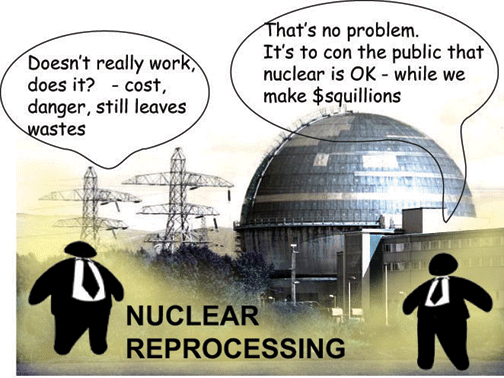
Especially serious are the ~20 large holding tanks at Sellafield containing thousands of litres of extremely radiotoxic fission products. Discussing these tanks, the previous management consortium Nuclear Management Partners stated in 2012:
“there is a mass of very hazardous [nuclear] waste onsite in storage conditions that are extraordinarily vulnerable, and in facilities that are well past their designated life.”
most of all, we should recognize that nuclear policies, in both weapons and energy, have poorly served the nation.
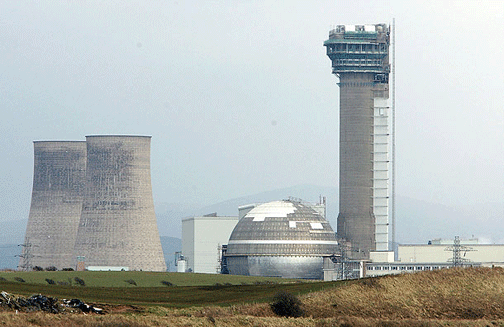 Sellafield exposed: the nonsense of nuclear fuel reprocessing http://www.theecologist.org/reviews/2988095/sellafield_exposed_the_nonsense_of_nuclear_fuel_reprocessing.html Ian Fairlie 6th September 2016 Last night’s BBC Panorama programme did a good job at lifting the lid on Britain’s ongoing nuclear disaster that is Sellafield, writes Ian Fairlie. But it failed to expose the full scandal of the UK’s ‘reprocessing’ of spent fuel into 50 tonnes of plutonium, enough to build 20,000 nuclear bombs – while leaving £100s of billions of maintenance and cleanup costs to future generations.
Many readers will have seen the interesting Panorama programme on the poor safety record at Sellafield broadcast on BBC1 last night.
The BBC press release stated this was a “special investigation into the shocking state of Britain’s most hazardous nuclear plant” – and it certainly was.
The most important of several whistleblower revelations was that the previous US managers had been shocked at the state of the plant when they took over its running in 2008.
Although the programme producers are to be congratulated for tackling the subject, it was only 30 minutes long and tells only a fragment of the whole sorry story.
This article tries to give more background information, and importantly, more analysis and explanation. The full story would require several books, and provide exceedingly painful reading.
What is reprocessing for? Continue reading
The end of the line for Japan’s super expensive nuclear reprocessing project?
Monju has drifted on for years after its future was clearly in doubt. A decision now to terminate the project seems sensible. Such a decision should also prompt the government to stop and consider whether its nuclear fuel cycle still makes sense.
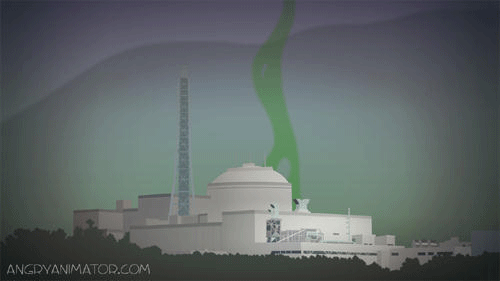
 Monju and the nuclear fuel cycle http://www.japantimes.co.jp/opinion/2016/09/04/editorials/monju-nuclear-fuel-cycle/#.V8yFTFt97Gg Media reports that the government is finally weighing whether to pull the plug on the Monju fast-breeder reactor in Tsuruga, Fukui Prefecture, due to the massive cost needed to restart the long-dormant facility, should come as no surprise. Once touted as a “dream reactor” for an energy-scarce country that produces more plutonium than it consumes as fuel, Monju has been a nightmare for national nuclear power policy for the past two decades.
The sole prototype reactor for this kind of technology has been in operation a mere 250 days since it first reached criticality in 1994. It has mostly been offline since a 1995 sodium coolant leak and fire. Its government-backed operator has been declared unfit by nuclear power regulators to run the trouble-prone reactor, and the education and science ministry, in charge of the project, has not been able to find a viable solution.
More than ¥1 trillion in taxpayer money has so far been spent on Monju, and maintenance alone costs ¥20 billion a year. Restarting the reactor under the Nuclear Regulation Authority’s new safety standards would cost another several hundred billion yen, including the expense of replacing its long-unused fuel as well as its aging components — though there would still be no guarantee that it would complete its mission of commercializing fast-breeder reactor technology.
The Abe administration may think that writing off the ill-fated costly project, even with the projected ¥300 billion cost of decommissioning the facility over 30 years, will help win more public support for its policy of seeking to reactivate the nation’s conventional reactors — most of which remain idled in the wake of the 2011 meltdowns at Tokyo Electric Power’s Fukushima No. 1 plant — once they’ve cleared the NRA screening. Public concerns over the safety of nuclear energy remain strong after the Fukushima disaster, with media surveys showing a large portion of respondents still opposed putting the idled reactors back online.
If it is going to decide to decommission the Monju reactor, however, the government should also rethink its pursuit of the nuclear fuel cycle — in which spent fuel from nuclear power plants is reprocessed to extract plutonium for reuse as fuel. Monju, which runs on plutonium-uranium mixed oxide (MOX) fuel, has been a core component of the program. As Monju remained dormant for more than 20 years, the government and power companies have shifted the focus of the policy to using MOX fuel at regular nuclear power plants. The No. 3 reactor at Shikoku Electric Power’s Ikata plant in Ehime Prefecture, which resumed operation in August, runs on MOX fuel. The government apparently thinks the Monju program is no longer essential to the policy.
But the nuclear fuel cycle itself has proven elusive, and some say the policy has already collapsed. It is still nowhere in sight when the nuclear fuel reprocessing plant in Rokkasho, Aomori Prefecture — another key component in the program and whose construction began in 1993 — will be ready for operation.
After its scheduled completion in 1997 has been delayed by more than 20 times due to a series of technical glitches and other problems, its construction cost has ballooned three times the original projection to ¥2.2 trillion.
If indeed the Rokkasho facility is completed and starts reprocessing spent fuel from power plants across the country, the Ikata power plant is currently the only one in operation that consumes plutonium-uranium fuel. It’s not clear how many more will be up and running in the years ahead given the slow pace of restarting the idled reactors, and the Rokkasho facility operating without a sufficient number of reactors using MOX fuel would only add to Japan’s stockpile of unused plutonium — which has already hit 48 tons.
If it’s the cost problem that’s finally spelling doom for the Monju project, the government and power companies should also consider the cost-efficiency of the nuclear fuel cycle program, including the extra cost of reprocessing spent fuel into MOX fuel. They should also think about whether the program is compatible with the government’s stated policy — though its commitment may be in doubt — of seeking to reduce Japan’s dependency on nuclear power as an energy source.
Monju has drifted on for years after its future was clearly in doubt. A decision now to terminate the project seems sensible. Such a decision should also prompt the government to stop and consider whether its nuclear fuel cycle still makes sense.
Global nuclear industry ponders ways to get taxpayers to pay up for Small Modular Nuclear Reactors (SMRs)

Doncha love the way they leave the word “nuclear” out of “SMRs”, hoping that people somehow won’t notice that SMRs are nuclear reactors?
Can SMRs unlock financing? World Nuclear news, 24 August 2016 Whilst a project of the size and complexity
of Hinkley Point C faces a range of challenges which lessen the availability of limited-recourse financing, it is clear that nuclear plant construction violates the basic precepts of project finance due to the unpredictability of project costs and schedule, write Rory Connor and Ken Culotta of law firm King & Spalding…..
For the industry to flourish, even in the presence of strong government policy support, the ability to finance is critical. There is the possibility though that new technology and new construction techniques, in the form of small modular reactors (SMRs), may hold the key to overcoming such issues……..
……..a long-term, minimum-price, power purchase agreement (or equivalent) a fundamental bankability requirement.

The UK government’s Electricity Market Reform initiatives, including the flagship contract-for-difference, have shored up the bankability of nuclear power projects. However, in a controversial field like nuclear power, there remains a risk that political or public sentiment could change during the life a project; as happened in Germany, which effectively ended its nuclear power industry in the wake of the Fukushima disaster. Lenders will require assurances that changes in policy will not adversely affect their exposure. For Hinkley Point C, the UK government agreed to enter into a so-called Secretary of State Agreement with the project sponsors, which grants the sponsors a put-option against the government in the event of a political shutdown of the project, effectively requiring the government to compensate the sponsors for their loss of investment – project lenders would no doubt expect similar protection to cover the cost of repayment of all outstanding project debt.
Nevertheless, not even the package of the Hinkley Point C contract-for-difference (which guarantees a power price of more than double the prevailing market price over a 35-year term) and the Secretary of State Agreement was enough to satisfy prospective lenders or bond underwriters that the project represented a bankable proposal. The problem lurked elsewhere – construction risk……..
The first SMRs to be installed will doubtless surface interesting risk issues, particularly the perceived ‘new technology’ risk which would likely see lenders requiring extended warranties from SMR technology providers. …..
construction risk alone is not the only issue that makes project financing a challenge for nuclear projects – the highly regulated nature of nuclear power does not sit easily with many standard project financing instruments and techniques. In any event, the developer(s) of the first commercially deployed SMRs may decide to finance on-balance sheet or by other means.
But the fact is that SMRs are no longer just ‘pie in the sky’ – billions of dollars of investment has been committed to the development of this technology (including more than $200 million by the US Department of Energy and up to £250 million by the UK government) and, in the UK at least, the possibility of contracts-for-difference, and other government-backed credit enhancements, create an attractive framework for investment and financing. http://www.world-nuclear-news.org/V-Can-SMRs-unlock-financing-24081602.html
1 This Month



19 November – Webinar – The Reality of Reprocessing
Time: 11:00 AM Pacific Time (US & Canada) / 2:00 PM Eastern / 7:00 PM UK / 8:00 PM CET
Register for the Zoom Event Here



Shut down the radiation-damaged Heysham nuclear reactors now
To see nuclear-related stories in greater depth and intensity – go to https://nuclearinformation.wordpress.com

Say No to NASA’s Reckless Nuclear Reactor on the Moon
Say No to NASA’s Reckless Nuclear Reactor on the Moon
-
Archives
- November 2026 (22)
- October 2026 (302)
- September 2026 (339)
- August 2026 (330)
- July 2026 (355)
- June 2026 (287)
- May 2026 (306)
- April 2026 (356)
- March 2026 (251)
- February 2026 (267)
- January 2026 (308)
- December 2025 (358)
-
Categories
- 1
- 1 NUCLEAR ISSUES
- business and costs
- climate change
- culture and arts
- ENERGY
- environment
- health
- history
- indigenous issues
- Legal
- marketing of nuclear
- media
- opposition to nuclear
- PERSONAL STORIES
- politics
- politics international
- Religion and ethics
- safety
- secrets,lies and civil liberties
- spinbuster
- technology
- Uranium
- wastes
- weapons and war
- Women
- 2 WORLD
- ACTION
- AFRICA
- Atrocities
- AUSTRALIA
- Christina's notes
- Christina's themes
- culture and arts
- Events
- Fuk 2022
- Fuk 2023
- Fukushima 2017
- Fukushima 2018
- fukushima 2019
- Fukushima 2020
- Fukushima 2021
- general
- global warming
- Humour (God we need it)
- Nuclear
- RARE EARTHS
- Reference
- resources – print
- Resources -audiovicual
- Weekly Newsletter
- World
- World Nuclear
- YouTube
-
RSS
Entries RSS
Comments RSS

