Radiation for dummies, Space Daily, by Staff Writers, Paris (ESA) Jan 28, 2019Meet Helga and Zohar, the dummies destined for a pioneering lunar flyby to help protect space travelers from cosmic rays and energetic solar storms.
These two female phantoms will occupy the passenger seats during Orion’s first mission around the Moon, going further than any human has flown before.
Fitted with more than 5600 sensors, the pair will measure the amount of radiation astronauts could be exposed to in future missions with unprecedented precision.
The flight test will take place during NASA’s Exploration Mission-1, an uncrewed trip to the vicinity of the Moon and back to Earth.
Radiation poses a major health risk to people in space. Astronauts on the International Space Station receive doses 250 higher than on Earth. Away from Earth’s magnetic field and into interplanetary space, the impact on the human body could be much higher – up to 700 times more.
Two sources of radiation are of concern: galactic cosmic radiation and virulent solar particle events. This radiation could increase the crew’s risk of cancer and become a limiting factor in missions to the Moon and Mars.
Helga and Zohar The two phantoms simulate adult female torsos. Both Helga and Zohar are made up of 38 slices of tissue-equivalent plastics that mimic the varying density of bones, soft tissue and lungs. Similar dummies are used in hospitals to quantify the right dose of radiation for cancer therapies.
“We chose female phantoms because the number of women astronauts is increasing, and also because the female body is typically more vulnerable to radiation,” explains Thomas Berger, lead scientist of the Matroshka AstroRad Radiation Experiment (MARE) at the German Aerospace Center, DLR.
Sensors have been fitted in the most radiation-sensitive areas of the body – lungs, stomach, uterus and bone marrow. While thousands of passive dosimeters will record the radiation dose from launch until return to Earth, a set of 16 active detectors will map the radiation dose both on the phantoms’ skin and internal organs during flight.
Crews start project to reduce maintenance, operations costs at Molten Salt Reactor, Oak Ridge Today, JANUARY 22, 2019, BY JOHN HUOTARI Cleanup crews started a $4.7 million project this month to reduce maintenance and operations costs at the Molten Salt Reactor Experiment, which was shut down 50 years ago at Oak Ridge National Laboratory.The project is expected to save nearly $25 million in costs, the U.S. Department of Energy Office of Environmental Management said in an “EM Update” published Tuesday.
The cost-reduction project will relocate employees stationed at the decades-old facility. Personnel currently housed in the building will move to other site locations to help with other projects, the “EM Update” said……..
The Molten Salt Reactor Experiment operated for only four years in the 1960s, …….
Oak Ridge Today reported in November 2017 that DOE was, at the time, studying whether to entomb parts of the Molten Salt Reactor Experiment. Those parts were reported to be too radioactively “hot” for humans. The current status of the entombment proposal wasn’t immediately clear Tuesday evening.
In 2017, Jay Mullis, manager of the Oak Ridge Office of Environmental Management, said most of the fuel at the Molten Salt Reactor Experiment, a unique reactor that operated from June 1965 to December 1969, was removed about 10 years ago. That included uranium, plutonium, and some uranium-233.
Oak Ridge Today reported at that time that some residual fuel and fission products remained, including cesium and strontium.
The Oak Ridge Office of Environmental Management has previously estimated the cost of removing the salt from the Molten Salt Reactor Experiment and disposing of it at the Waste Isolation Pilot Plant in New Mexico at between $150 million to $200 million. It’s not clear if that estimate has changed.
In the meantime, several million dollars has been spent each year on surveillance and maintenance at the Molten Salt Reactor Experiment and liquid and gaseous waste operations at ORNL, including at what are known as “hot cells,” and costs were expected to increase. Federal officials had asked for $12 million for those surveillance and maintenance operations in fiscal year 2019, the current fiscal year. Oak Ridge Today did not immediately have information on Tuesday about what amount was actually appropriated.
A consortium led by Rolls-Royce has asked for more than £200m in government funding to help develop its project for small nuclear reactors, as ministers scramble to recast Britain’s energy policy after the collapse of plans to build several large reactors. The engineering group and its partners, which include Laing O’Rourke and Arup, want to secure a sum “in the low hundreds of millions”, confirmed one person with knowledge of the request. Any amount would be match-funded by the consortium and be used to develop Rolls-Royce’s technology through to the later stages of the licensing process in order to be able to attract private investment.
Supporters of small modular reactors — most of which will not be commercial until the 2030s — argue that they can deliver nuclear power at lower cost and reduced risk. They will draw on modular manufacturing techniques that will reduce construction risk, which has plagued larger-scale projects.
The consortium has applied for funding from the government’s industrial strategy challenge fund under UK Research and Innovation. The money would enable the group to develop its design through to the later stages of the “generic design assessment” by the industry regulator. Industry sources with knowledge of the bid said the consortium “entered detailed negotiations” with UKRI before Christmas. Rolls-Royce has previously said it believes its reactor would cost about £2.5bn to build.
The push comes as the UK’s long-term energy policy has been thrown into chaos by the collapse of three new nuclear projects, after Hitachi’s decision earlier this month to freeze its involvement in the Wylfa plant in north Wales.
More than 40 per cent of the UK’s planned new nuclear capacity has in effect been cancelled, with Toshiba pulling out of developing a plant in Cumbria last year, while Hitachi has scrapped plans for another plant in Oldbury-on-Severn in Gloucestershire. The UK government said it remained committed to developing nuclear plants with the private sector but has baulked at the cost and level of support investors have demanded. It is due to publish a white paper this summer that will overhaul its energy strategy. While nuclear is expected to remain part of the mix, the government is keen to examine new funding models and approaches.
Business secretary Greg Clark said in a letter to the Financial Times last week that “small modular reactors can have a role to play” but again cautioned these plans could not be “at any price”. Rolls-Royce and its team is one of several consortiums that bid in a government-sponsored competition launched in 2015 to find the most viable technology for a new generation of small nuclear power plants. However, when a nuclear sector deal was finally unveiled last June, the government allocated funding only for more advanced modular reactors.
SMR’s, which typically use water-cooled reactors similar to existing nuclear power stations, were omitted from funding even though they were closer to becoming commercial.
Rolls-Royce threatened last summer that it would shut down the project if there was no meaningful support from the government. It has already significantly reduced the number of staff working on the project. The business department said the government was “considering” a funding bid from a UK consortium to support research and development of a low-cost SMR”. A decision was expected “in spring 2019”. Rolls-Royce said: “Our consortium is in discussions with UK government officials that we hope could result in a significant joint investment in our power plant design.”
Evening Standard 22nd Jan 2019 The British nuclear industry is a mess. Successive governments spent 13 years devising a nuclear policy, and after years of debate, six nuclear power stations were eventually selected. The idea was that private contractors, not government, should take the risk and build the plants. But the contractors were wary, and with the collapse of renewable energy prices they have become warier still.
Of the six sites, three have been abandoned, two — Sizewell and Bradwell in Suffolk and Essex — are still to be finalised. Only one, Hinkley Point C in Somerset is proceeding and it is controversial to say the least. Chances are that Hinkley will be abandoned
and we won’t build any more giant plants, but Government is still wedded to its policy so it may take a few years, or a general election.
The cost of renewable energy is, however, coming down fast and environmentalists say new electricity storage systems still to be developed will eventually bridge the gap for when the wind does not blow enough. We are not there yet though. But there is another option, though not one which environmentalists favour, and that is small modular reactors. Rolls-Royce has been making and
maintaining the power plants which drive the nuclear-powered submarines
carrying Britain’s nuclear deterrent since at least the Sixties.
SMRs required Government to make available resources so the licensing and safety-assessment programme could
run smoothly and remove the risk of the whole thing being endlessly delayed. It required further long-term thinking in the form of a promise to buy at least seven of the plants so that Rolls-Royce could capture the economies of scale in manufacturing which are essential to bringing the costs down. It required Government to be willing to provide matched funding in the development phase of the project. And finally it required Government support to assist the company in fully developing its export markets.
Why There Are No Nuclear Airplanes Strategists considered sacrificing older pilots to patrol the skies in flying reactors. An Object Lesson. The Atlantic, 20 Jan 19 CHRISTIAN RUHL
“……….. Why don’t airplanes run on nuclear power?
The reasons are many. Making a nuclear reactor flightworthy is difficult. Shielding it from spewing dangerous radiation into the bodies of its crew might be impossible. During the Cold War, when the threat of nuclear apocalypse led to surprisingly pragmatic plans, engineers proposed to solve the problem by hiring elderly Air Force crews to pilot the hypothetical nuclear planes, because they would die before radiation exposure gave them fatal cancers.
The Italian American physicist Enrico Fermi had introduced the idea of nuclear flight as early as 1942, while serving on the Manhattan Project to build the atomic bomb. As World War II drew to a close, the United States began work to realize Fermi’s dream of nuclear-powered flight. From 1946 until 1961, vast teams of engineers, strategists, and administrators toiled in a whirl of blueprints, white papers, and green bills in an attempt to get the idea off the ground.
The advantages of nuclear-powered airplanes mirrored those of nuclear submarines. Nuclear submarines did not need to surface for fuel, and nuclear airplanes would not need to land. A 1945 proposal at the Department of War (now the Department of Defense) promised, “With nuclear propulsion, supersonic flight around the world becomes an immediate possibility.” A secret Atomic Energy Commission memorandum now held in the Eisenhower Presidential Library explained the promise of nuclear flight in a more measured tone. Nuclear energy “should make possible ranges of one or more times around the world with a single loading of the reactor.” The idea of a nuclear-powered bomber became a strategic dream for the military; it could stay aloft for days to cover any number of targets throughout the world, before returning to the United States without refueling………
nuclear power came with its own problems. The reactor would have to be small enough to fit onto an aircraft, which meant it would release far more heat than a standard one. The heat could risk melting the reactor—and the plane along with it, sending a radioactive hunk of liquid metal careening toward Earth.
The problem of shielding pilots from the reactor’s radiation proved even more difficult. What good would a plane be that killed its own pilots?
To protect the crew from radioactivity, the reactor needed thick and heavy layers of shielding. But to take off, the plane needed to be as light as possible. Adequate shielding seemed incompatible with flight.
Still, engineers theorized that the weight saved from needing no fuel might be enough to offset the reactor and its shielding. The United States spent 16 years tinkering with the idea, to no avail. The Soviet Union pursued nuclear aircraft propulsion too, running up against the same problems.
……The nuclear airplane became redundant from a military point of view, as ICBMs avoided the problems of manned nuclear flight.
…….In a last-ditch effort to keep the nuclear airplane on the table, military strategists considered a radical solution: They could use pilots closer to death. The Air Force would use crews old enough to die of natural causes before the harmful effects of radiation could show up and thus, the logic went, sidestep the shielding problem. As the nuclear-policy expert Leonard Weiss explained in an article for the Bulletin of the Atomic Scientists, the proposal would have made radiation shielding unnecessary and decreased the weight of the plane significantly. It might have let the nuclear airplane take flight.
………Even that shocking proposal failed to save the nuclear airplane. The Eisenhower administration concluded that the program was unnecessary, dangerous, and too expensive. On March 28, 1961, the newly inaugurated President John F. Kennedy canceled the program. Proposals for nuclear-powered airplanes have popped up since then, but the fear of radiation and the lack of funding have kept all such ideas down……….https://www.theatlantic.com/technology/archive/2019/01/elderly-pilots-who-could-have-flown-nuclear-airplanes/580780/
From Radiation to Isolation: 5 Big Risks for Mars Astronauts (Videos)
By Kasandra Brabaw, Space.com Contributor | January 7, 2019 “……..Most people know that being exposed to too much radiation can make you sick, but the levels of radiation we experience on Earth are nothing compared to those that astronauts would be exposed to on the journey to Mars. Space radiation is much more harsh and damaging than the radiation experienced by people living on Earth.
Even astronauts who live on the International Space Station, which sits inside Earth’s protective magnetic field, are exposed to 10 times the radiation they would if they were back on Earth, NASA officials said in a statement and series of videos from the agency’s Human Research Program.
Anyone who traveled through deep space would be at much greater risk from radiation exposure. Outside of Earth’s protective shield, radiation can increase cancer risk and damage a person’s central nervous system (which would cause altered cognitive function, reduced motor function and behavioral changes), NASA’s Human Research Program said. Other dangers of being exposed to such high radiation include nausea, vomiting, anorexia, fatigue, cataracts, cardiac disease and circulatory disease. …….https://www.space.com/42918-big-space-risks-mars-astronauts-videos.html
Debate Continues: Can New Technology Save Nuclear Power? Power, 01/01/2019 | Kennedy Maize.………Are advanced nuclear reactor designs the answer to the decades-long doldrums for nuclear power? For the U.S., a National Academy of Sciences (NAS) panel led by long-time nuclear advocate M. Granger Morgan of Carnegie Mellon University, issued a pessimistic report last July—US nuclear power: The vanishing low-carbon wedge.
The academy’s report found, “While advanced reactor designs are sometimes held up as a potential solution to nuclear power’s challenges, our assessment of the advanced fission enterprise suggests that no US design will be commercialized before midcentury.” That’s a chilling indictment for all advanced LWRs. The crux of the Morgan report is an assessment that the economic hurdles for nuclear in the U.S. are insurmountable.………
Peter Bradford, a veteran electric utility regulator and nuclear skeptic who served on the U.S. Nuclear Regulatory Commission (NRC) from 1977 to 1982, agrees that nuclear power in the U.S. is priced out of the market. “Even if, for once, they could contain or level out the costs,” he told POWER, “new nuclear is so far outside the competitive range. They have to cut costs and they can’t cut costs without building a bunch [of reactors]. That really isn’t in the cards.”
Nor does Bradford see new nuclear as a way to combat global warming. “Even if it is scaled up much faster than anything now in prospect, it cannot provide more than 10% to 15% of the greenhouse gas displacement that is likely to be needed by mid-century. Not only can nuclear power not stop global warming, it is probably not even an essential part of the solution to global warming,” he wrote in 2006. Since then, he argues, the declining costs of renewables and energy efficiency swamp nuclear economics even further.
While advocates call for setting a price on carbon to reward carbon-free generation, Bradford said that is a weak reed. “At any given level” of carbon prices, he said, “it is going to wind up benefiting renewables and storage,” not nuclear. A reasonable carbon price, he argued, “might not be enough to keep existing plants running.”
SMRs to the Rescue?….
while smaller nuclear reactors are an appealing technological approach to keeping nuclear in the generating mix, they come with their own set of problems.
On closer inspection, said the NAS panel, “Our results reveal that while one light water SMR module would indeed cost much less than a large LWR, it is highly likely that the cost per unit of power will be higher. In other words, light water SMRs do make nuclear power more affordable but not necessarily more economically competitive for power generation.”
Given the “economic premium” of SMRs, along with “the considerable regulatory burden associated with any nuclear reactor, we do not see a clear path forward for the United States to deploy sufficient numbers of SMRs in the electric power sector to make a significant contribution to greenhouse gas mitigation by the middle of this century,” the report says. Economist Kee echoed that conclusion. When it comes to SMRs, he said there “is a lot of work to do and not much time to do it.”
SMRs also face a challenge of demonstrating their viability: Making an economic or climate impact requires many reactors. Neil Alexander, a Canadian nuclear consultant, wrote recently, “Everything about SMRs such as the cost of construction, availability of fuel, cost of shared services, availability of trained operators, and cost of research needed to resolve emerging challenges, only work economically when the unit is in a fleet. A FOAK [first-of-a-kind] cannot stand alone and the barrier to entry that the industry faces is more akin to the ‘First Dozen of a Kind.’ ”
Portland, Oregon-based NuScale appears to be the leader in developing SMR technology (Figure 4 on original). It is taking Alexander’s advice. NuScale has a customer for a 12-unit (720-MW) station: Utah Associated Municipal Power System (UAMPS), which has a site at the Department of Energy’s (DOE’s) Idaho National Laboratory (INL). UAMPS will own the project and Energy Northwest, a municipal joint action agency that operates the Columbia nuclear station near Richland, Washington, will run the plant. Columbia is a 1,100-MW boiling water reactor.
NuScale recently selected BWX Technologies (BWXT) of Lynchburg, Virginia, to begin engineering work leading up to the manufacture of the 60-MW NuScale reactors. BWXT, created after reactor builder Babcock & Wilcox (B&W) emerged from bankruptcy in 2006, has deep experience in the U.S. naval reactor program. NuScale has received a commitment of some $200 million from the DOE. Global engineering firm Fluor Corp. is the majority investor in NuScale.
Ironically, BWXT was the early leader in the SMR race, with its 195-MW mPower pressurized water reactor design. After spending some $400 million on the mPower venture (including $100 million from the DOE), B&W declared it officially dead in March 2017. Rod Adams, who worked on the project for B&W, had this epitaph for the mPower project, “There was simply too much work left to do, too much money left to invest, and an insufficient level of interest in the product to allow continued expenditures to clear corporate decision hurdles.”
NuScale still has a long way to go to demonstrate the validity of its SMR. The company said it expects the Nuclear Regulatory Commission (NRC) will approve the NuScale reactor design in September 2020. UAMPS will also have to get NRC approval for a combined construction and operating license for the site at INL. Nonetheless, NuScale’s optimistic schedule projects commercial operation “by the mid-2020s.”
Past experience suggests that nuclear construction schedules are made to be broken. SMRs pose unique challenges to federal regulators, both in the reactor designs and in operational issues such as staffing levels and communications among 12 discrete units, particularly if they are used to follow load. Additionally, power prices in the Western U.S. are already low and natural gas is driving them lower.
Recognizing the challenges to deploying SMRs, the DOE in November issued a report suggesting state standards and incentives, modeled on those boosting renewables, be applied to SMR technology. But, as POWER reported, “To make a meaningful impact, nearly $10 billion in incentives would be needed to deploy 6 GW of SMR capacity by 2035.”
Beyond the LWR?
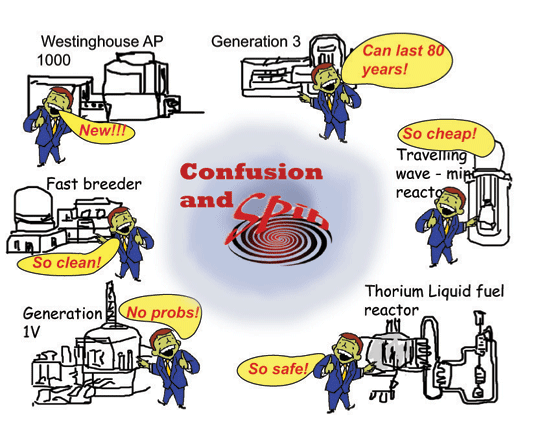
Several efforts are in place to replace conventional LWRs with other approaches to splitting atoms to generate power. Admittedly longshots, these build-on technologies go back to the early days of civilian nuclear power, and were previously abandoned in favor of the proven LWR designs.
The highest profile of the LWR apostates is TerraPower, based in Bellevue, Washington, and backed by Microsoft founder and multi-billionaire Bill Gates. [ Ed note: TerraPower has now abandoned this joint project with China] Founded in 2006, TerraPower is working on a liquid-sodium-cooled breeder-burner machine that can run on uranium waste, while it generates power and plutonium, with the plutonium used to generate more power, all in a continuous process.
Liquid sodium has advantages over pressurized water as a coolant, including better heat transfer. It also does not act as a moderator to slow neutrons, which allows for breeding plutonium. Sodium coolant has its own set of problems. Sodium catches fire when exposed to oxygen so coolant leaks can be devastating, as has happened in the past.
Nuclear power father Adm. Hyman Rickover, after a bad experience with the Seawolf-class submarine sodium-cooled reactor—the second subs to use LWR technology after the USS Nautilus—commented that sodium-cooled systems were “expensive to build, complex to operate, susceptible to prolonged shutdown as a result of even minor malfunctions, and difficult and time-consuming to repair.” TerraPower hopes to have commercial machines operating in the late 2020s, but industry insiders have reported that the company’s prototype reactor being built in China has experienced major problems.
Another approach to bypass LWRs is the molten salt reactor, long a favorite of nuclear pioneer Alvin Weinberg. A Canadian firm, Terrestrial Energy, is pushing a 190-MW SMR design using the technology Weinberg developed at Oak Ridge National Lab in the mid-1960s. Molten salt technology operates at close to atmospheric temperature and combines the fuel and the coolant. Terrestrial plans to use the technology to power an SMR, with a target date for the late 2020s. Molten salt poses new engineering challenges for nuclear reactors. One nuclear observer commented, “I prefer solid fuel” to the liquid fuel-coolant in the molten salt reactor.
Finally, developers are looking at abandoning uranium as the primary nuclear fuel. Instead, the idea is to use thorium, one of the most-common elements on the planet. Thorium is a slightly radioactive metal. But thorium is not fissile—able to undergo nuclear fission—so it has to be irradiated with enriched uranium in order to be transmuted into fissile U-233.
Thorium’s chief attribute is that the fuel is so plentiful. Terrestrial Energy has shown interest in using thorium in its molten salt reactors, along with low-enriched uranium that is used in the design it is pursuing in Canada. Skeptics suggest that thorium is an answer in search of a question, given the easy availability of uranium, particularly in seawater. Uranium shortages, forecast in the 1960s when advocates first suggested using thorium, have never materialized.
The Union of Concerned Scientists (UCS) is currently wrapping up a study of the new, non-LWR reactor designs. Physicist Ed Lyman, a veteran UCS staffer, told POWER, “Our overall conclusion is that vendors, DOE, and advocates are greatly exaggerating the benefits” of the technologies. “The whole landscape is not compelling. We question whether the best direction for nuclear power is to go off on these more exotic tangents,” rather than focus on making LWRs cheaper and safer. “That’s potentially a better near term” investment, he said.
The original generations of civilian nuclear power failed to live up to their promises. The U.S. nuclear industry stalled in the mid-1970s and has not recovered, despite repeated government and industry attempts at a restart.
Gen III reactors were aimed at overcoming the perceived safety and economic shortcomings of the original machines. As those new designs appear to be falling short, attention has shifted to SMRs or new approaches that abandon traditional light-water technology. Whether they will live up to their billing remains a serious, open question. ■
America’s Mad Scientists Wanted to Use Nuclear Power to Create Tunnels in a Shocking Way,
In the 1970s, Los Alamos National Laboratory explored a science-fiction approach to tunneling: using nuclear power to literally melt holes through rock and turn the melted rock into tunnel lining. National Interest by Steve Weintz 30 Dec 18, Digging out deep underground complexes or undersea bases could be expedited the Atomic way, in an alternate universe where the wildest ideas of the 1950s, 60s and 70s came to pass. Although our own timeline relies on mega-engineering for transportation, energy and architectural infrastructure, for the past half-century we’ve mostly relied on conventional power sources and design principles……..
in the 1970s, Los Alamos National Laboratory explored a science-fiction approach to tunneling: using nuclear power to literally melt holes through rock and turn the melted rock into tunnel lining. One product of the lab’s research was a patent for a nuclear subterrene—a machine which could theoretically move through rock the way a submarine moves through water. ……..
besides a bit part in a TV pilot, the nuclear subterrene didn’t get much farther. In 1975, the project was transferred from the NSF to the new Department of Energy and quietly disappeared. The concept resurfaced in the 1980s as a way of digging tunnels for bases on the Moon and other worlds but remained a concept. Advances in conventional excavation equipment since the 1970s make modern TBMs perform as well or better than Los Alamos’ conceptual nukes. …..https://nationalinterest.org/blog/buzz/americas-mad-scientists-wanted-use-nuclear-power-create-tunnels-shocking-way-40072
NASA has proposed a plan to use a nuclear-powered drill to dig into the surface of a moon in an attempt to find aliens By FREDDIE JORDAN, Express UK Dec 19, 2018The drill, nicknamed ‘tunnelbot’, would hunt beneath the ice that covers the surface of Jupiter’s moon Europa in an effort to confirm suspicions of alien life lurking in the depths. Scientists have long known of the presence of large quantities of water hidden below the moon’s icy crust – but it has been difficult to reach. A proposal given at the 2018 meeting of the Geophysical Union said: “We have performed a concept study for a nuclear powered tunnelling probe (a tunnelbot) that can traverse through the ice shell and reach the ocean, carrying a payload that can search for nested, corroborative evidence for extant/extinct life.
“The tunnelbot would also assess the habitability of the ice shell and underlying ocean.
Nobody knows what to do with a vast uranium and plutonium stockpile built up in the UK by reprocessing spent fuel. It is now a nuclear nightmare.
LONDON, 14 December, 2018 − Thirty years ago it seemed like a dream: now it is a nuclear nightmare. A project presented to the world in the 1990s by the UK government as a £2.85 billion triumph of British engineering, capable of recycling thousands of tons of spent nuclear fuel into reusable uranium and plutonium is shutting down – with its role still controversial.
Launched amid fears of future uranium shortages and plans to use the plutonium produced from the plant to feed a generation of fast breeder reactors, the Thermal Oxide Reprocessing Plant, known as THORP, was thought to herald a rapid expansion of the industry.
In the event there were no uranium shortages, fast breeder reactors could not be made to work, and nuclear new build of all kinds stalled. Despite this THORP continued as if nothing had happened, recycling thousands of tons of uranium and producing 56 tons of plutonium that no one wants. The plutonium, once the world’s most valuable commodity, is now classed in Britain as “an asset of zero value.” Continue reading →
Reporterre 11th Dec 2018Claiming to ” recycle ” used nuclear fuel, the reprocessing industry complicates the management of waste by increasing the amount of plutonium and hazardous materials.
Most countries engaged in this dead-end way come out … but not France.
According to the official communication, the reprocessing does not generate
contamination, only ” authorized discharges ” . They are spit by the
chimneys, dumped at the end of a pipe buried in the Channel.
In reality, according to the independent expert Mycle Schneider, ” the plant is
authorized to reject 20,000 times more radioactive rare gases and more than
500 times the amount of liquid tritium that only one of the Flamanville
reactors located 15 km away. ” . It contributes ” almost half to the
radiological impact of all civilian nuclear installations in Europe ” . https://reporterre.net/Comment-la-France-multiplie-les-dechets-nucleaires-dangereux
the decision to pursue Molten Salt Nuclear Reactors (MSRs )may not be based on market laws. For MSRs to succeed, they will likely be developed with appropriate political support and military funding.
If a nation wants an unlimited power supply for cutting-edge military technologies, then the MSR is indeed a very good candidate.
small modular reactors fitted with MSR technology could effectively supply electricity at remote military bases.
When a technology has some potential, the military sector can provide appropriate funding to quickly prototype products, which won’t necessarily have commercially viable features
Molten Salt Reactors: Military Applications Behind the Energy Promises, POWER,12/02/2018 | Jean-Baptiste Peu-Duvallon The commercial nuclear power sector has evolved with great help from the military-industrial complex. Research and development funded for the purpose of national defense has resulted in advances directly applicable to the power industry. For molten salt reactor designs to succeed, political support and military dollars may again be necessary.
……… under the leadership of its director Alvin M. Weinberg, the Oak Ridge Laboratory pursued the concept for civilian applications with the construction of a 7.4-MWth MSR, which operated for five years before being permanently shutdown in 1969. The reason testing was stopped was mainly political, as the MSR experiment in Oak Ridge wasn’t providing enough workload to other laboratories, while at the same time research on fast-breeding reactors was ramping up, requiring the engagement of more and more resources .
It was not only political, however. While the MSR concept is quite simple on paper, its industrialization is quite complex. Because the coolant is a mixture of chemicals rather than water, it provokes the release of significant quantities of tritium, which must be removed continuously. It generates other issues too, such as speedy corrosion of standard alloys, and also core lifetime issues when the coolant is moderated with graphite.
Because no MSRs have operated after the early 1970s, none of the technical solutions currently proposed to solve the outstanding issues have actually been tested. Still, new MSR projects are suddenly popping up for two main reasons: the Fukushima events and re-emerging military needs. …….
Nuclear Power in the New Weapons Race. MSRs have also gotten renewed interest following significant evolutions in military affairs. Indeed, since 2010, the U.S. military has started to deploy effective defense systems against ballistic missiles. In turn, it encourages rival powers to develop alternatives for their deterrence such as extreme-range hypersonic vehicles and low-altitude supersonic missiles.
During a speech to the nation on March 1, 2018, President Vladimir Putin revealed to the world the Russian ambition of extreme endurance. “We’ve started the development of new types of strategic weapons that do not use ballistic flight paths on the way to the target,” he said. “One of them is creation of a small-size highly powerful nuclear power plant that can be planted inside the hull of a cruise missile identical to our air-launched X-101 or the United States’ Tomahawk, but at the same time is capable of guaranteeing a flight range that is dozens of times greater, which is practically unlimited,” Putin added.
Beyond postures and statements, however, it seems there is still some work to be done. It has been reported that all flight tests of this new cruise missile resulted in short-term crashes.
Also, since the emergence of China as a military power, the probability of a high-intensity conflict in the Asia-Pacific region is growing. In such a case, the control over the vastness of the Pacific Ocean will be the aim of each party. Extreme ranges and endurance would be a key advantage for a potential winner.
If a nation wants an unlimited power supply for cutting-edge military technologies, then the MSR is indeed a very good candidate. As previously explained, the high temperature generated by an MSR makes it well-suited for airborne operations, while much more compact than a PWR for other applications. The advent of unmanned vehicles also makes the use of MSR technology easier, because radiation shielding requirements become far less stringent with no crew.
To counter the threat of new hypersonic vehicles currently under development, armies are again launching research for directed-energy weapons, such as high-energy lasers, which require huge power supplies to run efficiently. Finally, small modular reactors fitted with MSR technology could effectively supply electricity at remote military bases.
Although these military applications may sound like science fiction, one past example demonstrates the definitive military advantage procured by a high-temperature reactor over a PWR: the development of Alfa class submarines (Figure 4) in the Soviet Union in the 1960s. The Alfa-class submarine is still today considered the fastest, deepest, and most-agile nuclear submarine ever built. Its deployment resulted in the urgent design and manufacture of faster NATO torpedoes, like the U.S. Mark 48 Advanced Capability (ADCAP) or British Spearfish, to counter something that was virtually invulnerable when first put in service.
What made the Alfa possible? A lead-bismuth-cooled fast reactor, which shares the same main feature of the MSR: high temperature delivery, resulting in a high-power-density design, enabling a small, light, and powerful reactor for the submarine. However, as at ambient temperature the high-density lead-bismuth would freeze, the quayside maintenance operations aimed at preventing any irremediable core damage due to coolant freezing were very complicated and costly. While lead-bismuth and molten-salt reactors share many common points, MSRs are less costly and more easily maintainable.
Developing Viable MSR Designs
In France, the energy sector has not shown interest in MSR technology, as its current PWR fleet delivers competitive energy while achieving a very high level of safety. Furthermore, new PWR designs (EPRs) are intrinsically much safer than the Fukushima GE Mark I, which was designed in the 1960s.
MSRs are not just a different design, however; they are a different sector. MSR developers must essentially start from scratch with dedicated codes and regulations, dedicated licensing processes, dedicated fuel production facilities, dedicated reactors with dedicated highly trained operators, and dedicated waste reprocessing plants. Nonetheless, the decision to pursue MSRs may not be based on market laws. For MSRs to succeed, they will likely be developed with appropriate political support and military funding.
When a technology has some potential, the military sector can provide appropriate funding to quickly prototype products, which won’t necessarily have commercially viable features but will provide the groundwork for further refinement. Then, step by step, the remaining short-comings will be overcome to make a practical product for commercial operation. ■
Reuters 29th Nov 2018 , The French government has informed Japan that it plans to freeze a next
generation fast-breeder nuclear reactor project, the Nikkei business daily
reported on Thursday. Japan, which has been cooperating with Paris on the
fast-breeder development in France, has invested about 20 billion yen
($176.27 million) in the project, the report added. The French government
will halt research into the Astrid (Advanced Sodium Technological Reactor
for Industrial Demonstration) project in 2019, with no plans to allocate a
budget from 2020 onwards, the report said, without citing sources. https://www.reuters.com/article/france-nuclearpower-astrid/update-1-france-to-freeze-fast-breeder-nuclear-reactor-project-nikkei-idUSL4N1Y41OU?rpc=401&
Sellafield: Europe’s most radioactively contaminated site
Inside Sellafield’s death zone with the nuclear clean-up robots,By Theo Leggett, Business correspondent, BBC News, 27 November 2018
The Thorp nuclear reprocessing plant at Sellafield, Cumbria, has recycled its final batch of reactor fuel. But it leaves behind a hugely toxic legacy for future generations to deal with. So how will it be made safe?
Thorp still looks almost new; a giant structure of cavernous halls, deep blue-tinged cooling ponds and giant lifting cranes, imposing in fresh yellow paint.
But now the complex process of decontaminating and dismantling begins.
It is a dangerous job that will take decades to complete and require a great deal of engineering ingenuity and state-of-the-art technology – some of which hasn’t even been invented yet.
This is why.
Five sieverts of radiation is considered a lethal dose for humans. Inside the Head End Shear Cave, where nuclear fuel rods were extracted from their casings and cut into pieces before being dissolved in heated nitric acid, the radiation level is 280 sieverts per hour.
We can only peer through leaded glass more than a metre thick at the inside of the steel-lined cell, which gleams under eerie, yellow-tinged lighting.
This is a place only robots can go.
They will begin the first stage of decommissioning – the post-operative clean-out – removing machinery and debris……….. Cleaning up other parts of the plant will also need robots and remotely operated vehicles (ROVs).
Some will need to be developed from scratch, while others can be adapted from systems already used in other industries, such as oil and gas, car manufacturing and even the space sector……..
The site in Cumbria contains a number of other redundant facilities, some dating back to the 1950s and many of them heavily contaminated, which are currently being decommissioned………
Remote submarines have explored and begun cleaning up old storage ponds. Other remote machines are being used to take cameras deep inside decaying bunkers, filled with radioactive debris.
The job of developing machines like these is shared with a large network of specialist companies, many of them based in Cumbria itself. They form part of a growing decommissioning industry within the UK, as the country grapples with the legacy of its first era of nuclear power.
The NDA believes that these companies can use what they learn at Sellafield, and other plants, to attract further business from overseas……..https://www.bbc.com/news/business-46301596