UK pledges to fully fund EU nuclear-fusion facility
 Britain will pay £60 million to keep the Joint European Torus near Oxford running if negotiations to continue EU funding stall. Nature, Elizabeth Gibney, 20 Mar19,
The UK government has said that it will step in to pay for a European Union-funded nuclear-fusion laboratory near Oxford after 29 March, if European cash cannot be agreed in the next ten days.
The Joint European Torus (JET) laboratory currently has only a short-term funding contract with the European Commission, which will run out on 28 March, the day before Britain is scheduled to leave the European Union. Until now, JET has received around 88% of its funding from EU sources, and the remainder from the United Kingdom. Negotiations with the EU to agree a new contract to fund the facility until the end of 2020 are ongoing, but have stalled in part because of uncertainty over Brexit.
In a statement to Parliament on 13 March, UK Chancellor of the Exchequer Philip Hammond promised to front up to £60 million (US$80 million) to run the JET in 2019–20, should no new agreement be reached in time.
The £60 million would cover the whole of the lab’s 2019–20 budget, says Ian Chapman, chief executive of the Culham Centre for Fusion Energy near Oxford, which hosts JET. Chapman says that the pledge is effectively an “insurance policy”: he is still optimistic that a contract with the EU will be signed in time, and that the commission will continue to fund JET in the long term. “It’s not the intention on either side for [JET] to become a UK facility. This is to make sure we’re covered and operations continue in every eventuality,” he says. ……
Unless the deal is passed by Parliament, or Brexit is delayed, the United Kingdom will leave the EU without a deal. Although it would be possible for the bloc to keep funding JET in a ‘no deal’ Brexit, it is unclear whether this would happen. A UK government spokesperson said that the funding for JET would come from existing funds earmarked for science. https://www.nature.com/articles/d41586-019-00930-3
USA pushing mini-nuclear reactors for military reasons

US pursuing mini-nuclear reactors to support military expeditionary capabilities, Defence Connect, 20 Mar 19, The US military is conducting research into the development of rapidly deployable, container mounted nuclear reactors to support deployed American and allied forces, reducing threats to traditional supply and support convoys…….
The incessant statement that nuclear is “carbon free” is untrue, and the nuclear industry knows it
When “selling” a power plant to the public, the fact that it “provides” lots of jobs is seen as a positive. But in terms of carbon footprint and allocation of resources; the more humans needed to operate the plant; the bigger the carbon footprint, forever. This bit of resource accounting is always ignored, and is very far from trivial. Basically, in order to operate Three Mile Island, a small village of 700 people, + all the services they need, all the support- belongs to the carbon footprint of the nuclear plant. If those same people were elsewhere; their carbon costs would be attached to whatever enterprise they are involved in. T
ime to be serious about it; and honest. Only “Lifetime- total system” accounting – counts
Are these tiny, ‘inherently safe’ nuclear reactors the path to a carbon-free future?

Are these NuScale nuclear power stations REALLY tiny?

the industry sees the future not in building gargantuan plants, but in small modular reactors, or SMRs — factory-built units with fewer parts, designed to be installed underground with passive cooling systems that the industry says are “inherently safe.”
“SMRs seem to be a fad, as far as I can tell,” said Edwin Lyman, a senior scientist with the Union of Concerned Scientists, who wrote a widely cited paper questioning the economics of small reactors. “There’s very really little substance to its motivation, other than the private sector can’t afford ordinary sized reactors.”
…… Inside a Small Modular Reactor
Small modular reactors are factory-built, contain fewer mechanical parts, and are designed to be installed underground with passive cooling systems that are “inherently safe,” the industry says.
SMR designers say the plants will need fewer operators, and because the design is safer, they have also asked the NRC to reduce the 10-mile emergency planning zones now required for larger commercial reactors to an area confined to the plant site. Critics such as the Union of Concerned Scientists have opposed the request, saying the plants and their accumulated on-site spent fuel still pose a significant risk.
“They argue the reactors are so safe that terrorists won’t be able to effectively cause a massive radiological contamination event, and I beg to differ,” said Lyman.
The initial markets for SMRs are expected to be primarily overseas, where electricity costs are higher and nuclear energy can compete, NuScale says. Some water-starved Middle Eastern countries have expressed interest because some units can be configured to produce steam, rather than electricity, to power a nearby water desalinization plant.
Antidote to climate change
The industry is also positioning carbon-free nuclear plants as an antidote to climate change……
many environmental advocates fiercely oppose any expansion of nuclear energy’s role, including skeptics who cite safety issues exposed by the accident 40 years ago this month at Three Mile Island Unit 2 in Pennsylvania, which put the brakes on the industry’s growth in the 1980s. In the last 20 years, just one new commercial plant has begun operations in the United States, and only two are currently under construction.
Lyman said the industry would need to produce “hundreds or thousands” of units in order to cut costs and reduce the need for government assistance. ……
Nuclear power’s cost is at the heart of a debate that officially launched in Pennsylvania last week with the introduction of a proposal to give the nuclear industry $500 million in annual subsidies, paid by electric customers. Nuclear operators have threatened to shut down several Pennsylvania reactors because they are unable to compete in low-price electricity markets awash in cheap power from natural gas plants.
Exelon Generation says it will shut down Three Mile Island Unit 2, located next to the partly dismantled Unit 1, unless state lawmakers come to the rescue by June. …….
Dozens of companies are working to develop new nuclear reactors, including so-called Generation IV reactors that are cooled with such materials as molten salts, inert gases, or even liquid metals.
Several companies have focused on developing SMR designs. Holtec International, a private company in Camden whose core business is managing spent fuel at nuclear reactors and decommissioning old reactors, has developed a 160-megawatt reactor design it calls the SMR-160. The project’s status is unclear, and Holtec did not respond to written questions.
“I haven’t seen evidence of it really advancing,” said Lyman, of the Union of Concerned Scientists.
Westinghouse and BWX Technologies Inc., which both have long histories of building reactors, abandoned their SMR projects.
NuScale in September chose BWXT to build its SMR. BWXT, which built many of the small reactors used to power U.S. Navy ships and submarines, plans to subcontract component manufacturing to Precision Custom Components of York, Pa.
Mundy said by outsourcing the manufacturing to existing plants, NuScale can keep costs down compared with building a new factory. NuScale’s majority owner is the giant contractor Fluor Corp………
Lyman said that he is worried that multiple modular reactors would fail in NuScale plant, but that the NRC will accept more risk because it is under pressure to not impede the licensing process.
R.I.P. Small Modular Nuclear Reactors

An obituary for small modular reactors Jim Green, The Ecologist, 11 March 2019,https://theecologist.org/2019/mar/11/obituary-small-modular-reactors
The nuclear industry is heavily promoting the idea of building small modular reactors (SMRs), with near-zero prospects for new large power reactors in many countries. These reactors would have a capacity of under 300 megawatts (MW), whereas large reactors typically have a capacity of 1,000 MW.
Construction at reactor sites would be replaced with standardised factory production of reactor components then installation at the reactor site, thereby driving down costs and improving quality control.
The emphasis in this article is on the questionable economics of SMRs, but a couple of striking features of the SMR universe should be mentioned (for details see the latest issue of Nuclear Monitor).
First, the enthusiasm for SMRs has little to do with climate-friendly environmentalism. About half of the SMRs under construction (Russia’s floating power plant, Russia’s RITM-200 icebreaker ships, and China’s ACPR50S demonstration reactor) are designed to facilitate access to fossil fuel resources in the Arctic, the South China Sea and elsewhere. Another example comes from Canada, where one application of SMRs under consideration is providing power and heat for the extraction of hydrocarbons from oil sands.
A second striking feature of the SMR universe is that it is deeply interconnected with militarism:
- Argentina’s experience and expertise with small reactors derives from its historic weapons program, and its interest in SMRs is interconnected with its interest in small reactors for naval propulsion.
- China’s interest in SMRs extends beyond fossil fuel mining and includes powering the construction and operation of artificial islands in its attempt to secure claim to a vast area of the South China Sea.
- Saudi Arabia’s interest in SMRs is likely connected to its interest in developing nuclear weapons or a latent weapons capability.
- A subsidiary of Holtec International has actively sought a military role, inviting the US National Nuclear Security Administration to consider the feasibility of using a proposed SMR to produce tritium, used to boost the explosive yield of nuclear weapons.
- Proposals are under consideration in the US to build SMRs at military bases and perhaps even to use them to power forward operating bases.
- In the UK, Rolls-Royce is promoting SMRs on the grounds that “a civil nuclear UK SMR programme would relieve the Ministry of Defence of the burden of developing and retaining skills and capability”.
Independent economic assessments
SMRs will almost certainly be more expensive than large reactors (more precisely, construction costs will be lower but the electricity produced by SMRs will be more expensive).
They will inevitably suffer diseconomies of scale: a 250 MW SMR will generate 25 percent as much power as a 1,000 MW reactor, but it will require more than 25 percent of the material inputs and staffing, and a number of other costs including waste management and decommissioning will be proportionally higher.
It’s highly unlikely that potential savings arising from standardised factory production will make up for those diseconomies of scale.
William Von Hoene, senior vice president at Exelon, has expressed scepticism about SMRs: “Right now, the costs on the SMRs, in part because of the size and in part because of the security that’s associated with any nuclear plant, are prohibitive,” he said last year. “It’s possible that that would evolve over time, and we’re involved in looking at that technology. Right now they’re prohibitively expensive.”
Every independent economic assessment finds that electricity from SMRs will be more expensive than that from large reactors.
A study by WSP / Parsons Brinckerhoff, commissioned by the 2015/16 South Australian Nuclear Fuel Cycle Royal Commission, estimated costs of A$180‒184/MWh (US$127‒130) for large pressurised water reactors and boiling water reactors, compared to A$198‒225 (US$140‒159) for SMRs.
A 2015 report by the International Energy Agency and the OECD Nuclear Energy Agency predicts that electricity costs from SMRs will typically be 50−100 percent higher than for current large reactors, although it holds out some hope that large volume factory production of SMRs could help reduce costs.
A report by the consultancy firm Atkins for the UK Department for Business, Energy and Industrial Strategy found that electricity from the first SMR in the UK would be 30 percent more expensive than power from large reactors, because of diseconomies of scale and the costs of deploying first-of-a-kind technology.
An article by four current and former researchers from Carnegie Mellon University’s Department of Engineering and Public Policy, published in 2018 in the Proceedings of the National Academy of Science, considered options for the development of an SMR market in the US. They concluded that it would not be viable unless the industry received “several hundred billion dollars of direct and indirect subsidies” over the next several decades.
No market
SMR enthusiasts envisage a large SMR market emerging in the coming years. A frequently cited 2014 report by the UK National Nuclear Laboratory estimates 65‒85 gigawatts (GW) of installed SMR capacity by 2035, valued at £250‒400 billion.
But in truth there is no market for SMRs. Thomas Overton, associate editor of POWER magazine, wrote in 2014: “At the graveyard wherein resides the “nuclear renaissance” of the 2000s, a new occupant appears to be moving in: the small modular reactor (SMR) … Over the past year, the SMR industry has been bumping up against an uncomfortable and not-entirely-unpredictable problem: It appears that no one actually wants to buy one.”
Let’s briefly return to the National Nuclear Laboratory’s estimate of 65‒85 GW of installed SMR capacity by 2035. It is implausible and stands in contrast to the OECD Nuclear Energy Agency’s estimate of <1 GW to 21 GW of SMR capacity by 2035. But even if the 65‒85 GW figure proved to be accurate, it would pale in comparison to renewable energy sources.
As of the of end of 2017, global renewable energy capacity was 2,195 GW including 178 GW of new capacity added in 2017. On current trends, even in the wildest dreams of SMR enthusiasts, SMR capacity would be roughly 50 times less than renewable capacity by 2035.
SMRs under construction
SMR projects won’t be immune from the major cost overruns that have crippled large reactor projects (such as the AP1000 projects in the US that bankrupted Westinghouse). Indeed cost overruns have already become the norm for SMR projects.
Estimated construction costs for Russia’s floating nuclear power plant (with two 35-MW ice-breaker-type reactors) have increased more than four-fold and now equate to over US$10 billion / GW (US$740 million / 70 MW). A 2016 OECD Nuclear Energy Agency report said that electricity produced by the Russian floating plant is expected to cost about US$200 per megawatt-hour (MWh), with the high cost due to large staffing requirements, high fuel costs, and resources required to maintain the barge and coastal infrastructure.
The CAREM (Central Argentina de Elementos Modulares) SMR under construction in Argentina illustrates the gap between SMR rhetoric and reality. Cost estimates have ballooned. In 2004, when the CAREM reactor was in the planning stage, Argentina’s Bariloche Atomic Center estimated an overnight cost of US$1 billion / GW for an integrated 300 MW plant. When construction began in 2014, the estimated cost of the CAREM reactor was US$17.8 billion / GW (US$446 million for a 25-MW reactor). By April 2017, the cost estimate had increased to US$21.9 billion / GW (US$700 million with the capacity uprated from 25 MW to 32 MW). The CAREM project is years behind schedule and costs will likely increase further. In 2014, first fuel loading was expected in 2017 but completion is now anticipated in November 2021.
Little credible information is available on the cost of China’s demonstration high-temperature gas-cooled reactor (HTGR). If the 210 MW demonstration reactor is completed and successfully operated, China reportedly plans to upscale the design to 655 MW. According to the World Nuclear Association, China’s Institute of Nuclear and New Energy Technology at Tsinghua University expects the cost of a 655 MW HTGR to be 15-20 percent more than the cost of a conventional 600 MW PWR. A 2016 report said that the estimated construction cost of China’s demonstration HTGR is about twice the initial cost estimates, with increases due to higher material and component costs, increases in labour costs, and increased costs associated with project delays. The World Nuclear Association states that the cost of the demonstration HTGR is US$6,000/kW.
NuScale Power’s creative accounting
Cost estimates for planned SMRs are implausible. US company NuScale Power is targeting a cost of just US$65/MWh for its first plant. But a study by WSP / Parsons Brinckerhoff, commissioned by the South Australian Nuclear Fuel Cycle Royal Commission, estimated a cost of US$159/MWh based on the US NuScale SMR design. That’s 2.4 times higher than NuScale’s estimate.
A 2018 Lazard report estimates costs of US$112‒189/MWh for electricity from large nuclear plants. NuScale’s claim that its electricity will be 2‒3 times cheaper than large nuclear is implausible. And even if NuScale achieved costs of US$65/MWh, that would still be well above Lazard’s figures for wind power (US$29‒56) and utility-scale solar (US$36‒46).
Likewise, NuScale’s construction cost estimate of US$4.2 billion / GW is implausible. The latest estimate for the AP1000 reactors under construction in Georgia is US$17.4 billion / GW. NuScale wants us to believe that it will build SMRs at less than one-quarter of that cost, even though every independent assessment concludes that SMRs will be more expensive to build (per GW) than large reactors.
No-one wants to pay for SMRS
No company, utility, consortium or national government is seriously considering building the massive supply chain that is at the very essence of the concept of SMRs ‒ mass, modular factory construction. Yet without that supply chain, SMRs will be expensive curiosities.
In early 2019, Kevin Anderson, North American Project Director for Nuclear Energy Insider, said that there “is unprecedented growth in companies proposing design alternatives for the future of nuclear, but precious little progress in terms of market-ready solutions.”
Anderson argued that it is time to convince investors that the SMR sector is ready for scale-up financing but that it will not be easy: “Even for those sympathetic, the collapse of projects such as V.C Summer does little to convince financiers that this sector is mature and competent enough to deliver investable projects on time and at cost.”
A 2018 US Department of Energy report states that to make a “meaningful” impact, about US$10 billion of government subsidies would be needed to deploy 6 GW of SMR capacity by 2035. But there’s no indication or likelihood that the US government will subsidise the industry to that extent.
To date, the US government has offered US$452 million to support private-sector SMR projects, of which US$111 million was wasted on the mPower project that was abandoned in 2017.
The collapse of the mPower project was one of a growing number of setbacks for the industry in the US. Transatomic Power gave up on its molten salt reactor R&D last year. Westinghouse sharply reduced its investment in SMRs after failing to secure US government funding. MidAmerican Energy gave up on its plans for SMRs in Iowa after failing to secure legislation that would force rate-payers to part-pay construction costs. The MidAmerican story has a happy ending: the company has invested over US$10 billion in renewables in Iowa and is now working towards its vision “to generate renewable energy equal to 100 percent of its customers’ usage on an annual basis.”
Canadian Nuclear Laboratories has set the goal of siting a new demonstration SMR at its Chalk River site by 2026. But serious discussions about paying for a demonstration SMR ‒ let alone a fleet of SMRs ‒ have not yet begun. The Canadian SMR Roadmap website simply states: “Appropriate risk sharing among governments, power utilities and industry will be necessary for SMR demonstration and deployment in Canada.”
Companies seeking to pursue SMR projects in the UK are seeking several billion pounds from the government to build demonstration plants. But nothing like that amount of money has been made available. In 2018, the UK government agreed to provide £56 million towards the development and licensing of advanced modular reactor designs and £32 million towards advanced manufacturing research. An industry insider told the Guardian in 2017: “It’s a pretty half-hearted, incredibly British, not-quite-good-enough approach. Another industry source questioned the credibility of SMR developers: “Almost none of them have got more than a back of a fag packet design drawn with a felt tip.”
State-run SMR programs
State-run SMR programs ‒ such as those in Argentina, China, Russia, and South Korea ‒ might have a better chance of steady, significant funding, but to date the investments in SMRs have been minuscule compared to investments in other energy programs.
And again, wherever you look there’s nothing to justify the high hopes (and hype) of SMR enthusiasts. South Korea, for example, won’t build any of its domestically-designed SMART SMRs in South Korea (“this is not practical or economic” according to the World Nuclear Association). South Korea’s plan to export SMART technology to Saudi Arabia is problematic and may in any case be in trouble.
China and Argentina hope to develop a large export market for their high-temperature gas-cooled reactors and small pressurised water reactors, respectively, but so far all they can point to are partially-built demonstration reactors that have been subject to significant cost overruns and delays.
All of the above can be read as an obituary for SMRs. The likelihood that they will establish anything more than a small, niche market is vanishingly small.
Dr Jim Green is the lead author of a Nuclear Monitor report on small modular reactors, and national nuclear campaigner with Friends of the Earth Australia.
Mobile nuclear reactors for U.S. army -‘a COLOSSAL mistake’ – could bring about World War 3
 World War 3 news: US military’s mobile nuclear reactor ‘a COLOSSAL mistake’ https://www.express.co.uk/news/world/1097564/world-war-3-mobile-battlefield-nuclear-reactor-us-military-nuclear-war
US DEFENCE Department plans to build mobile nuclear reactors capable of powering their battlefield bases could trigger another world war, an eminent scientist has warned.
The US army is keen to end its dependance on fossil fuel deliveries to forward operating bases, situated close to conflict zones.
There would be a significant escalation if a nuclear plant was hit
But Dr Edwin Lyman, the senior global security scientist with the Union of Concerned Scientists, believes swapping to nuclear power is “simply trading one problem for another.”
Speaking exclusively to Express.co.uk, Dr Lyman said: “The military generally use diesel fuel that has to be trucked in, creating supply vulnerabilities.
“So they would love to have a constant supply of electricity which does not require these frequent shipments.
“And they think nuclear power can provide that.
“But nuclear reactors also require fuel – admittedly not as regularly – but not only would fresh fuel have to be delivered, but after its use it is highly radioactive spent fuel and there is no discussion over what would happen to that.”
The Defence Department has requested tenders for nuclear reactors capable of producing between one and 10 megawatts of electricity, weigh less than 40 tonnes, and can be transported by ship, truck or C-17 aircraft.
And it would have a so-called “inherently safe design”, ensuring a meltdown is physically impossible in various complete failure scenarios.
However, Dr Lyman, a scientist with several decades in the field, believes it is naive to expect a such nuclear reactor to be safe in the middle of a war zone.
He said: “It is foolish for the US Department of Defence to assume there are reactors that cannot meltdown and devastate their bases with radioactivity.
“And if that is what they are looking for, it is a fools errand.”
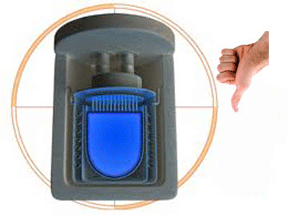 The nuclear scientist believes these nuclear reactors would be a target for terrorists, and a direct strike could disperse that hazardous radioactive enriched uranium that could damage the safety systems preventing the reactor from melting down.
Dr Lyman said: “I expect in a worst-case scenario you would have an area of many tens of kilometres that could be contaminated to the extent where the land would be unusable without being decontaminated.
“And anyone at the military base at that time would be exposed to potentially lethal doses of radiation.
“So at best it would be a costly mess and at worse it could imperil the mission and the military personnel, and contaminate the area of the base which would affect the inhabitants of the host country.“
The nuclear scientist believes the US military response to such a devastating nuclear attack on its armed forces could trigger a like-foxlike reaction.
“If you bomb a fossil fuel installation it would not be pretty, but there would be a significant escalation if a nuclear plant was hit.
“And so the military would have to respond in kind or with a more devastating response and it could escalate.”
He said: “There could be a number of disadvantages, both to military forces and also to the countries where the reactors would be located.
“The US military could end up leaving a radioactive mess for other countries to deal with.
There is precedent for this, when the US military dropped nuclear weapons off the coast of Spain and in Greenland.
“The US left a radioactive legacy in both countries for decades.
“So there are a lot of factors to consider, and I fear the military has an unrealistic view as to how successful this project is likely to be.”
Russia considering making spaceplane powered by a nuclear reactor
 ‘Reshaping space market’: Russia mulls building rocket plane with nuclear engine Rt.com : 6 Mar, 2019 Russian space agency Roscosmos is considering building a spaceplane powered by a nuclear reactor, according to a memo obtained by a Russian news agency. The move could “reshape” the market for space launches, the document says.
A rocket plane is an aircraft powered by rocket engines. Conventional jets proved better for atmosphere-only flight, but this type of vehicle found its niche application as a reusable spacecraft – most notably as the Space Shuttle program.
Several rocket planes are still operational today, like the SpaceShipTwo, which is meant for suborbital tourist flights. Roscosmos believes such an aircraft may be viable for space missions if equipped with a nuclear power plant, says a memo reviewed by RIA Novosti.
The memo says Russia’s experience with creating the Buran spaceplane and similar space systems would come in handy for designing such a craft in the future.
Nuclear power is tricky to use in space, let alone harnessing it to provide propulsion. The USSR experimented with placing small nuclear reactors on its satellites for endurance, but the incident with the Kosmos 954 sat, which malfunctioned and fell in Canada in 1977, showed that potential problems probably outweigh the benefits. Improvements in solar panels made them the to-go power source in space applications while chemical and compressed gas thrusters are used for propulsion.
The picture may be different for long-range space missions, in which a reliable power source, capable of providing propulsion for months rather than minutes would be a huge advantage. Russia is currently working on a project dubbed TEM, a nuclear-powered rocket powered by a megawatt-class nuclear reactor…….. https://www.rt.com/russia/453132-rocket-plane-nuclear-power/
The very dubious “market” for Small Modular Nuclear Reactors
What has not been tested is whether there would ever be enough orders for any one sort of small modular reactor to justify setting up a factory to produce dozens of them. This is the only way to get the unit cost down sufficiently to compete with renewables, which are continuing to get cheaper and already dominate the market.

|
Off-the-shelf nuclear reactors seek buyers, Climate NewsNetwork March 5th, 2019, by Paul Brown The nuclear industry’s fierce fight for survival is leading several countries to develop smaller, off-the-shelf nuclear reactors.
|
|
A BIG boondoggle – Nuclear And Emerging Technologies For Space

Nuclear In Space — The NETS Meeting, Forbes 28 Feb 19 James Conca The NETS meeting is wrapping up today at the  Pacific Northwest National Laboratory in Richland, Washington. The Nuclear And Emerging Technologies For Space is an annual gathering of people from NASA, National Laboratories, industry, and academia to discuss space nuclear power and propulsion as well as new and emerging technologies that make further space exploration possible…….
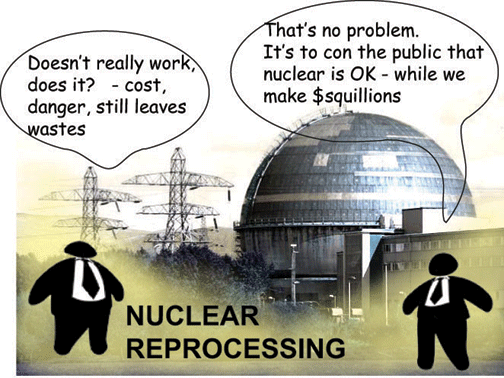
USA taxpayers again forking out money for dodgy new nuclear reprocessing
|
Department of Energy moves forward with controversial test reactor, Science, By Adrian ChoFeb. 28, 2019 ,The U.S. Department of Energy (DOE) announced today that it will go forward with plans to build a controversial new nuclear reactor that some critics have called a boondoggle. If all goes as planned, the Versatile Test Reactor (VTR) will be built at DOE’s Idaho National Laboratory (INL) near Idaho Falls and will generate copious high-energy neutrons to test new material and technologies for nuclear reactors. That would fill a key gap in the United States’s nuclear capabilities, proponents say. However, some critics have argued that the project is just an excuse to build a reactor of the general type that can generate more fuel than it consumes by “breeding” plutonium…….
The VTR—also known as the Versatile Fast Neutron Source—would be the first reactor DOE has built since the 1970s. It would differ in one key respect from the typical commercial power reactors. Power reactors use a uranium fuel that contains just a few percent of the fissile isotope uranium-235 and is made to be used once and discarded. In contrast, the VTR would use a fuel richer in uranium-235 that would generate more high-energy neutrons as it “burned.” Those neutrons could be used to test how new materials and components age within the core of a conventional nuclear reactor, a key factor in reactor design. In principle, such a “fast reactor” could also convert nonfissile uranium-238 to plutonium-239, which could be extracted by reprocessing the fuel……https://www.sciencemag.org/news/2019/02/department-energy-moves-forward-controversial-test-reactor |
|
|
Claim that a 12 year old boy has built a working nuclear fusion reactor
playroom. Jackson Oswalt, who is now 14, is thought to be the youngest
person in the world to achieve this incredible goal, according Open Source
Fusor Research Consortium. With help from his parents, Jackson, from
Memphis, Tennessee, was able to purchase the equipment needed – costing
around £7,660 – so he could set up a physics lab in his playroom,
according to Fox News.
https://www.mirror.co.uk/news/us-news/boy-12-achieves-nuclear-fusion-14040183
Future is not looking good for thorium nuclear reactors
 Can Thorium Offer a Safer Nuclear Future? Thomas net by David Sims. Staff Writer Feb 21, 2019
Nuclear energy has numerous advantages, but there are drawbacks as well: nuclear waste poses a significant environmental threat, meltdowns are a possibility and nuclear materials can be used to create weapons of mass destruction.
However, advocates of using thorium as a nuclear fuel instead of uranium point out that it solves many of these problems……. (unsuitable for nuclear weapons, wastes last less long, can’t melt down )
If it’s so great, why aren’t we using it? When nuclear power was being developed in the 1950s, it was part of a broader Cold War strategy. Governments were paying for the research and it was in their interest to develop uranium as the primary nuclear fuel because it could also be used in weapons development.
However, critics of the thorium alternative point out that it’s more expensive than uranium because it can’t sustain a reaction by itself and must be bombarded with neutrons. Uranium can be left alone in a reaction, while thorium must be constantly prodded to keep reacting. Although this allows for safer reactions (if the power goes out it simply deactivates), it’s a more expensive process.
Thorium is a popular academic alternative: in the lab it works well, but it hasn’t been successfully — or profitably — used on a commercial scale yet.
Current Usage of ThoriumIndia is the market leader in trying to harness thorium for the energy grid. It has the largest proven thorium reserves and the world’s only operating thorium reactor, Kakrapar-1, a converted conventional pressurized water reactor. China is working to develop the technology as well, while the United States, France and Britain are studying its viability.
Flibe Energy, which is based in Huntsville, Alabama, recently noted the company is looking to establish a liquid fluoride thorium reactor in the U.S. within the next decade, with Wyoming as a possible location.
Proponents of renewable energy concede that thorium is preferable to uranium, but argue that the millions in subsidies thorium will require to become commercially viable would be better spent on solar, wind and other alternative energy sources.
While nuclear advocates are more hospitable to thorium, they are hesitant to put all their eggs in one basket at this point. The element hasn’t shown itself to be feasible as a profitable commercial energy source, whereas uranium has. Despite a history of reactor meltdowns and near-meltdowns, there’s a renewed emphasis on nuclear power in the world today, and nuclear industry advocates don’t see now as the time to try an unproven alternative.
The bottom line is that when it comes to thorium versus uranium, thorium is more abundant, as well as cleaner and safer, but given current capabilities, it produces more expensive energy than uranium and still leads to environmental waste issues.
Thorium could be part of the answer to the world’s energy needs, but it currently lacks a track record of cost-effective energy generation. In the meantime, nations like China and India are taking the lead in developing thorium-based nuclear systems. https://news.thomasnet.com/featured/can-thorium-offer-a-safer-nuclear-future/
the nuclear lobby’s dream of small modular nuclear reactors is not likely to come true
The quest for boundless energy http://science.sciencemag.org/content/363/6429/809, Adrian Cho, See all authors and affiliations
Summary
For all their innovations, NuScale Power’s small modular reactors remain conventional in one way: They would use ordinary uranium-based reactor fuel that’s meant to be used once and safely disposed of. But for decades, nuclear engineers envisioned a world powered by “fast reactors” that can breed an essentially boundless supply of plutonium that can be reprocessed into fuel. Early in the atomic age, experts believed nuclear energy would one day supply most of the world’s power, raising the specter of a uranium shortage and boosting interest in fast breeder reactors.
However, the reactors are complex and must be cooled with substances such as liquid sodium or molten salt. The chemically intensive recycling process produces plenty of its own hazardous waste. And the closed fuel cycle also would establish a global market for plutonium, the stuff of atomic weapons, raising proliferation concerns. Perhaps most important, the world is in no danger of running out of uranium. So some experts doubt fast reactors will ever become mainstream.
Nuclear fusion: American Association for the Advancement of Science deceived by ITER propagandists
Some content on this page was disabled on July 14, 2020 as a result of a DMCA takedown notice from New Energy Times. You can learn more about the DMCA here:
U.S. Congress needs to look hard at the rationale for a fast reactor program.
Are Washington’s ‘Advanced’ Reactors a Nuclear Waste?
Congress needs to look hard at the rationale for a fast reactor program.https://nationalinterest.org/feature/are-washington%E2%80%99s-advanced-reactors-nuclear-waste-43797,
Late last year, the Energy Department (DOE), began work on a new flagship nuclear project, the Versatile Test Reactor (VTR), a sodium-cooled fast reactor. If completed, the project will dominate nuclear power research at DOE. The department’s objective is to provide the groundwork for building lots of fast-power reactors. This was a dream of the old Atomic Energy Commission, DOE’s predecessor agency. The dream is back. But before this goes any further, Congress needs to ask, what is the question to which the VTR is the answer? It won’t be cheap and there are some serious drawbacks in cost, safety, but mainly in its effect on nonproliferation.
Congress has to ask hard questions: Is there an economic advantage to such reactors? Or one in safety? Or is it just what nuclear engineers, national laboratories, and subsidy-hungry firms would like to do?
The answer of DOE’s Idaho National Laboratory, which would operate the reactor, is cast in terms of engineering and patriotic goals, not economic ones: “US technological leadership in the area of fast reactor systems . . . is critical for our national security. These systems are likely to be deployed around the globe and U.S. leadership in associated safety and security policies is in our best national interest.” In other words, we need to build fast reactors because DOE thinks other people will be building them, and we need to stay ahead.
But we then learned there are vast deposits of uranium worldwide, and at the same time many fewer nuclear reactors were installed than were originally projected, so there is no foreseeable fuel shortage. Not only that, the reprocessing of fuel, which is intrinsic to fast reactor operation, has turned out to be vastly more expensive than projected. Finally, by all accounts fast reactors would be more expensive to build than conventional ones, the cost of which is already out of sight. In short, there is no economic argument for building fast reactors.
With regard to nonproliferation, the issue that mainly concerns us is that the fast reactor fuel cycle depends on reprocessing and recycling of its plutonium fuel (or uranium 233 if using thorium instead of uranium). Both plutonium and uranium 233 are nuclear explosives. Widespread use of fast reactors for electricity generation implies large quantities of nuclear explosives moving through commercial channels. It will not be possible to restrict such use to a small number of countries. The consequent proliferation dangers are obvious. And while it is doubtful the U.S. fast reactor project will lead to commercial exploitation—few, if any, projects from DOE ever do—U.S. pursuit of this technology would encourage other countries interested in this technology, like Japan and South Korea, to do so.
With all these concerns, and the lack of a valid economic benefit, why does the Energy Department want to start an “aggressive” and expensive program of fast reactor development? It’s true that so far only exploratory contracts have been let, on the order of millions of dollars (to GE-Hitachi). But the Department is already leaning awfully far forward in pursuing the VTR. It estimates the total cost to be about $2 billion, but that’s in DOE-speak. We’ve learned that translates into several times that amount.
But beyond that, the nuclear engineering community, and the wider community of nuclear enthusiasts, have never given up the 1960s AEC dream of a fast breeder-driven, plutonium-fueled world. Such reactors were to have been deployed by 1980 and were to take over electricity generation by 2000. It didn’t even get off the ground, in part because of AEC managerial incompetence, but mainly because it didn’t make sense.
After the 1974 Indian nuclear explosion and the realization that any country with a small reactor and a way to separate a few kilograms of plutonium could make a bomb, proliferation became a serious issue. In 1976 President Gerald Ford announced that we should not rely on plutonium until the world could reliably control its dangers as a bomb material. The plutonium devotees never accepted this change. Jimmy Carter froze construction of an ongoing fast-breeder prototype, the Clinch River Reactor, about three time the size of the proposed VTR. Ronald Reagan tried to revive it but, as its rationale thinned and its cost mounted, Congress shut it down in 1983. The plutonium enthusiasts thought they got their chance under George W. Bush with a fast reactor and a reprocessing and recycling program under of the rubric of Global Nuclear Energy Partnership. But it was so poorly thought out it didn’t go anywhere. More or less the same laboratory participants are now pushing the VTR.
Congress needs to look hard at the rationale for a fast reactor program. This means getting into the details. At a Senate Appropriations hearing last month on advanced reactors, Sen. Dianne Feinstein said rather plaintively, “We cast the votes, and cross our fingers hoping nothing bad will happen.” That’s not good enough.
Victor Gilinsky is program advisor for the Nonproliferation Policy Education Center (NPEC) in Arlington, Virginia. He served on the Nuclear Regulatory Commission under Presidents Ford, Carter, and Reagan. Henry Sokolski is executive director of NPEC and the author of Underestimated: Our Not So Peaceful Nuclear Future (second edition 2019). He served as deputy for nonproliferation policy in the office of the U.S. secretary of defense in the Cheney Pentagon.
Clinch River Breeder Reactor Project an example of the folly of nuclear reprocessing
The rise and demise of the Clinch River Breeder Reactor, Bulletin of the Atomic Scientists, By Henry Sokolski, February 6, 2019 This year marks the 36th anniversary of the termination of the Clinch River Breeder Reactor Project, a federally funded commercial demonstration effort. In the very early 1980s, it was the largest public-works project in the United States. Japan, South Korea, China, France, Russia, and the United States are now all again considering building similar plants. For each, how and why Clinch River was launched and killed is a history that speaks to their nuclear future. This history involves more than cost benefit analysis. For the public and political leadership, facts and arguments rarely close an initial sale of a large government-funded, high-tech commercialization program. Nor do they generally goad officials to abandon such projects. Such acts are fundamentally political: Fears and hopes drive them. Certainly, to understand why the US government launched and subsequently killed Clinch River requires knowledge not just of what the public and its political leadership thought, but also of how they felt.
Unwarranted fears of uranium’s scarcity fueled interest in fast-breeder reactors. …….in 1945, uranium 235, a fissile uranium isotope that can readily sustain a chain reaction, was believed to be so scarce, it was assumed there was not enough of it to produce nuclear electricity on a large scale. Scientists saw the answer in fast-breeder reactors………
The Atomic Energy Commission publicly promoted their commercialization with confident, cartoonish optimism. In one publication, the commission asked the upbeat question: “Johnny had three truckloads of plutonium. He used three of them to power New York for a year. How much plutonium did Johnny have left?” The answer: “Four truckloads.”
Unfortunately, this pitch glossed over two stubborn facts. First, because plutonium is so much more toxic and difficult to handle than uranium, it is many times more expensive to use as a reactor fuel than using fresh uranium. Second, because plutonium fast-breeder reactors use liquid metal coolants, such as liquid sodium, operating them safely is far more challenging and expensive than conventional reactors.
When private industry tried in the early 1960s to operate its own commercial-sized fast-breeder, Fermi I, the benefits were negative. Barely three years after Fermi 1 came online, a partial fuel meltdown in 1966 brought it down. It eventually resumed operations before being officially shut down in 1972.
These facts, however, are rarely emphasized. Those backing breeders—whether it be in 1945, 1975, or today—focus not on reliability and economics, but rather that we are about to run out of affordable uranium. For the moment, of course, we are not. Uranium is plentiful and cheap as is enriching it. This helps explain why the United Kingdom, France, Germany, Japan, and the United States, no longer operate any commercial-sized fast-breeder reactors and are in no immediate rush to build new ones………
When the Atomic Energy Commission argued the case for building a breeder reactor in the late 1960s and early 1970s, it projected 1,000 reactors would be on line in the United States by the year 2000 (the real number turned out to be 103) and that the United States would soon run out of affordable uranium. Also, by the mid-1960s, the commission needed a new, massive project to justify its continued existence. Its key mission, to enrich uranium for bombs and reactors, had been completed and was overbuilt. The commission was running out of construction and research projects commensurate with its large budget. A breeder-reactor- commercialization program with all the reprocessing, fuel testing, and fuel fabrication plants that would go with it, seemed a worthy successor.
But the most powerful political supporter of Clinch River, then-President Richard Nixon, focused on a different point. Nixon saw the project less as a commercial proposition than as a way to demonstrate his power to secure more votes by providing government-funded jobs while at the same time affirming his commitment to big-science, engineering, and progress……….
the Energy Department videotaped safety tests it had conducted of how molten sodium might react once it came in contact with the reactor’s concrete containment structure. Concrete contains water crystals. Molten sodium reacts explosively when it comes in contact with oxygen, including oxygen contained in water. What the test demonstrated and the video showed was concrete exploding when it came in contact with liquid sodium.
This set off waves of worry at the department………
Just weeks before the final vote, the Congressional Budget Office released its financial assessment of the Energy Department’s last ditch effort to use loan guarantees to fund the project. Even under the most conservative assumptions, the budget analysts determined that the loan guarantees would only increase the project’s final costs. This helped push the project over a political cliff. The final Senate vote: 56 against, 40 for. All of the 16 deciding votes came from former Clinch River supporters.
No commercial prospects? Militarize. Nixon backed numerous science commercialization projects like Clinch River, including the Space Shuttle Program and the supersonic transport plane……… While the Space Shuttle Program won congressional support, the envisioned satellite contracts never materialized. The program became heavily dependent on military contracts. Finally, our national security depended upon it.
Although Clinch River never was completed, as its costs spiraled, it too attracted military attention. …….
Essentially, it didn’t matter when you asked–1971 or 1983—Clinch River was always another seven years and at least another $2.1 billion away from completion. ……
With Clinch River, what we now know, we may yet repeat. Fast-reactor commercialization projects and support efforts, such as Argonne National Laboratory’s Small Modular Fast Reactor, the US-South Korean Pyroreprocessing effort, the Energy Department’s Virtual (Fast) Test Reactor, France’s Astrid Fast Reactor Project, the PRISM Reactor, the TerraPower Traveling Wave reactor, India’s thorium breeder, Russia’s BN-1200, China’s Demonstration Fast-Breeder Reactor, continue to capture the attention and support of energy officials in Japan, China, Russia, South Korea, France, the US, and India. None of these countries have yet completely locked in their decisions. How sound their final choices turn out to be, will ultimately speak to these governments’ credibility and legitimacy.
In the case of Clinch River, the decision to launch the program ultimately rested on a cynical set of political calculations alloyed to an ideological faith in fast reactors and the future of the “plutonium economy.” Supporters saw this future clearly. As a nuclear engineer explained to me in 1981 at Los Alamos National Laboratory, the United States technically could build enough breeder reactors to keep the country electrically powered for hundreds of years without using any more oil, coal, or uranium. When I asked him, though, who would pay for this, he simply snapped that only fools let economics get in the way of the future.
This argument suggests that the case for fast reactors is beyond calculation or debate, something mandatory and urgent. That, however, never was the case, nor is it now. Instead, the equitable distribution of goods, which is a key metric of both economic and governmental performance (and ultimately of any government’s legitimacy and viability), has always taken and always must take costs into account. In this regard, we can only hope that remembering how and why Clinch River was launched and killed will help get this accounting right for similar such high-tech commercialization projects now and in the future. https://thebulletin. org/2019/02/the-rise-and- demise-of-the-clinch-river- breeder-reactor/?utm_source= Bulletin%20Newsletter&utm_ medium=iContact%20email&utm_ campaign=ClinchRiver_February6
1 This Month



26 September – International Day for the Total Elimination of Nuclear Weapons


PLEASE OPPOSE HR 8255 AND S.3639 – bills would accelerate satellite deployment, with no environmental review or safeguards – https://ncstd5li.quorum.us/campaign/169331/
To see nuclear-related stories in greater depth and intensity – go to https://nuclearinformation.wordpress.com
-
Archives
- September 2026 (269)
- August 2026 (330)
- July 2026 (355)
- June 2026 (287)
- May 2026 (306)
- April 2026 (356)
- March 2026 (251)
- February 2026 (267)
- January 2026 (308)
- December 2025 (358)
- November 2025 (359)
- October 2025 (375)
-
Categories
- 1
- 1 NUCLEAR ISSUES
- business and costs
- climate change
- culture and arts
- ENERGY
- environment
- health
- history
- indigenous issues
- Legal
- marketing of nuclear
- media
- opposition to nuclear
- PERSONAL STORIES
- politics
- politics international
- Religion and ethics
- safety
- secrets,lies and civil liberties
- spinbuster
- technology
- Uranium
- wastes
- weapons and war
- Women
- 2 WORLD
- ACTION
- AFRICA
- Atrocities
- AUSTRALIA
- Christina's notes
- Christina's themes
- culture and arts
- Events
- Fuk 2022
- Fuk 2023
- Fukushima 2017
- Fukushima 2018
- fukushima 2019
- Fukushima 2020
- Fukushima 2021
- general
- global warming
- Humour (God we need it)
- Nuclear
- RARE EARTHS
- Reference
- resources – print
- Resources -audiovicual
- Weekly Newsletter
- World
- World Nuclear
- YouTube
-
RSS
Entries RSS
Comments RSS

