From Nuclear Fusion Fraud to Physics Fortune
 The ITER Power Amplification Myth Oct. 6, 2017 – By Steven B. Krivit –
Short link: http://tinyurl.com/y9lvf79j
This is the third of three reports about the claims by representatives and proponents of the International Thermonuclear Experimental Reactor (ITER). “The Selling of ITER” published on Jan. 12, 2017. “Former ITER Spokesman Confirms Accuracy of New Energy Times Story” published on Jan. 19, 2017.
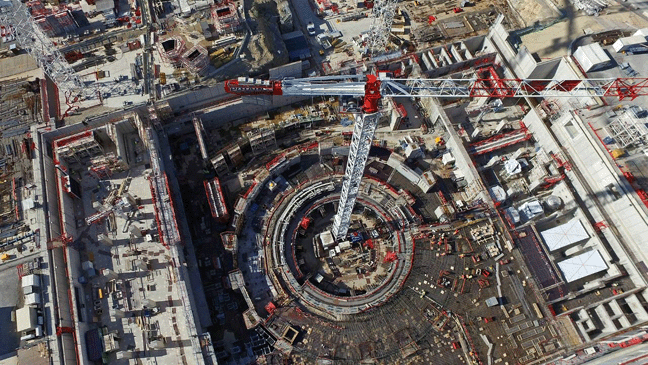
From Fusion Fraud to Physics Fortune
“………..The ITER project, supported by a widespread misunderstanding of its promised results, funded by billions in cash, resources and materials, will not deliver a practical demonstration of fusion power, but merely a scientific demonstration of a sustained fusion reaction. Yet on July 3, 2017, the Chinese Experimental Advanced Superconducting Tokamak reactor already did this, for 101 seconds. When built, ITER will merely do it for four times longer.
Oddly, the quest for practical nuclear fusion on Earth was born out of fraud. The ITER Web site recognizes this, with a page titled “Proyecto Huemul: From Fusion Fraud to Physics Fortune.”
The story began in 1948 in Argentina when Austrian scientist Ronald Richter proposed his idea for a fusion device to President Juan Perón. Perón agreed to fund the concept, and on March 24, 1951, Perón held a press conference at which he announced that his country had achieved practical, controlled nuclear fusion. By 1952, however, after independent investigators reported no evidence to support the claims, the project was shut down. The ITER page calls it “the scientific fraud of the century.”
Yet in 1951, before the Argentinian project was shut down, the project caught the attention of Lyman Spitzer, an astrophysicist at Princeton University. Spitzer, in turn, approached the U.S. Atomic Energy Commission and convinced it to fund his own fusion research concept. Thus, the U.S. controlled nuclear fusion era began at the Princeton Plasma Physics Laboratory, and the worldwide race for fusion energy began.
Since construction on ITER began in 2007, nuclear fusion news stories have been tagged with titillating headlines about unlimited energy. A CNN story headline is typical: “Is Nuclear Fusion About to Change Our World?” Every incremental step forward in temperature, pressure, or plasma confinement time has been a “breakthrough.” Each breakthrough, according to the news stories, has brought the dream of harnessing the power of the sun on Earth one step closer to reality. Rarely have the stories featured any critical assessment or analysis.
One journalist wrote that physicists at the Department of Energy’s Princeton Plasma Physics Laboratory had “demonstrated” how a new fusion reactor design could lead to the first commercially viable nuclear fusion power plant. The demonstration was merely on paper. The article featured a photo of a reactor. But it wasn’t the reactor described in the article. That reactor hadn’t been built yet.
As the comics below show, the very same Princeton Plasma Physics Laboratory — back in 1975 when the DOE was called the Atomic Energy Commission — told journalists it was a big step closer to virtually limitless pollution-free energy thanks to “breakthroughs” in plasma density and temperature.
Then there’s MIT scientist Earl Marmar, who told journalists this year that the technology exists to have fusion energy in 13 years if only it is funded aggressively enough.
Vision and hope are wonderful and necessary components of the human experience. But false hope and worthless promises — laced with misleading claims — do not represent the science accurately. They do not represent the integrity of all scientists involved in the research.
The false idea that the JET reactor produced 65% of the power it consumed has been deeply planted in the minds of the public and journalists. The same goes for the false idea that the ITER reactor will produce 10 times the power it consumes. These two myths serve to misrepresent the status of fusion energy research and, specifically, the ITER project……http://news.newenergytimes.net/2017/10/06/the-iter-power-amplification-myth/#more-44064
Bill Gates partners with China’s government nuclear companies to develop his small nuclear reactor dream

China nuclear energy and coal company partner to make traveling wave nuclear reactor, October 2, 2017, The China National Nuclear Corp (CNNC) has signed an agreement with the Shenhua Group, China’s biggest coal producer, to promote the development of advanced “traveling wave” reactor technology, the state nuclear giant said.
The new organization will be a partnership with four Chinese energy companies and will have /A> starting capital of CNY1bn ($153.2 million).
TWR, one of several new “fourth-generation” reactor designs, uses depleted uranium and is more fuel-efficient and cheaper to run than conventional nuclear reactors.
Leading developers of TWR include the Bill Gates-backed Terrapower, which is working on large scale projects aimed at providing base-load electricity. CNNC said its chairman, Wang Shoujun, met with Gates in July to discuss cooperation.
TerraPower’s traveling wave design is a breeder reactor that produce more atomic fuel than they consume, reducing the need to add costly processed nuclear elements.
In 2006, Intellectual Ventures launched a spin-off named TerraPower to model and commercialize a working design of such a reactor, which later came to be called a “traveling-wave reactor”. TerraPower has developed TWR designs for low- to medium- (300 MWe) as well as high-power (~1000 MWe) generation facilities. Bill Gates featured TerraPower in his 2010 TED talk.
In 2010 a group from TerraPower applied for patent EP 2324480 A1 following WO2010019199A1 “Heat pipe nuclear fission deflagration wave reactor cooling”. The application was deemed withdrawn in 2014.
In September, 2015 TerraPower and China National Nuclear Corporation (CNNC) signed a memorandum of understanding to jointly develop a TWR. TerraPower plans to build a 600 MWe demonstration Plant, the TWR-P, by 2018–2022 followed by larger commercial plants of 1150 MWe in the late 2020s |.
………….Shenhua, which is in the middle of a merger with state power giant Guodian, is seeking to diversify away from coal and coal-fired power, and it has already been in talks with CNNC and CGN to invest in nuclear projects. https://www.nextbigfuture.com/2017/10/china-nuclear-energy-and-coal-company-partner-to-make-traveling-wave-nuclear-reactor.html
James Hansen – great on climate change – wrong on Generation IV nuclear reactors

The risks……..in fact, thorium has been used to produce fissile material (uranium-233) for nuclear weapons tests.
Waste…. “Even integral fast reactors (IFRs), which recycle most of their waste, leave behind materials that have been contaminated by transuranic elements and so cannot avoid the need to develop deep geologic disposal.”
Generation IV economics…..The US Government Accountability Office’s 2015 report noted that technical challenges facing SMRs and advanced reactors may result in higher-cost reactors than anticipated, making them less competitive with large light-water reactors or power plants using other fuels.
James Hansen’s Generation IV nuclear advocacy: a deconstruction of nuclear fallacies and fantasies http://www.theecologist.org/News/news_analysis/2989318/james_hansens_generation_iv_nuclear_advocacy_a_deconstruction_of_nuclear_fallacies_and_fantasies.html, Dr Jim Green, 3rd October, 2017
Climate scientist James Hansen’s claims about Generation IV nuclear concepts simply don’t stack up, argues JIM GREEN Dr James Hansen is rightly admired for his scientific and political work drawing attention to climate change. His advocacy of nuclear power ‒ and in particular novel Generation IV nuclear concepts ‒ deserves serious scrutiny.
In a nutshell, Dr Hansen (among others) claims that some Generation IV reactors are a triple threat: they can convert weapons-usable (fissile) material and long-lived nuclear waste into low-carbon electricity. Let’s take the weapons and waste issues in turn. Continue reading
A plan to ‘economically’ send ‘ordinary citizens’ into space

-
- Will these rockets be powered by plutonium? And if so, what happens if there’s an accident, and one plunges into a city?
-
- LANL engineer looks for partners for cheap space flight, LA Monitor, By Tris DeRoma, October 2, 2017
Joseph Archer wants to start a company to take ordinary citizens into space With all the millions of dollars spent on space tourism today, the Los Alamos National Laboratory radiological safety employee has a plan to do it more efficiently, and cheaper.
His first step is to get a group of investors together who are genuinely enthusiastic and interested in the idea…..The project will involve launching a one-ton payload into space within a year of the company’s formation. He estimates he could do it for an amount between $200,000-$600,000.
“As a group of retired professional and technical types, there is little doubt that we can accomplish such a modest objective,” he said in his statement……..
In his argument, he talks a lot about how the Germans were able to accomplish much with little when they built the V-2 rocket in World War II.
One Los Alamos resident, Alan Hack, said in a letter to the Los Alamos Monitor that there was a huge difference between the wartime German program and what’s happening today in civilian space travel.
“Comparing costs to manufacture the V-1 ignores that it was built by slave labor from the captured countries as the Nazi regime did not have enough German labor to meet the huge demands for war production. Your manned rocket cannot be as cheap as you estimate,” Hack said…..http://www.lamonitor.com/content/lanl-engineer-looks-partners-cheap-space-flight
Thorium molten salt reactor experiment begun in Netherlands
Power Mag 1st Oct 2017, Scientists at the Nuclear Research and Consultancy Group (NRG) in Petten,
Netherlands, have commenced the world’s first thorium molten salt reactor
(TMSR) experiment in more than 45 years (Figure 1). The SALt Irradiation
ExperimeNT, or SALIENT, was developed in cooperation with the European
Commission Joint Research Center’s Institute for Transuranium Elements,
which is located near Karlsruhe, Germany.
http://www.powermag.com/thorium-molten-salt-reactor-experiment-underway-in-the-netherlands/
Japan and USA to continue agreement on nuclear fuel reprocessing
Nikkei Asian Review 25th Sept 2017, Japan and the U.S. will likely let their existing nuclear cooperation
agreement renew automatically when the pact expires next July, enabling
Tokyo to continue reprocessing spent nuclear fuel.
President Donald Trump’s administration has no intention of ending or renegotiating the deal, a
spokesperson at the U.S. State Department told The Nikkei Saturday. Since
the Japanese government has been seeking the pact’s renewal, there is now a
good chance that the treaty will simply remain in force without any
modifications.
https://asia.nikkei.com/Politics-Economy/International-Relations/US-to-renew-nuclear-pact-with-Japan
Britain’s Small Modular Nuclear Reactors – really happening, or vapourware?
 Is The UK Really Planning To Approve “Mini Nuclear Reactor” Rollout? https://cleantechnica.com/2017/09/22/uk-really-planning-approve-mini-nuclear-reactor-rollout/ by James Ayre It was reported last week in The Telegraph that ministers in the UK were “ready” to approve the rapid development and testing of a fleet of “mini nuclear reactors” — to be used as baseload capacity and meant to make up for older soon-to-be-decommissioned nuclear facilities.
Is there any truth to this assertion? What about the assertion that such mini nuclear facilities will provide electricity that’s one-third cheaper than that provide by the nuclear facilities currently in use in the UK?
That sounds a bit “too good to be true” (which means that it probably is), but that is the sales pitch that’s being used.
I haven’t been able to find out too much about what’s going on, as many news outlets haven’t been covering the matter apparently, but it seems that “Rolls-Royce, NuScale, Hitachi, and Westinghouse have held meetings in past weeks with civil servants about Britain’s nuclear strategy and development of ‘small modular reactors’ (SMRs)” in recent days — if The Telegraph is to be believed.
Here’s more from that coverage: “Whitehall sources confirmed that officials from the Department for Business were whittling down proposals from consortia keen to work with government to develop SMRs, with an announcement on the final contenders for funding expected soon.
“The report to be published by Rolls-Royce, entitled ‘UK SMR: A National Endeavour’, which has been seen by The Telegraph, claims SMRs will be able to generate electricity significantly cheaper than conventional nuclear plants.
“The mini reactors are each expected to be able to generate between 200 megawatts and 450 megawatts of power, compared with the 3.2 gigawatts due from Hinkley, meaning more of them will be required to meet the UK’s energy needs.”
The Rolls Royce report claims that its projects would be able to generate electricity at a strike price of £60 per megawatt-hour — a fair bit higher than a number of other electricity generation modalities can offer. Though, I guess that the sales pitch is based on the idea of its use as baseload capacity?
Holtec planning to build small nuclear reactors in Ukraine
 HOLTEC TO START ACTIVE PHASE OF BUILDING SMALL REACTORS SMR-160 IN 2023 WITH POSSIBILITY OF LOCALIZATION IN UKRAINE http://open4business.com.ua/holtec-start-active-phase-building-small-reactors-smr-160-2023-possibility-localization-ukraine/ 11 SEP , 2017
 KYIV. Sept 11 (Interfax-Ukraine) – Holtec International (the United States) in 2023 will start the active phase of building small module reactors SMR-160, President of Ukrainian National Nuclear Generating Company Yuriy Nedashkovsky said at a ribbon-cutting ceremony for a new plant of the company in New Jersey (the United States).
According to a posting on the website of Energoatom, Nedashkovsky said that earlier President of Holtec International Chris Singh made a proposal to Ukrainian President Petro Poroshenko to create a hub in Ukraine to sell small module reactors to Europe, Asia and Africa with localization of production facilities and the large amount of equipment at Ukrainian enterprises.
Nedashkovsky said that Kharkiv-based Turboatom has turbines suiting SMR-160. There is a chance of attracting other Ukrainian enterprises to the project.
He said that the start of licensing of SMR-160 could start in 2018.
He said that SMR-160 reactors are rather cheap compared to more powerful reactors. They can be installed in small areas and do not require powerful lines. Nedashkovsky said that the need in SMR-160 after 2025 is estimated at $1 trillion.
“These reactors have an increased level of safety due to the fact that they use passive safety systems: that is it has no pumping equipment, reinforcement and other things which require external power supply,” the president of Energoatom said.
The plant, built by Holtec in New Jersey, is mainly focused on two spheres: production of container fleet for spent nuclear fuel, as well as vessels for small modular reactors of the SMR-160 project.
Nuclear lobby pins its hopes on China to develop costly and dubious Generation IV nuclear reactors
the theories behind many of the proposed systems aren’t new and often date back to the 1950s and ’60s. Some experimental plants have been built, such as the fast breeder reactors in the U.K. and U.S. Most suffered from crippling cost or design problems or were abandoned after nuclear accidents.
“Most if not all of these so-called advanced reactor designs have been around for decades,”
“Different designs have different problems. I don’t think anyone can be or should be confident that these problems can be resolved merely by throwing money and hiring engineers and scientists.”
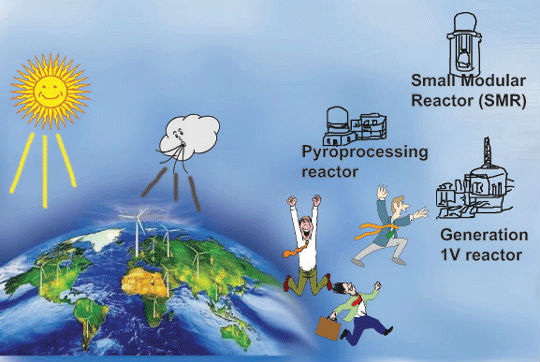
Nuclear Experts Head to China to Test Experimental Reactors, Bloomberg By
“The outlook for nuclear power is brighter there than anywhere else in the world,” said M. V. Ramana, a professor at the Liu Institute for Global Issues at the University of British Columbia. “It is not so difficult for a company developing a nuclear reactor design to find a partner.”
The systems proposed belong to the so-called fourth generation of reactors. The current generation under construction include enhanced safety features following the Fukushima disaster in Japan in 2011, but still typically use traditional fuel rods, cooled by water under pressure. Both Areva SA and Westinghouse Electric Co. are slated to turn on their current-generation nuclear reactors in the next year in China — well ahead of any other nation, despite delays.
Recycled Fuel
Some Generation IV designs aim to cut construction costs by using coolants that work at atmospheric pressure — reducing the need for massive containment structures. Many recycle their fuel, reducing the need for uranium, and in some cases are fail-safe without intervention if something goes wrong…….
Coolants include liquid sodium, gases and molten metal. Some use thorium instead of uranium to power the reaction.
Still, the theories behind many of the proposed systems aren’t new and often date back to the 1950s and ’60s. Some experimental plants have been built, such as the fast breeder reactors in the U.K. and U.S. Most suffered from crippling cost or design problems or were abandoned after nuclear accidents.
“Most if not all of these so-called advanced reactor designs have been around for decades,” said Ramana at the Liu Institute. “Different designs have different problems. I don’t think anyone can be or should be confident that these problems can be resolved merely by throwing money and hiring engineers and scientists.”
Computer Models
TerraPower’s traveling-wave design is based on research by Saveli Feinberg, a physicist who first proposed it in the 1950s. Levesque says that advancements in computing in the last decade have revolutionized the ability to develop these technologies. “You couldn’t get it near the concept without the computer modeling,” he said.
Yet computers alone won’t prove the technology without a working plant.
“What they really need is to construct research reactors,” said Allison Macfarlane, former head of the U.S. Nuclear Regulatory Commission. “And that is really expensive.”………
Areva is not currently working with Chinese teams to develop a fourth generation reactor, spokesman Mathias Schuch said in an email. Westinghouse didn’t respond to requests for comment on next-generation reactors………
“Nuclear can be a difficult industry and it needs to be heavily regulated,” Macfarlane said. “You can make rather a big expensive mess if you don’t get it right. Only one accident will seriously affect the entire industry. There are very few industries like that.”
Developers say the industry is over-regulated. Michael F. Keller, president of Hybrid Power Technologies LLC said the NRC is a “bureaucratic straight jacket” that creates a massive financial burden on the deployment of advanced reactors. “As advanced reactors are generally passively fail-safe, there is no rational reason to apply the grossly overly-complex regulations currently in use,” he said.
The DOE said in a email that it is promoting development of a framework that will increase regulatory certainty for advanced reactors in coordination with the NRC and industry………https://www.bloomberg.com/news/articles/2017-09-21/nuclear-scientists-head-to-china-to-test-experimental-reactors
Most Britons happy to live near wind turbines, but not near Small Modular Nuclear Reactors
Most Britons would not be happy living near the mini nuclear power stations
that Rolls-Royce and several other international companies want to build in
the UK, a survey has found. The government has promised the developers of
small modular reactors a slice of a £250m funding pot in a race to
position the UK as the place where the first generation of the power
stations should be built.
Polling by YouGov, however, believed to be the
first survey of public attitudes towards the plants, found that 62% of
people would be unhappy living within five miles of one. The poll,
commissioned by the climate change charity 10:10, found that only 24% would
be unhappy living near an onshore windfarm, which the Conservative party
has stymied with tougher planning rules.
The figure fell to 17% for community-owned windfarms. Ellie Roberts, a campaigner at 10:10, said:
“These results show just how wildly out of step with public opinion UK
energy policy has become.” Most small modular reactors (SMRs) would
generate less than a tenth of the power the projected Hinkley Point C will
provide, but are backed by industry as a cheaper option to big nuclear
plants and an opportunity for British firms to be first in a new
technology.
Harry Holt, the president of nuclear at Rolls-Royce, said:
“With demand for energy set to rise in the near future, in part due to
the growing popularity of electric cars, we believe that a UK SMR programme
is a vital addition to our national infrastructure.”
Guardian 18th Sept 2017
The problem of plutonium: justification for its reprocessing is now dead
Forty years later, Japan’s breeder program, the original justification for its reprocessing program, is virtually dead.
Forty years of impasse: The United States, Japan, and the plutonium problem http://www.tandfonline.com/doi/full/10.1080/00963402.2017.1364007 Masafumi Takubo &Frank von Hippel, 23 Aug 2017, Recently, records have been published from the internal discussions in the Carter administration (1977–80) on the feasibility of convincing Japan to halt its plutonium-separation program as the United States was in the process of doing domestically. Japan was deeply committed to its program, however, and President Carter was not willing to escalate to a point where the alliance relationship could be threatened. Forty years later, the economic, environmental, and nonproliferation arguments against Japan’s program have only been strengthened while Japan’s concern about being dependent on imports of uranium appears vastly overblown. Nevertheless, Japan’s example, as the only non-weapon state that still separates plutonium, continues to legitimize the launch of similar programs in other countries, some of which may be interested in obtaining a nuclear weapon option.
Foreign civilian plutonium programs had become a high-level political issue in the United States after India used plutonium, nominally separated to provide startup fuel for a breeder reactor program in its first nuclear weapon test in 1974 (Perkovich 1999). The United States reversed its policy of encouraging the development of plutonium breeder reactors worldwide to avoid an anticipated shortage of uranium. The breeder reactors would convert abundant non-chain-reacting uranium 238 into chain-reacting plutonium and then use the plutonium as fuel, while conventional reactors are fueled primarily by chain-reacting uranium 235, which makes up only 0.7 percent of natural uranium.
The Ford administration (1974–77) blocked France’s plan to sell spent fuel reprocessing plants to South Korea and Pakistan but did not succeed in persuading Japan to abandon its nearly complete Tokai pilot reprocessing plant. Therefore, when the Carter administration took office in January 1977, it inherited the difficult plutonium discussion with Japan.
The earliest document in the newly released trove is a 19-page memo dated 24 January 1977, in which career State Department official Louis Nosenzo briefs the incoming Carter political appointees on the issue.2 His arguments are strikingly similar to those being made some 40 years later by United States and international nongovernmental organizations such as the International Panel on Fissile Materials (IPFM 2015) and by US government officials – most recently, members of the Obama administration.3
These arguments are, in brief, that the separation and use of plutonium as a fuel is not economically competitive with simply storing the spent fuel until its radioactive heat generation has declined and a deep underground repository has been constructed for its final disposal. In this “once-through” fuel cycle, the plutonium remains mixed with the radioactive fission products in the intact spent fuel and therefore is relatively inaccessible for use in weapons.
The earliest document in the newly released trove is a 19-page memo dated 24 January 1977, in which career State Department official Louis Nosenzo briefs the incoming Carter political appointees on the issue.2 His arguments are strikingly similar to those being made some 40 years later by United States and international nongovernmental organizations such as the International Panel on Fissile Materials (IPFM 2015) and by US government officials – most recently, members of the Obama administration.3
These arguments are, in brief, that the separation and use of plutonium as a fuel is not economically competitive with simply storing the spent fuel until its radioactive heat generation has declined and a deep underground repository has been constructed for its final disposal. In this “once-through” fuel cycle, the plutonium remains mixed with the radioactive fission products in the intact spent fuel and therefore is relatively inaccessible for use in weapons.
Presumably with tongue in cheek, he opined that “[s]pace limitations are a real problem only for countries like Luxemburg.” (Luxemburg, about equal in area to St. Louis, Missouri, did not and still does not have a nuclear program.) Subsequently, it was pointed out that the volume of an underground repository for highly radioactive waste is determined not by the volume of the waste but by its heat output; the waste has to be spread out to limit the temperature increase of the surrounding buffer clay and rock (IPFM 2015). Reprocessing waste would contain all the heat-generating fission products in the original spent fuel, and the heat generated by the plutonium in one ton of spent MOX fuel would be about the same as the heat generated by the plutonium in the approximately seven tons of spent low-enriched uranium fuel from which the plutonium used to manufacture the fresh MOX fuel had been recovered.
With regard to the issue of the need for plutonium to provide startup fuel for breeder reactors, Nosenzo noted that “experimental breeders currently utilize uranium [highly enriched in the chain-reacting isotope uranium 235] rather than plutonium for start-up and this will probably also be true of commercial breeder start-up operations.”4
“[T]here is a strong need for a US position paper presenting the above rationale with supporting analysis,” Nosenzo wrote. “This would be of value, for example, with other governments in the nuclear suppliers context and more generally … for use by sympathetic foreign ministries attempting to cope effectively with their ministries of energy, of technology and of economics.”
The last point reflected the reality that the promotion of breeder reactors was central to the plans of powerful trade ministries around the world, including Japan’s Ministry of International Trade and Industry (now the Ministry of Economy, Trade and Industry), and that foreign ministries sometimes use independent analyses to push back against positions of other ministries that seem extreme to them. A few years ago, an official of South Korea’s Foreign Ministry, for example, privately described the Korea Atomic Energy Research Institute, the driving force behind South Korea’s demand for the same “right” to reprocess as Japan, as “our Taliban.”
Japan planned to start operation of its Tokai reprocessing plant later that spring, and it appeared clear to Nosenzo that it would be impossible to prevent the operation of the almost completed plant. Another memo cited Prime Minister Fukuda as publicly calling reprocessing a matter of “life and death” for Japan.5 Japan’s government had committed itself to achieving what Glenn Seaborg, chairman of the US Atomic Energy Commission from 1961–71, had relentlessly promoted as a “plutonium economy,” in which the world would be powered by the element he had codiscovered.
Why would the Fukuda administration have seen the separation and use of plutonium as so critical? We believe that the Prime Minister had been convinced by Japan’s plutonium advocates that the country’s dependence on imported uranium would create an economic vulnerability such as the country had experienced during the 1973 Arab oil embargo, still a recent and painful memory. Indeed, according to a popular view in Japan, further back, in 1941, it was a US embargo on oil exports to Japan that had triggered Japan’s attack on Pearl Harbor. The plutonium advocates argued that breeder reactors would eliminate resource-poor Japan’s vulnerability to a uranium cutoff by turning already imported uranium into a virtually inexhaustible supply of plutonium fuel for its reactors.
During the past 40 years, however, uranium has been abundant, cheap, and available from a variety of countries. Furthermore, as some foreign observers have suggested, if Japan was really concerned about possible disruptions of supply, it could have acquired a 50-year strategic reserve of uranium at a much lower cost than its plutonium program (Leventhal and Dolley 1994). Indeed, because of the low cost of uranium, globally, utilities have accumulated an inventory sufficient for about seven years. Although it took several years for Congress to accept the Carter administration’s proposal to end the US reprocessing and breeder reactor development programs, Congress did support the administration’s effort to discourage plutonium programs abroad. The Nuclear Nonproliferation Act of 1978 required that nuclear cooperation agreements with other countries be renegotiated so that any spent fuel that had either originally been produced in the United States or had been irradiated in a reactor containing components or design information subject to US export controls could not be reprocessed without prior consent from the US government. Internally, however, the administration was divided over whether the United States could force its allies to accept such US control over their nuclear programs.
One of the final memos in the National Security Archives file, written in May 1980, toward the end of the Carter administration by Jerry Oplinger, a staffer on the National Security Council, criticized a proposal by Gerard Smith, President Carter’s ambassador at large for nuclear nonproliferation. Smith proposed that the administration provide blanket advance consent for spent fuel reprocessing in Western Europe and Japan.7 Oplinger characterized Smith’s proposal as “surrender” and argued that, even though the danger of further proliferation in Europe or by Japan was low, their examples could be used by other countries as a justification for launching their own plutonium programs.
The Carter administration did not surrender to the Japanese and the West European reprocessing lobbies but, in 1988, in exchange for added requirements for safeguards and physical protection of plutonium, the Reagan administration signed a renegotiated US–Japan agreement on nuclear cooperation with full, advance, programmatic consent to reprocessing by Japan for 30 years. In the original 1968 agreement, the United States had been given the right to review each Japanese shipment of spent fuel to the British and French reprocessing plants on a case-by-case basis and to make a joint determination on reprocessing in Japan. This right had allowed the United States to question whether Japan needed more separated plutonium. As a result of the 1988 agreement, by the time of the 2011 Fukushima accident, Japan had built up a stock of some 44 tons of separated plutonium, an amount sufficient for more than 5000 Nagasaki-type bombs (Japan Atomic Energy Commission 2012), and the largest amount of MOX fuel it had loaded in a single year (2010) contained about one ton of plutonium (IPFM 2015).
The initial period of the 1988 agreement will expire in 2018, after which either party may terminate it by giving six months written notice. This provides an opportunity for the US government to reraise the issue of reprocessing with Japan.
Unlike the 1968 agreement with Japan, the 1958 US–EURATOM agreement did not have a requirement of prior US consent for reprocessing of European spent fuel in West Europe. The Europeans refused to renegotiate this agreement, and, starting with President Carter, successive US presidents extended the US–EURATOM agreement by executive order year by year (Bulletin of the Atomic Scientists 1994). Finally, in 1995, the Clinton administration negotiated language in a new agreement that the European reprocessors accepted as a commitment to noninterference (Behrens and Donnelly 1996). By that time, the nonnuclear weapon states in Europe – notably Germany and Italy – had lost interest in breeder reactors and the only reprocessing plants listed in the agreement were those of United Kingdom and France. Reprocessing proponents in Japan often say that Japan is the only non-weapon state trusted by the international community to reprocess. In reality, Japan is the only non-weapon state that has not abandoned reprocessing because of its poor economics.
As Oplinger pointed out, Japan played a central role in sustaining large-scale reprocessing in Europe as well as at home. In addition to planning to build their own large reprocessing plant, Japan’s nuclear utilities provided capital, in the form of prepaid reprocessing contracts, for building large new merchant reprocessing plants in France and the United Kingdom. France also played a leading role in promoting reprocessing and in designing Japan’s reprocessing plant.
Oplinger insisted that the planned reprocessing programs in Europe and Japan would produce huge excesses of separated plutonium beyond the requirements of planned breeder programs: “Any one of these three projected plants would more than swamp the projected plutonium needs of all the breeder R&D programs in the world. Three of them would produce a vast surplus … amounting to several hundred tons by the year 2000.”
He attached a graph projecting that by the year 2000, the three plants would produce a surplus of 370 tons of separated plutonium beyond the requirements of breeder research and development. The actual stock of separated civilian plutonium in Europe and Japan in 2000 was huge – using the IAEA’s metric of 8 kilograms per bomb, enough for 20,000 Nagasaki bombs – but about half the amount projected in Oplinger’s memo (IPFM 2015). This was due in part to operating problems with the UK reprocessing plant and delays in the operation of Japan’s large reprocessing plant. On the demand side, breeder use was much less than had been projected, but, in an attempt to deal with the surplus stocks, quite a bit of plutonium was fabricated into MOX and irradiated in Europe’s conventional reactors.
Forty years later, Japan’s breeder program, the original justification for its reprocessing program, is virtually dead. Japan officially abandoned its Monju prototype breeder reactor in 2016 after two decades of failed efforts to restore it to operation after a 1995 leak of its sodium secondary coolant and a resulting fire. Japan’s government now talks of joining France in building a new Advanced Sodium Technological Reactor for Industrial Demonstration (ASTRID) in France, and France’s nuclear establishment has welcomed the idea of Japan sharing the cost.8
The mission for ASTRID-type fast-neutron reactors would be to fission the plutonium and other long-lived transuranic elements in spent low-enriched uranium fuel and MOX fuel, for which Japan will have to build a new reprocessing plant. According to France’s 2006 radioactive waste law, ASTRID was supposed to be commissioned by the end of 2020.9 Its budget has been secured only for the design period extending to 2019, however. In an October 2016 briefing in Tokyo, the manager of the ASTRID program showed the project’s schedule with a “consolidation phase” beginning in 2020 (Devictor 2016). The next day, the official in charge of nuclear issues at France’s embassy in Tokyo stated that ASTRID would not start up before 2033 (Félix 2016). Thus, in 10 years, the schedule had slipped by 13 years. It has been obvious for four decades that breeder reactors and plutonium use as a reactor fuel will be uneconomic. The latest estimate of the total project cost for Japan’s Rokkasho Reprocessing Plant, including construction, operation for 40 years, and decommissioning, is now 13.9 trillion yen ($125 billion), with the construction cost alone reaching 2.95 trillion yen ($27 billion), including 0.75 trillion yen for upgrades due to new safety regulations introduced after the Fukushima accident. The total project cost of the MOX fuel fabrication facility, including some 42 years of operation and decommissioning, is now estimated at 2.3 trillion yen ($21 billion) (Nuclear Reprocessing Organization of Japan 2017
). In the United States, after it became clear in 1977 that reprocessing and breeder reactors made no economic sense and could create a proliferation nightmare, it took only about five years for the government and utilities to agree to abandon both programs, despite the fact that industry had spent about $1.3 billion in 2017 dollars on construction of a reprocessing plant in South Carolina (GAO 1984), and the government had spent $4.2 billion on the Clinch River Demonstration Breeder Reactor project (Peach How could Japan’s government have allowed reprocessing advocates to drive its electric-power utilities to pursue its hugely costly plutonium program over 40 years?
For context, it must be remembered that the United States, a nuclear superpower, has been much more concerned about nuclear proliferation and terrorism than Japan. Tetsuya Endo, a former diplomat involved in the negotiations of the 1988 agreement, depicted the difference in the attitude of the two governments as follows:
Whereas the criterion of the United States, in particular that of the US government … is security (nuclear proliferation is one aspect of it), that of the Japan side is nuclear energy. … [I]t can be summarized as security vs. energy supply and the direction of interests are rather out of alignment. (Endo 2014)As we have seen, in the United States, after India’s 1974 nuclear test, both the Ford and Carter administrations considered the spread of reprocessing a very serious security issue. Indeed, a ship that entered a Japanese port on 16 October 1976 to transport spent fuel to the United Kingdom could not leave for nine days due to the Ford administration’s objections (Ibara 1984
). In Japan, the US concerns about nuclear proliferation and terrorism have been generally considered interference in Japan’s energy policy by a country that possesses one of the worlds’ largest nuclear arsenals. Even the eyes of parliament members opposed to reprocessing, antinuclear weapon activists and the media sometimes got blurred by this nationalistic sentiment.
Nevertheless, reprocessing is enormously costly and the willingness of Japan’s government to force its nuclear utilities to accept the cost requires explanation.
One explanation, offered by the Japan Atomic Energy Commission (JAEC) (Japan Atomic Energy Commission 2005), involves the political challenge of negotiating arrangements for storing spent fuel indefinitely at reactor sites. The government and utilities had promised the host communities and prefectures that spent fuel would be removed from the sites. The reprocessing policy provided destinations – first Europe and the Tokai pilot plant, and then the Rokkasho Reprocessing Plant. The JAEC argued that, since it would take years to negotiate indefinite onsite storage of spent fuel, nuclear power plants with no place to put spent fuel in the meantime would be shut down one after another, which would result in an economic loss even greater than the cost of reprocessing.
Japan’s nuclear utilities have had to increase on-site storage of spent fuel in any case due to delays in the startup of the Rokkasho Reprocessing Plant, which was originally to start commercial operations in 1997. Indeed, the utilities have adopted the dangerous US practice of dense-packing their spent-fuel cooling pools with used fuel assemblies. Storing spent fuel in dry casks, onsite or offsite, cooled by natural convection of air would be much safer (von Hippel and Schoeppner 2016). In the United States, spent fuel is transferred to onsite dry cask storage after the dense-packed pools become completely full. It’s better to make this transfer as soon as the spent fuel gets cool enough. Such a shift to a policy of accelerated dry cask storage would require stronger nuclear safety regulation in both countries (Lyman, Schoeppner, and von Hippel 2017
Second, there is the bureaucratic explanation. The bureaucracy has more power over policy in Japan than in the United States. In Japan, when a new prime minister is elected in the Diet, only the ministers change whereas, in the United States with a two-party system, policy making is shared by Congress and the executive branch to a greater extent, and a new president routinely replaces more than 4000 officials at the top of the bureaucracy.10 (This works both for the better and worse as can be observed in the current US administration.) Also, in Japan, unlike the United States, the bureaucracy is closed. There are virtually no mixed careers, with people working both inside and outside the bureaucracy (Tanaka 2009).
Third, the provision of electric power has been a heavily regulated regional monopoly in Japan. Utilities therefore have been able to pass the extra costs of reprocessing on to consumers without eroding their own profits. This monopoly structure also has given utilities enormous power both locally and nationally, making it possible for them to influence both election results and the policy-making process. Thus, even if the original reprocessing policy was made by bureaucrats, it is now very difficult to change because of this complicated web of influence.
Japan has been gradually shifting toward deregulation, especially since the Fukushima accident, but a law has been passed to protect reprocessing by requiring the utilities to pay in advance, at the time of irradiation, for reprocessing the spent fuel and fabricating the recovered plutonium into MOX fuel (Suzuki and Takubo 2016). The fact that nuclear utilities didn’t fight openly against this law, which will make them pay extra costs in the deregulated market, suggests that they expect the government to come up with a system of spreading the cost to consumers purchasing electricity generated by nonnuclear power producers, for example with a charge for electricity transmission and distribution, which will continue to be regulated.
Plutonium separation programs also persist in France, India, and Russia. China, too, has had a reprocessing policy for decades, although a small industrial reprocessing plant is only at the site-preparation stage and a site has not yet been found for a proposed large reprocessing plant that is to be bought from France. Central bureaucracies have great power in these countries, as they do in Japan. France’s government-owned utility has made clear that, where it has the choice – as it has had in the United Kingdom, whose nuclear power plants it also operates – it will opt out of reprocessing. This is one of the reasons why reprocessing will end in the United Kingdom over the next few years as the preexisting contracts are fulfilled (IPFM 2015
).
A final explanation put forward from time to time for the persistence of reprocessing in Japan is that Japan’s security establishment wants to keep open a nuclear weapon option. There already are about 10 tons of separated plutonium in Japan, however (with an additional 37 tons of Japanese plutonium in France and the United Kingdom), and the design capacity of the Rokkasho Reprocessing Plant to separate eight tons of plutonium, enough to make 1000 nuclear warheads per year, is far greater than Japan could possibly need for a nuclear weapon option. Also, Japan already has a centrifuge enrichment plant much larger than that planned by Iran. Iran’s program precipitated an international crisis because of proliferation concerns. Japan’s plant, like Iran’s, is designed to produce low-enriched uranium for nuclear power plants, but the cascades could be quickly reorganized to produce enough weapon-grade uranium for 10 bombs per year from natural uranium. Japan plans to expand this enrichment capacity more than 10-fold.11 It is therefore hard to imagine that the hugely costly Rokkasho reprocessing project is continuing because security officials are secretly pushing for it.
The idea that Japan is maintaining a nuclear weapon option has negative effects for Japan’s security, however, raising suspicions among its neighbors and legitimizing arguments in South Korea that it should acquire its own nuclear weapon option. It also undermines nuclear disarmament. According to the New York Times, when President Obama considered adopting a no-first-use policy before leaving office, Secretary of State John Kerry “argued that Japan would be unnerved by any diminution of the American nuclear umbrella, and perhaps be tempted to obtain their own weapon” (Sanger and Broad 2016). It’s about time for both the security officials and antinuclear weapon movements to examine this concern more seriously.
Given the terrible economics of reprocessing, its end in Japan and France should only be a matter of time. As the 40-year-long impasse over Japan’s program demonstrates, however, the inevitable can take a very long time, while the costs and dangers continue to accumulate. The world has been fortunate that the stubborn refusals of Japan and France to abandon their failing reprocessing programs have not resulted in a proliferation of plutonium programs, or the theft and use of their plutonium by terrorists. The South Korean election of President Moon Jae-in – who holds antinuclear-power views – may result in a decrease in pressure from Seoul for the “right” to reprocess.
The combined effects of the “invisible hand” of economics and US policy therefore have thus far been remarkably successful in blocking the spread of reprocessing to non-weapon states other than Japan. China’s growing influence in the international nuclear-energy industry and its planned reprocessing program, including the construction of a large French-designed reprocessing plant, could soon, however, pose a new challenge to this nonproliferation success story. Decisions by France and Japan to take their completely failed reprocessing programs off costly government-provided life support might convince China to rethink its policy.
UK government being strongly lobbied by makers of Small Modular Nuclear Reactors
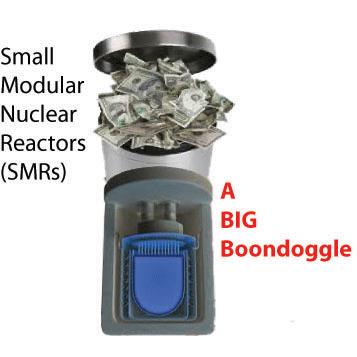 City AM 10th Sept 2017 ,A consortium developing small modular reactors is expected to urge the
government to push forward with a plan to develop so-called baby reactors
to secure the UK’s energy needs after the decommissioning of older
nuclear power stations. The government launched a competition to find the
best value SMR reactor design for the UK in 2016, and this week a
consortium led by Rolls-Royce will publish a report in Westminster which
claims it can generate electricity at £60 per megawatt hour, which is
two-thirds the price of recent large-scale nuclear plants.
http://www.cityam.com/271732/mps-review-baby-nuclear-reactor-plans-cheaper-source-secure
NuScale wooing Britain on Small Nuclear Reactors (SMRs)
 Chain reaction? NuScale seeks to reignite UK small nuclear reactor plans
US nuclear technology specialist NuScale Power has this week unveiled a new
action plan, in an attempt to kickstart UK efforts to establish the country
as a pioneer in the development of small modular reactors (SMRs).
Last year the UK government launched a competition to accelerate the development of
SMRs, amid predictions the technology could help cut greenhouse gas
emissions and curb the cost of nuclear power.
However, the promised £250m, five year R&D programme has been beset by delays and earlier this summer
reports suggested a ‘crunch’ meeting was recently called between government
officials and potential SMR developers over the competition.
NuScale, which is backed by US engineering giant Fluor Corporation, this week sought to
highlight the UK’s potential role as an SMR hub with the publication of an
action plan detailing how it could deliver the technology by the 2020s. The
five-point UK SMR Action Plan sets out how the firm would partner with UK
industry to deliver a multi-billion pound SMR venture, which could see UK
firms provide more than 85 per cent of the content required for UK
reactors. https://www.businessgreen.com/bg/news/3016958/chain-reaction-nuscale-seeks-to-reignite-uk-small-nuclear-reactor-plans
Elon Musk’s warning: race for Artificial Intelligence could cause World war 3
Global race for AI will ‘most likely cause’ WWIII as computers launch 1st strike – Musk https://www.rt.com/usa/401957-ww3-ai-musk-strike/#.Wa2SHDrLvSE.facebook 4 Sep, 2017 Competition for superiority in Artificial Intelligence at national level will “most likely” cause World War Three, billionaire entrepreneur Elon Musk has said, warning that an AI may deem first use its best chance of winning.
“China, Russia, soon all countries with strong computer science. Competition for AI superiority at national level most likely cause of WW3,” Musk tweeted.The SpaceX founder says he doubts that North Korea can launch its own nuclear strike. He believes that Pyongyang “launching a nuclear missile would be suicide for their leadership, as South Korea, [the U.S.] and China would invade and end the regime immediately.”
Musk’s comments come days after Russian President Vladimir Putin stated that “the future belongs to artificial intelligence” and whoever masters it first will rule the world.
“Artificial intelligence is the future, not only for Russia, but for all humankind. It comes with colossal opportunities, but also threats that are difficult to predict. Whoever becomes the leader in this sphere will become the ruler of the world,” Putin said.
An avid anti-AI crusader, Musk appears to be more frightened by artificial intelligence, a rising phenomenon he is willing to put under control.
“If you’re not concerned about AI safety, you should be. Vastly more risk than North Korea,” Musk said in August this year.
The entrepreneur has long warned about the perils AI might bring to humankind. He maintains there is a great probability that artificial intelligence, free of any regulation and oversight, is able to go rogue and turn on humans in the end.
“AI is a fundamental risk to the existence of human civilization in a way that car accidents, airplane crashes, faulty drugs or bad food were not. They were harmful to a set of individuals in society of course, but they were not harmful to society as a whole,” Musk said in mid-July during a public event.
1 This Month
29 Jan. Thursday 7-8 p.m. Webinar – World’s Largest Nuclear Station in Port Hope, ON?
To see nuclear-related stories in greater depth and intensity – go to https://nuclearinformation.wordpress.com/



31st January – Challenging the War Machine – a DECLASSIFIED UK SUMMIT


Website of the Week
Now until to February 10, 2026 Radioactive waste storage in France: the debate is finally open! How to participate?
-
Archives
- January 2026 (288)
- December 2025 (358)
- November 2025 (359)
- October 2025 (376)
- September 2025 (258)
- August 2025 (319)
- July 2025 (230)
- June 2025 (348)
- May 2025 (261)
- April 2025 (305)
- March 2025 (319)
- February 2025 (234)
-
Categories
- 1
- 1 NUCLEAR ISSUES
- business and costs
- climate change
- culture and arts
- ENERGY
- environment
- health
- history
- indigenous issues
- Legal
- marketing of nuclear
- media
- opposition to nuclear
- PERSONAL STORIES
- politics
- politics international
- Religion and ethics
- safety
- secrets,lies and civil liberties
- spinbuster
- technology
- Uranium
- wastes
- weapons and war
- Women
- 2 WORLD
- ACTION
- AFRICA
- Atrocities
- AUSTRALIA
- Christina's notes
- Christina's themes
- culture and arts
- Events
- Fuk 2022
- Fuk 2023
- Fukushima 2017
- Fukushima 2018
- fukushima 2019
- Fukushima 2020
- Fukushima 2021
- general
- global warming
- Humour (God we need it)
- Nuclear
- RARE EARTHS
- Reference
- resources – print
- Resources -audiovicual
- Weekly Newsletter
- World
- World Nuclear
- YouTube
-
RSS
Entries RSS
Comments RSS
 nuclear-news