Salt Lake City-based Energy Strategies – study shows NuScale’s small nuclear reactors too costly for Utah
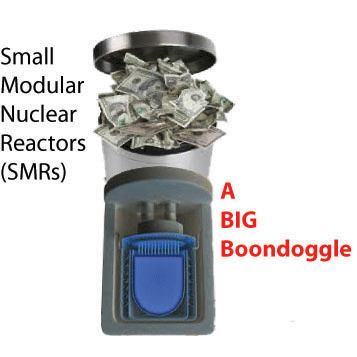 Environmental group says new nuclear power plant too pricey for Utah’s municipal utilities, KSL.com SALT LAKE CITY — A group opposed to a new type of nuclear plant being developed said Thursday the price of power produced there would be more than other carbon-free energy sources, making it a bad investment for Utah’s municipal utilities.
“We feel the numbers are independent and speak for themselves,” Michael Shea, a senior policy associate for the Healthy Environmental Alliance of Utah, told reporters at a news conference discussing the findings in a new study.
The study, by Salt Lake City-based Energy Strategies, found power produced by the small modular nuclear reactors to be built in Idaho would cost more than $66 per megawatt hour, compared to as low as just over $38 for wind and solar power.
“It does not make economic sense from a market perspective for a group like (the Utah Associated Municipal Power Systems) to be investing in what is essentially a subsidized science project that has not ever been proven,” Shea said…….
Longtime consumer protection watchdog Claire Geddes spoke at the news conference about her confidence in the study and her concerns about the impact of higher costs on the public.
Geddes, who said she has worked on utility issues since 1992, suggested the local governments supervising municipal utilities don’t have the resources to adequately vet the project.
“It’s really not fair to the public,” she said. “I would stress that these cities understand, before they go into it, what the risks are to their citizens and their businesses.”
Both the environmental alliance and Geddes called for further study by the municipal power system before local governments make a final decision next year on what would be a 40-year contract. ……
Besides the cost concerns, Williams said the new type of nuclear plant can’t be presumed to be safe and would still produce at least as much nuclear waste as a traditional plant.
The intent is for the municipal power system to purchase all 12 modular reactors at the plant being built by an Oregon-based company, NuScale Power, system spokesman LaVarr Webb said.
The power generated would be used by the 46 members, mostly municipalities, in Utah and other states, Webb said, and would sold to other users including the federal government for use by the Idaho National Laboratory and the Department of Energy……..https://www.ksl.com/article/46578424/environmental-group-says-new-nuclear-power-plant-too-pricey-for-utahs-municipal-utilities
Most robots are not up to the task of cleaning up nuclear wastes
Cleaning up nuclear waste is an obvious task for robots, Economist, 19 June 19,
But designing ’bots that can do it is hard SOME PEOPLE worry about robots taking work away from human beings, but there are a few jobs that even these sceptics admit most folk would not want. One is cleaning up radioactive waste, particularly when it is inside a nuclear power station—and especially if the power station in question has suffered a recent accident.
Those who do handle radioactive material must first don protective suits that are inherently cumbersome and are further encumbered by the air hoses needed to allow the wearer to breathe. Even then their working hours are strictly limited, in order to avoid prolonged exposure to radiation and because operating in the suits is exhausting. Moreover, some sorts of waste are too hazardous for even the besuited to approach safely.
So, send in the robots? Unfortunately that is far from simple, for most robots are not up to the task. This became clear after events in 2011 at the Fukushima Daiichi nuclear power plant in Japan, which suffered a series of meltdowns after its safety systems failed following a tsunami. The site at Fukushima has turned into something of a graveyard for those robots dispatched into it to monitor radiation levels and start cleaning things up. Many got stuck, broke down or had their circuits fried by the intense radiation…… (subscribers only) https://www.economist.com/science-and-technology/2019/06/19/cleaning-up-nuclear-waste-is-an-obvious-task-for-robots
Holtec and Ukraine developing Small Modular Nuclear Reactors (dodgy underground devices)
 Consortium established for SMR-160 deployment in Ukraine, WNN 12 June 2019
The consortium document was signed by Holtec CEO Kris Singh, Energoatom President Yury Nedashkovsky and SSTC President Igor Shevchenko. The signing ceremony – held at Holtec’s headquarters in Camden, New Jersey – was attended by senior Holtec officials and delegations from Mitsubishi Electric, the US Department of Energy and Energoatom.
The consortium is a US company registered in Delaware with each of the three parties owning allotted shares. Its technology operation centre will be based in Kiev, Ukraine…….
The MoU includes the licensing and construction of SMR-160 reactors in Ukraine, as well as the partial localisation of SMR-160 components. The Ukrainian manufacturing hub is to mirror the capabilities of Holtec’s Advanced Manufacturing Plant in Camden, and will be one of four manufacturing plants Holtec plans to build at distributed sites around the world by the mid-2020s.
Holtec’s 160 MWe factory-built SMR uses low-enriched uranium fuel. The reactor’s core and all nuclear steam supply system components would be located underground, and the design incorporates a wealth of features including a passive cooling system that would be able to operate indefinitely after shutdown….
The SMR-160 is planned for operation by 2026.
The SMR-160 is currently undergoing the first phase of the Canadian Nuclear Safety Commission’s three-phase pre-licensing vendor design review process. State Nuclear Regulatory Inspectorate of Ukraine, the nuclear regulatory authority in Ukraine, is expected to coordinate its regulatory assessment of SMR-160 under a collaborative arrangement with its Canadian counterpart. http://www.world-nuclear-news.org/Articles/Consortium-established-for-SMR-160-deployment-in-U
Edwin lyman on the safety of these reactors “Holtec SMR-160. The Holtec SMR-160 will generate 160 MWe. Like the NuScale, it is designed for passive cooling of the primary system during both normal and accident conditions. However, the modules would be much taller than the NuScale modules and would not be submerged in a pool of water. Each reactor vessel would be located deep underground, with a large inventory of water above it that could be used to provide a passive heat sink for cooling the core in the event of an accident. Each containment building would be surrounded by an additional enclosure for safety, and the space between the two structures would be filled with water. Unlike the other iPWRs, the SMR-160 steam generators are not internal to the reactor vessel. The reactor system is tall and narrow to maximize the rate of natural convective flow, which is low in other passive designs. Holtec has not made precise dimensions available, but the reactor vessel is approximately 100 feet tall, and the aboveground portion of the containment is about 100 feet tall and 50 feet in diameter (Singh 2013)
For these and other SMRs, it is important to note that only limited information is available about the design, as well as about safety and security. A vast amount of information is considered commercially sensitive or security-related and is being withheld from the public. ….
in the event of a serious accident, emergency crews could have greater difficulty accessing underground reactors.
Underground siting of reactors is not a new idea. Decades ago, both Edward Teller and Andrei Sakharov proposed siting reactors deep underground to enhance safety. However, it was recognized early on that building reactors underground increases cost. Numerous studies conducted in the 1970s found construction cost penalties for underground reactor construction ranging from 11 to 60 percent (Myers and Elkins). As a result, the industry lost interest in underground siting. This issue will require considerable analysis to evaluate trade-offs…. ” https://nuclearinformation.wordpress.com/2017/11/29/edwin-lyman-on-small-modular-reactors/ erious accident, emergency crews could have greater difficulty accessing underground reactors.
Energy experts doubt the viability of Small Modular Nuclear Reactors (SMRs)

|
Caution urged over modular nuclear reactors, New Civil Engineer, 9 JUNE, 2019 Energy heavyweights have urged caution over the idea of rolling out small modular reactor (SMR) technology to replace cancelled and decommissioned nuclear power projects.
The warnings came during a discussion on the potential ‘clean energy gap’ left by cancelled nuclear projects like Wylfa and older plants being decommissioned early. One potential solution to the gap would be to accelerate the progress of SMR development, which are marketed by their supporters as a more affordable nuclear power option, and safer than larger projects, such as Hinkley Point C. However National Infrastructure Commission chief economist James Richardson warned that the industry had failed to deliver on technological promises in the past. “You have to have a degree of caution with new nuclear technology,” he said. “We have been promised things time and time again and typically the industry tends to be more expensive and take longer than planned. I would be cautious against SMRs, they are a question for the 2030s.” “SMRs are not going to help in the next decade because they are just not available. By the time they turn up we can see if they are still cost effective or if renewable’s have gone beyond.” UK Energy Research Centre director Jim Watson agreed, and added we need to decarbonised power before SMR’s can be deployed. “I would also be cautious; we need to remember that 2030 is when we need to have decarbonised our power system by and I think there is a limit to which nuclear can help deliver that. We don’t know what the real cost of these SMRs are. History does make us cautious.” ……. https://www.newcivilengineer.com/latest/caution-urged-over-modular-nuclear-reactors/10042995.article |
|
Mars and travel to Mars – will kill astronauts with ionising radiation

EUROPEAN SPACE AGENCY: RADIATION WILL MAKE MARS MISSION DEADLY, https://futurism.com/the-byte/space-radiation-mars-mission-deadly JUNE 5TH 19__DAN ROBITZSKI__
Slow Down
Elon Musk once said he’d likely move to Mars in his lifetime. But before we settle the Red Planet, the European Space Agency (ESA) urges extreme caution.
That’s because it lacks the natural barriers that protect us Earthlings from cosmic radiation, which would put astronauts at risk of deadly health conditions. But they’re working on it — the ESA says it has partneredwith particle accelerators to recreate cosmic radiation in a controlled setting and build shields that can protect future explorers.
Harsh Conditions
“The real problem is the large uncertainty surrounding the risks,” said ESA physicist Marco Durante in the press release. “We don’t understand space radiation very well and the long-lasting effects are unknown.”
Shields Up
The ESA found that a six-month stay on Mars would expose astronauts to “60% of the total radiation dose limit recommended for their entire career.”
As it stands today, we can’t go to Mars due to radiation,” said Durante. “It would be impossible to meet acceptable dose limits.”
READ MORE: Radiation Makes Human Missions to Mars Too Dangerous: ESA [ExtremeTech]
Ionising radiation in space will kill astronauts headed for Mars
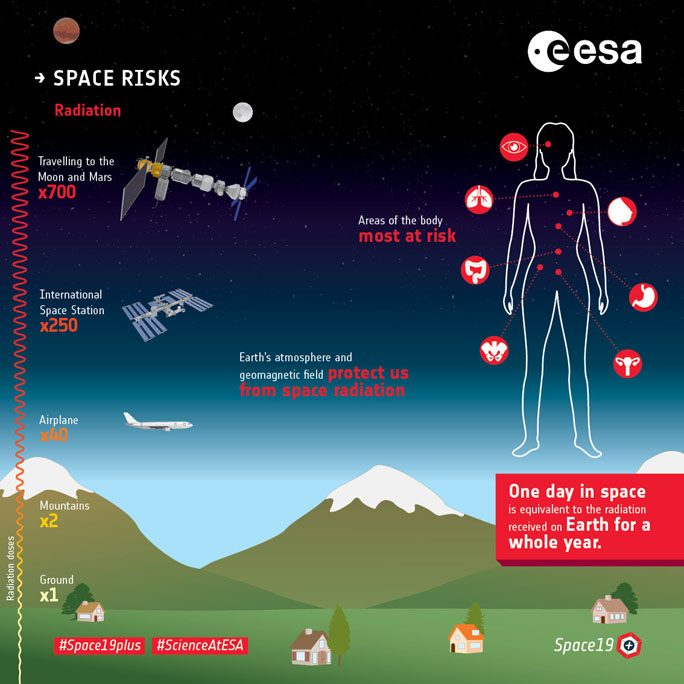 The radiation showstopper for Mars exploration https://phys.org/news/2019-06-showstopper-mars-exploration.html, by European Space Agency 3 June 19, An astronaut on a mission to Mars could receive radiation doses up to 700 times higher than on our planet—a major showstopper for the safe exploration of our solar system. A team of European experts is working with ESA to protect the health of future crews on their way to the Moon and beyond.
Earth’s magnetic fieldand atmosphere protect us from the constant bombardment of galactic cosmic rays—energetic particles that travel at close to the speed of light and penetrate the human body.
Cosmic radiation could increase cancer risks during long duration missions. Damage to the human body extends to the brain, heart and the central nervous system and sets the stage for degenerative diseases. A higher percentage of early-onset cataracts have been reported in astronauts.
“One day in space is equivalent to the radiation received on Earth for a whole year,” explains physicist Marco Durante, who studies cosmic radiation on Earth.
Marco points out that most of the changes in the astronauts’ gene expression are believed to be a result of radiation exposure, according to the recent NASA’s Twins study. This research showed DNA damage in astronaut Scott Kelly compared to his identical twin and fellow astronaut Mark Kelly, who remained on Earth.
A second source of space radiation comes from unpredictable solar particle events that deliver high doses of radiation in a short period of time, leading to “radiation sickness” unless protective measures are taken.
Europe’s radiation fight club
“The real problem is the large uncertainty surrounding the risks. We don’t understand space radiation very well and the long-lasting effects are unknown,” explains Marco who is also part of an ESA team formed to investigate radiation.
Since 2015, this forum of experts provides advice from areas such as space science, biology, epidemiology, medicine and physics to improve protection from space radiation.
“Space radiation research is an area that crosses the entire life and physical sciences area with important applications on Earth. Research in this area will remain of high priority for ESA,” says Jennifer Ngo-Anh, ESA’s team leader human research, biology and physical sciences.
While astronauts are not considered radiation workers in all countries, they are exposed to 200 times more radiation on the International Space Station than an airline pilot or a radiology nurse.
Radiation is in the Space Station’s spotlight every day. A console at NASA’s mission control in Houston, Texas, is constantly showing space weather information.
f a burst of space radiation is detected, teams on Earth can abort a spacewalk, instruct astronauts to move to more shielded areas and even change the altitude of the station to minimize impact.
One of the main recommendations of the topical team is to develop a risk model with the radiation dose limits for crews traveling beyond the International Space Station.
ESA’s flight surgeon and radiologist Ulrich Straube believes that the model should “provide information on the risks that could cause cancer and non-cancer health issues for astronauts going to the Moon and Mars in agreement with all space agencies.”
Recent data from ExoMars Trace Gas Orbiter showed that on a six-month journey to the Red Planet an astronaut could be exposed to at least 60% of the total radiation dose limit recommended for their entire career.
“As it stands today, we can’t go to Mars due to radiation. It would be impossible to meet acceptable dose limits,” reminds Marco.
Measure to protect
ESA has teamed up with five particle accelerators in Europe that can recreate cosmic radiation by “shooting” atomic particles to speeds approaching the speed of light. Researchers have been bombarding biological cells and materials with radiation to understand how to best protect astronauts.
“The research is paying off. Lithium is standing out as a promising material for shielding in planetary missions,” says Marco.
ESA has been measuring the radiation dose on the International Space Station for seven years with passive radiation detectors in the DOSIS 3-D experiment. ESA astronauts Andreas Mogensen and Thomas Pesquet wore a new mobile dosimeter during their missions that gave them a real-time snapshot of their exposure.
The same European team behind this research will provide radiation detectors to monitor the skin and organ doses of the two phantoms traveling to the Moon onboard NASA’s Orion spacecraft.
Problems in nuclear fusion, radiation risks – some active wastes, intermittency
 Fusion- some new issues http://newrenewextra.blogspot.com/2019/06/fusion-some-new-issues.html–3 June 19, Renewables are doing very well these days, with costs falling, but some say that we will also need other non-fossil options to respond to climate change. Nuclear fission is one, but it is having problems- it’s proving to be expensive and, some say, risky. Some are hopeful that new technology will improve its lot, but for others the big hope is that, at some point in the future, nuclear fusion will be available and will avoid the problems that fission faces.
It is usually claimed that fusion will be cleaner and safer, with no fission products to store and no risks of core melt downs. Moreover, since it uses hydrogen isotopes (deuterium and tritium), which are relatively easily obtained (deuterium from sea water, tritium from lithium), fusion can provide energy more or less indefinitely, into the far future. It may not be a renewed resource, but it is large. An exciting high tech solution – that could, some say, be available soon!
However, the reality is a bit more complex, with there being issues at each stage of the fuel-to-energy process, and a lot more work to do. In terms of fuel, it takes energy to extract deuterium from water, and lithium reserves, although relatively large, may be increasingly depleted given the growing demand for Lithium Ion batteries for electric vehicles. In terms of fusion plant operation, there will be radiation exposure risks and the potential for accidental release of active materials – tritium has a 12.3 year half-life, and tritiated water can be a major health hazard. Depending on the fusion system used, there will also still be some active wastes to deal with- the components and containment structures will be activated by the high radiation fluxes and have to be regularly stripped out. They will be less long-lived than fission wastes, but they are still an issue.
More generally there is the issue of plant operation in power terms. It is early days yet, since we only have experience with small prototype test projects, like JET at Culham, and no detailed plans for full scale power stations. However, it seems likely that the plants will not be run continually, but in pulses. When eventually finished, and fully commissioned (maybe by 2030?) the 500 MW rated €15bn ITER project being built in the south of France is expected to generate power in up to 10 minute bursts, and for at the most 1 hour. The proposed larger DEMO follow up (in the 2040s?) willevidently also only run in bursts, but of 2-4 hours.
One implication of this intermittent generation is that commercial scale fusion reactors, when and if they emerge, may be used not to generate base-load continuous power, but for producing hydrogen in batch-production mode. That can be used as a storable fuel for heating or be converted into various synfuels for vehicle use. It may thus be that fusion will focus on these more lucrative markets rather than trying to compete in the very tight electricity market.
There are other approaches to fusion which might offer other power options. The USA’s laser-fired ‘ignition’ system has its fans. Certainly some see the ‘inertial confinement’ approach, with tiny fuel pellets being compressed, using multiple focused laser beams, to reach fusion conditions, as winning over Tokomak magnetic constriction plasma systems like ITER. We shall see, with Google even entering the field, offering advanced electronics. Germany, Japan, South Korea and China are also in the game, as is Russia, which is where the original Tokomak design came from. TheUK national hopes rest with the MAST spherical Tokomak at Culham and derivatives like the ST40.
Few of these technologies seem likely to be running at full scale before the 2030s or even 2040’s, but some do claim that they can be ready earlier. In 2014, Lockheed surprised everyone by claiming that for their ‘compact fusion’ programe they were aiming for a ‘prototype in 5 years, defence products in 10, clean power for the world in 20 years’. We may see, but for the moment it all seems rather speculative and long term. Some of the rivals may get there faster, but, even assuming everything goes to plan, a commercial-scale ITER follow up is not now seen as likely to be available to feed power to the grid until after 2050!
Breakthroughs in smaller-scale laser fusion or some such are possible, and some reports seem to suggest imminent success (or at least a sustained positive output by 2024), but for the moment, there are the practicalities of the large scale Tokomak approach being developed by ITER to face. Some of the issues are quite worrying. The high radiation fluxes will present some operational safety issues. Indeed, a recent paper in Nature has warned that not enough attention had so far been given to safety.
It compared the current 500MW rated ITER project with the hypothetical DEMO commercial-scale follow-up project, maybe running in the 2040/50s. In ITER, it said, the risk of radiation exposure comes from fusion neutrons emitted from the plasma, γ-radiation emitted by neutron-activated components, X-rays emitted by some heating and current drive generators, and the β-radiation emitted from tritium. DEMO, would have a similar range of radiation – the main difference being the size of the inventories of typical radioactive products. It would presumably be the workforce who were most at risk, but there could also be public exposure issues, especially if there was a major loss of containment
The Nature article says that it’s been calculated that the radioactivity due to materials activation in a future fusion reactor may be three orders of magnitude more than that in a typical fission reactor with the same electrical power output, while the total radioactivity is comparable. It adds ‘from this point of view, fusion reactors may be potentially unsafe if low-activation materials are not deployed. Note that this finding may also be applicable to the more recent fusion reactor concepts with even low-activation materials adopted. This means that radiation exposure control for fusion reactor design and operation is of critical concern […] Thus, several radiation protection provisions, such as confinement barriers, radiation shielding and access control, must be applied in order to meet the maximum public dose limits required by the regulatory body and at the same time to keep individual occupational doses for workers as low as reasonably achievable.’
It also says ‘a fusion demonstration reactor is generally expected to have an order of magnitude more decay heat power than ITER, comparable to that of a fission reactor with the same electrical output power’ And finally, ‘in DEMO, radio-active waste activity after 100 years, assuming that low/reduced-activation materials are used for the first wall & structure material, could be around 20–50 times more than for ITER. The larger tritium inventory is also significant for tritiated waste management. In fact, this large amount of radioactive waste and especially tritiated waste will result in a large burden for waste disposal sites in the country where DEMO is located’.
There do seem to be some serious issues, and the ITER project has attracted its fair share of criticism. Breakthroughs are always possible, but artificial fusion may not be the way ahead after all! We may have to rely on the (free) fusion reactor we already have- the sun. Maybe a safer option. And a faster one- we have working renewables now: we don’t need to wait for fusion topossibly start dealing with climate change decades hence.
USA’s “Doomsday plane” – the pilots might survive, anyway

This ‘Doomsday Plane’ Can Survive a Nuclear Attack https://www.livescience.com/65603-doomsday-plane-can-survive-nuclear-attack.htmlm By | May 31, 2019
USA Dept of Energy funding bankrupted French company AREVA – now resuscitated as Framatome

|
Lightbridge fuel development gains DOE funding, WNN 30 May 2019, Framatome has received a voucher through the US Department of Energy’s (DOE’s) Gateway for Accelerated Innovation in Nuclear (GAIN) programme to support development of Lightbridge Fuel in collaboration with Idaho National Laboratory (INL). ….. Enfission – a joint venture of Lightbridge Corporation and Framatome – was set up in January 2018 to commercialise nuclear fuel assemblies based on this technology.
The GAIN initiative was launched in November 2015 to provide a way to fast-track nuclear innovation,….. This is Framatome’s third GAIN voucher and its first supporting the Lightbridge Fuel design. Framatome said its collaboration with INL under this GAIN voucher will “leverage the laboratory’s experience in fuel and material development, as well as its performance knowledge, to facilitate Framatome’s understanding of phenomena unique to uranium-zirconium metallic fuel”. …… For this work DOE will fund INL at a value of USD477,000…… https://www.world-nuclear-news.org/Articles/Lightbridge-fuel-development-gains-DOE-funding |
|
$125 million to NASA to develop nuclear rockets
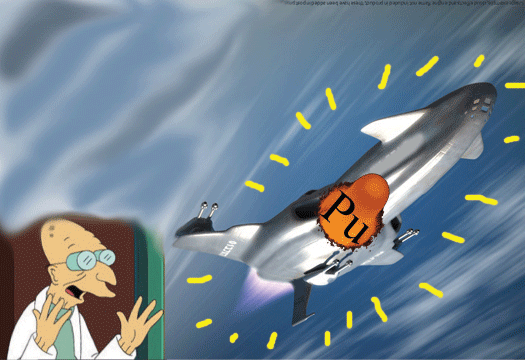 NASA JUST GOT $125 MILLION TO DEVELOP NUCLEAR ROCKETS, https://futurism.com/the-byte/nasa-develop-nuclear-rockets DAN ROBITZSKI_ 29 May 19, For the first time since the 1970s, NASA is developing nuclear propulsion systems for its spacecraft.NASA didn’t request any money for a nuclear propulsion program, but it will get $125 million for the research as part of the space agency’s $22.3 billion budget that Congress approved last week, Space.comreports. If the program succeeds, nuclear propulsion could significantly cut down on travel time during missions to Mars and beyond.
Test Launch
Republican leadership sees nuclear propulsion as an important step along the way to deep space missions and the 2024 Moon landing with which Congress has tasked NASA, per Space.com. Alabama Representative Robert Aderholt described nuclear propulsion as “critical” for the 2024 launch in a budget meeting last week.
“As we continue to push farther into our solar system, we’ll need innovative new propulsion systems to get us there, including nuclear power,” Vice President Mike Pence told the National Space Council in March.
Sorting It Out
But before NASA can embrace nuclear-powered technology, there’s the matter of navigating regulations that govern the use of nuclear energy.
For the time being, the space agency hasn’t announced any plans to use nuclear propulsion for any of its planned missions, according to Space.com, but that may change as the technology develops.
USA govt pouring money into dodgy new nuclear projects
|
U.S. Department of Energy Further Advances Nuclear Energy Technology through Awards of $10.6 Million , MAY 23, 2019 WASHINGTON, D.C. – The U.S. Department of Energy (DOE) today announced funding selectees for multiple domestic advanced nuclear technology projects. Three projects in three states will receive varying amounts for a total of approximately $11 million in funding. The projects are cost-shared and will allow industry-led teams, including participants from federal agencies, public and private laboratories, institutions of higher education, and other domestic entities, to advance the state of U.S. commercial nuclear capability.The awards are through the Office of Nuclear Energy’s (NE) funding opportunity announcement (FOA) U.S. Industry Opportunities for Advanced Nuclear Technology Development. This is the fourth round of funding through this FOA. The first group was announced on April 27, the second group was announced on July 10, the third group was announced on November 13, 2018, and the fourth groupwas announced on March 27, 2019. The total of the five rounds of awards is approximately $128 million. Subsequent quarterly application review and selection processes will be conducted over the next four years.
“There are a lot of U.S. companies working on technologies to make the next generation of nuclear reactors safer and highly competitive, and private-public partnerships will be key to accomplishing this goal,” said U.S. Secretary of Energy Rick Perry. “The Trump Administration is committed to reviving and revitalizing the U.S. nuclear industry, and these partnerships are needed to help successfully develop innovative domestic nuclear technologies.” The prior version of the bill would have cost residential customers about $2.50 a month or $300 million a year with the money going mostly to the nuclear plants but also to other resources that do not produce carbon dioxide emissions, like wind and solar. Democrats on the House committee opposed the removal of the credit for renewable resources and the speed at which the bill was proceeding through the legislature. The bill could be voted on by the full House as soon as May 29, according to analysts at Height Capital Markets in Washington. The solicitation is broken into three funding pathways:
The following two projects were selected under the Advanced Reactor Development Projects pathway:…….. https://www.energy.gov/ne/articles/us-department-energy-further-advances-nuclear-energy-technology-through-awards-106 |
|
|
Funds being cut from US Air Force nuclear, space programs
 US Air Force nuclear, space programs take hit in border wall reprogramming, Defense News, WASHINGTON — In the wake of the Pentagon reprogramming $1.5 billion in fiscal 2019 funds to support President Donald Trump’s border wall with Mexico, only the U.S. Air Force appears to be losing money appropriated for equipment updates.
The false hope of “Small Modular Nuclear Reactors” being pushed in Wales
of Everlasting Nuclear Destruction. It is also the Welsh word for fox.
talked about as a possible location for a new, small modular reactor (SMR).
Trawsfynydd reactors are decommissioning now, but very slowly. On
Wikipedia, the page proclaims that the decommissioning is expected to take
“almost 100 years.”
beyond Trawsfynydd. Being described as “small” and “modular” tends
to mask the reality that it is expensive, of little use for climate change,
and likely still far in the future.
false hope, of course, because the likelihood of SMRs coming to fruition is
slim and would provide only a handful of jobs.
https://beyondnuclearinternational.org/2019/05/12/the-fox-we-need-to-guard-this-henhouse/
The vulnerability of nuclear weapons systems to cyber threats

|
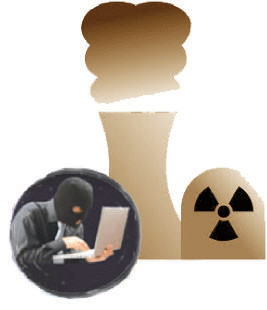
Apocalypse now? Cyber threats and nuclear weapons systems, European Leadership Network Julia Berghofer |Policy Fellow and Project Manager for the YGLN, 10 May 19, It is accepted that all states are vulnerable to cyber threats. Yet, a majority of states have yet to develop coherent cyber strategies or implement sufficient preventive measures. Despite the increase in severe cyber incidents directed at national power plants, companies and nuclear-related military equipment, the threat of cyber interference in national nuclear weapons systems is not being properly tackled. With multinational nuclear supply chains and nuclear command and control systems at risk of being compromised, this must be urgently addressed. The more complex, the more vulnerable Governments and legislators are struggling to keep pace with the rapid development of cyber capabilities. As military systems become more technically complex it would be easy to assume that they are more secure. The opposite is true. Increased automation and connectivity increases vulnerabilities to cyber attacks. Measures such as air-gapping a system (ie. de-connecting it from the internet) can fall short. A recent US Government Accountability Office (GAO) report assessed the cyber security of US weapons systems and found “mission critical cyber vulnerabilities in nearly all weapons systems […] under development.“ While the report does not make reference to any specific system type, one can reasonably assume that nuclear weapons systems are vulnerable to cyber attacks.
Cyber attacks can take many forms. Activities range from cyber espionage, data theft, infiltration of nuclear command, control and communications (NC3), denial of service/distributed denial of service (DoS/DDoS) attacks, false alarms (jamming and spoofing), sabotage and physical damage. When directed against nuclear weapons systems, in the worst possible case this may escalate to a deliberate or inadvertent exchange of nuclear weapons. Another area of concern is the supply chain, comprised of any hardware and software components belonging to the nuclear weapons system, including NC3, platforms, delivery systems and warheads. The supply chain usually includes a string of companies and providers located in different countries with varying cyber security standards, which means there is room for manipulation and sabotage. Take, for instance, a computer chip produced in country A. If a vulnerability were inserted at the production stage it could then be remotely activated at a later point when the chip is integrated into the military system of country B. If the attacker happened to be an “insider“ with unlimited access to a military site, compromising military equipment could be easier. This could be done for instance through an infected USB drive when security standards in a military facility happen to be low, leaving the victim of the attack unaware of the manipulation up until it is too late. Limited awareness of cyber risks to nuclear systems There is a lack of awareness within the expert community and among decision-makers and a reluctance by states to implement measures such as common cyber security standards and the sharing of information on vulnerabilities. Among the nuclear weapons states, only in the United States have high-ranking officials, such as Gen. Robert Kehler (ret.) and Air Force Gen. John Hyten (STRATCOM), in two Senate Armed Service Committee hearings in 2013 and 2017 expressed their concerns about a potential cyber attack affecting the U.S. nuclear deterrent. One reason why decision-makers and governments are unwilling to take these steps could be that it seems too unrealistic or improbable a threat, merely belonging to the worlds of science fiction and doomsday scenarios. But there is no reason to assume that the warnings of the GAO, the U.S. 2017 Task Force on Cyber Deterrence or the Nuclear Threat Initiative (NTI) are exaggerated. Certainly, there has not yet been a major cyber attack on a state-run nuclear weapons programme – at least none we have publicly heard of. But there are a string of examples of cyber interference in nuclear installations or parts of the What should decision-makers and policy-makers do? Governments need to grapple with how to handle rapidly developing cyber capabilities. A critical first step is develop a better understanding of the threat…….. https://www.europeanleadershipnetwork.org/commentary/understanding-and-addressing-cyber-threats-to-nuclear-weapons-systems/
|
|

The problematic arrival of Artificial Intelligence for NuclearWeapons

From the A bomb to the AI bomb, nuclear weapons’ problematic evolution, more https://www.france24.com/en/20190510-nuclear-weapons-artificial-intelligence-ai-missiles-bombs-technology-military, France 24 LIVE, Sébastian SEIBTm 10 May 19
From autonomous nuclear submarines to algorithms detecting a threat, to robot-guided high-speed missiles, artificial intelligence could revolutionise nuclear weapons – risking some profound ethical conundrums – a recent report reveals.
At 2:26 A.M. on June 3, 1980, Zbigniew Brezezinski, US President Jimmy Carter’s famously hawkish national security adviser, received a terrifying phone call: 220 Soviet nuclear missiles were heading for the US. A few minutes later, another phone call offered new information: in reality, 2,220 missiles were flying towards the US.
Eventually, as Brezezinski was about to warn Carter of the impending doom, military officials realised that it was a gargantuan false alarm caused by a malfunctioning automated warning system. Thus, the Cold War nearly became an apocalypse because of a computer component not working properly.
This was long before artificial intelligence (AI) rose to prominence. But the Americans and Soviets had already begun to introduce algorithms into their control rooms in order to make their nuclear deterrence more effective. However, several incidents – most notably that of June 3, 1980 – show the disadvantages of using AI.
Novelty implies new vulnerabilities’
Almost forty years on from that near debacle, AI seems to have disappeared from the nuclear debate, even though such algorithms have become ubiquitous at every level of society. But a report by the Stockholm International Peace Research Institute (SIPRI) published on May 6 underlines the importance of this aspect.
The nuclear arms race still poses a considerable threat, seeing as Donald Trump’s America has promised to modernise its arsenal, North Korea seems uninterested in abandoning its nuclear programme, and relations are tense between neighbouring nuclear powers and historical antagonists India and Pakistan.
However, technological breakthroughs in AI show “enormous potential in nuclear power, as in the areas of conventional and cyber weapons”, said Vincent Boulanin, the researcher at SIPRI responsible for the report, in an interview with FRANCE 24. In particular, machine learning is “excellent for data analysis”, Boulanin continued. Such work could play an essential role in intelligence gathering and the detection of cyber attacks.
Russia resurrects Soviet AI system
“In truth, we know very little about the use of AI in nuclear weapons systems at present,” Boulanin admitted. Russia is the only world power to have brought up the issue recently, with President Vladimir Putin announcing in March 2018 the construction of a fully automated nuclear submarine called Poseidon. Furthermore, in 2011 Moscow resurrected and updated the Perimetr system, which uses artificial intelligence to be able (under certain conditions) to detect an atomic bomb by another state. But experts consider these announcements to be lacking in concrete details.
In part, such scepticism stems from the fact that “the adoption of new technologies in the nuclear field tends to be rather slow because novelty implies the possibility of new vulnerabilities”, Boulanin pointed out. Those in control of nuclear weapons programmes prefer to work on outdated computers instead of state-of-the-art technologies that are at risk of being hacked.
Nevertheless, Bounanin continued, it’s only a matter of time before the nuclear powers adopt AI in their weapons systems, considering the enticing prospects of such technology. Its main advantage is that algorithms are an awful lot faster than humans at processing information.
AI could also make guidance systems for missiles more accurate and more flexible, according to Boulanin. “This would be especially useful for high velocity systems that human can’t manoeuvre,” he said. Indeed, several countries are working on prototypes of hypersonic aircraft and missiles able to fly five times faster than the speed of sound. It would be impossible for humans to intervene on the trajectory of such missiles, while AI could correct the aim if necessary.
The dark side of AI in nuclear weapons
There is, however, a very dark side to AI. By nature, it implies the delegation of decision-making from humans to machines – which would carry serious “moral and ethical” implications, noted Page Stoutland, vice-president of the American NGO Nuclear Threat Initiative, which collaborated in the SIPRI report.
On this basis, “the guiding principle of respect for human dignity dictates that machines should generally not be making life-or-death decisions”, argued Frank Sauer, a nuclear weapons specialist at the University of Munich, in the SIRI study. “Countries need to take a clear stance on this” so that they don’t have robotic hands on the red button.
That’s while algorithms are created by humans and, as such, can reinforce the prejudices of their creators. In the US, AI used by the police to prevent reoffending has been shown to be “racist” by several studies. “It is therefore impossible to exclude a risk of inadvertent escalation or at least of instability if the algorithm misinterprets and misrepresents the reality of the situation,” pointed out Jean-Marc Rickli, a researcher at the Geneva Centre for Security Policy, in the SIRI report.
Risk of accidental use
Artificial intelligence also risks upsetting the delicate balance between the nuclear powers, warned Michael Horowitz, a defence specialist at the University of Pennsylvania, in the SIRI study: “An insecure nuclear-armed state would therefore be more likely to automate nuclear early-warning systems, use unmanned nuclear delivery platforms or, due to fear of rapidly losing a conventional war, adopt nuclear launch postures that are more likely to lead to accidental nuclear use or deliberate escalation.” That means that the US – which boasts the world’s largest nuclear stockpile – will be more cautious in adopting AI than a minor nuclear power such as Pakistan.
In short, artificial intelligence is a double-edged sword when applied to nuclear weapons. In certain respects, it could help to make the world safer. But it needs to be adopted “in a responsible way, and people needs to take time to identify the risks associated with AI, as well as pre-emptively solving its problems”, Boulanin concluded.
One sobering comparison might be with the financial services industry. Bankers used the same arguments – the promises of speed and reliability – to introduce AI to the sector as those used by its advocates in the nuclear weapons field. Yet the use of AI in trading rooms has led to some very unpleasant stock market crashes. And of course, nuclear weapons will give AI much more to play with than mere money.
1 This Month



26 September – International Day for the Total Elimination of Nuclear Weapons


PLEASE OPPOSE HR 8255 AND S.3639 – bills would accelerate satellite deployment, with no environmental review or safeguards – https://ncstd5li.quorum.us/campaign/169331/
To see nuclear-related stories in greater depth and intensity – go to https://nuclearinformation.wordpress.com
-
Archives
- September 2026 (269)
- August 2026 (330)
- July 2026 (355)
- June 2026 (287)
- May 2026 (306)
- April 2026 (356)
- March 2026 (251)
- February 2026 (267)
- January 2026 (308)
- December 2025 (358)
- November 2025 (359)
- October 2025 (375)
-
Categories
- 1
- 1 NUCLEAR ISSUES
- business and costs
- climate change
- culture and arts
- ENERGY
- environment
- health
- history
- indigenous issues
- Legal
- marketing of nuclear
- media
- opposition to nuclear
- PERSONAL STORIES
- politics
- politics international
- Religion and ethics
- safety
- secrets,lies and civil liberties
- spinbuster
- technology
- Uranium
- wastes
- weapons and war
- Women
- 2 WORLD
- ACTION
- AFRICA
- Atrocities
- AUSTRALIA
- Christina's notes
- Christina's themes
- culture and arts
- Events
- Fuk 2022
- Fuk 2023
- Fukushima 2017
- Fukushima 2018
- fukushima 2019
- Fukushima 2020
- Fukushima 2021
- general
- global warming
- Humour (God we need it)
- Nuclear
- RARE EARTHS
- Reference
- resources – print
- Resources -audiovicual
- Weekly Newsletter
- World
- World Nuclear
- YouTube
-
RSS
Entries RSS
Comments RSS

