NuScale “small nuclear” push into universities

Engineering students intern at US nuclear testing company Grad Plus Friday, 08 July 2016 Four engineering students from the University of Sheffield have travelled to the US to take up internships at NuScale Power’s nuclear test facilities.
Nuclear lobby strategy – teach the teachers how good nuclear power is
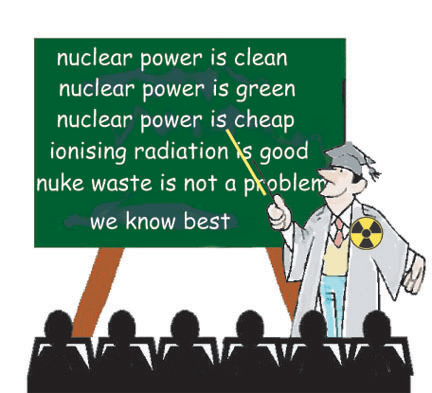 Teachers from two states go nuclear at educational summer institute, Augusta Chronicle By Mel Buckner
In each case, career opportunities were discussed……In addition, the evening programs included a panel discussion of local educational opportunities, led by Mindy Mets, the nuclear workforce initiative program manager for the Savannah River Site Community Reuse Organization, and a challenging presentation by Capt. Kevin Byrne, commanding officer of the Naval Nuclear Power Training Command at the Navy Nuclear Power School.
The institute included a series of workshop sessions over the three days to emphasize atomic and nuclear fundamentals; power generation fundamentals; nuclear technology applications; risk (real vs. perceived); and nuclear workforce opportunities ……
Lodging (if needed) and meals were provided at the University of South Carolina Aiken along with free educational resources and teacher guides for classroom presentations. In addition, each participant received two $25 gift cards to help cover travel expenses.
SSNI IS LED BY Citizens for Nuclear Technology Awareness, a local nonprofit organization whose mission is to provide education and information on nuclear subjects for the public. Other sponsors include the American Nuclear Society – Savannah River and Columbia, AREVA, Atkins, Georgia Power Co./Plant Vogtle, SCE&G, SRSCRO, SUNRISE Universities, USC Aiken and the Aiken Rotary Club.
(The writer – a retired program manager from the Savannah River National Laboratory – is a member of the Citizens for Nuclear Technology http://chronicle.augusta.com/opinion/opinion-columns/2016-07-03/teachers-two-states-go-nuclear-educational-summer-institute#
Fake story from Wall Street Journal claiming environmentalists support nuclear power
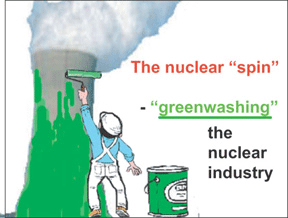
So are there prominent climate scientists and self-described environmentalists advocating for nuclear power? To be sure. But their stance doesn’t necessarily define the larger movement of low-carbon, renewable energy advocates who hold a decidedly different position.
WSJ Fakes a Green Shift Toward Nuclear Power http://fair.org/home/wsj-fakes-a-green-shift-toward-nuclear-power/ By Miranda C. Spencer The Wall Street Journal(6/16/16) published an article headlined “Environmental Groups Change Tune on Nuclear Power: Focus on Climate Change Has Raised Profile of Reactors, Now Viewed as Reliable, Carbon-Free Source of Energy.” Written by Amy Harder, the approximately 600-word piece appeared on the front page of the Journal’s B section.
Its dramatic lead-in: Continue reading
Global advertising giant Dentsu orchestrates pro nuclear propaganda in Japan
Fukushima and Nuclear Power: Does the Advertising Giant Dentsu Pull the Strings of Japan’s Media? By Mathieu Gaulène
1 June 2016 “………Advertisements in Japan are literally everywhere: a veritable hell of posters or screens in trains and stations, giant posters on buildings, bearers of advertising placards or lorries with huge posters and loud PA systems in the streets: even advertising displays mounted atop urinals in some restaurants. In this advertising empire, the media are no exception. In the press, naturally, as in France, major companies pay for full page advertisements. But, above all in television. An entertainment show generally starts with the announcement of sponsors, and is interrupted every five minutes by numerous short advertising spots, where we often find the same sponsors. There is virtually no time for thinking, most TV channels offer programs close to the world of pachinko: garish colors, constant noise, and frat humor even of the most vulgar kind.
In this immense television arena, advertising is orchestrated by one of the global giants, Dentsu, the 5th communication group in the world and the number one ad agency. With its rival Hakuhodo, 2nd in the archipelago, the two agencies nicknamed “Denpaku,” combine advertising, public relations, media monitoring, crisis management for the largest Japanese and foreign companies, the local authorities, political parties or the government. Together they hold nearly 70% of the market. A true empire that some accuse of ruling the roost in the Japanese media.
Dentsu and information on nuclear power…..
In a book published in 2012, Honma Ryu looked into some of Dentsu’s backstage, and its tight control over the media, especially on behalf of one of its major clients: Tokyo Electric Power Company, Tepco. ……
n 2012, his book Dentsu and Nuclear Coverage became a bestseller within a few months, despite almost universal media blackout.
Honma meticulously described the mechanisms by which Dentsu, the inevitable intermediary, implicitly imposes on media what can or cannot be written on nuclear power, and under what conditions. “Dentsu occupies a special position since the agency holds 80% of the market for nuclear advertising in Japan,” he reminded us during an interview in a coffee shop at Ueno Station. In 2010, in this huge advertising market, Tepco, a regional firm, indeed ranked 10th in terms of advertising expenses, next to power plant manufacturer Mitsubishi Heavy Industries. That year, on the eve of the Fukushima accident, Tepco had spent more than 2 million euros on advertising. The overall advertising expenses of the 10 regional electrical power companies amounted to 7 million euros.
For decades, especially since the 1990s when public opinion began to become critical of nuclear power following several accidents, Tepco and other power companies stepped up commercials and advertorials in the press.
On television, the advertisements can be enough in themselves to overwhelm criticism. Big groups often sponsor TV programs, talk shows or series for an entire season. Sometimes, entire documentaries are produced by Denjiren, [the Federation of Electric Power Companies of Japan (FEPC)], a key player in the nuclear lobby, to promote the industry. Any dissenting voice is unwelcome for fear of losing sponsors.
After Fukushima, Yamamoto Taro paid the price; appearing regularly on TV as a tarento [talent] until then when he suddenly became persona non grata on TV and even in cinema for having expressed opposition to nuclear power. This is hardly new since the great figures of the anti-nuclear movement, best-selling authors such as Hirose Takashi or Koide Hiroaki are almost never invited to appear on TV, especially after the Fukushima accident.
This “control by media” denounced by Honma Ryu obviously is not limited to the nuclear power industry.
Amid all these private media groups, only NHK escapes this advertising empire and can claim to be independent, receiving its funding directly from viewers. Alas, the situation at NHK is even more disastrous, its president Momii Katsuto having said without embarrassment on several occasions that the chain had to be the spokesman for the Abe government. In a recent statement before 200 retired NHK employees, he even seemingly acknowledged having ordered NHK journalists to confine broadcasts to reassuring communiqués from the authorities about Kyushu earthquakes and potential risks they pose to nuclear plants and instructing them not to interview independent experts.
Indirect pressures on the press
What about the press? Dentsu has long had a special relationship with the two news agencies Kyodo News and Jiji Press: the three entities formed a single information group before the war. If information in the press is more difficult to control, Dentsu not only advertises, but provides after-sales customer service — media monitoring, advice on crisis management, and indirect pressure on newspapers.
Whereas in France, the acquisition of media companies by large industrial groups is the prelude to direct pressure, in Japan pressure comes via advertising agencies that act as true ambassadors for the groups. ……..
Advertisements of nuclear power are mainly distributed in weekly and daily newspapers. Since the accident at the Fukushima nuclear plant, they stopped; but for Dentsu, a profitable new business emerged: promoting agricultural products from Fukushima. Since 2011, with the participation of star singers, Fukushima Prefecture has never skimped on promoting its peaches, rice, or tomatoes, with slogans like “Fukushima Pride” or “Fukushima is well!”…….
Dentsu thus occupies a very special position in the promotion of nuclear power, beside Tepco but also the powerful Ministry of Economy, Trade, and Industry (METI) and the Liberal Democratic Party (LDP), both clients of the advertising company. Under these conditions, can Dentsu not be considered to actively underwrite the “nuclear village”?…….
Dentsu is a member of the Japan Atomic Industrial Forum (JAIF), the main organization of nuclear lobbying, along with Japanese electric utility companies and EDF [Electricity of France, Électricité de France],…….
Source: Asia-Pacific Journal
http://apjjf.org/2016/11/Gaulene.html
Michael Mariotte exposes pro nuclear “environmentalists” Hansen and Shellenberger
 How low can they go? Hansen, Shellenberger now shilling for Exelon Green World, Michael Mariotte
April 6, 2016 “…….Enter the pro-nuke “environmentalists.”
Specifically, renowned climate scientist Dr. James Hansen and industry-oriented Michael Shellenberger of the Breakthrough Institute, came to Illinois this week to weigh in on the Exelon bailout debate. And no, they didn’t support renewables or other clean energy technologies. They didn’t question whether the nation’s largest electric utility really needs to gouge Illinoisans for another $300 million to keep aging, money-losing reactors open. Their message was pretty simple: in an open letter to Illinois legislators they, and several dozen others (most of whom are long-standing nuclear advocates) urged them to “do everything in your power to keep all of Illinois’s nuclear power plants running for their full lifetimes.”
Sometimes Dr. Hansen just makes you wonder if he isn’t undertaking some bizarre experiment to see how far he can undermine his own credibility before it all blows up in his face.
Back in November 2013 he and three colleagues wrote an open letter to us nuclear opponents urging us to reconsider nuclear power. It’s worth going back and reading some of that letter.
“As climate and energy scientists concerned with global climate change, we are writing to urge you to advocate the development and deployment of safer nuclear energy systems,” the letter began. It added, “We call on your organization to support the development and deployment of safer nuclear power systems as a practical means of addressing the climate change problem.” And: “We understand that today’s nuclear plants are far from perfect. Fortunately, passive safety systems and other advances can make new plants much safer.”
Note the emphasis: Hansen is clearly talking about “safer” nuclear reactors. To be precise, he was seeking environmentalist support for development and deployment of Generation IV reactors. Which, to date, do not exist.
NIRS and Civil Society Institute organized a response, signed by 300+ organizations, to Hansen’s letter explaining our continued opposition to nuclear power as a climate response and calling for a public debate on the issue. We never received a reply.
Now jump ahead to December 2015, just four months ago. Shortly before the Paris COP 21 climate talks, Hansen et. al. issued a new missive: “Nuclear power, particularly next-generation nuclear power with a closed fuel cycle (where spent fuel is reprocessed), is uniquely scalable, and environmentally advantageous. Over the past 50 years, nuclear power stations – by offsetting fossil fuel combustion – have avoided the emission of an estimated 60bn tonnes of carbon dioxide. Nuclear energy can power whole civilizations, and produce waste streams that are trivial compared to the waste produced by fossil fuel combustion. There are technical means to dispose of this small amount of waste safely. However, nuclear does pose unique safety and proliferation concerns that must be addressed with strong and binding international standards and safeguards. Most importantly for climate, nuclear produces no CO2 during power generation.”
While there is much to dispute in this paragraph, again note the emphasis on safety and “next-generation nuclear power” and continued acknowledgement of nuclear’s “unique safety and proliferation concerns.”
Fukushima-clone Quad Cities, which began operation in 1972, and Clinton, which began operation in 1987, clearly do not fall under the “safer” or “next-generation” nuclear memes. By endorsing not only their continued operation, but their continued operation enabled by forcing the people of Illinois to further line Exelon’s pockets, Hansen has made a mockery of his earlier safety concerns and exposed himself as no different than any other Exelon-paid-for Nuclear Matters spokesperson.
But it gets worse, because by allying himself with the Breakthrough Institute’s Shellenberger, Hansen has gone a step even further, a step right over the credibility cliff. Because asMidwest Energy News reported, “Shellenberger described next-generation technology as farther away from viability than he had previously hoped, and urged more focus on the nation’s existing reactors.
“How much safer could they be?” he said. “If you have nuclear plants that don’t hurt anyone, keep running them.”
In other words, Shellenberger dismisses Hansen’s support of Generation IV reactors in one phrase and argues in essence that because Fukushima hasn’t happened yet at Quad Cities, well, hell, it never will; keep them running… But Fukushima did, in fact, happen. And there were supposed to have been lessons learned from that disaster. One of those is to be highly skeptical of GE Mark I nuclear reactor designs that are essentially identical to Fukushima, and that have been highly controversial even since their inception in the 1960s.
Thus, Hansen and Shellenberger (and the rest of the letter’s signers, most of whom probably know little about the actual situation in Illinois) are now dismissing any pretense of caring about nuclear safety. For what? To enable Exelon, the largest electric utility in the nation, to gouge Illinoisans for another $300 million to keep open three aging, uneconomic and unsafe nuclear reactors, because of their low carbon emissions.
Seriously, do Hansen and Shellenberger really intend to argue that the world’s climate depends on whether three midwestern nuclear reactors stay open or not? Especially when, to the extent their power needs to be replaced at all it will not be replaced by coal (check out the growing list of coal bankruptcies, there won’t be any new coal plants in Illinois) but to some limited and temporary extent by gas and over the longer and larger term by clean energy. Genuinely clean energy. The kind that doesn’t routinely spew out toxic radiation into the air and water nor create lethal radioactive waste that–their protestations to the contrary–there is not yet, and may not be for centuries, a scientifically-responsible and publicly-acceptable storage solution.
And why have they even entered this debate at all? Shellenberger has gone so far as to establish a new organization called Environmental Progress Illinois to “protect and grow solar, wind and nuclear energy.” He claims that the group hasn’t taken a position on state legislative proposals yet, but expressed support for the concept of having nuclear power treated like renewables in a new “clean energy portfolio standard.” Which happens to be Exelon’s proposal.
Shellenberger, for the record, says his new group takes no money from the energy industry.
And why is Hansen jumping into this battle? This is not the Keystone pipeline. Closing three reactors–or 30 reactors over the next few years for that matter–is not “game over” for climate, not when those reactors can be replaced by clean energy technologies, as both EPA and EIA analyses project they will be.
Arguing for environmentalists to consider Generation IV reactor technology was one thing. For many reasons, we rejected that approach and explained in detail why we did so, but at least it was a fair challenge. But actively working to prevent the shutdown of three reactors of 1960s nuclear technology under the pretense that it would matter for the climate is a leap too far. I hate to say it, but it is a leap so far that it brings into question Hansen’s credibility on the far more important issues of his climate science generally. I have long trusted Hansen on climate issues; now, I am nervous about that. If he can be so wrong in Illinois, and so far removed from his own previous statements on nuclear safety, and seems willing to sell himself to the nation’s largest, and quite possibly greediest, electric utility, well, how can I trust his other work?
I have been telling myself–and others– as Hansen’s pro-nuclear statements have become more and more strident and outlandish over the past few years that, well, Hansen is a climate expert, not an energy expert, and there is a big difference between the two. That’s still true, of course. But I’m having my doubts. Could some of his climate statements–that I’m not expert enough to evaluate the way I am expert enough to evaluate his nuclear statements–be as far removed from reality as his Illinois positions? Fortunately, there are a lot of other climate experts out there. I’ll start listening more closely to them. And there are lots of real energy experts out there, but I already know them and I’ll continue to listen to them. As for Hansen, I probably won’t listen to him anymore on either subject.
As for Illinois, closing Clinton and Quad Cities would not only save its citizens money and reduce the daily risk these dangerous reactors pose, it would help usher in substantial new clean energy investment, something the state desperately could use. That would be the kind of win-win situation–for the state and the climate, if not for Exelon–that the legislature hopefully will recognize. https://safeenergy.org/2016/04/06/how-low-can-they-go/
In his last interview, Michael Mariotte exposed James Hansen as shill for the nuclear industry
just before his death, Michael Mariotte told me “…I have long trusted Hansen on climate issues; now, I am nervous about that. If he can be so wrong in Illinois, and so far removed from his own previous statements on nuclear safety, and seems willing to sell himself to the nation’s largest, and quite possibly greediest, electric utility, well, how can I trust his other work?”
It gets worse. Michael Mariotte tells us that James Hansen, in his zeal for nukes, went to other foundations asking them do cut funding to any environmental group that opposed nuclear power! I haven’t verified this myself, but NIRS has the documents. Mariotte says this Hansen push to defund even included groups like the National Resources Defense Council (NRDC) – which isn’t even specifically anti-nuclear, but says reactors are a concern.
 Download or listen to this 21 minute interview with activist Michael Mariotte in Michael Mariotte on Ecoshock CD Quality or Michael Mariotte on Ecoshock Lo-Fi
ICE MELT CONTROLS WORLD WEATHER http://www.ecoshock.org/2016/05/ice-melt-controls-world-weather.html “……..IS JAMES HANSEN WRONG ON NUCLEAR POWER AS A SOLUTION TO CLIMATE CHANGE?Why is the world’s most famous climate scientist helping out America’s biggest electricity producer Exelon? And why is James Hansen trying to get the people of Illinios to subsidize Exelon’s dangerous old reactors in Illinios? Even stranger, why did the “death of environmentalism” guy Michael Shellenberger suddenly pop up with a new front group called “Environmental Progress Illinois”? Who is the billionaire funding all that, and why did Hansen join the board? Questions, questions. Continue reading
Change “renewable” to “clean” – Exelon’s plan to get taxpayer money for nuclear power
With hard times setting in for some nuclear power plants, Illinois state legislators are trying to decide whether they should put nuclear facilities on life support, or lay them to rest early…….

How to Use the 25 Rules of Disinformation to Your Advantage
May 05, 2016
Identify the 25 rules of disinfo when you see it & then draw attention to the disinfo perpetrators by identifying which rule they are using & how they are using it to silence, bully & ridicule antinuclear voices.
Websites mentioned in the video:
The 25 Rules of Disinfo
vigilantcitizen.com/latestnews/the-25-rules-of-disinformation/
www.whale.to/m/disin.html
Veterans Today – Your Radiation This Week
www.veteranstoday.com/author/bobnichols/
Twitter
twitter.com/nuclearworldnet
The Little Rad Book – a free download on Smashwords
www.smashwords.com/books/view/544375
Dr. Yuri Bandazhevsky’s work in Minsk following Chernobyl
linkis.com/blogspot.com/wDG3h
Hiroshima Syndrome
www.hiroshimasyndrome.com/about-the-author.html
Other resources:
Tritium
www.nirs.org/factsheets/tritiumbasicinfo.pdf
DSM – IV PDF
justines2010blog.files.wordpress.com/2011/03/dsm-iv.pdf
NLP
www.sagaciousnewsnetwork.com/10-ways-to-protect-yourself-from-nlp-mind-control/
www.trans4mind.com/spiritual/brainwashing.htm
Dana Durnford
youtu.be/3Dwt1Om5CiA
youtu.be/kMgXltONBSQ
youtu.be/XeaNRAzqfcU
Uranium Mining
www.pembina.org/reports/ClearingAir_UraniumMining.pdf
www.nirs.org/factsheets/nuclearenergyisdirtyenergy.pdf
Hormesis
www.youtube.com/watch?v=ZpeB-EjTP94
youtu.be/ZpeB-EjTP94
Mainstream Media
www.westernjournalism.com/the-mainstream-media-is-propaganda/
www.zerohedge.com/news/2014-10-29/20-year-cbs-news-veteran-details-massive-censorship-and-propaganda-mainstream-media
Food Irradiation
www.organicconsumers.org/old_articles/irrad/alkreb.php
www.naturalnews.com/041878_food_irradiation_harmful_nutrition.html
You may want to bookmark some of these sites and go back to review them later. (It’s a lot of information to digest at once. )
Big doubts about Bill Gates’ enthusiastic claims for nuclear power
Nuclear Power: Part of the Alternative Energy ‘Solution’? Differing views voiced by Microsoft founder Bill Gates and Stanford energy expert Yale Climate Connections, Mark Z. Jacobson, May 16, 2016 By Peter Sinclair
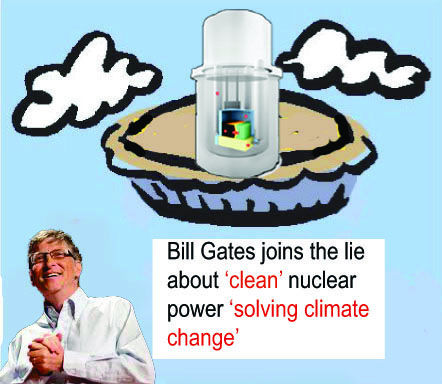 “………..“If everything goes perfectly,” Gates has told a Wall Street Journal conference, a demonstration fourth-generation design could be in place by 2022. “If everything continues to go perfectly,” that design could be replicated and built in many countries around the world by 2028.
“Big Ifs,” some might say, and a moderator suggested as much in response to Gates’ point.
In this month’s “This is Not Cool” video, Stanford University engineering professor Mark Z. Jacobson expresses reservations. His research looks at energy technologies in hand and not those he says “might be available 20, 30 years from now.” That research – as explained in an earlier related video – involves wind, solar, and water power.
To reach global carbon dioxide emissions targets, Jacobson says, 80 percent of the world’s energy infrastructure needs to be converted by 2030 and 100 percent by 2050.
Jacobson says exiting nuclear power may be cleaner than natural gas, but it is nine to 25 times more polluting per kilowatt hour generated than wind power in terms of carbon and air pollution. In addition, about 40 percent of that difference results from a need to continuously mine and refine uranium during the life time of the nuclear power plant. He says the “sole purpose” of two coal-fired power plants in the U.S. now is to refine uranium for nuclear energy and weapons.
While Gates expresses optimism about fourth-generation nuclear power technology and safety, Jacobson counters that 1.5 percent of all nuclear reactors built worldwide “have melted down seriously. So there’s a catastrophic risk problem.” A world wanting to go fully nuclear – and currently having 400 850-megawatt nuclear reactors – would need 16,000 850-megawatt reactors.
Jacobson points to relative costs as the key determinant. Unsubsidized current costs are about 12.5 cents per kilowatt hour; for wind 3.2 to 5 cents per kilowatt hour; for thin film solar 5 to 6 cents per kilowatt hour; and for utility-scale crystalline solar 5.2 to nearly 7 cents per kilowatt hour. Big differences, he says. http://www.yaleclimateconnections.org/2016/05/nuclear-power-part-of-the-alternative-energy-solution/Nuclear
International Atomic Energy Agency keen to teach kids how great is the nuclear industry
IAEA Invites Students to Learn Nuclear Science Through Play. IAEA, By Laura Gil, IAEA Office of Public Information and Communication, 12 May 16, Teachers have reached almost 10 000 students in four Asian countries through a guidebook designed to bring nuclear science and technology closer to young adults. The compendium, which is being tested by the IAEA and education experts from several countries, collects unique teaching strategies and materials to introduce science and technology in education systems.
By generating interest in science among young generations, the compendium aims at contributing to the sustainability of the nuclear industry and related technologies in the future. With populations growing, applications of nuclear technology rapidly expanding, and active nuclear scientists ageing, a new generation of professionals will soon need to step up……
In preparation for the curriculum, experts collected ideas from, for example, Japan, where teachers often organize field trips for students; India, where education centres convoke essay contests all across the country to create an interest in the student community; Israel, where the government has built a nuclear science park and museum; and Australia, where school children are invited to an exhibition centre in the Australian Nuclear Science and Technology Organisation already from an early age. https://www.iaea.org/newscenter/news/iaea-invites-students-to-learn-nuclear-science-through-play
So-called “charity” nuclear front group lobbies UK govt to fund Small Nuclear Reactors

 UK think tank urges nuclear innovation, World Nuclear News, 28 April 2016 A think tank [Alvin Weinberg Foundation] has urged the British government to spend money earmarked for nuclear R&D on ensuring that at least three advanced reactors including at least one small modular reactor (SMR) and a Generation IV design have completed regulatory assessment by the early 2020s.
Weinberg Next Nuclear’s report, Next Steps for Nuclear Innovation in the UK….. The latest study follows a report by the same foundation, The Need for Nuclear Innovation, published in November 2015. Later that month, the UK government announced plans to invest £250 million ($377 million) over five years in a nuclear R&D program to include a competition to identify the best value SMR for the country. The initial phase of the competition was launched in March, with a call for initial expressions of interest.
The first phase of the competition, which will also lead to the development of an SMR Roadmap to set out the policy framework and assess the potential for possible pathways for SMRs in the UK, will run until late 2016. Individual reactor designs will not be assessed at this stage……
At least one of the reactors supported should be a Generation IV design that could use fuel made from previously used reactor fuel and from the UK’s plutonium stocks. It suggests that SMRs and “micro-reactors” – reactors of less than 20 MWe capacity – will be cheaper to construct than large reactors….
Finally, the report proposes that UK regulators cooperate with their peers in other countries, citing US and Canadian regulatory practices where proposed reactor designs are discussed with developers before the formal regulatory process begins. It calls for a three-way collaboration to be established with the aim of establishing international standards for the safety of advanced reactors……
Weinberg Next Nuclear is part of the Alvin Weinberg Foundation. The report was prepared with the sponsorship of Terrestrial Energy, Urenco and Moltex Energy, with Weinberg Next Nuclear retaining sole editorial control.http://www.world-nuclear-news.org/NP-UK-think-tank-urges-nuclear-innovation-2804167.html
Russian nuclear corporation Rosatom to “educate” South Africans on benefits of nuclear power

 ROSATOM TO GROW PUBLIC AWARENESS ON NUCLEAR ENERGY, Eyewitness News, The Russian atomic energy company faces strong resistance from environmental lobbyists in SA. Rahima Essop 21 Apr 16 CAPE TOWN – Rosatom says it has to ‘gradually grow public awareness and acceptance’ about nuclear energy as the Russian atomic energy company faces strong resistance from environmental lobbyists and opposition politicians in South Africa.
Two organisations have challenged the legality of government’s proposed 9,600 MW nuclear build programme in court before Energy Minister Tina Joemat-Pettersson calls for quotes for the tender.
Rosatom is said to be on the inside track for the contract.
The Democratic Alliance (DA), meanwhile, is pushing for the project to be abandoned on the basis that it’s unaffordable and shrouded in secrecy.
Rosatom has billed nuclear as a cheap source of energy and a job-creating solution for the country.
The company, which is building 34 reactors across the globe, is hoping to influence South African perceptions about nuclear…….Rosatom has sponsored a press trip to Hungary. http://ewn.co.za/2016/04/21/Rosatom-to-gradually-grow-public-awareness-on-nuclear-energy
Blowing away the dishonest spin of the nuclear lobby against renewable energy

 Renewable energy versus nuclear: dispelling the myths http://www.theecologist.org/News/news_analysis/2987577/renewable_energy_versus_nuclear_dispelling_the_myths.html Mark Diesendorf 19th April 2016
Don’t believe the spurious claims of nuclear shills constantly doing down renewables, writes Mark Diesendorf. Clean, safe renewable energy technologies have the potential to supply 100% of the world’s electricity needs – but the first hurdle is to refute the deliberately misleading myths designed to promote the politically powerful but ultimately doomed nuclear industry.
Nuclear energy and renewable energy (RE) are the principal competitors for low-carbon electricity in many countries.
As RE technologies have grown in volume and investment, and become much cheaper, nuclear proponents and deniers of climate science have become deniers of RE.
The strategies and tactics of RE deniers are very similar to those of climate science deniers.
To create uncertainty about the ability of RE to power an industrial society, they bombard decision-makers and the media with negative myths about RE and positive myths about nuclear energy, attempting to turn these myths into conventional wisdom.
In responding to the climate crisis, few countries have the economic resources to expand investment substantially in both nuclear and RE. This is demonstrated in 2016 by the UK government, which is offering huge long-term subsidies to nuclear while severely cutting existing short-term subsidies to RE.
This article, a sequel to one busting the myth that we need base-load power stations such as nuclear or coal, examines critically some of the other myths about nuclear energy and RE. It offers a resource for those who wish to question these myths. The myths discussed here have been drawn from comments by nuclear proponents and RE opponents in the media, articles, blogs and on-line comments.
Myth 1: Base-load power stations are necessary to supply base-load demand. Continue reading
Who are the pro nuclear donors funding Center for Strategic and International Studies (CSIS)?
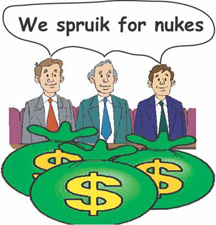 US Think Tank Urging Japan Keep Nuclear Funded By Japanese Govt & Nuclear Industry , Simply Info, April 12th, 2016 | “……The CSIS received over $500,000 from the Japanese government. …Japan is a top donor to CSIS. Only the UAE and US are included in that top donor category along with Japan.
Contributions over $200,000
Lockheed Martin Corporation
Northrop Grumman Corporation
Contributions over $100,000
Bechtel Corporation
General Dynamics Corporation
Mitsubishi Corporation
Nippon Keidanren
Raytheon
Contributions over $65,000
Marubeni Corporation
Rolls-Royce plc
Contributions over $35,000
Fluor Corporation
GE Foundation
Hitachi, Ltd.
ITOCHU Corporation
Mitsubishi Heavy Industries, Ltd.
Mitsui & Co., Ltd.
Contributions under $34,999
Chubu Electric Power Co., Inc.
E. I. du Pont de Nemours and Company
Électricité de France S.A.
Exelon Corporation
General Atomics
General Electric Company
Honeywell International, Inc.
Mitsubishi Hitachi Power Systems, Ltd.
Toshiba Corporation
URENCO USA http://www.fukuleaks.org/web/?p=15416
Disagreements in the nuclear shill camp – Patrick Moore versus Australia’s Ben Heard
Climate Science Denier Patrick Moore Under Attack From Fellow Nuclear Energy Advocates, DESMOG, 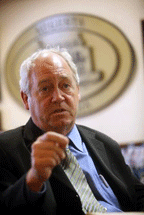 By Graham Readfearn • Thursday, April 7, 2016 Climate science
denialist Patrick Moore is all about “consensus building.” We know this because it says so on his biography at the think tank Frontier Centre for Public Policy.
And so, fresh from delivering a coal-funded talk in Brussels where he told the audience to “celebrate CO2”, the Canadian has been out doing a bit of that “consensus building” in his own unique way.
In recent days, Moore has accused respected climate scientist Ken Caldeira of “fakery”, called him a “jerk” and then told a fellow nuclear power advocate to “GFY”.
The nuclear advocate in question was Australian energy and climate consultant Ben Heard, who  had engaged Moore on social media. He’s written a blog about the exchange.
British environmentalist and author Mark Lynas, who is also pro-nuclear energy, weighed in too, describing Moore as “just a predictable right-wing anti-green contrarian”.
When DeSmog UK gave Moore the chance to respond to a story showing he had been paid by coal lobbyists to deliver a talk, his response was “bugger off”.
Who is Patrick Moore?
For those that don’t know, Patrick Moore is often described as a former senior member of Greenpeace, even though he left that organisation 30 years ago.
Since then, he has spent his time being an advocate for nuclear power, GM crops, forestry and, apparently, burning as much coal as you can get your hands on.
In a French television interview last year, Moore told a journalist that the pesticide glyphosate was not a carcinogen and was so safe, “you could drink a whole quart of it and it won’t hurt you”.
Moore was then immediately offered the chance to drink a glass by the interviewer, which he declined. “I’m not an idiot,” he said.
Moore is a long-time climate science denialist and claims, against all credible scientific institutions, that there is “no proof” that the extra CO2 in the atmosphere (about 40 per cent more than there was before the industrial revolution) is causing any global warming.
Acidification denial ……..http://www.desmogblog.com/2016/04/07/climate-science-denier-patrick-moore-under-attack-fellow-nuclear-energy-advocates
1 This Month



26 September – International Day for the Total Elimination of Nuclear Weapons


PLEASE OPPOSE HR 8255 AND S.3639 – bills would accelerate satellite deployment, with no environmental review or safeguards – https://ncstd5li.quorum.us/campaign/169331/
To see nuclear-related stories in greater depth and intensity – go to https://nuclearinformation.wordpress.com
-
Archives
- September 2026 (233)
- August 2026 (330)
- July 2026 (355)
- June 2026 (287)
- May 2026 (306)
- April 2026 (356)
- March 2026 (251)
- February 2026 (267)
- January 2026 (308)
- December 2025 (358)
- November 2025 (359)
- October 2025 (375)
-
Categories
- 1
- 1 NUCLEAR ISSUES
- business and costs
- climate change
- culture and arts
- ENERGY
- environment
- health
- history
- indigenous issues
- Legal
- marketing of nuclear
- media
- opposition to nuclear
- PERSONAL STORIES
- politics
- politics international
- Religion and ethics
- safety
- secrets,lies and civil liberties
- spinbuster
- technology
- Uranium
- wastes
- weapons and war
- Women
- 2 WORLD
- ACTION
- AFRICA
- Atrocities
- AUSTRALIA
- Christina's notes
- Christina's themes
- culture and arts
- Events
- Fuk 2022
- Fuk 2023
- Fukushima 2017
- Fukushima 2018
- fukushima 2019
- Fukushima 2020
- Fukushima 2021
- general
- global warming
- Humour (God we need it)
- Nuclear
- RARE EARTHS
- Reference
- resources – print
- Resources -audiovicual
- Weekly Newsletter
- World
- World Nuclear
- YouTube
-
RSS
Entries RSS
Comments RSS
 nuclear-news