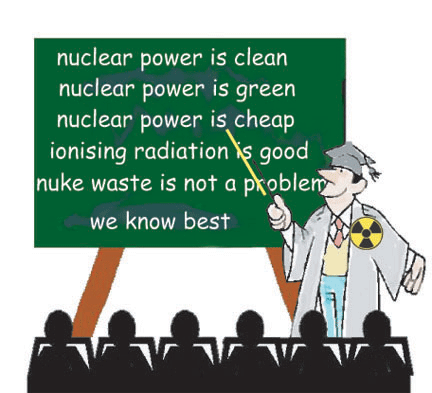
1986 “glossy safe” image of nuclear industry – still being spun today
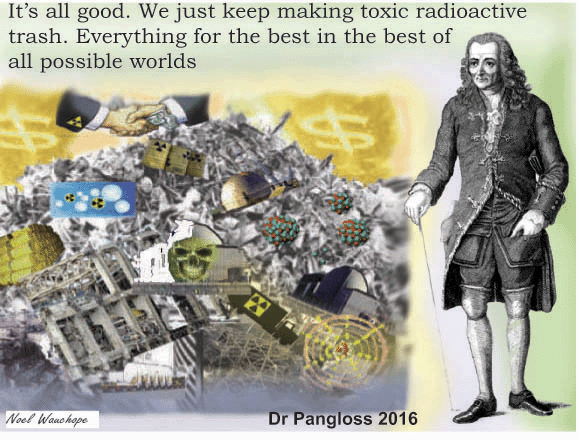
the long-term effects of low-level radiation exposure have consistently been downplayed, distorted or concealed by scientists, the nuclear industry and the government.
It seems that while the US and the USSR had a hard time cooperating on nuclear arms at that time, they had a tacit agreement to cover up each other’s nuclear power mistakes.
these facts, like all those about nuclear power and nuclear weapons testing, were kept secret and released only through the efforts of private citizens and a few courageous researchers and journalists.
At least 250,000 American troops were directly exposed to atomic radiation during the 17 years of bomb testing here and in the Pacific, but they have been totally ignored by the government and the Army.
There is little doubt that hundreds died and that countless others developed illnesses that led to death from various cancers, blood disorders and chronic body ailments. Today the government still rejects all claims for such illnesses.
The press also played a role in soothing public fears.
the US has led the world in setting examples of deliberate deceit, suppression of information and harassment of nuclear critics
Professionals, in order to perform their work, resist truth strongly if it calls the morality of their work into question. They sincerely believe they are helping humankind. In addition, scientific research involves so many uncertainties that scientists can, with an easy conscience, rationalize away dangers that are hypothetical or not immediately observable. They also have an intellectual investment if not a financial one in continuing their work as well as families to support, and nuclear science in particular has been endowed not only with government money and support but great status and prestige.
In order to perform professional work, one must not only believe one is doing good but must also rationalize the dangers. Indeed, with regard to ionizing radiation, this is quite easy inasmuch as the risks of radiation exposure at any level are statistical and not immediately manifested.
 Pro Nuclear Propaganda: How Science, Government and the Press Conspire to Misinform the Public http://www.lornasalzman.com/collectedwritings/pro-nuclear.html by Lorna Salzman Hunter College, Energy Studies program, 1986 After the Chernobyl nuclear reactor disaster in the Soviet Union, there was much finger-wagging in the US about the suppression of information there, and the purported differences in reactor design and safety requirements between Russia and the US, which made a similar accident here unlikely if not impossible Continue reading
Anti -science climate deniers and haters paid by industries
I could fill this newspaper with the names of Trump staffers who have emerged from such groups:
 Frightened by Donald Trump? You don’t know the half of it, Guardian, George Monbiot, 1 Dec 16 Many of his staffers are from an opaque corporate misinformation network. We must understand this if we are to have any hope of fighting back against them. Yes, Donald Trump’s politics are incoherent. But those who surround him know just what they want, and his lack of clarity enhances their power. To understand what is coming, we need to understand who they are. I know all too well, because I have spent the past 15 years fighting them.
I first encountered the machine when writing about climate change. The fury and loathing directed at climate scientists and campaigners seemed incomprehensible until I realised they were fake: the hatred had been paid for. The bloggers and institutes whipping up this anger were funded by oil and coal companies.
Among those I clashed with was Myron Ebell of the Competitive Enterprise Institute (CEI). The CEI calls itself a thinktank, but looks to me like a corporate lobbying group. It is not transparent about its funding, but we now know it has received $2m from ExxonMobil, more than $4m from a group called the Donors Trust (which represents various corporations and billionaires), $800,000 from groups set up by the tycoons Charles and David Koch, and substantial sums from coal, tobacco and pharmaceutical companies.
For years, Ebell and the CEI have attacked efforts to limit climate change, through lobbying, lawsuits and campaigns. An advertisement released by the institute had the punchline “Carbon dioxide: they call it pollution. We call it life.”
It has sought to eliminate funding for environmental education, lobbied against the Endangered Species Act, harried climate scientists and campaigned in favour of mountaintop removal by coal companies. In 2004, Ebell sent a memo to one of George W Bush’s staffers calling for the head of the Environmental Protection Agency to be sacked. Where is Ebell now? Oh – leading Trump’s transition team for the Environmental Protection Agency.
Charles and David Koch – who for years have funded extreme pro-corporate politics – might not have been enthusiasts for Trump’s candidacy, but their people were all over his campaign. Until June, Trump’s campaign manager was Corey Lewandowski, who like other members of Trump’s team came from a group called Americans for Prosperity (AFP).
This purports to be a grassroots campaign, but it was founded and funded by the Koch brothers. It set up the first Tea Party Facebook page and organised the first Tea Party events. With a budget of hundreds of millions of dollars, AFP has campaigned ferociously on issues that coincide with the Koch brothers’ commercial interests in oil, gas, minerals, timber and chemicals.
In Michigan, it helped force through the “right to work bill”, in pursuit of what AFP’s local director called “taking the unions out at the knees”. It has campaigned nationwide against action on climate change. It has poured hundreds of millions of dollars into unseating the politicians who won’t do its bidding and replacing them with those who will.
I could fill this newspaper with the names of Trump staffers who have emerged from such groups: people such as Doug Domenech, from the Texas Public Policy Foundation, funded among others by the Koch brothers, Exxon and the Donors Trust; Barry Bennett, whose Alliance for America’s Future (now called One Nation) refused to disclose its donors when challenged; and Thomas Pyle, president of the American Energy Alliance, funded by Exxon and others. This is to say nothing of Trump’s own crashing conflicts of interest. Trump promised to “drain the swamp” of the lobbyists and corporate stooges working in Washington. But it looks as if the only swamps he’ll drain will be real ones, as his team launches its war on the natural world……… https://www.theguardian.com/commentisfree/2016/nov/30/donald-trump-george-monbiot-misinformation#comment-88633094
Nuclear propagandist James Conca shows the industry how to peddle its lies
From Media To Nuclear Power, Messaging Trumps Reality, Forbes, James Conca , 22 Nov 16
“……the nuclear industry, along with most others, must get with the program and learn to define itself first, control the message, and disrupt the nonsense espoused by its detractors (HuffPost). It must tell its story in terms of job creation and lucrative careers, in terms of lights and heating and electricity and what that means to modern societies, or to eradicating poverty. It must speak in terms of innovation, inventions and technology creation. Above all, the industry must wrest control of the green message by taking on its very leadership since nuclear produces twice as much clean energy as all other clean energy sources combined.

And it must do this on social media. Sites like Northwest Clean Energy, Nuke Power Talk, Atomic Insights, the World Nuclear Association, the Nuclear Energy Institute, Mothers for Nuclear, and Nuclear Street, among others, are excellent sources of good, readily-available, easy-to-understand information on nuclear power along with most other forms of power. But they have difficulty reaching millions of people. Anti-nuclear activists are more numerous and their messaging doesn’t even have to be correct. They reach millions of people.
More than ever before, Americans need to know what is real, and what is in their best interest. In the cacophony of messaging in the present world, it is more and more difficult to get the truth to the public. Or to have them recognize it…..”
Nuclear lobby renews its pretense that it is “clean and green”
Todd Allen, senior visiting fellow for a Washington think tank called Third Way, said the industry 
needs to remake itself because “nuclear energy stands at a crossroads.”
In a separate event last week, Tim Judson, Nuclear Information and Resource Service executive director, discussed findings of a report he authored called “Too Big to Bail Out,” in which he argued that subsidizing the nuclear industry will have deep consequences.
Peter Bradford, a former U.S. Nuclear Regulatory Commission board member and a former state utility regulator in Maine and New York, said New York’s bailout is “the clearest example of a state capitulating” to the industry.
Nuclear industry looks to reshape image The Blade By | BLADE STAFF WRITER,Nov. 13, 2016 the U.S. nuclear industry is trying harder than ever to market itself as an irreplaceable ally in the war against climate change.
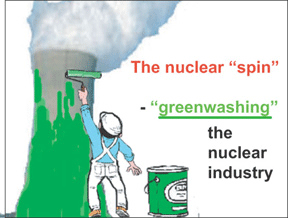
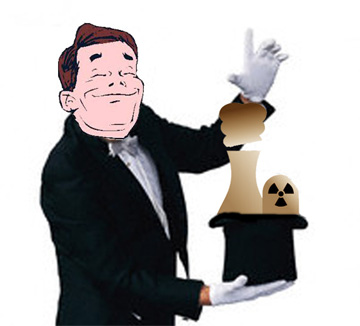 It is eager to get going on a new generation of plants that are smaller, leaner, faster, easier to manage,
and more attractive to private investors.
At stake could be the degree to which electricity ratepayers in Ohio and other states end up subsidizing the nuclear industry.
“There’s an important and continuing role for nuclear power in achieving these goals,” Kenneth N. Luongo, president of the Washington-based Partnership for Global Security, said at the start of a recent discussion between his group and the nuclear industry’s chief lobbying group on Capitol Hill, the Nuclear Energy Institute.
The Partnership for Global Security, originally incorporated in 1997 as the Russian-American Nuclear Security Advisory Council, is a think tank that promotes the convergence of 21st-century security, technology, and economic issues that affect the global nuclear industry. It has been working with the NEI on an effort called the Global Nexus Initiative, which promotes stronger public-private collaboration on nuclear issues.
“This is not a one-country issue,” Mr. Luongo said.
The NEI wants the public to reconsider how it views nuclear power ……
The NEI’s marketing campaign, though, took another hit in late October when Omaha Public Power announced it is giving up on its Fort Calhoun nuclear plant.
It is the seventh site in three years where a utility said it can no longer justify high operation costs.
Chicago-based Exelon, which owns the most nuclear plants, announced in June it will shut its single-unit Clinton and its twin-unit Quad Cities plants in Illinois in 2017 and 2018, respectively, because of poor economics.
Although Akron-based FirstEnergy Corp. has said repeatedly that its Davis-Besse and Perry plants in Ohio are safe from early closure, Davis-Besse appeared on another list of at-risk plants in a Nov. 3 report issued by the Nuclear Information and Resource Service, an anti-nuclear group in Takoma Park, Md.
Three years ago, Davis-Besse was one of several plants cited at-risk for early closure in a Vermont Law School study. FirstEnergy’s chief executive officer, Charles “Chuck” Jones, said in a conference call with analysts earlier this month that the utility giant is undertaking a 12 to 18-month “strategic review” of its competitive generation business that could lead to selling off as many as 13 power plants, including Davis-Besse and plants at its other two nuclear complexes. The latter are the Perry nuclear plant east of Cleveland, and the twin-reactor Beaver Valley nuclear complex west of Pittsburgh.
“The fact is, competitive generation is weighing down the rest of the company,” Mr. Jones said. “We do not think competitive generation is a good fit.”
Though showing a profit for its third quarter, FirstEnergy lost millions of dollars during the first nine months of 2016 and expects to end the year with a loss as well.
“We are at a crossroads,” Mr. Jones said. “We have to make some tough decisions.”
Rate request
In a highly contentious rate request argued for months before the Public Utilities Commission of Ohio, FirstEnergy originally sought a guaranteed cash flow of up to 15 years to ensure the viability of Davis-Besse and the utility’s massive coal-fired Sammis plant in southern Ohio.
Last month, after the Federal Energy Regulatory Commission struck down a modified plan, state regulators unanimously agreed to let FirstEnergy impose $132.5 million a year in new surcharges on its 1.9 million customers over the next three years. That comes to about $3 more a month for a typical residential customer. The deal is substantially less than FirstEnergy’s attempted compromise for an eight-year deal at $558 million per year for a total of $4.5 billion.
Critics have decried each proposal as a bailout, while the utility argued the money is necessary to help stabilize it.
But Ohio’s handling of FirstEnergy requests has been watched closely by other states which are undecided about the degree to which they should support nuclear power.
California, Mr. Luongo noted, has taken the position of gradually phasing out its nuclear plants, while New York decided late this summer to spend $7.6 billion over 12 years to ensure continued operation of three upstate nuclear plants……
There isn’t any uniformity regarding this issue at the moment,” Mr. Luongo said. “The market seems to be distorted, in that it is disincentivizing nuclear power.”
The discussion focused on the mix of old and new: How an investment in advanced nuclear reactors that are smaller but more efficient than today’s existing fleet could bring back the nuclear industry …..
The hope is to achieve better economies of scale with advanced nuclear reactors, standardized designs, greater involvement from private investors, and global partners.
“They’re unlikely to be wholly government financed,” Everett Redmond, NEI fuel cycle and technology policy senior director, said. “It’s key to be able to export this technology.”
Todd Allen, senior visiting fellow for a Washington think tank called Third Way, said the industry needs to remake itself because “nuclear energy stands at a crossroads.”
“Nuclear energy must evolve to keep up with changes in the energy sector,” he said……
In a separate event last week, Tim Judson, Nuclear Information and Resource Service executive director, discussed findings of a report he authored called “Too Big to Bail Out,” in which he argued that subsidizing the nuclear industry will have deep consequences.
He said his research shows half of the current fleet of nuclear plants could be uneconomical as early as 2020.
The nation should invest in other technologies instead of “obsolete infrastructure,” Mr. Judson said.
“Renewable energy and efficiency can be done for less,” he said.
Peter Bradford, a former U.S. Nuclear Regulatory Commission board member and a former state utility regulator in Maine and New York, said New York’s bailout is “the clearest example of a state capitulating” to the industry.
Contact Tom Henry at: thenry@theblade.com, 419-724-6079, or via Twitter @ecowriterohio. http://www.toledoblade.com/Energy/2016/11/13/Nuclear-industry-looks-to-reshape-image-It-can-help-meet-carbon-reduction-goals-but-can-t-compete-on-cost.html
Australia’s pivotal role in the global nuclear lobby’s pitch for survival
So – the Australian public dreams on – preoccupied with the Melbourne Cup and other sporting events. And the global nuclear lobby continues its machinations. It would be such a strong selling point, to be able to tell South Asian countries that they can go ahead with nuclear power, as Australia will take out the radioactive trash.
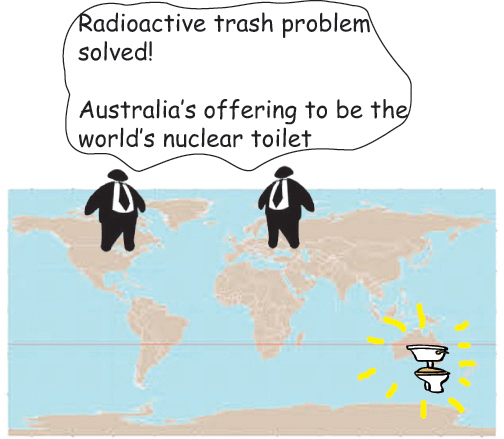
The machinations of the global nuclear lobby http://readersupportednews.org/pm-section/27-27/40006-the-machinations-of-the-global-nuclear-lobby-qdown-underq Noel Wauchope , 31 October 2016
Australia has been pretty much of a forgotten player in the global nuclear “renaissance”. Not any more. The big nuclear players – USA, Russia, Canada, France, China , Japan South Korea are busily marketing nuclear technology to every other country that they can. Strangely enough little ole non-nuclear Australia, (population 23 million) has a starring role to play in all this.
You see, the global nuclear lobby’s problem is – what to do with the radioactive wastes? I know that the new geewhiz guys and gals are pushing hard for Generation IV reactors that will “eat the wastes”. The trouble is – there is an awful lot of the stuff. World total of high level radioactive wastes was estimated at 250,000 tonnes in 2010 . There must be quite a bit more by now. The other trouble is that even the most geewhiz of the as yet non- existent Gen IV nuclear reactors still would leave a smaller but highly toxic volume of radioactive trash, which would still require disposal.
This leads to a serious marketing issue. If countries such as USA, Japan, Canada, South Korea, are still having trouble dealing with their own domestic accumulation of nuclear waste, how can they persuasively sell nuclear reactors to Asian, Middle Eastern and African countries? The waste problem must be solved!
The wizards of the global nuclear lobby have come up with what they see as the perfect answer. A far away land, with lots of space that’s owned by “unimportant” indigenous people, could import the wastes, and thus remove the problem. It’s a sort of variant on the old “toilet way down the back”. Continue reading
A “nonsense” paper accepted for International Conference on Atomic and Nuclear Physics
The International Conference on Atomic and Nuclear Physics will be held on 17-18 November in Atlanta, Georgia,
 Nonsense paper written by iOS autocomplete accepted for conference New Zealand professor asked to present his work at US event on nuclear physics despite it containing gibberish all through the copy, Guardian, Elle Hunt, 22 Oct 16 A nonsensical academic paper on nuclear physics written only by iOS autocomplete has been accepted for a scientific conference.
Christoph Bartneck, an associate professor at the Human Interface Technology laboratory at the University of Canterbury in New Zealand, received an email inviting him to submit a paper to the International Conference on Atomic and Nuclear Physics in the US in November.
“Since I have practically no knowledge of nuclear physics I resorted to iOS autocomplete function to help me writing the paper,” he wrote in a blog post on Thursday. “I started a sentence with ‘atomic’ or ‘nuclear’ and then randomly hit the autocomplete suggestions.
“The text really does not make any sense.”
“The atoms of a better universe will have the right for the same as you are the way we shall have to be a great place for a great time to enjoy the day you are a wonderful person to your great time to take the fun and take a great time and enjoy the great day you will be a wonderful time for your parents and kids,” is a sample sentence from the abstract.
It concludes: “Power is not a great place for a good time.”
Bartneck illustrated the paper – titled, again through autocorrect, “Atomic Energy will have been made available to a single source” – with the first graphic on the Wikipedia entry for nuclear physics.
He submitted it under a fake identity: associate professor Iris Pear of the US, whose experience in atomic and nuclear physics was outlined in a biography using contradictory gender pronouns.
The nonsensical paper was accepted only three hours later, in an email asking Bartneck to confirm his slot for the “oral presentation” at the international conference.
“I know that iOS is a pretty good software, but reaching tenure has never been this close,” Bartneck commented in the blog post. He did not have to pay money to submit the paper, but the acceptance letter referred him to register for the conference at a cost of US$1099 (also able to be paid in euros or pounds) as an academic speaker.
The International Conference on Atomic and Nuclear Physics will be held on 17-18 November in Atlanta, Georgia, and is organised by ConferenceSeries: “an amalgamation of Open Access Publications and worldwide international science conferences and events”, established in 2007…….. https://www.theguardian.com/science/2016/oct/22/nonsense-paper-written-by-ios-autocomplete-accepted-for-conference
Big nuclear promotion to Asian schookids,by International Atomic Energy Agency
 Dr Paterson highlighted the importance of changing the conversation around nuclear issues through both outreach and education to address the knowledge gap and a lack of understanding that exists in society……
“People’s awareness has to be raised about the benefits of nuclear technology for health, the environment and important research,” said Dr Paterson.
Inspiring tomorrow’s scientists: The IAEA presents a new nuclear science and technology educational resource package for secondary schools,International Atomic Energy Agency 30 September 2016 “…… a new educational resource package developed by the IAEA in partnership with education and communication experts from around the world aims to answer. The Compendium of Resources and Activities on Nuclear Science and technology for Secondary School Teachers and Students, presented this week at a side event entitled ‘Introducing Nuclear Science and Technology in Secondary Schools’ on the margins of the 60th IAEA General Conference, aims to make nuclear science more interesting and attractive to students, and to encourage young people to enter the fields of nuclear science and technology……. we need to ensure that the nuclear knowledge is passed on to the next generations. This project is an opportunity for the youth, for developing countries, for women! ” said Ms Najat Mokhtar, Director of the IAEA’s Division for Asia and the Pacific in her opening statement to the side event……
engaging their interest while still in high school is key to ensuring a cohort of students and graduates interested in pursuing careers as scientists, and ready to take on the challenge of developing nuclear knowledge and capacity in their countries……
“In the Philippines, 46 Science Department Heads and around 200 teachers were trained by IAEA experts. ……..Over 900 high school teachers and 10,000 high-school students benefitted from the pilot project. Many of the teachers who received training from IAEA experts in turn trained other teachers back in their countries. …….
Dr Adrian Paterson, Chief Executive Officer at the Australian Nuclear Science and Technology Organisation (ANSTO) and Dr Takeshi Iimoto, Associate Professor at the University of Tokyo, who had both provided expert advice to the preparation of the Compendium, shared their experience and talked about some of the ideas that they had contributed. Dr Paterson highlighted the importance of changing the conversation around nuclear issues through both outreach and education to address the knowledge gap and a lack of understanding that exists in society……
“People’s awareness has to be raised about the benefits of nuclear technology for health, the environment and important research,” said Dr Paterson.
Background
The pilot Compendium initiative was successfully completed under a regional technical cooperation project RAS0065 supported by the Department of Nuclear Sciences and Applications and the Department of Technical Cooperation. A follow-up regional project for Asia and the Pacific is being prepared for 2018–2020 to expand and sustain nuclear science and technology information, education and communication among secondary school students and teachers in the region. https://www.iaea.org/technicalcooperation/Home/Highlights-Archive/Archive-2016/0930016-GC-comp.html
Prof Geraldine Thomas promoting nuclear industry in South Australia, but no always accurate
Steve Dale Nuclear Fuel Cycle Watch South Australia, 1 Oct 16 In Geraldine Thomas’s recent talk she showed dosimeter data from students in Japan, but she didn’t make it clear that the students were kept out of the “Restricted zone” (funny about that). But if you read the paper, it mentions that a teacher went into the zone for 2 hours (to Okuma) and had readings of 5 microSieverts per hour. Thought I would show how the graph would look with this data included. (Note: Okuma is not the “hottest” area, some areas in the restricted zone are over 20 microSieverts per hour) [relevant graph can be seen on original on Facebook] Facebook https://www.facebook.com/groups/1021186047913052/
Measurement and comparison of individual external doses of high-school students living in Japan, France, Poland and Belarus—the ‘D-shuttle’ project— N Adachi1, V Adamovitch2, Y Adjovi3, K Aida4, H Akamatsu5, S Akiyama6, A Akli7, A Ando8, T Andrault9,H Antonietti3 Show full author list 27 November 2015 , ,
Twelve high schools in Japan (of which six are in Fukushima Prefecture), four in France, eight in Poland and two in Belarus cooperated in the measurement and comparison of individual external doses in 2014. In total 216 high-school students and teachers participated in the study. Each participant wore an electronic personal dosimeter ‘D-shuttle’ for two weeks, and kept a journal of his/her whereabouts and activities. The distributions of annual external doses estimated for each region overlap with each other, demonstrating that the personal external individual doses in locations where residence is currently allowed in Fukushima Prefecture and in Belarus are well within the range of estimated annual doses due to the terrestrial background radiation level of other regions/countries………..
A large value of 5 μSv h−1 was recorded for one participant from Fukushima high school (figure10 top) [on orioginal]. This was when this person (teacher) visited Okuma town in the restricted zone, close to the Fukushima Dai-ichi Nuclear Power Plant (figure 1) for research purposes. For two hours, 15:00 and 16:00, high hourly doses were recorded, and this coincided with the activity journal entry of this person……..http://iopscience.iop.org/article/10.1088/0952-4746/36/1/49
Professor Geraldine Thomas and nuclear scientific misconduct
 This is part of a very important article, in which Dr Baverstock thoroughly refutes the claims that Professor Geraldine Thomas’ made in a BBC interview, about Fukushima ionising radiation not being much to worry about. The BBC has since withdrawn her statements.
But that hasn’t stopped the South Australian government bringing Thomas out here to spin her stuff, in  support of Weatherill’s push for SA as the global nuclear waste dump.
Thomas’ comments in the video were insulting to the intelligence of the Japanese authorities and their advisors, and extremely ill-judged from a professional radiological point of view. The BBC was right to withdraw her comments as incorrect.
 ‘This was quite clearly scientific misconduct’ by Dr Keith Baverstock, Fissiononline 23 Sept 16 . I will take the BBC interview first. In this interview Thomas questions the whole basis of the Japanese response to the Fukushima accident in terms of its evacuation policy. Is one to imagine that those authorities and the Japanese scientific establishment are so stupid as not to recognise that there is no risk entailing living in those areas?
The internationally agreed public dose limit is 1 mSv per year in addition to approximately 2 mSv per year from natural background radiation. The single measurement made in that television interview indicate 2.8 microsieverts per hour, which is close to 25 mSv per year. That includes the natural background doses o at that point the dose rate is at least 20 times the public dose limit.
Surely Thomas can recognise that this must demand serious consideration by the appropriate authorities as to the safety of those who would live there? However, to determine the safety or otherwise of living there it would be necessary to do a comprehensive survey of the area. My guess is that five years after the deposition of the radioactivity there will be a high degree of variability in measurements: some may be less in the measurement made on the programme, but others more and perhaps considerably more. Furthermore, if one were looking at a situation, for example in the UK, one would have to ensure that the most exposed person could not receive more that 1 mSv per annum. Therefore promises arguments that being indoors for example would reduce the dose rate are not valid in the context of the radiological protection of the public in general.
Whether a special dispensation applies when determining the return of evacuees to their homes is a question that I believe needs to be discussed, because as far as I’m aware the current situation in Japan is unique. Furthermore, we are not talking about a total dose of 20 mSv for someone who returns to live in this village. In many such villages remedial measures to reduce the dose rate are being taken, but only for the main “living areas”. Straying beyond these areas could lead to much higher doses, and eating natural produce, mushrooms etc, to even higher doses.
In the light of these considerations, Thomas’ comments in the video were insulting to the intelligence of the Japanese authorities and their advisors, and extremely ill-judged from a professional radiological point of view. The BBC was right to withdraw her comments as incorrect if that is indeed what they did.
Watching the video I am inclined to believe that Thomas is being disingenuous when she says she made a numeric al error when calculating the dose from the interviewer’s measurement. She made no attempt to do any kind of calculation: the figure she cited was something she clearly had in mond at the outset: she was delivering propaganda for the nuclear industry
That in the context in which the interview took place and the way in which she was introduced to the audience, is clearly scientific misconduct. One must also say here that the ninterviewer must have been, for an experienced journalist, amazingly gullible to have allowed the interview to be broadcast……….. https://issuu.com/fission/docs/fissionline_44
Dr Keith Baverstock led the Radiation Programme at the World Health Organisation’s Regional Office for Europe from 1991 to 2003.
South Africa’s Eskom makes unreliable prediction of its future cash reserves
Eskom’s R150 billion cash-reserves claim is wishful thinking – Natahsa Mazzone http://www.politicsweb.co.za/politics/eskoms-r150-billion-cashreserves-claim-is-wishful- Natasha Mazzone | 23 September 2016
DA says power utility’s profit of R4,6 billion a far cry from the R15 billion need a year to make up amount. The claim by Head of Generation for Eskom, Mr Matshela Koko, that Eskom could pay for the nuclear build programme by using cash-reserves, which he indicated could be R150 billion in 10 years’ time, is wishful thinking.
Eskom recorded a R4.6 billion profit in the 2015/16 financial year, a far cry from the R15 billion in profits it would need to generate consistently for the next 10 years to make up R150 billion.
Considering that by Eskom’s admission electricity demand is down, coupled with economic growth projected at a mere 0.6%, this raises serious questions about the assumptions underlying their projections.
I will therefore be submitting parliamentary questions to Eskom to find out how they intend to generate these massive cash reserves.
The validity of their projections notwithstanding, spending any cash reserves on a nuclear build program would be financially irresponsible. Eskom currently owes its creditors R322 billion underwritten by R350 billion in government guarantees. The entity should rather use excess cash reserves to decrease these liabilities.
Moreover, the fact that Eskom believe they can generate these massive profits whilst pushing for well-above inflation tariff increases on electricity, should be a slap in the face of the majority of poor citizens in our country. Energy and electricity costs are eating into their limited budget and now with these tariff increases, their pockets will be hurting even more.
The big question is why Eskom needs to be building nuclear in the first place when future electricity shortages would be better addressed by cheaper and more sustainable renewable and gas projects. With advancements in storage and battery technologies, these would be the better alternative by 2035.
The Minister is the only person with the prerogative to choose nuclear over any other form of energy, in this vein Mr Koko is overstepping his fiduciary duties to even suggest that Eskom would be investing in Nuclear.
In the context of its massive debt, and repeated requests for above inflation tariff increases, it is irrational to utilise any cash reserves in pursuit of the much maligned nuclear “wonder” programme and once again calls the motivation for the nuke deal into question.
Issued by Natasha Mazzone, DA Shadow Minister of Public Enterprises, 23 September 2016
A reminder that the World Health Organisation is subservient to International Atomic Energy Agency
Dissolving the WHO-IAEA agreement is a necessary first step to restoring the WHO’s independence to research the true health impacts of ionising radiation and publish its findings.
it is time the WHO regained the freedom to impart independent, objective advice on the health risks of radiation.
 Toxic link: the WHO and the IAEA, https://www.theguardian.com/commentisfree/2009/may/28/who-nuclear-power-chernobyl Oliver Tickell, A 50-year-old agreement with the IAEA has effectively gagged the WHO from telling the truth about the health risks of radiation. F
Fifty years ago, on 28 May 1959, the World Health Organisation‘s assembly voted into force an obscure but important agreement with theInternational Atomic Energy Agency – the United Nations “Atoms for Peace” organisation, founded just two years before in 1957. The effect of this agreement has been to give the IAEA an effective veto on any actions by the WHO that relate in any way to nuclear power – and so prevent the WHO from playing its proper role in investigating and warning of the dangers of nuclear radiation on human health.
The WHO’s objective is to promote “the attainment by all peoples of the highest possible level of health”, while the IAEA’s mission is to “accelerate and enlarge the contribution of atomic energy to peace, health and prosperity throughout the world”. Although best known for its work to restrict nuclear proliferation, the IAEA’s main role has been to promote the interests of the nuclear power industry worldwide, and it has used the agreement to suppress the growing body of scientific information on the real health risks of nuclear radiation.
Under the agreement, whenever either organisation wants to do anything in which the other may have an interest, it “shall consult the other with a view to adjusting the matter by mutual agreement”. The two agencies must “keep each other fully informed concerning all projected activities and all programs of work which may be of interest to both parties”. And in the realm of statistics – a key area in the epidemiology of nuclear risk – the two undertake “to consult with each other on the most efficient use of information, resources, and technical personnel in the field of statistics and in regard to all statistical projects dealing with matters of common interest”.
The language appears to be evenhanded, but the effect has been one-sided. For example, investigations into the health impacts of the Chernobyl nuclear accident in Ukraine on 26 April 1986 have been effectively taken over by IAEA and dissenting information has been suppressed. The health effects of the accident were the subject of two major conferences, in Geneva in 1995, and in Kiev in 2001. But the full proceedings of those conferences remain unpublished – despiteclaims to the contrary by a senior WHO spokesman reported in Le Monde Diplomatique.
Meanwhile, the 2005 report of the IAEA-dominated Chernobyl Forum, which estimates a total death toll from the accident of only several thousand, is widely regarded as a whitewash as it ignores a host of peer-reviewed epidemiological studies indicating far higher mortality and widespread genomic damage. Many of these studies were presented at the Geneva and Kiev conferences but they, and the ensuing learned discussions, have yet to see the light of day thanks to the non-publication of the proceedings.
The British radiation biologist Keith Baverstock is another casualty of the agreement, and of the mindset it has created in the WHO. He served as a radiation scientist and regional adviser at the WHO’s European Office from 1991 to 2003, when he was sacked after expressing concern to his senior managers that new epidemiological evidence from nuclear test veterans and from soldiers exposed to depleted uranium indicated that current risk models for nuclear radiation were understating the real hazards.
Now a professor at the University of Kuopio, Finland, Baverstock finally published his paper in the peer-reviewed journal Medicine, Conflict and Survival in April 2005. He concluded by calling for “reform from within the profession” and stressing “the political imperative for freely independent scientific institutions” – a clear reference to the non-independence of his former employer, the WHO, which had so long ignored his concerns.
Since the 21st anniversary of the Chernobyl disaster in April 2007, a daily “Hippocratic vigil” has taken place at the WHO’s offices in Geneva, organised byIndependent WHO to persuade the WHO to abandon its the WHO-IAEA Agreement. The protest has continued through the WHO’s 62nd World Health Assembly, which ended yesterday, and will endure through the executive board meeting that begins today. The group has struggled to win support from WHO’s member states. But the scientific case against the agreement is building up, most recently when the European Committee on Radiation Risk (ECRR) called for its abandonment at its conference earlier this month in Lesvos, Greece.
At the conference, research was presented indicating that as many as a million children across Europe and Asia may have died in the womb as a result of radiation from Chernobyl, as well as hundreds of thousands of others exposed to radiation fallout, backing up earlier findings published by the ECRR in Chernobyl 20 Years On: Health Effects of the Chernobyl Accident. Delegates heard that the standard risk models for radiation risk published by the International Committee on Radiological Protection (ICRP), and accepted by WHO, underestimate the health impacts of low levels of internal radiation by between 100 and 1,000 times – consistent with the ECRR’s own 2003 model of radiological risk (The Health Effects of Ionising Radiation Exposure at Low Doses and Low Dose Rates for Radiation Protection Purposes: Regulators’ Edition). According to Chris Busby, the ECRR’s scientific secretary and visiting professor at the University of Ulster’s school of biomedical sciences:
“The subordination of the WHO to IAEA is a key part of the systematic falsification of nuclear risk which has been under way ever since Hiroshima, the agreement creates an unacceptable conflict of interest in which the UN organisation concerned with promoting our health has been made subservient to those whose main interest is the expansion of nuclear power. Dissolving the WHO-IAEA agreement is a necessary first step to restoring the WHO’s independence to research the true health impacts of ionising radiation and publish its findings.”
Some birthdays deserve celebration – but not this one. After five decades, it is time the WHO regained the freedom to impart independent, objective advice on the health risks of radiation.
Coal lobby is urged to copy tactics of the tobacco lobby!
 Here we go again: Fossil fuel industry takes a play from Big Tobacco’s playbook. http://www.dailyclimate.org/t/1692193038704125011 August 31, 2016 by Sen. Sheldon Whitehouse (D-R.I.)
Last year, coal mining executives attending the annual meeting of the Rocky Mountain Coal Mining Institute were treated to a presentation on the future of American mining titled:“Survival Is Victory: Lessons From the Tobacco Wars.” As the title implies, the presentation laid out a path for the fossil fuel industry to weather a barrage of lawsuits and new safety and health regulations, modeled on the efforts of the tobacco industry in the 90s and early 2000s. (See John Schwartz’s story in The New York Times.)
Richard Reavey, the Cloud Peak Energy vice president who delivered the presentation, described the similarities between what Big Tobacco went through and the challenges facing coal today as “remarkable and eerie.” (We should take his word for it. Before working for Cloud Peak, a mining company, Reavey was an executive at tobacco giant Philip Morris for 17 years, according to his LinkedIn profile.) His advice to the coal execs: do what tobacco did and “cut a deal while we are still relevant.” After all, “a much more heavily regulated tobacco industry is still viable and profitable.”
Ironically, Reavey’s presentation on these similarities between tobacco and fossil fuel strategies has a much deeper parallel.
For decades, cigarette makers hid from the public and from policymakers the scientific evidence they had of their product’s dangers. The Justice Department brought, and ultimately won, a civil racketeering lawsuit against the major tobacco companies for carrying out that fraud. Today, researchers often compare this tobacco fraud on the public to the fossil fuel industry’s suppression of its research on the dangers of carbon pollution.
Dr. Michael Mann of Pennsylvania State University has written about the pattern followed by both industries: hiring their own scientists to churn out favorable research; creating (and bankrolling) front groups to sow doubt in the public debate about scientific consensus, while obscuring the hand of the industry; and even attacking and harassing individual scientists whose work may discredit the industry propaganda. Professor Mann himself has been the target of vexatious “investigations” and efforts to intimidate and harass him, including death threats—just for producing peer-reviewed academic research shedding light on the effects of increasing concentrations of carbon dioxide in the atmosphere.
Dr. Robert Brulle of Drexel University has documented an intricate propaganda web of climate denial, with over one hundred organizations, from industry trade associations to conservative think tanks to plain old phony front groups. The purpose of this sophisticated denial apparatus, he says, is “a deliberate and organized effort to misdirect the public discussion and distort the public’s understanding of climate.” These are tactics that were developed, tested, and proven effective by the tobacco industry—and in some cases the very same front groups were involved.
Public lawyers demanded that the “tobacco files”” behind this fraud be made a public record. A recentanalysis by the Center for International Environmental Law of millions of documents from these tobacco industry archives reveals close collaboration over the better part of a century between cigarette manufacturers and oil producers on research, lobbying, and public relations. The new bookPoison Tea, by Climate Nexus Executive Director Jeff Nesbit, chronicles this same relationship.
In the book and film Merchants of Doubt, Drs. Naomi Oreskes and Erik Conway identify spin doctors, spokespeople and even scientists-for-hire who were involved in the tobacco and now fossil fuel campaigns. Not only has the energy industry recycled tobacco’s strategies and front groups, it’s redeploying some of the same personnel, like Mr. Reavey, the coal convention presenter.
Sharon Eubanks, lead counsel on behalf of the United States in United States v. Phillip Morris, the federal tobacco litigation, has said she believes the government could make a case against fossil fuel producers very similar to the one she led against tobacco under federal civil racketeering laws. That’s not just because coal companies are openly taking cues from tobacco’s legal and regulatory fight. It’s because mounting evidence indicates that, like tobacco, the fossil fuel industry may have engaged in a deliberate, protracted fraud to mislead the public, to protect their profits, to the peril of us all.
Nuclear industry started the now sophisticated practice of corporate greenwashing
The troubling evolution of corporate greenwashing The term “greenwashing” was coined in the 1980s to describe outrageous corporate environmental claims. Three decades later, the practice has grown vastly more sophisticated, Guardian, Bruce Watson, 21 Aug 16, In the mid-1980s, oil company Chevron commissioned a series of expensive television and print ads to convince the public of its environmental bonafides. Titled People Do, the campaign showed Chevron employees protecting bears, butterflies, sea turtles and all manner of cute and cuddly animals.
The commercials were very effective – in 1990, they won an Effie advertising award, and subsequently became a case study at Harvard Business school. They also became notorious among environmentalists, who have proclaimed them the gold standard of greenwashing – the corporate practice of making diverting sustainability claims to cover a questionable environmental record.
The term greenwashing was coined by environmentalist Jay Westerveld in 1986, back when most consumers received their news from television, radio and print media – the same outlets that corporations regularly flooded with a wave of high-priced, slickly-produced commercials and print ads. The combination of limited public access to information and seemingly unlimited advertising enabled companies to present themselves as caring environmental stewards, even as they were engaging in environmentally unsustainable practices.
But greenwashing dates back even earlier. American electrical behemoth Westinghouse’s nuclear power division was a greenwashing pioneer. Threatened by the 1960’s anti-nuclear movement, which raised questions about its safety and environmental impact, it fought back with a series of ads proclaiming the cleanliness and safety of nuclear power plants. One, featuring a photograph of a nuclear plant nestled by a pristine lake, proclaimed that “We’re building nuclear power plants to give you more electricity,” and went on to say that nuclear plants were “odorless […] neat, clean, and safe”……
One shift has been outreach. Many companies are now working to engage customers in their sustainability efforts, even as their core business model remains environmentally unsustainable. The Home Depot and Lowes, for example, both encourage customers to do their part by offering onsite recycling for several products, including compact fluorescent lights and plastic bags. Meanwhile, they continue to sell billions of dollars per year worth of environmentally damaging products, such as paints that are loaded with toxic ingredients and which release noxious fumes.
“It’s misdirection, and it’s intended to shift the customer’s focus from a company’s appalling behaviors to something that’s peripheral,” Ballard says.
The bottled water conundrum
The water industry trades heavily on images of rugged mountains and pristine lakes to sell its products. And many companies – Nestle, in particular – spend millions of dollars trying to convince the public that their bottled water isn’t only good to drink, but is also good for the planet. Over the past few years, the bottled water giant has claimed that its Eco-Shape bottle is more efficient, that itsResource recycled plastic bottle is more environmentally responsible and that its use of plant-based plastics is less damaging to the planet.
In 2008, Nestle Waters Canada even ran an ad claiming: “Bottled water is the most environmentally responsible consumer product in the world.”…….
A golden oldie
What the commercial failed to mention was that, two years earlier, Westinghouse was cited by the Nuclear Regulatory Commission for concealing flaws in its reactor designs and submitting false information to regulators. And, in February 2016, another plant that uses Westinghouse reactors, New York’s Indian Point,leaked radioactive material into the surrounding area’s groundwater.
Greenwashing may have taken on a new shape in the last decade, but it’s still as murky as ever. https://www.theguardian.com/sustainable-business/2016/aug/20/greenwashing-environmentalism-lies-companies
Bill Gates – wrong about renewable energy
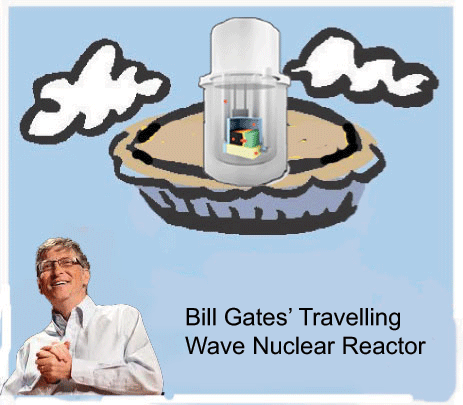 Jigar Shah rebuts Bill Gates’ fossil fuel vision for energy access in developing countries. GreenTech Media by Jigar Shah August 22, 2014 “……In 2012, I wrote in the Huffington Post that Bill Gates had zero qualifications to understand energy and its costs. I also acknowledged that I am not qualified to run a global software company.
So, Bill Gates doesn’t know much about energy outside of his vested interests in nuclear power, and I don’t know much about running a software company outside of my bumbling with my Android apps. I say this about myself even though I have helped with smart metering and oversaw the global implementation for monitoring solar systems worldwide for SunEdison.
But Bill Gates has more money and power than I, as well as a powerful — and wonderful — charity. In this instance, however, his charity is misguided. And nothing is more dangerous than misguided charity.
Gates’ misguided path starts with the fact that he cited a notorious climate confusionist, Bjorn Lomborg. Lomborg has stubbornly refused to acknowledge the fact that renewable energy is cost-competitive with fossil fuels as an energy source.
Given Gates’ stature, framing energy poverty as a climate issue reveals a depth of ignorance that poses a serious problem. So here is reality.
Ending energy poverty requires the right tool for the job: distributed energy
The truth is that an over-reliance on centralized grid extension and large-scale power plants will keep a billion people in the dark. It is time to recognize what even the IEA says is overwhelmingly necessary, but dramatically under-invested in: distributed renewable energy for those living beyond the grid.
To understand why this is so important, take a step back and consider the reaction if Gates wrote a blog suggesting that Mark Zuckerberg is a fool and that the solution for universal internet access around the world is connecting every home around the world via physical fiber-optic cable. The reaction would be riotous laughter. In emerging markets, they are busy ripping out copper and everyone is using wireless. Yet that’s exactly analogous to what Gates is proposing for energy.
No expert on energy access is paying any attention to Gates’ folly on energy for the poor…… When it comes to energy poverty, Gates is arguing for outdated and ineffective solutions that will keep people energy-poor. It is time that we deploy our 21st century energy solutions and put power directly in the hands of the impoverished. http://www.greentechmedia.com/articles/read/sorry-bill-gates-you-are-wrong-on-clean-energy
Pro nuclear propaganda revs up in South Africa
 Why Eskom’s Brian Molefe is pumping up the nuclear propaganda
The issue of relative costs is an area in which Eskom likes to play fast and loose with facts. Molefe, for instance, loves to talk about the relative cheapness of nuclear power Rand Daily mail CAROL PATON
26 JULY 2016 “……..As Eskom prepares to roll back the rise of independent power producers (IPPs) and lay the basis for the nuclear build, the propaganda war is going to be critical. This is because, on the facts alone, Eskom’s central argument — that SA’s energy future is a straight choice between variable and unreliable renewables and reliable base load nuclear — is nonsense.
What SA needs to do to break Eskom’s stranglehold
Even before Eskom’s letter to Energy Minister Tina Joemat-Pettersson drawing the line under the IPP programme surfaced last week, Molefe and Eskom’s head of generation, Matshela Koko, have been pushing this line. As SA can’t have more coal plants because of its commitments to reduce emissions, and as renewable energy is available during the day, when it’s not really required, the only solution lies with nuclear power.
This is a misrepresentation of the choices available. A great deal of technical work and international experience has shown that the next round of large investments SA should be making should be in gas. Unlike renewable energy, nuclear energy or a coal-fired power station, gas can be switched on and off to provide peaking power. The turbines need to turn only when you need them. With large discoveries in Mozambique, investing in gas is the logical next step. The CSIR has done detailed work on this and has put forward a third option to the baseload debate: to use gas and renewables — now by far the cheapest — in concert to create baseload power.
The issue of the relative costs of the technologies is another area in which Eskom likes to play fast and loose with the facts. Molefe, for instance, loves to talk about the relative cheapness of nuclear power. Koeberg — built in 1985 and long since paid for — supplies energy at R0.43/kWh. This should be compared with solar thermal power — the only renewable energy technology that can store energy — he says, the cost of which ranges between R2/kWh and R6/kWh. It’s a ridiculous comparison. In the absence of an agreed-on and updated Integrated Resource Plan (IRP) that would provide an authoritative view on the relative costs of the technologies, the CSIR’s Energy Centre calculated the following in 2015: new nuclear power is projected to cost at least R1/kWh, but very likely more; new coal R0.80/kWh — it is now much higher at about R1; wind R0.60/kWh and solar R0.80/kWh.
A new draft of the IRP by Eskom’s technical modellers — that has been sent back to the drawing board by the Department of Energy — has suggested that the overnight cost (capital cost excluding interest) of building new nuclear power would be $6 000/kW. The department reckoned on about $4 166/kW.
These are not numbers Eskom is likely to use in the public debate. Eskom, in particular Molefe, has a talent for spinning a good story. After less than five months in the job, he made the startling and completely untrue statement that Eskom’s plant performance had improved vastly. At that point, Eskom’s plant performance was still in decline. More recently, in May, he insisted at a news conference in Parliament that Eskom’s ability to meet demand had nothing to do with lower-than-anticipated demand. This too, turned out not to be true, with Eskom’s own demand curve showing real decline over 2015.
These are perhaps minor skirmishes with the truth. But getting the nuclear build on track is a far bigger fight. Expect Eskom to pump up the propaganda war. — Business Day http://www.rdm.co.za/business/2016/07/26/why-eskom-s-brian-molefe-is-pumping-up-the-nuclear-propaganda
1 This Month



26 September – International Day for the Total Elimination of Nuclear Weapons


PLEASE OPPOSE HR 8255 AND S.3639 – bills would accelerate satellite deployment, with no environmental review or safeguards – https://ncstd5li.quorum.us/campaign/169331/
To see nuclear-related stories in greater depth and intensity – go to https://nuclearinformation.wordpress.com
-
Archives
- September 2026 (233)
- August 2026 (330)
- July 2026 (355)
- June 2026 (287)
- May 2026 (306)
- April 2026 (356)
- March 2026 (251)
- February 2026 (267)
- January 2026 (308)
- December 2025 (358)
- November 2025 (359)
- October 2025 (375)
-
Categories
- 1
- 1 NUCLEAR ISSUES
- business and costs
- climate change
- culture and arts
- ENERGY
- environment
- health
- history
- indigenous issues
- Legal
- marketing of nuclear
- media
- opposition to nuclear
- PERSONAL STORIES
- politics
- politics international
- Religion and ethics
- safety
- secrets,lies and civil liberties
- spinbuster
- technology
- Uranium
- wastes
- weapons and war
- Women
- 2 WORLD
- ACTION
- AFRICA
- Atrocities
- AUSTRALIA
- Christina's notes
- Christina's themes
- culture and arts
- Events
- Fuk 2022
- Fuk 2023
- Fukushima 2017
- Fukushima 2018
- fukushima 2019
- Fukushima 2020
- Fukushima 2021
- general
- global warming
- Humour (God we need it)
- Nuclear
- RARE EARTHS
- Reference
- resources – print
- Resources -audiovicual
- Weekly Newsletter
- World
- World Nuclear
- YouTube
-
RSS
Entries RSS
Comments RSS
 nuclear-news