“NuclearMatters” lobby group revs up its spin ahead of Paris climate conference
 Bloomberg BNA and Nuclear Matters Hosting December 3 Event in Austin on the Role of Nuclear Energy in the Region, PR Newswire
Complimentary Event Features Industry Leaders, Policy Experts and Members of Academia Discussing Challenges and Opportunities for Nuclear Energy in Texas ARLINGTON, Va., Nov. 20, 2015 /PRNewswire-USNewswire/ — Bloomberg BNA today announced that it is hosting Nuclear Energy,Texas and the EPA Clean Power Plan, an afternoon conversation exploring the future role of nuclear energy in Texas. The fourth in a series of nationwide events underwritten by Nuclear Matters, the discussion is being held in Austin on Thursday, December 3 from3:30 p.m. to 6:30 p.m. at the Driskill Hotel Austin. ……
Nuclear medicine – the nuke industry’s big con job in Australia
 Medical radioactive wastes — the nuclear industry fig leaf, Independent Australia, 17 Nov 15 With modern developments in the non-nuclear production of medical isotopes, perhaps it’s also time to shut down the Lucas Heights nuclear reactor and stop producing dangerous radioactive trash, writes Noel Wauchope.
Watching the Australian media last week, you would be sure that the government’s hunt for a nuclear waste disposal site was solely to do with medical wastes. Rarely do they mention the real impetus for this hasty search, which is Australia’s current obligation to take back processed nuclear wastes from France. Later, we will have to receive similar wastes returning from UK. …..
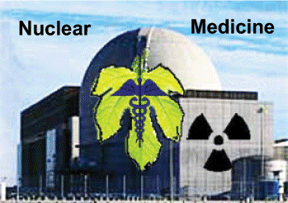
the vast majority of medical radioisotopes have very short half-lives, so there’s no need for them to be moved beyond the site of use…. The real problem is the returning intermediate level wastes from Australia’s used nuclear fuel rods reprocessed overseas….
it must be acknowledged that the medical radioisotopes produced at Lucas Heights do have their valuable uses in diagnostics and in the treatment of cancers.
However, it also must be recognised that all these radioisotopes can be produced without use of a nuclear reactor. This is happening increasingly and, rather like the distributed renewable energy boom, the world could be on the brink of a distributed medical radioisotope boom.
Canada and some in the USA certainly think so, judging by recent reports. The World Nuclear Association reports on University of British Columbia’s success in quadrupling the rate of production of medical radioisotopes using a (non-nuclear) cyclotron. Nova Scotia’s QEII Health Sciences Centre’s cyclotron was granted a Drug Establishment Licence (DEL) from Health Canada in June 2015
In USA, Niowave Inc, NorthStar Medical Radioisotopes and SHINE Medical Technologies, are competing in the market for medical isotopes, produced in a (non-nuclear) linear accelerator.
The non-nuclear production of medical isotopes has it all over the centralised production by nuclear reactor. This is not just because it eliminates the obvious dangers of nuclear wastes, weapons proliferation, terrorism risks, disastrous accident, and radiation emissions.
It’s because the greatest uses of medical radiopharmaceuticals involve very short-lived isotopes…….That makes them much better suited to localised production, in or near hospitals. The delivery of pharmaceuticals to patients is much more secure. In addition, the risk of transport accidents is close to zero……..
With all the fuss about finding a dump sites for ‘Olympic sized pools of medical radioactive waste‘, it is time for the government and media to fess up to the real purpose of this hunt. And with modern developments in the non-nuclear production of medical isotopes, perhaps it’s also time to shut down the Lucas Heights nuclear reactor and stop producing dangerous radioactive trash.https://independentaustralia.net/environment/environment-display/medical-radioactive-wastes–the-nuclear-industry-fig-leaf,8384
Expanding nuclear power will reduce and retard climate protection.
 “[E]xpanding nuclear power is uneconomic, is unnecessary, is not undergoing the claimed renaissance
 in the global marketplace … and, most importantly, will reduce and retard climate protection.
Nuclear Power: Dead in the Water it Poisoned, CounterPunch, by JOHN LAFORGE NOVEMBER 5, 2015 On Feb. 11, 1985, the cover page of Forbes thundered, “The failure of the U.S. nuclear power program ranks as the largest managerial disaster in business history, a disaster on a monumental scale.…”
Fourteen months later, reactor No. 4 at Chernobyl exploded and burned for 40 days, spreading radioactive fallout across the entire Northern Hemisphere, depositing cesium-137 in Minnesota’s milk[1]and Japan’s topsoil.[2]
So how is it that Congressional representatives, TV network pundits, FOX ditto heads and even CNN program directors still promote nuclear power?
Part of the answer comes from American University researcher Judy Pasternak and her students. According to Pasternak’s 2010 study, the nuclear industry spent $645 million over 10 years lobbying Capitol Hill, and another $63 million in campaign contributions over the same period.[3] Between 1999 and 2008, these millions manufactured the canard that nuclear power is “carbon free,” “clean” and can “help fend off climate change.” Prior to this spending blitz, the US nuclear power program was, because of the shock of accidents at Three Mile Island in 1979 and Chernobyl in 1986, “pretty well dead in the water” — in the words of economist and author Jeremy Rifkin.[4]
The lobbyists and check writers worked hard spinning the yarn that the richest and most pollution-intensive industrialists on earth were concerned about climate change and wanted to cut carbon emissions — but they didn’t convince everybody.
Independent scientists, free of corporate blinders and the market imperative of short term profit, scoff at “green nuke” propaganda. Continue reading
Plumes of disinformation from nuclear lobby hide the truth on radiation
 The National Council on Radiation Protection (NCPR) says, “…the Council assumes that, for radiation-protection purposes, the risk of stochastic [random] effects is proportional to dose without threshold…”[17] (Emphasis added) In other words, “… every increment of radiation exposure produces an incremental increase in the risk of cancer.”[18]
Nuclear Power: Dead in the Water it Poisoned, CounterPunch, by JOHN LAFORGE NOVEMBER 5, 2015 “……….Another part of reactor greenwashing is the powerful influence of mis- and disinformation following the Great East Japan Earthquake, the resulting tsunami, and the catastrophic Fukushima radiation gusher that began March 11, 2011.
In reporting on the contamination of soil, tap water, rain water, groundwater, breast milk, vegetables, fish, baby food, animal feed, beef, and incinerator ash, radiation was and is almost always said to pose little or no “immediate” danger. This minimization is designed to and quite successfully does ease public concern and push Fukushima’s ongoing radio-contamination from public consciousness.
Contaminated spinach and milk “do not pose an immediate health threat,” NPR’s Giles Snyder reported April 19, 2011. The Agence France-Presse reported October 6, 2011, “An exposure of 100 millisieverts per year is considered the lowest level at which any increase in cancer risk is evident.” However, as the US Nuclear Regulatory Commission says, “…any increase in dose, no matter how small, results in an incremental increase in risk.”[11]
An April 11, 2011 Forbes report flatly misstated the US EPA’s published public warning about radiation. Noting that a Phoenix, Arizona, drinking water sample contained 3.2 pico-curies per liter of radioactive iodine-131 from Fukushima, and that the EPA’s maximum contaminant level is 3.0, the writer concluded, “EPA does not consider these levels to pose a health threat.” In fact, the EPA officially warns that “there is no level below which we can say an exposure poses no risk.”
This pattern of misstatement and official falsehood went to the very top of the food chain. Japan’s Chief Cabinet Secretary Yukio Edano famously declared March 11, 2011, “Let me repeat that there is no radiation leak, nor will there be a leak.”[12] He later asked the public not to overreact to reports of radioactively contaminated food, saying, according to the BBC, “Even if you eat contaminated vegetables several times, it will not harm your health at all.”
President Obama followed suit. Continue reading
Exxon’s campaign to spread doubt on the science of climate change
Exxon Sowed Doubt About Climate Science for Decades by Stressing Uncertainty
 Collaborating with the Bush-Cheney White House, Exxon turned ordinary scientific uncertainties into weapons of mass confusion. Inside Climate News, David Hasemyer and John H. Cushman Jr. 23 Oct 15 As he wrapped up nine years as the federal government’s chief scientist for global warming research, Michael MacCracken lashed out at ExxonMobil for opposing the advance of climate science.
His own great-grandfather, he told the Exxon board, had been John D. Rockefeller’s legal counsel a century earlier. “What I rather imagine he would say is that you are on the wrong side of history, and you need to find a way to change your position,” he wrote.
Addressed to chairman Lee Raymond on the letterhead of the United States Global Change Research Program, his September 2002 letter was not just forceful, but unusually personal.
No wonder: in the opening days of the oil-friendly Bush-Cheney administration, Exxon’s chief lobbyist had written the new head of the White House environmental council demanding that MacCracken be fired for “political and scientific bias.”
Exxon was also attacking other officials in the U.S. government and at the UN’s Intergovernmental Panel on Climate Change (IPCC), MacCracken wrote, interfering with their work behind the scenes and distorting it in public.
Exxon wanted scientists who disputed the mainstream science on climate change to oversee Washington’s work with the IPCC, the authoritative body that defines the scientific consensus on global warming, documents written by an Exxon lobbyist and one of its scientists show. The company persuaded the White House to block the reappointment of the IPCC chairman, a World Bank scientist. Exxon’s top climate researcher, Brian Flannery, was pushing the White House for a wholesale revision of federal climate science. The company wanted a new strategy to focus on the uncertainties.
“To call ExxonMobil’s position out of the mainstream is thus a gross understatement,” MacCracken wrote. “To be in opposition to the key scientific findings is rather appalling for such an established and scientific organization.”
MacCracken had a long history of collaboration with Exxon researchers. He knew that during the 1970s and 1980s, well before the general public understood the risks of global warming, the company’s researchers had worked at the cutting edge of climate change science. He had edited and even co-authored some of their reports. So he found it galling that Exxon was now leading a concerted effort to sow confusion about fossil fuels, carbon dioxide and the greenhouse effect.
Exxon had turned a colleague into its enemy.
It was a vivid example of Exxon’s undermining of mainstream science and embrace of denial and misinformation, which became most pronounced after President George W. Bush took office. The campaign climaxed when Bush pulled out of the Kyoto Protocol in 2001. Taking the U.S. out of the international climate change treaty was Exxon’s key goal, and the reason for its persistent emphasis on the uncertainty of climate science.
This in-depth series by InsideClimate News has explored Exxon’s early engagement with climate research more than 35 years ago – and its subsequent use of scientific uncertainty as a shield against forceful action on global warming. The series is based on Exxon documents, interviews, and other evidence from an eight-month investigation………. http://insideclimatenews.org/news/22102015/Exxon-Sowed-Doubt-about-Climate-Science-for-Decades-by-Stressing-Uncertainty
Touting the nuclear industry to South Carolina’s students, calling it ‘renewable’!
Engineers seek to educate about role of nuclear energy, Technican, North Carolina, October 22, 2015 Alex Kanora, Correspondent
Participating in the National Nuclear Science Week for the fifth time, NC State’s nuclear engineers are spending this week educating fellow students about the everyday presence of nuclear science, from electricity to textiles.
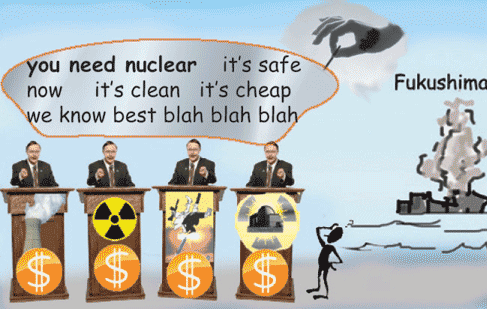
The primary goal of National Nuclear Science Week is to demystify what it means to study nuclear engineering and celebrate its role in society, according to Lisa Marshall, director of Outreach, Retention and Engagement for the department of nuclear engineering. ……..
Tuesday evening at Talley Student Union, nuclear engineering students showed “Pandora’s Promise,” a documentary that explains misconceptions and why skeptics were turned into believers in nuclear power. …..“Many people think of nuclear science as a weapons technology, which in turn keeps people from believing that nuclear energy is a great source of renewable energy,” Marshall said. …… http://www.technicianonline.com/news/article_b2d156e8-7873-11e5-8076-5ff13e669dad.html
Promotion of nuclear industry by IAEA – pushing nuclear education
IAEA to boost nuclear education in Europe and Asia http://www.energylivenews.com/2015/10/19/iaea-to-boost-nuclear-education-in-europe-and-asia/ An agreement has been signed by 12 universities to improve regional co-operation in transferring nuclear knowledge.
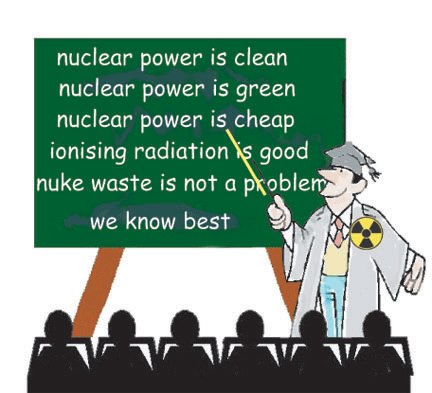
It aims to bring together universities from six countries in Eastern Europe and Central Asia, including Azerbaijan, Belarus and Kazakhstan.
It is the fifth regional network launched by the International Atomic Energy Agency (IAEA).
It aims to collaborate in nuclear education programmes and nuclear industry-oriented training centres.
Mikhail Chudakov, IAEA Deputy Director General, said: “This translates into a rising demand for nuclear educational and training programmes to meet a continued necessity for highly qualified nuclear professionals.”
The IAEA recently inspected the safety of a Japanese nuclear plant.
Radiation and cancer: to USA’s NRC it’s PR not science, that counts
Instead of treating cancer as a scientific issue, the nuclear industry treats it as a PR challenge. Frequent attempts are made to trivialize the dangers of radiation. Often this involves the Radiation- Is-Everywhere tactic complete with ludicrous examples (“It’s just like eating a banana,” or “It’s just like flying to Denver”). They like to show how little radiation is in an average X-ray but they are careful not to mention that radioactive exposure is cumulative: every dose adds.
The dirty little secret of the nuclear industry is that all NPP regularly discharge radiation into the environment. Nuclear power plants cannot operate without these discharges, and the NRC sets standards for what is allowable.
The push by the nuclear industry to block cancer research demonstrates their true colors.
 NRC Blocks Cancer Study Near San Onofre and other Nuclear Power Plants http://voiceofoc.org/2015/10/nrc-blocks-cancer-study-near-san-onofre-and-other-nuclear-power-plants/
By Roger Johnson October 14, 2015 Do the regular radioactive emissions from nuclear power plants (NPP) increase the risk of cancer? No one knows for sure whether living near a NPP can cause cancer, but on Sept. 8 the Nuclear Regulatory Commission (NRC) terminated a study designed to find out. It would have been carried out by the prestigious National Academy of Sciences which spent 5 years planning the study.
One of the six locations chosen for study was our own San Onofre. The medical records of everyone living within 31 miles of San Onofre (a circle from Huntington Beach around to Solana Beach) would have been part of the study. The research proposal is entitled Analysis of Cancer Risks in Populations near Nuclear Facilities.
The NRC logo is “Protecting People and the Environment” but many wonder if it should read “Protecting the Nuclear 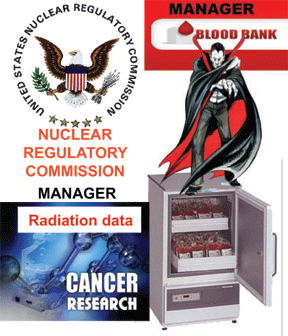 Industry and Its Profits.”
The NRC said it could not afford the $8 million, but no one swallows this since the NRC has an annual budget of over $1 billion (90 percent of which comes from the industry it is supposed to be regulating).
The NRC also said that it already knows the answer: low-level radiation coming from NPP is harmless. It continues to cite a now thoroughly discredited study by the National Cancer Institute (NCI) which examined this issue a quarter of a century ago and failed to find cancer streaks. The nuclear industry prefers this study because it likes the results.
We now know that the NCI study failed because it studied only cancer deaths, not incidence, and it studied only where people died, not where they lived or worked. It also averaged people living very near a NPP with those who lived far away. Also worrisome are recent studies in Europe which discovered that children who live near a NPP double their risk of cancer. The NAS is well-aware of this and designed part of the study to focus on children.
Instead of treating cancer as a scientific issue, the nuclear industry treats it as a PR challenge. Continue reading
Nuclear lobby keen to ‘educate’ public
 Nuclear leaders say education key to industry’s future, Pittsburgh Business Times,
 A decline in nuclear power has been ongoing in the United States. There are 99 nuclear reactors in operation in 30 states, but the industry’s growth has stalled significantly. In 2013, four reactors went out of service, and another was shut down in December 2014. Two nuclear reactor licenses were approved by the Nuclear Regulatory Commission in 2012, which was a bright point for the industry. But those were the first nuclear licenses approved since 1978………
Dr Lawrence Lindsey spoke during a conference of nuclear power industry leaders gathered Wednesday at the Westin Convention Center in downtown Pittsburgh. Called “Nuclear Going Forward” and underwritten by the advocacy group Nuclear Matters, the power brokers were there to discuss the industry’s future…….
“This is the time we need to start making decisions and start providing some certainty for the industry………
it’s a matter of extolling the virtues of nuclear — and staying course………
USA nuclear fans trivialise effects of nuclear bombing
Photos of what the Manhattan Project’s plutonium bomb did to human beings at Nagasaki prove the point. There is radioactive blowback in the fact that the thousands of tons of plutonium created since 1945 is so dangerously hot and long-lived that, like the underworld itself, nobody knows how to handle it at all — except maybe to trivialize it.
Hoping perhaps to show that the bomb from hell can be transformed from a vengeful, self-destructive, nightmare demon, into a benign, peace-loving, fairy-tale prince, nuclear propagandists and their friends in Congress are establishing nuclear war theme parks — without the taint of mass destruction — at former bomb factories and nuclear weapons launch pads all across the country: Continue reading
Don’t fall for nuclear industry propaganda about radiation “hormesis” !
 Cancer, Coverups and Contamination: The Real Cost of Nuclear Energy 27th September 2015 Andreas Toupadakis Ph.D Contributing Writer for Wake Up World “…….many nuclear industry advocates actually maintain that low-dose nuclear radiation is in fact beneficial to human health. Their theory, known as the “Hormesis Effect”, is deliberate industry propaganda. The human body perceives radiation as a threat to its existence, which results in an intense immune response. The short term result of this immune activity can be a short-term improvement of other existing ailments, however the immune system cannot work permanently in such a state of stress, and as environmental exposure continues, human health inevitably deteriorates. This is also the conclusion of the ECRR which concludes that…
“… hormesis may exist, but if it does exist its long-term effects are likely to be harmful… [When exposed to radiation] immune system surveillance is being potentiated in the short term … [however] the existence of radiation-inducible repair means that the repair systems themselves may be open to attack, also by radiation… If cells were induced into a state of high sensitivity for repair replication, then the cell line would undergo a greater rate of replication throughout the period of stress, and… the consequence of the short-term advantage conferred by hormesis is… accumulated DNA damage caused by high numbers of replication-copying processes.”
Over fifty years ago, questions on radiation and toxicity hazards were raised by at least three groups – the the International Commission on Radiological Protection (ICRP), National Council on Radiation Protection (NCRP), and the Federal Radiation Council (FRC). Continue reading

International Atomic Energy Agency’s Fukushima Report for the benefit of the nuclear industry
 International Atomic Energy Agency’s Fukushima Report puts the interests of the nuclear industry first http://www.greenpeace.org/international/en/news/Blogs/nuclear-reaction/IAEA-Fukushima-Daiichi-accident-report/blog/54198/?__surl__=Ig26R&__ots__=1443134068370&__step__=1 t by Justin McKeating – 24 September, 2015
The report draws conclusions when it should be highlighting major uncertainties and a lack of data surrounding the Fukushima disaster. It downplays the ongoing environmental and health effects of the disaster and misrepresents the current radiological crisis in the Fukushima region.
It’s clear that the IAEA is putting the interests of the nuclear industry before those of the disaster’s many victims. Its report does not accurately reflect the utter failure of the nuclear industry, and most nuclear regulators globally, to learn and implement the lessons of the Fukushima disaster. Not only that, it glosses over the seriously flawed nature of nuclear safety regulation in Japan right now.
And so Greenpeace Japan, together with Japanese civil society organisations, has sent a letter to the International Atomic Energy Agency (IAEA) Director General Yukiya Amano, challenging the conclusions of the IAEA’s Fukushima report as inadequate and flawed.
The IAEA says no discernible health consequences are expected as a result of the Fukushima disaster. This, while it admits uncertainties about both radiation exposure and its long-term effects. The recently released IAEA Fukushima Daiichi Accident Report on Japan’s on-going nuclear disaster in the wake of the 2011 triple reactor core meltdowns and catastrophic containment building failure reads more like nuclear industry propaganda than the so-called authoritative and balanced scientific assessment the agency attempts to claim it is.The truth is that nobody knows how much radiation citizens were exposed to in the immediate days following the disaster. If the IAEA can’t give accurate figures about radiation exposure, how can it say there won’t be any consequences? This is political spin and PR, not science.
Not only that, but the report supports the Japanese government’s agenda to make it appear that things can return to normal after a nuclear disaster.
Why else would the IAEA seek to justify Japanese government policy of lifting evacuation orders in increasingly contaminated areas in Fukushima? This strips returning evacuees of much needed and deserved compensation and may force many to return to areas where radiation levels remain dangerously high.
This is all part of the propaganda push to overcome huge public opposition in Japan to restarting Japan’s 42 shutdown nuclear reactors. It’s about normalising the Fukushima disaster. There is nothing normal about the exposure rates that former Fukushima citizens are being asked to return to.
Only a truly independent international commission that can investigate the causes, consequences, and implications of the accident can provide the Japanese people and the wider world with the unbiased information and accountability they need.
The nuclear industry will continue putting profit before people and safety – that’s what it does. But the IAEA should begin protecting people from the nuclear industry, not acting as its PR company. Justice demands it.
Nuclear propaganda film “Pandora’s Promise” scrutinised again
The film’s claim that nuclear is cheaper than energy from clean, renewable sources is completely false.
The film minimizes the question of what to do with high-level nuclear waste.
The very reasons not to support nuclear power are ignored by the film. The risks, economic realities, waste disposal problems, regulatory issues, and environmental and health impacts from the complete nuclear fuel chain are not addressed in “Pandora’s Promise.” Anyone who is interested is these issues should continue to ask questions and seek answers outside industry propaganda.
 Don’t believe the pro nuclear hype, http://www.moabsunnews.com/opinion/article_c24fc8cc-62d2-11e5-8359-e3fcae67ba87.html?mode=story— Sarah Fields, Director, Uranium Watch,
24 Sept 15 On Thursday, September 24, the Grand County Library and Utah Film Society will be showing the film,  “Pandora’s Promise,” at Star Hall, starting at 7 p.m. The film is a one-sided and factually challenged look at nuclear power as an answer to climate change. The film’s premise is that nuclear power will provide clean energy and help developing countries end poverty. This claim is presented in interviews with several former opponents of nuclear power who have had a change of heart, and with some nuclear scientists.There were no interviews with citizens, environmentalists, legal experts, or scientists who are currently involved with the many serious and complex issues related to the production of nuclear power in the U.S.
The film neglects to discuss the environmental impacts of the whole nuclear fuel chain, from uranium mining and milling to the disposal and long-term care of low- and high-level nuclear waste. As we know here in southeast Utah, uranium mining and milling is not carbon-free and impacts our land, air, water and public health. There are hundreds of abandoned uranium mines in Utah and nearby states that have yet to be remediated. Hundreds of uranium mine and mill workers died or continue to suffer severe health impacts from the production of uranium.
The film’s claim that nuclear is cheaper than energy from clean, renewable sources is completely false. Nuclear reactors cost billions of dollars to construct, taking 10 years or longer to license and bring online. Reactors under construction in the U.S. have construction delays and serious cost overruns, which are passed onto the ratepayers. The cost of reactors keeps going up and the cost of renewables keeps going down.
The film minimizes the question of what to do with high-level nuclear waste. For decades, that problem has been pushed back for future generations to deal with. The type of spent fuel casket that the proposed Yucca Mountain disposal site was designed for is no longer being developed. There is no approved casket for the storage of high-burn up fuel — the fuel used at most reactors today. The government and industry has no long-term solution for high-level nuclear waste, except for indefinite storage at reactor sites. If Yucca Mountain were approved, much of the spent fuel would be transported through Utah, including Grand County.
The proposed reactor near Green River is an example the realities of nuclear power development. The Blue Castle Project would require about 87 million gallons of water per day in a time of drought and reduced runoff. It would impact the recovery program for threatened and endangered fish species in the Green River. Thus far, the proponent of the reactor, Blue Castle Holdings, has only raised $19 million. It will take from $50 to $100 million to obtain an Early Site Permit from the Nuclear Regulatory Commission and many millions more to obtain a construction and operation license. It will take billions to construct the reactor. Thus far, no utility has joined this project, so there is no place for the electricity to go and no outside funding.
The very reasons not to support nuclear power are ignored by the film. The risks, economic realities, waste disposal problems, regulatory issues, and environmental and health impacts from the complete nuclear fuel chain are not addressed in “Pandora’s Promise.” Anyone who is interested is these issues should continue to ask questions and seek answers outside industry propaganda.
Fisherman debunks radiation as cause of giant woffish
 The Guy Who Caught the Internet’s Favorite Giant Fish Is Bummed No One Gets It, Motherboard by EMIKO JOZUKA September 18, 2015 Earlier this week, an odd-looking gargantuan fish from Japan became a minor celebrity on Twitter. But the tide soon turned as curious reactions gave way to harmful rumors that its strange appearance is the result of the effects of radiationfrom the Fukushima disaster.
The fish, however, was no radioactive specimen. It was a Bering wolffish (Anarhichas orientalis)—a species found off the coast of Hokkaido, the northernmost island of Japan. It also just happens to look like a cross between a grumpy grandpa and a monster.
When rumors broke of the fish’s supposed contamination, no one was more disappointed than the man who captured the creature: Hiroshi Hirasaka, a reporter and researcher who “lives life in pursuit of odd-looking creatures.”
“The wolffish I caught was given write-ups on the internet as ‘monster as a result of nuclear accident,’” Hiroshi Hirasaka, the man who caught the fish, told me. Hirasaka initially tweeted the photo because he was proud of his catch, but he soon became devastated by the rapid-fire spread of false internet buzz around the fish.
“That fish has been in [Hokkaido] for a long time, so it’s not feasible for it to be affected by radiation. It’s rude to the fish to say that, and it’s not cool to blame everything on radiation,” Hirasaka said. “Creatures only become big in the world of science fiction, and we’re not living in the world of Hulk or Godzilla.”………
“I find slightly odd, grotesque or scary fish interesting,” Hirasaka told me. “There will always be other writers who report on the beautiful creatures of this world, but I want other people to understand the allure of more ugly specimens.”
As for the internet rumour—he tried debunking it on Twitter, but admitted that the misunderstanding was probably still developing out of his sight and control.
“People in Japan are used to seeing that fish in aquariums, but I guess other people don’t know it. I’m not sure if it was a joke or not, but I was sad to think that they thought it was like that because of nuclear radiation,” said Hirasaka. “I just want them to have the correct information.” http://motherboard.vice.com/read/the-fish-that-was-wrongly-accused-of-being-affected-by-radiation
Timothy Mousseau dismisses radiation as cause of giant wolffish
NO, THIS WOLFFISH IS NOT A FUKUSHIMA RADIATION MUTANT,As for the idea of giant, mutant Fukushima fish … there is no scientific evidence to support claims that fallout from the Fukushima disaster has, or will, cause this to happen. Even right after the disaster, a swim in nearby waters would have dosed you with just 0.03% of the daily radiation an average Japanese resident receives. And much of that fallout has disappeared because of natural decomposition and decay.
Besides, even in the extremely unlikely event that radiation was the culprit here, we would actually expect to see smaller, not larger, fish. “Very, very few mutations lead to extra-large size,” explains University of South Carolina radiation specialist Dr Timothy Mousseau. “[Instead], they grow less efficiently, they’re less capable of catching food and they tend to not live as long.
All that said, this catch is still an impressive one. Wolffish (family Anarhichadidae) average about three feet in length (110 cm), but can get bigger. What Hirasaka has landed is a very old and very healthy specimen. “If you look hard and long enough there’s always a few that manage to survive long enough to achieve these large sizes,” says Mousseau. http://www.earthtouchnews.com/wtf/mutants-and-freaks/no-this-wolffish-is-not-a-fukushima-radiation-mutant
1 This Month
19 February – VIRTUAL EVENT-Decision Time: AI and Our Nuclear Arsenal
12:45 p.m. Central / 1:45 p.m. Eastern
To see nuclear-related stories in greater depth and intensity – go to https://nuclearinformation.wordpress.com
-
Archives
- February 2026 (170)
- January 2026 (308)
- December 2025 (358)
- November 2025 (359)
- October 2025 (376)
- September 2025 (258)
- August 2025 (319)
- July 2025 (230)
- June 2025 (348)
- May 2025 (261)
- April 2025 (305)
- March 2025 (319)
-
Categories
- 1
- 1 NUCLEAR ISSUES
- business and costs
- climate change
- culture and arts
- ENERGY
- environment
- health
- history
- indigenous issues
- Legal
- marketing of nuclear
- media
- opposition to nuclear
- PERSONAL STORIES
- politics
- politics international
- Religion and ethics
- safety
- secrets,lies and civil liberties
- spinbuster
- technology
- Uranium
- wastes
- weapons and war
- Women
- 2 WORLD
- ACTION
- AFRICA
- Atrocities
- AUSTRALIA
- Christina's notes
- Christina's themes
- culture and arts
- Events
- Fuk 2022
- Fuk 2023
- Fukushima 2017
- Fukushima 2018
- fukushima 2019
- Fukushima 2020
- Fukushima 2021
- general
- global warming
- Humour (God we need it)
- Nuclear
- RARE EARTHS
- Reference
- resources – print
- Resources -audiovicual
- Weekly Newsletter
- World
- World Nuclear
- YouTube
-
RSS
Entries RSS
Comments RSS
 nuclear-news