SO FAR, nuclear lobbyists have not managed to hijack climate action funding
Is the nuclear industry having any success winning over environmentalists? Around the margins, perhaps, but the ranks of‘pro-nuclear environmentalists’ (PNEs – an acronym previous used to describe ‘peaceful nuclear explosions’) are very thin.Nuclear lobbyists’ epic COP21 fail. Our next job? Keep their hands off climate funds.

Nuclear lobbyists’ epic COP21 fail. Our next job? Keep their hands off climate funds, Ecologist Jim Green 16th December 2015
nuclear industry has had a disappointing COP21, writes Jim Green. Lobbyists were there en masse desperately trying to get pro-nuclear wording into the Paris Agreement, and they failed. The word does not occur even once in the entire document. But we must prepare for the next battle: keeping nuclear power out of the $100 billion a year Green Climate Fund.
The nuclear industry and its supporters were busily promoting nuclear power – and attacking environmentalists – before and during the COP21 UN climate conference in Paris.
All the usual suspects were promoting nuclear power as a climate-friendly energy source: the World Nuclear Association, the International Atomic Energy Agency, the International Energy Agency, the OECD’s Nuclear Energy Agency, the US Nuclear Energy Institute, and so on.
The Breakthrough Institute has been promoting its pro-nuclear “paradigm-shifting advocacy for an ecomodernist future” and arguing against the “reactionary apocalyptic pastoralism” of anyone who disagrees with them. Continue reading
Corporate Astroturf “Nuclear for Climate” is really a lobby group of 140 pro nuclear societies.
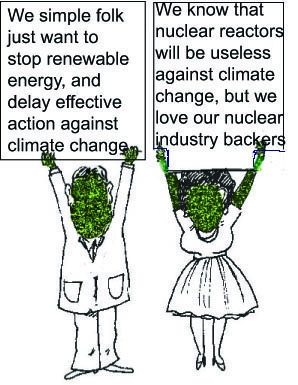 Nuclear for Climate isn’t a network of grassroots environmentalists, it’s a network of more than 140 nuclear societies. It isn’t grassroots environmentalism, it’s corporate astroturf.
Nuclear lobbyists’ epic COP21 fail. Our next job? Keep their hands off climate funds, Ecologist, Jim Green16th December 2015 “……..Robert Stone, director of the Pandora’s Promise pro-nuclear propaganda film, launched a ‘resource hub’ called Energy For Humanity, promoting “more advanced, mass-producible, passively safe, reactor designs”.
Rauli Partanen and Janne Korhonen, members of the Finnish Ecomodernist Society, have been attacking environmentalists for opposing nuclear power. Rebutting a rebuttal by Michael Mariotte from the Nuclear Information and Resource Service, Partanen and Korhonen offer this gem:
“Even the much-maligned Olkiluoto 3 nuclear project [in Finland] turns out to be very fast way of adding low-carbon energy production when compared to any real-world combination of alternatives.”
A single reactor that will take well over a decade to build (and is three times over budget) is a “very fast way” of adding low-carbon energy? Huh? Maybe that’s why a second reactor of the same EPR design to be built at Okiluoto was cancelled in May 2015, while the main players are locked in a €10 billion legal battle.
‘The instransigent network of anti-nukes’ versus Astroturf
Partanen and Korhanan authored a booklet called ‘Climate Gamble: Is Anti-Nuclear Activism Endangering Our Future?‘, and crowdfunded the printing of 5,000 copies which were distributed for free at the COP21 conference.
James Hansen and three other climate scientists were in Paris to promote nuclear power. Hansen attacks the “intransigent network of anti-nukes” that has “grown to include ‘Big Green,’ huge groups such as the Natural Resources Defense Council, Environmental Defense Fund and World Wide Fund for Nature. They have trained lawyers, scientists, and media staff ready to denounce any positive news about nuclear power.”
By way of sharp contrast, the impoverished US nuclear industry could only rustle up US$60 million (€55m) to lobby Congress and federal agencies in 2013-14.
So is there an undercurrent of grassroots pro-nuclear environmentalism waiting to burst forth if only their voice could cut through Big Green hegemony? Perhaps Nuclear for Climate, promoted as a ‘grassroots organization‘, is the environmental network to take on Big Green?
Well, no. Nuclear for Climate isn’t a network of grassroots environmentalists, it’s a network of more than 140 nuclear societies. It isn’t grassroots environmentalism, it’s corporate astroturf.
And the list of 140 associations includes 36 chapters of the ‘Women in Nuclear’ organisation and 43 chapters of the ‘Young Generation Network’. One wonders whether these organisations have any meaningful existence. Does Tanzania really have a pro-nuclear Young Generation Network? Don’t young people in Tanzania have better things to do?
Nuclear for Climate has a website, a hashtag, a twitter handle and all the modern social media sine qua non. But it has some work to do with its messaging. One of its COP21 memes was: ‘The radioactive waste are not good for the climate? Wrong!’ So radioactive waste is good for the climate?! http://www.theecologist.org/News/news_analysis/2986693/nuclear_lobbyists_epic_cop21_fail_our_next_job_keep_their_hands_off_climate_funds.html
Nuclear lobby in frantic mode at Paris Climate Summit
Nuclear Champions go into Overdrive http://www.no2nuclearpower.org.uk/recent-additions/nuclear-champions-go-into-overdrive/ 11 Dec 15
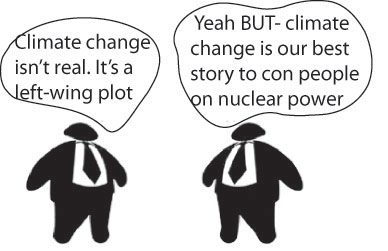 Pro-nuclear lobbyists and nuclear industry champions have been in overdrive during the Paris Climate Conference.
They seem to be making a desperate last-ditch effort to convince us all that nuclear power is an important part of the answer to the climate crisis with blatant attacks on those who envisage a future based on renewable energy without nuclear. (1) But the truth is that nuclear power is a dangerous distraction from what we really need to be doing. Because every pound spent on nuclear power could have been spent more effectively, making greater reductions in carbon emissions, nuclear is actually damaging efforts to tackle climate change.
NASA scientist James Hansen was in Paris to berate climate campaigners for failing to support nuclear power. But Hansen ignores renewables and energy efficiency, setting up a false choice between fossil fuels and nuclear. (2) Hansen doesn’t just want more nuclear power, but he wants next-generation nuclear power stations fuelled with weapons-useable plutonium, extracted from spent fuel in reprocessing plants like Sellafield, which runs the risk of more weapons proliferation problems in future. (3)
A big part of the pro-nuclear argument seems to be based on the idea that renewable energy currently provides only a tiny part of global electricity supply and cannot scale up rapidly enough to replace fossil fuels. Nuclear power, on the other hand, the argument goes, could do so. Hansen wants 115 new reactors to be built every year – yet the world has never built more than 40 a year. (4) Fortunately the concept of a world powered by 100% renewable energy is no longer seen as a pipedream but as a necessary and, more importantly, achievable goal at every level–from individuals to large corporations, and from small communities to large cities. (5)
Meanwhile the UK Government seems intent on demonstrating to the rest of the world that nuclear power is too expensive to play a part in tackling climate change and leads to the slashing of budgets for faster and much more effective ways of reducing carbon emissions. References …..
Bill Gates, Peter Thiel, Breakthrough Institute etc – more like snake oil salesmen for nuclear
 Nuclear pitched as the new green, Charlotte Observer , 9 Dec 15 BY EVAN HALPER“……..Investors, including Microsoft founder Bill Gates and PayPal co-founder Peter Thiel, have poured about $2 billion into a few dozen small outfits, many of which are concentrated in the West. The entrepreneurs behind them are racing to design nuclear power facilities engineered to seem no more imposing than a neighborhood arts center……
That may all be possible someday, say the nuclear experts at the Union of Concerned Scientists, but that day is probably several decades and many tens of billions of dollars away. The sudden excitement around nuclear makes them nervous. They say they have seen this before.
“The people who deny or downplay the risks involved are doing a disservice to the future of nuclear power that leads to complacency, and complacency leads to Fukushima,” said Edwin Lyman, a senior scientist at the organization. “This is very complex. It is hard. It costs a lot. It is slow, especially to develop advanced systems. … It seems nuclear will at most be a minor contribution over the next few decades to dealing with the climate crisis.”……
The Sierra Club says it has all the makings of a snake-oil sale.
“There is always such a rosy picture coming from the industry of what it can deliver with these technologies, yet it has such a terrible history with over-promising and under-delivering,” said John Coequyt, the Sierra Club’s director of international climate programs. The organization would prefer the Obama administration abandon the extremely costly pursuit of advanced nuclear power in favor of greater investment in renewable energy such as solar and wind power.
But that’s not the direction the White House is headed. It hosted a nuclear power summit last month during which John Holdren, the president’s senior adviser on science and technology, expressed hope of “making nuclear energy everything that it can be, and thus a major contributor in this country and worldwide to minimizing the risks from climate change.”…….
The administration announced its budget plan, including $900 million in new funding for development of advanced nuclear technologies, as well as plans to allow firms like UPower and Transatomic access to testing facilities in federally funded national research labs, which the firms had been lobbying for. This year, the House passed a resolution nudging regulators to nurture the industry.
Such moves have come at the urging of some muscular neoliberal think tanks in California and Washington, D.C.
The Breakthrough Institute in Oakland, where philanthropist Rachel Pritzker and Whole Earth Catalog founder Stewart Brand sit on the board, has been a major proponent of the technologies as a solution to climate change, most famously in the 2013 documentary “Pandora’s Promise,” which premiered at the Sundance Film Festival. Pritzker is also on the board of Third Way, an influential advocacy group best known for helping centrist Democrats find bipartisan approaches to policy disputes. The group, which receives some nuclear industry funding, is leading the push in Washington…….http://www.charlotteobserver.com/news/science-technology/article48767550.html
Climate Change Denialism – money buys opinion
Follow the money to climate science denial https://independentaustralia.net/environment/environment-display/follow-the-money-to-climate-science-denial,8472 Graham Readfearn 10 December 2015, A Greenpeace investigation uncovers a complex climate science denial machine involving cash from big business in exchange for “peer review” studies.Graham Readfearn from DeSmogBlogreports.
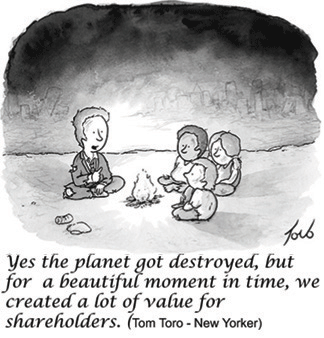
AN UNDERCOVER INVESTIGATION by environment group Greenpeace has found some of the world’s most vocal climate science denial groups were willing to accept cash from fossil fuel interests in return for writing articles and reports that reject the impacts of greenhouses gases. Continue reading
Don’t fall for the Breakthrough Energy Coalition ‘s nuclear boondoggle
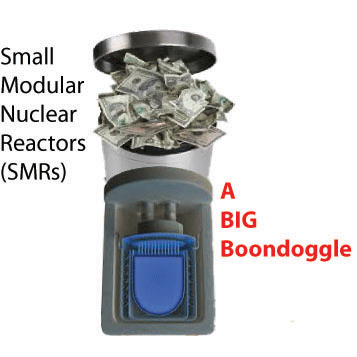 Breakthrough Boondoggle leaders fawn over the Breakthrough Energy Coalition as world saviors promoting so-called ‘climate solutions’, the reality is that these con artists are setting us up for a global heist that we’ll be paying for long into the future.
Bill Gates’ nuclear power – Wrong Kind of Green
 THE BIG THREE: THE 21ST CENTURY “CLEAN ENERGY” REGIME Wrong Kind of Green Dec 07, 201 5 Bill & Melinda Gates Foundation
December 7, 2015 The “big three” that comprise the 21st century “clean energy” regime are Mission Innovation, Breakthrough Energy Coalition (BEC), and the Global Apollo Programme, with BEC in the driving seat.
What we are witnessing is militarized advertising campaign for pseudo ‘public interest’ purposes. This is an example of ‘gray ops’ in psywar terminology. Promoting it as a patriotic mission sets up the opposition as ‘unpatriotic’. A massive and unspoken con for a pre-orchestrated bailout under the guise of “climate solutions”. A last ditch effort to save an ailing capitalist economic system which has become dangerously stagnant for those in power.
Mission Innovation was announced by Bill Gates at COP21 on 30 November 2015, on stage with President Obama, President Hollande and Prime Minister Modi. [Source] Its link to private sector investment is via the Breakthrough Energy Coalition group of private investors, also spearheaded by Bill Gates and which formed in parallel at COP21.”[Source]
Several example technologies were mentioned at the launch of the initiative: biofuel, carbon capture and storage, airborne wind turbines, nuclear fission and nuclear fusion. [Source] http://www.wrongkindofgreen.org/2015/12/07/the-big-three-the-21st-century-clean-energy-regime/
Corporate welfare may come to billionaire nuclear enthusiasts
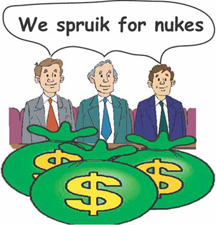 Billionaires have landed, therefore, on a new mission. As Donald Trump might say, they want to make nuclear energy great again.
“If we are serious about replacing fossil fuels, we are going to need nuclear power,” PayPal co-founder and Facebook mega-investor Peter Thiel crowed in a New York Times op-ed shortly before negotiators from 195 nations gathered in Paris to seal an international climate pact.
Thiel, who personally invests in nuclear energy, made the self-serving demand that the U.S. government forge a “plan to fund and prototype the new reactors that we badly need.”
In other words: What does a guy like me with only $2.2 billion to my name gotta do to get my corporate welfare handout?
Bill Gates is also advocating heavy public investment in novel designs that these nuclear cheerleaders swear will be safer and cheaper than the 391 reactors that now generate about one in 10 watts around the world.
As the Paris climate talks got underway, the Microsoft co-founder launched an unprecedented multibillion-dollar “clean” energy fund, backed by the U.S., Chinese, and Indian governments, as well as other billionaires and some foundations. Don’t be surprised if it’s nuclear-friendly.
The crowd of rich men with tech cred dipping their toes in these radioactive waters also includes Amazon titan Jeff Bezos and Paul Allen, Gates’ fellow Microsoft co-founder.
But there are many reasons why governments, including our own, should resist their call to pump more tax dollars into nuclear energy. Namely:
Reactors are expensive, they’re very difficult to shield from terrorist and other security threats, and they’re prone to catastrophic accidents that have created ghost towns in Japan and the former Soviet Union. Furthermore, there are still no solutions for meeting the daunting challenges of safeguarding nuclear waste and cleaning upabandoned uranium mines.
And nuclear power takes too long to crank up. Remarkably, five of the 62 reactors under construction worldwide have been in the nuclear pipeline for three decades. It’s too slow to stop the climate crisis.
Besides — to a much greater extent than solar and wind power — nuclear energy emits its own carbon pollution. Those greenhouse gas emissions come largely through the use of fossil fuels in activities like reactor construction, waste transportation, and uranium mining.
More importantly, successful businessmen ought to be able to spot an uncompetitive industry when they see one.
Here’s what Lazard, an investment bank with $180 billion under management, has to say about today’s top energy options: Utility-scale “wind and solar are much cheaper than gas and coal, and less than half the cost of nuclear.”
Renewable energy’s competitive edge makes it no surprise that generation from solar power is now growing exponentially and wind power has been expanding by more than 20 percent annually for the past seven years around the world as nukes have fumbled. The total amount of global nuclear energy remained well below 1996 levels in 2014.
A total of four new nuclear reactors in Georgia and South Carolina are at least three years behind schedule and billions of dollars over budget. That bodes badly for the save-our-nukes billionaire class because (sorry, guys) those power stations weresupposed to be models for ramping up nuclear energy quickly without cost overruns.
I wonder what they’ll choose as their next losing battle.
Emily Schwartz Greco is the managing editor of OtherWords, a non-profit national editorial service run by the Institute for Policy Studies. OtherWords.org.
Most of “Breakthrough Energy Coalition’s ” members are nuclear obsessives
perhaps the Breakthrough Billionaires Club will yet come to the realization that from a clean energy generation perspective we have already broken through. The innovations needed are not in abstract research but into deployment; and into enabling technologies led by low cost electricity storage and conversion into fuels.
The Breakthrough Energy Coalition must tear itself away from the fascination of tinkering in a laboratory and instead do something real, practical and hands-on with their money. However, the group’s assertion that “the foundation of this program must be large funding commitments for basic and applied research”, does not provide much reason for optimism.
A tennis coach I used to know would tell his team after a loss that “breakdowns come before breakthroughs.” We’ve caused the climate breakdown and we’ve made the energy breakthroughs. Now we just need to start winning
The first question that crossed my mind when reading about the latest Bill Gates investment venture was “is this a cover to divert yet more money into nuclear energy?”
Gates unveiled hisBreakthrough Energy Coalition at the start of the COP21 climate talks in Paris with much fanfare but few details, including the size of the financial commitment.
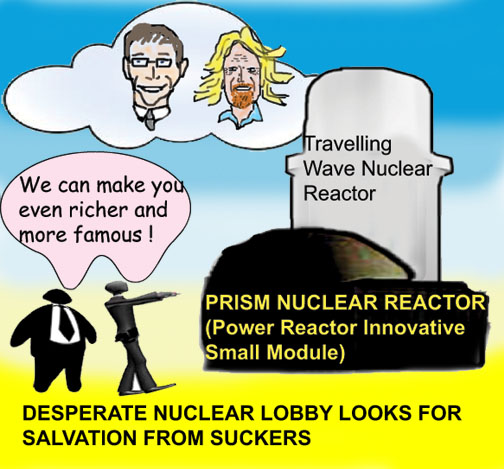
My suspicions were triggered not only by Gates’ already public commitment to nuclear energy research, but by the name selected for this collection of 28 of the world’s richest people (mainly men).
The Breakthrough Institute, after all, is the name of the pseudo-green nuclear energy front group whose people promoted and starred in the 2013 nuclear power propaganda film, Pandora’s Promise. But so far the Breakthrough Institute is lying low on the Breakthrough Energy Coalition, although I suspect not for long.
At first glance, the mission of the Breakthrough Energy Coalition, whose collective wealth is $350 billion, sounds reasonable enough, even if it takes a while to get ones head around that kind of disposable income.
Madness in the method Continue reading
UK’s nuclear industry urged to launch a new propaganda drive

 Nuclear industry urged to woo public support for ‘low carbon, secure’ energy, Express and Star UK, 3
 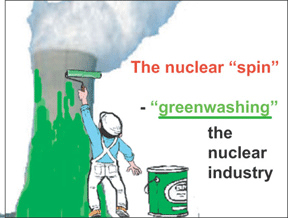 Dec 15 “……Lord Hutton, chairman of the Nuclear Industry Association, launched a new drive to engage with the public as plans continue to build new nuclear power stations.
He told the association’s annual conference in London that the nuclear industry had “work to do” to help improve public awareness of nuclear power…….
“There is a world of opportunity opening up,” he said, adding that a new “concordat” launched today could help change public opinion about nuclear power.
“The industry already engages in public outreach, especially in areas where they operate, or plan to build. This can be through open public consultations or school events, but as an industry we need to get the message to a wider audience, to those people who aren’t in nuclear communities…..
The aim is to take the narrative beyond the media, by encouraging people to be proud of the sector and the work they do, having the confidence to talk to other parents in the school playground, or to family and friends.
Helping the wider public understand what nuclear is, can help change opinion about the sector.”… http://www.expressandstar.com/business/city-news/2015/12/03/nuclear-industry-urged-to-woo-public-support-for-low-carbon-secure-energy/
Bill Gates’ ‘Breakthrough Energy Coalition’ is about renewable energy research, but what is needed is renewable energy DEPLOYMENT

 Can Bill Gates’ ‘Breakthrough Energy Coalition’ Become Truly Useful?, Climate Progress, BY JOE ROMM NOV 30, 2015, Led by Bill Gates, billionaires like Jeff Bezos and Mark Zuckerberg have announced a new multibillion-dollar “Breakthrough Energy Coalition” at the start of a Paris climate talks. In parallel, 20 countries — including China, India, U.S., Indonesia, and Brazil — are joining “Mission Innovation,” which commits them to double their clean energy research and development funding by 2020.
The question is, however, whether the Breakthrough Energy Coalition be tweaked into something truly useful, given that:
- The world needs about 100 times as much money for deployment of carbon-free energy as it does for R&D right now;
- Key developing countries like India are making decisions about building coal vs. carbon-free power right now that could lock in carbon pollution for decades; and
- Genuine technology breakthroughs are exceedingly rare in the energy arena and generally take decades and vast resources to deploy once they do make it to market……
The “Breakthrough Energy Coalition,” however, appears to be overly focused on breakthrough technologies and on a somewhat out-moded notion of the R&D pipeline, arguing “But in the current business environment, the risk-reward balance for early-stage investing in potentially transformative energy systems is unlikely to meet the market tests of traditional angel or VC investors –- not until the underlying economics of the energy sector shift further towards clean energy.”
Well, that obviously isn’t true in such keystone technologies as solar, wind, batteries, and LED lighting, where the underlying economics have already shifted dramatically!
I (and others) have been critical of Gates in the past for his focus on the need for new breakthrough technologies to solve the climate problem, what he calls “Energy Miracles.” Gates has generally downplayed the amazing advances we’ve had in the keystone clean technologies — and been investing in new nuclear power, geo-engineering technologies, and off-the-wall stuff.
And the Breakthrough Energy Coalition continues to tout Gates’ debunked claims about the need for “Energy Miracles,”
So while a boost in cleantech R&D funding is always welcome, what is most needed now is money for accelerated deployment and project financing of technologies that are now market-ready. ……
“In terms of dollars, the real cost is deployment. Globally, deployment costs will be in the trillions of dollars, while R&D costs might be in the tens of billions,” climate expert Ken Caldeira told meback in 2011. “We are talking about the elephant and the mouse.”…..http://thinkprogress.org/climate/2015/11/30/3726419/bill-gates-breakthrough-energy/
Bill Gates’ nuclear dream doesn’t stand up to critical analysis
Germany gives rise to much optimism. With solar resources no better than Alaska, solar power has nevertheless reached nearly 6% of the total electricity mix in the country. Ten years ago, solar power essentially didn’t exist there. In the U.S., the cost of installing solar has fallen from more than $8/watt to less than $3 in the past eight years, the industry has 175,000 working in it — more than twice the number of people that mine coal — and the value of solar installations reached $18 billion last year, according to the Solar Energy Industries Association.
Thiel and Gates are using their megaphones to make different points, but they actually share much in common. Gates is an investor in TerraPower, one of the companies trying to build the kind of advanced nuclear reactor Thiel wants to see the regulatory environment pave the way for. Gates talks up far-out technologies like making fuels directly from the sun, perhaps pulling carbon from the air to do it. Like Thiel’s nuclear, it’s not remotely clear any of this is going to make economic sense and its very unlikely any of it will be useful for a decade or more……..
There are paths to 100% renewable energy using existing technologies and aggressive deployment efforts.
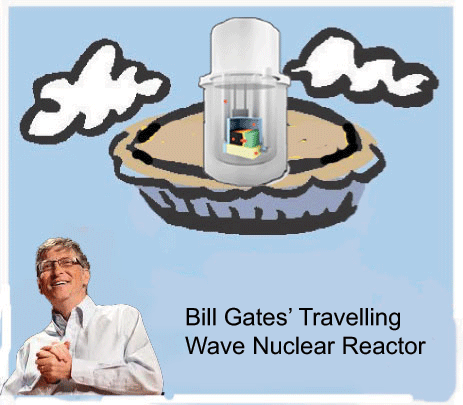 One Tech Billionaire Sees Nuclear As The Path To Clean Energy, But Is He Right?, Forbes, 30 Nov 15
Mark Rogowsky ,
The United Nations climate summit begins today in Paris and already there are headlines. The world’s richest man, Bill Gates, and a slew of his fellow billionaires have announced the Breakthrough Energy Coalition: an effort to take private money to advance promising clean-energy ideas from the lab to the marketplace. Gates suggests wind and solar have made good progress, but given the daunting scale of the challenge ahead, we need to look everywhere we can for promising ideas and develop them as quickly as possible. One thing he doesn’t talk up much is nuclear power, which just days earlier got some very positive words from another tech billionaire, number 234 on the Forbes list, Peter Thiel, who penned “The New Atomic Age We Need” for The New York Times…….
nuclear has established a safety record that argues for a rebirth, right? Perhaps if today were 1979. Unfortunately, the world has changed and nuclear hasn’t changed quickly enough……
The French, however, are set to lower the share that nuclear contributes to 50% over the coming decade. With the average French reactor now three decades old, at least part of the story is economic and technological. Thiel argues that what’s holding back nuclear is: “Designs using molten salt, alternative fuels and small modular reactors have all attracted interest not just from academics but also from entrepreneurs and venture capitalists like me ready to put money behind nuclear power… However, none of these new designs can benefit the real world without a path to regulatory approval.”
What he neglects to mention is that none of these designs are remotely ready to be put into use either. Although molten-salt reactors date back to the 1960s, the current designs haven’t left the research phase. Even in countries like China where U.S. regulatory approval isn’t a gating factor, when the scientists and engineers working on building a production reactor to make power dates like 2032 are tossed around. There are a number of other promising technologies being researched, but still the timeframes for first deployment are all between 2020-30. The U.S. regulatory regime isn’t holding these up, the slow path to development of incredibly complex systems is….. Continue reading
In Japan, the “Nuclear Village” is in charge again
In Japan the propaganda warfare took a more sinister turn blaming the victims for their predicament. Japanese newspaper Asahi Shimbun that is closely connected to Japan’s ruling elite has run a series of articles on “radiophobia”, attributing health complaints of the affected to psychological and emotional stress.
 The long standing and corrupt practice of “amakudari” -“descent from heaven” which led to the capture of regulators by the regulated in form of career revolving doors has made any meaningful reform a pipe dream.
The Fukushima disease: Creation of virtual world based on radioactive reality,Rt.com 24 Nov 15 Derek Monroe “…………”We are in a difficult position that we made ourselves reliable on nuclear energy first and then were hurt by it,” said a local Minamisoma city employee who asked to remain anonymous as he was not authorized to talk to the media. “Many people here had good jobs and good lives and when the nuclear accident happened this came to a complete halt,” he said. The city’s website now is very optimistic in its proclamation of moving forward without nuclear power, despite the central government’s move to the contrary. The government in Tokyo has decided what is best for the citizens of Minamisoma and all of Japan.

Furthermore, nuclear power is back in charge as if it never left. Nationalist Prime Minister Abe Shinzo’s administration is another one anointed by “kempatsu mura” – “the nuclear village”, power and money complex that has been a steady fixture in the history of modern Japan. In 2012, Tokyo’s Waseda University researcher Tetsuo Arima disclosed declassified CIA documents dating to the 1950s. It was revealed that the long time kingmaker of Japanese politics, Matsutaro Shoriki and head of the country’s most powerful Yomiuri Shimbun media empire, worked hand in hand with the CIA to popularize nuclear energy as way for the future. Despite its peaceful angle and spin thrown onto the Japanese public that was still traumatized within a generation of the Hiroshima and Nagasaki bombings, Shoriki insisted the way to a successful future would have to include Japan’s nuclear armament………..
The long standing and corrupt practice of “amakudari” –“descent from heaven” which led to the capture of regulators by the regulated in form of career revolving doors has made any meaningful reform a pipe dream. This ultimately allowed the Tokyo Power Company (TEPCO), Japan’s largest utility, to defeat any efforts to improve plant safety as it would cost it too much money to comply with increased regulatory requirements. ………..
In Britain the government together with the industry decided on a strategy to spin the information released to the public as to avert a backlash against nuclear energy experienced in Germany as result of the disaster in Japan.
In Japan the propaganda warfare took a more sinister turn blaming the victims for their predicament. Japanese newspaper Asahi Shimbun that is closely connected to Japan’s ruling elite has run a series of articles on “radiophobia”, attributing health complaints of the affected to psychological and emotional stress. Ironically the same took place during a period of “radiophobia” scare doled out by medical professionals and nuclear experts in the Soviet Union after the Chernobyl disaster. Their fears and concerns were met with explanation that the victims were subjected and suffered from fear of radiation rather than the radiation itself. University of California anthropologist Adriana Petryna’s ethnographic study of the Chernobyl medical assessment and compensation system shown it was biased against the victims and politically manipulated. The same now applies to the case of Fukushima disaster victims as the more sophisticated forms of manipulation employing intrinsically Japanese traits of shame and group think are now used to shift the effects of the disaster onto victims’ own sense of responsibility. This allows the system to move on and not take responsibility for what transpired while using the cultural trait of the population’s acquiescence as a catalyst for its de facto forced amnesia.
Looking at the Japanese media and governmental space that work hand in hand to obfuscate its responsibility to inform, the truth of the matter is : the technology to decommission melted reactors doesn’t exist and the most optimistic scenario of final solution to the crisis is pure fiction.
As the country’s political establishment is readying itself to host the 2020 Olympics in Tokyo for which there is no public money or popular support whatsoever, the nuclear sword of Damocles will be hanging over it. The negligence and incompetence bordering on willful disregard for lives of its citizens makes the Japanese government a perfect candidate for prosecution under the crimes against humanity statues. Its handling of the Fukushima crisis puts into doubt Japanese credentials as a real democracy that is able and willing to address its citizens’ needs instead of using them as fodder for obscene corporate profits and foreign policy gamesmanship.
As a result Fukushima is worse than Chernobyl in many respects, making the difference between both political systems only a semantic one at best.
Japan Red Cross declined to be interviewed for the story.
Japanese Government did not respond to questions about its propaganda funding.
Chicago Tribune did not respond to request for interview.
Greg Burns did not respond to request for interview.
TEPCO did not respond to request for interview.
Japan Times did not respond to request for interview. https://www.rt.com/op-edge/323105-japan-fukushima-nuclear-disaster/
As Paris meeting nears, we must expose James Hansen’s pro nuclear spin
 Don’t nuke the climate! James Hansen’s nuclear fantasies
exposed http://www.theecologist.org/News/news_analysis/2986335/dont_nuke_the_climate_james_hansens_nuclear_fantasies_exposed.html Dr Jim Green 20th November 2015
NASA scientist James Hansen is heading to COP21 in Paris to berate climate campaigners for failing to support ‘safe and environmentally-friendly nuclear power’, writes Jim Green. But they would gladly support nuclear power if only it really was safe and environment friendly. In fact, it’s a very dangerous and hugely expensive distraction from the real climate solutions.
James Hansen will be promoting nuclear power – and attacking environmental and anti-nuclear groups – in the lead-up to the UN COP21 climate conference in Paris in December.
The press release announcing Hansen’s visit to Paris berates environmentalists for failing to support“safe and environmentally-friendly nuclear power”.
It notes that the Climate Action Network, representing all the major environmental groups, opposes nuclear power – in other words, efforts to split the environment movement have failed.
Hansen won’t be participating in any debates against nuclear critics or renewable energy experts. His reluctance to debate may stem from his participation in a 2010 debate in Melbourne, Australia.
The audience of 1,200 people were polled before and after the debate. The pre-debate poll found an 8% margin in favour of nuclear power; the post-debate poll found a margin of 24% against nuclear power.
The turn-around was so striking that Hansen’s colleague Barry Brook falsely claimed the vote must have been rigged by anti-nuclear and climate action groups. “I can think of no other logical explanation – statistically, such a result would be nigh impossible”, Brook claimed.
‘Nuclear safety’ – a contradiction in terms?
An article co-authored by Hansen and Pushker Kharecha, published in the Environment, Science and Technology journal, claims that between 1971 and 2009, “global nuclear power has prevented an average of 1.84 million air pollution-related deaths and 64 gigatonnes of CO2-equivalent greenhouse gas emissions that would have resulted from fossil fuel burning”.
Kharecha and Hansen ignore renewables and energy efficiency, setting up a false choice between fossil fuels and nuclear. Even as an assessment of the relative risks of fossil fuels and nuclear, the analysis doesn’t stack up. Kharecha and Hansen cite a UN Scientific Committee on the Effects of Atomic Radiation (UNSCEAR) report to justify their figure of 43 deaths from the Chernobyl disaster.
But the UNSCEAR report did not attempt to calculate long-term deaths from radiation exposure from Chernobyl, citing “unacceptable uncertainties in the predictions”. Thecredible estimates of the long-term cancer death toll from Chernobyl range from 9,000 (in Eastern Europe) to 93,000 (across Eastern and Western Europe).
Hansen states: “No people died at Fukushima because of the nuclear technology.” The impacts of the disaster are more accurately summarised by radiation biologist Dr Ian Fairlie: “In sum, the health toll from the Fukushima nuclear disaster is horrendous. At the minimum:
- “Over 160,000 people were evacuated, most of them permanently.
- “Many cases of post-trauma stress disorder (PTSD), depression, and anxiety disorders arising from the evacuations.
- “About 12,000 workers exposed to high levels of radiation, some up to 250 mSv
- “An estimated 5,000 fatal cancers from radiation exposures in future.
- “Plus similar (unquantified) numbers of radiogenic strokes, CVS diseases and hereditary diseases.
- “Between 2011 and 2015, about 2,000 deaths from radiation-related evacuations due to ill-health and suicides.
- “An, as yet, unquantified number of thyroid cancers.
- “An increased infant mortality rate in 2012 and a decreased number of live births in December 2011.”
There are many reasons to conclude that Kharecha and Hansen’s figure of 4,900 deaths from nuclear power from 1971 to 2009 is a gross underestimate, yet they claim that the figure “could be a major overestimate relative to the empirical value (by two orders of magnitude).” In other words, they think the real figure may be as low as five.
‘Nuclear power has the best safety record of any energy technology’
However a realistic assessment of nuclear power fatalities would include:
- Routine emissions: UNSCEAR’s estimated collective effective dose to the world population over a 50-year period of operation of nuclear power reactors and associated nuclear fuel cycle facilities is two million Sieverts. Applying a risk estimate of 0.1 fatal cancers / Sievert gives a total of 200,000 fatal cancers.
- Radiation exposure from accidents, including Chernobyl (estimated 9,000 to 93,000 cancer fatalities) and Fukushima (estimated 5,000 long-term cancer fatalities), and thelarge number of accidents that have resulted in a small number of fatalities.
- Indirect deaths.
In relation to indirect deaths at Fukushima, Japanese academics state: “for the Fukushima coastal region, no-one, not even Self-Defense Forces, could enter the area for fear of exposure to radioactive materials, and the victims were left in the area for a long period of time.
“This resulted in so-called indirect fatalities, people who died due to difficult and long-term evacuation, or those who committed suicide, lamenting the radioactive pollution of their farm lands and farm animals and who had lost hope to ever rebuild their lives.
“These are considered as fatalities related to the nuclear accident, and their numbers have risen to 1459 as of September 2013, according to the Fukushima Prefectural Office. Though they are considered indirect deaths, they would have not died if there had been no nuclear accident.”
Kharecha and Hansen ignore non-fatal impacts. For example, the permanent relocation of 350,000 people in the aftermath of the Chernobyl disaster was associated with a great deal of trauma. Four and a half years after the Fukushima disaster, over 110,000 of the original 160,000 evacuees remain displaced according to the Japanese government.
Using those figures (350,000 + 110,000), and the global experience of around 16,000 reactor-years of power reactor operations, gives a figure of 29 ‘nuclear refugees’ per reactor-year.
Nuclear power is safer than fossil fuels when considering accidents and routine emissions (by a wide margin, though not as wide as Kharecha and Hansen claim) – but we also need to consider the unique WMD proliferation risks associated with the nuclear industry as well as related security issues such as attacks on nuclear facilities.
But of course the ‘nuclear versus fossil fuels’ argument is a false one. When accidents and routine emissions are considered, renewables are clearly safer than either nuclear power or fossil fuels, and of course nuclear power’s proliferation and security risks don’t apply to renewables.
Yet Hansen falsely claims that “nuclear power has the best safety record of any energy technology.”
Nuclear WMD proliferation – there’s no way to stop it
Kharecha and Hansen correctly state that “Serious questions remain about [nuclear] safety, proliferation, and disposal of radioactive waste, which we have discussed in some detail elsewhere.” However the paper they cite barely touches upon the WMD proliferation problem and what little it does say is a mixture of codswallop and jiggery-pokery:
- It falsely claims that thorium-based fuel cycles are “inherently proliferation-resistant”. Irradiation of thorium produces fissile uranium-233 which can be – and has been – used in nuclear weapons.
- It falsely claims that integral fast reactors (IFRs) “could be inherently free from the risk of proliferation”. Dr George Stanford, who worked on an IFR R&D program in the US,notes that proliferators “could do [with IFRs] what they could do with any other reactor – operate it on a special cycle to produce good quality weapons material.”
- And the paper states that if “designed properly”, breeder reactors would generate “nothing suitable for weapons”. India’s Prototype Fast Breeder Reactor will be the next fast neutron reactor to begin operation. India refuses to place it under International Atomic Energy Agency safeguards.
John Carlson, former head of the Australian Safeguards and Non-proliferation Office,describes the risks associated with India’s plans: “India has a plan to produce [weapons-grade] plutonium in fast breeder reactors for use as driver fuel in thorium reactors. This is problematic on non-proliferation and nuclear security grounds.
“Pakistan believes the real purpose of the fast breeder program is to produce plutonium for weapons (so this plan raises tensions between the two countries); and transport and use of weapons-grade plutonium in civil reactors presents a serious terrorism risk (weapons-grade material would be a priority target for seizure by terrorists).”
Hansen and his colleagues argue that “modern nuclear technology can reduce proliferation risks”. But are new reactors being made more resistant to weapons proliferation? In a word: No. Fast reactors have been used for weapons production in the past (e.g. by France) and will likely be used for weapons production in future (e.g. by India).
Thorium – another not-so-modern ‘modern’ nuclear technology – has also been used to produce weapons (e.g. by the US and India) and will likely be used for weapons production in future (e.g. India’s breeder/thorium program).
It is disingenuous – and dangerous – for Hansen to be waving away those problems with the claims that modern nuclear technology can somehow be made inherently proliferation-proof.
False hope: Generation IV nuclear technology
Here’s Hansen’s take on Generation IV nuclear technology – hyped up for it’s claimed ability to burn up nuclear waste. Nuclear waste “is not waste”, he writes. “It is fuel for 4th generation reactors! … The 4th generation reactors can ‘burn’ this waste, as well as excess nuclear weapons material, leaving a much smaller waste pile with radioactive half-life measured in decades rather than millennia, thus minimizing the nuclear waste problem.”
Hansen’s views take little or no account of the real-world experience with fast neutron reactors (and Generation IV technology more generally). That real-world experience is littered with accident-prone, obscenely expensive reactors (and R&D programs) that have worsened waste and proliferation problems. Most countries that have invested in fast reactor R&D programs have decided not to throw good money after bad and have abandoned those programs.
Hansen’s views are also at odds with reports published this year by the French and US governments. The report by the French Institute for Radiological Protection and Nuclear Safety (IRSN) – a government authority under the Ministries of Defense, the Environment, Industry, Research, and Health – states:
“There is still much R&D to be done to develop the Generation IV nuclear reactors, as well as for the fuel cycle and the associated waste management which depends on the system chosen.”
IRSN is also sceptical about safety claims: “At the present stage of development, IRSN does not notice evidence that leads to conclude that the systems under review are likely to offer a significantly improved level of safety compared with Generation III reactors, except perhaps for the VHTR [Very High Temperature Reactors] … “
Moreover the VHTR system could bring about significant safety improvements “but only by significantly limiting unit power”.
‘Technical challenges may result in higher-cost reactors than anticipated’
The US Government Accountability Office released a report in July on the status of small modular reactors (SMRs) and other ‘advanced’ reactor concepts in the US The report concluded:
“While light water SMRs and advanced reactors may provide some benefits, their development and deployment face a number of challenges. Both SMRs and advanced reactors require additional technical and engineering work to demonstrate reactor safety and economics …
“Depending on how they are resolved, these technical challenges may result in higher-cost reactors than anticipated, making them less competitive with large LWRs [light water reactors] or power plants using other fuels …
“Both light water SMRs and advanced reactors face additional challenges related to the time, cost, and uncertainty associated with developing, certifying or licensing, and deploying new reactor technology, with advanced reactor designs generally facing greater challenges than light water SMR designs. It is a multi-decade process … “
The glum assessments of the US and French governments are based on real-world experience. But Hansen prefers conspiracy theories to real-world experience, claiming that an IFR R&D program in the US was terminated due to pressure from environmentalists with devious motives.
The real reasons for the termination of the IFR program were mundane: legitimateproliferation concerns, the already-troubled history of fast reactor programs, the questionable rationale for pursuing fast reactor R&D given plentiful uranium supplies, and so on. But Hansen has a much more colourful explanation:
“I think it was because of the influence of the anti-nuclear people who realised that if this newer technology were developed it would mean that we would have an energy source that is practically inexhaustible – it could last for billions of years – and they succeeded in getting the Clinton administration to terminate the R&D for the fourth generation nuclear power plants.”
Wrong, stupid, and offensive: Hansen lines up with far-right nuts who argue that environmentalists want everyone living in caves. No wonder he is having so little success winning the green movement over.
Renewables and energy efficiency
“Can renewable energies provide all of society’s energy needs in the foreseeable future?”asks Hansen. “It is conceivable in a few places, such as New Zealand and Norway. But suggesting that renewables will let us phase rapidly off fossil fuels in the United States, China, India, or the world as a whole is almost the equivalent of believing in the Easter Bunny and Tooth Fairy.”
But there are credible studies for the countries that Hansen mentions:
- USA: The Nuclear Information & Resource Service maintains a list of reportsdemonstrating the potential for the US (and Europe) to produce all electricity from renewables.
- China: A 2015 report by the China National Renewable Energy Centre finds that China could generate 85% of its electricity and 60% of total energy from renewables by 2050.
- India: A detailed 2013 report by WWF-India and The Energy and Resources Institute maps out how India could generate as much as 90% of total primary energy from renewables by 2050.
There is a growing body of research on the potential for renewables to largely or completely supplant fossil fuels for power supply globally.
The doubling of global renewable energy capacity over the past decade has been spectacular, with 783 gigawatts (GW) of new renewable power generation capacityinstalled from 2005 to 2014 – compared to a lousy 8 GW for nuclear.
As of the end of 2014, renewables supplied 22.8% of global electricity (hydro 16.6% and other renewables 6.2%). Nuclear power’s share of 10.8% is less than half of the electricity generation from renewables – and the gap is widening.
The International Energy Agency (IEA) anticipates another 700 GW of new renewable power capacity from 2015-2020. The IEA report also outlines the spectacular cost reductions: the global average costs for onshore wind generation fell by 30% from 2010-2015, and are expected to decline a further 10% by 2020; while utility-scale solar PV fell two-thirds in cost and is expected to decline another 25% by 2020.
There’s also the spectacular potential of energy efficiency that Hansen sometimes ignores and sometimes pays lip-service to. A 2011 study by University of Cambridge academics concluded that a whopping 73% of global energy use could be saved by practically achievable energy efficiency and conservation measures.
Making nuclear power safe … how would you do it?
But let’s go with Hansen’s argument that renewables and energy efficiency aren’t up to the job of completely supplanting fossil fuels. It’s not an unreasonable place to go given that the task is Herculean and urgent.
What would make nuclear power more palatable, reducing the risk of Chernobyl- and Fukushima-scale catastrophes and reducing the WMD proliferation risks? ‘Super-safe’, ‘proliferation-resistant’ Generation IV reactor technology that’s both unproven and grossly uneconomic? Not likely.
So how about improved safety standards and stricter regulation? That’s something that really would reduce the risk of catastrophic accidents. A strengthened – and properly funded – safeguards system would reduce the WMD proliferation risks.
And therein lies the greatest irony of Hansen’s nuclear advocacy. Many of the environmental and anti-nuclear groups that he attacks have a commendable track record of campaigning for improved safety and regulatory standards and for improvements to the safeguards system.
Hansen has said little and done less about those issues.
Dr Jim Green is the national nuclear campaigner with Friends of the Earth Australia> and editor of the Nuclear Monitor newsletter, where a longer version of this article was originally published.
Nuclear Monitor has been publishing deeply researched, often strongly critical articles on all aspects of the nuclear cycle since 1978. A must-read for all those who work on this issue! jim.green@foe.org.au
Petition for organizations: ‘Don’t nuke the climate – COP21!‘
Join our campaign to keep nuclear power out of COP21.
More information
- Jusen Asuka, Seung-Joon Park, Mutsuyoshi Nishimura and Toru Morotomi, 31 Jan 2014, ‘Reply to the letter from Dr. Hansen and others‘.
- Nuclear Information & Resource Service, 2013, ‘Why Letter by Hansen et al Misses the Mark on Nuclear Power and Renewables‘.
“The Third Way” – front group for new nuclear spinning hard for Paris climate Conference

 Washington think tank, has taken upon itself the unenviable task of trying to convince liberal Democrats that nuclear energy is an important part of the battle against global warming…….
1 This Month
19 February – VIRTUAL EVENT-Decision Time: AI and Our Nuclear Arsenal
12:45 p.m. Central / 1:45 p.m. Eastern
To see nuclear-related stories in greater depth and intensity – go to https://nuclearinformation.wordpress.com

-
Archives
- February 2026 (170)
- January 2026 (308)
- December 2025 (358)
- November 2025 (359)
- October 2025 (376)
- September 2025 (258)
- August 2025 (319)
- July 2025 (230)
- June 2025 (348)
- May 2025 (261)
- April 2025 (305)
- March 2025 (319)
-
Categories
- 1
- 1 NUCLEAR ISSUES
- business and costs
- climate change
- culture and arts
- ENERGY
- environment
- health
- history
- indigenous issues
- Legal
- marketing of nuclear
- media
- opposition to nuclear
- PERSONAL STORIES
- politics
- politics international
- Religion and ethics
- safety
- secrets,lies and civil liberties
- spinbuster
- technology
- Uranium
- wastes
- weapons and war
- Women
- 2 WORLD
- ACTION
- AFRICA
- Atrocities
- AUSTRALIA
- Christina's notes
- Christina's themes
- culture and arts
- Events
- Fuk 2022
- Fuk 2023
- Fukushima 2017
- Fukushima 2018
- fukushima 2019
- Fukushima 2020
- Fukushima 2021
- general
- global warming
- Humour (God we need it)
- Nuclear
- RARE EARTHS
- Reference
- resources – print
- Resources -audiovicual
- Weekly Newsletter
- World
- World Nuclear
- YouTube
-
RSS
Entries RSS
Comments RSS
 nuclear-news