Terminal decline? Fukushima anniversary marks nuclear industry’s deepening crisis, Ecologist, Jim Green / Nuclear Monitor 10th March 2017
“……..Nuclear lobbyists debate possible solutions to the nuclear power crisis
Michael Shellenberger from the Breakthrough Institute argues that a lack of standardisation and scaling partly explains the “crisis that threatens the death of nuclear energy in the West”. Theconstant switching of designs deprives the people who build, operate and regulate nuclear plants of the experience they need to become more efficient.
Shellenberger further argues that there is too much focus on machines, too little on human factors:
“Areva, Toshiba-Westinghouse and others claimed their new designs would be safer and thus, at least eventually, cheaper, but there were always strong reasons to doubt such claims. First, what is proven to make nuclear plants safer is experience, not new designs. …
“In fact, new designs risk depriving managers and workers the experience they need to operate plants more safely, just as it deprives construction companies the experience they need to build plants more rapidly.”
1. ‘Consolidate or Die’: “If nuclear is going to survive in the West, it needs a single, large firm – the equivalent of a Boeing or Airbus – to compete against the Koreans, Chinese and Russians.”
2. ‘Standardize or Die’: He draws attention to the “astonishing” heterogeneity of planned reactors in the UK and says the UK “should scrap all existing plans and start from a blank piece of paper”, that all new plants should be of the same design and “the criteria for choosing the design should emphasize experience in construction and operation, since that is the key factor for lowering costs.”
3. ‘Scale or Die’: Nations “must work together to develop a long-term plan for new nuclear plant construction to achieve economies of scale”, and governments “should invest directly or provide low-cost loans.”
Wrong lessons
Josh Freed and Todd Allen from pro-nuclear lobby group Third Way, and Ted Nordhaus and Jessica Lovering from the Breakthrough Institute, argue that Shellenberger draws the wrong lessons from Toshiba’s recent losses and from nuclear power’s “longer-term struggles” in developed economies.
They argue that “too little innovation, not too much, is the reason that the industry is on life support in the United States and other developed economies”. They state that:
The Westinghouse AP1000 represents a fairly straightforward evolution in light-water reactor design, not a radical departure as Shellenberger claims.
Standardisation is important but it is not a panacea. Standardisation and building multiple reactors on the same site has limited cost escalation, not brought costs down.
Most of the causes of rising cost and construction delays associated with new nuclear builds in the US are attributable to the 30-year hiatus in nuclear construction, not the novelty of the AP1000 design.
Reasonable regulatory reform will not dramatically reduce the cost of new light-water reactors, as Shellenberger suggests.
They write this obituary for large light-water reactors: “If there is one central lesson to be learned from the delays and cost overruns that have plagued recent builds in the US and Europe, it is that the era of building large fleets of light-water reactors is over in much of the developed world.
“From a climate and clean energy perspective, it is essential that we keep existing reactors online as long as possible. But slow demand growth in developed world markets makes ten billion dollar, sixty-year investments in future electricity demand a poor bet for utilities, investors, and ratepayers.”
A radical break
The four Third Way / Breakthrough Institute authors conclude that “a radical break from the present light-water regime … will be necessary to revive the nuclear industry”. Exactly what that means, the authors said, would be the subject of a follow-up article.
The answers came in a follow-up article on February 28. The four authors want a thousand flowers to bloom, a bottom-up R&D-led nuclear recovery as opposed to top-down, state-led innovation.
They don’t just want a new reactor type (or types), they have much greater ambitions for innovation in “nuclear technology, business models, and the underlying structure of the sector” and they note that “a radical break from the light water regime that would enable this sort of innovation is not a small undertaking and will require a major reorganization of the nuclear sector.”
To the extent that the four authors want to tear down the existing nuclear industry and replace it with a new one, they share some common ground with nuclear critics who want to tear down the existing nuclear industry and not replace it with a new one.
Japan to Dispel Fear over Fukushima Radiation before Tokyo 2020, Latin American Herald Tribune, 3 Mar 17 TOKYO – Preventing fear and concern over the Fukushima disaster from negatively impacting foreign tourist arrivals during the 2020 Olympics is among Japan’s current priorities, representatives of the Ministry of Economy, Trade and Industry and the Tokyo Electric Power Company said at a press conference on Thursday…….
TEPCO decommissioning head Naohiro Masuda said radiation levels inside as well as around the plant continue to be stable, and will thus pose no threat to residents or the environment.
However, he added that one of the challenges for TEPCO is to safeguard the health of its 5,850 personnel, who have been working daily to decontaminate and dismantle the plant, a process that is expected to take 30 to 40 years to complete……http://www.laht.com/article.asp?ArticleId=2432153&CategoryId=12395
Advocates stress need for greater progress on advanced nuclear development https://dailyenergyinsider.com/featured/3519-advocates-stress-need-greater-progress-advanced-nuclear-development/February 28, 2017 by Daily Energy Insider Reports Investors, philanthropists and innovators in the nuclear industry recently discussed the need to use the power of storytelling to better communicate the importance of advanced nuclear technology at think tank Third Way’s Advanced Nuclear Summit.
Ross Koningstein, engineering director emeritus of Google Inc.’s advanced energy research and development (R&D) group, stressed the need to communicate the fact that renewables alone will not solve climate change and that nuclear must be part of the solution, especially to people who have already made up their minds to the contrary.
“We’re in the middle of an evolution in thinking, away from anti-nuclear orthodoxy,” Spencer Reeder, senior program officer for climate and energy at Seattle-based Vulcan Inc.’s, philanthropy unit, said. “Our objective is to work through the inherent tension between these narratives. Facts will get you part of the way to influence the narrative — you need storytelling.”
Jay Faison, founder and chief executive officer of ClearPath Foundation, also stressed the need to return to large-scale, industrial innovation with investments in infrastructure projects.
“The nuclear ecosystem is in crisis,” Faison said. “To fix the crisis you need innovation. To get innovation, you need better policy, and to get to better policy, you need a clear, compelling story.”
Faison warned that countries like China and Russia are overtaking the United States in nuclear technology innovation.
A group of U.S. senators also expressed their support for advanced nuclear energy and the Nuclear Energy Innovation Capabilities Act, which the House advanced last month. The bill would direct the U.S. Department of Energy to develop testing centers to commercialize advanced reactor technology.
“The U.S. has long been a global leader in innovation, and the best of the world’s scientists have come to this country to discover, develop, innovate and deploy some of the most compelling technologies of the last century,” U.S. Sen. Chris Coons (D-DE) said. “Whether we’ll continue to lead is up to this Congress and the new administration.”
U.S. Sen. Tim Scott (R-SC), said he would continue supporting legislation “that increases domestic energy production to provide affordable, reliable energy and reduce our dependence on foreign oil. The United States must remain a leader in the global energy sector and nuclear energy is certainly a critical component of our future.”
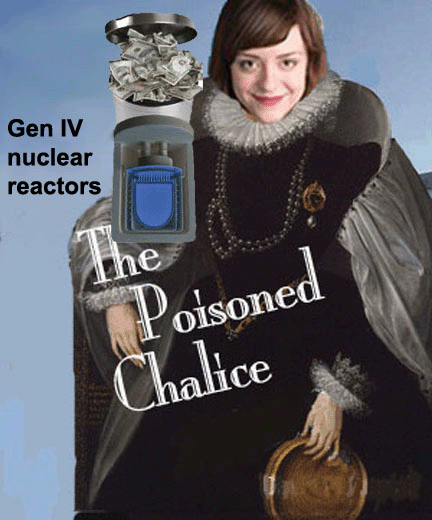
It’s interesting the way that, for dubious nuclear enterprises, they like to put a young woman at the top. Is this to make the nuclear image look young and trendy? Or is it so they she can cop the flak when it all goes wrong?
Below – Leslie Dewan – CEO of Transatomic Power
Nuclear Energy Startup Transatomic Backtracks on Key Promises The company, backed by Peter Thiel’s Founders Fund, revised inflated assertions about its advanced reactor design after growing concerns prompted an MIT review. MIT Technology Review by James Temple February 24, 2017 Nuclear energy startup Transatomic Power has backed away from bold claims for its advanced reactor technology after an informal review by MIT professors highlighted serious errors in the company’s calculations, MIT Technology Review has learned.
The Cambridge, Massachusetts-based company, founded in 2011 by a pair of MIT students in the Nuclear Science & Engineering department, asserted that its molten salt reactor design could run on spent nuclear fuel from conventional reactors and generate energy far more efficiently than them. In a white paper published in March 2014, the company proclaimed its reactor “can generate up to 75 times more electricity per ton of mined uranium than a light-water reactor.”
Those lofty claims helped it raise millions in venture capital, secure a series of glowing media profiles (including in this publication), and draw a rock-star lineup of technical advisors. But in a paper on its site dated November 2016, the company downgraded “75 times” to “more than twice.” In addition, it now specifies that the design “does not reduce existing stockpiles of spent nuclear fuel,” or use them as its fuel source. The promise of recycling nuclear waste, which poses tricky storage and proliferation challenges, was a key initial promise of the company that captured considerableattention.
“In early 2016, we realized there was a problem with our initial analysis and started working to correct the error,” cofounder Leslie Dewan said in an e-mail response to an inquiry from MIT Technology Review.
The dramatic revisions followed an analysis in late 2015 by Kord Smith, a nuclear science and engineering professor at MIT and an expert in the physics of nuclear reactors.
At that point, there were growing doubts in the field about the company’s claims and at least some worries that any inflated claims could tarnish the reputation of MIT’s nuclear department, which has been closely associated with the company. Transatomic also has a three-year research agreement with the department, according to earlier press releases.
In reviewing the company’s white paper, Smith noticed immediate red flags. He relayed his concerns to his department head and the company, and subsequently conducted an informal review with two other professors.
“I said this is obviously incorrect based on basic physics,” Smith says. He asked the company to run a test, which ended up confirming that “their claims were completely untrue,” Smith says.
He notes that promising to increase the reactor’s fuel efficiency by 75 times is the rough equivalent of saying that, in a single step, you’d developed a car that could get 2,500 miles per gallon.
Ultimately, the company redid its analysis, and produced and posted a new white paper………
The company has raised at least $4.5 million from Peter Thiel’s Founders Fund, Acadia Woods Partners, and Daniel Aegerter of Armada Investment AG. Venture capital veteran Ray Rothrock serves as chairman of the company.
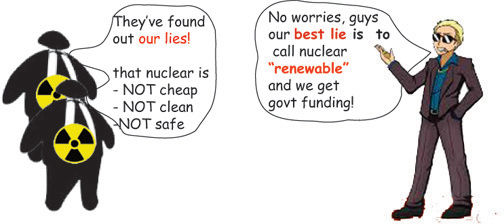
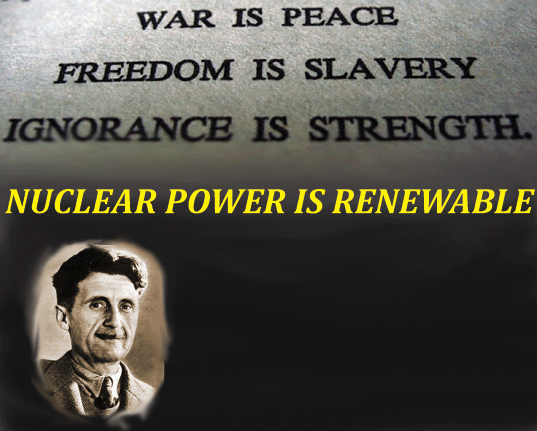
Bill to label nuclear energy as renewable stalls A bill aimed at classifying nuclear power as a renewable energy source in New Mexico stalled Thursday afternoon in committee on a tie vote.
House Bill 406, sponsored by Rep. Cathrynn Brown, R-Carlsbad, would have amended the state’s Renewable Energy Act, which requires energy companies provide a certain amount of electricity from renewable sources…. New Mexico Political Report 24 Feb 17
Nuclear Is Renewable Energy?http://krwg.org/post/nuclear-renewable-energy By CVNM •Santa Fe, N.M. 24 Feb 17 – Today, the House Energy, Environment and Natural Resources Committee debated Nuclear Energy as Renewable Energy (HB 406, Brown). The bill was tabled on a tied vote. CVNM Legislative Director Ben Shelton and CVNM Education Fund Western New Mexico Program Director Talia Boyd released the following statements:
“Nuclear energy is part of the problem, not the solution. Proposing to classify nuclear as renewable energy – as Governor Martinez did her in energy plan – disrespects the sacrifice Indigenous communities in western New Mexico have already made and continue to make with their health from the impacts of uranium mining,” says Ben Shelton, CVNM Legislative Director. “In addition, adding nuclear energy to the Renewable Energy Portfolio standard neutralizes its job creating potential because of nuclear assets already held by New Mexico’s two largest electric utilities – something our leaders should not consider a possibility.”
“My community in Gallup and Church Rock have witnessed our health, culture, families, and land be desecrated and sacrificed for uranium – an industry that many in our communities do not want, as demonstrated by a ban on uranium mining passed by the Navajo Nation in 2005,” says Talia Boyd, CVNM Education Fund Western New Mexico Organizer and member of the Diné Nation.
“Communities that have been living with the impacts of poor energy policy need to be at the table shaping our energy future by putting hardworking New Mexicans first with clean, renewable energy jobs, like wind and solar.”
It is extraordinary that some French wine producers are accompanying the Australian and French nuclear promoters spruiking the benefits of nuclear waste dumping to the community in the Barndioota region of South Australia. Not only are many vital questions unanswered as ENuFF SA (Everyone for a Nuclear Free Future SA) has shown, but this propaganda campaign completely ignores both the opposition to nuclear waste dumping, in France and the radioactive danger to France’s Champagne vineyards
“The Champagne producers are facing two nuclear timebombs – one already leaking at Soulaine, and one planned at Bure. The wine producers in the Rhone region stood up to the nuclear state in France and won. The Champagne region needs to act fast before it’s too late,” said Fred Marillier of Greenpeace France. “The French Government must stop this madness. The new facility must not accept any more waste, and an immediate investigation launched into how to stop further contamination of ground water.”
Radioactive waste leaking into Champagne Water Supply, Levels set to rise warns Greenpeace, Greenpeace 30 May, 2006 Greenpeace today revealed that France’s iconic sparkling wine, Champagne, is threatened by radioactive contamination leaking from a nuclear waste dumpsite in the region. Low levels of radioactivity have already been found in underground water less than 10 km from the famous Champagne vineyards.
Problems at the dumpsite, including water migration leading to fissures in the storage cells have been reported to French nuclear safety agency in recent weeks (1). Greenpeace has written to the Comita des Producteur de Champagne to warn them that their production risks contamination, as experienced by dairy farmers in la Hague, Normandy.
The waste dump, Centre Stockage l’Aube (CSA) in Soulaine eastern France, contains mostly waste from Electricite de France (EdF) and AREVA, but also includes foreign nuclear waste disposed of illegally under French law (2). Every week nuclear waste is trucked across France to the Champagne site. Once full, the dumpsite will be one of the world’s largest with over 1 million cubic meters of waste, including plutonium and other radionuclides.
ANDRA, the national nuclear waste agency operating the site, stated that it would not release any radioactivity into the environment when given permission for the dumpsite in the late 1980’s. Greenpeace research released last week showed levels of radioactivity leaking from another dumpsite run by ANDRA in Normandy were up to 90 times above European safety limits in underground water used by farmers, and that the contamination was spreading into the countryside (3). The Champagne site will receive a total of 4 thousand terabequerels of tritium; more than three times the amount of tritium waste as the dumpsite in Normandy.
“We have been told for decades that nuclear dumpsites will not leak and that the best standards are being applied. In reality the dumpsite in Normandy is a disaster, and radioactivity is already leaking from the dumpsite in Champagne,” said Shaun Burnie nuclear campaigner at Greenpeace International. “The authorities know they have a problem in Champagne already, with mistakes in the design. This is only the beginning of the problem, the bigger picture is that France has a nuclear waste crisis out of control that is threatening not only the environment and public health but also the economy of the Champagne region.”
In addition to the problems with the waste stores at the site, Greenpeace has learnt recently that French nuclear safety agency DGSNR has written to AREVA seeking clarification of the type of waste being disposed of at the Champagne site (4).
In addition to the low and intermediate waste site, a new high-level waste dumpsite is being planned in Bure also in the Champagne region, in which the most radioactive material in France would be deposited. Plans to build a high level waste facility in the Rhone Valley were scrapped a few years ago after strong opposition by the wine producers due to the threat to their vines and wine production.
“The Champagne producers are facing two nuclear timebombs – one already leaking at Soulaine, and one planned at Bure. The wine producers in the Rhone region stood up to the nuclear state in France and won. The Champagne region needs to act fast before it’s too late,” said Fred Marillier of Greenpeace France. “The French Government must stop this madness. The new facility must not accept any more waste, and an immediate investigation launched into how to stop further contamination of ground water.”……http://www.greenpeace.org/international/en/press/releases/radioactive-waste-leaking-into/
Weinberg Next Nuclear welcomes new Patron January 26th, 2017 Weinberg Next Nuclear, by Suzanna Hinson Weinberg Next Nuclear, the charity !!! promoting the next generation of nuclear energy, is delighted to announce its newest Patron – Professor Wade Allison, Emeritus Professor of Physics and Emeritus Fellow of Keble College. Professor Allison is a leading authority on medical physics, especially the effects of radiation on life……..
In Radiation and Reason (2009) he brought the scientific evidence of the effect of radiation to a wider audience. After the Fukushima accident this was translated into Japanese and Chinese. Nuclear is for Life (2015) is a broad study that contrasts the cultural rejection of nuclear energy with the evidence, at all but the highest levels, for the harmless, and even beneficial, interaction of radiation with life.
Upon his appointment, Professor Allison said:
‘’Fukushima showed that radiation is no threat to life ………
Stephen Tindale, Director of Weinberg Next Nuclear, said:
“Public opposition to nuclear energy on the basis of exaggerated and unscientific fear of radioactivity is a significant barrier to nuclear progress. The world needs more nuclear energy, and addressing the fear factor is a major part of nuclear advocacy. So I am delighted to welcome Wade as a Patron. Wade has immense scientific knowledge and is also extremely well versed in the need for new public communication on nuclear.” http://www.the-weinberg-foundation.org/2017/01/26/weinberg-next-nuclear-welcomes-new-patron/
Sadly, some in the U.S. Congress would rather bury their heads in radioactive quicksand, sinking our money into nuclear energy research at national laboratories that have sought but failed to find illusory atomic answers for decades.
The House and Senate are re-introducing near identical versions of the “Nuclear Energy Innovation Capabilities Act of 2017,” which promises to throw our money down the nuclear rabbit hole rather than direct major funding to renewable energy solutions that are already addressing climate change quickly and effectively but should be supported and accelerated before it’s too late.
The Act states as its purpose “To enable civilian research and development of advanced nuclear energy technologies by private and public institutions, to expand theoretical and practical knowledge of nuclear physics, chemistry, and materials science, and for other purposes.” It passed the House last year but stalled in the Senate.
In reality, it is another futile tilt at the so-called “advanced reactor” windmill, when real windmills would actually do the job far faster, more safely and cheaply and without all the attendant risks of tinkering with radioactive materials and perpetuating a deadly waste problem into eternity.
The bill states it would authorize research, modeling and simulation of “advanced nuclear reactor concepts” that are “inherently safe.” This chimera has been chased for decades and inherent safety won’t be found in the designs the national laboratories are pushing, such as the sodium-cooled reactor, proven to be literally explosive.
So-called new generation “fast reactors” are another old idea from an old research establishment, the Argonne National Laboratory, which would be delighted to be on the receiving end of this latest transfusion. Argonne’s first attempt at a fast neutron reactor was canceled by the U.S. Congress in 1994.
A new documentary, The New Fire, (a singularly odd choice of title given the subject), celebrates the excitement of eager young scientists determined to invent the better nuclear mousetrap. But back in 1996 the National Academy of Sciencesalready acknowledged that the development of a reactor that could recycle its own waste would have very high costs and marginal benefits and would take hundreds of years — time we definitely do not have.
The thrill of theoretical experimentation in the laboratory may be exciting for young engineers. But they shouldn’t get our money. Nor should we hand these aspiring atomic alchemists the mandate to cure climate change. That race is already being won by renewable energy research and implementation. It is in this field where the real “innovation” lies and where Congress should be directing their mandate and funding dollars.
Under Trump, INL pivots its nuclear message Post Register January 24, 2017 By LUKE RAMSETH lramseth@postregister.comIdaho National Laboratory officials are considering how to shift their message under a Trump administration that has sent mixed signals on energy research and the existence of climate change.
The Gazette-Times’ Jan. 13 article about NuScale’s reactor certification, needs some clarification. NuScale’s “small modular reactor” is not: an answer to climate change, small, a “clean energy” source, nor inherently safe.
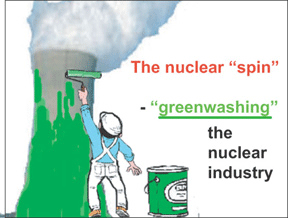
The nuclear industry has been selling us a story that nuclear power is a solution to climate change because it does not generate carbon dioxide (CO2), a major greenhouse gas. While this is true of the nuclear chain reaction itself, the front and back ends of nuclear power generate a large volume of CO2 and leave a trail of endlessly dangerous radioactivity along the way.
At the front end of nuclear power, carbon energy is used for uranium mining, processing, conversion, and enrichment, as well as for transportation, formulation of rods and construction of nuclear reactors (power plants). At the back end, there is the task of decommissioning and isolating highly radioactive nuclear waste for millennia — a task which science has so far not been able to address.
NuScale’s power plants are not small. Their plants contain 50 megawatt modules, but to be competitive with solar energy, wind energy or natural gas, they need all 12 modules (600 megawatts). Nuclear energy is not “clean energy.” This is understood with the ongoing Fukushima or Chernobyl tragedies. NuScale’s is not a fail-safe system, regardless of the nonhuman intervention with its passive design. Neither Mother Nature nor human nature can be anticipated completely. NuScale is not the answer to our energy problems, it will just add to them. Wind, solar and efficiency are better investments.
don’t for one second think that nuclear power is green or sustainable in any way. You will hear that, because nukes don’t create CO2 when they’re generating power, they’re a solution to climate change.
What you don’t hear from the proponents of nuclear power/weapons is that the mining and refining of nuclear fuel is extremely energy- and carbon-intensive.
What you don’t hear is that the billions of government subsidy dollars that are going to shore up and bail out unprofitable nuclear power companies could be better spent on developing and bringing to scale truly sustainable forms of energy.
What you don’t hear is that there is no way to safely clean up radioactive waste. “Green” and “nuclear” simply cannot be credibly used together.
My Turn/Darling: No such thing as ‘green’ nuclear power http://www.recorder.com/my-turn-nuclear-facilities-7049505By ANN DARLING , December 26, 2016 Here in the Pioneer Valley we live within a circle of five operating, decommissioning, or decommissioned nuclear power facilities and a nuclear submarine base. Radioactive materials are extremely dangerous and extremely long lived. For our safety and the safety of future generations, we need to be informed about nuclear power and the waste created from its mining and its use.
Of course, there are nuclear facilities all over the world and nuclear contamination has a way of traveling very long distances in the air, through oceans and rivers, and in our bodies. So it’s not something anyone can totally escape from, no matter where we live. We have fouled our nest with nightmarishly toxic and pernicious stuff and we don’t know what to do with it.
It’s extremely painful, frightening and depressing to face this head on. But we have to. We are now the stewards of all this radioactive waste, whether we like it or not. And more waste is being made all the time.
What can you do? First, accept the responsibility of being a nuclear steward. Then, become knowledgeable. Two good resources are the Nuclear Information and Resource Service, www.nirs.org, or Fairewinds Energy Education, www.fairewinds.org.
Second, question everything you hear about nuclear power. Start with these two basic assumptions and see if they help you make sense of it:
Corporations have a “perverse motivation” (i.e. profit) to reduce costs and neglect safety, so they tend to obfuscate and lie when challenged.
The Nuclear Regulatory Commission is about one quarter regulator (at best) and three quarters nuclear industry cheerleader. It is one of many “captive regulators” in an economy driven by short-term gain and not by long-term investment in the future.
Third, do everything you can to pressure government, utilities, and corporations to stop creating more radioactive waste. A good starting place would be calling Gov. Baker and telling him Pilgrim Nuclear in Plymouth should be shut down.
Fourth, don’t for one second think that nuclear power is green or sustainable in any way. You will hear that, because nukes don’t create CO2 when they’re generating power, they’re a solution to climate change. What you don’t hear from the proponents of nuclear power/weapons is that the mining and refining of nuclear fuel is extremely energy- and carbon-intensive. What you don’t hear is that the billions of government subsidy dollars that are going to shore up and bail out unprofitable nuclear power companies could be better spent on developing and bringing to scale truly sustainable forms of energy. What you don’t hear is that there is no way to safely clean up radioactive waste. “Green” and “nuclear” simply cannot be credibly used together.
Fifth, don’t even imagine that Yucca Mountain is an appropriate place to store radioactive waste. Even if we had technology good enough to contain radioactive waste for generations — which we don’t — Yucca is not the right place from a geological standpoint.
Sixth, if you live near a shutdown reactor (which you do) and just want the radioactive waste gone, yesterday, think about where it will go. Think about the places it would be transported through, at great risk of accident or terror attack. Think about the places where it would be stored, and where it could leak or worse. Right now, radioactive materials from the decommissioning of Vermont Yankee are being shipped to a storage facility near the Texas-New Mexico border that sits on top on a huge aquifer supplying at least seven southwestern states. What will happen if the radioactivity gets into the deep water?
Seventh, recognize that the communities and geographies that are being forced or asked to take on radioactive waste are sacrifice zones inhabited by people with dark skin and/or no money or political clout. That storage facility on the Texas-New Mexico border is in an area that is poor, rural, and largely Mexican-American. Uranium is mined on indigenous people’s land throughout the world and the waste simply left there, making them sick. Yucca Mountain itself, and the contaminated Nevada nuclear testing sites nearby, are actually on Shoshone tribal lands. This is racism at a profound level.
Finally, get involved in anything that will slow down or stop the creation of nuclear waste. Promote sustainable energy and energy conservation efforts. Climate Action Now is a good local resource: www.climateactionnowma.org. Advocate to shut down Pilgrim Nuclear in Plymouth: www.capedownwinders.org or www.pilgrimcoalition.org. Get involved in regional and national discussions about what is the least bad resolution to the problem of nuclear waste. The Citizens’ Awareness Network is a local organization with a solid history and national reach: www.nukebusters.org.
You don’t have to be an expert on nuclear power to make a difference. You just have to show up and be ready to learn and work hard for your children and their children and their children.
Ann Darling currently lives in Easthampton and has worked in Greenfield for over 15 years. She is a 35-year resident of the Brattleboro, Vt., area and a member of the Safe and Green Campaign to responsibly shut down and decommission Vermont Yankee Nuclear Power Plant. She recently attended a national summit on radioactive waste in Chicago.
Myth: the new generation of nuclear reactors are designed to recycle nuclear waste
BUST: These reactors don’t exist
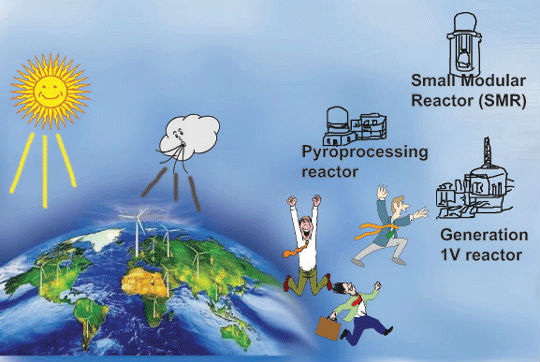
These reactors often spoken of by advocates of nuclear energy are hypothetical. There are none of these “Generation IV” reactors commercially operating anywhere in the world:
Even the demonstration plants are still decades away
Various designs are still under investigation on paper and have been for many years.
The first demonstration plants are projected to be in operation by 2030-2040, so they are yet to be tested and still many years away.
Problems with earlier models
The specific type of Generation IV reactor that would recycle waste – the Integral Fast Reactor – only exists on paper, but earlier models of fast reactors have been expensive, underperforming, and have had a history of fires and other accidents, with many countries abandoning the technology.
These reactors would still produce some waste
The Integral Fast Reactor is called “integral” because it would process used reactor fuel on-site, separating plutonium (a weapons explosive) and other long-lived radioactive isotopes from the used fuel, to be fed back into the reactor. It essentially converts long-lived waste into shorter lived waste. This waste would still remain dangerous for a minimum of 200 years (provided it is not contaminated with high level waste products), so we are still left with a waste problem that spans generations.
The theory is that these reactors would eat through global stockpiles of plutonium
When thinking about recycling waste it’s important not to confuse recycling existing stockpiles of waste with these reactors perpetually running off of their own waste, which they could also be operated to do. If they ran off their own waste, they would not consume existing waste beyond the initial fuel load.
Myth: nuclear is the only alternative to coal for baseload power
The “New Nuclear” lobby is kicking off its New Nuclear propaganda for 2017 with its favourite tactic – FILM.
They started this method with great success in 2013 with a very glossy and quite seductive advertisement calld “Pandora’s Promise” That has now been rehashed many times, e.g on Youtube. It pretends to be a documentary about c limate change, but is really a hymn to new nuclear “Generation IV” technology, especially Small Nuclear Reac
tors, and to endless consumption of electricity.
Then came the even more sophisticated and glossier television series, “Twisting the Dragon’s Tail”, a subtle nuclear advertisement promotion that featured Australia quite strongly. Cleverly introducing the negative aspects of the nuclear industry, it finishes with that same message for boundless energy consumption via New Nuclear.
These so-called “independent documentaries” are quite lavishly and expensively produced. Who pays for them? That is a well-kept secret. Do presenters like Derek Muller (Dragon’s Tail) understand how they are being used?
“The New Fire” is currently under production, using, as those other ads did, very capable media professionals. We have no idea who is behind this project, but, with billionaires now in the Small Nuclear Reactor business, we can suspect those in the nuclear front group “Breakthrough Energy Coalition”
The theme of those first two nuclear propaganda films was about the “need for ever-rocketing electricity consumption, and how new small nuclear reactors will meet that need.”
Thee theme of this 2017 nuclear advertisement will be that “only via new nuclear power can the world be saved from climate change” It will focus on the new smart young people who reject the boring old people’s anxiety about nuclear power.
THE NEW FIRE describes itself as ” an independent documentary that will introduce audiences to young nuclear engineers who are developing next-generation reactors which they hope will provide clean and safe solutions to the world’s future energy needs. Could these audacious innovators be the agents of change the world has been waiting for? With unprecedented access to key people, places and events, award-winning filmmaker David Schumacher has traveled the globe to capture a powerful, eye-opening story that needs to be told now—before it’s too late.”
Utility regulator wants nuclear energy to count as renewable, The Daily Progress, PHOENIX (AP) 13 Dec 16 — Arizona’s utility regulator has suggested that nuclear energy should count as a renewable power source, allowing it to compete with solar and wind.
Environmental advocates don’t generally consider nuclear power plants renewable because the uranium that fuels them must be mined, reported The Arizona Republic (http://bit.ly/2hitoC0 ). Utility regulator Andy Tobin proposed the change in a letter that implies he never supported the Renewable Energy Standard the state passed in 2006, which didn’t include nuclear energy as a renewable source.
the long-term effects of low-level radiation exposure have consistently been downplayed, distorted or concealed by scientists, the nuclear industry and the government.
It seems that while the US and the USSR had a hard time cooperating on nuclear arms at that time, they had a tacit agreement to cover up each other’s nuclear power mistakes.
these facts, like all those about nuclear power and nuclear weapons testing, were kept secret and released only through the efforts of private citizens and a few courageous researchers and journalists.
At least 250,000 American troops were directly exposed to atomic radiation during the 17 years of bomb testing here and in the Pacific, but they have been totally ignored by the government and the Army.
There is little doubt that hundreds died and that countless others developed illnesses that led to death from various cancers, blood disorders and chronic body ailments. Today the government still rejects all claims for such illnesses.
The press also played a role in soothing public fears.
the US has led the world in setting examples of deliberate deceit, suppression of information and harassment of nuclear critics
Professionals, in order to perform their work, resist truth strongly if it calls the morality of their work into question. They sincerely believe they are helping humankind. In addition, scientific research involves so many uncertainties that scientists can, with an easy conscience, rationalize away dangers that are hypothetical or not immediately observable. They also have an intellectual investment if not a financial one in continuing their work as well as families to support, and nuclear science in particular has been endowed not only with government money and support but great status and prestige.
In order to perform professional work, one must not only believe one is doing good but must also rationalize the dangers. Indeed, with regard to ionizing radiation, this is quite easy inasmuch as the risks of radiation exposure at any level are statistical and not immediately manifested.
Pro Nuclear Propaganda: How Science, Government and the Press Conspire to Misinform the Publichttp://www.lornasalzman.com/collectedwritings/pro-nuclear.htmlby Lorna Salzman Hunter College, Energy Studies program, 1986 After the Chernobyl nuclear reactor disaster in the Soviet Union, there was much finger-wagging in the US about the suppression of information there, and the purported differences in reactor design and safety requirements between Russia and the US, which made a similar accident here unlikely if not impossible Continue reading →












 nuclear-news