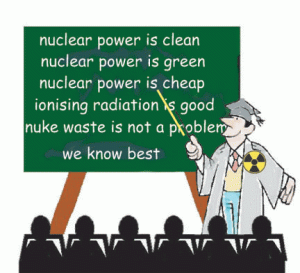
Anglesey students experience work life at Horizon, North Wales Chronicle 1 Aug 17, A group of pupils from schools across Anglesey were given a taste of working life at Wylfa Newydd last week.
The year 11 and Sixth form students were given the opportunity as part of Horizon’s Work Insight Week……
Alongside an explanation of how to build and operate the proposed nuclear power station, the students got to visit the site and learn more about the scale of the Project and the opportunities Wylfa Newydd will bring.
August 4, 2017
Posted by Christina Macpherson |
Education |
Leave a comment
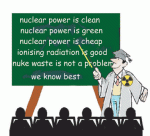 K-State receives two federal nuclear energy grants, Mercury, Kansas, 28 July 17, Two new grants awarded to K-State may help the university attract the best students and faculty in nuclear engineering.
The Nuclear Regulatory Commission, a federal nuclear energy commission, awarded K-State’s mechanical and nuclear engineering department two grants totaling about $843,000. The commission awarded a $450,000 grant to help develop young faculty members’ careers and a $393,820 grant to continue the department’s nuclear research fellowship program for graduate students…….
The fellowship grant will cover tuition and fees for students pursuing graduate studies in nuclear engineering…..
A previous fellowship grant from the NRC helped the university recruit three doctoral students in nuclear engineering who plan to graduate in 2018, according to the university. The continuation of the program will assist the university in increasing the number of doctoral graduates in nuclear engineering, which is a direct measure of the success of the department, Bindra said.
July 29, 2017
Posted by Christina Macpherson |
Education, USA |
Leave a comment
Westinghouse and partners get $7.5m funding from DOE for nuclear research, EBR 13 July 2017 The U.S. Department of Energy (DOE) has selected Westinghouse Electric Company and university research partners to receive a total of $7.5m in funding to advance nuclear innovation in a number of areas.
For one of the projects, Westinghouse is investigating the neutron radiation effects on zirconium alloys produced via the additive manufacturing process (3D printing) for light water reactors……The funding that Westinghouse received is part of DOE’s more than $66 million in funding for nuclear energy-related and infrastructure research in 28 states through the Nuclear Energy University Program (NEUP), Nuclear Science User Facilities (NSUF) and Nuclear Energy Enabling Technology (NEET) program. http://nuclear.energy-business-review.com/news/westinghouse-and-partners-win-75-million-for-nuclear-innovation-from-the-department-of-energy-5870951
July 17, 2017
Posted by Christina Macpherson |
Education, USA |
Leave a comment
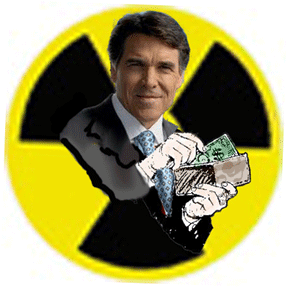
 Washington Examiner by John Siciliano | Jun 27, 2017, Energy Secretary Rick Perry said Tuesday that one of his agency’s goals is to push nuclear energy.
“One of the things we want to do at [the Department of Energy] is to make nuclear energy cool again,” Perry said during a lengthy news conference at the White House Tuesday….”..when I was younger in the ’60s, and a lot of kids wanted to go into the nuclear energy field.”
But that isn’t the case now, he said, “because this industry has been strangled all too often by government regulations.”
He wants the U.S. to begin again to “bring us to that place where nuclear energy is part of a portfolio, and be able to sell it in great truthfulness and honesty about what it can add to America from an environmental standpoint and from a security standpoint.”…..
On the nuclear power side, the U.S. has the largest fleet of nuclear reactors in the world, although it is becoming too expensive to run many of the plants because of increased cost pressures and competition from natural gas.
Perry mentioned that the U.S. will engage with India on nuclear power development as part of a three-part plan to export energy technologies to foreign markets. The first part of new cooperation with India will be exporting liquefied natural gas, the second area will be on clean coal, and the third will be nuclear energy. http://www.washingtonexaminer.com/perry-wants-to-make-nuclear-energy-cool-again/article/2627250
June 28, 2017
Posted by Christina Macpherson |
spinbuster, USA |
Leave a comment
Czech Republic nuclear power station hosts bikini contest to choose interns, DW, 25 June 17 A Czech nuclear power plant decided a bikini contest would be a good way to choose its next round of interns. Facebook users were asked to rate school graduates who posed inside a cooling tower. A Czech nuclear power plant operator apologized last week for using a Facebook bikini contest to choose its next intern.
Power generation conglomerate CEZ had 10 bikini-clad high school graduates pose in a cooling tower of its Temelin nuclear power plant, which was briefly closed for maintenance.
It then asked Facebook users to vote for their favorite, with the most popular winning a 14 day internship at the plant.
In a press release CEZ likened the photoshoot to its previous cultural enrichment programs, such as hosting the Bohemian Philharmonic at the plant in South Bohemia. The release said the experience was greatly enjoyed by the girls, who were required to wear hard hats and enclosed shoes at all times.
Local TV channel Jihoceske filmed a feature on the shoot, showing the models touring the Czech Republic’s largest power station which is about 90 kilometers (55 miles) north east of the state of Bavaria on the German border.
The competition caused an outcry among Czech news and social media.
“The competition is absolutely outside the bounds of ethics. In 2017, I find it incredible that someone could gain a professional advantage for their good looks,” Petra Havlíková, a lawyer for human rights non-profit Nesehnutí and an equal opportunities adviser, told aktualne.cz.
Undress and you get an internship – this can not be serious, it’s degrading, disgusting and primitive,” one internet user commented.
“Knowledge obviously does not matter,” noted another user……
A Russian first
The power plant was not the first to link the wonders of nuclear energy with the revealing bathing suit.
Russia used to host an annual beauty contest open to women working in nuclear industries or studying in nuclear-related subjects in Russia and former USSR countries. Women aged 18 to 45 would pose in front of a nuclear power plant. http://www.dw.com/en/czech-republic-nuclear-power-station-hosts-bikini-contest-to-choose-interns/a-39404100
June 26, 2017
Posted by Christina Macpherson |
EUROPE, spinbuster |
2 Comments
 Energy dept seeks to calm nuclear power fears, Joel Guinto, ABS-CBN News Jun 20 2017 MOSCOW – The Department of Energy on Monday stressed the need to calm the public’s fears over nuclear power, as it studied the feasibility of adding it to the country’s energy mix. The department aims to provide President Rodrigo Duterte with a menu of nuclear energy sources, including using the three-decade-old Bataan Nuclear Power Plant, Energy Undersecretary Donato Marcos told ABS-CBN News.
“The biggest challenge is social acceptability,” said Marcos on the sidelines of a summit hosted by the Russian State Atomic Energy Corp.
“We need to come up with a massive information campaign so that the people will know. They need to be educated on nuclear power,” he said.
The $2-billion Bataan Nuclear Power Plant was never used due to worries over its safety……
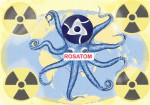 The energy department last month signed a memorandum of understanding with ROSATOM on nuclear energy cooperation, including winning public support.
Russian companies have also offered nuclear power barges to the Philippines to help meet growing demand in one of the world’s fastest growing economies. http://news.abs-cbn.com/business/06/19/17/energy-dept-seeks-to-calm-nuclear-power-fears
June 23, 2017
Posted by Christina Macpherson |
Philippines, spinbuster |
Leave a comment
 Nuclear Power is Becoming Irrelevant, Renewable Energy will Kill Nuclear Power, too, Energy and Capital, by Jeff Siegel 19 June 17 Forbes contributor James Conca recently wrote a piece entitled: Natural Gas Industry Blasts Nuclear Power with Fake News.
According to Conca, the American Petroleum Institute has flooded the airwaves in Ohio and Pennsylvania with anti-nuke commercials and has even “drawn AARP into the fray by pushing fear – fear of higher prices and fear of radiation. Just the opposite of what is true.”
While I don’t doubt that the oil industry would use its marketing muscle to convince folks that natural gas is better than nuclear, to deny that there is relevance to fear of higher prices and radiation is absurd.
On the cost side, Conca partly blames renewable energy subsidies, which, by the way, haven’t been around nearly as long as subsides for nuclear, and of course solar and wind will likely be free of many of those subsidies within the next ten years.
Don’t get me wrong. In a perfect world, there would be no subsidies at all, and all forms of energy would have to compete on a level playing field where free markets, not government intervention, dictated the winners and losers. But that’s never been the case for energy. And it’s certainly never been the case for nuclear.
Joe Romm, that liberal energy analyst that provokes the status quo with his annoying facts and sound data analysis wrote about this very thing back in 2008, and made some very valid points that I’m sure Conca would refute just on principle. Check it out …
From 1948 to today, nuclear energy research and development exceeded $70 billion, whereas research and development for renewables was about $10 billion. From 2002 to 2007, fossil fuels received almost $14 billion in electricity-related tax subsides, whereas renewables received under $3 billion.
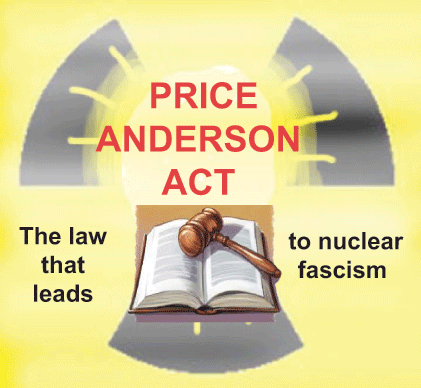
 The Price-Anderson Nuclear Industries Indemnity Act caps the liability for claims arising from nuclear incidents. It reduces the insurance nuclear power plants need to buy and requires taxpayers to cover all claims in excess of the cap. The benefit of this indirect subsidy has been estimated at between $237 million and $3.5 billion a year, which suggests that it has been worth many billions of dollars to the industry. It could be argued that the value is considerably larger than that, since the industry might not have existed at all without it: “At the time of the Act’s passing, it was considered necessary as an incentive for the private production of nuclear power … because investors were unwilling to accept the then-unquantified risks of nuclear energy without some limitation on their liability.
One can make a case that such insurance was reasonable for a new, almost completely unknown technology in 1957. Extending it through 2025 is harder to justify. If investors aren’t willing to accept the risks of nuclear energy now, without taxpayers liable for any major catastrophe, perhaps the technology no longer deserves government support.
Conca also claims that the fear of radiation is not true. I’m not sure if he means the fear isn’t true or the potential of radiation isn’t true. Either way, both are quite accurate arguments from the oil and gas industry. Just ask the parents of this kid. [picture on original]……..
Of course, I don’t expect my opinion on this to sway nuclear power advocates. Those folks will go down with the ship, screaming from the top of their lungs that nuclear is clean, safe, and cheap. But it’ll never be as clean, safe, or cheap as where we’ll see renewable energy in another ten years. That’s a fact. And that’s without subsidies.
Meanwhile, while the solar and wind industries are beginning to ween themselves off subsidies, the nuclear industry is seeking more. This, despite the fact that the federal government has ponied up in excess of $85 billion for the nuclear industry since 1948. It seems to me that if the nuclear industry can’t stay competitive without government support after getting it for almost 70 years, it probably never will be able to compete without that support……https://www.energyandcapital.com/articles/nuclear-power-is-becoming-irrelevant/5930
June 21, 2017
Posted by Christina Macpherson |
2 WORLD, spinbuster |
Leave a comment
Leaders urge collective effort to secure nuclear’s future role, World Nuclear News, 20 June 2017 The nuclear energy industry needs to work together to secure its future role in the fight against climate change and energy poverty, five of its most prominent leaders said yesterday at the opening ceremony of the IX AtomExpo International Forum in Moscow.
Senior officials from the World Nuclear Association, the World Association of Nuclear Operators (WANO), the OECD-Nuclear Energy Agency (NEA), the International Atomic Energy Agency (IAEA) and Russian state nuclear corporation Rosatom – which hosts the annual forum – said the global industry must cooperate to harness the attributes of nuclear power as a low-carbon, sustainable and reliable source of electricity……http://www.world-nuclear-news.org/NP-Leaders-urge-collective-effort-to-secure-nuclears-future-role-20061701.html
June 21, 2017
Posted by Christina Macpherson |
spinbuster |
Leave a comment

Energy Department Invests Nearly $67 Million to Advanced Nuclear Technology, Energy Gov,
JUNE 14, 2017 WASHINGTON, D.C. –Today, the U.S. Department of Energy (DOE) announced nearly $67 million in nuclear energy research, facility access, crosscutting technology development, and infrastructure awards in 28 states. In total, 85 projects were selected to receive funding that will help advance innovative nuclear technologies….
These awards provide funding for nuclear energy-related research through the Nuclear Energy University Program, Nuclear Science User Facilities, and Nuclear Energy Enabling Technologies programs. In addition, a number of nuclear technology developers will receive access to unique research capabilities and other assistance consistent with the goals and objectives of the Gateway for Accelerated Innovation in Nuclear (GAIN) initiative…..
Nuclear Energy University Program
DOE is awarding over $31 million through its Nuclear Energy University Program (NEUP) to support 32 university-led nuclear energy research and development projects in 23 states. NEUP seeks to maintain U.S. leadership in nuclear research across the country by providing top science and engineering faculty and their students with opportunities to develop innovative technologies and solutions for civil nuclear capabilities.
Additionally, 19 universities will receive approximately $6 million for research reactor and infrastructure improvements providing important safety, performance, and student education-related upgrades to a portion of the nation’s 25 university research reactors as well as enhancing university research and training infrastructure.
Integrated Research Projects
The Department is awarding $11 million for three Integrated Research Projects (IRPs), which address well-defined but highly complex technical issues impacting key NE mission objectives. IRPs are multi-million, three-year projects executed by university-led consortiums that typically include multiple universities, industrial and international research entities, and the unique resources of the DOE national laboratories. IRPs comprise a significant element of DOE’s innovative nuclear research objectives and illustrate the Office of Nuclear Energy’s (NE) strategy to pursue R&D solutions most directly relevant to the near-term, significant needs of the NE R&D programs.
Crosscutting Research Projects
Additionally, nearly $6 million will be awarded for six research and development projects led by Department of Energy national laboratories, industry, and U.S. universities. Together, they will conduct research to address crosscutting nuclear energy challenges that will help to develop advanced sensors and instrumentation, advanced manufacturing methods, and materials for multiple nuclear reactor plant and fuel applications.
Nuclear Science User Facilities – Public Private Partnerships
Lastly, DOE has selected five university, four national laboratory, and five industry-led projects that will take advantage of NSUF capabilities to investigate important nuclear fuel and material applications. DOE will support 6 of these projects with a total of $2.3 million in research funds, and all 14 of these projects will be supported by over $10 million in facility access costs and expertise for experimental neutron and ion irradiation testing, post-irradiation examination facilities, synchrotron beamline capabilities, and technical assistance for design and analysis of experiments through the NSUF.
By supporting the five industry-led projects, DOE is accelerating its implementation of the GAIN initiative by providing these nuclear technology developers with access to world-class neutron and gamma irradiation and post-irradiation examination services. The GAIN initiative provides the nuclear community with a single point of access to the broad range of capabilities, people, facilities, materials, and data across the DOE complex and its National Laboratory capabilities. Visit here for details.
Since 2009, the Energy Department’s Office of Nuclear Energy has awarded approximately $472 million to 103 U.S. colleges and universities to continue American leadership in energy innovation and to train the next generation of nuclear engineers and scientists through its university programs. Visit neup.gov for more information on today’s awards and Energy.gov for information on all of the Energy Department’s efforts to continue American leadership in nuclear energy innovation. https://energy.gov/articles/energy-department-invests-nearly-67-million-advanced-nuclear-technology
June 16, 2017
Posted by Christina Macpherson |
Education, USA |
Leave a comment
DOE shells out $67M for advanced nuclear technology research http://www.utilitydive.com/news/doe-shells-out-67m-for-advanced-nuclear-technology-research/445065/ Robert Walton@TeamWetDog June 15, 2017
Dive Brief:
- The U.S. Department of Energy yesterday announced nearly $67 million funding for nuclear energy research this week, including facility access and infrastructure awards in 28 states, to support 85 projects in total.
- DOE said in a statement that the funding “sows the seeds for safer, more efficient, clean baseload energy” that will support the economy and energy independence.
- Among the awards, DOE will provide $31 million through its Nuclear Energy University Program (NEUP) to support 32 university-led nuclear energy research and development projects in 23 states.
-
Dive Insight:
The federal government has been signaling its interest in nuclear development, particularly advanced reactors and modular designs, for several years now. But the bankruptcy of Westinghouse Electric, a nuclear development firm working on two projects in the United States, could add a new sense of urgency to the research as the time and cost of traditional nukes continues to face pressure.
“Investing in the future of nuclear energy is an important strategic priority for the Energy Department,” DOE Acting Assistant Secretary for Nuclear Energy Ed McGinnis said in a statement, “Nuclear energy technologies contribute to our economy, our environment, and our national security.”
In addition to the NEUP funding for universities, DOE also said 19 universities will receive approximately $6 million for research into reactor and infrastructure improvements. The agency will also award $11 million for three integrated projects which address well-defined but highly complex technical issues.
DOE also said almost $6 million will be awarded for six research and development projects led by Department of Energy national laboratories, industry, and U.S. universities, to address crosscutting nuclear energy challenges that will help to develop advanced sensors and instrumentation, and advanced manufacturing methods.
Finally, DOE said it has selected five university, four national laboratory, and five industry-led projects that will take advantage of NSUF capabilities. The agency will support six of these projects with a total of $2.3 million in research funds, and all 14 of these projects will be supported by over $10 million in facility access costs.
- But more traditional nuclear projects are continuing—despite turmoil in the industry.
Georgia Power and its parent company, Southern Co., have reached an agreement with Westinghouse to complete the long-delayed Vogtle nuclear plant expansion. The announcement helps alleviate fears the project may be permanently halted and the nuclear industry on hold, but it is also a reminder of the costs involved.
Under terms of the agreement, Westinghouse parent company Toshiba has guaranteed $3.68 billion in payments to Georgia Power for completion of the project. Vogtle is billions over budget and years behind schedule, and the completion date for two new reactors has been extended multiple times.
June 16, 2017
Posted by Christina Macpherson |
Education, USA |
1 Comment
 The psychology of nuclear power: Stop saying it’s safe, Power Technology, by Molly Lempriere, 30 May 17
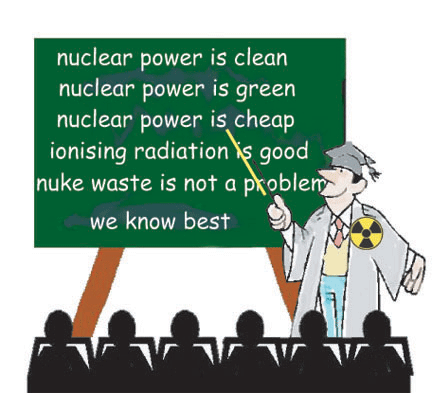
At the end of this year’s Nuclear Industry Forum, talk turned to the psychology of nuclear propaganda, including why – as Imperial University fellow Malcolm Grimston explains -calling it safe is not always a good thing. The aircraft industry amongst others learnt a long time ago that you do not lead your advertising with your weak points. That is why it does not often emphasis safety on its adverts but instead focuses on the joys of the holiday you are flying too.
Imperial University Centre for Environmental Policy senior research fellow Malcolm Grimston believes that this is something the nuclear industry needs to learn. Faced with criticism over the safety of nuclear power from charities, groups and individuals, the nuclear industry long ago embarked on a campaign to try and convince the public of its inherent safety. But this approach has been ineffectual according to Grimston………
What is the best type of propaganda?
So how can the nuclear industry really convey its importance and use, as well as safety to the masses in an effective way? “It’s not a matter of trying to play up problems that are out there, it’s a matter of saying this is something that has some very positive points that can contribute towards finding the solution to some of the difficulties out there,” suggests Grimston.
As nuclear new build Hinkley Point begins construction in the UK, it will be interesting to see if the nuclear industry leads with the old safe message, a more emotive take, or nothing at all.http://www.power-technology.com/features/featurethe-psychology-of-nuclear-power-stop-saying-its-safe-5822092/
May 31, 2017
Posted by Christina Macpherson |
2 WORLD, spinbuster |
Leave a comment
Moscow offers Bangladeshi students scholarship to study nuclear tech http://www.dhakatribune.com/bangladesh/education/2017/05/30/moscow-bangladeshi-scholarship-nuclear/
Moscow intends to offer scholarships to Bangladeshi students to study nuclear technology
-
Russian Parliament’s Upper House Deputy Chief Ilyas Magomed-Salamovich Umakhanov on Tuesday said Moscow intends to offer scholarships to Bangladeshi students to study nuclear technology.
Bangladesh’s first nuclear plant is being being built with Russia’s assistance, according to a BSS report.
“Russian Government is keen to enhance the number of scholarships to the Bangladeshi students in the disciplines related to nuclear science,” A statement released by Bangladesh embassy in Moscow quoted Umakhanov as saying during a meeting with a delegation of Bangladesh parliament standing committee on foreign affairs led by Dr Dipu Moni on Monday.
It said Umakhanov told the Bangladesh delegation that Russia intended to offer the stipends with the aim of building a pool of talent for operating nuclear power plants in Bangladesh.
- Dipu Moni described the Rooppur Nuclear Power Plant to be a signature initiative in regard to Dhaka-Moscow ties and appreciated the progress of the project.
The former foreign minister lead the parliamentary standing committee delegation to its first ever visit to Russia while it was warmly received by the representatives of Russian parliament’s upper house and the State Duma or lower house in the historic city of St Petersburg and Moscow.
The delegation was comprised of lawmakers Faruk Khan, Sohrabuddin, Selim Uddin, Razee Mohammad Fakhrul and Mehjabeen Khaled, who were joined by Bangladesh Ambassador in Moscow Dr Saiful Hoque and other embassy officials.
May 31, 2017
Posted by Christina Macpherson |
Education, Russia |
Leave a comment
Korsnick calls for concerted nuclear advocacy effort, World Nuclear News 24 May 2017

The US nuclear energy industry must work together to strengthen existing relationships and build new coalitions among supporters of nuclear energy’s different attributes, according to Nuclear Energy Institute (NEI) president and CEO Maria Korsnick….
Korsnick said the industry has developed the National Nuclear Energy Strategy to communicate nuclear energy’s benefits “more aggressively, more widely and more consistently than we ever have before”. The industry has “stepped up our advocacy efforts not just a notch or two, but by a great margin”, she said……..
“this remains a time of great stress for the nuclear energy industry”, she said, stressing that the industry must ensure nuclear energy remains part of the conversation on clean energy.
“Like me, you know exactly which aspects of this fascinating field have kept you a passionate believer in its promise for the future,” she said. “What I’d like you to do is go out and spread the passion in the ways you know best.” http://www.world-nuclear-news.org/NP-Korsnick-calls-for-concerted-nuclear-advocacy-effort-2405175.html
May 26, 2017
Posted by Christina Macpherson |
2 WORLD, spinbuster |
Leave a comment
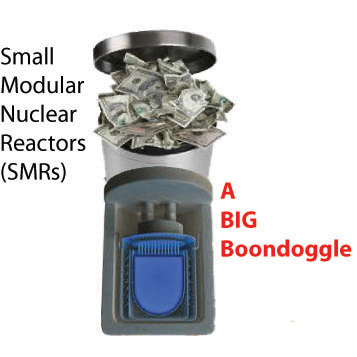
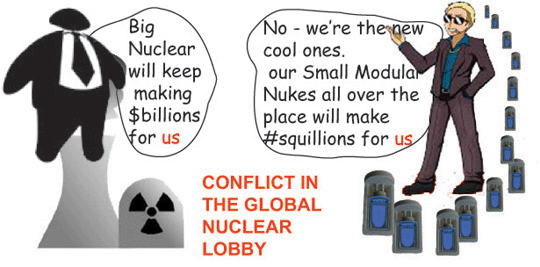 Britain’s on the brink of a small-scale nuclear reactor revolution, The Register, 24 May 2017 , Marcus Gibson Sure, there are hurdles, but no £18bn hole on the other side like Hinkley Point ……. a cheaper and smaller alternative is emerging if activity from British entrepreneurs and academics is anything to judge by – the small “modular” nuclear reactor, or SMR…….
No nuclear industry programme has yet produced a series of reactors along factory production lines, but a large order for SMRs could change all that.
Tony Roulstone, course director at Cambridge Nuclear Energy Centre, believes a production line operation could fulfil the promise of continuous improvements, of more efficient designs over the years, and the real prize of being manufactured in the UK…….
Dr Jenifer Baxter, lead author of the report, said: “Pushing ahead on the demonstration and commercialisation of SMRs would be a key way for the UK to once again become a world leader in the sector.”
This view was backed by a House of Lords committee that criticised the government’s “failure to deliver on a multimillion-pound competition to develop mini atomic power stations,” which it said “hurt the nuclear sector and risks international companies walking away from the UK.”
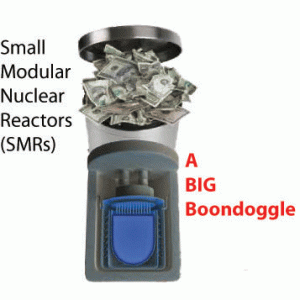 SMRs also ensure that the British government can avoid a repetition of the growing fiasco over the cost of Hinkley Point. An expert in engineering capacity and financing energy plants, who spoke to The Reg on condition of anonymity, said Hinkley Point “could cost the UK as much as £81bn if maximum financing costs are included”……
And yet SMRs face daunting development costs, and mind-boggling technical uncertainties. Like all nuclear sites they inevitably involve high costs, the problems of expensive decommissioning, the risk of accidents and waste disposal.
Sceptics include former government adviser professor Gordon MacKerron, who has described SMRs as “a classic case of supply-push technology development – no potential user of SMRs, mostly electric utilities, has expressed any serious interest in them.”…….https://www.theregister.co.uk/2017/05/24/mini_nuclear_reactors_for_british_power/
May 26, 2017
Posted by Christina Macpherson |
spinbuster, UK |
1 Comment
 No corruption in nuclear negotiations, Eskom chief nuclear officer assures Engineering News, 18TH MAY 2017 BY: KIM CLOETE CREAMER MEDIA CORRESPONDENT, Eskom’s chief nuclear officer David Nicholls is still firmly committed to the principle that nuclear is the way to go for a sustainable energy future and says he knows of no corruption in negotiations on a deal to procure new nuclear energy capacity.
May 19, 2017
Posted by Christina Macpherson |
South Africa, spinbuster |
Leave a comment
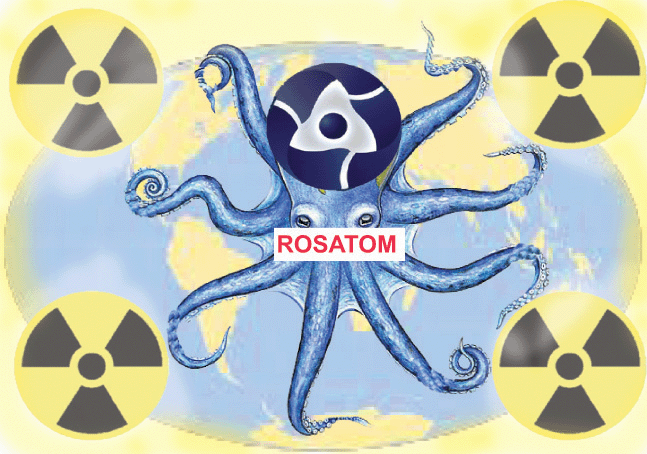 The energy department last month signed a memorandum of understanding with ROSATOM on nuclear energy cooperation, including winning public support.





 nuclear-news