The weapons proliferation risks of thorium nuclear reactors
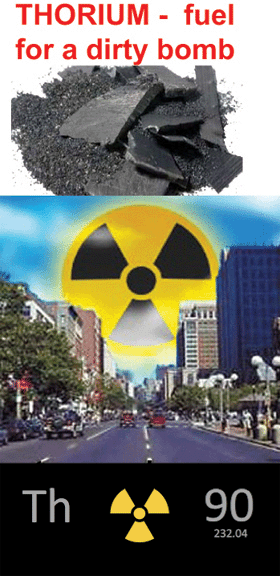 Dispelling Claim 3: Thorium use has hardly any proliferation risk Thorium ‒ a better fuel for nuclear technology? Nuclear Monitor, by Dr. Rainer Moormann 1 March 2018
The proliferation problem of Th / U-233 needs a differentiated analysis ‒ general answers are easily misleading. First of all, one has to assess the weapon capability of U-233. Criteria for good suitability are a low critical mass and a low rate of spontaneous fission. The critical mass of U-233 is only 40% of that of U-235, the critical mass of plutonium-239 is around 15% smaller than for U-233. A relatively easy to construct nuclear explosive needs around 20 to 25 kg U-233.
The spontaneous fission rate is important, because the neutrons from spontaneous fission act as a starter of the chain reaction; for an efficient nuclear explosion, the fissile material needs to have a super-criticality of at least 2.5 (criticality is the amount of new fissions produced by the neutrons of each fission.)
When, because of spontaneous fissions, a noticeable chain reaction already starts during the initial conventional explosion trigger mechanism in the criticality phase between 1 and 2.5, undesired weak nuclear explosions would end the super-criticality before a significant part of the fissile material has reacted. This largely depends on how fast the criticality phase of 1 to 2.5 is passed. Weapon plutonium (largely Pu-239) and moreover reactor plutonium have – different from the mentioned uranium fission materials U-235 and U-233 – a high spontaneous fission rate, which excludes their use in easy to build bombs.
More specifically, plutonium cannot be caused to explode in a so-called gun-type fission weapon, but both uranium isotopes can. Plutonium needs the far more complex implosion bomb design, which we will not go into further here. A gun-type fission weapon was used in Hiroshima – a cannon barrel set-up, in which a fission projectile is shot into a fission block of a suitable form so that they together form a highly super-critical arrangement. Here, the criticality phase from 1 to 2.5 is in the order of magnitude of milliseconds – a relatively long time, in which a plutonium explosive would destroy itself with weak nuclear explosions caused by spontaneous fission.
One cannot find such uranium gun-type fission weapons in modern weapon arsenals any longer (South Africa’s apartheid regime built 7 gun-type fission weapons using uranium-235): their efficiency (at most a few percent) is rather low, they are bulky (the Hiroshima bomb: 3.6 metric tons, 3.2 meters long), inflexible, and not really suitable for carriers like intercontinental rockets.
On the other hand, gun-type designs are highly reliable and relatively easy to build. Also, the International Atomic Energy Agency (IAEA) reckons that larger terror groups would be capable of constructing a nuclear explosive on the basis of the gun-type fission design provided they got hold of a sufficient amount of suitable fissile material.1
Bombs with a force of at most 2 to 2.5 times that of the Hiroshima bomb (13 kt TNT) are conceivable. For that reason, the USA and Russia have tried intensively for decades to repatriate their world-wide delivered highly enriched uranium (HEU).
A draw-back of U-233 in weapon technology is that – when it is produced only for energy generation purposes – it is contaminated with maximally 250 parts per million (ppm) U-232 (half-life 70 years).2 That does not impair the nuclear explosion capability, but the uranium-232 turns in the thorium decay chain, which means ‒ as mentioned above ‒ emission of the highly penetrating radiation of Tl-208. A strongly radiating bomb is undesirable in a military environment – from the point of view of handling, and because the radiation intervenes with the bomb’s electronics.
In the USA, there exists a limit of 50 ppm U-232 above which U-233 is no longer considered suitable for weapons.
Nevertheless, U-232 does not really diminish all proliferation problems around U-233. First of all, simple gun-type designs do not need any electronics; furthermore, radiation safety arguments during bomb construction will hardly play a role for terrorist organisations that use suicide bombers.
Besides that, Tl-208 only appears in the end of the decay chain of U-232: freshly produced or purified U-233/U-232 will radiate little for weeks and is easier to handle.2 It is also possible to suppress the build-up of uranium-232 to a large extent, when during the breeding process of U-233 fast neutrons with energies larger than 0.5 MeV are filtered out (for instance by arranging the thorium in the reactor behind a moderating layer) and thorium is used from ore that contains as little uranium as possible.
A very elegant way to harvest highly pure U-233 is offered by the proposed molten salt reactors with integrated reprocessing (MSR): During the breeding of U-233 from thorium, the intermediate protactinium-233 (Pa-233) is produced, which has a half-life of around one month. When this intermediate is isolated – as is intended in some molten salt reactors – and let decay outside the reactor, pure U-233 is obtained that is optimally suited for nuclear weapons.
An advantage of U-233 in comparison with Pu-239 in military use is that under neutron irradiation during the production in the reactor, it tends to turn a lot less into nuclides that negatively influence the explosion capability. U-233 can (like U-235) be made unsuitable for use in weapons by adding U-238: When depleted uranium is already mixed with thorium during the feed-in into the reactor, the resulting mix of nuclides is virtually unusable for weapons.
However, for MSRs with integrated reprocessing this is not a sufficient remedy. One would have to prevent separation of protactinium-233.9
The conclusion has to be that the use of thorium contains severe proliferation risks. These are less in the risk that highly developed states would find it easier to lay their hands on high-tech weapons, than that the bar for the construction of simple but highly effective nuclear explosives for terror organisations or unstable states will be a lot lower.
Thorium nuclear reactors: no safer than conventional uranium reactors
Dispelling Claim 4: Thorium reactors are safer than conventional uranium reactors Thorium ‒ a better fuel for nuclear technology? Nuclear Monitor, by Dr. Rainer Moormann 1 March 2018
The fission of U-233 results in roughly the same amounts
of the safety-relevant nuclides iodine-131, caesium-137
and strontium-90 as that of U-235. Also, the decay heat is
virtually the same. The differences in produced actinides (see
next claim) are of secondary importance for the risk during
operation or in an accident. In this perspective, thorium use
does not deliver any recognisable safety advantages.
Of greater safety relevance is the fact that uranium-233
fission produces 60% less so-called delayed neutrons than
U-235 fission. Delayed neutrons are not directly created
during the fission of uranium, but from some short-lived
decay products. Only due to the existence of delayed
neutrons, a nuclear reactor can be controlled, and the
bigger their share (for instance 0.6% with U-235), the
larger is the criticality range in which controllability is given
(this is called delayed criticality). Above this controllable
area (prompt criticality) a nuclear power excursion can
happen, like during the Chernobyl accident. The fact that
the delayed super-critical range is with U-233 considerably
smaller than with U-235, is from a safety point of view an
important technical disadvantage of thorium use.
During the design of thermal molten salt reactors (breeders),
the conclusion was that the use of thorium brings problems
with criticality safety that do not appear with classical
uranium use in this type of reactors. For that reason, it was
necessary to turn the attention to fast reactors for the use
of thorium in molten salt reactors. Although this conclusion
cannot be generalised, it shows that the use of thorium can
lead to increased safety problems.
As mentioned, a serious safety problem is the necessity to
restart breeder and reprocessing technology with thorium.
Thorium is often advertised in relation to the development
of so-called advanced reactors (Generation IV). The
safety advantages attributed to thorium in this context are
mostly, however, not germane to thorium (the fuel) but
rather due to the reactor concept. Whether or not these
advanced reactor concepts bring overall increased safety
falls outside the scope of this article, but that is certainly
not a question with a clear “yes” as the answer.
Thorium reactors – NOT a solution to nuclear waste problem
Dispelling Claim 5: Thorium decreases the waste problem
Thorium ‒ a better fuel for nuclear technology? Nuclear Monitor, by Dr. Rainer Moormann 1 March 2018
Thorium use delivers virtually the same fission products
as classical uranium use. That is also true for those
isotopes that are important in issues around long-term
disposal. Those mobile long-lived fission products
(I-129, Tc-99, etc.) determine the risk of a deep geological
disposal when water intrusion is the main triggering event
for accidents. Thorium therefore does not deliver an
improvement for final disposal.
Proponents of thorium argue that thorium use does not
produce minor actinides (MA)5, nor plutonium. They argue
that these nuclides are highly toxic (which is correct) and
they compare only the pure toxicity by intake into the body
for thorium and uranium use, without taking into account
that these actinides are hardly mobile in final disposal
even in accidents.
The Thorium lobby – religious fervour in attacking critics of the nuclear industry
 Thorium Church: a trojan horse in the “green” movements. Here the Removal Tool. “How do I know if my preferred “green” organization, or group, or leader… is infected by the ‘thorium church’ trojan horse?”. How to protect yourself from malicious propaganda of Thorium Church or from related compromised group or organizations. nonukes Italy, By Massimo Greco (June 2015)
What are trojan horses?
Trojan horses, otherwise known as trojans, are programs or applications that are inadvertently opened by the user, who expects the file to be something else.. by the same way “thorium supporters” are infecting forums, mailing list, debacts and environmental organizations.
It’s a strategy that is working in progress from some year. In few years they infected large part of the web.
Like any malware, thorium’s priests are insinuated through any open space or open port .. and they are able to act at different levels. Mutating depending on the circumstances, improvising them selves as technicians or economists with the sole purpose of creating deviationism which in practice consists of annoying redirect to their cause that is regularly touted as a “green” solution or, even, “pacifist” or as a miraculous solution for the “salvation of the climate”.
Their function is aggressive, especially when you try to contradict them. Continue reading
Scan your environmental group for “thorium troll” infection
nonukes Italy, By Massimo Greco (June 2015) “How do I know if my preferred “green” organization, or group, or leader… is infected by the ‘thorium church’ trojan horse?”
“……..Scanning and Removal, First check if the leader or “group leader” you are referring knows the problem of thorium, whether it has never taken a position on it. If the answer is “I do not know the problem” or “what you’re talking about,” you have the first certainty that your organization or target group is NOT protected.
If the answer is: “It is not a problem that concerns us”, “there is no matter in our topic or with antinuclear matter or uranium …”, or even worse … “nuclear thorium could be a clean way but the NWO prevents “… then you have the most certain that your group or environmental organization is terribly infected and that the leader is highly compromised.
If you are doing this survey “in public”, in a forum related to your organization reference, and after posting these sacrosanct questions and you are reproached or assaulted without causing or leading an intervention by the “admin” able to defend you, that’s another proof that your organization, or environmental group, results hugely infected.
You can also do a very easy search to see if the “admin” or the “most active” subjects are related to pro-thorium forums or registered as supporters of fan in groups offering thorium as a “savior” or “green”, especially when you attend to spam and suspicious behavior in the forums or social networks. You can do the same search about chemtrails or “HAARP” deviationism. As better Explained before, Thorium Church used very much the conspiracy decoy in order to mislead, confused and make it weak, vulnerable and unpractical environmental movements.
How to protect yourself from malicious propaganda of Thorium Church or from related compromised group or organizations.
If, as explained above, your reference group or environmental organization is infected: leave the group. This way you will avoid being accomplices. Thou hast tried, you have already taken the necessary steps. You’re not responsible. You have tried to change things.
If you are a “leader” or admin of a forum, or group… or green or environmental organization, you have to eject such people before they get completely the control of any topic. You have the duty to eject these individuals, without any hesitation of “democracy” and “freedom of confusion”… Because they, in the spaces controlled by the Thorium Church, do not allow you ever to contradict them and erase systematically, as their typical practice, anything that might cast doubt on their truth or propaganda. And, in any case, as admin or “leader” you have a duty to treat these subjects like any nuclearist that want to provoke discussion on the space that you are owning, or controlling.
If you are owning a youtube channel or any social page on social networks and you want to get protection from the thorium worm.. specially concerning antinuclear or environmental documents:
Simply “turn off” the option about “free comments” and choice comments under authorization or moderate. If you are admin of social pages delete their worms (spamming) and eject the vehicle of infection (for the reasons better explained before).
“How can I become active against cultural damages of pro-nuclear business propaganda of the Thorium Church?”
Ofcourse there are many different ways. Remember that pro-nuclear lobbies are pushing for the “new generation of nuclear power”, that means not only tradicional way of uranium. In fact they are talking about “nuclear of future”. So, “green”, environmentalist organizations, antinuclear people need to look about future strategies of the lobbies and not only to the past or the temporary, local, contingencies.
In recent years many antinuclear resources and internationally famous have taken a position on thorium. Just think about documents released by Bellona, Beyond Nuclear or to the Excellent article from Bob Alvarez on why thorium is not the wonder fuel it’s being promoted as and a brief history of the US’s persistent failure in making thorium safe or efficient ending with the expected trail of dangerous, weaponizable, waste… or the position of Helen Caldicott, violently attacked by the priests of the Thorium Church with a lot of insults like at the time of the “Scarlet Letter”…
[Dr. Arjun Makhijani on the downsides of the proposed thorium reactors (by Dr. Helen Caldicott)]
So it’s important to diffuse all the events, documents and positions, everywhere is possible, in order to counteract the mala information and debunking thorium commercials spot on the net.
To start an international and active support of the antinuclear movement in Indonesia, Malaysia, specially concerning the mobilization around Lynas, Koodankulam and any Rare Earth opposition in the West Asia. Promoting an active “UPGRADE” of all the antinuclear organizations.
Not only. You can help also supporting all the RNA spaces. Like this. For a new “NoThorium” activism. RNA was the first organization that started activism against thorium in Italy and in Paris. And at this moment has and diffuses the most rich archive of documents against thorium.
Better active today than radioactive tomorrow http://www.nonukes.it/rna/news326.html
USA nuclear weapons agency trying to repair their macho image? Appointment of Lisa E. Gordon-Hagerty as security chief

She may be very smart, and even have a bit of integrity. I hope so. But are we here seeing the macho nuclear weapons lobby copying the “new nukes” gimmick of appointing a good-looking young woman to front their dangerous operation?

First woman in history takes helm of US nuclear weapons arsenal, Washington Examiner by John Siciliano | Energy  Secretary Rick Perry on Thursday swore in the first woman in history as head of the nation’s nuclear weapons arsenal.
Lisa E. Gordon-Hagerty was sworn in as administrator of the National Nuclear Security Administration, which under President Trump’s fiscal 2019 budget proposal would comprise nearly half of the Energy Department’s funding.
“The selection of Gordon-Hagerty, who [came] to USEC without any experience operating a company, surprised some enrichment industry analysts,” USEC Watch commented December 22, 2003. “But some sources suggested that the new COO [would] concentrate on improving USEC’s relationships with DOE and with the national security community. https://www.sourcewatch.org/index.php/Lisa_E._Gordon-Hagerty
“MILITARY PLUTONIUM To be manufactured at Hinkley”
“MILITARY PLUTONIUM To be manufactured at Hinkley”
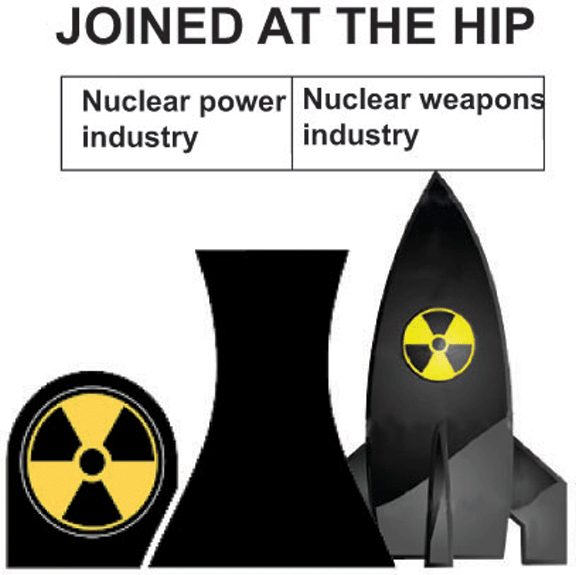 The charade of Atoms for Peace, Dr David Lowry , 23 Feb 18, “……Atoms for Peace ( in reality a cynical project promoting US global nuclear technology dominance launched by President Eisenhower at the UN in New York in December 1953) using a special atomic train taking nuclear scientists around the country promoting nuclear power.
But it was a charade. The first public hint came with a public announcement on 17 June 1958 by the Ministry of Defence, on: “the production of plutonium suitable for weapons in the new [nuclear ] power stations programme as an insurance against future defence needs…” in the UK’s first generation Magnox (after the fuel type, magnesium oxide) reactor.
A week later in the UK Parliament, Labour Roy Mason, who incidentally later became Defence Secretary, asked (HC Deb 24 June 1958 vol 590 cc246-8246) why Her Majesty’s Government had
“decided to modify atomic power stations, primarily planned for peaceful purposes, to produce high-grade plutonium for war weapons; to what extent this will interfere with the atomic power programme; and if he will make a statement.?” to be informed by the Paymaster General, Reginald Maudling
“At the request of the Government, the Central Electricity Generating Board has agreed to a small modification in the design of Hinkley Point and of the next two stations in its programme so as to enable plutonium suitable for military purposes to be extracted should the need arise.
The modifications will not in any way impair the efficiency of the stations. As the initial capital cost and any additional operating costs that may be incurred will be borne by the Government, the price of electricity will not be affected.
The Government made this request in order to provide the country, at comparatively small cost, with a most valuable insurance against possible future defence requirements. The cost of providing such insurance by any other means would be extremely heavy.”
The headline story in the Bridgwater Mercury, serving the community around Hinkley, on that day (24 June} was:
“MILITARY PLUTONIUM To be manufactured at Hinkley”
The article explained: “An ingenious method has been designed for changing the plant without reducing the output of electricity…”
CND was reported to be critical, describing this as a “distressing step” insisting
“The Government is obsessed with a nuclear militarism which seems insane.”
The then left wing Tribune magazine (on 27 June 1958) was very critical of the deal under the headline ‘Sabotage in the Atom Stations’:
“For the sake of making more nuclear weapons, the Government has dealt a heavy blow at the development of atomic power stations.
And warned:
“Unless this disastrous decision is reversed, we shall pay dearly in more ways than one for the sacrifice made on the grim alter of the H-bomb.”
The late Michael Foot, that great inveterate peace-monger, who later became Labour leader, was then the Tribune editor……..http://drdavidlowry.blogspot.com.au/2018/02/the-charade-of-atoms-for-peace.html
Saudis want nuclear energy to ‘save oil’ (nothing to do with chance for nuclear weapons?)
The world’s largest oil exporter, Saudi Arabia, is exploring the use of nuclear energy for domestic energy consumption as part of its transition away from an oil-based system.
“We are looking at a number of countries that have nuclear technology for peaceful purposes… so that we can save the oil and export it in order to generate revenue,” Foreign Minister Adel Al-Jubeir said at the Munich Security Conference.
Nuclear propaganda to the kids – Boy Scouts this time
 Boy Scouts try their hand at nuclear science at Byron plant RRStar Feb 17, 2018, BYRON — The alarm was buzzing and the lights were blinking in the Byron Nuclear Generating Station simulation room Saturday.
It was a faux reactor trip, and dozens of Boy Scouts were there to learn how the plant staff would respond in such a crisis…….
Scouts had the opportunity to take two four-hour classes to earn two merit badges. But those interested in nuclear science only had time for one badge, since that career path took all day and concluded with a tour of the plant. …….
Before going into the simulation room, Scouts studying nuclear science sat in classrooms and learned about different types of radiation and ionization.
This is the first time in a while the plant hosted the merit badge event; its been held at Sauk Valley for the past 15 years or so.
Paul Dempsey, the station’s community manager, said bringing the Scouts to Byron also benefits the station.
“This takes the plant into future generations,” he said. “We have plenty of guys who got their (nuclear science) merit badge who now work for us.”…….http://www.rrstar.com/news/20180217/boy-scouts-try-their-hand-at-nuclear-science-at-byron-plant
Russia’s nuclear macho men spin propaganda to Indian kids
 I had a bit of a laugh, reading this one.
Russia is using the same pathetic old comics and jolly stories that Western nuclear companies have now  given up on.
And once again – it’s the macho nuclear men that are doing the nuclear spinning to kids. (The West now uses sophisticated young women as much as they can, with more subtle propaganda)
Nuclear ABC: Rosatom Explains Nuclear Science to Indian School Children, https://sputniknews.com/asia/201802091061516702-nuclear-eduction-indian-children/

New Delhi (Sputnik) — During the festival that was held from 6 to 9 February, experts gave presentations and held interactive sessions with children and teachers from different schools in Delhi. The occasion was designed to nurture the interest of children towards nuclear physics, Rosatom officials told Sputnik.
Nuclear experts and scientists of Rosatom also visited some schools in Delhi and conducted awareness sessions for children on the peaceful use of the atomic energy. Rosatom also released a book titled ‘Nuclear ABC’ in English and Hindi to help in the awareness drive. The book was jointly released on Thursday by Russian Ambassador to India Nikolay Kudashev, Professor Emeritus of Jawaharlal University R Rajaraman, Fedor Rozovskiy, Director of Russian Center along with officials of Rosatom at the Russian Centre for Science and Culture, New Delhi. The book launch was attended by hundreds of school children.
“The book is yet another instance of the rich history of Indo-Russian scientific cooperation dating back to the Soviet era,” professor R. Rajaraman said during the launch.
Prof Rajaraman hailed Russia’s assistance in achieving its nuclear energy targets.
How to impose a radioactive trash dump UK style – bribe communities and bypass local authorities

 Times 26th Jan 2018, Communities will receive up to £42 million if they agree to consider
hosting an underground nuclear waste dump. They can keep the money even if
they ultimately decide against it, under government plans. The payments,
which will be spread over 20 years, are aimed at persuading communities to
engage in the process of selecting and testing a site that will store
enough radioactive waste to fill the Albert Hall six times.
The Department for Business, Energy and Industrial Strategy said more than one community
could receive the funding, with each being given up to £42 million. The
proposals appear to weaken the power of county councils, making it harder
for them to prevent a community from agreeing to host the £19 billion
“geological disposal facility” (GDF).
A consultation document states
the final decision will be subject to a “test of public support”, which
could be a local referendum. The right to vote in the referendum could be
restricted to a small area around the proposed site.
Cumbria is still viewed as the most suitable location because of the ease of transporting
waste at Sellafield and the willingness of the community. However, other
areas with ageing or decommissioned nuclear plants have been suggested,
including Dungeness, Kent, and Hartlepool, in Co Durham. Doug Parr, of
Greenpeace, said: “Having failed to find a council willing to have
nuclear waste buried under their land, ministers are resorting to the
tactics from the fracking playbook — bribing communities and bypassing
local authorities.”
https://www.thetimes.co.uk/edition/news/42m-offer-to-communities-that-take-radioactive-waste-svrjj29nb
New tactic in Small Modular Nuclear Reactor lobbying – claim to help electric cars
-
Small modular reactors more versatile than conventional plants
-
Battery storage still too pricey for large-scale use
With collapsed uranium market and nuclear stagnation, failed company AREVA rebrands itself

France’s Areva rebrands to Orano in dire uranium market https://www.reuters.com/article/us-areva-strategy/frances-areva-rebrands-to-orano-in-dire-uranium-market-idUSKBN1FC25H, Geert De Clercq, PARIS (Reuters) 23 Jan 18,– French uranium mining and nuclear fuel group Areva rebranded itself as Orano on Tuesday, closing the book on a years-long restructuring but still facing an uncertain future, with uranium prices at decade lows and the nuclear industry in the doldrums.
“We had to change our name – we are a new company with a different perimeter, focused on the fuel cycle,” Knoche said at a presentation of the new brand.
Orano refers to uranium, the core of the firm’s business, and its new circular yellow logo references the yellowcake uranium concentrate that it extracts from the ore.
To mark the change – and reduce real estate costs by 10 million euros (8.78 million pounds) a year – Orano will move out of its prestigious Paris headquarters, a distinctive black-slab skyscraper inspired by the monolith in Stanley Kubrick’s “2001: A Space Odyssey”.
Orano has net debt of close to 3 billion euros and by 2025 plans to invest about 2 billion euros in its plants and a similar amount in its mines, Knoche said.
The company aims to be cash-flow positive from this year, but Knoche said nothing about profit targets and admitted that market prices for uranium are too low to invest in new mines.
He said long-term contract prices for uranium were about $10 per pound higher than spot prices, but declined to say what price Orano needed to operate profitably in the long run.
Uranium prices are down 80 percent from a decade ago as Japan’s 2011 Fukushima disaster has led to a slowdown in reactor newbuilds and countries such as Germany abandon nuclear.
Knoche said Orano was banking on nuclear growth in Asia. He expects the firm to earn 30 percent of its turnover there by 2020, up from 20 percent last year.
Talks about selling a nuclear fuel reprocessing plant to China were “accelerating”, Knoche said, but would not give a deadline. Discussions about the project have been going on for a decade, while the price the firm hopes to get has fallen to around 10 billion euros from 15 billion euros.
With an order book worth nearly eight years of turnover and solid business in service and maintenance for a large part of the world’s more than 400 nuclear reactors, Orano faces the prospect of rebuilding a profitable operation.
“We will do it with humility. That is why the name is written in lower case,” Knoche said. Reporting by Geert De Clercq and Benjamin Mallet; Editing by Sudip Kar-Gupta and Dale Hudson
Nuclear lobby’s outreach promotion to school students
UCD is educating next generation of nuclear scientists, Davis Enterprise, High school and college students in the greater Sacramento region have a unique opportunity to learn about nuclear science at the UC Davis McClellan Nuclear Research Center.
A new educational outreach program, the Nautilus Program, named after the U.S. Navy’s first nuclear submarine, is giving students hands-on experience with the center’s nuclear reactor, the largest university-operated reactor on the West Coast.
The program also gives students a chance to learn directly from veterans who have been part of the U.S. Navy’s nuclear program. Exposing students from diverse backgrounds to different aspects of STEM careers (science, technology, engineering and math) is one of the main goals of the Nautilus Program.
“I think there is a real need for this type of STEM engagement with young students in the community,” said Wesley Frey, director of the McClellan Nuclear Research Center………
The McClellan Nuclear Research Center has partnered with the Luther Burbank High School Naval Junior ROTC, as well as with Sacramento City College, the UC Berkeley Naval ROTC and other area institutions. The center also is working with local teachers through the Sacramento Area Science Project……
Students who attend the tours, and are interested in learning more about nuclear science, can apply to participate in one of center’s more intensive summer programs through a UCD outreach program.
A new series of courses also is being offered at UCD as part of the Nautilus Program. The “Designated Emphasis on Nuclear Sciences classes,” offered by the department of physics, will be available to UCD undergraduate and graduate students who are studying math, physical sciences or engineering.
The first course is radiation health physics and the second, which will be offered this spring quarter, is an introduction to nuclear engineering. A third course will be announced at a later date……https://www.davisenterprise.com/local-news/ucd/ucd-is-educating-next-generation-of-nuclear-scientists/
UK nuclear lobby uses the good old “medical” pretense in its zeal for government subsidies
 Dr David Lowry, 15 January 2018
Nuclear red herring thrown into Euratom Exit debate by desperate nuclear sector seeing significant subsidies disappearing
The nuclear industry lobby is desperate for the UK to remain in Euratom, as it would mean the massive subsidies they receive for research and development via Euratom would be lost. But they don’t believe such concerns would really bother most politicians, but claiming Brexatom would result in loss of radioactive isotope supplies for medical diagnoses, which does concern the public and politicians. So they have made a huge song and dance – successfully- over this red herring claim, to keep the UK in Euratom. Below is the latest in this ongoing saga.
Nuclear research and medical isotopes, European Scrutiny Committee, 15 January 2018
|
Committee’s assessment
|
Politically important
|
…….Summary and Committee’s conclusions……..While the substance of the proposal was not controversial, its political context is—of course—Brexit. The Prime Minister’s formal notification of the UK’s withdrawal from the EU under Article 50 of the Treaty on European Union (TEU) also included Euratom.17 Nuclear industry stakeholders have expressed concerns that the two-year negotiating period under Article 50 is insufficient for the UK to replicate Euratom’s existing regulatory safeguards regime for nuclear facilities domestically and agree new cooperation agreements with the EU, the IAEA and third countries. In addition, the medical establishment has warned that withdrawal from Euratom could impact on the availability and cost of medical isotopes in the UK post-Brexit……
On 28 July, the new Minister for Energy (Richard Harrington) replied to our predecessors’ letter of 25 April. He noted that the Government had not conducted a formal impact assessment on leaving Euratom, but emphatically confirmed that the UK’s ability to import medical isotopes from the EU or the rest of the world “will not be affected by withdrawal from Euratom”.
He also acknowledged the nuclear industry’s broader concerns about the UK’s exit from Euratom, noting that an “unsatisfactory withdrawal risks significant impacts for the nuclear sector”.
1 This Month
Chernobyl: The Lost Tapes – A good documentary on Chernobyl on SBS available On Demand for the next 3 weeks– https://www.sbs.com.au/ondemand/tv-program/chernobyl-the-lost-tapes/2352741955560

of the week–London Campaign for Nuclear Disarmament

Tell the Ukrainian Government to Drop Prosecution of Peace Activist Yurii Sheliazhenko
To see nuclear-related stories in greater depth and intensity – go to https://nuclearinformation.wordpress.com
-
Archives
- April 2026 (152)
- March 2026 (251)
- February 2026 (268)
- January 2026 (308)
- December 2025 (358)
- November 2025 (359)
- October 2025 (376)
- September 2025 (257)
- August 2025 (319)
- July 2025 (230)
- June 2025 (348)
- May 2025 (261)
-
Categories
- 1
- 1 NUCLEAR ISSUES
- business and costs
- climate change
- culture and arts
- ENERGY
- environment
- health
- history
- indigenous issues
- Legal
- marketing of nuclear
- media
- opposition to nuclear
- PERSONAL STORIES
- politics
- politics international
- Religion and ethics
- safety
- secrets,lies and civil liberties
- spinbuster
- technology
- Uranium
- wastes
- weapons and war
- Women
- 2 WORLD
- ACTION
- AFRICA
- Atrocities
- AUSTRALIA
- Christina's notes
- Christina's themes
- culture and arts
- Events
- Fuk 2022
- Fuk 2023
- Fukushima 2017
- Fukushima 2018
- fukushima 2019
- Fukushima 2020
- Fukushima 2021
- general
- global warming
- Humour (God we need it)
- Nuclear
- RARE EARTHS
- Reference
- resources – print
- Resources -audiovicual
- Weekly Newsletter
- World
- World Nuclear
- YouTube
-
RSS
Entries RSS
Comments RSS
 nuclear-news