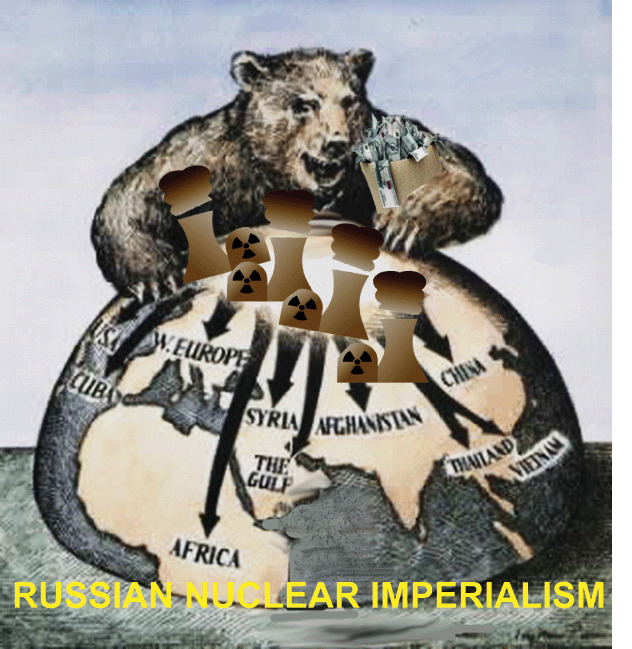
The supposed cost benefits of nuclear power are completely misrepresented by the nuclear advocacy.
Only Russia will benefit if PH goes nuclear, https://www.oilandgas360.com/only-russia-will-benefit-if-ph-goes-nuclear/ in Press by— 360 Feed Wire By BEN KRITZ, TMT, October 29, 2019 FOR the second time during the term of the current administration, fast-talking salesmen from Russia’s nuclear energy agency Rosatom have managed to convince a few impressionable officials here that the mighty atom is the answer to all the Philippines’ energy needs, especially if it is packaged in the product Rosatom has to offer.
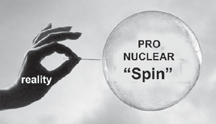
The only people who will benefit from the Philippines’ adopting nuclear power will be the shareholders of Rosatom. Nuclear power is an economically and environmentally disastrous proposition for the Philippines, and no amount of persistence from the misguided nuclear advocacy can change that.
On October 17, Energy Secretary Alfonso Cusi announced the Department of Energy had signed a memorandum of intent with Rosatom for the latter to conduct feasibility studies on the possible deployment of so-called small modular reactors (SMRs) in the Philippines.
These reactors, which generate between 20 to 200 megawatts (MW) of power, can be mounted on floating platforms to provide electricity to island provinces, or slaved together like giant batteries to create larger land-based power plants.
Russia currently has one such floating plant in operation, a 21,000- metric ton barge carrying two 35-MW reactors and dubbed the Akademik Lomonosov. The craft, which will replace a coal plant and an old nuclear plant in Russia’s far east, can provide power to about 100,000 homes and has a crew of about 70.
The (weak) case for nuclear power
Hard on the heels of the announcement of the DoE’s agreement with Rosatom, local nuclear advocates took part in a “Stand Up for Nuclear” event held in Manila and other cities around the world on October 20. The event achieved what its organizers presumably hoped it would — the publication of a rash of news articles and opinion columns in the days following it, all touting the supposed benefits of nuclear power to the energy-challenged Philippines.
The arguments put forth in favor of nuclear power in general — which haven’t changed in years — and of SMRs in particular are rather shallow, but at first glance seem to be valid.
The benefits of nuclear power, according to its advocates, are that it does not produce harmful emissions, unlike conventional fossil-fueled power plants; it is an extremely efficient energy source, which results in lower power costs to consumers; it has a very good overall safety record, in spite of attention-grabbing disasters like Chernobyl and Fukushima; and it provides reliable baseload power to augment energy from intermittent sources like solar and wind power.
SMRs are touted as a good option for countries like the Philippines without well-developed nuclear capabilities or budgets to sustain them because they are small, versatile, relatively inexpensive, and less complicated than normal-scale nuclear plants. For example, unlike a conventional pressurized water or boiling water reactor, the cooling and steam generation water flows in most SMR designs are gravity-fed. This presumably makes them immune from the sort of loss-of-coolant accidents that led to the Three Mile Island, Chernobyl and Fukushima disasters.
All of these arguments are very positive-sounding, enough to convince many impressionable government officials and media commentators, whom the nuclear advocacy hopes have neither the time, inclination nor capacity to look critically at the facts, which tend to be a more than a little inconvenient.
Cutting through the nonsense
The first argument that “nuclear plants do not produce harmful carbon dioxide (CO2) emissions,” is true in a very literal sense, but it is not true that nuclear plants do not contribute to harmful emissions at all, as some advocates claim. All nuclear plants emit heat and water vapor to the atmosphere at the rate of 4.4 grams CO2-equivalent per kilowatt-hour (g CO2-e/kWh) of energy produced. While this is certainly very much less than a conventional power plant, it is not zero, and compares unfavorably with solar and wind power, which actually remove water vapor and heat flux to the atmosphere at the rate of -2.2 g CO2-e/kWh.
An even bigger environmental problem with nuclear power is that any nuclear reactor uses an enormous amount of fresh water and discharges a large amount of heated wastewater.
Because of the complicated chemistry within a nuclear reactor, seawater cannot be used, and even fresh water must be “scrubbed” to remove any impurities. In a country such as the Philippines, where fresh water supplies are increasingly constrained, any nuclear power facility is a problematic option.
The second argument, that nuclear energy is extremely efficient and therefore less expensive than other forms of power, is again only literally true in a narrow context.
Uranium as a fuel is incredibly efficient; one ton of uranium has the energy content of about 80,000 tons of coal. However, to obtain useable fuel a great deal of processing is necessary, which of course comes at an energy cost, and the amount of useful uranium to be used as nuclear fuel is quickly being depleted; US reserves of uranium have virtually disappeared, and reserves elsewhere in the world are estimated to last no more than 100 years.
The supposed cost benefits of nuclear power are completely misrepresented by the nuclear advocacy. A comparison between an existing nuclear plant and an existing coal plant, for example, would show that electricity derived from nuclear power is less costly on a per-MW basis, but power costs, as Filipino consumers have long been painfully aware, include all the costs associated with building and maintaining a power plant. The proper way to calculate comparative costs is through a formula called levelized cost of energy (LCOE), which takes into account construction costs, regulatory costs, fuel costs, available subsidies, and operating costs.
This is where nuclear power completely falls apart compared to other energy alternatives.
According to the 2018 report of Lazard (the go-to source for energy cost analysis), nuclear has a high-end LCOE of $189 per megawatt hour (MWh). Coal has an LCOE of $143/MWh; utility-scale solar of between $44/MWh and $48/MWh; and wind, $56/MWh. Of the various energy sources analyzed, only gas peaking plants and rooftop solar installations had a higher LCOE than nuclear power, at $208/MWh and $287/MWh, respectively.
And Lazard’s results may be a serious underestimate of the true cost of nuclear power. In the next installment, I’ll explain further why, despite supplying about 20 percent of the world’s electricity, nuclear power is one of the worst solutions for the Philippines, or any other country for that matter
October 31, 2019
Posted by Christina Macpherson |
Philippines, spinbuster |
Leave a comment

Nuclear power pack: 3 Can’t miss STEM resources on nuclear energy, USA Office of Nuclear Energy SEPTEMBER 17, 2019 “………. DOE recently partnered with the American Nuclear Society and Discovery Education to develop high school and elementary curriculum.
Navigating Nuclear: Energizing Our Free World is packed with FREE K-12 resources to support educators who want to incorporate nuclear into their lesson plans. All activities and lesson plans are Next Generation Science Standard-aligned.
The middle school curriculum is ready for teachers to use. High school and elementary resources are under development and will be rolled out over the next two years, so stay tuned!
The DOE-sponsored curriculum will include new perspectives on computer science, computational thinking and culturally-responsive curriculum……..
Inspiring future generations of leaders, scientists, and engineers is what we’re all about at DOE. Our Nuclear Energy University Program (NEUP) supports students’ passion for nuclear by funding nuclear energy research and infrastructure projects at colleges and universities across the nation. …….. https://www.energy.gov/ne/articles/nuclear-power-pack-3-can-t-miss-stem-resources-nuclear-energy
September 19, 2019
Posted by Christina Macpherson |
Education, USA |
Leave a comment
“The ashes of half a dozen unidentified laborers ended up at a Buddhist temple in a town just north of the crippled Fukushima nuclear plant. Some of the dead men had no papers; others left no emergency contacts. Their names could not be confirmed and no family members had been tracked down to claim their remains. They were simply labeled “decontamination troops”
Addressing the issue, Japan’s environmental minister Yoshiaki Harada held a news conference (September 2019). Unfortunately, he proffered the following advice: “The only option will be to drain it into the sea and dilute it.” (Source: Justin McCurry in Tokyo, Fukushima: Japan Will Have to Dump Radioactive Water Into Pacific, Minister Says, The Guardian, Sept. 10, 2019)
“The only option”… Really?
Over the past 8 years, Tokyo Electric Power (TEPCO) has scrambled like a Mad Hatter to construct emergency storage tanks (1,000) to contain upwards of one million tonnes of contaminated radioactive water, you know, the kind of stuff that, over time, destroys human cells, alters DNA, causes cancer, or produces something like the horrific disfigured creature in John Carpenter’s The Thing! That’s the upshot of a triple nuclear meltdown that necessitates constant flow of water to prevent further melting of reactor cores that have been decimated and transfigured into corium or melted blobs. It’s the closest to a full-blown “china syndrome” in all of human history. Whew! Although, the truth is it’ll be a dicey situation for decades to come.
Ever since March 11, 2011, TEPCO has scrambled to build storage tanks to prevent massive amounts of radioactive water from pouring into the ocean (still, some lesser amounts pour into the ocean every day by day). Now the government is floating a trial balloon in public that, once the tanks are full, it’ll be okay to dump the radioactive water into the ocean. Their logic is bizarre, meaning, on the one hand, the meltdown happens, and they build storage tanks to contain the radioactive water, but on the other hand, once the storage tanks run out of space, it’s okay to dump radioactive water into the ocean. Seriously?
Meantime, the Fukushima meltdown brings the world community face to face with TEPCO and the government of Japan in an unprecedented grand experiment that, so far, has failed miserably. Of course, dumping radiation into the Pacific is like dumping radiation into everybody’s back yard. But, for starters, isn’t that a non-starter?
Along the way, deceit breeds duplicity, as the aforementioned Guardian article says the Japanese government claims only one (1) death has been associated with the Fukushima meltdown but keep that number in mind. Reliable sources in Japan claim otherwise, as explained in previous articles on the subject, for example, “Fukushima Darkness, Part Two” d/d November 24, 2017, and as highlighted further on in this article.
When it comes to nuclear accidents, cover-ups reign supreme; you can count on it.
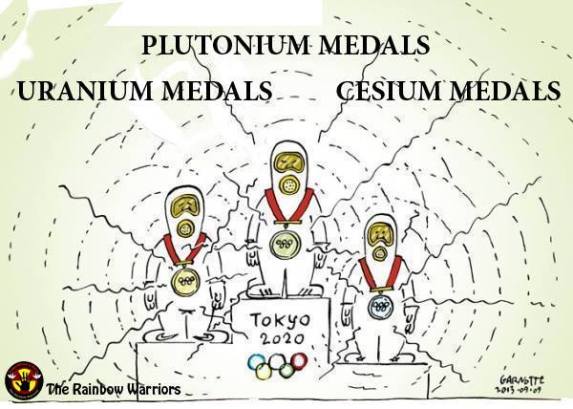
As such, it is believed the Japanese government is lying and should be held accountable for hoodwinking the world about the ravages of Fukushima, especially with the Olympics scheduled for next year.
For example, the following explains how death by radiation is shamefully hidden from the public via newspeak: Fukushima Daiichi Nuclear Power Station worker deaths “that expire at home” are not officially counted. Accordingly, how many workers on a deathbed with radiation sickness leave home to go to work (where deaths are counted) just before they die? Oh, please!
Meanwhile, the last thing the world community needs in the face of an uncontrollable nuclear meltdown, like Fukushima, is deceptiveness and irresponsibility by the host government. Too much is at stake for that kind of childish nonsense. And just to think, the 2020 Olympics are scheduled with events held in Fukushima. Scandalously, the International Olympic Committee (IOC) is A-Okay with that.
In contrast, a Greenpeace International March 8th 2019 article entitled: Japanese Government Misleading UN on Impact of Fukushima Fallout on Children, Decontamination Workers: “The Japanese government is deliberately misleading United Nations human rights bodies and experts over the ongoing nuclear crisis in areas of Fukushima… In areas where some of these decontamination workers are operating, the radiation levels would be considered an emergency if they were inside a nuclear facility.” Enough said!
“In its reporting to the United Nations, the Japanese government deliberately misrepresents the scale, complexity, and radiation risks in areas of Fukushima, the working practice and conditions for workers, and its disregard for children’s health and wellbeing. This reality should shame the government to radically change its failing policies,” said Kazue Suzuki, Energy Campaigner of Greenpeace Japan.
As such, either Greenpeace or the IOC is “dead wrong” about the conditions at Fukushima. Take your pick.
After all, the trend of misrepresentation of nuclear accidents has been established for decades. Not only Fukushima, Chernobyl (1986) is a nuclear disaster zone where the “official death count from radiation exposure” has been considerably discounted by various governmental agencies and NGOs. For inexplicable reasons (actually explicable but a long story), nuclear accidents are given Get Out Jail Free cards by the world’s press and associated governmental orgs and NGOs.
Yet, over time, the truth comes out, and when it does it’s dreadfully atrocious: A BBC special report, The True Toll of the Chernobyl Disaster d/d July 26, 2019 says: “The official, internationally recognized death toll, just 31 people died as an immediate result of Chernobyl while the UN estimates that only 50 deaths can be directly attributed to the disaster.”
That’s the official tally. Ugh! It’s so far off the mark that, if it were a baseball pitch, it’d be in the dirt, and a prime example of the public not getting the truth about the ravages of nuclear power accidents.
Of course, it is important to take note of how “wordsmiths” describe the death numbers, i.e., “died as an immediate result of Chernobyl” can only include someone standing at the site when it happened, leaving out all cases of radiation exposure that kills and cripples over subsequent days, months, and years. Or, in the case of the UN statement, “only 50 deaths can be directly attributed.” Only those standing there when it happened… ahem!
According to the BBC article, the Russian Academy of Sciences said as many as 112,000-125,000 died by 2005. That’s 2,500xs more deaths than the official reports, which also never increase in number over time as radiation takes its merry ole time blasting, destroying, and/or altering human cell structure. Ukrainian authorities claim death rates of Chernobyl cleanup workers rose from 3.5 to 17.5 deaths per 1,000 between 1988 and 2012 on a database of 651,453 cleanup workers, which equates to 11,392 deaths. Additionally, Belarus had 99,693 cleanup workers, equating to 1,732 deaths. Not only that, disability among workers shows that approximately 5% are still healthy in 2012 (only 5%, meaning 95% unhealthy) with commonality of cardiovascular and circulatory diseases and nervous system problems.
By 2008 in Belarus alone 40,049 liquidators or cleanup workers of Chernobyl were registered with cancer.
Viktor Sushko, deputy director general of the National Research Centre for Radiation Medicine (NRCRM) based in Kiev, Ukraine, describes the Chernobyl disaster as: “The largest anthropogenic disaster in the history of humankind,” Ibid.
Thus begging the most obvious of questions re Fukushima victims in the years ahead; how many cases of cancer, and how many will die? Unfortunately, radioactive isotopes don’t stop once they’re activated in a nuclear meltdown. They’re pernicious over time destroying and/or grotesquely altering human cell structure. For proof, visit second-generation Chernobyl children locked up in orphanages in Belarus.
“As of January 2018, 1.8 million people in Ukraine, including 377,589 children, carried status of victims of the disaster, according to Sushko and his colleagues. Not only that, there has been a rapid increase in the number of people with disabilities, rising from 40,106 in 1995 to 107,115 in 2018,” Ibid.
According to a USA Today article – Chernobyl’s Legacy: Kids With Bodies Ravaged by Disaster, April 17, 2016: “There are 2,397,863 people registered with Ukraine’s health ministry to receive ongoing Chernobyl-related health care. Of these, 453,391 are children — none born at the time of the accident. Their parents were children in 1986. These children have a range of illnesses: respiratory, digestive, musculoskeletal, eye diseases, blood diseases, cancer, congenital malformations, genetic abnormalities, trauma.” Many of the children are hidden away deep in the forested countryside in orphanages in Belarus.
Back to Fukushima, there are numerous instances of governmental meddling to hide the truth, starting with passage of the 2013 government secrecy act, The State Secrecy Law, aka: Act on the Protection of Specially Designated Secrets (SDS), Act No. 108, which says that civil servants or others who “leak secrets” will face up to 10 years in prison, and those who “instigate leaks,” especially journalists, will be subject to a prison term of up to 5 years. Subsequently, Japan fell below Serbia and Botswana in the Reporters Without Borders 2014 World Press Freedom Index.
Horrifically, at the end of the day, when nuclear goes bad, it takes everyone along on a daunting trip for years and years and more years, outliving life spans but continuing generation after generation, like the 453,391 Chernobyl-radiated-influence children born after the nuclear blowout in 1986. Chernobyl altered their genes before they were born…. Imagine that!
Cliodhna Russell visited children’s orphanages in Belarus in 2014: “Children rocking back and forth for hours on end, hitting their heads against walls, grinding their teeth, scraping their faces and putting their hands down their throats.” (Source: How My Trip to a Children’s Mental Asylum in Belarus Made Me Proud to be Irish, the journal.ie, March 18, 2014.)
Postscript: “It’s a real shame that the authorities hide the truth from the whole world, from the UN. We need to admit that actually many people are dying. We are not allowed to say that, but TEPCO employees also are dying. But they keep mum about it,” Katsutaka Idogawa, former mayor of Futaba (Fukushima Prefecture) Fukushima Disaster: Tokyo Hides Truth as Children Die, Become Ill from Radiation – Ex-Mayor, RT News, April 21, 2014)
Post-Postscript: “The ashes of half a dozen unidentified laborers ended up at a Buddhist temple in a town just north of the crippled Fukushima nuclear plant. Some of the dead men had no papers; others left no emergency contacts. Their names could not be confirmed and no family members had been tracked down to claim their remains. They were simply labeled “decontamination troops” — unknown soldiers in Japan’s massive cleanup campaign to make Fukushima livable again five years after radiation poisoned the fertile countryside,” (Source: Mari Yamaguchi, Fukushima ‘Decontamination Troops’ Often Exploited, Shunned, AP & ABC News, Minamisona, Japan, March 10, 2016)
September 17, 2019
Posted by Christina Macpherson |
Japan, Reference, secrets,lies and civil liberties, spinbuster |
1 Comment
 Noel Wauchope 31 Aug 19
He’s an expert at it.
What the nuclear industry wants is the removal of Australia’s Federal and State legislation that prohibits the nuclear industry in Australia.
Ziggy delivers.
Sure, he makes motherhood statements about nuclear dangers, about costs etc. He even gives a subtle little tick to that distracting fantasy – small modular nuclear reactors.
But Ziggy faithfully conveys the central message of the global nuclear lobby to Australia:
August 31, 2019
Posted by Christina Macpherson |
AUSTRALIA, spinbuster |
Leave a comment
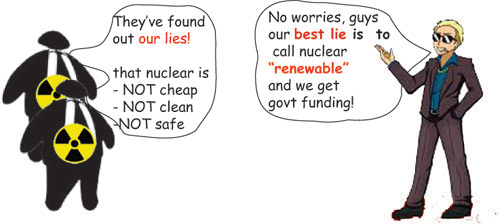
To keep Diablo Canyon open, SLO assemblyman wants to classify nuclear power as renewable, BY MATT FOUNTAIN The Tribune, AUGUST 28, 2019 A Central Coast legislator and two pro-nuclear groups are taking an unusual step to keep Diablo Canyon nuclear power plant operating: They want an amendment to the state Constitution classifying nuclear power as a renewable energy source.
Then, with the plant’s production able to count toward California’s target for renewables, the hope is that someone would acquire it through PG&E’s bankruptcy proceedings and continue to run it for another 20 years.
The effort’s a long shot, however, in a state controlled by Democrats more interested in investing in solar, wind, and geothermal energy, and with the plant facing significant relicensing hurdles.
Assemblyman Jordan Cunningham, R-San Luis Obispo, announced Wednesday that he filed a proposed constitutional amendment to prohibit the Legislature from discriminating against any form of renewable or zero-carbon energy as part of California’s Renewables Portfolio Standard, qualifying nuclear as a source of renewable energy.
The operating licenses for Diablo Canyon’s two reactors expire in 2024 and 2025 respectfully, and the plant is slated for closure in 2026.
Logistical issues aside, Cunningham says qualifying the plant as a generator of renewable energy could allow the plant to operate up to 2045.
In June 2016, PG&E abandoned its efforts to relicense the plant’s reactors, citing among other factors the state’s renewable energy policy…….
The proposed amendment is supported by the pro-nuclear nonprofit groups Environmental Progress and Californians for Green Nuclear Power.
‘LIPSTICK ON A PIG’
But David Weisman, spokesman for the Alliance for Nuclear Responsibility, which has called for the early closure of Diablo Canyon, likened the proposed amendment to a recent taxpayer bailout of Ohio’s two remaining nuclear reactors.
Saying that PG&E customers already pay among the highest rates in the country, Weisman said subsidies placed on the nuclear industry in other states have passed on extra costs to ratepayers.
“Ratepayers are already on the hook for a portion of billions of dollars in losses caused by PG&E’s negligence in Northern California,” Weisman said, referring to the utility’s liability for allegedly causing recent wildfires. “PG&E doesn’t want this plant.”
John Geesman, attorney for the Alliance, said the Diablo Canyon proposal will likely draw attention to the magnitude of Diablo’s above-market costs.
“This is an obvious attempt to put lipstick on a pig in hopes of attracting a purchaser of the asset in bankruptcy,” Geesman wrote in an email…… https://www.sanluisobispo.com/news/local/article234470352.html
August 29, 2019
Posted by Christina Macpherson |
spinbuster, USA |
Leave a comment
Regulators formalise technical collaboration on SMR regulation,WNN, 16 August 2019 Canadian and US nuclear regulators have signed a first-of-a-kind Memorandum of Cooperation (MoC) that will see them collaborate on the technical reviews of advanced reactor and small modular reactor (SMR) technologies. Meanwhile, the US Department of Energy has awarded funds to build SMR simulators at three US universities.
The MoC was signed on 15 August in Ottawa by Canadian Nuclear Safety Commission (CNSC) President Rumina Velshi and US Nuclear Regulatory Commission (NRC) Chairman Christine Svinicki and follows a Memorandum of Understanding signed two years ago. …..
The US DOE has awarded three grants to support the installation of a NuScale reactor plant simulators at Oregon State University, Texas A&M University-College Station and the University of Idaho, NuScale Power announced on 15 August. The simulators will be used for research and educational purposes…..
 We are very grateful to our university partners for their collaboration and eagerness to participate in this project, and to the Department of Energy for its continued support of NuScale’s groundbreaking work in the advanced nuclear industry,” NuScale Chairman and CEO John Hopkins said. “These simulator facilities will create new research opportunities and help ensure that we educate future generations about the important role nuclear power and SMR technology will play in attaining a safe, clean and secure energy future for our country.”
The simulator facilities will also be used for educational outreach to school-age students and public advocacy regarding nuclear power and SMR technology. The three grants are awarded through the DOE Nuclear Energy University Program and are worth a total of nearly USD844,000.
The simulators are based on NuScale’s simulator technology and computer models, and include an interface that accepts input from operators in a virtual control room and displays parameters simulating the plant response. They facilitate research into human factors engineering, human-system interface design, advanced diagnostics, cyber security and plant control room automation. In addition to supporting STEM research and education at universities, NuScale’s simulator can be used to show students and members of the public advanced nuclear technology in a control room setting.
http://www.world-nuclear-news.org/Articles/Regulators-formalise-technical-collaboration-on-SM?feed=feed
August 19, 2019
Posted by Christina Macpherson |
Canada, Education, USA |
1 Comment
|
Despite the TV show and the author’s landmark book, the truth about Chernobyl is still contested
|
|
August 19, 2019
Posted by Christina Macpherson |
2 WORLD, media, spinbuster |
Leave a comment
 Can 2020 Summer Olympics help Fukushima rebound from nuclear disaster?, LA TIMES, DAVID WHARTON, STAFF WRITER AUG. 12, 2019
“…….. ORGANIZERS OF THE
2020 SUMMER GAMES SAY THEY WANT TO HELP.
Under the moniker of the “Reconstruction Olympics,” they have plotted a torch relay course that begins near the crippled Fukushima Daiichi plant and continues through adjacent prefectures — Miyagi and Iwate — impacted by the disaster. The region will host games in baseball, softball and soccer next summer.
“We are hoping that, through sports, we can give the residents new dreams,” said Takahiro Sato, director of Fukushima’s office of Olympic and Paralympic promotions. “We also want to show how far we’ve come.”
The effort has drawn mixed reactions, if only because the so-called “affected areas” are a sensitive topic in Japan.
Some people worry about exposure to lingering radiation; they accuse officials of whitewashing health risks. Critics question spending millions on sports while communities are still rebuilding.
“The people from that area have dealt with these issues for so long and so deeply, the Olympics are kind of a transient event,” said Kyle Cleveland, an associate professor of sociology at Temple University’s campus in Japan. “They’re going to see this as a public relations ploy.”……
The populace began to question announcements from the Tokyo Electric Power Co. (Tepco) about the scope of the contamination, said Cleveland, who is writing a book on the catastrophe and its aftermath.
“In the first 10 weeks, Tepco was downplaying the risk,” he said. “Eventually, they were dissembling and lying.”……..
Reliable data on radiation risks is difficult to obtain, said Jonathan Links, a public health professor at Johns Hopkins University. …….
In terms of athletes and coaches visiting the impacted prefectures for a week or two during the Olympics, Links said the cancer risk is proportional, growing incrementally each day.
The Japanese government has raised what it considers to be the acceptable exposure from 1 millisievert to 20 millisieverts per year. Along with this adjustment, officials have declared much of the region suitable for habitation, lifting evacuation orders in numerous municipalities. Housing subsidies that allowed evacuees to live elsewhere have been discontinued.
But some towns remain nearly empty.
“People are refusing to go back,” said Katsuya Hirano, a UCLA associate professor of history who has who has spent years collecting interviews for an oral history. “Especially families with children.”……..
With infrastructure repairs continuing throughout the region, evacuee Akiko Morimatsu has a skeptical view of the Tokyo 2020 campaign.
“They have called these the ‘Reconstruction Games,’ but just because you call it that doesn’t mean the region will be recovered,” Morimatsu said.
Concerns about radiation prompted her to leave the Fukushima town of Koriyama, outside the mandatory evacuation zone, moving with her two young children to Osaka. Her husband, a doctor, remained; he visits the family once a month.
“The reality is that the region hasn’t recovered,” said Morimatsu, who is part of a group suing the national government and Tepco. “I feel the Olympics are being used as part of a campaign to spread the message that Fukushima is recovered and safe.”….. https://www.latimes.com/sports/olympics/story/2019-08-12/tokyo-olympics-2020-fukushima-nuclear-disaster
August 15, 2019
Posted by Christina Macpherson |
Japan, spinbuster |
Leave a comment
 In reality, these Games are about forgetting the nuclear accident itself and with it “the victims of the nuclear accident”
Refugees are currently to be forced by financial pressure to return to areas that have been evacuated after the 2011 triple disaster, despite still significantly increased levels of radiation, as retired nuclear physicist Hiroaki Koide is pointing out. According to him, the fact that even children or pregnant women have to live with a twenty-fold increased limit for annual radiation exposure (from 1 millisievert per year before and up to 20 mSv after the incident), “is something that cannot be accepted at all”.
The Olympics are being organised “so that people in Japan forget the responsibility of the state for the nuclear accident,”
“What’s really dangerous, is that “the athletes will tell the world that Fukushima is safe”
‘Bad for Fukushima, bad for democracy’, Play the Game, By Andreas Singler, 7 Aug 19
One year before the opening of the Summer Olympics in Tokyo there is considerable resistance to the so-called ‘Reconstruction Games’ in Japan that critics fear will remove focus from the Fukushima disaster and undermine democratic values.
July 24 – one year to go until the opening of the Summer Olympics in Tokyo – may have been a day of joyful anticipation for many who embrace the Olympic Movement. But not all people anticipate this event as cheerfully as the organisers in Japan, a large part of the media and the Government of Prime Minister Shinzo Abe would appreciate. There was and still is much opposition against the hosting of the Olympic and Paralympic Games 2020 in Tokyo. Opponents call it both “bad for democracy” and “bad for Fukushima” – the area hit by a nuclear power plant disaster on 11 March 2011 and a devastating earthquake and tsunami.
For those critics, July 24 was a reason to take to the streets against Tokyo 2020. They had announced a rally for this memorable day followed by a demonstration in Shinjuku, one of the most crowded hubs in Tokyo. A leaflet even suggested that the Olympics could be “given back even a year before”. The protest in Tokyo was part of a so-far unique international gathering of ‘NOlympics’ activists from several countries. For eight days, opponents from Tokyo, Pyeongchang, Rio de Janeiro, Paris and Los Angeles discussed the dark sides of the Olympics with critical scholars and alternative media. A press conference was held at the Foreign Correspondents’ Club of Japan.
The motto ‘the Reconstruction Games’, that the organisers and the Government chose after the 2011 East Japan triple disaster, sounds like sheer mockery, opponents say. Organisers as well as the International Olympic Committee (IOC), including President Thomas Bach, often talk about reconstruction, but hardly ever mention the Fukushima Daiichi nuclear power plant disaster as one of the main reason for the need of such rebuilding. Continue reading →
August 10, 2019
Posted by Christina Macpherson |
Japan, opposition to nuclear, politics, secrets,lies and civil liberties, spinbuster |
Leave a comment
|
Fukushima residents look for Olympic PR boost, Kyodo News, By Jim Allen, 29 July 19, – Two softball games and one baseball game in Fukushima next summer may be little more than an 2020 Olympic cameo, but local fans are thrilled to have them, largely in the hopes they will give their prefecture a badly needed public relations boost.
………… Tokyo Olympic organizers have dubbed the games “the Reconstruction Olympics.”
 In addition to the games in Fukushima, Miyagi Stadium will be one of the Olympic soccer venues, while all three prefectures will be focal points of the Olympic torch relay — which officially starts in Fukushima. In addition to the games in Fukushima, Miyagi Stadium will be one of the Olympic soccer venues, while all three prefectures will be focal points of the Olympic torch relay — which officially starts in Fukushima.
……….. Even eight years later, Fukushima suffers from the suspicion that food from the prefecture might be contaminated. And locals see the Olympics as an opportunity to show off their region the way they see it. ………
Iwamura said that consumers outside Fukushima have second thoughts about the safety of the food raised there and local farmers cannot get fair value for their products. But he said the Olympics are a golden opportunity to change peoples’ perceptions of Fukushima.
“For us baseball people here, we want to make the baseball and softball games held here a success,” Iwamura said. “If we can be wildly enthusiastic about them and show that to the people coming from abroad, then they will tell others that Fukushima is safe, that the people here are living good lives.”……..
Iwamura expressed optimism for next year and for the future.
“Most prefectures will have no Olympic sports,” he said. “That Fukushima is going to have baseball and softball is a thrill, something to be really happy about. Twenty or 30 years down the road, nobody will remember what it is like now.” https://english.kyodonews.net/news/2019/07/d5c2ea5b4956-feature-fukushima-residents-look-for-olympic-pr-boost.html
|
|
July 30, 2019
Posted by Christina Macpherson |
Japan, spinbuster |
Leave a comment
The Olympic Games and the second Tokai Nuclear Plant, Subject: Some crucial facts about Fukushima,
https://limitlesslife.wordpress.com/2019/07/20/the-olympic-games-and-the-second%e3%80%80tokai-nuclear-plant/ Mitsuhei Murata 20 July 19
I am revealing some meaningful facts about Fukushima.
1.Former Prime Minister Yukio Hatoyama,in his twitter of June 1,criticized
an interim report presented by the Fukushima Prefecture that denies the
influence of radiation on children’s cancer,thus recalling the importance of
ethics to us.
2.Former Prime Minister is vigorously engaged in pleading for abolishing
nuclear reactors and for promoting natural energies.He is determined to prevent the restarting of the second Tokai Nuclear Reactor,situated only 100 kilometers away from Tokyo. He is to visit the nearby city Hitachi in September to make a speech that could gather thousands of citizens.

3.On June 25,three days before the G 20 Summit in Osaka,white smoke was
observed blowing up near No.6 reactor at the Fukushima Daiichi.
There is no press report about this up to this day. On 28 June,an acquaintance
informed me of it and a director in charge of the Fukushima Prefecture I
contacted confirmed this and asked me to reassure people that there was
no need for panic.I sent out a BCC message to this effect.
Why me and not the media !
I have sent a message to Prime Minister Abe to inform him of the fact and
the problem regarding the media.
4.The floods in Kumamoto in Kyushu actually oblige 1 million residents to
take refuge.We are reminded that Japan is a super power of natural disasters.
The actual severe heat wave in Europe makes us anxious about the Tokyo Olympic Games taking place in mid-summer.
July 21, 2019
Posted by Christina Macpherson |
Japan, secrets,lies and civil liberties, spinbuster |
Leave a comment

Is Tokyo Ready for the Olympic Juggernaut? Tokyo says that it’s ready to host the 2020 Olympics. The early numbers—and quality of Olympic leadership—are not encouraging. The Nation, By Dave Zirin and Jules Boykoff 18 July 19
This is not so much a prophecy as it is a prediction: The city of Tokyo is in serious trouble. We are headed to the “Electric Town” this week to look at how this modern metropolis of more than 9 million people is preparing to host the 2020 Summer Olympics exactly one year before the five-ring juggernaut rolls into town. To be clear, the Olympics—and their masters in the International Olympic Committee—are not in trouble. They will nest in Tokyo’s five-star hotels, avoid traffic in special Olympic driving lanes and gather a mighty profit. But, if recent history is any guide, the city and its residents are in for a very rough ride.
We are heading to Tokyo to report on the preparations underway for (and growing resistance against) next year’s games, but even before we land there are some things we can be sure about. One is that the debt to be incurred from the Games could have a perilous effect on Japan’s economy. The country is already weighted down by debt, with
Forbes magazine publishing
breathless articles about “when Japan’s debt crisis will implode.” The 2020 Olympics costs have exploded, now
in the range of $30 billion, four times the original cost projections. After a slew of bad press, Tokyo organizers have claimed that they’ve made extreme budget cuts, but as sports economist Andrew Zimbalist
noted, many of these cuts were fictitious. And the cuts the organizers have made have largely been on essentials related to the experience of fans and athletes, like new transportation infrastructure for the games.
Thirty billion dollars might seem like a drop in the bucket for a country whose total debt stands at over $11 trillion, but taking on any water at this point could prove deeply harmful politically and economically. It could mean even steeper cuts to social services, which is a recipe for social conflict. We don’t need to look further than the fallout following the 2016 Olympics in Rio to see just how combustible a bloated Olympics can be for a struggling economy.
Speaking of conflict, anti-Olympic dissent is already percolating in Japan. While we are there, we’ll be attending a demonstration on July 24, the one-year mark before the Olympics kick off, where people from Olympic cities across the world—past, future, and prospective—are coming together to protest against the cost, displacement, and militarization that the Games bring. We’ll attend a conference and workshops organized by activists who have been resisting the excesses of the Olympics. And we’ll travel to Fukushima, the site of the horrific 2011 nuclear meltdown, and future home of Olympic baseball and softball games as well as the site where the Olympic torch relay will begin. We will also be looking at areas of the city that are being upended by the Olympics. ……..
Expect to see swathes of the mainstream media say that “Tokyo has the Olympics in its sights.” The opposite is true: The Olympics have Tokyo in its sights. Tokyo is the target. The only question is how much of the Olympics it can withstand. Over the coming week, we’ll give you on-the-ground analysis from a future Olympic city where activists are standing up and saying hell no. We’ll gather stories from locals whose lives are being directly affected by the Olympics. We’ll pull back the Olympics’ shimmering curtain of propaganda and see what lies behind it.
Dave ZirinDave Zirin is the sports editor of The Nation.
July 21, 2019
Posted by Christina Macpherson |
Japan, secrets,lies and civil liberties, spinbuster |
Leave a comment
 Viewpoint: Building a belief in nuclear, financially and emotionally, WNN, 08 July 2019
 “………. . Nuclear technology remains emotive and controversial in some countries, and public pressure can ultimately move policy, as has been seen in Germany, which is abandoning nuclear generation entirely, despite the impact this has on its ability to meet CO2 reduction targets.
Delivering projects, on time and to budget
The nuclear industry is also susceptible to wavering investor confidence, as has been evident recently in the UK. Nuclear plants are exceptionally large and long-term investments, so private-sector investors set the bar very high when it comes to incentives and the reassurances they need before making final investment decisions.
When Hitachi suspended work on its Wylfa Newydd project, it cited the size of the financial burden as one of the main factors, while the high cost of Hinkley Point has, in part, been explained by the fact that EDF could only borrow capital funding at high interest rates. That’s because this project is deemed ‘risky’, and well over half the cost was attributed to raising the money over the lifetime of the project.
Following the publication of the UK National Infrastructure Assessment last year, these high borrowing costs for nuclear have come into even sharper focus. This report recommended that the Government restrict support to “one more nuclear plant before 2025” as the costs of renewable technologies were “far more likely to fall, and at a faster rate”.
Delays and cost increases don’t help public perception. ………… It’s our responsibility as an industry to work together to change perceptions and provide stakeholders with the confidence that nuclear projects will be delivered on time and to cost, and to set out the evidence that demonstrates why nuclear energy must form part of the future energy mix. If we can’t do this then the trust simply won’t be there, and neither will the investment……..
we’re working alongside other leading industry bodies including Korea Hydro and Nuclear Power, the Electric Power Research Institute, the International Atomic Energy Agency and the Organisation for Economic Co-operation and Development’s Nuclear Energy Agency to deliver events like the Innovation for the Future of Nuclear Energy – A Global Forum, which took place in Korea last month………
Present a more positive future
There are many exciting possibilities for nuclear, from innovation in waste management and recycling to the emergence of small modular reactors. But, in order to realise this future, the industry has some short-term hurdles that it must overcome. And in particular we must drive efficiencies into existing programmes and onto existing plants.
EDF has said that, by applying lessons learned at Hinkley Point, huge economies of scale can be achieved if a second pair of EPR reactors are built at Sizewell. Even so, the confidence may not be there yet for stakeholders and investors to appreciate where the returns lie. We need to focus on what can make a real difference now, in order to bring  about that future.
It’s a crucial time for the nuclear sector. ……. can we work together to drive transformative change and help persuade all those who will need to invest in its future, both emotionally and financially, to believe in it too? http://world-nuclear-news.org/Articles/Viewpoint-Building-a-belief-in-nuclear,-financiall
July 13, 2019
Posted by Christina Macpherson |
2 WORLD, politics, spinbuster |
2 Comments
 Energy Department Invests Nearly $50 Million at National Laboratories and Universities to Advance Nuclear Technology
JUNE 27, 2019 “……… DOE is awarding more than $28.5 million through its Nuclear Energy University Program (NEUP) to support 40
university-led nuclear energy research and development projects in 23 states. NEUP seeks to maintain U.S. leadership in nuclear research across the country by providing top science and engineering faculty and their students with opportunities to develop innovative technologies and solutions for civil nuclear capabilities.Additionally, seven university-led projects will receive more than $1.6 million for
research reactor and infrastructure improvements providing important safety, performance and student education-related upgrades to a portion of the nation’s 25 university research reactors as well as enhancing university research and training infrastructure.
Crosscutting Research Projects
Five research and development projects led by DOE national laboratories and U.S. universities will receive $4.5 million in funding. Together, they will conduct research to address crosscutting nuclear energy challenges that will help to develop advanced sensors and instrumentation, advanced manufacturing methods, and materials for multiple nuclear reactor plant and fuel applications.
Nuclear Science User Facilities (NSUF)
DOE has selected two university-, one national laboratory- and three industry-led projects that will take advantage of NSUF capabilities to investigate important nuclear fuel and material applications. DOE will support three of these projects with a total of $1.5 million in research funds.
June 29, 2019
Posted by Christina Macpherson |
Education, USA |
Leave a comment
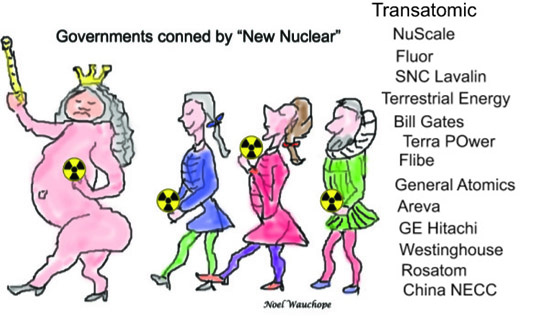
 Fukushima, the ‘nuclear renaissance’ and the Morrison Government, Independent Australia, By Helen Caldicott | 25 June 2019 Now that the “nuclear renaissance” is dead following the Fukushima catastrophe, when one-sixth of the world’s nuclear reactors closed, the nuclear corporations – Toshiba, Nu-Scale, Babcock and Wilcox, GE Hitachi, Cameco, General Atomics and the Tennessee Valley Authority – will not accept defeat, nor will the ill-informed Morrison Government…..
To be quite frank, almost all of our politicians are scientifically and medically ignorant and in an age where scientific evolution has become extraordinarily sophisticated, it behoves us – as legitimate members of democracy – to both educate ourselves and our naive and ignorant politicians for they are not our leaders, they are our representatives.
Many of these so-called representatives are now being cajoled into believing that electricity production in Australia could benefit from a new form of atomic power in the form of small modular reactors (SMRs), allegedly free of the dangers inherent in large reactors — safety issues, high cost, proliferation risks and radioactive waste.

But these claims are fallacious, for the reasons outlined below.
Basically, there are three types of small modular reactors (SMRs), which generate less than 300 megawatts of electricity compared with current 1,000-megawatt reactors.
1. Light-water reactors
These will be smaller versions of present-day pressurised water reactors, using water as the moderator and coolant, but with the same attendant problems as Fukushima and Three Mile Island. Built underground, they will be difficult to access in the event of an accident or malfunction.
Because they’re mass-produced (turnkey production), large numbers must be sold yearly to make a profit. This is an unlikely prospect because major markets — China and India — will not buy our reactors when they can make their own.
If safety problems arise, they all must be shut down, which will interfere substantially with electricity supply.
SMRs are expensive because the cost per unit capacity increases with a decrease in reactor size. Billions of dollars of government subsidies will be required because investors are allergic to nuclear power. To alleviate costs, it is suggested that safety rules be relaxed.
2. Non-light-water designs
These include high-temperature gas-cooled reactors (HTGRs) or pebble-bed reactors. Five billion tiny fuel kernels consisting of high-enriched uranium or plutonium will be encased in tennis-ball-sized graphite spheres that must be made without cracks or imperfections — or they could lead to an accident. A total of 450,000 such spheres will slowly and continuously be released from a fuel silo, passing through the reactor core and then recirculated ten times. These reactors will be cooled by helium gas operating at high very temperatures (900 degrees Celcius).
A reactor complex consisting of four HTGR modules will be located underground, usually to be run by just two operators in a central control room. Claims are that HTGRs will be so “safe” that a containment building will be unnecessary and operators can even leave the site (“walk-away-safe” reactors).
However, should temperatures unexpectedly exceed 1,600 degrees Celcius, the carbon coating will release dangerous radioactive isotopes into the helium gas and at 2,000 degrees Celcius, the carbon would ignite, creating a fierce, Chernobyl-type graphite fire.
If a crack develops in the piping or building, radioactive helium would escape and air would rush in, also igniting the graphite.
Although HTGRs produce small amounts of low-level waste, they create larger volumes of high-level waste than conventional reactors.
Despite these obvious safety problems, and despite the fact that South Africa has abandoned plans for HTGRs, the U.S. Department of Energy has unwisely chosen the HTGR as the “next-generation nuclear plant.” There is a push for Australia to follow suit.
3. Liquid-metal fast reactors (PRISM)
It is claimed by proponents that fast reactors will be safe, economically competitive, proliferation-resistant and sustainable.
They are fueled by plutonium or highly enriched uranium and cooled by either liquid sodium or a lead-bismuth molten coolant. Liquid sodium burns or explodes when exposed to air or water, and lead-bismuth is extremely corrosive, producing very volatile radioactive elements when irradiated.
Should a crack occur in the reactor complex, liquid sodium would escape, burning or exploding. Without coolant, the plutonium fuel could reach critical mass, triggering a massive nuclear explosion, scattering plutonium to the four winds. One-millionth of a gram of plutonium induces cancer — and it lasts for 500,000 years. Extraordinarily, they claim that fast reactors will be so safe that they will require no emergency sirens and that emergency planning zones can be decreased.
There are two types of fast reactors: a simple, plutonium-fueled reactor and a “breeder,” in which the plutonium-reactor core is surrounded by a blanket of uranium 238, which captures neutrons and converts to plutonium.
The plutonium fuel, obtained from spent reactor fuel, will be fissioned and converted to shorter-lived isotopes, caesium and strontium, which last 600 years instead of 500,000. The industry claims that this process, called “transmutation,” is an excellent way to get rid of plutonium waste. But this is fallacious because only ten per cent is fissioned, leaving 90 per cent of the plutonium for bomb-making and so on.
Then there’s construction. Three small plutonium fast reactors are grouped together to form a module and three of these modules will be buried underground. All nine reactors will then be connected to a fully automated central control room operated by only three operators. Potentially, then, one operator could face a catastrophic situation triggered by the loss of off-site power to one unit at full power, another shut down for refuelling and one in startup mode. There are to be no emergency core cooling systems.
Fast reactors require massive infrastructure, including a reprocessing plant to dissolve radioactive waste fuel rods in nitric acid, chemically removing the plutonium and a fuel fabrication facility to create new fuel rods. A total of 14-23 tonnes of plutonium are required to operate a fuel cycle at a fast reactor, and just five pounds is fuel for a nuclear weapon.
Thus fast reactors and breeders will provide extraordinary long-term medical dangers and the perfect situation for nuclear-weapons proliferation. Despite this, the Coalition Government is considering their renaissance. https://independentaustralia.net/environment/environment-display/fukushima-the-nuclear-renaissance-and-the-morrison-government,12834
June 25, 2019
Posted by Christina Macpherson |
politics, Reference, Small Modular Nuclear Reactors, spinbuster |
Leave a comment














 nuclear-news
