The UK government deserves an award for the biggest load of nuclear propaganda BS yet!

“to safeguard and celebrate the
history and cultural heritage of the nuclear industry”
will also support
future nuclear developments
The Nuclear Decommissioning Authority (NDA) has published the first ever
nuclear heritage vision and strategy. The NDA is the organisation
responsible for decommissioning the UK’s legacy nuclear sites, sites and
facilities. It said the purpose of the nuclear heritage vision and
strategy, published on 12 September, is “to safeguard and celebrate the
history and cultural heritage of the nuclear industry”. Among the
strategy’s aims will be the collection of learnings to improve planning
of decommissioning activities and reduce risks. This will also support
future nuclear developments such as new nuclear builds, research and
development, long term decommissioning programmes and a Geological Disposal
Facility (GDF).
New Civil Engineer 16th Sept 2024,
https://www.newcivilengineer.com/latest/inaugural-nuclear-heritage-strategy-to-support-decommissioning-planning-and-new-nuclear-builds-16-09-2024/
Welcome to Planet Vogtle! The Lessons of Georgia’s Nuclear Boondoggle
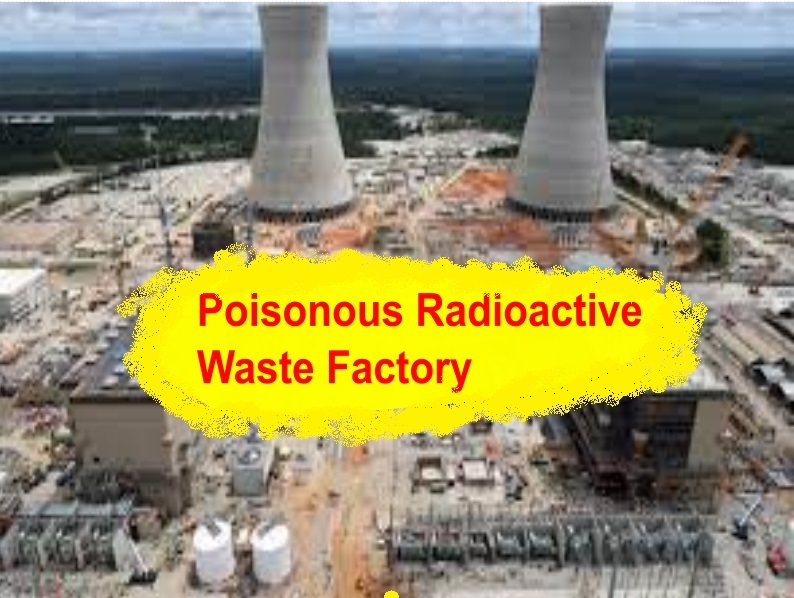
The ADVANCE Act greases the tracks by eliminating regulatory barriers, essentially transforming the Nuclear Regulatory Commission from a safety watchdog into an industry booster. It curtails the licensing process, downgrades health and safety standards, and promotes the export of nuclear technology. The U.S. can now compete with Russia and China to spread “nuclear waste factories” like Vogtle around the globe.
Jul 1, 2024, https://www.stephenwing.com/blog/2024/07/01/welcome-to-planet-vogtle-the-lessons-of-georgias-nuclear-boondoggle/
A global race is on to see who will host the next nuclear disaster, and as always the U.S.A. is determined to take the lead. On June 18 the Senate passed the so-called ADVANCE Act, pledging billions of taxpayer dollars to the most expensive, inefficient, and toxic form of energy ever devised. Thanks to the $37 billion expansion of Plant Vogtle, Georgia Power ratepayers like me know what that means: record-breaking profits for utility companies, record-breaking power bills for the rest of us.
Lavish federal subsidies under the last four presidents and a grandiose “nuclear renaissance” P.R. campaign have failed to reverse decades of decline for nuclear energy. No surprise – it’s an obsolete, dangerous, and financially untenable technology that no private investor or insurance carrier will touch.
Now, like the Four Horsemen of the Apocalypse, what Naomi Klein calls “disaster capitalism” comes galloping to the rescue. A rare bipartisan consensus hails “clean, safe nuclear energy” as the answer to climate change. The 93-page ADVANCE Act – cleverly concealed within the 3-page Fire Grants & Safety Act – delivers the entire wish list of the nuclear industry. Only Bernie Sanders and Ed Markey voted “no.” Liberal icon Sheldon Whitehouse actually helped to draft the legislation.
Calling nuclear power “clean” and “safe” would be laughable if it weren’t such a grim joke. Radioactive contamination plagues it at every step, from carcinogenic uranium mining to routine radionuclide releases at every operating reactor to the mounting backlog of radioactive waste. “Disposal” is a euphemism; the waste will remain deadly to life for tens of thousands of years, longer than the entire history of civilization, with no safe storage option in sight.
Expecting nukes to help slow global warming is equally deluded. The two new reactors at Plant Vogtle – the nation’s first since the Three Mile Island meltdown in 1979 – took 15 years to construct, double the original estimate. We would have to build 1,400 more within ten years to noticeably impact the pace of climate change. Developing untested technologies such as “Small Modular Nuclear Reactors” will take decades longer.
Electricity as a Byproduct of Profit
The ADVANCE Act greases the tracks by eliminating regulatory barriers, essentially transforming the Nuclear Regulatory Commission from a safety watchdog into an industry booster. It curtails the licensing process, downgrades health and safety standards, and promotes the export of nuclear technology. The U.S. can now compete with Russia and China to spread “nuclear waste factories” like Vogtle around the globe.
Not that the NRC ever seriously hindered the industry it is charged to regulate. The new legislation comes amid a nationwide rush to extend the licensing of nuclear plants from their estimated safe lifespan of 40 years to 60, 80, even 100 years, despite the proven tendency of radioactivity to “embrittle” the concrete that shields us from exposure.
Though media coverage of the ADVANCE Act was largely clueless, several outlets quoted a statement by Ed Lyman of the Union of Concerned Scientists: “Make no mistake: This is not about making the reactor licensing process more efficient, but about weakening safety and security oversight across the board, a longstanding industry goal.”
The only reason utilities are pushing nukes – and the only reason they ever did – is profit. Ever since Eisenhower heralded “the peaceful atom” and the industry promised energy “too cheap to meter,” nuclear power has depended entirely on government subsidies to survive. By far the most costly way to generate electricity, it’s also the most profitable, since We the Taxpayers cover most of the costs, from uranium mining and enrichment to managing nuclear waste to the uninsurable consequences of catastrophic accidents.
Betting on nukes not only wastes irrecoverable time and money; it pre-empts real solutions. Investing the same tax dollars in renewables like solar and wind, energy-efficient retrofits, and upgrading the power grid would displace far more carbon emissions. Renewables already provide more electricity globally than nukes, are far cheaper per kilowatt-hour, and can be expanded much more rapidly while generating exponentially more jobs.
Not to mention sidestepping the risk of another Fukushima, Chernobyl, or Three Mile Island. Factor in the escalating threats of extreme weather and terrorism, declining safety standards, and the industry’s eagerness to sell its radioactive snake-oil to developing nations, and the odds of another deadly meltdown somewhere in the world approach the threshold of inevitability – maybe right here in my home state.
Georgia’s Plant Vogtle: A Cautionary Tale
On the eve of Georgia Power’s triumphant ribbon-cutting for its new reactors, six environmental and consumer groups released “Plant Vogtle: The True Cost of Nuclear Power in the United States,” a 35-page report exposing the political maneuvering and cynical profiteering that made the project a “success.”
The story begins in 2009, when most U.S. utilities had abandoned the “nuclear renaissance” due to plunging natural gas prices, zero growth in energy consumption, and the astronomical cost of nuclear fission. Despite federal loan guarantees, no one was investing – until the Georgia General Assembly solved the problem with a bill allowing Georgia Power (a subsidiary of Southern Company) to charge customers a monthly fee to finance two additional reactors at Plant Vogtle, near Augusta.
Georgia Power’s sales had been flat for two decades and its generating capacity was nearly three times the reserves recommended by the federal agency in charge of our national grid. So why would the company build two expensive, unnecessary new reactors? And why would Georgia’s elected utility regulators, the Public Service Commission, allow it?
“By all appearances,” the report explains, “the Georgia PSC is deep in regulatory capture, a phenomenon where a regulator prioritizes the interests of the companies it regulates (like Georgia Power) over the public good. . . .
Since Georgia Power is a monopoly and operates outside of a competitive business market, it can shift risks and costs onto customers if regulator or legislative bodies enable it. That is exactly what the Georgia PSC did.”
Adding as much as 10% to a typical power bill, the fees raised over $4 billion – 88% of it from residential customers, small businesses, even public schools, and only 11% from major industries, thanks to some canny lobbying. The average household ended up paying about $1,000 up-front to subsidize the reactors. The U.S. Treasury contributed a $12 billion low-interest loan, and the rest of the up-front cost came from other lenders. But Georgia law guarantees that ratepayers must cover loan repayment along with Georgia Power’s other costs – which the PSC repeatedly approved as the budget jumped from an initial $14 billion to $21, then $27 billion.
In effect, ratepayers and taxpayers were forced to shoulder the entire investment, while the profits go to Southern Company shareholders.
Milking a Corporate Monopoly to the Max
That same year, South Carolina authorized a similar customer fee to expand its VC Summer plant. Both projects were contracted to Westinghouse. Construction began in 2013, but according to the report, “Cost overruns at both reactor sites began immediately, and by early 2017 were so extreme that Westinghouse declared bankruptcy.” In South Carolina, an investigation led to criminal charges against Westinghouse and utility executives, four of whom went to prison and paid steep fines “for lying about the costs and progress of the project.”
“Similar behavior by Westinghouse and Georgia Power/Southern Company officials occurred in Georgia,” the report goes on, “but there has been no accountability. . . . Commissioners repeatedly accepted Georgia Power’s budget and schedule forecasts in defiance of documented evidence from the Commission’s own staff and consultants that they were materially inaccurate for over ten years.” The Commissioners also praised the company and nuclear power itself with evangelical fervor, violating state regulations that require neutrality in upholding the public interest.
The two reactors ultimately cost over $36.85 billion, making Vogtle “the most expensive power plant ever built on Earth.” But because the PSC approved an exceptionally high rate of “return on equity” (ROE), every cost overrun and construction delay only bolstered Georgia Power’s profits. “Georgia Power was making substantially greater profits from Vogtle 3 and 4’s delay than if it had finished on schedule,” the report says. “Indeed, commissioners allowed Georgia Power to amass a record $17 billion in profits between 2009 and 2023, while allowing $20 billion in cost overruns for Vogtle 3 and 4.”
In December 2023, the PSC voted to saddle ratepayers with $11.1 billion in cost overruns, often caused by shoddy workmanship, inept management, or poor design. Vogtle-related rate increases will eventually total 23.7% – “in stark contrast,” the report points out, “to claims Georgia Power made in 2016 that completing Vogtle units would put ‘downward pressure on rates.’ . . . It is very likely Georgians will soon be paying the highest power bills in the nation due to Plant Vogtle.”
The report’s conclusion illuminates the fraudulent premises of the ADVANCE Act:
“Fossil fuels and uranium are burned to boil water to produce steam to generate electricity which produces large amounts of waste heat. Renewable energy not only does not produce waste heat, but is more than twice as efficient as steam generated power, thus fossil fuel and nuclear energy can be replaced by less than half as much clean, renewable energy . . .”
“Washington, Oregon, Idaho, and South Dakota produced over 60% of their electricity from renewables in 2023, and ten countries generated 60 to 90% of their electricity from renewables in 2022 including Scotland, Iceland, the Netherlands, Germany, and Guatemala, among others. California’s output from wind, water and solar power exceeded demand for 30 of 38 days early in 2024 . . .”
“Investments in a clean energy transition would save substantial amounts of ratepayer money, and would quickly meet the reduced greenhouse gas emissions reduction targets the world needs to address the climate crisis. Yet these investments are not made as they are not as profitable for monopoly utilities seeking to maximize profits. . . . An immense transfer of wealth is taking place from the people of Georgia to a rich, powerful monopoly whose only motivation is to maximize profits.”
Don’t let your state be taken in by scammers in suits! Download the full report here.
Don’t Be Bamboozled by Nuclear Power
by Prerna Gupta, https://www.counterpunch.org/2024/09/13/dont-be-bamboozled-by-nuclear-power/
In the face of a complex and urgent problem like climate change, it’s tempting to believe in simple solutions. Just as detox teas or diet pills claim to solve health issues that truly require lifestyle changes, nuclear energy has been marketed as a quick fix for the socio-political problem that climate change is. It’s presented as an essential part of the climate solution, yet, like many health fads, it is both ineffective and harmful. Today, nuclear energy is being pushed in the form of Small Modular Reactors (SMRs)—touted as the latest technological miracle.
Jan Haaken’s latest documentary, Atomic Bamboozle, pulls back the curtain on this techno-fantasy, revealing SMRs for what they truly are: old wine in a new bottle. Haaken, a seasoned filmmaker who has tackled climate action in her recent Necessity films, unravels the fantastic narrative surrounding SMR propaganda through humor, expert testimony, and a rich history of grassroots resistance.
Haaken intersperses the industry’s lofty claims with a systematic critique from nuclear expert M. V. Ramana, who debunks the promises of SMRs. Despite their high-tech veneer, these reactors are burdened by the same issues that have long plagued the nuclear industry: exorbitant costs, proliferation risks, risk of catastrophic accidents, and the unresolved nightmare of nuclear waste. The arguments presented concisely here are expanded upon in Ramana’s recent book, Nuclear is Not the Solution: The Folly of Atomic Power in the Age of Climate Change, which offers a comprehensive critique, demonstrating that nuclear energy is neither a desirable nor feasible solution to the climate crisis.
Haaken then draws our attention to the troubled legacy of nuclear power through the resistance to the Trojan Nuclear Power Plant and the ongoing pollution at the Hanford Site. Voices like Lloyd Marbet, a key figure in the Trojan resistance, highlight the dangers inherent in nuclear projects and the struggle to hold industry accountable. Marbet recalls the safety issues surrounding Trojan, such as cracks in its steam generators and the mounting costs required to address them—which eventually led to its shutdown. Meanwhile, First Nations advocates like Cathy Sampson-Kruse and Dr. Russell Jim emphasize the environmental devastation caused by the Hanford Site. The Yakama Nation, along with other activists, have been fighting tirelessly to protect their land and the Columbia River from contamination, underscoring the toxic legacy that still requires cleanup decades later.
Haaken expertly contrasts these real-world examples of nuclear disasters with the glossy, futuristic promises of SMRs as a “clean, green” energy source. This juxtaposition slices through the propaganda and traces the roots of the narrative back to the “Atoms for Peace” program. After the devastation of Hiroshima and Nagasaki, this initiative sought to rebrand nuclear technology as a “friend” to humanity – presenting nuclear power as a powerful genie that could be safely contained within the walls of a reactor. However, the nuclear industry’s legacy of pollution, which will take thousands of years to clean up, and catastrophic accidents like Fukushima demonstrate that this reassuring image is far from reality.
One of the most dangerous effects of technological quick fixes is their ability to obscure the power dynamics underlying climate issues. Big corporations and influential individuals hide behind technological solutions, deflecting attention from the required changes to a system that disproportionately benefits them. Haaken, therefore, makes a point to focus on billionaires like Bill Gates, who are promoting SMRs. In the video clip shown in the documentary Gates awkwardly plays down the issue of nuclear safety, while Ramana reveals a deeper irony: despite Gates’ immense wealth, even he relies on public funding to push forward these risky projects. Investors seem reluctant to gamble their own money on unproven technologies like SMRs, raising serious doubts about their viability.
This brings Haaken’s sharp yet accessible critique of nuclear energy to its full conclusion, succinctly captured in the film’s title—Atomic Bamboozle. The title itself exposes the latest SMR trend for what it truly is: a sales trick designed to siphon off your tax dollars, peddling an overpriced technology through confusing jargon and false promises.
The Sierra Club Grassroots Network Nuclear Free Team is concluding its first Nuclear-free Film Series with the powerful independent film, ATOMIC BAMBOOZLE: THE FALSE PROMISE OF A NUCLEAR RENAISSANCE. As political pressure mounts in the US to meet net zero carbon goals, the nuclear power industry makes its case for a nuclear “renaissance.” This documentary by NECESSITY Director Jan Haaken follows activists as they expose the true costs of the new small nuclear reactor designs.
Why fans of nuclear are a problem today
… not because they will succeed, but because they will fail
Jérôme à Paris, Aug 25, 2024,
https://jeromeaparis.substack.com/p/why-fans-of-nuclear-are-a-problem
Nuclear energy has been great. In many places, it has produced relatively cheap electricity and (although we did not care about that when it was built) it is largely carbon-free. It still works, but it is simply no longer competitive against available alternatives, and it is going to be increasingly difficult to integrate in a system that is inexorably dominated by solar energy during the day and other renewables. (see for instance this recent academic study). In any case, it is not financeable, and given the large amounts required for each plant, they will struggle to get built, even with large-scale state support.
If a few nuclear plants could easily be built on budget and on time in a given system, it would not be an issue, but the problem is that (i) a lot of the energy of its proponents is directed at maligning renewable energy, presenting it as unserious and insufficient (arguments of the “you can’t do vital surgery if there’s no wind” type which ignore how grids work), and (ii) more importantly, nuclear swallows an incredible volume of political capital that could better be used for other purposes, like energy efficiency, upgrading the grid or reducing fossil fuel use outside the electricity sector.
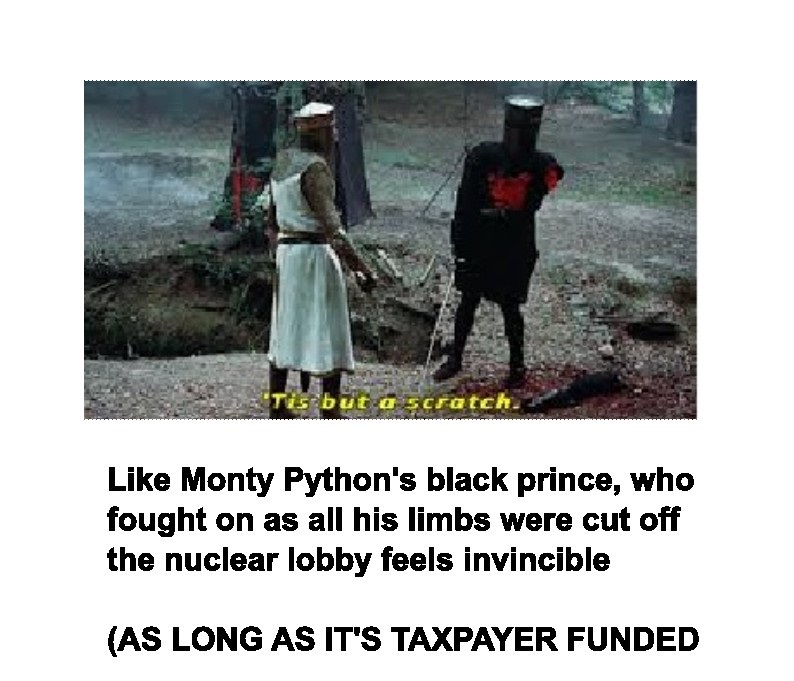
Politicians like these very large, multi-billion-euro projects that seem to solve an issue in one go, and can be forcefully and visibly decided by a handful of large-ego persons like themselves. They don’t understand (or hate) the very decentralized and uncontrollable nature of renewable energy systems, that require complex rules and don’t give them the same publicisable impact on things. Nuclear provides a concentrated nexus of jobs, TV opportunities, and VIP meetings with big stakes. So they are easily convinced by proponents that this is what is needed.
And thus we get endlessly repeating “decisions” to build new nuclear plants, to be executed over the next 20 or 40 years, and which increasingly resemble fusion energy – always 20 years away. This is because the underlying arithmetic unfortunately no longer works, and nobody is actually willing to sink the billions, or pay the inflated tariffs, that are required to get the plants of the ground – and that’s before delays and cost overruns hit (and obviously nobody sane will agree to be responsible for these in advance).
If nuclear made sense, Microsoft or Amazon or Rio Tinto would finance the construction of a few plants to feed their ever growing appetite for reliable carbon-free energy… In reality, despite all the high-powered attention, ridiculously few new nuclear plants are being built compared to new renewables, even in China. Nuclear is at best irrelevant and at worst a distraction…
This would be harmless if it did not occupy the limited time that senior politicians have to spend on the topic of energy, and get them to spend their political capital on these projects that end up going nowhere. It also means that they don’t understand what is actually happening in the energy sector in the meantime, and don’t work on the new policies that are needed to make sure that ongoing (unstoppable) transition to renewables is done more smartly and efficiently.
Nuclear proponents do understand the energy system a bit better, and they certainly see that renewables are eating their lunch (typified by the switch in discourse, beyond the “it’s ugly” and ‘what do you do when there’s no wind” arguments, from “it’s too small to matter” to “it cannot do 100% on its own”) and thus they need to attack and criticise renewables to make it appear that nuclear is still necessary or relevant.
In that – continuing to denigrate renewables, and capturing too much political attention, nuclear proponents achieve only one thing – slowing down the transition to renewables, and making it more expensive than it could be because regulatory changes are not made. They have effectively become the useful idiots of the fossil fuels industry which they still occasionally claim to fight.
And, to conclude, a fun fact that seems ignored by most: France has lost more annual kWh from nuclear than Germany since 2011, which closed its plants. Maybe the blame for weakening the nuclear case should go to France rather than Germany?
Global disappointment with the most promising energy: ‘The dream is dead’, and we are in ‘big trouble’
by D. García, 08/23/2024 https://www.ecoticias.com/en/fusion-nuclear-energy-dream-dead/5728/?fbclid=IwY2xjawE2PiVleHRuA2FlbQIxMQABHfSEEnp1jh9NKYg3N-pZe7YOq421dNO7fCN7ZZKAeigI3n1uZOiemR-I-Q_aem_ePp32l88aWrmHEcGwyKikg
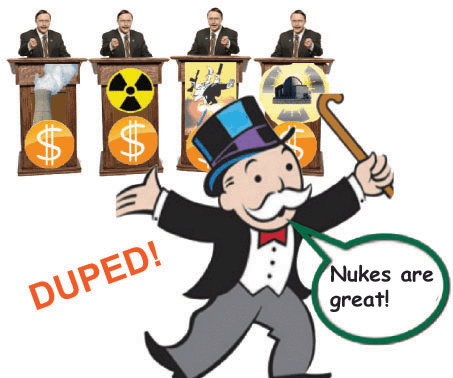
Renewable sources are expanding across the country, but there is a ‘silent enemy’ that is eating away at some of this progress, and that is nuclear energy. Experts have believed for years that they can make it clean and safe, which we simply call a pipe dream. Recently, a prestigious media outlet such as The Guardian collected the opinions of several experts under the reflection ‘The dream is dead’. What has happened so that optimism has turned into global pessimism? A discovery about reactors has left everyone in shock.
It was a promising, non-renewable energy: Now, it’s a dead dream, according to experts
Nuclear fusion, a dream of obtaining a virtually inexhaustible and pollution-free energy, has remained an appealing goal for science and politics for a long time. Still, recent problems and accumulating issues caused some analysts to announce that nuclear fusion as a near-term energy source is indeed dead.
A major dream in energy generation circles has been nuclear fusion – the process that drives the sun and stars. Fusion reactions in which hydrogen atoms are combined to form helium have no complicated, long-lived radioactive waste or greenhouse gases as a by-product. But to maintain controlled fusion on Earth, it has been identified as one of the greatest scientific feats ever.
The International Thermonuclear Experimental Reactor is the largest fusion experiment in the world, and the project has experienced the problems with time and over budget. Initially designed to start operations in 2025, the current schedule of ITER has now been delayed, and it is not expected that full fusion operations will commence until the 2050s.
Key figures to understanding why this is a global disappointment: We are losing energy at GW-scale
The dominoes began to tumble and affect the overall nuclear energy industry because of the failures of fusion research. While fusion remains experimental, traditional fission-based nuclear power has been on a downward trend in many parts of the world:
- Worldwide nuclear energy generation has been on the downtrend, with a record in 2006, and Nuclear electricity generation was reduced by 4% between 2019 and 2020.
- Nuclear power’s contribution to the world’s electricity mix has gone down from a peak of roughly 17%. It went from 5% in 1996 to slightly above 10% in the recent past.
- Nuclear power’s contribution to electricity generation in the United States has been steady at approximately 20 percent, but the operating reactors are fewer than before, with 93 as compared to 104 in 2012 and 2021.
What’s the reason why nuclear energy is declining? Beyond the fusion process
The nuclear energy sector in America is facing significant challenges:
- Aging Infrastructure: A majority of the nuclear plants in the United States are either already, or on the verge of, expiring their permits granted for 40 years of utilization.
- Economic Challenges: Nuclear power is unable to compete with relatively cheaper sources such as natural gas and renewable forms of energy. Some of the plants have been shut down before time due to unfavorable market conditions.
- Public Perception: Public opinion remains a core issue of discussion since safety, management of waste and probabilities of the occurrence of an accident cannot be fully overlooked when producing nuclear energy.
- Policy Uncertainty: It is stated that energy policy lacks a long-term vision, which resulted in no clear inspiration for the new nuclear projects.
Is America facing the same situation? Not, here is worse
Several U.S. states have experienced significant losses in nuclear energy capacity:
- California: All nuclear power will vanish in the state following the shutdown of the San Onofre Nuclear Generating Station in 2013 and the planned Diablo Canyon Nuclear Power Plant in 2025.
- Massachusetts: The last operating nuclear power plant in Massachusetts shut down operations in 2019, and the Pilgrim Nuclear Power Station has been off.
- New York: While some efforts had been made to carry forward the Indian Point Energy Center, it was extensively shut down in 2021, thus lowering New York’s nuclear power.
- Pennsylvania: The Three Mile Island plant shut down in 2019, and other plants in the state are also facing financial issues.
Who knows if nuclear fusion energy in America will become a more established source than ever (as Trump said last week) or if it will remain a memory, something like Natrium, Bill Gates’ extravagant invention to resurrect a source that many still believe will be the future. Will we ever “break the dream” and go for a 100% clean and renewable industry? Yes, but without sources with the potential to pollute entire ecosystems for millennia.
Nuclear power on the prairies is a green smokescreen.

By M. V. Ramana & Quinn Goranson, August 19th 2024, Canada’s National Observer https://www.nationalobserver.com/2024/08/19/opinion/nuclear-power-prairies-green-smokescree
On April 2, Alberta Premier Danielle Smith declared on X (formerly Twitter) “we are encouraged and optimistic about the role small modular reactors (SMRs) can play” in the province’s plans to “achieve carbon neutrality by 2050.”
SMRs, for those who haven’t heard this buzzword, are theoretical nuclear reactor designs that aim to produce smaller amounts of electricity compared to the current reactor fleet in Canada. The dream of using small reactors to produce nuclear power dates back to the 1950s — and so has their record of failing commercially.
That optimism about SMRs will be costing taxpayers at least $600,000, which will fund the company, X-Energy’s research “into the possibility of integrating small modular reactors (SMRs) into Alberta’s electric grid.” This is on top of the $7 million offered by Alberta’s government in September 2023 to oil and gas producer Cenovus Energy to study how SMRs could be used in the oil sands.
Last August, Saskatchewan’s Crown Investments Corporation provided $479,000 to prepare local companies to take part in developing SMRs. Alberta and Saskatchewan also have a Memorandum of Understanding to “advance the development of nuclear power generation in support of both provinces’ need for affordable, reliable and sustainable electricity grids by 2050”.
What is odd about Alberta and Saskatchewan’s talk about carbon neutrality and sustainability is that, after Nunavut, these two provinces are most reliant on fossil fuels for their electricity; as of 2022, Alberta derived 81 per cent of its power from these sources; Saskatchewan was at 79 percent. In both provinces, emissions have increased more than 50 per cent above 1990 levels.
It would appear neither province is particularly interested in addressing climate change, but that is not surprising given their commitment to the fossil fuel industry. Globally, that industry has long obstructed transitioning to low-carbon energy sources, so as to continue profiting from their polluting activities.
Canadian companies have played their part too. Cenovus Energy, the beneficiary of the $7 million from Alberta, is among the four largest Canadian oil and gas companies that “demonstrate negative climate policy engagement,” and advocate for provincial government investment in offshore oil and gas development. It is also a part of the Pathways Alliance that academic scholars charge with greenwashing, in part because of its plans to use a problematic technology, carbon capture and storage, to achieve “net-zero emissions from oilsands operations by 2050.”
Carbon capture and storage is just one of the unproven technologies that the fossil fuel industry and its supporters use as part of their “climate pledges and green advertising.” Nuclear energy is another — especially when it involves new designs such as SMRs that have never been deployed in North America, or have failed commercially.
X-energy, the company that is to receive $600,000, is using a technology that has been tried out in Germany and the United States with no success. The last high-temperature, gas-cooled reactor built in the United States was shut down within a decade, producing, on average, only 15 per cent of what it could theoretically produce.
Even if one were to ignore these past failures, building nuclear reactors is slow and usually delayed. In Finland, construction of the Olkiluoto-3 reactor started in 2005, but it was first connected to the grid in 2022, a thirteen-year delay from the anticipated 2009.
Construction of Argentina’s CAREM small modular reactor started in February 2014 but it is not expected to start operating till at least the “end of 2027,” and most likely later. Both Finland and Argentina have established nuclear industries. Neither Alberta nor Saskatchewan possess any legislative capacity to regulate a nuclear industry.
What Alberta and Saskatchewan are indulging in through all these announcements and funding for small modular nuclear reactors is an obstructionist tactic to slow down the transition away from fossil fuels. Discussing nuclear technology shifts attention from present and projected GHG emissions, while enabling a ramp-up of fossil fuel reliance in the medium-term and delaying climate action into the long-term.
Floating the idea of adding futuristic SMR technology into the energy mix is one way to publicly appear to be committed to climate action, without doing anything tangible. Even if SMRs were to be deployed to supply energy in the tar sands, that does not address downstream emissions from burning the extracted fossil fuels.
Relying on new nuclear for emission reductions prevents phasing out fossil fuels at a pace necessary for the scientific consensus in favour of rapid and immediate decarbonization. An obstructionist focus on unproven technologies will not help.
Quinn Goranson is a recent graduate from the University of British Columbia’s School of Public Policy and Global Affairs with a specialization in environment, resources and energy. Goranson has experience working in research for multiple renewable energy organizations, including the CEDAR project, in environmental policy in the public sector, and as an environmental policy consultant internationally.
M.V. Ramana is the Simons Chair in Disarmament, Global and Human Security and Professor at the School of Public Policy and Global Affairs, at the University of British Columbia in Vancouver. He is the author of The Power of Promise: Examining Nuclear Energy in India (Penguin Books, 2012) and “Nuclear is not the Solution: The Folly of Atomic Power in the Age of Climate Change” (Verso Books, 2024).
Nuclear power is a dead end as a climate solution


Many Climate ‘Solutions’ Are Dead Ends Or Niches & Should Be Ignored
Michael Barnard, Climate futurist advising multi-billion dollar funds and firms.
Money, power and influence. The low-carbon transformation that we have started is the path to immense amounts of money, power and influence. Non-solutions and even major problems are being pitched hard as climate wins. Nuclear energy, carbon capture, hydrogen for energy and synthetic fuels should be ignored by most policy makers and serious investors.
Let’s start with nuclear power. Up front, there are a lot of things to like about the technology. It’s low-carbon, low-pollution and safe. Personally, I’m pleased with every nuclear reactor that actually gets attached to the grid. If there weren’t alternatives and serious downsides, I would be all in on the power generation technology.
But there are serious problems for nuclear in the vast majority of countries in the world, and we have to power every country. Wind, solar, transmission and storage are viable in every country, hence their dominance in the short list of climate actions that will work.
Countries have to have some very specific conditions for success for nuclear generation build out, and almost none do in the 21st Century. They have to be at heightened risk of major conflict. They have to have a nuclear weapons strategic requirement, whether a program to build them as with the USA and France historically, or the ability to build them quickly should they become needed as with South Korea. They have to be a big, rich country.
Commercial nuclear generation has to be a national strategy. Federal purse strings have to open wide, and federal governments must have the ability to override local opposition and regulatory hurdles. The federal government has to satisfy 28 major requirements with the International Atomic Energy Agency and establish overlapping circles of physical and cyber defense on the full length of the nuclear fuel supply, use and waste chain.
A single technology and design has to be selected and required for every reactor to enable regulatory, technical and human processes to gain learning experience and more quickly deploy the technology. The nuclear design has to be large, typically gigawatt scale. And the deployment must run its course in 20 to 30 years so that the experienced teams don’t retire, losing their hard-won knowledge.
Every successful deployment of nuclear generation historically has had those characteristics. Without them, nuclear cost and schedule overruns are massive, and the time to approve and build a nuclear power plant is a decade or longer. As global megaproject expert Bent Flyvbjerg’s data set of over 16,000 projects greater than a billion dollars in cost shows, nuclear energy is close to the worst type for cost and schedule overruns, 23rd of 25 categories, with only the Olympics and nuclear waste repositories being worse.
Even then, nuclear power plants are inflexible and so only suitable for 40% or less of annual demand without running into significant challenges. France’s fleet is actually 13% of Europe’s electrical generation and the country trades terawatt hours in all directions annually. Without massive transmission in and out of the country, their cost of electricity and challenges with operations would multiply.
Jurisdictions that can’t commit to dozens of nuclear reactors at the national level and can’t enforce a single reactor design should ignore nuclear entirely.
China is a good natural experiment to consider regarding scaling of nuclear energy versus renewables. It’s had a national strategic nuclear generation program since the 1990s, and wind and solar programs since the mid-2000s. Despite its more centralized planning and authority, renewables have scaled vastly more quickly and are increasing exponentially, while the nuclear program peaked in 2018 and has been slower since.
If China can’t scale nuclear energy as rapidly as wind, solar, transmission and storage, no country can. Equivalent wind and solar generation can be built in a fifth the time for a third the cost with much greater budget and schedule certainty.
Small modular reactors are even worse. They lose the economies of physical size and won’t be able to build enough to achieve economies of manufacturing scale. They are unproven, and first of a kind projects are the highest risk. They require all of the same conditions for success as large scale nuclear. There is no reason to believe claims related to them.
Mechanical carbon capture and sequestration is mostly another subsidy for the fossil fuel industry. Globally, only oil and gas heavy countries are considering it as a reasonable carbon drawdown strategy, and that’s not because it is one. Looking around the world, the majority of countries are sensibly leaning into nature-based drawdown strategies because they scale and work……………………………………………………………….
Hydrogen for energy is another dead end. At present we manufacture about 120 million tons of it, and the process creates as much greenhouse gasses as the entire aviation industry globally. That must be cleaned up. ……………………………… any process which manufactures hydrogen requires a lot of energy
………………………………………. There are powerful and well-funded organizations and individuals attempting to bend our decarbonization journey to their ineffective technologies. They are slowing progress. They are working to create profits for themself at the expense of the planet. Many individuals are well meaning, but simply deluded about the benefits of their favored technology.
Ignore them. The climate crisis and the opportunity are both too great to waste time on clearly poor solutions.
As a reminder, here’s the short list of climate actions that will work:
- Electrify everything
- Overbuild renewable generation
- Build continent-scale electrical grids and markets
- Build pumped hydro and other storage
- Plant a lot of trees
- Change agricultural practices
- Fix concrete, steel and industrial processes
- Price carbon aggressively
- Shut down coal and gas generation aggressively
- Stop financing and subsidies for fossil fuel
- Eliminate HFCs in refrigeration
- Ignore distractions
- Pay attention to motivations
Michael Barnard spends his time projecting scenarios for decarbonization 80 years into the future, and assisting his clients — executives, Boards and investors on several continents — to pick wisely today. ………… mohttps://www.forbes.com/sites/michaelbarnard/2023/10/16/many-climate-solutions-are-dead-ends-or-niches–should-be-ignored/?sh=3eb5ba803987 #nuclear #antinuclear #nuclearfree #NoNukes
Some UK higher education rejoices in the nuclear and military partnership
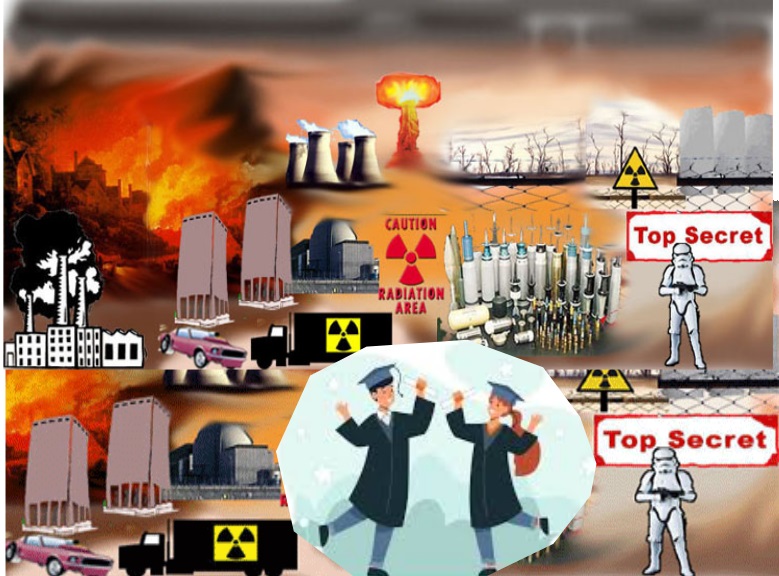
Nuclear decommissioning centre shares learning with MoD apprentices
An innovative engineering and maintenance centre is forging links with the Ministry of Defence to help share learnings between the nuclear and defence sectors.
Sellafield Ltd Engineering Centre of Excellence in Cleator Moor, hosted degree apprentices from Royal Naval Armaments Depot Coulport in Argyll and Bute, Scotland on Wednesday.
The visit was arranged by the Sellafield Engineering Centre of Excellence team to showcase its pioneering work with robotics, unmanned aerial vehicles, remotely operated vehicles, flight and electrical simulators and VR technology.
Five MoD degree apprentices, all on a five-year programme linked to the University of Wales, Trinity Saint David, at Swansea, gained hands-on experience of operating a drone simulator, using VR equipment and a range of other remotely operated technology at the state-of-the-art centre in Cumbria. ………………………………………………………………more https://cumbriacrack.com/2024/07/30/nuclear-decommissioning-centre-shares-learning-with-mod-apprentices/
Bangor University to collaborate with Rolls Royce and the University of Oxford to develop nuclear power for space

Bangor University is continuing its relationship with Rolls-Royce in the
field of space nuclear power technology. Rolls-Royce has secured funding
from the UK Space Agency under the National Space Innovation Programme
(NSIP), which adds more support for the development of its space nuclear
power technology. The new £4.8m award from NSIP Major Projects will help
to significantly advance the development and demonstration of key
technologies in the space nuclear Micro-Reactor. The Rolls-Royce National
Space Innovation Programme will have a total project cost of £9.1m and
aims to progress the Micro-Reactor’s overall technology readiness level,
which will bring the reactor closer to a full system space flight
demonstration.
Bangor University 24th July 2024
NATO’s deceptive veneer – young, feminist, peaceful – “civilian”

NATO’s Civilian Bases BY JOAN ROELOFS. https://www.counterpunch.org/2024/07/24/natos-civilian-bases/
Why has NATO been so generally accepted in Europe by almost all the major political parties and especially puzzling, the social democratic ones? Its economic costs, illegal aggressive wars, environmental damage, and the risks of nuclear annihilation would seem to make it a prime platform item. Well-informed political activists are unlikely to believe that an invasion of Switzerland or Denmark is imminent. There are significant anti-NATO movements, such as No to War No to NATO, but so far they haven’t been able to turn the tide.
Some reasons are fairly obvious. The US military connections to European defense and foreign ministries began during World War II. These strong ties have continued, now with an emphasis on NATO’s newly acquired feminist face, the Women, Peace, and Security agenda.

Promotion long and wide has been carried out by overtly pro-NATO lobbies such as the Atlantic Council and national think tanks, for example, the Council on Foreign Relations (US), the British Royal Institute of International Affairs, and their counterparts in many nations. There is also a Youth Atlantic Treaty Association, a network of national organizations of young professionals, university students and researchers.
The secretive Bilderberg group harnesses the political, economic, academic and journalism elites of NATO nations. Operation Gladio, Operation Paperclip and others have sustained firm links with military and intelligence agencies. There has also been covert and overt interventions in political parties and nongovernmental organizations, such as the CIA funding of Christian Democratic party in 1948 to defeat the Communist Party and meddling in the British Labour Party to minimize the influence of the Committee on Nuclear Disarmament. These have also cleared the path for NATO. Eastern Europe was even more easily penetrated by NATO, after the devastation of its economic, cultural, and scientific institutions.
There have been constant protests against NATO bases, yet their less vocal sympathizers appreciate the economic benefit. At first, in war-torn Europe both the liberated and the occupied nations saw little economic activity. Now the European economy is increasingly militarized, having outsourced much of its civilian industry and facing declines in its tourist industry due to pandemics, protests by local residents, and environmental costs. According to the Stockholm International Peace Research Institute (SIPRI) Fact Sheet of 2024, weapons production has greatly accelerated in many European countries, even though NATO and national militaries also equip themselves royally with US products. Sales to the Middle East and other violence inflicted areas are good business.
Now workers, many unionized and some even socialists and communists, have secure jobs in war industries and in the burgeoning military-civilian industries. As the Erikssons have documented:
The defence industry is undergoing rapid change, particularly regarding the development of dual-use technology and transfer of technology between military and civilian domains. . . The blurring of the military-civilian divide is particularly noticeable with the rapid development of Artificial Intelligence (AI), digitalization, satellite technology, integrated quantum, photonics, high-capacity wireless communications, and “big data” networking through 5 G – developments which have been referred to as “the fourth industrial revolution. . .”
Just as its military bases need everything, NATO institutes, operations, conferences, war games, and its supersized headquarters in Brussels equip and maintain from every kind of business. Much information is available on the NATO website; it also has a presence on YouTube, LinkedIn, Facebook, Instagram and X (Twitter). The NATO Support and Procurement Agency contracts database for 2023 lists only orders valued above €80,000. It includes “consumables” from a firm in Luxembourg, transport of tents and conference center equipment from Belgium, winter clothing from France, “civil and mechanical” from Albania, medical equipment from Sweden, waterproof bags from Great Britain, and spare parts from vendors in many countries.
Undoubtedly, even smaller businesses supply a wide range, and, as in the US, provide economic survival for owners, workers, and communities (see The Trillion Dollar Silencer). A listing of bids above €800,000 includes medical treatment structures from a firm in Italy, training services (Netherlands and Spain), and military cots and mosquito nets (Italy and Turkey). Although the largest in both lists are expenditures for weapons, firms that are often the economic lifeblood—rather the deathblood—of their communities, the smaller (but not piddling) purchases can influence many citizens and their elected representatives.
NATO training and research operations involve civilian universities, which increasingly have military departments, as well as national military academies. There are even public high school training programs, e.g., in Sweden, Germany, and France (Defence Cadets). In addition, the US Department of Defense has direct contracts with universities and scientific institutes worldwide, especially for weapons development, nanotechnology, and biotechnology.
NATO also has several layers of its own training entities. One is the Partnership Training and Education Centres, in 34 member and partner (i.e., not full member) countries. Some examples are Switzerland, Geneva Centre for Security Policy; Israel, IDF Military Medical Academy; Serbia, Chemical, Biological, Radiological and Nuclear Training Centre; Mongolia, Peace Support Operations Centre; Colombia, International Demining Centre; Italy, The International Institute of Humanitarian Law; and United Kingdom, United Kingdom Defence Academy.
Another NATO network is the 28 Centres of Excellence which are “international military organizations that train and educate leaders and specialists from NATO member and partner countries.” They are funded nationally and accredited by NATO. Some of these are Civil-Military Cooperation, one of two in the Netherlands; Crisis Management and Disaster Response, Bulgaria; Modelling and Simulation, one of several in Italy; Strategic Communications, Latvia; Climate Change and Security, Canada; and Maritime Security, Turkey. The latter is described as:
[P]roviding expertise both as a centre for academic research and as a (multinational) hub for practical training in the field of maritime security, along with relevant domains (maritime trade, energy security, maritime environment, maritime resources, public health, maritime transport-logistic). The Centre strives to achieve the necessary collaboration among stakeholders from government, industry, academia and the private sector.
[P]roviding expertise both as a centre for academic research and as a (multinational) hub for practical training in the field of maritime security, along with relevant domains (maritime trade, energy security, maritime environment, maritime resources, public health, maritime transport-logistic). The Centre strives to achieve the necessary collaboration among stakeholders from government, industry, academia and the private sector.
NATO’s enormous Civil Diplomacy department works through all print and electronic media. Its Press Tours enable reporters to “sail aboard the aircraft carrier USS George H.W. Bush on the Adriatic Sea” and “mingle with counter-terrorism experts in a metro station in Rome, Italy.” The department also welcomes grant applications from think tanks, universities, NGOs, and other civil society organizations “ranging from out-of-the box, non-traditional ideas to more institutional formats. Particular focus should be placed on outreach to youth audiences, female audiences and key opinion formers, including those who have not connected with NATO before.”
As Merje Kuus notes:
In addition to NATO’s own public diplomacy division, the alliance’s message is produced and projected through a host of NGOs that collaborate with NATO but are not affiliated with it. Funded through national foreign and defense ministries, NATO’s Public Diplomacy Division, and private companies, they organize a wide range of activities designed to popularize NATO within and beyond its member states.
NATO’s less obvious influence may derive from its accelerated penetration of civilian institutions: education, entertainment, teenage “influencers,” festivals, nongovernmental organizations, even progressive and human rights movements. NATO portrays itself as simply the prime association of democratic nations, which was apparently very persuasive in Eastern European regimes trying to divest themselves of the “totalitarian” label.
A notable example is its Women, Peace and Security Agenda. Journalist Lily Lynch reports:
In January 2018, Nato secretary-general Jens Stoltenberg held an unprecedented press conference with Angelina Jolie. While InStyle reported that Jolie “was dressed in a black off-the-shoulder sheath dress, a matching capelet and classic pumps (also black)”, there was a deeper purpose to this meeting: sexual violence in war. The pair had just co-authored a piece for the Guardian entitled “Why NATO must defend women’s rights”. The timing was significant. At the height of the #MeToo movement, the most powerful military alliance in the world had become a feminist ally. “Ending gender-based violence is a vital issue of peace and security as well as of social justice,” they wrote. “NATO can be a leader in this effort.”
A study by Katharine AM Wright, exploring the legitimacy given to NATO by the surprising participation of women’s rights groups in its activities, found some activists who argued that it enabled feminists to “advise” NATO, “to get it to hear things that they don’t usually hear,” and to “speak truth to power.”
As climate change is among NATO’s catalog of serious threats to security, environmentalists speak at NATO conferences and vice versa, serve on advisory boards, and formally interact in many ways. For example, the 2020 meeting of the Brussels Dialogue on Climate Diplomacy and the Environment & Development Resource Centre was hosted by the Policy Planning Unit in the Office of the NATO Secretary-General.
In addition to the more traditional Youth Atlantic Treaty Association, NATO has more recently created youth activities that are more cuddly. Its 2022 “Protect the Future campaign” recruited:
12 young online creators [teenage “influencers”] from Germany, Hungary, Latvia, Spain, the United Kingdom and the United States. To discover more about the Alliance’s work, the creators met with the Secretary General in May; travelled to the Madrid Summit in June; visited the US aircraft carrier USS George H.W. Bush in October; and went on an AWACS training mission in November.
The outcome, NATO reported, was 300,000 social media engagements that reached more than 9 million young people.
In another wing of this campaign, “young artists from across the Alliance took part in an open competition to help create NATO’s first-ever graphic novel, ‘Protect the Future.’ Six young artists were selected to work with professionals to produce the book.” For the multitude, a Youth Summit was held that included 35,000 people from 99 countries.
At the [2023] NATO Gaming Tournament in Warsaw, Poland, thousands of gamers from across the Alliance and around the world gathered to play online games and chat with experts from NATO Headquarters. The vibe in the room is casual and relaxed. Young gamers from Warsaw mingle with artists, soldiers and NATO experts. In one corner, troops from NATO’s multinational battlegroup in Poland play vintage console games, including Street Fighter and Super Mario. In another area, gamers mash buttons on old arcade games like Pac-Man.
The arts are not neglected. NATO sponsors exhibits, murals, and competitions:
Are you an artist under 35? Do you have a creative mind and want your artwork to be displayed at a permanent location in Washington D.C. where NATO will mark the 75th anniversary of the Alliance? Submit your work to the NATO mural competition – an opportunity to showcase your talent and artistic vision of the future. The winner will get to work with a local street artist to feature their mural permanently on a wall in the city.
The NATO mural competition will give young talents a chance to produce a signature image for NATO’s anniversary as part of its “Protect the Future” campaign.
In our era of network governance it is not surprising that NATO has close connections with the European Union (including its Organization for Security and Co-operation in Europe and European Defense Agency), the United Nations, the Council of Europe, and many other intergovernmental organizations. These in turn are interwoven with international (e.g., World Economic Forum, Amnesty International) and thousands of national nongovernmental organizations (e.g., Council on Foreign Relations), foundations, and business corporations. Zbigniew Brzezinski noted in The Grand Chessboard:
As the imitation of American ways gradually pervades the world, it creates a more congenial setting for the exercise of the indirect and seemingly consensual American hegemony. And as in the case of the domestic American system, that hegemony involves a complex structure of interlocking institutions and procedures, designed to generate consensus and obscure asymmetries in power and influence. (p.27)
The staffs of intergovernmental organizations are required to be politically neutral. However, there is also pressure on progressive or left wing nongovernmental organizations to avoid confrontation or strong dissent with conference participants or any member of the “partnership.”
The very size of this monumental hive of associations, including representatives, staffs, task forces of university and other experts, NGOs, and contractors may in itself affect the complexion of European political parties. Although I have found no evidence so far, perhaps there has been a “brain drain” of progressive activists into the more promising, interesting, and often paid work of these institutions, compared with the scant rewards of local political parties. It could be yet another factor in the passive or active support for NATO in Europe. Might there be scholars, journalists, or activists exploring this possibility?
Unless otherwise indicated, all quotations are from the NATO website.
Joan Roelofs is Professor Emerita of Political Science, Keene State College, New Hampshire. She has been an anti-war activist since she protested the Korean War. She is the author of The Trillion Dollar Silencer: Why There Is So Little Anti-War Protest in the United States (Clarity Press, 2022), Foundations and Public Policy: The Mask of Pluralism (SUNY Press, 2003), and Greening Cities (Rowman and Littlefield, 1996). She is the translator of Victor Considerant’s Principles of Socialism (Maisonneuve Press, 2006), and with Shawn P. Wilbur, of Charles Fourier’s anti-war fantasy, The World War of Small Pastries (Autonomedia, 2015). Web site: www.joanroelofs.wordpress.com
Shiny New MP’s Fizzingly Push For More Nuclear Waste – Hotter the better! And a Complaint to Advertising Standards – Standards? What Standards!
BY MARIANNEWILDART, https://mariannewildart.wordpress.com/2024/07/18/shiny-new-mps-fizzingly-push-for-more-nuclear-waste-hotter-the-better-and-a-complaint-to-advertising-standards-standards-what-standards/
Well we are now awash with new shiny MPs pushing the “clean” “green” nuclear myth and falling over themselves to write fizzingly enthusiastic letters “urging” the new Labour government to “deliver” new unlicensed untested nuclear crapola which the public would be paying for before during and well after any electricity production. Meanwhile Sellafield is bursting at the seams with nuclear wastes which keep on coming – nuclear wastes whose only “solution” is to “decommission” ie disperse, dump, incinerate and forget, make room for more.
How have we come to this – it has taken a lot of effort on the part of the industry and pro nuclear governments from Thatcher to Blair and now Starmer and a lot of forgetting on the part of mainstream environmental NGOs who were the ‘green’ conscience of the people and started out with fierce unequivocal opposition to nuclear but somehow got inveigled into demanding “climate jobs’ with no anti-nuclear caveats giving the now “climate friendly” nuclear industry exactly what it wants.
I wonder how the following adverts [on original] which were in local press over June will be viewed by humanity in future years, or by aliens?
Westinghouse the front end of the industry with its “clean” “climate friendly” uranium fuel and Sellafield, the arse end of the industry with its sponsorship of the “Pride of Cumbria Awards” the Shame of Cumbria is palpable with every radioactive particle that washes back from Sellafied’s radioactive sewers with the tide.
Full Page adverts over consecutive weeks in local press
Anyway more in hope than in expectation of Advertising Standards actually doing its job and making a ruling against breathtaking greenwashing by the most dangerous industry, here is a complaint – also sent to the Westmorland Gazette and Westinghouse on July 8th (no reply from either).
I would like to make a complaint about the advert run in the Westmorland Gazette (and Whitehaven News?) for Westinghouse.
The advert was produced on the same page (on consecutive weeks) with an advert for Sellafield “Proud to be sponsoring the Pride of Cumbria Awards 2024″”.The Westinghouse advert claims that its products: Nuclear Fuel, AP1000 reactors and assisting Sellafield in decommissioning, are “clean” and “carbon free.”
This can be easily refuted as falsehood.
The nuclear fuel produced by Westinghouse at the Springfields site has been burned in nuclear reactors across the UK (and abroad) since the mid-1940s.
Clifton Marsh Landfill
Some of the many waste streams from the manufacture of nuclear fuel are dispersed to the River Ribble and Clifton Marsh Landfill although in January 2022 “the Clifton Marsh low level waste landfill site, operated by Suez, stopped accepting consignments of radioactive waste for disposal. As most of the solid radioactive waste from Springfields is disposed at Clifton Marsh, this has significantly affected routine waste management operations on site. Together with ONR we have discussed and reviewed SFL’s contingency plans to manage waste in the short term, which includes temporary accumulation of radioactive waste on site, improvements to waste characterisation and alternative disposal options. It was anticipated that Clifton Marsh would become available for disposals during the second half of 2022, although this has not yet occurred,” Environment Agency report . Decommissioning Plans Include Incineration of Radioactive Wastes Three Miles from Preston by “Clean” Westinghouse are proposing an incineration plant on their Springfields site just 3 miles from Preston for ” a large, refractory lined oven designed to treat a wide range of low and intermediate-level radioactive materials.” The feed into the incinerator would include European radioactive wastes of up to 3 tonnes a day. Countries such as Germany have now rejected new nuclear on health, safety, climate and financial grounds but still have wastes to dispose of would be keen to use Westinghouse’s new incineration plant.https://www.world-nuclear-news.org/Articles/New-UK-waste-treatment-facility-planned#:~:text=Plans% 20to%20jointly%20develop%20a,for%20the%20European%20nuclear%20market.
River Ribble
“The Ribble estuary near Preston receives radioactive substances from liquid effluent, discharged directly from the nearby Springfields Fuels Ltd site, and also transported down the coast from the Sellafield Ltd site via the Irish Sea. Estuaries are complex environments, influenced by both the marine tidal processes and the freshwater input from rivers. Some of the radioactive substances eventually become deposited in sediment in the estuary and on the nearby salt marsh.” …”The amount of shielding provided by boat hulls varied from almost none in a small pleasure boat, to 50 percent in a medium sized houseboat. Thick, dense clothing materials like rubber boots reduced the dose received from beta radiation by around 80 percent, wax jacket by 20 to 40 percent, while thin, less dense materials like woollen jumpers did not provide any protection” Environment Agencyhttps://assets.publishing.service.gov.uk/media/5a7c323240f0b674ed20f75e/scho0211btkg-e-e.pdf
“Carbon Free”
The latest carbon emissions report for the Preston Springfields site by Westinghouse is 38,617 tonnes for 2019. This is the equivalent of 20,000 cars on the road. https://westinghousenuclear.com/media/5kulvl03/springfields-carbon-reduction-plan.pdf?ver=d5dd1Fr giH03Wqky98f_fA%3D%3D
The uranium fuel rod wastes from Westinghouse end up at Sellafield in Cumbria. The carbon footprint for looking after Westinghouse’s burnt uranium fuel rods last year was, according to Sellafield, 600,000 tonnes of CO2. This is far higher than all the emissions generated by all vehicles using the M6 through Cumbria every year according to Cumbria Action for Sustainability’s figures (CaFS give nuclear a free ride excluding figures despite their gargantuan C02 footprint)
AP1000 reactors – Bankruptcy, Crime and Failed Reactor Coolant Pumps
The advert states “Our AP1000 plant is setting operational records in its global fleet and is ready for deployment in the UK.” Yes it is setting operational records in being the most expensive, and fault ridden reactor to date causing Westinghouse to go into bankruptcy. “By 2016 Westinghouse began to grasp the scope of its dilemma, according to a document filed in its bankruptcy: Finishing the two projects would require Westinghouse to spend billions of dollars on labor, abandoning them would mean billions in penalties. Westinghouse determined it could not afford either option.” It chose Chapter 11 Bankruptcy. https://www.reuters.com/article/world/how-two-cutting-edge-us-nuclear-projects-bankrupted-westingho use-idUSKBN17Y0C7/ Alongside this were charges of Westinghouse executive with dozens of crimes including ” felony counts including conspiracy, wire fraud, securities fraud, and causing a publicly-traded company to keep a false record.”https://thebulletin.org/2021/08/us-attorney-details-illegal-acts-at-construction-projects-sealing-t he-fate-of-the-nuclear-renaissance/
Westinghouse’s “global fleet” is largely in China where AP1000 reactor coolant pumps have failed forcing shut down of the reactors. https://www.spglobal.com/commodityinsights/en/market-insights/latest-news/electric-power/031419-us -designed-chinese-nuclear-reactor-forced-to-shut-by-pump-defect
Scientists in China are concerned enough to have provided “environmental radiation impacts assessment for the hypothetical accident in Haiyang nuclear power plant” saying that “the impact of east wind in August will mainly affect the west area of HYNPP, but it also has an impact on Northeast China, the Korean Peninsula region and Kyushu, Japan. The research results are aimed at supporting emergency decision-making of nuclear accidents and improving nuclear emergency response capabilities in surrounding areas.” https://www.sciencedirect.com/science/article/abs/pii/S0149197020301153?via%3Dihub Former US nuclear regulator Arnie Gunderson has suggested that the AP1000 deployed in the UK could cause a catastrophe that would be “like Chernobyl on steroids.” https://www.independent.co.uk/climate-change/news/nuclear-expert-arnie-gundersen-warns-of-cherno byl-on-steroids-risk-in-uk-from-proposed-cumbria-plant-10109930.html
Clearly Westinghouse’s claim to be “clean” and “carbon free” is false.
yours sincerely
Marianne Birkby
on behalf of Lakes Against Nuclear Dump
Kiev missile attack. What happened? [i]
Cruise missile or stray air defense missile
Black Mountain Analysis MIKE MIHAJLOVIC, JUL 14, 2024
Coincidence or not, every time NATO has a high-level meeting, something terrible happens in Ukraine. After that, there is a frenzy of accusations about war crimes, indiscriminate targeting of civilians, and insults in both mainstream media and social media. There are “experts” that pop up like mushrooms after rain and an uncontrollable flood of speculations. What is missing is someone who puts a brake on emotional comments and starts to look at the issue from different angles: what may be evident from one side may be completely different when looked at from the other side.
This article is not an attempt to investigate the recent explosion that damaged the children’s hospital in Kiev, nor to finger point at anyone, but rather to establish the facts that may point to some conclusion if one expends the effort.
FACTS
The warhead
On July 8, Russia unleashed a barrage of cruise missiles at strategically important locations such as the Artyom Plant, which is a well-known manufacturer of equipment for the Ukrainian military. This target was carefully selected, and selection was based on careful and long surveillance, meaning that drones, satellites, field operatives, etc., were involved. The target for the specific day was not chosen randomly but after careful analysis, and the decision to strike was made after many pieces of the intelligence puzzle were acquired and placed to reveal a clear picture.
The target was very important, so the targeteers decided to engage it with multiple cruise missiles. Mathematically, it is clear that the probability of destruction is much higher with multiple missiles. The weapon chosen was not by chance: a cruise missile with a 450 kg warhead (the optimal choice for this type of target) guarantees destruction on a large scale, even if it is not a pinpoint hit. Several warheads of this size will obliterate the designated target(s).
Ukrainians are not naïve; more often than not, valuable equipment is relocated to predetermined places. Because of the machinery and other equipment, moving the manufacturing facilities is harder but not entirely impossible. Moving the VIPs is much easier, but one precise hit can virtually destroy the command structure or decision-makers.
In this case, as seen in several videos, the target mentioned was the Artyom Plant—a series of sequential hits by Kh-101 missiles achieved desirable results. What happened with the hospital is highly debatable
Firstly, there is a video clip showing a flying object, a missile, in a steep dive hitting the area. What is very important to say is that the missile didn’t hit the hospital directly, and the damage on the facade, which is evident in some photos, is caused by secondary effects such as blasts and shrapnel.
[excellent photos on original]
……………………………………………………………………………………………… Let’s do a brief investigation backward, starting from the position of the hit and working toward the missile. In almost every analysis flooding the media, everyone talks about the missile, and there are two streams: those who categorically say that the missile is indeed a Russian cruise missile and the other that argues for the stray Ukrainian AD missile. More on the hierarchy line in the political world, more acquisitions and this is especially on the pro-Ukrainian side.
The first step is to determine the level of damage and the impact point and compare it with the equivalent damage that can be produced with a high explosive charge.
The damaged building, a Soviet-built brick structure, has one corner collapsed, while the substation also shows damage from blasts and shrapnel. The hospital is not damaged except for shrapnel (that may be from the flying debris, not from the warhead fragments), broken windows, and other minor consequences of the blast…………………………………………………………………………………………………………………………………………………………………………………………………………………………………….. [many photos]……………….
What is the next?
Based on what was previously said, all factors must be involved in the investigation: the estimated size of the warhead, two “best” candidates for the perpetrator based on the video evidence, and something that both sides, including the whole pact for one side, are not willing to share—radar records and surveillance satellite records………………………………………………………………………………………………
Conclusion
The hospital was not the intended target. The damaged building is likely not the intended target as well.
The explosive was not heavy and is likely not from the typical cruise missile charge, even with the activation of unburned motor propellant. This does not exclude cruise missiles because they may be decoys or have some modified charge, another stream that may be explored.
The visual records are of low quality and prone to heavy editing, so the validity of the comparison is questionable, and the investigation can’t be judged solely on that.
AD units in the area were active. It is not publicly known how many missiles were launched and from where.
Hypotheses like that there was a secret meeting in the building or that the target was actually a Ministry of Infrastructure meeting may be considered. Still, there is no evidence to support this.
Sabotage and some heavily modified third types of missiles are in the domain of conspiracy theories and should stay there.
As usual, the blame game will continue until something else happens, and everything starts from the beginning.
In any case, the reader should conduct further research and, if possible, try to stay unbiased if that is possible.
I. Balagansky: Damaging Effects of Weapons and Ammunition, 3.5 Evaluation of the Damaging Effect of Shock Waves on Various Objects.
Ibid
High Explosive-Fragmentation
[i] Edited by Piquet (editPiquet@gmail.com) https://bmanalysis.substack.com/p/kiev-missile-attack-what-happened?utm_source=post-email-title&publication_id=1105422&post_id=146522183&utm_campaign=email-post-title&isFreemail=true&r=1ise1&triedRedirect=true&utm_medium=email—
Nuclear power would put our energy security into Russian hands.

George Baxter: Developing nuclear power would put our energy security into
Russian hands. Whenever there’s debate on energy and climate change, as
we are seeing fleetingly in the 2024 election campaign, you can rely on
nuclear power fans to flood the zone with claims that it is the answer.
It all seems so simple. But it isn’t. Far from it.
Take uranium. It’s not talked about much, but nuclear’s raw material is a global commodity – and we don’t have any. The global market is dominated by Russia which
controls around 50% of the supply of raw ore. Mining uranium isn’t the only
issue. Despite sanctions over the war in Ukraine, Russia continues to
supply western nuclear power plants with enriched uranium fuel. According
to the Royal United Services Institute, Europe and the US have scrambled to
build alternative supply chains for enriched fuel to reduce dependencies on
Russia. It is an intensifying international resource power play.
Replacing our vulnerability to international energy shocks and the market volatility
of fossil gas, with long term dependencies on uranium ore and nuclear fuel
hardly seems the wisest path to take, especially when your land and seas
are awash with untapped renewable energy.
A baseload of constant power
output from nuclear is not needed to make the electricity system work. Over
ten years ago the CEO of National Grid said the concept of baseload was
“already outdated.” while casting doubt on the role of large nuclear on
a modern green electricity network.
Nuclear creates more problems than it
solves because it isn’t very flexible. So when it is really windy or
sunny, it’s renewables that get turned off.
And worse, if there is a problem (and there have been issues in Scotland including cracks in the reactor cores of both Hunterston and Torness) the shut down can last for
weeks or months, and other reactors of the same design risk shut down as a
precaution.
If a wind turbine is attacked or damaged, there’s little drama,
we just put another one up. The reactors at Fukishima are not back in
operation – 13 years on – lest we forget. Renewables are variable in
nature, and predictably so, well in advance. To manage variability of some
renewable sources like the wind and sun, more flexible non-nuclear
technologies are a much better fit by far.
Herald 2nd July 2024
The nuclear and renewable myths that mainstream media can’t be bothered challenging

Mark Diesendorf, Jul 4, 2024, https://reneweconomy.com.au/the-nuclear-and-renewable-myths-that-mainstream-media-cant-be-bothered-challenging/
Nuclear energy proponents are attempting to discredit renewable energy and promote nuclear energy and fossil gas in its place. This article refutes several myths they are disseminating that are receiving little or no challenge in the mainstream media.
Myth: Renewables cannot supply 100% electricity
Denmark, South Australia and Scotland already obtain 88, 74 and 62 per cent of their respective annual electricity generations from renewables, mostly wind. Scotland actually supplies 113 per cent of its electricity consumption from renewables; the difference between its generation and consumption is exported by transmission line.
All three jurisdictions have achieved this with relatively small amounts of hydroelectricity, zero in South Australia. Given the political will, all three could reach 100% net renewables generation by 2030, as indeed two northern states of Germany have already done. The ‘net’ means that they trade some electricity with neighbours but on average will be at 100% renewables.
Computer simulations by several research groups – using real hourly wind, solar and demand data spanning several years – show that the Australian electricity system could be run entirely on renewable energy, with the main contributions coming from solar and wind. System reliability for 100% renewables will be maintained by a combination of storage, building excess generating capacity for wind and solar (which is cheap), key transmission links, and demand management encouraged by transparent pricing.
Storage to fill infrequent troughs in generation from the variable renewable sources will comprise existing hydro, pumped hydro (mostly small-scale and off-river), and batteries. Geographic dispersion of renewables will also assist managing the variability of wind and solar. For the possibility of rare, extended periods of Dunkelflaute (literally ‘dark doldrums’), gas turbines with stores of biofuels or green hydrogen could be kept in reserve as insurance.
Myth: Gas can fill the gap until nuclear is constructed
As a fuel for electricity generation, fossil gas in eastern Australia is many times more expensive per kilowatt-hour than coal. It is only used for fuelling gas turbines for meeting the peaks in demand and helping to fill troughs. For this purpose, it contributes about 5% of Australia’s annual electricity generation. But, as storage expands, fossil gas will become redundant in the electricity system.
The fact that baseload gas-fired electricity continues temporarily in Western Australia and South Australia is the result of peculiar histories that will not be repeated. Unlike the eastern states, WA has a Domestic Gas Reservation Policy that insulates customers from the high export prices of gas.
However, most new gas supplies would have to come from high-cost unconventional sources. South Australia’s ancient, struggling, baseload, gas-fired power station, Torrens Island, produces expensive electricity. It will be closed in 2026 and replaced with renewables and batteries.
Myth: Nuclear energy can co-exist with large contributions from renewables
This myth has two refutations:
- Nuclear is too inflexible in operation to be a good partner for variable wind and solar. Its very high capital cost necessitates running it constantly, not just during periods of low sun or wind. Its output can only be ramped up and down slowly, and it’s expensive to do that.
- On current growth trends of renewables, there will be no room for nuclear energy in South Australia, Victoria or NSW. The 2022 shares of renewables in total electricity generation in each of these states were 74%, 37% and 33% respectively.
Rapid growth from these levels is likely. It’s already too late for nuclear in SA. Provided the growth of renewables is not deliberately suppressed in NSW and Victoria, these states too could reach 100% renewables before the first nuclear power station comes online.
As transportation and combustion heating will be electrified, demand for electricity could double by 2050. This might offer generating space for nuclear in the 2040s in Queensland (23% renewables in 2022) and Western Australia (20% renewables in 2022). However, the cost barrier would remain.
Myth: There is insufficient land for wind and solar
The claim by nuclear proponents that wind and solar have “vast land footprints” is misleading. Although a wind farm can span a large area, its turbines, access road and substation occupy a tiny fraction of that area, typically about 2%.
Most wind farms are built on land that was previously cleared for agriculture and are compatible with all forms of agriculture. Off-shore wind occupies no land.
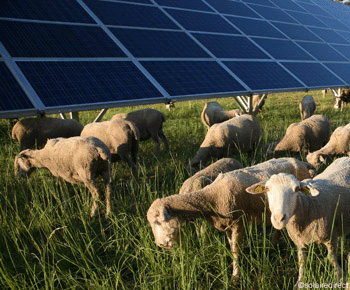
Solar farms are increasingly being built sufficiently high off the ground to allow sheep to graze beneath them, providing welcome shade. This practice, known as agrivoltaics, provides additional farm revenue, which is especially valuable during droughts. Rooftop solar occupies no land.
Myth: The longer lifetime of nuclear reactors hasn’t been taken into account
The levelised cost of energy method – used by CSIRO, AEMO, Lazard and others – is the standard way of comparing electricity generation technologies that perform similar functions.
It permits the comparison of coal, nuclear and firmed renewables. It takes account automatically of the different lifetimes of different technologies.
Myth: We need baseload power stations
The recent claim that nuclear energy is not very expensive “when we consider value” is just a variant of the old, discredited claim that we need baseload power stations, i.e. those that operate 24/7 at maximum power output for most of the time.
The renewable system, including storage, delivers the same reliability, and hence the same value, as the traditional system based on a mix of baseload and peak-load power stations.
When a nuclear power reactor breaks down, it can be useless for weeks or months. For a conventional large reactor rated at 1000 to 1600 megawatts, the impact of breakdown on electricity supply can be disastrous.
Big nuclear needs big back-up, which is expensive. Small modular reactors do not exist––not one is commercially available or likely to be in the foreseeable future.
Concluding remarks
We do not need expensive, dangerous nuclear power, or expensive, polluting fossil gas. A nuclear scenario would inevitably involve the irrational suppression of renewables.
The ban on nuclear power should be maintained because nuclear never competes in a so-called ‘free market’. Renewables – solar, wind and existing hydro – together with energy efficiency, can supply all Australia’s electricity.
Mark Diesendorf is Honorary Associate Professor at the Environment & Society Group in the School of Humanities & Languages and Faculty of Arts, Design & Architecture at UNSW. First published in Pearls and Irritations. Republished with permission of the author.
Why the Australian Opposition Party is not genuinely interested in nuclear power, (just in prolonging fossil fuels)

This is the truth at the heart of the Coalition’s latest climate fantasy: it gives people concerned about the speed and impact of the energy transition an alternative reality where this change doesn’t have to happen.
The Coalition’s nuclear fantasy serves short-term political objectives – and its fossil fuel backers
This is the truth at the heart of the Coalition’s latest climate fantasy: it gives people concerned about the speed and impact of the energy transition an alternative reality where this change doesn’t have to happen.
Dutton’s policy latches on to genuine concerns about power prices and disruption evident in the latest Guardian Essential report, but what are its real motivations?
Peter Lewis, 2 July 24 https://www.theguardian.com/australia-news/commentisfree/article/2024/jul/02/coalition-nuclear-policy-peter-dutton-power-plants
In 1959 the US government hatched a covert scheme to replace every single bird with a replicant surveillance drone to spy on its own citizens. This is only the second silliest theory flying around the internet right now.
Peter Dutton’s make-believe nuclear plan bears some of the hallmarks of Peter McIndoe’s actual piss-take, “Birds Aren’t Real”, which became so real he wound up doing interviews with Fox News and running large-scale community rallies where only some of the participants were chanting his nonsense slogan ironically.
There’s not too great a distance from ‘bird truthers’ to the Coalition’s latest permutation of fossil-fuelled climate skepticism.
In a world where information is driven by platform algorithms designed to maximise attention and reinforce existing prejudices, any theory can find a home; the crazier and louder the claims, the more likely they are to take off.
This is the truth at the heart of the Coalition’s latest climate fantasy: it gives people concerned about the speed and impact of the energy transition an alternative reality where this change doesn’t have to happen.
As this week’s Guardian Essential Report shows, support for renewable energy is contested. Lining up renewables, nuclear and fossil fuels, we found a lack of consensus on price, environmental impact and economic consequence.
While renewables are seen as the best energy source for the environment and most desirable overall, fossil fuels are seen as cheaper and better for jobs. It is here that the Coalition’s nuclear fantasy plays a critical bridging role.
The rollout of the renewable energy grid is a genuinely disruptive development; coal communities genuinely fear for their long-term economic future; consumers genuinely feel power prices rising as the rollout of renewables gathers momentum.
Coalition energy spokesperson Ted O’Brien is tasked with convincing those who have genuine concerns that if they just embrace nuclear, they can stop all these things they don’t like and still hit net zero by 2050.
Just like the bird conspiracy, this nuclear policy isn’t real: it has no scope, no production estimate, no costings, no timeline. But it’s a device that serves a flock of short-term political objectives.
It creates a reason to delay decommissioning coal and gas because, like magic, nuclear will provide a short cut. That’s good for the LNP’s fossil fuel backers and communities that rely on the production of these energy sources.
It offers hope to coal communities that they can become home to a new heavy industry. While critics of nuclear can make fun of the three-headed fish near the Springfield, the truth is Homer Simpson enjoyed the sort of secure job these communities fear will soon disappear.
And it sends a message to every regional community that they might not need to host the new renewable energy grid that is being rolled out. Because if you have a choice between looking out across a valley or looking out across power lines, who wouldn’t take the valley?
The problem for the Albanese government is that while each of these justifications is patently false, attacking them head-on risks a rerun of the voice referendum dynamic where “two sides” reporting creates a false equivalence that ends up defining the contest as a coin toss.
Exacerbating this challenge is the fact that fewer people trust the main proponents of the energy transition – the government and energy companies. Instead, trust is anchored at the level of the local.
The only people we really trust are those who we know personally – our friends and family and members of our community. Which raises the question, who do the people we trust get their information from? Perversely, the answer can only be “us”.
As McIndoe riffs in a hilarious piece of performance media: “Just because it’s a theory doesn’t mean its fake. It’s on the media, you can find it … Truth is subjective … There’s different proof out there for different things and if you do your research, you just might find it.”
Given this environment, the choice for Labor is whether to get dragged into a nuclear showdown where alternate facts will be wished into existence or simply dismiss the whole charade as the piece of political theatre it is.
A final question in this week’s report suggests the more effective way of confronting the nuclear “debate” is what disinformation experts call “pre-bunking” by calling out the opposition’s real motivations.
These findings show that half the electorate – and nearly two-thirds of young people – will reject the idea that this is a legitimate debate at all. Taking these people out of the equation before embarking on any merit analysis drastically reduces the number of votes in play.
Rather than trading economic models or platforming nuclear safety fears, the best approach might actually be the most honest one: to drag nuclear back into the political swamp from which it has risen.
First, expose the interests that will benefit from Dutton’s nuclear fantasy. Put the spotlight on the fossil fuel and nuclear players, who runs them, where they converge, who they pay to keep their dream alive and how much they stand to make by delaying the energy transition for a couple more decades.
Second, take away the oxygen for nuclear by doing the hard work required to build social licence for renewables, responding to legitimate concerns by giving communities a greater say in the way development occurs and how both costs and benefits are distributed.
Finally, turn the opposition to renewables back on to the LNP. While the political opportunism of the Dutton nuclear play is obvious, there are also risks that this decision comes to define not just him as a leader, but his entire political apparatus.
In a world where younger generations just want to get on with the job of addressing climate change, a major political party is walking away from this challenge in the interests of its corporate masters.
That’s the real conspiracy. And it’s not just a theory.
- Peter Lewis is the executive director of Essential and host of Per Capita’s Burning Platforms podcast
1 This Month

18 March Webinar @ 1 PM EST: An Assessment of SMR Projects: The Case of Canada
register for the zoom:
https://us02web.zoom.us/webinar/register/WN_o8BIIOUvQ2ONJR1nta65DQ#/registration

of the week – STOP SMALL MODULAR REACTORS IN CANADA
To see nuclear-related stories in greater depth and intensity – go to https://nuclearinformation.wordpress.com
-
Archives
- February 2026 (256)
- January 2026 (308)
- December 2025 (358)
- November 2025 (359)
- October 2025 (376)
- September 2025 (258)
- August 2025 (319)
- July 2025 (230)
- June 2025 (348)
- May 2025 (261)
- April 2025 (305)
- March 2025 (319)
-
Categories
- 1
- 1 NUCLEAR ISSUES
- business and costs
- climate change
- culture and arts
- ENERGY
- environment
- health
- history
- indigenous issues
- Legal
- marketing of nuclear
- media
- opposition to nuclear
- PERSONAL STORIES
- politics
- politics international
- Religion and ethics
- safety
- secrets,lies and civil liberties
- spinbuster
- technology
- Uranium
- wastes
- weapons and war
- Women
- 2 WORLD
- ACTION
- AFRICA
- Atrocities
- AUSTRALIA
- Christina's notes
- Christina's themes
- culture and arts
- Events
- Fuk 2022
- Fuk 2023
- Fukushima 2017
- Fukushima 2018
- fukushima 2019
- Fukushima 2020
- Fukushima 2021
- general
- global warming
- Humour (God we need it)
- Nuclear
- RARE EARTHS
- Reference
- resources – print
- Resources -audiovicual
- Weekly Newsletter
- World
- World Nuclear
- YouTube
-
RSS
Entries RSS
Comments RSS
 nuclear-news