MAGA Going to Israel for Propaganda Training

The Israeli government is paying to have 16 MAGA social media influencers, with millions of followers, brought to Israel to learn how to stop American youth from turning against Tel Aviv over Gaza, writes Joe Lauria.
By Joe Lauria, Consortium News, https://consortiumnews.com/2025/07/20/maga-going-to-israel-for-propaganda-training/
The Israel foreign ministry will spend $86,000 to finance a tour of Israel for 16 Americans to get them to use their vast online influence to craft more positive images of a nation openly engaged in genocide.
The effort is being made as Israel reacts to a significant turn in public opinion against it, especially by Western youth. Tel Aviv realizes its usual methods of propaganda — and apparently its own inhouse troll army — are no longer working as they once did.
The daily Haaretz reported:
“Foreign Ministry officials say the tour delivers significant media, advocacy, and diplomatic benefits – and represents a strategic shift, as traditional outreach is no longer sufficient to shape public opinion. They aim to leverage the massive followings of young social media influencers to bolster Israel’s standing in the U.S.”
The Americans, whose names have not been divulged, belong to the MAGA and America First movements, the newspaper said. They are all younger than 30 and each have hundreds of thousands or millions of followers, a vast, target-rich environment for propaganda. Israel intends to bring more than 500 “influencer delegations” to Israel this year, the ministry said.
It is paying an organization called Israel365 to organize the first American tour because it is in a “unique position to convey a pro-Israel stance that aligns entirely with the MAGA and America First agenda.”
Israel365’s website says the group “stands unapologetically for the Jewish people’s God-given right to the entire Land of Israel,” calls the two-state solution a “delusion,” and says it’s defending “Western civilization against threats from both Progressive Left extremism and global jihad.”
Israeli officials justified the no-bid contract with the organization because of its “experience and know-how in creating awareness, engagement, and mobilization of Christian audiences regarding their support for the Jewish people and the State of Israel,” Haaretz reported.
Ministry officials told the newspaper that “while older Republicans and American conservatives still hold pro-Israel views, positive perspectives towards Israel are falling across all younger age groups.”
News of the tour comes after the U.S. national teachers union voted to ditch the Zionist curriculum of the Ant-Defamation League, which was influencing young American minds.
Western youth, including conservatives, have become increasingly aware of the history of Israel’s expulsion of Palestinian people from their land and of Israel’s stated genocidal intent and actions in Gaza today. It is a wave of understanding Israel needs to contain.
A ministry source said: “We’re working with influencers, sometimes with delegations of influencers. Their networks have huge followings, and their messages are more effective than if they came directly from the ministry.”
Haaretz reported:
“The strategy appears to be paying off. During the 12-day conflict last month with Iran, Israeli digital messaging garnered roughly 1.8 billion online views, boosted in part by social media influencers with millions of followers. The Foreign Ministry has set a goal of bringing 550 influencer delegations to Israel by the end of 2025 to continue this outreach.”
The Foreign Ministry chose Israel365 because “with the rise of the America First movement and MAGA in American politics, it’s essential for Israel that the movement adopt a pro-Israel position.” A Foreign Ministry document said Israel365 “has the ability to smoothly link the spiritual/biblical and geopolitical aspects of support for Israel.”
Joe Lauria is editor-in-chief of Consortium News and a former U.N. correspondent for The Wall Street Journal, Boston Globe, and other newspapers, including The Montreal Gazette, the London Daily Mail and The Star of Johannesburg. He was an investigative reporter for the Sunday Times of London, a financial reporter for Bloomberg News and began his professional work as a 19-year old stringer for The New York Times. He is the author of two books, A Political Odyssey, with Sen. Mike Gravel, foreword by Daniel Ellsberg; and How I Lost By Hillary Clinton, foreword by Julian Assange.
The Militarization and Weaponization of Media Literacy-NATO Invades the Classroom

July 10, 2025, Nolan Higdon and Sydney Sullivan, https://www.projectcensored.org/military-weaponization-media-literacy/
This Dispatch is informed by our forthcoming 2025 article, “Media Literacy in the Crosshairs: NATO’s Strategic Goals and the Revival of Protectionist Pedagogy,” from the Journal of Media Literacy Education, Volume 17, Issue 2.
During President Donald Trump’s second term, education has remained a central battleground in American politics. Republicans claim that classrooms have become hotbeds of “woke” indoctrination, accusing educators of promoting progressive agendas and tolerating antisemitism. In contrast, Democrats argue that conservatives are systematically defunding and dismantling public and higher education precisely because it teaches values like diversity, equity, and inclusion. While these partisan skirmishes dominate headlines, they obscure a much deeper and more enduring issue that encompasses all of these issues and more: the influence of corporate and military power on public education.
For decades, scholars have warned that corporations have steadily infiltrated the classroom—not to promote critical thinking or democratic values, but to cultivate ideologies that reinforce capitalism, nationalism, and militarism. Critical media literacy educators, in particular, have called attention to the convergence of tech firms and military entities in education, offering so-called “free” digital tools that double as Trojan horses for data collection and ideological control.
One striking example is the rise of programs like NewsGuard, which uses public fears over fake news to justify increased surveillance of students’ online activity. Relatedly, in 2018, the Atlantic Council partnered with Meta to perform “fact-checking” on platforms such as Facebook. In 2022, the US Marine Corps discussed developing media literacy trainings. It remains to be seen what training, if any, they will develop. However, what is known is that a large global player has entered the media literacy arena: the North Atlantic Treaty Organization (NATO). While NATO presents its initiatives as supportive of media literacy and democratic education, these efforts appear to be oriented more toward reinforcing alignment with its strategic and political priorities than to fostering critical civic engagement.
NATO was created in 1949, during the Cold War, as a military alliance to contain communism. Although the war officially ended in 1991, NATO has expanded both its mission and membership. Today, it encompasses more than thirty member nations and continues to frame itself as a global force for peace, democracy, and security. But this self-image masks real conflicts of interest.
NATO is deeply intertwined with powerful nation-states and corporate actors. It routinely partners with defense contractors, tech firms, think tanks, and Western governments—all of which have a vested interest in maintaining specific political and economic systems. These relationships raise concerns when NATO extends its reach into education. Can a military alliance—closely linked to the defense industry and state propaganda—credibly serve as a neutral force in media education?
In 2022, NATO associates collaborated with the US-based Center for Media Literacy (CML) to launch a media literacy initiative framed as a strategic defense against misinformation. The initiative included a report titled Building Resiliency: Media Literacy as a Strategic Defense Strategy for the Transatlantic, authored by CML’s Tessa Jolls. It was accompanied by a series of webinars featuring military personnel, policy experts, and academics.
On the surface, the initiative appeared to promote digital literacy and civic engagement. But a closer look reveals a clear ideological agenda. Funded and organized by NATO, the initiative positioned media literacy not as a means of empowering students to think critically about how power shapes media, but as a defense strategy to protect NATO member states from so-called “hostile actors.” The curriculum emphasized surveillance, resilience, and behavior modification over reflection, analysis, and democratic dialogue.
Throughout their webinars, NATO representatives described the media environment as a battlefield, frequently using other war metaphors such as “hostile information activities” and “cognitive warfare.” Panelists argued that citizens in NATO countries were targets of foreign disinformation campaigns—and that media literacy could serve as a tool to inoculate them against ideological threats.
A critical review of NATO’s media literacy initiative reveals several troubling themes. First, it frames media literacy as a protectionist project rather than an educational one. Students are portrayed less as thinkers to be empowered and more as civilians to be monitored, molded, and managed. In this model, education becomes a form of top-down, preemptive defense, relying on expert guidance and military oversight rather than democratic participation.
Second, the initiative advances a distinctly neoliberal worldview. It emphasizes individual responsibility over structural analysis. In other words, misinformation is treated as a user error, rather than the result of flawed systems, corporate algorithms, or media consolidation. This framing conveniently absolves powerful actors, including NATO and Big Tech, , of their role in producing or amplifying disinformation.
Third, the initiative promotes a contradictory definition of empowerment. While the report and webinars often use the language of “citizen empowerment,” they ultimately advocate for surveillance, censorship, and ideological conformity. Panelists call for NATO to “dominate” the information space, and some even propose systems to monitor students’ attitudes and online behaviors. Rather than encouraging students to question power—including NATO itself—this approach rewards obedience and penalizes dissent.
Finally, the initiative erases the influence of corporate power. Although it criticizes authoritarian regimes and “hostile actors,” it fails to examine the role that Western corporations, particularly tech companies, play in shaping media environments. This oversight is especially problematic given that many of these corporations are NATO’s partners. By ignoring the political economy of media, the initiative offers an incomplete and ideologically skewed version of media literacy.
NATO’s foray into media literacy education represents a new frontier in militarized pedagogy. While claiming to promote democracy and resilience, its initiative advances a narrow, protectionist, and neoliberal approach that prioritizes NATO’s geopolitical goals over student empowerment.
This should raise red flags for educators, policymakers, and advocates. Media literacy is not a neutral practice. The organizations that design and fund media literacy programs inevitably shape those programs’ goals and methods. When a military alliance like NATO promotes media education, it brings with it a strategic interest in ideological control.
Educators must ask: What kind of media literacy are we teaching—and whose interests does it serve? If the goal is to produce informed, critically thinking citizens capable of questioning power in all its forms, then NATO’s approach falls short. Instead of inviting students to explore complex media systems, it simplifies them into a binary struggle between “us” and “them,” encouraging loyalty over literacy.
True media literacy must begin with transparency about who and what is behind the curriculum. It must empower students to question all forms of influence—governmental, corporate, and military alike. And it must resist the creeping presence of militarism in our classrooms. As educators, we must defend the right to question, not just the messages we see, but the institutions that shape them.
Nolan Higdon is a political analyst, author, host of The Disinfo Detox Podcast, lecturer at Merrill College and the Education Department at the University of California, Santa Cruz, and Project Censored Judge. Higdon’s popular Substack includes the bi-weekly Gaslight Gazette, which chronicles important and well-researched examples of disinformation, character assassination, and censorship in the United States.
Sydney Sullivan is an educator, author, and researcher specializing in critical media literacy, student well-being, and digital culture. She is a lecturer in the Rhetoric and Writing Studies department at San Diego State University and a co-host of Disinfo Detox. Her popular Substack series @sydneysullivanphd explores how digital habits shape student mental health, media literacy, and classroom culture.
Local website reveals city’s secret nuclear weapons programme

by Paul Linford , 18 Jul 2025, https://www.holdthefrontpage.co.uk/2025/news/local-website-reveals-citys-secret-nuclear-weapons-programme/
A city news website has revealed a university’s role in a programme to develop a new nuclear warhead.
The Sheffield Tribune, part of Mill Media, found evidence of a secure cell established at the Advanced Manufacturing Research Centre – part of the University of Sheffield.
The unit was set up by the Atomic Weapons Establishment (AWE) – an MoD body responsible for developing nuclear weapons — with the purpose of helping develop a new warhead for the UK’s nuclear arsenal, known as Astraea.
Data journalist Daniel Timms pieced together the story from documents already in the public domain, including a set of minutes from a meeting of parish councillors in Berkshire.
Danie spent four months working on the story and has written a first-person piece about how he uncovered the scoop.
Local website reveals city’s secret nuclear weapons programme
by Paul Linford Published 18 Jul 2025

A city news website has revealed a university’s role in a programme to develop a new nuclear warhead.
The Sheffield Tribune, part of Mill Media, found evidence of a secure cell established at the Advanced Manufacturing Research Centre – part of the University of Sheffield.
The unit was set up by the Atomic Weapons Establishment (AWE) – an MoD body responsible for developing nuclear weapons — with the purpose of helping develop a new warhead for the UK’s nuclear arsenal, known as Astraea.
Data journalist Daniel Timms pieced together the story from documents already in the public domain, including a set of minutes from a meeting of parish councillors in Berkshire.
Daniel, pictured, spent four months working on the story and has written a first-person piece about how he uncovered the scoop.
The key breakthrough came when he read a set of minutes from a meeting of Berkshire parish councillors around the AWE’s Aldermaston HQ in November 2023 which was addressed by an AWE director, Andrew McNaughton.
Wrote Daniel: “Unsurprisingly, AWE publishes very little. But they do have occasional meetings with local parish councillors around their Berkshire site. And in the published minutes, I finally find what I’d been searching for.
“It was the 108th meeting of the committee, in November 2023. Andrew McNaughton, the executive director for infrastructure on the fissile programme, explained that AWE had not had to design new warheads for decades, and taking this on will require new buildings and facilities.
“But in the meantime, they were doing some work elsewhere. And this was where the key admission was made.
“‘We already have a secure cell in Sheffield (part of Sheffield University) where we have some of the equipment we have been using… where we are going to be trialling the processes and training some of our employees,” McNaughton said.”
The Tribune gave both the Ministry of Defence and the university the opportunity to dispute its reporting, but they did not.
Added Daniel: “I’ve been working on this story for four months. I have no previous experience with the defence sector, and I assumed it would be an interesting diversion that would ultimately lead nowhere.
“Instead, largely by relying on freely available documents, I’ve been able to reveal where a significant aspect of the UK’s nuclear weapons programme is taking place — in a building with apparently minimal security just outside Sheffield.
“It’s possible that others with more of a headstart — and with less benign motives — have been able to do the same. But, given the lack of pushback (we haven’t been asked not to publish) perhaps the parties involved aren’t too concerned.”
A spokesperson for the university told The Tribune: “Our work at the AMRC involves developing and testing new technologies and processes for manufacturing companies and does not involve production of components for deployment.
Local website reveals city’s secret nuclear weapons programme
by Paul Linford Published 18 Jul 2025
A city news website has revealed a university’s role in a programme to develop a new nuclear warhead.
The Sheffield Tribune, part of Mill Media, found evidence of a secure cell established at the Advanced Manufacturing Research Centre – part of the University of Sheffield.
The unit was set up by the Atomic Weapons Establishment (AWE) – an MoD body responsible for developing nuclear weapons — with the purpose of helping develop a new warhead for the UK’s nuclear arsenal, known as Astraea.
Data journalist Daniel Timms pieced together the story from documents already in the public domain, including a set of minutes from a meeting of parish councillors in Berkshire.
Daniel, pictured, spent four months working on the story and has written a first-person piece about how he uncovered the scoop.
The key breakthrough came when he read a set of minutes from a meeting of Berkshire parish councillors around the AWE’s Aldermaston HQ in November 2023 which was addressed by an AWE director, Andrew McNaughton.
Wrote Daniel: “Unsurprisingly, AWE publishes very little. But they do have occasional meetings with local parish councillors around their Berkshire site. And in the published minutes, I finally find what I’d been searching for.
“It was the 108th meeting of the committee, in November 2023. Andrew McNaughton, the executive director for infrastructure on the fissile programme, explained that AWE had not had to design new warheads for decades, and taking this on will require new buildings and facilities.
“But in the meantime, they were doing some work elsewhere. And this was where the key admission was made.
“‘We already have a secure cell in Sheffield (part of Sheffield University) where we have some of the equipment we have been using… where we are going to be trialling the processes and training some of our employees,” McNaughton said.”
The Tribune gave both the Ministry of Defence and the university the opportunity to dispute its reporting, but they did not.
Added Daniel: “I’ve been working on this story for four months. I have no previous experience with the defence sector, and I assumed it would be an interesting diversion that would ultimately lead nowhere.
“Instead, largely by relying on freely available documents, I’ve been able to reveal where a significant aspect of the UK’s nuclear weapons programme is taking place — in a building with apparently minimal security just outside Sheffield.
“It’s possible that others with more of a headstart — and with less benign motives — have been able to do the same. But, given the lack of pushback (we haven’t been asked not to publish) perhaps the parties involved aren’t too concerned.”
A spokesperson for the university told The Tribune: “Our work at the AMRC involves developing and testing new technologies and processes for manufacturing companies and does not involve production of components for deployment.
“Our collaboration with partners in the defence sector helps them to overcome sustainability and productivity challenges, and support UK security and sovereign capabilities.”
Joshi Hermann, proprietor of Mill Media commented: “This is a fantastic story from Daniel Timms, revealing the existence of a secret nuclear weapons programme in Sheffield.
“If he can work this out from sources and the minutes of a parish council meeting in Berkshire, then the Russians/Chinese can too.”
The first US atomic rush was a bust. Will Trump’s big nuclear-for-AI plans fare any better?

Bulletin, By Chloe Shrager | July 18, 2025
As Big Tech turns to nuclear power to solve the artificial intelligence power problem, critics have cast doubt on energy developers’ ability to build new reactors on a timeline that will satisfy data centers’ energy needs.
High costs and lack of commercial economic viability have been persistent obstacles to new nuclear infrastructure development. But on May 23, President Donald Trump signed four executive orders that represent the most explicit government commitment to nuclear power for artificial intelligence yet.
Three of the orders explicitly mention AI as a driver for nuclear energy development and a potential beneficiary. One directive incentivizes the operation of privately funded advanced nuclear reactor technologies on federal sites—mainly national laboratories or military installations—allegedly to power AI infrastructure, labelled as “critical defense facilities,” and mandates the deployment of small modular nuclear reactors on one of these sites within 30 months.
Previously, tech companies were the most vocal advocates pushing for nuclear power to meet AI’s energy demands. Now the US government—heavily influenced by Big Tech’s hand—has made nuclear power for AI a national security priority, setting a goal of quadrupling the United States’ nuclear capacity from 100 gigawatts to 400 gigawatts by 2050. Whether government intervention can overcome the challenges that have plagued nuclear deployment for decades remains to be seen—and if so, at what cost?
Déjà vu. As with the rise of the nuclear power industry in the 1950s and 60s, the demand for nuclear energy is being created, justified, and incentivized by the government and its national security interests rather than by market forces.
Robert Duffy, a professor of political science at Colorado State University, summarized the history of the US nuclear power industry in a 2004 paper.
“The atomic energy subgovernment was endowed with additional prestige and power because of the program’s identification with national security issues,” Duffy wrote. “The actors in this tightly knit monopoly were united by the conviction that the development of atomic energy, first as a weapon but later as a means of generating electricity, was both necessary and desirable for the nation’s welfare.”
Duffy showed that the government’s rush to create a nuclear industry in the United States ultimately undermined that very industry. The hasty development, government incentives, and ambitious timelines led to cost overruns, safety problems, and public opposition that ultimately killed new nuclear construction for decades.
Today, the Trump administration is repeating history by declaring AI technologies driven by advanced nuclear power generators a key national security interest.
“There seems to be an aspect to the government’s interest in AI which is sort of positing that as the next nuclear weapons race,” Tim Judson, executive director of the Nuclear Information and Resource Service, observes. “If you expect the most powerful countries in the history of the world, and the wealthiest corporations that have ever existed, which are trying to develop […] ‘digital gods,’ to not do everything they can to win that race, then you don’t understand human nature, and you don’t understand geopolitics.”
But by trying to rush nuclear power development again for geopolitical reasons (then the Cold War, now the global AI race), the US government risks creating another failed—or at least costly and insufficiently safe—nuclear program…………………………………………
………………………………………………………………………………………………………..Sticky problems. Even without the economic hurdles, the fundamental problem remains timing, and presidential orders cannot change the laws of physics. As Mycle Schneider, an independent nuclear policy analyst and main contributor to the World Nuclear Industry Status Report, bluntly states: “I doubt that any SMR would be operating 10 years from now in the Western world.”
Schneider’s skepticism isn’t unfounded. Construction times for nuclear plants average around 10 years, he said, and that’s just the construction phase—which only begins with the pouring of reactor foundations. Even with the Trump administration’s regulatory streamlining and federal site access, the reality of nuclear development timelines clashes directly with AI’s immediate energy needs. “All of these deals with nuclear companies are about future power plants maybe coming online in the 2030s, but all the AI data centers are being built today,” Judson observes.
Small modular reactors have long been promoted by the industry—and now also the government—as a solution to nuclear power’s problems, promising faster construction, lower costs, and standardized designs. The Trump administration’s nuclear orders specifically enable SMR testing and deployment on federal sites, betting that government support can make SMR promises a reality.
But the reality has proven far more complex, even with unprecedented government backing. Canada’s recent approval of the world’s first SMR in a G7 country demonstrates both the promise and the problems. The project’s price tag sits at nearly $21 billion Canadian dollars ($15.1 billion US dollars) for four reactors at Ontario’s Darlington site, roughly $12.5 million US dollars per megawatt—far exceeding the costs of renewable alternatives that can be deployed in a fraction of the time. Even more so, Judson says the energy company GE Vernova-Hitachi chose to pursue its SMR project in Canada because the Canadian Nuclear Safety Commission regulations allow construction permit applications to be submitted with much of the design still incomplete. “The jury is very much still out on whether the BWRX-300 [SMR design] will prove feasible to build on time and on budget, but what we know so far is not encouraging,” Judson said.

The long-term management of nuclear waste also poses a sticky issue to new nuclear development, especially the relatively higher waste per gigawatt from SMRs compared to full-scale reactors, which has no permanent solution yet……………………………………………………………. https://thebulletin.org/2025/07/the-first-us-atomic-rush-was-a-bust-will-trumps-big-nuclear-for-ai-plans-fare-any-better/
Trump’s Weapons Magic Show is Smoke & Mirrors Masterclass

Simplicius, Jul 15, 2025
Trump finally ‘wowed’ the world today with his grand announcement on punitive measures against Russia.
As usual, the announcement struck a dull and lackluster chord for most, with Russian markets jubilantly jumping by nearly 3% in response. But let’s dig in to see whether there is actually more meat on the bone of Trump’s scary threats than people give credit for.
Firstly, the timing: Axios now reports that Putin allegedly told Trump he plans to ‘intensify’ the Russian summer offensive in the next 60 days, with the goal—according to some sources—purportedly being to capture the remainder of nominal Russian territory, i.e. Donetsk, Lugansk, and Zaporozhye oblasts
Axios: According to Trump, Putin allegedly told him about plans to intensify the offensive in Ukraine in the next 60 days.
Trump shared details of the conversation with the Russian leader with his French counterpart Macron, adding: “He wants to take everything.”
It was after this conversation, according to the publication, that Trump criticized Putin and promised to increase arms supplies to Ukraine.
If there’s any hint of truth to such reports, then Trump’s “50-day notice” would seem to line up with Putin’s timeline, given that the conversation happened days ago, and thus Putin’s “60-day plan” would fall almost precisely on Trump’s deadline.
The basic interpretation of that could be that Trump is giving Russia two months to capture whatever territory it claims belongs to it, then “the hammer” will come down.
Now on the weapons side, as always, is where the biggest cloud of ambiguity lies. No one seems to know precisely what weapons and from what package will be sent, but according to CNN, it all sounds like more of the same, but just ‘repackaged’ with a new price tag.
Reports indicate the same air-to-air missiles, howitzer and GMLRS rounds will be sent as before, but simply that now NATO countries will foot the bill. Prior to that, under Biden’s PDA, the US was sending weapons directly to Ukraine from its own stockpiles, and then replenishing those stockpiles with new orders to the MIC, from taxpayer funds. Now, it will come from European taxpayer funds—a win for the US, we must admit.
But the biggest focal point were the Patriot ‘systems’. Again, the cloud of confusion—no one quite knows what the numbers represent: Patriot launchers, batteries, battalions, etc. Trump once mentioned the word ‘batteries’, but the numbers being discussed do not appear to realistically jibe. For instance, he mentioned sending “17” to Ukraine, but the US itself only has something like a total 50-70 active batteries, and obviously sending a third of its entire Patriot stock is unlikely.
When you really read between the lines, what Trump appeared to intimate was that the eventual goal is to scrounge up a larger amount of ‘systems’ for Ukraine, but “initially” only a tiny fraction will be sent. This is one of the few commenters who grasped the nuances of the mealy-mouthed ‘announcement’:
Recall that Rubio just recently implied the US has no more Patriots to give, a video I posted several updates ago. He called on Europe to give their Patriots instead, but quelle surprise, in a new FT article German Defense Minister Pistorius admitted that Germany will not be sending any Patriots nor Taurus missiles:
You can see in the above [on original], he goes on to say that Germany could purchase two systems from the US for Ukraine, instead. This is a kind of puerile shell game which is really meant to bolster the PR narrative that Ukraine is being ‘supported’ in order to keep hopes alive, so that the AFU doesn’t collapse from demoralization.
German Defense Minister Pistorius to Reuters:
Decision on two Patriots for Ukraine will be taken within days or weeks, but actual delivery of first system will take months.
In short: it’s a lot of hoopla to kick the can down the road again, repackaging the same policy with new fanfare.
The sanctions threat was likewise fraught with double-meaning. Trump called them ‘tariffs on Russia’, but in reality they are merely tariffs on US’ own allies:
Russia exports virtually nothing to the US which can be ‘tariffed’. The threat here is meaningless as these other heavyweights will not put up with Trump’s threat, forcing him to back away at the last moment as usual, then claiming “victory” after securing some other secondary fig leaf ‘deal’.
In conclusion: the entire charade appears to be a sneaky but brilliant act of jugglery by Trump, wherein he once again gives the appearance of major ‘action’ against Russia to silence critics and placate neocons, while in actuality doing little to further Ukraine’s war efforts, apart from plugging the previous status quo back onto life support. The act is meant to play both sides, relieving pressure on himself, while not overly risking his relationship with Putin in the hopes he can still clinch his big Nobel-earning armistice.
Notably, top-shelf items like JASSM missiles were all absent from the discussion, contrary to high-octane predictions from the peanut gallery the day before. Likewise, in the earlier-mentioned FT article, Pistorius once again categorically rejected—for the umpteenth time—the sending of Taurus missiles to Ukraine:
So, what are we left with? Essentially, the resumption of Biden’s PDA status quo with an ambiguous new promise of “a few” Patriot launchers, which is more a preliminary call to look for some potential stock among allies.
When asked what would happen after the 50 day mark if Putin refuses to back down, Trump told a reporter: “Don’t ask me that question.”
The bigger debate is whether Trump has now officially taken ownership of the war, despite his feeble attempts to impute his continued failings to Biden; many think so. But I still suspect Trump is trying his hardest to playact the stern and impatient taskmaster to signal ‘toughness’ against Putin for his deep state audience, all while actually trying to mitigate damage to US-Russian relations.
For instance, ‘senior officials’ told FT just two days ago that Trump still views Zelensky as the primary obstacle to peace:
That would likely make his ‘anger’ at Putin a put-on.
—
Intermezzo:
Ex-Russian prime minister Sergei Stepashin has a stark message for Germany, amidst all the militarization threats:
Moscow ‘knows location’ of German missile plants as Merz plans to hand Zelensky the bombs to hit ‘center of Russia’ — ex-PM Stepashin
Given that all the Trump-Ukraine weapons antics are merely an attempt to front-run and offlet some steam from the Russian summer offensives, let us now turn to frontline news:
Starting in western Zaporozhye Russian forces took over the remainder of Kamyanske:……………………………………………………………………………………….. https://simplicius76.substack.com/p/trumps-weapons-magic-show-is-smoke?utm_source=post-email-title&publication_id=1351274&post_id=168312161&utm_campaign=email-post-title&isFreemail=false&r=c9zhh&triedRedirect=true&utm_medium=email
The next four phases of Ukraine’s collapse.

Now, a major collapse of Ukraine’s defense fronts along the entire or nearly entire battle line—which stretches from Kherson just north of Crimea in the east, then north through Donetsk to Kharkiv and Sumy—is imminent
by Gordonhahn, July 14, 2025, https://gordonhahn.com/2025/07/14/les-quatre-prochaines-phases-deffondrements-de-lukraine/
*Translated by Wayan, proofread by Hervé, for Saker Francophone .
I wrote some time ago : “ With the collapse of the front and the army on the verge of dissolving, Zelenskiy’s post-Maidan regime is deeply divided and in danger of dissolution, which could lead to state collapse, internecine warfare, and widespread chaos .” Below, I detail these four imminent or potential collapses—collapses of the battlefront, the Ukrainian army, the Maidan regime, and the Ukrainian state itself—because this issue is of crucial importance to the question of war or peace in Ukraine and to the challenges that will be faced in any reconstruction.
A dysfunctional Ukrainian army, regime, and state will prevent Kyiv from concluding any peace process and treaty that U.S. President Donald Trump or others might develop. In fact, the peace effort Trump is beginning to enlist Russian President Vladimir Putin in will almost certainly be thwarted by a cascade of two or more of the four major dysfunctions, collapses, and crises that appear to await Ukraine unless the war ends or a radical shift occurs in the correlation of Russian and NATO-Ukrainian forces. The first two of these collapses, of the front and the army, will almost certainly occur this year. The last two—of the Maidan regime and the Ukrainian state—may be postponed until next year.
The collapse of the military front in Ukraine
Ukraine’s defensive fronts have slowly weakened and increasingly collapsed over the past year. Throughout last year, Russian territorial gains and, for most of this year, Ukrainian losses increased monthly, just as I predicted more than a year ago. The infamous Institute for the Study of War , a Washington-based organization that relies on Ukrainian propaganda and turns itself into “ data ,” falsely claimed : “ Russian forces gained 4,168 square kilometers (1,609 square miles, GH), largely consisting of fields and small settlements in Ukraine and Kursk Oblast, at a reported cost of more than 420,000 casualties in 2024. Ukrainian Commander-in-Chief Col. Gen. Oleksandr Syrskyi said on December 30 that Russian forces suffered 427,000 casualties in 2024. ISW observed geotagged evidence to estimate that Russian forces advanced 4,168 square kilometers in 2024, indicating that Russian forces suffered approximately 102 casualties per square kilometer of Ukrainian territory seized .”
The propaganda element here lies primarily in the claim that Russia’s territorial gains were ” largely fields and small settlements ” and in the figures for Russian losses. The Russians seized ” largely fields and small settlements ” because the landscape of Ukraine, like that of any country, is largely made up of arable land and small villages.
However, Russia did capture several small towns and the main Ukrainian strongholds of Avdiivka, Vuhledar, Kurakhove, Selydove, Novosilevke, Toretsk, and almost all of Chasov Yar. The Russians may not have suffered 420,000 casualties over the course of the entire war, let alone in 2024. For 2024, the Mediazona institute—which, in affiliation with the BBC and the Russian opposition outlet Meduza , scours internet sources, social media, obituaries, and regional government announcements—counted 120,000 Russians killed in action between the start of the country’s ” special military operation ” in February 2022 and the end of 2024. It found that at least 31,481 Russian soldiers died between January 1, 2024, and December 17, 2024. Even if we increase this figure by 50%, taking into account the typical 1:3 ratio of killed to wounded, we still arrive at a figure of only about 180,000 Russian casualties in 2024, half of the reported Ukrainians/ ISW .
What is going on here? The acceleration of what I have called Russia’s ” attrition and advance ” strategy has been downplayed by ISW by accompanying it with data on territorial gains from the Ukrainian Defense Minister and other Ukrainian military sources on Russian losses in order to give the impression of massive Russian losses disproportionate to the ” modest ” territorial gains. This is done to support the Western myth that Russia is throwing away the lives of its soldiers in ” human wave ” attacks.
ISW carefully avoids the prospect of negative comparison by omitting any mention of Ukrainian casualties, mimicking the Ukrainian Defense Ministry and US-funded ” Ukrainian ” news outlets such as Ukrainskaya Pravda .
The raw data show that Russian territorial gains have indeed increased throughout the year on a nearly monthly basis, with the possible exception of December, which saw a decline compared to November. As Western media outlets finally began to expose the fallacy of the “ Ukraine is winning ” propaganda line in the fall of last year, the New York Times referenced data from a military expert with the Finland-based Black Bird group, Pasi Paroinen.
It turned out that Russian gains were being made all along the front line, from the north at Kharkiv to the south at Zaporozhye. Paroinen’s measurement of Russia’s overall gains in the first ten months of 2024 confirmed my own expectation of an intensified Russian advance. Russian advances during this period amounted to over 1,800 square kilometers and were made at an increasingly accelerated pace:
“ Half of Russia’s territorial gains in Ukraine so far this year have been made in the last three months alone. In August, Ukraine’s defensive lines buckled and Russia quickly advanced 16 km. In October, Russia made its most significant territorial gains since the summer of 2022, as Ukrainian lines buckled under sustained pressure. October’s gains amounted to over 257 square km of land in Ukraine’s eastern Donbas region alone .” Russian forces advanced 2,356 square kilometers in September, October, and November 2024, making 56.5% of their 2024 territorial gains during this period . November proved to be the most successful month for Russian forces in terms of territorial gains in 2024, “ advancing at the significantly higher rate of 27.96 square kilometers per day ” during that month.
ISW was careful not to compare Russia’s territorial gains in 2024 with those made in 2023, so as not to highlight the crucially important trend of accelerating Russian advances and Ukrainian retreats, but France 24 television picked up the slack . It noted that the Russian military had advanced in 2024 “ seven times more than in 2023 ,” taking “ 610 square kilometers in October and 725 square kilometers in November. These two months saw the Russians capture the most territory since March 2022, in the opening weeks of the conflict. Russia’s advance slowed in December, reaching 465 square kilometers in the first 30 days of the month. But it is already nearly four times greater than in the same month last year and two and a half times more than in December 2022. ”
Now, a major collapse of Ukraine’s defense fronts along the entire or nearly entire battle line—which stretches from Kherson just north of Crimea in the east, then north through Donetsk to Kharkiv and Sumy—is imminent. Some fronts may hold out longer, but they are unlikely to survive 2025. Russian forces are beginning to encircle the crucial industrial, mining, and transport center of Pokrovsk. After its fall, perhaps in two months, Moscow’s army will have a relatively unimpeded march toward Dnipro, Zaporozhye, and other points less south of the Dnieper. After that, the territorial advance will continue to accelerate at an ever-increasing pace and could lead to major breakthroughs across the Dnieper at any moment now, given the already dire and deteriorating state of Ukraine’s armed forces.
The collapse of the Ukrainian army
To read further: https://lesakerfrancophone.fr/les- quatre-prochaines-phases-dplombs-de-lukraine
Hoping for nuclear to boost the economy -will not end well.

Samuel Rafanell-Williams, Scottish CND:
MANY readers will be conscious of
the emerging PR operation to promote nuclear power and admonish the
Scottish Government over its long-standing opposition to new nuclear
projects in Scotland.
This comes at a time when The Ferret reported 585
cracks in the reactor of the Torness nuclear plant in East Lothian,
prompting fears about radioactive risks (Hunterston B power station was
closed in 2022 following the discovery of 586 reactor cracks).
The industrial messes of the Hinkley and Sizewell nuclear projects in England,
both running billions over budget, also don’t sweeten the case for
starting similar projects in Scotland.
Transparently, this media drive is
an attempt to manufacture consent for new potential nuclear plants in
Scotland in the wake of the UK Government’s recent proud announcement of
“Nuclear Britain”.
These PR efforts in Scotland are being led by
lobbyists like Britain Remade, a group composed of former Tory party
officials firmly committed to lifting Scotland’s ban on nuclear power, as
recently reported by Bella Caledonia.
Make no mistake, the UK
Government’s promotion of nuclear power is integral to its vision of a
war economy: massive investment, including exorbitant public expenditure,
into so-called “civilian” nuclear power (£40 billion-plus for Hinkley,
£40bn-plus for Sizewell) is a precondition for shoring up the nuclear
weapons industry. As Scottish CND have frequently argued, much of the same
technical expertise, personnel and fissile materials are required in both
fission and the production of warheads and propulsion reactors for naval
vessels. All nuclear states know building their omnicide weapons relies on
a nuclear power programme.
The National 11th July 2025, https://www.thenational.scot/politics/25305651.hoping-nuclear-boost-economy-will-not-end-well/
Energy Scotland’s John Proctor responds to The Herald’s pro-nuclear spread.
Nuclear power in Scotland – not needed, not economic, not wanted, not safe

Leah Gunn Barrett, Jul 07, 2025, https://dearscotland.substack.com/p/energy-scotlands-john-proctor-responds
Energy Scotland* convener John Proctor has given me permission to publish a letter he sent to The Herald in response to its series of pro-nuclear articles published at the end of June. The Herald is owned by London-based Newsquest which, in turn, is owned by US media conglomerate, Gannett. The Herald has not published his letter.
I see Joani Reid MP has joined Anas Sarwar MSP and Michael Shanks MP in the chorus calling for new nuclear energy plant in Scotland (The Herald 28th June).
Of course, Joani has no concerns about someone building one of these in her back-yard – as her back-yard is in London, but Michael Shanks was bit more bullish when he declared he would be relaxed about having a Small Modularised Reactor (SMR) erected in his constituency. I am not sure how the good people of Rutherglen feel about this.
What I find mystifying is the lack of proper scrutiny being applied to the claims made by those members of the Nuclear Energy All-Party Parliamentary Group and their well-funded nuclear lobbyists. It does not surprise me that they are unable to set out what configuration they favour, as the reactors which they claim will produce 400 MWs do not exist. They have not been manufactured, tested or installed – anywhere!
As an Engineer, I would be keen to ask the politicians if they have thought about some of the basic elements of a power plant. Do they have any ideas what the thermal capacity of the proposed reactors are? Have they understood what the cooling requirements might be? How about the status of design of the ‘core catcher’ (the system designed to prevent a Chernobyl type event)?
Be under no illusion, Ms Reid, Mr Shanks and Mr Sarwar and the Nuclear lobby are building a Potemkin village.
They of course don’t want to talk about the European Power Reactor (EPR) configuration being installed at astronomical cost at Hinkley C.
This project is forecast to cost £45,000,000,000 when it finally comes on line sometime next decade. It is not easy to get a proper sense of this sum – but it might surprise the readers of The Herald that this is the equivalent of paying £1 million every single day for 110 years – and this is just the construction cost. We have not even started talking about operational costs, asset management and asset decommissioning.
Hinkley C is the same configuration Labour have just committed to at Sizewell C. Are we really gullible enough to believe Julia Pyke (Managing Director of Sizewell C) when she assures us that the Consortium have learned the lessons from Hinkley C?
If I can be generous for a moment, and accept that they can achieve a 10% saving relative to Hinkley C, that would still indicate a £40 billion project cost – which is enough to build 80 hospitals similar to the Forth Valley Hospital.
When Ms Pyke was recently asked on BBC how the project was going, she answered airily that it is ‘on schedule and within budget’. I waited eagerly for the obvious follow up question – ‘What is the budget and schedule?’ but that question never came.
The supporters of nuclear energy tell us that we need these plants for baseload capacity. They fail to acknowledge that in Scotland, we already generate more capacity from renewables than we consume – and this surplus is only going to grow as we continue to see more investment in wind, solar, tidal and energy storage.
‘What about intermittency and lack of system inertia?’ is the nuclear advocates’ stock question when discussing the growth of renewables.
The answer is beautifully simple – we will continue to do what we do now – rely on gas fired CCGTs (Combined-Cycle Gas Turbines). Which is reassuring – as there will be no nuclear plant coming on stream anytime soon.
‘But what about Net Zero?’ might be the next question. Thankfully, there are a raft of solutions to this currently available and more coming on stream every week. For example, gas turbine manufacturers are again building on 50 years of experience of burning hydrogen in gas turbines, and they will be ready to burn hydrogen or blended hydrogen/methane as quickly as the hydrogen market can come on stream.
My prediction is that the hydrogen market will come on stream faster than any SMRs (Small Modular Reactors) can be built – and if UK politicians had a strategic bone in their body, they would be trying to beat our friends in Europe to win the hydrogen race.
However as we have seen with HS2 and the third runway at Heathrow, they will carry on with their blundering plans to build new nuclear.
This comes to the final question that is not asked of nuclear supporting friends in the English Labour and Tory parties. How will they reduce the cost of energy when they are committed to this ruinously expensive nuclear build program?
The UK Government have no answer to this – and this is why the Scottish Government must keep in place the moratorium on new nuclear in Scotland and continue their support of renewables such as tidal power and also fully commit to their Hydrogen Action Plan.
John Proctor
Convener – Energy Scotland
*Energy Scotland, a member of the Independence Forum Scotland (IFS), is an association of Scottish-based energy professionals committed to addressing Scotland’s energy challenge of building a secure, decarbonised, affordable energy system which benefits Scottish industry and consumers.
Sellafield supporting Whitehaven Science Fair -(nuclear lobby infiltrates education)

We were pleased to support Whitehaven Town Council in hosting the 5th
Annual Whitehaven Science Fair, working in partnership with Nuclear Waste
Services to plan and deliver a two-day programme focused on innovation,
scientific curiosity and community engagement. The first day welcomed
primary school pupils to experience an engaging theatre-style science
demonstration, followed by interactive exhibits located in the robotics and
technology marquees. Local employers, including ourselves and Nuclear Waste
Services, presented a range of technologies and provided hands-on
activities. These included opportunities to operate robots, participate in
educational games, test coordination skills, and meet Spot-the-dog.
Sellafield Ltd 30th June 2025 https://www.gov.uk/government/news/sellafield-supporting-whitehaven-science-fair
The nuclear mirage: why small modular reactors won’t save nuclear power
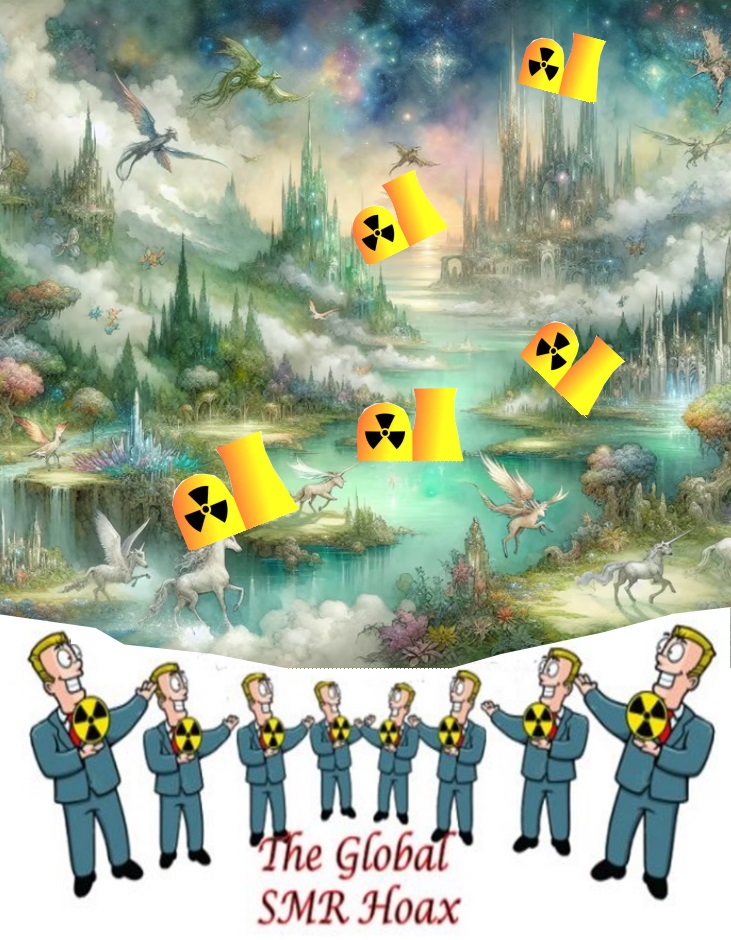
Small Modular Reactors (SMRs) are the nuclear industry’s latest shiny dream. It is more hope than strategy. SMRs only exist in the imagination of the nuclear industry and its supporters. SMRs can only be found on glossy PowerPoint slides. That is why Mycle Schneider dubbed SMRs “power point reactors.” There are no engineering plans, no blueprints, no working prototypes.
Climate and Capital Media, by Arnie Gundersen | Jun 20, 2025
Don’t believe the hype, says a 50-year industry veteran
“The definition of insanity is doing the same thing repeatedly and expecting different results.”
Everywhere you look, the nuclear industry’s hype machine is in overdrive. Columbia University’s Center on Global Energy Policy urges a “warp speed” nuclear revival. Goldman Sachs, Microsoft, and the UK government all tout small modular reactors (SMRs) as the silver bullet for climate change and energy security. Tech billionaires are hiring nuclear veterans. Wall Street is whispering about “round-the-clock power” for AI data centers. The UK is betting billions on “mini nukes” to fill its looming energy gap.
For those old enough to remember, this should sound familiar. For those who don’t, listen up. I spent over 50 years in the nuclear industry, advancing to Senior Vice President and managing projects at 70 nuclear power plants. I hold a nuclear safety patent and co-authored three peer-reviewed papers on the spread of radiation after meltdowns.
I once believed in the dream. I helped build the dream. And now, watching this third act unfold, I can only shake my head at the déjà vu. Because the nuclear industry’s latest pitch is not a revolution, but a rerun — an expensive distraction from real climate solutions.
The nuclear industry’s latest pitch is not a revolution, but a rerun — an expensive distraction from real climate solutions.
What is an SMR, anyway?
Small Modular Reactors (SMRs) are the nuclear industry’s latest shiny dream. It is more hope than strategy. SMRs only exist in the imagination of the nuclear industry and its supporters. SMRs can only be found on glossy PowerPoint slides. That is why Mycle Schneider dubbed SMRs “power point reactors.” There are no engineering plans, no blueprints, no working prototypes.
Still, hope springs eternal, and the idea is to build advanced atomic fission reactors, typically defined as producing up to 300 megawatts of electricity per unit, less than a third the size of a conventional nuclear plant.
The “small” part refers to their reduced output and physical footprint, while “modular” means they’re designed to be built in factories, shipped to sites, and installed as needed, supposedly making them cheaper and faster to deploy than traditional reactors. In theory, you could add modules over time to scale up output, like snapping together Lego blocks.
Too small to succeed
But let’s not be fooled by the word “small.” Even a single SMR is a massive, highly radioactive industrial machine, capable of powering a mid-sized city and containing a radioactive inventory far greater than the bombs dropped on Hiroshima and Nagasaki.
The “small” label is relative only to the behemoths of the last century. In practice, a “small” reactor brings all the big problems of a conventional reactor: dangerous radioactive fuel, complex safety systems, and the risk of catastrophic failure or sabotage. The only thing that’s truly small about SMRs is their inability to benefit from the economies of scale that, in theory, were supposed to make large reactors affordable — but never actually did.
All risk, no advantage
So, the SMR is a lose-lose: all the risks and headaches of traditional nuclear, but with none of the cost or scale advantages that never materialized in the first place.
But that is not stopping nuclear power zealots from championing what will be another failed chapter in the sad legacy of commercial atomic power. Sensing blood, the battered commercial nuclear industry is back with its most audacious pitch yet: SMR lobbying of governments worldwide for taxpayer money. Why? No private investor will touch nukes with a ten-foot uranium rod.
The irony is rich: while Goldman Sachs, Microsoft, and Amazon herald SMRs as the solution to everything from AI’s energy hunger to coal’s decline, the nuclear vendors themselves won’t promise atomic power will be cheaper than renewables. Perhaps they recall the Westinghouse executives who were imprisoned for defrauding the public on atomic project costs. They know what I know: it is pure fantasy to think smaller, less powerful SMRs will magically generate cheap power. Power generation doesn’t work that way.
A legacy of failure — and my place in it
I started my career in the early 1970s, a young engineer with a master’s degree and a reactor operator’s license, working on Millstone Unit 1 in Connecticut. We were going to make electricity “too cheap to meter.” Instead, we made it too expensive to afford — and too complex to run reliably…………………………………………………………………………………………………………………….
“The NRC is truly a captured agency… NEI complained that the agency’s proposed language for a new rule to weaken security for new nuclear reactors was too stringent. So, the NRC complied and completely eviscerated the draft. Pathetic,” said Dr. Edwin Lyman, Union of Concerned Scientists
Who’s who in SMRs
But none of this has stopped nuclear vendors from pushing their SMR hopefuls:
- Holtec: It has never built a reactor. Its design has changed three times in three years, each version more complex. Larger and expensive than the last. At one point, Holtec claimed its reactor would be as safe as a chocolate factory. Willy Wonka would disagree.
Natrium: Backed by Bill Gates, it uses liquid sodium coolant and a thermal storage gimmick. The design is so complicated that the only thing it’s likely to generate is more press releases — and perhaps a few more government grants. And here’s the kicker: the only fuel available for Natrium’s first core load was to come from Russia. When Russia invaded Ukraine, the project was immediately delayed by at least two years, exposing the folly of building a new generation of reactors dependent on a single, geopolitically fraught source of fuel.- NuScale: The first to get NRC approval for an SMR design, but has no customers and just canceled its flagship project due to cost overruns. Its original 50 MW design was quickly upsized to 77 MW after the economics failed to pencil out. After revisiting the drawing board, the new version was just approved in May, but there are no unsubsidized potential buyers.
- Westinghouse: The old hand. Its AP1000 reactors in Georgia nearly bankrupted the company. Now it’s back with an even smaller AP300. Because if at first you don’t succeed, shrink the reactor and try again.
Goldman Sachs, Microsoft, and the UK: The new true believers
But never let facts get in the way of a good story. It’s almost touching to see the world’s financial and tech giants lining up behind SMRs, as long as they are subsidized by someone else……………………………………………….
Why nuclear can’t compete with renewables
The dream of the first nuclear plants was that mining uranium was a lot cheaper than mining coal. But while nuclear costs continue to rise, wind, solar, and battery storage are becoming increasingly cheaper and more reliable every year. And the sun and wind give energy for free. Renewables are now the lowest-cost source of new electricity in most markets. Nuclear, by contrast, has never achieved cost reductions through learning or mass production. Every new design is a new experiment, with new risks and new costs……………………………………………….
SMRs will never be built
Here’s the final irony: despite all the headlines and billions in taxpayer subsidies, an SMR will never be built — not in time to matter, and not at a price that makes sense. But that won’t stop the industry from burning through billions more in public money, chasing a fantasy that distracts and diverts resources from real, proven solutions. As Yogi Berra said, “It’s déjà vu all over again.” And as someone who’s lived through every act of this atomic opera, I can only add: Fool me once, shame on you. Fool me twice, shame on me. Fool me a third time? Well, that’s just nuclear insanity.
Arnie Gundersen is a former nuclear industry executive and Chief Engineer at Fairewinds Energy Education. He has testified as an expert on nuclear safety and reliability worldwide.
Stop Sizewell C campaigner slams Labour lies over nuclear power

Alison Downes from the Stop Sizewell C campaign group spoke to Socialist Worker
Thursday 19 June 2025, https://socialistworker.co.uk/environment/stop-sizewell-c-campaigner-slams-labour-lies-over-nuclear-power/
Labour energy secretary Ed Miliband claims Britain needs new nuclear power plants “to deliver a golden age of clean energy abundance”.
But Alison Downes from the Stop Sizewell C campaign group says it’s the last thing we need to stop climate breakdown.
The Labour government pledged over £14 billion last week towards building a new nuclear power station on the Suffolk coast. Construction of Sizewell C began last year, next to the live Sizewell B plant.
Alison told Socialist Worker she opposes it because of “the climate emergency and the need for quick, cost effective action to reduce our carbon emissions”.
“This type of reactor has got such a bad track record in the other places where it’s been built, or attempted to be built,” she explained.
“And the slowness of completion all count against it as a solution for a climate emergency.”
The new nuclear plant would cost billions at a time when Labour is pushing austerity. Alison said, “In 2020 the cost was estimated at £20 billion and I think very credibly is now predicted at around £40 billion.
“Our assumption is that at least 50 percent of Sizewell C would be paid for by the taxpayer.”
She added, “A lot of this information is not in the public domain. Every time we ask, we get batted away with reasons of commercial confidentiality.
“But our understanding is that the government still intends to be a majority owner in the project.”
Sizewell C, which will be built by French state-owned company EDF, is expected to be operational some time in the 2030s.
It will be funded using a Regulated Asset Base model. This will guarantee EDF a return on its investments and means that electricity suppliers will contribute to the cost of building the plant.
“And that comes from consumer bills,” says Alison. “Consumers just have to keep paying for as long as the project is under construction.”
Radioactive waste disposal underlines that nuclear power is not an environmentally-friendly option.
In the long term, it would need to be stored deep underground.
Alison explained, “A disposal facility for all of Britain’s waste is under consideration. But they still haven’t found a willing host community in a place where the geology is suitable.
“We don’t really know when it would be available and how much it would cost. Sizewell B waste is here and is going to be here for decades to come.
“And, of course, you have big question marks about the impacts of climate change. Every time new studies are released they suggest that those impacts are bigger and faster than previously thought.
“So you have to factor in the cost of keeping this site safe from flooding for a century or more.”
The leaderships of the Unite and GMB unions have enthusiastically welcomed the Sizewell C announcement.
Alison said, “Well, of course, major infrastructure projects bring jobs. We definitely agree that opportunities for young people are very important. But they’re not necessarily very long term jobs.
“There was a major boom and bust in this area when Sizewell B was built. A lot of people feel that the area has really struggled in the aftermath as a result of the crash once construction was finished.
“The thing that really frustrates us about this is that the number of permanent long term jobs at Sizewell C is relatively small. It’s about 700 with a couple of hundred contractors.”
Alison said that home insulation would make people’s energy bills go down and create thousands of new jobs.
Stop Sizewell C has run advertising campaigns on the London Underground, lobbied county councils, met with ministers and stopped pension funds from investing in the project.
“Keir Starmer was due to come here last week and he cancelled at short notice,” said Alison. “I think he probably thought that it might be wise to stay away.”
Unions should fight for investment in green energy and a just transition for workers in nuclear.
A golden nuclear age
‘the last thing variable renewables need is inflexible nuclear plants: they are incompatible.’
June 14, 2025, Renew Extra Weekly
Nuclear power will help take us into a ‘golden age of clean energy abundance’. So said UK Energy Secretary Ed Milliband, in the run up to the public spending review. He announced an extra £14.2 billion in state support for EdFs proposed 3.2GW Sizewell C European Pressurised-water Reactor (EPR) and also £2.5bn for small modular reactor support, with Rolls Royce having won the UK Small Modular Reactor (SMR) competition. There would also be £2.5bn to support fusion.
Whereas there has been a lot a concern about the cost of Sizewell, given the delays and over-runs with its sister EPR plant at Hinkley, it was argued that the second plant would benefit from the lessons learnt, and certainly Miliband was very single-minded about it: ‘all of the expert advice says nuclear has a really important role to play in the energy system. In any sensible reckoning, this is essential to get to our clean power and net zero ambitions.’
Not everyone agreed with that, and, in any case, as the Stop Sizewell C campaign said, ‘there still appears to be no final investment decision for Sizewell C’, with agreements on the remaining substantial private funding still being negotiated. And it noted that ‘every pound sunk into risky, expensive Sizewell C is a pound lost to alternative energy sources and critical social funding that the voting public cares deeply about. It’s not too late to redirect money to offshore wind, or warm homes – creating thousands of jobs – or to restoring the most unpopular and unjust cuts. Sizewell C, given the terrible track record of Hinkley Point C, would be £40 billion badly spent.’
However, Labour seems totally committed to it, although there was some wry media commentary that this might be what sinks Millband’s career- and also about the dubiousness of the nuclear investments and associated fiscal rule changes. There certainly is plenty of potential for things to go awry, and, despite what Milliband claimed, plenty of experts who have warned about the risks and uncertainties of new nuclear, including SMRs. And on costs, the Royal Society had earlier concluded that, even with storage back up, renewables were likely to be cheaper than nuclear. Interestingly, Scotland is still sticking to its no nuclear approach. And there was plenty of opposition from the rest of the UK.
The large-scale new reactor funding (nearly £20bn in all) was the only significant energy-related allocation in the Spending Review, unless you include the £15bn for trams and local transport outside London. The £15bn allocated specifically to nuclear weapons upgrading, for the delightfully named sovereign warhead programme, was unrelated, but, as CND noted, there are some links between civil and military nuclear technology development, including reactors for submarines. There had been hopes from devotees that Carbon Capture would get a lot more funding. It already had £22bn, and so ought to be more than content with the £9.4 bn extra allocation. It did seem to go down well.
As for renewables, there’s just £300m (actually already announced), for Great British Energy to upgrade Offshore wind supply chains. Although to be fair, there will also be support for some renewable projects from the Research Councils and from the Department of Energy Security and Net Zero (DESNZ), which of course also supports the private sector CfD based renewable auction market system. The Spending Review also says the government is supporting ‘the development of home-grown clean power’, including ‘by confirming up to £80 million over the SR period for port investment to support floating offshore wind deployment in Port Talbot, subject to final due diligence’, while ‘Great British Energy and Great British Energy – Nuclear will invest more than £8.3 billion over this Parliament in homegrown clean power’. Make that what you will- it’s been suggested that it means more for SMRs, less for renewables! But Carbon Brief notes that, overall, there’s a 16% rise (to £12.6bn) in DESNZ spending- not including the nuclear investment.
The spending review isn’t about policy formulation, but of course it does reflect policy, so what we are seeing is the triumphant renewal of nuclear, although renewables are still seen as all import, very little new public money in being allocated to them. Even AI got £2bn! But perhaps you can’t read too much into that. Milliband is clearly still keen on net zero with renewables being central (aiming for around 60GW by 2030), with CCUS, and now nuclear, playing smaller bit parts, along with some residual fossil gas.
So renewables will continue to lead. They are now supplying over 50% of UK power and are still expanding fast. Nuclear has fallen to 15% and will fall further as the old AGR plants are closed, before picking up again when Hinkley finally gets going and then some more if Sizewell really does get built, along possibly with some SMRs, in the 2030s. So maybe 25% of power by then?
There will no doubt continue to be objections to each of the energy options. Certainly to nuclear, but also to CCUS and to fossil gas. And inevitably also to renewables – as well as to the whole ‘net zero’ idea. For example, predictably, the Global Warming Policy Foundation has produced a new report which claims that ‘net zero will bankrupt Britain.’ For example, it says ‘the Government’s plans ensure that bills are likely to go up, rather than fall as claimed’, with new subsidies for variable renewable energy locking in further price rises for consumers. It also warns about the increasing cost of grid balancing.
Instead of this, the GWPF report seems to favour a return to fossil fuel. It says ‘the potential of the UK’s shale gas resources has also gone unexplored. A new discovery in Lincolnshire, known as the Gainsborough Trough, could add £112 billion to UK GDP, according to a study by Deloitte’. Farage seems to be saying the same sort of thing – even calling for a return to coal mining in Wales. So, they both seem to be saying let’s not worry too much about emissions – let’s go backwards. Labour is not doing that, although some might think its conversion from an anti-nuclear party in the 1980s to a militantly pro-nuclear one now, has involved a bit of backtracking, and a lack of consistent vision.
Personally, as I said in response to the Labour Party’s invitation to submit comments to its National Policy Forum consultation on energy policy, I do not think we need renewables and nuclear, not least since ‘the last thing variable renewables need is inflexible nuclear plants: they are incompatible.’ Quite apart from the costs and the safety and security risks, which I have looked at elsewhere, I think it’s foolish to build large expensive plants that are only used occasionally for backup. The same is true for an isolated fleet of SMRs- trying to make them flexible enough to provide grid balancing is likely to make them even more costly. Instead, I pointed out that ‘there are UK scenarios in which renewables expand to supply almost all energy needs by 2050 led by wind and solar’, with full short and long term storage and flexible system balancing, at reasonable costs, although I did warn that ‘ dealing with interannual cycles may require import/grid trading options to be explored. But having inflexible nuclear plants doesn’t help at all- they just get in the way’.
It’s fascinating stuff trying to ensure zero carbon green energy system flexibility and sustainability at low cost, as I have reported in Renew over the years, but Labour now seems to see nuclear as a key option. As a result, although there are some good things (e.g. on warm housing) in the new spending review, I’m not sure, given also their stance on some other key issues, how much longer I can stay being a member.
When did nuclear power become “clean”?

A lunge towards nuclear is the worst possible path for a world aspiring towards “clean” energy. It poses a major security risk too.
Gerald Warner, Former special adviser to the Scottish Secretary, 13June, 2025
When, exactly, did nuclear power become “clean” energy? Even in our post-truth society, it remains mind-boggling that the most dangerous and enduringly toxic technology known to man should have been repackaged and presented as “green”, “safe” and “clean”. This imposture puts Orwell’s “War is peace, freedom is slavery” very much in the shade.
Rachel Reeves’s statement on Wednesday included £14bn of funding for the construction of the new Sizewell C nuclear plant, as well as the announcement that three small modular reactors (SMRs) would be built by Rolls Royce. While this reflects government awareness of the inadequacy of “renewables” for energy supply, this lunge towards nuclear is the worst possible path we could have taken. A world aspiring to clean energy should be phasing out nuclear power, not expanding it………… (subscribers only) https://www.reaction.life/p/when-did-nuclear-power-become-clean
The media, scientific consensus, and toxic nuclear waste
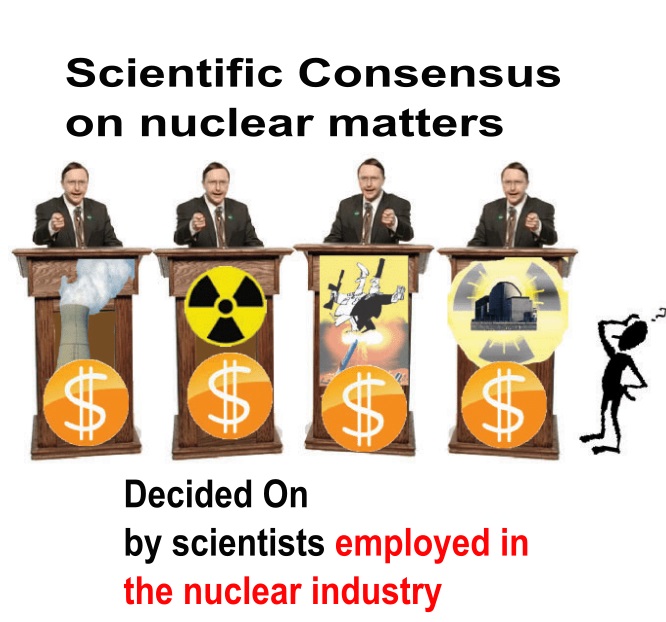
Not to be outdone by more modern means of propaganda, Nuclear Waste Services has continued the tradition of only providing the audience with the information that suits their argument.
The only way to reduce waste is to reduce the activities that cause it.
There is no other logical way.
News media tends to use ‘scientific consensus’ as if it is the end point of the discussion.
The implication that ‘this is the only way’ serves to quash dissenting voices and validate the overall message of the article.
When government agencies are hard to trust, who do we look to? Scientists. But what job is the concept of scientific consensus doing in the marketing of the GDF?
A Quiet Resistance, 8 May 2025
‘Scientific consensus’ carries a lot of weight in news media discussing the proposed Geological Disposal Facilities (GDFs) (nuclear waste dumps) in West Cumbria.
This consensus is also being used as a persuasion tool in the official literature handed out to communities by Nuclear Waste Services (NWS).
Since most of us aren’t scientists in either the nuclear industry or geodisposal, we have to turn to those who are if we’re to understand what’s going to happen to our community. Alongside the regular newsletters and other marketing from NWS, we usually access those people through articles in the news and on the internet.
But it’s important to keep asking questions about what we’re reading.
‘Scientific consensus’ doesn’t mean the science is settled; articles can contain facts and still be biased.
Biases in news media
The news media are paid for by advertisers. If they publish articles that make arguments against their advertisers’ interests, they lose advertising money. Their advertisers’ interests may not be clear. For example, they may be companies that have money invested in hedge funds, which in turn invest in nuclear power.
News media also come up against political pressure, as The Guardian found out a few years ago, to its long-term detriment.
There’s also the question of audience. News media write to a specific audience, one already sold on the ideas they are promoting, or at the very least, suggestible. Most people are aware of ‘climate change’. If someone authoritative tells them it’s important for us to have a GDF because nuclear energy will help us ‘beat climate change’, they are likely to accept that, unless they have some wider knowledge.
Bias can be edited into an article by keeping the facts, but leaving out certain contexts. They can also cherry pick facts, so that the only ones they use are those which suit their argument.
Biases and misinformation across the internet
Misinformation across the web is an endemic problem now, brought on by too little regulatory oversight, too late. A bitter combination of an advertising free-for-all, empty content for the sake of it, and algorithmic twists that feed on themselves has come together to make an internet that doesn’t run the kind of useful searches it did just 12 years ago.
On top of this, a type of information warfare has been raging, hidden in plain sight from the eyes of everyday people, and the proliferation of GenAI has made the situation much worse. Social media, news media, every place we get our information from has been seeded with doubt.
All of this means that when we read information anywhere, from both respectable and dubious sources, we have to take time to process what we’ve read before we lead with our emotions.
Bias and messaging in public information
Not to be outdone by more modern means of propaganda, Nuclear Waste Services has continued the tradition of only providing the audience with the information that suits their argument.
In the case of the Community Partnership newsletter this month, this includes a soothing word salad introduction from the outgoing Community Partnership Chair explaining that he has resigned, and our local Town Council has withdrawn from the group. There are then several pages on how the Community Investment Fund money has been spent recently.
From that messaging, it is clear they’re seeking to reassure the community – talk quietly, you don’t want them to startle – and remind us that we’re getting plenty of money for the deal.
So, what’s the problem with the scientific consensus on the idea of a geological disposal facility (GDF), more prosaically known as a nuclear waste dump?
What is ‘scientific consensus’?
Scientific consensus refers to an agreement amongst scientists in a specific, very narrow field of study.
In the consideration of a GDF, that field would be geology, and most likely a particular area of geology, such as geodisposal.
Why do we need ‘scientific consensus’?
For most of us, despite our education and our wide understanding of the world, we don’t have intensive scientific training. Even if we do, it may not be in the narrow field in question.
Ethan Siegel at Forbes.com explained this really clearly:
… Unlike in most cases, unless you are a scientist working in the particular field in question, you are probably not even capable of discerning between a conclusion that’s scientifically valid and viable and one that isn’t. Even if you’re a scientist in a somewhat related field! Why? This is mostly due to the fact that a non-expert cannot tell the difference between a robust scientific idea and a caricature of that idea.
Why should we believe ‘scientific consensus’?
Although a consensus is an impossible number to quantify, the argument for a consensus is that a lot of related research is borne out by the agreement, so if it isn’t correct – e.g. if a GDF isn’t a safe and complete solution for nuclear waste – then a lot of other research is also wrong.
That sounds reassuring, but there’s more to it.
What do we have to consider behind the messaging of ‘scientific consensus’?
News media tends to use ‘scientific consensus’ as if it is the end point of the discussion.
The implication that ‘this is the only way’ serves to quash dissenting voices and validate the overall message of the article.
This is also how Nuclear Waste Services is using ‘scientific consensus’. The inference is that there is only one solution, and a GDF is it.
But scientific consensus is not the end position of the science. It’s the starting position from which further investigation can arise.
While that future studying may not set out to prove early scientific reasoning wrong, it should seek to improve or refine our understanding of the science.
And the main problem with scientific investigation?
Take a look at this quote. It’s from the article Development in Progress, from the Consilience Project.
It is also important to consider how existing biases and values ‘prime’ us towards certain starting points when we seek to understand the world through science. Before we formulate questions of design experiments, we often have preconceived notions as to what we imagine as likely to be important to the question at hand.
You’ve got to ask what their starting point is, before you can evaluate the idea.
Or, to put it another way: if you ask a geodisposal specialist what the best way is to deal with a higher activity nuclear waste problem, they’re going to tell you to bury it underground.
What’s the motivation for a GDF? Why the bias? Where’s the starting point of the plan?
Waste is a massive issue for modern Western societies. Everything we do, everything we buy creates waste. The only way to reduce waste is to reduce the activities that cause it.
There is no other logical way.
Government and the nuclear industry are motivated towards using a geological disposal facility to store higher activity nuclear waste because:
- There’s almost seventy years’ worth of higher activity nuclear waste to store
- Nuclear appears to offer a solution to the legal requirements of Net Zero.
The more we use nuclear technology, the more toxic waste we will produce. It’s inevitable without social, political, and industrial change.
The nuclear industry
The nuclear industry’s back is against the wall. It urgently has to put the accruing waste somewhere permanently safe.
Nuclear waste is produced in solid, aqueous, and gaseous forms. If the industry reduces some of the gaseous waste, that means that it increases it in another form, e.g. aqueous. There is no escaping the waste issue without stopping the industry.
There’s a lot of money in nuclear.
The UK Government
The government has to enable the production of electricity, but having effectively phased out coal-fired power stations, it has brought in gas-fuelled hydrogen plants which are arguably just as greenhouse-gas-intensive as coal. Natural gas is still a fossil fuel, it still causes huge emissions, and it still presents supply problems.
For the government, nuclear represents a lower carbon option, with political expediencies, such as being free of Russian fossil fuel pressures (Russian uranium is still unsanctioned and likely part of the ‘diversified’ fuel mixes used in the UK).
There is also a disturbing link between civil nuclear skills and military nuclear skills which doesn’t get much media time:
Other countries tend to be more open about it, with the interdependence acknowledged at presidential level in the US for instance. French president Emmanuel Macron summarises: “without civil nuclear power, no military nuclear power, without military nuclear, no civil nuclear”.
This is largely why nuclear-armed France is pressing the European Union to support nuclear power. This is why non-nuclear-armed Germany has phased out the nuclear technologies it once lead the world in. This is why other nuclear-armed states are so disproportionately fixated by nuclear power.
In 2022, the Nuclear Decommissioning Authority (NDA) published a Radioactivity Waste Inventory with a timeline for the phasing out of nuclear power by 2136. But in early 2025, the Labour government announced it was keen to rapidly start up the building of Small Modular Reactors (SMRs) across the UK. Going forward from this year, nuclear waste will continue to be produced in the UK beyond the 100-year lifetime of the current GDF project. Waste is inevitable.
Waste isn’t the only issue for nuclear power, either. There is the question of what happens to nuclear power plants in the face of climate catastrophe. Fukushima wasn’t an anomaly, and it wasn’t avoidable. It could be seen as a foreshadowing of future possibilities.
Back to scientific consensus
So, when Nuclear Waste Services and other media proponents talk about scientific consensus being in agreement that a GDF is the best solution available for toxic nuclear waste, what they mean is:
- there is an inexorable accumulation of nuclear waste, both historical and into the future
- there are going to be more GDFs in the future
- they aren’t looking for other methods of storage
- they absolutely will not consider a non-nuclear future
- and they don’t want to argue about it.
And, for some reason, despite a GDF apparently being the safest possible housing for nuclear waste – and despite there being many geologically suitable locations – they don’t want to locate it under Westminster.
Ultimately, despite the focus given to the science, this isn’t about the science.
It’s about burying a waste product that they have no other solution for. Sweeping it under the carpet. And calling it common sense!
Common sense as a message, in an area of study called Semiotics, is a problematic idea. Although it is dressed up as the common, standard, everyday way of thinking, it is often used in marketing and media to promote the ideas of those in power.
As the future beckons, common sense should be saying no to nuclear. Just like with plastic, nuclear has no end and no sure way of getting rid of its byproducts.
For communities that ‘host’ a nuclear waste dump, the GDF solution represents a forever risk with inter-generational risks and costs along the way.
Somehow, West Cumbria always seems to be saddled with nuclear detritus.
The potential collateral damage, seen already across the United States and South America, is similar to that experienced around mining and climate solution industries.
It starts with
- environmental destruction,
- contamination of water sources and land,
- loss of biodiversity,
- loss of human rights,
- loss of health, and
- upheaval of established communities.
These may be experienced just in the construction of a GDF.
Who knows where it ends?
Further information on the proposed GDFs in West Cumbria:
New York Governor Kathy Hochul’s Major Nuclear Power Push

What the nuclear industry and nuclear believers in government are calling “advanced” nuclear power plants are, as the Union of Concerned Scientists has found in an extensive report, not improved and no better—”and in some respects significantly worse”—than current nuclear plants.
the nuclear industry now is seeking large amounts of government financial support including in the forms of tax credits and loan guarantees to cover cost overruns.
Karl Grossman, May 14, 2025, https://www.counterpunch.org/2025/05/14/new-york-governor-kathy-hochuls-major-nuclear-power-push/
“Governor [Kathy] Hochul is making a major push to not only build new nuclear plants in New York State but to make N.Y. the center of a nuclear revival in the U.S.,” declared Mark Dunlea, chair of the Green Education and Legal Fund, and long a leader on environmental issues in the state and nationally, in a recent email calling on support to “stop Hochul’s nuclear push.”
Dunlea is author of the book “Putting Out the Planetary Fire: An Introduction to Climate Change and Advocacy.” An Albany Law School graduate, he co-founded both the New York Public Interest Research Group and national PIRG. In an interview last week from his home in Poestenkill in upstate New York, Dunlea charged that Governor Hochul has “bought into nuclear power.”
He said, “She buys the argument that nuclear is carbon-free, avoiding looking at the life cycle of nuclear and its carbon footprint,” which includes, he noted, significant emissions of carbon in uranium mining, milling, enrichment, fuel fabrication and at other points. “The nuclear industry has been lobbying her to go along with it, and she has,” he said.
Hochul has also become involved in promoting nuclear power nationally.
The Clean Air Task Force, based in Sunnyside in Queens, New York, which advocates nuclear power, issued a press release in February stating: “The National Association of State Energy officials announced a multi-state initiative to accelerate advanced nuclear energy projects. The initiative was first previewed by Gov. Kathy Hochul of New York last month and will be co-chaired by New York.”
The heading of the release: “New York leads multi-state consortium to drive nuclear energy deployment …”
Tim Judson, executive director of the Nuclear Information and Resource Service (NIRS), based in Mount Rainier, Maryland, and formerly of Syracuse, New York, pointed out in an interview that Hochul made nuclear power “a specific priority in her State of the State speech” in January.
Hochul in the speech declared: “The economy of the future: microchips fabs [fabrication plants], data centers and the supercomputers that power AI need tremendous amounts of energy. To support these industries, we’ve already started developing an advanced nuclear strategy. This is a good investment. Artificial Intelligence alone is projected to drive $320 billion of economic growth in our state by 2038.”
What the nuclear industry and nuclear believers in government are calling “advanced” nuclear power plants are, as the Union of Concerned Scientists has found in an extensive report, not improved and no better—”and in some respects significantly worse”—than current nuclear plants. The Cambridge, Massachusetts-based organization has detailed this in an article headlined: “Report Finds That ‘Advanced’ Nuclear Reactor Designs Are No Better Than Current Reactors—and Some Are Worse.”
Hochul is a Democrat. But also, said Judson, the “New York Republican Party has been rabidly pro-nuclear.” In a time of extreme partisan polarity, there is a “bipartisan consensus among the political elite in favor of nuclear power,” and thus is one thing in government for which “there are bipartisan votes.”
As the Syracuse.com website has reported: “Fort Drum, the U.S. Army base outside Watertown, could become the first New York site to try advanced nuclear power technology if the Army goes along with pleas from congressional representatives. U.S. Reps. Elise Stefanik and Claudia Tenney, both upstate Republicans, issued a joint letter October 25 urging the Army to put Fort Drum first in line for one of the small modular nuclear reactors that President Joe Biden and Department of Defense officials are promoting as a clean source of resilient energy.”
Stefanik is a Republican front-runner to challenge Hochul in election for governor in 2026. Democrat Biden has supported nuclear power.
Hochul’s predecessor as New York governor, Andrew Cuomo, also a Democrat, now seeking to be the Democratic candidate for New York City mayor in the 2025 election, has a mixed record on nuclear power.
As governor Cuomo was instrumental in closing down in 2021 the two Indian Point nuclear power plants 26 miles north of New York City, but in 2016 he engineered a $7.6 billion bail-out to allow four aged nuclear plants in upstate New York to continue to operate. Their owners then deemed them uneconomical to continue to operate.
The plants—Fitzpatrick, Nine Mile Point 1 and 2, and Ginna—are now owned by Constellation Energy, the largest nuclear power plant operator in the United States.
The $7.6 billion bail-out is being paid for over a 12-year period as a surcharge on electric bills of all residential and industrial customers in New York State.
So far, Dunlea said, Hochul has been focusing on upstate New York for new nuclear development, particularly targeting areas where nuclear plants are now located, rather than, “at the moment,” downstate.
For decades, a battle raged that stopped the plan of the Long Island Lighting Company to build a large collection of nuclear power plants—seven to 11 nuclear plants—downstate, on Long Island, the 120-mile island east of Manhattan.
If there is again a plan for placement of nuclear power plants on Long Island, said Dunlea, “hopefully, Long Islanders would stand up and beat it back.”
Grassroots citizen action was a key in the decades long fight to block to the scheme to, in the parlance of promoters of it at the time, turn Long Island into a “nuclear park.” The only plant built was Shoreham 1 which was stopped from going into commercial operation.
The October Syracuse.com piece said: “Gov. Kathy Hochul has expressed an interest in exploring the potential for new nuclear power in New York” highlighted by her having “hosted an energy summit last month [September 2024] in Syracuse that focused heavily on nuclear power.”
Judson, of NIRS, said the nuclear industry now is seeking large amounts of government financial support including in the forms of tax credits and loan guarantees to cover cost overruns.
Laura Shindell, New York State director of the Washington-headquartered organization Food & Water Watch, has scored in a piece in the Times Union newspaper of Albany what she terms “Governor Hochul’s nuclear embrace” and said Hochul should commit to “real climate and affordable energy solutions.” Shindell’s piece was headlined, “Commentary: No place for nuclear in New York’s energy plants.” Its subhead: “Nuclear power is a dirty, dangerous, expensive distraction to the essential work of transitioning to clean energy.”
New York State’s emphasis on nuclear power under Hochul has been recognized by World Nuclear News, a publication of the World Nuclear Association, a London-based group that describes itself as an “international organization that promotes nuclear power.”
A January article was headlined “New York State looks to advanced nuclear.”
It began: “As New York Governor Kathy Hochul announces a master plan for advanced nuclear development,” the New York State Energy Research and Development Authority, NYSERDA “has joined Constellation [Energy] on a grant proposal to help it pursue an early site permit for advanced nuclear reactors at its Nine Mile Point Clean Energy Center.” That’s the site of the Nine Mile Point 1 and 2 nuclear power plants.
Anne Rabe, volunteer coordinator of the group Don’t Waste New York, charged in an interview that Hochul “is recklessly and deliberately telling NYSERDA to pursue advanced reactors.” A resident of Castleton-on-Hudson in upstate New York, she said “the nuclear industry for years has worked to lay the groundwork for this.”
Karl Grossman, professor of journalism at State University of New York/College at Old Westbury, and is the author of the book, The Wrong Stuff: The Space’s Program’s Nuclear Threat to Our Planet, and the Beyond Nuclear handbook, The U.S. Space Force and the dangers of nuclear power and nuclear war in space. Grossman is an associate of the media watch group Fairness and Accuracy in Reporting (FAIR). He is a contributor to Hopeless: Barack Obama and the Politics of Illusion.
1 This Month



Shut down the radiation-damaged Heysham nuclear reactors now
To see nuclear-related stories in greater depth and intensity – go to https://nuclearinformation.wordpress.com

Say No to NASA’s Reckless Nuclear Reactor on the Moon
Say No to NASA’s Reckless Nuclear Reactor on the Moon
-
Archives
- October 2026 (256)
- September 2026 (339)
- August 2026 (330)
- July 2026 (355)
- June 2026 (287)
- May 2026 (306)
- April 2026 (356)
- March 2026 (251)
- February 2026 (267)
- January 2026 (308)
- December 2025 (358)
- November 2025 (359)
-
Categories
- 1
- 1 NUCLEAR ISSUES
- business and costs
- climate change
- culture and arts
- ENERGY
- environment
- health
- history
- indigenous issues
- Legal
- marketing of nuclear
- media
- opposition to nuclear
- PERSONAL STORIES
- politics
- politics international
- Religion and ethics
- safety
- secrets,lies and civil liberties
- spinbuster
- technology
- Uranium
- wastes
- weapons and war
- Women
- 2 WORLD
- ACTION
- AFRICA
- Atrocities
- AUSTRALIA
- Christina's notes
- Christina's themes
- culture and arts
- Events
- Fuk 2022
- Fuk 2023
- Fukushima 2017
- Fukushima 2018
- fukushima 2019
- Fukushima 2020
- Fukushima 2021
- general
- global warming
- Humour (God we need it)
- Nuclear
- RARE EARTHS
- Reference
- resources – print
- Resources -audiovicual
- Weekly Newsletter
- World
- World Nuclear
- YouTube
-
RSS
Entries RSS
Comments RSS

