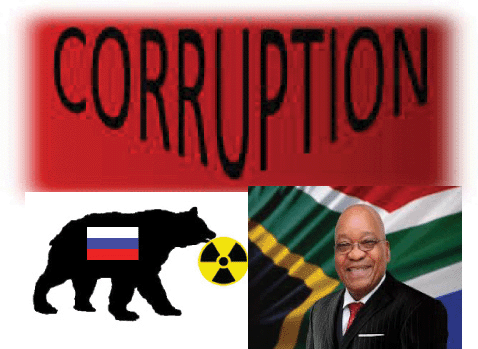
Nene refused to sign off on nuclear energy – and it cost him his job https://businesstech.co.za/news/energy/275039/nene-refused-to-sign-off-on-nuclear-energy-and-it-cost-him-his-job/ Bloomberg3 October 2018South African Finance Minister Nhlanhla Nene said he met repeatedly with members of the Gupta family, who have been implicated in a corruption scandal related to former President Jacob Zuma and separately was twice pressured to sign a multi-billion Russian nuclear-power deal by former Energy Minister Tina Joemat-Pettersson.
Nene made his comments in a statement accompanying his testimony at a judicial inquiry into allegations of corruption and so-called state capture which involve the Guptas, who are friends with the former president.
Nene denied wrongdoing in his meetings with the family and said he refused to sign the agreement for Russia to provide nuclear energy, a plan that had been publicly backed by Zuma.
President Cyril Ramaphosa came to power in February and has changed the top management at the likes of the revenue authority and the state power utility as part of his pledge to fight corruption. He reappointed Nene as finance minister, a move that helped bolster investor confidence after years of economic mismanagement and regular cabinet changes under Zuma.
Nene first served as finance minister until December 2015, when Zuma fired him, causing a plunge in the rand and bonds. Mcebisi Jonas, who was Nene’s deputy, told the commission the Guptas offered him a bribe to take over the finance minister post, which he declined.
Nene rejected pressure to approve the construction of as many as eight nuclear reactors, which would have the capacity to generate 9,600 megawatts of energy. The costs of the project, championed by Zuma, would have been “astronomical,” he said in his statement.
In July 2015, Nene twice refused to sign a letter from Joemat-Pettersson providing a guarantee to the Russian government on the nuclear program.
“As a result of my refusal to sign the letter, I was seen as the person standing in the way of the nuclear deal,” he said. “I was accused of insubordination, not only by the president but by some of my colleagues.”
The United States on Thursday indicted seven Russian intelligence officers for conspiring to hack computers and steal data, including attempts to break into the computer networks of the nuclear power company Westinghouse Electric Co. France 24 4 Oct 18The Justice Department said one of the Russian officers performed online reconnaissance and stole log-in credentials of Westinghouse workers, including staff that work at its advanced nuclear reactordevelopment and new reactor technology units.
Westinghouse, which is located outside of Pittsburgh, provides fuel, services and plant design to customers, including Ukraine.
Three of the seven Russian military officers indicted on Thursday were charged in a separate case brought by Special Counsel Robert Mueller’s office for their role in hacking activities designed to influence the 2016 presidential election……..
In the indictment, prosecutors alleged that one of the Russian officers, Ivan Sergeyevich Yermakov, performed “technical reconnaissance” of the company as early as Nov. 20, 2014, and got access to IP addresses, domains and network ports. The hackers also researched Westinghouse to learn about the company’s employees and their backgrounds in nuclear energy research.
In December, the Justice Department said, Yermakov and his co-conspirators registered a fake domain and website designed to mimic the company’s website and sent phishing emails to at least five employees. Once people clicked on the spoofed domain and provided their log-ins, they were rerouted to the original network.
On other occasions, according to the indictment, the conspirators also sent spearphishing emails to the personal emails of employees at Westinghouse. Two account users clicked on the malicious links.
The indictment does not clearly explain why Westinghouse was targeted or whether the hackers succeeded, and Justice Department officials declined to comment beyond the indictment.
Nuke Expert Dana Durnford Unpacks – Linear No-Threshold (LNT) Debate
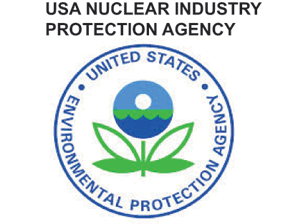
Trump’s EPA moving to loosen radiation limits, Financial Post, Ellen Knickmeyer, 2 Oct 18 WASHINGTON — The Trump administration is quietly moving to weaken U.S. radiation regulations, turning to scientific outliers who argue that a bit of radiation damage is actually good for you — like a little bit of sunlight.
The government’s current, decades-old guidance says that any exposure to harmful radiation is a cancer risk. And critics say the proposed change could lead to higher levels of exposure for workers at nuclear installations and oil and gas drilling sites, medical workers doing X-rays and CT scans, people living next to Superfund sites and any members of the public who one day might find themselves exposed to a radiation release.
The Trump administration already has targeted a range of other regulations on toxins and pollutants, including coal power plant emissions and car exhaust, that it sees as costly and burdensome for businesses. Supporters of the EPA’s new radiation guidance argue the government’s current no-tolerance rule for radiation damage forces unnecessary spending for handling exposure in accidents, at nuclear plants, in medical centres and at other sites.
…… The proposed rule would require regulators to consider “various threshold models across the exposure range” when it comes to dangerous substances.
While it does not specify that it’s addressing radiation and chemicals, an EPA news release on the rule quotes Edward Calabrese as saying it would: “The proposal represents a major scientific step forward by recognizing the widespread occurrence of non-linear dose responses in toxicology and epidemiology for chemicals and radiation and the need to incorporate such data in the risk assessment process.”
The comment period for the science regulation has ended and the agency is currently reviewing the comments. There’s no specific date for final action by the administration. The EPA declined to make an official with its radiation-protection program available.
… what’s of concern is the higher-energy, shorter-wave radiation, like X-rays, that can penetrate and disrupt living cells, sometimes causing cancer.
As recently as this March, the EPA’s online guidelines for radiation effects advised: “Current science suggests there is some cancer risk from any exposure to radiation.”
“Even exposures below 100 millisieverts” — an amount roughly equivalent to 25 chest X-rays or about 14 CT chest scans — “slightly increase the risk of getting cancer in the future,” the agency’s guidance said.
But that online guidance — separate from the rule-change proposal — was edited in July to add a section emphasizing the low individual odds of cancer: “According to radiation safety experts, radiation exposures of …100 millisieverts usually result in no harmful health effects, because radiation below these levels is a minor contributor to our overall cancer risk,” the revised policy says.
…….. The radiation regulation is supported by Steven Milloy, a Trump transition team member for the EPA who is known for challenging widely accepted ideas about manmade climate change and the health risks of tobacco. He has been promoting Calabrese’s theory of healthy radiation on his blog.
But Jan Beyea, a physicist whose work includes research with the National Academies of Science on the 2011 Fukushima nuclear power plant accident, said the EPA science proposal represents voices “generally dismissed by the great bulk of scientists.”
The EPA proposal would lead to “increases in chemical and radiation exposures in the workplace, home and outdoor environment, including the vicinity of Superfund sites,” Beyea wrote.
At the level the EPA website talks about, any one person’s risk of cancer from radiation exposure is perhaps 1 per cent, Beyea said.
“The individual risk will likely be low, but not the cumulative social risk,” Beyea said.
“If they even look at that — no, no, no,” said Terrie Barrie, a resident of Craig, Colorado, and an advocate for her husband and other workers at the now-closed Rocky Flats nuclear-weapons plant, where the U.S. government is compensating certain cancer victims regardless of their history of exposure.
“There’s no reason not to protect people as much as possible,” said Barrie.
U.S. agencies for decades have followed a policy that there is no threshold of radiation exposure that is risk-free.
The National Council on Radiation Protection and Measurements reaffirmed that principle this year after a review of 29 public health studies on cancer rates among people exposed to low-dose radiation, via the U.S. atomic bombing of Japan in World War II, leak-prone Soviet nuclear installations, medical treatments and other sources.
Twenty of the 29 studies directly support the principle that even low-dose exposures cause a significant increase in cancer rates, said Roy Shore, chief of research at the Radiation Effects Research Foundation, a joint project of the United States and Japan. Scientists found most of the other studies were inconclusive and decided one was flawed.
None supported the theory there is some safe threshold for radiation, said Shore, who chaired the review.
If there were a threshold that it’s safe to go below, “those who profess that would have to come up with some data,” Shore said in an interview.
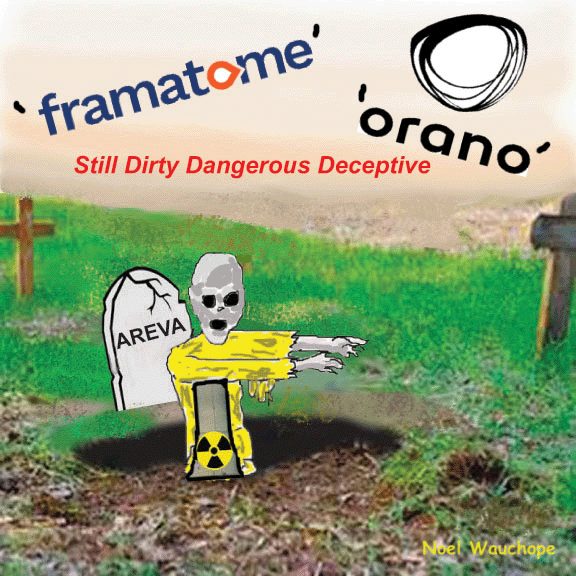
Bad news for the french taxpayer Because, in the event of a lawsuit for corruption in the United States, the rule is that the amount of the fine covers the totality of the financial loss. Admittedly, the prosecutor could simply claim Areva $ 243 million corresponding to the amount of the acquisition of Ausra. But it can also very well demand the reimbursement of all the federal expenses incurred in the case, namely: the $ 7.7 billion invested in the MOX plant ever built, the $ 19.9 billion that will be swallowed up in the management of unprocessed plutonium and the 243 million of the Ausra acquisition, totaling nearly $ 28 billion, or, if you prefer, € 24.1 billion at the current rate.
Needless to say, since Orano does not have a penny in its pocket, the state should go to the cash register. The only way to avoid such a disaster, argue the jurists, would be that the French justice sanctions itself guilty.
AREVA BUSINESS: THE MONSTROUS FINE THAT THREATENS FRANCE ,https://www.capital.fr/entreprises-marches/affaire-areva-la-monstrueuse-amende-qui-menace-la-france-1308725 –(translation Noel Wauchope) THIERRY GADAULT 27/09/2018 The nuclear group could be fined 24 billion euros by the US justice in a corruption case in the United States. A file that could embarrass Anne Lauvergeon but also Edouard Philippe, at Areva at the time of the facts.
· Forget the scandal Credit Lyonnais 1990s and the 15 billion euros it has cost France. The Areva case is about to break all records. According to our information, the US justice discreetly warned the French authorities in early July that it could launch a trial for corruption against the former tricolor nuclear star. And that in case of conviction, the fine could go up to … 24 billion euros, the equivalent of one third of income tax revenue.
· Since then, Areva has been cut in three (since being acquired by EDF) and was renamed Orano, as if to give it a new start. Alas! Now that a possible corruption pact, concluded in 2010 by the company with leaders of the American Democratic Party, threatens to explode for good.
· A case that could also smirch the Prime Minister Edouard Philippe, director of public affairs of Areva at the time.
“When, at the beginning of the year, I discovered the scale of this affair, I communicated with the director of the FBI all the information that I had been able to get my hands on”, Marc Eichinger revealed to Capital . This private investigator specializing in the fight against serious international crime and corruption is very aware of the case: it was he who wrote the report submitted in April 2010 to the security department of Areva to denounce the potential fraud related the redemption of Uramin three years earlier.
· Stunned by this new case of corruption in the United States, he also forwarded the whole file to French justice, causing a heating up of the investigation in a summer, already scorching. According to our information, the financial brigade, in charge of Areva’s sprawling affairs, recommended to the National Financial Office (PNF) to open a new instruction for “bribery of foreign public official and trading in influence”. But at the beginning of September, when we wrote these lines, the PNF had still not followed these recommendations.
At the heart of this new scandal, which has not yet erupted in the United States, the conditions in which Areva acquired, in February 2010, is Ausra, an American startup specializing in solar energy. Continue reading →
A conversation with Dr. Gordon Edwards: contemporary issues in the Canadian nuclear industry, and a look back at the achievements of the Canadian Coalition for Nuclear Responsibility (CCNR), http://www.ccnr.org/ Montreal, August 25, 2018, Nuclear waste management: an exercise in cynical thinking. DiaNuke.org, 24 Sept 2018. “…….. The elusive “willing host community”DR: I know too there have been a lot of targeted “willing host communities” that have rejected it. Do you think they’ll succeed in finding one?
GE: Here in Canada they have gone through this process of looking for a “willing host community,” which is kind of foolish because these communities are very small. For example, I just visited two of them within the last few weeks way up above Lake Superior. In the two communities that I visited, Hornepayne and Manitouwadge, I gave presentations. These communities have less than a thousand residents in each one of them and they get $300,000 a year as basically bribe money in order to keep them on the hook, to keep them interested in learning more. It’s called the “learn more” program, and as long as they’re “learning more,” they can get $300,000 a year. Well, they are both interested in getting the money, and consequently they’re still in the running, but do they really want to be a nuclear-waste community? If this is such a good deal for them, then why aren’t other communities bidding for this—larger communities? Of course, one of the points that comes to mind immediately is that if you had a city of a million people or so, then you’d have to shell out $300 million instead of $300,000 every year, so this idea of a “willing host community” exists only because of the bribes that are given by the industry in order to keep these communities supposedly interested in receiving the waste. And in some of them, of course, there are people who see dollar signs and who see an opportunity for them to make a lot of money. In a small community, a certain small number of people can make a lot of money by capitalizing on an opportunity like that without being concerned very much about the long-term wisdom of it.
DR: Yeah, and the seventh future generation doesn’t get a voice.
I did speak to two other communities a couple of years ago in that same general area north of Lake Superior. One of them was the town of Schreiber, and one of them was White River, and both of those communities are now off the list. They’re no longer candidates, so we now have only three communities up north of Lake Superior which are still actively pursuing this program of taking money and “learning more.” I have spoken now to two of them and I haven’t yet been invited to go to the third one.
10. The great unknowable: long term care for nuclear waste. Who pays? Who cares?When I go there I try and point out to them not only the fact that this whole exercise is questionable, but also the fact that once the nuclear waste is moved up to a small remote area like this, what guarantee is there that it’s really going to be looked after properly? Because these small communities do not have a powerful voice.
They don’t have economic clout, and so they can’t really control this. If a person like Donald Trump, for example in the United States, or Doug Ford in Ontario, who many people think is a kind of a mini Donald Trump, thinks, “Why are we going to spend money on that? Forget it we’re not going to spend money on that,” then it’s going to not be pursued as originally planned. And it could become just a surface parking lot for high-level nuclear waste. Who is going to guarantee that it is actually going to be carried out? Now the nuclear plants are in danger of closing down. We’re having fewer nuclear plants every year than we had the year before now in North America, and consequently there’s not the revenue generation that there used to be. The money that’s been set aside is nowhere near adequate to carry out the grandiose project they’re talking about, which here in Canada is estimated to cost at least twenty-two billion dollars. They have maybe five or six billion, but that’s not nearly enough.
So there’s also another problem lurking in the wings, and that is that if you do want to carry out this actual full-scale program of geological excavation with all the care that was originally planned, how do you generate revenue? What company is willing to spend twenty-two billion dollars on a project which generates absolutely no revenue?
There are only two ways you can generate revenue from that, and one way is to take waste of other countries and charge a fee for storing the waste. The other thing is to sell the plutonium. If you extract the plutonium, then you could have a marketable product, but both of these ideas are extremely far from what these communities are being told. In other words, the plan that’s being presented to them does not include either one of these possibilities, and it changes the game considerably. As we all know, getting the plutonium out of the spent fuel involves huge volumes of liquid radioactive waste. It involves very great emissions, atmospheric emissions, and liquid emissions. The most radioactively polluted sites on the face of the earth are the places where they’ve done extensive reprocessing, such as Hanford in Washington, Sellafield in northern England, La Hague in France, Mayak in Russia, and so on.
DR: And Rokkasho in Japan.
GE: That’s right, and so this is a completely different picture than what they’re being presented with. Now whether or not that would actually happen is anybody’s guess, but it’s written right in their documents that this is an option, and they’ve never excluded that option. They’ve always included the option. In fact, the first sentence of the environmental impact statement written by Atomic Energy of Canada Limited many years ago says that when we say high-level nuclear waste we mean either irradiated nuclear fuel or solidified post-reprocessing waste. They have always kept that door open for reprocessing.
11. A disturbed “undisturbed” geological formation is no longer undisturbed But even under the best of circumstances we know that you can’t get waste into an undisturbed geological formation without disturbing it. As soon as you disturb it, it’s no longer the same ballgame. The other thing that people are unaware of, generally, is the nature of this waste. They really don’t realize that this waste is not inert material, that it’s active. It’s chemically active. It’s thermally active. It generates heat for fifty thousand years. They have a fifty thousand-year time period they call the thermal pulse, and the degree of radio-toxicity staggers the mind. Most people have no ability to wrap their mind around that. Take a simple example like Polonium 210 which was used to murder Alexander Litvinenko, and which will breed into the irradiated fuel as time goes on… According to the Los Alamos nuclear laboratories (it’s on their website), this material is 250 billion times more toxic than cyanide. That’s a staggering concept. In fact, nobody can wrap their mind around that, really. 250 billion times more toxic?! Theoretically that means that if you had a lethal dose of cyanide, and you had the same amount of Polonium 210, the cyanide could kill one person. The Polonium 210 could kill 250 billion persons. That’s amazing. How do you possibly wrap your mind around that?………https://www.dianuke.org/a-conversation-with-dr-gordon-edwards-contemporary-issues-in-the-canadian-nuclear-industry-and-a-look-b
Observer 23rd Sept 2018, Warnings about the dangers of global warming are being watered down in the
final version of a key climate report for a major international meeting
next month, according to reviewers who have studied earlier versions of the
report and its summary.
They say scientists working on the final draft of
the summary are censoring their own warnings and “pulling their
punches” to make policy recommendations seem more palatable to countries
– such as the US, Saudi Arabia and Australia – that are reluctant to
cut fossil-fuel emissions, a key cause of global warming.
“Downplaying the worst impacts of climate change has led the scientific authors to omit
crucial information from the summary for policymakers,” said one
reviewer, Bob Ward, policy director at the Grantham Research Institute on
Climate Change and the Environment.
The report – to be presented at a
meeting in Korea in early October – will make clear that allowing
temperatures to rise by 2C will have devastating consequences, including
rising sea levels, spreading deserts, loss of natural habitats and species,
dwindling ice-caps and increases in the number of devastating storms. https://www.theguardian.com/science/2018/sep/23/scientists-changing-global-warming-report-please-polluters
Dr Yamashita is only one among a host of politicians, bureaucrats, experts and advertising and media consultants who support the post-3.11 safety mantra of anshin (secure 安心), anzen (safe 安全), fukkō (recovery 復 興). Through public meetings, media channels, education manuals and workshops,54 local citizens in Fukushima Prefecture were inundated with optimistic and reassuring messages.
*********************************************
At the same time, to reduce ‘radiophobia’ and anxiety, while focusing on the psychological impact from stress, health risks from radiation exposures have been trivialised and/or normalised for the general public.
*********************************************
This approach is backed up by international nuclear-related agencies. As stipulated on 28 May 1959 in the ‘WHA12-40’ agreement, the WHO is mandated to report all data on health effects from radiation exposures to the IAEA, which controls publication.
*********************************************
Nevertheless, it is no longer possible to ignore a significant body of research, including 20 years of scientific studies compiled in Belarus and Ukraine that show serious depopulation, ongoing illnesses and state decline.
Informal Labour, Local Citizens and the Tokyo Electric Fukushima Daiichi Nuclear Crisis: Responses to Neoliberal Disaster Management Adam Broinowski {extensive footnotes and references on original] September 2018, “……… (Official Medicine: The (Il)logic of Radiation Dosimetry On what basis have these policies on radiation from Fukushima Daiichi been made? Instead of containing contamination, the authorities have mounted a concerted campaign to convince the public that it is safe to live with radiation in areas that should be considered uninhabitable and unusable according to internationally accepted standards. To do so, they have concealed from public knowledge the material conditions of radiation contamination so as to facilitate the return of the evacuee population to ‘normalcy’, or life as it was before 3.11. This position has been further supported by the International Atomic Energy Agency (IAEA), which stated annual doses of up to 20 mSv/y are safe for the total population including women and children.43 The World Health Organisation (WHO) and United Nations Scientific Commission on the Effects of Atomic Radiation (UNSCEAR) also asserted that there were no ‘immediate’ radiation related illnesses or deaths (genpatsu kanren shi 原発 関連死) and declared the major health impact to be psychological.
While the central and prefectural governments have repeatedly reassured the public since the beginning of the disaster that there is no immediate health risk, in May 2011 access to official statistics for cancer-related illnesses (including leukaemia) in Fukushima and southern Miyagi prefectures was shut down. On 6 December 2013, the Special Secrets Protection Law (Tokutei Himitsu Hogo Hō 特定秘密保護法) aimed at restricting government employees and experts from giving journalists access to information deemed sensitive to national security was passed (effective December 2014). Passed at the same time was the Cancer Registration Law (Gan Tōroku Hō 癌登録法), which made it illegal to share medical data or information on radiation-related issues including evaluation of medical data obtained through screenings, and denied public access to certain medical records, with violations punishable with a 2 million yen fine or 5–10 years’ imprisonment. In January 2014, the IAEA, UNSCEAR and Fukushima Prefecture and Fukushima Medical University (FMU) signed a confidentiality agreement to control medical data on radiation. All medical personnel (hospitals) must submit data (mortality, morbidity, general illnesses from radiation exposures) to a central repository run by the FMU and IAEA.44 It is likely this data has been collected in the large Fukushima Centre for Environmental Creation, which opened in Minami-Sōma in late 2015 to communicate ‘accurate information on radiation to the public and dispel anxiety’. This official position contrasts with the results of the first round of the Fukushima Health Management Survey (October 2011 – April 2015) of 370,000 young people (under 18 at the time of the disaster) in Fukushima prefecture since 3.11, as mandated in the Children and Disaster Victims Support Act (June 2012).45 The survey report admitted that paediatric thyroid cancers were ‘several tens of times larger’ (suitei sareru yūbyōsū ni kurabete sūjūbai no ōdā de ōi 推定される有病数に比べて数十倍の オーダーで多い) than the amount estimated.46 By 30 September 2015, as part of the second-round screening (April 2014–March 2016) to be conducted once every two years until the age of 20 and once every five years after 20, there were 15 additional confirmed thyroid cancers coming to a total of 152 malignant or suspected paediatric thyroid cancer cases with 115 surgically confirmed and 37 awaiting surgical confirmation. Almost all have been papillary thyroid cancer with only three as poorly differentiated thyroid cancer (these are no less dangerous). By June 2016, this had increased to 173 confirmed (131) or suspected (42) paediatric thyroid cancer cases.47
The National Cancer Research Center also estimated an increase of childhood thyroid cancer by 61 times, from the 2010 national average of 1–3 per million to 1 in 3,000 children. Continue reading →
Radioactive material is still missing in Malaysia: Cause for concern?, Bulletin of the Atomic ScientistsBy Francisco Parada, Margarita Kalinina-Pohl, Miles A. Pomper, September 14, 2018 A radioactive source was reported missing on August 10 in Malaysia. Since then, Malaysian authorities have expressed growing concern about the possible use of this material in a terrorist attack. The reality is that this material could be used to build a radiological dispersal device (RDD), commonly known as a “dirty bomb,” and it can be found virtually in any country in the world……..
The incident caused concerns at the highest levels of the government, and it was discussed in the National Security Council of Malaysia. Datuk Ayub Khan Mydin Pitchay, the Special Branch’s Counter-Terrorism Division assistant principal director, reported that after an investigation, the case was not linked to terrorism, and now is a criminal investigation. However, the possibility of malicious intent and insider threat cannot be ruled out, and the Malaysian government in late August set up a special force of the Atomic Energy Licensing Board and local police to continue investigating the incident.
Regional concerns in Southeast Asia. The missing radioactive device in Malaysia also raises concerns on the regional level, for a variety of reasons. First, Malaysia is in a strategic location for shipping routes as it shares a border with Singapore—one of the world’s busiest ports. With a high volume of cross-border transfer of goods into and out of Singapore, a perpetrator could smuggle a radioactive source to a country with porous borders. Fortunately, Singapore has a robust radiation portal monitor (RPM) infrastructure to prevent the smuggling of radioactive material. Complementing their RPMs, national authorities decided to ramp up security at their borders checkpoints as well. ……..
Big research payments in radiation oncology are distributed only to a few, Radiology Business, September 19, 2018 | Subrata Thakar |New research in the Journal of the American College of Radiology suggests an association between disclosed payment from the healthcare industry and increased individual productivity metrics.
“Studies have suggested radiation oncologists are less likely to disclose financial conflicts of interest compared with their surgical and medical oncology colleagues,” wrote Nicholas Zaorsky, MD, of the Penn State Cancer Institute in Hershey, Pennsylvania, and colleagues.
MEPs defy warnings from internet pioneers, civil liberties groups and commercial interests, Guardian, Rankinin Brussels, Wed 20 Jun 2018 A European parliament committee has voted for legislation that internet pioneers fear will turn the web into “a tool for surveillance and control”.
In a key vote on a draft law to overhaul EU copyright rules, the parliament’s legal affairs committee on Wednesday voted for measures that would require the likes of Google and Microsoft to install filters to prevent users from uploading copyrighted materials.
The MEPs voted narrowly for the provision, despite warnings from some of the biggest names in the internet, and civil liberties campaigners, that the law would damage freedom of expression, while entrenching the power of the biggest companies and loading costs on to European startups.
The plans still have to be agreed with representatives from the EU’s 28 governments before becoming law, but the vote reduces the chances of serious changes.
Guardian 17th Sept 2018 Britain’s energy regulator has been fighting to keep secret the claims of
two whistleblowers who independently raised concerns about potentially
serious irregularities in projects worth billions of pounds, the Guardian
can reveal. The two men say Ofgem threatened them with an obscure but
sweeping gagging clause that can lead to criminal prosecutions and possible
jail terms for those who defy it. https://www.theguardian.com/law/2018/sep/17/ofgem-made-my-life-hell-whistleblowers-say-they-were-threatened-by-regulator
Bideford radiation expert held over home chemicals, BBC News, 13 September 2018A radiation scientist has spoken of his anger at being arrested on suspicion of making a bomb.Two police officers “felt unwell” during a visit to Dr Chris Busby’s home in Bideford, Devon, which boasts its own laboratory.
The 73-year-old said he was held for 19 hours under the Explosives Act before being released with no further action………..
A cordon was set up around his home on Wednesday morning when the two officers complained of feeling unwell – which Dr Busby attributed to “psychological problems associated with their knowledge of the Skripal poisoning”.
The scientist said he was handcuffed and interviewed all night by police who suspected he was making a bomb, but the only substances found at his home were “innocuous chemicals for research into radiation”.
He returned home that night to find officers had searched his home laboratory and sealed off his home in Bridge Street.
“They destroyed my experiment. It was most irritating,” he said.
Dr Busby said he felt he was being targeted because of his criticism of the government’s current assessment of radiation risks.
WikiLeaks Whistleblower Awaits Fate, American Free Press , September 7, 2018 The fate of gutsy WikiLeaks founder and whistleblower Julian Assange rests in the hands of the government of Ecuador, first reported here in AFP’s Issue 33&34. Assange has lived at the Ecuadorian embassy in London since 2012 and will be instantly arrested by the UK if he leaves the building. Just-released news that his health is deteriorating rapidly makes even more urgent Ecuadorian action’s even more urgent.
By S.T. PatrickAs the future of WikiLeaks founder Julian Assange twists in the political winds, the United States, Great Britain, and Ecuador continue to negotiate over the life of the Australian computer programmer and hacker.
Assange has been housed at the Ecuadorian embassy in London since 2012. According to one of his lawyers, Assange’s health is suffering and, for the past four months, he has been held in a situation that can be more accurately described as “solitary confinement.” The end of WikiLeaks, as well as Assange’s own version of freedom, may soon be near.
The white-haired Australian, Assange, 47, founded WikiLeaks in 2006, but his presence in the global spotlight dates back to 2010 when he published a series of leaks given to him by U.S. Army soldier Bradley (Chelsea) Manning. The leaks, factual yet damaging to the U.S. military’s public image, prompted a federal criminal investigation into WikiLeaks and its founder. Allied nations were encouraged to do the same………
Technically, Assange is not a prisoner of any government. That is the inevitability that he is trying to avoid. He may leave the embassy, but doing so would trigger the execution of an active warrant that still exists in the UK for jumping bail. If arrested, extradition to the United States seems likely.
Time may be at hand for Assange. On July 27, Ecuadorian President Lenin Moreno admitted that he has been in talks with the British government to revoke the asylum. Moreno had been a detractor of Assange since taking office in May 2017……..
Because there is a clause in the UK-Ecuadorian extradition treaty that bars one country turning citizens over to the other, Assange’s Ecuadorian citizenship may have to be rescinded for extradition to occur.
…..In April, Attorney General Jeff Sessions hinted to the media that he would consider bringing criminal charges against Assange.
“We are going to step up our efforts and already are stepping up our efforts on all leaks,” Sessions said. “We will seek to put some people in jail.”…….
Former U.S. litigator Glenn Greenwald, founder of “The Intercept” website, believes that extradition to the United States would not be as automatic as is being reported by many news outlets. He calls the British government “subservient” to the United States, yet he points out that the British judges lean more independent. He also points out that the specifics of the U.S.-UK treaty may not allow extradition.
“Political crimes, like publishing documents and engaging in journalism—that really isn’t what extradition is for,” Greenwald said. “And in fact . . . is excluded from most extradition treaties, including the one between the U.S. and the UK.”……
Big Brother is keeping ‘Five Eyes’ on you,Darius Shahtahmasebi is a New Zealand-based legal and political analyst, currently specialising in immigration, refugee and humanitarian law. Rt.com 7 Sep, 2018 Just last week, the world’s leading snooping powers quietly and without notice issued a disturbing warning to tech giants, telling them to surrender unprecedented backdoor access to their citizens’ data.
Not many people know this, but the United Kingdom has some of the most extreme spying powers in the developed world. At the end of 2016, passing what some people called the “Snooper’s Charter,” the UK put into law some of the most draconian anti-privacy laws that we have ever known, allowing its government to compel companies to break their own encryption.
The UK plays a pivotal part in the so-called Five Eyes alliance, which also includes the US, Canada, Australia and New Zealand. Nobody knew it at the time, but the American military base which my family and I grew up next to has played a crucial role in delivering US drone strikes across the Middle East and beyond. America’s drone-strike regime, largely considered illegal for numerous reasons, is not something that countries should willingly participate in lightly and without public scrutiny.
Why am I mentioning this? Because it goes to the very heart of my point: the extent to which we know or do not know what our governments are doing behind closed doors is quite literally a matter of life and death.
Now, it has been revealed that the Five Eyes alliance, dedicated to a global “collect-it-all”surveillance task, has issued a memo calling on their governments to demand that tech companies build backdoor access for states to access users’ encrypted data or face measures that will force companies to comply.
The memo was released quietly with little media coverage last week by the Australian Department of Home Affairs, and essentially demanded that providers “create customized solutions, tailored to their individual system architectures that are capable of meeting lawful access requirements.” The memo was reportedly released after ministers for the intelligence agencies of the Five Eyes nations met on Australia’s Gold Coast last week……
Will those tech companies cave in to these government’s demands? You can bet your bottom dollar that eventually, yes, they very well might. ……
It is worth noting that there has been next to no criticism of these Five Eyes powers for delivering such a blatant attack on our right to privacy. Remember that, of course, Russian President Vladimir Putin is attempting to “wrest control of the internet,” as the Guardian wrote approximately three years ago. But these same Western media companies are awkwardly silent about what their own governments are proposing to do, something which other nations could only dream about achieving on such a global scale. …….https://www.rt.com/op-ed/437895-privacy-five-eyes-encryption/








 nuclear-news