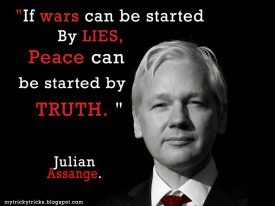
We need to ask ourselves why the focus is not on the crimes perpetrated by those involved in war crimes. Why is an Australian citizen being subjected to US espionage laws even though he was never on US soil? More importantly, why should an Australian citizen have allegiance to the US?
Australia and the Morrison government now face the stark choice. Do we defend an Australian citizen facing rendition and an effective death sentence, because of Trump – a President facing impeachment. Or do we abandon him?
The Swedish case against Assange was always political, https://www.theage.com.au/national/the-swedish-case-against-assange-was-always-political-20191120-p53cgs.html,By Greg Barns and Alysia Brooks, November 20, 2019 It is almost a decade since Julian Assange woke to discover, on the front page of a Swedish newspaper, that Swedish authorities had decided to pursue him on allegations of sexual misconduct. Immediately, Julian presented himself to the police station to make a statement and clear his name. After speaking with prosecutors, he was told he could leave the country; so he did.
It was only after his arrival in London that an Interpol notice was issued for his arrest. In the meantime, Assange sought and was granted asylum in the Ecuadorian embassy on the grounds that he would be subjected to grave human rights abuses should he be extradited to the US. Despite years of his legal team requesting that Swedish authorities provide assurances that he would not be extradited onwards to the US, the opportunity for Assange to formally clear his name was never afforded to him. Nor was the right to the presumption of innocence. Many in the media still falsely claim that charges were laid. It was trial by media.
The political nature of the Swedish case became apparent from the beginning. As early as 2013, emails from the UK Crown Prosecution Service, released under Freedom of Information, demonstrated that the prosecutors wanted to drop the case. However, pressure was placed on them to keep it open – and they were told not to get “cold feet”. The London-based organisation Women Against Rape point out that the case was pursued with “unusual zeal” and concluded it was only pursued for the simple fact that he has uncovered war crimes.
Let’s make one thing clear, any sexual misconduct allegations should be treated seriously. But, as Women Against Rape and the UN Special Rapporteur on Torture point out, this case was never about protecting the women involved; it was about ensuring the focus was kept off the war crimes that WikiLeaks exposed, and assassinating Assange’s character.
The decision now to drop the investigation is welcome news for Assange and his legal team, and removes the possibility of extradition from Sweden to the US. However, the fact remains that an Australian citizen is being pursued by the Trump administration for political purposes and is facing serious human rights violations if extradited to the US.
Currently, Assange is held on remand in Belmarsh prison, in conditions that are exacerbating his already fragile health, and impeding his ability to prepare his defence. He is facing unprecedented charges under the US Espionage Act, for allegedly carrying out actions that journalists and publishers engage in as a part of their work. He is facing 175 years – an effective death sentence – for allegedly engaging in journalism.
And let’s not forget the material that was exposed by WikiLeaks. The releases included evidence of war crimes, including torture and unlawful killings, perpetrated during the Iraq and Afghanistan wars, and the Guantanamo files, which demonstrated that the majority of men, and children, were being held and tortured at the prison, even though they were innocent of any crime.
We need to ask ourselves why the focus is not on the crimes perpetrated by those involved in war crimes. Why is an Australian citizen being subjected to US espionage laws even though he was never on US soil? More importantly, why should an Australian citizen have allegiance to the US?
Australia and the Morrison government now face the stark choice. Do we defend an Australian citizen facing rendition and an effective death sentence, because of Trump – a President facing impeachment. Or do we abandon him?
Greg Barns is a barrister and adviser to the Australian Assange Campaign. Dr Alysia Brooks is a human rights and due process advocate.
THE WORST MOMENT was one of a number of “worst” moments. I have sat in many courtrooms and seen judges abuse their positions. This judge, Vanessa Baraitser – actually she isn’t a judge at all; she’s a magistrate – shocked all of us who were there.
Her face was a progression of sneers and imperious indifference; she addressed Julian Assange with an arrogance that reminded me of a magistrate presiding over apartheid South Africa’s Race Classification Board. When Julian struggled to speak, he couldn’t get words out, even stumbling over his name and date of birth.
When he spoke truth and when his barrister spoke, Baraister contrived boredom; when the prosecuting barrister spoke, she was attentive. She had nothing to do; it was demonstrably preordained. In the table in front of us were a handful of American officials, whose directions to the prosecutor were carried by his — back and forth this young woman went, delivering instructions.
The Magistrate watched this outrage without a comment. It reminded me of a newsreel of a show trial in Stalin’s Moscow; the difference was that Soviet show trials were broadcast. Here, the state broadcaster, the BBC, blacked it out, as did the other mainstream channels.
Having ignored Julian’s barrister’s factual description of how the CIA had run a Spanish security firm that spied on him in the Ecuadorean embassy, she didn’t yawn, but her disinterest was as expressive. She then denied Julian’s lawyers any more time to prepare their case — even though their client was prevented in prison from receiving legal documents and other tools with which to defend himself.
Her knee in the groin was to announce that the next court hearing would be at remote Woolwich, which adjoins Belmarsh Prison and has few seats for the public. This will ensure isolation and be as close to a secret trial as it’s possible to get. Did this happen in the home of the Magna Carta? Yes, but who knew?
Julian’s case is often compared with Dreyfus, but historically it’s far more important. No one doubts – not his enemies at The New York Times, not the Murdoch press in Australia – that if he is extradited to the United States and the inevitable Supermax, journalism will be incarcerated, too.
Who will then dare to expose anything of importance, let alone the high crimes of the West? Who will dare publish ‘Collateral Murder’? Who will dare tell the public that democracy, such as it is, has been subverted by a corporate authoritarianism from which fascism draws its strength?
Once there were spaces, gaps, boltholes, in mainstream journalism in which mavericks, who are the best journalists, could work. These are long closed now. The hope is the samizdat on the internet, where fine disobedient journalism is still practised.
The greater hope is that a judge or even judges in Britain’s court of appeal, the High Court, will rediscover justice and set him free. In the meantime, it’s our responsibility to fight in ways we know but which now require more than a modicum of Julian Assange’s courage.
BY JESSICA KWONG ON 5/7/19 President Donald Trump and his son-in-law and senior White House adviser Jared Kushner have been accused of breaking the law by failing to keep records of their meetings with foreign government officials including Russian President Vladimir Putin, North Korean leader Kim Jong Un and top Saudi officials.
In a lawsuit filed Tuesday against Trump and the executive office of the president, the watchdog Citizens for Responsibility and Ethics in Washington (CREW) alleged that White House officials including the president and Kushner seem to have violated the Presidential Records Act and the Federal Records Act by intentionally neglecting to create and keep records of meetings with Putin and Kim, among other foreign officials.
“There are a lot of questions surrounding Jared Kushner and the extent to which he, like the president, has an agenda that also serves his own personal and family business interests,” CREW’s chief FOIA counsel Anne Weismann told Newsweek on Tuesday.
The suit cites news reports that Trump had at least five different meetings with Putin with no notetaker in the room, meaning an official record of the meeting does not exist. Trump also confiscated a State Department interpreter’s notes after meeting with Putin in Germany, and had a private meeting with Kim in Vietnam with two interpreters but no record was produced, according to the suit.
In addition, the suit raises a recent meeting Kushner had with top Saudi officials that did not include State Department officials, and from which no record was created.
“The absence of records in these circumstances when the President and his top advisers are exercising core constitutional and statutory powers causes real, incalculable harm to our national security and the ability of our government to effectively conduct foreign policy,” the suit states, “Because the documentary record of this administration’s foreign policy regarding Russia, North Korea, and Saudi Arabia will be unavailable to policy makers and forever lost to history.”
Weismann said Kushner—whom Trump tasked with creating a supposedly soon-to-be-released Middle East peace plan—is meeting with very sophisticated and possibly adversarial foreign leaders and “that alone raises concerns.”
“He may be compromising American interests in ways that we don’t know about,” Weismann said. “Even if he’s not acting to pursue his business or financial interests, he doesn’t come to the job with experience in foreign relations.”
The White House did not immediately respond to a request for comment from Newsweek on Tuesday.
Co-plaintiffs in the suit are the National Security Archive and the Society for Historians of American Foreign Relations, which has nearly 1,000 members.
“The problem goes beyond improperly shredding records, to the deliberate failure to create the records in the first place,” stated Tom Blanton, director of the archive, which has sued past presidents who failed to keep records.
Neglecting to make and preserve records “undermines the principle of government accountability that is the very bedrock of democracy,” the historians society president Barbara Keys stated.
By Sara Chessa | 5 November 2019 Former Icelandic Interior Minister tells Independent Australia how he blocked U.S. interference in 2011 in order to defend WikiLeaks and its publisher Julian Assange. Sara Chessa reports.
Former Icelandic Interior Minister tells Independent Australia how he blocked U.S. interference in 2011 in order to defend WikiLeaks and its publisher Julian Assange. Sara Chessa reports.
A MINISTER OF THE INTERIOR wakes up one summer morning and finds out that a plane full of United States Federal Bureau of Investigation (FBI) agents has landed in his country, aiming to carry out police investigations without proper permission from the authorities.
How many statesmen would have the strength to say, “No, you can’t do this”, to the United States? Former Icelandic Interior Minister Ögmundur Jónasson, in fact, did this — and for the sake of investigative journalism. He understood that something wrong with the sudden FBI mission in Reykjavik, and that this had to do with the whistleblowing website WikiLeaks and its publisher Julian Assange. Continue reading →
Will you come and help?’ Father of Julian Assange on campaign to free his son, Irish Examiner, MICHAEL CLIFFORD November 09, 2019 At 80, John Shipton thought he would be enjoying his retirement, he tells Michael Clifford. Instead, he is touring European capitals campaigning for his son, Wikileaks founder Julian Assange.
A parent’s work is never done. John Shipton entering his ninth decade. He’d like to kick back, maybe learn a few recipes, stroll at a leisurely pace towards the declining years.
But his son needs him. His son’s health is in serious danger and his future looks dark, with the prospect of spending decades, if not the remainder of his life, in prison.
His son is Julian Assange. It’s a name that is familiar to most people, although many would, at this remove, find it difficult to couple his celebrity standing with his talent or achievement.
Assange is an Australian who has been a serious thorn in the side of the powerful. His Wikileaks organisation was responsible for disseminating information that showed what exactly the US and its allies were getting up to in foreign wars.
Wikileaks exposed war crimes. It was the receptor for whistleblower Chelsea Manning’s treasure trove of documents that painted a picture of torture and maltreatment by US forces in Iraq, among other crimes.
Vanity Fair described the resultant stories as “one of the greatest journalistic scoops of the last 30 years… they have changed the way people think about how the world is run”…….
Assange is a category B prisoner, which means he’s not considered an immediate danger to fellow human beings or society in general, but his conditions of detention are still onerous.
“He’s locked up 22 or 23 hours a day,” his father says. “It’s a grade A maximum security prison. Because those in it are treated like terrorists, that’s what Julian is being subjected to.”
Shipton was in Dublin recently on a flying visit that now forms part of his current “job”. That entails lobbying, meeting, and publicising on behalf of his son. Shipton is on a tour of European capitals trying to round up support……
Assange is in a bad way, there is no doubt about that. Both physically and psychologically, his condition is deteriorating. The prison conditions are onerous but they come following eight years cooked up in the embassy, at times under serious stress. The day before arriving in Dublin Shipton had been in to see his son.
“As you would expect after nine years of persecution, he’s a bit down in the dumps,” he says.
“The report of the UN rapporteur on torture says it all really, pointing out that he has every sign of having suffered torture with both physical and mental results…..
The UN rapporteur on torture, Nils Melzer, did visit Assange with two doctors in June in Belmarch and were highly condemnatory of the conditions in which he was being kept.
Last week, Melzer issued a further statement, saying Assange’s life was at risk and that he must not be extradited to the US as a consequence of “exposing serious governmental misconduct”…..
Melzer goes further and offers an opinion on what is driving the harsh treatment.
“In my view, this case has never been about Mr Assange’s guilt or innocence, but about making him pay the price for exposing serious governmental misconduct, including alleged war crimes and corruption,” he says. “Unless the UK urgently changes course and alleviates his inhumane situation, Mr Assange’s continued exposure to arbitrariness and abuse may soon end up costing his life.”…..
Since coming to power, Trump has railed against many forms of the free press. And his government has requested Assange’s extradition to stand trial for spying.
If he is extradited, his father doesn’t have much confidence in the prospects of a fair trial.
“The espionage law courts are held in Elizabeth, Virginia,” says Shipton. “It’s a town where all the constituents are from the intelligence community. Every judgement in the espionage courts they say just go to jail. It’s not theoretical. If he’s tried he will go to jail.”
The next hearing on extradition isn’t scheduled until February and on the basis that he previously did skip bail while awaiting an extradition hearing he is unlikely to get bail. For his family and close friends, the most immediate issue is his health rather than the political and legal vortex into which he has been drawn.
At a recent court appearance on October 21, he was described by eyewitnesses as appearing “distressed and disorientated”.
He is subject to a legal process, but few could argue that it is anything more than political. Assange published leaked material. In that he was performing an act of journalism.
Manning, for instance, was prosecuted and served seven years of what was originally a 35-year sentence. But Assange’s role was that of publisher.
Much of Wikileaks most serious material was presented in collaboration with leading global newspapers, including the New York Times and The Guardian.
His father believes that the attack on the press through Assange is not fully appreciated.
Mainstream Media Fights for Own Freedom, But Not for Assange’s, Sydney Criminal Lawyers,02/11/2019BY PAUL GREGOIREMajor Australian mainstream media outlets joined forces a fortnight ago to launched the Right to Know campaign. It aims to see public interest journalism decriminalised, and safeguards for whistleblowers enhanced.This unprecedented display of unity has seen The Guardian, the ABC, Nine, News Corp, SBS and the MEAA join forces in calling on the government to enact reforms. And this is rather significant, considering some of these organisations have been much criticised for towing the party line.
The Right to Know has six demands: exceptions so journalists can’t be prosecuted under national security laws, freedom of information reform, defamation law reform, a narrowing of the information classified as secret, protections for whistleblowers and the right to contest warrants.
Of course, the campaign was sparked by the June AFP press raids, which saw agents rifle through the house of a News Corp journalist, as well as the offices of the national broadcaster, in what was understood by many to be a warning to the media and whistleblowers to keep quiet.
However, a glaring campaign omission is the case of an Australian publisher who’s currently being remanded in the UK over charges that apply in the US, which relate precisely to public interest journalism. Yet, the Australian media has all but forgotten their colleague, Julian Assange.
Silenced by association
“The Right to Know campaign drives to the heart of the matter more than many journalists realise,” remarked Ian Rose, a member of the Support Assange and Wikileaks Coalition.
“While on the one hand, they’re right to finally be calling out the creeping incursions and restrictions into media freedoms,” he told Sydney Criminal Lawyers. “On the other, they don’t have the inner fortitude to stand up for Assange.”
According to Rose, there are two reasons that the Australian media has abandoned the Walkley award-winning journalist. One is that he’s “an egalitarian”, which “frightens the hell out of the ruling class”, as most of the work of WikiLeaks has been all about exposing their lies.
The second reason behind the silence is that the “oligarchs” are the “journalists’ paymasters”. And for this reason – which is underscored by the justifiable fear of losing their lives – journalists have refrained from “calling these people out”.
An excuse for silencing
Attorney general Christian Porter spoke out against the Right to Know campaign, claiming that by providing the media with the right to contest warrants could hinder criminal investigations. And he also asserted that the campaign demands could lead to national security threats.
As an example of how the media could become such a threat, Porter pointed to Assange having published leaked classified documents on WikiLeaks. The top lawmaker further set out that while this act of publication was widely condemned, the local industry still awarded Assange a Walkley……..
Neglecting an ally
And as for what the Australian media should be doing about one of its own locked away in isolation in circumstances that undermine the rule of law, Mr Rose says that it “ought to get over its jealousy and unite to support Assange”.
Indeed, the Right to Know campaign should embrace Assange’s cause, as it’s the quintessential example of the concerted crackdown on journalists that’s currently taking place across the western world. And there’s a clear correlation between his silencing and the local AFP raids.
“The way Assange is being treated is the way journalists are starting to be treated, and the way all of society will be treated if we don’t collectively call for a stop to the new dictatorial world order,” Rose warned.
Welcome to the “nuclear sponge.” A bizarre idea that has outlived its questionable Cold War-era usefulness, the nuclear sponge is the United States’ collection of land-based intercontinental ballistic missiles intended to “soak up” a nuclear attack.
by Tom Z. CollinaAkshai Vikram 6 Nov 19, The media is abuzz about the epic battle between corporate titans Northrop Grumman and Boeing over who will win the $100 billion contract to build a new nuclear-armed ballistic missile. For those who are keeping score, it looks like Northrop will win a sole-source contract, which would be a disaster for taxpayers.
But media coverage of the Clash of the Titans is missing the real story. This is not about contractor wars or sweet-heart deals. This is about the integrity of our government: why, thirty years after the end of the Cold War, are we rebuilding nuclear weapons that we do not need? Why are we spending national treasure to buy weapons that make us less safe?
What if we told you that residents of Colorado, Montana, Nebraska, North Dakota, and Wyoming are being used as bait in a nuclear war with Russia? Surely, no sane person would accept or offer such terms. However, if you live anywhere near these states, you already have a nuclear target on your back.
Welcome to the “nuclear sponge.” A bizarre idea that has outlived its questionable Cold War-era usefulness, the nuclear sponge is the United States’ collection of land-based intercontinental ballistic missiles (ICBMs) intended to “soak up” a nuclear attack. Before the development of nuclear-armed submarines that can hide their locations at sea, ICBMs were the crux of American nuclear strategy. Today, however, their only purpose is to draw fire away from other targets (like New York and San Francisco) in the (suicidal and thus highly unlikely) event of a first strike by Russia. The Air Force does not plan to launch the missiles in a war, but to have them draw a nuclear attack to the Upper Midwest.
We’re not making this up—that’s what former Defense Secretary Jim Mattis told Congress. However, sacrificing the Upper Midwest not only undervalues the people who live there but would not actually spare the residents of other states. A major nuclear war with Russia would doom the entire nation. It would little matter whether one resides in Manhattan or Montana.
Why then are we rebuilding the nuclear sponge? The answer, as House Armed Services Committee Chair Adam Smith (R-CA) recently highlighted, has much more to do with parochial interests and money than national security.
When asked at a recent press conference why states would want to host the missiles, and thereby put themselves at risk, Smith said, only partly in jest, “They’re fond of their missiles. Apparently, they want to be targeted in a nuclear first strike.” And then, more seriously, he said “They want the jobs . . . no matter the circumstances. And that’s not rational. It’s parochial.”
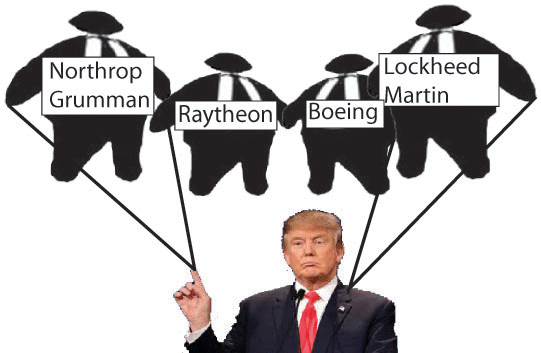
With current ICBMs getting older, the Trump administration has greenlit a new cohort of missiles as part of an almost $2 trillion nuclear rebuild plan over the next thirty years. The price tag for the new ICBM alone is potentially $140 billion. That contract is currently slated to go to Northrop Grumman, even as it fights off a Federal Trade Commission investigation for unfair competition, which may cost taxpayers “billions.”
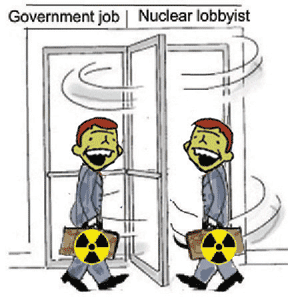
Northrop Grumman and others have hijacked the nuclear-security agenda of the United States through the usual Washington channels: lobbying and campaign contributions. In the 2018 election cycle, Northrop spent $5.6 million in campaign contributions. In fact, Northrop spends more than any other defense contractor on lobbying and is just behind Amazon and Facebook. Defense contractors have grown even more powerful with a willing ally in the White House. Simply put, the Trump administration has filled its top national-security ranks with people holding extensive ties to major defense contractors.
Mattis worked for General Dynamics and received speaking fees from Northrop Grumman. The current defense secretary, Mark Esper, worked for Raytheon. Ex-White House Chief of Staff John Kelly worked for DynCorp; former Deputy Defense Secretary Mike Shanahan’s employment history at Boeing goes back over thirty years. Meanwhile, Undersecretary of Defense for Policy John Rood worked for Lockheed Martin as did former Secretary of the Air Force Heather Wilson. In fact, that’s where she skirted lobbying restrictions. This list goes on.
Programs such as a new ICBM are strategically unnecessary, economically unsustainable, and morally abhorrent. The missiles would be destroyed in a first strike (Russia knows where they are; you can find them on Google Maps) and serve no purpose except to “absorb” blows in a war whose fallout would kill most Americans anyway. Some jobs are created—but far more jobs could be created if the money was spent in other ways. In 2019, there are surely better ways to employ people than to have them guard Cold War relics. As Smith observed after visiting bases that host nuclear weapons, “what struck me was that the job is unbelievably boring.” Maybe that’s why substance abuse continues to plague these sites, with service members literally falling asleep on duty.
Clearly, our nuclear policy needs a reboot. As Sen. Elizabeth Warren(D-MA) has said “Take any big problem we have in America today and you don’t have to dig very deep to see the same system at work . . . despite our being the strongest and wealthiest country in the history of the world, our democracy is paralyzed. And why? Because giant corporations have bought off our government.”
Warren was talking about climate change, guns, and healthcare, but her remarks hold just as true for nuclear weapons. The next president must tackle corruption in nuclear policy aggressively—by throwing away the nuclear sponge. Tom Collina is Policy Director and Akshai Vikram is a Hale Fellow at Ploughshares Fund, a global security foundation in Washington DC.
Julian Assange’s Extradition Process Is ‘A Charade’, The Real News Network, November 5, 2019
Interview Transcript
GREG WILPERT: Julian Assange recently lost a court bid to have his upcoming February 2020 extradition hearing postponed. The hearing about the postponement took place on October 21, and according to observers who were present, he could barely speak in coherent sentences. Reacting to the hearing, UN Human Rights Rapporteur Nils Melzer warned last Friday that Assange continues to show symptoms of psychological torture. Melzer had visited Assange in May when he conducted an extensive review of his physical and psychological condition. In his statement on Friday, Melzer said, “Despite the medical urgency of my first appeal, and the seriousness of the alleged violations, the U.K. has not undertaken any measures of investigation, prevention, and redress required under international law.”
In addition to the concerns about Assange’s treatment at Belmarsh Prison outside of London, many have also raised concerns about the impartiality of the proceedings against him. Assange was jailed last April when the Ecuadorian Embassy, where he had been given political asylum, allowed the police to arrest him. He then received a 50-week sentence for having skipped jail in 2012. The Trump Administration has since then requested Assange’s extradition on 17 charges of espionage for which he could receive a 170-year prison sentence in the United States.
Joining me now to discuss the latest developments in the case of Julian Assange is John Pilger. He has been observing the Assange case very closely and was present at the October 21 court hearing……
John Pilger – “…..His physical condition has changed dramatically. He’s lost about 15 kilos in weight. To see him in court struggling to say his name, and his date of birth, was really very moving. I’ve seen that when I visited Julian in Belmarsh Prison where he struggles at first, and then collects himself. I’m always impressed by the sheer resilience of the man, because as Melzer says, absolutely nothing has been done to change the conditions imposed on him by the prison regime. Nothing has been done by the British authorities.
This was almost underlined by the contemptuous way that this court hearing recently was conducted by this judge, by this magistrate. There was a sense among all of us who were there that the whole charade, and it seemed a charade, was preordained. You had sitting in front of us, on a long table, four Americans who were from the U.S. Embassy here in London, and one of the prosecution team was scurrying backwards and forwards to get instructions from them. The judge could see this, and she allowed it. It was just absolutely outrageous.
When Julian did try to speak, and to say that basically he was being denied the very tools with which to prepare his case, he was denied the right to call his American lawyer. He was denied the right to have any kind of word process or laptop. He was denied certain documents. As he said, “I’m even denied my own writings,” as he called it. That is, his own notes and manuscripts. This hasn’t changed at all, and of course the effect of that on his morale, to say the least, has been very significant, and that showed in the court.
Greg Wilpert – ” ….district judge, Vanessa Baraitser, and one of the things that she did was completely dismiss Assange’s request for determination whether the extradition proceedings are even legal. That is, he cites according to U.K. law, “Extradition shall not be granted if the offense for which extradition is requested is a political offense”
JOHN PILGER quotes Julian’s lawyer Gareth Peirce – “….under law, it’s not a matter of opinion. They are political. All but one of the charges concocted in Virginia are based on the 1917 Espionage Act, which was a political piece of legislation used to chase off the conscientious objectors during the first World War.
It’s political. There is no charge. There is no basis, no foundation, for allowing these extradition proceedings to go forward, and almost perversely the judge seemed to, if not acknowledged that in her contempt for the proceedings. Whenever Julian Assange spoke, she feigned a disinterest, a boredom, and whenever his lawyers spoke, the same thing.
Whenever the prosecutor spoke, she was attentive. The theatrics of this hearing were quite remarkable. I’ve never seen anything like it. Then very hurriedly, when Julian Assange’s lawyer requested a delay in when the case actually starts from February, they said, “We’re not going to be ready in February,” and she dismissed that out of hand.Not only that, she said that the extradition case would be held in a court that is in fact adjoining Belmarsh prison. It’s almost part of the prison. It’s a long way out of London.
So you have, if not a secret trial, but a trial in which, or an extradition hearing in which very few seats are available to the public. It’s a very difficult place to get to. So every obstacle has been put in the way of Assange getting a fair hearing. And I can only repeat, this is a publisher and a journalist convicted of nothing, charged with nothing in Britain, whose only crime is journalism. That may sound like a slogan, but it’s true. They want him for exposing the kind of outrageous war crimes, Iraq, Afghanistan, that journalists are supposed to do. “
GREG WILPERT: “…….How do you explain this lack of concern among the media and human rights groups for Assange’s situation?
JOHN PILGER: Because so many human rights groups are deeply political, Amnesty International never made Chelsea Manning a prisoner of conscience. A really disgraceful thing. Chelsea Manning, who was effectively tortured in prison, and they haven’t, as you say, they haven’t elevated Julian’s case. Why? Well, they’re an extension. They’re an extension of an establishment that is now almost systematically coming down on any form of real dissent. In the last five, six years, the last gaps, the last bolt holes, the last spaces in the mainstream media for journalists, from average journalists for the likes Assange, not only Assange, for the likes of people like even myself and others, have closed.
The mainstream media, certainly in Britain, always held open those spaces. They’ve closed, and there is generally I would think a fear, right throughout the media, a fear about opposing the state on something like the Assange case. You see the way the whole obsession with Russia has consumed the media with so many nonsensical stories. The hostility, the animosity towards Julian. My own theory is that his work shamed so many journalists. He does what journalists ought to have done, and don’t do any more. He’s done the job of a journalist. That can only explain it. I mean when you take a newspaper like The Guardian, which published originally the WikiLeaks revelations about Iraq and Afghanistan, they turned on Julian Assange in the most vicious way.
They exploited him for one thing. A number of their journalists did extremely well with their books, and Hollywood scripts, and so on, but they turned on him personally. It was one of the most unedifying sights I think I’ve ever seen in journalism. The same thing happened in the New York Times. Again, I can only surmise the reason for that. It’s that he shames them. We have a desert of journalism at the moment. There are a few who still do their jobs; who still stand up against establishment power; who still are not frightened. But there’re so few now, and Julian Assange is totally fearless in that. He knew that he was going to run into a great deal of trouble with the state in Britain, the state in the United States–but he went ahead anyway. That’s a true journalist…… https://therealnews.com/stories/julian-assange-extradition-process-charade
The charge against Julian is very specific; conspiring with Chelsea Manning to publish the Iraq War logs, the Afghanistan war logs and the State Department cables. The charges are nothing to do with Sweden, nothing to do with sex, and nothing to do with the 2016 US election; a simple clarification the mainstream media appears incapable of understanding.
The campaign of demonization and dehumanization against Julian, based on government and media lie after government and media lie, has led to a situation where he can be slowly killed in public sight, and arraigned on a charge of publishing the truth about government wrongdoing, while receiving no assistance from “liberal” society.
Unless Julian is released shortly he will be destroyed. If the state can do this, then who is next?
I was deeply shaken while witnessing yesterday’s events in Westminster Magistrates Court. Every decision was railroaded through over the scarcely heard arguments and objections of Assange’s legal team, by a magistrate who barely pretended to be listening.
Before I get on to the blatant lack of fair process, the first thing I must note was Julian’s condition. I was badly shocked by just how much weight my friend has lost, by the speed his hair has receded and by the appearance of premature and vastly accelerated aging. He has a pronounced limp I have never seen before. Since his arrest he has lost over 15 kg in weight.
But his physical appearance was not as shocking as his mental deterioration. When asked to give his name and date of birth, he struggled visibly over several seconds to recall both. I will come to the important content of his statement at the end of proceedings in due course, but his difficulty in making it was very evident; it was a real struggle for him to articulate the words and focus his train of thought.
Until yesterday I had always been quietly skeptical of those who claimed that Julian’s treatment amounted to torture – even of Nils Melzer, the UN Special Rapporteur on Torture – and skeptical of those who suggested he may be subject to debilitating drug treatments. But having attended the trials in Uzbekistan of several victims of extreme torture, and having worked with survivors from Sierra Leone and elsewhere, I can tell you that yesterday changed my mind entirely and Julian exhibited exactly the symptoms of a torture victim brought blinking into the light, particularly in terms of disorientation, confusion, and the real struggle to assert free will through the fog of learned helplessness. Continue reading →
In 2010, nuclear engineer Donna Busche warned of the risks of a disastrous radioactive explosion at a Hanford site waste-treatment plant, then under construction. She insisted on the need for a “hazard review” that would cause costly delays for her employer, a federal Energy Department contractor. And she refused to back down even under intense workplace harassment that ended with her firing for “unprofessional conduct.”
Busche testified before a federal nuclear-safety board, met with U.S. senators and helped to launch a lawsuit against two major Hanford contractors alleging the multibillion-dollar project failed to meet rigorous nuclear quality standards.
“The impact on your personal life is hell,” Busche said. “People who I thought were my friends, I found out they are not my friends.”
In taking these steps, Busche became a Hanford whistleblower, one of hundreds of people who through the decades have raised alarms about waste, fraud and safety problems at the massive cleanup operations of the south central Washington federal site that once produced the plutonium for U.S. nuclear weapons.
“Hanford is ground zero for whistleblowing in America,” said Tom Mueller, author of “Crisis of Conscience,” a sweeping new chronicle of the nation’s whistleblowers, the difficulties they have faced and the wrongdoing they have exposed. “It has all the key factors … You have corporate power. You have government. You have huge amounts of money, and secrecy. Time and time again, taxpayer dollars are misspent.” Continue reading →
Indian nuclear power plant’s network was hacked, officials confirm
After initial denial, company says report of “malware in system” is correct. SEAN GALLAGHER – 10/31/2019
The Nuclear Power Corporation of India Limited (NPCIL) has acknowledged today that malware attributed by others to North Korean state actors had been found on the administrative network of the Kudankulam Nuclear Power Plant (KKNPP). The admission comes a day after the company issued a denial that any attack would affect the plant’s control systems.
In a press release today, NPCIL Associate Director A. K. Nema stated, “Identification of malware in NPCIL system is correct. The matter was conveyed by CERT-In [India’s national computer emergency response team] when it was noticed by them on September 4, 2019.”
That matches the date threat analyst Pukhraj Singh said he reported information on the breach to India’s National Cyber Security Coordinator.
“The matter was immediately investigated by [India Department of Atomic Energy] specialists,” Nema stated in the release. “The investigation revealed that the infected PC belonged to a user who was connected to the Internet connected network used for administrative purposes. This is isolated from the critical internal network. The networks are being continuously monitored.”
Lazarus in the house
It’s not clear if data was stolen from the KKNPP network. But the nuclear power plant was not the only facility Singh reported being compromised. When asked by Ars why he called the malware attack a “casus belli”—an act of war—Singh, a former analyst for India’s National Technical Research Organization (NTRO), said, “It was because of the second target, which I can’t disclose as of now.”
The malware in question, named Dtrack by Russian malware protection company Kaspersky, has been used in widespread attacks against financial and research centers, based on Kaspersky data collected from over 180 samples of the malware. Dtrack shares elements of code from other malware attributed to the Lazarus threat group, which, according to US Justice Department indictments, is a North Korean state-sponsored hacking operation. Another version of the malware, ATMDtrack, has been used to steal data from ATM networks in India.
DTrack appears to be an espionage and reconnaissance tool, gathering data about infected systems and capable of logging keystrokes, scanning connected networks, and monitoring active processes on infected computers. The malware may have been delivered by an “in-memory implant,” Singh said, though he added that he is waiting for confirmation from other sources. He added that he had not seen any data indicating whether data had been stolen from the KKNPP network. “I didn’t have the full indicators,” Singh said.
While the attack may not have given direct access to nuclear power control networks, it could have been part of an effort to establish a persistent presence on the nuclear plant’s networks. As a paper published in May by the International Committee of the Red Cross on the human cost of cyber operations pointed out, “the majority of the computer devices in the world are only one or two steps away from a trusted system that a determined attacker could compromise.” Lukasz Olejnik, a security researcher who co-authored the paper, noted that “preemptive compromise of trusted systems would make attacks significantly easier,” and that establishing a persistent presence on a network could aid in things such as supply-chain attacks—attempts to use software update processes or other potential opportunities to move to isolated networks to deliver an attack in the future.
That’s similar to the route demonstrated by Stuxnet, the malware attributed to US and Israeli intelligence that managed to jump an “air gap” into Iranian nuclear enrichment equipment controls. While the administrative network of KKNPP was likely not a good route for such an attack given standards for nuclear control systems security, it certainly could provide information about maintenance operations that would be useful for espionage—or for a future attempted cyber-attack. more https://arstechnica.com/information-technology/2019/10/indian-nuclear-power-company-confirms-north-korean-malware-attack/
Why is it that the Australian government is so helpful to Australian murderers and drug dealers imprisoned overseas, but so relentlessly unhelpful to an Australian whose only crime is to tell the truth?
October 28, 2019, Julian Assange’s British legal team has requested Australian diplomatic help as fears grow for his health and mental state in a London prison.
Australian officials told a Senate estimates hearing on Thursday that diplomats had not heard back from Assange’s lawyer since writing to her last week asking that she raise with him their offer of consular assistance.
Barrister Greg Barns, an adviser to the Australian Assange campaign, told The Age and The Sydney Morning Herald his UK lawyers on Friday requested consular assistance following a recent inquiry from the Department of Foreign Affairs and Trade.
“Julian’s lawyers are asking for the Australian government’s assistance in dealing with their client’s inhumane conditions in Belmarsh prison which has led to, and is continuing to cause, serious damage to Julian’s health,” Mr Barns said.
Assange was due to be released on September 22 but was told at a court hearing last month he would be kept in jail because there were “substantial grounds” for believing he would abscond.
The Australian Lawyers Alliance (ALA) passed a motion at its national conference on Saturday calling for the Australian government to do “all it can” to bring Assange home and resist US attempts to extradite him.
ALA national president Andrew Christopoulos said it was an important issue about the rule of law and protecting an Australian in a vulnerable position overseas.
“This is about standing up for the rule of law, fairness and the freedom to expose wrongdoing,” he said. “The reported decline of Julian Assange’s physical and mental health heightens the need for urgent government intervention. The government has intervened in cases like this before and should do so in this circumstance.”
If the case goes to a series of appeals, Assange could remain in a UK jail until at least 2025.
Foreign Minister Marise Payne last week acknowledged the publicity around the case and that Assange had high-profile and loyal supporters. She said it was important to let the legal process run its course.
“He has been offered consular services … like any other Australian would,” Senator Payne told the Senate committee. “I think it’s important to remember that as Australia would not accept intervention or interference in our legal processes, we are not able to intervene in the legal processes of another country
“Media outlets have faced attacks in the form of centralisation of private ownership, funding cuts to public broadcasters, and potential prosecution of journalists, including News Corp journalist Annika Smethurst.”
One of the report’s authors, Geoffrey Watson, SC, former counsel assisting the Independent Commission Against Corruption, said he had been shocked by how quickly the brutal type of politics that evolved in the United States and the United Kingdom, and partly led to the ascendancy of Donald Trump and Boris Johnson, had taken root in Australia.
“One day you see the judiciary attacked and the next someone in the media,” said Mr Watson, who is a director of the Centre for Public Integrity. “On the third day it might be the CSIRO, they even attack our scientists. Some people don’t recognise it as the same problem, but it is all part of the same disease.”
He said the effectiveness of the media in Australia as a watchdog was not only threatened by personal and legal attacks by the government, but by regulations that had allowed ownership of newspapers to be reduced to an effective duopoly.
The report, entitled “Protecting the Integrity of Accountability Institutions”, said that a range of institutions – including the judiciary and the Administrative Appeals Tribunal, the public service, integrity commissions such as the ICAC, statutory authorities such as the Human Rights Commission and the Fair Work Commission, and the CSIRO – had all been targeted in recent years by interested parties seeking to undermine their independence and public trust.
“These institutions are important not only because they ensure actual accountability, transparency and good governance but because they build confidence and trust within the Australian community,” it said. “When this confidence and trust is diminished, divisiveness and conflict increase. This impacts social cohesiveness and the economy, and the welfare of all Australians suffers. Ultimately, as international experience has shown, it is a threat to democracy itself.”
It cited as examples of interference attempts by federal ministers to influence the Victorian Court of Appeal in 2017 terrorism cases, sustained funding cuts and personal attacks on the ABC, and the de-skilling of the public service through the outsourcing of up to 50 per cent of government departments to contractors.
The report listed a series of principles that needed to be respected in order to protect the independence of the threatened institutions. They include protection from political retribution, secure and sufficient funding, secure tenure of senior officials and public access to advice to the government from accountability institutions, as well as the creation of an effective federal integrity watchdog.
The Centre for Public Integrity, a independently funded think tank, was formed earlier this year in part to champion the case for a such a body. The report comes in the midst of a campaign by Australian media, including the Herald and The Age, to defend the public right to information in the face of increasing attempts by government and government agencies to suppress information, prosecute whistleblowers and criminalise legitimate public interest journalism.
October 28th, 2019, by Chris Yelland, investigative editor, EE Publishers An explosive letter, dated 17 October 2019, from the current Nuclear Energy Corporation of South Africa (Necsa) board to the Parliamentary Portfolio Committee on Minerals and Energy, reveals startling new information relating to the misuse of Necsa’s funds by the former board under fired former chairman Kelvin Kemm and former CEO Phumzile Tshelane.
The letter reveals that Necsa has been making massive operating losses since 2014, which have deteriorated over the years, and has resulted in various ring-fenced funds being irregularly used to meet operating expenses, including salaries.
For example, the letter says that in financial year (FY) 2018/19, Necsa raided R268-million from the Safari low-enriched uranium (LEU) spent Fuel Waste Disposal Fund, which was meant for future disposal of spent nuclear fuel waste, in order to meet operating costs.
The Safari-1 reactor became one of Necsa’s cornerstone facilities, especially during the mid 1990’s, where it’s main application was to be a cost-sustainable facility operating as a commercial production facility of radioisotopes and the rendering of irradiation services.
Furthermore, in FY 2017/18, the letter indicates that Necsa borrowed R58,5-million from its subsidiary, NTP Radioisotopes, which was to be repaid in 2019, but was subsequently unilaterally extended to 2021 when it became clear that Necsa could not afford to repay NTP Radioisotopes.
In FY 2016/17, Necsa is said to have used R100-million of investments of the Safari LEU Spent Fuel Waste Disposal Fund as security for a R100-million overdraft facility from Nedbank, which the bank later withdrew due to the absence of a turnaround strategy to address Necsa’s strained financial position.
This, according to the letter, then forced Necsa to raid R100-million from the Safari LEU Spent Fuel Waste Disposal Fund to meet operating costs, and this R100-million was later repaid to the Fund from government grant funding.
The effect of the unconventional funding interventions in previous years, says the letter, was that about R445-million of ring-fenced funds were used for operations, despite being meant for other purposes, thus negatively affecting Necsa’s liquidity and solvency.
The letter further says that Necsa has been technically bankrupt since about 2016, and has survived using ring-fenced funds, which has cumulatively had an impact on the going concern status on the entity – a challenge which the current board is now faced with.
This letter from the new Necsa board to Parliament follows a damning audit report by the Auditor General of South Africa detailing the maladministration and irregular expenditure under the former Necsa board. The qualified audit report was attached Necsa’s financial statements for FY 2017/18, which were tabled about six months late by the former board.
Necsa’s financial statements for FY 2018/19 are also late, as the new board grapples with the political turmoil and disruptive actions by labour union NEHAWU. It is expected that there will be further explosive revelations by the Auditor General.
The entire former board of Necsa was removed by the former minister of energy, Jeff Radebe, in December 2018, and there is ongoing litigation in this regard.
 J
J











 nuclear-news