Climate science deniers jump on to Far Right with QAnon conspiracy group
In May, a second Q-Drop riffed on climate change, with a link to a snarky tweet about science and the Swedish teen climate activist Greta Thunberg by a would-be House Republican who’d lost her primary race in March.
Both of those Q-Drops were picked up by a report commissioned by a coalition of environmental groups and conducted by the research firm Graphika, which found that a group of vocal climate science deniers began using QAnon hashtags in May — and they haven’t stopped since.
“The QAnon movement hasn’t traditionally covered climate change, but in May, when an influential QAnon account tweeted about climate denial, there was a notable and sustained increase of QAnon content shared within the climate denial group,” Michael Khoo, an advisor on disinformation for the environmental group Friends of the Earth, and Melissa Ryan, CEO of CARD Strategies and author of the Ctrl Alt-Right Delete weekly newsletters, wrote in an article published today on Medium.
Asked and Answered
The questions that Q advanced on climate change have been asked and answered — as essentially all of the burning questions on climate science still churning around in climate denial circles have been.
And today, as the impacts of a warming climate are accelerating, it is very clear that we collectively have little time to spare waiting until those who haven’t been keeping up with, or who refuse to acknowledge, the scientific consensus are convinced. The longer the world waits to slash greenhouse gas pollution, the less chance we collectively have to calm the worst impacts of a warming world, according to the world’s top climate experts, and if we don’t, climate change could make all of the calamities we’ve faced in 2020 soon pale in comparison.
Q, however, raised different concerns about climate action.
“Who audits where the money goes?” the December Q-Drop asked, linking to an article about the Green Climate Fund, which provides funding to help developing countries reduce their greenhouse gas emissions to help them meet their Paris Agreement goals.
Nevermind that if you want the audits of the Green Climate Fund alluded to in the Q-Drop, the answer is extraordinarily unmysterious and unglamorous: the audited financial statements are posted online and they’re done by accountants. Nevermind also that the Paris Agreement itself was never fundamentally about the movement of money, but instead involves countries promising to regulate pollution inside their borders — something we’re still continuing to fail to do, both in the United States and worldwide.
And nevermind that the U.S., whose politicians the Q-Drop implies are pocketing money somehow along the way, has nearly walked away from both the Paris Agreement and the Green Climate Fund. That’s despite the glaring fact that the U.S. has been the world’s worst climate polluter since 1750, meaning that this country has played the single largest role in causing the very problem that the global climate pact attempts to (somewhat) address.
To turn Q’s question around, one very basic question Q has never answered is who exactly they are — and to what extent, if any, they’ve sought to monetize the power and influence they’ve been busy amassing. “At this point, who’s behind it is speculation more than anything,” Ryan told DeSmog.
Another key part of the problem — as ever — is that climate science deniers publicly talk a lot more than others. Whereas in years past, mainstream media was faulted for giving climate science deniers a misleading amount of airtime, today, they’re using social media to achieve the same ends. Graphika’s research found that for every social media post by the vocal climate scientists and environmentalists they studied, the vocal climate science deniers they studied posted four times.
“On average, they observed that the Climate Denial group was about four times ‘louder’ (number of tweets relative to the group size) than the Climate Science group,” Khoo and Ryan, both advisors to a coalition of environmental groups that commissioned Graphika’s research, wrote.
Clutching at Q’s Coattails
Not only is QAnon taking up climate denial, but prominent climate deniers have been taking up QAnon.
“The other thing we see is that the right needs QAnon more and more to amplify their messaging,” said Ryan.
Take, for example, Naomi Seibt, a young German YouTuber who has questioned climate science and who has worked with the Heartland Institute, a U.S. think tank and notorious promoter of climate science denial………….
As in Germany, white supremacists in the U.S. have increasingly engaged in racially motivated “mass shooter” armed attacks on unarmed people. And QAnon followers have also begun committing violent acts. “I think it’s also important to remember that the FBI has declared QAnon a domestic terrorism threat,” said Ryan, “and QAnon has inspired kidnappings, it has inspired at least one murder, it has inspired arson, there is a real danger from these folks who are drawn to this and become just embroiled in it.”…………
Social Media Fail
Khoo and Ryan pointed to the ways that social media companies for years failed to conduct the most basic scrutiny of information that they publish online and allowed all sorts of demonstrably false information to be repeated in an endless rumor mill online.
“Facebook has policies that let Trump lie uninterrupted,” they wrote. “And when climate deniers get a simple fact-check on Facebook, members of Congress themselves have sent letters to company executives to complain.”
All of this can, of course, have significant policy consequences in the real world.
“The danger for environmental advocates and for the planet is that QAnon could be the energy that stops a big push for any meaningful climate action,” Khoo told DeSmog. “If a Green New Deal is the next thing, we could see QAnon followers serving as the foot soldiers in that war.”
There’s also the risk that fossil fuel companies and trade organizations might jump on the QAnon bandwagon, inspired by the conspiracy theory’s popularity. Last week, President Trump praised the movement, claiming not to know much about it except that “they like me very much.”
“If QAnon becomes more mainstream,” Ryan said, “I could see a scenario where industry groups that are invested in climate denial and fossil fuels and such will be incentivized to embrace QAnon or rely on those tactics and networks.”
The other risk is that conspiracy theorizing, when mixed with social media, can not only bring in adherents, it can also raise money.
“The new addition to this history of climate capitalism is the capitalism behind the clicks, the monetizing of disinformation that happens on all the platforms,” Khoo and Ryan wrote. “Virality is central to the profit model, as are ads. Whether or not they’re true is secondary, from a business perspective.”
And the reality is that QAnon has been growing, with NBC News reporting earlier this month that Facebook discovered QAnon accounts and pages have attracted over 3 million member and follower accounts.
Last week, Facebook removed nearly 800 QAnon groups and took some steps to restrict QAnon hashtags and other social media. That follows moves by Twitter to take down roughly 7,000 Twitter accounts and designating QAnon as “coordinated harmful activity.”
Some see that as far too little, far too late. “They’ve had three years of almost unfettered access outside of certain platforms to develop and expand,” Brian Friedberg, a senior researcher at the Harvard Shorenstein Center’s Technology and Social Change Project, told MIT Technology Review in July.
As of press time, Facebook and Heartland have not responded to questions from DeSmog. https://www.desmogblog.com/2020/08/27/qanon-conspiracy-naomi-seibt-climate-science-deniers?utm_source=DeSmog%20Weekly%20Newsletter
FirstEnergy heavily involved in the corruption-filled Ohio nuclear stations bailout
 FirstEnergy had big stake in tainted nuclear plant bailout,
  Chattanooga Times Free Press, August 28th, 2020 | by MARK GILLISPIE and JOHN SEEWER / The Associated Press CLEVELAND (AP) — FirstEnergy Corp. was once blamed for its part in triggering North America’s largest blackout nearly 20 years ago. Now, the multistate power company is again facing intense scrutiny — this time for its role in an alleged $60 million bribery scheme that has ensnared one of Ohio’s most powerful politicians.While FirstEnergy and its executives have denied wrongdoing and have not been criminally charged, federal investigators say the company secretly funneled millions to secure a $1 billion legislative bailout for two unprofitable Ohio nuclear plants then operated by an independently controlled subsidiary called FirstEnergy Solutions.
Officials from the Akron-based corporation, including CEO Chuck Jones, have long insisted FirstEnergy Corp. had no financial stake in rescuing the plants because they were operated by FirstEnergy Solutions. Yet nearly all of the money used to fund the scheme, authorities said, came from the corporation itself.
Critics say the bailout bill, known as HB6, helped smooth the way for FirstEnergy to officially shift ownership of the nuclear plants and two coal-burning power plants to its creditors in federal bankruptcy court in February. Shedding the plants allowed the corporation to focus on its profitable business of powering 6 million customers in Ohio and other states.
Ashley Brown, executive director of the Harvard Electricity Policy Group at Harvard University’s John F. Kennedy School of Government and a member of the Public Utilities Commission of Ohio from 1983 to 1993, said the bailout legislation clearly benefited FirstEnergy Corp.
“I think there’s no question that FirstEnergy was acting in its own self-interest,” Brown said. “Ordinarily, there’s nothing particularly wrong with that. But HB6 skewed everything.”
‘Company A’
After its bailout-driven success, FirstEnergy’s fortunes took an unwelcome turn July 21.
That’s when federal authorities released a criminal complaint detailing how “Company A” — a clear reference to FirstEnergy — spent $60 million to get a well-known Republican named Larry Householder selected as Ohio’s House speaker, finance his bailout passage efforts and prevent Ohioans from having their say about the legislation at the polls.
FirstEnergy’s stock price plummeted nearly 35% within two days and has yet to rebound. Independent board members have called for an internal investigation and shareholders have filed at least four potential class-action lawsuits alleging FirstEnergy’s executives committed fraud and concealed an “illicit campaign” to secure the bailout.
“The company’s most senior executives, including its CEO defendant Jones, were directly involved in and oversaw these efforts, placing the company and its shareholders at extreme risk of legal, reputational and financial harm,” one lawsuit said………
The corporation funneled $38 million to a dark money group to finance a dirty tricks campaign that prevented bailout opponents from gathering enough signatures to place a referendum on the ballot, federal authorities alleged.
FirstEnergy also benefited from a last-minute change to the bailout legislation that essentially allowed the utility to charge retail customers more for lost revenue, a sweetener that Jones said made roughly one-third of the company’s business “recession proof.”
While the utility said the add-on would stabilize rates for customers, an analysis released by the Ohio Manufacturers Association estimated FirstEnergy could reap $355 million in unearned revenue through 2024.
Federal investigators said the add-on “likely came as a result of the successful influence campaign” waged by Householder and his four associates, all of whom were indicted on federal racketeering charges last month. The associates have pleaded not guilty, while Householder has been given more time to find a new attorney. ………
with state and federal officials reluctant to help, the FirstEnergy Solutions subsidiary announced in March 2018 that it would close the plants in 2021. The subsidiary filed for bankruptcy three days later, saying it had $7.2 billion in assets and $3.1 billion in debt as of Dec. 31, 2016.
By that time, according to federal authorities, the bribery scheme had already been set in motion.
Two months after Householder flew on a company plane to President Donald Trump’s inauguration in January 2017, FirstEnergy wired $250,000 into the bank account of Generation Now — a dark money group created to promote “social welfare” under a provision of federal tax law that shields its funding sources or spending. Authorities say Householder controlled Generation Now as part of the alleged scheme.
Of the $60 million eventually funneled by FirstEnergy to Generation Now through the end of 2019, $42 million came from an entity called FirstEnergy Services that is overseen by Jones and his corporate team, the criminal complaint said.
……….Jonathan Entin, a law professor emeritus at Case Western Reserve University in Cleveland, said there is no way for FirstEnergy “to spin this.”
“They cannot credibly say they’re completely innocent bystanders even if they did not break the law,” Entin said. “It’s really hard to believe they were completely ignorant of what was happening.”
……….The bailout legislation became law last October, the day after the anti-bailout referendum effort failed. By February of this year, FirstEnergy appeared to have gotten what it wanted: FirstEnergy Solutions had emerged from bankruptcy as a new privately held company called Energy Harbor. FirstEnergy Corp. was out of the power generation business and was now a regulated electric transmission company, feeding power to 6 million customers in six states.
And it was good, at least initially, for FirstEnergy’s bottom line, its shareholders, and the FirstEnergy leadership team.
The company, in a Securities and Exchange Commission filing early this year, said Jones’ total compensation in 2019 was nearly $21 million, including a $1.6 million performance-based salary bonus for that year and $18 million in performance-based stock units for a three-year period ending in 2019.
Now, 17 summers after a tree branch touched a high-voltage line and a computer malfunction at FirstEnergy unraveled into a massive blackout in the U.S. northeast and Canada, the company again finds itself on the defensive.
“If it turns out what FirstEnergy went over the line, the question is who will be held responsible,” Entin said. “Will it be individuals? Or will it be the company?” https://www.timesfreepress.com/news/business/aroundregion/story/2020/aug/28/firstenergy-stake-tainted-nuclear-plant-bailout/530974/
Ohio Attorney General could seek injunction to stop nuclear plant surcharge
Ohio AG Yost considering lawsuit to halt nuclear plant surcharge, LIZ SKALKA. The Blade. lskalka@theblade.com–26 Aug 20, COLUMBUS — Ohio Attorney General Dave Yost on Wednesday said he’s prepared to seek an injunction that would stop the imposition of a ratepayer surcharge flowing to two northern Ohio nuclear power plants at the center of the $61-million statehouse corruption scandal.Mr. Yost, a Republican, indicated he’s considering moving ahead with a lawsuit as the Ohio Senate prepares to return to Columbus next week to discuss repealing or replacing the energy law, House Bill 6, at the heart of the scandal.
Pressuring lawmakers to act quickly on what will be a complex process, Mr. Yost said he could file a lawsuit as soon as September if the legislature doesn’t move swiftly to repeal the law. He declined to set a deadline or elaborate on what might trigger him to file, except to say he supports a repeal……..
Lawmakers have debated how to handle the controversial law since former House Speaker Larry Householder (R., Glenford) and four others were charged in July with conspiring to funnel $61 million from FirstEnergy and related interests to help elect Mr. Householder’s allies who would then elevate him to speaker. The political power he gained was used to pass the energy law.
Its key feature is a new surcharge to FirstEnergy Solutions’ customers monthly bills beginning in 2021 to generate $150 million a year to support the struggling nuclear plants and $20 million a year for solar projects.
House Republicans and Democrats have introduced separate repeal bills that would block the new subsidies while restoring mandates that utilities obtain more of their power from renewable sources.
A bipartisan measure doing the same thing has been introduced in the Senate.
Mr. Yost said a lawsuit would stop a billion-dollar revenue stream from flowing to the nuclear plants while lawmakers deal with the fallout from the corruption scandal. ……
The Coalition to Restore Public Trust, a pro-repeal group, applauded Mr. Yost.
“The potential injunction sought by AG Yost should serve as further notice to Ohio’s legislature that they must move expeditiously to remove this tainted legislation from Ohio law,” executive director Michael Hartley said in a statement. https://www.toledoblade.com/business/energy/2020/08/26/ohio-ag-yost-considering-lawsuit-to-halt-nuclear-plant-charge/stories/20200826129
Iran says sabotage caused explosion at Natanz nuclear site
|
Iran says sabotage caused explosion at Natanz nuclear site, Aljazeera, 23 Aug 20
Spokesman for Atomic Energy Organization says authorities will reveal ‘in due time the reason behind blast’ in July. Iran’s Atomic Energy Organization has said an explosion last month that damaged the country’s Natanz nuclear facility was the result of “sabotage”.”Security investigations confirm this was sabotage and what is certain is that an explosion took place in Natanz,” spokesman Behrouz Kamalvandi said on Sunday. “But how this explosion took place and with what materials … will be announced by security officials in due course,” he was quoted as saying by state news agency IRNA. The Natanz uranium enrichment site, much of which is underground, is one of several Iranian facilities monitored by inspectors of the International Atomic Energy Agency (IAEA), the UN nuclear watchdog. Iran’s top security body said after the blast on July 2 that the cause had been determined but would be announced later “for security reasons”. Officials said the incident had caused significant damage that could slow the development of advanced uranium enrichment centrifuges. Some Iranian officials have previously said the explosion may have been the result of cyber-sabotage, warning that Tehran would retaliate against any country carrying out such attacks…….. Tehran denies ever seeking nuclear weapons. Iran agreed to curb its nuclear programme in exchange for the removal of most international sanctions in a deal reached between Tehran and six world powers in 2015…… The deal only allows Iran to enrich uranium at Natanz facility, with just over 5,000 first-generation IR-1 centrifuges. On Monday, IAEA head Rafael Mariano Grossi will visit Iran for the first time since taking up the role in December last year. The IAEA said in a statement Grossi will address Iran’s cooperation with the agency, particularly access for its inspectors to certain sites……..https://www.aljazeera.com/news/2020/08/iranian-official-sabotage-caused-fire-natanz-nuclear-site-200823174331248.html |
|
Biggest bribery and money-laundering bust in Ohio history, but the crooked pro nuclear law still stands!
 Opinion: How bad nuclear plant bailout legislation got passed
Now the law is forcing Ohio taxpayers to cough up $1.3 billion in subsidies to prop up two aging nuclear plants – quashing cheaper natural gas and zero-emissions renewables like wind and solar. It also memorialized taxpayer subsidies for ailing coal plants – including, because Householder and his alleged co-conspirators were apparently feeling neighborly, for a coal plant across the border in Indiana.
But let’s not lose sight of FirstEnergy. The opaque electric utility had already long shirked accountability for its actions, cloaking itself in expendable subsidiaries and opposing virtually any measure to improve Ohio’s air and water, which the utility has long been responsible for befouling. This time, to protect its toxic nuclear and coal assets, the company apparently happily engaged in what even the scheme’s conspirators allegedly openly referred to as “pay to play,” buying Ohio lawmakers for a song compared to the $1.3 billion the utility now stands to skim from Ohioans’ pockets.
We have yet to see how many more dominoes fall. There’s Sam “The Randazzler” Randazzo, the supposed ex-lobbyist and current public utilities commission chair, who seems to have much to answer for in the scheme. And FirstEnergy, it appears, didn’t stop at allegedly buying Ohio politicians. Even after the law passed, it spent another $38 million in an apparent dark-money campaign to make sure it’d stopped Ohio’s vital transition to a clean energy economy – the prospect of thousands of new clean jobs, not to mention saving the Earth, apparently not enough when compared to FirstEnergy profit margins and executives’ Christmas bonuses
Even as the feds continue following the money, we know what must happen: Gov. DeWine, who unenthusiastically signed the bill, is now calling for its repeal – a crucial first step toward righting this eye-popping wrong. As we now know, courtesy of the FBI and Justice Department, supporting these ailing power plants was nothing more than a successful bid to line executives’ pockets – and, it seems, buy the house speaker a vacation home in Florida. As we continue to learn who knew what when, erasing this law will clear the way for cleaner, far cheaper, truly market-competitive resources like natural gas and renewables to power our homes and businesses.
Ohioans deserve better – more honest politicians, truly transparent electricity providers, cleaner air and water. Repealing this law, and holding our officials to account, is the way to get there.
Jigar Shah is president of Generate Capital, a San Francisco-based finance company that builds, owns and operates renewable energy infrastructure.
Will Ohio finally be able to use its wind resources, now that the nuclear corruption is being exposed?

|
Will Ohio Finally Inherit Its Wind? https://readersupportednews.org/opinion2/277-75/64623-rsn-will-ohio-finally-inherit-its-wind?fbclid=IwAR0iFghBoz4O6r7yMYGVnrXjyQ27vmsal94R3U6STsPlmM2TWvPOriQ4IiMBy Bob Fitrakis and Harvey Wasserman, Reader Supported News, 17 August 20
 midst an astonishing billion-dollar nuke reactor corruption scandal, one of the world’s richest wind resources—the key to Ohio’s economic and ecological future—is being trashed by a single sentence. midst an astonishing billion-dollar nuke reactor corruption scandal, one of the world’s richest wind resources—the key to Ohio’s economic and ecological future—is being trashed by a single sentence.
According to the American Wind Energy Association, Ohio is being robbed of $4 billion worth of industrial development, thousands of jobs, and a wealth of cheap, emissions-free energy by a single easily-removable clause in the Ohio Code. How? In 2014, without public hearings, pro-fossil/nuke legislators slipped into law a requirement that wind turbines be sited at least 1300 feet from property lines. The previous requirement was 600 feet. There are no meaningful economic, ecological, or health/safety imperatives served by the additional set-back footage. No other state has such a requirement. But by vastly expanding the land required for turbine siting, that single sentence stopped some $4 billion in pre-approved northern Ohio wind farm development. Ohio’s “North Coast” has steady winds blowing over flat fields whose farmers desperately need the fat checks that come with turbine leasing. The region is uniquely crisscrossed with transmission lines feeding nearby urban areas where the power is consumed. Ironically, Ohio is already a leading manufacturing center for the turbine industry being blocked within its own borders. The proposed arrays are set to create thousands of jobs, save hundreds of family farms, and provide decades of reliable, clean electricity at rates far below current subsidized fossil/nuke prices. The employment created by the wind construction projects would far exceed that at the Davis-Besse and Perry reactors. The nuke bailout is now under intense fire. Because House Bill 6 has been tainted by the $60 million in bribes given House Speaker Larry Householder to grease it through the legislature, even pro-nuke governor Mike DeWine wants it rescinded. It comes in the wake of some $9 billion in “stranded cost” bailout money sucked up by Ohio’s nukes starting in 1999. But if HB6 goes away as promised, DeWine and pro-reactor legislators will likely introduce a new, slightly altered bailout. As a popular concession, they might drop the previously included handout for two coal burners or avoid attacking Ohio’s highly successful energy efficiency programs. But the one move that could completely revamp Ohio’s energy future would be to restore its wind setback to levels commonly accepted nearly everywhere else. Opening Ohio’s energy markets to cheap wind power would undercut subsidized, fossil/nuke-inflated electric rates, restore the jobs deleted by shutting the reactors, and spur long-term economic growth as virtually nothing else would. Will Ohio’s safe energy movement grab the opportunity to make all that happen? Bob Fitrakis & Harvey Wasserman have co-authored numerous books on election protection and the environment appearing at www.freepress.org along with Bob’s Fitrakis Files. Harvey’s People’s Spiral of US History awaits Trump’s departure at www.solartopia.org, where his Solartopia! Our Green-Powered Earth also resides. |
|
Danger in Houthi Smuggling of Thorium to Iran
|
Yemen Official Warns of Blast Worse than Beirut’s over Houthi Smuggling of Thorium to Iran, Asharq Al-Awsat, Sunday, 16 August, 2020 Jeddah – Asma al-Ghabri
The Yemen Coalition of Independent Women held a virtual seminar titled “Iranian intervention: A History of Disorder in The Arab Countries,” which tackled a variety of issues, including the Iran-backed Houthi militias’ smuggling of Thorium from Yemen to Iran. Hodeidah Undersecretary Walid al-Qudaimi warned of the impending danger facing Yemen over the ongoing smuggling of the material. Houthis are actively enriching Thorium extracted from Yemeni mountains and sending it to Iran for arms manufacture. Qudaimi said that a blast worse than the one that took place at Beirut port on August 4, due to the explosion of highly-flammable ammonium nitrate, was in store for Yemen if the smuggling does not stop…… “When we talk about Yemen, the catastrophe is very big and worse than we might expect,” he said, adding that Houthis control the ports of Hodeidah and use them to smuggle weapons and explosive materials of all kinds……. https://english.aawsat.com/home/article/2450796/yemen-official-warns-blast-worse-beirut%E2%80%99s-over-houthi-smuggling-thorium-iran |
|
Tehran urges IAEA to shed light on Saudi ‘covert’ nuclear program.
 Tehran Times 9th Aug 2020, Tehran urges IAEA to shed light on Saudi ‘covert’ nuclear program.
“Despite the fact that Saudi Arabia is a member of the Non-Proliferation
Treaty and has a comprehensive bilateral safeguard agreement with the
Agency, it has unfortunately refused to abide by its commitments to the
Agency’s inspections despite repetitive calls,” Kazem Gharibabadi said,
according to Tasnim.
and submit a full report on the status of nuclear activities in the Saudi
kingdom. Raising alarm about Riyadh’s nuclear ambitions, the ambassador
said the international community will not accept Saudi “deviation” from a
peaceful nuclear program and will confront it.
American intelligence agencies reportedly said they had spotted an
undeclared nuclear site near Saudi Arabia’s capital Riyadh, scrutinizing
attempts by the kingdom to process uranium and move toward the development
of atomic bombs.
had in recent weeks circulated a classified analysis about Saudi attempts
to build up its ability to produce nuclear fuel that could potentially lead
to the development of nuclear weapons. The study shows “a newly completed
structure near a solar-panel production area near Riyadh, the Saudi
capital, that some government analysts and outside experts suspect could be
one of a number of undeclared nuclear sites,” the report said.
Nuclear crime seems to have actually still been worth it for South Carolina fraudsters
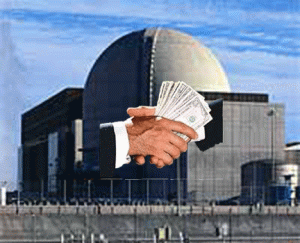 Executive admits fraud in fleecing ratepayers and shareholders https://wordpress.com/read/feeds/72759838/posts/2851460855 By Linda Pentz Gunter
“It looks like crime might well pay after all.”
That was the weary and only slightly tongue-in-cheek conclusion drawn by longtime anti-nuclear campaigner, Tom Clements recently, after a former South Carolina nuclear utility executive pled guilty to fraud in federal court.
Clements is the director of Savannah River Site Watch, but his activism has, for decades, extended well beyond the perimeter of that vast nuclear site.
For years, Clements and others have followed — and attempted to stand in the way of — the forced march of South Carolina ratepayers toward nuclear fiasco. When it finally unraveled in late July, there was only cautious cause for celebration.
On July 23, Stephen Byrne, the former COO of SCANA, the South Carolina utility originally in charge of the construction of two new nuclear reactors in the state, pled guilty in a massive nuclear conspiracy that defrauded ratepayers, deceived regulators and misled shareholders.
Byrne is charged with lying about progress on two Westinghouse AP 1000 reactors under construction — and since abandoned — at the V.C. Summer site, where costs ballooned to more than $9 billion.
The lies — or “intentional misrepresentations” as court documents described them — were necessary to make the case that the two new reactors would be finished on time, thereby qualifying the company for $1.4 billion in future federal tax credits.
But when Clements did the math, Byrne still came out ahead. “One of the court filings says Byrne earned $6.3 million from 2015-2017,” Clements said. “The project originally started with a filing with the SC Public Service Commission in 2008 and ended in July 2017. His plea agreement says he will pay a $1 million fine, though the judge could make it higher.”
So yes, crime still pays.
And so did South Carolina ratepayers. They were bilked of at least $2 billion until the project faltered and finally collapsed. A class action law suit and decisions by judges will see millions returned to ratepayers.
Ironically, the Nuclear Energy Institute, the industry’s lobbying group, gave Byrne the opportunity to explain exactly how ratepayers could be fleeced in advance to save money. In this 2012 NEI video, Byrne describes how Construction Work in Progress (CWIP) would allow the utility to collect funds from ratepayers in advance rather than waiting for construction completion — which has now, of course, not happened, even though customers paid for two new reactors that failed to materialize.
Byrne, who began cooperating with investigators about two years into the now three year-long investigation, could face jail time and a fine, but will likely testify against his co-conspirators to reduce his punishment.
For the time being, the judge has let him go home without even requiring he post the $25,000 bond. Sentencing could be years down the road. Clements believes Byrne “should face prison time” and that he “must fully reveal the criminal role of others in the conspiracy that has been so disastrous for ratepayers.”
Two other top SCANA executives could also be in the FBI’s crosshairs by now — former CEO Kevin Marsh and former chief financial officer Jimmy Addison.
Early warning signals of trouble to come sounded in February 2020, when Byrne and Marsh were charged with civil fraud by the Securities and Exchange Commission (SEC). The agency said the pair “lied and deceived shareholders, regulators, and the public regarding the construction of two new nuclear units at the V.C. Summer site, which the company abandoned amid massive cost overruns in July 2017,” according to reporting in Energy and Policy.
The thoroughly duped — or possibly hopelessly biased — S.C. Public Service Commission, had earlier “allowed SCE&G to raise its electric rates nine times to finance the doomed V.C. Summer Nuclear Station project,” reported the Charlotte Observer.
But by January 2019, the PSC had changed its mind, saying that “SCE&G intentionally misled the commission about a failing nuclear reactor construction project to win electric rate hikes.”
Clements joined other protesters outside the Columbia, SC courthouse where Byrne pled guilty to his offenses. “As he scurried into the federal courthouse, Byrne refused to tell us if he would apologize for his crime against ratepayers,” Clements said.
He, along with other South Carolina activists, and with support of Friends of the Earth, had consistently opposed the state law (CWIP, described in the NEI video), that had allowed the utility to fleece ratepayers in advance of completion of the reactors. The groups had also contested approval of the two-reactor project before the SC PSC since 2008.
As Clements watched Byrne enter the courthouse, finally forced to face up to his crimes, he basked, for a brief moment, in the glow of the celebratory light at the end of the tunnel.
“I’m glad there is going to be a little bit of justice,” Clements told the Post and Courier. And in an email, he wrote: “Nukes bring fraud, graft and corruption wherever they go. The next charges here will be more serious, I think.”
The Post and Courier described the nuclear debacle as “one of the worst economic calamities in South Carolina history”.
But while there may eventually be a day of reckoning — and sentencing — until then, South Carolina ratepayers could keep right on paying.
That is because, when SCANA went bankrupt over the Summer debacle, Dominion Energy took over. Dominion, says Clements, “will file a rate-hike request next month and the cost to ratepayers for the nuclear construction debacle will go up.”
Nuclear blackmail in Illinois — Beyond Nuclear International

Ratepayers robbed of renewables as well as cash
Nuclear blackmail in Illinois https://wordpress.com/read/feeds/72759838/posts/2851460456
Exelon stranglehold on energy legislation runs long and deep
By David Kraft, 9 Aug 20
The recent Illinois lobbying corruption scandal involving Exelon Corporation, its subsidiary Commonwealth Edison and Democratic House Speaker, Michael Madigan, demonstrates the extent to which nuclear “power” is about more than electrons.
The FBI arrests of the Ohio House Speaker and five others in a $60 million bribery/corruption scheme; the $10 billion Exelon nuclear bailout in New York; the questionable circumstances surrounding Exelon’s 2016 PepCo merger; and the South Carolina $9 billion SCANA fraud case, suggest that this may be a national pandemic.
All of this was summarized nicely in a recent New York Times opinion column, “When Utility Money Talks,” (8/2/20).
However, the situation in Illinois with Exelon, and its subsidiary ComEd, has been longstanding and particularly egregious.
For decades, Exelon’s stranglehold on Illinois energy legislation, in cooperation with the currently investigated Mr. Madigan, has stuck Illinois with more reactors (14) and high-level radioactive waste (>11,000 tons) than any other state. It has also severely stifled expansion of renewable energy and energy efficiency, and hampered the Illinois energy transformation to renewables needed to deal with the worsening climate crisis.
For decades, the Illinois environmental community has seen renewables expansion thwarted because no significant renewable energy buildout could occur without concessions to either Exelon or ComEd, and without Speaker Madigan’s approval. The most recent instance was the 2016 $2.35 billion bailout of three uncompetitive Exelon reactors.
This “nuclear blackmail” politics has forced environmentalists wanting to see new legislation pass that would expand renewables, into a reluctant and grudging alliance with Exelon, but on Exelon’s terms, with capacity market “reform” rewarding both renewables and ten of the company’s operating reactors.
If passed in its presently proposed form, this new legislation would provide yet another nuclear bailout under the disguise of “market-based reform.”
To ratchet up the pressure to enact this nuclear prop-up even more, Exelon CEO Chris Crane, in Exelon’s 2Q quarterly earnings call with analysts, once again dangled the prospect of closing up to six reactors if this market-based-bailout is not granted in 2021.
Under the current ongoing FBI corruption investigation, this reluctant alliance of necessity has turned disastrous, given the political toxicity of any current association with either ComEd or Exelon.
It is just and reasonable that ComEd executives (and the so-called “bad apples” who “retired” already), should be penalized and prosecuted for their misdeeds, even if they are reportedly “cooperative.”
However, a $200 million “settlement” penalty for a $34 billion corporation, which for decades has gouged billions from Illinois ratepayers through admittedly corrupt illegal practices, is a slap on the wrist.
Further, the $200 million penalty agreement provides no restitution for the decades-long societal damage done via nuclear pay-for-play.
Illinois rate payers deserve restitution from these and any predatory, corrupt companies that would engage in such activities. This may require explicit legislation. How can one logically or ethically assert that ill-gotten gains (e.g., the 2016 $2.35 billion nuclear bailout) are still “good for the public” when bribery and corruption were used to get them?
Last Fall, a spokesperson for Illinois Gov. JB Pritzker stated, “The governor’s priority is to work with principled stakeholders on clean energy legislation that is above reproach.” Gov. Pritzker – your moment of truth has arrived.
We urge the governor and the legislature to begin the restitution process by repealing the $2.3 billion 2016 nuclear bailout. Further, and as others like Crain’s Joe Cahill have suggested, Crane must step down completely from all functions at Exelon.
The legislature should also enact explicit utility ethics legislation, with transparent oversight of utility contracting and philanthropic giving activities, to insure that this kind of corrupt behavior is not repeated.
And if Crane’s threat of imminent reactor closure is true, then community just-transitions legislation to protect those negatively impacted communities should be a priority of the legislature.
As NEIS has maintained — and advocated since 2014 — it’s the reactor communities (and equally adversely affected coal mining and power plant communities) that need state support and bailouts when plants are threatened with closure, not profitable private corporations like Exelon.
Finally, we support the FBI’s continued investigation into the activities of Speaker Madigan, his associates, and other legislators if necessary, to ferret out the remaining political corruption that has abetted this corporate larceny.
This is the only way to send a significant and lasting message that nuclear pay-for-play in Illinois is over.
David Kraft is the director of Nuclear Energy Information Service
Nuclear scandals in Ohio and Illinois raise serious issues about the role of government in the electricity sector.
|
Twin nuclear scandals in Ohio and Illinois show why politicians shouldn’t be picking energy winners and losers: Josiah Neeley and Michael Haugh https://www.cleveland.com/opinion/2020/08/twin-nuclear-scandals-in-ohio-and-illinois-show-why-politicians-shouldnt-be-picking-energy-winners-and-losers-josiah-neeley-and-michael-haugh.html Aug 09, 2020 “……… two very similar political scandals involving the nuclear industry are playing out in Ohio and Illinois. In both cases, the operators of nuclear power plants are alleged to have bribed the state’s speaker of the house in exchange for enactment of favorable treatment and government bailouts.
These twin scandals raise serious issues about the role of government in the electricity sector.
Take Illinois first. On July 17, electric utility Commonwealth Edison (ComEd) admitted in court documents that it had directed jobs and contracts to associates of Illinois speaker Michael Madigan in exchange for favorable treatment by the legislature, such as approval of rate increases. ComEd is paying a $200 million fine to avoid prosecution. Madigan has denied the charges.
The situation in Ohio is even wilder. The 82-page criminal complaint for federal racketeering, money laundering and bribery alleges that the speaker of the Ohio House essentially set up a “dark money” account into which eventually was poured over $61 million by a power company and others that stood to benefit from legislation. The money was used partly to finance primary candidates over an election cycle to secure the vote for the top leadership position in the Ohio House of Representatives. Perhaps even more disgusting, the bulk of it, $38 million, was allegedly used for ads to defeat a referendum attempt and to harass and buy off signature gathers who were trying to keep the legislation from going into effect via a vote of the people.
The major alleged funder of this effort was FirstEnergy Corp., identified as Company A Corp. in the complaint, then-owner through a subsidiary of the only two nuclear plants in Ohio. In return, the speaker allegedly delivered a $1 billion bailout of FirstEnergy’s failing nuclear plants in House Bill 6 and set up his own little fiefdom of representatives.
Corruption is as old as human history. But it’s worth considering whether there is something about the way that power plants are operated and regulated that makes scandals like those in Ohio and Illinois more likely. In Ohio, a person identified as Company A Corp.‘s CEO provided an answer in comments detailed in the complaint about a provision added to HB 6 in the Ohio Senate to “decouple” the company’s revenue from the amount of energy sales. Under this provision, if the utility made less money in a year than it had in 2018, it could add a surcharge to customers’ bills to make up the difference. As the CEO bragged to investors, the provision would help make them “somewhat recession-proof.” Revenue guarantees may be a great deal for electric providers, but they aren’t necessarily for consumers. Nevertheless, they are actually the norm throughout much of the United States. This is because electric providers were once all government-sanctioned monopolies, the rates of which were set to cover their costs plus a set percentage of profit. In recent decades, some states have moved away from this model, introducing more competition into the system, but there are still too many avenues open for government intervention. One of the main arguments used in favor of HB 6 was that the state had already intervened to support alternative energy, and so it was only fair to bail out nuclear plants, too.
Ultimately, there are two ways for a business to make money. One is through the market. The other is through politics. The more space we give to the latter, the more likely we are to see corruption. And the one who will definitely pay for this corruption is the customer. Josiah Neeley is a resident senior fellow in energy with the R Street Institute. Michael Haugh is a senior fellow with the R Street Institute. The libertarian-leaning institute favors free-market solutions.
|
|
Bribery scandal haunts Exelon – casts doubt on future of Exelon’s Illinois Nuclear Plants
|
ComEd Bribery Scandal Clouds Picture for Exelon’s Illinois Nuclear Plants
Exelon wants state legislation to keep its Illinois nuclear plants open. Subsidiary ComEd’s involvement in a bribery scandal is not helping politically. GreenTech Media, JEFF ST. JOHN AUGUST 04, 2020 Exelon may be forced to close its Illinois nuclear plants if state legislation is not passed to bolster their eroding financial prospects. But subsidiary utility Commonwealth Edison’s involvement in a bribery scandal has complicated this and other key policy efforts in its home state.CEO Chris Crane outlined these challenges during the Chicago-based utility’s second-quarter earnings conference call on Tuesday. Last month, ComEd agreed to pay a $200 million fine as part of a deferred prosecution agreement with federal prosecutors to avoid criminal liability in an alleged bribery scheme involving Illinois House Speaker Michael Madigan. ……. Exelon owns the country’s largest nuclear generating fleet and other generation assets; it operates utilities in Illinois, Maryland, Delaware and Washington, D.C. …… Exelon’s nuclear plants hang in the balanceA December decision from the Federal Energy Regulatory Commission is forcing mid-Atlantic grid operator PJM to impose minimum prices on a wide array of state-supported grid resources. That rule is expected to include Exelon’s Clinton and Quad Cities nuclear power plants, which receive hundreds of millions of dollars per year in zero-emissions credits created by Illinois’ Future Energy Jobs Act. Exelon is seeking to extend the zero-emissions credits to its Braidwood, Byron and Dresden nuclear plants, which failed to clear PJM’s last capacity auction in 2018 and could face early retirement without additional financial support. While FERC has not approved PJM’s plan to comply with its order, and PJM has not yet set a date to resume its long-delayed capacity auction, “there’s a strong sense…that some of the nuclear units will not be picked up in that auction” when it occurs, Crane said. “Some are uneconomic right now, and some may become uneconomic.” …….. the bribery scandal has driven a wedge between the utility and state lawmakers, while the COVID-19 pandemic forced the legislature to curtail much of its work this spring and focus on responses to the public health crisis. The Clean Energy Jobs Act failed to move ahead during an emergency session in May, as did an alternative, less ambitious clean energy bill called Path to 100. llinois Governor JB Pritzker suspended the Energy Working Group involved in crafting the Clean Energy Jobs Act after the deferred prosecution agreement was announced, saying through a spokesperson that future legislation “will not be written by utility companies.” …….Absent a legislative solution to Exelon’s nuclear plants’ challenges in Illinois, Crane said, “If we can’t find…a path to profitability, we will have to shut them down.” But Exelon “will not allow the balance sheet to be further deteriorated by operating noneconomic assets,” he said. Exelon has successfully won zero-carbon credits in New York and New Jersey, but it has also laid plans to shut down its Three Mile Island nuclear plant in Pennsylvania if that state does not create similar supports. Formula rate extension and Chicago grid takeover both remain uncertain ComEd also faces an uphill battle in efforts to win an extension of a plan in place since 2011 that allows it to file its capital expansion plans under formula rate updates, rather than through a traditional rate-making process with the Illinois Commerce Commission. A bill that would have extended the formula rate structure past its 2022 expiration failed to pass the legislature this year
………. the utility’s $9.53 billion capital plan for 2020 through 2023, which will take effect under the formula rate structure, will add more than $5 billion to its capital rate base and lead to price hikes for customers in future years. ……. https://www.greentechmedia.com/articles/read/comed-bribery-scandal-affects-exelons-illinois-nuclear-plants-ratemaking-policy
|
|
|
Utah Taxpayers – NuScam nuclear power project costly and public kept in the dark
 New Information Disclosed in Meeting Closed to Public Points to Major Budget Commitments, Delay Risks in UAMPS Power Project https://utahtaxpayers.org/new-information-disclosed-in-meeting-closed-to-public-points-to-major-budget-commitments-delay-risks-in-uamps-nuclear-power-project/
by Tax Watchdog | Aug 4, 2020 “We Need Public Hearings and We Need Public Votes”: UTA Calls for Full Transparency and Accountability Ahead of September 14th Deadline; Parallels Seen to Ohio, Illinois and South Carolina Nuclear Controversies Where Public Was Kept in the Dark.
SALT LAKE CITY – August 4, 2020 – Utah Associated Municipal Power Systems (UAMPS) and NuScale Power held an “online town hall meeting” on July 21st, but there was just one problem: due to a quirk in Utah’s open meeting laws, the town was not invited. Not only did UAMPS/NuScale fail to be transparent in terms of the meeting about their controversial small modular nuclear reactor plans, but they also failed to disclose new and troubling information that emerged during the behind-closed-doors virtual session, according to the nonprofit Utah Taxpayers Association (UTA). UTA and Peter Bradford, a former U.S. Nuclear Regulatory Commission (NRC) member, warned that potentially higher costs, project delays, and other risks could be costly for UAMPS members and ratepayers.
A total of 34 municipalities in Utah, Idaho, New Mexico and California (see full list below) are participating in the UAMPS small modular nuclear project. Ratepayers will be locked into more than $100 million in commitments by a September 14th deadline and billions of dollars of risks later on if UAMPS members do not opt out of the project. The need for openness is particularly important while the nuclear industry is currently facing major credibility problems with scandals in Ohio, Illinois, and South Carolina.
On July 21st, UAMPS and NuScale held a so-called “online town hall meeting,” which was not made open to the media under a special Utah exemption for UAMPS for open meeting requirements. A video copy of the UAMPS/NuScale event was acquired after the fact. (The timecodes shown below refer to various points in the video.)
Rusty Cannon, Vice President, Utah Taxpayers Association, said: “The UAMPS project will lock in 27 municipalities in Utah and several in surrounding states for a share of billions of dollars in costs and unclear risk in the pursuit of a cluster of small modular reactors (SMRs) touted by Oregon-based NuScale Power, which repeatedly has delayed timelines and increased costs associated with its SMRs.”
Cannon added: “This risky project with massive cost escalations is being conducted largely out of the public eye. Most recently the public was barred from a late July online ‘town hall meeting,’ the content of which has since come to light and which raises serious concerns about what has not been disclosed to the general public. The Utah Taxpayers Association urges elected officials involved with UAMPS to disclose all relevant information to the public so decisions can be made in the open and city officials can be held accountable. We are urging city councils in Utah that are subscribed to the project to vote in a public meeting before the September deadline to withdraw from the project.”
Also speaking at today’s news event was Peter Bradford, a former member of the U.S. Nuclear Regulatory Commission who served as chair of both the New York Public Service Commission and the Maine Public Utilities Commission. He has been an expert witness in many cases involving nuclear power economics, and he has taught Nuclear Power and Public Policy at the Vermont Law School as well as Energy Policy and Environmental Protection at the Yale School of the Environment.
Peter Bradford said: “There is the very real possibility of large rate increases to the customers in these communities due to inadequate safeguards in this project. It is difficult to understand the case for taking on this risk given the certainty of cheaper clean energy alternatives as clearly shown by recent purchases of firm combinations of renewables, energy efficiency plus storage elsewhere in the West. The cost of lack of transparency plus unwise and secretive deals has resulted in the nuclear energy industry becomingembroiled in multiple debacles. UAMPS members and ratepayers should take heed and avoid making the same mistakes.”
Just what is UAMPS and NuScale failing to disclose to the public?
- RAPIDLY ESCALATING CONSTRUCTION COSTS. NuScale’s website currently explains to the public: “The estimated construction cost for the first NuScale 684 MWe (net) plant is about $3 billion.” However, during the July 2020 “town hall,” UAMPS contractor Bob Squires (MPR Associates) calls the project a “roughly $5 billion nuclear power plant development project with first of a kind technology.” (3:47:24) Even worse: NuScale’s 2020 Amended Budget & Plan of Finance projects a total cost of approximately $6.1 billion.
- MAJOR MISSED DEADLINES. In 2008, NuScale explained: “With timely application for a combined construction and operating license (COL), a NuScale plant could be producing electricity by 2015-16.” In 2019, UAMPS publicly announced that the NuScale nuclear power plant would begin construction in 2023, “with the first 60 MW module becoming operational in 2026 [and] [o]ther modules would come on-line soon thereafter.” However, during the non-public July “town hall,” Glenn Neises, nuclear director, Burns & McDonnell, announced for the first time that completion is now projected for June 2030, and the first module is not expected to become operational until June 2029. (3:22:25) And things could get even worse. Warning of possible new delays, Neises said: “I’d also like to stress that this is the current schedule and expect it to change as we see changes in funding, engineering moves forward, and as licensing advances.” (3:22:25)
-
- LOW-BALLED ENERGY PRICE. Doug Hunter, UAMPS CEO, said an undisclosed Economic Competitiveness Test (ECT) determined the UAMPS project power that could be generated would cost $55/MWh in 2018 dollars. (24:30) The UAMPS/NuScale estimate contrasts sharply with other independent utility projections (PacifiCorp’s estimate of $95/MWh and Idaho Power’s estimate of $125/MWh). Doug Hunter confirms this in answering a question as to why large investor-owned utilities are not pursuing this project: “Right now they’re still relying on existing capacity, most of them, to fill in energy with renewables because that happens to be the lowest IRP.” (2:28:20)
- DEPENDENCE ON UNPREDICTABLE FEDERAL SUBSIDIES. Mason Baker, UAMPS chief legal officer, admitted during the “town hall” that project organizers are now banking on a “massive increase” in the federal government’s contribution to UAMPS, a jump from $60 million to $1.4 billion. (48:30) UAMPS now acknowledges taxpayer subsidies are necessary to achieve the $55 per MW/h price point. (53:50) In effect, U.S. taxpayers are being asked to subsidize roughly 25 percent of the UAMPS SMR project to artificially hold down energy costs. However, taxpayer subsidies of this sort are both objectionable on their merits, entirely unpredictable as to passage, and subject to being withdrawn at any time.
- The Utah Taxpayers Association also noted that no town or city of more than 100,000 has opted into the UAMPS SMR project, which has not been successful in securing investments in it by investor-owned utilities. It is not apparent that any UAMPS member so far opting into the SMR project has been able to afford to do its own independent financial evaluation of the project, and, instead, may be over relying on assurances from the promoter, NuScale. Committing a municipal government to a long-term contract of this magnitude could result in massive sunk costs and higher rates and taxes on citizens.
- The following are the UAMPS members currently subscribed to the SMR project: Utah (Beaver City, Blanding, Bountiful, Brigham City, Enterprise, Ephraim City, Fairview City, Fillmore City, Heber City Light & Power, Holden Town, Hurricane City, Hyrum City, Kanosh Town, Kaysville City, Lehi, Logan City, Monroe City, Morgan City, Mt. Pleasant City, Murray City, Oak City, Paragonah Town, Parowan, Payson City, Santa Clara City, South Utah Valley Electric Service District, Spring City, Washington City, and Weber Basin Conservancy District); Idaho (Idaho Falls Power and Salmon River Electric Cooperative, Inc.); California (Lassen Municipal Utility District and Plumas-Sierra Rural Electric Cooperative); and New Mexico (Los Alamos County). The total size of the subscriptions is 160.4 megawatts, with 133.4 megawatts going to the state of Utah.
The Utah Taxpayers Association is a non-profit 501(c)(4) organization that works to limit state and local taxes, making Utah an attractive place to live and do business. www.utahtaxpayers.org
Important note: The Utah Taxpayers Association has no position on nuclear energy. The Association’s interest in this matter is limited to the extent to which public business of interest to ratepayers/taxpayers is conducted in an open and transparent manner in order to ensure maximum accountability to the public.
How the Ohio nuclear bribery scandal developed. And what’s next

|
Nuclear bailout in Ohio tied to bribery scandal was years in making
Nuclear plants nationwide were warning four years ago that their aging reactors were in need of financial help, because they couldn’t compete with cheaper natural gas-fired plants. The New Indian Express, By PTI 3 Aug 20,
TOLEDO: A $1 billion bailout for Ohio’s two nuclear plants that’s now entangled in a state bribery scandal had little support when the idea came up three years ago. It was all but dead until the spring of last year, when the new leader of the Ohio House stepped up with a last-ditch attempt to give the plants a financial lifeline. But that’s all on shaky ground again after federal authorities accused the powerful Republican Ohio House speaker and four associates of orchestrating a $60 million bribery scheme involving corporate money secretly funneled to them in exchange for passing the bailout. The question for state lawmakers who are under pressure to repeal the bailout is whether they’re willing to face another divisive debate — this time under the shadow of scandal — in order to find a new way to prop up the financially strapped nuclear plants. Here is a look at how the bailout came about and its prospects going forward. DIM OUTLOOK …….. GLIMMER OF HOPE Just months after taking over the GOP-controlled Ohio House, Speaker Larry Householder in early 2019 unveiled a plan to save the nuclear plants and eliminate incentives promoting wind and solar power. It would steer the state in the right direction, he said. …….. BEHIND THE SCENES t was no secret that millions were being spent to persuade lawmakers to support the bill and keep a repeal effort off the statewide ballot last year. But it wasn’t until just two weeks ago that federal authorities said it involved illegal activity that began in 2017. Householder’s strategy, according to a federal complaint, was to pick freshman legislators he’d help elect to sponsor the bill, create a new subcommittee comprised mostly of his supporters who would push the legislation forward, and engage in an expensive media blitz to pressure public officials to back it. Federal prosecutors allege Householder then used “pressure tactics” to get the bill passed, strong-arming his own House members and senators to vote in favor. In exchange, investigators said a dark money group Householder controlled received $60 million from a unidentified company, which the complaint makes clear is FirstEnergy and its affiliates. Householder and his attorney have not commented since his arrest. FirstEnergy’s CEO has said he and the company did not do anything wrong. WHAT’s NEXT? Ohio’s governor is calling on the Legislature to repeal the bailout and replace it, saying he still believes the nuclear plants are an important part of the state’s energy future. Fellow Republican Bob Cupp, a veteran lawmaker from Lima who was chosen this past week to become the new House speaker after lawmakers booted Householder from the job, said one of his first priorities will be to do away with the legislation and start anew. But some lawmakers, including those who voted for the bailout last time around, want nothing to do with it again…….. https://www.newindianexpress.com/world/2020/aug/03/nuclear-bailout-in-ohio-tied-to-bribery-scandal-was-years-in-making-2178602.html |
|
French company EDF fined – it spread false information on cost of Hinkley nuclear power project
 Bunham-on-sea.com 1st Aug 2020, The French market watchdog has levelled a £4.5m fine against energy giant
EDF for misleading investors about the cost of the Hinkley Point C nuclear
project. Regulators say the French state-owned energy company spread
“false information” about its agreement with the Government to build
the nuclear plant near Burnham-On-Sea.
AMF, France’s financial markets
authority, says the company may have set EDF’s share price “at an
abnormal or artificial level” by claiming in a news release dated October
2014 that the terms of its deal with the UK government were “unchanged”
from the 2013 agreement.
1 This Month
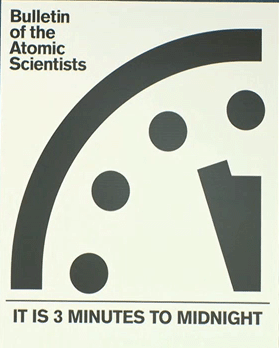
Watch the 2026 Doomsday Clock unveiling live here on January 27 at 10 a.m. EST
To see nuclear-related stories in greater depth and intensity – go to https://nuclearinformation.wordpress.com/

29 Jan. Thursday 7-8 p.m. Webinar – World’s Largest Nuclear Station in Port Hope, ON?


31st January – Challenging the War Machine – a DECLASSIFIED UK SUMMIT


Website of the Week
Now until to February 10, 2026 Radioactive waste storage in France: the debate is finally open! How to participate?
-
Archives
- January 2026 (283)
- December 2025 (358)
- November 2025 (359)
- October 2025 (376)
- September 2025 (258)
- August 2025 (319)
- July 2025 (230)
- June 2025 (348)
- May 2025 (261)
- April 2025 (305)
- March 2025 (319)
- February 2025 (234)
-
Categories
- 1
- 1 NUCLEAR ISSUES
- business and costs
- climate change
- culture and arts
- ENERGY
- environment
- health
- history
- indigenous issues
- Legal
- marketing of nuclear
- media
- opposition to nuclear
- PERSONAL STORIES
- politics
- politics international
- Religion and ethics
- safety
- secrets,lies and civil liberties
- spinbuster
- technology
- Uranium
- wastes
- weapons and war
- Women
- 2 WORLD
- ACTION
- AFRICA
- Atrocities
- AUSTRALIA
- Christina's notes
- Christina's themes
- culture and arts
- Events
- Fuk 2022
- Fuk 2023
- Fukushima 2017
- Fukushima 2018
- fukushima 2019
- Fukushima 2020
- Fukushima 2021
- general
- global warming
- Humour (God we need it)
- Nuclear
- RARE EARTHS
- Reference
- resources – print
- Resources -audiovicual
- Weekly Newsletter
- World
- World Nuclear
- YouTube
-
RSS
Entries RSS
Comments RSS
 nuclear-news