France and Russia portray nuclear hydrogen as ”green”- arousing anger of several European nations.

Atomic giants EDF and Rosatom push plan to sell nuclear-powered hydrogen as ‘green’Labelling nuclear hydrogen as green is likely to cause irritation among countries without atomic power or exiting it, 28 April 2021 By Bernd Radowitz , Recharge
French and Russian state-owned nuclear energy giants EDF and Rosatom have teamed up to develop low carbon hydrogen projects in Russia and Europe in order to decarbonise mobility and industrial sectors – but their labelling of H2 produced from nuclear power as ‘green’ is likely to cause irritation elsewhere in Europe.
As part of a strategic cooperation agreement signed last month, the hydrogen is slated to be produced both from nuclear power and from methane conversion linked to carbon capture and storage (CCS) technologies……..
Any massive use of nuclear hydrogen on an EU level is strongly opposed by countries without atomic power, or exiting it, such as Germany and Austria. Andreas Feicht, secretary of state in Germany’s economics and energy ministry, at a late-2020 virtual conference on hydrogen organised by his ministry stressed nuclear is not an option for Germany’s energy system or for the production of hydrogen.
The French government (backed by some Eastern European countries), by contrast, is trying to push nuclear hydrogen and wants it to be entitled for state support, which would be a way to use French or EU funds to help its highly-indebted nuclear utility EDF and give new life to its ageing nuclear fleet.
…… Béatrice Buffon, group executive vice-president in charge of EDF’s International Division.
“The agreement with the Rosatom Group, our historical partner in Russia and one of the country’s key players in the field of decarbonised hydrogen, illustrates EDF’s desire to develop a new energy model with lower CO2 emissions wherever we operate.”
The two nuclear companies didn’t provide more detail on specific projects being studied. https://www.rechargenews.com/energy-transition/atomic-giants-edf-and-rosatom-push-plan-to-sell-nuclear-powered-hydrogen-as-green/2-1-1002350
Ukraine’s nuclear industry in crisis – corrupt, unsafe, with politicised decision-making

Could Ukraine’s nuclear industry face another Chernobyl?
Thirty-five years after the disaster, the nuclear industry is Ukraine’s most reliable economic lifeline. But critics say it faces a perennial crisis caused by corruption, safety problems and politicised decision-making. Aljazeera, By
Mansur Mirovalev, 26 Apr 2021 ”…………………. The nuclear industry remains Ukraine’s most reliable economic lifeline.
But domestic and international critics claim that the industry faces a perennial crisis caused by corruption; safety problems with ageing, worn reactors; disruption of ties with a Russian nuclear monopoly; and a politicised switch to US-made nuclear fuel.
Industry insiders, environmentalists and politicians claim that the construction of a spent fuel storage facility near the capital, Kyiv, and the proximity of Europe’s largest nuclear station in the southern city of Zaporizhzhia to Europe’s hottest armed conflict add to their concerns about the possibility of a nuclear incident, particularly in a nation that went through two popular uprisings since 2005 and lost a chunk of its territory to Russia.
……….. uranium dioxide sealed in zirconium alloy tubes in the rods emits radiation that has to be contained in hermetically sealed reactors. Ukraine’s Soviet-designed rods are hexagonal, resembling bee cells, while Western-made rods are square.
The switch is far from simple – but necessary, because Rosatom, Russia’s nuclear monopoly that charged Ukraine hundreds of millions of dollars a year, is controlled by the Kremlin. And the Kremlin has a well-known proclivity to use energy supplies as a political cudgel.
The switch to Westinghouse fuel is potentially dangerous,” Oskar Njaa, the Russia and Eastern Europe adviser for Bellona, a Norway-based nuclear industry monitor, told Al Jazeera.
In 2012, Westinghouse fuel rods had to be removed from the South Ukrainian power station after protective envelopes in two reactors were damaged.
Ukraine asked Rosatom for fuel and help – prompting Russian President Vladimir Putin to remark gloatingly that Rosatom experts had “to solve complex technical problems, take [the Westinghouse fuel] out and load the Russian fuel back in”.
Ukraine’s losses amounted to $175 million, Mikhail Gashev, Ukraine’s top nuclear safety inspector at the time, claimed – and banned the use of Westinghouse fuel.
Ukrainian experts doubted his assessment, and his decision was overturned after he was fired among hundreds of pro-Russian officials following Ukraine’s second anti-Russian popular uprising, the 2014 Revolution of Dignity.
Former Prime Minister Nikolay Azarov, another pro-Russian political figure who fled Ukraine after the revolt, said in 2017 that the decision was made “in spite of Ukraine’s security interests”.
Westinghouse modified the rods – and no further incidents were reported.
“That might be a sign of a better culture for safety and security in the industry,” Njaa said adding that his group is, however, “worried that incidents might become more severe and greater in numbers due to the ageing equipment at the plants.”………
Apart from the fuel, observers are also concerned about Ukraine’s ageing, worn reactors, 12 of which began operating in the 1980s and were supposed to be shut down in 2020. But Energoatom extended their lifespan spending hundreds of millions on each, thanks largely to loans from the European Union.
This is a common practice worldwide – the average lifespan of almost 100 nuclear reactors in the US is 40 years, and 88 have been approved for another 20 years. But some experts are worried about the safety measures and upgrades.
“What we witness every time a decision [to extend the lifespan] is made, some of the safety upgrades have either not been made or have not been made in full,” Iryna Holovko, the Ukraine coordinator for Bankwatch, a Prague-based environmentalist group, told Al Jazeera.
Bankwatch has for years been urging Ukraine to stop extending the lifespan of its “zombie reactors” without correcting “safety deviations” and detailed assessments of all the environmental risks for the people living around the stations and in neighbouring nations……….
The fuel switch brought about another problem; unlike Rosatom, Westinghouse does not take the spent fuel back for processing or storage.
Until December, Ukraine had two pretty problematic storage facilities – and an unfinished third one. One at the shut-down Chernobyl station is almost full. At the second one, an open-air yard outside the Zaporizhzhia nuclear plant, thousands of spent fuel rods are stored in ventilated concrete containers. In 2014, the plant was about 200 kilometres (125 miles) southwest of the front line of the separatist conflict.
The sight was horrifying to a visiting expert.
“I suddenly stood in front of the utterly unprotected interim storage,” Patricia Lorenz of Friends of the Earth, an environmentalist group that visited the plant on a fact-finding mission in 2014, told Al Jazeera. “It is basically unprotected against war and terrorism, while the front was close by back then.”
In May 2014, the station’s security and police turned away dozens of armed and masked far-right nationalists who tried to enter the plant to “protect” the station from the separatists.
Since then, the front line has moved eastward, and in December, Energoatom opened a third facility a mere 70 kilometres (43 miles) north of Kyiv, in the Chernobyl exclusion zone that is scheduled to receive the first batch of spent fuel in June.
But plans to transport spent fuel via Kyiv, the city of more than two million, drew sharp criticism.
“This will be happening in a country where everything turns upside-down, collides, explodes, and where lawlessness rules,” Kyiv-based environmentalist Vladimir Boreiko told reporters……………. https://www.aljazeera.com/features/2021/4/26/does-ukraines-nuclear-industry-face-another-chernobyl
Not to be forgotten – the 1957 nuclear explosion in Mayak centre, Russia, that continues to poison the region.

Reporterre 26th April 2021, While the Chernobyl nuclear disaster occurred thirty-five years ago,
another explosion, which occurred in Russia in 1957 in the Mayak military
nuclear center, continues to poison the region. A look back at this
disaster kept secret for more than twenty years.
https://reporterre.net/Trente-ans-avant-Tchernobyl-la-catastrophe-nucleaire-de-Kychtym
Soviet Documents Reveal Cover-Ups At Chernobyl Nuclear Plant Before 1986 Disaster
Soviet Documents Reveal Cover-Ups At Chernobyl Nuclear Plant Before 1986 Disaster https://www.ndtv.com/world-news/soviet-documents-reveal-cover-ups-at-chernobyl-nuclear-plant-before-1986-disaster-2422532 26 Apr 21, After a botched safety test in the fourth reactor of the plant, located in what was then Soviet Ukraine, clouds of radioactive material from Chernobyl spread across much of Europe in what remains the world’s worst nuclear disaster.
The Soviet Union knew the Chernobyl nuclear plant was dangerous and covered up emergencies there before the 1986 disaster, the Ukrainian authorities said as they released documents to mark the 35th anniversary of the accident on Monday.
After a botched safety test in the fourth reactor of the plant, located in what was then Soviet Ukraine, clouds of radioactive material from Chernobyl spread across much of Europe in what remains the world’s worst nuclear disaster.
The archives show there was a radiation release at the plant in 1982 that was covered up using what a KGB report at the time called measures “to prevent panic and provocative rumours”, Ukraine’s security service (SBU) said in a statement on Monday.
There were separate “emergencies” at the plant in 1984, it added.
“In 1983, the Moscow leadership received information that the Chernobyl nuclear power plant was one of the most dangerous nuclear power plants in the USSR due to lack of safety equipment,” the SBU said.
When a French journalist collected water and soil samples from the Chernobyl area after the accident in 1987, the KGB swapped the samples for fake ones in a special operation, the SBU cited another KGB report as saying.
Thirty-one plant workers and firemen died in the immediate aftermath of the 1986 disaster, mostly from acute radiation sickness.
Thousands more later succumbed to radiation-related illnesses such as cancer, although the total death toll and long-term health effects remain a subject of intense debate.
The present day government in Kyiv has highlighted the Soviet authorities’ bungled handling of the accident and attempts to cover up the disaster in the aftermath. The order to evacuate the area came only 36 hours after the accident.
“The 35th anniversary of the Chernobyl tragedy is a reminder of how state-sponsored disinformation, as propagated by the totalitarian Soviet regime, led to the greatest man-made disaster in human history,” the foreign ministry said.
USA’s Defense Secretary Lloyd Austin – a ”soldier’s soldier” and a useful purchaser for Raytheon’s military merchandise
Austin’s personal history and connection to the military and Raytheon mark him as a fitting Pentagon chief in an era of destructive militarism and creeping fascism in the U.S.
When civilians no longer control the key institutions of government and war industries ensure the perpetuation of endless wars from which they make obscene profits, the political system can no longer be defined as a democracy.

Defense Secretary Lloyd Austin—Former Member of Raytheon Board of Directors—Has Awarded Over $2.36 Billion in Contracts to Raytheon Since His Confirmation in January, Covert Action Magazine By Jeremy Kuzmarov – April 19, 2021 he Pentagon has awarded the defense giant Raytheon Technologies over $2.36 billion in government contracts since Secretary of Defense Lloyd Austin III’s confirmation on January 22nd.
Austin was on Raytheon’s board of directors prior to his confirmation.
Austin at the time had made a commitment to resign from Raytheon’s board and recuse himself from all matters concerning Raytheon for four years and agreed to divest from his financial holdings in the company, amounting to between $500,000 and $1.7 million in stock.
These initiatives, however, have not prevented Austin from using his position to bolster Raytheon’s fortunes. Nor those of other defense contractors on whose board he has sat such as Booz Allen Hamilton, the world’s “most profitable spy organization,” according to Bloomberg News, and Pine Island Capital, a private equity firm that invests in military industry.[1]
At Austin’s nomination hearing, Senator Elizabeth Warren (D-MA) questioned him about his ties to Raytheon—whose headquarters are based in Warren’s home district (Waltham, Massachusetts).
A year earlier, Warren had proposed legal changes to strengthen ethics at the Defense Department by blocking the revolving door between the Pentagon and giant defense contractors like Raytheon, including by prohibiting big defense contractors from hiring former Pentagon officials for four years after they leave government.
Warren paradoxically voted to confirm Austin’s appointment as Defense Secretary—even though he embodies the danger of the revolving door.
Mark Pocan (D-WI), who with Barbara Lee wrote a letter in November 2020 to President-elect Joe Biden requesting that he nominate a Secretary of Defense with no previous ties to weapons manufacturers, stated that “American national security should not be defined by the bottom lines of Boeing, General Dynamics and Raytheon.”
With men like Austin at the helm, however, it is very clearly being defined in this way…………….
Phyllis Bennis of the Institute for Policy Studies, a left-wing think-tank, told The Intercept that since “Raytheon manufactures the bomb components that are used in Yemen, [General Austin] bears a direct responsibility [for war crimes and civilian deaths]. He was making money as a board member of this company that is directly responsible for the death and destruction there.”
William Hartung, the director of the arms and security project for the Center for International Policy, said that “picking Austin was tantamount to making the position of Secretary of Defense the Secretary of Defense contractors.”
Raytheon’s 2021 Pentagon Contracts
Fitting with Hartung’s assessment, Raytheon has benefitted from multi-million-dollar government contracts on a near-daily basis since Austin has taken charge at the Pentagon.
On February 1st, the company secured a whopping $290,704,534 government contract to produce equipment for depot maintenance facilities and services in support of the F-35 Lightning II, which military analyst Pierre Sprey characterized as “overweight and dangerous.”……………….
Promoting More War
Though Austin claims to have recused himself from decisions involving Raytheon, the Pentagon under his direction is providing his old company with huge contracts on a daily basis that is bolstering its profits and stock price.
Austin furthermore has used his new bully pulpit to advocate for yet greater levels of military spending—to the benefit of Raytheon.
On February 25th, for example, on a visit to the U.S.S. Nimitz, Austin emphasized the need for U.S. warships throughout the globe to deter security threats—from China to Iran. A week later on a tour of Southeast Asia with Secretary of State Antony Blinken, Austin warned about China again and the North Korean nuclear threat and pledged that the U.S. would maintain a robust military presence in the Indo-Pacific.
He further cautioned North Korea that the United States, following military exercises with South Korea, was “ready to fight tonight.”
When fighting resumed in Eastern Ukraine in early April, Austin assured Ukraine’s Defense Minister Andrii Taran of the “U.S. commitment to building the capacity of Ukraine’s forces to defend more effectively against [supposed] Russian aggression”–which was demonstrated by a recent $125 million military aid package–and took to Twitter to reaffirm the U.S.’s “unwavering support for Ukraine’s sovereignty, territorial integrity, and Euro-Atlantic aspirations.”
…………A Soldier’s Soldier
Besides his connection to Raytheon, Austin’s appointment as Pentagon chief was controversial because he had not been retired from the military for the requisite seven years and required a legal waiver.
Traditionally, the role of Defense Secretary is supposed to be a civilian position, ensuring the U.S.’s military apparatus is led not by a warfighter, but a policymaker. That requirement is laid out in the National Security Act of 1947 that established the Defense Department.
Heralded as a “soldier’s soldier” who would endure hardships with his troops, the 6’4” tall Austin graduated from West Point in 1975, and led infantry troops in the capture of Baghdad during the 2003 Operation Iraqi Freedom.
After a stint commanding the 10th Mountain Division in Afghanistan, Austin was appointed as chief of staff of the U.S. Central Command at McDill Air Force Base in Tampa, Florida, a high-tech command post where military officers could watch live imagery on plasma screens and order air-strikes through the Pentagon’s secure internet server.
Groomed for high military command by Admiral Mike Mullen, Chairman of the Joint Chiefs of Staff from 2007 to 2011, Austin was appointed as Commanding General of U.S. forces in Iraq in 2010, and Commander of the U.S. Central Command (CENTCOM), which is responsible for all military operations in the Middle East, by President Obama in 2013.
In this latter capacity, Austin drafted a war plan—approved by Obama—that allowed the U.S. military for the first time to directly provide ammunition and weapons to Syrian opposition forces, who included Islamic jihadists.
President Obama also endorsed General Austin’s idea to increase the air campaign on Islamic State of Iraq and the Levant (ISIS) from Incirlik Air Base in Turkey. The result was an increase in civilian deaths. Journalists Anand Gopal and Azmat Khat determined that one in five of the 27,500 coalition air strikes in the 2nd Iraq War resulted in at least one civilian death, more than 31 times the number that was publicly acknowledged
Austin’s personal history and connection to the military and Raytheon mark him as a fitting Pentagon chief in an era of destructive militarism and creeping fascism in the U.S.
When civilians no longer control the key institutions of government and war industries ensure the perpetuation of endless wars from which they make obscene profits, the political system can no longer be defined as a democracy. https://covertactionmagazine.com/2021/04/19/defense-secretary-lloyd-austin-former-member-of-raytheon-board-of-directors-has-awarded-over-2-36-billion-in-contracts-to-raytheon-since-his-confirmation-in-january/
What is the real reason behind UK design approval for China’s proposed nuclear reactor, supposedly for Bradwell?
What’s it all about? https://www.banng.info/news/regional-life/whats-it-all-about/ 15 April 2021Andy Blowers speculates on the real reason behind the Environment Agency’s recent public consultation on Bradwell B in the BANNG column for the April 2021 edition of Regional Life magazine,
Time to regroup
The February announcement by Chinese nuclear developer, CGN, that it would pause all project work and engagement on Bradwell B for ‘at least a year’ seems in sharp contrast to the Environment Agency (EA) pressing ahead with its consultation on the Generic Design Assessment (GDA) on the proposed reactor. Could it be that these apparently conflicting positions are, in fact, mutually compatible? Let me try to explain.
CGN has cited the pandemic as a key reason for the slowdown. Yet, only a year ago, the plans for Bradwell B had emerged, all bells and whistles, just as the pandemic took hold. Despite BANNG and others urging the company to suspend its consultation during the period of lockdown, it pressed ahead claiming the national need for the project was urgent and it was in the public interest that the proposed development ‘is not indefinitely or even substantially delayed’.
Now all is silent on the Bradwell B front while the team apparently regroups, vaguely indicating that essential engagement with local councils and stakeholders will ‘begin again in future years’. An obvious inference from this is that the project is now in limbo and, for Bradwell B at least, the chances of its resurrection must be close to zero. For opponents of Bradwell B it is better that the project sinks now while it is still virtual rather than subsides into the waters under the hammering impacts of climate change when it is a reality of radioactive menace.
Time to consult
But hold on a moment. In another corner of the wood, the Environment Agency has been beavering away with its public consultation on the GDA of the Chinese designed Hualong 1 pressurised water reactor. And yes, it is as technical and tedious as it sounds but, nonetheless, not something to be disregarded, if for no other reason than that it appears to keep the Chinese reactor alive when its producers are withdrawing. So what’s it all about and is it worth responding?
For three months, the EA has made a commendable effort appealing to the general public and stakeholders to respond. ‘We are the Environment Agency. We protect and improve the environment’ and ‘we welcome everyone’s views’. Despite the brio of the appeal, the experience of responding falls somewhat flat.
The consultation document is a formidable 169 pages (plus nine assessment reports) written in technical and uncompromising language. Moreover, it tends to present conclusions to be confirmed rather than open up issues for discussion. The scope is, therefore, limited and evasive.
The consultation is not about Bradwell, but about a ‘generic site’ specified with characteristics similar to Bradwell. This is confusing but it means that a whole range of issues of importance to Bradwell, such as impacts on habitats, the cooling system, flooding, etc., can be passed down the line on the grounds that it is generic, not specific. Overall, the impression is of a decision-making process that is fragmented, incremental and uncoordinated, a situation which is likely to favour the developer and confuse and distract opponents.
Despite its enthusiasm for hearing our views, it is obvious the consultation is not interested in the big issues that concern us most. This is made clear: ‘Our consultation does not relate to a specific site. It is not about the need for nuclear power, the siting of nuclear power stations, nor the safety and security of the design’. So, no point, then, in asking the EA the key question: ‘how can the development of a mega nuclear power station on the generic site conceivably serve the EA’s objective to ‘protect and improve the environment?’.
A passport and a platform
Given the consultation does not seem fit for its ostensible purpose, we may well ask, what is its real purpose? I suggest it is nothing more, nor less than to provide the developer ultimately with the seal of approval from the UK’s regulators, regarded as among the most rigorous in the world. With the imprimatur of UK design approval, the Hualong 1 reactor would be able to launch into markets worldwide. This is what the developer has wanted and what the EA signals it is likely to get. The EA’s preliminary conclusion is that the design is on course to be ‘suitable for use in England’.
And what of Bradwell B? CGN is still going through the motions but may well be considering its position. Does it really want to persist with the project in the face of firmly entrenched opposition? Gaining permission to develop was always improbable and has looked increasingly impossible. But, with a GDA in its pocket, CGN has a passport and a platform, and may be content to walk away from Bradwell and try its luck elsewhere.
South Africa’s history of ”state capture” by the nuclear industry
The battle for 2050 energy dominance: Nuclear industry makes its pitch Mail and Guardian, 14 Apr 21, Moscow The nuclear industry believes it should be able to account for more than 50% of South Africa’s vacant 24 gigawatts of power left behind by the demise of coal in a net-zero 2050 scenario. This was one of the outcomes of a government communications’ panel discussion on alternative future energy sources for South Africa hosted on Wednesday.”’
……………….before returning to instruct the then energy minister, Tina Joemat-Pettersson, to sign a deal with the Russians on the sidelines of the general conference of the International Atomic Energy Agency in Vienna, Austria.At the same time, Russia’s state-owned nuclear agency, Rosatom, released a statement that it had clinched a deal with South Africa. A legal battle ensued and in 2017, the Western Cape high court ruled that the secret tabling of the intergovernmental agreements with Russia, the US and Korean were unconstitutional and unlawful, and that they be set aside.
A legal battle ensued and in 2017, the Western Cape high court ruled that the secret tabling of the intergovernmental agreements with Russia, the US and Korean were unconstitutional and unlawful, and that they be set aside……….
In 2019 a report by the Carnegie Endowment for International Peace said that Russian engagement with South Africa during the Zuma era was deep rooted and relied on a web of relationships at the highest levels of both governments.
This included the promotion of multibillion-dollar projects involving state-owned companies particularly in the energy sector, and the leveraging of Cold War-era ties forged during South Africa’s period of national liberation.
The researchers linked the significance of the secret deal to a larger problem of state capture.
According to authors Andrew S Weiss and Eugene Rumer: “As early as the autumn of 2011, Zuma told then finance minister Pravin Gordhan that he wanted to award the entire construction deal to Russia. He brushed aside Gordhan’s insistence on following established procedures for state procurement, according to Gordhan’s written testimony to the state capture commission.
“Gordhan warned Zuma that failing to follow the established procedures could land the president in trouble similar to the fallout over the earlier arms-sales scandal that had nearly ended his political career,” the report noted……….
During the presidency of Thabo Mbeki, Eskom explored possibly expanding the Koeberg nuclear power facility but decided in 2008 that the project was unaffordable.
Secrecy over new conditional coal mine licence applications for Cumbria – no public scrutiny.
Keep Cumbrian Coal in the Hole 13th April 2021, Nuclear safety group Radiation Free Lakeland have asked for and been refused sight of the new conditional coal mine licence applications from
West Cumbria Mining to the Coal Authority. The controversial Irish Sea coal
mine developers had originally been granted conditional exploration
licences eight years ago over the heads of Cumbria County Council and the
public, with no public scrutiny at all.
These have now lapsed and the
developers have applied for new licences. Radiation Free Lakeland have
asked for sight of the licence applications from West Cumbria Mining. The
Coal Authority have refused sight of the licence applications based on two
clauses in the Freedom of Information Act 2000: Section 43(2) Commercial
Interests and Section 44(1)(a) Prohibition by Enactment. Campaigners say
that there is no justification offered by the Coal Authority for the
protection of the developers at the expense of public scrutiny into the new
licence applications.
COAL AUTHORITY REFUSE RIGHT TO SEE LICENCE TO DRILL UNDER IRISH SEA
Israel appears to confirm it carried out cyberattack on Iran nuclear facility
Shutdown happened hours after Natanz reactor’s new centrifuges were started, Guardian, Martin Chulov Middle East correspondentMon 12 Apr 2021, Israel appeared to confirm claims that it was behind a cyber-attack on Iran’s main nuclear facility on Sunday, which Tehran’s nuclear energy chief described as an act of terrorism that warranted a response against its perpetrators.
The apparent attack took place hours after officials at the Natanz reactor restarted spinning advanced centrifuges that could speed up the production of enriched uranium, in what had been billed as a pivotal moment in the country’s nuclear programme.
As Iranian authorities scrambled to deal with a large-scale blackout at Natanz, which the country’s Atomic Energy Agency acknowledged had damaged the electricity grid at the site, the Israeli defence chief, Aviv Kochavi, said the country’s “operations in the Middle East are not hidden from the eyes of the enemy”.
Israel imposed no censorship restrictions on coverage as it had often done after similar previous incidents and the apparent attack was widely covered by Israeli media. Public radio took the unusual step of claiming that the Mossad intelligence agency had played a central role.
Israeli Prime Minister Benjamin Netanyahu said later Sunday that “the struggle against Iran and its proxies and the Iranian armament efforts is a huge mission”…..
The unexplained shutdown is thought to be the latest in a series of exchanges between the two arch-enemies, who have fought an extensive and escalating shadow war across the Middle East over more than decade, centred on Iran’s nuclear programme and its involvement in matters beyond its borders.
Clashes have more recently been fought in the open, with strikes against shipping, the killing of Iran’s chief nuclear scientist, hundreds of airstrikes against Iranian proxies in Syria, and even a mysterious oil spill in northern Israel, which officials there have claimed was environmental sabotage.
Natanz has remained a focal point of Israeli fears, with an explosion damaging a centrifuge assembly plant last July, and a combined CIA and the Mossad cyber-attack using a computer virus called Stuxnet in 2010 that caused widespread disruption and delayed Iran’s nuclear programme for several years.
Iran’s nuclear chief, Ali Akbar Salehi, urged the international community and the International Atomic Energy Agency (IAEA) to take action against the perpetrators of the attack. He confirmed that a “terrorist attack” had damaged the electricity grid of the Natanz site. The IAEA said it was aware of the reports but declined to comment further…………
Western officials believe Israel has become increasingly brazen in its attempts to disrupt the Iranian programme, pointing to the killing of the country’s leading nuclear scientist, Mohsen Fakhrizadeh, last November, who was shot dead along with his bodyguards on a rural highway. Iran claims that artificial intelligence was used to identify Fakhrizadeh, who was gunned down by a remotely operated automatic weapon. The small lorry carrying the weapon then exploded…………… https://www.theguardian.com/world/2021/apr/11/israel-appears-confirm-cyberattack-iran-nuclear-facility
Two years since Julian Assange was seized from the Ecuadorian Embassy
the Biden administration has continued Trump’s pursuit of the WikiLeaks founder—in 2010, Biden had labelled him a “high-tech terrorist”.

Two years since Assange was seized from the Ecuadorian Embassy, World Socialist Website, Thomas Scripps, 9 April 2021 Two years ago on Sunday, WikiLeaks founder Julian Assange was seized from the Ecuadorian embassy in London. He has been incarcerated ever since, fighting extradition to the United States where he faces life imprisonment in barbaric conditions for exposing war crimes, coup plots, mass state surveillance, torture and corruption.
On April 11, 2019, Assange’s political asylum status was revoked by the Ecuadorian government and British police entered the embassy building, dragging him away. The recently published diaries of former Foreign Office minister Sir Alan Duncan confirm the involvement of the highest levels of the state in this lawless operation.
Duncan explains how he watched the police raid on a live feed from the “Operations Room at the top of the Foreign Office.” Codenamed “Pelican”, Duncan recalled how one of its officials looked on, “wearing a pelican-motif tie.” Duncan’s diary entry concludes, “So, job done at last—and we take a commemorative photo of Team Pelican. It had taken many months of patient diplomatic negotiation, and in the end it went off without a hitch. I do millions of interviews, trying to keep the smirk off my face.”
The sadism of the British state’s snatch-and-grab operation was matched only by the degraded efforts of the pseudo-left to vilify Assange and blacken his reputation in support of a manufactured sexual assault investigation launched by Sweden in 2010. Rightly fearing that his extradition to Sweden would be a stepping-stone to US extradition, Assange sought asylum in the Ecuadorian embassy. While he was there, his former “media partners”, most prominently the Guardian, and an international roll call of pseudo-left groups, launched a despicable years’ long slander campaign to smear him as a sexual predator………………
The Trump administration, it was later revealed, was working with the CIA to spy on Assange, including his privileged communications with lawyers and doctors, and to steal his personal documents. CIA operatives discussed plans for Assange’s kidnap or assassination, until Ecuadorian President Lenin Moreno agreed to turn him over to the UK police.
Once in the hands of the British state, Assange was subjected to two years of pseudo-legal persecution, culminating in a degrading show trial. Hauled in front of Westminster Magistrates Court just hours after he was seized from the embassy, Assange was found guilty of violating bail. District judge Michael Snow declared, “His assertion that he has not had a fair hearing is laughable. And his behaviour is that of a narcissist who cannot get beyond his own selfish interests.”………..
Assange’s time in Belmarsh was characterised by the repeated and flagrant denial of his legal rights, aimed at crushing him and which left him suicidal. He was repeatedly denied proper access to his lawyers and to materials necessary to prepare his defence. When Assange reached the end of his sentence, District Judge Vanessa Baraitser ordered that he continue to be held in Belmarsh on remand. During the initial week of Assange’s extradition hearing, held in February 2020 at Woolwich Crown Court, he was held in a glass box, with Baraitser preventing him from speaking or communicating effectively with his lawyers. He was stripped twice and handcuffed 11 times on the first day.
In the run-up to the main hearing at Westminster Magistrates Court in September 2020, Assange was repeatedly denied bail, even as COVID-19, to which he is especially vulnerable on account of a respiratory condition, ripped through Belmarsh prison.
The US government used this time to develop its monstrous assault on democratic rights. The initial indictment of the WikiLeaks founder, unsealed on the day of his seizure from the embassy, charged him with conspiracy to commit computer intrusion, with a maximum sentence of five years. On May 23, 2019, the US unveiled 17 new charges under the 1918 Espionage Act with a combined potential sentence of 170 years. These charges have chilling implications for freedom of the press, criminalising basic journalistic practices and holding them tantamount to treason or espionage.
Another superseding indictment was issued on June 24, 2020, after one phase of Assange’s hearing had been completed and a matter of weeks before the defence was due to submit its skeleton argument for the second. Besides being a gross abuse of due process, the new indictment, based largely on testimony from FBI informants with histories of fraud and entrapment, expanded the framework of the charges to an even wider range of journalistic activity.
The immense significance of WikiLeaks’ and Assange’s journalism, and the criminality of their persecution, was underscored at his hearing in September. Dozens of witnesses spoke to WikiLeaks’ pioneering source protection and the global impact of releases like the Collateral Murder video, revealing the massacre of Iraqi civilians, journalists and first responders by a US Apache helicopter gunship. The US case was exposed as a groundless, vindictive witch-hunt designed to destroy Assange and set a dictatorial precedent for what will happen to any journalists who dare expose imperialist crimes.
With a ruling in favour of extradition considered all but assured, Baraitser delivered a surprise decision against on January 4 of this year. But her politically calculated ruling blocked the extradition request solely on the grounds that it would be oppressive by reason of Assange’s compromised mental health and his risk of suicide if he were imprisoned in the US. She accepted every other element of the prosecution’s case, including its denial of free speech and freedom of the press, and its justification of the abuse of Assange’s democratic rights.
This left the gate wide open to a US appeal. The US Department of Justice quickly responded, “While we are extremely disappointed in the court’s ultimate decision, we are gratified that the United States prevailed on every point of law raised. In particular, the court rejected all of Mr. Assange’s arguments regarding political motivation, political offense, fair trial, and freedom of speech. We will continue to seek Mr. Assange’s extradition to the United States.”………
the Biden administration has continued Trump’s pursuit of the WikiLeaks founder—in 2010, Biden had labelled him a “high-tech terrorist”. As the World Socialist Web Site and the International Committee of the Fourth International (ICFI) have warned, Assange’s persecution is integral to the war drive of US imperialism, escalated by Trump and now intensified by his successor.
Biden has engaged in an aggressive anti-China campaign and is whipping up anti-Chinese xenophobia at home, promoting conspiracy theories on the origin of COVID-19. The US and its allies stand on a cliff edge with Russia over Crimea and eastern Ukraine, with NATO’s endless anti-Russia provocations and proxy incursions threatening to spill into war.
Military conflicts of such catastrophic scope can only be pursued abroad by destroying democratic rights at home. WikiLeaks’ releases of the Afghanistan and Iraq war logs were a spark to mass anti-war sentiment all over the world. The ruling class in the imperialist countries around the world are determined to prevent their war plans and crimes being reported and have sought to crack down on left-wing, socialist and anti-war opposition. The Assange case is emblematic of this turn to dictatorship.
In the two years since Assange’s arrest, two sharply opposed political perspectives have defined themselves in the fight for his freedom. The official campaign, run by Don’t Extradite Assange (DEA), has based itself on rotten appeals to the state and its representatives. The DEA’s first champion was former Labour leader Jeremy Corbyn. Throughout the 2019 general election, as leader of the Labour Party, Corbyn maintained a politically criminal silence on Assange, blocking the development of a mass movement against British and US imperialism to secure his freedom. When Corbyn did finally speak, it was to appeal to Boris Johnson and the British justice system that had trampled Assange’s democratic rights………..
The pandemic has proved beyond all doubt that there is no constituency in the ruling class for even the most basic democratic rights, including the right to protest and assembly and the right to life. It has responded to the virus with a policy of social murder and by advancing its preparations for state repression and war on a vast scale……….
On the second anniversary of the WikiLeaks founder’s seizure, we reaffirm our demand for Assange’s immediate, unconditional freedom and our commitment to a programme of class struggle to achieve it. https://www.wsws.org/en/articles/2021/04/10/assa-j01.html?pk_campaign=assange-newsletter&pk_kwd=wsws
Iran calls Natanz nuclear enrichment site blackout ‘nuclear terrorism’
Iran calls Natanz nuclear enrichment site blackout ‘nuclear terrorism’, ABC, 12 Apr 21, A blackout at Iran’s Natanz nuclear facility on Sunday was an act of “nuclear terrorism”, according to the country’s nuclear chief, Ali Akbar Salehi.
Key points:
- Multiple Israeli media outlets reported a cyberattack caused the blackout
- The incident took place a day after Tehran launched advanced uranium enrichment centrifuges
- Israel has not claimed responsibility for the attack
While there was no immediate claim of responsibility, suspicion fell immediately on Israel, where its media nearly uniformly reported a devastating cyberattack orchestrated by the country caused the blackout.
Earlier on Sunday, a spokesman for the country’s Atomic Energy Organisation (AEOI) said that a problem with the electrical distribution grid of the Natanz site had caused an incident, Iranian media reported.
The spokesman said that “the incident caused no casualties or contamination”.
The incident took place a day after Tehran launched new advanced uranium enrichment centrifuges at the site……… https://www.abc.net.au/news/2021-04-12/iran-calls-natanz-atomic-site-blackout-nuclear-terrorism/100062156
Records falsified at Turkey Point nuclear power station
Feds say Turkey Point staff falsified records. FPL says it will pay proposed $150,000 fine
BY DAVID GOODHUE, APRIL 09, 2021 Federal investigators say employees at Turkey Point nuclear power plant in Homestead falsified records and deliberately recorded inaccurate information on maintenance reports in 2019.
The Nuclear Regulatory Commission recommended Thursday that Florida Power & Light, which operates the power plant on south Biscayne Bay, be fined $150,000 for the violations.
The utility said Friday that it will pay the civil fine, and that it had also conducted its own
investigation, which resulted in the firing of the employees involved in the inquiry……
The NRC said in a press release that two of its investigations in 2020 “determined FPL employees engaged in deliberate misconduct” the year before………. https://www.miamiherald.com/news/local/community/miami-dade/homestead/article250551789.html
Crookedness, fraud, in 10 years of Fukushima nuclear clean-up

How the Cleanup of the Fukushima Nuclear Accident Got So Expensive, The Asia Pacific Journal Philip Brasor and Masako Tsubuku, April 2921,
Abstract: Drawing on Japanese press and TV reports, the authors explain the extraordinary costs of the decade long cleanup of the 3.11 earthquake, tsunami, and nuclear meltdown, with no end to the process in sight.
………………………. According to a documentary special that aired on public broadcaster NHK in February, ¥5.6 trillion has so far been spent on decontaminating the areas surrounding the Fukushima Daiichi nuclear power plant, but not all of this money has been spent directly on cleanup activities, the goal of which was to bring the affected area back to “normal” as soon as possible so that evacuees could return to their homes. But ten years later that hasn’t happened, or, at least, not to the degree originally envisioned. After 90% of the work was finished, an estimated 60% of the radiation had been reduced, and the cleanup had become a self-generating public works project with its own profit motives for contractors and sub-contractors.
The central problem was the way the work was allocated. Ideally, the trade or education ministry should have been in charge, since both have experience in the nuclear energy field; or the construction ministry, which has extensive experience in large public works projects. However, the government chose the environment ministry, which has never carried out any large-scale public works. The other ministries, apparently, were loath to take on a job involving “waste.”
Usually, when a government entity orders work to be done, they set up a bidding process. In this case, there were multiple distinct areas targeted for cleanup, as well as various stages in the cleanup process. Under such circumstances, general contractors try to get all the work in a given area in order to maximize profits, and ideally, they will have no competition for bids, which means they can essentially charge whatever they want. When NHK examined the bid documents for the areas targeted for cleanup and related work, they found that 68 percent of the work orders only had one bidder. These sorts of public works normally generate a profit margin of 5%, but in this case, it was about 10%. As one environment ministry official admitted to NHK, they had no real idea about the competitive situation and didn’t know how to oversee the work.
As a result, there was a lot of misuse of funds. NHK looked at one subcontractor headquartered in the city of Iwaki, Fukushima Prefecture, that was investigated by the tax authorities. The company’s president was described by others as being a big-hearted individual who had once worked at the nuclear power station himself and wanted to help his neighbors move back into the area. That’s why he started the company, with the intention of reconstructing the area. The company grew quickly. After only two years, its profits exceeded ¥10 billion, at which point, according to one employee, “the original motivation” for starting the company “disappeared.” The company was freely padding receipts and spending money to entertain contractors who controlled work orders so that they could get even more lucrative jobs.
The president started giving away new cars to valued employees. After six years, one of the contractors discovered that the Iwaki subcontractor had bribed several of its employees and dropped the subcontractor. Subsequently, the subcontractor started laying off people as profits decreased sharply, and they weren’t the only ones. Two employees of another large general contractor were arrested for fraud for having reported fake costs and pocketing the difference. As one subcontractor explained, it was easy to do. The manager of a particular job asks the subcontractor to forge receipts saying that twice as many people worked on the job or asks a company that supplies lodging for workers to inflate the room charge on the receipts. At least 15 employees of one general contractor were accused of fraud or failure to report income. The total amount of money swindled in these cases was about ¥4 billion.
One contractor told NHK that he knew the environment ministry was understaffed so he didn’t worry about getting audited. The ministry asked for more personnel and the government always refused, saying the cleanup was only a short-term project. As initially planned, it would be finished in three years and cost a little over ¥1 trillion, but after 10 years it’s still not finished and actual costs have soared past ¥3 trillion, not counting the money spent for processing waste and constructing storage facilities. The ministry planned to build only two incinerators for waste disposal, but the local governments said they would only allow waste collected within their borders to be burned, so the ministry ended up building 16 incinerators in Fukushima Prefecture alone. And while they were built to last 20 years, half of them have since been demolished in order to alleviate local anxieties, so in many areas the work was not completed, though the cost of waste incineration ended up being more 5 times the original estimate.
Public funds paid for all of this, but direct tax money was used mainly for mid-term storage of irradiated materials. Everything else related to the cleanup is supposed to be paid for by capital gains made from the government selling Tokyo Electric Power Co. (Tepco) stock. NHK says that the government bought ¥1 trillion worth of Tepco stock at ¥300 per share and estimates that in order to pay off the cleanup costs they would need to sell that stock at ¥1,500 per share. Unfortunately, the stock hasn’t gone up in price since the government bought it. As of February 20, it was about one-fourth what it needed to be, so they have simply put off sale of the shares. One expert NHK talked to, a scholar who has done extensive research into nuclear accidents, said that if the stock doesn’t go up in price, then the government will end up using tax money anyway to pay for the cleanup; either that, or Tepco is going to have to cover more of the cost, which means utility bills will go up again. So, the public—more specifically, future generations—pays for it either way.
This pay structure was built into the law quite recently. Originally, Tepco was legally responsible for cleaning up any situations caused by an accident at their facilities, and thus were expected to pay for the Fukushima disaster, but since the job was so huge the government borrowed money and paid for the operations on behalf of Tepco. In turn, all of Japan’s electric power companies were supposed to reimburse the government. But in March 2013, Tepco talked the government into changing the pay structure, convincing it to shoulder more of the burden by saying that making utilities pay for everything is unfair to their shareholders, since nuclear power is a “national policy.”
A letter that NHK uncovered from Tepco to the trade ministry said that Tepco would not be able to “revive” itself if the government didn’t take more responsibility for the cleanup. Nine months later, the Cabinet decided on the capital gains strategy. According to various officials interviewed by NHK, the government knew that the capital gains plan wouldn’t be able to cover the costs of the cleanup, even before it ballooned out of proportion, but that they had to come up with something quickly “on paper.” As one trade ministry official said, the plan puts the government in a double bind, since in order for the stock to go up appreciably, it has to guarantee not only Tepco’s survival, but its success as a private corporation in the short run. And that, presumably, means getting nuclear power plants back online as soon as possible, a task that has run up against a wall of public opposition in the wake of the Fukushima disaster. ………..https://apjjf.org/2021/7/Brasor.html
Environmental Ruin in Modern Iraq – largely due to depleted uranium.


In particular, she points to depleted uranium, or DU, used by the U.S. and U.K. in the manufacture of tank armor, ammunition, and other military purposes during the Gulf War and the 2003 invasion of Iraq.
The United Nations Environment Program estimates that some 2,000 tons of depleted uranium may have been used in Iraq, and much of it has yet to be cleaned up.
‘Everything Living Is Dying’: Environmental Ruin in Modern Iraq, Decades of war, poverty, and fossil fuel extraction have devastated the country’s environment and its people. Undark, BY LYNZY BILLING, 12.22.2021 All photos by LYNZY BILLING for UNDARK ”’,,,,,,,,,,,,,,,,,,,,,,,,,,,,,,,,,,,,,,,,,,, Miscarriages, of course, are common everywhere, and while pollution writ large is known to be deadly in the aggregate, linking specific health outcomes to local ambient pollution is a notoriously difficult task. Even so, few places on earth beg such questions as desperately as modern Iraq, a country devastated from the northern refineries of Kurdistan to the Mesopotamian marshes of the south — and nearly everywhere in between — by decades of war, poverty, and fossil fuel extraction.
As far back as 2005, the United Nations had estimated that Iraq was already littered with several thousand contaminated sites. Five years later, an investigation by The Times, a London-based newspaper, suggested that the U.S. military had generated some 11 million pounds of toxic waste and abandoned it in Iraq. Today, it is easy to find soil and water polluted by depleted uranium, dioxin and other hazardous materials, and extractive industries like the KAR oil refinery often operate with minimal transparency. On top of all of this, Iraq is among the countries most vulnerable to climate change, which has already contributed to grinding water shortages and prolonged drought. In short, Iraq presents a uniquely dystopian tableau — one where human activity contaminates virtually every ecosystem, and where terms like “ecocide” have special currency.
According to Iraqi physicians, the many overlapping environmental insults could account for the country’s high rates of cancer, birth defects, and other diseases. Preliminary research by local scientists supports these claims, but the country lacks the money and technology needed to investigate on its own. To get a better handle on the scale and severity of the contamination, as well as any health impacts, they say, international teams will need to assist in comprehensive investigations. With the recent close of the ISIS caliphate, experts say, a window has opened.
While the Iraqi government has publicly recognized widespread pollution stemming from conflict and other sources, and implemented some remediation programs, few critics believe these measures will be adequate to address a variegated environmental and public health problem that is both geographically expansive and attributable to generations of decision-makers — both foreign and domestic — who have never truly been held to account. The Iraqi Ministry of Health and the Kurdistan Ministry of Health did not respond to repeated requests for comment on these issues……………………….
experts who study Iraq’s complex mosaic of pollution and health challenges say. Despite overwhelming evidence of pollution and contamination from a variety of sources, it remains exceedingly difficult for Iraqi doctors and scientists to pinpoint the precise cause of any given person’s — or even any community’s — illness; depleted uranium, gas flaring, contaminated crops all might play a role in triggering disease……………………………
This is Eman’s sixth year at the hospital, and her 25th as a physician. Over that time span, she says, she has seen an array of congenital anomalies, most commonly cleft palates, but also spinal deformities, hydrocephaly, and tumors. At the same time, miscarriages and premature births have spiked among Iraqi women, she says, particularly in areas where heavy U.S. military operations occurred as part of the 1991 Gulf War and the 2003 to 2011 Iraq War.
Research supports many of these clinical observations. According to a 2010 paper published in the American Journal of Public Health, leukemia cases in children under 15 doubled from 1993 to 1999 at one hospital in southern Iraq, a region of the country that was particularly hard hit by war. According to other research, birth defects also surged there, from 37 in 1990 to 254 in 2001.
But few studies have been conducted lately, and now, more than 20 years on, it’s difficult to know precisely which factors are contributing to Iraq’s ongoing medical problems. Eman says she suspects contaminated water, lack of proper nutrition, and poverty are all factors, but war also has a role. In particular, she points to depleted uranium, or DU, used by the U.S. and U.K. in the manufacture of tank armor, ammunition, and other military purposes during the Gulf War and the 2003 invasion of Iraq.
The United Nations Environment Program estimates that some 2,000 tons of depleted uranium may have been used in Iraq, and much of it has yet to be cleaned up. The remnants of DU ammunition are spread across 1,100 locations — “and that’s just from the 2003 invasion,” says Zwijnenburg, the Dutch war-and-environment analyst. “We are still missing all the information from the 1991 Gulf War that the U.S. said was not recorded and could not be shared.”
Souad Naji Al-Azzawi, an environmental engineer and a retired University of Baghdad professor, knows this problem well. In 1991, she was asked to review plans to reconstruct some of Baghdad’s water treatment plants, which had been destroyed at the start of the Gulf War, she says. A few years later, she led a team to measure the impact of radiation on soldiers and Iraqi civilians in the south of the country.
Around that same time, epidemiological studies found that from 1990 to 1997, cases of childhood leukemia increased 60 percent in the southern Iraqi town of Basra, which had been a focal point of the fighting. Over the same time span, the number of children born with severe birth defects tripled. Al-Azzawi’s work suggests that the illnesses are linked to depleted uranium. Other work supports this finding and suggests that depleted uranium is contributing to elevated rates of cancer and other health problems in adults, too.
Today, remnants of tanks and weapons line the main highway from Baghdad to Basra, where contaminated debris remains a part of residents’ everyday lives. In one family in Basra, Zwijnenburg noted, all members had some form of cancer, from leukemia to bone cancers.
To Al-Azzawi, the reasons for such anomalies seem plain. Much of the land in this area is contaminated with depleted uranium oxides and particles, she said. It is in the water, in the soil, in the vegetation. “The population of west Basra showed between 100 and 200 times the natural background radiation levels,” Al-Azzawi says.
Some remediation efforts have taken place. For example, says Al-Azzawi, two so-called tank graveyards in Basra were partially remediated in 2013 and 2014. But while hundreds of vehicles and pieces of artillery were removed, these graveyards remain a source of contamination. The depleted uranium has leached into the water and surrounding soils. And with each sandstorm — a common event — the radioactive particles are swept into neighborhoods and cities.
Cancers in Iraq catapulted from 40 cases among 100,000 people in 1991 to at least 1,600 by 2005.

In Fallujah, a central Iraqi city that has experienced heavy warfare, doctors have also reported a sharp rise in birth defects among the city’s children. According to a 2012 article in Al Jazeera, Samira Alani, a pediatrician at Fallujah General Hospital, estimated that 14 percent of babies born in the city had birth defects — more than twice the global average.
Alani says that while her research clearly shows a connection between contamination and congenital anomalies, she still faces challenges to painting a full picture of the affected areas, in part because data was lacking from Iraq’s birth registry. It’s a common refrain among doctors and researchers in Iraq, many of whom say they simply don’t have the resources and capacity to properly quantify the compounding impacts of war and unchecked industry on Iraq’s environment and its people. “So far, there are no studies. Not on a national scale,” says Eman, who has also struggled to conduct studies because there is no nationwide record of birth defects or cancers. “There are only personal and individual efforts.”…………………..

After the Gulf War, many veterans suffered from a condition now known as Gulf War syndrome. Though the causes of the illness are to this day still subject to widespread speculation, possible causes include exposure to depleted uranium, chemical weapons, and smoke from burning oil wells. More than 200,000 veterans who served in Iraq, Afghanistan, and elsewhere in the Middle East have reported major health issues to the Department of Veterans Affairs, which they believe are connected to burn pit exposure. Last month, the White House announced new actions to make it easier for such veterans to access care.
Numerous studies have shown that the pollution stemming from these burn pits has caused severe health complications for American veterans. Active duty personnel have reported respiratory difficulties, headaches, and rare cancers allegedly derived from the burn pits in Iraq and locals living nearby also claim similar health ailments, which they believe stem from pollutants emitted by the burn pits.
Keith Baverstock, head of the Radiation Protection Program at the World Health Organization’s Regional Office for Europe from 1991 to 2003, says the health of Iraqi residents is likely also at risk from proximity to the burn pits. “If surplus DU has been burned in open pits, there is a clear health risk” to people living within a couple of miles, he says.
Abdul Wahab Hamed lives near the former U.S. Falcon base in Baghdad. His nephew, he says, was born with severe birth defects. The boy cannot walk or talk, and he is smaller than other children his age. Hamed says his family took the boy to two separate hospitals and after extensive work-ups, both facilities blamed the same culprit: the burn pits. Residents living near Camp Taji, just north of Baghdad also report children born with spinal disfigurements and other congenital anomalies, but they say that their requests for investigation have yielded no results. ……………………………………… https://undark.org/2021/12/22/ecocide-iraq/
The nuclear lobby’s lying propaganda on the run up to COP Climate Conference
Ya gotta admire the global spread and relentless persistence of the nuclear industry at every level. Whether it be aimed ast schoolkids or heads of state, – the message is just such a lie – that nuclear power is ”essential to fight climate change’‘
Never mind that nuclear power is itself very vulnerable to climate change (over-heating, rising sea leveles, storm surges, water shortages……)
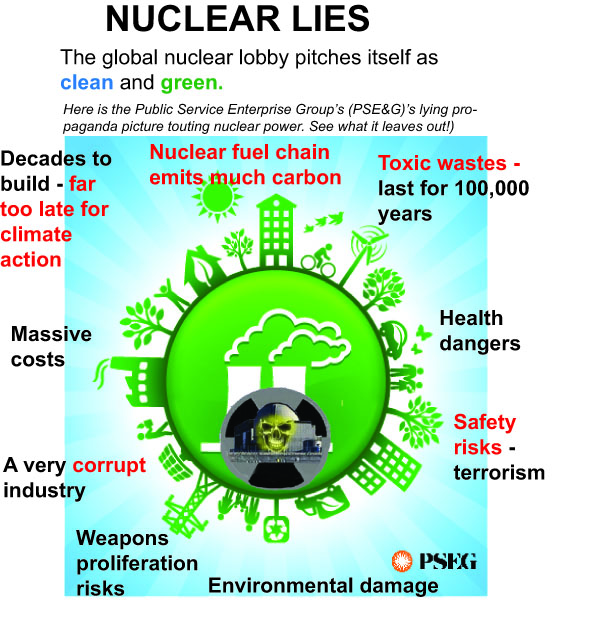
Anyway, today I was captivated by a charming, pretty, graphic, touted by the Public Service Enterprise Group, (PSE&G’) in an article extolling nuclear power, published by INSIDER NJ.
I just felt the need to make PSE&G’s picture honest.
1 This Month



26 September – International Day for the Total Elimination of Nuclear Weapons


PLEASE OPPOSE HR 8255 AND S.3639 – bills would accelerate satellite deployment, with no environmental review or safeguards – https://ncstd5li.quorum.us/campaign/169331/
To see nuclear-related stories in greater depth and intensity – go to https://nuclearinformation.wordpress.com
-
Archives
- September 2026 (245)
- August 2026 (330)
- July 2026 (355)
- June 2026 (287)
- May 2026 (306)
- April 2026 (356)
- March 2026 (251)
- February 2026 (267)
- January 2026 (308)
- December 2025 (358)
- November 2025 (359)
- October 2025 (375)
-
Categories
- 1
- 1 NUCLEAR ISSUES
- business and costs
- climate change
- culture and arts
- ENERGY
- environment
- health
- history
- indigenous issues
- Legal
- marketing of nuclear
- media
- opposition to nuclear
- PERSONAL STORIES
- politics
- politics international
- Religion and ethics
- safety
- secrets,lies and civil liberties
- spinbuster
- technology
- Uranium
- wastes
- weapons and war
- Women
- 2 WORLD
- ACTION
- AFRICA
- Atrocities
- AUSTRALIA
- Christina's notes
- Christina's themes
- culture and arts
- Events
- Fuk 2022
- Fuk 2023
- Fukushima 2017
- Fukushima 2018
- fukushima 2019
- Fukushima 2020
- Fukushima 2021
- general
- global warming
- Humour (God we need it)
- Nuclear
- RARE EARTHS
- Reference
- resources – print
- Resources -audiovicual
- Weekly Newsletter
- World
- World Nuclear
- YouTube
-
RSS
Entries RSS
Comments RSS
 nuclear-news