Enforcement strategies against global corruption now confront Unaoil

Unaoil’s global web of corruption, however, shows that bribery is still alive and kicking. The companies that secured contracts through Unaoil bribes are based in countries that signed the OECD anti-bribery convention, including the U.S., U.K. Australia, Canada, Germany, Greece, Spain and Turkey.
The response of these nations will be the next test of international commitment to stop corruption.
Crooked political leaders embroiled in attention-grabbing stories like these don’t act alone. They are often enabled by international corporations like Unaoil, which greased government officials’ pockets across North Africa, the Middle East and Central Asia to secure lucrative contracts.
[Read More: There’s A Huge New Corporate Corruption Scandal. Here’s Why Everyone Should Care.]
This kind of international graft is what has prompted the United States in recent decades to crack down on corruption, an issue it has come to see as a significant national security problem.
Because of that 35-year American effort, joined by other Western nations, more countries are “adopting serious reforms, enforcing anti-corruption laws with real effectiveness, and government officials are feeling tremendous pressure as a result,” said Andrew Spalding, an expert in U.S. anti-corruption law at the University of Richmond School of Law.
The tough U.S. stance on bribery and corruption dates to the Watergate scandal, which brought down President Richard Nixon. Congressional investigations revealed illegal corporate contributions to the Nixon campaign, and found that U.S. companies — including Lockheed Martin, Mobil Oil and Northrup — maintained bank accounts for the purpose of bribing foreign officials to secure contracts abroad.
In response, Congress passed the Foreign Corrupt Practices Act in 1977, making the U.S. the first nation to ban companies from bribing foreign government officials.
The law was rarely enforced at first, but it nevertheless caused concern for U.S. companies. In the late 1980s, corporations pushed for Congress to repeal or weaken the law, arguing that it put them at a disadvantage with international competitors. A 1988 compromise required the president to work with the Organization of Economic Coordination and Development, an international trade organization, to press other countries to adopt anti-bribery laws.
It took nine more years for the U.S. to convince other OECD nations to enact an anti-bribery convention that aligned their laws with the U.S. In 2003, the United Nations created its own anti-bribery scheme, expanding the restrictions to countries not part of the OECD. ……….
The watershed moment for anti-bribery enforcement came in 2008, when the German engineering company Siemens pleaded guilty to paying $1.4 billion in bribes to government officials in Argentina, Israel, Nigeria, China and Russia, among other countries, to secure lucrative contracts. The company agreed to pay a record $1.6 billion to U.S. and European authorities to settle the charges.
The Siemens settlement spurred even more enforcement actions in the U.S., targeting U.S. and foreign companies. Both the DOJ and the Securities and Exchange Commission can bring FCPA charges against any company listed on U.S. stock exchanges, doing business through U.S. banks, or making transactions in U.S. dollars.
Since 2008, U.S. regulators have reached billions of dollars in settlements with major companies. Top executives have been sent to jail. Halliburton and KBR reached a $402 million settlement in 2009 for a decade-long scheme to bribe Nigerian officials for contracts. British company BAE Systems settled for $400 million in 2010 over accusations of bribing Saudi Arabian princes in exchange for defense contracts. German automaker Daimler settled following an investigation that found it was paying bribes in 22 countries……..
The BAE Systems investigation ultimately landed with U.S. authorities. In 2010, the company pleaded guilty and agreed to pay $400 million.
Blair’s attempt to protect BAE Systems highlighted a significant problem with the OECD anti-bribery convention — that only a few countries actually enforce their anti-bribery laws. Transparency International, a nongovernmental organization that monitors corruption, reported that only four of the 41 OECD nations are major enforcers of their laws, and six are moderate enforcers. Despite the BAE Systems dustup — or perhaps because of it — Britain ranks as a major enforcer. Japan remains one of biggest problem countries…….
Collecting evidence across multiple borders is time consuming and challenging, forcing investigators to navigate each country’s laws for data privacy and information sharing. As a result, a 2014 international report found that enforcement cases were taking an average of seven years to reach a conclusion.
Another problem for OECD countries is the lack of involvement of rising economies, like China and India.
U.S. focus on anti-corruption enforcement was underscored on March 16, when Attorney General Loretta Lynch spoke at the annual meeting of the OECD anti-bribery convention.
“[W]e have transitioned in less than two decades from a world in which bribery of foreign officials was considered a sound business strategy, to one in which bribery is treated like the destructive and corrosive crime that it is,” Lynch said. “That is a tremendous achievement in which we can all take pride — and it is a testament to what is possible through multinational cooperation.”
Unaoil’s global web of corruption, however, shows that bribery is still alive and kicking. The companies that secured contracts through Unaoil bribes are based in countries that signed the OECD anti-bribery convention, including the U.S., U.K. Australia, Canada, Germany, Greece, Spain and Turkey.
The response of these nations will be the next test of international commitment to stop corruption. http://www.huffingtonpost.com.au/entry/unaoil-corruption-enforcement_us_56fb04b4e4b0daf53aedee71?section=australia
Get the lowdown on the lowdown global oil industry
 “World’s biggest bribe scandal”: Report on oil corruption exposes how corporations help destabilize Middle East
Mar 31, 2016. Leaked docs show how the shadowy company Unaoil bribes Middle Eastern regimes for oil contracts for multinationals …
The interactive report “The Bribe Factory” details how Unaoil exploits the widespread corruption in many oil-rich nations, based on company documents obtained by the Huffington Post and its Australian partner Fairfax Media.
Must-read three-part interactive report ‘The Bribe Factory: World’s biggest bribe scandal’
The Bribe Factory: World’s biggest bribe scandal
A global bribery scheme that implicates leading Western multinationals has been exposed by the leak of confidential files in the oil industry.
http://www.theage.com.au/interactive/2016/the-bribe-factory/#chapter1
(Links for the three parts are listed below. Check out the additional stories – twenty in total and all well worth reading – that are listed for the three parts. These can also be readily accessed at: http://www.theage.com.au/interactive/2016/the-bribe-factory/.)
The Bribe Factory Part 1/3: Unaoil: The company that bribed the world
It was the company with jet-set style and dirty hands. From the tiny principality of Monaco, Unaoil reached across the globe to pay multi-million dollar bribes in oil rich states. The beneficiaries? Some of the biggest companies in England, Europe, America and Australia.
In the list of the world’s great companies, Unaoil is nowhere to be seen. But for the best part of the past two decades, the family business from Monaco has systematically corrupted the global oil industry, distributing many millions of dollars worth of bribes on behalf of corporate behemoths including Samsung, Rolls-Royce, Halliburton and Australia’s own Leighton Holdings.
Now a vast cache of leaked emails and documents has confirmed what many suspected about the oil industry, and has laid bare the activities of the world’s super-bagman as it has bought off officials and rigged contracts around the world.
The Bribe Factory Part 2/3: Unaoil: Police launch joint global investigation
The biggest leak of documents in oil-industry history has exposed Monaco-based company Unaoil as an agent of serious corruption. Now, law enforcement groups around the world, including the FBI, are taking notice.
A Fairfax Media and Huffington Post investigation has uncovered an extraordinary story of bribery and corruption in the oil industry, centred on Monaco-based company Unaoil. This is the story of Unaoil’s penetration of the former Soviet states.
Read more: http://www.theage.com.au/interactive/2016/the-bribe-factory/day-2/global-investigation.html
The Bribe Factory Part 3/3: Unaoil: Dark secrets of Asian powers
Asian companies such as Hyundai, Samsung, Sinopec and Petronas are household names. But they have dark secrets. In the latest in Fairfax Media and The Huffington Post’s global bribery expose, these firms and more are implicated for paying kickbacks, money laundering and corruption.
Read more: http://www.theage.com.au/interactive/2016/the-bribe-factory/day-3/asian-powers.html
Additional articles provided for Part 3 of ‘The Bribe Factory’ report
Unaoil: Asia’s corruption tigers
In the list of the world’s great companies, Unaoil is nowhere to be seen. But for the best part of the past two decades, the family business from Monaco has systematically corrupted the global oil industry, distributing many millions of dollars worth of bribes on behalf of corporate behemoths including Samsung, Rolls Royce, Halliburton and Australia’s own Leighton Holdings. This is the story of how Unaoil helped Korean giants form a cartel in Africa.
http://www.theage.com.au/interactive/2016/the-bribe-factory/day-3/koreans.html
Unaoil in Africa
A Fairfax Media and Huffington Post investigation has uncovered an extraordinary story of bribery and corruption in the oil industry, centred on Monaco-based company Unaoil. This is the story of Leighton Offshore’s pursuit of a billion dollar pay day. Unaoil was desperate for a piece of the action in Africa’s burgeoning oilfields.
http://www.theage.com.au/interactive/2016/the-bribe-factory/day-3/africa.html
Unaoil & Tony Kazal: The Sydney Connection
A Fairfax Media and Huffington Post investigation has uncovered an extraordinary story of bribery and corruption in the oil industry, centred on Monaco-based company Unaoil. This is the story of Leighton Offshore’s pursuit of a billion dollar pay day. Unaoil had friends in many places – including a Sydney identity who helped it do business in the Middle East.
http://www.theage.com.au/interactive/2016/the-bribe-factory/day-3/kazal.html
Unaoil: Why we must act
2 Apr 16. Australia is leagues behind the US when it comes to investigating corrupt multinational companies who bribe their way to success in third world countries.
This fact is even more concerning given that US prosecutors acknowledge that even they aren’t getting it right, and need to do more to send US corporate crooks to jail. If the US regime needs a jolt, Australia’s system needs a triple bypass.
http://www.theage.com.au/interactive/2016/the-bribe-factory/day-3/why-we-must-act.html
The Age Editorial
The Age Editorial: Lax laws and morals let corruption flourish
April 1, 2016. Ata Ahsani, the patriarch of the Unaoil company, suggests the work his outfit does in countries such as Iraq, Iran, Libya, Syria and Yemen is “very basic”. The way he puts it, Unaoil helps to “integrate Western technology with local capability”. A more straightforward description is that Unaoil pays bribes to government officials on behalf of some of the world’s biggest companies.
In an extensive global investigation, The Age, in conjunction with The Huffington Post, has revealed how Monaco-based Unaoil has operated a veritable factory of sly dealings sealed through illegal transactions as its tentacles threaded into the topmost tiers of corrupt countries.
Related Huffington Post items:
Unaoil’s Huge New Corporate Bribery Scandal, Explained
03/30/2016. Here’s what you need to know.
(And check out the other important stories recommended at the end of this article)
There’s A Huge New Corporate Corruption Scandal. Here’s Why Everyone Should Care.
03/30/2016. Bribery fuels political instability — and it’s a propaganda tool for terrorists. …
On Wednesday, The Huffington Post and its Australian partner, Fairfax Media — led by reporters Richard Baker and Nick McKenzie — published the results of a months-long investigation of Unaoil, an obscure firm that helps big multinational corporations win contracts in areas of the world where corruption is common.
U.S. Oil Industry Giant Paid Millions To A Company At The Center Of Huge Corruption Scandal
While KBR was being investigated for bribery in Nigeria, it was partnering with a company that bribed officials in Kazakhstan.
The American engineering and construction firm KBR hired Unaoil — an obscure Monaco-based company now involved in amassive international bribery scandal — to help it win oil and gas contracts in Kazakhstan. KBR, which until 2007 was part of the oilfield services giant Halliburton, paid Unaoil millions of dollars from 2004 until at least 2009, according to thousands of internal documents obtained by The Huffington Post and Fairfax Media.
Inside The Battle Against Global Corruption
Here’s the enforcement landscape that companies involved in corruption with Unaoil will face.
New proof that South Africa planned a binding nuclear deal with Russia


 SA planned binding nuclear deal with Russia, Business Day BY CAROL PATON, 31 MARCH 2016, NEW proof has emerged that SA intended to sign a binding deal with Russia to buy a fleet of nuclear reactors, bypassing public finance management rules along the way.
This is contained in court papers lodged on Wednesday by the Southern African Faith Communities Environmental Initiative and Earthlife Africa in the High Court in Cape Town.
The lobby groups, which are asking the court to declare the inter-governmental agreements on nuclear energy signed in 2014 unlawful, secured the new information through court processes that compelled the government to provide the record of decisions on the deal.
Among the records provided is an explanatory memorandum drafted by the state law adviser in November 2013 on the draft Russian deal, which makes clear — they say — that the deal was “intended” and was “understood as creating a firm commitment that Russia would construct the required nuclear plants in SA”.
The state law adviser’s memo has been long sought by the media and opponents of the forthcoming nuclear procurement as it was widely rumoured at the time that the office had given a strong warning that the proposed agreement was binding in nature, had budgetary implications and had to be debated publicly before it could be adopted.
Asked at the time to comment, chief state law adviser Enver Daniels refused, citing client confidentiality……..http://www.bdlive.co.za/business/energy/2016/03/31/sa-planned-binding-nuclear-deal-with-russia
A Bailout for the Nuclear Industry – the Pepco-Exelon Merger
Is the Pepco-Exelon Merger A Bailout for the Nuclear Industry? – Big Picture with Thom Hartmann
March 27, 2016 Pepco and Exelon are about to merge and create the biggest utility company in the country. But is this merger – which is being sold as a pro-consumer – actually just a glorified bailout for the nuclear industry? Kevin Kamps joins Thom Hartmann to discuss this.
Once again, access to South Africa’s nuclear documents is denied
Access to nuclear documents denied once again http://www.bdlive.co.za/business/energy/2016/03/22/access-to-nuclear-documents-denied-once-again BY LINDA ENSOR, 22 MARCH 2016 ENERGY Minister Tina Joemat-Pettersson has turned down an appeal by the Open Democracy Advice Centre (Odac) against her department’s refusal to grant access to sensitive documents relating to government’s nuclear procurement plans.

The centre — acting on behalf of Business Day — used the Promotion of Access to Information Act (Paia) last year to request access to three reports relating to the estimated cost of building 9,600MW nuclear plants. The reports on nuclear-procurement models, the cost of nuclear plants and financing models were compiled for the department by three international consultancies — KPMG, Ingerop and Deloitte.
Former Business Day editor Songezo Zibi, speaking last year after the application was lodged, said the newspaper had “reason to believe that the cost studies the department does not want the public to see until it is too late in the process, show that 9,600MW of nuclear will be unaffordable”.
The affordability of the nuclear plans has become even more concerning given the financial straits government finds itself in. But the Treasury has insisted that it will approve only what is affordable.
The energy department rejected the original Paia request, saying the documents were classified as secret and would not be made available to the public. Its view was confirmed by the minister in a letter sent last week to Odac’s head of advocacy and special projects, Alison Tilley. Ms Joematt-Pettersson said “there is no evidence before me to suggest that the public interest in the disclosure of the record sought outweighs the harm contemplated by the release of the reports”.
She said the records sought included “information (which includes financial information) to be used in the procurement process and if released, in all likelihood, would be detrimental to the procurement process, most especially the competitive bidding process that is soon to be under way.
“Disclosure thereof would have the effect of materially jeopardising the economic interests or financial welfare of the republic.”
Similar reasons were given by the department to maintain the secrecy of the intergovernmental agreements on nuclear co-operation that were found to contain no proprietary or commercial information when they were tabled in Parliament last June.
When the department rejected Odac’s request, Right 2 Know Campaign spokesman Murray Hunter said the affordability study for SA’s strategic arms procurement in 1999 had been classified until last year. “When this was unclassified, it was clear that there had been enormous financial risks. Governments often overclassify documents to shield themselves from accountability and end up making the wrong decisions. The fact that these documents are being withheld, makes it impossible for SA to have the conversation about nuclear energy.”
Odac has three months within which to lodge an appeal against the minister’s decision.
USA’s failure of f Decommissioning Regulation: are these trust funds really slush funds?

 The Nationwide Failures of Decommissioning Regulation: Decommissioning Trust Funds or Slush Funds? http://www.fairewinds.org/nuclear-energy-education//03tj9289ut746v9sb3cbkrhfzqgtdzFairewinds Energy Education has submitted a new decommissioning report entitled: The Nationwide Failures of Decommissioning Regulation: Decommissioning Trust Funds or Slush Funds? to the Nuclear Regulatory Commission (NRC). Research was funded by a Lintilhac Foundation Grant. First submitted a year ago, the report evaluates utility owner Entergy’s plan to use the NRC sanctioned SAFSTOR process to decommission Vermont Yankee.
Developed by the NRC, SAFSTOR is a subsidy that benefits nuclear power plant owners like Entergy by providing them with a 60-year window to decommission nuclear plants. With an increasing number of aging atomic power plants shutting down in the United States, Fairewinds’ report is an ongoing case study of the decommissioning process at Vermont Yankee where nuclear energy corporations have been allowed by the NRC to raid decommissioning funds procured by ratepayers like you and me. From unregulated withdrawals of funds, a 60-year timeline with no basis in science, to zero responsibility in regards to emergency planning, it’s clear that NRC regulations are benefitting corporations and not the public.
The Nationwide Failures of Decommisioning Regulation: Decommisioning Trust Funds or Slush Funds?, Comments Submitted to the Nuclear Regulatory Commission
March 17, 2016, Fairewinds Energy Education
Toshiba investigated Over Westinghouse Accounting
Toshiba Said to Face U.S. Probe Over Westinghouse Accounting, 17 Mar Tom Schoenberg and Matt Robinson, 2016, Bloomberg Toshiba Corp. is under investigation by the U.S. government over allegations that it hid $1.3 billion in losses at its nuclear power operations, according to two people familiar with the matter. Shares plunged in Tokyo.
The Justice Department and the Securities and Exchange Commission are looking into whether fraud was committed, said the two, who asked not to be named because the investigations aren’t public. The probes, they said, follow one by Japan’s securities regulator, which found that Toshiba falsified financial statements and documents involving its issuance of corporate bonds.
U.S. authorities are scrutinizing allegations made in an internal review published last year by the Tokyo-based company, the two people said. The report, a 334-page version of which was published in English on Toshiba’s website in December, said management was complicit in padding profits for almost seven years. It led to the resignations of top officials, including Hisao Tanaka, Toshiba’ president and chief executive officer.
Until now, the investigation into Toshiba’s accounting practices had been limited to its home country, where regulators fined the company $62.1 million — the largest penalty ever imposed — and fined its former auditor, Ernst & Young ShinNihon, $17.4 million and barred it from accepting new business for three months. Toshiba President Masashi Muromachi, who took over as the scandal unfolded last year, promised to take steps to overhaul operations and prevent future wrongdoing.
The stock fell 8 percent to 192 yen in Tokyo, the biggest drop since Feb. 5. The shares had climbed as as much as 4.9 percent before the probe was reported.
“The markets are very sensitive to any news of impropriety,” said Yukihiko Shimada, a Tokyo-based analyst at SMBC Nikko Securities Inc. “Toshiba has previously assured investors that everything was right at Westinghouse. Their track record isn’t great.”
The recent expansion by U.S. authorities, which are known to open cases even when another jurisdiction is already investigating, means Toshiba could face further enforcement action in America. The U.S. can exert jurisdiction in part because the allegations involve its Westinghouse Electric Co. unit, which is based in Cranberry Township, Pennsylvania. The report also names Ernst & Young, which audited the Westinghouse accounts……..
In Japan, Toshiba’s accounting scandal is the largest since 2011, when Olympus Corp. admitted to using takeovers to hide $1.7 billion in losses. Toshiba, a 140-year-old industrial group that makes everything from nuclear reactors to microchips and home appliances, dropped to a 35-year low in Tokyo in February after widening its annual loss forecast to a record $6 billion as it restructures in the wake of the scandal.
Toshiba said it initially uncovered irregularities related to “percentage of completion” estimates used on infrastructure projects including nuclear, hydroelectric, wind-power equipment, air-traffic control and railway systems. Percentage of completion accounting is a subjective method that relies almost completely on management estimates on the profitability of long-term contracts………
Westinghouse was purchased by Toshiba for $5.4 billion in 2006. Toshiba explained to investors in November that Westinghouse’s nuclear plant construction business was harmed by the Fukushima nuclear disaster.
Toshiba’s internal report describes how the company failed to account for more than $100 million in Westinghouse losses on its 2013 books involving the construction of a nuclear power plant in Florida. Toshiba officials traveled to the U.S. to meet with Westinghouse executives to discuss findings showing increasing costs of the Florida project…….http://www.chicagotribune.com/news/sns-wp-blm-toshiba-0c20a5c8-ec23-11e5-a9ce-681055c7a05f-20160317-story.html
Is India’s Government Hiding A Serious Accident Underway In Gujarat?
India’s Former Nuclear Regulator Says, Govt Might Be 
 , CounterCurrents By Kumar Sundaram 13 March, 2016 Indiaresists.com The retired chief of India’s nuclear regulator, Dr. A Gopalakrishnan has sent out an urgent note in which he has cautioned that a ‘loss of coolant accident(LOCA)’ might be underway in Gujarat’s Kakrapar Nuclear Power Station(KAPS). A LOCA accidents is the most serious accident that can happen in nuclear plants and it might lead to the meltdown of the reactor fuel core.
The same reactor had a major accident in 1994 when floodwaters drowned Kakrapar. The floodgates meant to release excess water could not be opened and the water kept increasing–which could lead to a major accident–but it was prevented with the efforts of local engineers. Mr. Manoj Mishra, a worker in the power station then who blew whistle on that accident was terminated by the NPCIL. He was denied justice even by the Supreme Court in India which bought the NPCIL’s argument that he cannot be a whistle-blower as he did not have technical degrees. Mr. Mishra had years of experience in the reactor and he was a strong leader of the workers’ union.
Kakrapar is situated not very far from the Vansda-Bharuch earthquake faultline running through Gujarat, which has experienced several major earthquakes.
Exactly on the 5th anniversary of Fukushima, a leak has been reported in the Unit-1 of the Kakrapar Nuclear Power Station near Surat in Gujarat.
Here is the note by Dr. Gopalakrishnan:
The Kakrapar Unit-I nuclear reactor in Gujarat is undergoing a moderately large leakage of heavy water from its Primary Heat Transport (PHT) system since 9.00 AM on March 11,2016. From the very limited information released by the Nuclear Power Corporation of India Limited (NPCIL) and the Atomic Energy Regulatory Board (AERB) of the government , as well as from the conversations I had with press people who have been in touch with nuclear officials, few inferences can be drawn.
Till 7.00 PM on March 12,2016 , the DAE officials have no clue as to where exactly the PHT leak is located and how big is the rate of irradiated heavy water that is leaking into the reactor containment . However, some reports indicate that the containment has been vented to the atmosphere at least once , if not more times , which I suspect indicates a tendency for pressure build up in that closed space due to release of hot heavy water and steam into the containment housing . If this is true, the leak is not small , but moderately large , and still continuing. No one confirms that any one has entered the containment (in protective clothing) for a quick physical assessment of the situation , perhaps it is not safe to do so because of the high radiationfields inside . When NPCIL officials state that the reactor cooling is maintained , I believe what they may be doing is to allow the heavy water or light water stored in the emergency cooling tanks to run once-through the system and continue to pour through the leak into the containment floor through the break .
All this points to the likelihood that what Kakrapar Unit-1 is undergoing is a small Loss-of-Coolant Accident (LOCA) in progress. It is most likely that one or more pressure tubes (PT) in the reactor (which contain the fuel bundles) have cracked open , leaking hot primary system heavy-water coolant into the containment housing . ……….
. It may be possible that , having built more than 20 PHWRs , NPCIL and AERB in recent years have become overconfident and relaxed their strict adherence to this Aging Management Program , which might have been the reason for the current accident.
Let me caution the reader that the above conjecture is based on bits and pieces of reliable and not so reliable information gathered from different people close to the accident details and in positions of authority. Future detailed evaluation may or may not prove my entire set of conclusions or part of them to be not well-founded. But , technical experts are compelled to put out such conjectures because of the total lack of transparency of the Indian cilvilian nuclear power sector and the atomic energy commission (AEC) , the Dept. of Atomic Energy (DAE) , the NPCIL and the AERB . Public have a need to know and , therefore , the AEC and its sub-ordinate organizations need to promptly release status reports on the progressing safety incident which could affect their lives , to alleviate their concerns and anxieties . It is a series of such lapses in communication over the years which has built up the ever-increasing trust deficit in the DAE system among the general public. All future plans for expanding the civilian nuclear power sector should be put on hold until a truly independent nuclear safety regulator is put in place , who is not controlled by the AEC or the Prime Minister’s Office (PMO) , who will then be answerable to openly communicating with the public on all civilian nuclear power matters.
Kumar Sundaram is a senior researcher with Coalition for Nuclear Disarmament and Peace (CNDP) and Editor of DiaNUke.org http://www.countercurrents.org/sundaram130316.htm
South Carolina nuclear whistleblower workers punished for speaking out on safety concerns
 Nuclear workers say they were retaliated against for exposing wrongdoing BY LINDSAY WISE AND SAMMY FRETWELL, The State, 13 Mar 16 lwise@mcclatchydc.com, sfretwell@thestate.com WASHINGTON, DC
In her job at the Savannah River Site nuclear weapons plant in South Carolina, Sandra Black was responsible for looking into concerns raised by employees about everything from health and safety to fraud, abuse, harassment and retaliation.
But in fall 2014, when federal investigators with the Government Accountability Office asked her whether she had the necessary independence to do her job, Black says she answered truthfully: She told them her supervisors had interfered with her work and had tried to intimidate her into changing her findings if they validated employees’ complaints.
Black disclosed her conversation with the GAO investigators to her bosses. A few weeks later, on Jan. 7, 2015, she was fired.
“It is so humiliating and embarrassing,’’ Black said. “It’s hard to come home and tell your family you’ve been terminated after 35 years. It was for no reason other than retaliation for doing my job correctly with integrity.’ ’’
The investigators who questioned Black had been conducting a probe into whistleblower retaliation by the Department of Energy and its contractors at the nation’s nuclear facilities. The GAO is expected to release a report this spring.
Three U.S. senators — Democrats Claire McCaskill of Missouri, Ron Wyden of Oregon and Edward Markey of Massachusetts — had asked the GAO in March 2014 to get to the bottom of persistent incidents of retaliation against whistleblowers reported at the Hanford nuclear reservation in Washington state.
The probe broadened to review other DOE sites, including SRS near Aiken, S.C.
“It defies belief that an Energy Department contractor would fire an employee who cooperated with a Government Accountability Office investigation into whistleblower retaliation,” said Wyden, a former chairman of the Senate Committee on Energy and Natural Resources.
“I’m awaiting the GAO’s full report,” Wyden said, “but the firing of Sandra Black under these circumstances demonstrates to me that the culture of retaliation against whistleblowers is regrettably alive and well at DOE.”
Markey said Black’s termination is evidence of a “dangerous culture of disregard for the law” among DOE contractors, including Savannah River Nuclear Solutions, the company Black says let her go.
“Rather than rewarding whistleblowers who bravely put their careers on the line to protect public safety, SRNS and other contractors have acted to retaliate against them, sending a chilling message to all employees who bear witness to wasteful, unsafe, or illegal activity,” Markey said. “DOE has historically done nothing to curb this wholly unacceptable behavior.”……….
Carolina Dust Up
Similar concerns are found nearly 3,000 miles from Hanford at the Savannah River Site, along the South Carolina-Georgia border.
Black, a 59-year-old Martinez, Ga., resident, said she’s worried workers at the 310-square-mile complex won’t come forward with safety complaints now that she has been let go………http://www.thestate.com/news/local/article65707887.html
Exxon’s scandalous dishonesty about climate change
 Scandal! Exxon knew about climate change, boosted denialism, misled shareholders, went carbon heavy, Ecologist Bill McKibben 9th March 2016 One of the world’s biggest energy companies has been caught out in what may be the biggest ever climate scandal, writes Bill McKibben. Way back in the 1980s ExxonMobil knew of the ‘potentially catastrophic’ and ‘irreversible’ effects of increasing fossil fuel consumption, but chose to cover up the findings, spread misinformation on climate change, and go for high carbon energy sources……….
Exxon twisted the facts to further its own agenda
So here’s what happened. Exxon used its knowledge of climate change to plan its own future. The company, for instance, leased large tracts of the Arctic for oil exploration, territory where, as a company scientist pointed out in 1990, “potential global warming can only help lower exploration and development costs.”
Not only that but, “from the North Sea to the Canadian Arctic,” Exxon and its affiliates set about “raising the decks of offshore platforms, protecting pipelines from increasing coastal erosion, and designing helipads, pipelines, and roads in a warming and buckling Arctic.”In other words, the company started climate-proofing its facilities to head off a future its own scientists knew was inevitable.
But in public? There, Exxon didn’t own up to any of this. In fact, it did precisely the opposite. In the 1990s, it started to put money and muscle into obscuring the science around climate change. It funded think tanks that spread climate denial and even recruited lobbying talent from the tobacco industry.
It also followed the tobacco playbook when it came to the defence of cigarettes by highlighting ‘uncertainty’ about the science of global warming. And it spent lavishly to back political candidates who were ready to downplay global warming.
Its CEO, Lee Raymond, even travelled to China in 1997 and urged government leaders there to go full steam ahead in developing a fossil fuel economy. The globe was cooling, not warming, he insisted, while his engineers were raising drilling platforms to compensate for rising seas.
“It is highly unlikely”, he said, “that the temperature in the middle of the next century will be significantly affected whether policies are enacted now or 20 years from now.” This wasn’t just wrong, but completely and overwhelmingly wrong – as wrong as a man could be.
Sins of omission
In fact, Exxon’s deceit – its ability to discourage regulations for 20 years – may turn out to be absolutely crucial in the planet’s geological history. It’s in those two decades that greenhouse gas emissions soared; as did global temperatures until, in the twenty-first century, ‘hottest year ever recorded’ has become a tired cliché.
And here’s the bottom line: had Exxon told the truth about what it knew back in 1990, we might not have wasted a quarter of a century in a phony debate about the science of climate change, nor would anyone have accused Exxon of being ‘alarmist.’ We would simply have gotten to work.
But Exxon didn’t tell the truth. A Yale study published last fall in the Proceedings of the National Academy of Sciences showed that money from Exxon and the Koch Brothers played a key role in polarizing the climate debate in this country.
The company’s sins – of omission and commission – may even turn out to be criminal. Whether the company ‘lied to the public’ is the question that New York Attorney General Eric Schneiderman decided to investigate last fall in a case that could make him the great lawman of our era if his investigation doesn’t languish.
There are various consumer fraud statutes that Exxon might have violated and it might have failed to disclose relevant information to investors, which is the main kind of lying that’s illegal in this country of ours. Now, Schneiderman’s got back up from California Attorney General Kamala Harris, and maybe – if activists continue to apply pressure – from the Department of Justice as well, though it’s highly publicized unwillingness to go after the big banks does not inspire confidence.
Here’s the thing: all that was bad back then, but Exxon and many of its Big Energy peers are behaving at least as badly now when the pace of warming is accelerating. And it’s all legal – dangerous, stupid, and immoral, but legal.
Exxon finally admits global warming is occurring – but there’s no big problem………
The carbon tax and the political stonewall
In other words, we’re no longer talking about outright denial, just a denial that much really needs to be done. And even when the company has proposed doing something, its proposals have been strikingly ethereal. Exxon’s PR team, for instance, has discussedsupporting a price on carbon, which is only what economists left, right, and centre have been recommending since the 1980s.
But the minimal price they recommend – somewhere in the range of $40 to $60 a ton – wouldn’t do much to slow down their business. After all, they insist that all their reserves are still recoverable in the context of such a price increase, which would serve mainly to make life harder for the already terminal coal industry.
But say you think it’s a great idea to put a price on carbon – which, in fact, it is, since every signal helps sway investment decisions. In that case, Exxon’s done its best to make sure that what they pretend to support in theory will never happen in practice…….
Now the cover ups are being investigated – could Exxon be liable?
As with the tobacco companies in the decades when they were covering up the dangers of cigarettes, there’s a good chance that the Big Energy companies were in this together through their trade associations and other front groups.
In fact, just before Christmas, Inside Climate News published some revealing new documents about the role that Texaco, Shell, and other majors played in an American Petroleum Institute study of climate change back in the early 1980s. A trial would be a transformative event – a reckoning for the crime of the millennium.
But while we’re waiting for the various investigations to play out, there’s lots of organizing going at the state and local level when it comes to Exxon, climate change, and fossil fuels – everything from politely asking more states to join the legal process to politely shutting down gas stations for a few hours to pointing out to New York and California that they might not want to hold millions of dollars of stock in a company they’re investigating. It may even be starting to work.
Vermont Governor Peter Shumlin, for instance, singled Exxon out in his state of the state address last month. He called on the legislature to divest the state of its holdings in the company because of its deceptions:
“This is a page right out of Big Tobacco, which for decades denied the health risks of their product as they were killing people. Owning ExxonMobil stock is not a business Vermont should be in.”
The question is: Why on God’s not so green Earth any more would anyone want to be Exxon’s partner?
Action: BreakFree2016, May 4-15 – a global wave of mass actions will target the world’s most dangerous fossil fuel projects, in order tokeep coal, oil and gas in the ground and accelerate the just transition to 100% renewable energy. Across the world, people are showing the courage toconfront polluters where they are most powerful – from the halls of power to the wells and mines themselves. http://www.theecologist.org/News/news_analysis/2987359/epic_scandal_how_exxon_boosted_climate_change_denial_infiltrated_politics_misled_shareholders.html
Authorities withheld information on serious incident at Fessenheim nuclear facility in France
Reports: Fessenheim nuclear accident played down by authorities http://www.dw.com/en/reports-fessenheim-nuclear-accident-played-down-by-authorities/a-19093477
An incident at the Fessenheim nuclear facility in France in 2014 was more serious than previously known. German media reports claim the authorities withheld information detailing the gravity of the situation. Both the French nuclear authority, ASN, and the company operating the two Fessenheim nuclear reactors, French energy giant EDF, allegedly did not divulge the gravity of the incident on April 9, 2014, when one of the reactors had to be shut down after water was found leaking from several places.
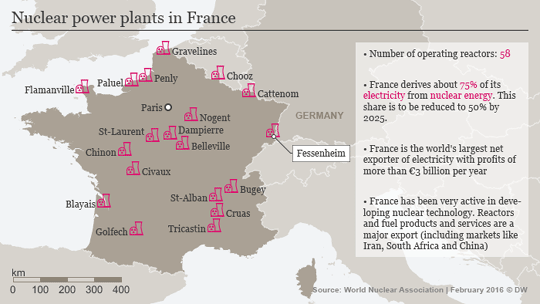
Researchers from German daily “Süddeutsche Zeitung” and public broadcaster WDR claim the incident at Fessenheim, which is in Alsace near the border with Germany, could turn out to be one of “most dramatic nuclear accidents ever in Western Europe.”
They are basing the claim on a document they say they have obtained, sent by ASN to the then-head of the facility on April 24, 2014.
The letter and subsequent reply reveal that the reactor could not be shut down in an ordinary fashion due to control rods being jammed. The reactor had to be shut down by adding boron to the pressure vessel, an unprecedented procedure in Western Europe, according to an expert.
“I don’t know of any reactor here in Western Europe that had to be shut down after an accident by adding boron,” Manfred Mertins, expert and government advisor on nuclear reactor safety, told WDR and Süddeutsche Zeitung.
The reports say the official report ASN released did not contain information on adding boron nor the jammed control rods. It was also not reported in that way to the International Atomic Energy Agency (IAEA).
The Fessenheim reactors went online in 1977 and 1978, making them France’s oldest. The government has repeatedly said it would shut down the facility after fierce criticism from politicians at home, as well as from neighboring Germany and Switzerland.
On Friday, Eveline Lemke, environment minister for the German state of Rhineland-Palatinate, which borders Alsace, called for Fessenheim to be shut down immediately. She said she was “dismayed to hear about yet another incident involving a French reactor,” adding that France’s nuclear watchdog was “evidently failing.”
Germany has also been at loggerheads with Belgium over the country’s Tihange nuclear reactor near their shared border. It was shut down in March 2014, but went back online in December last year, despite concerns over cracks in its pressure vessels.
Nuclear power still provides three-quarters of France’s energy needs, but the government passed legislation last summer to cut the country’s dependence on atomic energy.
Murder of indigenous activist Green Nobel winner Berta Caceres
Environmental activist, Green Nobel winner Berta Caceres killed http://www.theaustralian.com.au/news/world/environmental-activist-green-nobel-winner-berta-caceres-killed/news-story/8399e153bdf91f483868c9e9d63e6dac AFP MARCH 5, 2016 TEGUCIGALPA: Honduran indigenous activist Berta Caceres, an award-winning environmentalist, has been shot and killed in her home, her family labelling her death an assassination.
Ms Caceres won the 2015 Goldman Prize, the world’s top award for grassroots environmental activism, for leading the indigenous Lenca people in a struggle against a hydro-electric dam project that would flood native lands and cut off water supplies to hundreds.
Her mother, Berta Flores, said yesterday police had indicated her daughter was killed in a robbery, “but we all know it was because of her struggle”.
The 43-year-old mother of four, who had received death threats for her activism, was shot dead in the early hours of Thursday at her home in the western town of La Esperanza.
In awarding her the prize, the Goldman organisation commended her for carrying on her campaign despite the threats, writing: “Her murder would not surprise her colleagues, who keep a eulogy — but hope to never have to use it. “Despite these risks, she maintains a public presence in order to continue her work”.
President Juan Orlando Hernandez called the killing “a crime against Honduras” and vowed to bring the perpetrators to justice, and secretary-general of the Organisation of American States Luis Almagro condemned the crime as “horrific.”
As Ms Caceres’s body lay in a hall at a union headquarters in the Honduran capital Tegucigalpa yesterday, supporters outside shouted, “Berta is alive, the fight goes on”. About 3000 students blocked a road elsewhere in Tegucigalpa before police dispersed them with tear gas.
Security Minister Julian Pacheco said a security guard at the complex where Ms Caceres lived and another suspect who was wounded had been arrested.
Ms Caceres had won a ruling by the Inter-American Commission on Human Rights granting her special security measures. Police formerly provided her with an around-the-clock guard, but switched to an occasional security detail at her request, Mr Pacheco said. But the Centre for Justice and International Law denied that Ms Caceres had turned down bodyguards and accused the government of providing “deficient” security.
Mr Pacheco said Ms Caceres had spent the night away from the home that was registered with the authorities. Fellow activists said she had moved to a safe house, fearing for her life. Gustavo Castro, a Mexican activist who was with Ms Caceres at the time of the attack, was grazed with a bullet.
Labor leader Carlos Reyes joined Ms Caceres’s mother in insisting that she was not just another victim of violent crime.“The information from the police is that attackers broke into her home from the back and shot her twice, but we all know it’s a lie, that they killed her because of her struggle,” he said. “It’s a political crime by the government.”
Ms Flores said her daughter had recently had a “very big altercation” with soldiers and representatives of a hydro-electric company during a visit to the Gualcarque River.
Ms Caceres founded the Civic Council of Indigenous and People’s Organisations in 1993 with her then husband Salvador Zuniga. She was best known for her battle to save the Gualcarque River, which earned her the Goldman Prize — dubbed the “Green Nobel” — last year.
On accepting the prize, Ms Caceres linked her environmentalism to her indigenous roots.“In our cosmic vision we are beings born of the Earth, the water and the maize plant. We are the ancestral custodians of the rivers,” she said.
TEPCO Lied To The World About Fukushima Meltdowns
 5 Yrs. Later, TEPCO Finally Admits It Lied To The World About Fukushima Meltdowns http://environews.tv/world-news/after-5-yrs-tepco-finally-admits-it-lied-to-the-world-about-fukushima-meltdowns/ — Fukushima Prefecture, Japan — EDITORIAL: THE TRUTH 3 Mar 16 : Tokyo Electric Power Company (TEPCO) knew within hours following the 3/11/11 tsunami that a full-scale, multi-reactor nuclear meltdown was underway. THE LIE: TEPCO waited nearly two months to inform the public. Those were the staggering admissions handed down to the media in a press release published by TEPCO on February 24, 2016. Of course, for many people on the inside track with Fukushima Daiichi news, this came as no surprise at all. TEPCO admitted it was aware of the meltdowns from the inception and apologized, saying a declaration should have been made to the public. Despite the acknowledgement of wrong-doing in the press release, on the other hand, TEPCO says it didn’t break the law, and did what was required when it reported the meltdowns to the Japanese Government within three days. But the company downplayed the severity to the public, allowing people to linger in worry, and to remain ignorant of the fact that dangerous radiation had already been spewed and rained down onto the population. And sadly, the Japanese government didn’t let them know either
Why is it critical for the public to know as soon as humanly possible when a meltdown is underway? For one, so people can get the heck out of there, but secondly, so people can take iodine capsules or other protective supplements in a timely fashion. It has long been encouraged for people living near nuclear reactors to keep iodine supplements on-hand for consumption in the event of a meltdown. The idea is that the non-radioactive iodine supplement will saturate a person’s thyroid gland, so that the incoming radioactive iodine is then treated as excess by the body, not taken up by the thyroid, and excreted through the body’s natural pathways of elimination. The problem is, if these supplements are not administered immediately after a meltdown starts, before the environment and air becomes inundated with radioactive iodine, the pills do nothing to protect a person at all. Noteworthy is the discovery that approximately 48% of the ground-zero children from Fukushima Prefecture are displaying thyroid abnormalities — and that number has been steadily rising.
Journalist, activist and author Harvey Wasserman writes in EcoWatch: Some 39 months after the multiple explosions at Fukushima, thyroid cancer rates among nearby children have skyrocketed to more than forty times (40x) normal. More than 48 percent of some 375,000 young people—nearly 200,000 kids—tested by the Fukushima Medical University near the smoldering reactors now suffer from pre-cancerous thyroid abnormalities, primarily nodules and cysts. The rate is accelerating.
Rising toll of missing Fukushima workers – presumed dead – coverup by mass media

 4,000 Missing TEPCO Nuclear Plant Workers – Presumed To Be Dead, Fukushima Radiation Caused Death Toll Is Rising Fast http://agreenroad.blogspot.com.au/2013/10/200-or-more-missing-tepco-nuclear-plant.html
PRO NUCLEAR PROMOTERS AND THEIR MASS MEDIA SHILLS KEEP ON REPEATING THE PR PROPAGANDA THAT NO ONE DIED DUE TO FUKUSHIMA AND NOTHING BAD HAPPENED
No One Died! How The Nuclear Industry Gets Away With Genocide Due To Nuclear Bombs And Nuclear Plant Accidents, Explained By Dr. Helen Caldicott MD
http://agreenroad.blogspot.com/2015/04/no-one-died-how-nuclear-industry-gets.html
Safecast Radiation Readings From Inside Fukushima Daichi Plant Finally Revealed In Dec. 2013 – 192 USv/Hr, 5,900,000 CPM, Converting CPM radiation readings into uSv/Hr And Back Again
http://agreenroad.blogspot.com/2013/12/radiation-readings-from-inside.html
1 This Month



26 September – International Day for the Total Elimination of Nuclear Weapons


PLEASE OPPOSE HR 8255 AND S.3639 – bills would accelerate satellite deployment, with no environmental review or safeguards – https://ncstd5li.quorum.us/campaign/169331/
To see nuclear-related stories in greater depth and intensity – go to https://nuclearinformation.wordpress.com
-
Archives
- September 2026 (281)
- August 2026 (330)
- July 2026 (355)
- June 2026 (287)
- May 2026 (306)
- April 2026 (356)
- March 2026 (251)
- February 2026 (267)
- January 2026 (308)
- December 2025 (358)
- November 2025 (359)
- October 2025 (375)
-
Categories
- 1
- 1 NUCLEAR ISSUES
- business and costs
- climate change
- culture and arts
- ENERGY
- environment
- health
- history
- indigenous issues
- Legal
- marketing of nuclear
- media
- opposition to nuclear
- PERSONAL STORIES
- politics
- politics international
- Religion and ethics
- safety
- secrets,lies and civil liberties
- spinbuster
- technology
- Uranium
- wastes
- weapons and war
- Women
- 2 WORLD
- ACTION
- AFRICA
- Atrocities
- AUSTRALIA
- Christina's notes
- Christina's themes
- culture and arts
- Events
- Fuk 2022
- Fuk 2023
- Fukushima 2017
- Fukushima 2018
- fukushima 2019
- Fukushima 2020
- Fukushima 2021
- general
- global warming
- Humour (God we need it)
- Nuclear
- RARE EARTHS
- Reference
- resources – print
- Resources -audiovicual
- Weekly Newsletter
- World
- World Nuclear
- YouTube
-
RSS
Entries RSS
Comments RSS

