National Guard ‘neo-Nazi’ aimed to hit Miami nuclear plant, roommate says, Tampa Bay Times, Dan Sullivan, Times Staff Writer, 13 June 17 TAMPA — Brandon Russell, a National Guardsman and self-described neo-Nazi, had plans to blow up power lines in the Florida Everglades and launch explosives into a nuclear power plant near Miami, his roommate Devon Arthurs told police.
Prosecutors on Tuesday played portions of a recorded interrogation Arthurs gave in the hours immediately after he was arrested in the killings of Jeremy Himmelman and Andrew Oneschuk. In the video, Arthurs offers a justification for the killings, claiming that Russell, the surviving roommate, was preparing to commit acts of terrorism.
“The things they were planning were horrible,” Arthurs said. “These people were not good people.”
The U.S. Attorney’s Office presented the video excerpts in an effort to get U.S. Magistrate Judge Thomas B. McCoun III to revoke an order granting Russell bail, arguing that he poses a danger to the community.
Late Tuesday, the judge stayed the order. Russell will remain jailed while the judge reconsiders the issue.
Russell, 21, faces explosives charges after bombmaking materials were found at his Tampa Palms apartment May 19 during the murder investigation. Arthurs, separately, has been charged with two counts of first-degree murder in state court.
In the video, Arthurs sits beside a table in a white-walled interrogation room, his right leg resting over his left knee. He gestures with both hands as he casually describes Russell’s neo-Nazi beliefs and supposed plans to commit terrorist acts.
He said Russell studied how to build nuclear weapons in school and is “somebody that literally has knowledge of how to build a nuclear bomb.”
When a Tampa police detective asked Arthurs if his friends had any specific terrorist intentions, he said they had a plan to blow up power lines along Alligator Alley, the stretch of Interstate 75 linking Naples with Fort Lauderdale.
He also said they had a plan to fire mortars loaded with nuclear material into the cooling units of a nuclear power plant near Miami.
He said the damage would cause “a massive reactor failure” and spread “irradiated water” throughout the ocean……
Assistant U.S. Attorney Josephine Thomas noted during the hearing that the Turkey Point Nuclear Generating Station is near Miami. She also noted that when bomb squad members arrived at Russell’s apartment, their pagers alerted them to the presence of “two radiation sources.” The criminal complaint says those were thorium and americium, both radioactive metals.
The Tampa Bay Times reports that prosecutors are alleging Tampa resident Brandon Russell had bombmaking materials at a garage adjacent to his apartment that he planned on using for the mass killing of civilians.
Officers arrested Russell after finding explosives in the garage at the same time they were investigating Russell’s roommate, Devon Arthurs, who is himself a former neo-Nazi who allegedly murdered his two other roommates after they mocked his conversion to Islam.
Russell admitted to police that the explosives in the apartment were his, and prosecutors say that Arthurs described Russell’s plans to plant them at nuclear reactors while being interrogated by police.
Prosecutors presented this new evidence in a fresh bid to get U.S. Magistrate Judge Thomas B. McCoun to deny Russell bail. McCoun ruled last week that Russell was entitled to bail, although he still hasn’t set the specific amount.
Evening Standard 7th June 2017Former Lib Dem energy minister Sir Ed Davey was today accused of “keeping quiet” about a paid job with a lobbying firm that represents the French energy giant he awarded an £18 billion deal.
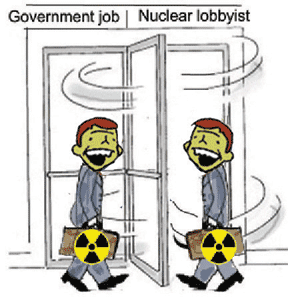
The accusation came after Sir Ed sent voters in Kingston and Surbiton a summary of his career in an election leaflet. While the “CV” for voters in the key marginal said he had gone “back to consultancy” after losing his seat in 2015, it made no mention that he is working two days a month for MHP Communications, a company which specialises in influencing government policy on behalf of paying clients.
Among MHP’s clients is EDF, the French firm that struck a controversial deal to build the Hinkley Point nuclear power station in Somerset. The deal, overseen by Sir Ed as energy secretary in the Coalition, was attacked as poor value for the taxpayer by critics because it involved paying EDF nearly three times the current wholesale price of electricity in return for constructing and running the massive project. One expert called the contract the “worst deal I’ve ever seen”. http://www.standard.co.uk/news/politics/ed-davey-kept-quiet-on-election-cv-about-energy-lobbying-job-a3558901.html
Sure, we knew it was coming, but no one thought it would really happen. We figured the whole Russian thing would destroy Trump long before he got a chance to destroy the planet. But quicker than you can say, anthropogenic climate change, the Yanks were gone.
But who is really to blame for this mess? Angry white men, people who didn’t vote, Donald Trump and his troupe of bad impersonators?
For an answer to this we need to dip our toes – once again– into the murky waters of secret donations, clandestine organisations and fictional Disney characters. This is a tale about the unidentified rich who sit high on a stack of cash in their air-conditioned money vaults, while secretly bankrolling climate change denial. The Scrooge McDucks of this world.
An imaginary Disney character is about as close as we’ll get to the identity of these cloak and dagger contributors, because the hundreds of millions of dollars they donate to climate denial organisations are routed via third party payments.
Despite all the cloak and dagger stuff, the donations of some of these wealthy birds have been well documented. The fossil fuel industry and, in particular, ExxonMobil and the Koch family, have considerable history in the climate denial space. Exxon have been accused of covering up climate change research and American businessman Charles Koch has reportedly funded climate denial activity to the tune of tens of millions of dollars.
But it’s not just the wealthy ducks from the fossil fuel sector feeding the mayhem. Even companies who publically declare their grand support for climate action have made political donations to climate deniers. Google, Microsoft, eBay have all contributed to politicians who oppose climate legislation, while at the same time spruiking their own climate credentials to the public. The subsequent self-serving rationalisation of these Scrooge McDucks is evidence: there’s at least one thing they want more than improving the environment, their huge bank balances.
Likely, there were many factors affecting the decision to pull out of the Paris Accord. But without the confusion sewn by secretly funded denialists, it’s likely that rational, scientific thought would have won the day and the U.S. might still be part of the Paris Accord. However, the Scrooge McDucks of this world could never allow their ideology of money to be threatened by regulations — whether climate change is real or not.
You see, failing crops, water shortages, or savage storm events may wreak havoc on the rest of us, but won’t really affect the billionaires and corporations.
Like Uncle Scrooge, they’ll be swimming high on their mountains of coins, always safe from the rising waters of global warming.
‘Last Secret’ of 1967 War: Israel’s Doomsday Plan for Nuclear Display, NYT,By WILLIAM J. BROAD and DAVID E. SANGERNYT, JUNE 3, 2017 On the eve of the Arab-Israeli war, 50 years ago this week, Israeli officials raced to assemble an atomic device and developed a plan to detonate it atop a mountain in the Sinai Peninsula as a warning to Egyptian and other Arab forces, according to an interview with a key organizer of the effort that will be published Monday.
By Graham Readfearn • Wednesday, May 31, 2017, On the face of it, the climate science conference scheduled for the romantic Italian city of Rome looks like any other.
The organizers, India-based ConferenceSeries, promise their “4th World Conference on Climate Change” will attract “world class experts” from across the planet.
Anticipating “more than 500 participants,” the event claimed to have an organizing committee with representatives from the UN’s World Meteorological Organization (WMO), the European Space Agency, and the European Environment Agency (EEA).
But a DeSmog investigation reveals the event is being hijacked by a group of climate science deniers who have previously claimed they want to investigate climate scientists for fraud and have dismissed human-caused climate change as a hoax.
Since being contacted by DeSmog, both the WMO and the EEA have issued statements distancing themselves from the three-day conference, scheduled to start on October 19.
ConferenceSeries, also known as OMICS, promotes hundreds of meetings around the world and is behind the logistics and promotion for the Italy conference. In August 2016 the U.S. government’s Federal Trade Commission launched court action against the company, alleging deceptive marketing practices. The case is ongoing.
Seven presenters, including Monckton and Mörner, and one organizer of that London meeting, Maranzana, are also scheduled to speak at the Rome event. Continue reading →
22 MAY 2017 Shortly after news broke that Devon Arthurs, an 18-year-old Muslim convert and former white supremacist, killed two of his friends for attacking his new faith, more details have been revealed surrounding the murders.
According to the Miami Herald, Brandon Russell, Arthurs’ roommate, was in possession of multiple materials meant to build explosives, including a lethal bomb-making chemical named hexamethane triperoxide diamine. FBI and Tampa Police Department officers found the materials in Russell’s garage.
Russell was arrested on May 21 during a traffic stop in Key Largo, and police have not yet revealed why he was pulled over or what he was doing in the Florida Keys.
While in Russell’s bedroom, devices used by police bomb technicians alerted to the presence of radiation sources — thorium and americium.
Russell returned home from National Guard duty on May 19 to find that Arthurs had killed their friends. It’s unclear whether the bomb was intended for Arthurs’ or for another person or group.
Russell is an admitted “national socialist,” the name of the Adolf Hitler’s party that was soon shortened to “Nazi” during the lead-up to World War II.
The Herald also reports that Russell is a member of a group called “Atomwaffen” (meaning “atomic weapon” in German.) The group has been promoted by the white supremacist Daily Stormer website since last year. The racist site praised the group for holding a protest during “a homo vigil for the victims of the Orlando nightclub shooting.”
In January, RadarOnline reported that the group’s leader was a nuclear physics student who was “trying to encourage members to conduct an attack similar to Timothy McVeigh‘s strike in Oklahoma City.”
Police reportedly found a framed photo of Oklahoma City bomber Timothy McVeigh in Russell’s bedroom. It is believed that he learned to manufacture explosives while at the University of South Florida, where he was a member of the engineering club.
According to the Chicago Maroon, the Atomwaffen Division group has described itself as a “very fanatical, ideological band of comrades who do both activism and militant training. Hand to hand, arms training, and various other forms of training. As for activism, we spread awareness in the real world through unconventional means.”
How SA’s nuclear plant build could fuel corruption The government can restrict public and parliamentary oversight by using arguments on national security, Business Day, 23 MAY 2017 7 NEIL OVERY, The construction of a nuclear power plant is considered to be a megaproject – characterised as a significant investment, as being highly complex organisationally and technically and as having a long-lasting effect on the economy, society and the environment.
International experience shows that such projects are prime targets for corruption. Their size, complexity and longevity create thousands of contractual links — between the customer, contractor, sub-contractors, co-ordinating project offices, etc — each of which present an opportunity for corruption. A recent local example is the corruption that plagued phase 1 of the Lesotho Highlands Water Project.
Allied to this is the potential problem of central government involvement. Energy projects in particular tend to be centrally managed by governments and, by necessity, afford senior public officials discretionary powers over projects.
The construction of a nuclear power plant is particularly problematic as governments can use issues of alleged national security to restrict public and even parliamentary oversight.
In SA, apartheid-era legislation such as the National Key Points Act of 1980 could be used to withhold information about any new nuclear power plant being constructed. As Right2Know has said, “historically, the National Key Points Act has been used and abused to stifle access to information”.
In the alleged interests of national security, information about corruption (think Nkandla) or a radioactive leak could be hidden from the public. The situation is made worse by the fact that there is no public interest defence for whistleblowers in terms of the National Key Points Act.
Nuclear power plant construction is also open to corruption because of the information asymmetry between the vendor and the buyer.
SA is not able to build nuclear power plants on its own and lacks the necessary information on the technical complexity of construction processes. This means that the vendor can be confident that the buyer is not fully aware of all the features and financing needs of the power plant, creating opportunities for graft by the vendor.
The type of construction model signed with vendors can also have an effect on corruption. SA’s nuclear build front-runner Rosatom offers various models. According to Phumzile Tshelane, CEO of the Nuclear Energy Corporation of SA, the country prefers the build, own and transfer model in terms of which vendors and states work in joint venture partnerships to build and operate power plants that are eventually transferred to recipient states.
At first glance, this looks like the best model for SA because it means that anything between 25% and 50% of project implementation and construction jobs will be localised. However, in SA, where according to Transparency International, both the public and private sectors are endemically corrupt, such a model creates numerous opportunities for rent-seeking.
Already, we have seen a R171m deal for the “procurement of the nuclear build programme management system” awarded to a company called Central Lake Trading 149 that is run by the son of Vivian Reddy, long-time associate of President Jacob Zuma. While there is no indication of anything suspicious in this deal, it demonstrates the kind of opportunities created……..
How nuclear procurement has been handled to date in the country shows just how far the government has departed from best practice.
Firstly, the government has failed to show that the nuclear build is necessary. Its own Ministerial Advisory Council on Energy recommends that no new nuclear power capacity is necessary in SA for the foreseeable future.
This view is confirmed by Council for Scientific and Industrial Research (CSIR) modelling, which shows that no new nuclear power is necessary until at least 2050 (the date their modelling ended). Prof Anton Eberhard of the University of Cape Town has described the state’s determination to pursue the nuclear procurement as “irrational”.
Secondly, the government has not properly assessed alternative ways of meeting the perceived need.
While it has considered renewable energy options, it has done so in a fashion that artificially constrains their potential.
The government’s draft 2016 Integrated Resource Plan (IRP) places completely arbitrary limits on the amount of renewable energy that can be delivered in SA despite there being, according to the CSIR, no technical reason for this.
Energy expert Chris Yelland has stated that the constraints imposed in the IRP are the result of “a political decision rather than a rational planning decision”.
Thirdly, project costs and benefits have not been estimated accurately throughout their complete life cycles.
Energy experts throughout SA agree that the draft 2016 IRP underestimates the cost of nuclear power and overestimates the cost of renewables.
The IRP suggests a cost of R0.97/kWh for new nuclear power. The CSIR has found that the “most optimistic” cost would be R1.17/kWh, while research carried out by EE Publishers suggested R1.30/kWh.
None of these calculations factor in the considerable extra costs of nuclear fuel, routine plant maintenance and refurbishment, decommissioning, or the long-term disposal of nuclear waste. For renewables, the IRP gives a price of R0.81/kWh for solar and R0.93/kWh for wind, while the CSIR shows that both now cost R0.62/kWh, with prices continuing to fall.
Lastly, particular suppliers have been favoured and deals have been reached without proper oversight.
The recent court case between the Department of Energy and Earthlife Africa-Southern African Faith Communities Environment Institute demonstrates this.
The judges in the case found that Rosatom had been favoured over other potential vendors as a “a firm legal commitment existed between SA’s government and Rosatom in terms of the Intergovernmental Agreement signed with Russia in 2014”. An agreement that the judges found, “clearly required to be scrutinised and debated by the legislature” and was in breach of section 10 of the National Energy Regular Act, which calls for participatory decision-making processes.
New Energy Minister Mmamoloko Kubayi recently stated that new agreements will be signed with nuclear vendors but that she did not want to find herself “in court every day”.
She could heed best practice and ensure that before any procurement proceeds, an anti-corruption plan is in place between the government, the vendor and civil society.
This should identify where corruption could take place, make recommendations for mitigating it and should be regularly reviewed during each phase of project implementation. Transparency International calls these plans “integrity pacts” and they have been successfully implemented in 15 countries in more than 300 procurement projects.
Sadly, in the current climate, it seems inconceivable that either Eskom or Rosatom (or any other vendor) would agree to be held accountable to civil society, such is the headlong charge for nuclear power in SA.
As Politico reported, Trump’s deputy national security adviser, KT McFarland, gave him a fake 1970s Time magazine cover warning of a coming ice age. The Photoshopped magazine cover circulated around the internet several years ago, but was debunked in 2013. Four years later, McFarland put the fake document in Trump’s hands, and he reportedly “quickly got lathered up about the media’s hypocrisy … Staff chased down the truth and intervened before Trump tweeted or talked publicly about it”.
Second, there were some climate scientists whose research suggested that we could trigger an ice age – if human sulfur pollution were to quadruple. But that didn’t happen. In addition to blocking sunlight (and hence having a cooling effect), sulfur pollution causes other problems like acid rain. So various governments (including America’s) enacted Clean Air Acts to regulate that pollution (quite like the way we should be responding to carbon pollution’s dangerous impacts). Since then, human sulfur pollution has gone down, while carbon pollution has gone way up. The climate scientists weren’t wrong – the scenario they warned could have triggered an ice age didn’t happen because we took action to prevent it.
Third, although we’ve established climate scientists weren’t wrong in the 1970s, even if they had been, so what? Science advances, and we understand how the climate works today much better than we did 40 years ago, as illustrated in this funny video by Adam Levy:
To be blunt, this is a really dumb myth, and it says a lot that about the state of America’s government that the president was suckered into believing it.
KT McFarland is one of Trump’s many unqualified staffers
McFarland, who spouted numerous misleading and bizarre comments during her time at Fox, is so unsuited for her deputy national security adviser position that retired Vice Adm. Robert Harward, an accomplished and decorated Navy vet, refused Trump’s offer to serve as national security adviser because he didn’t want her on his team. McFarland is now slated to be ousted from the National Security Council and nominated as ambassador to Singapore; she has already been “largely sidelined” at the agency
Ironically, Fox News’ Jon Scott interviewed Politico’s Shane Goldmacher about the fake magazine cover story, and noted “The president getting some fake news every once in a while, apparently, from his own staffers.” That fake news of course came from a former Fox News analyst and concerned one of Fox News’ favorite climate myths. In fact, a 2013 study found that Fox News is a major driving force behind climate denial.
Seven Democrats on the House Committee on Science, Space, and Technology wrote Trump a letter expressing concern that he is frequently being fooled by this sort of fake news. The committee members suggested:
First of all, I find it very strange that this agreement has been signed up to in advance, not by any elected representative of the Australian Parliament, but by Dr Adi Patterson CEO of the Australia Nuclear Science and Technology Organisation, apparently pre-empting the results of this Inquiry!
I find it disturbing that this Inquiry is being held without any public information or discussion. Are we to assume that the decision to join this “Charter” is being taken without prior public knowledge?
It is a pretty momentous decision. According to the World Nuclear Association the 2005 Framework agreement “formally commits them (signatories) to participate in the development of one or more Generation IV systems selected by GIF for further R&D.”
The Environment Protection and Biodiversity Conservation Act 1999 currently prohibits the development of nuclear power in…
First of all, I find it very strange that this agreement has been signed up to in advance, not by any elected representative of the Australian Parliament, but by Dr Adi Patterson CEO of the Australia Nuclear Science and Technology Organisation, apparently pre-empting the results of this Inquiry!
I find it disturbing that this Inquiry is being held without any public information or discussion. Are we to assume that the decision to join this “Charter” is being taken without prior public knowledge?
It is a pretty momentous decision. According to the World Nuclear Association the 2005 Framework agreement “formally commits them (signatories) to participate in the development of one or more Generation IV systems selected by GIF for further R&D.”
The Environment Protection and Biodiversity Conservation Act 1999 currently prohibits the development of nuclear power in Australia. Nuclear power cannot be approved under either the EPBC Act or the Australian Radiation Protection and Nuclear Safety Act 1998. These prohibitions are, as I understand it, supported by all major parties in Australia?
This would be an extraordinary step for Australia to take, especially in the light of the recent South Australian Nuclear Fuel Cycle Royal Commission (NFCRC) pro-nuclear Royal Commission, which, while recommending South Australia for an international nuclear waste dump, nevertheless stated that
“The recent conclusion of the Generation IV International Forum (GIF), which issued updated projections for fast reactor and innovative systems in January 2014, suggests the most advanced system will start a demonstration phase (which involves completing the detailed design of a prototype system and undertaking its licensing, construction and operation) in about 2021. The demonstration phase is expected to last at least 10 years and each system demonstrated will require funding of several billion US dollars. As a result, the earliest possible date for the commercial operation of fast reactor and other innovative reactor designs is 2031. This timeframe is subject to significant project, technical and funding risk. It extends by six years a similar assessment undertaken by GIF in 2002. This means that such designs could not realistically be ready for commercial deployment in South Australia or elsewhere before the late 2030s, and possibly later.”
This was hardly a ringing endorsement of Generation IV nuclear reactors.
The South Australian Citizens Jury, Community Consultations, numerous economists, and the S.A. Liberal Party all rejected that nuclear waste plan, as not economically viable. A huge amount of preparation was done by the NFCRC in investigating the phases of the nuclear Fuel Cycle (more accurately Chain) to arrive at their rather negative view of Generation IV nuclear reactors.
That makes it all the more extraordinary that the Australian government would be willing to sign up so quickly to ANSTO’s request that Australia put resources into these untested, and so far, non-existent nuclear technologies.
I hope that the Committee is aware of the present financial troubles of the giant nuclear corporations, such as AREVA, Toshiba, and Westinghouse Electric. Nuclear power is turning out to be a financial liability wherever it is not funded by the tax-payer, (as in China and Russia). (1)
The World Nuclear Association describes the Generation IV International Forum (GIF)as countries for whom nuclear energy is significant now or seen as vital in the future. Australia’s situation in no way fits these criteria.
Nuclear energy is not significant now in Australia, and even the NRCRC nuclear proponents do not see it as vital for Australia’s future. It is almost laughable, that right now, renewable energy systems are taking off in Australia – both as large solar and wind farms, and as a huge increase in small decentralised systems such as home and business solar panel installations.
That’s where Australia should be putting its resources of human energy, talent, and funding.
The claims made by the nuclear lobby, ANSTO and some politicians, notably Christopher Pyne and Julie Bishop, about Generation Iv nuclear reactors, do not stand up to scrutiny:
Non proliferation “- Furthering Australia’s non-proliferation and nuclear safety objectives.” The well-known claim that a “conventional” nuclear bomb cannot be made from these new types of reactor, might be true, to a certain extent. However, IFRs and other plutonium-based nuclear power concepts fail the WMD proliferation test, i.e. they can too easily be used to produce fissile material for nuclear weapons. The use of thorium as a nuclear fuel doesn’t solve the WMD proliferation problem. Irradiation of thorium (indirectly) produces uranium-233, a fissile material which can be used in nuclear weapons. These materials can be used to make a “dirty bomb” – irradiating a city or other target. They would require the same expensive security measures that apply with conventional nuclear reactors.
If the purpose in joining the GIF is to strengthen non-proliferation and safety – why is ANSTO the implementing agent not the Australia Safeguards and Non-Proliferation Office?
Solving nuclear waste problem? Claims that these new nuclear reactors will solve the problem of nuclear wastes are turning out to be spurious. For example, Nuclear energy startup Transatomic Power has backed away from bold claims for its advanced reactor technology after an informal review by MIT professors highlighted serious errors in the company’s calculations. (2) Even at the best of times, the “new nuclear” lobby admits that their Gen IV reactors will produce highly toxic radioactive wastes, requiring security for up to 300 years.
The Integral Fast Reactor is called “integral” because it would process used reactor fuel on-site, separating plutonium (a weapons explosive) and other long-lived radioactive isotopes from the used fuel, to be fed back into the reactor. It essentially converts long-lived waste into shorter lived waste. This waste would still remain dangerous for a minimum of 200 years (provided it is not contaminated with high level waste products), so we are still left with a waste problem that spans generations. (3)
Climate change. The claim that new nuclear power will solve climate change is spurious. This ignores life-cycle CO2 emissions
Nuclear energy is not zero carbon.
Emissions from nuclear will increase significantly over the next few decades as high grade ore is depleted, and increasing amounts of fossil fuels are required to access, mine and mill low-grade ore.
To stay below the 2 degrees of global warming that climate scientists widely agree is necessary to avert catastrophic consequences for humans and physical systems, we need to significantly reduce our emissions by 2050, and to do this we need to start this decade. Nuclear is a slow technology:
The “Generation IV” demonstration plants projected for 2030-2040 will be too late, and there is no guarantee the pilots will be successful.
Nuclear Economics. For “a time when significant expansion in nuclear power production is underway” – this is a laughable falsehood. In reality, nuclear power economics are in a state of crisis, most notably in America, but it is a world-wide slowdown. (4)
The vagueness of the Generation IV International Forum (GIF)agreement is a worry. Australia is to formally commit to participate in the development of one or more Generation IV systems selected by GIF for further R&D. Surely Australia is not going to sign up to this, without any detail on what kind of research, what kind of reactor, what amount of funding we would be committing to the GIF.
The hacking group that leaked NSA secrets claims it has data on foreign nuclear programs, WP, By Brian FungMay 16 2017, The hacking group that leaked the bugs that enabled last week’s global ransomware attack is threatening to make public even more computer vulnerabilities in the coming weeks — potentially including “compromised network data” pertaining to the nuclear or missile programs of China, Iran, North Korea and Russia, as well as vulnerabilities affecting Windows 10, which is run by millions of computers worldwide.
A spokesperson for the group, which calls itself the Shadow Brokers, claimed in a blog post Tuesdaythat some of those computer bugs may be released on a monthly basis as part of a new subscription-based business model that attempts to mimic what has proved successful for companies such as Spotify, Netflix, Blue Apron and many more……..
Marcy Wheeler, a longtime independent researcher, said in a blog post Tuesday that the Shadow Brokers’ post “brings the hammer” down both on Microsoft, whose products could be affected by any further leaks, and the U.S. National Security Agency, whose information the Shadow Brokers leaked in April. That leak led indirectly to the creation of WannaCry and the subsequent crisis, security experts say.
“Simply by threatening another leak after leaking two sets of Microsoft exploits, Shadow Brokers will ratchet up the hostility between Microsoft and the government,” Wheeler wrote…….
The group’s new claim that it possesses information on the nuclear programs of state governments is extremely worrisome, said Joseph Lorenzo Hall, chief technologist for the Center for Democracy and Technology, a Washington think tank. “While they don’t seem to have the most amazing PR department,” he said, “they’ve already proved that they had some pretty serious access. The nuke facility stuff is particularly concerning, [speaking] as a former physicist.”
The Terrible Things Happening To Children In India’s ‘Nuclear Graveyard’ Will Scar You For Life [PHOTOGRAPHS] scoopwhoop.com, by Era Tangar, 16 May 17 “…….Jadugoda, a town of 19,500 people about 1,370km from New Delhi, is a four-hour drive from Ranchi, Jharkhand. In 1967, this tribal town became the site for India’s first nuclear mine. It is often called India’s best kept secret. The government-owned Uranium Corporation of India (UCIL) mines for uranium in the region. The small township is home to the world’s finest uranium ore, magnesium diuranate,
Locals were initially ecstatic because this would increase employment opportunities. Over the past 40 years, the UCIL has conducted indiscriminate and unchecked uranium mining. This has destroyed local environment and the health of the tribal population. The toxic emission has caused facial tumours, mascular dystrophy, deformed skeletons, lung cancer and curved spines, to name a few.
The crimes of the UCIL have been under-reported in the media. There are articles and documentaries portraying the state of the town and the areas nearby but not much has been done as a follow up while people of Jadugoda continue to suffer for 50 years now. India’s nuclear dream has costed the well-being of Jharkhand’s tribals and made them suffer in silence. …….. Share the word about Jadugoda till it reaches someone who can help these innocent souls.
These photos were featured at the 3rd International Uranium Film Festival, Rio De Janeiro, Brazil, World Uranium Symposium in Quebec City, Canada 2015, World Nuclear Victims Forum, 2015 in Hiroshima, Japan and at UCCJ International Youth Conference in Kyoto, Japan 2017. https://www.scoopwhoop.com/the-dark-truth-about-nuclear-graveyard-jadugoda/#T.t2a4psvnq
Is Rosatom selling debt and dependence to its overseas customers? http://bellona.org/news/nuclear-issues/2017-05-is-rosatom-selling-debt-and-dependence-to-its-overseas-customersWhen a court in South Africa torpedoed a $76 billion deal to build 10 nuclear reactors with Russia’s Rosatom because the arrangement reeked of corruption, it seemed like the project was kaput. May 10, 2017 by Charles Digges, charles@bellona.no, When a court in South Africa torpedoed a $76 billion deal to build 10 nuclear reactors with Russia’s Rosatom because the arrangement reeked of corruption, it seemed like the project was kaput.
At issue to the court was the fact that Rosatom was given the lucrative contract behind closed doors without any competing tenders, and that the company had been granted “special favors.” South Africa’s president, Jacob Zuma, even sacked his finance minister for opposing the deal.
The high court demanded that a contract of such breathtaking magnitude – representing a quarter of South Africa’s gross domestic product and $24 billion more than its state utility, Eskom, has in the bank – be approved by parliament.
Hanging over the deal, and numerous others like it, is the degree to which Rosatom seems to be pursing not just energy dominance in a world trying to wean itself coal, but political influence as well by putting its customers in long-term hock to Moscow.
The South Africa deal may yet come off, but it’s also surprising that it got so far in the first place.
It began as one of Rosatom’s handshake “memorandums of understanding” that the company is using to blanket the nuclear construction market and squeeze out competition. The company says it has 27 of these MOUs and other arrangements, amounting to $135 billion in incoming business, a claim that invites skepticism.
Many of the counties Rosatom counts among that number – like Jordan, Algeria, Nigeria and Bolivia – won’t be ready for nuclear for decades. Others where Rosatom builds are already underway – like India’ Kudankulam, Iran’s Bushehr, China’s Tianwan and Belarus’s Ostrovets – are already familiar with Rosatom’s typical cost overruns and delays.
Rosatom’s approach to marketing its VVER-1000 and VVER-1200 reactors is unique because it offers to finance, build and operate its plants. These generous terms come thanks to the enormous state subsidies it receives, and which it can then funnel into loans that boost its profits on paper. With government subsides set to decrease or dry up in 2020, however, Rosatom seems desperate to announce ever more MOUs.
While the terms of the financing for the South Africa deal never got spelled out, it’s clear from Rosatom deals in other countries that the terms are often steep.
To build Hungary’s controversial Paks-2 plant, Rosatom gave Budapest an $11 billion loan spread out over 30 years. Hungary has to start paying that back even if the plant is not completed on time. The interest Moscow could collect from Hungary is unclear, but a similar 30-year, $11.4 billion agreement with Bangladesh inked last year could result in $8 billion in interest. A $25 billion deal Rosatom signed with Egypt could, over 35-year term of the loan, swell to $71 billion.
And that’s if everyone behaves. The plant Rosatom is building in Turkey offers an indication of what happens when they don’t. To build Hungary’s controversial Paks-2 plant, Rosatom gave Budapest an $11 billion loan spread out over 30 years. Hungary has to start paying that back even if the plant is not completed on time. The interest Moscow could collect from Hungary is unclear, but a similar 30-year, $11.4 billion agreement with Bangladesh inked last year could result in $8 billion in interest. A $25 billion deal Rosatom signed with Egypt could, over 35-year term of the loan, swell to $71 billion.
And that’s if everyone behaves. The plant Rosatom is building in Turkey offers an indication of what happens when they don’t.