ISIS and nuclear Armageddon? – Exclusive to nuclear-news.net
“…However we look at it, as we hear the PR call for more and/or better nuclear weapons, the issue of nuclear weapons grade materials escaping from countries like the Ukraine, Kazakhstan, Pakistan etc and also the possibility of theft from large nuclear reprocessing complexes in the west like Sellafield, La Hague, Hanford, Negev Nuclear Research Center etc means that huge resources will have to be spent defending these places that will not be accounted for in costing nuclear power and reprocessing to the tax payer with no guarantee that corrupt practices now or in the future will not circumvent them…..”
Following the article (Link ref 1 below) I picked up from India and posted to nuclear-news.net, I shared it to Fukushima 311 Watchdogs (F311W) . As an Admin on F311 W I later checked the statistics and found a small number of posts not getting any hits. Its as though they were being blocked. I had discovered in 2013 that this was possible and did a video (Link ref 2 below) showing that evidence.
I then did a video (Link ref 3 below) showing the issue of the blocked posts on the Uranium story and also showed that the Uranium story was being ignored by all the western Main Stream Media and that Google was blocking the nuclear-news.net story About 5 hours after posting the video the Google block to the nuclear-news.net story became unblocked.
I then checked out the stats on the video (Screenshot ref 4 below) and saw that some parties in the United Arab Emirates, Saudi Arabia and Pakistan were interested in that post. Also i noted that Pakistan came up on the stats earlier but with no observable clicks (maybe Pakistan Secret Service computer whizz kids were trying to cover their tracks?). It looks like ISIS are seeking and succeeding in their efforts to acquire nuclear materials
So, what did I conclude with on all this? Firstly a non story about Donald Trump was beginning to go “viral” and in this Post Truth world I wondered why? The USA and Russia had already said they would be renewing and expanding their nuclear weapons arsenal and also with “safer” mini nukes earlier on in the year.
The fact that many outlets in India were posting articles on the story led me to think that the western Trump Tweet story was being manufactured to hide the Indian story that was going viral there.
Also, Mordechai Vannunu was having his latest court case in Israel and the judgment is going to be made in the next few weeks. So, there are two good reasons for the swamping of the internet on “other” nuclear stories to hide these two important facts. In Fact i had just done an article that described how large PR companies managed to manufacture narrative in a Post Truth world.
So, what is so important on the Thane Uranium Black market story? Firstly, the details of the purity of the Uranium. The Indian Police had done some homework and had the purity and the cost of the Uranium and this was in the article i posted. But the costs was in RS Core and the conversion from that to US Dollars was not easy.
So I did the conversion and also checked the upper level of purity (which was “85 percent” pure) and compared that to the purity of US nuclear weapons grade Uranium 235 (which is 93 percent). Now it has to be said that the Indian article did not specify U235 or U238 but when judging purity of Uranium it is valued at the amount of U235 with the rest being the more common U238. So it was looking likely we were talking nuclear weapons grade uranium but with a slightly lower value than the US standard.
So was this rejected weapons grade uranium or was it a lower standard of uranium for nuclear weapons? I do not think we will see the actual tests to confirm the particular isotope of uranium but it does beg the question, How safe are all the hundreds of thousands of tons of high and intermediate level waste and the millions of tons on low level waste and how easy it is for terrorists to get hold of it? Why make more when we have such a problem already? We need to secure this material and shut down the sprawling sites that already exist! Someone please tell the IAEA to stop promoting nuclear as it is just too dangerous!
“…However we look at it, as we hear the PR call for more and/or better nuclear weapons, the issue of nuclear weapons grade materials escaping from countries like the Ukraine, Kazakhstan, Pakistan etc and also the possibility of theft from large nuclear reprocessing complexes in the west like Sellafield, La Hague, Hanford, Negev Nuclear Research Center etc means that huge resources will have to be spent defending these places that will not be accounted for in costing nuclear power and reprocessing to the tax payer with no guarantee that corrupt practices now or in the future will not circumvent them…..”
Wind, Solar, Hydro electricity are looking like much saner options with all the above in mind.
There is also the issue of transparency and Human Rights as we see countries with nuclear weapons currently criminalising activists (as we see in France) and energy developers and innovators (as we see in the UK).
In a recent Atlantic Alliance meeting (from March 2016), I heard them say that European left leaning peace and social justice citizens would need to be reigned in as they were “doing the work of Putin whether they knew it or not” We are living in dangerous times and the left and right peace activists need to come together to make a change. Some food for thought for the coming year perhaps?
Have a great Christmas and a good nuclear free New Year
Namaste
Shaun McGee
Sources for article
French Human Rights abuses regarding nuclear energy
Trump questionnaire recalls dark history of ideology-driven science, Skeptical Science 21 December 2016 by By Paul N. Edwards, Professor of Information and History, University of Michigan,
President-elect Trump has called global warming “bullshit” and a “Chinese hoax.” He has promised to withdraw from the 2015 Paris climate treaty and to “bring back coal,” the world’s dirtiest, most carbon-intensive fuel. The incoming administration has paraded a roster of climate change deniers for top jobs. On Dec. 13, Trump named former Texas Governor Rick Perry, another climate change denier, to lead the Department of Energy (DoE), an agency Perry said he would eliminate altogether during his 2011 presidential campaign.
Just days earlier, the Trump transition team presented the DoE with a 74-point questionnaire that has raised alarm among employees because the questions appear to target people whose work is related to climate change.
For me, as a historian of science and technology, the questionnaire – bluntly characterized by one DoE official as a “hit list” – is starkly reminiscent of the worst excesses of ideology-driven science, seen everywhere from the U.S. Red Scare of the 1950s to the Soviet and Nazi regimes of the 1930s.
The questionnaire asks for a list of “all DoE employees or contractors” who attended the annual Conferences of Parties to the United Nations Framework Convention on Climate Change – a binding treaty commitment of the U.S., signed by George H. W. Bush in 1992. Another question seeks the names of all employees involved in meetings of the Interagency Working Group on the Social Cost of Carbon, responsible for technical guidance quantifying the economic benefits of avoided climate change.
It also targets the scientific staff of DoE’s national laboratories. Continue reading →
By Patrick M. Malone, Center for Public Integrity December 21, 2016
Altogether, the three companies making these settlement payments since 2013 are involved in the operation of six of the eight active sites in the Energy Department’s nuclear weapons program. Actions by the Energy Department’s contractors – including any misspending – have substantial impact there, since contract work consumes roughly 90 percent of its total spending.
Although work on energy generation and consumption garners more public attention and President-elect Donald Trump has nominated an oil-state politician – former Texas governor Rick Perry – to become the department’s new top manager, nuclear weapons-related work accounts for nearly two-thirds of all the Energy Department’s activities.
The latest case emerged from a civil lawsuit that accused two companies of both performing substandard work at a nuclear weapons-related waste site and said one of them had improperly spent government funds to lobby for more. The companies declared on Nov. 23 they would settle the allegations by making the payment, mostly to the federal government, for a total of $125 million, a massive amount for alleged Energy Department-related malfeasance.
The settlement involves work by Bechtel National Inc. and its parent Bechtel Corp., and URS Corp. and its subsidiary URS Energy and Construction Inc., which together have been trying to clean up the Hanford Nuclear Reservation near Richland, Washington. That’s where raw uranium was enriched into fuel for nuclear bombs during the Manhattan Project and the Cold War.
The firms have denied doing anything improper. But the settlement is part of an emerging pattern.
Lockheed Martin Corp., which operates one of three U.S. nuclear weapons laboratories – Sandia, agreed in August 2015 to pay $4.7 million to settle a complaint by the Justice Department that it used federal funds to lobby for a no-bid contract extension, while Fluor Corp. paid $1.1 million in April 2013 to settle accusations that it used federal funds to lobby government agencies for more business at its Hanford training facility.
Worries about the mission being underminedBesides overseeing the Hanford cleanup, Bechtel and URS (now owned by a company called AECOM) help operate the other two U.S. nuclear weapons labs — Los Alamos and Lawrence Livermore, which perform the bulk of U.S. nuclear weapons design work. Altogether, the firms that have reached the settlements since 2013 are involved with operations at Los Alamos and Sandia in New Mexico, Livermore in California, the Pantex Plant in Texas, the Savannah River Site in South Carolina, and the Y-12 National Security Complex in Tennessee.
The recent settlement “demonstrates that the Justice Department will work to ensure that public funds are used for the important purposes for which they are intended,” Benjamin C. Mizer, principal deputy assistant attorney general in charge of the Justice Department’s civil division, said in a written statement released on Nov. 23.
Money allocated by Congress for Hanford “is intended to fund the Department of Energy’s important mission to clean up the contaminated Hanford nuclear site, and this mission is undermined if funds are wasted on goods or services that are not nuclear compliant or to further lobbying activities,” Mizer said.
Both Bechtel and AECOM in written statements said the settlements were made to avoid messy litigation and keep the waste plant project moving. “We have performed our work…ethically and professionally,” Bechtel National Inc. spokesman Fred deSousa said in a written statement, without going into details.
In its own written statement, AECOM — which acquired URS in 2014 — complained that the Department of Justice joined the whistleblowers’ “unwarranted lawsuit against URS” based on events that preceded AECOM’s acquisition of the company. “We take our responsibilities as a government contractor very seriously and have a demonstrated track record of serving our customers with honesty and integrity,” the company’s statement said.
The Justice Department’s involvement in the case originated in civil allegations of mismanagement and wrongdoing in Hanford’s Waste Treatment and Isolation Plant project, commonly called “WTP.” Under its contract with the Energy Department, Bechtel designed and is constructing machinery to convert nuclear-tainted wastes there into a stable, glassy substance suitable for safe disposal.
Three whistleblowers — Walt Tamosaitis, Donna Busche and Gary Brunson — filed a lawsuit on Feb. 4, 2013, accusing Bechtel and URS bosses of mismanagement and misappropriation of funds over a dozen years that together cost the government more than $1 billion. They also said safety lapses at the site, motivated by a desire to meet Energy Department deadlines and collect financial bonuses, were serious enough to risk a nuclear accident.
The whistleblowers’ complaint triggered an investigation by the Energy Department’s Office of Inspector General, which collected emails sent between Bechtel’s project leaders, the company’s top congressional lobbyist for nuclear projects, and Energy Department employees. The whistleblowers’ attorneys subsequently obtained the emails through the civil discovery process and incorporated them into an amended complaint. The Justice Department, in turn, used the complaint as the basis for its own investigation of Bechtel and URS.
Getting $45 million in new work
In the complaint, the whistleblowers said that when they originally lodged accusations of mismanagement – several years earlier — Bechtel project leaders launched a coordinated lobbying campaign to defend itself and also to collect new revenues for additional work on the waste treatment plant project. It then billed the department for the costs of this lobbying, the complaint said.
In an email sent by one Bechtel manager to another — along with a chart detailing the work that the company could say the additional revenue would finance — the manager said “in reality if we did not receive the additional $50m … most of these activities would still likely happen,” according to the whistleblowers’ complaint. The company subsequently got $45 million added to its contract.
The full emails detailing these actions have not been publicly released, by either the government or the plaintiffs, because the messages are part of an investigation that remains “open and ongoing,” according to Felicia Jones, spokeswoman for the Energy Department Office of Inspector General. She declined to say whether her colleagues consider the whistleblowers’ description of the emails accurate.
The Justice Department’s statement affirmed that it had “alleged that Bechtel National Inc. and Bechtel Corp. improperly claimed and received government funding for lobbying activities.” But Justice Department spokeswoman Nicole Nava declined to comment about the whistleblower’s account of specific emails.
Lobbying Congress for new work isn’t against the law. But billing the government for lobbying is, according to the federal Byrd Amendment, approved by Congress in 1989. Court records state that Bechtel will pay $67.5 million of the settlement, and AECOM will pay $57.5 million; the amount of money that will go to the whistleblowers – who are entitled to a portion of any funds they help the government recover — has not been determined yet.
Charles Curtis, who oversaw the Energy Department’s nuclear weapons work from 1994 to 1997 while serving as undersecretary and then deputy secretary, said he was not aware of any improperly-funded lobbying during his tenure. But he expressed surprise that multiple contractors within the past three years have been caught doing it. “These are for-profit enterprises. They can use their shareholders’ money for lobbying, but to use congressionally appropriated money [is] a diversion of funds,” Curtis said. “It’s not only unethical … it’s illegal.”
Three years ago, it was the Fluor Corporation and its subsidiary Fluor Hanford Inc., which at the time held the contract to manage the Hanford site, that agreed to pay $1.1 million to settle a separate complaint that its officials lobbied with government money from 2005 to 2010 to drum up business for a federally funded training facility there. Loydene Rambo, a Fluor employee, triggered the settlement by filing her own whistleblower suit, based on what she described as records of the lobbyists being paid with federal funds. She received a $200,000 reward, and Fluor denied any wrongdoing.
The Justice Department’s August 2015 settlement with Lockheed Martin Corporation, which runs Sandia, similarly followed improper billing of the government for a more complex and elaborate lobbying effort to extend its management contract, according to a special investigation report released by the Energy Department Office of Inspector General. Lockheed agreed to pay $4.7 million in 2015 to settle the Justice Department’s complaint about the billing. Like Fluor before it and Bechtel and URS since, Lockheed Martin in a written statement denied it had done anything wrong.
Asked by the Center about how the lobbying settlements have affected the department’s relationship with its nuclear weapons contractors, Energy Department spokeswoman Bridget Bartol said in an email that “the Department has taken and will continue to take vigorous action against any contractor who spends federal funds on improper lobbying activities.”
Bechtel remains the primary contractor on the WTP project, and Lockheed Martin still holds the contract to operate Sandia National Laboratories.
Cleanup of the Hanford site was authorized 25 years ago, and as of 2000 it was expected to cost $4.3 billion and be completed in 2011. The Department now estimates it may not be fully operational until 2037, according to pleadings filed in federal court by government lawyers defending the Energy Department in a lawsuit brought by the state of Washington to force an acceleration of the cleanup. If the job is funded at its current level of about $690 million a year until 2037, the cost would exceed $15 billion.
President-elect Donald Trump’s transition team is mindful of the project’s problems and growing price tag. A recent memo to top Energy Department officials from the transition team he appointed asked them to describe “your alternatives to the ever increasing WTP cost and schedule, whether technical or programmatic.”
The Center for Public Integrity is a nonprofit, investigative newsroom in Washington, D.C. More of its national security reporting can be found here.
What Lies Beneath In the 1960s, hundreds of pounds of uranium went missing in Pennsylvania. Is it buried in the ground, poisoning locals—or did Israel steal it to build the bomb?
BY SCOTT C. JOHNSON FOREIGN POLICY, 20 DEC 16 As a kid in the 1960s, Jeff Held thought that having a nuclear company in his backyard made life more exciting in Apollo, Pennsylvania. About 2,400 people lived alongside the Nuclear Materials and Equipment Corporation (NUMEC), the town’s main employer. Held’s neighborhood subsisted on atomic lore: Just 33 miles down the road in Pittsburgh, the Westinghouse Corporation had helped construct the world’s first nuclear submarine, and in Apollo, NUMEC consequently manufactured the requisite nuclear fuel, a source of stirring pride minted by the Cold War
To Held, the plant, its lights flickering over the western edge of town on the banks of the Kiskiminetas River, was “kind of neat.” When one of the town’s radiation monitors went off, children would dash through neighbors’ backyards to reach the facility—it was housed inside a refurbished steel mill with dirt floors, big windows, and dozens of smokestacks—to see what had happened.
As Held grew older, the plant that inspired his boyish thrill evolved into something more puzzling, and more sinister. NUMEC closed its doors in 1983, and in the mid-1990s, the federal government swooped in and declared several city blocks contaminated. Various agencies rolled in with bulldozers, razed the plant, and carted off the radioactive pieces, barrel by barrel, for disposal. Ever since, Apollo’s residents have been grappling with fears that NUMEC poisoned their town.
One bitterly cold day this January, Held—now 53 and Apollo’s mayor—drove me north on State Route 66, which cuts along one side of the old NUMEC site. A green chain-link fence outlines the desolate acreage where the factory once stood. Held, a stout man with a graying beard, gestured up a hill toward several decaying Victorian houses. The residents, he said, have suffered from various cancers: lung, thyroid, prostate, brain. They have argued that years of radiation soaking into their soil, air, water, clothes, and homes had led to their afflictions. To date, owners of the NUMEC property have shelled out tens of millions of dollars in compensation to locals who’ve filed suit.
Apollo’s woes didn’t end with those payouts, however. Held told me that events shifted, alarmingly, one day in September 2011, two years before he was elected mayor. That’s when he saw several white SUVs, with blue U.S. Homeland Security decals emblazoned on their sides, stationed on the road just five miles north, in Parks Township. As he drove up the road, Held said, men with high-caliber military assault rifles milled around. It looked like a Hollywood blockbuster about a terrorist attack.
In Parks, a second NUMEC facility had produced plutonium starting in 1960, but it also had served another purpose: nuclear disposal. From 1961 to 1970, the corporation dug at least 10 shallow trenches, spread across about 44 acres, into which it dumped radioactive waste; some locals speculate that other companies around the country shipped their waste to Parks to be buried too. Although the U.S. Army Corps of Engineers (USACE) had been put in charge of cleaning up the site in 2002, under congressional authorization, the process didn’t begin until almost a decade later—right before Held encountered the madness on the road.
In October 2011, the USACE announced that excavation activities at the site were suspended. The work was halted after Cabrera Services, a Connecticut-based contractor hired to clean up Parks, mishandled materials, which the company acknowledged. The following year, the USACE uncovered an unexpected variety of “complex” radioactive contaminants in the ground, but it didn’t say all of what it had found or how much of it. In a December 2014 report, the USACE noted that among the contaminants it expects to find are several “radionuclides of concern,” including americium-241, radium-228, uranium-235, and various types of plutonium, which, under the right conditions, could be used as ingredients for a dirty bomb. It seems the material buried at Parks is more dangerous than anyone had previously imagined.
The USACE immediately ceased the excavation and established a 24-hour patrolled security perimeter that’s still in effect today. Bidding for a new cleanup contractor starts this summer, and the work, now forecast to begin in 2017, is expected to cost roughly half a billion dollars—10 times the original estimate in 2002.
The nuclear mess in Parks could hold clues to yet another mystery in this Pennsylvania community, one that has bedeviled nuclear analysts for decades. Beginning in the early 1960s, investigators from the Atomic Energy Commission (AEC), the agency that regulated U.S. nuclear facilities at the time, began to question how large amounts of highly enriched, weapons-grade uranium had gone missing from NUMEC. Any nuclear site had a certain amount of loss, from seepage into walls and floors, for instance. In fact, between 1952 and 1968, lax standards at 20 of the country’s commercial nuclear sites resulted in an apparent loss of 995 kilograms (2,194 pounds) of uranium-235. But investigators found that at NUMEC, hundreds of pounds went missing, more than at any other plant.
NUMEC’s founder, Zalman Shapiro, an accomplished American chemist, addressed the concern in 1978, telling Arizona Congressman Morris Udall that the uranium simply escaped through the facility’s air ducts, cement, and wastewater. Others, such as the late Glenn Seaborg, the AEC’s chairman in the 1960s—who had previously helped discover plutonium and made key contributions to the Manhattan Project—have suggested that the sloppy accounting and government regulations of the mid-20th century meant that keeping track of losses in America’s newborn nuclear industry was well near impossible. Today, some people in Apollo think that at least a portion of the uranium might be buried in Parks, contaminating the earth and, ultimately, human beings.
But a number of nuclear experts and intelligence officials propose another theory straight out of an espionage thriller: that the uranium was diverted—stolen by spies working for the Mossad, Israel’s intelligence agency. In the 1960s, to secure nuclear technology and materials, Israel mounted covert operations around the world, including at least one alleged open-ocean transfer of hundreds of pounds of uranium. Some experts have also raised questions about Shapiro himself. He had contacts deep within Israel’s defense and intelligence establishments when he ran NUMEC; several of them even turned up at his facility over time and concealed their professional identities while there.
Fifty years after investigations began—they have involved, at various times, the AEC and its successors, Congress, the FBI, the CIA, and other government agencies—NUMEC remains one of the most confounding puzzles of the nuclear era. ……….
Today, many people in the nuclear and intelligence communities are still convinced that a diversion occurred. “I tend to think it happened,” Stockton told me. “In fact, I’m damn sure it happened.” But the believers also concede that the evidence against Shapiro remains largely circumstantial; the nail in the coffin, they say, would be a confession from the aging founder of NUMEC or the release of a yet-to-be-identified document that would show definitive proof…….http://foreignpolicy.com/2015/03/23/what-lies-beneath-numec-apollo-zalman-shapiro/
Adani’s Galilee Basin complex corporate web spreads to tax havens, ABC News 21 Dec 16 Stephen Long It is an intriguing corporate web that spreads from North Queensland, across Asia to the Caribbean.
Giant Indian conglomerate Adani, which plans to build one of the world’s largest coal mines in Queensland’s Galilee Basin, has set up a complex network of companies and trusts in Australia which are owned in one of the world’s major tax havens, the Cayman Islands.
The Adani Group is also attempting to shift ownership of the existing Abbot Point coal port — which it bought for $1.8 billion — to a Singaporean company ultimately owned in the Cayman Islands.
An exhaustive search of company filings and documents across the globe has cast light on this opaque structure of ownership and control.
It has alarmed environmental activists and legal experts, who fear it could make it harder to gain compensation from Adani in the event of an environmental disaster from Adani’s planned mine and port expansion on the edge of the Great Barrier Reef.
“I’ve been a businessman for most of my life, as well as an environmental activist, and the risks are great,” said Geoff Cousins, former Optus CEO and chairman of the George Paterson advertising agency, now a board member of the Australian Conservation Foundation.
“With these kinds of approvals of big mining operations or port operations, you always get a set of conditions that the Government puts on.
“But those conditions aren’t worth anything if, when something goes wrong, you try to find the company responsible and either it has no money or if it has money it’s in a tax haven and you can’t reach it.”
It is a view echoed by David Chaikin, a professor of business law at the University of Sydney.
“The advantage of having the money in tax havens is that you are able to conceal the source of money, the use of money, and also to minimise tax,” he said.
Coal infrastructure owned through opaque structures
As well as building Australia’s biggest coal mine in north Queensland, Adani is planning a huge expansion of the existing coal terminal at Abbot Point, near Bowen, to ship coal across the Great Barrier Reef to India — turning it into one of the world’s biggest coal ports.
It also wants to build a new railway linking the mine, about 400 kilometres inland, to the port.
All the planned developments are based on corporate structures involving tax havens.
Control of the railway — which the Federal Government is preparing to support with a $1 billion publicly subsidised loan — ultimately resides in the Cayman Islands, one of the world’s most notorious and secretive tax havens………
Transferring ownership of the critical port infrastructure to a Caymans Islands’ company “means it will be unregulated, unaccountable,” Tim Buckley, director of the Institute for Energy Economics and Financial Analytics told the ABC.
“It will be non-transparent to the Australian Government as to what is going on, who owns it, who are the directors. To me it is a matter of national security.”
Companies and trusts created by Adani for the proposed Carmichael mine are ultimately owned by Adani Enterprises, a publicly-listed company in India, but the control flows via a company registered in the tax haven of Mauritius, Adani Global Ltd.
A $5 billion fund the Federal Government set up for the development of northern Australia, the Northern Australia Infrastructure Facility or NAIF, is considering a request from Adani for a $1 billion subsidised loan for its rail development.
Karen Gay Silkwood (February 19, 1946 – November 13, 1974) was an American chemical technician and labor unionactivist known for raising concerns about corporate practices related to health and safety of workers in a nuclear facility. Following her mysterious death, which received extensive coverage, her estate filed a lawsuit against chemical company Kerr-McGee, which was eventually settled for $1.38 million. Silkwood was portrayed by Meryl Streep in Mike Nichols‘ 1983 Academy Award-nominated film Silkwood.
She worked at the Kerr-McGeeCimarron Fuel Fabrication Site plant near Crescent, Oklahoma, United States. Silkwood’s job was making plutoniumpellets for nuclear reactor fuel rods. This plant experienced theft of plutonium by workers during this era. She joined the union and became an activist on behalf of issues of health and safety at the plant as a member of the union’s negotiating team, the first woman to have that position at Kerr-McGee. In the summer of 1974, she testified to the Atomic Energy Commission about her concerns.
For three days in November, she was found to have plutonium contamination on her person and in her home. That month, while driving to meet with David Burnham, a New York Times journalist, and Steve Wodka, an official of her union’s national office, she died in a car crash under unclear circumstances.
Her family sued Kerr-McGee on behalf of her estate. In what was the longest trial up until then in Oklahoma history, the jury found Kerr-McGee liable for the plutonium contamination of Silkwood, and awarded substantial damages. These were reduced on appeal, but the case reached the United States Supreme Court in 1979, which upheld the damages verdict. Before another trial took place, Kerr-McGee settled with the estate out of court for US $1.38 million, while not admitting liability. https://en.wikipedia.org/wiki/Karen_Silkwood
Questions Still Remain In Suspicious Death Of Karen Silkwood
“Nuclear Whistleblowers Proof of Criminal Acts by Multiple Government Agencies“, 3 Hour Video here: http://youtu.be/x1usmYI-v88 Partial summary of case below Affidavit. (This video gets more interesting as it goes along and is worthwhile, though so long we didn’t finish it. It also discusses Silkwood’s death.)
Today, February 19th, Texas born Karen Silkwood would have been 70 years old. Instead she was killed in 1974, at age 28, in a car crash while en route to meet with a New York Times reporter, and a US AEC (NRC-DOE) official.[1] She reportedly had “discovered evidence of spills, leaks, and missing plutonium…“, [2] as well as defective fuel rods, at the Kerr-McGee Cimarron Facility in Oklahoma. She had just left a union meeting, and “another attendee of that meeting later testified that Silkwood had a binder and a packet of documents with her… Silkwood’s relatives, too, confirmed that…
Coverup at French Nuclear Supplier Sparks Global Review Inspectors say Areva unit’s files suggest manufacturing flaws in critical parts were covered up for decades, WSJ, By MATTHEW DALTON and INTI LANDAURO in Paris and REBECCA SMITH in San Francisco, Dec. 13, 2016
Inspectors from the U.S. and other countries are investigating a decadeslong coverup of manufacturing problems at a key supplier to the nuclear power industry, probing whether flaws introduced in a French factory represent a safety threat to reactors world-wide.
Inspectors from the U.S., China and four other nations visited ArevaSA’s Le Creusot Forge in central France earlier this month to examine the plant’s quality controls and comb through its internal records.
A string of discoveries triggered the newly expanded review: First, French investigators said they found steel components made at Le Creusot and used in nuclear-power plants across France had excess carbon levels, making them more vulnerable to rupture. Then, the investigators discovered files suggesting Le Creusot employees for decades had concealed manufacturing problems involving hundreds of components sold to customers around the world.
The disclosure of flaws covered up by Le Creusot led to two reactor shutdowns this summer in France, and in September authorities ordered Areva to check 6,000 manufacturing files by hand, covering every nuclear part made at Le Creusot since the 1960s.
“I’m concerned that there keep being more and more problems unveiled,” said Kerri Kavanagh, who leads the U.S. Nuclear Regulatory Commission’s unit inspecting Le Creusot. Regulators are considering returning to Le Creusot or inspecting Areva’s Lynchburg, Va., offices to deepen their probe of the plant, a U.S. official said.
On Wednesday, Paris prosecutors opened a preliminary investigation into whether Le Creusot’s activities were fraudulent and dangerous, according to a spokeswoman for prosecutors.
“What we see now at Le Creusot is clearly unacceptable,” said Julien Collet, assistant general manager at France’s Nuclear Safety Authority.
Areva executives have acknowledged the records falsifications and blamed them on a breakdown of manufacturing controls spanning many decades at Le Creusot. Areva has since tightened its controls and is cooperating with the regulators’ reviews, company officials said…….
Beyond France, regulators are trying to determine whether other nuclear facilities that relied on components from Le Creusot are safe. Finnish inspectors visiting the forge last week said they learned of potential flaws in a component slated for a reactor in the southwestern island of Olkiluoto. In the U.S., the NRC has identified at least nine nuclear plants that use large components from Le Creusot……..
“Kikawada once said that building a nuclear plant is like doing a deal with the devil,”
Tepco ‘Deal With Devil’ Signals End to Japan’s Postwar Era, Business Week, October 21, 2011, “…..Tepco in 2002 admitted it had falsified maintenance reports at nuclear plants for more than two decades. Chairman Hiroshi Araki and President Nobuya Minami resigned to take responsibility.
Faked Records
In 2007, the utility said it hadn’t come entirely clean five years earlier and admitted to concealing at least six emergency stoppages at Dai-Ichi and a “critical” reaction at the plant’s No. 3 unit that lasted seven hours.
Kansai Electric, Chubu Electric Power Co., Tohoku Electric Power Co. and Hokuriku Electric Power Co. have also said they faked safety records. “Accidents, mishaps, lies, duplicities — the postwar landscape of Japan’s nuclear power development is filled with fiascoes,” the University of Toronto’s Donnelly said.
Amid the accidents and fake safety reports, the underlying premise that resource-poor Japan had to rely on nuclear power was rarely questioned by the government, industry or the country’s bureaucrats……
The majority of opinion surveys show Japan’s public now opposes nuclear power. Sixty percent of respondents to a Mainichi newspaper poll published on Sept. 20 said they favor phasing out atomic energy…..
“The nuclear industry is a very Japanese bureaucracy in nature, similar to the Japanese army during World War II,” said Tetsunari Iida, executive director at the Tokyo-based Institute for Sustainable Energy Policies and a former nuclear industry official. “They don’t listen to anybody.”
Outa says there is no case for nuclear http://www.iol.co.za/business/news/outa-says-there-is-no-case-for-nuclear-7126828BUSINESS NEWS / 8 December 2016, Emsie Ferreira Cape Town– Civic rights organisation Outa on Thursday said it believed the case for building new nuclear energy reactors had been dismantled after the energy minister’s advisors told public hearings there were cheaper viable options.
“Following input provided by numerous entities at Wednesday’s Integrated Energy and Resource Plan (IEP and IRP) draft documents, Outa believes the rationale for any plans to introduce nuclear energy into South Africa’s electricity grid has been removed,” Outa’s portfolio director Ted Blom said.
He said the first day of hearings on the draft resource and energy blueprints had shown that they contained serious flaws in their assumptions of the prices of different energy technologies and that there was a need to for the IRP base case scenario to use the cheapest options. The base case scenario advanced in the IRP provides for South Africa to add 20 gigawatt of new nuclear energy by 2050 and Eskom has said it would it go to the market with a request for proposals by the end of the year still.
A team of experts that advised Energy Minister Tina Joemat-Pettersson challenged this conclusion and said their input was ignored. Business Day reported that members of the panel of 40 experts told the hearings that the department’s decision to impose artificial constraints on how much renewable energy could be added to the grid, as well as outdated pricing had allowed nuclear into the model. Outa chairman Wayne Duvenhage said the hearings had already yielded valuable input for the final IRP and he did no see how it could support the government and Eskom’s plans for nuclear expansion.
“Personally, I cannot see how the final IRP-2016 document will be able to suggest the inclusion of even one kilowatt of energy being generated through nuclear. If nuclear energy is indeed forced into the system, the DOE’s credibility will come under serious scrutiny.” Outa has called on the department to allow more time for public submissions.
“We remain concerned that the DOE is trying to force the process to be complete by the end of March 2017, which we believe will not be sufficient time,” Blom said.
More terrifying than Trump? The booming conspiracy culture of climate science denial,Guardian, Graham Readfearn, 6 Dec 16,
Conspiracy websites and hyperpartisan media outlets are building huge online audiences who want to hear climate change is a hoax “…….
Climate change is an issue he [Alex Jones]covers regularly on his shows, where he has interviewed climate science deniers such as Christopher Monckton (a familiar name to Australians given his multiple speaking tours here), Marc Morano and James Delingpole.
While it’s easy to dismiss the conspiracy culture pushed by Jones as pseudoscientific rubbish, it is not so easy to dismiss the size of the audience he has been building. Jones’s website gets 57m page views per month – double where it was six months ago.
According to analytics site Social Blade, the Alex Jones YouTube channel has 1.8m subscribers and just racked up its one billionth (that’s not a typo) video view. (For comparison, the BBC News YouTube channel has 992,000 subscribers.)
Jones’s Infowars site is part of an ecosystem of hyperpartisan media outlets that insist climate change is a hoax. Like Jones, that ecosystem is rapidly building a receptive online audience.
Those sites can now reach hundreds of millions of people with headlines insisting that human-caused climate change is a hoax, that global warming has stopped or that adding CO2 to the atmosphere is good.
Rather, the story claimed that thousands of scientists had come forward to declare that climate change was a hoax. The writer was a guy running a website in Los Angeles who worked for eight years for the UK conspiracy theorist David Icke.
Icke thinks the moon might be some sort of spaceship, that the world is controlled by a globalist illuminati and, yes, that climate change is a hoax. Icke is a regular guest on Infowars.
Infowars will often source material from Breitbart – the website that used to be run by Trump’s campaign chairman and soon-to-be chief strategist, Steve Bannon.
Many of Breitbart’s most popular climate change items are written by Delingpole, a British polemicist. Guess what he thinks of climate change?…..
Breitbart is also building its audience. According to data from SimilarWeb, the site now gets 168m page views per month, doubling its reach in the past six months……
I’m happy to admit the online growth and reach of climate science denialists and conspiracy theorists terrifies me. Why?
The problem is not that these sites exist but that not enough people seem to know the difference between actual news, fake news, partisan opinion and conspiratorial bullshit. One of those people is the president-elect of the United States.
Either that, or people don’t even care to differentiate between fake and real, especially if what they read taps into their own prejudices.
There is a concerted attempt to cut sensible climate policy off at the knees by building a popular online movement against the science itself.
For decades, the fossil fuel industry and so-called “free market” ideologues at conservative thinktanks have misled the public on the science and the risks of climate change.
Now, the decades of material produced by that climate science denial machineryis finding a new audience. Those talking points are being reheated and screamed, in FULL CAPS.
So what’s the answer? No one seems to know but much appears to be in the hands of Google and Facebook.
the long-term effects of low-level radiation exposure have consistently been downplayed, distorted or concealed by scientists, the nuclear industry and the government.
It seems that while the US and the USSR had a hard time cooperating on nuclear arms at that time, they had a tacit agreement to cover up each other’s nuclear power mistakes.
these facts, like all those about nuclear power and nuclear weapons testing, were kept secret and released only through the efforts of private citizens and a few courageous researchers and journalists.
At least 250,000 American troops were directly exposed to atomic radiation during the 17 years of bomb testing here and in the Pacific, but they have been totally ignored by the government and the Army.
There is little doubt that hundreds died and that countless others developed illnesses that led to death from various cancers, blood disorders and chronic body ailments. Today the government still rejects all claims for such illnesses.
The press also played a role in soothing public fears.
the US has led the world in setting examples of deliberate deceit, suppression of information and harassment of nuclear critics
Professionals, in order to perform their work, resist truth strongly if it calls the morality of their work into question. They sincerely believe they are helping humankind. In addition, scientific research involves so many uncertainties that scientists can, with an easy conscience, rationalize away dangers that are hypothetical or not immediately observable. They also have an intellectual investment if not a financial one in continuing their work as well as families to support, and nuclear science in particular has been endowed not only with government money and support but great status and prestige.
In order to perform professional work, one must not only believe one is doing good but must also rationalize the dangers. Indeed, with regard to ionizing radiation, this is quite easy inasmuch as the risks of radiation exposure at any level are statistical and not immediately manifested.
Pro Nuclear Propaganda: How Science, Government and the Press Conspire to Misinform the Publichttp://www.lornasalzman.com/collectedwritings/pro-nuclear.htmlby Lorna Salzman Hunter College, Energy Studies program, 1986 After the Chernobyl nuclear reactor disaster in the Soviet Union, there was much finger-wagging in the US about the suppression of information there, and the purported differences in reactor design and safety requirements between Russia and the US, which made a similar accident here unlikely if not impossible Continue reading →
Nuclear vision: New Eskom CEO Koko puts controversial nuclear power plans back on table The nation breathed a collective sigh of relief when the government appeared to back down on plans to build nuclear power plants any time soon. But Eskom’s new acting CEO Matshela Koko has moved quickly to get the build back on the agenda. He would like to start the process to identify project participants before the end of the year, with nuclear power plants up-and-running within the next decade, Fin24 has revealed.
The nuclear power plan has proved controversial for a number of reasons: firstly, the amount of money involved in developing the programme is so huge it could damage the economy; secondly, the plans first came to light after it emerged that President Jacob Zuma had been in secret talks with Russia to do the work. While Russia and its agency Rosatom have denied that there have been any irregularities in their dealings with South Africa about the build programme, it’s hard not to be cynical about what has gone on behind-the-scenes. The state capture report released by former public protector Thuli Madonsela pointed to the widespread abuse of state funds and the involvement of foreign parties in the control of state entities. Power utility Eskom featured prominently in the report.
So far, there has been no concerted action to fully investigate the allegations. Koko replaces Brian Molefe, who resigned after disgracing himself with bizarre statements about a shebeen in Saxonwold in order to deny he was visiting the controversial Gupta family who live in the leafy suburb. But Koko is no saint; he has also had links to an irregular Eskom deal highlighted in the state capture report. The fact that the nuclear build programme is back on the table, and that there is a sense of urgency to get it moving, points to the worrying possibility that state capture doesn’t only extend across the public sector – it runs deep within institutions. – Jackie Cameron
Biz News, By Matthew Le Cordeur, 1 Dec 16
Cape Town – Despite a draft energy plan that sees nuclear energy being delayed by over a decade, government and its state-owned entities (SOE) are gearing up to release the request for proposal (RFP) for the 9.6 GW nuclear build programme.
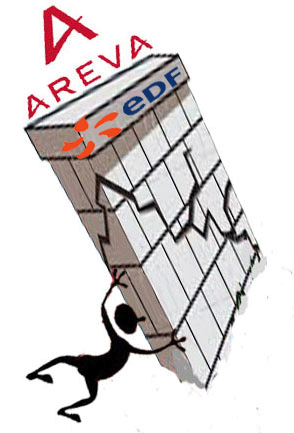
EDF faces a seemingly impossible financial equation. It has colossal debt of €37 billion; it must deal with the complex €2.5 billion takeover of Areva; and find the money to extend the life of its 58 reactors at costs estimated between €60 and €100 billion up to 2030. (8)
Meanwhile EDF has been accused by Greenpeace France of grossly underestimating the cost of nuclear electricity.
Greenpeace claimed that if EDF disclosed the true cost of running its fleet of reactors in France while financing two new ones in the UK, it would be declared bankrupt.
“In summary, the French nuclear fleet is at the end of its course, dilapidated and dotted with deficient parts. At the same time, the finances of EDF are in such a deplorable state that the company could soon join Areva in bankruptcy, and is in any case unable to properly maintain its reactors.”
NuClear News No 90 , 26 Nov 16 Problems discovered at Areva’s metal forge at Le Creusot have been growing over the past six months and are now even threatening to derail EDF’s takeover of Areva’s reactor business.
Last spring when Economy Minister Emmanuel Macron visited to tell the workers at Le Creusot that he had every confidence in the nuclear sector, despite the difficulties, 400 files which were being examined for suspected “anomalies” had to be hastily moved out of the meeting room. Now, six months later a crane has been moving prefabricated office buildings into position so that 6,000 records concerning nuclear components – 2.4 million pages – forged at Le Creusot over the last 60 years can be re-examined. Areva has had to accept that the original 400 suspicious files are just the tip of an iceberg and not the only ones containing “irregularities”. 50 people are now trawling through the paperwork and as many more are being recruited for a job that will take at least another eighteen months.
EDF’s CEO Jean-Bernard Lévy says if Le Creusot’s “problems prove insurmountable, the acquisition will not happen”. (1)
With potentially more than half of France’s 58 reactors affected by the “carbon segregation” problem the French nuclear watchdog, the Autorité de Sûreté Nucléaire (ASN) has ordered preventative measures to be taken immediately to ensure public safety. ASN confirmed that, as of late October, 20 reactors were offline and more could be shut down over coming weeks.
Questionable Materials and Documentation
At the heart of France’s nuclear crisis are two problems. One concerns the carbon content of the steel used in critical reactor components, steam heat exchangers, and other components manufactured or supplied by AREVA SA, the French state-owned nuclear engineering firm and global producer of nuclear reactors. The second problem concerns forged, falsified, or incomplete quality control reports about the critical components themselves. Excessive levels of carbon in the steel parts could make them more brittle and subject to sudden fracture or tearing under sustained high pressure, which is obviously unacceptable.
Steam generators from 18 reactors have carbon levels that are above the acceptable level. Some of these were forged at Le Creusot, but others were forged in Japan by JCFC, a subcontractor of Areva. Twelve reactors equipped with JCFC steel are still at a standstill and will be in December while inspections are carried out.
The massive outages are draining power from all over Europe. In the event of severe cold weather this winter, there could be blackouts. Worse, new questions continue to swirl about both the safety and integrity of EDF’s nuclear fleet, as well as the quality of some French- and Japanese-made components that EDF is using in various high-profile nuclear projects around the world.
In October EDF was forced to reduce its 2016 generation targets from 395–400 TWh to 380– 390 TWh, while estimates for nuclear output in 2017 have also been lowered to between 390 TWh and 400 TWh. For perspective, annual nuclear production averaged 417 TWh in the period 2005–2015.
Flamanville
The problem was originally discovered at the Flamanville EPR project in 2014. Since then an internal probe at Le Creusot where many of the components in question were manufactured, has uncovered new anomalies. AREVA is now reported to be reviewing all 9,000 manufacturing records at the forge dating back as far as 1943, including files from more than 6,000 nuclear components.
This autumn there have been almost weekly revelations resulting in plant shutdowns, extended outages, reduced generation, and lots more questions. According to ASN there are now a significant number of reactors offline, with more to be inspected in the next few weeks. “We are now finding carbon segregation problems from components coming from both Le Creusot and [the Kitakyushu-based Japan Casting & Forging Corp.] JCFC plant. As for now, there [are] 20 EDF reactors offline,” the official said, noting that the number will fluctuate as inspections take place.
The analyses performed by EDF thus far have found that since 2015 certain channel heads of the steam generators manufactured by Le Creusot and JCFC “contain a significant carbon concentration zone which could lead to lower than expected mechanical properties,” according to ASN. The Japan Times reports that the JCFC is now also under scrutiny by Japan’s Nuclear Regulation Authority.
Shaun Burnie for Greenpeace said “As a result of substandard manufacturing in Japan, citizens in France have been unknowingly exposed to the risk of catastrophic failure of critical reactor components which could result in a reactor core meltdown. Japanese-supplied steel is now at the centre of France’s unprecedented nuclear crisis the scale of which has never been seen in any country. All 12 reactors supplied by JCFC are either in forced shutdown or about to be. It lacks all credibility that the Japanese nuclear industry would claim that there are no implications for the safety of their own nuclear reactors. The steel production records released in France did not reveal the scale of excess carbon, which was only found after physical testing. There are currently no plans for such tests in Japan. That is wholly unacceptable. There are many urgent questions that need to be answered by the industry and the NRA, and with full public disclosure and transparency.” (2)
Energy traders and analysts warn that the French market needs to prepare for longer maintenance periods in coming years given the age of the nuclear fleet and the continuing design flaw revelations. With the average French reactor now more than 30 years old, equipment will need to be replaced more frequently, and increasingly stringent safety requirements will mean that components could be delayed, especially as ASN imposes additional checks. The safety inspections and other reviews “will lead in particular to extensions of certain planned outages,” EDF said in a press release.
Erring on the Side of Safety?
Despite the outages and findings from the carbon quality investigations, EDF continues to downplay the risk. “The safety margins are very large and the carbon content does not undermine integrity or security, even in the case of an accident,” an EDF spokesperson told Le Monde newspaper. But questions about quality control practices at Le Creusot continue to grow. Indeed, the greater the scrutiny, the more problems are being discovered. The number of components affected by irregularities and already installed in operating reactors increased from 33 known issues in April to 83 by the end of September. Startlingly, irregularities affecting just the Flamanville EPR project increased from two to 20 during the same period.
While EDF and AREVA are dealing with costly damage control, ASN and other agencies are erring on the side of caution. Indeed, the ASN representative said, “We take no risks. That is the rule. If we don’t know the dangers of the carbon segregation, then we must take the reactors offline until we know what the situation is and [can confirm that] it’s not dangerous.”
ASN revealed that AREVA has now identified at least 87 irregularities concerning EDF reactors in operation, including vessels, steam generators, and main primary system piping, plus the 20 issues for parts intended for Flamanville 3, and one more affecting a steam generator planned for installation in Gravelines 5. Inspectors have also found four irregularities affecting transport packaging for radioactive substances. ASN said that whatever the outcome of these investigations, the irregularities “reveal unacceptable practices.”
External Parties Push for Answers
After the discovery of anomalies in the composition of steel in certain zones of the vessel closure head and the vessel bottom head of the EPR reactor being built at Flamanville in 2014, an internal audit was carried out and released in April 2015, suggesting the existence of many more anomalies. These were initially downplayed by ASN and AREVA. But in September 2015 an independent evaluation conducted by Large and Associates for Greenpeace France really set the cat amongst the pigeons. “The nature of the flaw in the steel, an excess of carbon, reduces steel toughness and renders the components vulnerable to fast fracture,” said the report’s author, John Large. The Greenpeace report, “Amplified the questions ASN already had,” said an ASN representative.
12 reactors have been identified by ASN to have carbon problems in replacement steam generators forged by JCFC. In these reactors initial surface tests were followed by more invasive studies. The first reactors to enter scheduled refuelling outages for a more thorough examination were Tricastin 1 and 3. The early nondestructive inspection results for the JCFC bottom channel heads at these reactors revealed an alarming 0.39% level of carbon present, almost 100% greater than the maximum permissible level. That finding, with its associated reduction in material toughness, rendered the component vulnerable to fast fracture, reported Greenpeace in a late October update. ASN decided to order the shutdown of all but one of these reactors and these shutdowns will remain in force until EDF can demonstrate each reactor is safe to re-enter service.
Uncertainty Remains
At a French parliamentary hearing into the situation on October 25, ASN said it would need another year or two to examine the thousands of documents at the Le Creusot foundry and more anomalies and irregularities will probably be discovered. (3
As of late October 2016 ASN has confirmed the following:
Six reactors have been granted approval to restart and are operating normally: Blayais 1, Chinon 1 and 2, Dampierre 2 and 4, and Saint-Laurent-des-Eaux B2.
Seven reactos are in planned outages and have been, or are being, inspected. They are: Bugey 4, Civaux 2, Dampierre 3, Gravelines 2, Saint-Laurent-des-Eaux B1, and Tricastin 1 and 3. (4) The Times reports that the re-start of Civaux 2 and Dampierre 3 has been delayed until 31st December.
(5) · Five reactors have been ordered by ASN to be taken offline to conduct checks before 18th January 2017. They are: Civaux 1, Fessenheim 1, Gravelines 4, and Tricastin 2 and 4. (6)
Three reactors are currently scheduled to remain unavailable throughout the winter months. They are: Bugey 5, Gravelines 5, and Paluel 2.
One reactor has been ordered by ASN to shut down following the detection of an irregularity in the lower shell of the steam generator. That unit is Fessenheim 2.
Incidentally, Paluel 2 has been offline since May 2015. Its maintenance period is continuing, following an incident on March 31, 2016, in which a 465-ton steam generator tipped over during removal. (7)
EDF’s Debts
EDF faces a seemingly impossible financial equation. It has colossal debt of €37 billion; it must deal with the complex €2.5 billion takeover of Areva; and find the money to extend the life of its 58 reactors at costs estimated between €60 and €100 billion up to 2030. (8)
Meanwhile EDF has been accused by Greenpeace France of grossly underestimating the cost of nuclear electricity.
Greenpeace claimed that if EDF disclosed the true cost of running its fleet of reactors in France while financing two new ones in the UK, it would be declared bankrupt. Greenpeace commissioned an audit by AlphaValue, the equity research company. The French government has agreed to inject €3 billion into the group this year and has renounced dividend payments until next year. Shares in EDF, 85% of which are owned by the French state, have lost almost a third of their value in the past year and the company is no longer listed on the Paris blue-chip index.
The AlphaValue report described EDF as an “uncompetitive firm – incapable of reacting rapidly and efficiently to the variations in electricity needs and the changes created by the liberalisation of European markets”. It said that EDF’s rivals had written down the value of their nuclear plants because of the move to renewable energy and the fall in electricity prices and that EDF had failed to follow suit. Juan Camilo Rodriguez, author of the report, said the company might have to close 17 of its 58 French reactors to meet the government’s requirement that nuclear power should provide 50 per cent of the nation’s electricity in 2025, down from 75 per cent now.
“The provisions to safeguard the burden of financing the decommissioning of the French reactors are far from sufficient. [If 17 are closed], the group should increase its provisions by more than €20 billion.” Mr Rodriguez said the cost of handling nuclear waste added at least €33.5 billion to that figure. “Whatever scenario is retained, an adjustment of the nuclear provisions . . . would lead to the bankruptcy of EDF from an accountancy point of view,” he added. The report said that EDF would need to find a further €165 billion during the next decade to finance projects such as Hinkley Point and the renovation of reactors in France. EDF says it will spend €51 billion renovating its reactors and £12 billion on Hinkley Point. A spokesman for EDF accused AlphaValue of making erroneous calculations that failed to take account of long-term electricity price movements and differences between France and other European markets. (9) Greenpeace filed a complaint against EDF and its CEO, Jean-Bernard Lévy, for “stock trading offences” at the end of November and EDF responded by suing the group for making “false allegations”.
Greenpeace has asked the public prosecutor “to open a preliminary investigation or to appoint an investigating judge”, saying that “shareholders, investors but also French citizens are being misled by EDF and its CEO”. (10)
According to Stéphane L’homme, Directeur de l’Observatoire du nucléaire: “In summary, the French nuclear fleet is at the end of its course, dilapidated and dotted with deficient parts. At the same time, the finances of EDF are in such a deplorable state that the company could soon join Areva in bankruptcy, and is in any case unable to properly maintain its reactors.” http://www.no2nuclearpower.org.uk/nuclearnews/NuClearNewsNo90.pdf
The Justice Department announced today that Bechtel National Inc., Bechtel Corp., URS Corp. (predecessor in interest to AECOM Global II LLC) and URS Energy and Construction Inc. (now known as AECOM Energy and Construction Inc.) have agreed to pay $125 million to resolve allegations under the False Claims Act that they made false statements and claims to the Department of Energy (DOE) by charging DOE for deficient nuclear quality materials, services, and testing that was provided at the Waste Treatment Plant (WTP) at DOE’s Hanford Site near Richland, Washington. The settlement also resolves allegations that Bechtel National Inc. and Bechtel Corp. improperly used federal contract funds to pay for a comprehensive, multi-year lobbying campaign of Congress and other federal officials for continued funding at the WTP. Bechtel Corp. and Bechtel National Inc. are Nevada corporations. URS Corp. is headquartered in California, and URS Energy & Construction Inc. is headquartered in Colorado.
“The money allocated by Congress for the Waste Treatment Plant is intended to fund the Department of Energy’s important mission to clean up the contaminated Hanford nuclear site, and this mission is undermined if funds are wasted on goods or services that are not nuclear compliant or to further lobbying activities,” said Principal Deputy Assistant Attorney General Benjamin C. Mizer, head of the Justice Department’s Civil Division. “This settlement demonstrates that the Justice Department will work to ensure that public funds are used for the important purposes for which they are intended.”
“The environmental clean-up and restoration of the land that comprises the Hanford Nuclear Reservation is one of the single most important projects in this region,” said U.S. Attorney Michael C. Ormsby of the Eastern District of Washington. “It is imperative that funds allocated for this project be used appropriately and judiciously – the public expects nothing less. This office and our DOJ and DOE counterparts take allegations of contractor abuse seriously and place a priority on investigating and pursuing enforcement when those allegations could impact the safety and security of our citizens.”
“The DOE Office of Inspector General is committed to ensuring the integrity of Departmental contracts and financial expenditures,” said Acting Inspector General Rickey R. Hass. “We will continue to steadfastly investigate allegations of fraudulent diversion of tax dollars throughout DOE programs and appreciate the support of DOJ attorneys in these matters.”
Between 2002 and the present, DOE has paid billions of dollars to the defendants to design and build the WTP, which will be used to treat dangerous radioactive wastes that are currently stored at DOE’s Hanford Site. The contract required materials, testing and services to meet certain nuclear quality standards. The United States alleged that the defendants violated the False Claims Act by charging the government the cost of complying with these standards when they failed to do so. In particular, the United States alleged that the defendants improperly billed the government for materials and services from vendors that did not meet quality control requirements, for piping and waste vessels that did not meet quality standards and for testing from vendors who did not have compliant quality programs. The United States also alleged that Bechtel National Inc. and Bechtel Corp. improperly claimed and received government funding for lobbying activities in violation of the Byrd Amendment, and applicable contractual and regulatory requirements, all of which prohibit the use of federal funds for lobbying activities.
The allegations resolved by this settlement were initially brought in a lawsuit filed under the qui tam, or whistleblower, provisions of the False Claims Act by Gary Brunson, Donna Busche, and Walter Tamosaitis, who worked on the WTP project. The False Claims Act permits private parties to sue on behalf of the United States when they believe that a party has submitted false claims for government funds, and to receive a share of any recovery. The Act also permits the government to intervene in such a lawsuit, as it did in part in this case. The whistleblowers’ reward has not yet been determined.
This matter was handled by the Civil Division’s Commercial Litigation Branch, the U.S. Attorney’s Office for the Eastern District of Washington, the DOE Office of the Inspector General and the FBI.
The claims asserted against defendants are allegations only, and there has been no determination of liability. The case is United States ex rel. Brunson, Busche, and Tamosaitis v. Bechtel National, Inc., Bechtel Corp., URS Corp., and URS Energy & Construction, Inc., Case No. 2:13-cv-05013-EFS (E.D. Wash.).




 Nuclear weapon firms pay to settle illegal lobbying cases http://www.usatoday.com/story/news/2016/12/21/nuclear-weapon-firms-pay-settle-illegal-lobbying-cases/95609254/












 nuclear-news