As French anti nuclear activists organise protests, police carry out violent raids
The French state intensifies its crackdown on anti-nuclear groups https://litbyimagination.blogspot.com.au/2017/09/sept-2017-french-state-intensifies-its.html Possible Slow Fuse,
Many people have bought the argument that nuclear energy is carbon-free, even though it isn’t, and they have accepted the promise from the nuclear industry that there will be no more nuclear catastrophes because all the “lessons have been learned” and nothing of the kind will ever, ever happen again. They say that after every nuclear mistake big or small. The public also accepts without too much inquiry that nuclear reactors could exist in this world alongside a hypothetical abolition of nuclear weapons. Enough people seem persuaded of these arguments, so a passive acceptance of nuclear energy is the norm in most countries that still depend on it.
The issue that ought to be the real deal-breaker is none of the above-mentioned objections, even though they are each, individually, sufficient to make any nation reject nuclear energy. The most serious problem with nuclear energy is that no one, since the time when nuclear power plants were first switched on, has found a way to dispose of irradiated uranium and plutonium, commonly known as “nuclear waste.”
The public has been told that it can be safely buried as soon as nuclear reactor operators find a suitable geological disposal site and a “willing host community” to take it. So far both of these conditions have not been met. Willing host communities are extremely hard to produce, and reluctant host communities have exposed the fact that no proposed disposal site can be guaranteed to be safely sealed off from the ecosystem for the thousands of years into the future.
Over the last five years I have followed the opposition that has arisen to France’s plan to bury its nuclear waste in an enormous facility in northeastern France near the town of Bure. The articles I translated previously can be found at the links at the end of this article. The translation that follows this introduction describes what is happening to opponents in September 2017 as their movement has grown and their lawsuits and legal challenges have been rejected. The state has finally decided to crack down. When a group of people decide to stand up and protect future generations, this is the thanks they get.
Events in France illustrate the serious flaws in our civilization’s approach to energy policy. Any solution that imposes destruction on a local people cannot be called the product of a democratic process. One can say that this is a majority decision, or the nation requires this sacrifice, but any such abuse of a minority is incompatible with democracy because anyone, and thus everyone, becomes susceptible to such tyranny in different times and circumstances.
Some nations are aware of this dilemma so they are content to delay indefinitely the quest for a final resting place for irradiated fuel rods. They hope to someday find the appropriate host community, but it doesn’t matter if they never succeed. As long as they talk of having this intent and pretend a solution is possible, they can continue operating their reactors. France, on the other hand, seems to have been foolish enough to take the idea of building a permanent disposal site seriously. They proceeded to build it over the objections of citizens and in spite of evidence that it would jeopardize future generations.
On Wednesday September 20, police raided several locations in Bure (Meuse region) and surrounding areas inhabited by opponents of the nuclear waste disposal project. For many of them, this operation seems to be “the main focus of police pressure that has become widespread and permanent.” Gatherings of support are being organized throughout France.
La maison de résistance in Bure, the place where opponents of CIGEO meet and organize, was raided for the first time on September 20 at about 06:15.
Bought in 2005 by French and Germn antinuclear activists from belonging to Bure Zone Libre (BZL), this old farm today welcomes activists of many kinds on a regular and permanent basis. “Raiding la maison de resistance is very symbolic. They are getting serious now,” remarks Joel, a resident of Mandres and opponent of the nuclear waste repository. Over almost ten hours, officers went through everything in the building, and seized numerous objects. Joel explained, “They didn’t have enough boxes to seal everything up properly, so they had to have more brought to them. They came with a moving truck, ready to empty the house.”
It was about 6:20 in the morning when officers started their raids at the maison de resistance, in Bure, the grounds of the station at Lumeville, and a residence in Commercy. They also went to an apartment in Mandres-en-Barrois, near Verdun. These places are occupied by people opposed to the burial of nuclear waste in Bure. Managed by ANDRA (l’Agence Nationale pour la gestion des Déchets RAdioactifs), this project was baptized as CIGEO (Centre Industriel de stockage GEologique)
The forces of public order justified their entry into the maison de resistance with a warrant from a commission of inquiry formed to investigate an attack on the hotel-restaurant of the ANDRA laboratory last June.
According to the website MVC.Camp maintained by the activists on the site, “There were forty officers, and they made their entry violently. Equipped with a crowbar, they broke the door and, it seems, some car windows.”
At the train station, about fifteen officers were present, accompanied by a prosecutor and drug-sniffing dogs. They came in with a warrant from the commission allowing a search for drugs. In Commercy, they also arrived about 6:00 and seized a computer, a hard drive and a portable phone. During this time, roadblocks were put up at Ribeaucourt and at Mandres.
“The people here are exhausted and afraid”
According to the prosecutor in Bar-le-Duc, Olivier Glady, interviewed by AFP (Agence France Presse), officers seized helmets, gas masks and fireworks, 140 grams of “packaged” cannabis resin, ten cannabis plants, as well as data and phones. They were pursuing three different investigations:
- The one ordered by the commission of inquiry mentioned above.
- Another investigation was launched after confrontations that occurred at a protest on August 15, according to Mr. Glady.
- Some raids were related to “infractions of drug laws,” he added.
For the organization Sortir du Nuléaire, “this raid comes after many months of permanent police harassment in the villages around Bure, with constant patrols by police cars and helicopters, and roadblocks where both protesters and farmers have to show identification.”
In a press release, the group denounced “these unacceptable methods and the escalation in this strategy of tension. It is shameful that the State chooses targeting of opponents rather than abandoning this dangerous project that imposes a danger on future generations.” The group is calling for protests throughout the country (see list below.)
A resident of Mandres, an opponent of the CIGEO project, told Reporterre, “It’s the first time we’ve seen an operation of this scale in Bure.” For him, it’s the main focus of a police pressure that is now diffuse and permanent. “Officers patrol daily in the streets and villages, filming and harassing, controlling everything in a pervasive manner. They are raising the tension in order to discourage people, making people afraid, and pushing them to the margins, but all they’re doing is motivating people to mobilize more.”
Michel Labat, another resident of Mandres told Reporterre he was revolted. “It’s incredible. So many police everywhere. Today there is no more opposition. As soon as we do something, they call in the police. Then they insult and harass us regularly. They have no respect. People here are exhausted and afraid.”
For Jean-Francois Bodenreider, a physiotherapist, a resident of Bonnet, and president of the group Habitants Vigilants de Gondrecourt said, “These raids are a way of destabilizing the struggle, a way of focusing on other things. While we are pointing out the dangers of CIGEO, they are conducting disciplinary operations, portraying opponents as druggies and criminals. This makes people stop talking about the real problems. They don’t know what to say or do to defend le nucléaire, so they talk about something else.
“They are pushing us to our limits to make us do something irreparable”
On September 17, this physiotherapist who established himself in Gondrecourt twenty-five years ago, experienced another of many provocations by police. He was in his yard when a black 4×4 stopped in front of his house. Mr. Bodenreider said, “I approached and the passenger in the front took out his phone to take some photos. He told me he was looking for houses to buy in the area. I asked him to leave because our house is not for sale, then his tone changed. Suddenly, one of the passengers shouted, ‘Go! He has a hammer!’” Mr. Bodenreider’s son, Leonard, a medical student, was in the garage gathering supplies for a camping trip. “Out of fear for his father, and in anger” he threw a rubber hammer toward the vehicle. Then the family was shocked to see the passengers in the 4×4 identify themselves as police officers. They handcuffed Leonard and took him away. The spouses of father and son went to the police station in Gondrecourt and waited patiently until they were finally listened to as witnesses. Mr. Bodenreider recounted, “The officers were talking about attempted manslaughter charges, but some local officers who knew us were there and they defused the situation, and they finally got our son released that evening.”
Leonard will have to appear in court on charges of destruction of property because the hammer slightly struck the vehicle.
“After the incident, I told myself that if I reacted like that it was because I was irritated,” said the physiotherapist. I don’t live under daily pressure, not like the residents of Mandres who are patrolled eight times a day. But this pressure exerted by police patrols affects all of us.” He describes himself as “moderate” in the struggle, but he is sure of one thing: “They are pushing us so that we’ll do something irreparable.”
“Once you are identified as an opponent, you are presumed to be guilty”
Joel, an opponent of the CIGEO project, recently relived the experience of his house arrest during the COP21 summit: “At 6 AM, ten officers came to the door of the friend I was staying with in Commercy. They went through everything for the next hour. One of them had a Taser gun. They left with papers, my computer, and my phone. As a bonus question, the forces of public order asked before leaving, “Do you have anything else to declare regarding Bure?”
As in the other locations that were raided, one of which was Joel’s apartment in Mandres, officers indicated that they were investigating the attack on the hotel-restaurant of the ANDRA laboratory. One catch: Joel was on vacation in Greece at the time. He adds indignantly, “Once you are identified as an opponent, in my case since the COP21, you’re a target and presumed guilty.”
For Joel, this is all proof that the operations this Wednesday were not aimed solely at finding who is responsible for the acts committed this summer. He observes, “They are creating permanent tension in order to break people.”
List of protest events being organized by Sortir du Nucleaire this Wednesday:
Paris à 18h, appel à rassemblement au marché aux fleurs, métro Cité, à 18h. En solidarité également avec les camarades en procès de la voiture brûlée.
devant la Préfecture de Bar-le-Duc à 17h30
Nantes, rdv 18h à Commerce dans le cadre du Front social.
Grenoble, 17h30, au pied de la tour Perret, parc Paul Mistral, par le comité local de soutien contre les GPII.
Nancy place Stanislas à 18h.
Angers, 18h, devant la Préfecture d’Angers.
Épinal, 18h, devant la Préfecture.
Colmar, 18h, devant la Préfecture, Champ-de-Mars.
Dijon, 18h, devant la Préfecture. Événement ici.
Rassemblement en cours d’organisation en Alsace, on vous tient au courant dès que possible.
Rassemblement en cours d’organisation à Reims, idem.
Une conférence de presse commune du mouvement de résistance se tiendra jeudi 21 septembre à 11h à la Maison de résistance à la poubelle nucléaire, à Bure.
More articles about Bure, CIGEO and French nuclear history:
Nuclear Waste Project Hungry for Land
French court: NGOs have no right to challenge nuclear “public authorities”
France’s Bure Nuclear Waste Site on Trial
The Inconvenience of a Geothermic Energy Source Under France’s Nuke Waste Dump
Superphénix (some history of the French anti-nuclear movement) Very valuable information for the anglophone world. We are constantly being told of how popular and successful is the nuclear industry in France. This is a timely counter to the pro nuclear English language propaganda
Huge secret nuclear power deal – Kushner, Bannon, Flynn with Middle East

 Kushner, Bannon, Flynn Pushed Huge Nuclear Power Deal In Middle East For Profit, In Secret https://www.dailykos.com/stories/2017/9/16/1699095/-Kushner-Bannon-Flynn-Pushed-Huge-Nuclear-Power-Deal-In-Middle-East-For-Profit-In-Secret, t’s no wonder that Mike Flynn asked the House and the Senate for immunity and has refused to voluntarily testify before the Senate twice, the last time being Tuesday. On Wednesday Democrats in the House Foreign Affairs and Oversight Committee reported that Flynn failed to disclose that he worked for oil companies and had attended a meeting on their behalf promoting a U.S.-Russian Saudi financed program to build nuclear reactors in the Arab world. This took place in 2015 and it is one of the meetings that Mike Flynn failed to disclose on his security clearance application.
USA’s ex-national security adviser was doing secret nuclear deal with Russia and Middle East nations
MIKE FLYNN’S NUCLEAR SIDE-HUSTLE GETS EVEN SHADIER
Two weeks before the inauguration, Flynn reportedly met the king of Jordan while pushing a deal to build nuclear reactors . . . in Jordan. Vanity Fair , BY BESS LEVIN SEPTEMBER 15, 2017 Remember Mike Flynn? The ex-national security adviser who was forced to resign after he forgot to mention some conversations he’d had with Russian ambassador Sergey Kislyak? Whose unfair persecution at the hands of James Comey was allegedly one of the reasons Donald Trump fired his own F.B.I. director? Who received $600,000 in a lobbying deal from a Turkish man with business ties to Russia, and who subsequently BLOCKED A PLAN TO ATTACK ISIS that the Turkish government opposed, all without ever registering a foreign agent or disclosing his lobbying deals? He’s back in the news today, and if you were hoping it was for something fun like Flynn announcing that he is joining the next season of Dancing with the Stars, you will be disappointed.
BuzzFeed News reports that two weeks before Donald Trump was inaugurated, Flynn and soon-to-be White House advisers Steve Bannon and Jared Kusher had a secret morning meeting with Jordan’s King Abdullah II, during the same period in which Flynn was pushing “a multibillion-dollar deal to build nuclear reactors in Jordan and other Middle East nations.” (Like 100 other foreign contacts he initially failed to disclose, Kushner’s initial security clearance form failed to mention this particular meeting.) According to BuzzFeed, topics discussed included “Israeli-Palestinian relations, intelligence sharing between America and Jordan on Syria, ISIS,” and a nuclear project called the Marshal Plan, a $200 billion project which initially involved U.S. companies building reactors in Jordan and other Middle East nations, with security handled by a Russian state-owned firm called Rosoboron, which, incidentally, is currently facing the possibility of U.S. sanctions.
People close to the three Trump advisers say that the nuclear deal was not discussed. But a federal official with access to a document created by a law enforcement agency about the meeting said that the nuclear proposal, known as the Marshall Plan, was one of the topics the group talked about.
According to Politico, Flynn was paid at least $25,000 in his capacity as a consultant on the plan by one of the American companies involved. According to the Wall Street Journal, Flynn’s disclosure forms “indicate that [his] year-and-a-half work on the project ended in December 2016, but Mr. Flynn in fact remained involved in the project once he joined the Trump administration in January, discussing the plan and directing his National Security Council staff to meet with the companies involved, the former staffers said.” (Flynn’s lawyer declined to comment to the Journal, as did the White House.)
If this all sounds like the type of thing that’s going to keep you up at night, you’re not alone. “Any proposal to introduce dozens of nuclear reactors to the Middle East, particularly Saudi Arabia, raises many proliferation red flags,” the Arms Control Association’s Daryl Kimball told BuzzFeed. “The Saudis do not need nuclear power and them gaining access could lead to dangerous consequences down the road.” Giving a country nuclear energy capacity, as the Marshall Plan would, “is like giving a country a nuclear weapons starter kit,” the nonprofit Center for Arms Control and Non-Proliferation’s Alexandra Bell said…..https://www.vanityfair.com/news/2017/09/mike-flynns-nuclear-side-hustle-gets-even-shadier
Nuclear power industry at last admitting its connection to nuclear weapons
 Energy Collective 13th September 2017, The nuclear power industry, under pressure economically, is arguing that it
deserves government support because it is essential for “national
security”, notes Jim Green, editor of the Nuclear Monitor newsletter.
Green explains why he finds this argument disingenuous and unconvincing.
The nuclear power industry has long maintained that it has no connection
whatsoever to nuclear weapons proliferation. This argument was always based
on lies and half-truths.
Ironically, the nuclear industry is now admitting they were not telling the whole truth. Its proponents are arguing it
deserves public support precisely because it is essential for national
security reasons! Some of them are adding a peculiar twist to their
argument: they are saying that a strong nuclear power sector needs to be
maintained in western countries so that they can maintain a capability to
constrain the proliferation of nuclear weapons.
http://www.theenergycollective.com/jim-green/2412709/nuclear-power-weapons-national-security
Owners of South Carolina nuclear plant tried to hide negative report on the project
Attorney: Utilities meant to hide report on nuclear project, abc news, BY SEANNA ADCOX, ASSOCIATED PRESS, COLUMBIA, S.C. — Sep 15, 2017
For at least two years before a South Carolina nuclear power construction project was abandoned, its owners had a report that they intended to keep secret showing the reactors couldn’t be completed as planned, an attorney for a legislative panel investigating the debacle said Friday.
“The report is very, very troubling,” said Scott Elliott, hired by the House for the hearings. “It was designed to never see the light of day.”
State-owned Santee Cooper and South Carolina Electric & Gas hired Bechtel Corp. in 2015 to assess construction on two new reactors at V.C. Summer Nuclear Station north of Columbia. The utilities were briefed on the findings later that year, though the official report is dated February 2016.
Essentially, the report says “this wasn’t going to work. … If things don’t change dramatically, you’ll never finish these projects,” Elliott said. Its findings included a lack of proper oversight by SCE&G, the majority owner.
SCE&G should have disclosed the report’s existence as it successfully sought approval in 2015 and 2016 to spend more on the project. Instead, executives told state regulators they were confident in the presented completion dates, said Elliott, also an attorney for South Carolina Energy Users Committee, a coalition of large industries that need a lot of energy.
Legislators accused SCE&G executives of intentionally hiding the report from regulators and lawmakers, withholding information that could have resulted in “no” votes.
…..The utilities abandoned the project July 31 after jointly spending nearly $10 billion, leaving nearly 6,000 people jobless. A 2007 state law allows SCE&G to recoup its debt from customers if state regulators determine money was spent prudently.
Legislators who are seeking ways to fix the law want to stop that. Customers have already paid more than $2 billion on interest costs through a series of rate hikes since 2009. The project accounts for 18 percent of SCE&G customers’ electric bills.
Elliott said the Bechtel report puts into question every decision made by the utilities over at least the last two years.
……The Bechtel report’s existence became public as executives testified at a legislative hearing last month. Lawmakers threatened to subpoena it if the utilities refused to provide it. Gov. Henry McMaster released it to reporters earlier this month, over SCANA’s written objections, after receiving a copy from Santee Cooper…….http://abcnews.go.com/US/wireStory/legislators-review-secret-report-nuclear-project-49869620
As national security adviser, did Michael Flynn secretly promote a U.S.-Russian project to build dozens of nuclear reactors in the Middle East?
AOL 13th Sept 2017, Democratic lawmakers are probing whether retired U.S. General Michael Flynn
secretly promoted a U.S.-Russian project to build dozens of nuclear
reactors in the Middle East after becoming President Donald Trump’s first
national security adviser.
Representatives Elijah Cummings and Eliot Engel
made the disclosure in a letter they sent on Tuesday to Flynn’s lawyer and
executives of firms that developed the reactor scheme and for which Flynn’s
now-defunct consulting company worked.
https://www.aol.com/article/news/2017/09/13/dems-investigating-whether-flynn-promoted-nuclear-reactor-project-as-trumps-national-security-adviser/23207327/
Secret troubles at Summer nuclear plant for months, now revealed in emails
 New emails reveal behind-the-scenes battle over Summer nuke, http://www.utilitydive.com/news/new-emails-reveal-behind-the-scenes-battle-over-summer-nuke/504529/ Robert Walton
Dive Brief:
- New emails obtained by the Charleston Post & Courier show a deteriorating relationship between the owners of the V.C. Summer nuclear plant in South Carolina and lead contractor Westinghouse Electric in the months leading up to the abandonment of an expansion plan for the facility.
- The emails build on past messages that indicate officials at Santee Cooper and South Carolina Electric & Gas Co. were aware of financial and construction difficulties at the plant as early as last summer, but kept the knowledge out of the public eye and continued to push for its completion.
- The new emails demonstrate that plant owners communicated directly with Toshiba, parent company of Westinghouse, about problems at the plant. In one, the CEO of SCANA wrote to Toshiba’s chief executive, saying “we have no doubt that we have been the victim of financial malfeasance by [Westinghouse] and Toshiba.”
-
Dive Insight:
The Post & Courier’s diligent coverage of the V.C. Summer fallout continues to raise questions about what the plant owners knew of project problems and when they knew it.
As early as last summer, both SCANA CEO Kevin Marsh and Santee Cooper CEO Lonnie Carter made it clear they suspected Westinghouse and Toshiba were unable to pull off the project — and told the companies that in no uncertain terms.
“Deceit and non-transparency” — words not often tossed around by electric utilities — was how Carter put it in one email. In an October 2016 note to Marsh, he said Santee Cooper had hired bankruptcy lawyers in June to “help us think through Toshiba/Westinghouse insolvency scenarios.”
The upshot is that the South Carolina utilities appear to have suspected to project was in trouble, but didn’t inform regulators or other officials. The utilities abandoned the project in July after spending more than $14 billion to construct two new reactors.
The new emails come in the wake of an audit of the project recently released at the demand of South Carolina Gov. Henry McMaster (R). Prepared by contractor Bechtel in February 2016, the report outlines numerous problems at the plant, including flawed engineering documents, low morale at the work site, frequent construction changes, high turnover and generally slow progress.
- The report was completed in early 2016 — months before SCE&G informed regulators that its share of the development costs had risen more than $800 million, and about a year and a half before the utilities agreed to scrap the project.
The emails also show SCE&G and Santee Cooper were already considering in June of last year that Westinghouse might fall into bankruptcy. The company went bankrupt in March of this year.
Originally proposed in 2007, the two-reactor expansion of the Summer plant was supposed to be completed by 2017 and 2018, respectively. Issues with Westinghouse’s reactor design led to delays, cost overruns and ultimately the company’s failure.
When the project was scrapped, officials said costs to complete could reach over $25 billion.
31 out of 32 South Carolina lawmakers received money from the utility and owners of failed V.C. Summer nuclear project
 SCANA has given money to nearly all South Carolina lawmakers probing the failed nuclear project, Post and Courier, By Thad Moore tmoore@postandcourier.com, Sep 2, 2017 All but one of the 32 lawmakers investigating the demise of the V.C. Summer nuclear project have taken campaign contributions from the utility responsible for building it, highlighting the extent of the power industry’s lobbying efforts in Columbia.
The overwhelming majority have received funds from SCANA Corp., parent company to S.C. Electric & Gas Co., its subsidiaries and political action committees within the last two years, according to a Post and Courier review of campaign finance records. They include 14 who took contributions this year as uncertainties surrounding the construction project mounted.
Those lawmakers, who sit on twin House and Senate committees formed last month, are now tasked with probing what went wrong with the project, which cost $9 billion before construction was halted in July. They’re also responsible for forming ideas on how to limit the financial fallout and create safeguards that prevent another energy failure like it.
The lone lawmaker who didn’t receive contributions was Republican Kevin Hardee of Loris, which is outside of SCE&G’s service territory.
SCANA doesn’t cut big checks — it typically gives individual legislators $500 to $1,000, the maximum for a single election cycle — but critics say the steady dribble of contributions helped build warm relationships under the Statehouse dome.
The Cayce-based utility has also given tens of thousands of dollars to legislative caucus groups, and it spends around $200,000 a year to lobby the General Assembly, with a crew of eight lobbyists to monitor legislation and advance its message.
“They make them because they’re basically trying to gain access,” said Frank Knapp, president and chief executive of the S.C. Small Business Chamber of Commerce, which has called for a ban on utility contributions. “They’re just not after good government. They’re looking for some return on their investment.”
The well -kept secrets of depleted uranium and the toxic economy of war in Iraq
 Invisibility and the Toxic Economy of War in Iraq, http://www.jadaliyya.com/pages/index/27076/invisibility-and-the-toxic-economy-of-war-in-iraq by Toby C. Jones, In April 2008 a small US engineering firm—Stafford, Texas-based MKM Engineers—brought to a close almost two decades of toxic cleanup work on a former US military facility just west of Kuwait City. Seventeen years earlier, in July 1991, a defective heating unit on a military vehicle loaded with 155mm artillery shells at Camp Doha caught fire and ignited a devastating inferno. The blaze injured several dozen people and damaged scores of other vehicles, including several highly prized M1A1 tanks.[1]
The making and circulation of weapons, typically easily monetized and measured, are only one way to think through the cost of war and the character of its economies. There is a second dimension to the productive power of toxic invisibility for war-makers as well. Because so much around depleted uranium is deliberately mystified and withheld – a pattern that is at odds with how militaries often conspicuously celebrate the power of their weapons systems—military and political authorities have also been able to deny claims about its most pernicious toxic effects. While all war results in long lasting environmental, infrastructural, and embodied suffering, toxic weapons produce consequences that are particularly devastating and long lasting. Given their molecular qualities and the scientific and medical difficulty in linking particular cases of exposure to illness, and especially because they mete out their violence over years and decades—slow violence—the damage they do often persist well after that last bombs were dropped.
In spite of the Pentagon’s efforts to obscure the scale of the use of depleted uranium weapons in Iraq and elsewhere as well as what amounts to obstruction of investigation into DU’s effects, Iraqi scientists and doctors, often assisted by global observers, have documented some of health and environmental damage done. The environmental and health impact has been significant and generational. In the face of extensive epidemiological and other evidence, the US military, alongside its allies that employ it in battle as well, deny the toxic dangers of DU weapons. Whatever the arguments put forward by other observers that DU’s hazardous effects are yet unproven, and there are many, claims of uncertainty are not driven by science, but by politics.[9] The evidence that DU causes health and environmental calamity is overwhelmingly understood to be true except to those who have an interest in believing otherwise.
Beyond the politically driven quest for scientific certainty around depleted uranium’s impact on Iraqi bodies and environments, much is lost. Because the impact of DU is denied by those with the power to potentially neutralize its effects, toxic DU dust is left suspended in Iraqi food systems, coated along infrastructure, lodged in the organs and bones bodies, passed on through childbirth, and left on scraps of metal destroyed in the war that themselves have become commodities exchanged in the country’s postwar economy. Iraqis in particularly affected areas come into constant contact with it. Their exposures are repeated and routine and, yet, remain unmeasured and untreated. And while experts can deny the linkage or withhold certainty about the connections between militarized toxins and affected communities, significant networks of suffering exist.
Indeed, alongside the weapons and the political economic terms of their production, use, and the veils that shroud them, the need for care in war-ravaged communities are the “other side” of these small parts of war economies. The injured and sick, particularly those who face long struggles as a result of toxic exposures, are also central to making sense of the economy of war.[10] Suffering and care, then, must also be accounted for not as the afterlife of war, but as central to our moral and economic calculations of what it involves in the first place. Like depleted uranium weapons themselves, the scale and cost of care and the struggle over health are too easily unseen and uncounted.[11]
[1] Associated Press, “56 Soldiers Hurt in Kuwait Blast,” New York Times, 12 July 1991, http://www.nytimes.com/1991/07/12/world/56-soldiers-hurt-in-kuwait-blast.html.
[3] Thomas D. Williams, “The Depleted Uranium Threat,” Truthout, 13 August 2008, http://truth-out.org/archive/component/k2/item/79582:the-depleted-uranium-threat.
[4] For one early example such a warning, see Wayne C. Hanson, “Ecological Considerations of Depleted Uranium Munitions,” Los Alamos Scientific Laboratory, United States Atomic Energy Commission, June 1974.
[5] Williams, op cit. See also, Snake River Alliance, “Tons of Waste Shipped to Idaho From Kuwait,” http://snakeriveralliance.org/tons-of-waste-shipped-to-idaho-from-kuwait/; Penny Coleman, “How 6,700 Tons of Radioactive Sand from Kuwait Ended up in Idaho,” Alternet, 16 September 2008, https://www.alternet.org/story/98950/how_6%2C700_tons_of_radioactive_sand_from_kuwait_ended_up_in_idaho.
[6] Toby Craig Jones, “America, Oil and War in the Middle East,” Journal of American History 99, no. 1 (June 2012): 208-218, https://academic.oup.com/jah/article-abstract/99/1/208/854761/America-Oil-and-War-in-the-Middle-East?redirectedFrom=fulltext.
[7] Daniel Trotta, “Iraq War Costs more than $2 trillion: Study,” Reuters, 14 March 2013, http://www.reuters.com/article/us-iraq-war-anniversary-idUSBRE92D0PG20130314. On the cost of the Camp Doha fire, see http://www.dtic.mil/ndia/2007/im_em/GeneralSession/Knudson.pdf.
[8] Samuel Oakford, “The United States Used Depleted Uranium in Syria,” Foreign Policy, 14 February 2017, http://foreignpolicy.com/2017/02/14/the-united-states-used-depleted-uranium-in-syria/.
[9] Toby Craig Jones, “Toxic War and the Politics of Uncertainty in Iraq,” International Journal of Middle Eastern Studies 46 no. 4 (October 2014).
[10] See Omar Dewachi, Ungovernable Life: Mandatory Medicine and Statecraft in Iraq (Stanford University Press, 2017).
[11] Omar Dewachi, “The Toxicity of Everyday Survival in Iraq,” Jadaliyya, August 13, 2013. http://www.jadaliyya.com/pages/index/13537/the-toxicity-of-everyday-survival-in-iraq
Prison for US man who illegally shared nuclear tech
Jail term for US man who illegally shared nuclear tech, An American man has been sentenced to two years in jail for illegally helping China develop its nuclear power programme. BBC 2 Sept 17
Szuhsiung Ho, aka Allen Ho, helped Chinese efforts to develop nuclear power for almost 20 years, said the US Department of Justice.
Ho was prosecuted because he did not obtain explicit permission to share “sensitive” nuclear technologies.
He was also fined $20,000 (£15,500) for breaking the US tech transfer rules…….Many of the technologies involved in using radioactive material to generate power are on a proscribed list, and anyone seeking to share them must first get permission from the US Department of Energy to do so…..http://www.bbc.com/news/technology-41122104
Time to stop the secrecy on nuclear reports,by SCE&G, its parent company SCANA, and Santee Cooper
 No excuse for secrecy, http://www.postandcourier.com/opinion/editorials/no-excuse-for-secrecy/article_10c74bc4-8e96-11e7-afd6-03e74390c340.html, 1 Sept 17 As lawmakers and state officials investigate the failure to complete construction on two new nuclear reactors in Fairfield County, the responsible parties — SCE&G, its parent company SCANA, and Santee Cooper — owe the hundreds of thousands of customers who have already helped pay for the project a full and thorough explanation.
That includes supplying every piece of documentation and evidence available as regards the nearly decade-long effort.
Troublingly, neither Santee Cooper nor SCE&G appear to have been forthcoming with a particularly intriguing report produced by Bechtel, an engineering and project management company. The Post and Courier reported on Thursday that SCANA and Santee Cooper officials testified under oath about the Bechtel document — specifically that it exists — which was news to officials at the state Office of Regulatory Staff, who had been told otherwise by SCE&G after repeated requests.
Now, SCANA is claiming that the document cannot be handed over to lawmakers investigating the debacle since it contains privileged information that could be used in a lawsuit against lead contractor Westinghouse.
Santee Cooper, which is a state agency that answers to Gov. Henry McMaster, has similarly refused access, even to Mr. McMaster himself.
For SCANA, refusal to hand over a document that could provide critical information to investigators amounts to an unacceptable hindrance of an effort to save ratepayers from having to pay off as much as $2.2 billion over the next six decades for power plants they will never use.
For Santee Cooper, stonewalling the governor could be fairly described as insubordination. Santee Cooper is a state agency and Mr. McMaster is the chief executive officer of the state.
The Bechtel report was ordered when problems began to arise during the construction process on the reactors. It reportedly contains recommendations for getting the project back on track and avoiding delays and budgetary woes.
If state officials can prove that SCE&G ignored the advice or was insufficiently prudent in implementing it, it could help customers avoid having to pay some or all of the costs associated with the failed project, as part of a critical clause in the disastrously misguided Base Load Review Act.
Members of the state House and Senate investigative committees have threatened to subpoena if the Bechtel report is not turned over in a timely fashion. They should not hesitate to do so.
In the meantime, SCANA and Santee Cooper must be completely forthcoming with not just one critical document but with every relevant piece of evidence that can help explain just what went wrong leading to one of the state’s costliest-ever economic disasters.
At the least, the utilities owe it to the many South Carolinians who already have been collectively charged $1 billion for a plant that apparently will never go on line.
Corruption in South Africa: Eskom and the nuclear industry: time to promote renewables
 Time for the energy sector to self-correct. EE, August 15th, 2017, by Prof. Hartmut Winkler, University of Johannesburg, May and June 2017 will go down as two of the most dreadful months in the history of the South African power utility Eskom. Its credibility in the eyes of the public has reached rock bottom after a series of well-publicised scandals.
Following the suspension of the then acting Eskom CEO, Matshela Koko, over a large contract allegedly benefitting his step-daughter, the nation was stunned by the reinstatement of the former CEO, Brian Molefe, who had previously left the utility under a cloud. The saga also forced the power utility to face the wrath of the parliamentary portfolio committee on Public Enterprises.
Highly damaging revelations followed from leaked emails, corroborating the findings of the Public Protector that Eskom’s leadership had allegedly irregularly assisted the Gupta family’s Oakbay Investments in securing the Optimum mine and the associated coal supply contract. The emails apparently also highlighted indefensibly close links between the Guptas and specific Eskom board members and executives. To top it off, the R4-billion Duvha boiler replacement was inexplicably awarded to a Chinese company, at a much higher cost than proposed by its competitors.
The scale of these alleged transgressions and the initial unwillingness or inability of government to deal with these matters has generated the impression that there are other agendas at play. It suggests that, like many other state-linked entities, Eskom has been taken over by persons furthering individual interests at the expense of the national good, a phenomenon now referred to as state capture.
This further raises the suspicion that the brazen taking of sides in the rollout of new generating capacity is also driven by other motives. Koko and Molefe have been outspokenly pro-nuclear and have blocked the long outstanding conclusion of power purchase agreements with successful bidders under the Renewable Energy Independent Power Producers Procurement Programme (REIPPPP). The power utility appears to have also promoted the distorted narrative that renewables are chiefly responsible for job losses at Mpumalanga coal mines.
The latest REIPPPP projects offer vastly reduced power purchase tariffs compared to the early rounds. Most renewables are now clearly cheaper than the cost of new coal and nuclear. Therefore Eskom’s opposition to REIPPPP on affordability grounds sounds decidedly hollow. The perception has therefore been created that Eskom is part of an effort to sabotage the renewable energy sector, which is the nuclear industry’s chief competitor in South Africa’s future energy landscape……..
While at this stage not directly compromised in the manner of Eskom, the nuclear industry too is in need of deep introspection. The sector has failed to condemn the irregularities and presidential interference in the nuclear procurement process to date, which saw Russian developer Rosatom allegedly placed in a dominant position over its competitors.
The Western Cape High Court ruling that the Russian nuclear agreement is invalid is viewed in some quarters as merely a speed hump rather than a call to return to the drawing board. NECSA board chair Kelvin Kemm’s defiant pronouncement in Moscow that the nuclear deal will be finalised before year end, probably to Rosatom’s advantage, is the worst thing the nuclear sector could do right now. Whatever the intention, such sabre rattling will merely harden the opposition from a public seemingly skeptical of all things nuclear.
There are respected people working in the nuclear field who genuinely believe that nuclear technology has a role in the future South African energy mix. These nuclear advocates have to now recognise that rehabilitating their sector requires the rebuilding of public trust, and honest attempts to allay concerns about costs, safety and potential corruption associated with new builds.
The renewable energy sector has been riding high on the back of positive international sentiment and the successful implementation of projects from the first three REIPPPP phases. That ride is however about to get much bumpier as the sector runs into opposition from unions and government.
While this opposition is to some degree based on misinformation, possibly planted deliberately, the renewable industry also needs to re-evaluate its tactics. Green hype and crude PR are no longer going to cut it, and current and past mistakes are about to be exploited ruthlessly. As with nuclear, sober engagement and diplomacy are now crucial to take the renewable energy sector forward to its rightful place in South Africa’s energy landscape. Send your comments to energize@ee.co.za http://www.ee.co.za/article/time-energy-sector-self-correct.html
Did SCANA Corp mislead regulators about secret nuclear report?
Secretive report on South Carolina nuclear reactor construction never given to state utility regulators, Post and Courier, By Andrew Brown abrown@postandcourier.com, Aug 31, 2017 COLUMBIA — SCANA Corp. may have misled state utility regulators about the existence of a secretive report that detailed construction failures at two troubled nuclear reactors at the V.C. Summer station in Fairfield County, months before the $9 billion energy project was abandoned.
The director of the state Office of Regulatory Staff told The Post and Courier on Thursday that SCANA officials repeatedly told state agency employees they didn’t have a copy of a report that was produced by Bechtel Corp., an engineering and project management company that observed the nuclear construction near Jenkinsville in past years.
“They have continued to ask for it,” said Dukes Scott, the regulatory staff director. “As we asked for it, they never said, ‘Yes, here it is.'” Those state regulators were surprised last week when SCANA and Santee Cooper officials admitted under oath in a Senate hearing the document did exist, and they were again denied access to it by SCANA, who is now claiming it as legally privileged information……http://www.postandcourier.com/business/secretive-report-on-nuclear-reactor-construction-never-given-to-state/article_6d7d5560-8e56-11e7-a0f0-cf722935ab39.html
America’s Military Now Run by Military Industrial Complex Lobbyists?
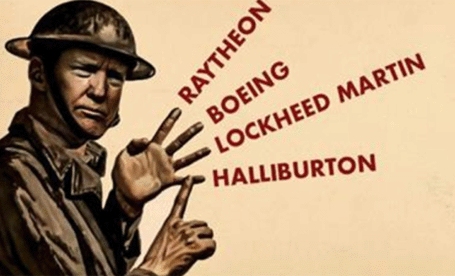 Fill the Swamp: Trump to Put Military Industrial Complex Lobbyist in Charge of the Army, Last Wednesday, it was reported that Donald Trump was moving to nominate Raytheon lobbyist Mark Esper for secretary of the Army. Raytheon is one of the “big five” defense contractors, and the president’s decision comes at a time when concerns are being raised over the idea of defense industry executives being placed in senior positions at the Pentagon.Daily Liberator, By: James Holbrooks, 29 Aug 17
 This article first appeared at ANTIMEDIA……
The Washington Examiner, which broke the news in an exclusive after speaking with unnamed D.C. sources, reported that Pentagon officials “privately expressed confidence that Esper, with his military, Pentagon and Capitol Hill experience, will win quick Senate confirmation.”
That would be a change of pace. Esper’s nomination is Trump’s third attempt to fill the position of Army secretary.
A ROCKY ROAD
Trump’s first choice, New York billionaire and owner of the Florida Panthers hockey team, Vincent Viola, withdrew back in February over concerns about financial conflicts of interest……..
Assuming Mark Esper hangs in there and keeps his name in the running for Army secretary, he’ll need to pass vetting by the Senate Armed Services Committee (SASC). That hearing isn’t expected to take place until September. But it was within that committee, back in June, that SASC chairman John McCain first voiced concern over members of the defense industry taking key positions at the Pentagon.
THE CHAIRMAN MAKES NOISE
In a hearing Defense News called “surprisingly contentious,” McCain threatened to block the SASC confirmation of Patrick Shanahan for deputy defense secretary, the number two spot at the Pentagon below defense secretary James Mattis. One of the reasons, the Arizona senator made clear, was Shanahan’s ties to industry contractors.
Shanahan had been with Boeing since 1986 before accepting Trump’s nomination. He was a member of the Boeing Executive Council and had even earned the nickname “Mr. Fix-it” within the corporation for his ability to turn around troubled projects.
At the hearing, McCain cited Shanahan’s industry past, saying he was “not overjoyed” that the would-be deputy secretary spent so much time at one of the big five defense contractors. He also said Shanahan’s ilk serving at the Pentagon was “not what our Founding Fathers had in mind.”
McCain, a Republican, went further weeks later, bluntly stating in a hallway interview in Congress that he “did not want people from the top five corporations” to fill positions at the Pentagon. Party politics aside, at least some lawmakers across the aisle appear to share his concern.
Senator Jack Reed, a Democrat who sits on the SASC, told Defense News in early July that “real concern about the concentration of these people” exists because decision-making processes may be “influenced by [their]prior employment.”
Similarly, Senator Richard Durbin, another Democrat, said the Trump administration has “turned a blind eye to the whole question of conflicts of interest from start to finish.”
Despite such criticisms, the SASC gave Shanahan the green light, and the Senate officially confirmed him last Tuesday. This means that right now, the two most powerful men at the Pentagon have significant past connections to the defense industry.
For those unaware, for years Secretary of Defense James Mattis was a board member of one of the big five contractors, General Dynamics, and up until the point of his nomination had nearly $600,000 in vested stock options with the corporation, according to Securities and Exchange Commission (SEC) filings.
LUCKY BREAK
In a convenient bit of timing, John McCain was absent at Shanahan’s full Senate confirmation on July 18, as he was recovering from surgery to remove a blood clot, which ultimately revealed a brain tumor. The same could be said for Ellen Lord, who went through SASC vetting relatively unscathed on the very same day and now awaits the committee’s nod to move on to a full Senate vote.
Lord has been CEO of Textron Systems, a global aerospace and defense conglomerate, since 2012. As with what happened to Shanahan, Lord likely would have faced a harsh grilling from McCain. Commenting on Lord’s smooth sail through her SASC hearing, Defense News wrote:
“That may have been due to the absence of Sen. John McCain, the Arizona Republican who chairs SASC. McCain, recuperating at home from a recent surgery, previously told Defense News he is concerned about the number of defense industry figures entering key Pentagon roles.”
The same good fortune was bestowed upon a former Lockheed Martin vice president on Thursday. Ryan McCarthy passed his SASC vetting for undersecretary of the Army, and if the Senate eventually confirms both him and Mark Esper, it would mean the top two Army positions at the Pentagon would be filled by defense industry executives.
It was speculated that former Lockheed Martin attorney David Ehrhart would come under heavy scrutiny at his SASC hearing for Air Force General Counsel, the department’s chief legal officer. The same would have surely gone for John Rood, Trump’s expected pick for undersecretary of defense for policy and current head of international sales at Lockheed.
But with the SASC confirming defense industry figures in McCain’s absence, it now appears the Arizona senator’s leeriness was the only substantive thing holding up the show.
DOWN A DARK PATH
Like Senator Richard Durbin and others in Congress who don’t like the emerging trend under Donald Trump, most in the mainstream media will only go so far as to highlight the myriad conflicts of interest between the Trump administration and the corporate world.
Right now, for example, Secretary of State Rex Tillerson is catching fire for being the CEO of ExxonMobil when it violated sanctions on Russia back in 2014. The U.S. Treasury Department just hit Exxon with a $2 million fine for that move, and Exxon promptly filed a lawsuit against the government in response………http://www.thedailyliberator.com/fill-swamp-trump-put-military-industrial-complex-lobbyist-charge-army/
“Dirty radioactive bomb” planned for attack in Indonesia – using THORIUM
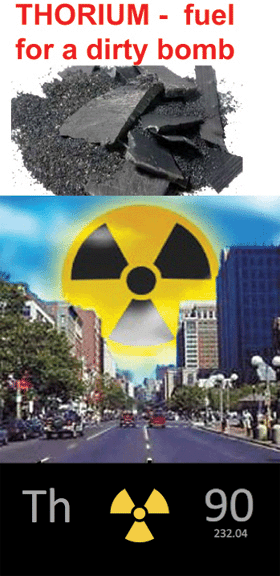 Indonesian militants planned ‘dirty bomb’ attack – sources, Yahoo 7 By Tom Allard and Agustinus Beo Da Costa, JAKARTA (Reuters) – Indonesian militants planned to detonate a radioactive dirty bomb, security sources said, highlighting the rising ambitions of extremists to wreak destruction in the world’s largest Muslim-majority nation.
But experts cast doubt on their expertise, equipment and chances of success.
The plot was foiled when police raided homes and arrested five suspects in Bandung, West Java, last week, the sources with direct knowledge of the plot said. After the raids, police spoke of a plan to explode a “chemical” bomb but provided no other details……
The three counter-terrorism sources, speaking on condition of anonymity, said the militants had hoped to transform low-grade radioactive Thorium 232 (Th-232) into deadly Uranium 233 (U-233).
The highly radioactive uranium would be combined with the powerful home-made explosive triacetone triperoxide (TATP) to create a “nuclear bomb”, according to an instruction manual used by the militants and reviewed by Reuters.
In fact, the device would be, at best, a radiological dispersal device or dirty bomb that could spray radioactive material when the conventional bomb exploded.
A spokesman for Indonesia’s national police, Inspector General Setyo Wasisto, declined to confirm or deny the plot to construct the device, but said it would have been more potent than the two bombs made from TATP that killed three police in Indonesia’s capital Jakarta in May.
“If this bomb was finished, it would have had a more destructive impact than the bomb made from ‘Mother of Satan’,” he said, using the nickname for TATP.
“It could burn anything and make it hard for people to breathe.”
Thorium-232 can be transformed into Uranium-233 but requires the Thorium to absorb a neutron, a process that needs powerful irradiation, generally from a nuclear reactor, according to three analysts contacted by Reuters and the website of the World Nuclear Association, which represents reactor vendors and nuclear engineers, among other industry stakeholders….
One senior Indonesian counter-terrorism source said the Bandung-based cell had bought a large amount of a household item and had begun to extract the Thorium. Reuters has chosen not to name the item.
“They needed three weeks. It was still only one week (into the process when police raided),” the source said…..
According to police, the suspected Bandung plotters were members of JAD and were considering targets like the presidential palace in Jakarta and police headquarters in Bandung and the capital….. (Reporting by Tom Allard and Agustinus Beo Da Costa Additional reporting by Stefanno Reinard; Editing by Ed Davies and Nick Macfie) https://au.news.yahoo.com/a/36844136/exclusive-indonesian-militants-planned-dirty-bomb-attack-sources/
1 This Month

of the week – THE ONENESS of HUMANITY
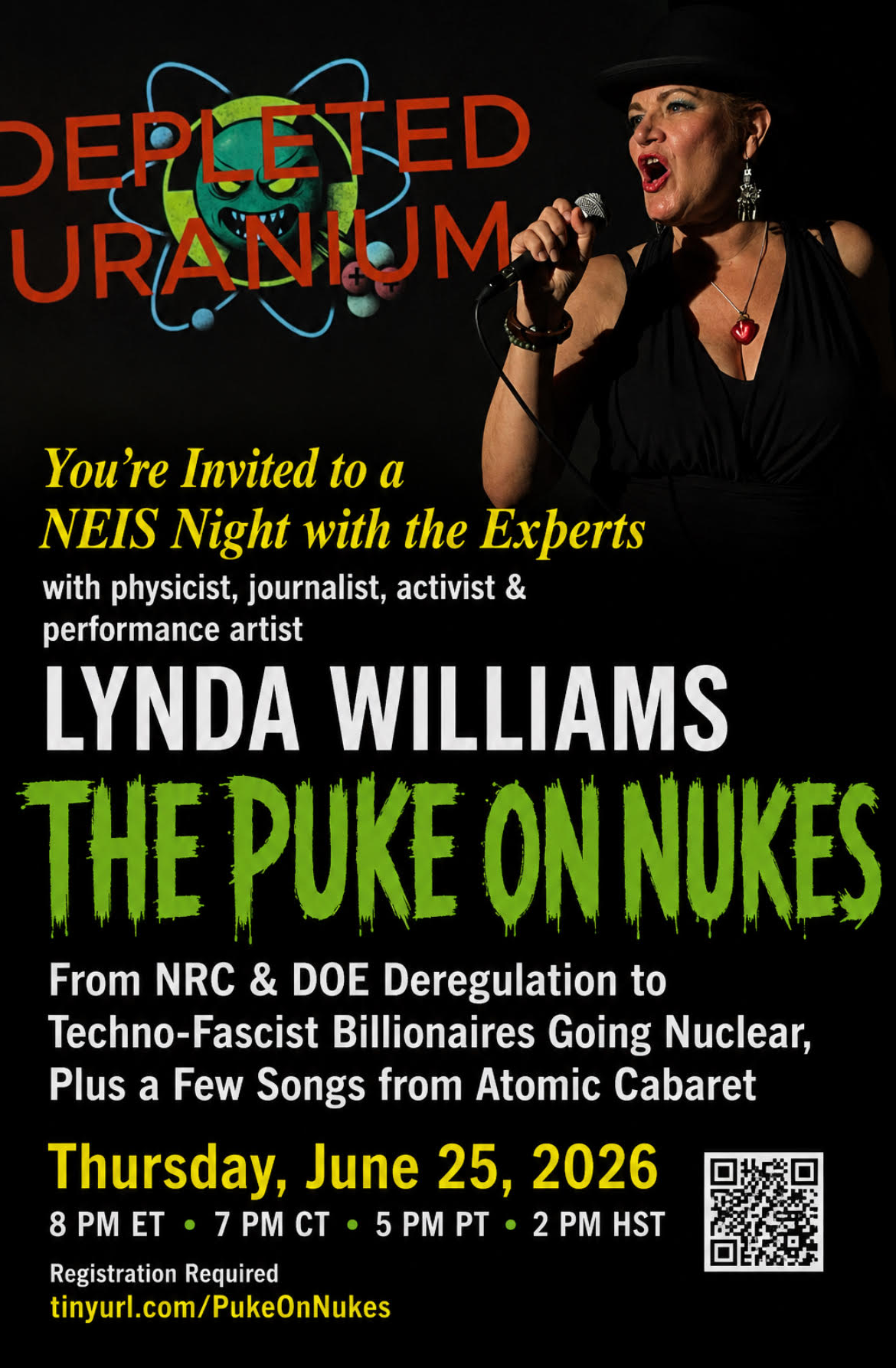
25 June- THE PUKE ON NUKES
Thursday, June 25, 2026
7pm Central Time (8pm ET, 6pm MT, 5pm PT) UTC – 5
From NRC & DOE Deregulation to Techno-Fascist Billionaires Going Nuclear, Plus a Few Songs from Atomic Cabaret REGISTER
26 June – Radiation Trainwreck at the NRC / Join the Protect Better Campaign – https://us02web.zoom.us/meeting/register/4ZlZ5_qLSHGiLSCg8FF6Bg#/registration

1st July – Webinar Waste of Space: The Environmental Harm of Military and Civil Space Activity st July, 7 pm

Report Launch Online: We are seeing an increasing exploitation of space for military and commercial purposes. This must change.

Protect Sazan Island from the Trump family! https://secure.avaaz.org/campaign/en/protect_sazan_island_from_the_trump_family_loc/?bqFCVab&v=174511&cl=22707147157&_checksum=5e9dde668860e8231c33699735e16a1fbf22ab2cb01da50c999fe8732b9775ef&utm_source=email&utm_medium=blast_email&utm_campaign=174511


Cuba Is Not a Failed State – It Is a Besieged State
PETITION: “Global Appeal to Endorse Palestinian Right of Return of Refugees”
To see nuclear-related stories in greater depth and intensity – go to https://nuclearinformation.wordpress.com
-
Archives
- June 2026 (241)
- May 2026 (306)
- April 2026 (356)
- March 2026 (251)
- February 2026 (268)
- January 2026 (308)
- December 2025 (358)
- November 2025 (359)
- October 2025 (376)
- September 2025 (257)
- August 2025 (319)
- July 2025 (230)
-
Categories
- 1
- 1 NUCLEAR ISSUES
- business and costs
- climate change
- culture and arts
- ENERGY
- environment
- health
- history
- indigenous issues
- Legal
- marketing of nuclear
- media
- opposition to nuclear
- PERSONAL STORIES
- politics
- politics international
- Religion and ethics
- safety
- secrets,lies and civil liberties
- spinbuster
- technology
- Uranium
- wastes
- weapons and war
- Women
- 2 WORLD
- ACTION
- AFRICA
- Atrocities
- AUSTRALIA
- Christina's notes
- Christina's themes
- culture and arts
- Events
- Fuk 2022
- Fuk 2023
- Fukushima 2017
- Fukushima 2018
- fukushima 2019
- Fukushima 2020
- Fukushima 2021
- general
- global warming
- Humour (God we need it)
- Nuclear
- RARE EARTHS
- Reference
- resources – print
- Resources -audiovicual
- Weekly Newsletter
- World
- World Nuclear
- YouTube
-
RSS
Entries RSS
Comments RSS
 nuclear-news