Kathleen Hartnett White, Trump nominee for White House Environment czar, faked water radiation data
 170 MILLION IN U.S. DRINK RADIOACTIVE TAP WATER. TRUMP NOMINEE FAKED DATA TO HIDE CANCER RISK. https://www.ewg.org/research/170-million-us-drink-radioactive-tap-water-trump-nominee-faked-data-hide-cancer-risk#.WlvAYryWbGg By Bill Walker, Editor in Chief, and Wicitra Mahotama, Environmental Analyst, 11 Jan 18, Drinking water for more than 170 million Americans contains radioactive elements at levels that may increase the risk of cancer, according to an EWG analysis of 2010 to 2015 test results from public water systems nationwide.
Radiation in tap water is a serious health threat, especially during pregnancy. But the Environmental Protection Agency’s legal limits for several types of radioactive elements in tap water are badly outdated. And President Trump’s nominee to be the White House environment czar rejects the need for water systems to comply even with those outdated and inadequate standards.
The nominee, Kathleen Hartnett White, former chair of the Texas Commission on Environmental Quality, admitted in a 2011 interview that the commission falsified data to make it appear that communities with excessive radiation levels were below the EPA’s limit. She said she did not “believe the science of health effects” to which the EPA subscribes, placing “far more trust” in the work of the TCEQ, which has a reputation of setting polluter-friendly state standards and casually enforcing federal standards.
Last month, after Hartnett White again admitted to the Senate Environment and Public Works Committee she knew the TCEQ had ignored the EPA’s radiation regulations, her nomination was sent back to the White House. But on Jan. 8, the White House renominated her, setting up another confirmation vote before the committee, and then by the full Senate.
EWG’s Tap Water Database compiles results of water quality tests for almost 50,000 utilities nationwide. EWG also mapped the nationwide occurrence of radium, the most common radioactive element found in tap water. From 2010 to 2015, more than 22,000 utilities serving over 170 million people in all 50 states reported the presence of radium in their water.
Radioactive elements enter groundwater from natural deposits in the earth’s crust, and the levels can be higher when uranium mining or oil and gas drilling unearth these elements from the rock and soil. They produce radiation called “ionizing” because it can release electrons from atoms and molecules, and turn them into ions.
The EPA has classified all ionizing radiation as carcinogenic. There is clear evidence that high doses of radiation cause cancer in various organs. The probability of developing cancer decreases with lower doses of radiation, but it does not go away.
The developing fetus is especially sensitive to ionizing radiation. At doses higher than are typically found in drinking water, radiation has been shown to impair fetal growth, cause birth defects and damage brain development. But there is no evidence of a dose threshold below which a fetus would be safe from these effects.
Six radioactive contaminants were included in EWG’s Tap Water Database, including radium, radon and uranium. By far the most widespread are two isotopes of radium known as radium-226 and radium-228, which contaminate tap water in every state. The EPA does not have a separate legal limit for each isotope, only for the combined level of the two.
From 2010 to 2015, 158 public water systems serving 276,000 Americans in 27 states reported radium in amounts that exceeded the federal legal limit for combined radium-226 and radium-228.
But federal drinking water standards are based on the cost and feasibility of removing contaminants, not scientific determinations of what is necessary to fully protect human health. And like many EPA tap water standards, the radium limits are based on decades-old research rather than the latest science.
The EPA’s tap water limits on the combined level of the radium isotopes and the combined level of alpha and beta particles were set in 1976. They were retained in 2000, when the uranium standard was established.
To more accurately assess the current threat of radiation in U.S. tap water, we compared levels of the contaminants detected by local utilities not to the EPA’s 41-year-old legal limits, but to the public health goals set in 2006 by the respected and influential California Office of Environmental Hazard Assessment..
California public health goals are not legally enforceable limits, but guidelines for levels of contaminants that pose only a minimal risk – usually defined as no more than one expected case of cancer in every million people who drink the water for a lifetime.
California has separate public health goals for radium-226 and radium-228 that are hundreds of times more stringent than the EPA limit for the two isotopes combined. The EPA standard for radium-226 plus radium-228 is 5 picocuries per liter of water. The California public health goal for radium-226 is 0.05 picocuries per liter, and for radium-228 it is just 0.019 picocuries per liter. The lifetime increased cancer risk at the EPA’s level is 70 cases per 1 million people.
California has the most residents affected by radiation in drinking water. Almost 800 systems serving more than 25 million people – about 64 percent of the state’s population – reported detectable levels of radium-226 and radium-228 combined.
Texas has the most widespread contamination. More than 3,500 utilities serving more than 22 million people – about 80 percent of the state’s population – reported detectable levels of radium-226 and radium-228 combined.
But while Kathleen Hartnett White was chair of the Texas Commission on Environmental Quality from 2003 to 2007, the state regularly and deliberately lowered the levels of radiation in tap water it reported to the EPA.
A 2011 investigation by KHOU-TV of Houston unearthed TCEQ emails documenting the deception. Instead of reporting the levels measured in laboratory tests, TCEQ would first subtract the test’s margin of error. Because TCEQ’s falsifying of data made it appear that the system met EPA standards, the system did not have to inform its customers that their tap water contained dangerous levels of radiation.
How dangerous?
In 2001, TCEQ reported to top state officials – including Hartnett White and then-Gov. Rick Perry, now Trump’s energy secretary – that some types of radiation in the tap water of some Texas communities posed an increased lifetime cancer risk of 1 in 400. The EPA’s increased lifetime cancer risk for five types of radioactive elements ranges from 2 to 7 in 100,000. But the practice continued until 2008, after an EPA audit caught the state cooking the books.
In a 2011 interview with KHOU-TV, Hartnett White defended the deception, saying the EPA’s standards were too protective and that it would cost small communities millions of dollars to comply. She said TCEQ continued its practice instead of challenging the federal rules in court because it would be “almost impossible” for the state to win:
As my memory serves me, [subtracting the margin of error] made incredibly good sense … We did not believe the science of health effects justified EPA setting the standard where they did … I have far more trust in the vigor of the science by which TCEQ assesses, than I do EPA.
KHOU investigative reporter Mark Greenblatt pressed Hartnett White: “But what if you’re wrong? What if you’re wrong and EPA’s right about there being a danger?”
“It would be . . . it would be regrettable,” she replied.
In October, Trump nominated Hartnett White, now a fellow at the Texas Public Policy Foundation, to head the White House Council on Environmental Quality, which coordinates environmental policy for all federal agencies. One of its major responsibilities is “to develop and recommend national policies to the President that promote the improvement of environmental quality and meet the Nation’s goals.”
In November, in her confirmation hearing before the Senate Environment and Public Works Committee, she characterized TCEQ’s falsification of data as “one of these technical issues” and declared: “I would never, ever tell staff to underreport health hazards.”
In her written responses to follow-up questions from the committee, Hartnett White said she was “aware of the EPA’s interpretation of its rule,” but that she did not “recall EPA telling TCEQ during my tenure there that TCEQ’s methodology was not legal.” But KHOU’s investigation documented that in June 2004 the EPA warned the TCEQ if it did not stop the falsification, the federal agency could take over regulation of the state’s water systems.
The Environment and Public Works Committee voted along party lines to send Hartnett White’s nomination to the full Senate. But on Dec. 21, Senate Democrats refused to vote on the nomination before the end of the 2017 legislative session. On Jan. 8 the White House renominated her without comment. She will now face a second confirmation vote before the committee before a vote by the full Senate.
Installing a head of the Council for Environmental Quality who deliberately falsified data to get around federal regulations is an egregious betrayal of public trust. The fact that her deception left people at a serious risk of cancer makes it even more alarming.
The Senate should reject Hartnett White’s nomination. The EPA must also tighten its legal limits for radioactive contaminants and require more extensive radiation testing and better disclosure – including making sure that rogue state regulators like Hartnett White don’t try to hide risks.
You can read more about the health risks posed by radioactivity in drinking water in EWG’s Tap Water Database radiation report.
Governments can use social media to target activists – UK and the Iran protests
 Could GCHQ influence Iran protests? They’ve done it before, claims
  researcher https://www.rt.com/uk/414831-gchq-influence-hack-protest/#.WkwCv_uo99Q.facebook
He says through its social media manipulation operations, spy agency Government Communications Headquarters (GCHQ) tried to influence online activists during the 2009 Iranian presidential election protests, and the 2011 uprisings widely known as the Arab Spring.
Al-Bassam told the Chaos Communication Congress in Germany last week that the Joint Threat Research Intelligence Group (JTRIG) – a unit in GCHQ – uses “dirty tricks” to target activists.
He says JTRIG has been tasked by the British government to “[use] online techniques to make something happen in the real or cyber world.” To fulfil this aim, a wide but basic array of technological tools and software are used, including ‘DEADPOOL,’ which is described as a “URL shortening service,” and ‘HUSK,’ a “secure one-to-one web based dead-drop messaging platform.”
He told the conference: “It’s basically a fancy name for sitting on Twitter and Facebook all day and trolling online. What they do, is they conduct what they call ‘human intelligence’ – which is like the act of interacting with humans online to try and make something happen in the real world.
“In their own words one of the things they do is to use ‘dirty tricks’ to ‘destroy, deny, degrade [and] disrupt’ enemies by ‘discrediting’ them.”
JTRIG has been involved in infiltrating hacktivist groups Anonymous and LulzSec, and protesters in Iran, Syria and Bahrain, he says.
As a “honey pot” to attract activists, GCHQ set up free URL shortening service lurl.me, which was used on Twitter and other social media platforms to spread revolutionary messages in the Middle East. These messages would attract people protesting against the government there, and British intelligence would collect information on them.
Al-Bassam said he discovered this information among the documents leaked by NSA whistleblower Edward Snowden. “In 2011, I was unknowingly messaged… by a covert agent from [GCHQ], who was investigating the hacktivist groups of Anonymous and Lulzsec. Later that year, I was arrested and banned from the internet for my involvement in Lulzsec.
Then, in 2014, I discovered through a new Snowden leak that GCHQ had targeted Anonymous and Lulzsec, and that the person that messaged me was a covert employee, pretending to be a hacktivist.”
He added: “Because I was myself targeted in the past, I was aware of a key detail – a honeypot URL shortening service set up by GCHQ, that was actually redacted in the Snowden documents published in 2014. This URL shortening service enabled GCHQ to deanonymize another hacktivist and discover his real name and Facebook account, according to the leaked document.
“Using this key detail, I was able to discover a network of sockpuppet Twitter accounts and websites set up by GCHQ, pretending to be activists during the Arab spring of 2011,” he said.
Britain’s Hinkley nuclear project rife with scandalous conflicts of interest

 Times 1st Jan 2018,Consultancy firms working for the government on the Hinkley Point C nuclear power station were advising the project’s Chinese investor and its French builder at the same time, an investigation by The Times has revealed.
KPMG, the professional services group, was paid £4.4 million between 2012 and 2017 as a financial adviser to the energy and business departments, despite telling officials that it was also acting for China General Nuclear Power
Corp on the project.
The apparent conflict of interest has been revealed after the Information Commissioner’s Office intervened to press for
disclosure from the Department for Business, Energy and Industrial Strategy. Previously, officials had redacted the information, claiming that it was commercially sensitive.
In a second potential conflict, Lazard, the financial advisory firm, was paid £2.6 million between 2012 and 2015 to
advise the business department on Hinkley Point. Details of its previously redacted tender documents reveal that it was an adviser to EDF, the French developer that is investing in Hinkley Point alongside the Chinese. A source said that Lazard’s advice to EDF was not related to the Somerset project.
Meg Hillier, chairwoman of the Commons public accounts committee, said that Hinkley Point was crucial public infrastructure and therefore it was “vital that auditors get full sight” of the potential conflicts. It “looks cosy”, she said, adding that it was “not really appropriate” for firms to be advising both sides.
The details have been released more than a year and half after The Times complained to the Information Commissioner’s Office, which informally advised the business department to reconsider its position. The department previously had handed over heavily redacted documents in response to a Freedom of Information request.
The Information Commissioner’s Office said that there was a “significant and important public interest”, something that had been strengthened by a report from the National Audit Office in June, which found that the government’s deal had “locked consumers into a risky and expensive project with uncertain strategic and economic benefits”. The project has been riddled with delays and controversy over its spiralling costs.
The National Audit Office also criticised the business department for insufficiently managing the potential conflict of Leigh Fisher, another government adviser. The Times reported in November 2016 that Leigh Fisher, the management consultant, had been awarded contracts worth a combined £1.2 million despite telling officials that the British division of Jacobs Engineering Group, an American firm that owns Leigh Fisher, was working for EDF on Hinkley Point.
https://www.thetimes.co.uk/edition/business/advisers-on-hinkley-point-c-nuclear-power-station-had-cosy-ties-to-both-sides-xftxcl9sz
Facebook now willing to be censored by U.S. government
FACEBOOK NOW SEEMS to be explicitly admitting that it also intends to follow the censorship orders of the U.S. government.
the Trump administration — has the unilateral and unchecked power to force the removal of anyone it wants from Facebook and Instagram by simply including them on a sanctions list.
Facebook Says It Is Deleting Accounts at the Direction of the U.S. and Israeli Governments, The  Intercept, IN SEPTEMBER OF last year, we noted that Facebook representatives were meeting with the Israeli government to determine which Facebook accounts of Palestinians should be deleted on the ground that they constituted “incitement.” The meetings — called for and presided over by one of the most extremist and authoritarian Israeli officials, pro-settlement Justice Minister Ayelet Shaked — came after Israel threatened Facebook that its failure to voluntarily comply with Israeli deletion orders would result in the enactment of laws requiring Facebook to do so, upon pain of being severely fined or even blocked in the country.
The predictable results of those meetings are now clear and well-documented. Ever since, Facebook has been on a censorship rampage against Palestinian activists who protest the decades-long, illegal Israeli occupation, all directed and determined by Israeli officials. Indeed, Israeli officials have been publicly boasting about how obedient Facebook is when it comes to Israeli censorship orders:
Shortly after news broke earlier this month of the agreement between the Israeli government and Facebook, Israeli Justice Minister Ayelet Shaked said Tel Aviv had submitted 158 requests to the social media giant over the previous four months asking it to remove content it deemed “incitement.” She said Facebook had granted 95 percent of the requests.
She’s right. The submission to Israeli dictates is hard to overstate: As the New York Times put it in December of last year, “Israeli security agencies monitor Facebook and send the company posts they consider incitement. Facebook has responded by removing most of them.”
What makes this censorship particularly consequential is that “96 percent of Palestinians said their primary use of Facebook was for following news.” That means that Israeli officials have virtually unfettered control over a key communications forum of Palestinians.
In the weeks following those Facebook-Israel meetings, reported The Independent, “the activist collective Palestinian Information Center reported that at least 10 of their administrators’ accounts for their Arabic and English Facebook pages — followed by more than 2 million people — have been suspended, seven of them permanently, which they say is a result of new measures put in place in the wake of Facebook’s meeting with Israel.” Last March, Facebook briefly shut down the Facebook page of the political party, Fatah, followed by millions, “because of an old photo posted of former leader Yasser Arafat holding a rifle.”
A 2016 report from the Palestinian Center for Development and Media Freedoms detailed how extensive the Facebook censorship was:……….
Though some of the most inflammatory and explicit calls for murder are sometimes removed, Facebook continues to allow the most extremist calls for incitement against Palestinians to flourish. Indeed, Israel’s leader, Benjamin Netanyahu, has often used social media to post what is clearly incitement to violence against Palestinians generally…….
FACEBOOK NOW SEEMS to be explicitly admitting that it also intends to follow the censorship orders of the U.S. government. Earlier this week, the company deleted the Facebook and Instagram accounts of Ramzan Kadyrov, the repressive, brutal, and authoritarian leader of the Chechen Republic, who had a combined 4 million followers on those accounts. To put it mildly, Kadyrov — who is given free rein to rule the province in exchange for ultimate loyalty to Moscow — is the opposite of a sympathetic figure: He has been credibly accused of a wide range of horrific human rights violations, from the imprisonment and torture of LGBTs to the kidnapping and killing of dissidents.
But none of that dilutes how disturbing and dangerous Facebook’s rationale for its deletion of his accounts is…….
What this means is obvious: that the U.S. government — meaning, at the moment, the Trump administration — has the unilateral and unchecked power to force the removal of anyone it wants from Facebook and Instagram by simply including them on a sanctions list. Does anyone think this is a good outcome? Does anyone trust the Trump administration — or any other government — to compel social media platforms to delete and block anyone it wants to be silenced? ……..
Does Facebook’s policy of blocking people from its platform who are sanctioned apply to all governments? Obviously not. It goes without saying that if, say, Iran decided to impose sanctions on Chuck Schumer for his support of Trump’s policy of recognizing Jerusalem as the Israeli capital, Facebook would never delete the accounts of the Democratic Party Senate minority leader — just as Facebook would never delete the accounts of Israeli officials who incite violence against Palestinians or who are sanctioned by Palestinian officials. Just last month, Russia announced retaliatory sanctions against various Canadian officials and executives, but needless to say, Facebook took no action to censor them or block their accounts.
Similarly, would Facebook ever dare censor American politicians or journalists who use social media to call for violence against America’s enemies? To ask the question is to answer it. https://theintercept.com/2017/12/30/facebook-says-it-is-deleting-accounts-at-the-direction-of-the-u-s-and-israeli-governments/
Chernobyl nuclear disaster might have been started by a nuclear, not a steam, explosion
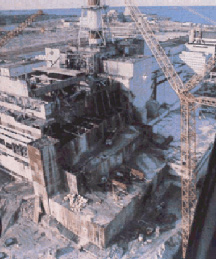 Scientists might have been wrong about the Chernobyl disaster, New York Post ,By James Rogers, November 20, 2017 A new theory on the Chernobyl disaster could shed fresh light on the world’s worst nuclear accident.
In an article published in the journal Nuclear Technology, scientists argue that the first of two explosions reported by eyewitnesses was a nuclear, not a steam explosion, as is widely thought. Instead, the researchers believe that the first explosive event noted by eyewitnesses was a jet of debris ejected to an altitude of almost 2 miles by a series of nuclear explosions within the Chernobyl reactor. Some 2.7 seconds later, they say, a steam explosion ruptured the reactor and sent yet more debris into the atmosphere at lower altitudes.
“We realized that we, based on real measurements and observations, could explain details in the Chernobyl accident scenario and the nature of the two major explosions that occurred during a few seconds that unfortunate night more than 31 years ago,” explained the report’s lead author Lars-Erik De Geer, in an email to Fox News.
The 1986 explosion at the Chernobyl nuclear plant in Ukraine sparked a widespread environmental disaster. Thirty workers died either from the explosion at the number four reactor or from acute radiation sickness within several months. The accident exposed millions in the region to dangerous levels of radiation and forced a wide-scale, permanent evacuation of hundreds of towns and villages in Ukraine and Belarus.
A cloud of radioactive particles from the disaster reached other parts of parts of Europe, such as Sweden.
The report cites xenon isotopes detected by the VG Khlopin Radium Institute in Leningrad four days after the accident. Leningrad, now known as Saint Petersburg, is about 599 miles north of Chernobyl. Xenon isotopes were also reported in Cherepovets, about 622 miles north of Chernobyl.
The result of recent nuclear fission, the isotopes were likely caused by a recent nuclear explosion, according to the experts. This is in contrast to the main Chernobyl debris that contained equilibrium xenon isotopes from the reactor’s rupture and drifted toward Scandinavia.
This new theory presented by experts from the Swedish Defense Research Agency, the Swedish Meteorological and Hydrological Institute and Stockholm University, could offer fresh insight into the disaster. The new analysis could help prevent similar incidents from occurring, experts say.
The destroyed reactor tank suggests that the first explosion caused temperatures high enough to melt a 6.6-foot bottom plate in part of the core, the researchers said, noting that this damage is consistent with a nuclear explosion. In the rest of the core, the bottom plate was relatively intact, but had dropped by nearly 13 feet. This, they say, is consistent with a steam explosion, noting that the temperature would not be sufficient to melt the plate, but could generate enough pressure to force it down.
Additionally, seismic measurements and eyewitness reports of a blue flash above the reactor a few seconds after the first explosion could also support the new theory of a nuclear explosion followed by a steam explosion……..
The disaster shone a spotlight on lax safety standards and government secrecy in the former Soviet Union. The explosion on April 26, 1986, was not reported by Soviet authorities for two days and then only after winds had carried the fallout across Europe and Swedish experts had gone public with their concerns.
The final death toll from Chernobyl is subject to speculation, due to the long-term effects of radiation. Estimates range from 9,000 by the World Health Organization to one of a possible 90,000 by the environmental group Greenpeace.
The terrible environmental fallout of Chernobyl is still being felt. A wild boar with more than 10 times the safe limit of radiation, for example, was recently killed by hunters hundreds of miles away in Sweden. https://nypost.com/2017/11/20/scientists-might-have-been-wrong-about-the-chernobyl-disaster/
First nuclear reactor was secretly built under the University of Chicago
The Experimental Nuclear Reactor Secretly Built Under the University of Chicago Chicago Pile-1, the first reactor to reach criticality, was built under a football field. Atlas Obscura, JULY 27, 2016
The Chicago Pile-1 (CP-1), as it came to be known was monolith made of carefully stacked graphite blocks, interlaced with cubes of uranium. Control rods made of cadmium were inserted to absorb any errant radiation from the reaction. It looked, from the outside, like not much more than a pile of black bricks.
Phony group in St Louis – “Coalition to Keep Us Safe” – attacks JustMomsSTL
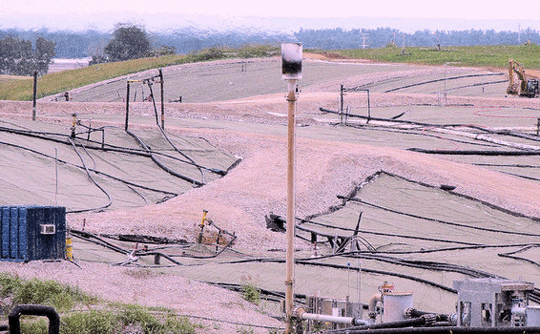 Repugnant practices by Republic Services, http://www.stltoday.com/opinion/columnists/repugnant-practices-by-republic-services/article_eb94c468-c084-5e8c-bd30-4d85fdfd156a.html By Dr. Stuart Slavin, 26 Dec 17,
Russia: no nuclear transparency, and still using Soviet style tactics against anti nuclear activists

CRACKDOWN IN RUSSIA: CRITICS ACCUSE NUCLEAR AUTHORITIES OF SOVIET-STYLE COVER-UPS AND HEAVY-HANDED TACTICS, Newsweek, BY When Russia’s FSB security service raided Fyodor Maryasov’s apartment in Siberia last year, the authorities seized his computer and a scathing report he had compiled about Rosatom, the Kremlin-owned nuclear corporation. Among other things, the authorities accused him of inciting hatred against nuclear industry employees, an unusual charge that carries a maximum sentence of five years behind bars. “They accused me of revealing state secrets in my report,” the 49-year-old environmental activist says. “But every single thing in it was taken from open sources.”
The raid came as activists are increasingly criticizing Rosatom over a range of issues, including the way it handles nuclear waste. This fall, for instance, critics alleged that one of its facilities was the source of a mysterious cloud of radioactive pollution that drifted across Europe.
Russian authorities have responded to these critics with tough tactics—including raids and smear campaigns—and in recent years, they’ve employed similar measures against other environmental groups. Rosatom says it was in no way trying to stifle dissent. “We strongly believe that every voice should be heard,” a spokesman for the nuclear agency tells Newsweek, “and we welcome open dialogue with civil society, including with those who are opposed to nuclear power.”
Maryasov says the crackdown is a continuation of the routine cover-ups of nuclear accidents and atomic pollution during the Soviet era and beyond—from the 1957 Kyshtym disaster to the meltdown at Chernobyl in 1986. “Trust in Rosatom and the authorities,” he says, “is at an absolute minimum.”
The activist’s recent troubles began after he spoke out against Rosatom’s plans for a permanent underground nuclear waste repository in his hometown of Zheleznogorsk, in eastern Siberia. If the project goes ahead, Russian authorities would likely begin storing hundreds of thousands of tons of radioactive waste at the site. Zheleznogorsk was built in 1950, under the supervision of Stalin’s secret police chief, Lavrentiy Beria, for the production of weapons-grade plutonium. Until 1992, plant employees regularly disposed of nuclear waste in the nearby Yenisey River, causing health problems for tens of thousands of people in the area. Russian authorities stopped the production of plutonium for nuclear weapons at the Zheleznogorsk plant in 2010.
But critics say the shadow of nuclear catastrophe still hangs over the region. In the event of a massive natural disaster or terrorist attack, the nuclear waste repository plan poses what Maryasov says is a threat to “every living thing” in the region. Zheleznogorsk is a mere 40 miles downstream from Krasnoyarsk, the regional capital, with a population of just over 1 million. And people in the area are concerned. More than 85,000 so far have signed a petition Maryasov drafted calling for Rosatom to scrap its plans for the repository.
The nuclear agency says it is building an underground lab at the Zheleznogorsk site to study the feasibility of its plans. It says those plans are open to public debate, and it points to similar storage sites currently operated in Finland, Sweden and the United States.
Critics, however, say it’s hard to access reliable information about Rosatom’s plans because many of its nuclear facilities are in so-called closed cities, like Zheleznogorsk. There are around 40 of these towns across Russia, the majority of which are sealed off from the outside world by barbed wire, fences and armed guards. Access is forbidden to foreigners, and even Russians who don’t live there have to receive special permission from the authorities to visit.
Those restrictions mean it’s easier for the authorities to ramp up the pressure against critics. Maryasov says he was the victim of a “vicious psychological campaign,” and he accuses the authorities of distributing fake news claiming he had advocated violence against atomic energy workers. The unrelenting pressure, he says, led to the breakup of his marriage of almost two decades.
“The constitution stipulates freedom of information and forbids censorship, as well as guaranteeing the right to everyone to information about the state of the environment,” Greenpeace said in a statement. “In order to realize those rights, someone has to seek out and make public this information, which is what Maryasov was engaged in doing.”
In recent months, critics have hammered Russia’s nuclear industry over allegations that Mayak, a notorious nuclear plant in Ozyorsk, a closed city in central Russia, was the source of radioactive pollution observed over Western Europe in late September. Mayak, which was built in 1948, produces components for nuclear weapons and stores and converts spent nuclear fuel. France’s Institute for Radioprotection and Nuclear Safety said the cloud that passed over Austria, France and other European countries was harmless, but it warned that the estimated level of radiation at the site of the suspected nuclear accident posed a serious threat to human health.
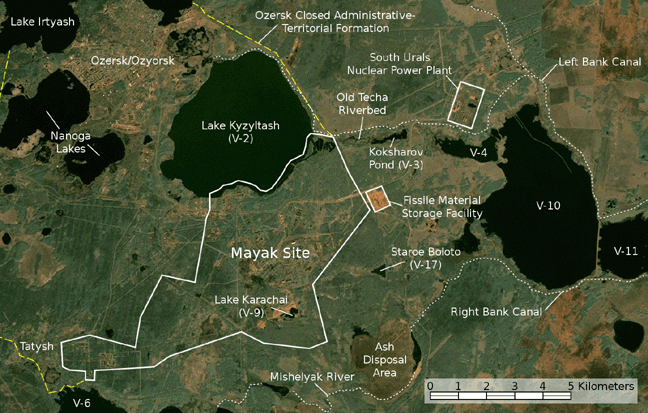
In November, Russian state meteorologists reported that high atmospheric concentrations of the radioactive isotope Ruthenium-106 had been detected around Mayak, triggering accusations that the secretive facility in Ozyorsk was the source of the pollution. However, Rosatom denied an accident had taken place there, said the levels detected by meteorologists were far below the admissible norm and insisted it had not carried out any operations that could have led to the isotope’s release into the atmosphere “for many years.”
Yet on December 13, Yuri Morkov, a senior executive at Mayak, admitted that Ruthenium-106 is routinely released as part of the plant’s processing of spent nuclear fuel. He insisted, however, that levels are so insignificant that there is no cause for concern.
Russian environmentalists are skeptical of his denials, in part because of Mayak’s history. Between 1949 and 1951, the factory dumped radioactive waste from the nuclear facility into the local river, polluting water supplies for tens of thousands of locals. In 1957, a storage tank containing highly radioactive nuclear weapons waste exploded at Mayak, exposing at least 272,000 people to dangerous levels of radiation. The accident was the third most serious nuclear disaster of all time, after far more famous accidents at Chernobyl and Fukushima. Eco-activists say the Soviets sent thousands of people, including some 2,000 pregnant women and hundreds of children, to clean up the disaster site with nothing more than rags and mops.
The atomic catastrophe was shrouded in secrecy: It wasn’t until 1989 that the USSR admitted it had taken place. Cancer rates in the worst affected areas around Mayak are between 2.5 and 3.5 times the national average, according to Greenpeace. In 2007, Russia’s constitutional court ruled that the unborn children exposed to radiation during the clean-up were not entitled to government benefits as adults, as they were not officially employed by the state.
This fall’s reports of the alleged nuclear leak at Mayak rekindled memories of the 1957 disaster. But Rosatom denies there have been any major incidents at its plants in recent years…….
There is no evidence suggesting Rosatom is directly responsible for the harassment of regional activists. A source close to the Russian nuclear industry tells Newsweekthat the “appalling and totally unacceptable” pressure is more likely coming from regional FSB officials trying to please their superiors in Moscow in the lead-up to Russia’s presidential election, a time when there’s increasingly less tolerance for dissent. Another possibility: lower-level officials who stand to benefit financially from Rosatom’s activities. “Russia is Russia,” the source says, asking for anonymity because of the sensitivity of the matter. “They play their own game as always.”
As for Maryasov, the Siberian activist faces an uncertain future as he continues his campaign against the nuclear waste repository. Finding a job has been hard because of his legal troubles, but he has no intention of moving.
“Too many people have put their trust in me,” he says, “I can’t let them down.” http://www.newsweek.com/crackdown-russia-critics-accuse-nuclear-authorities-soviet-style-cover-ups-and-755389
Investigation finds that USA’s Nuclear Regulatory Commission downplays safety warnings
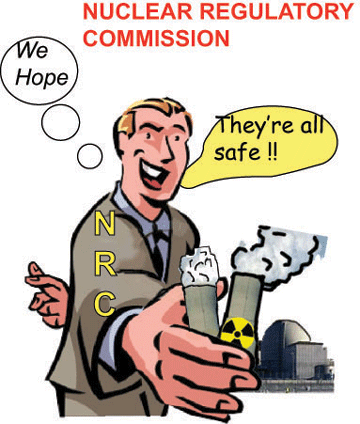 Nuclear Regulatory Commission downplays safety warnings, investigation finds, CBS News, 20 Dec 17, The federal agency responsible for safety at the nation’s 61 nuclear power plants routinely downplays warnings from plant workers and its own experts about problems, including some with potential for disaster, a Better Government Association investigation found.
Employees from U.S. nuclear power plants filed nearly 700 complaints with the United States Nuclear Regulatory Commission in recent years, claiming retaliation for raising safety concerns, records show. The agency found no wrongdoing.
NRC officials also overruled recommendations from their own technical experts on how to protect plants from potential catastrophe spurred by floods, equipment failures, power outages and other problems.
This article was provided to The Associated Press by the nonprofit news outlet Better Government Association.
Interviews with more than 20 current and former NRC and nuclear plant employees reveal a pattern of top officials dismissing safety warnings rather than impose costly fixes on plant operators. Some said careers suffered as potential threats were never fully addressed.
“It’s the NRC’s longstanding practice to consistently declare the plants are safe and to avoid directly answering any questions that might suggest otherwise,” said Lawrence Criscione, an NRC risk analyst.
NRC officials would not consent to an interview. But NRC spokeswoman Viktoria Mitlyng responded in writing to BGA questions……..
The nuclear industry, through its trade group and individual companies, often downplays the seriousness of problems highlighted by NRC experts. Exelon and others in the industry bat down potential rules and regulations by pleading to NRC’s top managers……….
The problem, say people who conduct government reviews, is that the NRC’s final rulings often don’t reflect warnings from its experts.
“Management tells you where they want the answer to go. If you push, you’re not going to get promoted again – there are other people who are willing to say it’s not a serious issue,” said Richard Perkins, one of Criscione’s NRC colleagues involved in exposing flooding concerns.
One case in point is the emergency safety valve issue at Exelon’s Byron and Braidwood plants……..
Underscoring that frustration is the NRC’s record of handling whistleblower complaints lodged by plant employees. From 2010 through 2016, workers filed 687 complaints. The NRC investigated just 235 and upheld none.
The largest number of complaints, 84, were filed by employees at the two nuclear plants operated in Georgia by Southern Nuclear, records show. Next were the 70 complaints lodged by nuclear workers in South Carolina, 58 by workers in Tennessee and 50 in California. Illinois ranked 12th, with 21 whistleblower cases filed. https://www.cbsnews.com/news/nuclear-regulatory-commission-downplays-safety-warnings-investigation-finds/
Nuclear radiation: Russia has no transparent system for monitoring the state of its environment

Wake up and smell the ruthenium https://www.opendemocracy.net/od-russia/violetta-ryabko/wake-up-and-smell-ruthenium Violetta Ryabko is head of Greenpeace Russia’s press service. Russia’s recent ruthenium scare, which went viral around the globe, brought a serious problem to light: the absence in Russia of proper and transparent monitoring of its environment.
In early October, information about a leak of the radioactive isotope ruthenium-106 into the atmosphere appeared in western media. Germany’s radiation watchdog announced that the source of the leak was most probably in the southern Urals, and French experts confirmed that conclusion.

Russia’s state-owned nuclear corporation Rosatom, however, denied the claim, saying that according to Roshydromet, the country’s environmental monitoring body, tests for particulate pollutants carried out between 25 September and 7 October failed to find any traces of Ruthenium, apart from a single instance in St Petersburg.
However, at the end of November, Greenpeace Russia received a response to a query it had sent Rosgidromet. This confirmed the discovery of ruthenium-106 in late September in the Chelyabinsk region, just to the east of the Ural mountains. The element was detected near the Mayak complex, a facility for reprocessing spent nuclear fuel. Ruthenium was also found in the atmospheres of Tatarstan, Bashkortostan, and the Krasnodar, Volgograd, and St Petersburg regions.
Ukrainian scientists also published data about its presence in the Altai, Dubno, Kirov, and Yakutia regions. Roshydromet admitted that in late September and early October atmospheric conditions were right for active movement of air masses, including pollutants, from the southern Urals towards the Mediterranean area and then northern Europe.
This news triggered an instant sensation, with Russia’s media simultaneously advancing all kinds of theories: it wasn’t Mayak at fault, but another Rosatom facility; the ruthenium could have come from a crashed satellite (although no satellites crashed at the time), and you can’t launch a satellite unnoticed; the source of the leak was in Romania, Kazakhstan, China… One theory held that it was an attempt to discredit Russia in the eyes of the world. Instead of releasing information about the accident to the public, Rosatom instead lashed out at western media for daring to report it.
A few days later, Rosatom invited journalists to a press trip where they could have a sniff of Ruthenium and discover how perfectly safe it was. More than 200 took up the offer, but only 17 were admitted. This triggered general anger, especially as the selection criteria were unclear. Then Rosatom created an advert showing a little cartoon lump of Ruthenium with big eyes, declaring how harmless it was: “What have I done to you? There’s nothing bad about me!”
Rosatom’s website then announced that a commission would be established to determine the source of the radiation, but it is unclear when this would happen and who would do it. On 8 December the commission held a press conference, where journalists were once again told that Mayak could not be the source of the emission, and were handed copies of the commission’s conclusion that the culprit had to be an unidentified satellite. Greenpeace sent a petition to the Russian General Prosecutor’s Office: by the next day it had been signed by more than 10,000 people.
Under the carpet
The hype around the ruthenium leak is that Russia has no transparent system for monitoring the state of its environment.
Radiation monitoring is overseen by Rosgidromet, which answers to Russia’s Ministry of Natural Resources and the Environment. The Roshydromet site quotes monthly radiation figures prepared by the Taifun scientific development centre, but they are not very easy to find. Occasionally it publishes other information, but in reality, all you can see is background gamma radiation from a few automatically selected detector elements: you can’t discover anything about the presence of specific radionuclides.
Russia has an automated radiation monitoring system: in other words, all nuclear installations are surrounded by automatic sensors that measure a number of indicators, and Rosatom is responsible for reporting accidents. So, if an accident happens, staff are inevitably made aware of emissions.
Rosgidromet, on the other hand, is only responsible for measuring emissions, but it takes a very long time to process these measurements and in the case of a serious radioactive emission, the publication of the relevant data a month later won’t save anyone from its consequences. For example, we still don’t know what happened in late September near the ruthenium emission zone. And the reports that we do have contain incomplete and sometimes contradictory data, although in faraway France the list of monitoring stations and the measurements around them appeared very fast.
In Russia, by contrast, no one plans to search for the emission’s source, on the supposed grounds that the concentration of ruthenium was too small to monitor. Yet by this logic, we can never learn any lessons from the incident at all. By the time an emission of a larger concentration is detected, it will be too late to look for its source.
Keeping the public happy
It looks as though Russia’s nuclear monitoring and information system is inadequate for the country’s needs. Immediately after the Chernobyl accident in 1986, the Soviet authorities set up a body now known as the federal nuclear and radiation safety authority, a powerful enough watchdog at the time, which even managed to halt work at Mayak. However, in 2004 this body became just a subsidiary arm of Rostekhnadzor, the federal environmental, industrial and nuclear supervision service, thereby losing some of its powers.
Meanwhile, Rosatom goes from strength to strength: it is now responsible for the development of Russia’s North Sea Shipping Route and is expected to acquire yet more functions. But are monitoring organs and systems growing at the same rate? Apparently the opposite is happening, and it’s a dangerous tendency.
The very fact that the source of the ruthenium is still officially unknown reveals, at best, the inadequacy of the current radiation monitoring and public reporting systems and at worst, Rosatom’s ability to lobby for secrecy and lying to the public. The precedents for further problems down the road have already been set.
In 1993, Russia experienced its first nuclear accident after the fall of the Soviet Union. This took place at the Siberian Chemical Combine in Tomsk region, which released ruthenium-106. Greenpeace’s archive contains a telling document of the time: a report on the radiation situation compiled by the Commission of the State Committee on Civil Defence, Emergency Situations and Liquidating Natural Disasters. In the letter that accompanies it, Sergey Shoigu, the head of the committee, notes that “just like the Chernobyl disaster, the Atomic Ministry informed both the immediate area and the capital about the accident with a significant delay, which could have led to serious consequences.” That said, even when this delay had been noted, it wasn’t reflected in the Commission’s reports — “in order to calm public opinion”, according to Shoigu.
Books have been written about how the news of the Chernobyl disaster and the 1957 Mayak accident was kept secret. Time passes, but we still don’t know anything about the radiation situation in our own country.
Translated by Liz Barnes.
Nadezhda Kutepova and the growing danger for anti nuclear activists in Russia
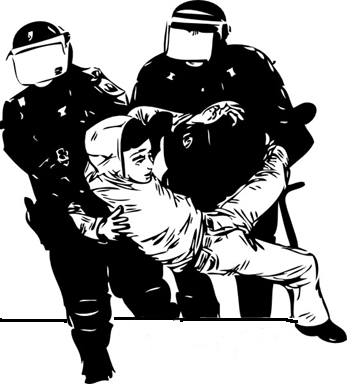 CRACKDOWN IN RUSSIA: CRITICS ACCUSE NUCLEAR AUTHORITIES OF SOVIET-STYLE COVER-UPS AND HEAVY-HANDED TACTICS, Newsweek, BY One thing that’s clear: The risks are growing for environmental and human rights activists who take on the powerful nuclear agency. Just ask Nadezhda Kutepova, 45, the head of a human rights organization that helped the victims of radiation pollution in and around Ozyorsk. “At first, I didn’t pay much attention to the reports about the radioactive pollution, but as soon as I heard that Rosatom had said everything was OK and that Mayak officials were denying an accident had taken place, I started to monitor the situation,” she tells Newsweek. “These are very cynical people.”
Kutepova was born in Ozyorsk in 1974. Her father worked at Mayak for 35 years and took part in the 1957 clean-up. He died of cancer in 1985, but the Soviet authorities never officially admitted that the illness was linked to his job. In 2007, after a long legal battle, Kutepova forced the government to recognize her father as a victim of occupational radiation sickness. Neither Kutepova nor her mother, however, received compensation.
Kutepova didn’t fight only for her family. She also tried to force Rosatom to pay for medical treatment for locals affected by illnesses related to decades of atomic pollution. In 2013, Kutepova discovered the first known case of third-generation radiation sickness in the region. The case involved a 6-year-old girl named Regina Khasanova who died of cancer. Medical experts said her death was caused by genetic mutations that resulted from the radiation her grandmother was exposed to during the 1957 clean-up at Mayak.
Two years later, Kutepova was forced to flee Russia after state TV accused her of trying to exploit the nuclear issue to foment revolution. Another report said she was attempting to destroy Russia’s nuclear deterrent on behalf of the United States. The purported evidence? Her human rights group received financing from the U.S. government–funded National Endowment for Democracy, which Russian officials have accused of seeking to topple Putin. (The NED says its aim is to promote worldwide democracy.) “We never covered up this funding,” Kutepova says. “We also received funds from organizations in Canada, Germany and the Netherlands.”
One of the televised reports even showed the door to Kutepova’s apartment, which caused her to fear for her safety. Kutepova and her four children now live in France, where she has political asylum…….http://www.newsweek.com/crackdown-russia-critics-accuse-nuclear-authorities-soviet-style-cover-ups-and-755389
Google filters nuclear-news.net website, so much for net neutrality anyway!

It seems fighting against environmental issues, nuclear madness and supporting peace strategies is not wanted on the web April/May 2017 Google algorythm changes. This has been widely reported by Democracy Now and many other websites! This is a quick video showing our blog getting hit as well. Bookmark https://nuclear-news.net/ before its to late! Evidence for the filtering is on this video;
Origin of the mysterious radioactive cloud remains obscure, as Russia now denies it came from Mayak
Russia’s Nuclear Industry Tries To Dispel Fears Over Mysterious Radioactive Cloud https://www.npr.org/sections/parallels/2017/12/08/569384745/russias-nuclear-industry-tries-to-dispel-fears-over-mysterious-radioactive-cloud, December 8, 2017 LUCIAN KIM
More than two months after a mysterious radioactive cloud was detected over Europe, Russia’s nuclear industry went public Friday in an attempt to dispel fears that one of its facilities had released a plume of ruthenium-106.Russia’s
state nuclear corporation, ROSATOM, released the findings of a special commission, which concluded that the Mayak nuclear reprocessing plant, near the border with Kazakhstan, could not have been the source of ruthenium-106, a radioactive isotope.
“There is no scientific basis for the hypothesis of some of our Western colleagues that there was a big release at Mayak,” Rafael Arutyunyan, deputy director of the Nuclear Safety Institute of the Russian Academy of Sciences and a member of the commission, said at a news conference in Moscow. European monitoring stations first picked up traces of ruthenium in the air in late September. While concentrations were too low to pose a health risk in Europe, scientists have
been puzzling over its origin. Wind patterns pointed to the south Urals, where the Mayak facility is located. The plant was the site of a 1957 explosion widely considered to be one of the world’s worst nuclear disasters.
In November, Russia’s meteorological service said that on Sept. 26, ruthenium-106 levels in a town 20 miles from the Mayak plant, Argayash, had exceeded the previous month’s by 986 times.
The same day, Mayak flatly denied that the spike in ruthenium had anything to do with its activities.
The ROSATOM commission that inspected the Mayak facility afterward reached the same conclusion. The commission said it hadn’t detected abnormal levels of ruthenium at the facility, there had been no malfunction of monitoring systems and none of the 250 Mayak employees tested had shown any trace of the isotope.
Arutyunyan rejected the suggestion that officials have been slow in informing thepublic, saying there had been no emergency situation that would have warranted an alarm. He called talk of a danger to health “nonsense.”
“Why should we come running to announce something? Mayak told us that all their systems were working absolutelynormally and routinely,” he said. “Why should they have jumped up and shouted? I think we spent the right amount of time to understand what happened.”
Environmental activists and government critics disagree.
After the findings of the commission were released, Greenpeace Russia started a petition drive addressed to the general prosecutor’s office, demanding an investigation by independent specialists and public figures into a possible release of ruthenium from Russian territory, as well as into the possible concealment of information by ROSATOM.
“The question is not only about the immediate danger, but the origin of this release,” Greenpeace energy campaigner Rashid Alimov said in a phone interview. “We think such incidents should be investigated and there must be an answer.”
Finding the source of the radioactive cloud was beyond the scope of the ROSATOM commission. But because the ruthenium-106 over Europe was found alone, that is, unaccompanied by other radioactive isotopes, the commission said nuclear power plants or spent nuclear fuel processing facilities like Mayak could be excluded as sources because they don’t produce “pure” ruthenium-106.
The commission said a satellite — or a fragment of one — re-entering the atmosphere cannot be completely ruled out as the source of the ruthenium.
According to French authorities,
the International Atomic Energy Agency found that no satellite containing ruthenium had fallen back to earth during the period in question.
The elephant in the room, of course, is the 1986 Chernobyl nuclear accident, when Soviet authorities lied for days about the scope of the disaster.
“What’s happening with the ruthenium cloud reminds me a lot of what went on with Chernobyl,”
Russian opposition leader Alexei Navalny said in a recent video blog. “In no way do I want to prove there’s been a catastrophe of that scale. I just want to say that the pattern of behavior is exactly the same.”
Navalny went on to pillory the headline on state television that “safe ruthenium rain fell on Bashkiria” and the chief oncologist of Chelyabinsk region, who advised people worried about high ruthenium levels “to watch soccer and drink beer.”
ROSATOM insistsit is being as transparent as possible.”Russia’s nuclear industry is a lot more open than our peers’,” ROSATOM spokesman Andrei Ivanov said at the news conference.
On Friday, local journalists were let into Mayak on the first press tour since the facility was identified as a possible source of the ruthenium cloud.
Foreign correspondents will have to wait up to two months to get a security clearance.
Revelations that Westinghouse knew of nuclear reactor problems
Sounding new nuclear alarms https://www.postandcourier.com/opinion/editorials/sounding-new-nuclear-alarms/article_be2fb7ca-dc42-11e7-8c26-0305d23937e2.html Westinghouse knew, as far back as 2011, that its designs for two new nuclear reactors in South Carolina were virtually guaranteed to face construction delays and serious cost overruns.
A shocking document published on Friday by The Post and Courier reveals that a Westinghouse engineer raised several alarms about the viability of the reactor plans just two years after construction began.
Worse, it suggests that Westinghouse officials all but ignored the conclusions and proceeded with construction on the now abandoned reactors anyway.
“The AP1000 Design is not complete, although it is currently under construction,” reads the document. “This virtually assures large numbers of changes will occur to both systems and structures.”
The author estimated that related delays could cost as much as $300 million in “claims which will be difficult to defend.”
The report also drew attention to the fact that Westinghouse chose not to require a “professional engineer seal” on plans for the reactors, which could call into question both the designs’ legal status and whether they could be safely built.
That particular flaw, and the existence of the report, were both documented in a September article by The Post and Courier.
If state lawmakers and officials can prove that SCANA or Santee Cooper were aware of Westinghouse’s own internal concerns about the nuclear project as far back as 2011, it would be the most damning piece of evidence yet that the utilities acted imprudently in continuing to funnel money into the new reactors at customer expense.
Today, The Post and Courier is publishing a thorough investigation not just of the failure of the two South Carolina reactors, but of a number of other projects in other states that have cost electric ratepayers tens of billions of dollars.
The report paints a troubling picture of money and influence wielded to shape public policy that benefits electric utilities at the cost of their customers.
In South Carolina, the 2007 Base Load Review Act paved the way for a $9 billion nuclear disaster that could impact hundreds of thousands of ratepayers for the next six decades. The law passed with near unanimous support at the Statehouse.
At least 11 states have similar pieces of legislation. That leaves millions of people nationwide at risk of similarly devastating economic impacts.
Even if Westinghouse never mentioned its concerns to SCANA or Santee Cooper officials, the two South Carolina power companies certainly knew that they were facing problems. Cost overruns and delays plagued the project almost from the start.
Then in 2015, engineering firm Bechtel produced an alarming audit that raised numerous red flags about construction schedules, design flaws and other potentially fatal problems. But work continued and utility officials publicly touted the project’s progress.
That shameful duplicity insults the electric ratepayers of South Carolina, who are paying higher rates for the project, and are faced with years more without state intervention. The situation must be rectified by state lawmakers, regulatory officers and Gov. Henry McMaster when the Legislature returns to session in January.
And as today’s report confirms, other states should take notice.
Russia’s deception, denial and propaganda over the nuclear event at Mayak
 Nuclear Russia Scares The World (Again), Lobe Log, DECEMBER 5, 2017, by Tatyana Ivanova
“…….Denial, Pressure, and Propaganda
As soon as information about the likely Russian origin of the ruthenium cloud over Europe appeared in the mass media, the Russian nuclear state corporation sprang into action to prevent any Russian investigation. Rosatom and then Mayak stated that their facilities couldn’t be a source of Ru-106 release and that the background radiation around them is normal. At the same time, they didn’t provide any specific data on Ru-106 concentrations in the air. Rosatom only made reference to its website, which is monitoring the gamma background.
A Russian regulatory agency “inspected” Mayak, and after only one day came to the hasty conclusion that there had been no accidents or events at the plant. Its public report contained only one number: the Ru-106 concentration in Bucharest that the IAEA had already published.
Some days later Russian pro-government mass media published a flurry of propaganda, denying that the contamination was of Russian origin and making fun of the journalists and citizens who wrote of a cover-up. Some of the Russian mass media disseminated false information that the release could have been caused by a downed American spy satellite or even an alien spaceship.
The most radical websites started a second wave of defamation against Nadezhda Kutepova, blaming her for espionage and intentional misinformation about Mayak. Some Russian officials blamed IRSN for issuing “false information” about the Russian trace, saying that the French regulator is competing with Rosatom.
Rosatom went further by publishing a poster on behalf of Ru-106 with the headline “Everyone accuses the little one” in the style of a propaganda cartoon for children. The poster states that Ru-106 is “small and good” and does not appear at nuclear waste reprocessing plants. Then the official Rosatom Facebook page invited journalists and bloggers to visit Mayak to “touch and smell” Ruthenium-106. They selected 16 people from 200 who expressed interest, stating that experts were not invited because they “already understand all the fictitiousness of the hype.”
At the same time, the Russian regulatory agency altered its published report, removing the words “extremely high concentrations of Ru-106” in reference to the villages around Mayak and reported instead that the levels did not exceed the limits. Last week a special commission including representatives of all the aforementioned Russian state organizations began another inspection of Mayak. The results have not yet been announced.
The situation is reminiscent of the Chernobyl catastrophe of 1986, during the Soviet era. Indeed, the Mayak facility, which specializes in nuclear fuel reprocessing and the production of nuclear weapons materials, never really left the Soviet era. The enterprise avoids publishing any detailed figures on emissions In its environmental impact assessments. An iron veil of secrecy, as well as Rosatom’s influence over decision-makers at the highest level, protect it from the scrutiny of Russians and everybody else.
Tatyana Ivanova is a Belarusian journalist residing in the United States https://lobelog.com/nuclear-russia-scares-the-world-again/
1 This Month



26 September – International Day for the Total Elimination of Nuclear Weapons


PLEASE OPPOSE HR 8255 AND S.3639 – bills would accelerate satellite deployment, with no environmental review or safeguards – https://ncstd5li.quorum.us/campaign/169331/
To see nuclear-related stories in greater depth and intensity – go to https://nuclearinformation.wordpress.com
-
Archives
- September 2026 (269)
- August 2026 (330)
- July 2026 (355)
- June 2026 (287)
- May 2026 (306)
- April 2026 (356)
- March 2026 (251)
- February 2026 (267)
- January 2026 (308)
- December 2025 (358)
- November 2025 (359)
- October 2025 (375)
-
Categories
- 1
- 1 NUCLEAR ISSUES
- business and costs
- climate change
- culture and arts
- ENERGY
- environment
- health
- history
- indigenous issues
- Legal
- marketing of nuclear
- media
- opposition to nuclear
- PERSONAL STORIES
- politics
- politics international
- Religion and ethics
- safety
- secrets,lies and civil liberties
- spinbuster
- technology
- Uranium
- wastes
- weapons and war
- Women
- 2 WORLD
- ACTION
- AFRICA
- Atrocities
- AUSTRALIA
- Christina's notes
- Christina's themes
- culture and arts
- Events
- Fuk 2022
- Fuk 2023
- Fukushima 2017
- Fukushima 2018
- fukushima 2019
- Fukushima 2020
- Fukushima 2021
- general
- global warming
- Humour (God we need it)
- Nuclear
- RARE EARTHS
- Reference
- resources – print
- Resources -audiovicual
- Weekly Newsletter
- World
- World Nuclear
- YouTube
-
RSS
Entries RSS
Comments RSS

