Local ‘ceasefire’ area declared at Ukrainian nuclear plant for damage repairs
Without reliable external power, the Zaporizhzhia nuclear power risks losing the cooling needed to keep its reactors stable.
Politico, October 18, 2025 By Mathieu Pollet
Repairs are underway at Ukraine’s Zaporizhzhia nuclear power plant after “local ceasefire zones” were established in the area, the United Nations nuclear watchdog said on Saturday.
“Restoration of off-site power is crucial for nuclear safety and security. Both sides engaged constructively with the [International Atomic Energy Agency] to enable complex repair plan to proceed,” the IAEA wrote in a post on X.
The Russian-occupied facility in southeastern Ukraine has been cut off from the national grid for four weeks — its longest blackout since the Russia’s invasion in February 2022. The plant has been using on diesel generators since its last power line went down last month…………………………………………….. https://www.politico.eu/article/ukraine-russia-local-ceasefire-zone-declared-nuclear-plant-damage-repairs/
TEPCO weighs scrapping 2 reactors at Niigata nuclear power plant
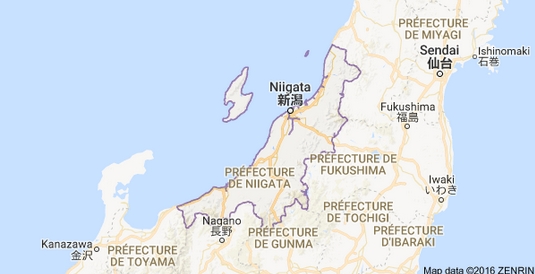
October 17, 2025 (Mainichi Japan)
NIIGATA, Japan (Kyodo) — Tokyo Electric Power Company Holdings Inc. said Thursday it is considering decommissioning two of the seven reactors at its nuclear power plant in Niigata Prefecture, all of which are currently offline.
TEPCO President Tomoaki Kobayakawa said in a prefectural assembly session that the utility is studying scrapping the Kashiwazaki-Kariwa plant’s Nos. 1 and 2 reactors, which began operating in 1985 and 1990, respectively.
His comments come as local municipalities around the nuclear power plant remain concerned about the complex’s safety and have requested that some of its Nos. 1 to 5 reactors be shut down……………………………………………………https://mainichi.jp/english/articles/20251017/p2g/00m/0bu/007000c
Gravelines: the Safety Expertise Department of ASNR’ damning opinion calls into question the EPR2
October 16, 2025, https://www.greenpeace.fr/espace-presse/gravelines-lavis-accablant-de-lasnr-remet-en-cause-les-epr2/
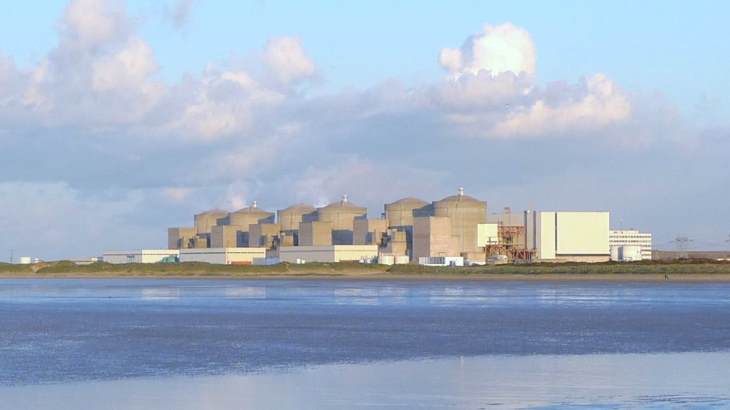
The Safety Expertise Department of ASNR, the nuclear safety and radiation protection authority, has just published a damning expert opinion on EDF’s project for the Gravelines power plant.
In addition to the already identified risks of submersion and flooding of the power plant, there is now the risk of soil settlement and liquefaction. The soil, which is designed to support the weight of the new EPR2 reactors, has “poor mechanical characteristics,” posing an unprecedented technical challenge regarding the robustness of the foundations over time and in the face of seismic hazards that could compromise nuclear safety.
“ This relentless opinion from the ASNR is further proof that the criteria for choosing sites for the construction of new EPR2 reactors are largely questionable. After underestimating the climate risks, EDF is underestimating the risk of building such a dangerous infrastructure on such unsuitable ground ,” emphasizes Pauline Boyer, nuclear campaigner for Greenpeace France. “This demonstrates once again the haste of EDF, which is rushing headlong into its plans to build new reactors in Gravelines. ”
A relentless opinion
In this opinion dated July 23, the ASNR severely rejects EDF’s copy of its first study of ground reinforcement on the Gravelines site, considering that the approach adopted by EDF is not sufficiently robust , ordering it to clarify the safety issues relating to ground reinforcement, to conduct new studies and to set up a monitoring system over time.
The opinion considers that the planned reinforcement of the ground at the Gravelines site constitutes “ a major technical challenge ” and that the system proposed by EDF is “of unprecedented scale, of great complexity and without representative feedback in France and internationally”.
A hard blow for EDF
The Gravelines nuclear power plant, built on a polder, is supposed to accommodate two new reactors (EPR2) as part of the nuclear recovery plan.
A year ago, Greenpeace published a report which, through mapping work projecting the rise in water levels in the Gravelines area until the end of the reactors’ lifespan, demonstrated that in 2100 and 2120, the entire Gravelines power plant site could be temporarily below sea level.
“The project to build new EPR2 reactors in Gravelines, EDF’s “seaside sandcastle,” is already sinking into quicksand. It’s time for EDF to make the most sensible decision: stop trying to build reactors at all costs, especially on such a vulnerable and unsuitable site, and invest this money in its renewable energy sector,” adds Pauline Boyer.
The difficulties and uncertainties of this nuclear construction project overlap, at the heart of an area accumulating risks (submersion, flooding, unsuitability of the soil, extreme climatic events, etc.). The 11-meter platform on which the EPR2 would be perched in an attempt to protect them from the risks of submersion and flooding (which Greenpeace always questions) makes the task even more difficult.
After the setbacks with the concrete intended for the construction of the future EPR2 in Penly, this is yet another example of EDF’s amateurism in wanting to build EPR2s in unsuitable areas without first carrying out a robust risk analysis.
The UN nuclear watchdog seeks a local truce to restore power to the Zaporizhzhia plant
By ASSOCIATED PRESS, 14 October 2025
VIENNA (AP) – The U.N. nuclear watchdog is pushing Ukraine and Russia to agree to local ceasefires so that external power can be restored to Ukraine´s huge nuclear power plant in Zaporizhzhia, two diplomats familiar with the plan told The Associated Press.
The plant is in an area under Russian control since early in Moscow’s full-scale invasion of Ukraine and is not in service, but it needs reliable power to cool its six shutdown reactors and spent fuel, to avoid any catastrophic nuclear incidents.
It has been operating on diesel generators since Sept. 23 when its last remaining external power line was severed in attacks that each side blamed on the other. The International Atomic Energy Agency has repeatedly expressed alarm about the nuclear plant, Europe’s biggest.
The agency is proposing to restore external power to the plant in two phases, according to a European diplomat briefed on the proposal by the IAEA Director General Rafael Grossi. A Russian diplomat confirmed some aspects of the plan.
Both diplomats spoke on condition of anonymity because they were not authorized to discuss the confidential negotiations publicly.
During the first phase, a 1.5-kilometer-radius (1-mile-radius) ceasefire zone would be established to allow repair of the Dniprovska 750-kilovolt line, the main power line to the plant that has been damaged in an area under Russian control.
During the second phase, a second such ceasefire zone would be established to repair the Ferosplavna-1 330-kilovolt backup line, which is in area under Ukraine’s control.
IAEA experts would be on hand to monitor the repairs, which originally were proposed for a 7-day period from Oct. 11 to Oct. 17, according to the European diplomat and confidential documents seen by the AP.
However, although the Ukrainian side has given necessary guarantees of safe passage for repair crews, Russia did not give such guarantees in time for the work to start under that timetable, according to the European diplomat.
The Russian diplomat, on the other hand, said that preparations for the repairs are under way and that they can start very soon.
The IAEA declined to comment on the timing, saying only that Grossi was engaging “intensively with both sides” to enable the reconnection of power and to “help prevent a nuclear accident.”
Grossi held talks with both Ukraine and Russia last month. He met with Ukrainian Foreign Minister Andrii Sybiha on Sept. 29 at the Warsaw Security Forum, following meetings in Moscow with Russian President Vladimir Putin on Sept. 25 and Rosatom Director General Alexei Likhachev on Sept. 26.
The IAEA warned that if diesel generators fail, “it could lead to a complete blackout and possibly causing an accident with the fuel melting and a potential radiation release into the environment, if power could not be restored in time.”
The latest blackout is the tenth time that the Zaporizhzhia plant has lost all external power, and is by far the longest since the start of the war. The 330-kilovolt backup line was lost in May, and the main line was disconnected on Sept. 23.
The plant is close to the front line and has been occupied by Russia since March 2022. Ukraine and Russia have traded blame for shelling close to the plant……. https://www.dailymail.co.uk/wires/ap/article-15188795/The-UN-nuclear-watchdog-seeks-local-truce-restore-power-Zaporizhzhia-plant.html
URGENT ACTION NEEDED to Help Protect the Defense Nuclear Facilities Safety Board!
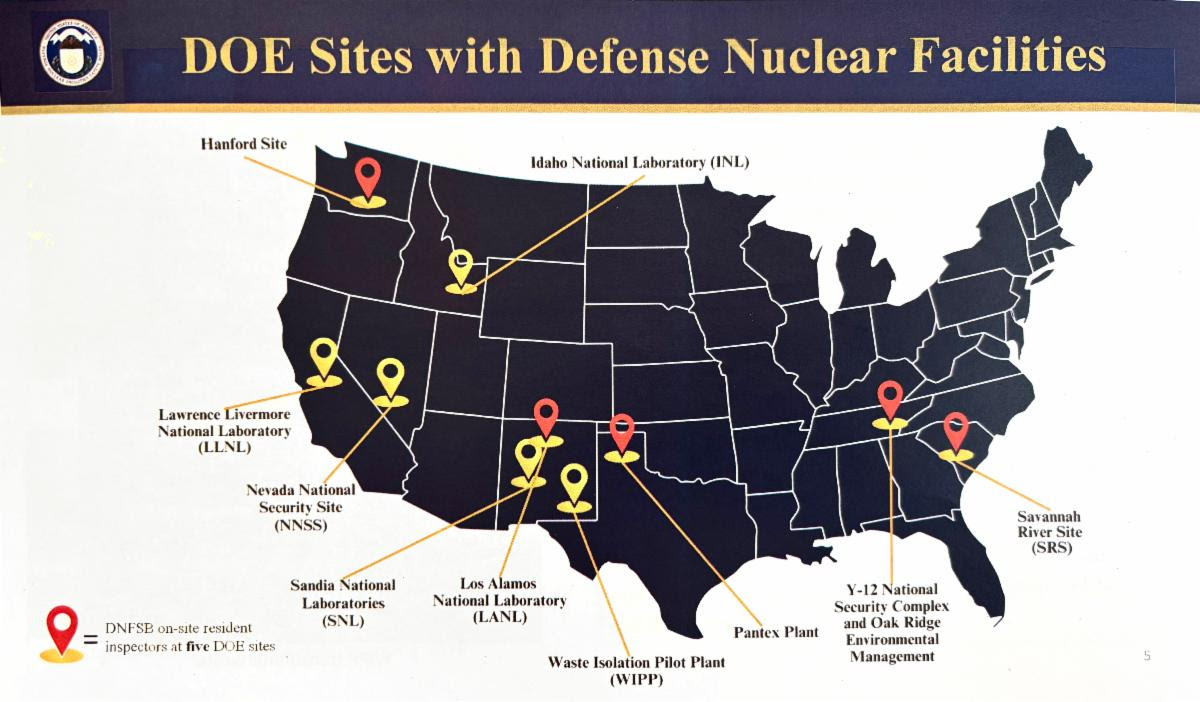
Nuclear Watch, Jay Coghlan, Executive Director, Scott Kovac, Research Director, Sophie Stroud, Digital Content Manager and Youth Specialist, 13 Oct 25
| The government is still shut down (unfortunately). But it does mean there’s still time to ask Congress to get a provision in the pending Continuing Resolution to keep the government running that will help save the Defense Nuclear Facilities Safety Board (DNFSB). |
Background: The Defense Nuclear Facilities Safety Board is an independent agency within the executive branch of the Federal Government. The DNFSB is chartered with the responsibility to provide recommendations and advice to the Secretary of Energy regarding public health and safety issues at Department of Energy (DOE) nuclear weapons facilities, including with the health and safety of employees, contractors, and nearby communities (for more see www.dnfsb.gov).
Congress established the Board in 1988 in response to increasing reports of nuclear safety risks impacting workers and the public. Since early this year, the Board has been reduced to just two Members out of five, with a temporary one-year statutory bridge to constitute a quorum that is drawing to a close. In addition, the current Acting Chairman’s term expires this October 18, ending the Board’s functioning quorum. Without it, the DNFSB cannot effectively carry out its critical nuclear safety oversight mission. The public would simply not know about the DOE’s chronic nuclear safety problems without the Board. This is critically important today given expanding production of nuclear weapons.
| Specific request: There should be a provision in any Continuing Resolution for FY 2026 that would temporarily extend the authority of the Defense Nuclear Facilities Safety Board by allowing the Acting Chair to serve until the end of January 2027. The overriding purpose is to enable the Safety Board to fully continue operations and provide more time for the President to nominate, and the Senate to confirm, new Safety Board Members. |
| Congress must take action to protect nuclear safety by preserving DNFSB’s quorum! |
Contact Senator Martin Heinrich through his official website, his Washington, D.C. office, or any of his New Mexico State offices:…………………………………………………………
Contact Senator Ben Ray Luján through his official website, his Washington, D.C. office, or any of his New Mexico State offices:………………………………………………….
Contact Senator John Thune through his official website, his Washington, D.C. office, or any of his South Dakota State offices:…………………………………………….
Contact Senator Chuck Schumer through his official website, his Washington, D.C. office, or any of his New York State offices:……………………………………………. https://nukewatch.org/action-item/urgent-action-needed-to-help-protect-the-defense-nuclear-facilities-safety-board/
Grossi says progress made on restoring Zaporizhzhia power

Friday, 10 October 2025, https://www.world-nuclear-news.org/articles/grossi-says-progress-made-on-restoring-zaporizhzhia-power
The two sides in the war have “engaged in a constructive way” with the International Atomic Energy Agency, whose director general says “a process has been set in motion” to help restore external power to Zaporizhzhia Nuclear Power Plant.
Rafael Mariano Grossi, Director General of the International Atomic Energy Agency (IAEA), said: “Following intensive consultations, the process leading to the re-establishment of off-site power – through the Dniprovska and Ferosplavna-1 lines – has started. While it will still take some time before the grid connection of the Zaporizhzhia nuclear power plant (ZNPP) has been restored, the two sides have engaged with us in a constructive way to achieve this important objective for the sake of nuclear safety and security. No one stands to gain from a further deterioration in this regard.”
External power was lost by the plant – which is on the frontline of Ukrainian and Russian troops – on 23 September, and it has since been relying on its fleet of emergency diesel generators for the power required for essential safety functions, including powering cooling pumps.
Before the war, there were 10 different external power lines to the plant, but that number has fallen since the start of the war in February 2022. Five months ago its last 330 kV backup power line was disconnected, leaving no supply when the sole operational 750 kV power line source was cut.
Both sides blame the damage on military activities and have said that the military situation has stopped them from being able to repair the damage. Grossi has had frequent contact with both sides as part of efforts to find a way forward.
The IAEA’s latest update says: “The focus has been on creating the necessary security conditions for repairs to be carried out on the damaged sections of the 750 kV Dniprovska and the 330 kV Ferosplavna-1 power lines, located on opposite sides of the frontline near the ZNPP.”
It is the tenth time that the plant has lost external power, although on previous occasions it was for a matter of hours rather than the current case of weeks. Seven emergency diesel generators are operating, with 13 on standby.
The IAEA team at the plant report that there has been no temperature increase within the coolant in the reactors or the used fuel pools and radiation levels at the site remain normal. They do continue to hear military action, including on Tuesday evening when they heard “five explosions one after the other, occurring close to the site and shaking windows in their building”.
The six-unit Zaporizhzhia nuclear power plant has been under Russian military control since early March 2022. All its units are shut down.
New nuclear push brings old dangers back — and bigger than ever

by Kevin Kamps, opinion contributor – 10/06/25 https://thehill.com/opinion/energy-environment/5537588-nuclear-power-dangers-regulation/
When President Trump and Keir Starmer, prime minister of the United Kingdom, signed a deal to rapidly expand nuclear power in the U.K., nuclear stock prices soared to record highs. But the boom ignores the overwhelming evidence that nuclear is a bad risk.
The only U.S. reactors built in the last 30 years, Vogtle Units 3 and 4, cost over $35 billion, resulting in the world’s most expensive electricity. Prohibitive cost overruns also sank NuScale, the only U.S. attempt to commercialize small modular reactors.
Notwithstanding, irrational nuclear exuberance is reaching a pitch. Spiking electricity demand, cratering nuclear regulation, reckless nuclear boosterism and federal attacks on renewables have produced a perfect storm fueling nuclear expansionism. Former regulators warn that with the Nuclear Regulatory Commission now compromised, the storm may blow us onto the rocks.
Nuclear hubris is so extreme that NASA says it will put a reactor on the moon by 2030. But with regulatory guardrails down, we ought to worry more about preventing a nuclear moonscape on earth.
One neon danger sign is the rise of “zombie nukes” — restarting old, disused reactors, including those previously shut down for safety reasons. It’s happening at Michigan’s Palisades nuclear plant, Pennsylvania’s Three Mile Island 1 and Iowa’s Duane Arnold.
Another red flag is so-called “advanced” reactors, including small modular reactors. Contrary to the name, small modular reactors are not new, not always small and probably not modular, comprising 127 different designs that are mostly speculative and haven’t been built yet.
Small modular reactors aren’t “walk away safe” or carbon-free. Their lower output precludes economies of scale and their construction costs aren’t proportionately smaller than conventional nuclear, so their electricity is costlier. They also produce up to 30 times the waste and leak more neutrons. They emit greenhouse gases and thermal pollution. Subsidizing them and other nuclear undermines renewables and makes climate change worse.
Holtec, a privately held firm facing ethical questions and known for hawking (though not yet building) small modular reactors and pioneering zombie nuke restart, was tapped in the U.S.-U.K. deal to develop nuclear-powered data centers in northeast England worth $15 billion. It gained notoriety by buying moribund U.S. nuclear plants cheaply under pretense of dismantling them and then pivoting to convert them back to operations, though it has no experience as a nuclear operator. The Nuclear Regulatory Commission obliged, granting regulatory relief and safety exemptions enabling Palisades to transition from decommissioning to “operations” status.

Holtec also plans to install small modular reactors there, next to a large cache of radioactive waste. It has similar plans for decommissioned nuclear sites it owns in New Jersey, Massachusetts and New York, and it intends to go public in the next few months with an IPO potentially valued at $10 billion.
What could possibly go wrong?
A nuclear engineer recently warned the Nuclear Regulatory Commission’s Advisory Committee on Reactor Safeguards that once Palisades is restarted, it could fail within six months, with “unimaginable impacts to the general public,” due to mishandled steam generator tubes or its cracked primary cooling system.
Watchdog groups in Massachusetts, where Holtec wants to install small modular reactors on the closed Pilgrim nuclear site, are decrying a pending energy bill repealing a 1982 state law requiring a permanent repository for radioactive waste, as well as voting up a referendum before any new nuclear can be built. Neither condition is met, but Gov. Maura Healy (D) is bent on small nuclear reactors and nuclear-powered AI data centers anyway.
At New York’s Indian Point, Holtec proposes to install small modular reactors and restart old, partially dismantled reactors, despite signing an agreement that prohibits even proposing renuclearizing the site without local, county and state support, which it doesn’t have.
Last year, Holtec sued to block a state law prohibiting it from dumping radioactive water into the Hudson River, which Gov. Kathy Hochul (D) signed. Then nuclear lobbyists went into high gear in Albany, including hiring former Gov. Andrew Cuomo, prompting an ethics complaint. Hochul then flipped, directing the New York Power Authority to build at least 1 gigawatt of new nuclear in the state.
This about-face toward nuclear buildout is happening as the regulatory regime, never robust, is in free fall. Four former Nuclear Regulatory Commission chairs (three in this article), have sounded the alarm. Nuclear Regulatory Commission commissioners testified before Congress that they expect to be fired if they question unsafe reactor designs and fail to rubberstamp them. Former Department of Energy Assistant Secretary Katy Huff and colleagues wrote that making nuclear regulatory decisions “for political reasons” is “setting the U.S. on the fastest path to a nuclear accident. … This is neither hypothetical nor hyperbole.”
From their mouths to market handicappers’ ears. Amory Lovins wrote recently that nuclear-powered AI centers “may be a trillion-dollar bubble, but it’s sellable until market realities intervene.” The same is true of the harsh realities of nuclear’s inherent dangers. Let’s hope radiological disaster doesn’t intervene before nuclear’s unacceptable risks and costs get priced back in.
Kevin Kamps is the Radioactive Waste Watchdog at Beyond Nuclear.
Russian Nuke Plant Latest To Suffer War-Inflicted Damage

The Novovoronezh Nuclear Power Plant was damaged in a string of incidents at four facilities in the region over the past two weeks.
Howard Altman, Oct 7, 2025, https://www.twz.com/news-features/russian-nuke-plant-latest-to-suffer-war-inflicted-damage
ussia’s atomic energy agency said a Ukrainian drone struck a cooling tower of the Novovoronezh Nuclear Power Plant (NNPP), located about 100 miles north of the border. While officials say there was no substantial damage to the plant, it was the fourth nuclear power facility in the region to have munitions land on or very close to it in the past two weeks.
Regardless of the level of damage incurred at NNPP, Russia is worried enough about drone strikes on its nuclear facilities that it is beefing up its defenses at a test site in the Arctic. You can read more about that later in this story.
The NNPP cooling tower was hit by a drone flying near the plant that was downed by electronic warfare, Russia’s Rosenergoatom claimed on Telegram. As a result, the agency said it hit the cooling tower of the No. 6 reactor and exploded upon impact. These structures are generally built to withstand light aircraft impacts
“There is no destruction or casualties; however, a dark mark remained on the cooling tower from the consequences of the detonation,” Rosenergoatom stated. “The safety of the nuclear power plant operation is ensured, the radiation background at the industrial site of the Novovoronezh Nuclear Power Plant and the adjacent territory has not changed and corresponds to natural background levels. Law enforcement agencies are working at the scene.”………………………………………………………………………………………..
Ukrainian officials have yet to comment on this incident, which took place as Kyiv’s drones frequently attack the Voronezh region. Despite Ukraine’s ongoing campaign against energy facilities in Russia, it is quite likely that this strike was inadvertent. Kyiv has been attacking oil and gas plants, not nuclear ones, though Russia claims it downed a drone in August that caused a fire and temporarily reduced the electrical output at the Kursk Nuclear Power Plant. However, we can’t tell for sure if either of these strikes was deliberate or not. Russia frequently blames damage from drone strikes on electronic warfare or air defense shootdowns, even if an intended target was hit.
It is also possible that the damage at NNPP was caused by Russian air defenses. These systems can fail, as you can see in the following video [on original] . Russia has also claimed that damage caused by failed air defenses was caused by enemy munitions in the past.
Regardless, as Ukraine develops newer long-range weapons with far larger warheads, even an accidental strike on one of these sites could have far greater consequences. You can read more about one of Ukraine’s newest long-range weapons in our story we published today here.
The International Atomic Energy Agency (IAEA) has yet to comment, but has expressed high concern about drones flying near the South (SNPP) and Zaporizhzhia Nuclear Power Plant (ZNPP).
IAEA Director General Rafael Mariano Grossi issued warnings about ZNPP. That plant has been operating on backup diesel fuel generators since Sept. 23, after power lines were downed. Ukrainian officials claim Russia cut the lines on purpose, which Russia denies. ZNPP is inactive; however, pumps are needed to keep water cooling reactors so they don’t melt down. The power outage is the longest experienced by ZNPP during this conflict, Grossi stated.
Putin’s UnPeaceful Atom

atomic reactors provide “weapons for the enemy,” serving as pre-deployed weapons of mass destruction.
No atomic reactor anywhere can credibly claim to be immune
The fragility of instrumentation, operational, cooling, spent fuel storage and other vital systems have been amply demonstrated
Karl Grossman – Harvey Wasserman, October 6, 2025, https://www.counterpunch.org/2025/10/06/putins-unpeaceful-atom/
Russian Dictator Vladimir Putin last week eagerly confirmed that all “Peaceful Atom” nuclear power plants are fair game for military destruction and that the ensuing apocalyptic fall-out is not really his concern.
As Reuters reported, “Putin on Thursday warned Ukraine that it was playing a dangerous game by striking the area near the Zaporizhzhia nuclear plant and suggested that Moscow could retaliate against nuclear plants controlled by Ukraine.”
The six-reactor Zaporizhzhia complex is, noted Reuters “Europe’s largest [and] has been cut off from external power for more than a week and is being cooled by emergency diesel generators.”
Zaporizhzhia was captured by Russian forces in the early days of the 2022 invasion.
The global crisis it now embodies was foreseen 45 years ago by Bennett Ramberg, in his book “Nuclear Power Plants as Weapons for the Enemy: An Unrecognized Military Peril.”
Ramberg holds a Ph.D. in international relations and a law degree. He’s been an analyst or consultant to the Nuclear Control Institute, Global Green, Committee to Bridge the Gap and the U.S. Senate and U.S. State Department. He now directs the Global Security Seminar. Published by the University of California Press, his book and a new edition out last year are beyond chilling.
And its grave warnings are playing out in recent years and today.
According to the U.S. government’s 9/11 Commission, the Indian Point nuclear reactors, 25 miles north of New York City, were potential targets considered for the September 11 attacks. Between 1984 and 1987, Iraq bombed Iran’s Bushehr nuclear power plant six times. In 1991, during the Persian Gulf War, the U.S. Air Force bombed three nuclear reactors in Iraq. It gets worse.
As an article in the Bulletin of the Atomic Scientists put it last year, “small modular reactors, floating nuclear plants, and microreactors….these emerging technologies elevate concerns that wartime attacks could expose warfighters and civilians to nuclear fallout….Russia’s occupation of Ukraine’s Zaporizhzhia nuclear power plant has already set a dangerous precedent that could sway the course of future wars.”
William Alberque, former director of strategy, technology and arms control of the International Institute for Strategic Studies, wrote in a piece on the website of the London-headquartered organization in 2023 that amidst “The wartime weaponization of nuclear power stations,” the “risks of a nuclear disaster remain high at Ukraine’s Zaporizhzhia Nuclear Power Plant as Russia continues to threaten the health and safety of the entire region through its reckless behaviour.”
In the war on Ukraine, he adds, “a nuclear weapon state has decided that nuclear power reactors are legitimate targets and tools of coercion in war.”
Thus, atomic reactors provide “weapons for the enemy,” serving as pre-deployed weapons of mass destruction.
Amidst yet another billionaire-hyped push for a “Nuclear Renaissance,” atomic power—including large, small, and fusion reactors—has again faltered due to runaway costs and devastating construction delays. All reactors heat the planet at 300 degrees Centigrade, emit radioactive carbon 14, and can’t match flexible demand.
Most importantly, huge breakthroughs in renewables and battery efficiency have made them cheaper, safer, cleaner, faster-to-build, and more flexible, job-producing and reliable than both fossil fuels and atomic energy. In short, they have priced out fossil/nukes. More than 90% of the world’s new energy capacity is now Solartopian, comprised of carbon/heat and waste-free renewables, battery backup-up units and increased efficiency.
But the Ukraine war has now underscored yet another “Peaceful Atom” pitfall known for decades—the threat of a rogue nation turning atomic reactors into weapons of apocalyptic mass terror and destruction.
More than 400 commercial nuclear power plants are now licensed worldwide. There are 94 in the US. The destruction of just one, at Diablo Canyon, California, could send lethal fallout pouring across the entire continental United States, while first turning Los Angeles into a radioactive wasteland.
Putin has not estimated precisely how much radioactive fallout might result from blowing up an atomic reactor. But the war in Ukraine has made it clear that it could be done with a single drone costing less than $1,000.
Putin has asked just one question about such an attack: who will stop me?
The answer could be apocalyptic: no reactor, large or small, is anywhere immune.
When Putin sent troops pouring through Belarus into northern Ukraine in 2022, they quickly assaulted the smoldering remains at Chernobyl, which infamously exploded in 1986. The seething core of Unit Four has been covered with a $2 billion sarcophagus funded by downwind European nations.
The original explosion irradiated much of Europe. Airborne clouds were detected twice passing over the U.S., killing birds in California and irradiating milk in New England.
In “Chernobyl: Consequences of the Catastrophe for People and the Environment,” published in 2009 by the New York Academy of Sciences,” lead author Dr. Alexey Yablokov, (environmental advisor to Russian Presidents Gorbachev and Yeltsin) drew from 5,000 documents. These included health data, radiological surveys, scientific reports, and more. The conclusion was that as of 2004, as a result of Chernobyl’s fall-out, some 985,000 people had died, mainly of cancer. In the two decades since yet more thousands have been stricken.
In 2022, Putin’s invading troops seemed bound to repeat history. They terrorized and tortured Ukrainian technicians tasked to safeguard Chernobyl’s melted core against another explosion.
Tragically, the Russian soldiers camped in nearby woods, exposing themselves to heavily contaminated dust and soil.
On February 14, 2025, a Russian drone severely damaged Chernobyl’s sarcophagus. Had it hit the melted core, another global-scale radiation release could have again contaminated much of the Earth.
Putin has denied responsibility for that attack. However, he has seized the six reactors at Zaporizhzhia. As at Chernobyl, his troops terrorized, tortured and terminated vital Ukrainian staffers, seriously endangering on-going plant safety.
Zaporizhzhia’s reactors are allegedly shut. But cooling water and backup/off-site power vital to keeping the cores and fuel pools from exploding are tenuous at best. Random munitions and at least one drone have hit the plant.
By cutting transmission lines into Ukraine while running one toward Russia, Putin may soon become Earth’s first autocrat to “steal” an atomic power plant.
He’s further threatened to turn any reactor he wants into a de facto weapon of mass radioactive destruction, saving himself the trouble and expense of a Bombs and missiles.
No atomic reactor anywhere can credibly claim to be immune. The fragility of instrumentation, operational, cooling, spent fuel storage and other vital systems have been amply demonstrated at Chernobyl, Fukushima, Chalk River, Fermi, Three Mile Island, Windscale, INEL, Santa Susanna, Khyshtym, and countless other stricken atomic facilities.
Chernobyl has shown the range and killing power of resultant fallout. Japan’s Fukushima, which exploded on March 11, 2011, has since spewed 100 times more radioactive cesium than did the atomic bombings of Hiroshima and Nagasaki. Its heavily irradiated liquid wastes are still pouring into the Pacific.
Though vehemently denied by the nuclear industry, the death toll from radiation releases at the 1979 Three Mile Island meltdown continues to rise.
Meanwhile Ukraine deploys drones to decimate Putin’s oil and gas infrastructure, utterly ravaging Russia’s refineries, storage tanks, pipelines and more.
With his own drones, Putin has made clear he can target any reactor anywhere.
Safe, clean, green renewable energy technology now accounts for more than 90% of the world’s new energy production. No war monger can destroy a city by blowing up a solar panel or tearing down a wind turbine.
Yet Ukraine itself has four reactors on order, offering Putin still more pre-deployed weapons of radioactive mass destruction.
Likewise, California’s “anti-Trump” Governor Gavin Newsom keeps running uninsured, hyper-expensive nukes at Diablo Canyon that Putin could drone-hit tomorrow, forever bankrupting California, turning Los Angeles and the downwind nation into a permanent radioactive wasteland.
Deep in the bowels of the Kremlin, the nuclear Stalin is laughing.
Karl Grossman is the author of “Cover Up: What You Are Not Supposed to Know About Nuclear Power.” He is the host of the nationally broadcast TV program “Enviro Close-Up with Karl Grossman” (www.envirovideo.com)
Harvey “Sluggo” Wasserman wrote “Solartopia! Our Green-Powered Earth,” and co-wrote (with Norman Solomon, Bob Alvarez & Eleanor Waters) “Killing Our Own: The Disaster of America’s Experience with Atomic Radiation. His Green Grassroots Election Protection is aired via Zoom (www.grassrootsep.org) on most Mondays at 5 p.m. ET.
Harvey Wasserman wrote the books Solartopia! Our Green-Powered Earth and The Peoples Spiral of US History. He helped coin the phrase “No Nukes.” He co-convenes the Grassroots Emergency Election Protection Coalition at www.electionprotection2024.org Karl Grossman is the author of Cover Up: What You Are Not Supposed to Know About Nuclear Power and Power Crazy. He the host of the nationally-aired TV program Enviro Close-Up with Karl Grossman (www.envirovideo.com)
Is Russia’s Putin gambling with the safety of Ukraine’s nuclear stations?
Russia and Ukraine have traded blame, accusing one another of imperilling the Zaporizhzhia nuclear power plant.
Aljazeera, By Mansur Mirovalev, 6 Oct 2025
Kyiv, Ukraine – On October 2, Russian President Vladimir Putin alleged that Ukrainian attacks had destroyed a high-voltage transmission line between the Moscow-occupied Zaporizhzhia nuclear power plant in southeastern Ukraine and Kyiv-controlled areas.
Days earlier, Ukraine’s leader, President Volodymyr Zelenskyy, said Russian shelling had cut the plant off from the electricity network.
The mammoth, six-reactor plant – Europe’s largest and known in Ukraine as the ZAES – sits less than 10km (6.2 miles) south of the front line. It has been shut since 2022, generating none of the electricity that once provided up to a fifth of Ukraine’s needs.
But dozens of Moscow-deployed engineers have frantically tried to restart it – so far unsuccessfully. Ukraine has long feared that Russia is trying to connect the power grid and quench a thirst for energy in Crimea and other occupied areas.
Putin purported that the alleged Ukrainian strikes caused a blackout at the plant and that it had to be fuelled by diesel generators.
The latest blackout at the plant is the longest wartime outage of power.
“On the [Ukrainian] side, people should understand that if they play so dangerously, they have an operating nuclear power station on their side,” Putin told a forum in St Petersburg.
‘The radioactivity is so powerful’
In fact, apart from the Zaporizhzhia nuclear plant, Ukraine has three operating power stations – as well as the shutdown Chornobyl facility, the site of one of the world’s worst nuclear disasters.
“And what prevents us from mirroring [Ukraine’s alleged actions] in response? Let them think about it,” Putin said.
His threat had apparently already been fulfilled a day earlier. Ukraine accused Russia of shelling that damaged the power supply to the colossal protective “sarcophagus” over the Chornobyl station’s Reactor Four that exploded in 1986.
Both the Chornobyl station and the plant in Zaporizhzhia need electricity for their safety systems and, most importantly, for the uninterrupted circulation of water that cools nuclear fuel.
The fuel, thousands of uranium rods that keep emitting heat, are too radioactive to be taken anywhere else.
In Chornobyl, the fuel is spent and submerged in cooling ponds or “dry-stored” in ventilated, secured facilities.
But at the Zaporizhzhia site, the rods are still inside the reactors – and are newer, hotter, and made in the United States…………………………………………………………………………………
The biggest problem is Russia’s failure to hook the plant to the energy grid of occupied regions as Ukrainian forces pin-pointedly destroy the transmission lines Russia is building – along with fuel depots and thermal power stations, he said.
“The Russians are restoring them any way they can, but Ukrainian forces very much prevent the restoration,” the engineer quipped.
Bellona, a Norway-based nuclear monitor, said on October 2 that a “greater danger lies in Moscow’s potential use of the crisis to justify reconnecting the plant to its own grid – portraying itself as the saviour preventing a nuclear disaster”.
Should Moscow do that, the step would only “worsen [the] strategic situation, give Moscow additional leverage, and bring a potential restart closer – a move that, amid ongoing fighting, would itself sharply increase the risk of a nuclear accident,” it said.
Analysts pointed to a deal proposed by US President Donald Trump in March to transfer the plant to US management as a possible solution.
Ukrainian strikes “will go on until Russia makes a peace deal that also includes US control over the ZAES and its operation”, Nikolay Mitrokhin, a researcher with Germany’s University of Bremen, told Al Jazeera.
Meanwhile, in recent weeks, blackouts in Crimea have become unpredictable and distressing, a Crimea local told Al Jazeera…………..
Russia understands that improved power supply is a prerequisite for its efforts to restore occupied Ukrainian regions and conquer more Ukrainian land, said an observer.
Moscow needs the plant to “cover the growing [energy] consumption in the region, considering not just occupied Crimea, but also the occupied areas [above the Sea of] Azov. And also within the context of Russia’s plan to occupy part of the Zaporizhia region,” Kyiv-based analyst Aleksey Kushch told Al Jazeera.
Greenpeace said that its detailed analysis of high-resolution satellite images taken after what Putin alleged were Ukrainian strikes showed that he was bluffing.
“There is no evidence of any military strikes in the area surrounding the pylons and network of power lines in this part of Zaporizhzhia nuclear power plant,” the international environmentalist group said on October 1.
The images showed that the power towers remained in position and there were no craters left by explosions around the lines, it said.
Greenpeace concluded that the blackout at the plant is “a deliberate act of sabotage by Russia” whose aim is to “permanently disconnect the plant from the Ukraine grid and connect the nuclear plant to the grid occupied by Russia”. https://www.aljazeera.com/news/2025/10/6/is-russias-putin-gambling-with-the-safety-of-ukraines-nuclear-stations
Nuclear disaster fears as expert highlights ‘fragile’ Zaporizhzhia power plant system

Europe’s largest nuclear plant is on the brink of disaster if total power loss is achieved, with experts saying that it is a fragile situation that needs monitoring
Ciaran McGrath and Zesha Saleem, 04 Oct 2025, https://www.dailystar.co.uk/news/world-news/nuclear-disaster-fears-expert-highlights-36013152
A nuclear plant faces the risk of meltdown from it’s longest blackout since 2022, with experts cautioning about a single power line’s dangerous vulnerability. Ukraine’s Zaporizhzhia nuclear plant lost its last connection to the external grid on September 23.
This makes it the 10th outage since the war began, according to the International Atomic Energy Agency (IAEA). Since Friday, the plant’s six reactors were inactive as it remained in a cold shutdown, but it still needs regular electricity to keep cooling systems on for spent nuclear fuel.
The scenario was described as “clearly not sustainable in terms of nuclear safety” by AEA Director General Rafael Grossi during talks between Ukrainian and Russian officials this week.
Nickolas Roth of the Nuclear Threat Initiative think tank highlighted the fragility of the plant’s power infrastructure.
He told Express.co.uk : “For much of this year, the site has relied on a single functioning transmission line instead of multiple redundant connections.
“That creates a single point of failure: if that one line goes down, the plant loses the electricity needed to keep cooling and safety systems operating.”
The shutdown has been due to fighting near the location, with Ukraine accusing Russian forces of shelling the last remaining 750 kV power line. On Wednesday, a Greenpeace satellite investigation uncovered no major damage to the line, fuelling speculation of sabotage.
Moscow denied the claims. Kremlin spokesman Dmitry Peskov described them as “stupid” and emphasised that Russia would not target a facility under its control. ZNPP is Europe’s largest nuclear plant, and was captured by Russian forces in March 2022 and formally annexed by Moscow following disputed referendums later that year.
While it doesn’t generate electricity, it holds tons of spent fuel that must remain submerged in water to prevent overheating.
Mr Roth explained the risks involved if there was a total power loss. He said: “A complete loss of power could lead to fuel overheating if cooling systems fail.”
He added that governments need to “develop plans to ensure the continuity of nuclear security operations during major crises,” including regular exercises practicing extended external threats.
Ukrainian nuclear safety official Dmytro Gumeniuk said: “The fact that it is running on diesel generators already represents a risk. Even if they are refuelled, this is still not a typical situation. Generators can fail, and they must be constantly monitored.”
Under Russian occupation, IAEA access to ZNPP has been restricted, which makes oversight difficult to achieve. The expert added that commitment to IAEA’s five principles on nuclear safety is important.
He said: “The plant should not be used to store or base heavy weapons or military personnel that could be employed for attacks. Off-site power must not be put at risk, and every effort should be made to ensure its availability and security at all times.
“First and foremost, Ukrainian reactor operators must be able to manage the plant without fearing for their lives and the lives of their families. They need safe working conditions and clear lines of communication with their national regulator.”
Another ageing Royal Navy nuclear-armed submarine completes a 200-day patrol amid fears absence of replacements will make epic voyages ‘the new normal’

Daily Mail, By BY MARK NICOL DEFENCE EDITOR, 3 October 2025
An ageing Royal Navy nuclear submarine has completed a 200-day patrol amid fears of shortages of alternative vessels.
The Vanguard class submarine was welcomed back to port with her hull covered in slime and barnacles.
The marine growth indicated how long the submarine – which carries the UK’s nuclear deterrent – had spent submerged.
Nuclear submarines remain undetected by spending the majority of their time on patrol at very slow speed. This is to minimise their noise signature.
Biofouling as it is also known, can also indicate a submarine has been operating in either shallower or warmer waters.
Nuclear submarine patrols are being extended as Navy chiefs await new vessels.
This submarine was understood to have spent 203 days at sea. Earlier this year another spent 204 days at sea.
While only last year another Vanguard-class submarine broke the 200 day barrier for the first time. At least ten patrols are understood to have exceeded five months.
The trend for extended patrols is dangerous according to Admiral Sir Tony Radakin, the recently retired former Chief of the Defence Staff (CDS).
In his final speech he decried the decrepit state of the Royal Navy’s subsurface fleet at a time when the world is getting more dangerous.
In September Admiral Sir Tony said: ‘Our armed forces are not as strong as we would wish. There is something wrong when governments profess the nuclear deterrent at sea is our highest priority but our sailors are having to put to sea for extraordinarily long patrols in some of the most complex machines on the planet that are beyond their original design life.’……………………….
The oldest of the Vanguard class submarines first put to sea 33 years ago. The vessels have a recommended service life of 25 years.
The physical strain on the Vanguard class submarines is mirrored by the psychological effects on their crews of spending six months and longer at sea.
Each submarine has a crew of around 130 sailors and officers
Experts have also warned of the growing risk of a catastrophic accident as parts are being cannabalised from other submarines which are more than 30 years old…………………………….
The shortage of submarines is also compounded by the length of time it takes to conduct repairs.
The Vanguards will be replaced by Dreadnought submarines – but these are not expected to enter service before the early 2030s……………………… https://www.dailymail.co.uk/news/article-15159175/Another-ageing-Royal-Navy-nuclear-armed-submarine-completes-200-day-patrol-amid-fears-absence-replacements-make-epic-voyages-new-normal.html
Money to oversee nuclear weapons safety will start running low after 8 days, Energy secretary says
The National Nuclear Security Administration will need to ramp back its work, which ranges from maintaining the weapons arsenal to international non-proliferation efforts.
Politico, By Kelsey Tamborrino, 10/03/2025
Energy Secretary Chris Wright is warning that the agency within the Energy Department that oversees the safety and reliability of the nation’s nuclear weapons stockpile has only enough funding to operate at full strength for about eight more days because of the ongoing government shutdown.
“Eight more days of funding, and then we have to go into some emergency shutdown procedures, putting our country at risk,” Wright said Thursday evening on Fox News, referring to the National Nuclear Security Administration.
Prior to federal cuts imposed earlier this year, NNSA had more than 65,000 federal workers and contractors across the country responsible for a wide range of activities from maintaining the nuclear arsenal to international non-proliferation work and overseeing the U.S. Navy’s nuclear operations.
In its recent shutdown plan, the Energy Department said it would maintain the NNSA’s weapons-focused staff who operate “critical control operations systems,” as well as employees who work on tasks such as stemming the spread of nuclear weapons, but it did not offer figures on how many people that includes…………………………………………………………….
The shutdown poses the second risk this year to the NNSA, after cuts instituted by Elon Musk’s DOGE removed too many people, forcing DOE to call back some terminated workers at the NNSA. Those DOGE appointees were reportedly unaware of the NNSA’s role in overseeing national security………………………………………………………. https://www.politico.com/news/2025/10/03/nuclear-energy-nnsa-00592883
The 750 kV power line at Zaporizhzhya Nuclear Power Plant shows no signs of major damage: new satellite investigation by Greenpeace
Greenpeace Ukraine,1 Oct 25, https://www.greenpeace.org/ukraine/en/news/4460/the-750-kv-power-line-at-zaporizhzhya-nuclear-power-plant-shows-no-signs-of-major-damage-new-satellite-investigation-by-greenpeace/
There is no evidence of any military strikes in the area surrounding the pylons and network of power lines in this part of Zaporizhzhia nuclear power plant. The investigation by Greenpeace is conclusive new evidence that the electric power loss at the Zaporizhzhia Nuclear Power Plant (ZNPP) is a deliberate act of sabotage by Russia. The aim is to permanently disconnect the plant from the Ukraine grid and connect the nuclear plant to the grid occupied by Russia.
1 October 2025, Kyiv…Former military remote sensing experts at McKenzie Intelligence Services (MIS) have reviewed high resolution satellite imagery from 26 September 2025 supplied by Greenpeace. In their report (1), MIS show that there has been no shelling or attacks at the location of the 750 kV transmission tower. It is exposing Russia’s false claims that the loss of external power at ZNPP is due to Ukraine military attacks. McKenzie concludes that if there is any damage to the line at all, it is minimal and could be easily repaired.
“Satellite imagery shows that Russia has deliberately sabotaged the external power line in an attempt to connect to the electric grid in the temporarily occupied territories of Ukraine. Russian disinformation and false claims of the cause of the damage have been exposed. Overall, the current loss of power at the Zaporizhzhya Nuclear Power Plant is a deliberate act from the Russian side. A few months before, occupiers informed the IAEA that they have a plan to connect to the grid under Russian occupation if there is a loss of external power – they have sabotaged the critical line and thus created those conditions. Russia’s total disregard for nuclear safety and security must be called out and challenged by IAEA Director Grossi and the Zaporizhzhia nuclear plant must be reconnected to the Ukraine controlled grid immediately. Failure to call out and stop Russia will only lead to further escalation of the nuclear threat at the plant”, – says Shaun Burnie nuclear specialist Greenpeace Ukraine.
McKenzie assessed the area at the ‘damaged’ transmission tower which is located 1.9km to the northeast of the boundary at reactor unit 6 at ZNPP. McKenzie conclude that:
- The vertical 750kV lattice towers remain in position and upright. It also appears to confirm that the horizontal gantry is still in place connecting the two vertical towers;
- There is some uncertainty over a shadow in the image;
- The suspension tower remains in situ. It is still standing and therefore it should be a relatively simple task to repair;
- There is no evidence of any crater, either fresh or historic in the area surrounding the pylons and network of power lines in this part of the plant.
- The Ukrainian policy is not to conduct military strikes on nuclear power plants, which further undermines the claim that it is too dangerous to conduct repairs to the suspension tower;
And finally, McKenzie concluded,
“An analysis of the wider area does not support claims of incoming shelling of the area.”
The MIS analysis supports Greenpeace analysis () published last week that the loss of external power to the 750kV transmission line was not a result of Ukraine targeting and shelling of the area. And, that if there is any limited damage to the transmission line at all, it is the result of targeted Russian sabotage and can be repaired in a short period of time.
Russian plan to connect to occupied grid and ZNPP restart reactor
Further evidence of Russia’s illegal actions at ZNPP are revealed in a Russian government communique to IAEA member states on 2 June 2025. The Note Verbale from the Permanent Mission of the Russian Federation, (INFCIRC 1295) says that,
“In the case of a complete loss of power supply, (a) “Procedure for voltage transmission to the own needs of a ZNPP from the unified power system of Russia in conditions of disconnected 750kV “ZNPP Dneprovskaya” HVL and 330kV “L-243 – Ferrosplavnaya-1” HVL, has been developed.”1
It is clear, according to the Russian government, that as of June 2025, Russia had a plan to use the loss of the 750kV Dniprovska line to connect ZNPP to the occupied grid. Three months later, the ZNPP was disconnected from the 750kV Dniprovska line. In its recent analysis Greenpeace documented Russian construction of new power lines and developments at the ZNPP cooling pond that could provide sufficient water for the restart of one reactor at reduced power.\
“Since 2022, Russia has used its occupation of the Zaporizhzhia nuclear plant as a tactical and strategic weapon against Ukraine and Europe. By sabotaging the last remaining electricity line to the plant, they deliberately create a crisis, in order to use the threat of a nuclear disaster to gain leverage and influence. They must be challenged and stopped. There can be no future for Russia’s illegal occupation of the ZNPP. IAEA Director Grossi must declare that Russian plans for restarting any reactor have no possibility and the only way to remove the safety and security threat to the plant is to end the Russian occupation,” said Jan Vande Putte, radiation and nuclear expert at Greenpeace Ukraine.
Notes ……………….
Power fully restored to Chernobyl site
The International Atomic Energy Agency says that power was restored on Thursday morning to the New Safe Confinement at Chernobyl Nuclear Power Plant after 16 hours, following damage to a nearby substation. Rafael Mariano Grossi, Director General of the International Atomic Energy Agency (IAEA) said the loss of power to the Chernobyl site “once again underlines risks to nuclear safety during the military conflict”.
World Nuclear News 2nd Oct 202, https://www.world-nuclear-news.org/articles/power-fully-restored-to-chernobyl-site
1 This Month

of the week – Shut Down Drone Warfare!


Tell the Ukrainian Government to Drop Prosecution of Peace Activist Yurii Sheliazhenko

Petition to revoke the licensing of the Near Surface Nuclear Disposal Facility (NSDF) at Chalk River. https://www.ourcommons.ca/petitions/en/Petition/Details?Petition=e-7247
To see nuclear-related stories in greater depth and intensity – go to https://nuclearinformation.wordpress.com
-
Archives
- April 2026 (44)
- March 2026 (251)
- February 2026 (268)
- January 2026 (308)
- December 2025 (358)
- November 2025 (359)
- October 2025 (376)
- September 2025 (257)
- August 2025 (319)
- July 2025 (230)
- June 2025 (348)
- May 2025 (261)
-
Categories
- 1
- 1 NUCLEAR ISSUES
- business and costs
- climate change
- culture and arts
- ENERGY
- environment
- health
- history
- indigenous issues
- Legal
- marketing of nuclear
- media
- opposition to nuclear
- PERSONAL STORIES
- politics
- politics international
- Religion and ethics
- safety
- secrets,lies and civil liberties
- spinbuster
- technology
- Uranium
- wastes
- weapons and war
- Women
- 2 WORLD
- ACTION
- AFRICA
- Atrocities
- AUSTRALIA
- Christina's notes
- Christina's themes
- culture and arts
- Events
- Fuk 2022
- Fuk 2023
- Fukushima 2017
- Fukushima 2018
- fukushima 2019
- Fukushima 2020
- Fukushima 2021
- general
- global warming
- Humour (God we need it)
- Nuclear
- RARE EARTHS
- Reference
- resources – print
- Resources -audiovicual
- Weekly Newsletter
- World
- World Nuclear
- YouTube
-
RSS
Entries RSS
Comments RSS
 nuclear-news