Mishandling of Classified Nuclear Documents Is Bad. Mishandling of the Sole Authority to Use Nuclear Weapons Would Be Much Worse.

Union of Concerned Scientists, Eryn MacDonald, 9 Sept 22, Headlines about the discovery of nuclear weapons-related materials in the trove of highly classified documents that former President Trump stashed at his private residence in Mar-a-Lago are not exactly confidence inspiring. The fact that a former president simply walked off with information at the highest levels of classification leaving it unguarded for more than a year should raise alarms for anyone who is concerned about national security.
But if you think it’s unbelievable that it was so easy to sidestep the safeguards and procedures in place to ensure that some of the most secret information known to our government was not packed up and stuck in a basement, I’ve got even worse news for you. Because the process to order the launch of US nuclear weapons has fewer safeguards and would require no sidestepping, leaving it even more vulnerable to the whims of an unstable leader. That decision is put in the hands of a single individual—the president—while the rest of us all just have to cross our fingers and hope that they take this responsibility more seriously than the former president took his responsibility to safeguard those classified documents.
The process that the United States has now for making decisions about the use of nuclear weapons is called “sole authority.” It is an outdated artifact of an earlier time that now carries more risks than benefits. ……………
sole authority intentionally includes no checks and balances. No requirement to consult with advisers or Congress. There is also no one with the legal authority to countermand the order if the president does decide to launch…….. And once missiles are launched, there is no going back—they cannot be called back or ordered to self-destruct.
The good news: we can fix it
Times have changed since the decision was made to give the president sole authority over the decision to launch a nuclear attack. Communications systems have improved immensely. And despite the deterioration of US-Russian relations, a surprise Russian nuclear attack on the US homeland is still not a realistic concern these days. And, the US now has a fleet of nuclear ballistic missile submarines that are essentially invulnerable when they are hidden on patrol in the ocean, rendering the need for split-second nuclear launch decisions obsolete.
Unfortunately, the nuclear launch decision-making system has not kept pace with the times. The good news, however, is that it would be an easy fix, that we could implement very quickly. There have been many suggestions of how this could be done, including a proposal by some of my colleagues at UCS.
The UCS proposal would require that the president obtain the consent of two other high-level officials in the presidential line of succession—for example, the vice president and the speaker of the House—to carry out any order to launch a nuclear attack. …………….
The time to change the system is now..…………………………….
We do not have the luxury of waiting for “lessons learned.” We must take the only opportunity we have to change this outdated, undemocratic, and dangerous system—now. Making this change permanent would require action from Congress, but that is no reason to delay the immediate steps that we can take. UCS and many others, including members of Congress, have already asked President Biden to change the decision-making procedures for using nuclear weapons.
You can join us in asking him to take his opportunity to do so, before it is too late.
https://allthingsnuclear.org/emacdonald/mishandling-of-classified-nuclear-documents/
Zaporizhzhia’s ‘last working’ nuclear reactor loses power after Russian shelling

SBS News6 Sept 22, The vast Zaporizhzhia nuclear power plant – the largest nuclear power plant in Europe – was captured by Moscow in March, but is still run by Ukrainian staff……….
The imperilled six-reactor facility in southern Ukraine, which is the largest nuclear power plant in Europe, was captured by Moscow in March, but is still run by Ukrainian staff.
“Today, as a result of a fire caused by shelling, the (last working) transmission line was disconnected,” Energoatom said in a statement on Telegram on Monday.
Advertisement
“As a result, (reactor) unit No. 6, which currently supplies the (plant’s) own needs, was unloaded and disconnected from the grid,” it said.
Ukraine was unable to repair the power lines now because of fighting raging around the station, Ukrainian Energy Minister German Galushchenko wrote on Facebook.
“Any repairs of the power lines are currently impossible- fighting is ongoing around the station,” he said……
Two reactors at the plant, number five and six, remain in use but are currently disconnected from the grid.
They have suffered repeated disconnections due to shelling over the last fortnight.
Zaporizhzhia nuclear power station is still under threat
https://www.thenational.scot/news/20899451.zaporizhzhia-nuclear-power-station-still-threat/ By Jane McLeod, 4 Sept 22,
INSPECTORS from the International Atomic Energy Agency are used to risky missions – from the radioactive aftermath of the Fukushima disaster in Japan to the politically-charged Iranian nuclear programme.
But their deployment amid the war in Ukraine to Zaporizhzhia takes the threat to a new level and underscores the lengths to which the organisation will go in attempts to avert a potentially catastrophic nuclear disaster.
The six-month war, sparked by Russia’s invasion of its western neighbour, is forcing international organisations, including the IAEA, to deploy teams during active hostilities in their efforts to impose order around Ukraine’s nuclear power plants, pursue accountability for war crimes and identify the dead.
The Zaporizhzhia plant was once again knocked offline in the early hours yesterday amid sustained shelling that destroyed a key power line and penetrated deep into the plant’s premises, local Russian-backed authorities said.
The IAEA’s mission is meant to help secure the site as Moscow and Kyiv continue to trade blame for shelling at and around the plant.
The plant has repeatedly suffered complete disconnection from Ukraine’s power grid since last week, with the country’s nuclear energy operator Enerhoatom blaming mortar shelling and fires near the site.
Noting that the IAEA sent inspectors to Iraq in 2003 and to the former Soviet Republic of Georgia during fighting, Tariq Rauf, the organisation’s former head of verification and security, said: “This is not the first time that an IAEA team has gone into a situation of armed hostilities. But this situation in Zaporizhzhia, I think it’s the most serious situation where the IAEA has sent people in ever, so it’s unprecedented.”
IAEA director general Rafael Mariano Grossi highlighted the risks on Thursday when he led a team to the sprawling plant in southern Ukraine.
“There were moments when fire was obvious – heavy machine guns, artillery, mortars at two or three times were really very concerning, I would say, for all of us,” he said of his team’s journey through an active war zone to reach the plant.
Speaking to reporters after leaving colleagues inside, he said the agency is “not moving” from the plant from now on, and vowed a “continued presence” of agency experts.
But it remains to be seen what exactly the organisation can accomplish.
Rauf added: “The IAEA cannot force a country to implement or enforce nuclear safety and security standards. They can only advise and then it is up to … the state itself.”
In Ukraine, that is further complicated by the Russian occupation of the power station.
The IAEA is not the only international organisation seeking to locate staff permanently in Ukraine amid the ongoing war.
International Criminal Court prosecutor Karim Khan has visited Ukraine three times, set up an office in the country and sent investigators into a conflict zone to gather evidence amid widespread reports of atrocities. National governments including the Netherlands have sent expert investigators to help the court.
Khan told a United Nations meeting in April: “This is a time when we need to mobilise the law and send it into battle, not on the side of Ukraine against the Russian Federation or on the side of the Russian Federation against Ukraine, but on the side of humanity to protect, to preserve, to shield people … who have certain basic rights.”
Super Typhoon Hinnamnor Could Slam Straight Into Nuclear Power Plant
https://www.newsweek.com/typhoon-hinnamnor-south-korea-kori-nuclear-power-plant-1739947 BY JESS THOMSON ON 9/5/22
The most powerful storm in South Korean history is due to collide with a nuclear power plant.
According to the South Korea Meteorological Administration, Super Typhoon Hinnamnor is due to hit on September 6, and may cause multiple casualties. Kori Nuclear Power Plant, which is in the oncoming path of the Category 5 storm near to industrial city Ulsan, has lowered the run rates of three of its nuclear reactors to less than 30 percent in preparation for the typhoon, according to EnergyVoice.
“We’re now entering a phase where we have to minimize casualties,” Han Sang Un, the chief forecaster at Korea Meteorological Administration, said during a briefing on September 5.
“It’s a massive typhoon with a 400-kilometer (248.5 miles) radius, which is big enough to cover Seoul to Busan. Most regions in Korea will experience intense rain and wind,” he said.
Typhoon Sarah, which hit South Korea in 1959, and Typhoon Maemi, which hit in 2003, are thought to be two of the most powerful storms in the nation’s history. Hinnamnor is forecasted to be potentially more powerful. As of September 5, the storm has wind speeds of 127 miles per hour (mph) with gusts around 155 mph, according to the U.S. Joint Typhoon Warning Center.
“Super typhoons are defined as a typhoon in the NW Pacific Ocean basin with 1-minute sustained winds of at least 130 kts (150 mph), which is equivalent to a strong Category 4 or Category 5 on the Saffir-Simpson hurricane wind scale,” Dr. Adam Lea, a senior research associate in hurricanes, typhoons and tropical cyclones for University College London’s Department of Space & Climate Physics, told Newsweek.
“The overall diameter of the storm can be hundreds of km but the very damaging winds are confined to a much smaller region surrounding the eye called the eye wall, which is a ring of thunderstorms surrounding the eye where the most extreme conditions occur. This area typically extends to 100km [around 60 miles] from the eye. Hinnamnor is one of the larger typhoons with typhoon force winds extending up to around 140km [around 85 miles] from the center.”
The Kori Nuclear Power Plant, which is in the path of the storm, may therefore be at risk if the typhoon hits it at full power.
Natural disasters of this kind are historically very bad news for power plants: the Fukushima Daiichi nuclear plant in Japan was severely damaged by a tsunami caused by a 9.0-magnitude earthquake in 2011, leading to some 150,000 people to be evacuated from the communities close to the disaster site.
According to Lea, a super typhoon hitting land at peak intensity would cause extreme to catastrophic damage to most buildings not built to resist such winds.
However, typhoon Hinnamnor has weakened considerably from its peak intensity.
“I am not knowledgeable on nuclear power plants, but the buildings are very sturdily constructed and will withstand the winds comfortably,” he said. “In advance of typhoon Maemi in 2003, five nuclear plants were shut down automatically and were ultimately unaffected.”
The typhoon is forecasted by the South Korea Meteorological Administration to hit the resort island of Jeju at about 1 a.m. local time on September 6, and southern coastal cities including Ulsan and Busan at about 7 a.m. Residents have been advised to remain indoors, and according to Bloomberg, 200 residents in coastal areas of Busan have been asked to evacuate to shelters on September 5.
Safety a ‘top priority’ for anti-nuclear groups seeking answers on nuclear rail transport
The Nuclear Free Local Authorities have joined with the Close Capenhurst Campaign, Highlands against Nuclear Transport (HANT) and Radiation Free Lakeland to highlight the issue of safety in nuclear rail transport in the UK.
For many years, Close Capenhurst, HANT, and Radiation Free Lakeland have raised issues of concern relating to the rail transportation of nuclear fuel and nuclear waste, particularly in relation to train movements in the North-West of England and from the former Dounreay plant on the North Scottish coast. The NFLA published its own analysis of the rail, sea and road transport of nuclear materials in June 2021[i], with member authorities expressing concerns about such movements through their own areas.
Although nuclear rail transport has a good record, the hazardous nature of the cargoes carried, and the consequences of any accident, means that all four organisations have resolved to work together to raise questions about safety standards and accident preparedness in the industry. They have today sent a joint question set to the head of Direct Rail Services (DRS), Chris Connolly, asking for answers on a range of safety issues, and it is hoped this will also open a dialogue with industry leaders.
Direct Rail Services (DRS) was established in 1995 as ‘lead supplier of rail transport and associated services to the nuclear industry’[ii]. In 2021, DRS was brought under the umbrella of Nuclear Transport Services (NTS), a new division of the restructured Nuclear Decommissioning Authority (NDA) responsible for the transportation of nuclear materials by rail, road, sea and air. The NDA is the publicly funded body responsible for decommissioning Britain’s old nuclear power stations and moving and managing spent fuel, radioactive waste and other materials from operational or redundant nuclear plants to storage at Sellafield or Drigg, both on the West Cumbrian coast. New nuclear fuel rods and materials are also transported from operating plants from manufacturing facilities at Capenhurst, near Chester, and Springfields, near Preston.
Commenting on the latest initiative, the Chair of the NFLA Steering Committee, Councillor David Blackburn, said: “All of our organisations are opposed to civil nuclear power generation, and so nuclear waste, but we are pragmatic; we cannot simply magic ‘nuclear away’. Although the case for renewables rather than nuclear – on the grounds of cost, time, practicality and safety – becomes stronger every day, the present government remains intent on building new nuclear power plants and keeping existing plants online for several years yet, and the decommissioning of closed stations will take many decades to complete. Consequently, there shall continue to be nuclear fuel rods and nuclear waste in transit for many years to come.
“We intend our questions to provoke debate and to open a dialogue between ourselves as campaigners opposed to nuclear power and those in the industry who are responsible for nuclear rail transportation. For when it comes to safety, it is best to talk. The absolute priority for all concerned about nuclear transport – whether for or against nuclear power – must be to ensure the best possible safety standards are maintained in the industry, for the well-being of the public, for NTS staff, and for our natural environment, for so long as the transport of these materials continues, whilst, for our part, we continue to work for the eventual elimination of nuclear power.”
The NFLA intends to publish a full Briefing of the responses and the dialogue in due course.
Collective madness — Zaporizhzhia is the poster child for abandoning the use of nuclear power.

The IAEA team that went to Zaporizhizhia aren’t superheroes and can’t fix what’s broken
Collective madness — Beyond Nuclear International By Linda Pentz Gunter
The deadly peril posed by nuclear power plants embroiled in a war zone — something we have been warning about since before the Russian invasion of Ukraine — just came into even sharper focus.
The continued military activity around the Zaporizhzhia nuclear power plant, home to six of Ukraine’s 15 reactors, has raised worldwide concern about the terrible consequences should a missile strike a reactor, or worse, the unprotected irradiated fuel pools or radioactive waste storage casks.
Let’s remember that the 1986 Chornobyl nuclear disaster — the result of the explosion of a single, relatively new unit — has rendered a 1,000 square mile region (the Exlusion Zone) uninhabitable still today and for the foreseeable future. Any one of the Zaporizhzhia reactors contains a far larger radioactive inventory and a more densely packed fuel pool than was the case at Chornobyl. A major breach of any one of the six would release long-lasting radioactive contamination into the environment, forcing permanent evacuations and sickening countless people.
Several obvious conclusions emerge from all this.
- Nuclear reactors cannot be in a war zone.
- The consequences of an attack on a nuclear plant could be catastrophic, long-lasting and far-reaching.
- It is impossible to predict where a war might happen (Lindsey Graham’s recent reckless statements remind us that yes, there could even be (civil) war again here in the US).
- The odds of a catastrophic failure at a nuclear plant must be zero given the unacceptable consequences; an impossibility.
- Nuclear power plants are not only ill-suited to the climate of war, but also to both the present and impending extremes of climate change (major sea-level rise; floods; fires; violent weather events etc).
Therefore, it is senseless and irresponsible to continue using nuclear power as an energy source.
Instead, as a 14-person delegation from the International Atomic Energy Agency (IAEA) made its way to the Zaporizhzhia plant, its General Secretary, Rafael Grossi, stated that theirs was a mission “that seeks to prevent a nuclear accident and to preserve this important — the largest, the biggest — nuclear power plant in Europe”.
Preserve? Well, as Henry Sokolski just reminded us in his August 31 article — The Zaporizhzhia Nuclear Plant Is Kindling for World War III — “The IAEA was founded seventy years ago to promote nuclear power.” It is set up to “conduct occasional nuclear audits, not to physically protect plants against military attacks or to demilitarize zones around them,” he wrote. “The IAEA can’t provide the Zaporizhzhia plant with any defenses, nor will it risk keeping IAEA staff on-site to serve as defensive tripwires.”
James Acton, co-director of the nuclear policy program at the Carnegie Endowment for International Peace, issued similar warnings about the limitations of the IAEA delegation when he was interviewed about the worsening situation at Zaporizhzhia and the IAEA visit on the August 29th edition of The Rachel Maddow Show.
“We should be realistic about what they can achieve,” he said. “It’s their job to report what’s going on in the plant, to assess the safety and security features on the plant and to report back. They don’t have a magic way of defending the plant or repairing broken equipment.”
The White House has called for the Zaporizhzhia reactors to be shut down. It should be calling for all reactors to be shut down. Instead, it is blindly persisting with nuclear power as a present and future energy program.
The White House is not alone, of course. The illogical — and arguably insane — response to the war in Ukraine by a number of governments has been to insist on the continued or even expanded use of nuclear energy. Given what is at stake in so doing — and given the obvious safer, faster and cheaper alternatives of energy efficiency and renewable energy— this appears to be a symptom of some kind of collective madness.
Let’s face it, if Zaporizhzhia was a 6-acre wind farm instead of a 6-reactor nuclear power plant, we wouldn’t even be talking about it, let alone worrying about how to pronounce it.
Linda Pentz Gunter is the international specialist at Beyond Nuclear and writes for and curates Beyond Nuclear International.
IAEA at Zaporizhia nuclear station: Dr Paul Dorfman assesses the risks
The “physical integrity” of the Zaporizhzhia nuclear power station in
south-eastern Ukraine has been “violated”, the head of the
International Atomic Energy Agency (IAEA) has said, as he voiced his fears
for the site.
Rafael Grossi led a team of inspectors to the
Russian-controlled plant that has been frequently shelled in recent weeks,
raising fears of a nuclear incident. “It is obvious that the plant and
physical integrity of the plant has been violated several times,” Grossi
told reporters after he returned with part of his team to the
Ukrainian-controlled area on Thursday.
“I worried, I worry and I will
continue to be worried about the plant,” he said, while adding that the
situation was “more predictable” now. Rafael Grossi speaks to the media
before setting off to visit the Zaporizhzhia nuclear power plant “We have
spent there four or five hours. I have seen a lot, and I have my people
there, we were able to tour the whole site,” Grossi said about the
long-anticipated inspection. He said that part of his 14-strong mission to
the plant would stay at the facility “until Sunday or Monday, continuing
with the assessment”.
Guardian 2nd Sept 2022
Very real risks of nuclear catastrophe at Zaporizhia nuclear station, with the memory of Chernobyl ever present
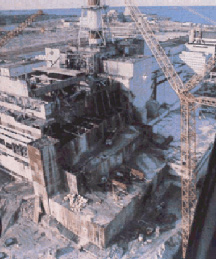
War in Ukraine. What are the risks of a nuclear accident around the
Zaporijjia power plant? For weeks, the international community has had its
sights set on the Zaporijjia nuclear power plant, which the Russians and
Ukrainians have accused each other of bombing. This Thursday, September 1,
IAEA experts arrived at the plant to assess the security situation there.
Its director general, Rafael Grossi, had earlier warned of the “real risk
of nuclear disaster”. What are the real risks of a nuclear accident around
this plant? In Zaporijjia, near the eponymous nuclear power plant, occupied
by Russian forces and the target of regular bombardments, the inhabitants
are now preparing for the worst, and some are already imagining seeing the
reactors explode.
Because the fighting around this power plant with its
imposing silhouette, the largest in Europe, has revived painful memories of
the Chernobyl disaster, which occurred in Ukraine on April 26, 1986. That
year, a reactor exploded, causing the largest civilian nuclear accident in
history and releasing a radioactive cloud that spread across Europe.
According to the UN, around thirty operators and firefighters lost their
lives there, killed by acute radiation, but the human toll of the disaster
is still debated today. According to different sources, the number of
deaths as a result of this nuclear accident varies from a few hundred to
several thousand. The NGO Greenpeace even estimates that it would have
caused 200,000 additional deaths between 1990 and 2004.
Thirty-six years later, this Chernobyl disaster is still present in people’s minds, and some
fear that the scenario will repeat itself in Zaporijjia. But are the fears
of the inhabitants of Zaporijjia, located barely fifty kilometers as the
crow flies from the plant, really justified? Is a serious nuclear accident
really possible?
“Yes, serious accidents are possible, nuclear power plants
being machines that are intrinsically very sensitive to external
aggressions and not being designed to operate in a context of armed
conflict” , explains Bernard Laponche, former nuclear engineer at the
Commissariat at the atomic energy (CEA), doctor in nuclear physics and
president of the Global Chance association. And this, especially since no
one knows today what the current state of this plant is.
Ouest France 1st Sept 2022
UN thanks Russia for keeping nuclear team safe
https://www.rt.com/russia/562010-un-thanks-russia-nuclear-safety/ 1 Sept 22, Russia “did what it needed to do” to get inspectors to front-line facility
The UN is appreciates Russia’s efforts to safeguard the International Atomic Energy Agency (IAEA) team that came to inspect the Zaporozhye nuclear power plant, on Thursday.
That’s according to the secretary-general’s chief spokesman, who was speaking after the Russian Defense Ministry said it was “bewildered” at the lack of reaction to an alleged Ukrainian attempt to seize the facility by force.
“We are glad that the Russian Federation did what it needed to do to keep our inspectors safe,” Stephane Dujarric told reporters at a briefing in New York, when asked about Moscow’s comments.
“As with any UN mission, it is the responsibility of those who control a certain area to keep the UN staff safe,” he added, also thanking the “security people” and “drivers” for the “tremendous job” of getting the IAEA team safely in and out of the Zaporozhye NPP.
The mission, led by IAEA director Rafael Grossi, was delayed at a Ukrainian checkpoint on Thursday morning. It eventually made its way to Russian-controlled Energodar and toured the facility for several hours, before heading back to Ukrainian-controlled territory.
Right before their visit, however, Ukrainian artillery targeted the city of Energodar and the Zaporozhye NPP itself, while a group of commandos crossed the Kakhovka Reservoir by boat and attempted to storm the facility, the Russian Defense Ministry said.
Both the initial assault group and the reinforcements that followed were wiped out by the National Guard and combat helicopters, the Russian military said. Their goal, according to Moscow, was to seize the Russian-held power plant and use the IAEA staff as “human shields” to maintain control over the facility.
Energodar and the Zaporozhye NPP have been under Russian control since early March. In August, the nuclear site was targeted by regular artillery and drone attacks, which Moscow and Kiev blamed on each other. Ukrainian officials also claimed that the Russian military was using the plant as a military base, stationing heavy weapons there. Moscow denied the accusations, saying that it only had lightly armed guards defending the facility.
Moscow has called for an IAEA visit to Zaporozhye, Europe’s largest nuclear power plant, since June – but Ukraine’s insistence that the mission must travel through Kiev to uphold Ukrainian sovereignty contributed to delaying the mission until this week.
Fighting at Ukraine nuclear plant brings chances of a meltdown to a ‘coin toss’, expert says

“If you lose both the offsite power and the backup diesel generators, there are other emergency measures that could be employed, but you only have a few hours to be able to set those up before the core might start to melt,”
By Samantha Hawley and Flint Duxfield for ABC News Daily, 2 Aug 22,
As calls continue for an end to military activity around Ukraine’s Zaporizhzhia power plant, experts are warning there is significant risk of a nuclear accident.
Key points:
- Nuclear experts are becoming increasingly concerned of a nuclear disaster at Russian-occupied Zaporizhzhia nuclear power plant in Ukraine
- A team from the UN’s nuclear watchdog arrived at the facility overnight
- Europe’s biggest nuclear power plant has been shelled repeatedly in recent weeks, and Ukrainian staff are reportedly working under threat
This week the Russian military, which has controlled the facility since March, agreed to a safety inspection by experts from the United Nations’ International Atomic Energy Agency (IAEA), who arrived overnight.
Despite this, the director of Nuclear Power Safety at the Union of Concerned Scientists, Edwin Lyman, said there was a significant possibility the situation could end badly.
“It’s probably a coin toss at this point,” he said.
While the fate of Europe’s biggest nuclear power plant has been thrust into the spotlight in recent weeks, Dr Lyman told ABC News Daily he became concerned the minute Russia set its sights on the facility in early March.
“When Russia started lobbing artillery shells at the plant and when a fire broke out, it was of extreme concern because one thing the nuclear power plant doesn’t handle too well is a large fire,” he said.
The fire was quickly contained, but as Russian forces took control of the plant, safety concerns only continued to grow.
Since then, there have been reports around 9,000 of the plant’s staff have been forced to continue working at gunpoint, and that some have been beaten and tortured.
“There is evidence that the Russians were intimidating the staff, not allowing them to report safety issues, accusing them of being spies or saboteurs and of physical abuse,” Dr Lyman said.
“These are obviously very poor conditions for the staff to work in.”
Plant under attack
In the past fortnight there have been further reports of shelling of the plant, with both sides claiming the other was at fault.
Ukraine has accused Russia of using the plant as a military base to launch attacks against Ukrainian positions.
Meanwhile, Russian Defence Ministry spokesman Igor Konashenkov said this week that nine shells fired by the Ukrainian artillery in two separate attacks had landed in the nuclear plant’s grounds.
While Dr Lyman doesn’t believe these kinds of attacks are likely to cause a major problem for the reactors themselves, he said there is still a risk they could damage other vital parts of the plant or make it difficult to maintain the reactors.
“The most dangerous parts of the plant, like the nuclear fuel in the reactors, is contained and under a fairly strong reinforced concrete containment building,” he said.
“Even if you had direct artillery fire on the containment, unless it was a sustained shelling, deliberately trying to destroy it, then it probably wouldn’t cause that much damage.”
However, Dr Lyman warned other parts of the plant were more susceptible to artillery fire.
“The turbine that’s used to convert the hot water or the steam that’s generated by the nuclear reactor into electricity are in less-protected buildings,” he said.
A power plant in need of power
A greater concern than artillery fire, experts believe, is the potential for the plant to lose its offsite power connection, something that has already happened twice in the past few weeks.
While it might seem strange that a power plant’s most vital input is electricity, external power is crucial in cooling the reactors to prevent them from overheating.
To reduce risk of meltdown, four of the plant’s six reactors have already been put into cold shutdown since the outbreak of the war.
But because the plant is responsible for around 20 per cent of Ukraine’s energy supply, shutting the remaining reactors would be a significant loss for the country.
The plant does have three external electricity supply lines, but these have all lost connection in recent weeks due to the conflict.
Last week, the company responsible for the plant, Energoatom, said fires at a nearby thermal power station had caused the nuclear plant’s last remaining electricity power line to be disconnected twice.
Ukrainian President Volodymyr Zelenskyy said the plant’s 20 backup diesel generators had to be “immediately activated” to avert a “radiation disaster”.
“If the diesel generators hadn’t turned on, if the automation and our staff of the plant had not reacted after the blackout, then we would already be forced to overcome the consequences of the radiation accident,” Mr Zelenskyy said in his nightly briefing.
Dr Lyman said the fact that the site has already lost offsite power showed how precarious the situation was.
“If you lose both the offsite power and the backup diesel generators, there are other emergency measures that could be employed, but you only have a few hours to be able to set those up before the core might start to melt,” he said.
Meltdown could happen in hours
One simulation of the reactors losing power showed they would have just over an hour before the cooling systems stopped working.
It predicted that the reactor would heat up so quickly that it would take less than five hours for it to break through the reactor vessel.
Even if that occurs, experts say a strong protective casing around the reactors means a Chernobyl-style disaster isn’t likely………………………
Ukraine prepares for radiation leaks
The Ukrainian government has begun preparations for the possibility of a radiation leak.
In recent weeks it has run emergency drills in nearby towns and distributed iodine tablets to residents.
Iodine helps prevent radiation from amassing in the thyroid, leading to thyroid cancer; a phenomena witnessed after the Chernobyl meltdown in hundreds of Ukrainian children.
While Dr Lyman believes it is a sensible precaution, he warned it would not be enough to protect people in the case of a leak.
“In nuclear reactors, you have a sea of a soup of hundreds of different types of radioactive isotopes, all of which interact in different ways of the body,” he said.
“So you can’t do much about that except to either evacuate to avoid exposure or to shelter for a long time in a structure that’s shielded against radiation.
“That’s why the best thing is to prevent any release in the first place.”
Overnight inspectors from the IAEA travelled to the city of Zaporizhzhia.
Experts from the team will remain on site to provide an impartial, neutral and technically sound assessment of the situation.
“I worried, I worry and I will continue to be worried about the plant until we have a situation which is more stable, which is more predictable,” IAEA head Rafael Grossi, who personally led the mission, told reporters after returning to Ukrainian-held territory…………………
https://www.abc.net.au/news/2022-09-02/fears-nuclear-disaster-zaporizhzhia/101394618
Pentagon admits ‘likelihood’ of Ukrainian shelling near nuclear plant
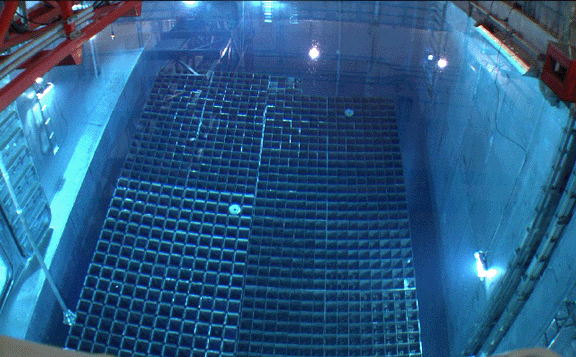
the biggest danger is not a reactor meltdown, but Ukrainian artillery striking the open-air spent fuel storage, which would result in a radioactive release
US officials responded to questions about Kiev’s forces targeting Zaporozhye,
https://www.rt.com/russia/561769-pentagon-ukraine-nuclear-shelling 30 Aug 22,
A senior US military official admitted on Monday that Ukrainian forces may have struck the area around the Zaporozhye Nuclear Power Plant, but insisted that this was only in response to Russian fire allegedly coming from the area. Earlier in the day, the Russian authorities said a Ukrainian artillery shell damaged the roof of the building storing reactor fuel.
“What I know for sure is that the Russians are firing from around the plant,” the unnamed official told reporters during a background briefing at the Pentagon. “I also know that there are rounds that have impacted near the plant.”
The official said it was “hard to explain, I guess” how the US was monitoring the situation around the nuclear power plant, Europe’s largest.
“And I don’t want to say that the Ukrainians haven’t fired in that vicinity either because I think there’s probably a likelihood that they have, but in good – in a number of cases, it’s returning fire of the Russians who are firing from those locations,” he said.
Russian forces established control of the Zaporozhye NPP in early March. National guard and nuclear protection specialists secured the site while the Ukrainian staff continued to operate without hindrance. The government in Kiev claims that Russian forces turned the plant into a military base from which they were attacking Ukrainian targets, but also that Russian troops were shelling themselves in a false-flag ploy to make Ukraine look bad.
The US official claimed “the Ukrainians are very aware of the potential impacts of striking the nuclear power plant and they’re going out of their way not to do that.”
Moscow has provided evidence to the UN of repeated Ukrainian attacks on the Zaporozhye NPP and the nearby town of Energodar since July, using kamikaze drones and even US-supplied artillery. The latest attack came on Monday, when a round breached the roof of a building where fresh reactor fuel was being stored, a member of the local administration said.
On Sunday, a drone was shot down over the plant, while Ukrainian artillery strikes on Energodar injured nine civilian residents.
Kiev has demanded that Russia hand the Zaporozhye NPP back over to Ukrainian control, or at least demilitarize a 30-kilometer area around it. On Monday, US National Security Council spokesman John Kirby also urged demilitarization, as well as a shutdown of the reactors. The US has previously echoed Kiev’s accusations that Moscow wants to “steal Ukraine’s electricity” by shutting down the plant or disconnecting it from the Ukrainian grid.
According to Russian nuclear experts, the biggest danger is not a reactor meltdown, but Ukrainian artillery striking the open-air spent fuel storage, which would result in a radioactive release.
International Atomic Energy Agency (IAEA) chief Rafael Grossi is personally leading the mission that is supposed to visit the plant this week.
Satellite images show damage to buildings right next to Zaporizhzhia nuclear reactors
Satellite images show damage to Ukraine nuclear plant buildings right next
to reactor. Satellite images show armoured personnel carriers stationed
near Zaporizhzhia nuclear plant’s reactors.
Independent 30th Aug 2022
Shelling ‘leaves HOLES in roof of Russian-occupied nuclear power plant’:
Images reveal damage at Zaporizhzhia site – with Putin’s forces blaming
Ukrainian artillery for potential disaster.
Daily Mail 30th Aug 2022
U.S. Calls For ‘Controlled Shutdown’ Of Zaporizhzhya Plant As IAEA Inspectors Seek Access
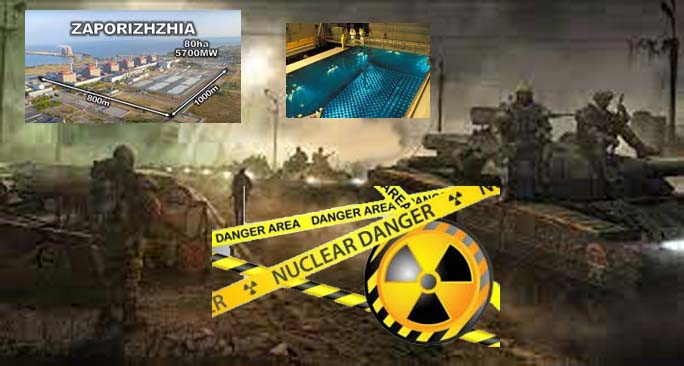
Radio Free Europe 29 Aug 22, The United States said a “controlled shutdown” of the Russian-occupied Zaporizhzhya nuclear power plant in southern Ukraine was the “safest option” and urged Moscow to agree to a demilitarized zone around the site, where increased fighting is sparking fears of a possible massive radiation leak.
“As we’ve said many times, a nuclear power plant is not the appropriate location for combat operations,” White House national security spokesman John Kirby told reporters on August 29.
“We continue to believe that a controlled shutdown of the Zaporizhzhya nuclear reactors would be the safest and least risky option in the near term,” he added.
His comments come as a mission from the UN nuclear safety agency is due to arrive in Kyiv late on August 29 and quickly travel on to the Russian-occupied nuclear plant.
It was not immediately clear if the team would be allowed access to the nuclear site by occupying Russian forces.
Rafael Grossi, head of the International Atomic Energy Agency (IAEA), said in a post on Twitter that the “day has come” and a team of IAEA experts was “now on its way” to the nuclear power plant, which Russian invading forces have controlled since shortly after the Russian invasion began on February 24.
“We must protect the safety and security of #Ukraine’s and Europe’s biggest nuclear facility. Proud to lead this mission which will be in #ZNPP later this week.”
The Ukrainian Foreign Ministry said the IAEA mission was due to reach Kyiv on August 29 and “start work at the Zaporizhzhya nuclear plant in the coming days.”
The IAEA’s experts were set to assess physical damage to the plant, determine the functionality of safety and security systems, evaluate staff conditions, and perform urgent safeguards activities, the agency said.
Neither he nor the agency specified when they would arrive at Zaporizhzhya.
………………….The United Nations and Ukraine have called for a withdrawal of military equipment and personnel from the plant to ensure it is not a target in the conflict.
………….. The G7’s Non-Proliferation Directors’ Group welcomed news of the IAEA’s trip and again voiced concerns about the safety of the plant under the control of Russian armed forces.
“We reaffirm that the Zaporizhzhya Nuclear Power Plant and the electricity that it produces rightly belong to Ukraine and stress that attempts by Russia to disconnect the plant from the Ukrainian power grid would be unacceptable,” it said in a statement issued on August 29.
Russia’s permanent representative to international organizations in Vienna, Mikhail Ulyanov, said Moscow welcomed the IAEA mission and said Russia had made a significant contribution to the visit, the RIA Novosti news agency reported.
Safety fears at the facility have escalated in recent weeks as Kyiv and Moscow have traded blame for rocket strikes around the facility in the southern Ukrainian city of Enerhodar.
…………. Attacks were reported over the weekend not only in Russian-controlled territory adjacent to the plant along the left bank of the Dnieper River, but along the Ukraine-controlled right bank, including the cities of Nikopol and Marhanets, each about 10 kilometers from the facility.
Ukraine’s atomic energy agency, Enerhoatom, issued on August 28 a map forecasting where radiation could spread from the power plant in the event of an accident, showing that based on wind forecasts for August 29 a nuclear cloud could spread across southern Ukraine and southwestern Russia.
Authorities last week began distributing iodine tablets to residents who live near the Zaporizhzhya plant in case of radiation exposure.
Much of the concern centers on the cooling systems for the plant’s nuclear reactors. The systems require electricity, and the plant was temporarily knocked offline on August 25 because of what officials said was fire damage to a transmission line. A cooling system failure could cause a nuclear meltdown.
Periodic shelling has damaged the power station’s infrastructure, Enerhoatom said on August 27.
The IAEA reported on August 28 that radiation levels were normal, that two of the Zaporizhzhya plant’s six reactors were operating, and that while no complete assessment had yet been made, recent fighting had damaged a water pipeline, since repaired. https://www.rferl.org/a/ukraine-zaporizhzhya-nuclear-iaea-inspection-russia-invasion/32008573.html
Nuclear: EDF extends the shutdown of four reactors for several weeks. (Translation)
The energy company announced on Thursday that reactors 1, 3 and 4 of the Cattenom power plant, as well as reactor 1 of Penly, will only be reconnected to the electricity network between November and January. An announcement related to the stress corrosion problem detected since last fall on several units.
By Les Echos
Posted on August 25, 2022 at 5:55 PMUpdated on August 25, 2022 at 6:04 p.m.
France will have to do without at least four nuclear reactors until the beginning of winter. This Thursday, EDF announced the extension, for several weeks, of the shutdown of units affected by the problem of stress corrosion detected for the first time in the fall of 2021.
According to the new provisional timetable published by the energy company, reactors 1 and 4 of the Cattenom power plant, in Moselle, will be reconnected to the electricity network on November 1 and 14 respectively . Reactor number 3 will resume service on December 11, while unit number 1 of the Penly power plant (Seine-Maritime) will not be reconnected until January 23……… (subscribers only) https://www.lesechos.fr/industrie-services/energie-environnement/nucleaire-edf-prolonge-pour-plusieurs-semaines-larret-de-quatre-reacteurs-1783781#utm_source=newsletter&utm_medium=email&utm_campaign=nl_lec_18h&utm_content=20220825&xtor=EPR-5020-%5B20220825
Imperiled Ukrainian nuclear power plant has the world on edge – a safety expert explains what could go wrong
The Conversation, Najmedin Meshkati, 26 Aug 22, “…………………………………… What are the risks to a nuclear plant in a conflict zone?
Nuclear power plants are built for peacetime operations, not wars.
The worst thing that could happen is if a site is deliberately or accidentally shelled. If a shell hit the plant’s spent fuel pool – which contains the still-radioactive spent fuel – or if fire spread to the spent fuel pool, it could release radiation. This spent fuel pool isn’t in the containment building, and as such is more vulnerable.
Containment buildings, which house nuclear reactors, are also not protected against deliberate shelling. They are built to withstand a minor internal explosion of, say, a pressurized water pipe. But they are not designed to withstand a huge explosion.
As to the reactors in the containment building, it depends on the weapons being used. The worst-case scenario is that a bunker-buster missile breaches the containment dome – consisting of a thick shell of reinforced concrete on top of the reactor – and explodes. That would badly damage the nuclear reactor and release radiation into the atmosphere, which would make it difficult to send in first responders to contain any resulting fire. It could be another Chernobyl.
What are the concerns going forward?
The safety problems I see are twofold:
1) Human error……….
2) Power failure
The second problem is that the nuclear plant needs constant electricity, and that is harder to maintain in wartime.
Even if you shut down the reactors, the plant will need off-site power to run the huge cooling system to remove the residual heat in the reactor and bring it to what is called a cold shutdown. Water circulation is always needed to make sure the spent fuel doesn’t overheat.
Spent fuel pools also need constant water circulation to keep them cool, and they need cooling for several years before they can be put in dry casks. One of the problems in the 2011 Fukushima disaster in Japan was the emergency generators intended to replace lost off-site power got inundated with water and failed. In situations like that, you get “station blackout” – and that is one of the worst things that could happen. It means no electricity to run the cooling system.
In that circumstance, the spent fuel overheats and its zirconium cladding can create hydrogen bubbles. If you can’t vent these bubbles, they will explode, spreading radiation.
If there is a loss of outside power, operators will have to rely on emergency generators. But emergency generators are huge machines – finicky, unreliable gas guzzlers. And you still need cooling waters for the generators themselves.
My biggest worry is that Ukraine suffers from a sustained power grid failure. The likelihood of this increases during a conflict because power line pylons may come down under shelling, or gas power plants might get damaged and cease to operate. …………………….
How else does a war affect the safety of nuclear plants?
One of the overarching concerns about the effects of war on nuclear plants is that war degrades safety culture, which is crucial in running a plant……………………..
War adversely affects safety culture in a number of ways. Operators are stressed and fatigued and may be scared to death to speak out if something is going wrong. Then there is the maintenance of a plant, which may be compromised by lack of staff or unavailability of spare parts.
Governance, regulation and oversight – all crucial for the safe running of a nuclear industry – are also disrupted, as is local infrastructure, such as the capability of local firefighters. In war, everything is harder…………….. https://theconversation.com/imperiled-ukrainian-nuclear-power-plant-has-the-world-on-edge-a-safety-expert-explains-what-could-go-wrong-189429
1 This Month

10 March A LIVE WEBINAR THE REAL EFFECTS OF NUCLEAR POWER
What the Industry Isn’t Telling Us
1:00 PM Mountain, 2 pm Central, 3 pm Eastern. Live on the Keepers of the Water Facebook page

18 March Webinar @ 1 PM EST: An Assessment of SMR Projects: The Case of Canada
register for the zoom:
https://us02web.zoom.us/webinar/register/WN_o8BIIOUvQ2ONJR1nta65DQ#/registration


of the week – STOP SMALL MODULAR REACTORS IN CANADA
To see nuclear-related stories in greater depth and intensity – go to https://nuclearinformation.wordpress.com
-
Archives
- March 2026 (9)
- February 2026 (268)
- January 2026 (308)
- December 2025 (358)
- November 2025 (359)
- October 2025 (376)
- September 2025 (258)
- August 2025 (319)
- July 2025 (230)
- June 2025 (348)
- May 2025 (261)
- April 2025 (305)
-
Categories
- 1
- 1 NUCLEAR ISSUES
- business and costs
- climate change
- culture and arts
- ENERGY
- environment
- health
- history
- indigenous issues
- Legal
- marketing of nuclear
- media
- opposition to nuclear
- PERSONAL STORIES
- politics
- politics international
- Religion and ethics
- safety
- secrets,lies and civil liberties
- spinbuster
- technology
- Uranium
- wastes
- weapons and war
- Women
- 2 WORLD
- ACTION
- AFRICA
- Atrocities
- AUSTRALIA
- Christina's notes
- Christina's themes
- culture and arts
- Events
- Fuk 2022
- Fuk 2023
- Fukushima 2017
- Fukushima 2018
- fukushima 2019
- Fukushima 2020
- Fukushima 2021
- general
- global warming
- Humour (God we need it)
- Nuclear
- RARE EARTHS
- Reference
- resources – print
- Resources -audiovicual
- Weekly Newsletter
- World
- World Nuclear
- YouTube
-
RSS
Entries RSS
Comments RSS
 nuclear-news