France’s EDF shuts down two nuclear reactors after fire at Chinon plant

Reuters, February 11, 2024, https://www.reuters.com/business/energy/frances-edf-shuts-down-two-nuclear-reactors-after-fire-chinon-plant-2024-02-10/
—
Nuclear energy operator EDF has shut down two reactors at Chinon in western France after a fire in a non-nuclear sector of the plant in the early hours of Saturday, the company said.
The fire has been extinguished, it said.
“Production unit number 3 at the Chinon nuclear power plant has shut down automatically, in accordance with the reactor’s safety and protection systems,” EDF said in a statement, adding it also shut down reactor number 4, which is coupled to number 3.
France’s nuclear safety watchdog said in a separate statement the fire had led to an electricity cut at the plant that triggered the automatic shutdown.
Chinon is one of France’s oldest nuclear plants.
Reporting by Tassilo Hummel; editing by Barbara L
5.5 tons of radioactive water leaked from Fukushima nuclear plant: media
China Daily, Xinhua 2024-02-07
TOKYO — Approximately 5.5 tons of water containing radioactive materials have leaked from an equipment at Japan’s Fukushima Daiichi nuclear power plant, local media reported Wednesday.
At about 8:53 am local time on Wednesday, workers discovered water leaking from the outlet of a device used to purify nuclear-contaminated water during the inspection of the equipment, Fukushima Central Television reported, citing the plant’s operator Tokyo Electric Power Company (TEPCO).
TEPCO estimates that the amount of water that leaked was approximately 5.5 tons, which may contain 22 billion becquerels of radioactive materials such as cesium and strontium, the report said.
Most of the leaked water appeared to have seeped into the soil, but monitoring of a nearby drainage channel did not show any significant radiation level changes, it added.
TEPCO has made the area where the water was leaked a no-go area……………………………. more https://www.chinadaily.com.cn/a/202402/07/WS65c35af9a3104efcbdaea423.html
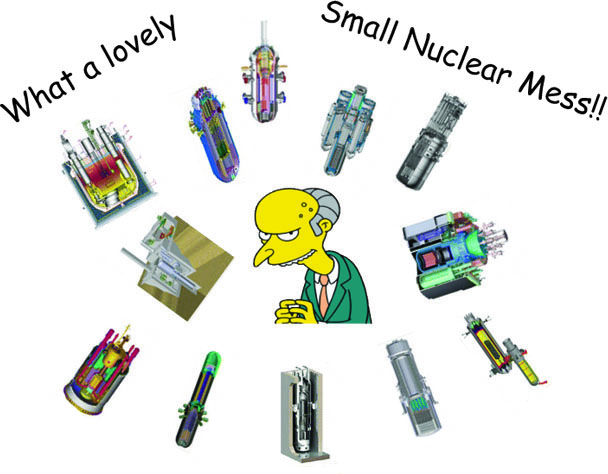
The dangerous craze for SMRs
This is going too far in trivializing risk. And this is not limited to “acceptability” which seems to be ASN’s major concern, but to the risks of such “mixed” installations.

a serious accident situation (AZF, Lubrizol) could damage the SMR unit and transform the accident into a disaster.
Bernard Laponche, Doctor of Science in Nuclear Reactor Physics, President of the Global Chance association, Le Club Mediapart, 5th Feb 2024 https://blogs.mediapart.fr/bernard-laponche/blog/050224/le-dangereux-engouement-pour-les-smr
The development of small modular nuclear reactors (SMR) is the subject of spectacular announcements.Based on the declarations of the Nuclear Safety Authority (ASN) on this
subject, we launch an appeal for reason on the realities and difficulties of such projects, on the technical, safety and security levels .
During his press conference on January 31, 2024, the president of the Nuclear Safety Authority (ASN) addressed the issue of small modular nuclear reactors, known as SMRs, and answered some questions on this subject.
In his presentation, the president highlights the technical and societal questions posed by these new reactors, as well as the safety, security and non-proliferation issues “to be integrated upstream of the projects”.
These are the usual concerns when we are interested in nuclear reactors, which produce heat and possibly electricity from fission and chain reactions of fissile elements (uranium, plutonium), but also products fission and transuranium elements found in irradiated fuels currently intended for reprocessing, leading to the accumulation of radioactive waste in addition to that from the dismantling of reactors. These are the problems that will have to be analyzed for candidate SMR reactors, as for any nuclear reactor and with the same rigor as for conventional reactors.
In the same way that a conventional industrial installation cannot claim to be free from all risk of accident, no nuclear installation can claim to be free of any risk of accident. The declaration “a nuclear accident is possible in France” by successive ASN officials is valid for SMRs, even if, as its current president says, certain innovative SMRs “present potentially promising intrinsic safety characteristics” .
The first “prototype” examples of candidate reactors under the title of SMR, that is to say intended to be mass-produced in a factory before installation on site, will therefore have to be built on nuclear sites, probably those housing research reactors.
As ASN points out, the use of SMR in France would not be of great interest for the production of electricity given the importance of the current fleet of EDF power plants and the announced projects. But, on the other hand, SMRs could be very useful for the production of heat or steam for the process industries (paper, food, chemical industries, etc.) of which there are very many.
It would then be necessary to install the SMR reactor very close to the industrial installation or even, according to ASN, inside this installation.
This is going too far in trivializing risk. And this is not limited to “acceptability” which seems to be ASN’s major concern, but to the risks of such “mixed” installations.
Indeed, we cannot admit the presence of a basic nuclear installation, containing highly radioactive materials within a classic industrial installation, of the ICPE type in which a serious accident situation (AZF, Lubrizol) could damage the SMR unit and transform the accident into a disaster.
Furthermore, it is clear that each promoter of an SMR candidate aims for a large order in the number of copies (of the order of a hundred say some) which will allow the “modular” manufacturing of reactors in a dedicated factory, this allowing the supposed reduction in unit cost.
In this case, by eliminating the solution of an SMR in the plant itself, we would have the creation of a large number of INB-ICPE couples. Even if we admit that the probability of an accident on the SMR is lower than for a conventional reactor (which remains to be demonstrated for each case), this probability is multiplied by the number of reactors, all identical.
In examining the safety files for EDF’s large power reactors and nuclear fuel plants, ASN and IRSN pay very close attention to “external attacks” of natural or malicious origin. What happens to these concerns for SMS located almost everywhere on the territory, on locations which are those of the industrial installation which they must supply with heat and whose location was chosen without any concern for nuclear safety and security? ? How would specific protection be organized which, to be effective, would certainly be expensive, especially since the SMRs concerned would be of low power?
The profusion of candidate projects for SMR, some of which are financially supported by the Government, leads to each being examined by the IRSN and the ASN, as announced by the latter. This examination can be postponed over time depending on the maturity of the projects, all of which currently only exist on file, more or less elaborate.
If this examination is done correctly, that is to say with as much care as for a power reactor, the examination of the technical and safety files of each SMR prototype is a considerable task. We can fear that the “craze” for SMRs that ASN speaks of will exert dangerous pressure on the quality of studies and safety and security injunctions.
Finally, but this is not the problem of the IRSN and the ASN, we would still need to have serious information on the costs. Not only that of the construction of a prototype (the example of NuScale in the United States is edifying) but also that of its exploitation and especially that of the fuel, from its manufacture to its treatment after use, dismantling and management garbage.
When we examine in the light of what we know of the climatic upheavals which are already affecting our territory and will intensify considerably, we can really ask ourselves the question of the fragility and the risk of installing a little small nuclear reactors everywhere which will obviously be subject, depending on the period and their site, to floods, droughts, storms, tornadoes, earthquakes, etc.
All those who today say they want to welcome an SMR on their territory should really think about it seriously.
IAEA watchdog to visit nuclear plant in occupied Ukraine to assess safety of ageing fuel and low staffing.
UN nuclear watchdog chief Rafael Grossi said
he would visit the Zaporizhzhia nuclear power plant in Russian-occupied
Ukraine today to see if it can be run with a reduced number of staff and
whether its years-old uranium fuel is safe. Russia gained control of
Europe’s largest nuclear power plant after launching a full-scale
invasion of Ukraine in early 2022, and its six nuclear reactors are now
idled.
Irish Independent 7th Feb 2024
Zaporizhzhia Nuclear Power Plant is falling apart, and the world is ignoring the danger
Leaks, power outages, low staffing, and no maintenance plan. Europe’s largest nuke plant is falling apart.
Malcontent, February 3, 2024, By David Obelcz
[WBHG 24 News] – The latest reports from the International Atomic Energy Agency (IAEA), which has had a team of international inspectors at the Zaporizhzhia Nuclear Power Plant for 16 months, painted an alarming picture of leaking steam generation circuits and safety systems, inadequate staff, and no 2024 maintenance plan.
Europe’s largest nuclear power plant is located in occupied Enerhodar. Previously located on the banks of the Kakhovka Reservoir, the primary source of cooling water for ZNPP drained away in June 2023 after the Kakhovka Dam was destroyed. Russian forces captured the plant on March 3, 2022, during the opening days of the expanded war of aggression against Ukraine. Webcams showed Russian tanks firing on the power plant and shooting into administrative buildings during the brief siege.
After pictures, videos, and satellite images proved that Russian forces had militarized the plant in violation of international humanitarian law and the pillars of nuclear safety, the IAEA, backed by the United Nations, pressured Russia to establish an international group of permanent monitors. On September 1, IAEA Director General Rafael Grossi and a team of experts, accompanied by Russian state media, arrived at the plant. There have been 15 rotations of monitors since.
Three reactors have various leaks, and Russia doesn’t plan to fix them
Currently, five of the six reactors at ZNPP are in cold shutdown, with Reactor 4 in hot shutdown to provide steam for plant operations and heat for the nearby town of Enerhodar.
On November 17, IAEA inspectors were told by Russian occupiers that boron had been detected in the secondary cooling circuit of Reactor 4, which was in hot shutdown at the time. Boron is added to the primary cooling and steam circuits of modern nuclear reactors as an extra safety measure. Boron isn’t supposed to be the secondary cooling system, but trace amounts are acceptable.
Four days later, the reactor was shut down, with Russia declaring the boron leak was within acceptable levels and would not be repaired. This was the second unscheduled shutdown of 2023. On August 10, Reactor 4 had to be shut down after a water leak was discovered in one of its steam generators. Plant technicians also found that the heat exchangers needed to be cleaned and did regular maintenance on the reactor’s transformers and emergency diesel generators.
On December 22, inspectors found boric acid deposits on valves, a pump, and on the floors of several rooms in the containment building of Reactor 6. Russian occupation officials said the leak was coming from a cracked boric acid storage tank and it would not be repaired. After IAEA Director-General Rafael Grossi published the finding in a January 3 update, inspectors were barred from accessing parts of Reactor 6 for almost two weeks.
On February 1, the IAEA reported that boric acid leaks were also discovered in Reactor 1.
Unreliable external power connections
Although power plants generate electricity, power to run a power plant is provided by external sources. This provides a layer of safety by assuring that there is always electricity to support normal operations in the event of a facility shutdown. Although a nuclear reactor can be “shut down,” it still needs external power to continuously circulate cooling water in the reactors and on-site spent fuel storage. In the event of a total power failure, backup generators running on diesel fuel become the last line of defense. ZNPP has 20 generators and keeps enough diesel for a minimum of ten days of operation.
It’s estimated that if a ZNPP reactor is in cold shutdown, it can go more than three weeks without water circulation. But in hot shutdown, a meltdown can start 27 hours after the loss of all external power. In the worst-case scenario, the absolute last line of defense is when a nuclear plant operates in “island mode.” That’s when a reactor or reactors are used to generate onsite power to maintain plant operations. It’s inherently dangerous because it requires bringing a reactor online, leaving no margin for error if there are any additional failures. None of ZNPP’s reactors have produced electricity in the last 18 months…………………………………………………………………………………………………………… https://malcontentment.com/zaporizhzhia-nuclear-power-plant-is-falling-apart/
Japan’s Nuclear Follies
Nuclear energy may make sense in places where reactors can be operated safely, but Japan is a seismically active archipelago.
By Jeff Kingston, February 03, 2024, https://thediplomat.com/2024/02/japans-nuclear-follies/
A nuclear energy love fest surfaced at COP28 in the United Arab Emirates, where nuclear power was touted as the only option to save the planet from climate change. Yet, the 7.6 magnitude Noto earthquake on January 1 provided a stark reminder that operating nuclear power plants is risky business, especially in Japan. The powerful quake shook the idled Shika nuclear plant on the Noto Peninsula beyond design specifications. Fortunately, there was no major damage reported, but two of the back-up generators failed and there was temporary loss of power in one of the cooling pools.
Japan has been celebrating its recent moon landing, but it took a month to restore electricity on the quake-stricken Noto Peninsula and thousands will not have water until mid-March. Meanwhile, at the end of January some 14,000 residents remain displaced in evacuation shelters where conditions are grim.
Shika has been shut down since the Fukushima disaster in 2011, but electricity is essential for cooling the spent fuel rod pools; if cooling is interrupted the water evaporates and the rods could explode, releasing plumes of radiation into the windy skies. In such a scenario, Kanazawa – population 465,000, just over 60 km away – would have to be evacuated. This would not only devastate the regional economy but also put the brakes on incoming tourism, just as it ground to a halt nationwide following the three meltdowns at Fukushima 13 years ago.
Plans to build another reactor on the Noto Peninsula are now shelved, but it was always a puzzling site given major quakes and tsunami in 1964, 1983, and 1993. The area has experienced an earthquake swarm over the past three years. The 2024 peak ground acceleration was almost the same as during the 2011 Tohoku quake that triggered the the Fukushima disaster.
Problematically, the utility initially reported that there were no changes in water levels at coastal intake valves but later corrected this to a rise of 3 meters, the height of the tsunami that devastated coastal towns on the peninsula. Apparently, this was a communication glitch rather than a gauge fault, but the snafu prompted the Nuclear Regulation Authority (NRA) to admonish the utility for not learning key lessons from the Fukushima accident.
The NRA should look in the mirror.
According to NHK, the NRA acknowledged that its disaster response guidelines failed to anticipate a complex disaster as happened in Fukushima. In a nuclear accident, the NRA calls on residents to shelter in place, but that is not an option for those in Noto whose homes were destroyed by the combination of the earthquake, tsunami, and related fires. The 2011 triple disaster in Tohoku should have ensured that a cascading disaster is integrated into the emergency response plan. NHK also reported that most radiation monitoring devices on the peninsula failed to function, leaving authorities in the dark about radiation levels and dispersal. This would make it difficult to manage evacuation of the 150,000 residents within the 30 km evacuation zone around the plant.
The current disruptions to Noto’s transport and communication networks have slowed emergency relief efforts and would be further compromised in the event of a radiation release or one of the region’s epic snowfalls.
The NRA guidelines require towns in that zone to conduct evacuation drills because the Fukushima experience demonstrated that improvising an exodus can be catastrophic. Yet, over the past decade there have been no comprehensive evacuation drills anywhere and only nine staged exercises in the nation’s 15 nuclear plant zones.
One of these limited exercises was conducted in the Shika zone, but it was a fiasco. There is nothing more disconcerting than watching a botched evacuation drill aimed at reassuring residents. Authorities assumed the road leading to the plant would be impassable and planned to evacuate local residents by ship, but waves were too high, so they reverted to a time consuming and embarrassing bus evacuation by the road.
The implications for TEPCO, Japan’s biggest utility, are huge as it hoped to restart the world’s largest nuclear complex in neighboring Niigata, but anxieties and opposition have spiked and delayed that plan. Back in 2007 a major quake there jammed the emergency control room door, forcing the plant manager to manage the six reactors in the parking lot using whiteboards and mobile phones. Due to extensive revelations about a culture of lax safety practices and its shambolic disaster response in 2011, TEPCO has since discovered that trust is not a renewable resource.
At Fukushima the backup generators were inundated in the 2011 tsunami and failed to function, a key factor in the three meltdowns. Regulators had urged TEPCO to relocate the generators to higher, safer, ground behind the plant, but they were left in the lower vulnerable location between the plant and the ocean. This is an example of regulatory capture in which regulators kowtow to the regulated. Thirteen years ago, the Fukushima meltdowns displaced more than 450,000 people in the vicinity and even now there are still nearly 30,000 nuclear refugees and many people remain barred from returning to their homes due to radiation. Once vibrant communities have become ghost towns. Subsequently, across the nation everyone understands that in a nuclear disaster the government and utilities can’t be relied on.
Despite this stark situation, in December 2022, Prime Minister Kishida Fumio announced plans to restart Japan’s aging fleet of nuclear reactors, extend their operating licenses from 40 years to 60 years and build new reactors.
Back in 2012, The Economist determined that nuclear energy is not financially viable and that remains true. But generating costs can be reduced if corners are cut on safety in operating and maintaining nuclear reactors. The energy crisis triggered by Russian President Vladimir Putin’s invasion of the Ukraine created a window of opportunity for Kishida to overturn the safety regime established in the wake of Fukushima. In light of Japan’s backsliding on safety issues, China’s and Russia’s ambitious nuclear energy plans further cautions against the COP28’s nuclear exuberance, especially given these nations’ track records on transparency.
Japan’s nuclear renaissance confronts the lack of a permanent storage site for its nuclear waste. There is also no evidence that mothballed reactors approaching the 40-year operating limit are now safer, but without the benefit of stress tests the government has yet again wished risk away. By ignoring the lessons of Fukushima, the government is shortchanging public safety. Nuclear energy may make sense in places where reactors can be operated safely, but Japan is a seismically active archipelago and as we learned from Fukushima, human error in operating safety systems amplifies such risks. It is time for Japan to retire its nuclear reactors and invest more in renewable energy and smart grids.
Residents ask for full examination of damage to nuclear plant caused by quake
Japan Today, By MARI YAMAGUCHI, TOKYO, 3 Feb 24
A group of residents of towns near Japanese nuclear plants submitted a petition on Friday asking regulators to halt safety screening for the restart of idled reactors until damage to a plant that partially lost external power and spilled radioactive water during a recent powerful earthquake is fully examined.
The magnitude 7.6 quake on New Year’s Day and dozens of strong aftershocks in north-central Ishikawa prefecture left 240 people dead and 15 unaccounted for and triggered a small tsunami.
Two idled reactors at Shika nuclear power plant on the Noto Peninsula in Ishikawa suffered power outages because of damage to transformers. Radioactive water spilled from spent fuel cooling pools and cracks appeared on the ground, but no radiation leaked outside, operator Hokuriku Electric Power Co. said.
The damage rekindled safety concerns and residents are asking whether they could have evacuated safely if it had been more severe. The earthquake badly damaged roads and houses in the region.
All Japanese nuclear power plants were temporarily shut down after the 2011 Fukushima nuclear disaster for safety checks under stricter standards. The government is pushing for them to be restarted but the process has been slow, in part because of lingering anti-nuclear sentiment among the public. Twelve of the 33 workable reactors have since restarted.
Residents of Ishikawa and other towns with nuclear plants gathered in Tokyo on Friday and handed their petition to officials at the Nuclear Regulation Authority. They are asking officials to freeze the screening process while damage at the Shika nuclear plant is fully examined and safety measures are implemented.
Susumu Kitano, a Noto Peninsula resident, said there would be no way to escape from his town in case of a major accident at the plant.
Nuclear safety officials have noted that the extensive damage suffered by houses and roads in the area of the Shika plant make current evacuation plans largely unworkable. The damage, including landslides, made many places inaccessible, trapping thousands of people on the narrow peninsula.
Experts say current nuclear emergency response plans often fail to consider the effects of damage from compounded disasters and need to be revised to take into account more possible scenarios.
Takako Nakagaki, a resident of Kanazawa, about 60 kilometers (35 miles) south of the Shika plant, said the current evacuation plan is “pie in the sky.” Under the plan, residents closer to the plant are advised to stay indoors in case of a radiation leak, but that would be impossible if houses are damaged in an earthquake.
The Noto quake also sparked fear in neighboring Fukui prefecture, where seven reactors at three plants have restarted, and in Niigata prefecture, where the operator of the tsunami-hit Fukushima nuclear plant is preparing to restart its only workable nuclear plant, the world’s largest seven-reactor Kashiwazaki-Kariwa plant.
Hundreds of other residents of towns hosting nuclear plants submitted similar requests to regulators and Prime Minister Fumio Kishida earlier this week……………………. more https://japantoday.com/category/national/residents-ask-for-a-full-examination-of-damage-to-a-japanese-nuclear-plant-caused-by-a-recent-quake
Britain plans ‘robocop’ force to protect nuclear sites with paint bombs
AI-powered drones are being designed to cut labour costs and boost
security at Sellafield. Britain’s nuclear sites could soon be protected
by a “robocop” style police force made up of AI-powered drones equipped
with paint bombs and smoke guns.
The Nuclear Decommissioning Authority
(NDA), which runs high-security nuclear sites such as Sellafield and
Dounreay, wants to build a robotic police force to cut costs and boost
security across sites containing radioactive waste. It has offered £1.5m
to security and defence companies for initial designs of a robotic defence
system, with a view to commissioning a fully-fledged version in the future.
The NDA’s document for the project says that a key aim is to cut labour
costs by reducing the number of armed police. Currently, the Civil Nuclear
Constabulary employs nearly 1,600 people, with its cost bill rising to
£130m in 2022/23 – up from £110m in 2018.
The procurement document
said: “The NDA covers 17 nuclear sites, 1,000 hectares of land and over
800 buildings. We are interested in innovative ways to ensure our sites
remain safe and secure in a resource-constrained environment.” A
spokesman for the NDA confirmed the “roboforce” plans, claiming that
police officers will be able to control the technology without being
exposed to danger. “They will be able to override the system, or
investigate and deal with intruders from a control room,” the spokesman
said.
Telegraph 1st Feb 2024
France’s ASN nuclear safety authority warns of fraud risk in nuclear industry
ELISE WU, Montel Paris, 31 Jan 2024
Montel) The head of France’s ASN nuclear safety authority has revealed that it found 43 cases of fraud and forgery in the French nuclear industry last year, warning that the threat of corruption is growing.
“There are a fairly constant 40 or so situations reported to us each year,” said ASN chief Bernard Doroszczuk.
The cases were related to materials used in nuclear reactors as well as false certificates from welders and inspectors, he added.
“Inspections of the supply chain of materials used in the nuclear sector reveal recurring weaknesses: mainly a lack of knowledge among suppliers of safety requirements, a lack of…….. (Subscribers only) ……………………………..more https://www.montelnews.com/news/1536520/french-asn-warns-of-fraud-risk-in-nuclear-industry—
Campaigners Warn Return of US Nukes to UK Would ‘Make Britain a Guaranteed Target’

The U.S. is reportedly planning to deploy nukes “three times the strength of the Hiroshima bomb” to an air base in Suffolk.
JAKE JOHNSON, Feb 02, 2024, Common Dreams
Nuclear weapon abolitionists sounded alarm Friday in response to fresh evidence that the United States is planning to station nukes in the United Kingdom for the first time in more than 15 years, a move that opponents said would only heighten the risk of an atomic war.
The U.S. removed more than 100 nuclear bombs from Royal Air Force Lakenheath, a base in Suffolk, in 2008 following sustained protests from the U.K.-based Campaign for Nuclear Disarmament (CND) and other nonproliferation advocates.
CND warned in a statement Friday that the redeployment of nukes to Lakenheath would “make Britain a guaranteed target in the event of any war between NATO and Russia.”
Nuclear weapon abolitionists sounded alarm Friday in response to fresh evidence that the United States is planning to station nukes in the United Kingdom for the first time in more than 15 years, a move that opponents said would only heighten the risk of an atomic war.
The U.S. removed more than 100 nuclear bombs from Royal Air Force Lakenheath, a base in Suffolk, in 2008 following sustained protests from the U.K.-based Campaign for Nuclear Disarmament (CND) and other nonproliferation advocates.
CND warned in a statement Friday that the redeployment of nukes to Lakenheath would “make Britain a guaranteed target in the event of any war between NATO and Russia.”
“We encourage both the media and the public to increase pressure on the British government to be honest about this deployment,” said Kate Hudson, CND’s general secretary.
The Telegraphreported last week that “procurement contracts for a new facility at RAF Lakenheath in Suffolk confirm that the U.S. intends to place nuclear warheads three times the strength of the Hiroshima bomb at the air base.”………………………………………. more https://www.commondreams.org/news/us-nuclear-weapons-uk
Canadian Environmental Law Association (CELA) Disappointed in Province’s Decision on Pickering Nuclear Plant
Toronto (January 30, 2024) – https://cela.ca/media-release-cela-disappointed-in-provinces-decision-on-pickering-nuclear-plant/
Canadian Environmental Law Association (CELA) is disappointed in the decision released today by the Ontario Minister of Energy, directing Ontario Power Generation to proceed to seek a license to refurbish the Pickering Nuclear Generating Station.
CELA has participated for many years in licensing matters related to the Pickering site. In particular, CELA has undertaken in depth analysis of emergency planning readiness and has expressed very high concern for the protection of the surrounding communities in the event of a severe offsite nuclear accident.
“The population density around the Pickering plant is far too high for the continued operation of a nuclear power plant,” stated Theresa McClenaghan, Executive Director of CELA, “If such a proposal was brought forward today it would never pass the siting guidelines of the International Atomic Energy Agency that Canada says it follows. Putting a major commercial nuclear power plant in the midst of a high population area is unconscionable.”
For example, it is unrealistic to imagine that successful alerting and evacuation could move people out of harm’s way in time if something went seriously wrong. The length of time required for evacuating the various areas are highly impacted by traffic, weather, and other events that might be occurring simultaneously. The potential for getting potassium iodide distributed on time to all the children in the affected area would also be very questionable.
While it is hoped that a severe nuclear accident will never again happen in Ontario, the reality is that unexpected and extremely damaging severe accidents can occur. For that reason, high population areas and operating commercial nuclear plants are incompatible.
The 10-kilometer zone around Pickering extends well into the City of Toronto. Durham Region and the City of Toronto are both large, growing urban areas. “The 50 kilometer ‘ingestion zone’ covers much of the GTA,” said McClenaghan. “Based on public safety, CELA strenuously urges the province of Ontario to reconsider and reverse its decision to seek to refurbish Pickering, and instead proceed with the original plan for a safe and permanent shut down and decommissioning process.”
Safety concerns persist at Ukraine’s Zaporizhzhya Nuclear Power Plant (ZNPP)
Ukraine’s Zaporizhzhya Nuclear Power Plant (ZNPP) lost its immediate
back-up 750 kV power supply to the reactor units for several hours during
the week of 15 January.
This was the latest incident underlining persistent
nuclear safety and security risks at the site, director general Rafael
Mariano Grossi of the International Atomic Energy Agency said on 19 January
during its Update 207 report. Thursday’s failure of two of the ZNPP’s
back-up power electrical transformers showed the continuing vulnerability
in the availability of external power, which the plant needs to cool its
six reactors and for other essential nuclear safety and security functions.
Modern Power Systems 30th Jan 2024
https://www.modernpowersystems.com/news/newssafety-concerns-persist-at-znpp-iaea-update-11474827
Ontario to announce refurbishment of four reactors at Pickering Plant
MATTHEW MCCLEARN, JEFF GRAY, QUEEN’S PARK REPORTER, TORONTO, 30 Jan 24, https://www-theglobeandmail-com.cdn.ampproject.org/c/s/www.theglobeandmail.com/amp/canada/article-ontario-pickering-nuclear-reactor/
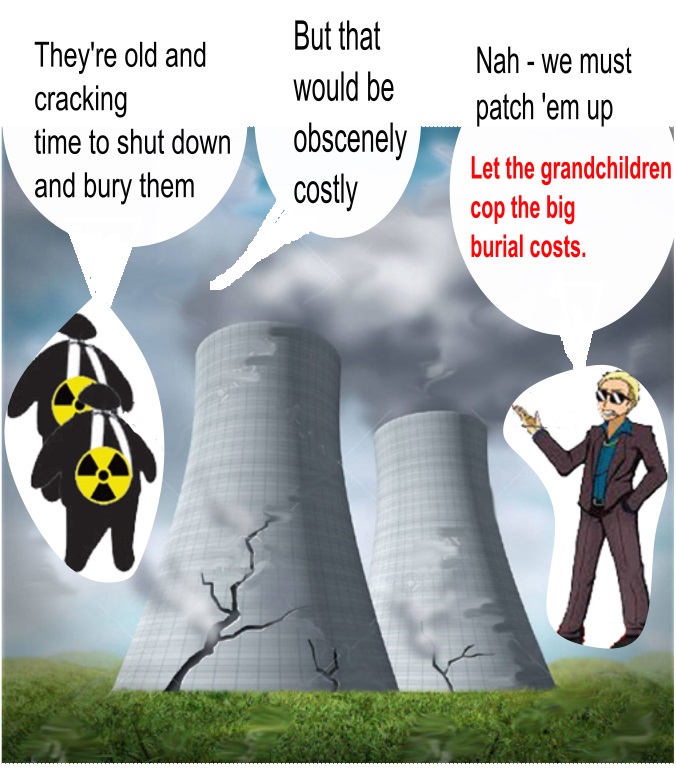
Ontario is proceeding with a massive, multibillion-dollar refurbishment of four aging nuclear reactors at its Pickering power plant east of Toronto, according to two provincial government sources.
The decision will be formally unveiled by Ontario Energy Minister Todd Smith at the facility in Pickering on Tuesday, a senior government source said. This would mark the government’s latest major move to preserve and expand the province’s reactor fleet.
Another government official said the province has approved a $2-billion budget for Ontario Power Generation, the plant’s owner, to complete the necessary engineering and design work and order crucial components, which can require years to manufacture. The Globe and Mail is not naming the sources, because they were not authorized to speak publicly about the decision.
No full cost estimate for the project has been revealed. Refurbishments under way at OPG’s Darlington nuclear plant in Clarington, and at Bruce Power’s station in Tiverton, have cost between $2-billion and more than $3-billion a reactor.
Mr. Smith’s announcement had been expected. In 2022, the province asked OPG to study the feasibility of refurbishing the four Pickering “B” units, which entered service in the mid-1980s and had previously been passed over for refurbishment 15 years ago. Mr. Smith received OPG’s report last summer, but his ministry rebuffed a request from this newspaper to release it underthe province’s freedom of information legislation.
The Pickering station, situated on the shore of Lake Ontario about 30 kilometres from downtown Toronto, generates about 15 per cent of Ontario’s power. It also includes the four 1970s-era Pickering “A” reactors, which are not currently being considered for refurbishment. Two have been dormant for decades after an aborted refurbishment, and the remaining two are scheduled to shut down permanently this year.
OPG’s current licence for Pickering B allows its reactors to operate only to the end of this year. OPG has applied to the Canadian Nuclear Safety Commission, which regulates the industry, for permission to operate them until late 2026. CNSC approval would also be required for a refurbishment.
Refurbishment involves replacing major components to extend reactors’ operating lives by 30 years, although the list of required upgrades varies from station to station. Subo Sinnathamby, OPG’s chief projects officer, told The Globe earlier this month that, if the project were approved, OPG would begin Pickering’s refurbishment in 2028, with the goal of returning its reactors to service by the mid-2030s. Previous refurbishments have unfolded over longer periods.
“It is a compressed timeline,” she acknowledged. But she added that this time OPG will benefit from the experience it and its contractors and suppliers gained during previous refurbishments.
Failure to deal with Trident concerns ‘puts Scots lives at risk’
FAILING to address acute concerns about the state of Trident nuclear
submarines is putting Scottish lives “at risk” and shows Westminster’s
“blatant disregard for Scotland”, an MP has said.
Martin Docherty-Hughes issued the warning ahead of a debate in Parliament today,
in which he will attempt to get answers from the UK Government over serious
concerns raised by a top insider about Britain’s nuclear weapons. The SNP
defence spokesperson will lead an adjournment debate on Wednesday evening
to highlight bombshell comments from former top government adviser Dominic
Cummings.
Cummings sparked concerns about Trident when he claimed to have
sought assurances from Prime Minister Rishi Sunak that he would deal with
the “scandal” of nuclear weapons infrastructure which he described as a
“dangerous disaster and a budget nightmare of hard-to-believe and highly
classified proportions”.
The National 24th Jan 2024
https://www.thenational.scot/news/24070255.failure-deal-trident-concerns-puts-scots-lives-risk/
UK’s Ministry of Defence has continued to allow critical parts of the nuclear weapons infrastructure to rot
Dominic Cummings said amongst other things the MoD has: continued to allow
critical parts of the nuclear weapons infrastructure to rot creating
further massive secret budget nightmares as well as extremely serious
physical dangers (cf. the recent near disaster with a submarine),
UK Parliament 24th Jan 2024
1 This Month
Chernobyl: The Lost Tapes – A good documentary on Chernobyl on SBS available On Demand for the next 3 weeks– https://www.sbs.com.au/ondemand/tv-program/chernobyl-the-lost-tapes/2352741955560

of the week–London Campaign for Nuclear Disarmament

Tell the Ukrainian Government to Drop Prosecution of Peace Activist Yurii Sheliazhenko
To see nuclear-related stories in greater depth and intensity – go to https://nuclearinformation.wordpress.com
-
Archives
- April 2026 (114)
- March 2026 (251)
- February 2026 (268)
- January 2026 (308)
- December 2025 (358)
- November 2025 (359)
- October 2025 (376)
- September 2025 (257)
- August 2025 (319)
- July 2025 (230)
- June 2025 (348)
- May 2025 (261)
-
Categories
- 1
- 1 NUCLEAR ISSUES
- business and costs
- climate change
- culture and arts
- ENERGY
- environment
- health
- history
- indigenous issues
- Legal
- marketing of nuclear
- media
- opposition to nuclear
- PERSONAL STORIES
- politics
- politics international
- Religion and ethics
- safety
- secrets,lies and civil liberties
- spinbuster
- technology
- Uranium
- wastes
- weapons and war
- Women
- 2 WORLD
- ACTION
- AFRICA
- Atrocities
- AUSTRALIA
- Christina's notes
- Christina's themes
- culture and arts
- Events
- Fuk 2022
- Fuk 2023
- Fukushima 2017
- Fukushima 2018
- fukushima 2019
- Fukushima 2020
- Fukushima 2021
- general
- global warming
- Humour (God we need it)
- Nuclear
- RARE EARTHS
- Reference
- resources – print
- Resources -audiovicual
- Weekly Newsletter
- World
- World Nuclear
- YouTube
-
RSS
Entries RSS
Comments RSS
 nuclear-news