IAEA Director General Statement on Developments in the Russian Federation, (with Kursk Nuclear Power Plant under threat)

“the imperative to ensure the physical integrity of a nuclear power plant. This is valid irrespective of where an NPP is situated.”
Vienna, Austria
The IAEA has been monitoring the situation on the reported military activities taking place in the vicinity of the Kursk Nuclear Power Plant (NPP).
This NPP has six units of two different reactor types: RBMK-1000 and VVER-510. Two of the RBMK-1000 are in shutdown and two are fully operational. The two VVER-510 units are under construction.
In view of the reportedly significant military activity, I wish to remind all parties of the seven indispensable pillars for ensuring nuclear safety and security during an armed conflict. Additionally, I emphasize the five concrete principles to help to ensure nuclear safety and security which have been established for the Zaporizhzhya NPP in the context of the current conflict between the Russian Federation and Ukraine, and which are equally applicable in this situation. These include, among others, the imperative to ensure the physical integrity of a nuclear power plant. This is valid irrespective of where an NPP is situated.
At this juncture, I would like to appeal to all sides to exercise maximum restraint in order to avoid a nuclear accident with the potential for serious radiological consequences. I am personally in contact with the relevant authorities of both countries and will continue to be seized of the matter. I will continue to update the international community as appropriate.
Ukraine and Russia trade accusations over fire at occupied Zaporizhzhia nuclear plant
By Reuters, August 12, 2024
- Summary
- Cause of fire unclear
- Both sides trade blame
- Main fire since extinguished
- IAEA head says attacks endanger nuclear safety, must stop
Aug 11 (Reuters) – Moscow and Kyiv accused each other of starting a fire on the grounds of Europe’s largest and now Russian-occupied Zaporizhzhia nuclear power plant in Ukraine on Sunday, with both sides reporting no sign of elevated radiation.
The U.N.’s International Atomic Energy Agency (IAEA) nuclear watchdog, which has a presence at the vast six-reactor facility, said its experts had seen strong, dark smoke coming from the northern area of the plant in southern Ukraine following multiple explosions.
“These reckless attacks endanger nuclear safety at the plant and increase the risk of a nuclear accident. They must stop now,” IAEA chief Rafael Grossi warned in a separate statement, without attributing blame for the attack.
The fire comes less than a week after Ukraine’s forces launched their largest incursion into Russian territory since the war-start in 2022, a surprise move that has brought conflict into a new phase, after weeks of Moscow’s battlefield gains.
Russian state news agencies, TASS and RIA, cited the country’s nuclear energy company Rosatom as saying the main fire was extinguished shortly before midnight on Sunday.
RIA, citing Rosatom, said a drone attack started the fire at the cooling tower, without providing evidence.
Ukraine’s nuclear power company Energoatom said in a statement on the Telegram messaging app that one of the cooling towers and other equipment were damaged………………………….Ukraine’s Energoatom said Russia’s “negligence” or arson could have sparked the fire.
Russia’s officials in turn, including Foreign Ministry spokeswoman, Maria Zakharova, accused Kyiv of deliberately trying to destroy the plant and sow “nuclear terror………………………
https://www.reuters.com/world/europe/ukraine-russia-trade-accusations-over-fire-occupied-nuclear-plant-2024-08-11/
Nuclear disaster warning for two countries as Putin orders urgent mass evacuation

Ukrainian forces have made a surprise incursion into Russian territory sparking fears fighting could develop around the Kursk Nuclear Power Plant.
By Richard Ashmore, Senior News Reporter Aug 10, 2024 https://www.express.co.uk/news/world/1934579/nuclear-disaster-warning-ukraine-russia
The head of the international atomic monitoring body has issued a stark warning to Russia and Ukraine to avoid fighting getting close to huge nuclear power plant.
Rafael Grossi, the chief of the International Atomic Energy Agency (IAEA), urged both militaries to “exercise maximum restraint” if combat erupts near the Kursk Nuclear Power Plant.
In a bold move Ukraine has stunned President Putin and the Kremlin with a military incursion on Tuesday into the Russian provinces of Kursk, and most recently the neighbouring Belgorod region.
A humiliated Vladimir Putin has now been forced to issue a massive evacuation order for more than 76,000 civilians from the Kursk region. The measures, which also apply to the neighbouring Belgorod and Bryansk provinces that border Ukraine, allow the government to relocate residents, control phone communications and requisition vehicles.
The Russian Defence Ministry said today (Saturday) that fighting was continuing in the Kursk and that the army has conducted airstrikes against Ukrainian forces.
In an urgent statement issued last night, IAEA boss Rafael Grossi said: “The IAEA has been monitoring the situation on the reported military activities taking place in the vicinity of the Kursk Nuclear Power Plant.
“In view of the reportedly significant military activity, I wish to remind all parties of the seven indispensable pillars for ensuring nuclear safety and security during an armed conflict.”
Mr Grossi urged Russia and Ukraine to respect principles adhered to so far in the conflict which have been used to protect the Zaporizhzhya Nuclear Power Plant in Ukraine.
He added: “These include, among others, the imperative to ensure the physical integrity of a nuclear power plant. This is valid irrespective of where an NPP is situated.
“At this juncture, I would like to appeal to all sides to exercise maximum restraint in order to avoid a nuclear accident with the potential for serious radiological consequences.”
The nuclear lobby wants new large nuclear reactors to be classed as “Small”
By magic, QUITE LARGE nuclear reactors are now SMALL.
And geewhiz – these new nuclear reactors no longer need much safety regulation
10 Aug 24, The Canadian Nuclear Association (CNA, the nuclear lobby) has written to all federal Members of Parliament in preparation for the 2025 budget. Their requests are in two sections: “investment tax credits” and “regulatory improvements.”
The investment tax credits allow companies to reduce their taxes owed if they spend money on nuclear development.
The CNA has numerous requirements , especially regarding SMRs
Small Modular Reactors (SMRs) – the numerous requirements include:
*Adjusting the definition to include projects up to 1400 megawatts thermal, or roughly 470 megawatts electrical.
*The CNA wants nuclear regulations to be reduced, particularly for Impact Assessments.
Streamline the Impact Assessment (IA) process:
Narrow the scope to factors of federal interest and indigenous rights and Remove the requirements for a Detailed Project Description
******************************************
From the International Atomic Energy Agency. Small modular reactors (SMRs) are advanced nuclear reactors that have a power capacity of up to 300 MW(e) per unit, which is about one-third of the generating capacity of traditional nuclear power reactors. https://www.iaea.org/newscenter/news/what-are-small-modular-reactors-smrs
From the International Atomic Energy Agency (For Small Modular Reactors) The main concepts underpinning the current safety approach — such as, for example, defence-in-depth, which assures prevention and mitigation of accidents at several engineering and procedural levels — are relevant for SMRs . A comprehensive safety assessment of all plant states — normal operation, anticipated operational occurrences and accident conditions — is required. https://www.iaea.org/newscenter/news/technology-neutral-safety-and-licensing-of-smrs
UK’s most dangerous nuclear site pleads guilty after endangering national security

More than 11,000 people work at the nuclear site in Cumbria, Sellafield, which holds the world’s largest store of plutonium and was called UK’s ‘most dangerous’
By WILLIAM MORGAN, Fri, Aug 9, 2024 https://www.express.co.uk/news/uk/1933985/UK-dangerous-nuclear-site-guilty-endangering-national-security
Europe’s largest nuclear site and the world’s largest plutonium storage facility has admitted putting Britain’s national security at risk, after a series of cybersecurity failings at the vast former nuclear power plant in Cumbria, Sellafield.
The company running the site, Sellafield Ltd, has apologised after pleading guilty to charges relating to information technology security from 2019 to 2023. Westminster Magistrates Court heard that, during this period, three quarters of the nuclear site’s servers were vulnerable to attack.
A Guardian investigation into nuclear industry practices also found that contractors could get unsupervised access to Sellafield computers and could plug external drives into the Sellafield systems. The company’s own report into the issue found that any “reasonably skilled hacker or malicious insider” could take advantage of these weaknesses.
The court heard from the nuclear watchdog that information which could pose a threat to national secrity lay vulnerable for years, with many of the critical security checks that Sellafield Ltd said they were completing, were simply not being done. The site has an otherwise poor reputation, often called “the most dangerous” site in the UK, employing 11,000 people to process nuclear waste and decommission equipment.
Tests of the vulnerable IT systems found that someone could access Sellafield’s servers and install phishing softward “without raising any alarms”. Raising further fears of information vulnerabiliy in key UK infrastructure to threats from hostile actors.
During their prosecution for failing to secure their systems, it emerged that 13 files marked “official/sensitive” had mistakenly been sent to outside contractors, alongside 4000 other files. Somehow, this did not trigger any elerts in their computer system, which was blamed in part for using “obsolete” software – including Windows 7 and Windows 2008.
At a court hearing on Thursday, a statement was read out from Sellafield Ltd’s CEO, Euan Hutton, who was present but did not speak.
The statement read: “I again apologise on behalf of the company for matters which led to these proceedings … I genuinely believe that the issues which led to this prosecution are in the past.”
The company is not due to be sentenced until September. The Office for Nuclear Regulation said after the August 8 hearing: “Sellafield Ltd had previously pleaded guilty to those offences in June, and while a hearing did take place today, Chief Magistrate Senior District Judge Paul Goldspring did not pass sentence.
“We expect Sellafield Ltd to be sentenced in September, when further details will be provided on our website and social media channels.”
Will Ukraine’s attack on Russian territory lead to the seizure of the Kursk Nuclear Plant?
Bellona, BY Dmitry Gorchakov, 9 Aug 24
As the Ukrainian army’s cross-border incursion into Russia’s Kursk Region rages into its fourth day, the objectives of the surprise attack have been grist for media speculation. Some have suggested the Ukrainians might target the Kursk Nuclear Power Plant as payback for Russia’s long-running seizure of Ukraine’s Zaporizhzhia nuclear plant.
It’s difficult to say how likely such a scenario is, but should it come to pass, it makes sense to briefly analyze the problems, risks, and dilemmas that would come of such an attack.
The specifics of the Kursk NPP
The Kursk Nuclear Power Plant is the closest Russian nuclear power plant to the Ukrainian border—just 60 km away. The idea that it could be at risk of attacks during a full-scale war became evident in the early months of Russia’s full-scale invasion of Ukraine. The Russia seizure of the Zaporizhzhia plant and territory of Chernobyl, followed by vigorous Ukrainian counterattacks, made clear that this would be a full-scale and potentially prolonged war with consequences for Russian territories.
As the war has dragged on, we have seen the Kursk NPP and its satellite city, Kurchatov, fall under attack by Ukrainian drones. No other Russian nuclear plants, which are much farther from the border and the front line, have been subjected to such attacks.
Currently, only two units are operating at the Kursk NPP, Units 3 and 4, each with a capacity of 1,000 MW. The first two units were shut down in 2021 and early 2024, respectively, after 45 years of operation. Fuel has been unloaded from Unit 1. All of the Kursk NPP’s units are RBMK-1000 reactors, similar to those used at Chernobyl. It’s worth noting that RBMK reactors — unlike the VVER-1000 reactors installed at the Zaporizhzhia NPP — are less protected against external threats. Much of our risk analysis for the Zaporizhzhia NPP during its seizure, presented in our 2023 report “The Radiation Risks of Seizing the Zaporizhzhia Nuclear Power Plant,” was based on a comparison of the characteristics of these reactor types.
Let’s examine some of the technical points and key vulnerabilities of the RBMK design. First, the lack of concrete containment structures (domes) over the reactor compartments makes RBMK reactors more vulnerable to damage from accidental or deliberate attacks by missiles, bombs, and artillery. Small arms or even light drones pose less danger.
Second, RBMK’s are single-circuit, boiling water reactors. This means that the same water and steam that pass through the reactor core go directly to the turbine, without intermediate circuits and heat exchangers. Therefore, depressurization and damage to the machine hall could lead to a radiation release………………………………
The seizure of nuclear facilities during war
Any armed seizure of a nuclear facility is unacceptable and extremely dangerous. Formally, this can be considered nuclear terrorism according to the International Convention for the Suppression of Acts of Nuclear Terrorism. Unfortunately, the reality of recent years in Europe has shown that many of the formulas embedded in international agreements, as well as many international organizations in general, are incapable of addressing, much less preventing, the modern challenges we are facing………………………………………………. https://bellona.org/news/nuclear-issues/2024-08-will-ukraine-attacks-on-russian-territory-lead-to-the-seizure-of-the-kursk-nuclear-plant
IAEA concerned about forest fires near occupied Zaporizhzhia Nuclear Power Plant
Tetyana Oliynyk — Thursday, 8 August 2024, https://www.pravda.com.ua/eng/news/2024/08/8/7469572/
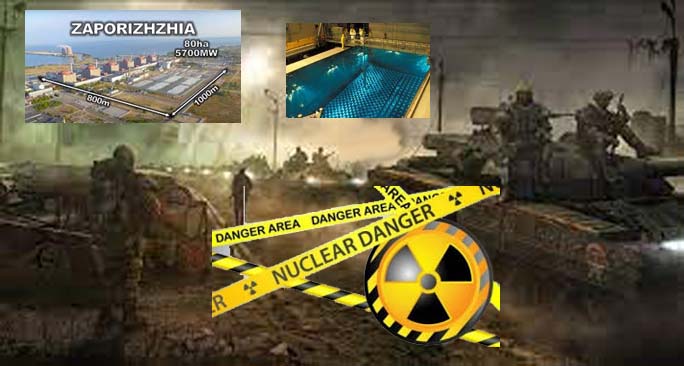
he International Atomic Energy Agency (IAEA) believes that intense fires near the Zaporizhzhia Nuclear Power Plant, which is temporarily occupied by Russia, pose a risk for its external power supply.
Source: IAEA website, as reported by Ukrinform
Quote: “On several occasions over the past week, the IAEA Support and Assistance Mission to Zaporizhzhya (ISAMZ) observed several fires at various distances from the ZNPP and nearby villages. Over the weekend, the IAEA experts observed smoke coming from an area to the north of the ZNPP near the Zaporizhzhya Thermal Power Plant (ZTPP) inlet channel.”
Details: The agency noted that the fire was underneath the remaining overhead power cables that supply power to the plant.
Quote: “As the summer heat continues, such fires along the pathways of the two remaining lines place the ZNPP at risk of loss of external power. While there was no disconnection of either line on this occasion, the situation highlighted the fragility of off-site power at the ZNPP.”
IAEA chief calls for restraint as fighting remains ongoing ‘in the vicinity’ of Russia’s Kursk Nuclear Power Plant

by Dmytro Basmat, Kyiv Independent 10th Aug 2024
International Atomic Energy Agency (IAEA) Director General Rafael Mariano Grossi called on both Kyiv and Moscow to “exercise maximum restraint” in order to avoid a nuclear accident as fighting is reportedly ongoing in the region around the Kursk Nuclear Power Plant (KNPP).
In a statement issued by the IAEA on Aug. 9, Grossi said that a nuclear accident at the KNPP would have “the potential for serious radiological consequences.”
Grossi noted that two of the six nuclear reactors at the KNPP are in shutdown, while another two are fully operational. The remaining two reactors are under construction.
The statement comes as Ukraine’s continues its surprise incursion across the border into Kursk Oblast, with Ukraine reportedly making gains deeper into Russian territory.
Earlier in the day on Aug. 9, a fire caused by an alleged drone attack on a power substation led to power outages in several areas of Kurchatov which houses the KNPP, regional Governor Alexei Smirnov claimed.
On Aug. 8, Kurchatov’s mayor, Igor Korpunkov, claimed that battles are ongoing “a few dozen kilometers” from the town.
Independent Russian news outlet IStories reported on Aug. 9 that Russia is currently preparing to defend the Kursk Nuclear Power Plant as Ukrainian troops are approaching it.
The entrances to the Kursk Nuclear Power Plant were blocked as of the afternoon of Aug. 9, the pro-government regional newspaper network Bloknot claimed, citing its undisclosed sources.
Everything at the nuclear power plant’s units under construction has been de-energized, and construction workers have left the site, Bloknot claimed………………………………………..
Russia’s Emergency Situations Ministry also said on Aug. 9 that the situation in Kursk Oblast had been declared a “federal emergency,” and began sending additional military equipment into the region. https://kyivindependent.com/iaea-chief-calls-for-restraint-to-ensure-nuclear-safety-at-kursk-nuclear-power-plant/
Russia strengthens security at Kursk nuclear power plant amid Ukraine’s assault in region
Russian Guard Corps says additional forces deployed in vicinity of plant to protect it from Ukraine’s attack
Elena Teslova |07.08.202, MOSCOW , https://www.aa.com.tr/en/russia-ukraine-war/russia-strengthens-security-at-kursk-nuclear-power-plant-amid-ukraines-assault-in-region/3298072
Russia said Wednesday that it strengthened security at the Kursk nuclear power plant amid Ukraine’s assault in the region.
The Russian Guard Corps said it took additional measures to ensure the safety of the plant, including the deployment of additional units in the area.
“As part of ensuring the safety of a particularly important facility, the Russian Guard Corps units took additional measures to protect the Kursk nuclear power plant,” it said.
It added that the security services increased their forces to combat the Ukrainian sabotage and reconnaissance groups in the Kursk and Belgorod regions.
The office of Kursk’s Acting Gov. Alexey Smirnov announced that emergency situation forces were introduced in the region because of ongoing combat operations and the situation on the border “remains tense.”
Additional forces have also been allocated to the operational headquarters under the leadership of the governor of the Kursk region to handle the incursion, it said.
The Russian chief of the General Staff, Valery Gerasimov, said Wednesday that up to 1,000 Ukrainian troops attacked Russia’s military positions near two border settlements adjacent to Ukraine’s Sumy region on Tuesday.
At least five civilians were killed and 24 injured in the attack, including six children, according to statements from regional authorities.
Ukraine has not yet commented on the claims and independent verification is difficult because of the war.
IAEA: Cooling pond water levels decreasing at Ukraine nuclear plant
Aug 6, 2024, https://www.ans.org/news/article-6266/iaea-cooling-pond-water-levels-decreasing-at-ukraine-nuclear-plant/
The water level in Ukraine’s Zaporizhzhia nuclear power plant cooling pond continues to decrease, creating a serious safety threat.
“If this trend continues, ZNPP staff confirmed that it will soon become challenging to pump water from the pond. Maintaining the level of the pond is made more difficult by the hot summer weather,” said Rafael Mariano Grossi, director general of the International Atomic Energy Agency, in an update issued August 2.
Zaporizhzhia—Europe’s largest nuclear plant—has been under Russian control since March 2022, shortly after the military invasion of Ukraine. The plant stopped producing power in September 2022, and all six of its units currently are in cold storage.
Water issues: Following the destruction of the Kakhovka dam in 2023, Zaporizhzhia workers dug 11 groundwater wells to provide approximately 250 cubic meters of cooling water per hour to support the plant’s sprinkler ponds. These ponds cool all six reactors.
“Dwindling water levels in the cooling pond remains a potential source of concern, and we will continue to closely monitor and observe the situation at the site to ensure the availability of a sufficient supply of cooling water for the plant’s needs at all times,” Grossi said.
During a site walkdown last week, IAEA inspectors stationed at the plant observed proper function in the sprinkler ponds, with water at nominal levels. But any compromise to the availability of water to the sprinkler ponds might necessitate using the cooling pond as a backup source.
Safety concerns: The IAEA team continue to hear military activity at varying distances from the plant.
On April 30, they reported hearing over 100 rounds of gunfire in the vicinity of the Zaporizhzhia, allegedly in response to drones flying near the plant’s training center. The “kamikaze” drones, some measuring 11 feet long and 8 feet wide, were observed in video evidence from Ukraine’s defense intelligence. The drones do not fire missiles but are equipped with explosives and can strike with precision.
Separately, the team reported three direct drone strikes on the plant on April 7 and April 9, resulting in one casualty. Ukrainian military intelligence spokesperson Andrii Cherniak said the Russians are using space around Zaporizhzhia because the Security and Defense Forces of Ukraine cannot return fire in a 1.5-kilometer zone around the plant.
IAEA report: In a letter from the permanent mission of the Russian Federation to the IAEA’s secretariat the following issues were highlighted.
- During a span of six days (July 22–28), 77 aerial vehicles launched with the aim of attacking and provoking ZNPP and the nearby town of Energodar.
- On July 29, Ukrainian armed forces launched three artillery strikes at the checkpoint entrance to Energodar, injuring three Russian Guard employees.
- The plant has enough diesel fuel to operate on emergency power for 19 days.
- Recruitment of personnel for the plant is ongoing, though the current number of employees is sufficient to continue cold shutdown operations and scheduled maintenance tasks.
Support for Zaporizhzhia: Starting in April 2022, the IAEA developed a broad assistance program at Zaporizhzhia. The agency recently organized four remote workshops with a focus on mental health. The sessions were geared toward supervisors, managers, and mental health teams to help recognize signs of distress and support those dealing with stress or trauma.
The United States and United Kingdom have lent support by delivering equipment and hosting workshops.
It must be no to nuclear – whether energy or weapons
Tor Justad: I REFER to recent articles in the National and Sunday
National regarding nuclear power and nuclear weapons in Scotland. The first
was headlined “Safety warnings as cracks rise at Torness nuclear plant”
(Sunday National, Jul 21) which reported on the increase to 46 of cracks
which have appeared in the Torness nuclear reactor.
It is extremely concerning that at the launch of the Cromarty Firth and Inverness Freeport,
Steve Chisholm, operations & Innovations director at Global Energy stated
that the area was ideally placed for a move into manufacturing small
modular reactors.
The National 5th Aug 2024
https://www.thenational.scot/community/24496800.must-no-nuclear—whether-energy-weapons/
US nuclear plant unfit for quick resurrection, former lead engineer says
By Timothy Gardner, WASHINGTON, Aug 2 2024, (Reuters)
– The first U.S. nuclear plant to ever try reopening after undergoing preparations for permanent closure is not fit to restart anytime soon because it sidestepped important safety work for years before retirement, a former official at the reactor said.
Power company Entergy (ETR.N), opens new tab closed the Palisades reactor in Michigan in 2022, after the plant generated electricity for more than 50 years. Privately-held Holtec International bought Palisades shortly after and has since secured a $1.52 billion conditional U.S. loan guarantee to restart. Holtec seeks to open the plant in about a year.
The fate of Palisades is closely watched by the nuclear industry as at least two other shuttered plants, including a unit at Constellation Energy’s (CEG.O)
, opens new tab Three Mile Island, consider reopening…………
“I’m pro-nuclear, but they selected the wrong horse to ride to town on,” said Alan Blind, who was engineering director at the Palisades plant from 2006 to 2013 under Entergy.
Blind said the plant got exemptions from the U.S. Nuclear Regulatory Commission, the nuclear safety regulator, allowing it to fall short of safety design standards that more modern plants must adhere to because it was nearing retirement.
Those safety standards include prevention of cooling systems being clogged by the breakdown of insulation on pipes, defense against earthquakes, and reduction of risks to fires, Blind said, adding he had been monitoring the plants’ exemption requests since his retirement.
“I’m worried that the NRC will not insist that the generic safety issues be the fixed before they allow Palisades to restart,” Blind told Reuters………………………………………………………..
The Biden administration’s Loan Programs Office at the Department of Energy issued Holtec a conditional $1.52 billion loan guarantee in March to restart Palisades. … https://www.reuters.com/business/energy/us-nuclear-plant-unfit-quick-resurrection-former-lead-engineer-says-2024-08-02/
Nuclear plant trips due to fire, and battery storage steps in to stabilises the grid
What happens when a giant nuclear power station
suddenly goes off line? It’s a question that market operators have to ask
themselves all the time.
The biggest units on the grid are generally
nuclear, in those countries that have them, and a considerable amount of
planning and expense needs to make sure that the back-up is on hand,
despite the insistence by some of the whackier pro-nuclear spruikers in
Australia that no storage or gas is needed.
According to Grid Status, which
monitors grid operations in the US, the frequency excursion was arrested by
a rapid response from the state’s rapidly growing portfolio of big
battery projects. “Immediately, grid frequency declined,” Grid Status
noted in a post on LinkedIn and X. “An excursion below critical levels
required a fast response by ERCOT to ensure stability of the grid. In this
case, ERCOT swiftly deployed ancillary services, including a significant
amount of batteries providing ECRS, to boost the frequency back to
normal.” ERCOT is the Electricity reliability Council of Texas, which
manages the grid. ECRS refers to the contingency reserve service. The big
batteries were back in action a few days later when one of the state’s
coal fired power station units also tripped.
Texas is expected to more than
double its battery storage capacity in 2024, adding around 6.4 GW of
battery capacity (with varying levels of storage), to the 5.5 GW that
existed before.
Renew Economy 1st Aug 2024
Japan nuclear watchdog panel decides against restarting Tsuruga reactor
difficult to determine the safety of the reactor, noting the proximity of a seismic faultline.
The government in Japan, one of the world’s most seismically active countries, does not allow nuclear plants to be situated over active faultlines.
July 27 2024, TOKYO, https://japantoday.com/category/national/japan-nuclear-watchdog-panel-decides-against-restarting-tsuruga-reactor1
A panel of Japan’s nuclear watchdog decided on Friday against restarting a reactor at the Tsuruga nuclear power plant citing seismic risks, paving the way for the regulator to keep the Japan Atomic Power plant shut.
The panel said it was difficult to determine the safety of the reactor, noting the proximity of a seismic faultline. Consequently, it said, the reactor was not deemed compliant with criteria for installation licensing.
“We will conduct an additional investigation. We are not considering decommissioning the plant,” Mamoru Muramatsu, president of Japan Atomic Power, said after the panel meeting, according to Kyodo News Agency.
The government in Japan, one of the world’s most seismically active countries, does not allow nuclear plants to be situated over active faultlines.
The panel is set to report its decision to the Nuclear Regulation Authority (NRA) soon.
If approved, this would be the first case of non-compliance under the stricter safety standards imposed after the 2011 Fukushima nuclear disaster.
The move could hinder the government’s efforts to restart more nuclear power plants to ensure a stable energy supply.
Japan, which had 54 operational reactors before the 2011 disaster, has restarted only 12 of the 33 nuclear reactors it has been considering restarting.
Along with most reactors in Japan, operations at the Tsuruga’s No.2 reactor have been halted since 2011 following triple meltdowns at Tokyo Electric Power’s Fukushima Daiichi nuclear power plant.
On March 11, 2011, Japan’s northeast coast was struck by a magnitude 9 earthquake, the strongest quake in Japan on record, and a massive tsunami, triggering the worst nuclear crisis since Chernobyl a quarter of a century earlier.
Seek shelter ‘best option’ in nuclear incident
Caroline Robinson, 25 July 24, BBC News, Ben Chapple, BBC News, Guernsey
Channel Island authorities will advise people to seek shelter in the unlikely event of a nuclear incident affecting the islands.
The UK Health Security Agency (UKHSA) looked at nuclear risks to the islands as part of “routine risk and business continuity planning”.
It said the risk of a nuclear incident occurring was extremely low and its review considered the worst-case scenarios.
The UKHSA recommended shelter-in-place and stockpiling iodine be considered, but the pan-island Radiation Advisory Group decided shelter was the most appropriate choice for the islands.
‘Shelter-in-place’
Nearby nuclear sites in France, radioactive waste dumped in the Hurd Deep trench off Alderney in the 1950s and 1960s and the transport of nuclear materials by ship in the seas around the Channel Islands were the risks considered.
The sites in France looked at were the Orano La Hague nuclear fuel reprocessing site, the Flamanville nuclear power station and Cherbourg’s naval dockyard, where nuclear submarines are dismantled.
The UKHSA said if an incident happened at one of these sites wind direction and weather were important – wind could blow the radioactive material towards the islands and rain would cause more of it to land on the islands.
Based on five years of weather data it said with the prevailing wind being from the west and south west it was unlikely a plume would be blown towards the islands.
The UKSHA said if any material was due to arrive in the island the “best option” for people was to “shelter-in-place”.
This means going inside, closing doors and windows and turning off ventilation fans and air conditioning…………………………………………………………….. more https://www.bbc.com/news/articles/c3grzg9j3xgo
1 This Month


PLEASE OPPOSE HR 8255 AND S.3639 – bills would accelerate satellite deployment, with no environmental review or safeguards – https://ncstd5li.quorum.us/campaign/169331/
To see nuclear-related stories in greater depth and intensity – go to https://nuclearinformation.wordpress.com
-
Archives
- September 2026 (194)
- August 2026 (330)
- July 2026 (355)
- June 2026 (287)
- May 2026 (306)
- April 2026 (356)
- March 2026 (251)
- February 2026 (267)
- January 2026 (308)
- December 2025 (358)
- November 2025 (359)
- October 2025 (375)
-
Categories
- 1
- 1 NUCLEAR ISSUES
- business and costs
- climate change
- culture and arts
- ENERGY
- environment
- health
- history
- indigenous issues
- Legal
- marketing of nuclear
- media
- opposition to nuclear
- PERSONAL STORIES
- politics
- politics international
- Religion and ethics
- safety
- secrets,lies and civil liberties
- spinbuster
- technology
- Uranium
- wastes
- weapons and war
- Women
- 2 WORLD
- ACTION
- AFRICA
- Atrocities
- AUSTRALIA
- Christina's notes
- Christina's themes
- culture and arts
- Events
- Fuk 2022
- Fuk 2023
- Fukushima 2017
- Fukushima 2018
- fukushima 2019
- Fukushima 2020
- Fukushima 2021
- general
- global warming
- Humour (God we need it)
- Nuclear
- RARE EARTHS
- Reference
- resources – print
- Resources -audiovicual
- Weekly Newsletter
- World
- World Nuclear
- YouTube
-
RSS
Entries RSS
Comments RSS
 nuclear-news