Dissension in the Nuclear Regulatory Commission over regulatory changes
Always a most dangerous nuclear plant – Fukushima
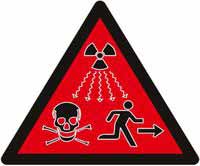 SPECIAL REPORT-Fukushima long ranked Japan’s most hazardous nuclear plant One of 5 worst nuclear plants in world for exposure to radiation
* Tepco prioritised cost-savings over radiation standard
* Tepco says old plants like Fukushima have high radiation
* Foreign workers used to avoid exposing staff to high radiation
* Improvements made at Fukushima before disaster hit
By Chisa Fujioka and Kevin Krolicki, TOKYO, July 26 (Reuters) – Japan’s Fukushima Daiichi nuclear plant ranked as one of the most dangerous in the world for radiation exposure years before it was destroyed by the meltdowns and explosions that followed the March 11 earthquake. For five years to 2008, the Fukushima plant was rated the most hazardous nuclear facility in Japan for worker exposure to radiation and one of the five worst nuclear plants in the world on that basis. The next rankings, compiled as a three-year average, are due this year. Reuters uncovered these rankings, privately tracked by Fukushima’s operator Tokyo Electric Power, in a review of documents and presentations made at nuclear safety conferences over the past seven years…..
As Japan debates its future energy policy after the worst nuclear accident since Chernobyl, a Reuters review of the long-troubled record at Fukushima shows how hard it has been to keep the country’s oldest reactors running in the best of times. It also shows how Japan’s nuclear establishment sold nuclear power to the public as a relatively cheap energy source in part by putting cost-containment ahead of radiation safety over the past several decades. …..http://www.reuters.com/article/2011/07/26/idUSL3E7IE3Z920110726—
Tanzania: poor protection from ionising radiation
| Atomic energy body’s radiation fears |
| 27 July 2011 23:00 |
|
By Zephania Ubwani, The Citizen Bureau Chief, Arusha. The Tanzania Atomic Energy Commission (TAEC) has raised a red flag over lack of effective protection infrastructure in areas such as industries, mines and other work places where radiation technology is used.
The commission says lack of effective radiation protection infrastructure poses occupational risks to workers through exposure to ionising radiation.The commission’s acting director general, Mr Firmin Banzi, says although Tanzania had seen increased use of nuclear technology such as atomic energy, many facilities that were operating throughout the country lacked effective radiation control. This, according to him, exposed workers and members of the public to harm resulting from the use of ionising radiation sources such as industrial radiography and irradiators as well as other nuclear gauges…..http://thecitizen.co.tz/news/-/13215-atomic-energy-bodys-radiation-fears |
Three months later, flood problems keep nuclear reactor closed
The nuclear plant has been shut down for nearly three months. According to the NRC it won’t be allowed back on-line until it passes several rigorous safety inspections.
OPPD: Duration of 2011 Flood “Unprecedented in Nuclear Industry”, Missouri News Horizon, by Joe Jordan, 27 July 1 1, Officials with the Nuclear Regulatory Commission(NRC) and the Omaha Public Power District (OPPD) met in Omaha today, as the NRC continues to examine OPPD’s flood safety plans at the Fort Calhoun Station.
In the midst of record flooding on the Missouri River, the NRC’s Kriss Kennedy says, “It’s not clear what we’re going to see when the waters recede.” Kennedy added, “There’s a potential long-term impact on the equipment.” Continue reading
Assassination of Iranian nuclear scientist
Doubts on the credibility of Japan’s nuclear regulator
The errors will adversely affect the operations of all nuclear power stations across the country, casting a damper on the planned stress tests from the outset..
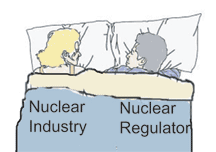 ..Goshi Hosono, state minister for the nuclear crisis, is aiming to separate NISA from its parent body, the Economy, Trade and Industry Ministry, which is promoting nuclear power generation in Japan. However, structural changes alone are insufficient. Whether NISA can function as a nuclear safety regulator will be severely tested.
Errors in nuclear plant data highlight checking system insufficiencies, Mainichi Daily News, By Takuji Nakanishi, Mainichi Shimbun, 23 July 2011 The discovery of errors in data incorporated in a report on the No. 3 reactor at the Genkai Nuclear Power Plant in Saga Prefecture illustrates problems with its operator’s checking system and the government regulator’s ability to examine safety data. Continue reading
18 Metre walls to protect Hamaoka nuclear plant from tsunamis
Nukes in Space – a Recipe for Disaster
an accident in which plutonium is released by a space device as tiny particles falling to Earth maximizes its lethality. A millionth of a gram of plutonium can be a fatal dose. The pathway of greatest concern is the breathing in plutonium particle..
As the NASA Environmental Impact Statement puts it: “Particles smaller than about 5 microns would be transported to and remain in the trachea, bronchi, or deep lung regions.” The plutonium particles “would continuously irradiate lung tissue.”
“A small fraction would be transported over time directly to the blood or to lymph nodes and then to the blood,” it continues. Once plutonium “has entered the blood via ingestion or inhalation, it would circulate and be deposited primarily in the liver and skeletal system.” Also, says the document, some of the plutonium would migrate to the testes or ovaries.
 What Could Truly End the Space Program: A Nuclear Disaster Overhead , OpED News, By Karl Grossman 21 July 11, Between November 25 and December 15 NASA plans to launch for use on Mars a rover fueled with 10.6 pounds of plutonium, more plutonium than ever used on a rover. Continue reading
Watts Bar nuclear plants – a history of safety flaws
Guity’s reports showed that hundreds of cables had been installed incorrectly at Watts Bar. They demonstrate that the TVA cared very little about regulations…
Safety Concerns Cloud US Nuclear Renaissance, Spiegel Online, By Ullrich Fichtner, 21 July 11, Translated from the German by Christopher Sultan “…….. A nuclear engineer who was born in Iran in 1942, Guity is a disappointed American today. “Time bombs,” he says, sounding very bitter. “We are sitting on a bunch of ticking time bombs.”……. Continue reading
Nuclear Regulatory Commission rubber-stamps another nuclear plant re-licence
Hope Creek nuclear plant’s license extended to 2046, Newsworks, By Monika Zaleska, July 20, 2011 The Hope Creek nuclear plant in South Jersey’s Salem County can now operate until 2046. The Nuclear Regulatory Commission renewed the 1,060-megawatt plant’s license Wednesday.
A watchdog group, Unplug Salem, which is campaigning to close Hope Creek and the two nearby Salem plants, is not happy about the decision.
Norm Cohen, a group coordinator, claims the 25-year-old plant is out of date and unsafe. He says the state should move toward wind and solar energy instead of renewing nuclear licenses.
The Hope Creek reactor is the same model as the plant that melted down in Japan following the catastrophic tsunami and earthquake in the spring…….http://www.newsworks.org/index.php/local/item/23437
Will the Nuclear Regulatory Commission relicense Fermi plant until 2045?
DTE seeks license extension for Fermi 2 nuke plant, DTE Energy has asked the Nuclear Regulatory Commission to allow the company to operate the Fermi 2 nuclear plant until 2045, Michigan Messenger, By Eartha Jane Melzer | 07.21.11
Fermi 2, located in Monroe County on Lake Erie, is a 1,140 megawatt plant that has the same GE Mark 1 design as the Fukushima, Japan power plant that melted down this spring following an earthquake and tsunami. Continue reading
Typhoon hazard to Japan’s nuclear power
a typhoon like Ma-On could be a huge blow to Japan……. also through the looming threat, again, to the country’s nuclear infrastructure…..What’s more, the shattered Fukushima plant may be so far gone that “insulating the facilities from the typhoon will be impossible,” ….If nothing else, the one-two punch of a tsunami and a typhoon may hasten Japan’s much called-for abandonment of nuclear power,….
Typhoon Tests Japan’s Nuclear Resolve, TIME, by Tara Thean, July 19, 2011 “…The typhoon is moving quickly north- and eastward, with sustained winds and gusts speeding along at 87 and 100 mph respectively. And quite a lot of that predicted rain – over 50mm, or 2 inches – has already hit Shikoku and Honshu islands. It’s still anyone’s guess whether or not the typhoon will lead to another national disaster — the most intense rainfall and strongest convection is still over the open ocean, and convection may be weakening because of warming cloud top temperatures and the movement of dry air
Whistleblower sceptical on safety of Tennessee nuclear plant
You’ll have to pardon Ann Harris if she’s heard it all before. She’s won a record six whistle-blower lawsuits against Watts Bar over issues like millions of feet of faulty electrical cable, and says she’s paid a price for speaking out…..
 VIDEO http://www.cbsnews.com/stories/2011/07/19/earlyshow/main20080633.shtml?tag=contentMain;contentBody Fukushima-type disaster inevitable in U.S.?, CBS News, Armen Keteyian, 19 July 11, The Nuclear Regulatory Commission was to meet Tuesday to discuss sweeping new safety recommendations, after having just finished inspecting all 104 U.S. nuclear plants in the wake of Japan’s Fukushima disaster.
On “The Early Show,” CBS News Chief Investigative Correspondent Armen Keteyian spotlighted one of those facilities’ post-Fukushima inspection reports.
Watts Bar, in Spring City, Tenn., is the last nuclear plant to be licensed in the U.S., and a textbook study of the pros and cons of nuclear power. It provides electricity to some 9 million people in seven states, yet is dogged with a long history of safety issues and whistle-blower lawsuits — including six by a 71-year-old great-grandmother named Ann Harris…. Continue reading
Deterioration in Seabrook nuclear plant stalls licence renewal
Nuclear plant concerns stall license renewal, By Shir Haberman,Issues raised over deterioration of concrete .seacoastonline.com July19, 2011NRC inspectors reviewing Seabrook Station for its fitness to have its license extended noted the deterioration, which was discovered by the plant’s staff, and noted it in an inspection report dated May 23.
SEABROOK — The U.S. Nuclear Regulatory Commission confirmed Friday that the discovery of deteriorating concrete in below-ground-level structures at the Seabrook Station nuclear power plant made public earlier this year could delay the granting of a license extension that would allow the plant to operate until 20 ….
“The walk-down inspections discovered the following plant material conditions; (a) large amount of groundwater infiltration, (b) large amount of calcium carbonate deposits, (c) corroded steel supports, base plates and piping, (d) corroded anchor bolts, (e) pooling of water and (f) cracking and spalling of concrete,” the NRC report indicated. “The inspection further noted that the below-grade, exterior walls in the Control Building B Electrical Tunnel … have random cracking and for several years have been saturated by groundwater infiltration……
typically, the license extension approval process takes 30 months when opponents call for a public hearing on the merits of that extension. Several nuclear safety organizations, including the Portsmouth-based Seacoast Anti-Pollution League, have been granted intervener status in the Seabrook license extension process creating the need for such a hearing.
“This ongoing groundwater infiltration and weakening of the plant foundations doesn’t sound good, considering that it is only about one-third of the way through its prospective life,” said Doug Bogen, executive director of SAPL after the May 23 report was issued. “This is exactly the kind of problem we’re concerned about as the plant enters its middle and old age, and it doesn’t bode well for future safety and reliability if the problem worsens in coming years.”…
http://www.seacoastonline.com/articles/20110719-NEWS-107190336
Radioactive water leak closes New Jersey nuclear plant
NJ nuclear plant taken offline due to water leak , LOWER ALLOWAYS CREEK TOWNSHIP, N.J. 16 JULY 11, The Salem 2 nuclear plant in southern New Jersey has been taken offline after a leak of low-level radioactive water developed during routine testing of an emergency cooling system…. it’s not known when the plant will return to service….http://www.businessweek.com/ap/financialnews/D9OGD6UG0.htm
—
1 This Month
22 June – Virtual Event –Climate Change: New Data, New Debate

Monday, June 22, 2026 2:30 p.m. – 3:15 p.m. CT
YouTube. Register here

Protect Sazan Island from the Trump family! https://secure.avaaz.org/campaign/en/protect_sazan_island_from_the_trump_family_loc/?bqFCVab&v=174511&cl=22707147157&_checksum=5e9dde668860e8231c33699735e16a1fbf22ab2cb01da50c999fe8732b9775ef&utm_source=email&utm_medium=blast_email&utm_campaign=174511
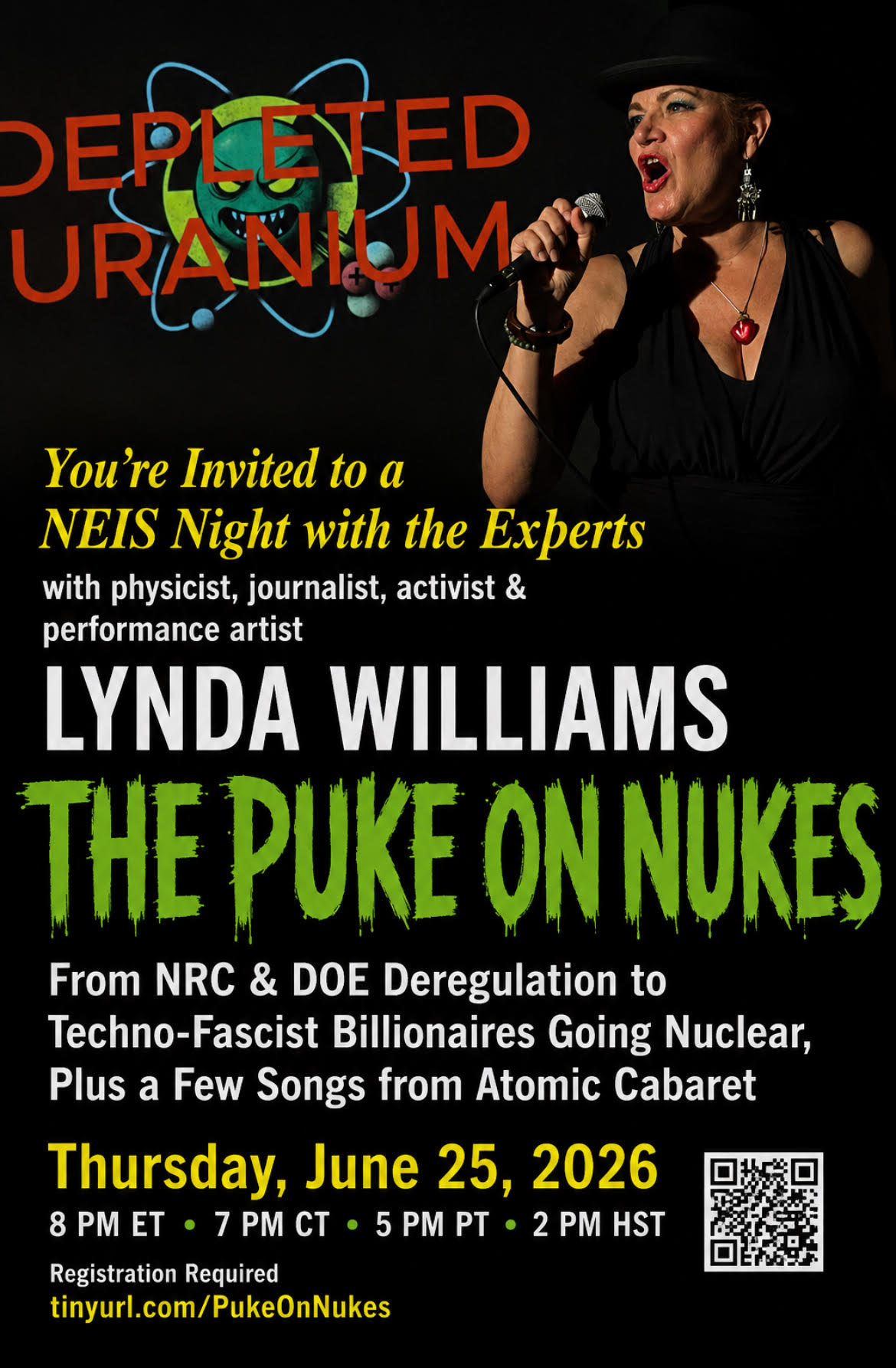
25 June- THE PUKE ON NUKES
Thursday, June 25, 2026
7pm Central Time (8pm ET, 6pm MT, 5pm PT) UTC – 5
From NRC & DOE Deregulation to Techno-Fascist Billionaires Going Nuclear, Plus a Few Songs from Atomic Cabaret REGISTER
26 June – Radiation Trainwreck at the NRC / Join the Protect Better Campaign – https://us02web.zoom.us/meeting/register/4ZlZ5_qLSHGiLSCg8FF6Bg#/registration

Cuba Is Not a Failed State – It Is a Besieged State
PETITION: “Global Appeal to Endorse Palestinian Right of Return of Refugees”
To see nuclear-related stories in greater depth and intensity – go to https://nuclearinformation.wordpress.com
-
Archives
- June 2026 (193)
- May 2026 (306)
- April 2026 (356)
- March 2026 (251)
- February 2026 (268)
- January 2026 (308)
- December 2025 (358)
- November 2025 (359)
- October 2025 (376)
- September 2025 (257)
- August 2025 (319)
- July 2025 (230)
-
Categories
- 1
- 1 NUCLEAR ISSUES
- business and costs
- climate change
- culture and arts
- ENERGY
- environment
- health
- history
- indigenous issues
- Legal
- marketing of nuclear
- media
- opposition to nuclear
- PERSONAL STORIES
- politics
- politics international
- Religion and ethics
- safety
- secrets,lies and civil liberties
- spinbuster
- technology
- Uranium
- wastes
- weapons and war
- Women
- 2 WORLD
- ACTION
- AFRICA
- Atrocities
- AUSTRALIA
- Christina's notes
- Christina's themes
- culture and arts
- Events
- Fuk 2022
- Fuk 2023
- Fukushima 2017
- Fukushima 2018
- fukushima 2019
- Fukushima 2020
- Fukushima 2021
- general
- global warming
- Humour (God we need it)
- Nuclear
- RARE EARTHS
- Reference
- resources – print
- Resources -audiovicual
- Weekly Newsletter
- World
- World Nuclear
- YouTube
-
RSS
Entries RSS
Comments RSS
 nuclear-news
