France’s Marcoule nuclear site – doubts on its safety
the priority was to get the job done – to meet the military imperative of fuel production, to irradiate whatever needed irradiating, without much of a thought about how the facilities would eventually be rendered safe. Marcoule is now dealing with the legacy of radioactive waste that created….

 The French nuclear programme does not have a stellar record of transparency…..What the incident implies for the future of the French nuclear programme is not entirely clear….
Marcoule’s long nuclear history, By Richard Black, BBC News 12 September 2011 The Marcoule site is one of the oldest in France, and played a significant role in the development of the French nuclear and thermonuclear deterrents. It opened in 1956 – well after the US began the era of nuclear armaments, at a time when France was among the nations looking to gain their own seat at the nuclear table. Continue reading
Dangers of earthquakes, floods, to nuclear plants
 NRC staff: Reassess earthquake risk at nuke plants, Fox News, September 12, 201 WASHINGTON – The Nuclear Regulatory Commission should immediately require U.S. nuclear plant operators to re-evaluate whether their facilities can withstand earthquakes and floods, the agency’s staff said.
A staff report made public Monday identified seven steps the NRC should take “without delay” as it responds to the March 11 earthquake and tsunami that crippled a nuclear plant in Japan.
Most prominently, the report recommended immediate reviews of seismic and flooding risks at the nation’s 104 nuclear reactors. Continue reading
IAEA’s nuclear safety plan lacks teeth
Ruediger Luedking, Germany’s chief IAEA representative, told the nuclear watchdog’s 35-nation board Monday that the plan “does not fully meet our expectations.”A diplomat from another IAEA member state familiar with the issue says several other EU states as well as Canada and Australia are also critical of the plan’s lack of teeth.
He says Russia, China, India, Pakistan and Argentina were chief opponents of giving the IAEA more authority to police nuclear safety. But the U.S. was also conformable with the lack of enforcement powers.
The diplomat asked for anonymity because his information was confidential http://www.google.com/hostednews/ap/article/ALeqM5itby0To8xFNqpzB2hblJSK9qk97A?docId=4bacc40403324d46929ab5b077266a3d
Wikileaks reveals poor security of radioactive materials at Mulago
 WikiLeaks: America feared theft of nuclear material from Mulago, Daily Monitor (Uganda) 12 Sept 11, The US government feared the theft of nuclear and radiological materials from Mulago Hospital in 2007 and had to send nuclear experts from Kansas to investigate the theft of the materials that were meant to treat cancer patients.
In the leaked diplomatic cable, the US ambassador in Uganda, Mr Jerry Lanier, also warned that poor storage of the materials in the hospitals is risky and dangerous to Uganda’s security. The radiological materials, which were meant to treat cancer, were stolen from the store at the hospital by suspected robbers. Continue reading
USA has not learned from Fukushima – say nuclear experts
 Nuclear Experts Say U.S. Learned Nothing From Fukushima, Care 2 by Beth Buczynski, September 10, 2011 “…… three leading U.S. experts held a news conference Friday to outline both what is now known in the wake of the Fukushima and where things stand for the nuclear power industry in the United States.
The overwhelming opinion of the panel, which included Peter Bradford, former member of the United States Nuclear Regulatory Commission, Edwin Lyman, Ph.D., senior scientist, Global Security Program, Union of Concerned Scientists; and Dr. Andrew Kanter, national board president-elect, Physicians for Social Responsibility, was that major lessons from the Japanese nuclear disaster are in danger of going unheeded.
The experts outlined eight concerns and lessons from this crisis that should guide decisions regarding the future of nuclear power in the U.S.:
1. The U.S. regulatory response since Fukushima has been inadequate. “Six months after Fukushima, it seems clear that the U.S. is not going to undertake the type of fundamental, no-holds-barred look at its nuclear regulatory practices that followed the much less serious accident at Three Mile Island some 30 years ago,” said Peter Bradford.
2. America should avoid post-9/11 mistakes in tightening reactor safety standards. “In responding to Fukushima by issuing orders, the NRC should not make the same mistakes as it did following 9/11, when industry stonewalling delayed implementation of critical security measures for many years…
3. Overall Japanese health dangers are getting short shrift. …
4. The impact on the health of Japanese children is being ignored. “Children are at least three-to-four times more susceptible to radiation than are adults. …….
5. The U.S. was warned of Fukushima-style problems but failed to act … and is still failing to do so.
6. Emergency planning zones in the U.S. must be expanded.
7. The recent East Coast earthquake should spur more NRC safety analysis.
A streaming audio replay of the entire news event is available at www.nuclearbailout.org.
Take Action: Sign the petition to tell Obama to stop subsidizing nuclear energy.
http://www.care2.com/causes/nuclear-experts-say-u-s-learned-nothing-from-fukushima.html
The world must work to remove the threat of nuclear terrorism
Keeping Nuclear Terrorism a Threat Only in Theory HUFFINGTON POST, Mark Fitzpatrick and Nigel Inkster 9/11/11 On September 11, as the world mourns the deaths in New York and Washington of ten years ago, some solace might be found in noting that the events that day are still the world’s most deadly terrorist attack to date. Osama bin Laden did not subsequently fulfill his self-professed religious obligation to obtain nuclear weapons. The “nuclear hell storm” that Al Qaeda operative Khalid Sheik Mohammed said would be unleashed if bin Laden was killed has not come to pass. There has not been a single incident of nuclear terrorism, even using a radiation-spreading dirty bomb. Continue reading
After 9/11, terrorists see nuclear plants as nice targets
 The NRC has now dithered for a decade while suicidal terrorists have eye balled U.S reactors and their radioactive wastes as “nice targets.”
Ten years after 9-11: Nuclear Plants and Their Deadly Wastes Still Vulnerable, Greenpeace by Jim Riccio – September 9, 2011 A decade ago, nineteen suicidal terrorists hijacked airliners and turned them into weapons by flying them into the World Trade Center and the Pentagon. Since those horrific attacks, the U.S. Nuclear Regulatory Commission (NRC) and the nuclear industry have repeatedly claimed that nuclear plants were not vulnerable to a similar attack.
Nothing could be further from the truth. Continue reading
Nuclear plant not designed to stand such an earthquake
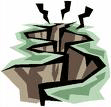 Quake-rattled nuclear plant puts NRC in unprecedented spot, By Wendy Koch, USA TODAY, 9 Sept 11 As the six-month anniversary of Japan’s near meltdown of a nuclear plant looms Sunday, the commercial nuclear industry in the United States is facing its own unprecedented challenge.
For the fist time, on Aug. 23, a U.S. nuclear plant was shaken more by an earthquake than it was designed to handle. So when is it safe to restart the Virginia plant shuttered by the 5.8-magnitude quake? This is the question now bedeviling the Nuclear Regulatory Commission.
At a public hearing Thursday, a senior NRC official told Dominion, the plant’s operator, that it will likely face a series of meetings and many questions before it gets the NRC’s approval to restart the North Anna Power Station in Mineral, Va…..
Executives of Richmond-based Dominion acknowledge the historic nature of the event. “This is the first time a U.S. plant has exceeded design basis,” Eugune Grecheck, vice president of nuclear development, told reporters after the three-hour public meeting at NRC’s headquarters in Rockville, Md….. http://content.usatoday.com/communities/greenhouse/post/2011/09/quake-rattled-nuclear-plant-puts-nrc-in-unprecedented-spot/1
Stuxnet computer worm could target nuclear warheads
 Nuclear warheads could be next Stuxnet target: Check Point, Code in Stuxnet worm can be modified with right skills, says security expert, CIO Hamish Barwick (Computerworld), 09 September, 2011, Due to the complexity and sophistication of the code contained within the Stuxnet worm, the possibility of it being used to take control of a nuclear warhead is high, according to a security expert.
At Check Point’s Sydney conference this week, Check Point Israel security evangelist, Tomer Teller, said he analysed the code of the Stuxnet worm, which was used to take control of a nuclear facility in Iran in June, 2009. “This is a huge file, it’s 1 megabyte [MB] of code and I respect the skill required to engineer that code as it is very complex,” he said.
Teller confirmed the code in Stuxnet could be modified to launch new SCADA attacks. “Nuclear warheads are controlled by computers so if someone managed to slip a worm inside a facility that will reach the warhead component, they could launch it and than aim it back at the country’s facility,” he said.
“Stuxnet is the first cyber weapon that could cause major disruption.”…..According to Teller, Stuxnet is a blueprint for future SCADA attacks, and he is aware that people have downloaded and modified the worm. “Stuxnet may have been deployed already but we don’t know about it because some companies won’t disclose breaches,” he said. https://mail.google.com/mail/?hl=en&tab=wm#compose
No quick restart for Virginia nuclear plant
 NRC rejects quick restart at Virginia nuclear plant, HOUSTON, Sep 9, 2011 (Reuters) by Eileen O’Grady; Editing by Marguerita Choy– Nuclear regulators shot down an ambitious five-week timeline proposed to restart Dominion’s (D.N) two North Anna reactors in Virginia during a public meeting on Thursday to discuss the Aug. 23 earthquake that knocked the station offline.
The 1,806-megawatt station has remained shut since it automatically tripped last month after the unusually strong 5.8 magnitude earthquake struck roughly 12 miles (19 km) from the plant in Mineral, Virginia…..
Dominion officials said it now appears the reactors shut when the earthquake caused a problem inside the cores at both units rather than from the loss of outside power to the plant as initially reported. “It looks like the (fuel) rods were going into the core prior to the transformer opening,” possibly from a relay problem, a Dominion executive said.
Dominion is still working to understand the “root cause” of the plant shutdown as multiple automatic trip signals from various indicators were received within seconds of the quake. http://www.reuters.com/article/2011/09/09/utilities-operations-dominion-northanna-idUSN1E78724S20110909
India’s government will weaken its nuclear safeguards

 Government plans nuclear watchdog with limited power, India Today, 10 Sept 11 A new Bill introduced in Parliament for setting up a Nuclear SafetyRegulatory Authority (NSRA) could result in a regulatory system much weaker than the existing one. Continue reading
Nuclear materials illegally transferred to Pakistan
Pakistani pleads guilty in U.S. nuclear export case WASHINGTON by James Vicini, Editing by Sandra Maler Sep 9, 2011 (Reuters) – A Pakistani national pleaded guilty on Friday in a U.S. court to conspiring to commit export violations in a scheme to illegally transfer nuclear-related materials to his home country from the United States…. Continue reading
Some nuclear nations keen to keep weak safeguards
IAEA Nations Divided Over Nuclear Reforms After Japan Crisis, NTI, Sept. 9, 2011 A faction of International Atomic Energy Agency member nations appears set to succeed in striking legal mandates from atomic accident prevention reforms proposed by the agency’s chief amid the crisis at Japan’s Fukushima Daiichi nuclear plant, Deutsche Presse-Agentur reported on Friday (see GSN, Aug. 26). Continue reading
Radiation technician falsified tests at nuclear plant
The U.S. Attorney’s Office says Michael McCarrick of Oswego admitted he falsified “qualitative fit test” records relating to 32 workers at the nuclear plant in Scriba (SKREYE’-buh), 35 miles northwest of Syracuse. Fit tests are designed to establish a proper respirator seal, but he didn’t perform the tests.
Respirators are protective devices given to employees for use during emergencies, such as a chemical release resulting in fumes that could otherwise endanger worker health…. http://online.wsj.com/article/APd05c4a90d9124978abca596509040e68.html
TVA’s Browns Ferry nuclear reactors has safety issues
TVA’s Browns Ferry reactor needs ‘highest level of attention,’ NRC says, September 07, 2011, ByBudd McLaughlin, The Huntsville Times, HUNTSVILLE, Alabama –– The Unit 1 reactor at Browns Ferry Nuclear Plant is among two reactors in the country that require the “highest level of attention” from regulators, according to a U.S. Nuclear Regulatory Commission assessment.
The agency said Tuesday it’s giving Browns Ferry supplemental inspection because of a problem that was discovered with a valve on a cooling system last fall. The increased oversight will include reviews of a number of issues at the Tennessee Valley Authority-operated plant, including its safety culture.
Omaha (Neb.) Public Power’s Fort Calhoun reactor is the other among 104 U.S. reactors, that needs additional inspections to ensure that safety concerns are met, the NRC said in a statement…..
1 This Month





PLEASE OPPOSE HR 8255 AND S.3639 – bills would accelerate satellite deployment, with no environmental review or safeguards – https://ncstd5li.quorum.us/campaign/169331/
To see nuclear-related stories in greater depth and intensity – go to https://nuclearinformation.wordpress.com
-
Archives
- October 2026 (10)
- September 2026 (339)
- August 2026 (330)
- July 2026 (355)
- June 2026 (287)
- May 2026 (306)
- April 2026 (356)
- March 2026 (251)
- February 2026 (267)
- January 2026 (308)
- December 2025 (358)
- November 2025 (359)
-
Categories
- 1
- 1 NUCLEAR ISSUES
- business and costs
- climate change
- culture and arts
- ENERGY
- environment
- health
- history
- indigenous issues
- Legal
- marketing of nuclear
- media
- opposition to nuclear
- PERSONAL STORIES
- politics
- politics international
- Religion and ethics
- safety
- secrets,lies and civil liberties
- spinbuster
- technology
- Uranium
- wastes
- weapons and war
- Women
- 2 WORLD
- ACTION
- AFRICA
- Atrocities
- AUSTRALIA
- Christina's notes
- Christina's themes
- culture and arts
- Events
- Fuk 2022
- Fuk 2023
- Fukushima 2017
- Fukushima 2018
- fukushima 2019
- Fukushima 2020
- Fukushima 2021
- general
- global warming
- Humour (God we need it)
- Nuclear
- RARE EARTHS
- Reference
- resources – print
- Resources -audiovicual
- Weekly Newsletter
- World
- World Nuclear
- YouTube
-
RSS
Entries RSS
Comments RSS

